What is interpreting? Siska Rizkiani Interpretation or Translation People commonly use the words Interpretation and Translation interchangeably. However, these are two very different activities, requiring different skills and
"What is interpreting? Siska Rizkiani" is the property of its rightful owner. Permission is granted to
download and print the materials on this website for personal, non-commercial use only, and to display it
on your personal computer provided you do not modify the materials and that you retain all copyright
notices contained in the materials. By downloading content from our website, you accept the terms of this
agreement.
Presentation Transcript
01
What is interpreting? Siska Rizkiani<br>
02
Interpretation or Translation People commonly use the words “Interpretation” and “Translation” interchangeably. However, these are two very different activities, requiring different skills and experiences from the Interpreter or Translator.<br>
03
“Interpretation” is the act of rendering the spoken or signed language into another spoken or signed language. Therefore, interpreters are used whenever the message is spoken.
“Translation”, in contrast to interpretation, is the act of rendering written language into another written language. Here, translators are used whenever a message is written, regardless of the written media (i.e., text, books, written briefs, websites, etc.). Note that audio recordings may also be translated.<br>
04
SO? Interpretation Spoken Messages
Translation Written Messages<br>
05
Interpretation is a complex practice that requires the interpreter to fully understand, analyze, and process spoken or signed messages. The interpreter, after processing this information, renders the message into another language.
It is useful to understand the modes of interpreting, the areas of interpreting and some of the qualifications that are required in interpreting.<br>
06
Areas of interpreting Diplomatic –interpretation that facilitates communication between government and/or international organizations; may be simultaneous or consecutive depending on the context.
Liaison–also known as “escort interpreting” --consecutive interpreting while accompanying visiting individuals or groups to a location.
Conference–Interpreting for the benefit of people attending congresses, conventions, summits, or other meetings. It is most often performed in the simultaneous mode, but may be performed consecutively. The best example of this occurs when the U.N. is in session where each delegation has a simultaneous interpreter.<br>
07
Cont’d Legal–interpreting in settings that are related to the administration of justice. This area encompasses a wide variety of legal settings, within court settings, out-of-court settings, and quasi-judicial proceedings.
Community and others –there are a number of other interpreting settings for social services, community support, education and healthcare activities.
Conflict Zone/Disaster Interpreting –supports individuals affected by conflict, disaster or other emergency situations. These may include humanitarian and military interpreting, depending on the context.<br>
08
Terminology of interpreting https://globalconnects.com/glossary/<br>
09
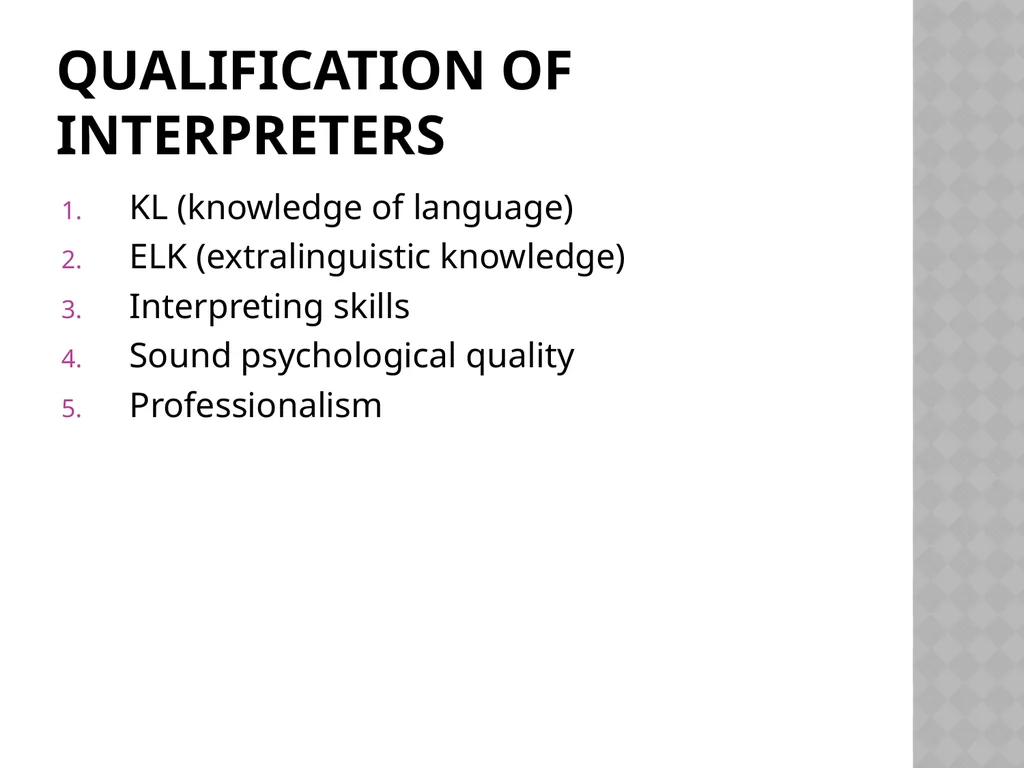
Qualification of interpreters KL (knowledge of language)
ELK (extralinguistic knowledge)
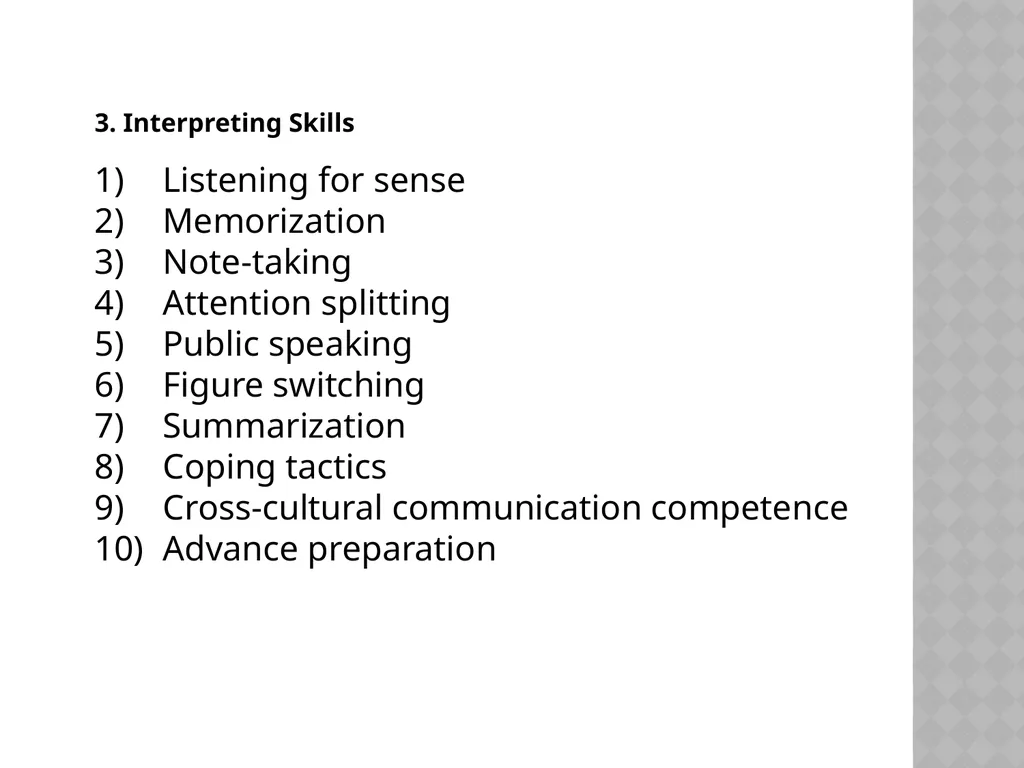
Interpreting skills
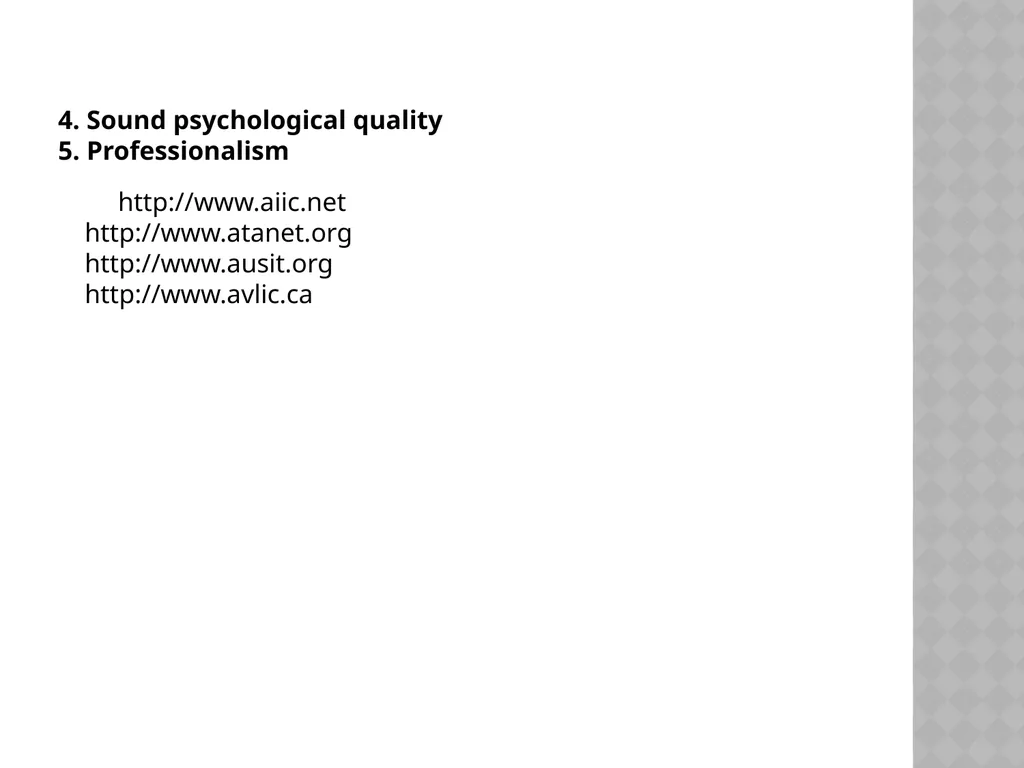
Sound psychological quality
Professionalism<br>
10
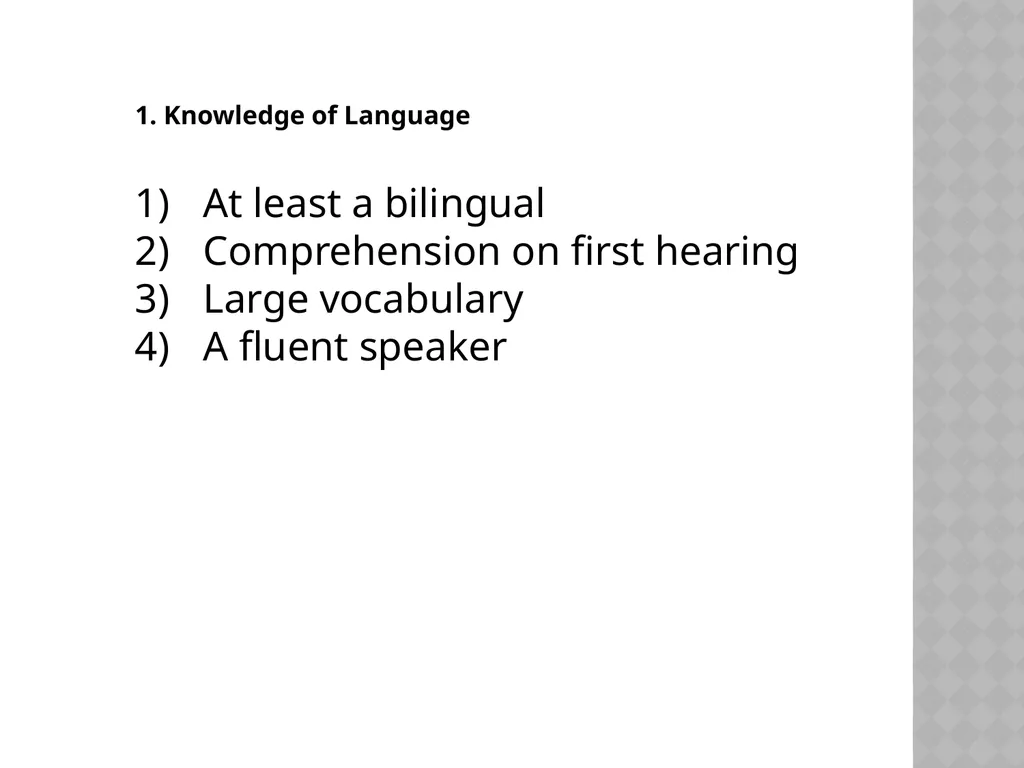
1. Knowledge of Language
At least a bilingual
Comprehension on first hearing
Large vocabulary
A fluent speaker<br>
11
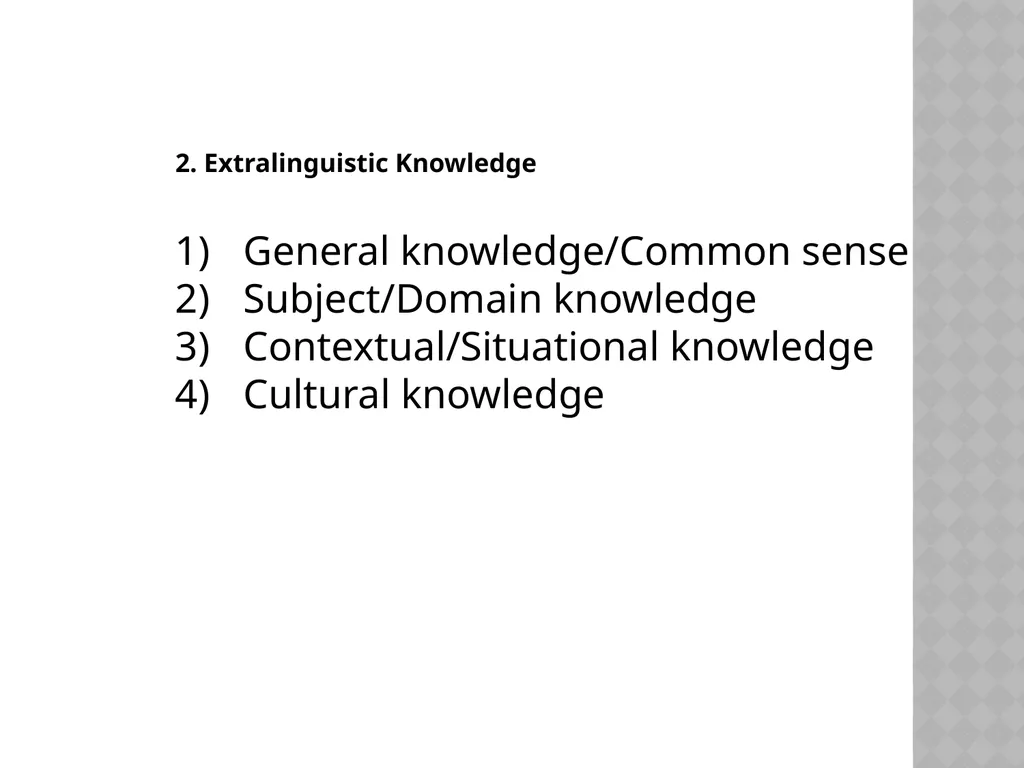
2. Extralinguistic Knowledge
General knowledge/Common sense
Subject/Domain knowledge
Contextual/Situational knowledge
Cultural knowledge<br>
12
3. Interpreting Skills
Listening for sense
Memorization
Note-taking
Attention splitting
Public speaking
Figure switching
Summarization
Coping tactics
Cross-cultural communication competence
Advance preparation<br>