
What is Psychoanalysis & What is Transference
PT
Published · 37 slides · 0 views
1 / 1




Description
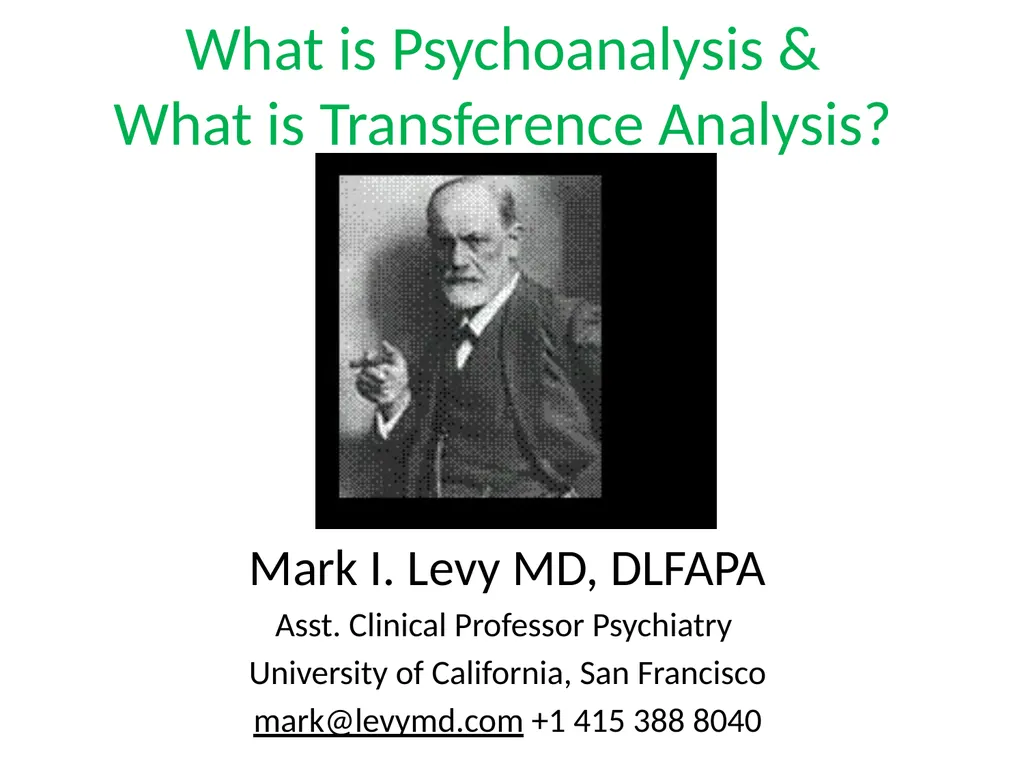
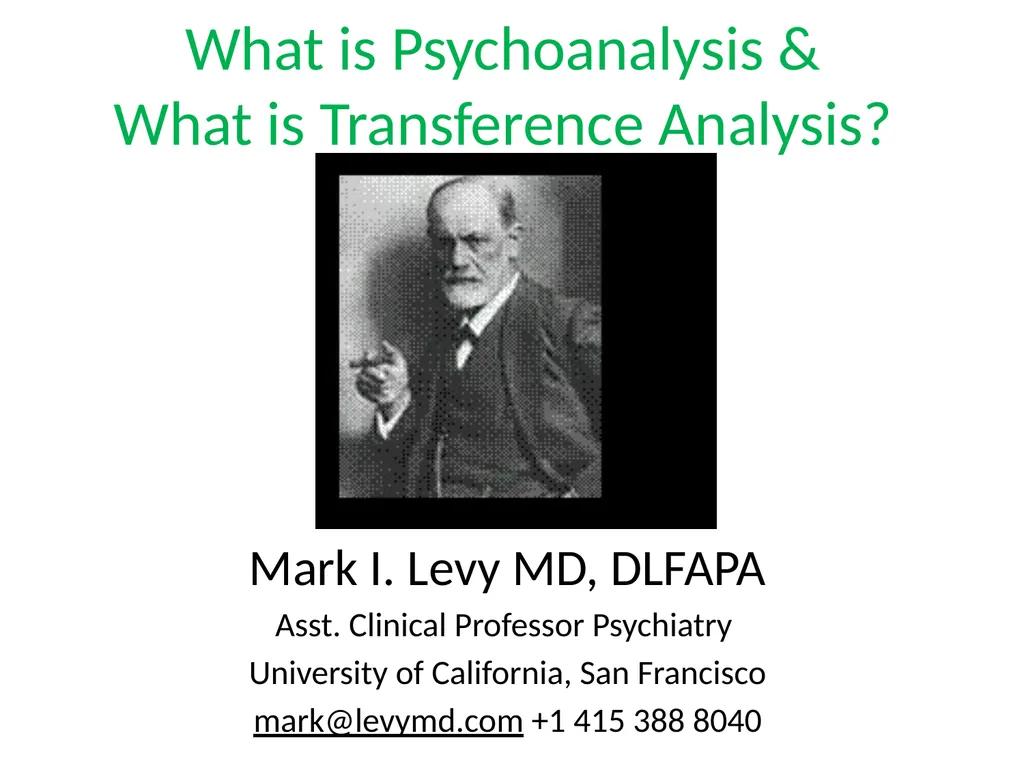
What is Psychoanalysis What is Transference Analysis? Mark I. Levy MD, DLFAPA Asst. Clinical Professor Psychiatry University of California, San Francisco marklevymd.com 1 415 388 8040 Key Points What is psychoanalysis? China is the
Related Topics
Share
Embed code
Download this presentation From Below
"What is Psychoanalysis & What is Transference" is the property of its rightful owner. Permission is granted to download and print the materials on this website for personal, non-commercial use only, and to display it on your personal computer provided you do not modify the materials and that you retain all copyright notices contained in the materials. By downloading content from our website, you accept the terms of this agreement.
Presentation Transcript
01
What is Psychoanalysis &
What is Transference Analysis? Mark I. Levy MD, DLFAPA
Asst. Clinical Professor Psychiatry
University of California, San Francisco
mark@levymd.com +1 415 388 8040<br>
Asst. Clinical Professor Psychiatry
University of California, San Francisco
mark@levymd.com +1 415 388 8040<br>
02
Key Points What is psychoanalysis?
China is the future.
Two languages, two men.
There is no psychoanalytic technique.
Psychoanalysis is like Jazz music.
Transference – historical issues.
Freud’s 3 great discoveries.
What is Transference?
What is Transferred?
What is primal, what is traumatic?
The role of culture.
Transference reactions: what they look like, what they are, how to use them.<br>
China is the future.
Two languages, two men.
There is no psychoanalytic technique.
Psychoanalysis is like Jazz music.
Transference – historical issues.
Freud’s 3 great discoveries.
What is Transference?
What is Transferred?
What is primal, what is traumatic?
The role of culture.
Transference reactions: what they look like, what they are, how to use them.<br>
03
What is Psychoanalysis? A Theory of Human Behavior
Universal
A Particular Type of Intensive Psychotherapy
Frequent Sessions, Free-Association, Lying on the Couch
Culturally Adapted
The Future of Psychoanalysis Will Be Shaped In China.<br>
Universal
A Particular Type of Intensive Psychotherapy
Frequent Sessions, Free-Association, Lying on the Couch
Culturally Adapted
The Future of Psychoanalysis Will Be Shaped In China.<br>
04
Psychoanalysis Travels Into The Future
In China<br>
05
“Two Languages,
Two Men”<br>
06
Psychoanalytic Technique There is no psychoanalytic technique.
2. We have only a theory of technique:
We ask the patient to free associate…and watch him fail.
We try to obey the “rule of abstinence”… and watch ourselves fail.
By understand both failures, the analytic process moves forward.<br>
2. We have only a theory of technique:
We ask the patient to free associate…and watch him fail.
We try to obey the “rule of abstinence”… and watch ourselves fail.
By understand both failures, the analytic process moves forward.<br>
07
Psychoanalysis = Jazz Music Structure
&
Improvisation
Discipline
&
Play<br>
&
Improvisation
Discipline
&
Play<br>
08
Transference Analysis
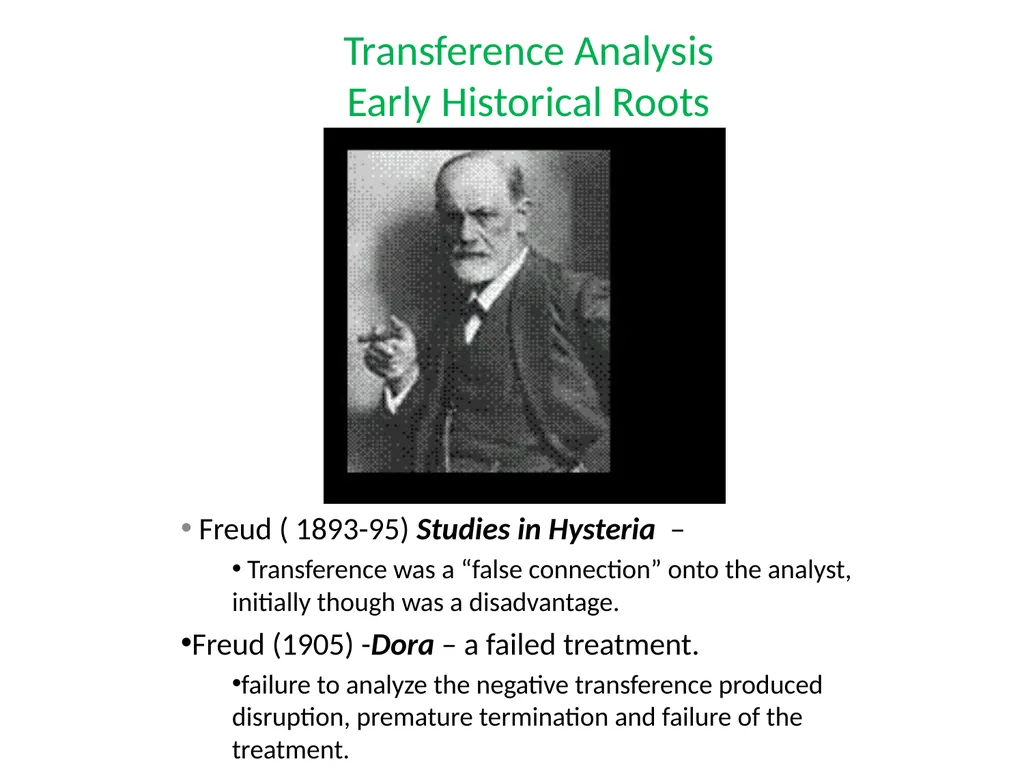
Early Historical Roots Freud ( 1893-95) Studies in Hysteria –
Transference was a “false connection” onto the analyst, initially though was a disadvantage.
Freud (1905) -Dora – a failed treatment.
failure to analyze the negative transference produced disruption, premature termination and failure of the treatment.<br>
Transference was a “false connection” onto the analyst, initially though was a disadvantage.
Freud (1905) -Dora – a failed treatment.
failure to analyze the negative transference produced disruption, premature termination and failure of the treatment.<br>
09
Transference Analysis
Early Historical Roots - bibliography Freud “The Dynamics of Transference” (1912)
Freud (1915) – “Observations of Transference Love”
Freud (1916-17) “Transference” and “Analytic Therapy” in Introductory Lectures
Freud (1920) Beyond the Pleasure Principal
Glover (1928)
Ella Freeman Sharpe’s (1930) technical papers
Freud (1937) Analysis Terminable or Interminable<br>
Freud (1915) – “Observations of Transference Love”
Freud (1916-17) “Transference” and “Analytic Therapy” in Introductory Lectures
Freud (1920) Beyond the Pleasure Principal
Glover (1928)
Ella Freeman Sharpe’s (1930) technical papers
Freud (1937) Analysis Terminable or Interminable<br>
10
Transference Analysis
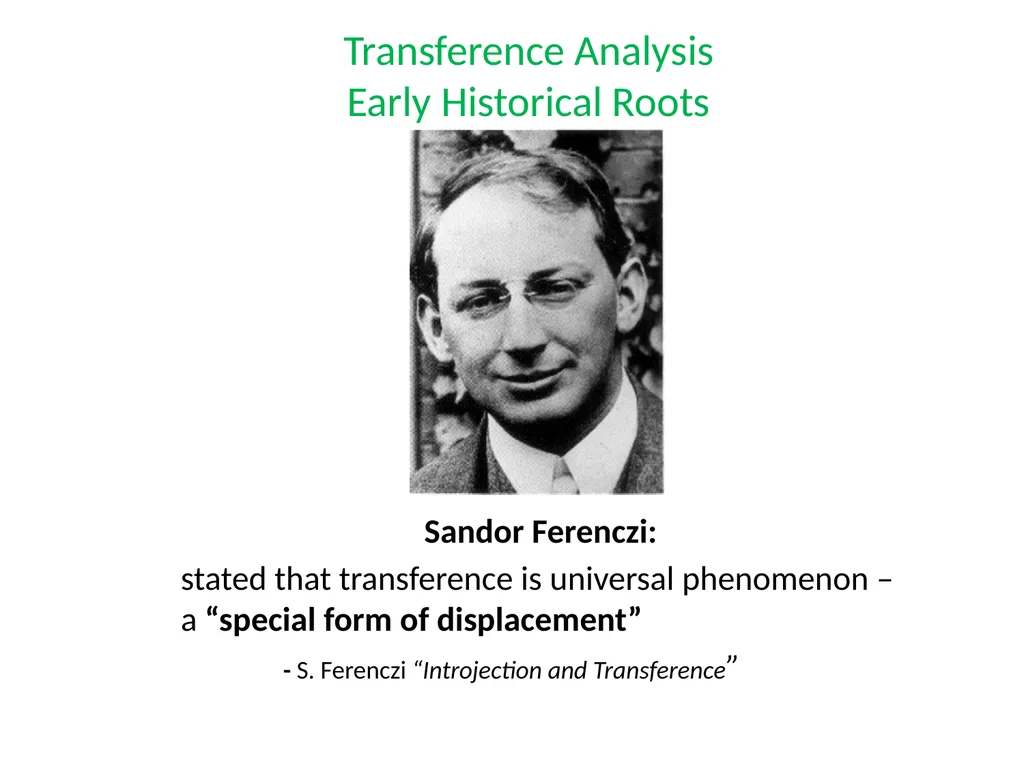
Early Historical Roots Sandor Ferenczi:
stated that transference is universal phenomenon – a “special form of displacement”
- S. Ferenczi “Introjection and Transference”<br>
stated that transference is universal phenomenon – a “special form of displacement”
- S. Ferenczi “Introjection and Transference”<br>
11
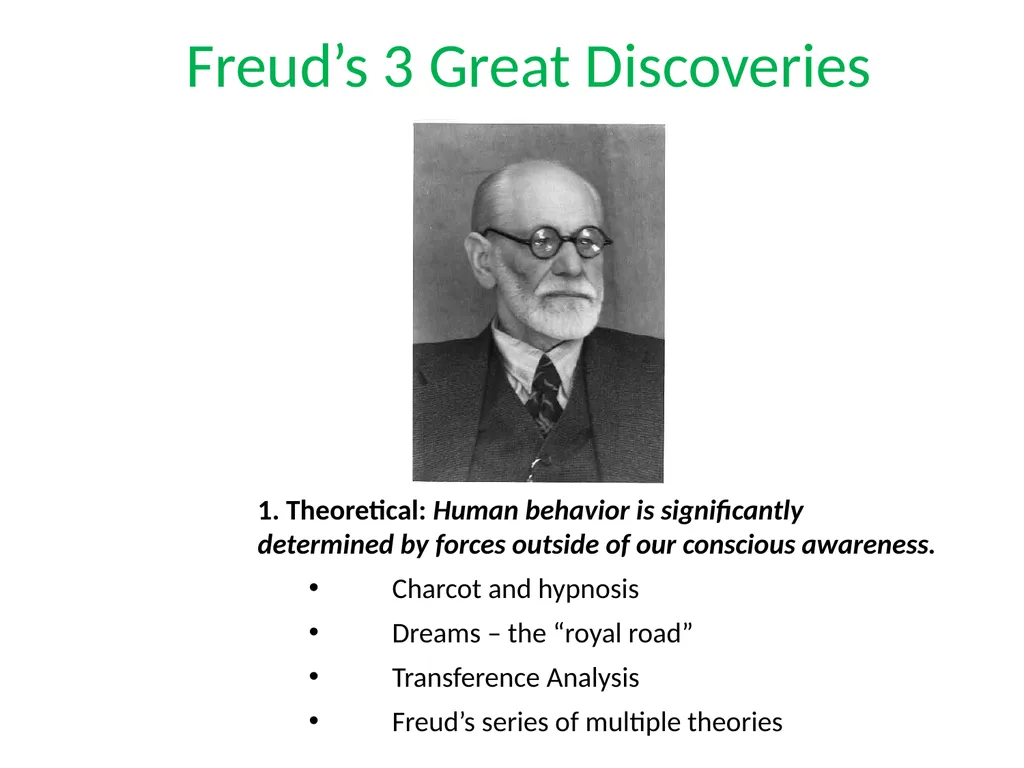
Freud’s 3 Great Discoveries 1. Theoretical: Human behavior is significantly determined by forces outside of our conscious awareness.
Charcot and hypnosis
Dreams – the “royal road”
Transference Analysis
Freud’s series of multiple theories<br>
Charcot and hypnosis
Dreams – the “royal road”
Transference Analysis
Freud’s series of multiple theories<br>
12
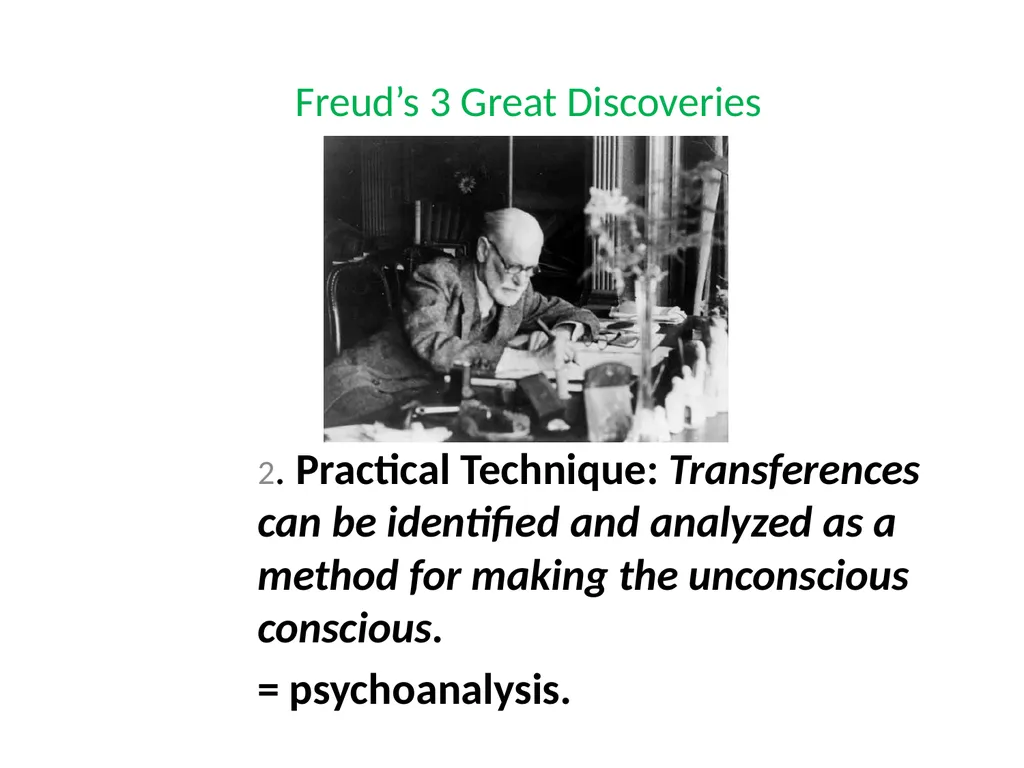
Freud’s 3 Great Discoveries 2. Practical Technique: Transferences can be identified and analyzed as a method for making the unconscious conscious.
= psychoanalysis.<br>
= psychoanalysis.<br>
13
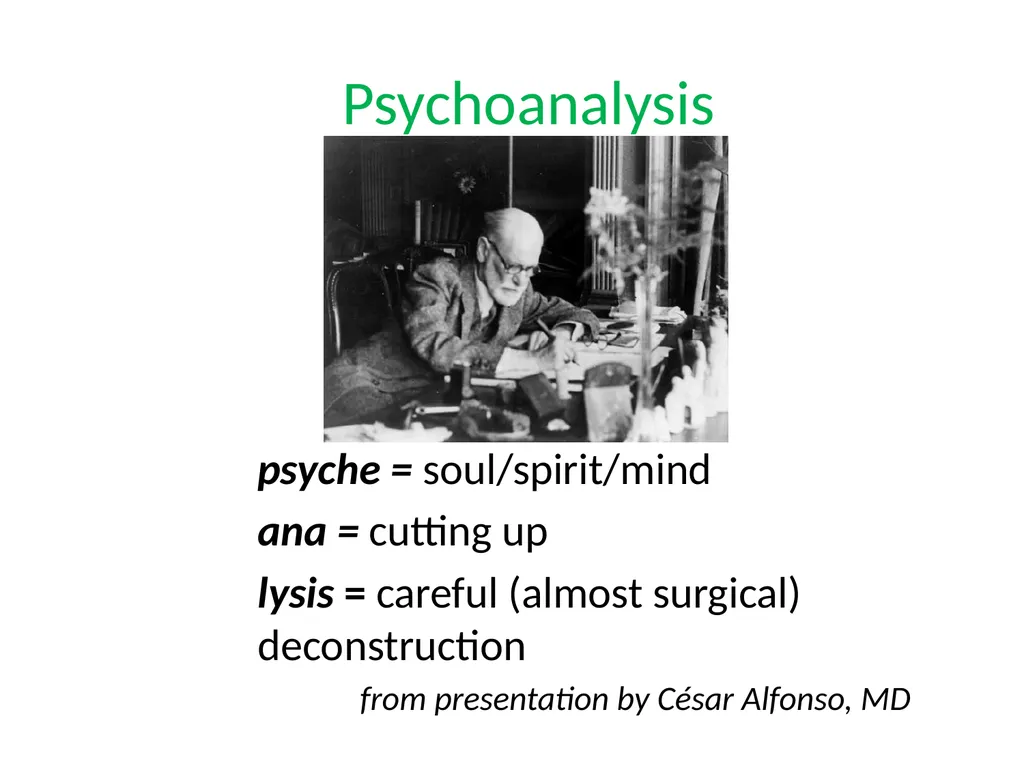
Psychoanalysis psyche = soul/spirit/mind
ana = cutting up
lysis = careful (almost surgical) deconstruction
from presentation by César Alfonso, MD<br>
ana = cutting up
lysis = careful (almost surgical) deconstruction
from presentation by César Alfonso, MD<br>
14
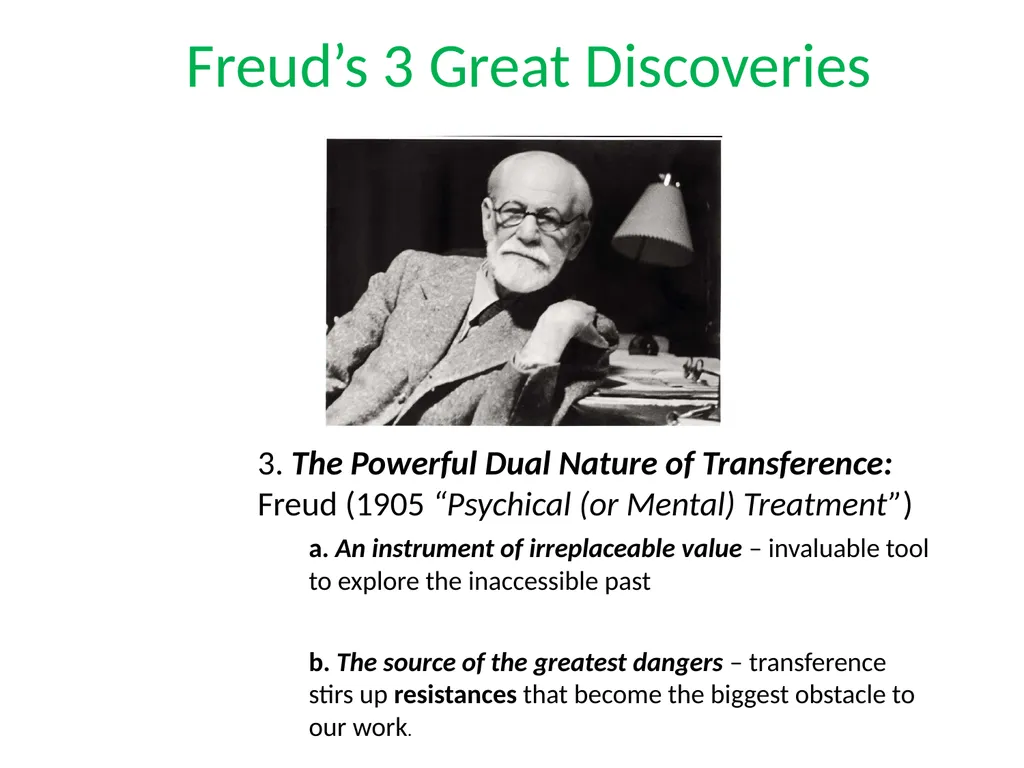
Freud’s 3 Great Discoveries 3. The Powerful Dual Nature of Transference: Freud (1905 “Psychical (or Mental) Treatment”)
a. An instrument of irreplaceable value – invaluable tool to explore the inaccessible past
b. The source of the greatest dangers – transference stirs up resistances that become the biggest obstacle to our work.<br>
a. An instrument of irreplaceable value – invaluable tool to explore the inaccessible past
b. The source of the greatest dangers – transference stirs up resistances that become the biggest obstacle to our work.<br>
15
Transference
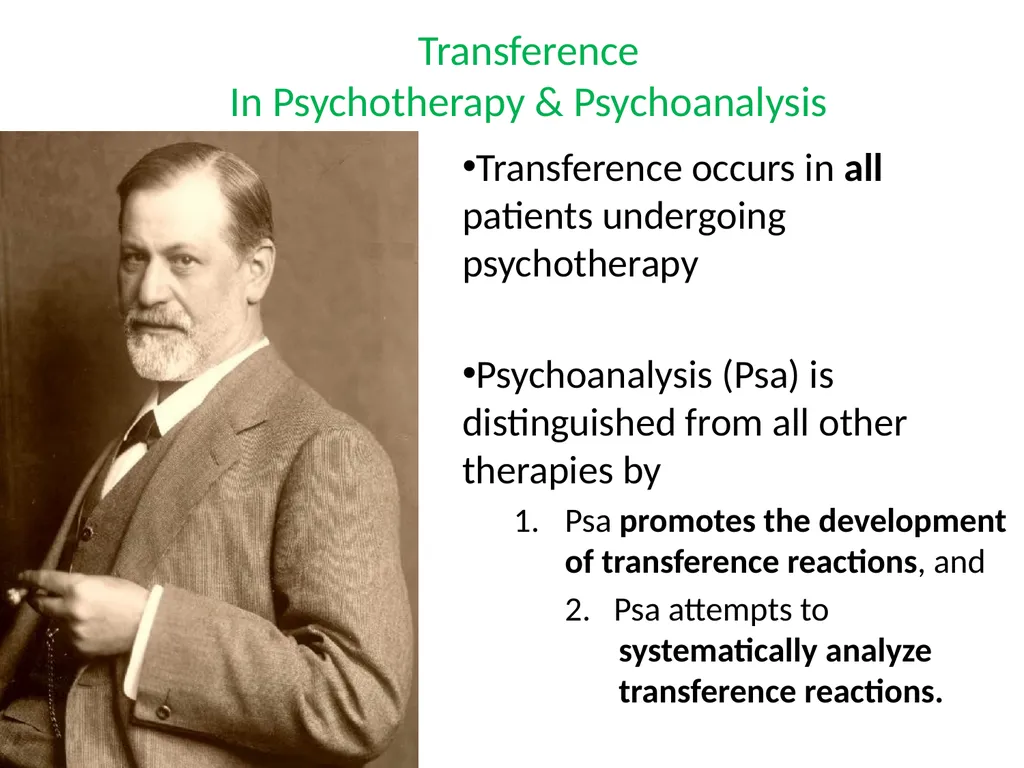
In Psychotherapy & Psychoanalysis Transference occurs in all patients undergoing psychotherapy
Psychoanalysis (Psa) is distinguished from all other therapies by
Psa promotes the development of transference reactions, and
2. Psa attempts to systematically analyze transference reactions.<br>
Psychoanalysis (Psa) is distinguished from all other therapies by
Psa promotes the development of transference reactions, and
2. Psa attempts to systematically analyze transference reactions.<br>
16
What is Transference? Transference – a universal interpersonal phenomenon
Transference Reactions:
erotic and aggressive impulses unconsciously displaced onto the analyst.
past primary relationships, repeated within the analytic relationship
purpose:
to obtain satisfaction not previously experienced, or
to belatedly master guilt or anxiety.
– Ralph Greenson –Technique and Practice of Psychoanalysis<br>
Transference Reactions:
erotic and aggressive impulses unconsciously displaced onto the analyst.
past primary relationships, repeated within the analytic relationship
purpose:
to obtain satisfaction not previously experienced, or
to belatedly master guilt or anxiety.
– Ralph Greenson –Technique and Practice of Psychoanalysis<br>
17
Summary:
What is Transference? A reliving of the past.
A misunderstanding the present, in terms of the past.<br>
A misunderstanding the present, in terms of the past.<br>
18
Transference Reaction:
Clinical Example A 35 year old educated, cultured woman, became tearful when kept waiting by the therapist for several minutes, fantasying that the therapist must have been giving extra time to his favorite woman patient.
Her associations led to a past situation when as a child of 5, she always had to wait several minutes for her father to kiss her good night, because he made it a rule to kiss her younger sister good night first. Then, she reacted with tears, anger and jealousy fantasies – precisely what she experienced in the present with her therapist.
Her reactions were appropriate for a 5 year old but not for a 35 year old cultured woman. The key to understanding this behavior was recognizing that it was a repetition of the past, a transference reaction.<br>
Her associations led to a past situation when as a child of 5, she always had to wait several minutes for her father to kiss her good night, because he made it a rule to kiss her younger sister good night first. Then, she reacted with tears, anger and jealousy fantasies – precisely what she experienced in the present with her therapist.
Her reactions were appropriate for a 5 year old but not for a 35 year old cultured woman. The key to understanding this behavior was recognizing that it was a repetition of the past, a transference reaction.<br>
19
What is Transferred? A version of past that is inappropriate to the present reality.
Past and repressed trauma, i.e. “forgotten.”
Psychoanalysis facilitates the process of remembering.
- S. Freud, Remembering, Repeating & Working Though (1914)
cathartic technique yielded to associative technique<br>
Past and repressed trauma, i.e. “forgotten.”
Psychoanalysis facilitates the process of remembering.
- S. Freud, Remembering, Repeating & Working Though (1914)
cathartic technique yielded to associative technique<br>
20
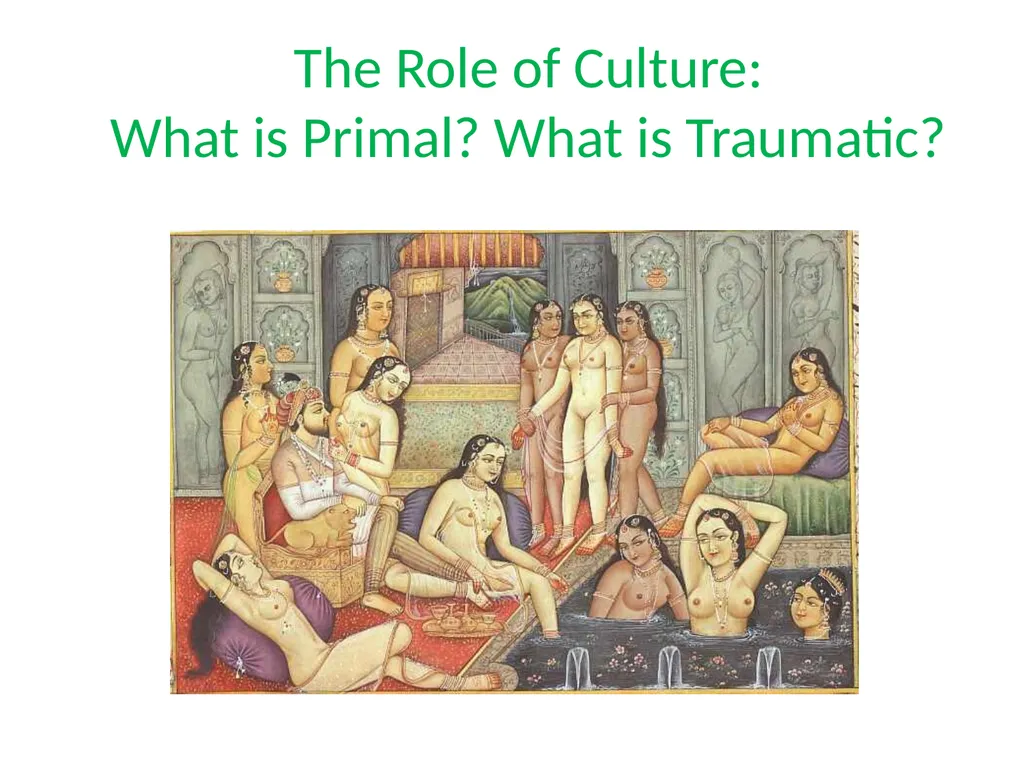
The Role of Culture:
What is Primal? What is Traumatic?<br>
21
The Role of Culture:
Sleeping Alone<br>
22
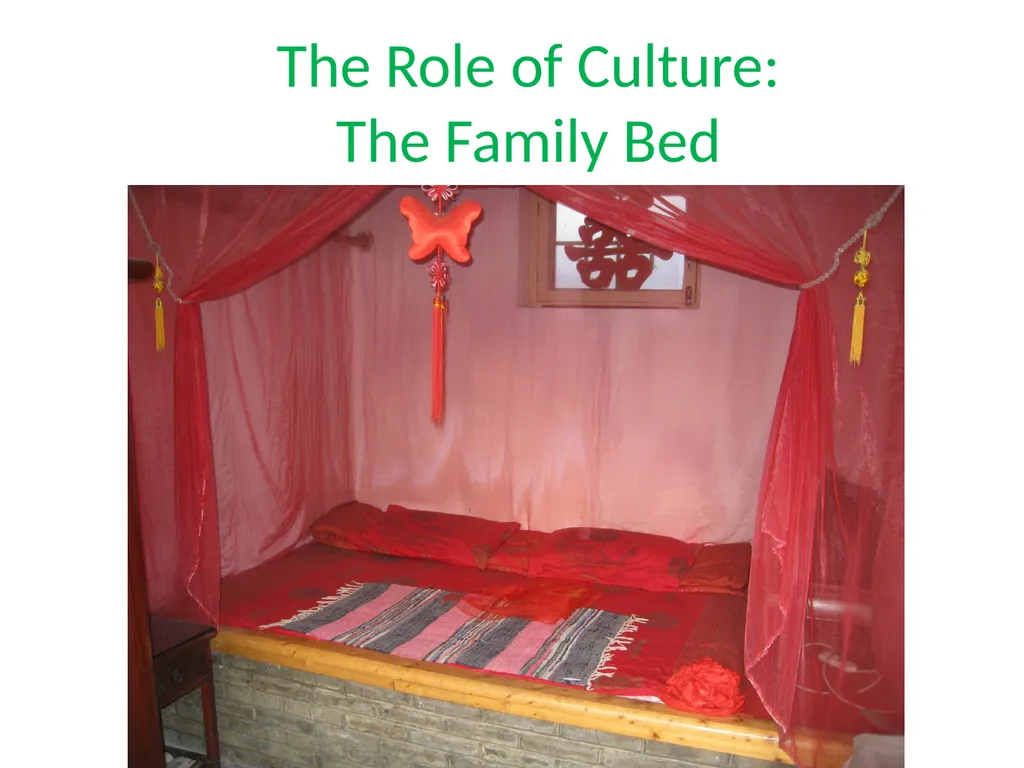
The Role of Culture:
The Family Bed<br>
23
The Role of Culture:
The Family Bed<br>
24
Transference Reactions: What they look like, what they are, how we use them
Neurotic patients are prone to transference reactions.
One of the most valuable sources of material for analysis.
One of the greatest motivations for analysis.
One of the greatest obstacles to analytic success.
If properly handled, the patient will with the psychoanalyst, experience all the significant human relations of his past which are not consciously accessible to him. (S.Freud, 1912, “The Dynamic of Transference”)<br>
Neurotic patients are prone to transference reactions.
One of the most valuable sources of material for analysis.
One of the greatest motivations for analysis.
One of the greatest obstacles to analytic success.
If properly handled, the patient will with the psychoanalyst, experience all the significant human relations of his past which are not consciously accessible to him. (S.Freud, 1912, “The Dynamic of Transference”)<br>
25
Transference
& The Analytic Situation Contributing technical factors in the analytic situation that encourage maximal development of transference:
Lying on the couch.
The analyst’s non-gratifying attitude
The analyst’s relative incognito
Transference analysis helps the patient endure the various, intense transference feelings.<br>
Lying on the couch.
The analyst’s non-gratifying attitude
The analyst’s relative incognito
Transference analysis helps the patient endure the various, intense transference feelings.<br>
26
Transference Resistance Patient may work hard at the beginning of analysis in part to gain favor with the analyst.
Non-gratification by the analyst may feel to the patient like rejection producing angry feelings towards the analyst.
How effectively the psychoanalyst analyzes the transference will determine the duration of transference resistances.<br>
Non-gratification by the analyst may feel to the patient like rejection producing angry feelings towards the analyst.
How effectively the psychoanalyst analyzes the transference will determine the duration of transference resistances.<br>
27
“Therapeutic Relationship”
or “Working Alliance” “
Freud: non-problematic positive transference.
Includes relatively non-neurotic, rational and realistic patient attitudes towards the analyst.
Is part of the patient-analyst (or real) relationship.
Patient identifies with the analyst’s point of view & collaborates with the analyst, despite neurotic transference reactions.<br>
Freud: non-problematic positive transference.
Includes relatively non-neurotic, rational and realistic patient attitudes towards the analyst.
Is part of the patient-analyst (or real) relationship.
Patient identifies with the analyst’s point of view & collaborates with the analyst, despite neurotic transference reactions.<br>
28
Goal of Transference Analysis To enable the patient to face what he once repressed from consciousness, because it was too dangerous, too shameful and too frightening.
Eventually he will risk attempting new ways to deal with old dangers.<br>
Eventually he will risk attempting new ways to deal with old dangers.<br>
29
Goal of Transference Analysis: Working Through =
Psychological work after insight has been achieved
Produces stable change in behavior or attitude
Involves the integration of insight leading to re-orientation<br>
Psychological work after insight has been achieved
Produces stable change in behavior or attitude
Involves the integration of insight leading to re-orientation<br>
30
Goal of Transference Analysis: All psychotherapies try to relieve symptoms;
Only psychoanalysis attempts to do this by resolving the unconscious conflicts which are the source of the symptoms.
The goal of psychoanalysis is permanent change through developing insight into previously unconscious conflicts.<br>
Only psychoanalysis attempts to do this by resolving the unconscious conflicts which are the source of the symptoms.
The goal of psychoanalysis is permanent change through developing insight into previously unconscious conflicts.<br>
31
General Characteristics of Transference Reactions: Inappropriateness
Intensity
Ambivalence
Capriciousness
Tenacity<br>
Intensity
Ambivalence
Capriciousness
Tenacity<br>
32
General Characteristics of Transference Reactions: Inappropriateness:
Not all reactions to the analyst are transference reactions.
Anger at the analyst alone does not clarify whether it is appropriate and realistic, or a transference reaction.
e.g. a patient becomes annoyed at my answering the telephone. A mature realistic response. Patient’s anger is not to be ignore but should be handled differently from the handling of transference<br>
Not all reactions to the analyst are transference reactions.
Anger at the analyst alone does not clarify whether it is appropriate and realistic, or a transference reaction.
e.g. a patient becomes annoyed at my answering the telephone. A mature realistic response. Patient’s anger is not to be ignore but should be handled differently from the handling of transference<br>
33
General Characteristics of Transference Reactions: Inappropriateness:
The patient becomes furious, not just annoyed, OR remains indifferent.
E.g. phone rings repeatedly, Therapist finally answers thinking it is an emergency. Turns out to be a wrong number. Patient carries on talking as though nothing has occurred. Therapist brings the omission to patient’s attention who says “How am I supposed to feel - it wasn’t your fault.” Patient tries to return to earlier conversation but sounds stilted. Therapist suggests that patient seems to be trying to cover up some of his emotional reactions by acting “the way he thinks that he is supposed to.” Patient recalls a momentary flash of anger when therapist answered the phone. Followed by a picture of therapist shouting at him angrily. Recalls a host of memories of being forced as a child to submit to lectures about how he was “supposed to” behave. Therapist interprets to patient that he reacted to therapist as if he were his father.<br>
The patient becomes furious, not just annoyed, OR remains indifferent.
E.g. phone rings repeatedly, Therapist finally answers thinking it is an emergency. Turns out to be a wrong number. Patient carries on talking as though nothing has occurred. Therapist brings the omission to patient’s attention who says “How am I supposed to feel - it wasn’t your fault.” Patient tries to return to earlier conversation but sounds stilted. Therapist suggests that patient seems to be trying to cover up some of his emotional reactions by acting “the way he thinks that he is supposed to.” Patient recalls a momentary flash of anger when therapist answered the phone. Followed by a picture of therapist shouting at him angrily. Recalls a host of memories of being forced as a child to submit to lectures about how he was “supposed to” behave. Therapist interprets to patient that he reacted to therapist as if he were his father.<br>
34
General Characteristics of Transference Reactions: Intensity:
Intense emotional reactions to the therapist are usually transference reactions.
Ambivalence:
All transference reactions are characterized by ambivalence.
No love for therapist without hate, no sexual attraction without repulsion.
“Splitting” occurs with Borderline patients<br>
Intense emotional reactions to the therapist are usually transference reactions.
Ambivalence:
All transference reactions are characterized by ambivalence.
No love for therapist without hate, no sexual attraction without repulsion.
“Splitting” occurs with Borderline patients<br>
35
General Characteristics of Transference Reactions: Capriciousness:
Inconstant, erratic, whimsical, sudden and unexpected
Tenacity:
Prolonged , rigid attitudes towards the therapist.
Unlikely to appear early in analysis, more likely towards the end.
Requires a long period of analysis.
Does not necessarily imply a stalemate.<br>
Inconstant, erratic, whimsical, sudden and unexpected
Tenacity:
Prolonged , rigid attitudes towards the therapist.
Unlikely to appear early in analysis, more likely towards the end.
Requires a long period of analysis.
Does not necessarily imply a stalemate.<br>
36
“You’ve Changed!”
by Dexter Gordon<br>
37
Key Points We’ve Discussed What is psychoanalysis?
China is the future.
Two languages, two men.
There is no psychoanalytic technique.
Psychoanalysis is like Jazz music.
Transference – historical issues.
Freud’s 3 great discoveries.
What is Transference?
What is Transferred?
What is primal, what is traumatic?
The role of culture.
Transference reactions: what they look like, what they are, how to use them.<br>
China is the future.
Two languages, two men.
There is no psychoanalytic technique.
Psychoanalysis is like Jazz music.
Transference – historical issues.
Freud’s 3 great discoveries.
What is Transference?
What is Transferred?
What is primal, what is traumatic?
The role of culture.
Transference reactions: what they look like, what they are, how to use them.<br>