
What is REF? All Staff Open Sessions – April 2019
GB
Published · 30 slides · 0 views

1 / 1



Description
What is REF? All Staff Open Sessions April 2019 Professor Neil Gow, DVC RI What is REF? Research Excellence Framework: a national assessment of research at UK universities by discipline The universitys allocation of Quality-Related
Related Topics
Share
Embed code
Download this presentation From Below
"What is REF? All Staff Open Sessions – April 2019" is the property of its rightful owner. Permission is granted to download and print the materials on this website for personal, non-commercial use only, and to display it on your personal computer provided you do not modify the materials and that you retain all copyright notices contained in the materials. By downloading content from our website, you accept the terms of this agreement.
Presentation Transcript
01
What is REF?
All Staff Open Sessions – April 2019
Professor Neil Gow, DVC R&I<br>
All Staff Open Sessions – April 2019
Professor Neil Gow, DVC R&I<br>
02
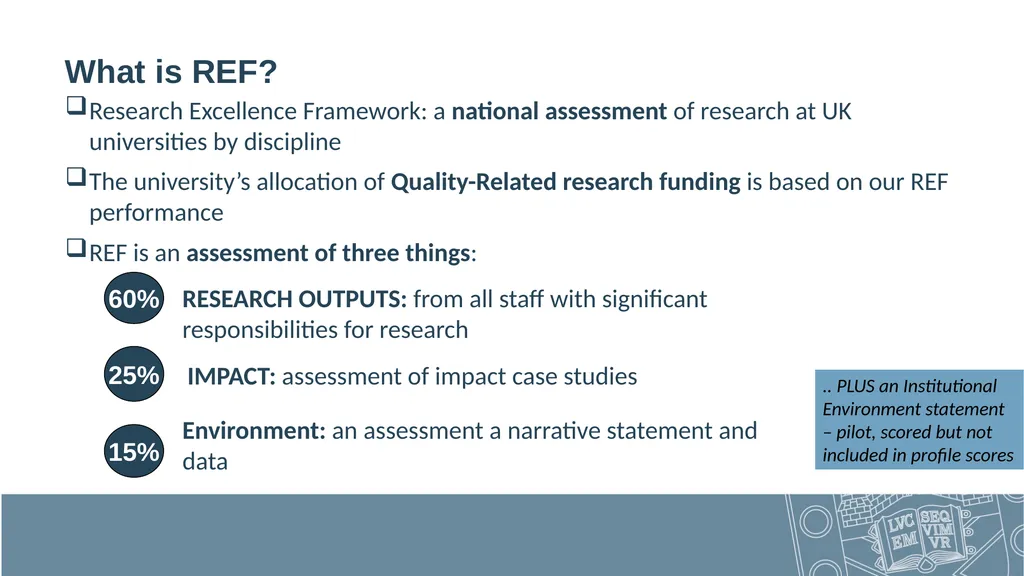
What is REF? Research Excellence Framework: a national assessment of research at UK universities by discipline
The university’s allocation of Quality-Related research funding is based on our REF performance
REF is an assessment of three things: 60% 25% 15% RESEARCH OUTPUTS: from all staff with significant responsibilities for research IMPACT: assessment of impact case studies Environment: an assessment a narrative statement and data .. PLUS an Institutional Environment statement – pilot, scored but not included in profile scores<br>
The university’s allocation of Quality-Related research funding is based on our REF performance
REF is an assessment of three things: 60% 25% 15% RESEARCH OUTPUTS: from all staff with significant responsibilities for research IMPACT: assessment of impact case studies Environment: an assessment a narrative statement and data .. PLUS an Institutional Environment statement – pilot, scored but not included in profile scores<br>
03
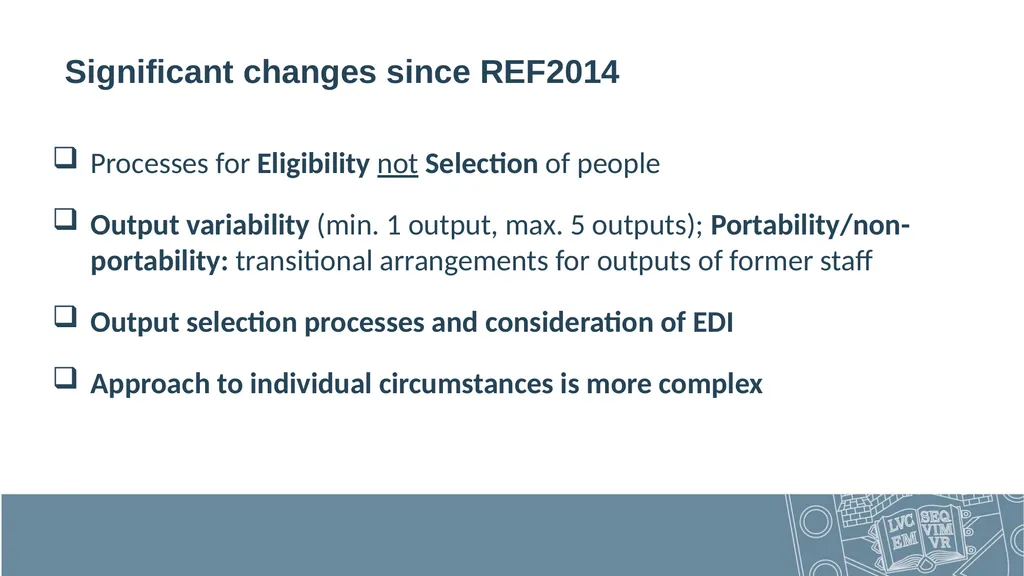
Significant changes since REF2014 Processes for Eligibility not Selection of people
Output variability (min. 1 output, max. 5 outputs); Portability/non-portability: transitional arrangements for outputs of former staff
Output selection processes and consideration of EDI
Approach to individual circumstances is more complex<br>
Output variability (min. 1 output, max. 5 outputs); Portability/non-portability: transitional arrangements for outputs of former staff
Output selection processes and consideration of EDI
Approach to individual circumstances is more complex<br>
04
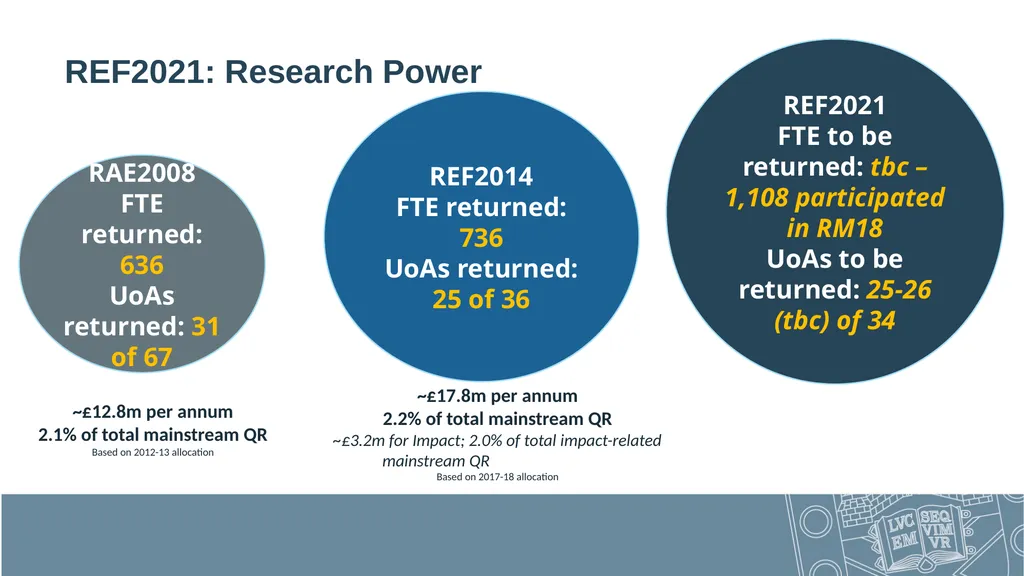
REF2021: Research Power RAE2008
FTE returned: 636
UoAs returned: 31 of 67 REF2014
FTE returned: 736
UoAs returned: 25 of 36 REF2021
FTE to be returned: tbc – 1,108 participated in RM18
UoAs to be returned: 25-26 (tbc) of 34 ~£12.8m per annum
2.1% of total mainstream QR
Based on 2012-13 allocation ~£17.8m per annum
2.2% of total mainstream QR
~£3.2m for Impact; 2.0% of total impact-related mainstream QR
Based on 2017-18 allocation<br>
FTE returned: 636
UoAs returned: 31 of 67 REF2014
FTE returned: 736
UoAs returned: 25 of 36 REF2021
FTE to be returned: tbc – 1,108 participated in RM18
UoAs to be returned: 25-26 (tbc) of 34 ~£12.8m per annum
2.1% of total mainstream QR
Based on 2012-13 allocation ~£17.8m per annum
2.2% of total mainstream QR
~£3.2m for Impact; 2.0% of total impact-related mainstream QR
Based on 2017-18 allocation<br>
05
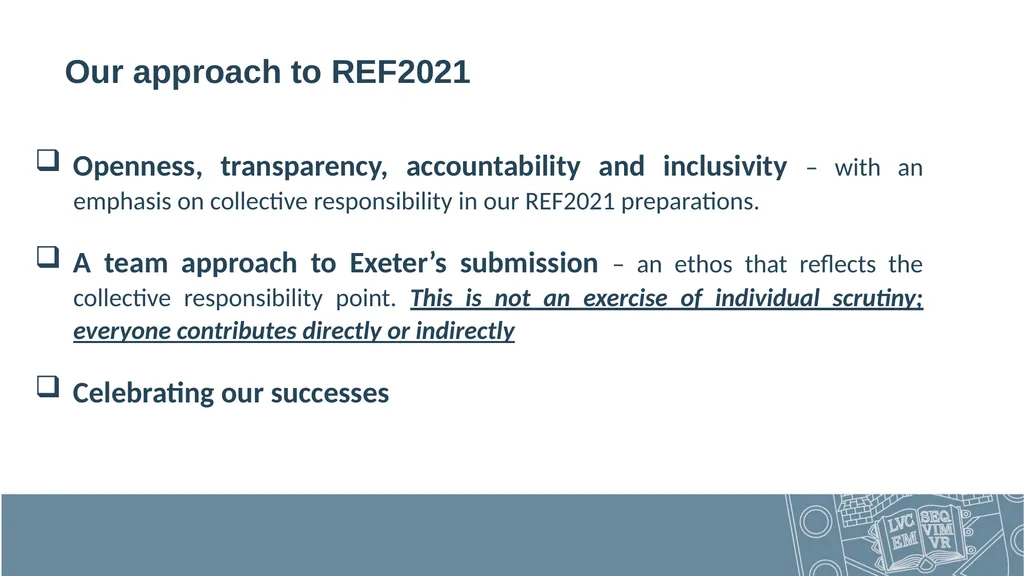
Our approach to REF2021 Openness, transparency, accountability and inclusivity – with an emphasis on collective responsibility in our REF2021 preparations.
A team approach to Exeter’s submission – an ethos that reflects the collective responsibility point. This is not an exercise of individual scrutiny; everyone contributes directly or indirectly
Celebrating our successes<br>
A team approach to Exeter’s submission – an ethos that reflects the collective responsibility point. This is not an exercise of individual scrutiny; everyone contributes directly or indirectly
Celebrating our successes<br>
06
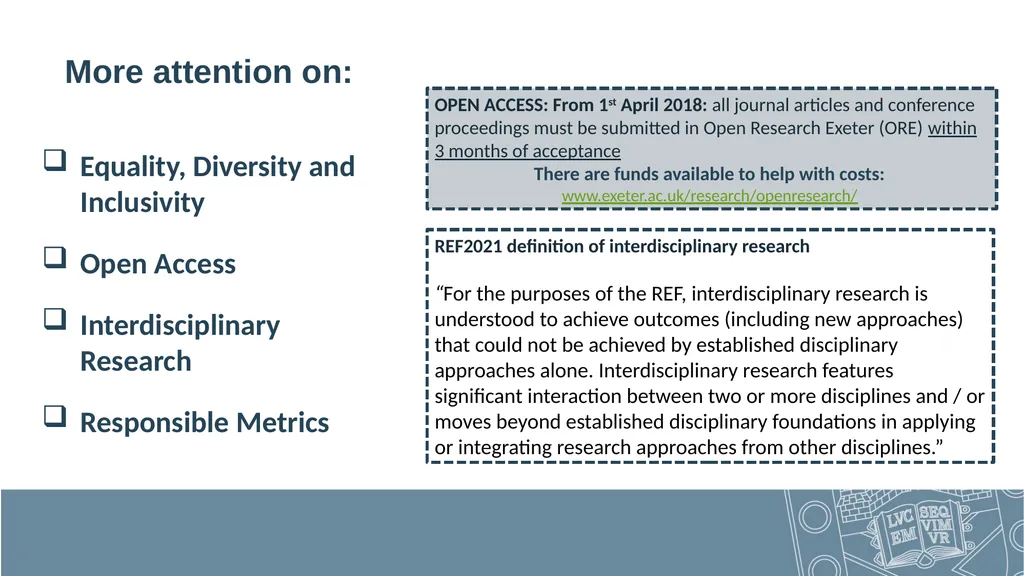
More attention on: Equality, Diversity and Inclusivity
Open Access
Interdisciplinary Research
Responsible Metrics OPEN ACCESS: From 1st April 2018: all journal articles and conference proceedings must be submitted in Open Research Exeter (ORE) within 3 months of acceptance
There are funds available to help with costs: www.exeter.ac.uk/research/openresearch/ REF2021 definition of interdisciplinary research
“For the purposes of the REF, interdisciplinary research is understood to achieve outcomes (including new approaches) that could not be achieved by established disciplinary approaches alone. Interdisciplinary research features significant interaction between two or more disciplines and / or moves beyond established disciplinary foundations in applying or integrating research approaches from other disciplines.”<br>
Open Access
Interdisciplinary Research
Responsible Metrics OPEN ACCESS: From 1st April 2018: all journal articles and conference proceedings must be submitted in Open Research Exeter (ORE) within 3 months of acceptance
There are funds available to help with costs: www.exeter.ac.uk/research/openresearch/ REF2021 definition of interdisciplinary research
“For the purposes of the REF, interdisciplinary research is understood to achieve outcomes (including new approaches) that could not be achieved by established disciplinary approaches alone. Interdisciplinary research features significant interaction between two or more disciplines and / or moves beyond established disciplinary foundations in applying or integrating research approaches from other disciplines.”<br>
07
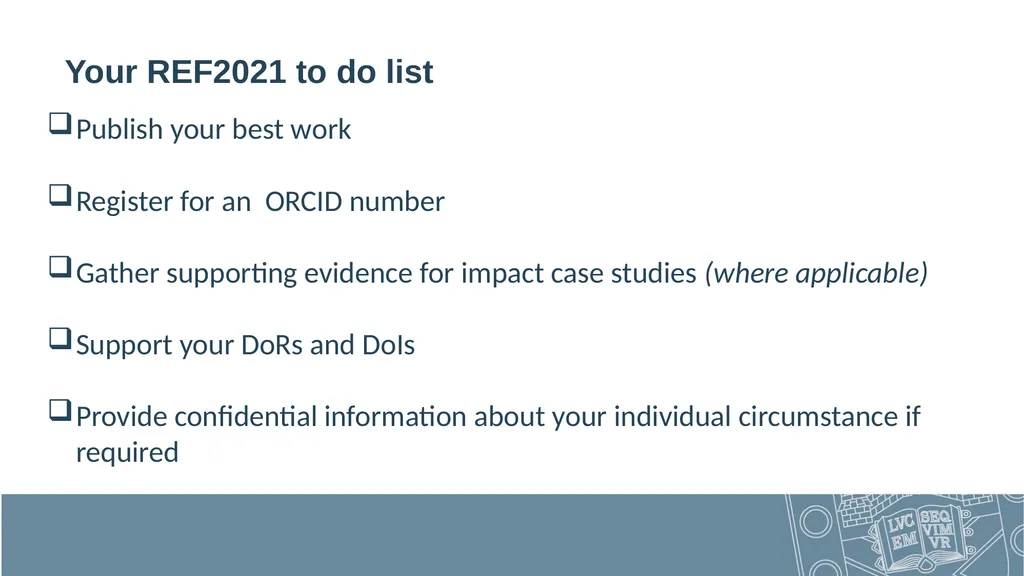
Your REF2021 to do list Publish your best work
Register for an ORCID number
Gather supporting evidence for impact case studies (where applicable)
Support your DoRs and DoIs
Provide confidential information about your individual circumstance if required<br>
Register for an ORCID number
Gather supporting evidence for impact case studies (where applicable)
Support your DoRs and DoIs
Provide confidential information about your individual circumstance if required<br>
08
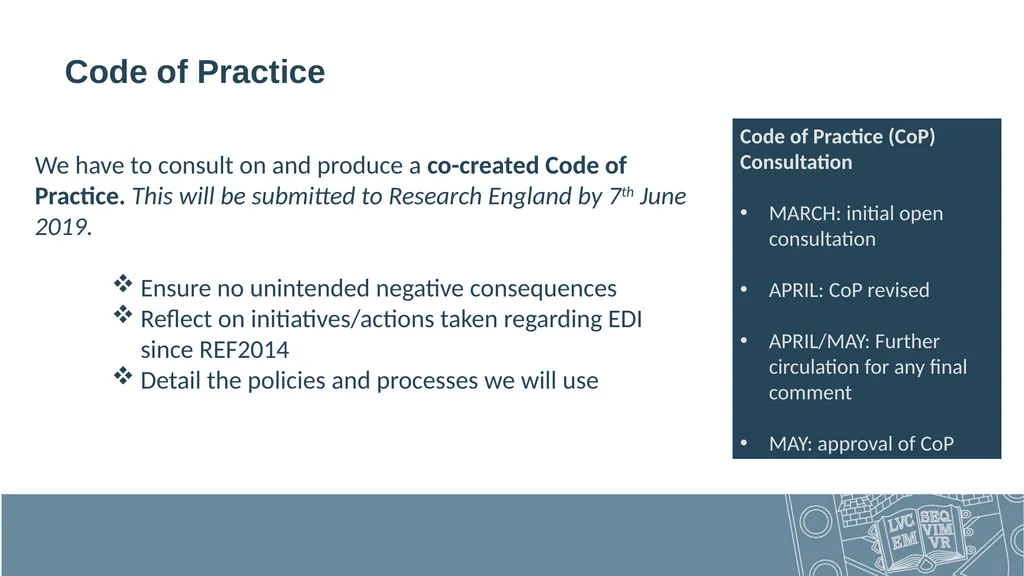
Code of Practice We have to consult on and produce a co-created Code of Practice. This will be submitted to Research England by 7th June 2019.
Ensure no unintended negative consequences
Reflect on initiatives/actions taken regarding EDI since REF2014
Detail the policies and processes we will use Code of Practice (CoP) Consultation
MARCH: initial open consultation
APRIL: CoP revised
APRIL/MAY: Further circulation for any final comment
MAY: approval of CoP<br>
Ensure no unintended negative consequences
Reflect on initiatives/actions taken regarding EDI since REF2014
Detail the policies and processes we will use Code of Practice (CoP) Consultation
MARCH: initial open consultation
APRIL: CoP revised
APRIL/MAY: Further circulation for any final comment
MAY: approval of CoP<br>
09
STAFF ELIGIBILITY Code of Practice – policies and processes<br>
10
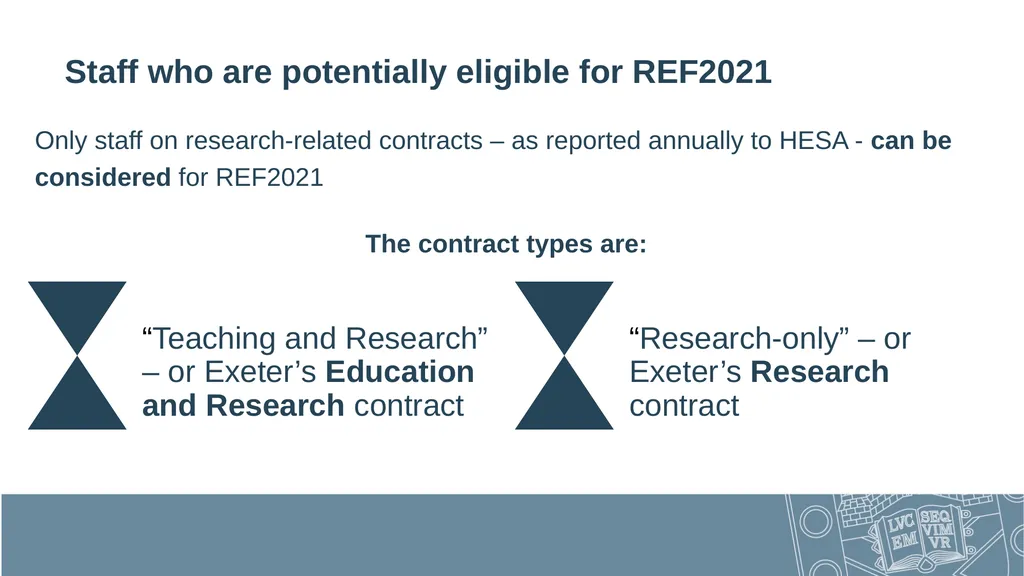
Staff who are potentially eligible for REF2021 Only staff on research-related contracts – as reported annually to HESA - can be considered for REF2021 The contract types are:<br>
11
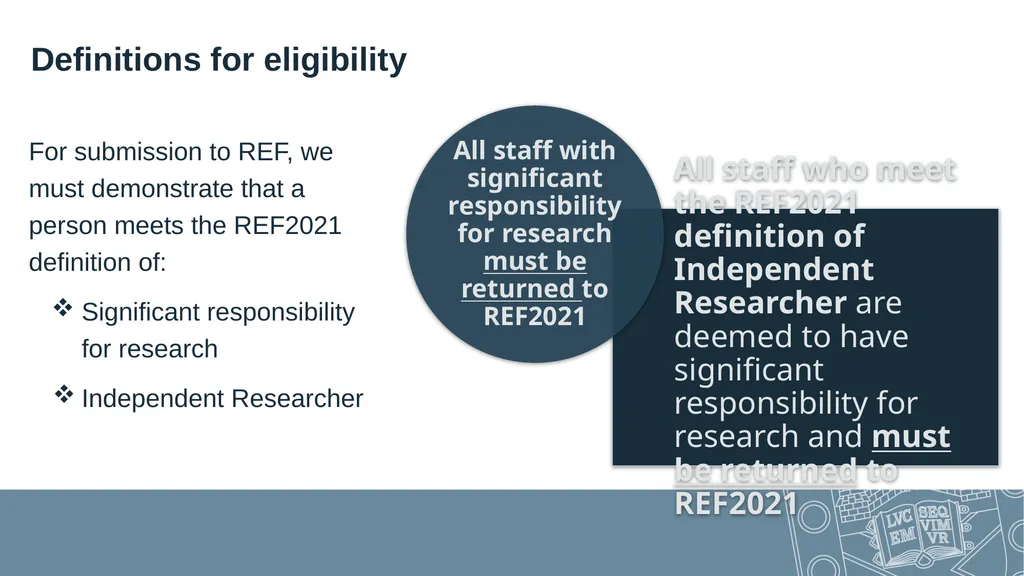
Definitions for eligibility For submission to REF, we must demonstrate that a person meets the REF2021 definition of:
Significant responsibility for research
Independent Researcher<br>
Significant responsibility for research
Independent Researcher<br>
12
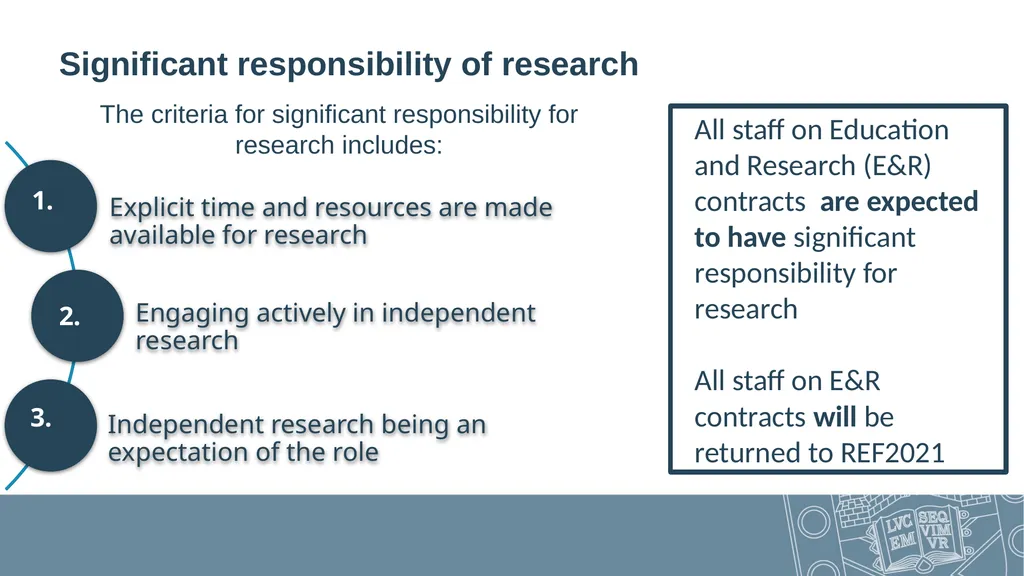
Significant responsibility of research All staff on Education and Research (E&R) contracts are expected to have significant responsibility for research
All staff on E&R contracts will be returned to REF2021 The criteria for significant responsibility for research includes: 1. 2. 3.<br>
All staff on E&R contracts will be returned to REF2021 The criteria for significant responsibility for research includes: 1. 2. 3.<br>
13
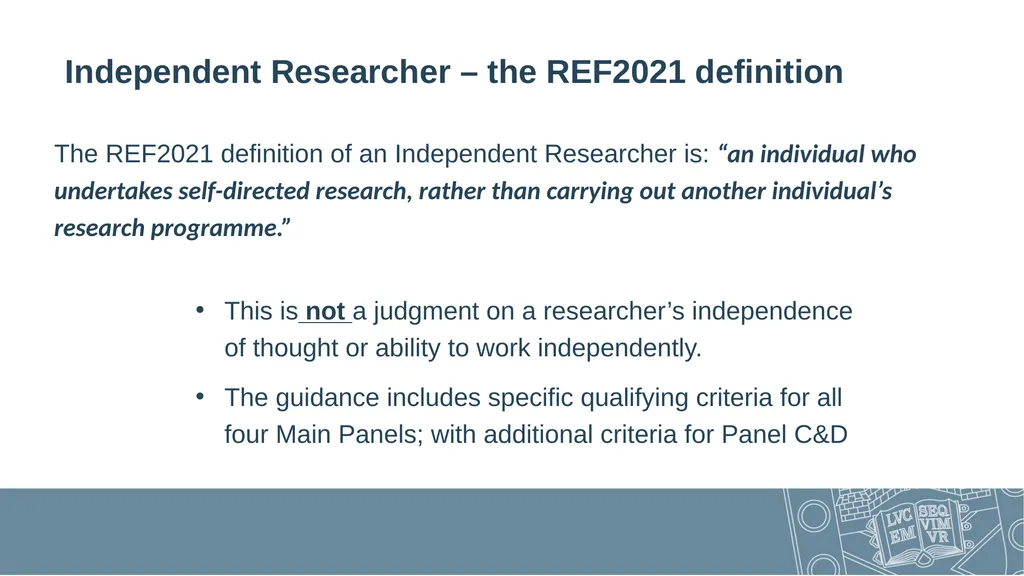
Independent Researcher – the REF2021 definition The REF2021 definition of an Independent Researcher is: “an individual who undertakes self-directed research, rather than carrying out another individual’s research programme.” This is not a judgment on a researcher’s independence of thought or ability to work independently.
The guidance includes specific qualifying criteria for all four Main Panels; with additional criteria for Panel C&D<br>
The guidance includes specific qualifying criteria for all four Main Panels; with additional criteria for Panel C&D<br>
14
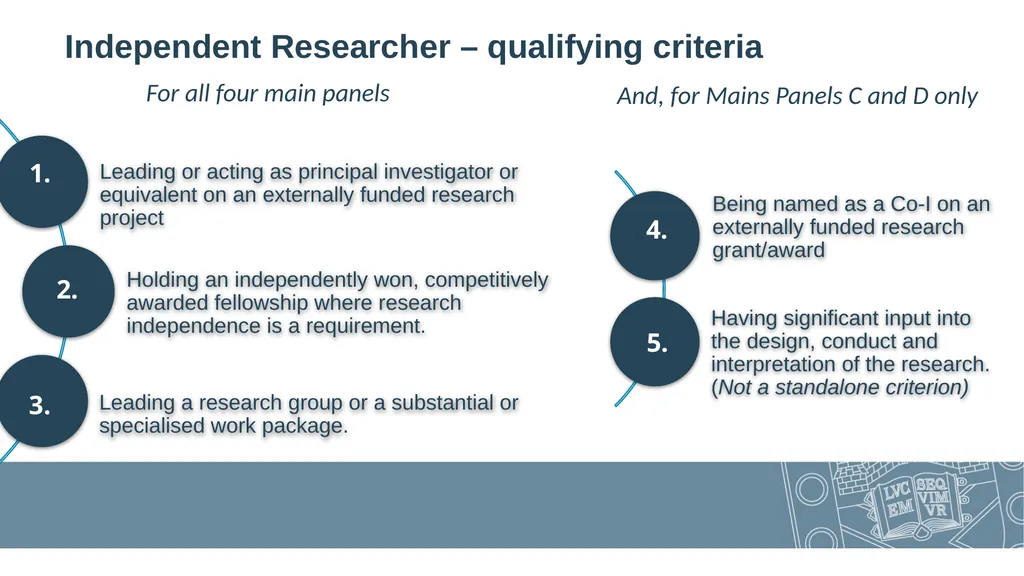
Independent Researcher – qualifying criteria And, for Mains Panels C and D only For all four main panels 1. 2. 3. 4. 5.<br>
15
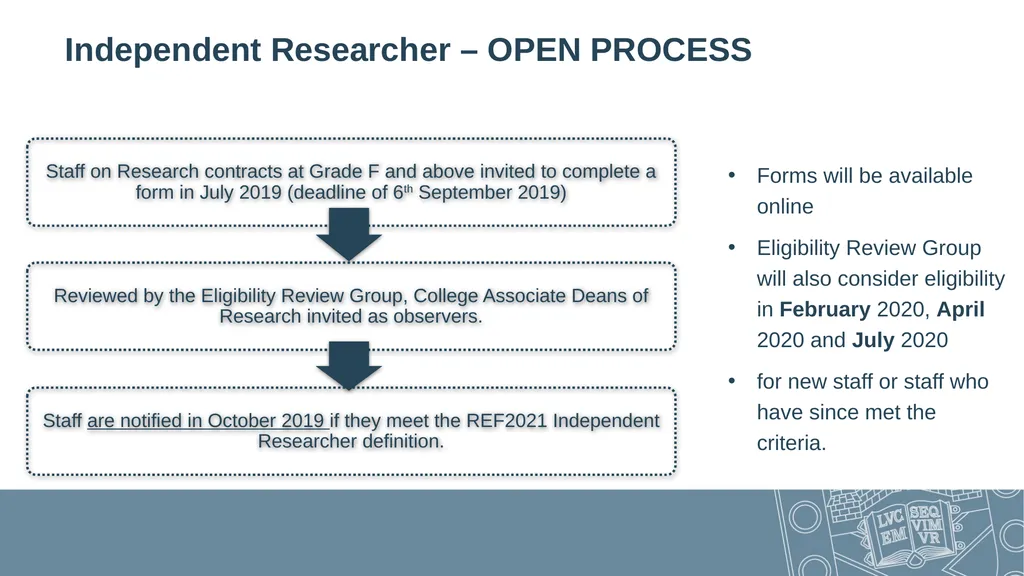
Independent Researcher – OPEN PROCESS Forms will be available online
Eligibility Review Group will also consider eligibility in February 2020, April 2020 and July 2020
for new staff or staff who have since met the criteria.<br>
Eligibility Review Group will also consider eligibility in February 2020, April 2020 and July 2020
for new staff or staff who have since met the criteria.<br>
16
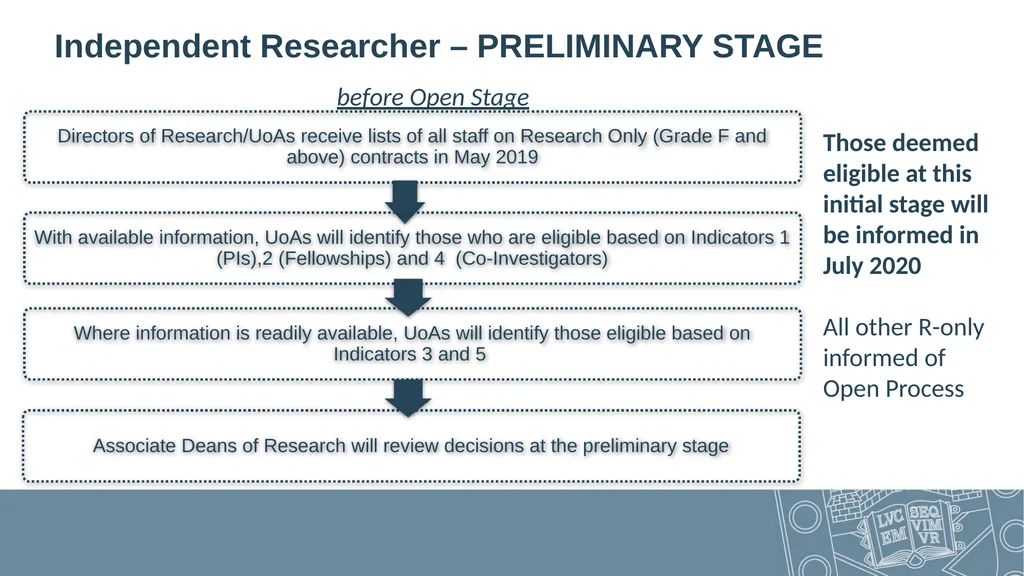
Independent Researcher – PRELIMINARY STAGE before Open Stage Those deemed eligible at this initial stage will be informed in July 2020
All other R-only informed of Open Process<br>
All other R-only informed of Open Process<br>
17
OUTPUT SELECTION Code of Practice – policies and processes<br>
18
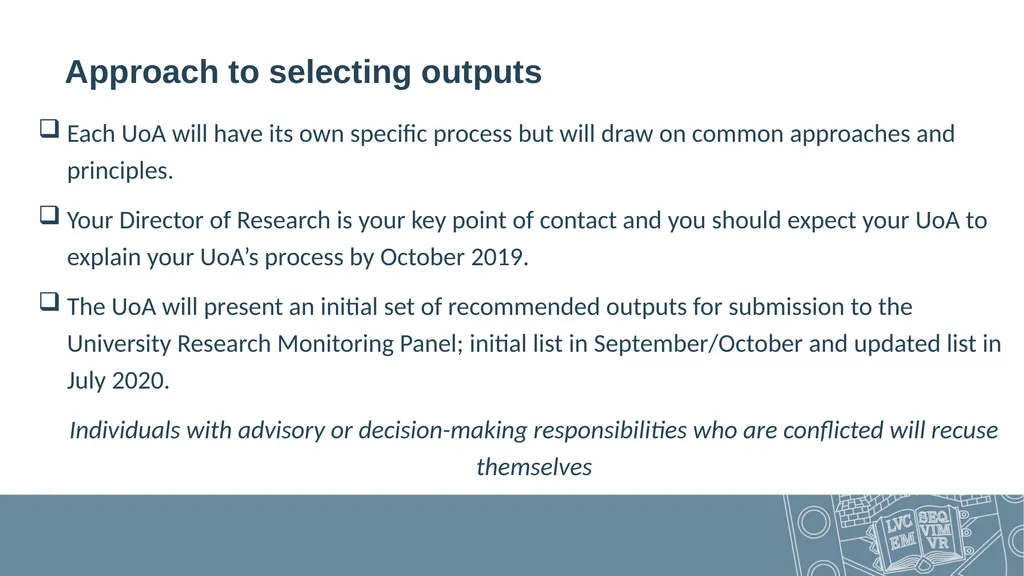
Approach to selecting outputs Each UoA will have its own specific process but will draw on common approaches and principles.
Your Director of Research is your key point of contact and you should expect your UoA to explain your UoA’s process by October 2019.
The UoA will present an initial set of recommended outputs for submission to the University Research Monitoring Panel; initial list in September/October and updated list in July 2020.
Individuals with advisory or decision-making responsibilities who are conflicted will recuse themselves<br>
Your Director of Research is your key point of contact and you should expect your UoA to explain your UoA’s process by October 2019.
The UoA will present an initial set of recommended outputs for submission to the University Research Monitoring Panel; initial list in September/October and updated list in July 2020.
Individuals with advisory or decision-making responsibilities who are conflicted will recuse themselves<br>
19
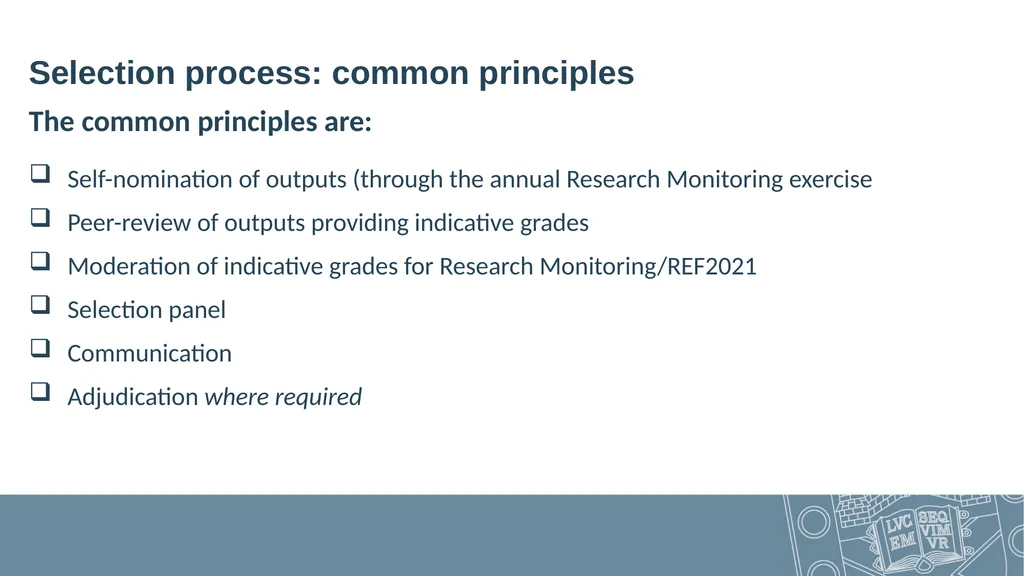
Selection process: common principles The common principles are:
Self-nomination of outputs (through the annual Research Monitoring exercise
Peer-review of outputs providing indicative grades
Moderation of indicative grades for Research Monitoring/REF2021
Selection panel
Communication
Adjudication where required<br>
Self-nomination of outputs (through the annual Research Monitoring exercise
Peer-review of outputs providing indicative grades
Moderation of indicative grades for Research Monitoring/REF2021
Selection panel
Communication
Adjudication where required<br>
20
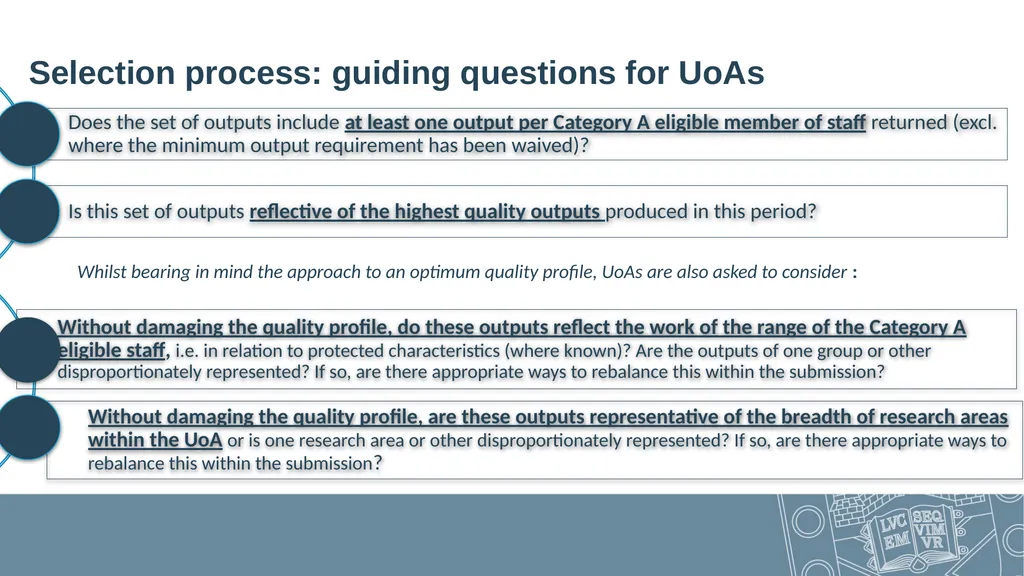
Selection process: guiding questions for UoAs Whilst bearing in mind the approach to an optimum quality profile, UoAs are also asked to consider :<br>
21
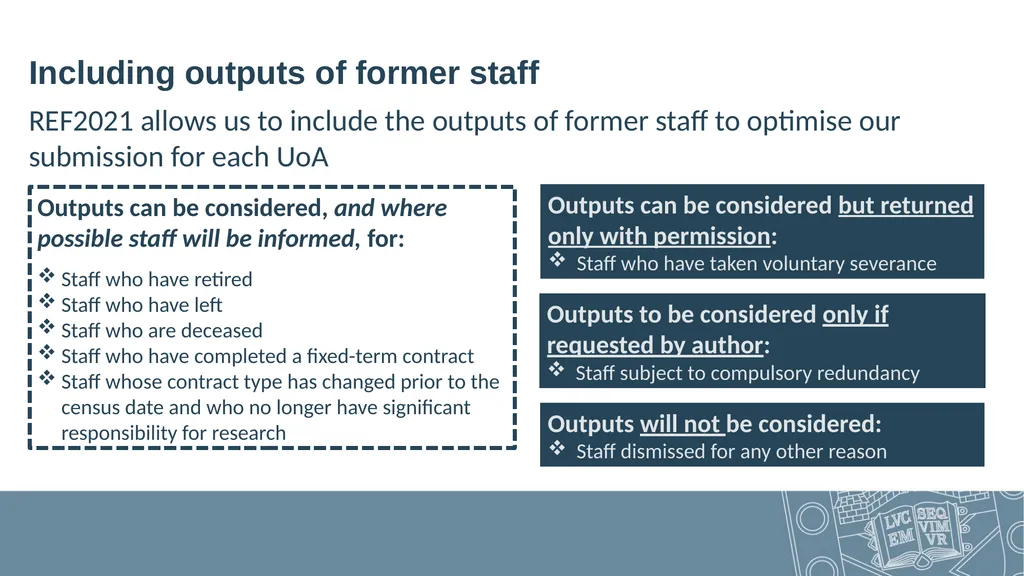
Including outputs of former staff REF2021 allows us to include the outputs of former staff to optimise our submission for each UoA Outputs can be considered, and where possible staff will be informed, for:
Staff who have retired
Staff who have left
Staff who are deceased
Staff who have completed a fixed-term contract
Staff whose contract type has changed prior to the census date and who no longer have significant responsibility for research Outputs can be considered but returned only with permission:
Staff who have taken voluntary severance Outputs to be considered only if requested by author:
Staff subject to compulsory redundancy Outputs will not be considered:
Staff dismissed for any other reason<br>
Staff who have retired
Staff who have left
Staff who are deceased
Staff who have completed a fixed-term contract
Staff whose contract type has changed prior to the census date and who no longer have significant responsibility for research Outputs can be considered but returned only with permission:
Staff who have taken voluntary severance Outputs to be considered only if requested by author:
Staff subject to compulsory redundancy Outputs will not be considered:
Staff dismissed for any other reason<br>
22
INDIVIDUAL CIRCUMSTANCES Code of Practice – policies and processes<br>
23
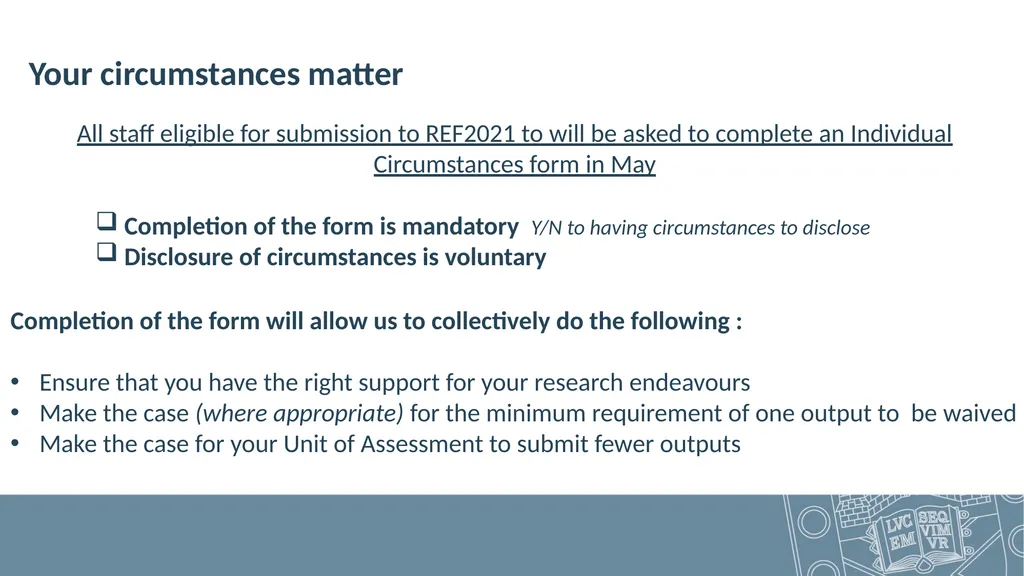
Your circumstances matter All staff eligible for submission to REF2021 to will be asked to complete an Individual Circumstances form in May Completion of the form will allow us to collectively do the following :
Ensure that you have the right support for your research endeavours
Make the case (where appropriate) for the minimum requirement of one output to be waived
Make the case for your Unit of Assessment to submit fewer outputs Completion of the form is mandatory Y/N to having circumstances to disclose
Disclosure of circumstances is voluntary<br>
Ensure that you have the right support for your research endeavours
Make the case (where appropriate) for the minimum requirement of one output to be waived
Make the case for your Unit of Assessment to submit fewer outputs Completion of the form is mandatory Y/N to having circumstances to disclose
Disclosure of circumstances is voluntary<br>
24
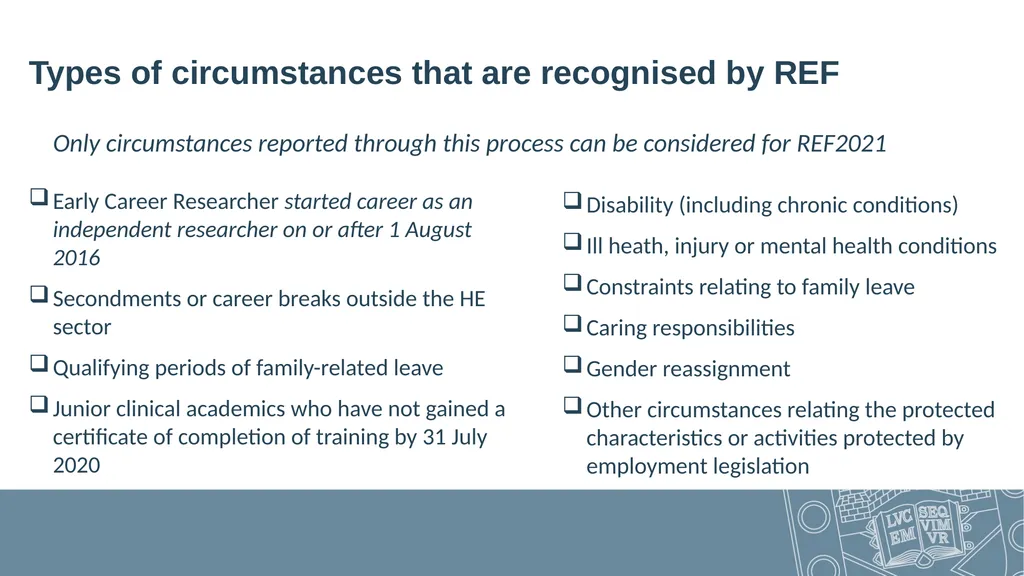
Types of circumstances that are recognised by REF Early Career Researcher started career as an independent researcher on or after 1 August 2016
Secondments or career breaks outside the HE sector
Qualifying periods of family-related leave
Junior clinical academics who have not gained a certificate of completion of training by 31 July 2020 Disability (including chronic conditions)
Ill heath, injury or mental health conditions
Constraints relating to family leave
Caring responsibilities
Gender reassignment
Other circumstances relating the protected characteristics or activities protected by employment legislation Only circumstances reported through this process can be considered for REF2021<br>
Secondments or career breaks outside the HE sector
Qualifying periods of family-related leave
Junior clinical academics who have not gained a certificate of completion of training by 31 July 2020 Disability (including chronic conditions)
Ill heath, injury or mental health conditions
Constraints relating to family leave
Caring responsibilities
Gender reassignment
Other circumstances relating the protected characteristics or activities protected by employment legislation Only circumstances reported through this process can be considered for REF2021<br>
25
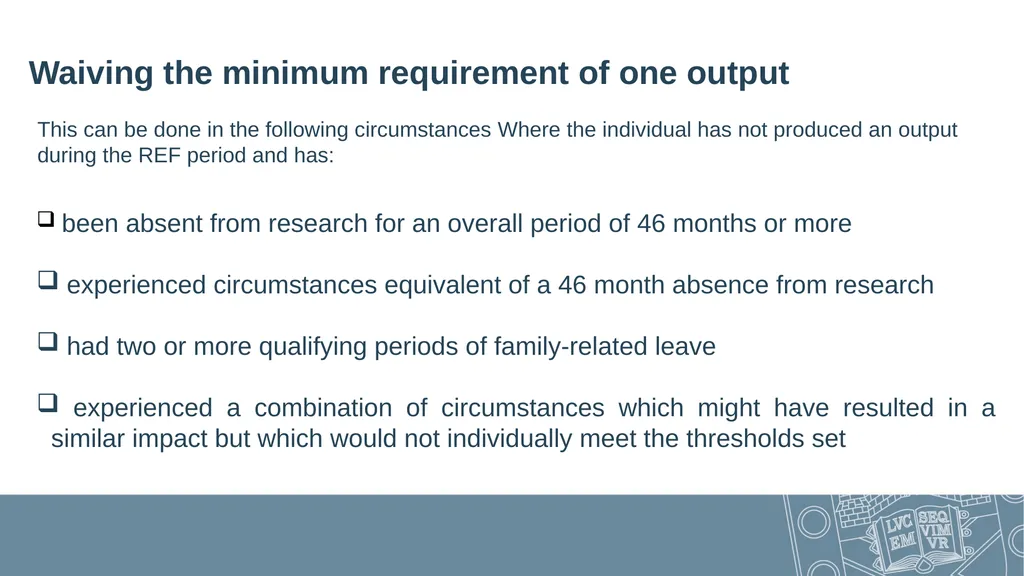
Waiving the minimum requirement of one output This can be done in the following circumstances Where the individual has not produced an output during the REF period and has: been absent from research for an overall period of 46 months or more
experienced circumstances equivalent of a 46 month absence from research
had two or more qualifying periods of family-related leave
experienced a combination of circumstances which might have resulted in a similar impact but which would not individually meet the thresholds set<br>
experienced circumstances equivalent of a 46 month absence from research
had two or more qualifying periods of family-related leave
experienced a combination of circumstances which might have resulted in a similar impact but which would not individually meet the thresholds set<br>
26
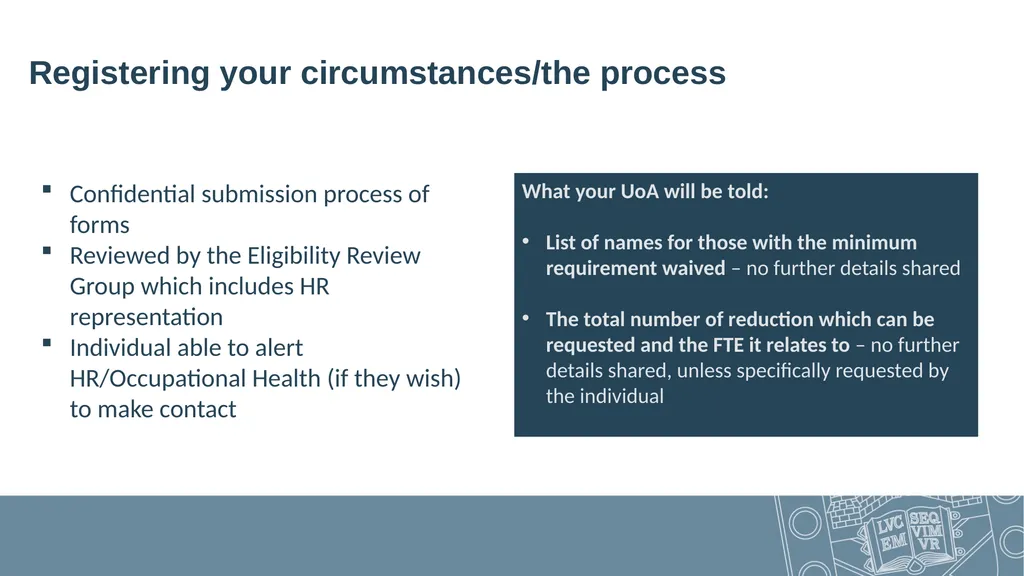
Registering your circumstances/the process Confidential submission process of forms
Reviewed by the Eligibility Review Group which includes HR representation
Individual able to alert HR/Occupational Health (if they wish) to make contact What your UoA will be told:
List of names for those with the minimum requirement waived – no further details shared
The total number of reduction which can be requested and the FTE it relates to – no further details shared, unless specifically requested by the individual<br>
Reviewed by the Eligibility Review Group which includes HR representation
Individual able to alert HR/Occupational Health (if they wish) to make contact What your UoA will be told:
List of names for those with the minimum requirement waived – no further details shared
The total number of reduction which can be requested and the FTE it relates to – no further details shared, unless specifically requested by the individual<br>
27
Reduction in total output pool If the minimum requirement of one output is waived, the total number of outputs is automatically reduced by one per person
Your Unit of Assessment can ask for additional reductions to be taken into consideration if there are multiple individual circumstances registered which have a cumulative effect on the UoA’s ability to meet the total number of outputs required<br>
Your Unit of Assessment can ask for additional reductions to be taken into consideration if there are multiple individual circumstances registered which have a cumulative effect on the UoA’s ability to meet the total number of outputs required<br>
28
OTHER POLICIES Code of Practice – policies and processes<br>
29
Also in the draft Code of Practice Our Governance arrangements
Confidentiality policy
Conflict of Interest
Approach to review
Policy to support decisions between UoAs Further (brief) opportunity to comment: we will be circulating the revised draft University of Exeter REF2021 Code of Practice to all staff<br>
Confidentiality policy
Conflict of Interest
Approach to review
Policy to support decisions between UoAs Further (brief) opportunity to comment: we will be circulating the revised draft University of Exeter REF2021 Code of Practice to all staff<br>
30
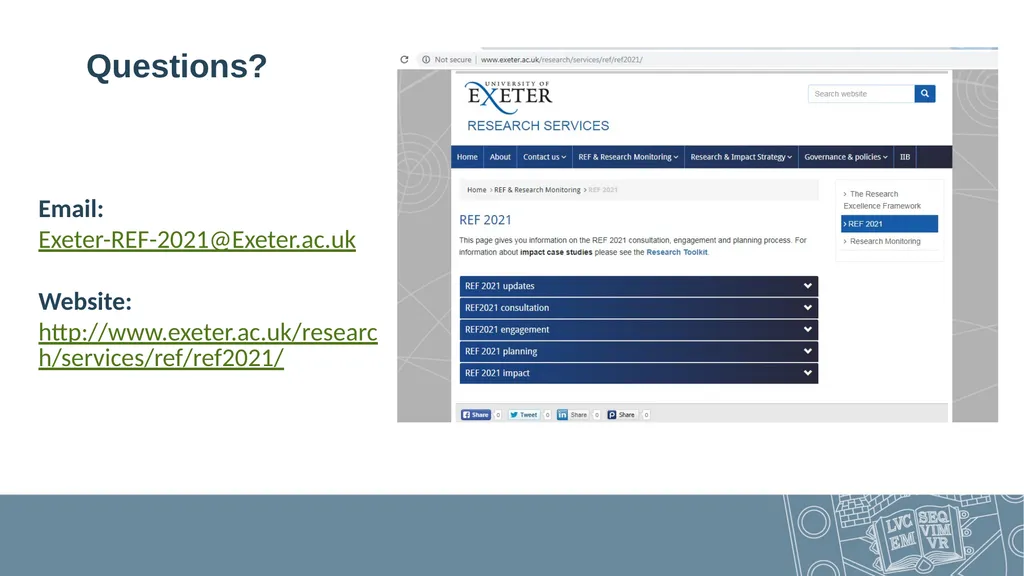
Questions? Email: Exeter-REF-2021@Exeter.ac.uk
Website: http://www.exeter.ac.uk/research/services/ref/ref2021/<br>
Website: http://www.exeter.ac.uk/research/services/ref/ref2021/<br>