
What is semantics? Semantics is the study of
CM
Published · 24 slides · 0 views
1 / 1



Description
What is semantics? Semantics is the study of meaning in language. It is a wide subject within the general study of language. An understanding of semantics is essential to the study of language acquisition (how language users acquire a sense
Related Topics
Share
Embed code
Download this presentation From Below
"What is semantics? Semantics is the study of" is the property of its rightful owner. Permission is granted to download and print the materials on this website for personal, non-commercial use only, and to display it on your personal computer provided you do not modify the materials and that you retain all copyright notices contained in the materials. By downloading content from our website, you accept the terms of this agreement.
Presentation Transcript
01
What is semantics?
Semantics is the study of meaning in language. It is a wide subject within the general study of language. An understanding of semantics is essential to the study of language acquisition (how language users acquire a sense of meaning, as speakers and writers, listeners and readers). It is also essential to the study of language change (how meanings alter over time).<br>
Semantics is the study of meaning in language. It is a wide subject within the general study of language. An understanding of semantics is essential to the study of language acquisition (how language users acquire a sense of meaning, as speakers and writers, listeners and readers). It is also essential to the study of language change (how meanings alter over time).<br>
02
It is important for understanding language in social contexts, as these are likely to affect meaning, and for understanding varieties of English and effects of style. It is thus one of the most fundamental concepts in linguistics. The study of semantics includes the study of how meaning is constructed, interpreted, clarified, obscured, illustrated, simplified, negotiated, contradicted, and paraphrased.<br>
03
In semantic analysis, there is always an attempt to focus on what the words conventionally mean, rather than what an individual speaker might want them to mean on a particular occasion<br>
04
Conceptual meaning
Conceptual meaning covers those basic essential components of meaning that are conveyed by the literal use of a word. Some basic components of a word like needle in English might include ‘thin, sharp, steel instrument’. These components would be part of the conceptual meaning of needle.<br>
Conceptual meaning covers those basic essential components of meaning that are conveyed by the literal use of a word. Some basic components of a word like needle in English might include ‘thin, sharp, steel instrument’. These components would be part of the conceptual meaning of needle.<br>
05
Conceptual meaning literally meaning is basically using a word or sentence NOT in the way it sounds, but the way the dictionary would describe it. here is an example I felt like i was walking on water... (implying that you were not walking on water, it just felt that way) Vs the literal I was literally walking on water (the device i used made me walk on the water)<br>
06
Associative meaning
Different people might have different associations or connotations attached to a word like needle. They might associate it with ‘pain’, or ‘illness’, or ‘blood’, or ‘drugs’, or ‘thread’, or ‘knitting’, or ‘hard to find’ etc.These associations may differ from one person to the next, and are not treated as part of the word’s conceptual meaning.<br>
Different people might have different associations or connotations attached to a word like needle. They might associate it with ‘pain’, or ‘illness’, or ‘blood’, or ‘drugs’, or ‘thread’, or ‘knitting’, or ‘hard to find’ etc.These associations may differ from one person to the next, and are not treated as part of the word’s conceptual meaning.<br>
07
Ways of Looking at Words
1- Words as ‘containers’ of meaning
2- Semantic Features
3- Words as fulfilling ‘roles’ within the situation described by a sentence
4- Semantic Roles ‘Relationships’ between words Lexical Relations<br>
2- Semantic Features
3- Words as fulfilling ‘roles’ within the situation described by a sentence
4- Semantic Roles ‘Relationships’ between words Lexical Relations<br>
08
Semantic Features .Do you find these sentences odd? Why?
Read the following sentences.
The hamburger ate the boy.
The table listens to the radio.
The horse is reading the newspaper.
The tree ate the elephant.<br>
The hamburger ate the boy.
The table listens to the radio.
The horse is reading the newspaper.
The tree ate the elephant.<br>
09
Semantic Features
We should note that the oddness of the sentences in the previous slide does not derive from their syntactical structure. The hamburger ate the boy. The boy at the hamburger. The first sentence is syntactically good, but semantically odd.<br>
We should note that the oddness of the sentences in the previous slide does not derive from their syntactical structure. The hamburger ate the boy. The boy at the hamburger. The first sentence is syntactically good, but semantically odd.<br>
10
Semantic Features
The components of the conceptual meaning of the noun hamburger must be significantly different from those of the noun boy, thereby preventing one, not being the other, from being used as the subject of the verb ate.The kind of noun that can be the subject of the verb ate must denote an entity that is capable of ‘eating’. The noun hamburger does not have this property and the noun boy does.<br>
The components of the conceptual meaning of the noun hamburger must be significantly different from those of the noun boy, thereby preventing one, not being the other, from being used as the subject of the verb ate.The kind of noun that can be the subject of the verb ate must denote an entity that is capable of ‘eating’. The noun hamburger does not have this property and the noun boy does.<br>
11
We can make this observation more generally applicable by trying to determine the crucial element or feature of meaning that any noun must have in order to be used as the subject of the verb ate.Such an element may be as general as ‘animate being’.<br>
12
A NTONYMY Antonymy is the state or phenomenon in which the words have the sense relation which involve the opposite of meaning. The concrete form of antonymy is called “antonym” (opposite). The word pairs of antonym can be divided into several types: a. Implicitly Gradable Pairs (Graded Antonym); b. Complementary Pairs (Complementarity<br>
13
and c. Relational Pairs (Converseness).
10. (a) Implicitly Gradable Pairs (Graded Antonym) refers to the words related to the object they modify. The words themselves do not provide an absolute scale. Examples: big >< small good >< bad Relatively fast >< slow comparable young >< old Thus, when we say that “a fly is bigger than another”, we imply that „big‟ is to be understood in the context of „flies‟. Another fact dealing with this type is that “a small elephant”, for example, is much bigger that “a big mouse”. A big mouse A small elephant<br>
10. (a) Implicitly Gradable Pairs (Graded Antonym) refers to the words related to the object they modify. The words themselves do not provide an absolute scale. Examples: big >< small good >< bad Relatively fast >< slow comparable young >< old Thus, when we say that “a fly is bigger than another”, we imply that „big‟ is to be understood in the context of „flies‟. Another fact dealing with this type is that “a small elephant”, for example, is much bigger that “a big mouse”. A big mouse A small elephant<br>
14
Another characteristic of certain pairs of gradable antonyms is that one is marked and the other is unmarked. The unmarked member is the one used in questions of degree. We ask, ordinarily, “how high is the mountain?” (not “how low is it?”). We answer, “ten thousand feet high”, but never “ten thousand feet low”, except humorously or ironically or the topic of the conversation is in the particular context.
12. Thus, „high‟ is the unmarked member of „high/low‟, similarly „tall‟ is the unmarked member of „tall/short‟, or „fast‟ is the unmarked member of „fast/slow‟. High Tall Fast unmarked unmarked unmarked High / Low Tall / Short Fast / Slow marked marked marked<br>
12. Thus, „high‟ is the unmarked member of „high/low‟, similarly „tall‟ is the unmarked member of „tall/short‟, or „fast‟ is the unmarked member of „fast/slow‟. High Tall Fast unmarked unmarked unmarked High / Low Tall / Short Fast / Slow marked marked marked<br>
15
Complementary Pairs (Complemetarity) refers to the existence of pairs that the denial of one, implies the assertion of the other. Examples: male >< female alive >< dead Incomparable present >< absent objects awake >< asleep Thus, if one is not male, then one is certainly female; if one is not present, then he/she must be absent, and so on.<br>
16
Related to complementary pairs, sets of terms like colors or numbers where the assertion of one member implies the negation of all the others. Thus, if we have a set of such as: green, yellow, brown, red, blue when we say: “This is green”, for instance, it means that it is not yellow, brown, red, or blue.<br>
17
Relational Pairs (converseness) refers to the pair of words that display symmetry in their meaning. If X gives Y to Z, then Z receives Y from X Relationships between certain semantic features can reveal knowledge about antonyms. Consider: A word that is [+married] is [-single] A word that is [+single] is [-married] These show that any word that bears the semantic property “married”, such as „wife‟, is understood to lack the semantic property “single”; and conversely, any word that bears the semantic property “single”, such as „bachelor‟, will not have the property “married”<br>
18
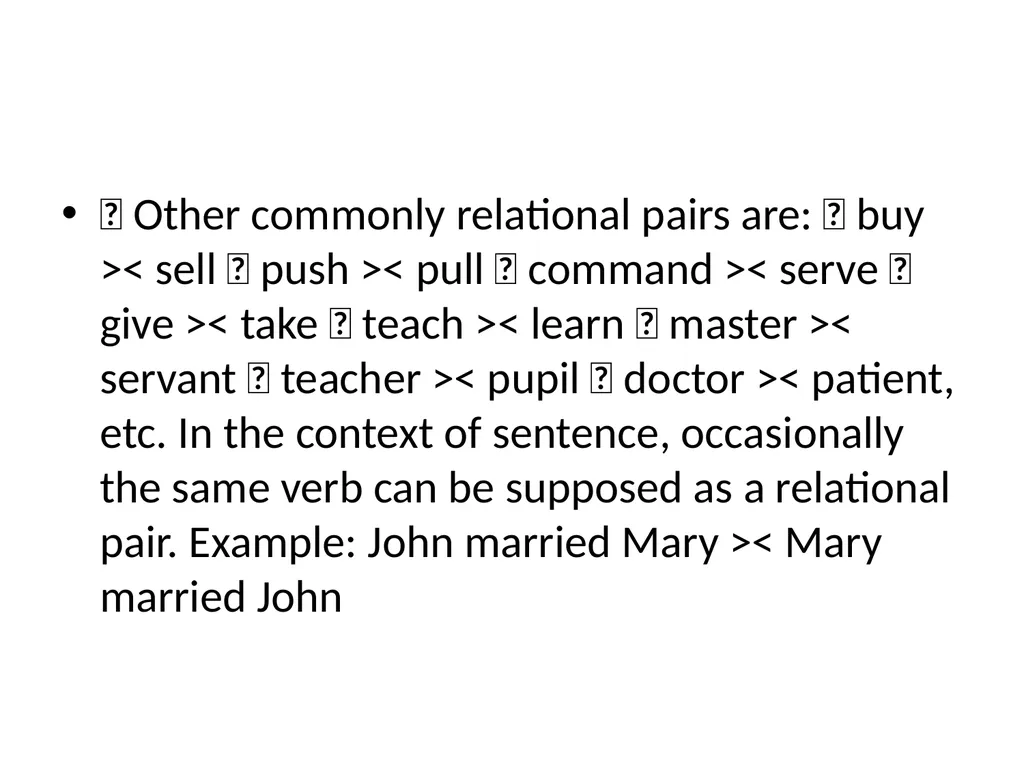
Other commonly relational pairs are: buy >< sell push >< pull command >< serve give >< take teach >< learn master >< servant teacher >< pupil doctor >< patient, etc. In the context of sentence, occasionally the same verb can be supposed as a relational pair. Example: John married Mary >< Mary married John<br>
19
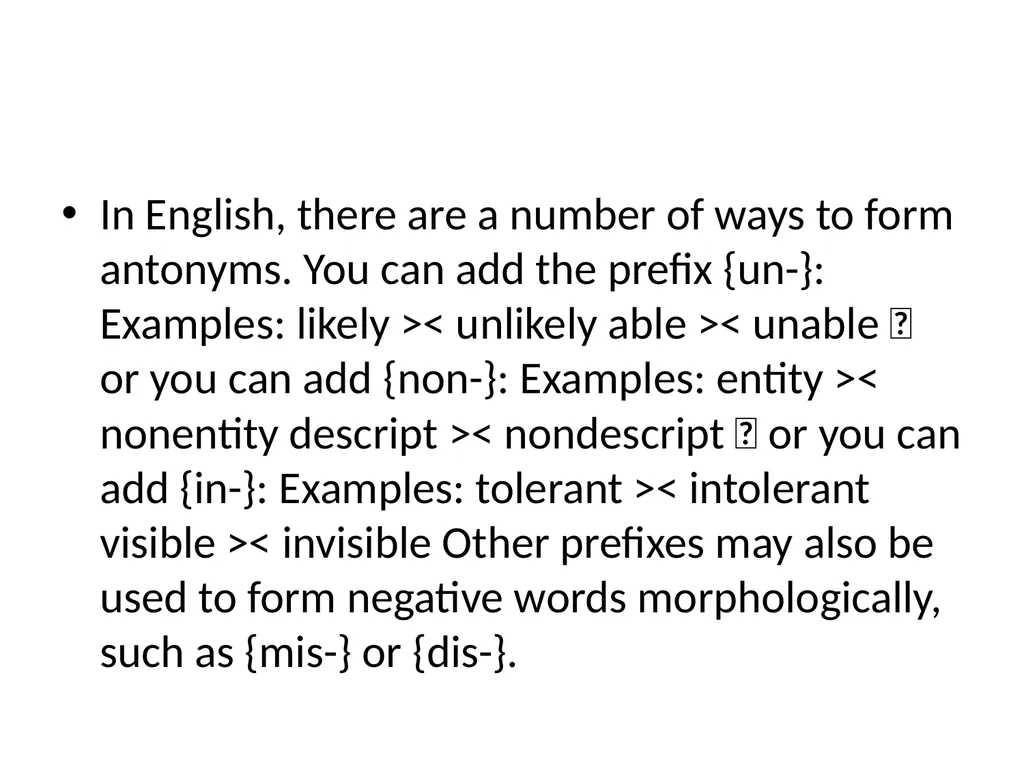
In English, there are a number of ways to form antonyms. You can add the prefix {un-}: Examples: likely >< unlikely able >< unable or you can add {non-}: Examples: entity >< nonentity descript >< nondescript or you can add {in-}: Examples: tolerant >< intolerant visible >< invisible Other prefixes may also be used to form negative words morphologically, such as {mis-} or {dis-}.<br>
20
PROTOTYPE<br>
21
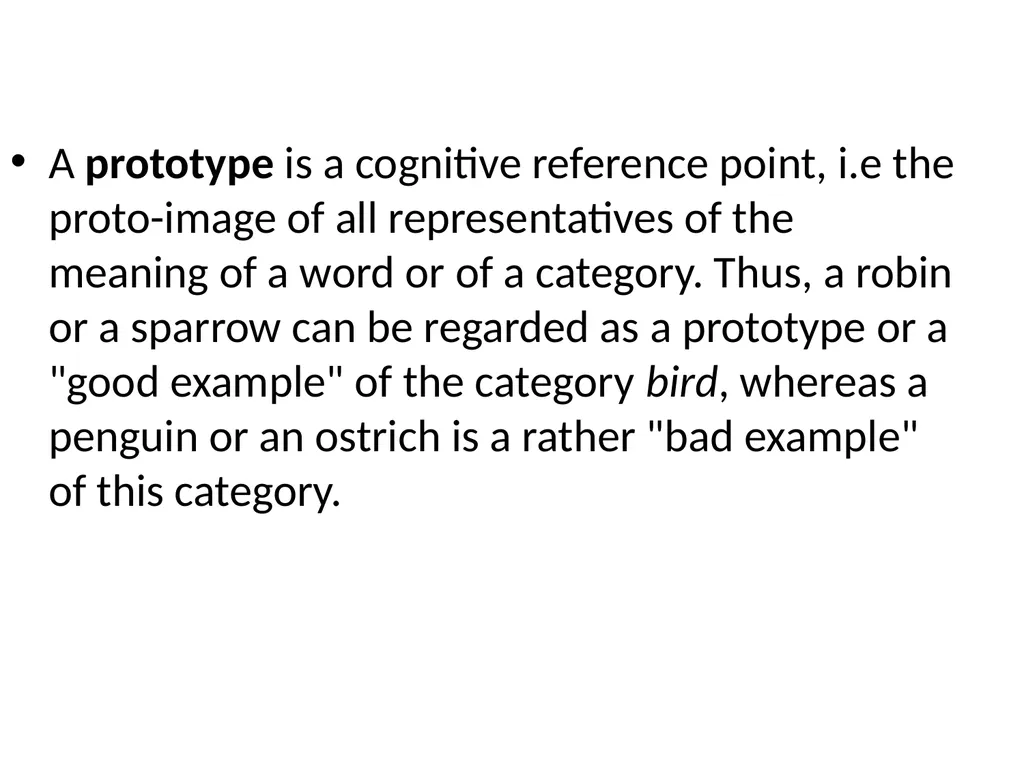
A prototype is a cognitive reference point, i.e the proto-image of all representatives of the meaning of a word or of a category. Thus, a robin or a sparrow can be regarded as a prototype or a "good example" of the category bird, whereas a penguin or an ostrich is a rather "bad example" of this category.<br>
22
Accordingly, the members of a category can be graded according to their typicality. A "good" example is only rated as such by virtue of its features. Defining a prototype as the bundle of typical features of a category, we can thus imagine birds as 'creatures that are covered with feathers, have two wings and two legs, and the majority of which can fly'. Therefore, a penguin is a less "good" bird, as it lacks some of the typical features, such as the ability to fly. Features themselves can also be more or less typical, for example 'twittering' is less typical and specific to birds than 'flying'.<br>
23
prototype If an item shares at least some central features with the category prototype, we consider it as an example of this category. As a consequence, word meanings contain all the properties of cognitive categories: We can distinguish between central and more peripheral meanings of a lexeme, and word meanings are not rigid, but there are often gradual transitions and fuzzy boundaries between them. Thus, prototype semantics is a 'more-or-less semantics', as opposed to the 'all-or-nothing' approach of structure-oriented feature semantics. However, this does not weaken the usefulness of a feature-based classification:
The features belonging to a prototype of a category are the ones that are relevant for categorization.<br>