01
What should I know already? Technology and warfare
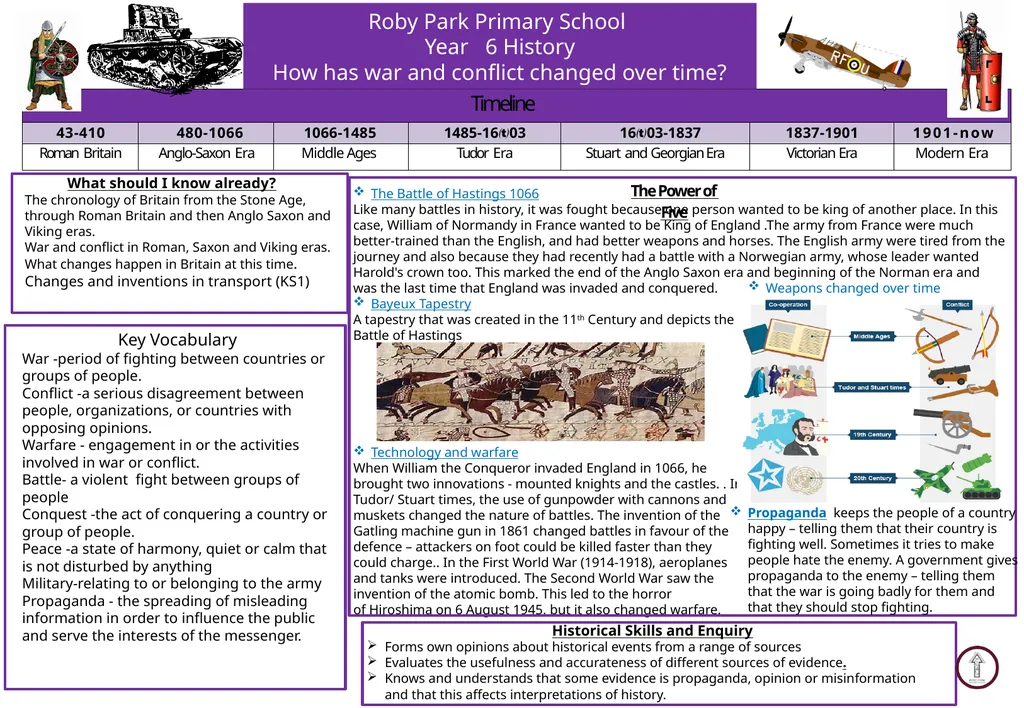
When William the Conqueror invaded England in 1066, he brought two innovations - mounted knights and the castles. . In Tudor/ Stuart times, the use of gunpowder with cannons and muskets changed the nature of battles. The invention of the Gatling machine gun in 1861 changed battles in favour of the defence – attackers on foot could be killed faster than they could charge.. In the First World War (1914-1918), aeroplanes and tanks were introduced. The Second World War saw the invention of the atomic bomb. This led to the horror of Hiroshima on 6 August 1945, but it also changed warfare. Key Vocabulary
War -period of fighting between countries or groups of people.
Conflict -a serious disagreement between people, organizations, or countries with opposing opinions.
Warfare - engagement in or the activities involved in war or conflict.
Battle- a violent fight between groups of people
Conquest -the act of conquering a country or group of people.
Peace -a state of harmony, quiet or calm that is not disturbed by anything
Military-relating to or belonging to the army
Propaganda - the spreading of misleading information in order to influence the public and serve the interests of the messenger. Historical Skills and Enquiry
Forms own opinions about historical events from a range of sources
Evaluates the usefulness and accurateness of different sources of evidence.
Knows and understands that some evidence is propaganda, opinion or misinformation and that this affects interpretations of history. Roby Park Primary School
Year 6 History
How has war and conflict changed over time? The Power of Five The Battle of Hastings 1066
Like many battles in history, it was fought because one person wanted to be king of another place. In this case, William of Normandy in France wanted to be King of England .The army from France were much better-trained than the English, and had better weapons and horses. The English army were tired from the journey and also because they had recently had a battle with a Norwegian army, whose leader wanted Harold's crown too. This marked the end of the Anglo Saxon era and beginning of the Norman era and was the last time that England was invaded and conquered.
Bayeux Tapestry
A tapestry that was created in the 11th Century and depicts the
Battle of Hastings Weapons changed over time The chronology of Britain from the Stone Age, through Roman Britain and then Anglo Saxon and Viking eras.
War and conflict in Roman, Saxon and Viking eras.
What changes happen in Britain at this time.
Changes and inventions in transport (KS1) Propaganda keeps the people of a country happy – telling them that their country is fighting well. Sometimes it tries to make people hate the enemy. A government gives propaganda to the enemy – telling them that the war is going badly for them and that they should stop fighting.<br>
02
Roby Park Primary School
Year 6 History
What can we learn from war and conflict in the past? What was the battle between the Normans and the Anglo Saxons called?
What was the name of the tapestry made about the Battle of Hastings?
When was the battle of Hastings?
What war were aeroplanes and tanks introduced?
What was invented during WW2 and led to the horror of Hiroshima? 3 2 1
List 3 reason why a government would use propaganda
……………………………………………
……………………..……………………
……………………..……………………
Name 2 innovations the William the conqueror brought with him
……………………………….…………………
……………………….…….….………………
Give 1 example of. a invention that changed warfare
………………………..……………………… Write the names of 5 weapons used
in war Speedy Pencil. Write as much as you can remember in 5 minutes.
…………………………………………………………………………….................................................................................... ………………………………………...……………………………………………………………………………………………………………………
…………………………………………………………………………………………………………………………..………………………………………
……………………………………………………………………………………………………………………………………………………………………
……………………………………………………………………………….…………………………………………………………………………………… VOCABULARY –write the definition
Conquest
_______________________________________________________________________________________________________________________________________________________________
Warfare
_______________________________________________________________________________________________________________________________________________________________
Propaganda
_______________________________________________________________________________________________________________________________________________________________<br>