Which two streams relate to equilibrium conditions
Description: Which two streams relate to equilibrium conditions for equilibrium staged operations? 2 5 1 2 2 6 2 4 Which two streams relate to operating conditions for equilibrium staged operations? 2 5 1 2 2 6 2 4 Which of the following
Related Topics
Download Presentation
"Which two streams relate to equilibrium conditions" is the property of its rightful owner. Permission is granted to download and print the materials on this website for personal, non-commercial use only, and to display it on your personal computer provided you do not modify the materials and that you retain all copyright notices contained in the materials. By downloading content from our website, you accept the terms of this agreement.
Presentation Transcript
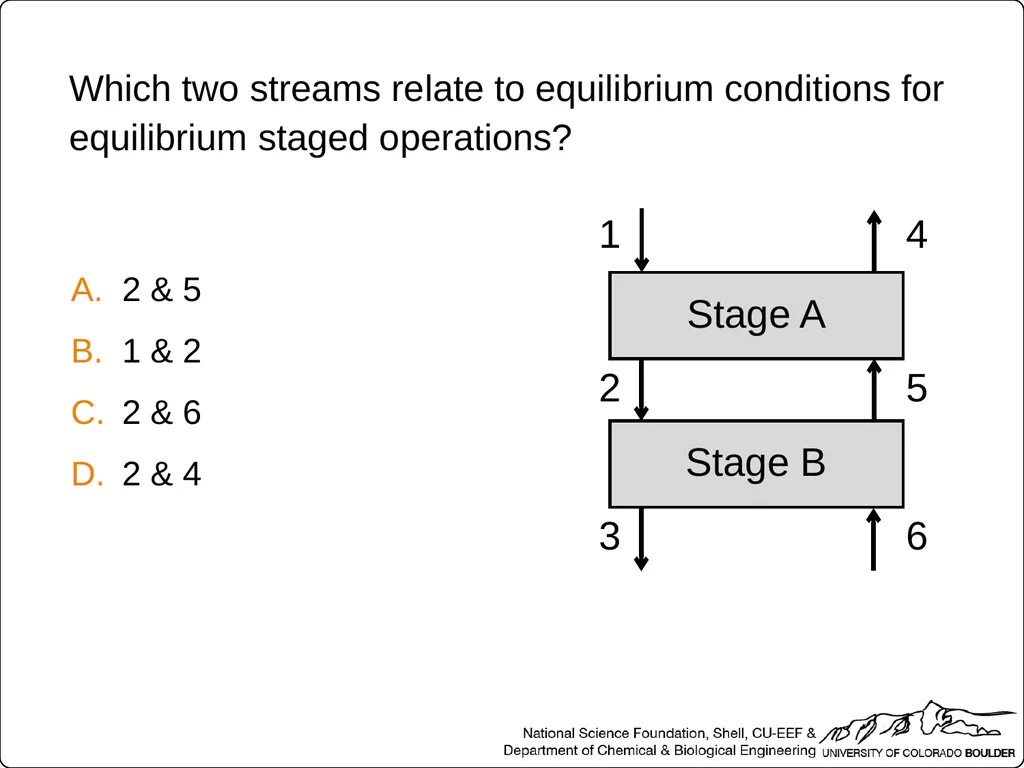
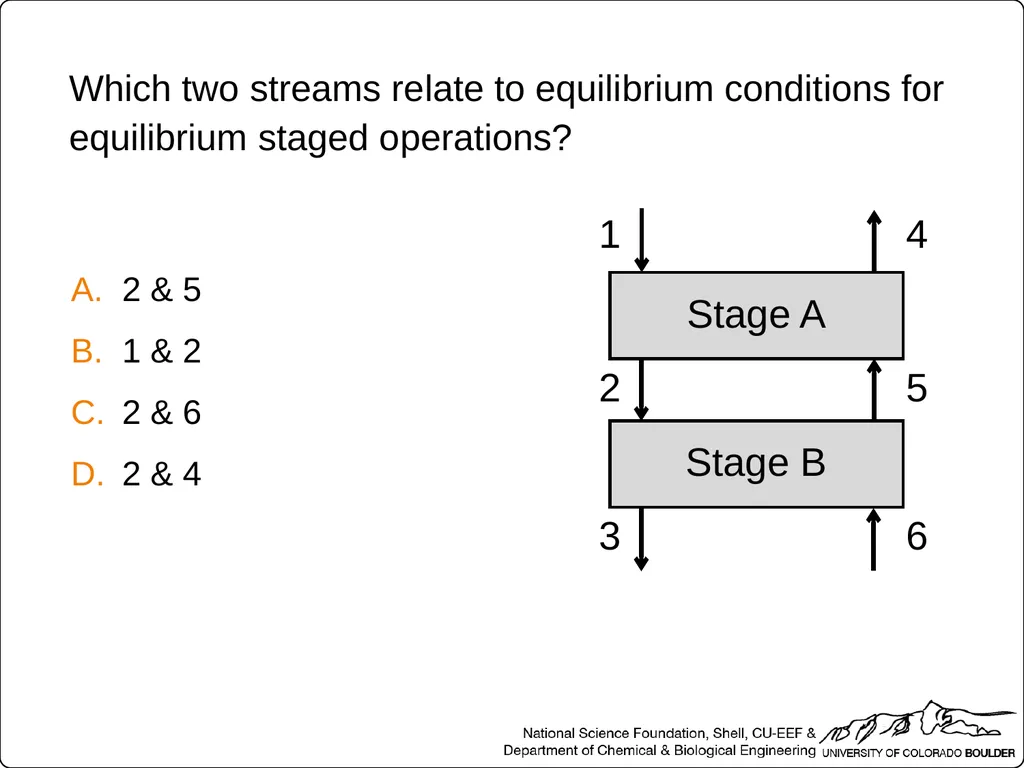
slide1. Which two streams relate to equilibrium conditions for equilibrium staged operations? 2 & 5
1 & 2
2 & 6
2 & 4<br>
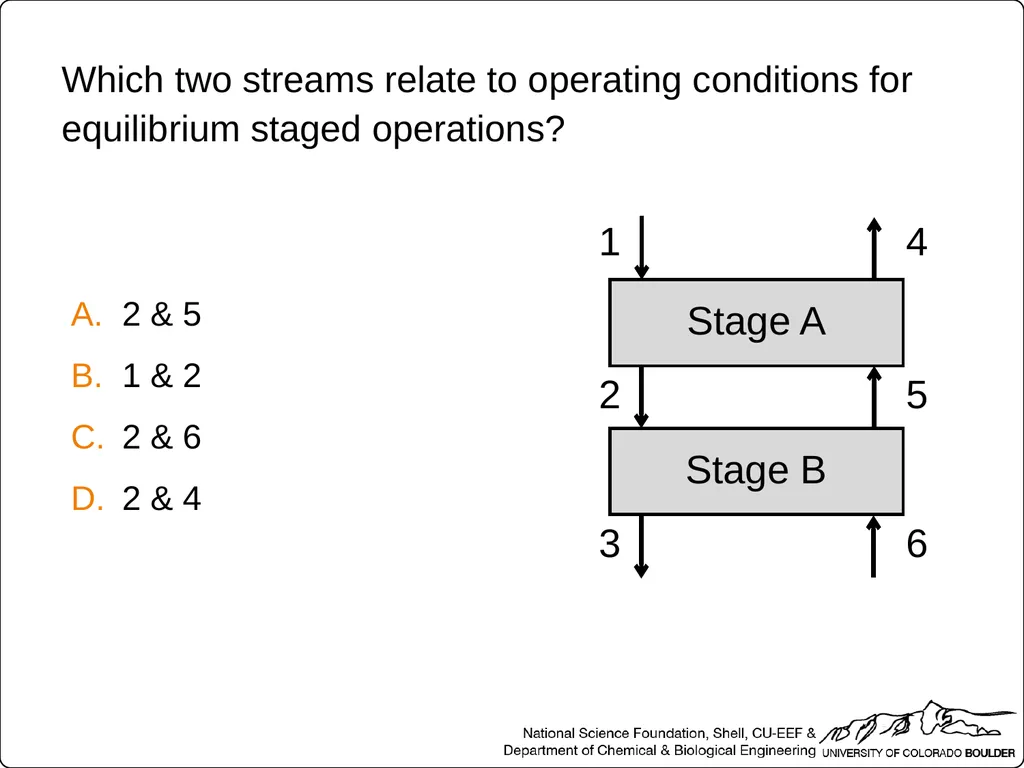
slide2. Which two streams relate to operating conditions for equilibrium staged operations? 2 & 5
1 & 2
2 & 6
2 & 4<br>
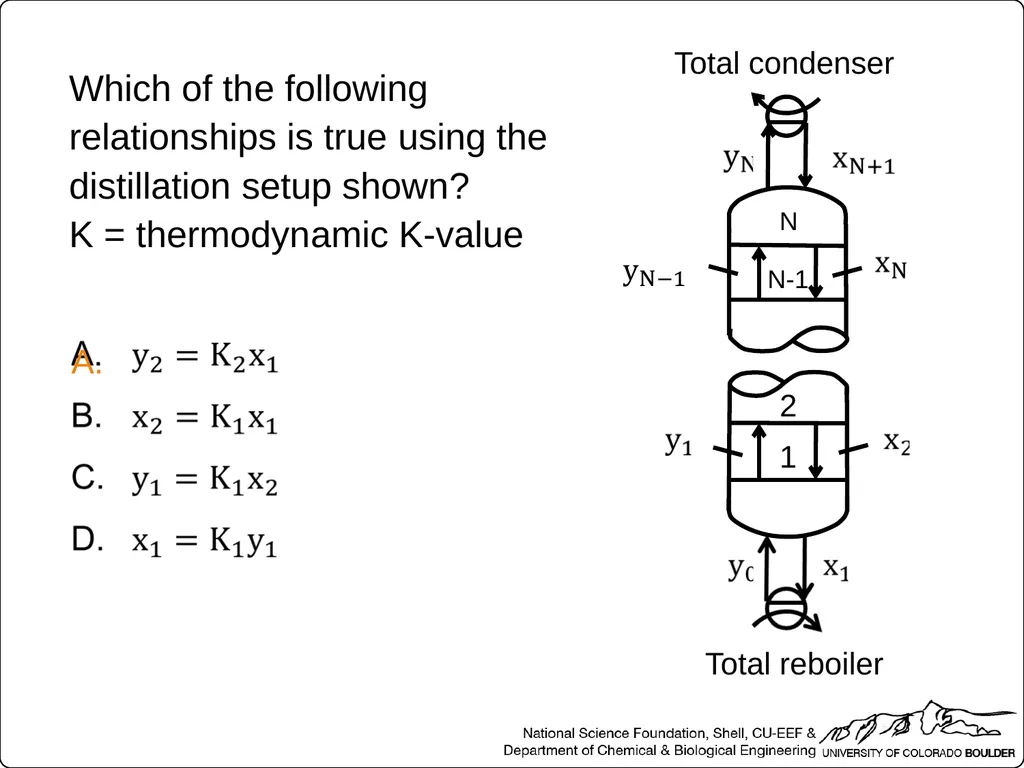
slide3. Which of the following relationships is true using the distillation setup shown?
K = thermodynamic K-value<br>
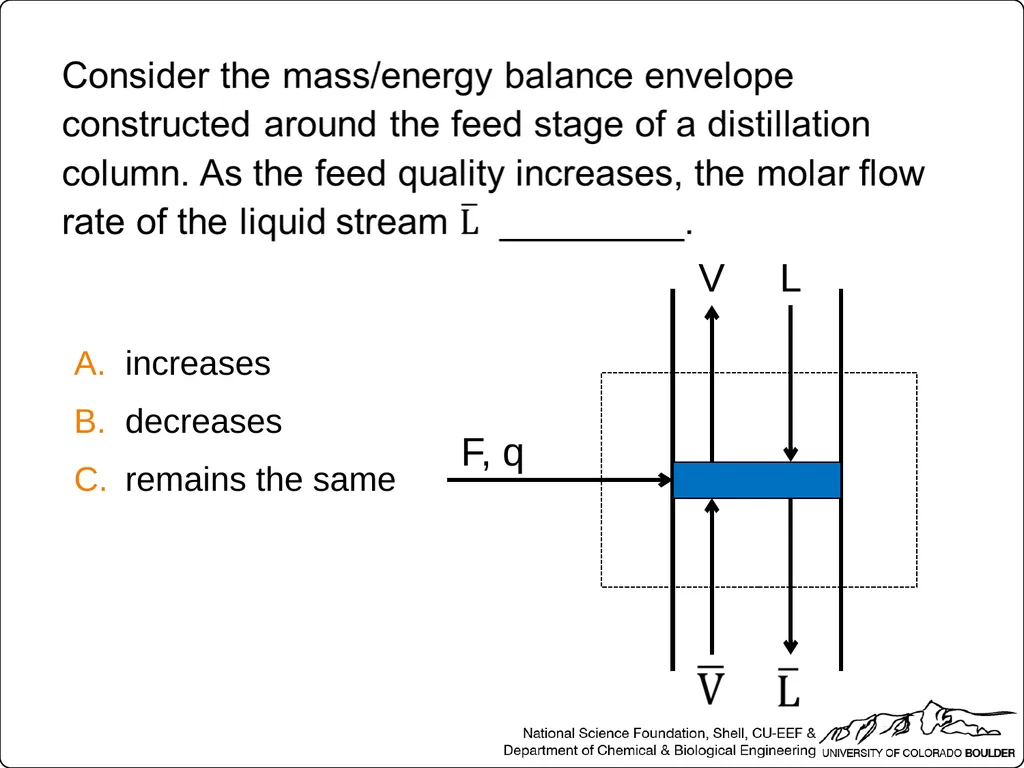
slide4. increases
decreases
remains the same V L F, q<br>
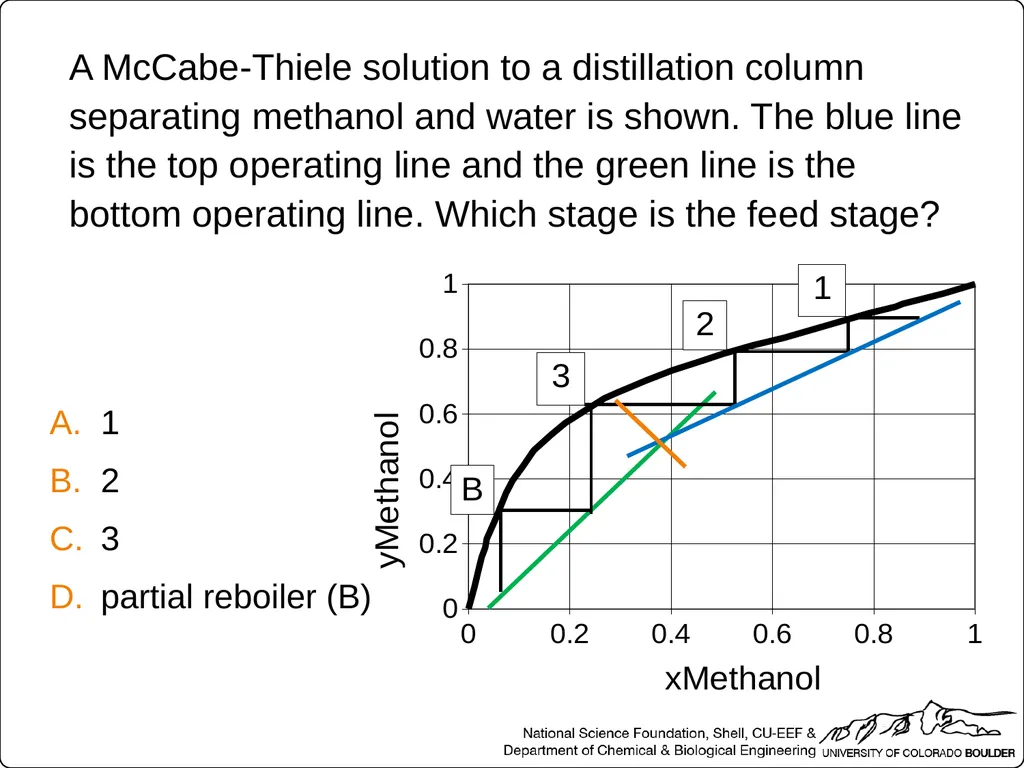
slide5. A McCabe-Thiele solution to a distillation column separating methanol and water is shown. The blue line is the top operating line and the green line is the bottom operating line. Which stage is the feed stage? 1
2
3
partial reboiler (B)<br>
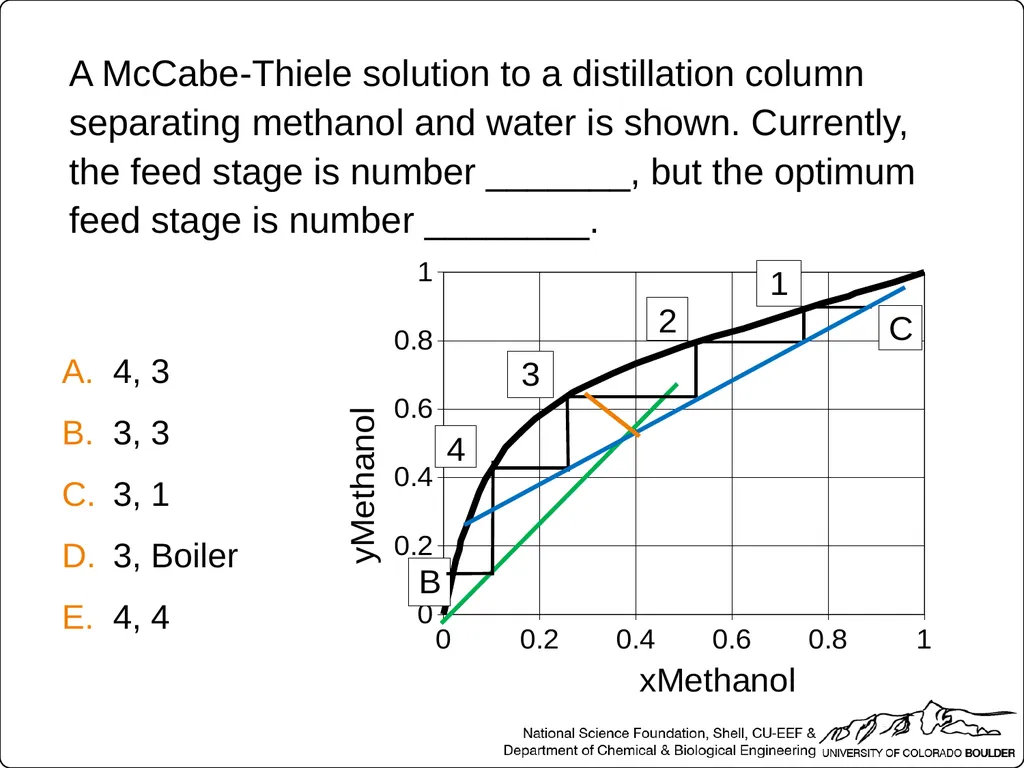
slide6. A McCabe-Thiele solution to a distillation column separating methanol and water is shown. Currently, the feed stage is number _______, but the optimum feed stage is number ________. 4, 3
3, 3
3, 1
3, Boiler
4, 4<br>
slide7. In column distillation, the limiting operating conditions of minimum reflux and total reflux represent a(n) _________ and a(n) __________ number of stages for a given separation, respectively. minimum, maximum
infinite, minimum
infinite, maximum
maximum, minimum<br>
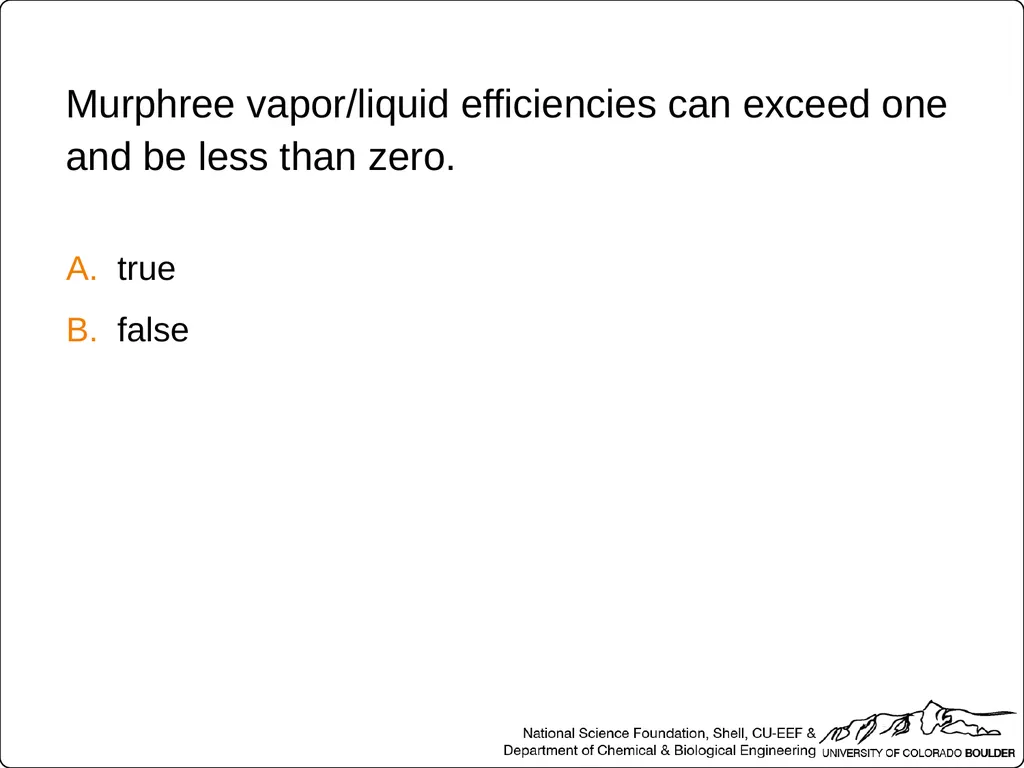
slide8. Murphree vapor/liquid efficiencies can exceed one and be less than zero. true
false<br>
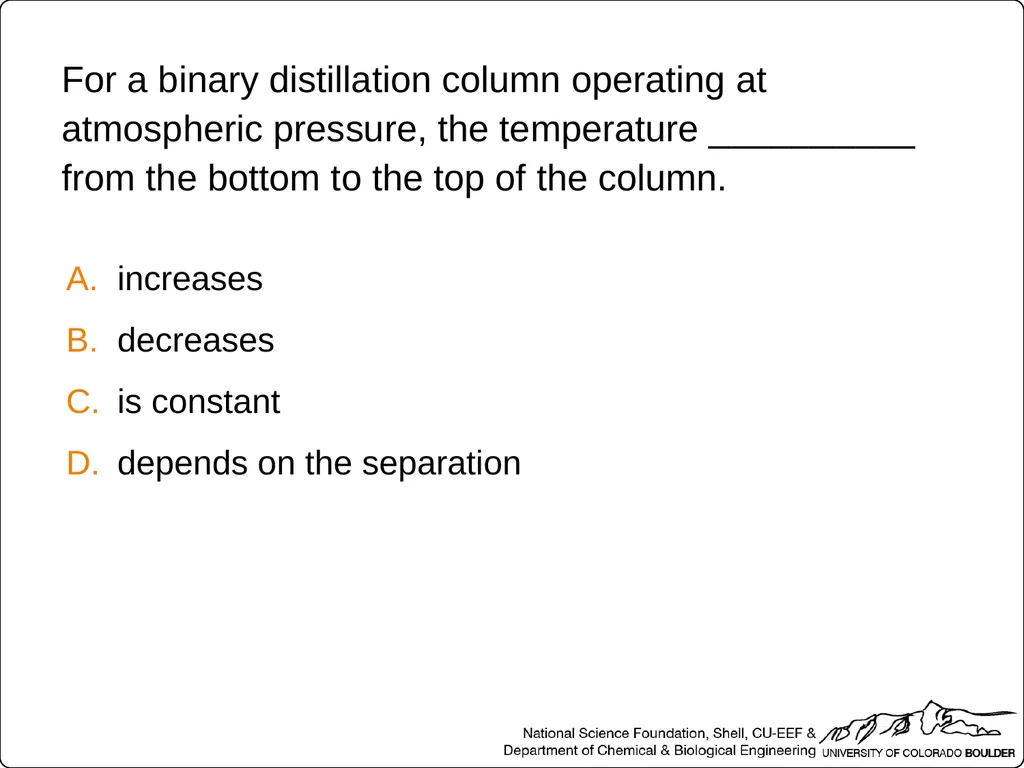
slide9. For a binary distillation column operating at atmospheric pressure, the temperature __________ from the bottom to the top of the column. increases
decreases
is constant
depends on the separation<br>
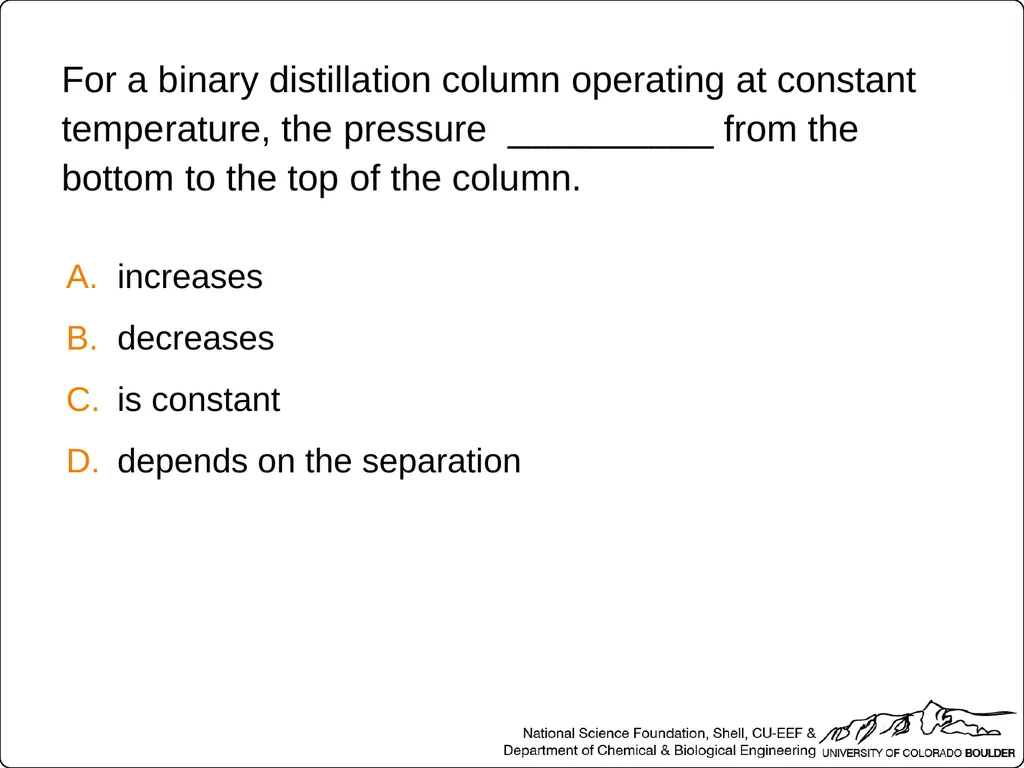
slide10. For a binary distillation column operating at constant temperature, the pressure __________ from the bottom to the top of the column. increases
decreases
is constant
depends on the separation<br>
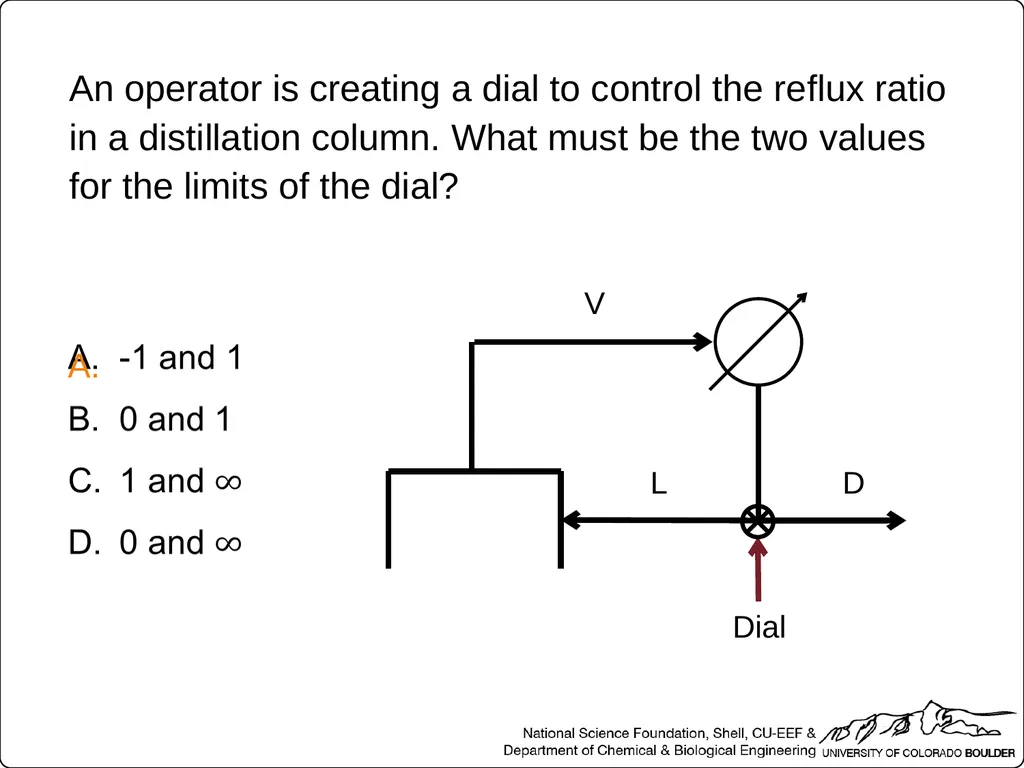
slide11. An operator is creating a dial to control the reflux ratio in a distillation column. What must be the two values for the limits of the dial? V D L Dial<br>
slide12. Which of the following plots cannot be used to represent a rectifying section operating line for a distillation column separating a binary mixture? Plots are for more volatile species. 3, 4, 6
4 & 5
4, 5, 6
1 & 2
3, 4, 5, 6 1 6 4 5 3 2<br>
slide13. Which of the following plots cannot be used to represent a stripping section for a distillation column separating a binary mixture? 2
1, 2, 3
2, 3, 5
2, 5
All but 4 1 6 4 5 3 2<br>
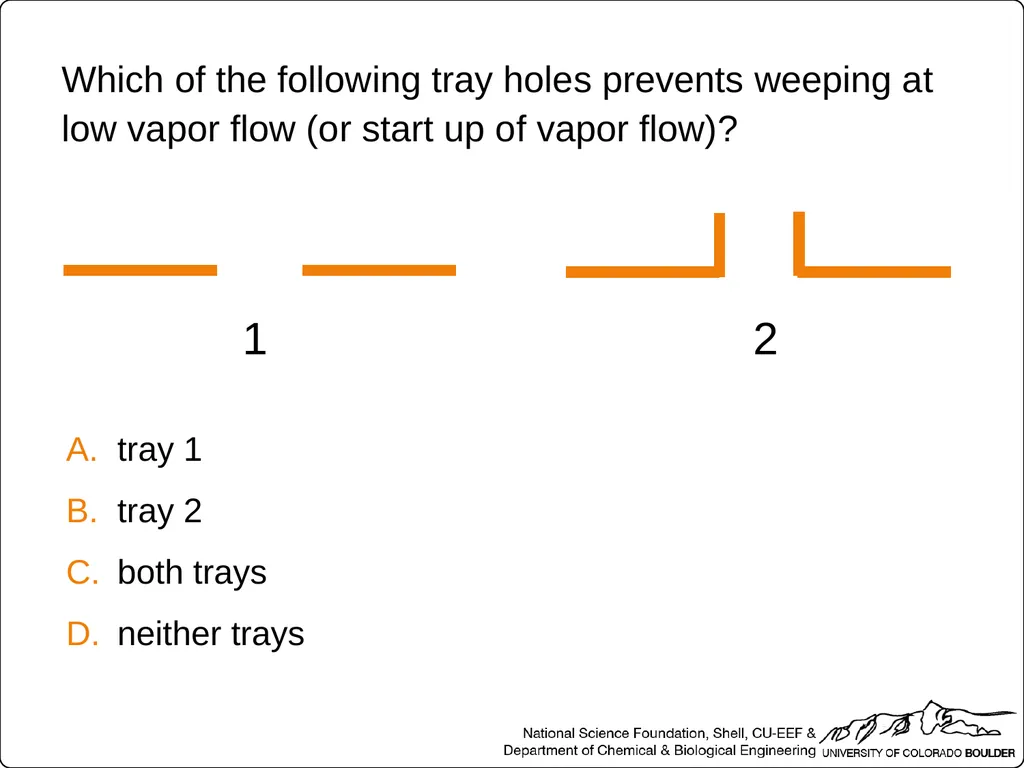
slide14. Which of the following tray holes prevents weeping at low vapor flow (or start up of vapor flow)? tray 1
tray 2
both trays
neither trays 1 2<br>
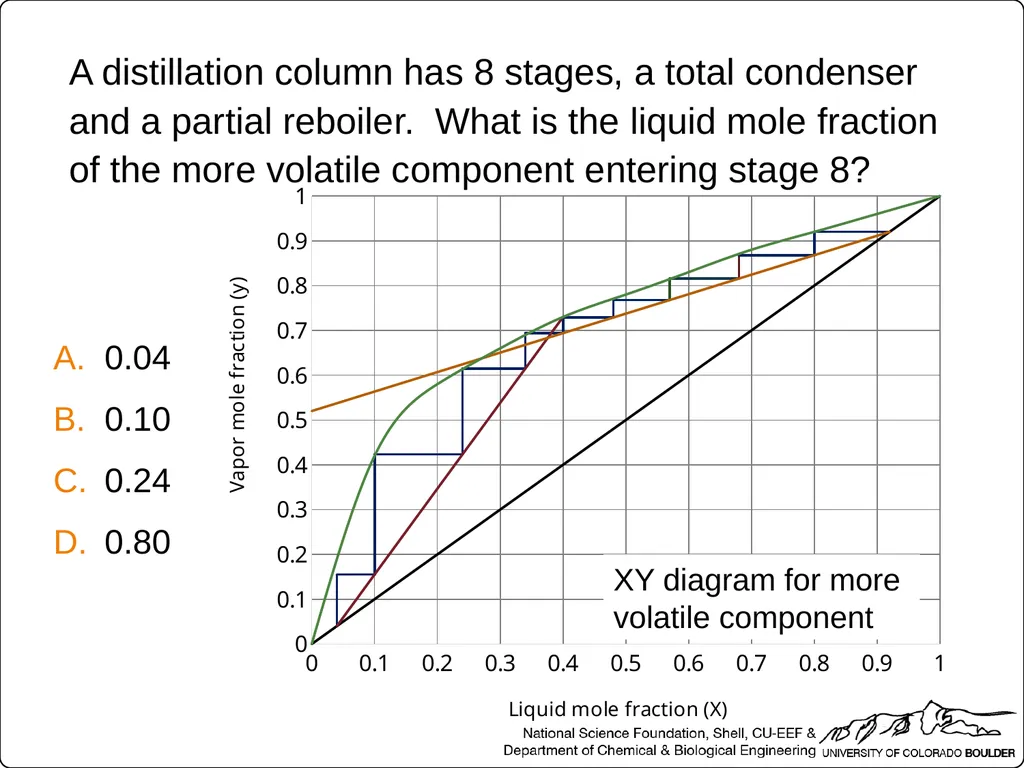
slide15. A distillation column has 8 stages, a total condenser and a partial reboiler. What is the liquid mole fraction of the more volatile component entering stage 8? 0.04
0.10
0.24
0.80 XY diagram for more
volatile component<br>
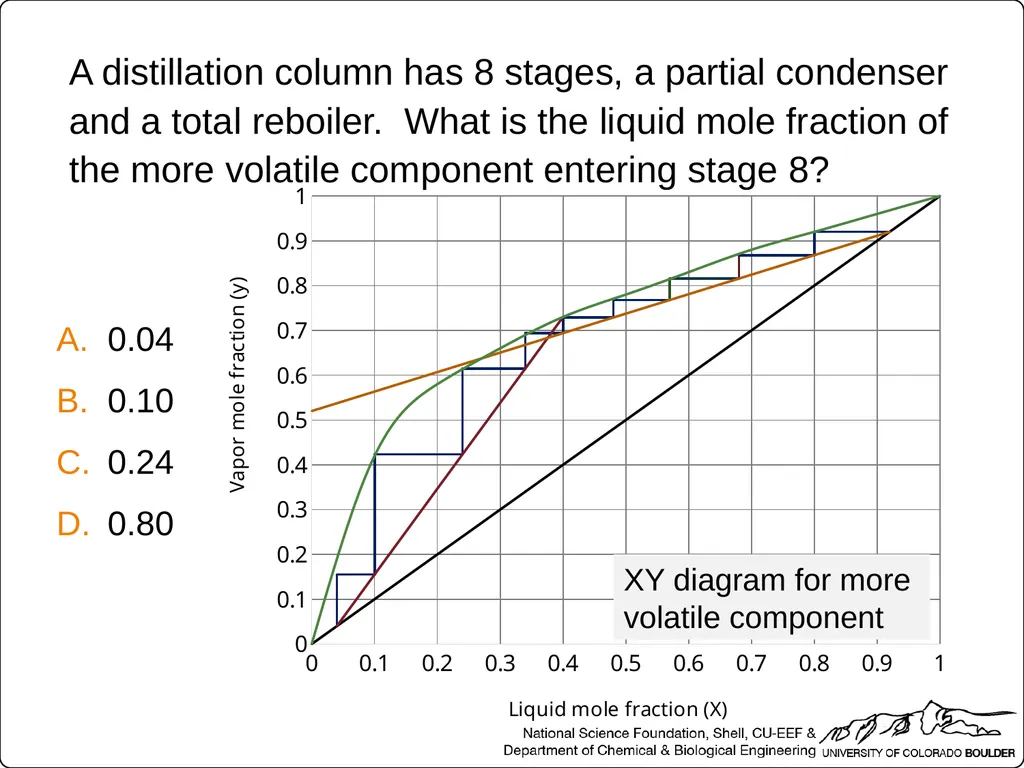
slide16. A distillation column has 8 stages, a partial condenser and a total reboiler. What is the liquid mole fraction of the more volatile component entering stage 8? 0.04
0.10
0.24
0.80 XY diagram for more
volatile component<br>
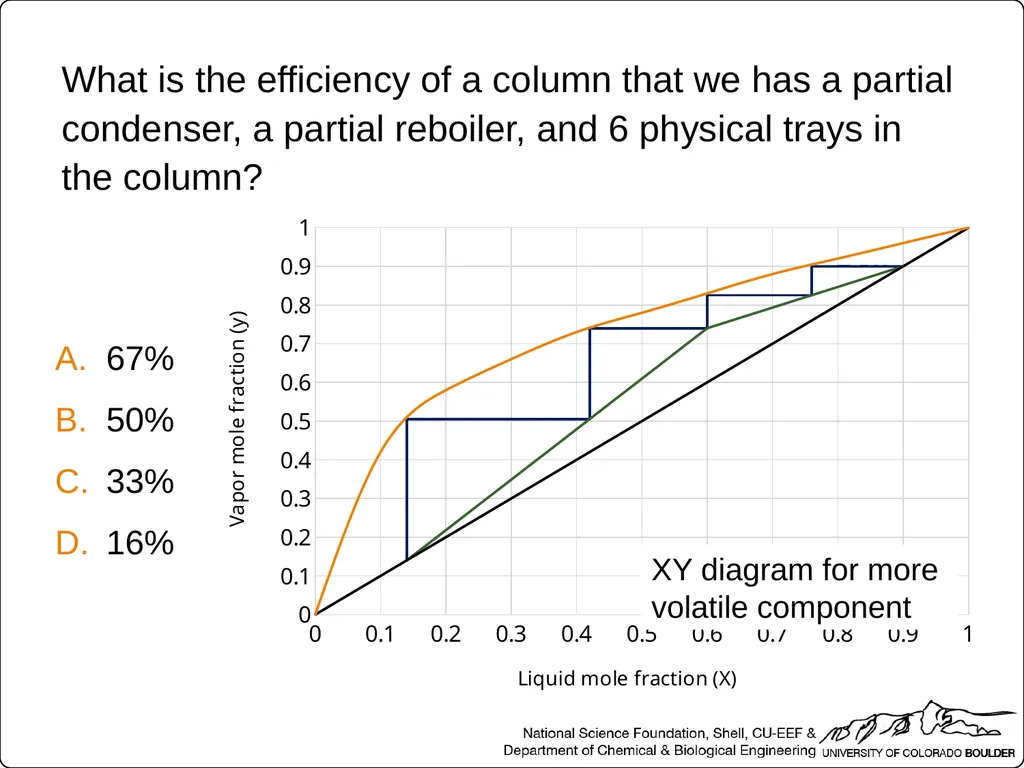
slide17. What is the efficiency of a column that we has a partial condenser, a partial reboiler, and 6 physical trays in the column? 67%
50%
33%
16% XY diagram for more
volatile component<br>
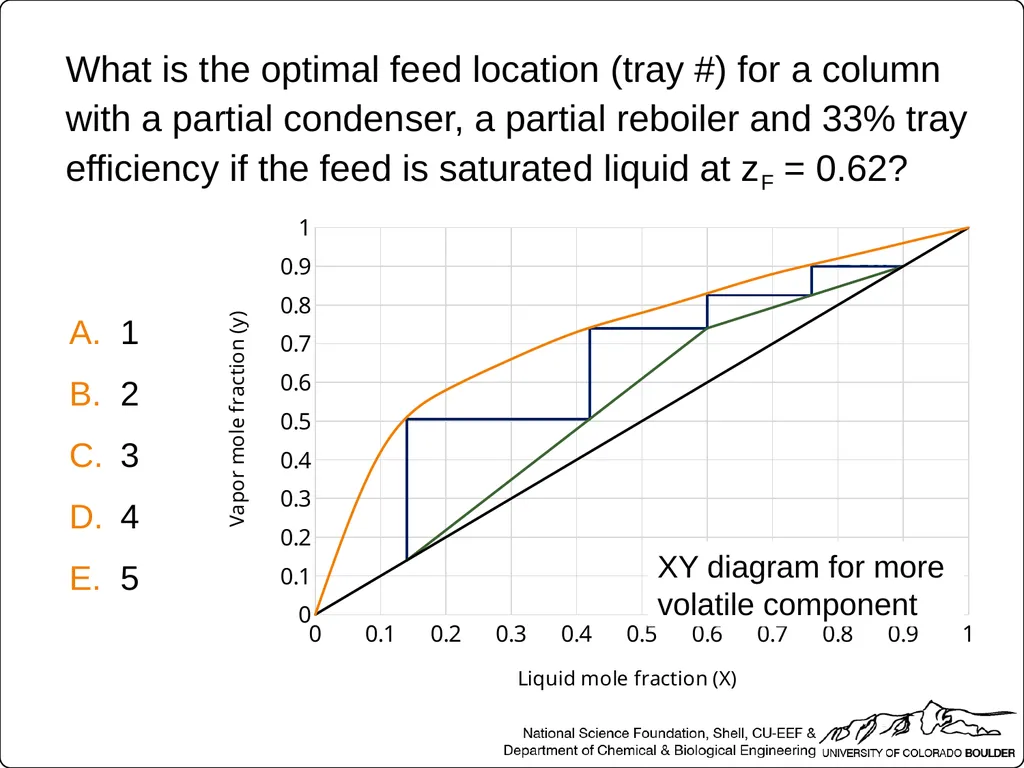
slide18. What is the optimal feed location (tray #) for a column with a partial condenser, a partial reboiler and 33% tray efficiency if the feed is saturated liquid at zF = 0.62? 1
2
3
4
5 XY diagram for more
volatile component<br>
slide19. Which feed condition minimizes the difference between partial reboiler and total condenser duties for an ideal binary separation in a distillation column? supercooled liquid
saturated liquid
saturated vapor
superheated vapor<br>
slide20. Which of the following material balance relationships are true for a binary distillation column operating with a saturated liquid feed, a total condenser and partial reboiler?
(R = reflux ratio = L/D)<br>
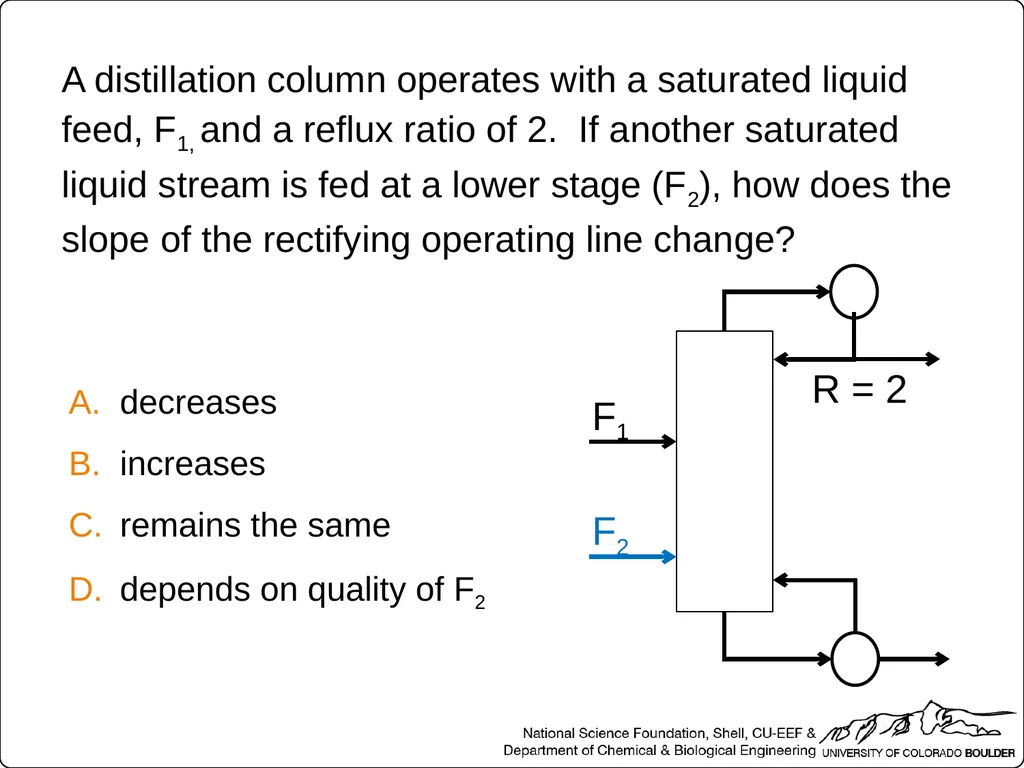
slide21. A distillation column operates with a saturated liquid feed, F1, and a reflux ratio of 2. If another saturated liquid stream is fed at a lower stage (F2), how does the slope of the rectifying operating line change? decreases
increases
remains the same
depends on quality of F2 F1 R = 2 F2<br>
slide22. A distillation column with a total condenser and partial reboiler separates a binary mixture. Lowering the reflux ratio decreases the tray efficiency. The number of trays needed to achieve the same separation as before ________. increases
decreases
remains the same
depends on reflux ratio<br>
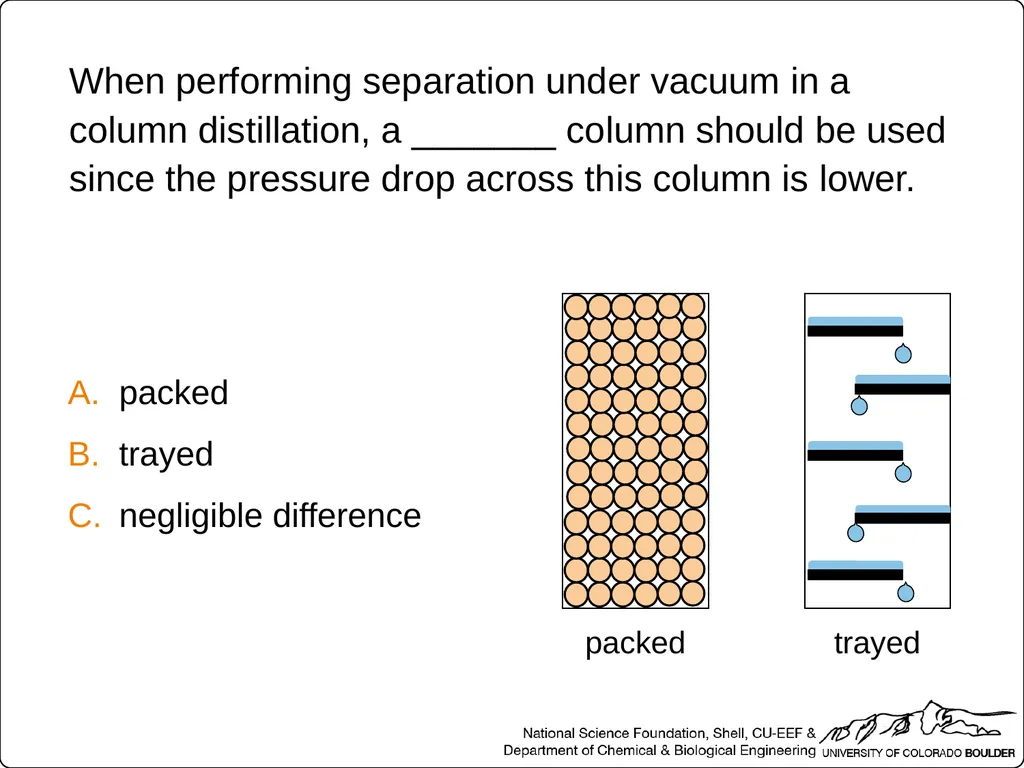
slide23. When performing separation under vacuum in a column distillation, a _______ column should be used since the pressure drop across this column is lower. packed
trayed
negligible difference<br>
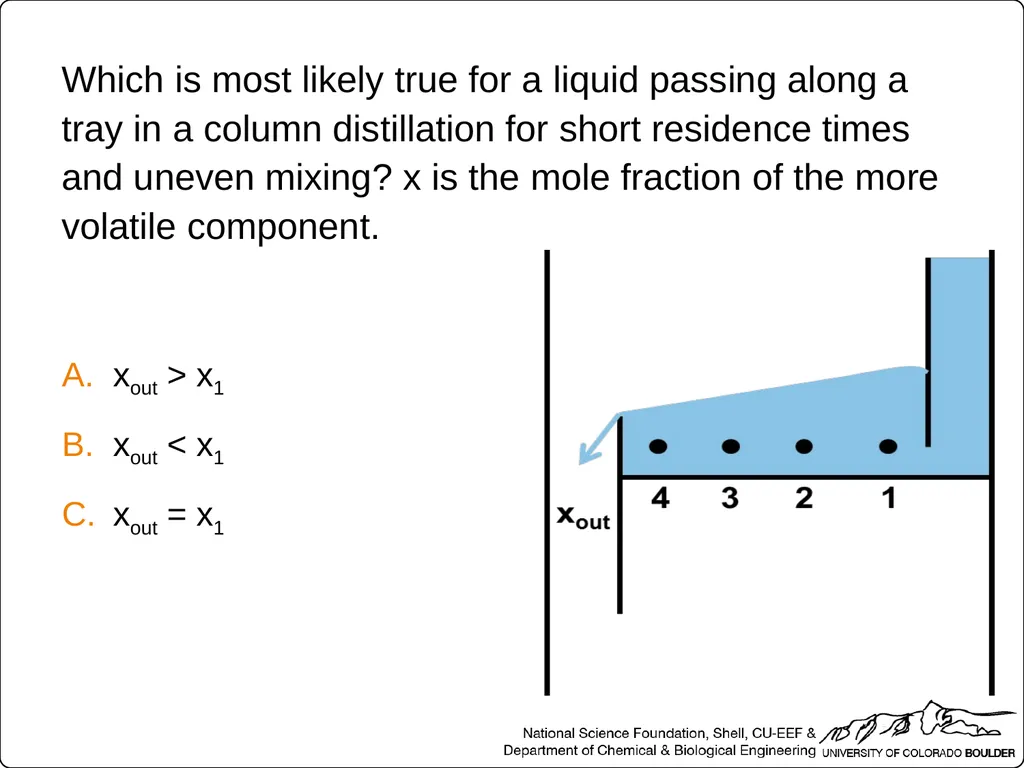
slide24. Which is most likely true for a liquid passing along a tray in a column distillation for short residence times and uneven mixing? x is the mole fraction of the more volatile component. xout > x1
xout < x1
xout = x1<br>
slide25. Which of the following results in only vapor products (D and B)?
1) Partial condenser 2) Total condenser
3) Partial reboiler 4) Total reboiler
5) Total reflux 6) Total boilup 1 & 3
5 & 6
2 & 4
2 & 6
4 & 5 Note: not drawn for all setups<br>
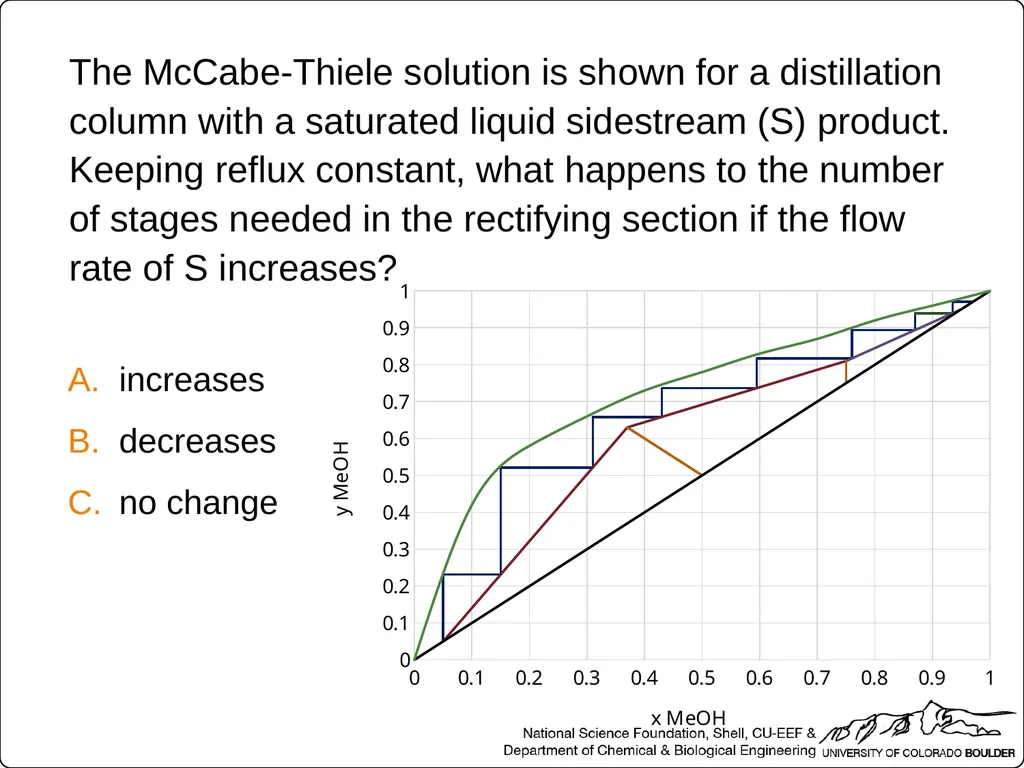
slide26. The McCabe-Thiele solution is shown for a distillation column with a saturated liquid sidestream (S) product. Keeping reflux constant, what happens to the number of stages needed in the rectifying section if the flow rate of S increases? increases
decreases
no change<br>
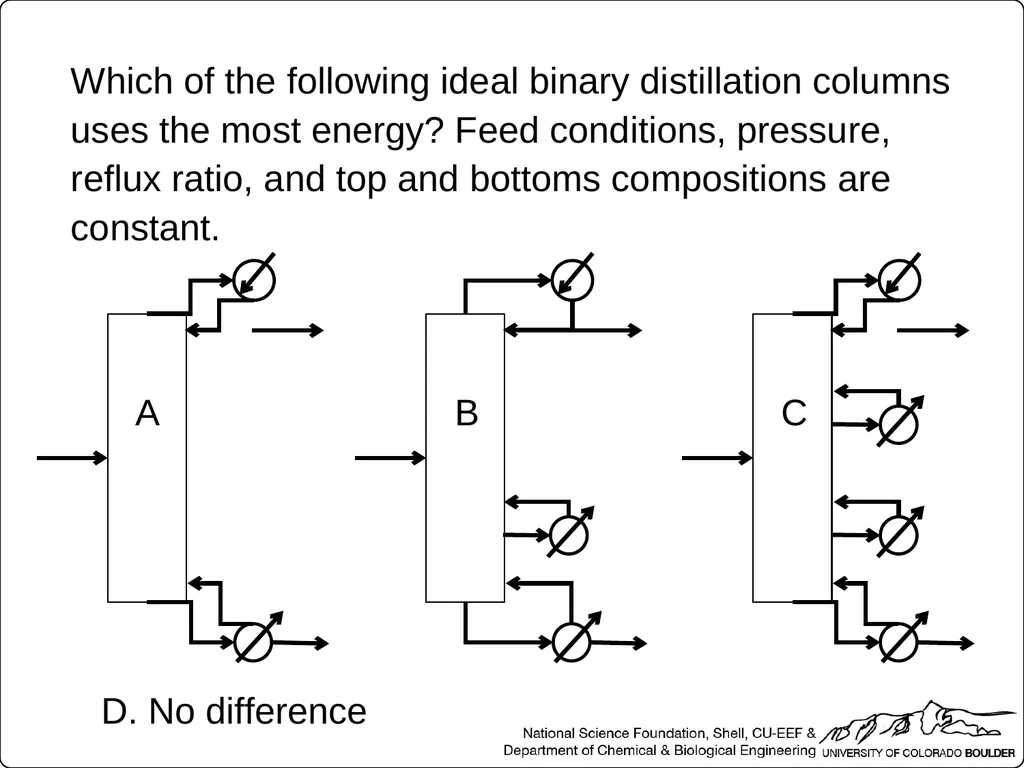
slide27. Which of the following ideal binary distillation columns uses the most energy? Feed conditions, pressure, reflux ratio, and top and bottoms compositions are constant. D. No difference A B C<br>
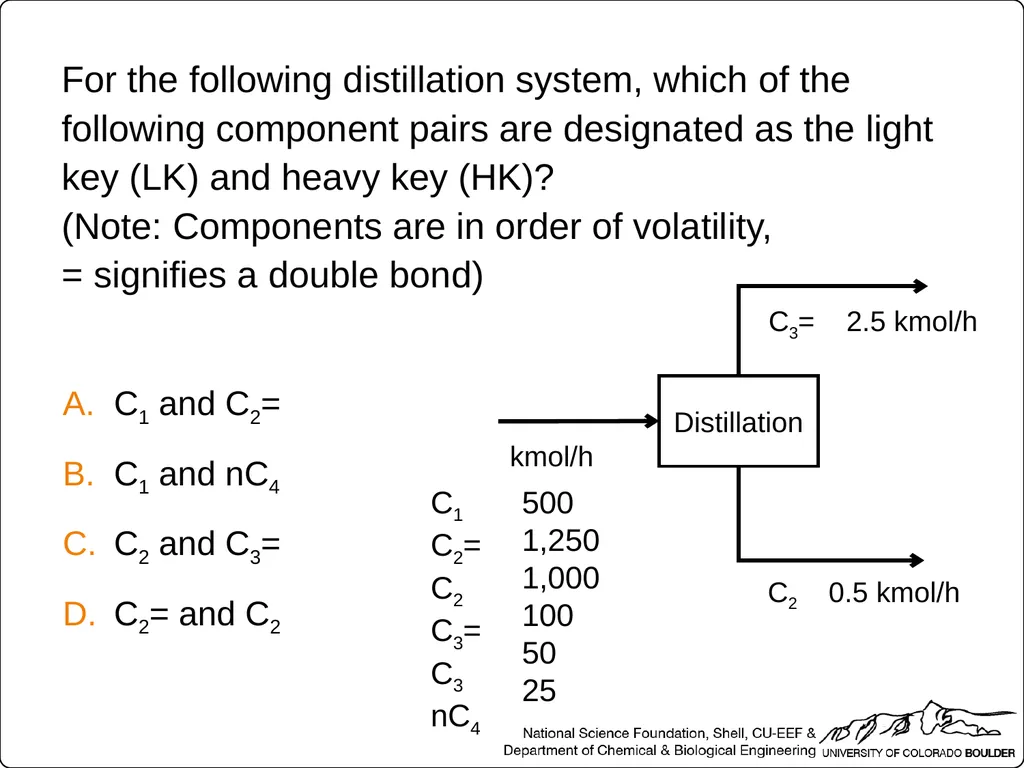
slide28. For the following distillation system, which of the following component pairs are designated as the light key (LK) and heavy key (HK)?
(Note: Components are in order of volatility, = signifies a double bond) C1 and C2=
C1 and nC4
C2 and C3=
C2= and C2 Distillation C1
C2=
C2
C3=
C3
nC4 500
1,250
1,000
100
50
25 kmol/h C3= 2.5 kmol/h C2 0.5 kmol/h<br>
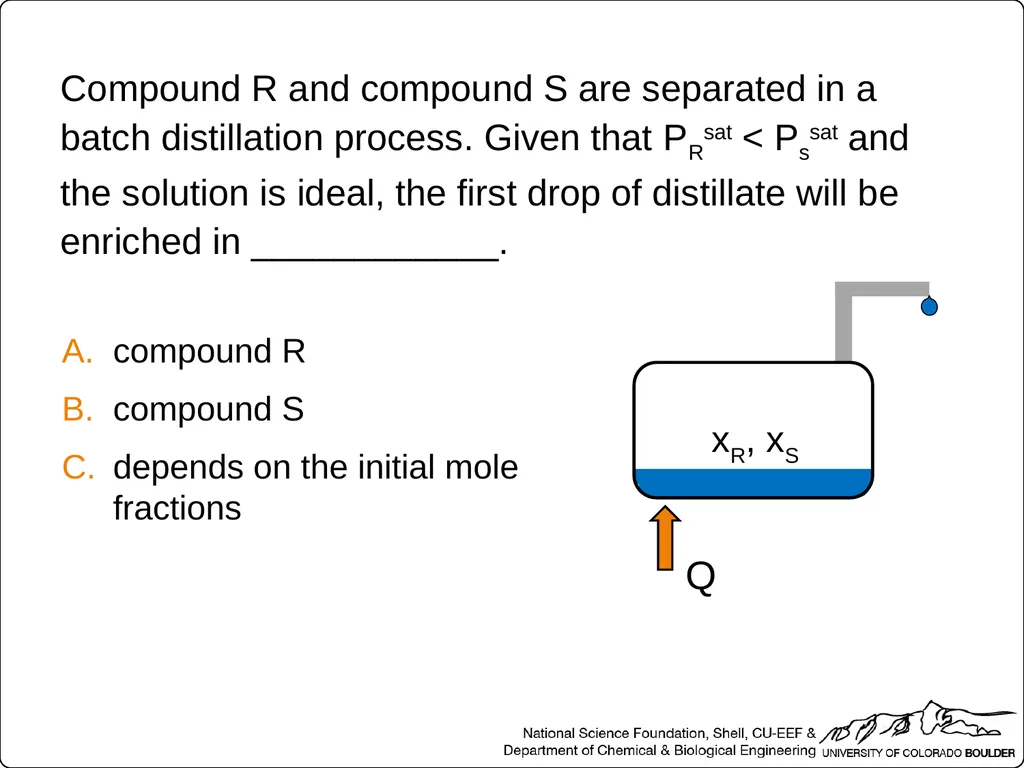
slide29. Compound R and compound S are separated in a batch distillation process. Given that PRsat < Pssat and the solution is ideal, the first drop of distillate will be enriched in ____________. compound R
compound S
depends on the initial mole fractions<br>
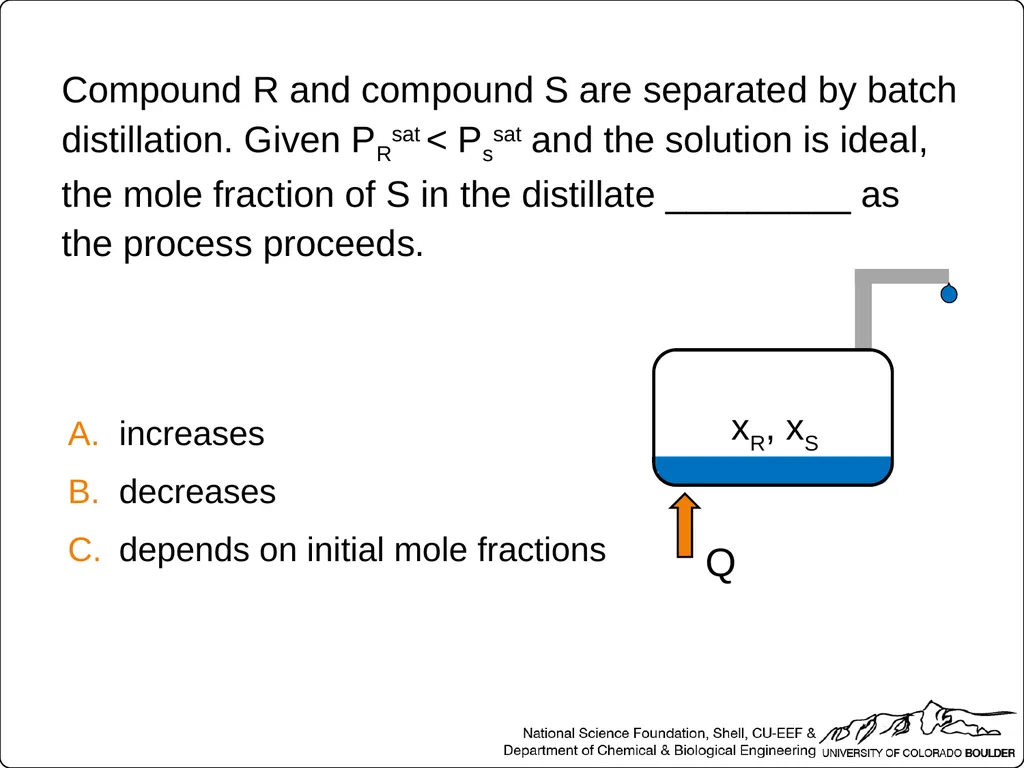
slide30. Compound R and compound S are separated by batch distillation. Given PRsat < Pssat and the solution is ideal, the mole fraction of S in the distillate _________ as the process proceeds. increases
decreases
depends on initial mole fractions<br>
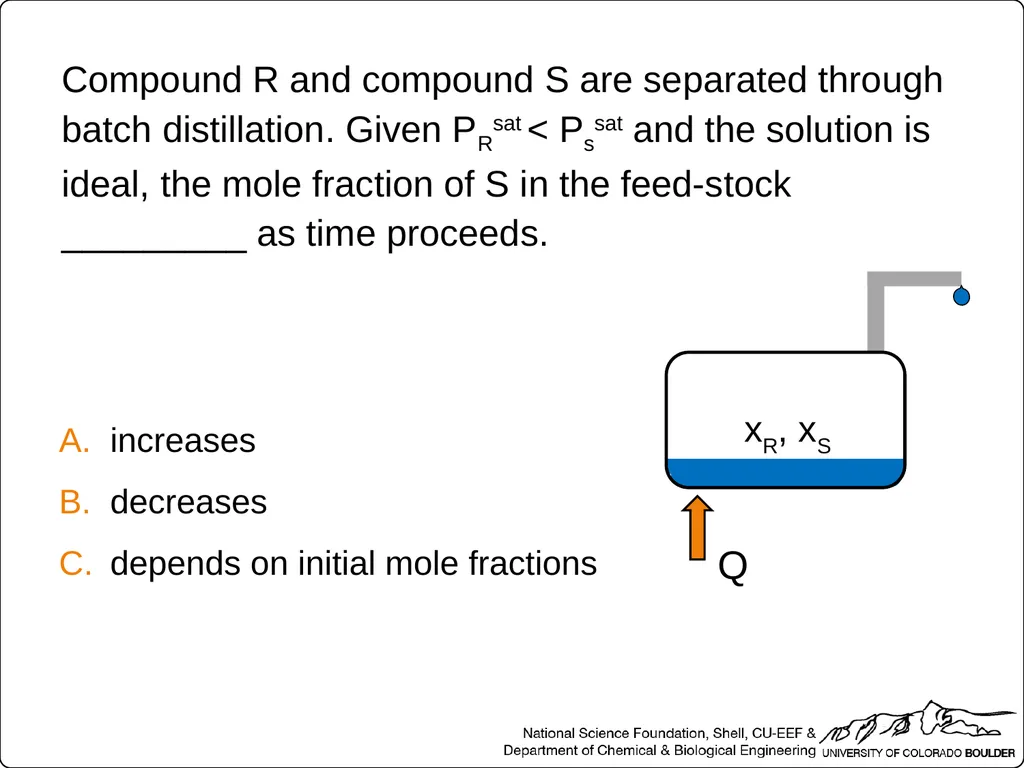
slide31. Compound R and compound S are separated through batch distillation. Given PRsat < Pssat and the solution is ideal, the mole fraction of S in the feed-stock _________ as time proceeds. increases
decreases
depends on initial mole fractions<br>
slide32. A 100-mol mixture of benzene and toluene are fed into a batch distillation still, which is heated to keep the boil-up rate constant. Which of the following does not change during the distillation? distillate composition
bottoms composition
still temperature
distillate flow rate
none of the above<br>
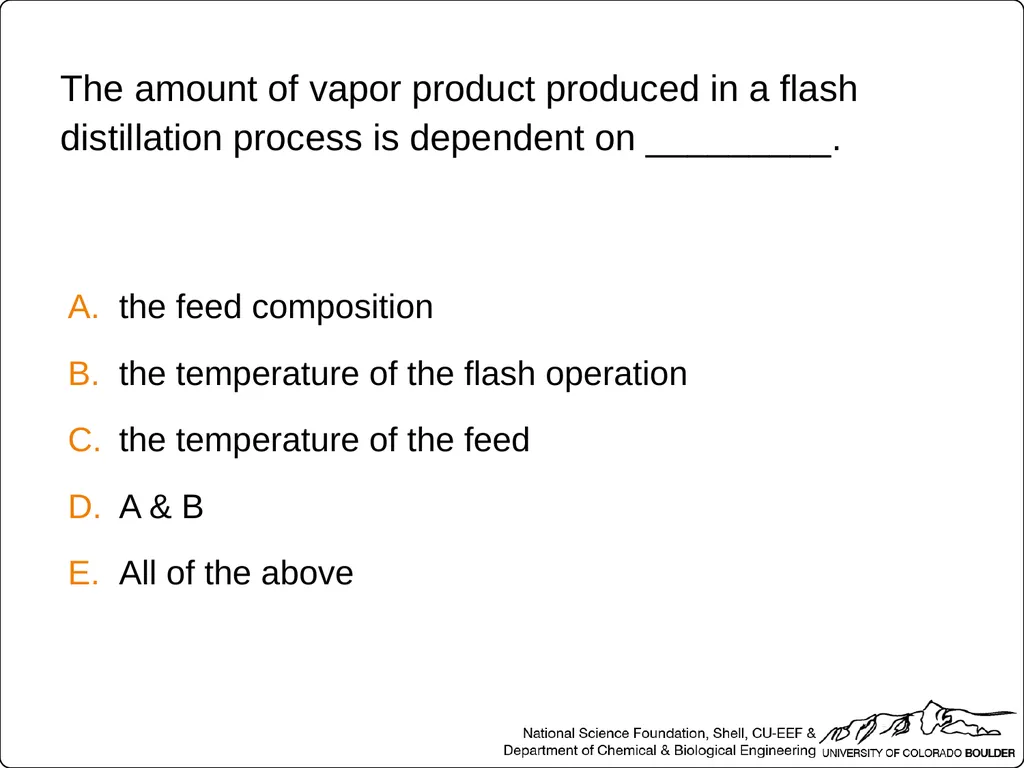
slide33. The amount of vapor product produced in a flash distillation process is dependent on _________. the feed composition
the temperature of the flash operation
the temperature of the feed
A & B
All of the above<br>
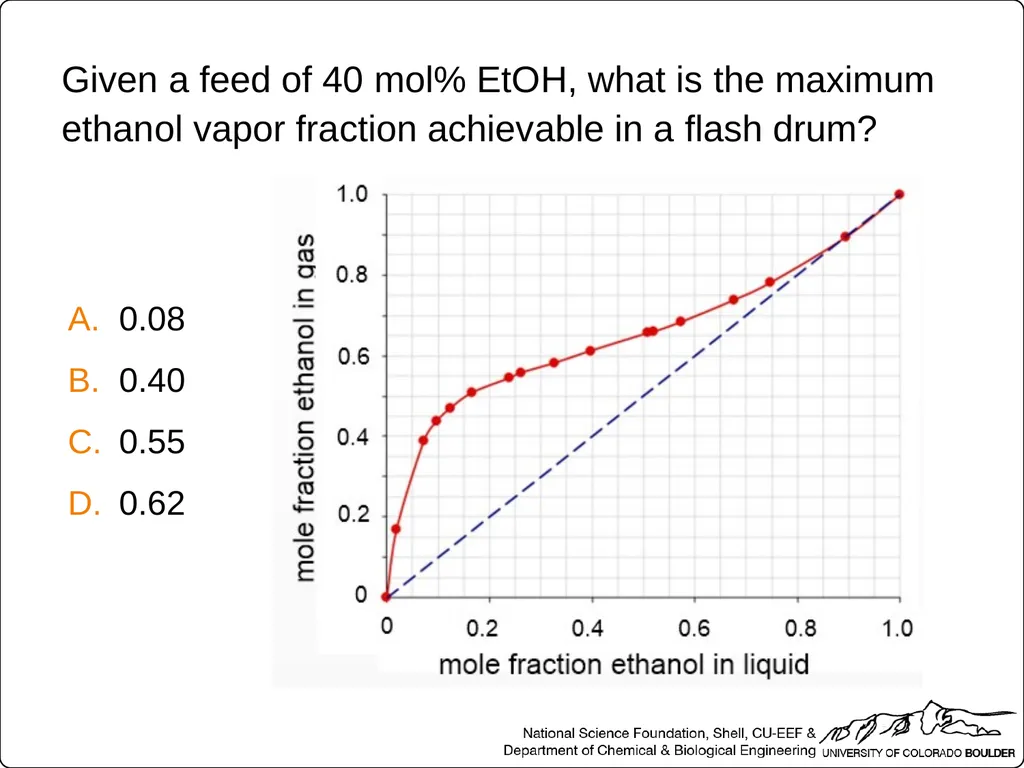
slide34. 0.08
0.40
0.55
0.62 Given a feed of 40 mol% EtOH, what is the maximum ethanol vapor fraction achievable in a flash drum?<br>
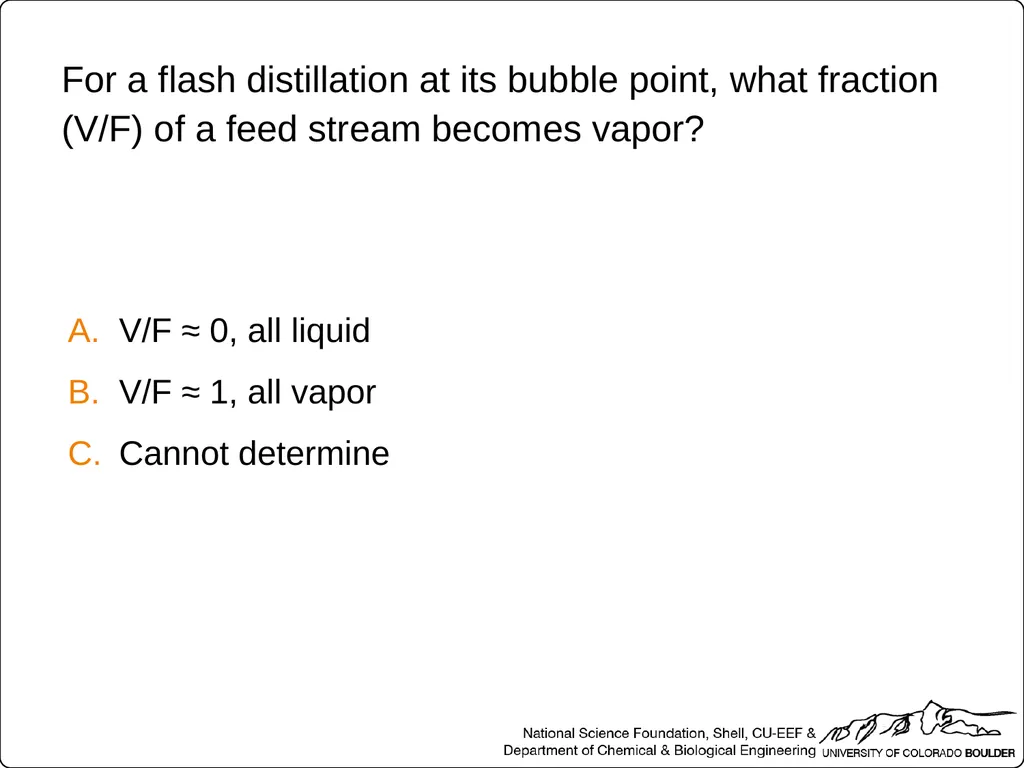
slide35. For a flash distillation at its bubble point, what fraction (V/F) of a feed stream becomes vapor? V/F ≈ 0, all liquid
V/F ≈ 1, all vapor
Cannot determine<br>
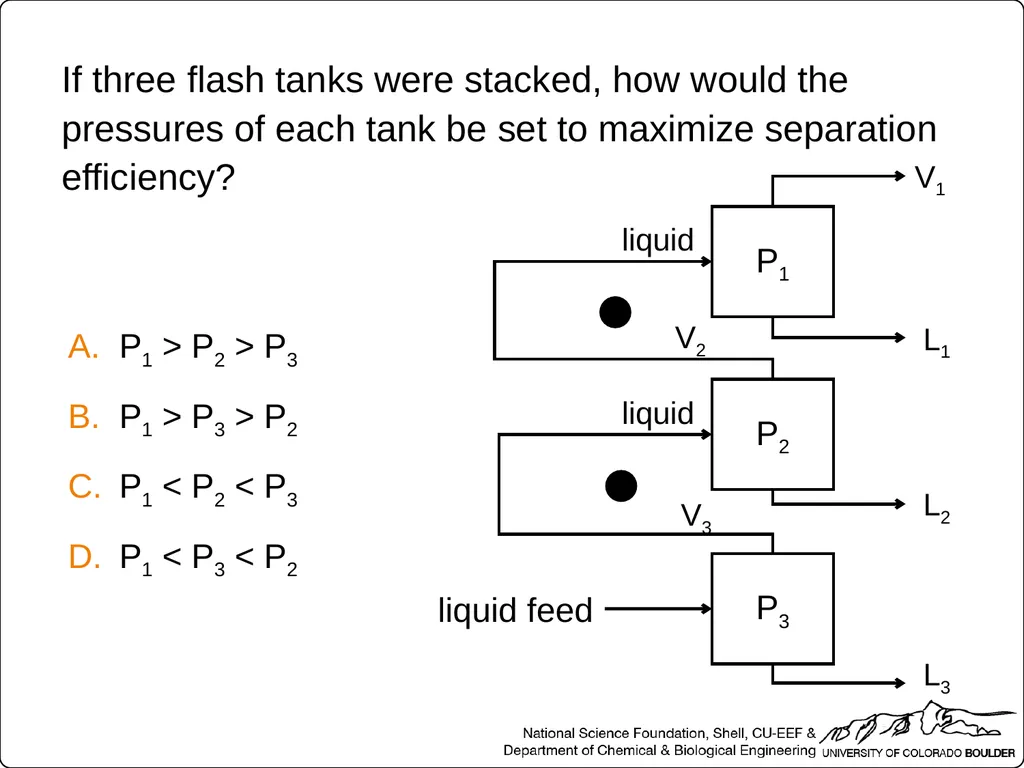
slide36. If three flash tanks were stacked, how would the pressures of each tank be set to maximize separation efficiency? P1 > P2 > P3
P1 > P3 > P2
P1 < P2 < P3
P1 < P3 < P2 P1 P2 P3 V1 L1 V2 V3 L2 L3 liquid feed liquid liquid<br>
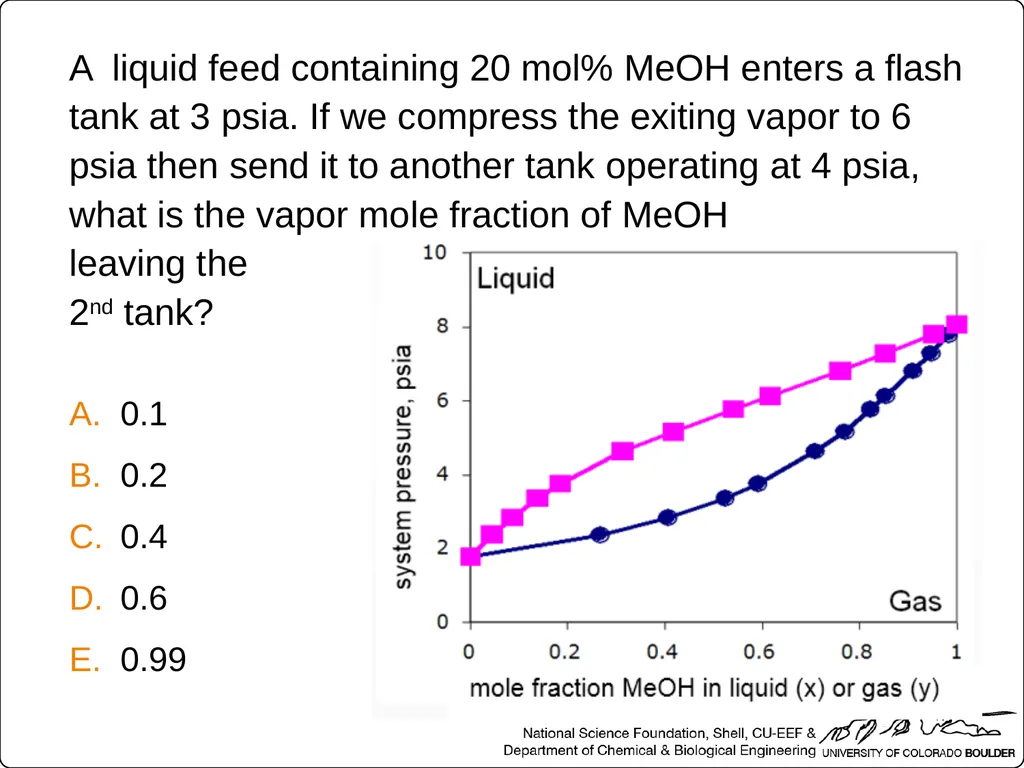
slide37. A liquid feed containing 20 mol% MeOH enters a flash tank at 3 psia. If we compress the exiting vapor to 6 psia then send it to another tank operating at 4 psia, what is the vapor mole fraction of MeOH
leaving the
2nd tank? 0.1
0.2
0.4
0.6
0.99<br>
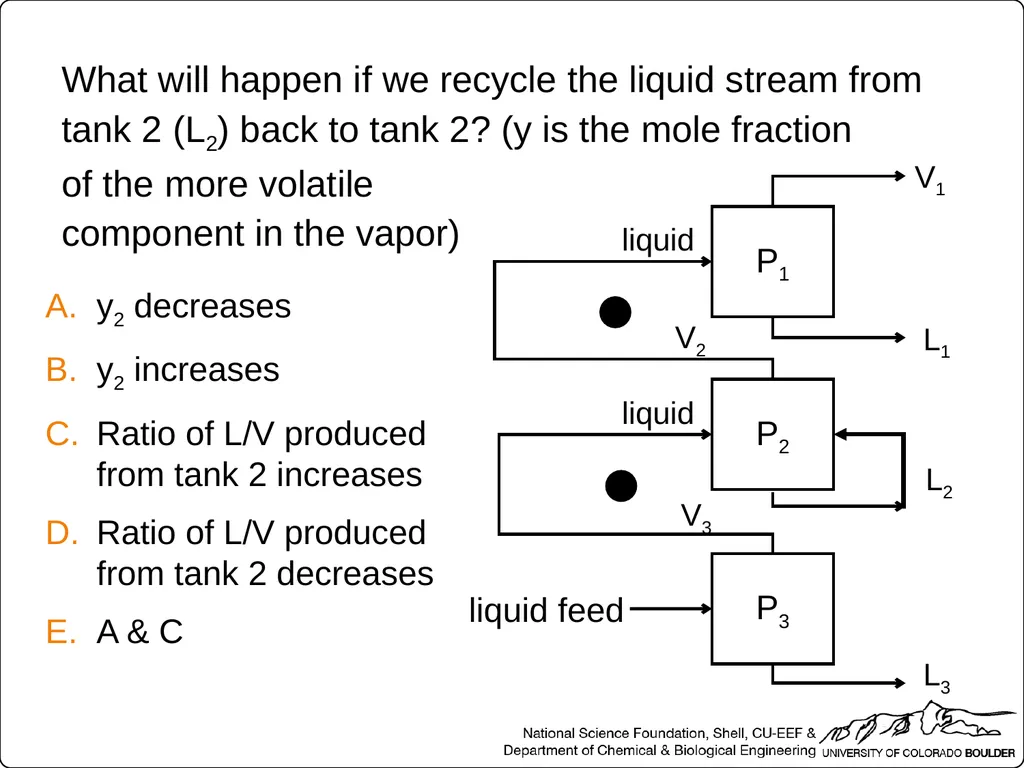
slide38. What will happen if we recycle the liquid stream from tank 2 (L2) back to tank 2? (y is the mole fraction of the more volatile component in the vapor) y2 decreases
y2 increases
Ratio of L/V produced from tank 2 increases
Ratio of L/V produced from tank 2 decreases
A & C P1 P2 P3 V1 L1 V2 V3 L2 L3 liquid feed liquid liquid<br>
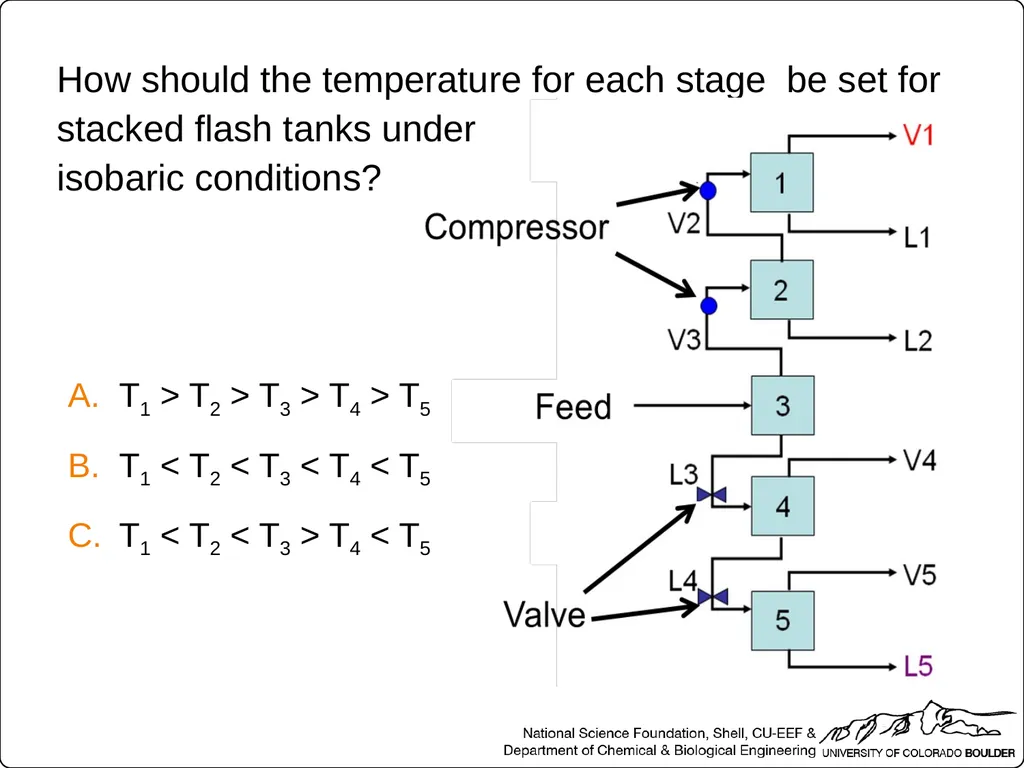
slide39. How should the temperature for each stage be set for stacked flash tanks under isobaric conditions? T1 > T2 > T3 > T4 > T5
T1 < T2 < T3 < T4 < T5
T1 < T2 < T3 > T4 < T5<br>
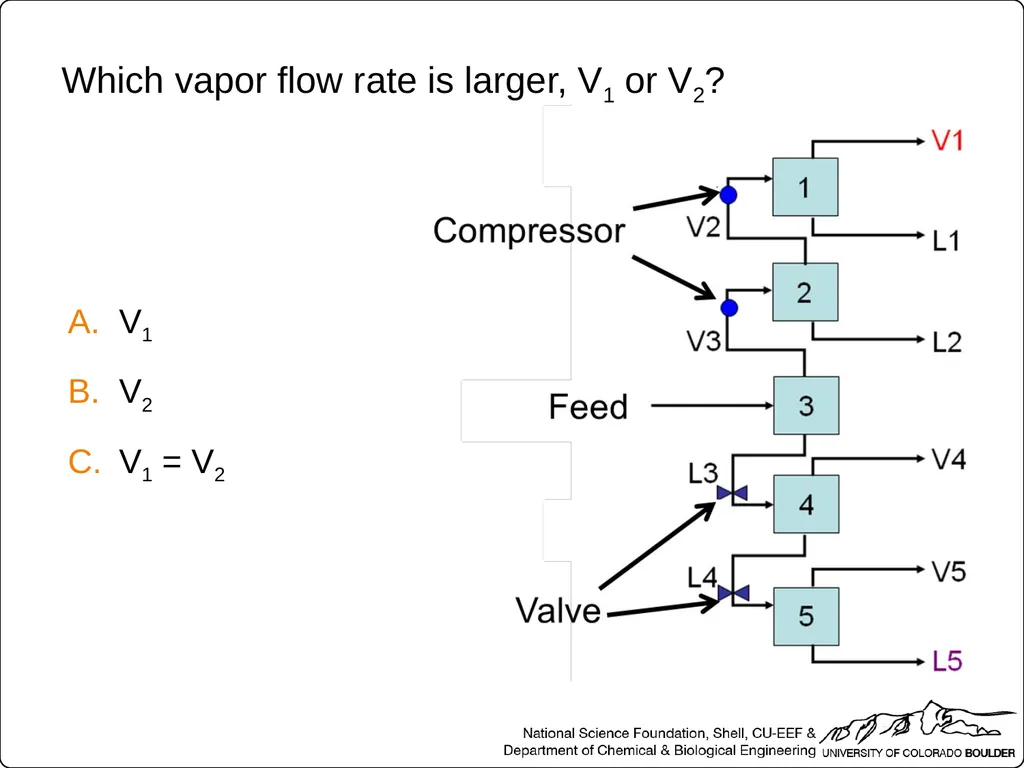
slide40. Which vapor flow rate is larger, V1 or V2? V1
V2
V1 = V2<br>

1 & 2
2 & 6
2 & 4<br>
slide2. Which two streams relate to operating conditions for equilibrium staged operations? 2 & 5
1 & 2
2 & 6
2 & 4<br>
slide3. Which of the following relationships is true using the distillation setup shown?
K = thermodynamic K-value<br>
slide4. increases
decreases
remains the same V L F, q<br>
slide5. A McCabe-Thiele solution to a distillation column separating methanol and water is shown. The blue line is the top operating line and the green line is the bottom operating line. Which stage is the feed stage? 1
2
3
partial reboiler (B)<br>
slide6. A McCabe-Thiele solution to a distillation column separating methanol and water is shown. Currently, the feed stage is number _______, but the optimum feed stage is number ________. 4, 3
3, 3
3, 1
3, Boiler
4, 4<br>
slide7. In column distillation, the limiting operating conditions of minimum reflux and total reflux represent a(n) _________ and a(n) __________ number of stages for a given separation, respectively. minimum, maximum
infinite, minimum
infinite, maximum
maximum, minimum<br>
slide8. Murphree vapor/liquid efficiencies can exceed one and be less than zero. true
false<br>
slide9. For a binary distillation column operating at atmospheric pressure, the temperature __________ from the bottom to the top of the column. increases
decreases
is constant
depends on the separation<br>
slide10. For a binary distillation column operating at constant temperature, the pressure __________ from the bottom to the top of the column. increases
decreases
is constant
depends on the separation<br>
slide11. An operator is creating a dial to control the reflux ratio in a distillation column. What must be the two values for the limits of the dial? V D L Dial<br>
slide12. Which of the following plots cannot be used to represent a rectifying section operating line for a distillation column separating a binary mixture? Plots are for more volatile species. 3, 4, 6
4 & 5
4, 5, 6
1 & 2
3, 4, 5, 6 1 6 4 5 3 2<br>
slide13. Which of the following plots cannot be used to represent a stripping section for a distillation column separating a binary mixture? 2
1, 2, 3
2, 3, 5
2, 5
All but 4 1 6 4 5 3 2<br>
slide14. Which of the following tray holes prevents weeping at low vapor flow (or start up of vapor flow)? tray 1
tray 2
both trays
neither trays 1 2<br>
slide15. A distillation column has 8 stages, a total condenser and a partial reboiler. What is the liquid mole fraction of the more volatile component entering stage 8? 0.04
0.10
0.24
0.80 XY diagram for more
volatile component<br>
slide16. A distillation column has 8 stages, a partial condenser and a total reboiler. What is the liquid mole fraction of the more volatile component entering stage 8? 0.04
0.10
0.24
0.80 XY diagram for more
volatile component<br>
slide17. What is the efficiency of a column that we has a partial condenser, a partial reboiler, and 6 physical trays in the column? 67%
50%
33%
16% XY diagram for more
volatile component<br>
slide18. What is the optimal feed location (tray #) for a column with a partial condenser, a partial reboiler and 33% tray efficiency if the feed is saturated liquid at zF = 0.62? 1
2
3
4
5 XY diagram for more
volatile component<br>
slide19. Which feed condition minimizes the difference between partial reboiler and total condenser duties for an ideal binary separation in a distillation column? supercooled liquid
saturated liquid
saturated vapor
superheated vapor<br>
slide20. Which of the following material balance relationships are true for a binary distillation column operating with a saturated liquid feed, a total condenser and partial reboiler?
(R = reflux ratio = L/D)<br>
slide21. A distillation column operates with a saturated liquid feed, F1, and a reflux ratio of 2. If another saturated liquid stream is fed at a lower stage (F2), how does the slope of the rectifying operating line change? decreases
increases
remains the same
depends on quality of F2 F1 R = 2 F2<br>
slide22. A distillation column with a total condenser and partial reboiler separates a binary mixture. Lowering the reflux ratio decreases the tray efficiency. The number of trays needed to achieve the same separation as before ________. increases
decreases
remains the same
depends on reflux ratio<br>
slide23. When performing separation under vacuum in a column distillation, a _______ column should be used since the pressure drop across this column is lower. packed
trayed
negligible difference<br>
slide24. Which is most likely true for a liquid passing along a tray in a column distillation for short residence times and uneven mixing? x is the mole fraction of the more volatile component. xout > x1
xout < x1
xout = x1<br>
slide25. Which of the following results in only vapor products (D and B)?
1) Partial condenser 2) Total condenser
3) Partial reboiler 4) Total reboiler
5) Total reflux 6) Total boilup 1 & 3
5 & 6
2 & 4
2 & 6
4 & 5 Note: not drawn for all setups<br>
slide26. The McCabe-Thiele solution is shown for a distillation column with a saturated liquid sidestream (S) product. Keeping reflux constant, what happens to the number of stages needed in the rectifying section if the flow rate of S increases? increases
decreases
no change<br>
slide27. Which of the following ideal binary distillation columns uses the most energy? Feed conditions, pressure, reflux ratio, and top and bottoms compositions are constant. D. No difference A B C<br>
slide28. For the following distillation system, which of the following component pairs are designated as the light key (LK) and heavy key (HK)?
(Note: Components are in order of volatility, = signifies a double bond) C1 and C2=
C1 and nC4
C2 and C3=
C2= and C2 Distillation C1
C2=
C2
C3=
C3
nC4 500
1,250
1,000
100
50
25 kmol/h C3= 2.5 kmol/h C2 0.5 kmol/h<br>
slide29. Compound R and compound S are separated in a batch distillation process. Given that PRsat < Pssat and the solution is ideal, the first drop of distillate will be enriched in ____________. compound R
compound S
depends on the initial mole fractions<br>
slide30. Compound R and compound S are separated by batch distillation. Given PRsat < Pssat and the solution is ideal, the mole fraction of S in the distillate _________ as the process proceeds. increases
decreases
depends on initial mole fractions<br>
slide31. Compound R and compound S are separated through batch distillation. Given PRsat < Pssat and the solution is ideal, the mole fraction of S in the feed-stock _________ as time proceeds. increases
decreases
depends on initial mole fractions<br>
slide32. A 100-mol mixture of benzene and toluene are fed into a batch distillation still, which is heated to keep the boil-up rate constant. Which of the following does not change during the distillation? distillate composition
bottoms composition
still temperature
distillate flow rate
none of the above<br>
slide33. The amount of vapor product produced in a flash distillation process is dependent on _________. the feed composition
the temperature of the flash operation
the temperature of the feed
A & B
All of the above<br>
slide34. 0.08
0.40
0.55
0.62 Given a feed of 40 mol% EtOH, what is the maximum ethanol vapor fraction achievable in a flash drum?<br>
slide35. For a flash distillation at its bubble point, what fraction (V/F) of a feed stream becomes vapor? V/F ≈ 0, all liquid
V/F ≈ 1, all vapor
Cannot determine<br>
slide36. If three flash tanks were stacked, how would the pressures of each tank be set to maximize separation efficiency? P1 > P2 > P3
P1 > P3 > P2
P1 < P2 < P3
P1 < P3 < P2 P1 P2 P3 V1 L1 V2 V3 L2 L3 liquid feed liquid liquid<br>
slide37. A liquid feed containing 20 mol% MeOH enters a flash tank at 3 psia. If we compress the exiting vapor to 6 psia then send it to another tank operating at 4 psia, what is the vapor mole fraction of MeOH
leaving the
2nd tank? 0.1
0.2
0.4
0.6
0.99<br>
slide38. What will happen if we recycle the liquid stream from tank 2 (L2) back to tank 2? (y is the mole fraction of the more volatile component in the vapor) y2 decreases
y2 increases
Ratio of L/V produced from tank 2 increases
Ratio of L/V produced from tank 2 decreases
A & C P1 P2 P3 V1 L1 V2 V3 L2 L3 liquid feed liquid liquid<br>
slide39. How should the temperature for each stage be set for stacked flash tanks under isobaric conditions? T1 > T2 > T3 > T4 > T5
T1 < T2 < T3 < T4 < T5
T1 < T2 < T3 > T4 < T5<br>
slide40. Which vapor flow rate is larger, V1 or V2? V1
V2
V1 = V2<br>