Whitepaper Geo-AQ Validation Needs Prepared by the Atmospheric Composition Virtual Constellation (AC-VC) AC-VC co-chaired by Ben Veihelmann (ESA), Jay Al-Saadi (NASA) Joint Geostationary Science Meeting Harvard-Smithsonian Center for
"Whitepaper ‘Geo-AQ Validation Needs’ Prepared by" is the property of its rightful owner. Permission is granted to
download and print the materials on this website for personal, non-commercial use only, and to display it
on your personal computer provided you do not modify the materials and that you retain all copyright
notices contained in the materials. By downloading content from our website, you accept the terms of this
agreement.
Presentation Transcript
01
Whitepaper ‘Geo-AQ Validation Needs’ Prepared by the Atmospheric Composition Virtual Constellation (AC-VC) AC-VC co-chaired by Ben Veihelmann (ESA), Jay Al-Saadi (NASA) Joint Geostationary Science Meeting
Harvard-Smithsonian Center for Astrophysics
Cambridge, MA, US
26-27 September, 2019 Committee on Earth Observation Satellites<br>
02
Background
Purpose of the Whitepaper ‘Geo-AQ Validation Needs’
Contributors to the Whitepaper
Structure / Table of Content
Constellation products
Consistency targets
Recommendations
Discussion 2 Overview<br>
03
3 Committee on Earth Observation Satellites (CEOS)
Forum for international coordination of space-based Earth observations
Working groups, virtual constellations, ad-hoc teams, …
Atmospheric Composition Virtual Constellation (AC-VC)
Enhance space-based observation capabilities for:
Ozone layer, air quality, and climate
Through coordination of international space assets
CEOS Work Plan Action VC-3: AC-VC to prepare a document on validation needs for the Geo-AQ Constellation
Final review during AC-VC-15, June 2019, Tokyo, Japan
Presented at CEOS SIT Technical Workshop, 11-12 Sep 2019
Presented at CEOS Plenary 14-16 Oct 2019, for endorsement/acknowledgement Background<br>
04
Elaborate the validation needs of the Geo-AQ Constellation: focus on
new challenges for geostationary atmospheric composition missions (new with respect to LEO heritage)
enhancing the success of missions when seen as elements of a constellation
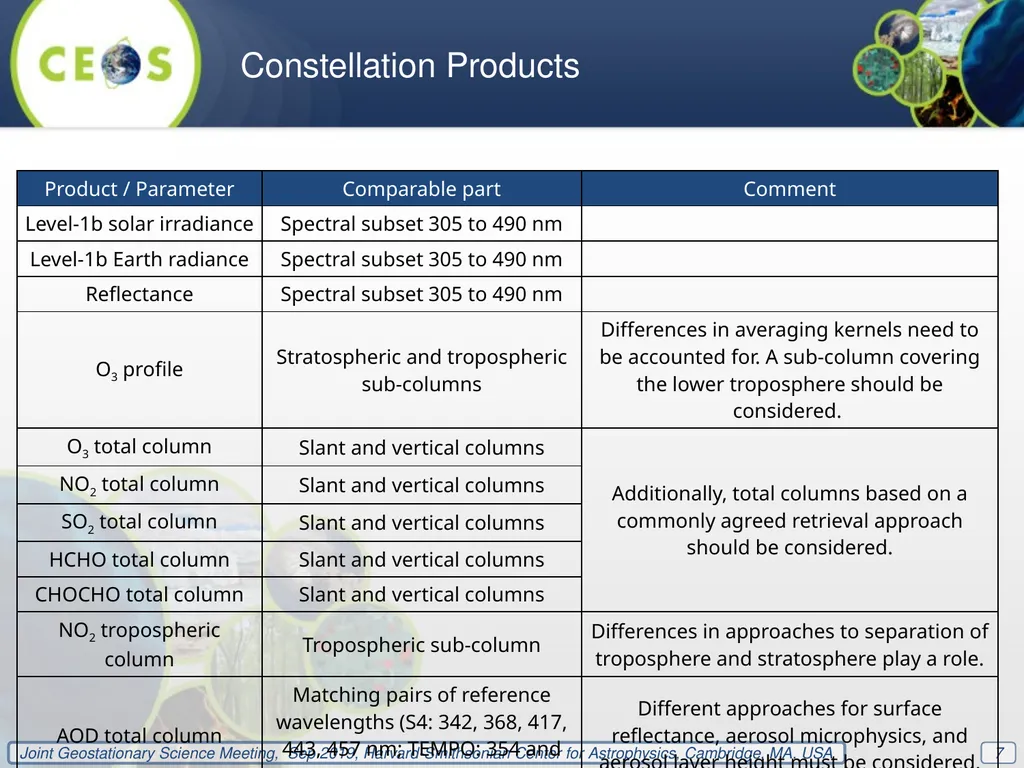
Identify ‘Constellation Products’
common to the Geo-AQ missions
enhanced value by establishing and monitoring inter-mission consistency
Set inter-mission consistency targets for Constellation Products
taking into account individual product performances and the accuracy of validation methods
Identify activities needed to assess and establish this consistency
Activities to be performed consistently for each mission
Activities addressing new Geo-AQ challenges and inter-mission consistency
Coordination and continuity
Make specific and actionable recommendations 4 Purpose of the ‘Geo-AQ Validation Needs’ Whitepaper<br>
05
The Whitepaper has been written by the science teams of the GEMS, Sentinel-4, and TEMPO missions and validation experts including
Al-Saadi, Jay (NASA, USA; AC-VC)
Cede, Alexander (Luftblick, AT, AC-VC)
Chance, Kelly (SAO, USA; AC-VC)
Flynn, Lawrence E. (NOAA, USA, AC-VC; GSICS)
Kim, Jhoon (Yonsei University, Korea; AC-VC)
Kim, Sang-Woo (Seoul National University, Korea, AC-VC)
Koopman, Rob (ESA, EU)
Lambert, Jean-Christopher (IASB-BIRA, Belgium; AC-VC; WGCV)
Lindstrot, Rasmus (EUMETSAT, EU)
Loyola, Diego (DLR, DE)
Munro, Rose (EUMETSAT, EU; AC-VC; GSICS)
Van Roozendael, Michel (IASB-BIRA, Belgium; AC-VC; WGCV)
Veihelmann, Ben (ESA, EU; AC-VC)
Wang, Jun (University of Iowa, USA; AC-VC)
Yoon, Jongmin (National Institute of Environmental Research, Korea; AC-VC) 5 Contributors to the Whitepaper<br>
06
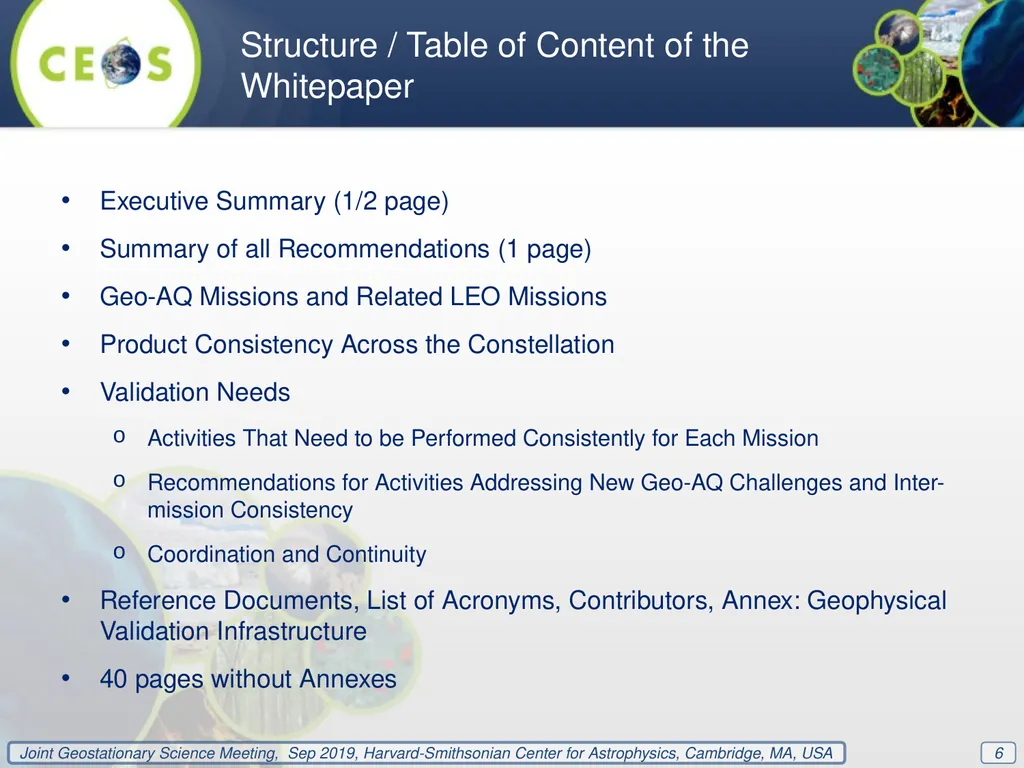
Executive Summary (1/2 page)
Summary of all Recommendations (1 page)
Geo-AQ Missions and Related LEO Missions
Product Consistency Across the Constellation
Validation Needs
Activities That Need to be Performed Consistently for Each Mission
Recommendations for Activities Addressing New Geo-AQ Challenges and Inter-mission Consistency
Coordination and Continuity
Reference Documents, List of Acronyms, Contributors, Annex: Geophysical Validation Infrastructure
40 pages without Annexes 6 Structure / Table of Content of the Whitepaper<br>
07
7 Constellation Products<br>
08
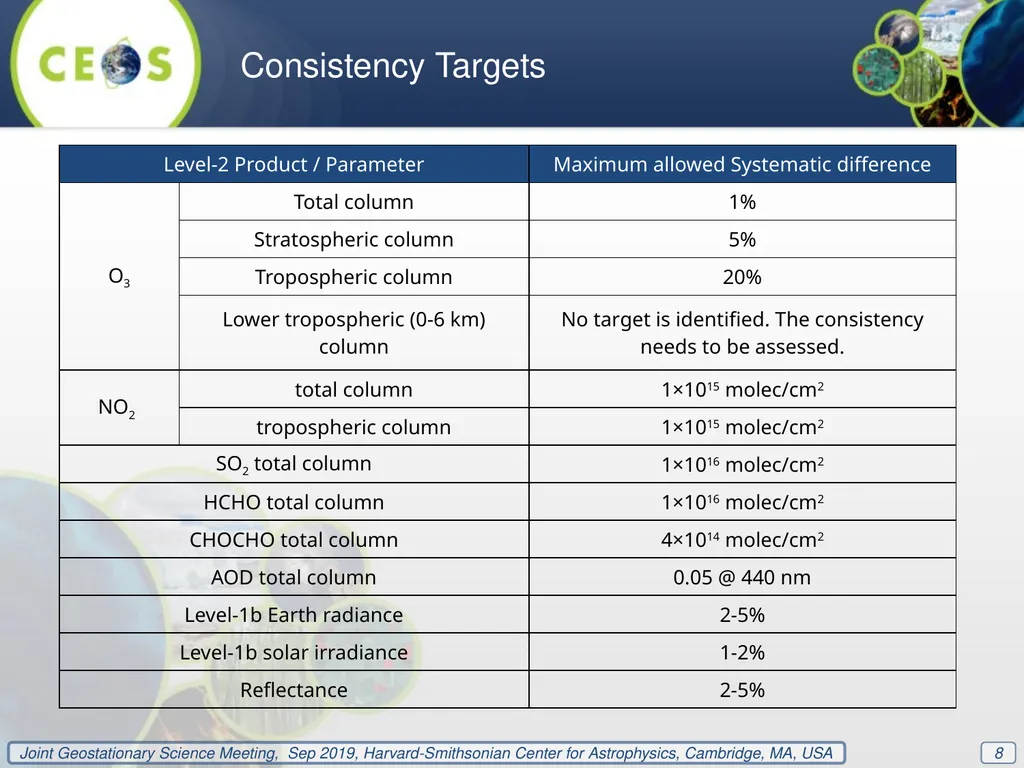
8 Consistency Targets<br>
09
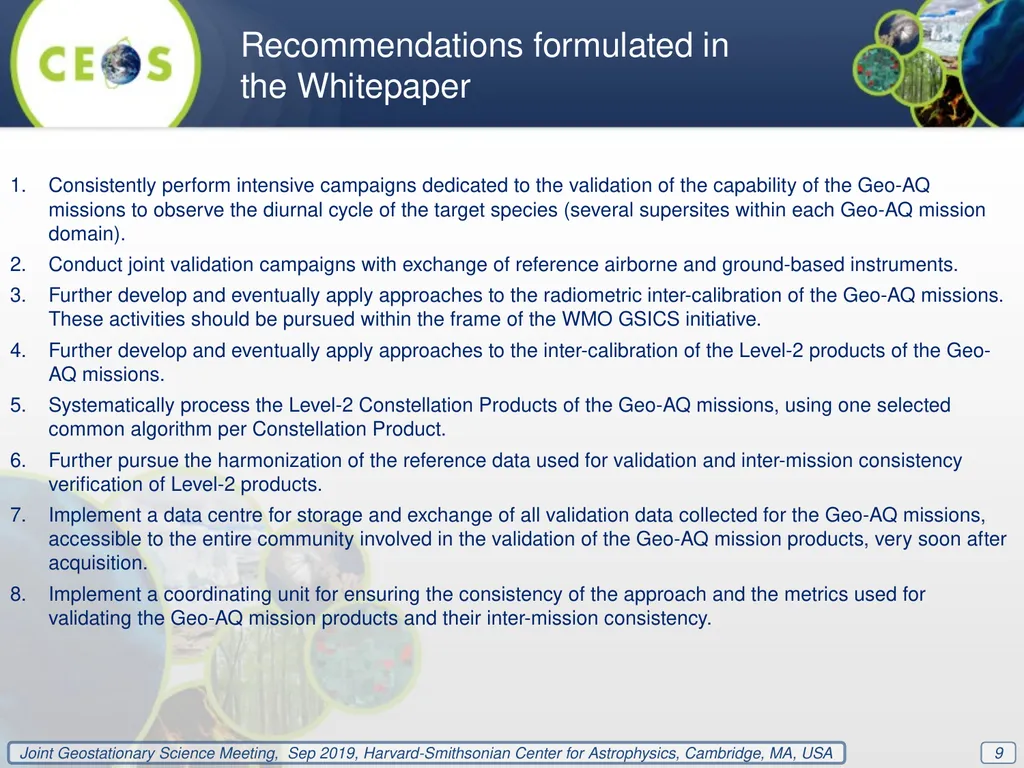
Consistently perform intensive campaigns dedicated to the validation of the capability of the Geo-AQ missions to observe the diurnal cycle of the target species (several supersites within each Geo-AQ mission domain).
Conduct joint validation campaigns with exchange of reference airborne and ground-based instruments.
Further develop and eventually apply approaches to the radiometric inter-calibration of the Geo-AQ missions. These activities should be pursued within the frame of the WMO GSICS initiative.
Further develop and eventually apply approaches to the inter-calibration of the Level-2 products of the Geo-AQ missions.
Systematically process the Level-2 Constellation Products of the Geo-AQ missions, using one selected common algorithm per Constellation Product.
Further pursue the harmonization of the reference data used for validation and inter-mission consistency verification of Level-2 products.
Implement a data centre for storage and exchange of all validation data collected for the Geo-AQ missions, accessible to the entire community involved in the validation of the Geo-AQ mission products, very soon after acquisition.
Implement a coordinating unit for ensuring the consistency of the approach and the metrics used for validating the Geo-AQ mission products and their inter-mission consistency. 9 Recommendations formulated in the Whitepaper<br>
10
What can we do in this forum to address the recommendations?
Which campaigns are planned / on the horizon? How will the validation activities be set up? What can be coordinated? Collaboration? 10 Discussion<br>
11
Collect real satellite and airborne data to assess diurnal biases (R1)
Identify airborne sensors for exchange? (R2)
What can be done pre-flight to ease the post-launch GSICS work on radiometric inter-calibration? (R3)
Cross-processing of L1b data acquired by one satellite sensor in a validation campaign with multiple L2 algorithms from different missions? (R4)
Goal:
quantify inter-mission product differences due to algorithm differences
pre-flight testing of L2 algorithms with real L1b and reference data
Concerns:
Schemes working well for one sensors might not work well for another
Adaptations of L2 algorithms necessary
L1b and reference data consolidated
Not intended to be a ranking of L2 algorithms
Not intended to put L1b features of one mission on the spot 11 Ideas<br>