
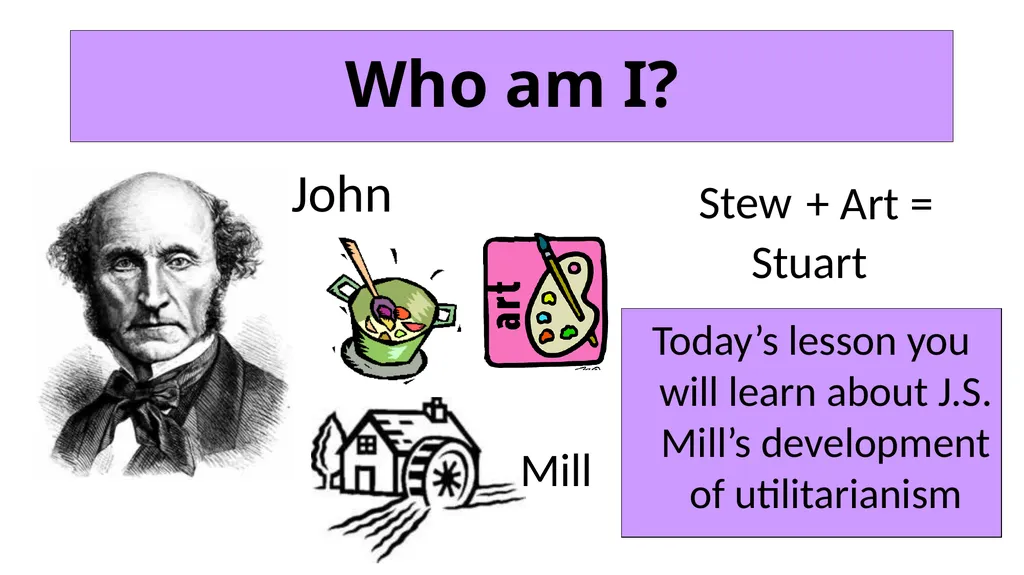
Who am I? Stew John + Art = Stuart Mill
NS
Published · 34 slides · 0 views

1 / 1



Description
Who am I? Stew John Art Stuart Mill Todays lesson you will learn about J.S. Mills development of utilitarianism ETHICS Theme 3: Teleological Ethics E: John Stuart Mills development of Utilitarianism By the end of todays lesson you
Related Topics
Share
Embed code
Download this presentation From Below
"Who am I? Stew John + Art = Stuart Mill" is the property of its rightful owner. Permission is granted to download and print the materials on this website for personal, non-commercial use only, and to display it on your personal computer provided you do not modify the materials and that you retain all copyright notices contained in the materials. By downloading content from our website, you accept the terms of this agreement.
Presentation Transcript
01
Who am I? Stew John + Art = Stuart Mill Today’s lesson you will learn about J.S. Mill’s development of utilitarianism<br>
02
ETHICS
Theme 3: Teleological Ethics
E: John Stuart Mill’s development of Utilitarianism<br>
Theme 3: Teleological Ethics
E: John Stuart Mill’s development of Utilitarianism<br>
03
By the end of today’s lesson you will Be able to explain how Mill distinguished between higher and lower pleasures, making his utilitarianism qualitative.
Understand Mill’s ‘Harm principle’.
Know why Mill’s utilitarianism is called ‘Rule Utilitarianism’
Be able to explain how Mill’s utilitarianism is a teleological/deontological hybrid.<br>
Understand Mill’s ‘Harm principle’.
Know why Mill’s utilitarianism is called ‘Rule Utilitarianism’
Be able to explain how Mill’s utilitarianism is a teleological/deontological hybrid.<br>
04
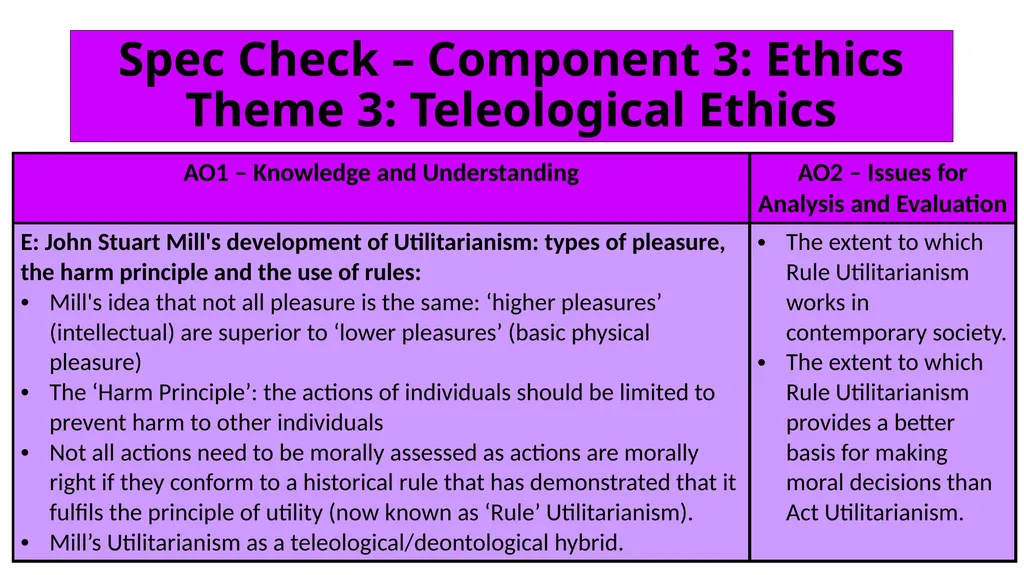
Spec Check – Component 3: Ethics
Theme 3: Teleological Ethics<br>
05
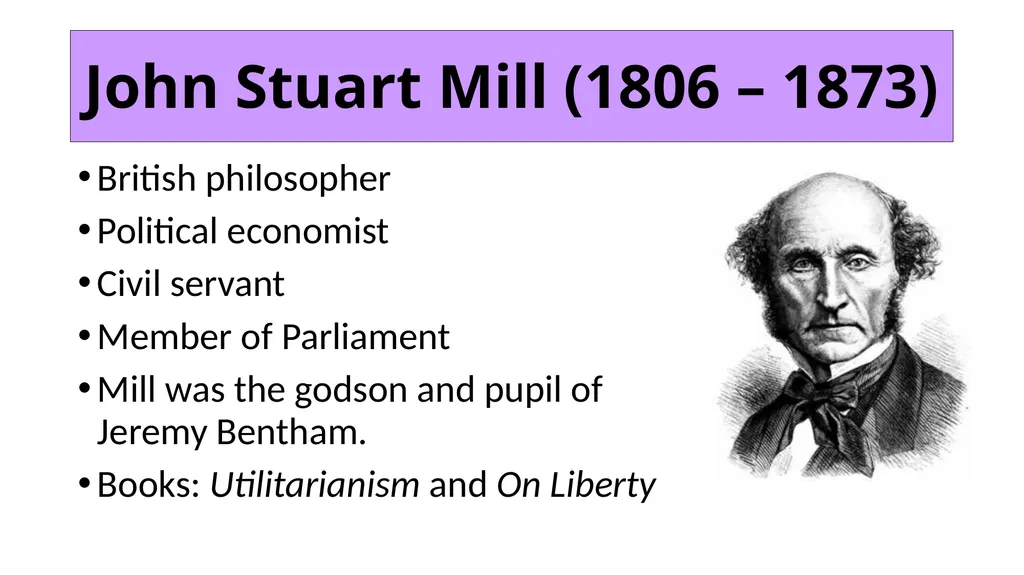
John Stuart Mill (1806 – 1873) British philosopher
Political economist
Civil servant
Member of Parliament
Mill was the godson and pupil of Jeremy Bentham.
Books: Utilitarianism and On Liberty<br>
Political economist
Civil servant
Member of Parliament
Mill was the godson and pupil of Jeremy Bentham.
Books: Utilitarianism and On Liberty<br>
06
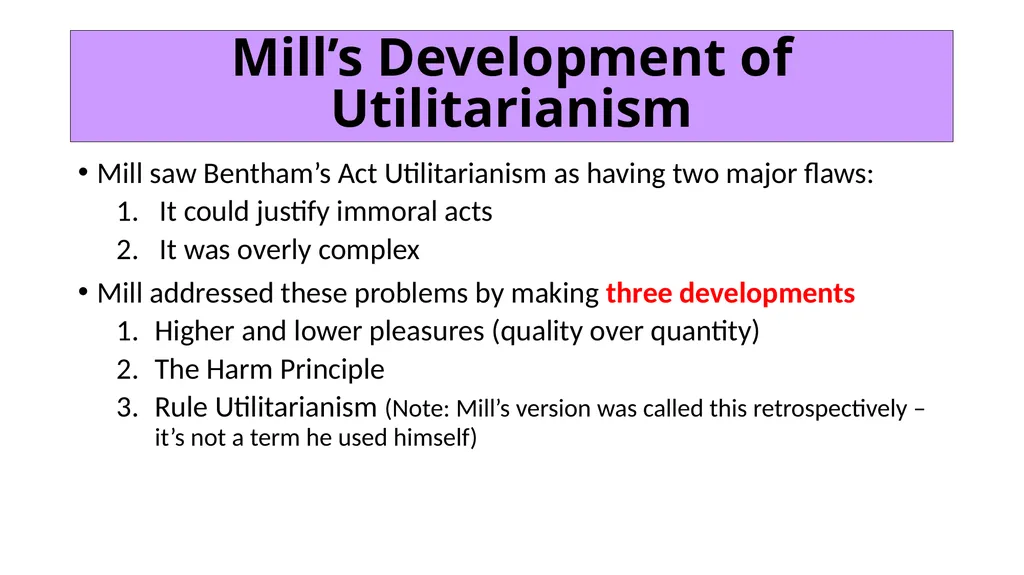
Mill’s Development of Utilitarianism Mill saw Bentham’s Act Utilitarianism as having two major flaws:
It could justify immoral acts
It was overly complex
Mill addressed these problems by making three developments
Higher and lower pleasures (quality over quantity)
The Harm Principle
Rule Utilitarianism (Note: Mill’s version was called this retrospectively – it’s not a term he used himself)<br>
It could justify immoral acts
It was overly complex
Mill addressed these problems by making three developments
Higher and lower pleasures (quality over quantity)
The Harm Principle
Rule Utilitarianism (Note: Mill’s version was called this retrospectively – it’s not a term he used himself)<br>
07
Mill’s Development of Utilitarianism:
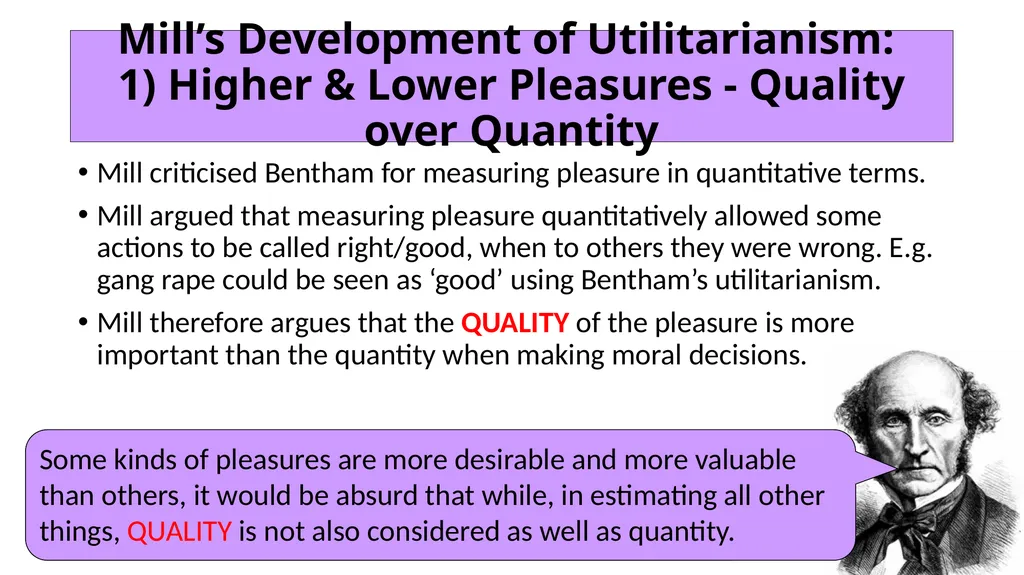
1) Higher & Lower Pleasures - Quality over Quantity Mill criticised Bentham for measuring pleasure in quantitative terms.
Mill argued that measuring pleasure quantitatively allowed some actions to be called right/good, when to others they were wrong. E.g. gang rape could be seen as ‘good’ using Bentham’s utilitarianism.
Mill therefore argues that the QUALITY of the pleasure is more important than the quantity when making moral decisions.<br>
Mill argued that measuring pleasure quantitatively allowed some actions to be called right/good, when to others they were wrong. E.g. gang rape could be seen as ‘good’ using Bentham’s utilitarianism.
Mill therefore argues that the QUALITY of the pleasure is more important than the quantity when making moral decisions.<br>
08
Mill’s Development of Utilitarianism:
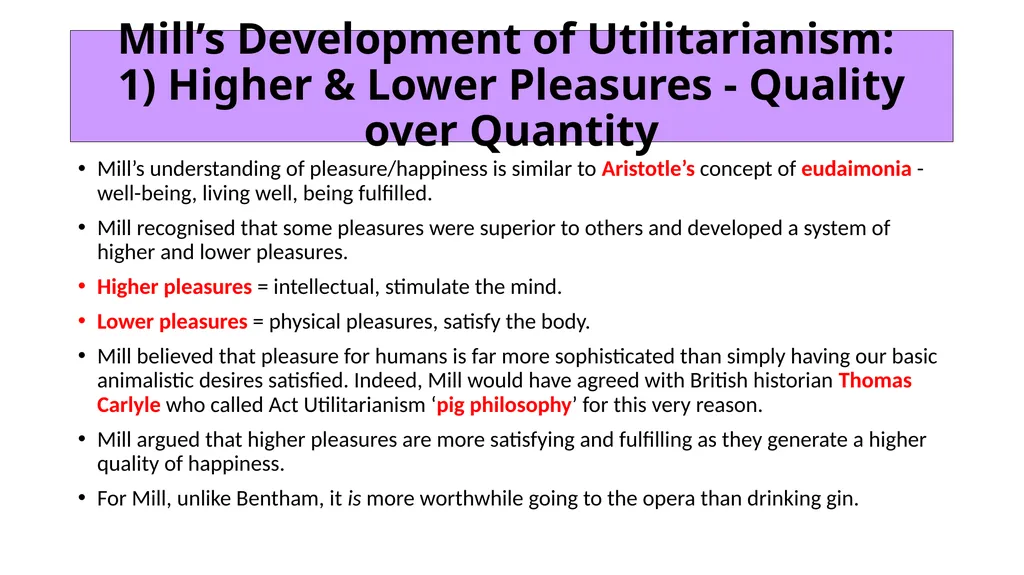
1) Higher & Lower Pleasures - Quality over Quantity Mill’s understanding of pleasure/happiness is similar to Aristotle’s concept of eudaimonia - well-being, living well, being fulfilled.
Mill recognised that some pleasures were superior to others and developed a system of higher and lower pleasures.
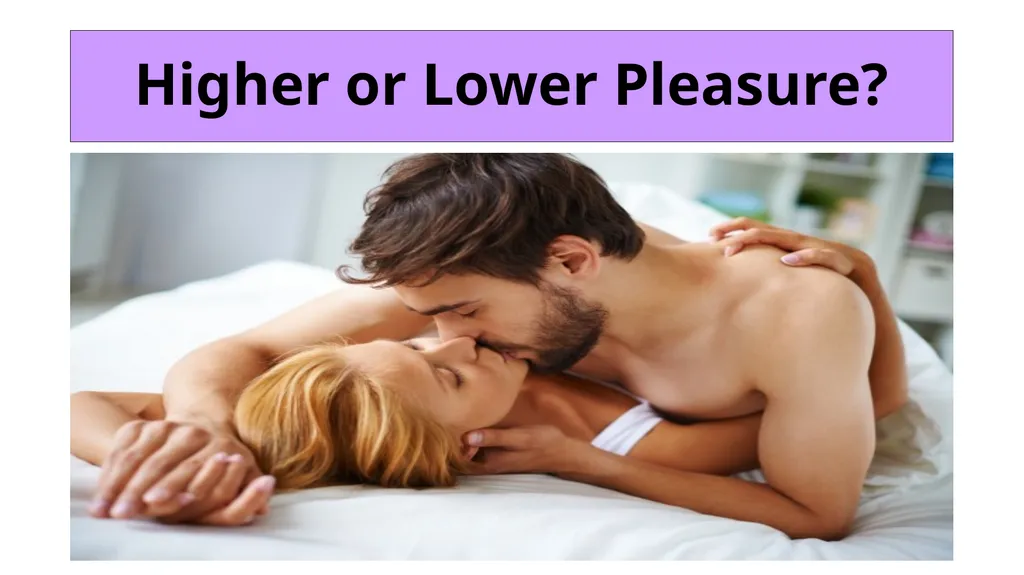
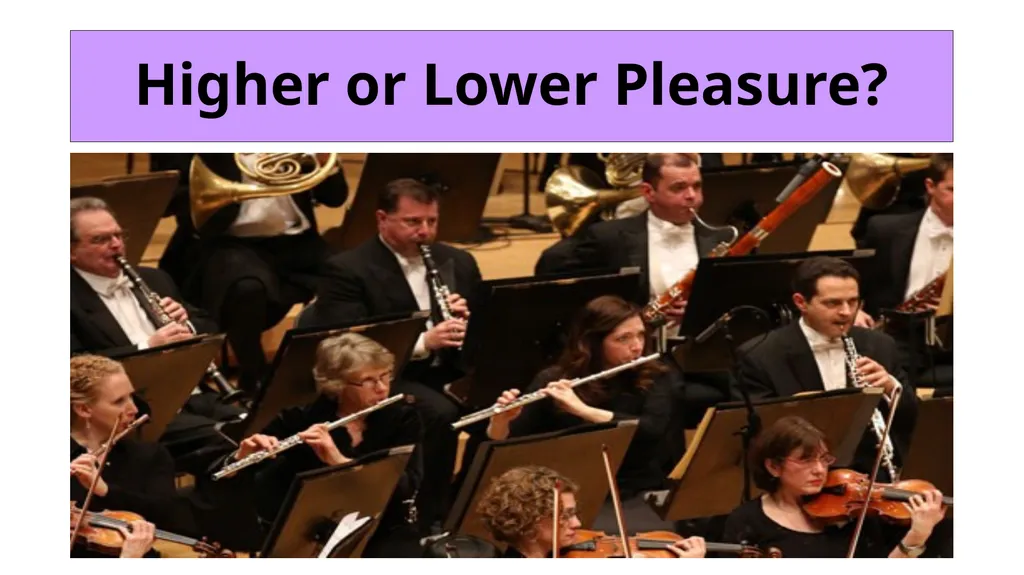
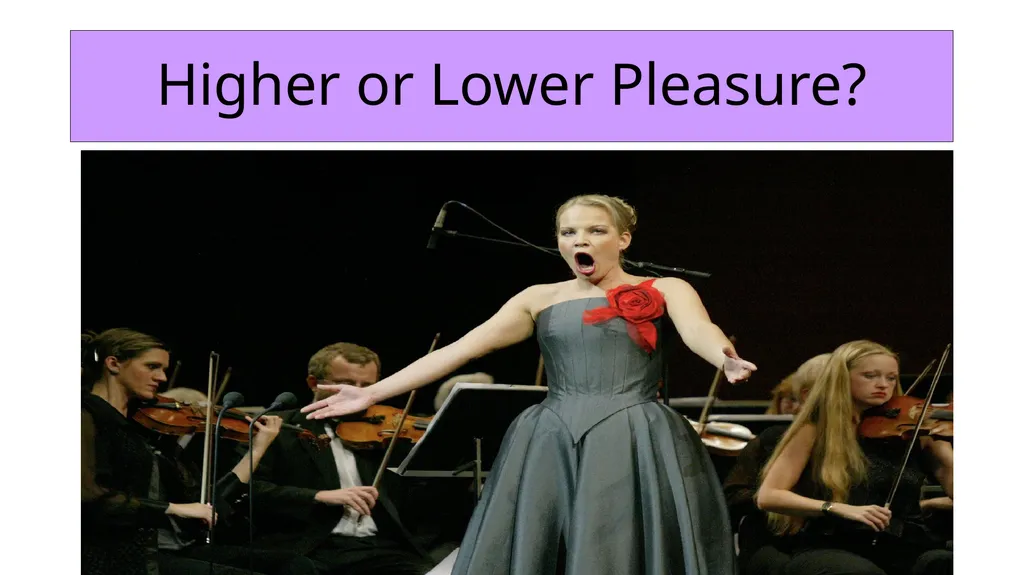
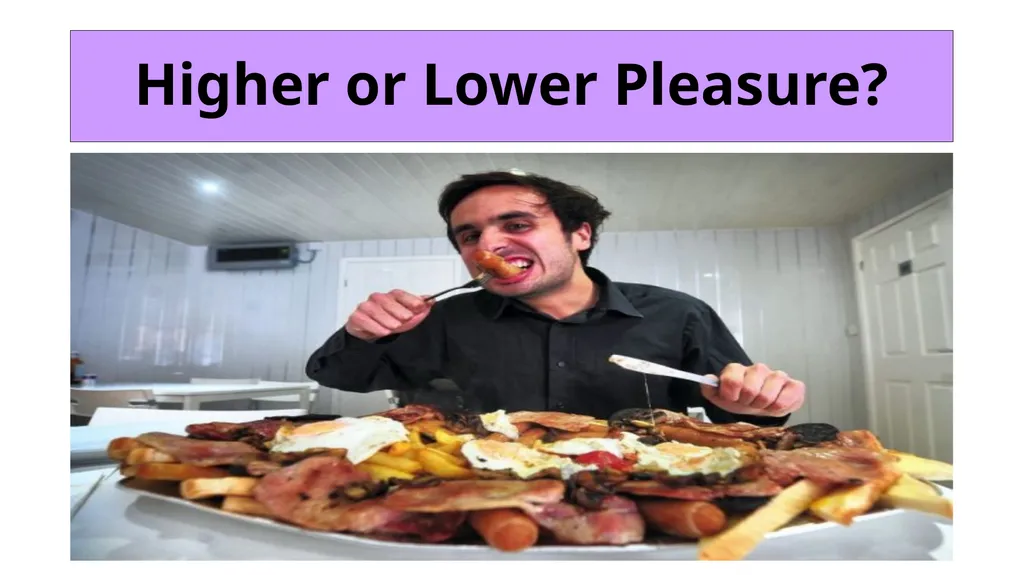
Higher pleasures = intellectual, stimulate the mind.
Lower pleasures = physical pleasures, satisfy the body.
Mill believed that pleasure for humans is far more sophisticated than simply having our basic animalistic desires satisfied. Indeed, Mill would have agreed with British historian Thomas Carlyle who called Act Utilitarianism ‘pig philosophy’ for this very reason.
Mill argued that higher pleasures are more satisfying and fulfilling as they generate a higher quality of happiness.
For Mill, unlike Bentham, it is more worthwhile going to the opera than drinking gin.<br>
Mill recognised that some pleasures were superior to others and developed a system of higher and lower pleasures.
Higher pleasures = intellectual, stimulate the mind.
Lower pleasures = physical pleasures, satisfy the body.
Mill believed that pleasure for humans is far more sophisticated than simply having our basic animalistic desires satisfied. Indeed, Mill would have agreed with British historian Thomas Carlyle who called Act Utilitarianism ‘pig philosophy’ for this very reason.
Mill argued that higher pleasures are more satisfying and fulfilling as they generate a higher quality of happiness.
For Mill, unlike Bentham, it is more worthwhile going to the opera than drinking gin.<br>
09
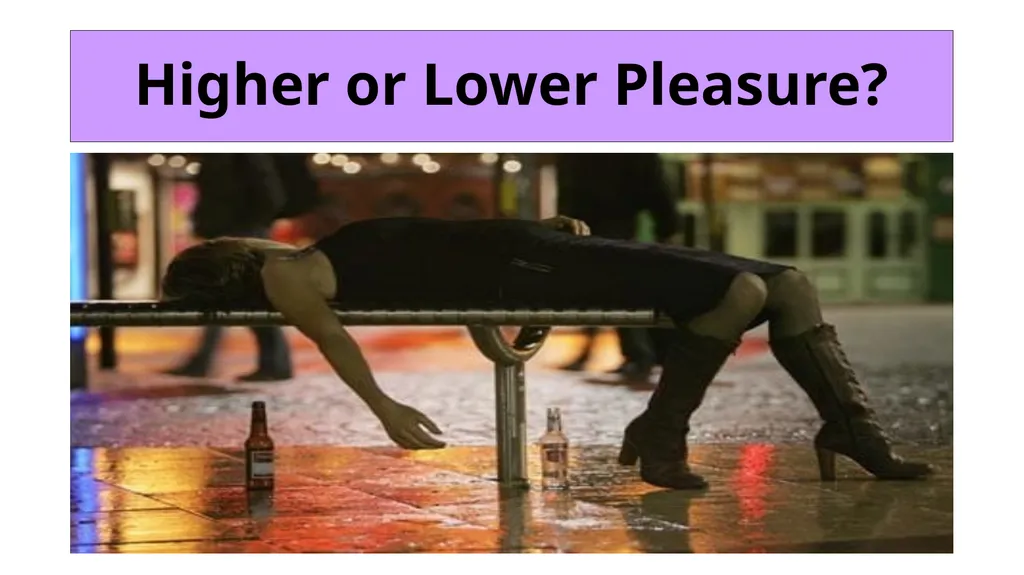
Higher or Lower Pleasure?<br>
10
Higher or Lower Pleasure?<br>
11
Higher or Lower Pleasure?<br>
12
Higher or Lower Pleasure?<br>
13
Higher or Lower Pleasure?<br>
14
Higher or Lower Pleasure?<br>
15
Higher or Lower Pleasure?<br>
16
Mill’s Development of Utilitarianism:
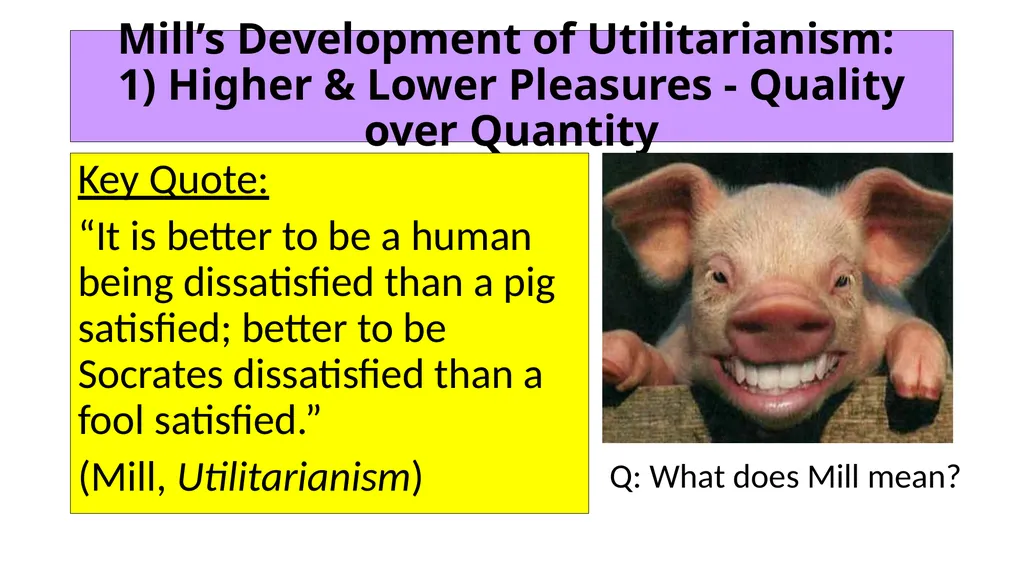
1) Higher & Lower Pleasures - Quality over Quantity Key Quote:
“It is better to be a human being dissatisfied than a pig satisfied; better to be Socrates dissatisfied than a fool satisfied.”
(Mill, Utilitarianism) Q: What does Mill mean?<br>
“It is better to be a human being dissatisfied than a pig satisfied; better to be Socrates dissatisfied than a fool satisfied.”
(Mill, Utilitarianism) Q: What does Mill mean?<br>
17
Mill’s Development of Utilitarianism:
1) Higher & Lower Pleasures - Quality over Quantity Q: How does Mill’s distinction between higher and lower pleasures overcome the criticism of the possibility that utilitarianism could allow immoral acts such as gang rape or sadistic guards gaining pleasure from torturing a prisoner?
A: The pleasure gained by the rapists or guards is a base, lower, animalistic pleasure and does not outweigh the severe pain experienced by the victim. The act of rape or torture is therefore not justified.<br>
A: The pleasure gained by the rapists or guards is a base, lower, animalistic pleasure and does not outweigh the severe pain experienced by the victim. The act of rape or torture is therefore not justified.<br>
18
Learning check ... By the end of today’s lesson you will:
Be able to explain how Mill distinguished between higher and lower pleasures, making his utilitarianism qualitative.
Understand Mill’s ‘Harm principle’.
Know why Mill’s utilitarianism is called ‘Rule Utilitarianism’
Be able to explain how Mill’s utilitarianism is a teleological/deontological hybrid.<br>
Be able to explain how Mill distinguished between higher and lower pleasures, making his utilitarianism qualitative.
Understand Mill’s ‘Harm principle’.
Know why Mill’s utilitarianism is called ‘Rule Utilitarianism’
Be able to explain how Mill’s utilitarianism is a teleological/deontological hybrid.<br>
19
Mill’s Development of Utilitarianism:
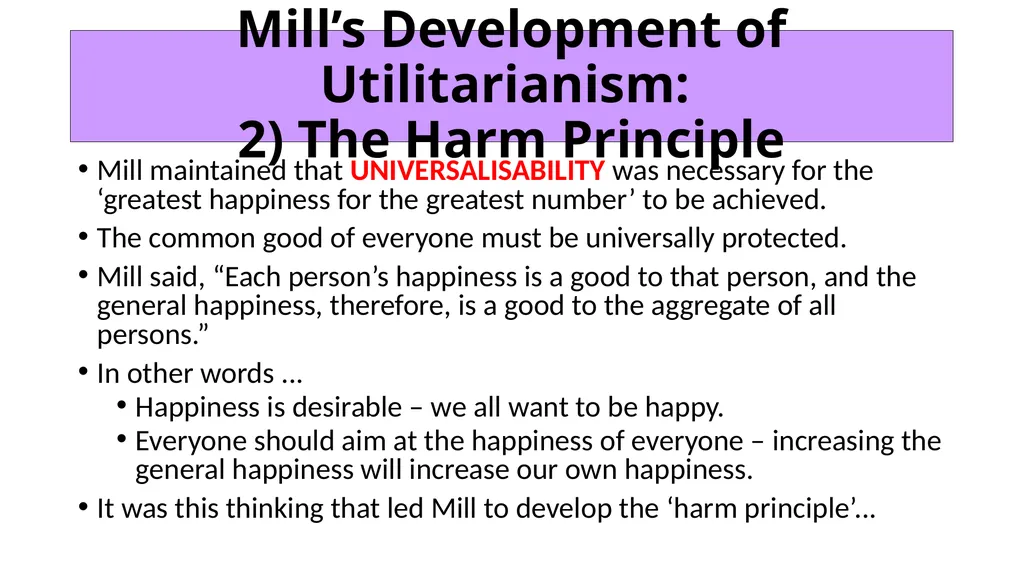
2) The Harm Principle Mill maintained that UNIVERSALISABILITY was necessary for the ‘greatest happiness for the greatest number’ to be achieved.
The common good of everyone must be universally protected.
Mill said, “Each person’s happiness is a good to that person, and the general happiness, therefore, is a good to the aggregate of all persons.”
In other words ...
Happiness is desirable – we all want to be happy.
Everyone should aim at the happiness of everyone – increasing the general happiness will increase our own happiness.
It was this thinking that led Mill to develop the ‘harm principle’...<br>
The common good of everyone must be universally protected.
Mill said, “Each person’s happiness is a good to that person, and the general happiness, therefore, is a good to the aggregate of all persons.”
In other words ...
Happiness is desirable – we all want to be happy.
Everyone should aim at the happiness of everyone – increasing the general happiness will increase our own happiness.
It was this thinking that led Mill to develop the ‘harm principle’...<br>
20
Mill’s Development of Utilitarianism:
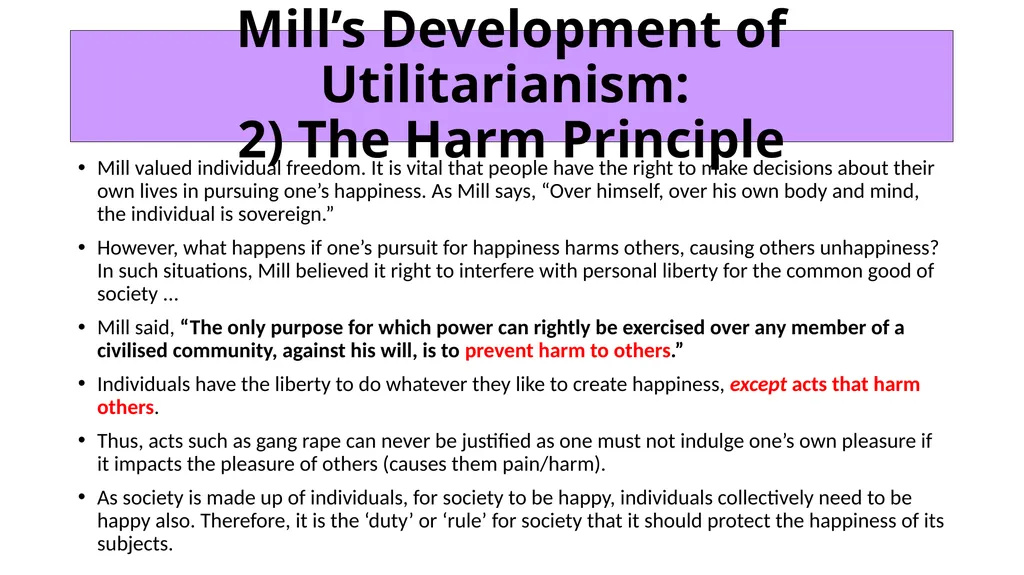
2) The Harm Principle Mill valued individual freedom. It is vital that people have the right to make decisions about their own lives in pursuing one’s happiness. As Mill says, “Over himself, over his own body and mind, the individual is sovereign.”
However, what happens if one’s pursuit for happiness harms others, causing others unhappiness? In such situations, Mill believed it right to interfere with personal liberty for the common good of society ...
Mill said, “The only purpose for which power can rightly be exercised over any member of a civilised community, against his will, is to prevent harm to others.”
Individuals have the liberty to do whatever they like to create happiness, except acts that harm others.
Thus, acts such as gang rape can never be justified as one must not indulge one’s own pleasure if it impacts the pleasure of others (causes them pain/harm).
As society is made up of individuals, for society to be happy, individuals collectively need to be happy also. Therefore, it is the ‘duty’ or ‘rule’ for society that it should protect the happiness of its subjects.<br>
However, what happens if one’s pursuit for happiness harms others, causing others unhappiness? In such situations, Mill believed it right to interfere with personal liberty for the common good of society ...
Mill said, “The only purpose for which power can rightly be exercised over any member of a civilised community, against his will, is to prevent harm to others.”
Individuals have the liberty to do whatever they like to create happiness, except acts that harm others.
Thus, acts such as gang rape can never be justified as one must not indulge one’s own pleasure if it impacts the pleasure of others (causes them pain/harm).
As society is made up of individuals, for society to be happy, individuals collectively need to be happy also. Therefore, it is the ‘duty’ or ‘rule’ for society that it should protect the happiness of its subjects.<br>
21
Learning check ... By the end of today’s lesson you will:
Be able to explain how Mill distinguished between higher and lower pleasures, making his utilitarianism qualitative.
Understand Mill’s ‘Harm principle’.
Know why Mill’s utilitarianism is called ‘Rule Utilitarianism’
Be able to explain how Mill’s utilitarianism is a teleological/deontological hybrid.<br>
Be able to explain how Mill distinguished between higher and lower pleasures, making his utilitarianism qualitative.
Understand Mill’s ‘Harm principle’.
Know why Mill’s utilitarianism is called ‘Rule Utilitarianism’
Be able to explain how Mill’s utilitarianism is a teleological/deontological hybrid.<br>
22
Mill’s Development of Utilitarianism:
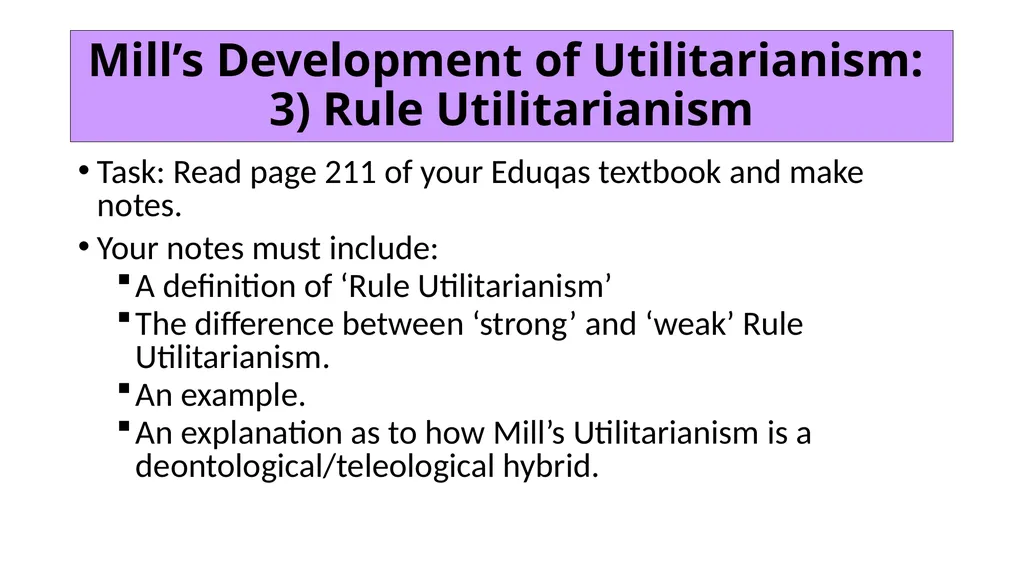
3) Rule Utilitarianism Task: Read page 211 of your Eduqas textbook and make notes.
Your notes must include:
A definition of ‘Rule Utilitarianism’
The difference between ‘strong’ and ‘weak’ Rule Utilitarianism.
An example.
An explanation as to how Mill’s Utilitarianism is a deontological/teleological hybrid.<br>
Your notes must include:
A definition of ‘Rule Utilitarianism’
The difference between ‘strong’ and ‘weak’ Rule Utilitarianism.
An example.
An explanation as to how Mill’s Utilitarianism is a deontological/teleological hybrid.<br>
23
Mill’s Development of Utilitarianism:
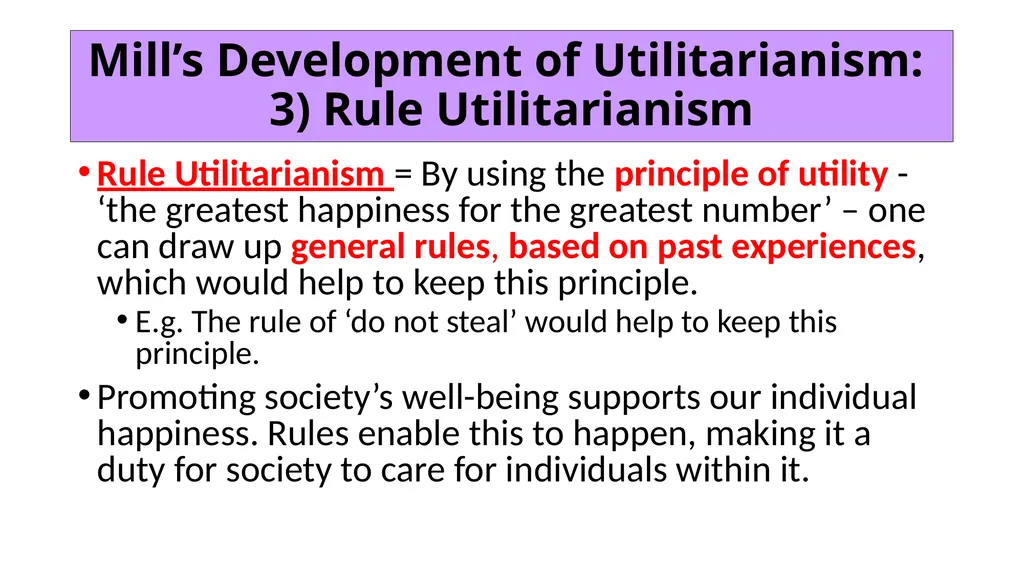
3) Rule Utilitarianism Rule Utilitarianism = By using the principle of utility - ‘the greatest happiness for the greatest number’ – one can draw up general rules, based on past experiences, which would help to keep this principle.
E.g. The rule of ‘do not steal’ would help to keep this principle.
Promoting society’s well-being supports our individual happiness. Rules enable this to happen, making it a duty for society to care for individuals within it.<br>
E.g. The rule of ‘do not steal’ would help to keep this principle.
Promoting society’s well-being supports our individual happiness. Rules enable this to happen, making it a duty for society to care for individuals within it.<br>
24
Mill’s Development of Utilitarianism:
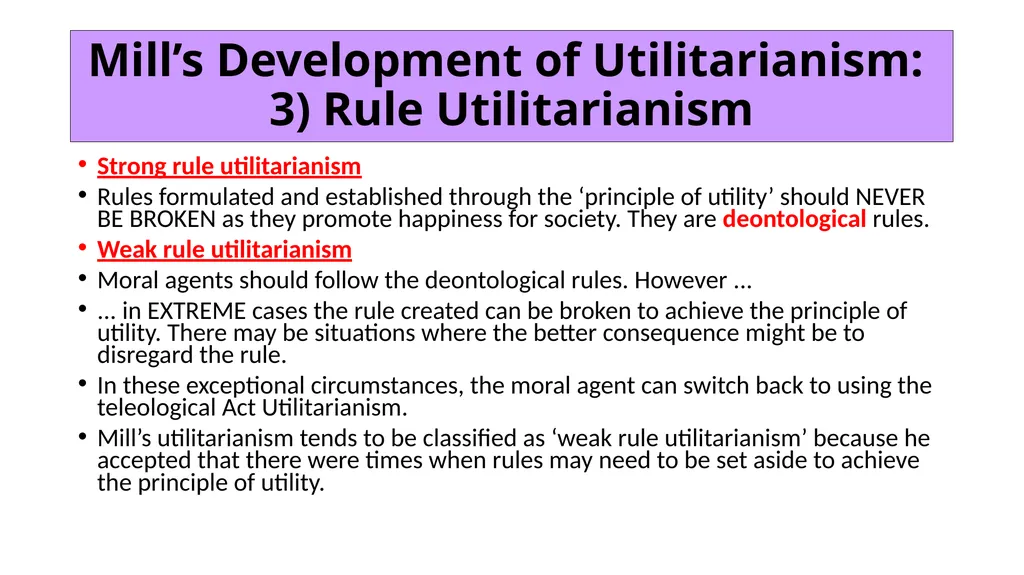
3) Rule Utilitarianism Strong rule utilitarianism
Rules formulated and established through the ‘principle of utility’ should NEVER BE BROKEN as they promote happiness for society. They are deontological rules.
Weak rule utilitarianism
Moral agents should follow the deontological rules. However ...
... in EXTREME cases the rule created can be broken to achieve the principle of utility. There may be situations where the better consequence might be to disregard the rule.
In these exceptional circumstances, the moral agent can switch back to using the teleological Act Utilitarianism.
Mill’s utilitarianism tends to be classified as ‘weak rule utilitarianism’ because he accepted that there were times when rules may need to be set aside to achieve the principle of utility.<br>
Rules formulated and established through the ‘principle of utility’ should NEVER BE BROKEN as they promote happiness for society. They are deontological rules.
Weak rule utilitarianism
Moral agents should follow the deontological rules. However ...
... in EXTREME cases the rule created can be broken to achieve the principle of utility. There may be situations where the better consequence might be to disregard the rule.
In these exceptional circumstances, the moral agent can switch back to using the teleological Act Utilitarianism.
Mill’s utilitarianism tends to be classified as ‘weak rule utilitarianism’ because he accepted that there were times when rules may need to be set aside to achieve the principle of utility.<br>
25
Mill’s Development of Utilitarianism:
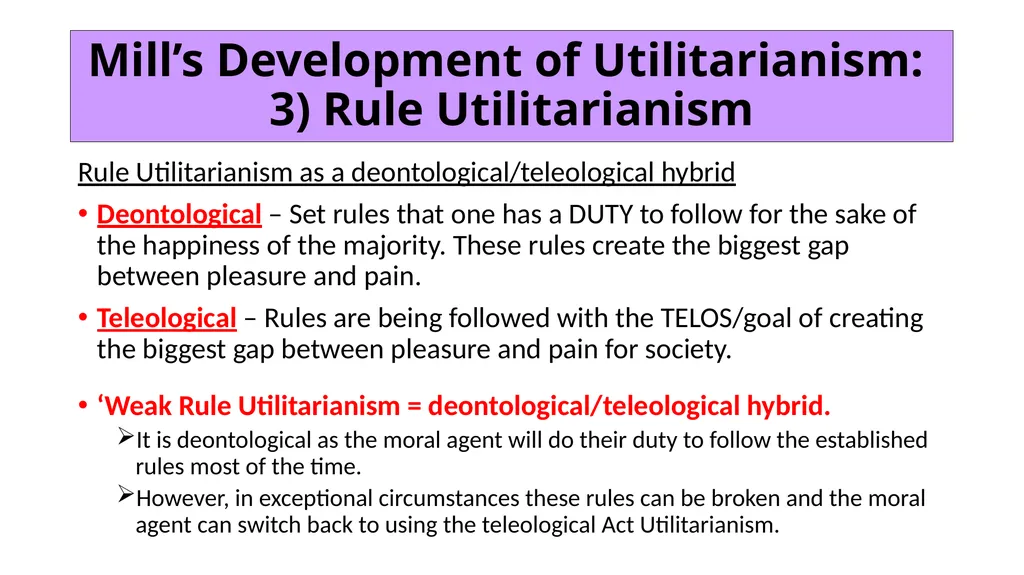
3) Rule Utilitarianism Rule Utilitarianism as a deontological/teleological hybrid
Deontological – Set rules that one has a DUTY to follow for the sake of the happiness of the majority. These rules create the biggest gap between pleasure and pain.
Teleological – Rules are being followed with the TELOS/goal of creating the biggest gap between pleasure and pain for society.
‘Weak Rule Utilitarianism = deontological/teleological hybrid.
It is deontological as the moral agent will do their duty to follow the established rules most of the time.
However, in exceptional circumstances these rules can be broken and the moral agent can switch back to using the teleological Act Utilitarianism.<br>
Deontological – Set rules that one has a DUTY to follow for the sake of the happiness of the majority. These rules create the biggest gap between pleasure and pain.
Teleological – Rules are being followed with the TELOS/goal of creating the biggest gap between pleasure and pain for society.
‘Weak Rule Utilitarianism = deontological/teleological hybrid.
It is deontological as the moral agent will do their duty to follow the established rules most of the time.
However, in exceptional circumstances these rules can be broken and the moral agent can switch back to using the teleological Act Utilitarianism.<br>
26
Learning check ... By the end of today’s lesson you will:
Be able to explain how Mill distinguished between higher and lower pleasures, making his utilitarianism qualitative.
Understand Mill’s ‘Harm principle’.
Know why Mill’s utilitarianism is called ‘Rule Utilitarianism’
Be able to explain how Mill’s utilitarianism is a teleological/deontological hybrid.<br>
Be able to explain how Mill distinguished between higher and lower pleasures, making his utilitarianism qualitative.
Understand Mill’s ‘Harm principle’.
Know why Mill’s utilitarianism is called ‘Rule Utilitarianism’
Be able to explain how Mill’s utilitarianism is a teleological/deontological hybrid.<br>
27
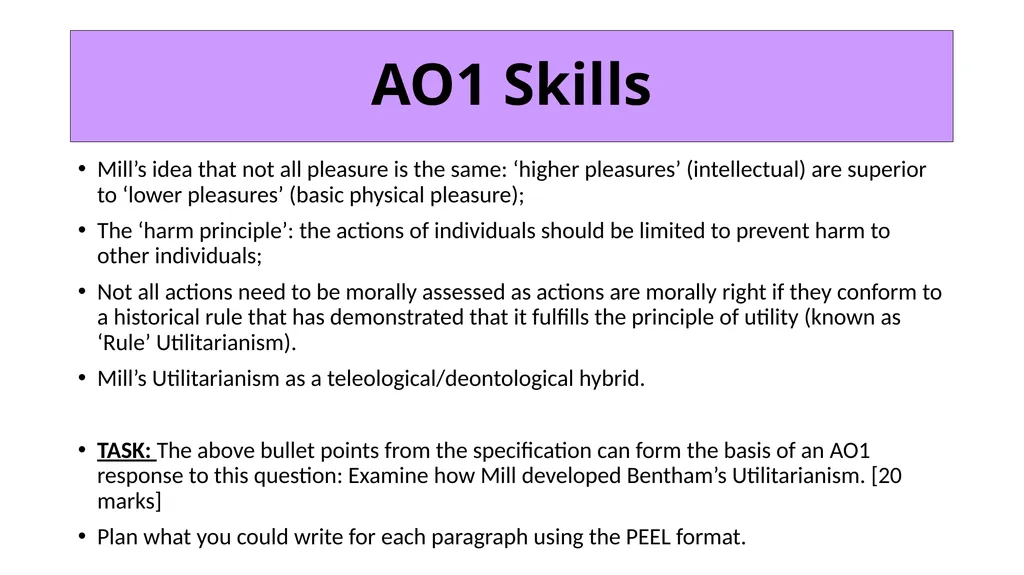
AO1 Skills Mill’s idea that not all pleasure is the same: ‘higher pleasures’ (intellectual) are superior to ‘lower pleasures’ (basic physical pleasure);
The ‘harm principle’: the actions of individuals should be limited to prevent harm to other individuals;
Not all actions need to be morally assessed as actions are morally right if they conform to a historical rule that has demonstrated that it fulfills the principle of utility (known as ‘Rule’ Utilitarianism).
Mill’s Utilitarianism as a teleological/deontological hybrid.
TASK: The above bullet points from the specification can form the basis of an AO1 response to this question: Examine how Mill developed Bentham’s Utilitarianism. [20 marks]
Plan what you could write for each paragraph using the PEEL format.<br>
The ‘harm principle’: the actions of individuals should be limited to prevent harm to other individuals;
Not all actions need to be morally assessed as actions are morally right if they conform to a historical rule that has demonstrated that it fulfills the principle of utility (known as ‘Rule’ Utilitarianism).
Mill’s Utilitarianism as a teleological/deontological hybrid.
TASK: The above bullet points from the specification can form the basis of an AO1 response to this question: Examine how Mill developed Bentham’s Utilitarianism. [20 marks]
Plan what you could write for each paragraph using the PEEL format.<br>
28
By the end of today’s lesson you will Have consolidated your knowledge and understanding of Bentham and Mill’s versions of Utilitarianism.
Have EVALUATED Rule Utilitarianism.<br>
Have EVALUATED Rule Utilitarianism.<br>
29
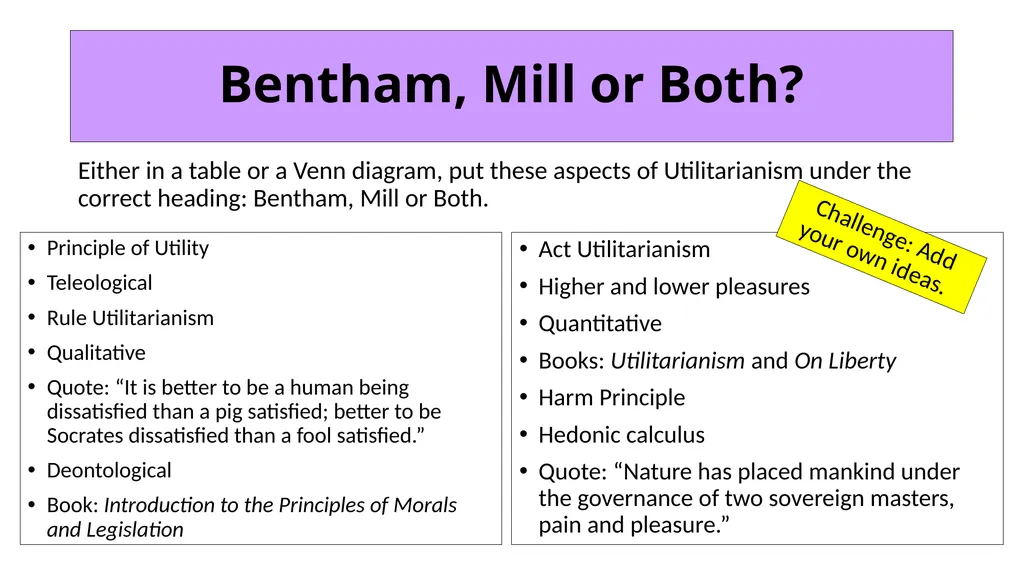
Bentham, Mill or Both? Either in a table or a Venn diagram, put these aspects of Utilitarianism under the correct heading: Bentham, Mill or Both. Principle of Utility
Teleological
Rule Utilitarianism
Qualitative
Quote: “It is better to be a human being dissatisfied than a pig satisfied; better to be Socrates dissatisfied than a fool satisfied.”
Deontological
Book: Introduction to the Principles of Morals and Legislation Act Utilitarianism
Higher and lower pleasures
Quantitative
Books: Utilitarianism and On Liberty
Harm Principle
Hedonic calculus
Quote: “Nature has placed mankind under the governance of two sovereign masters, pain and pleasure.” Challenge: Add your own ideas.<br>
Teleological
Rule Utilitarianism
Qualitative
Quote: “It is better to be a human being dissatisfied than a pig satisfied; better to be Socrates dissatisfied than a fool satisfied.”
Deontological
Book: Introduction to the Principles of Morals and Legislation Act Utilitarianism
Higher and lower pleasures
Quantitative
Books: Utilitarianism and On Liberty
Harm Principle
Hedonic calculus
Quote: “Nature has placed mankind under the governance of two sovereign masters, pain and pleasure.” Challenge: Add your own ideas.<br>
30
Strengths and Weaknesses What strengths and weaknesses are there of Rule Utilitarianism?
You have 5 minutes to come up with as many as you can think of.
Feedback.<br>
You have 5 minutes to come up with as many as you can think of.
Feedback.<br>
31
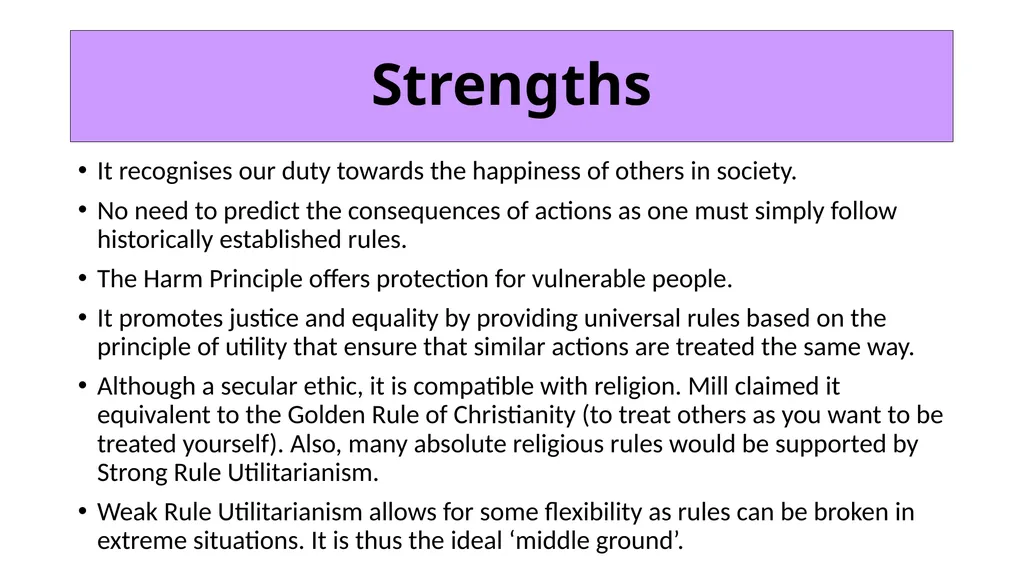
Strengths It recognises our duty towards the happiness of others in society.
No need to predict the consequences of actions as one must simply follow historically established rules.
The Harm Principle offers protection for vulnerable people.
It promotes justice and equality by providing universal rules based on the principle of utility that ensure that similar actions are treated the same way.
Although a secular ethic, it is compatible with religion. Mill claimed it equivalent to the Golden Rule of Christianity (to treat others as you want to be treated yourself). Also, many absolute religious rules would be supported by Strong Rule Utilitarianism.
Weak Rule Utilitarianism allows for some flexibility as rules can be broken in extreme situations. It is thus the ideal ‘middle ground’.<br>
No need to predict the consequences of actions as one must simply follow historically established rules.
The Harm Principle offers protection for vulnerable people.
It promotes justice and equality by providing universal rules based on the principle of utility that ensure that similar actions are treated the same way.
Although a secular ethic, it is compatible with religion. Mill claimed it equivalent to the Golden Rule of Christianity (to treat others as you want to be treated yourself). Also, many absolute religious rules would be supported by Strong Rule Utilitarianism.
Weak Rule Utilitarianism allows for some flexibility as rules can be broken in extreme situations. It is thus the ideal ‘middle ground’.<br>
32
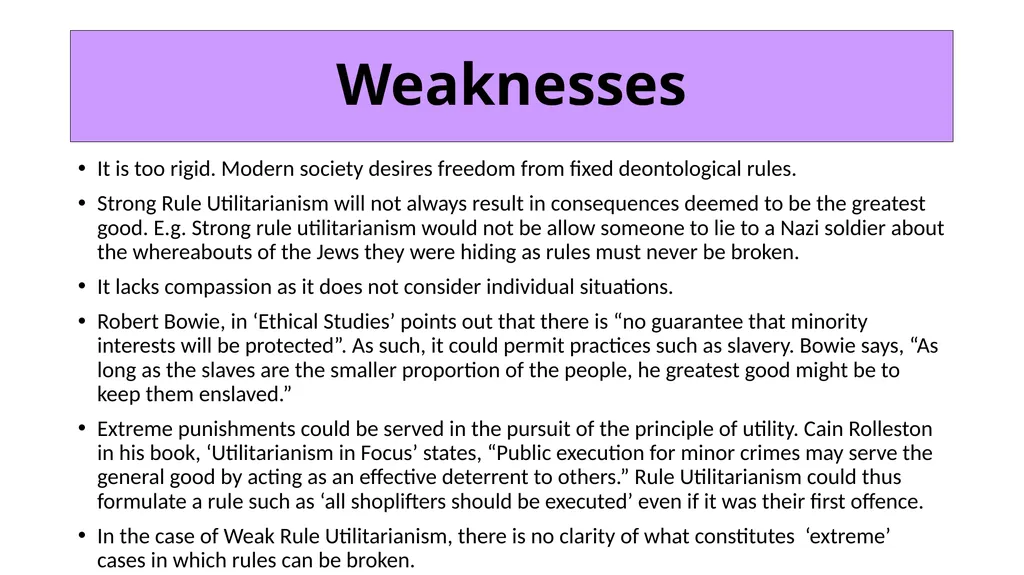
Weaknesses It is too rigid. Modern society desires freedom from fixed deontological rules.
Strong Rule Utilitarianism will not always result in consequences deemed to be the greatest good. E.g. Strong rule utilitarianism would not be allow someone to lie to a Nazi soldier about the whereabouts of the Jews they were hiding as rules must never be broken.
It lacks compassion as it does not consider individual situations.
Robert Bowie, in ‘Ethical Studies’ points out that there is “no guarantee that minority interests will be protected”. As such, it could permit practices such as slavery. Bowie says, “As long as the slaves are the smaller proportion of the people, he greatest good might be to keep them enslaved.”
Extreme punishments could be served in the pursuit of the principle of utility. Cain Rolleston in his book, ‘Utilitarianism in Focus’ states, “Public execution for minor crimes may serve the general good by acting as an effective deterrent to others.” Rule Utilitarianism could thus formulate a rule such as ‘all shoplifters should be executed’ even if it was their first offence.
In the case of Weak Rule Utilitarianism, there is no clarity of what constitutes ‘extreme’ cases in which rules can be broken.<br>
Strong Rule Utilitarianism will not always result in consequences deemed to be the greatest good. E.g. Strong rule utilitarianism would not be allow someone to lie to a Nazi soldier about the whereabouts of the Jews they were hiding as rules must never be broken.
It lacks compassion as it does not consider individual situations.
Robert Bowie, in ‘Ethical Studies’ points out that there is “no guarantee that minority interests will be protected”. As such, it could permit practices such as slavery. Bowie says, “As long as the slaves are the smaller proportion of the people, he greatest good might be to keep them enslaved.”
Extreme punishments could be served in the pursuit of the principle of utility. Cain Rolleston in his book, ‘Utilitarianism in Focus’ states, “Public execution for minor crimes may serve the general good by acting as an effective deterrent to others.” Rule Utilitarianism could thus formulate a rule such as ‘all shoplifters should be executed’ even if it was their first offence.
In the case of Weak Rule Utilitarianism, there is no clarity of what constitutes ‘extreme’ cases in which rules can be broken.<br>
33
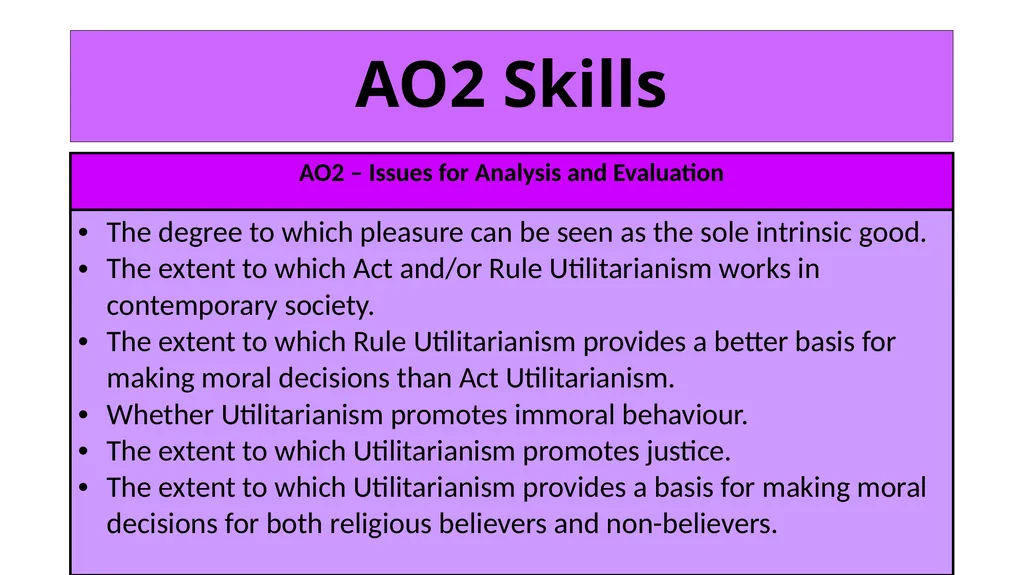
AO2 Skills<br>
34
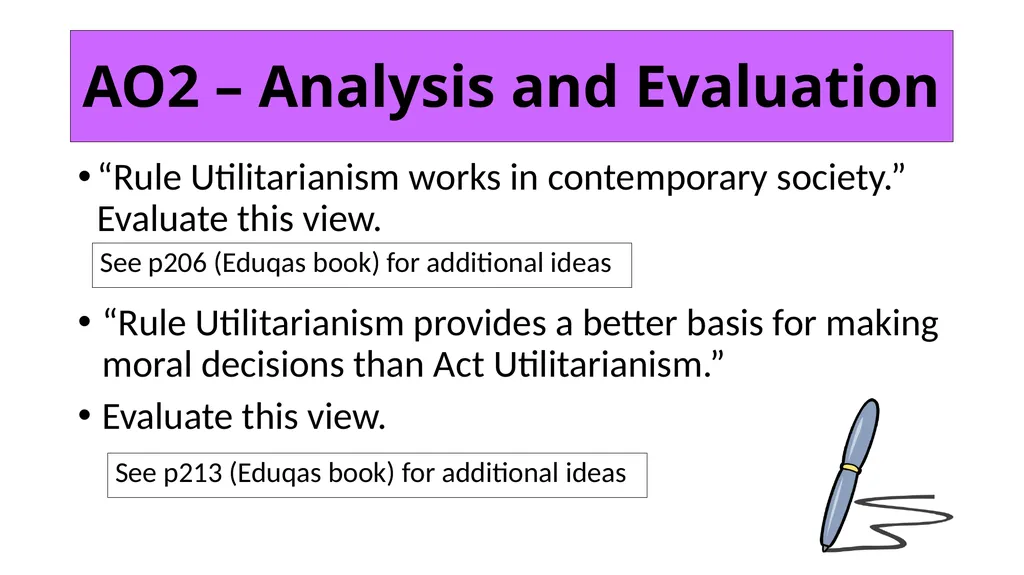
AO2 – Analysis and Evaluation “Rule Utilitarianism works in contemporary society.” Evaluate this view.
“Rule Utilitarianism provides a better basis for making moral decisions than Act Utilitarianism.”
Evaluate this view. See p206 (Eduqas book) for additional ideas See p213 (Eduqas book) for additional ideas<br>
“Rule Utilitarianism provides a better basis for making moral decisions than Act Utilitarianism.”
Evaluate this view. See p206 (Eduqas book) for additional ideas See p213 (Eduqas book) for additional ideas<br>