
Who Does NOT Need a Tourniquet US/Ukraine
AM
Published · 54 slides · 0 views

1 / 1
Description
Who Does NOT Need a Tourniquet USUkraine Tourniquet Working Group Dr. Frank Butler, Dr Warren Dorlac, Dr. John Holcomb 14 June 2024 The opinions or assertions contained herein are the private views of the author and are not to be
Related Topics
Share
Embed code
Download this presentation From Below
"Who Does NOT Need a Tourniquet US/Ukraine" is the property of its rightful owner. Permission is granted to download and print the materials on this website for personal, non-commercial use only, and to display it on your personal computer provided you do not modify the materials and that you retain all copyright notices contained in the materials. By downloading content from our website, you accept the terms of this agreement.
Presentation Transcript
01
Who Does NOT Need a
Tourniquet
US/Ukraine Tourniquet Working Group Dr. Frank Butler, Dr Warren Dorlac, Dr. John Holcomb
14 June 2024<br>
Tourniquet
US/Ukraine Tourniquet Working Group Dr. Frank Butler, Dr Warren Dorlac, Dr. John Holcomb
14 June 2024<br>
02
“The opinions or assertions contained herein are the private views of the author and are not to be construed as official or as reflecting the views of the Departments of the Army, Air Force, Navy or the Department of Defense.”
No financial interests in items discussed Disclaimers<br>
No financial interests in items discussed Disclaimers<br>
03
3 3 Bottom Line Up Front Many tourniquets are being placed on
extremities that do not need one.
That has not caused problems when transport
times to a treatment facility are short (< 2 hours.)
Where evacuations are prolonged (like Ukraine),
however, unnecessary tourniquets are causing
unnecessary amputations + kidney damage.
Tourniquet training needs to be modified to
include better training on what kind of wounds
do NOT require a tourniquet.<br>
04
4 4 US Military Tourniquet Use in Afghanistan and Iraq Butler 2015
Hartford Consensus Compendium
Bulletin of the ACS 1. Estimated 2000+ lives saved with tourniquets.
2. “At the start of the war in Afghanistan, very few
American service members carried tourniquets. By
the end of the war, nobody went onto a battlefield
without a tourniquet.”
3. Limbs were not lost to tourniquet ischemia with
the short (< 2 hr) evacuation times seen in those
two conflicts.<br>
05
5 5 Tourniquet Use: 2024 There has been increasing evidence that many tourniquets are being applied when they are not medically indicated.
Both military and civilian
Not a big problem in urban civilian settings because of short transport times; likely more of a problem in rural civilian settings.
Not a problem to date in the US military because of short transport times in recent conflicts.
Ukraine conflict: Much longer evacuation times
And a lack of medics to reassess tourniquets
Limbs are being lost to prolonged tourniquet ischemia in that conflict<br>
06
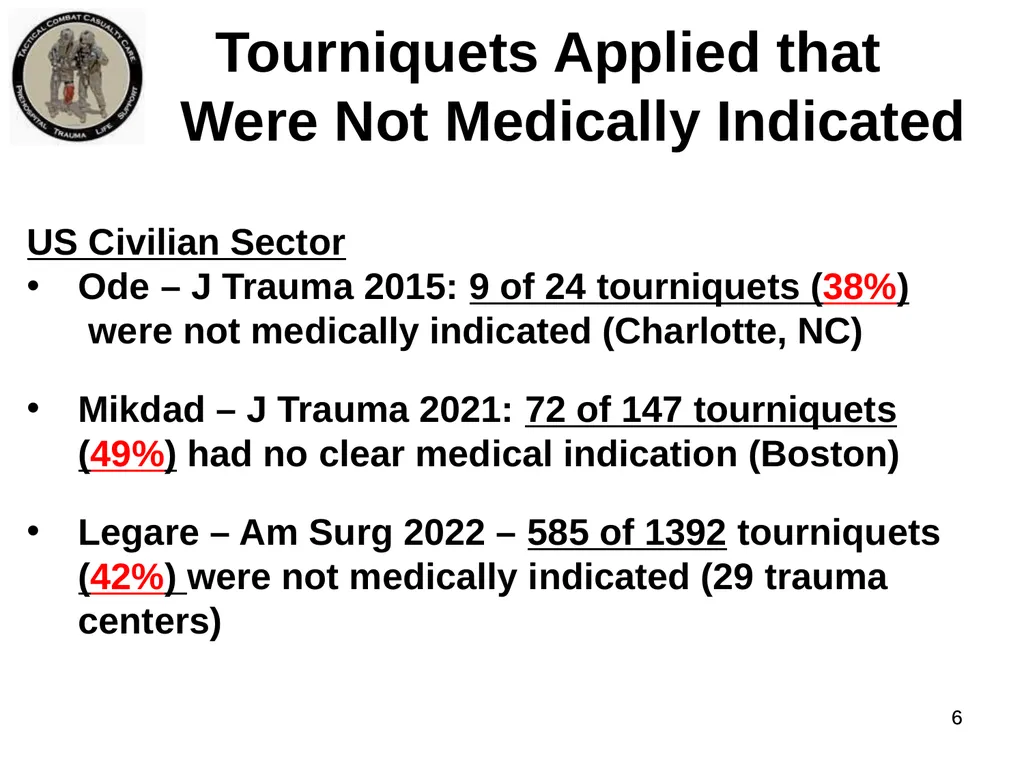
6 6 Tourniquets Applied that Were Not Medically Indicated US Civilian Sector
Ode – J Trauma 2015: 9 of 24 tourniquets (38%)
were not medically indicated (Charlotte, NC)
Mikdad – J Trauma 2021: 72 of 147 tourniquets
(49%) had no clear medical indication (Boston)
Legare – Am Surg 2022 – 585 of 1392 tourniquets (42%) were not medically indicated (29 trauma centers)<br>
Ode – J Trauma 2015: 9 of 24 tourniquets (38%)
were not medically indicated (Charlotte, NC)
Mikdad – J Trauma 2021: 72 of 147 tourniquets
(49%) had no clear medical indication (Boston)
Legare – Am Surg 2022 – 585 of 1392 tourniquets (42%) were not medically indicated (29 trauma centers)<br>
07
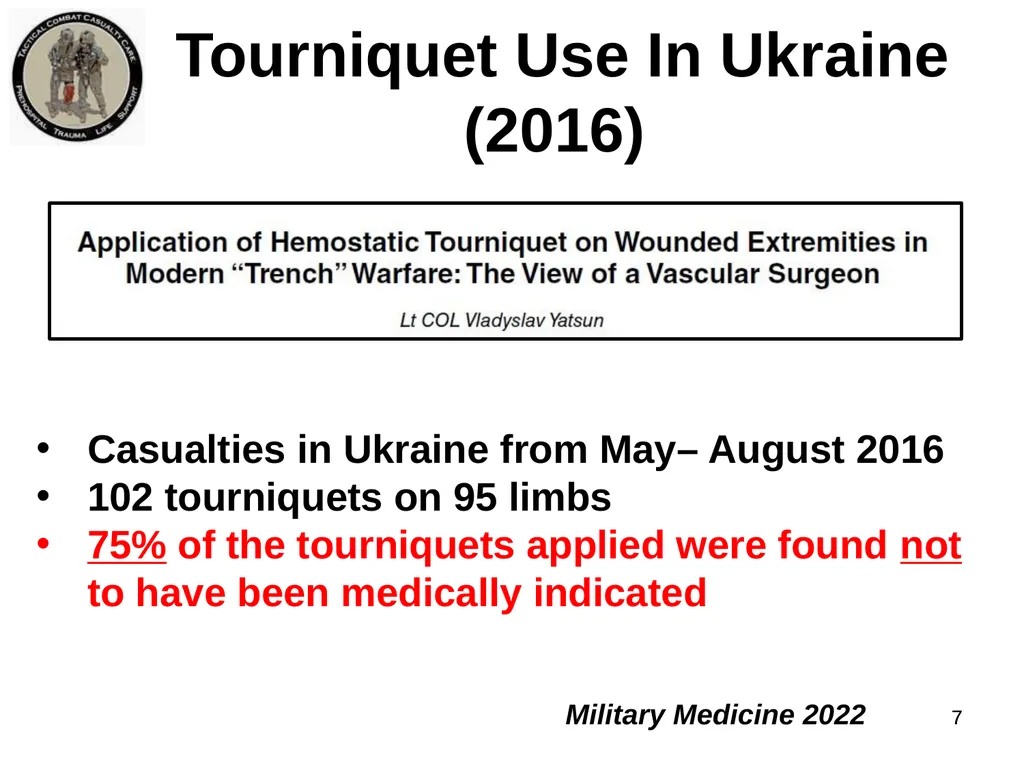
7 7 Tourniquet Use In Ukraine
(2016) Casualties in Ukraine from May– August 2016
102 tourniquets on 95 limbs
75% of the tourniquets applied were found not to have been medically indicated Military Medicine 2022<br>
102 tourniquets on 95 limbs
75% of the tourniquets applied were found not to have been medically indicated Military Medicine 2022<br>
08
8 8 Tourniquet Use In Ukraine
(Present Conflict) Prolonged evacuation times
Lack of air superiority and medics; drones
Numerous anecdotal examples of prolonged tourniquet
application times (>6 hours)
Significant morbidity - including amputations and Acute
Kidney Injury (AKI) - as a result
“Because of operational security issues surrounding casualty numbers and outcomes, summary data are not available describing numbers of patients, extremity injuries, tourniquet application, and outcomes across the Ukrainian theater. However, multiple frontline medical personnel have relayed these observations (authors O.Le., A.M., G.B., O.D., and O.Li.).” Holcomb
JTACS 2023<br>
09
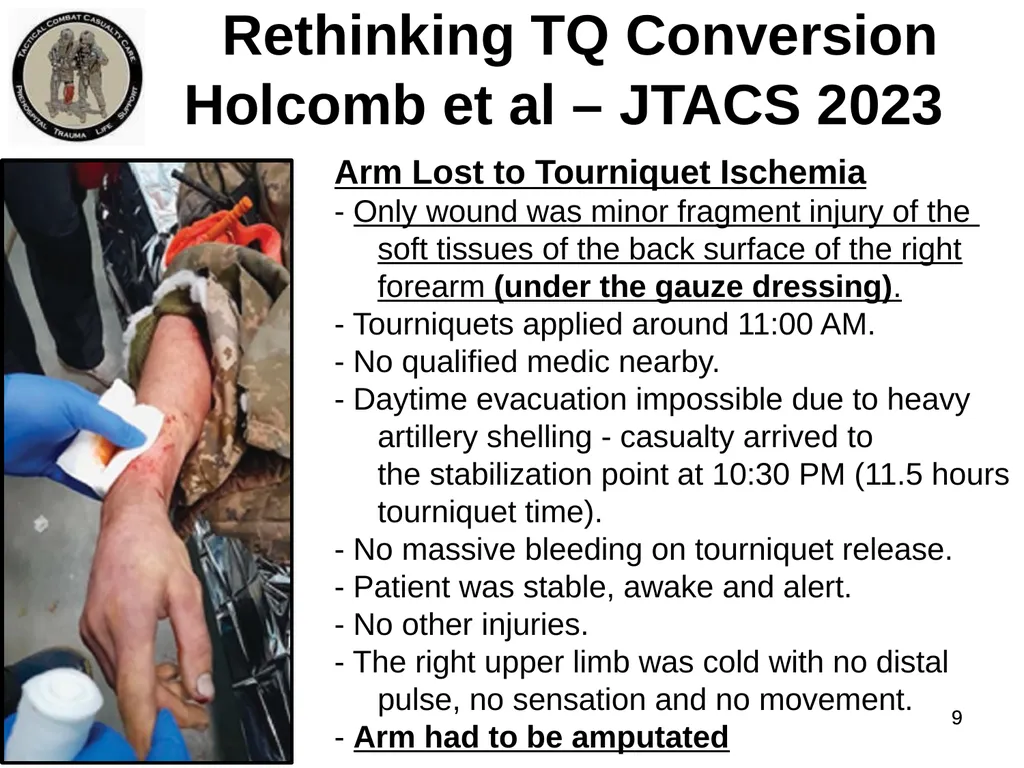
9 9 Rethinking TQ Conversion
Holcomb et al – JTACS 2023 Arm Lost to Tourniquet Ischemia
- Only wound was minor fragment injury of the
soft tissues of the back surface of the right
forearm (under the gauze dressing).
- Tourniquets applied around 11:00 AM.
- No qualified medic nearby.
- Daytime evacuation impossible due to heavy
artillery shelling - casualty arrived to
the stabilization point at 10:30 PM (11.5 hours
tourniquet time).
- No massive bleeding on tourniquet release.
- Patient was stable, awake and alert.
- No other injuries.
- The right upper limb was cold with no distal
pulse, no sensation and no movement.
- Arm had to be amputated<br>
10
10 10 Ukraine TCCC Training The Ukrainian military uses the U.S. TCCC
Guidelines to train their personnel.
The TCCC Training material on the Deployed
Medicine website has been translated into
Ukrainian.
There are 10 NAEMT-certified TCCC Training
Centers in Ukraine at present.<br>
Guidelines to train their personnel.
The TCCC Training material on the Deployed
Medicine website has been translated into
Ukrainian.
There are 10 NAEMT-certified TCCC Training
Centers in Ukraine at present.<br>
11
11 11 Beyond Ukraine Prolonged tourniquet application times may be encountered in other combat environments as well:
- New combat theaters
- Naval surface warfare combat
- Non-permissive environments for flight
operations (weather, anti-aircraft
threat, drone threat)
- Amphibious operations
- Urban conflict (Mogadishu)
- Large-scale combat operations<br>
- New combat theaters
- Naval surface warfare combat
- Non-permissive environments for flight
operations (weather, anti-aircraft
threat, drone threat)
- Amphibious operations
- Urban conflict (Mogadishu)
- Large-scale combat operations<br>
12
12 12 Tourniquets and Limb Survival It’s just physiology and time, not the geographic location. Dr. John Holcomb<br>
13
The published evidence documents a clear
opportunity and a pressing need to improve
tourniquet training in TCCC.
The presence of an extremity wound does
NOT automatically indicate a need for a
tourniquet to be applied.
TCCC students need an improved ability to
distinguish between extremity bleeding that is
life-threatening and that which is not. Reducing Morbidity from Prolonged
Tourniquet Application Time<br>
14
Butler
TCCC Leadership Lessons Learned
JTACS 2017<br>
TCCC Leadership Lessons Learned
JTACS 2017<br>
15
15 15 Recognizing Life-Threatening Extremity Bleeding Tactical Combat Casualty Care training on tourniquets as of December 2023 is shown on the following slides from the Deployed Medicine website.<br>
16
16 16 Recognizing Life-Threatening Extremity Bleeding Care Under Fire/Threat
-Tactical considerations are pre-eminent
- No chance to carefully assess wound
- If you see blood and think that the casualty
might need a tourniquet – apply one!
- Apply it just proximal to the bleeding site
- If unsure of where the source of the
bleeding is – apply the tourniquet “high and
tight” – as proximal as feasible - on the injured
extremity and move the casualty to cover.
Deployed Medicine website video:
https://books.allogy.com/web/tenant/8/books/a30c619d-7270-4bfe-be4f-eb4d27adc783/<br>
17
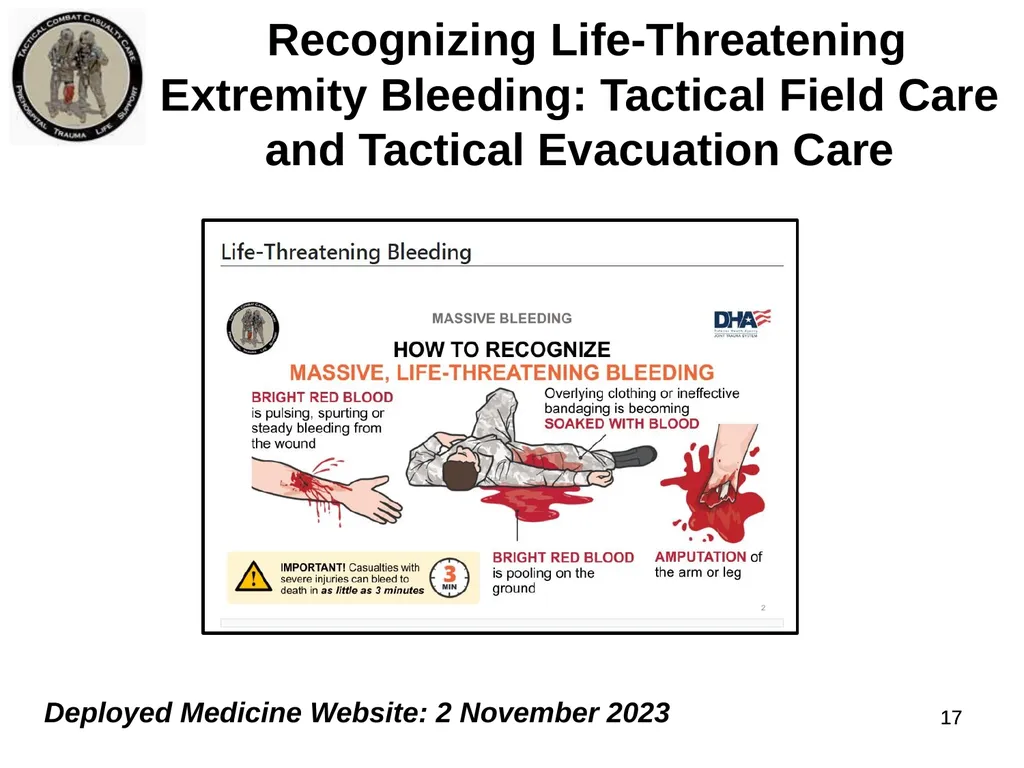
17 17 Recognizing Life-Threatening Extremity Bleeding: Tactical Field Care and Tactical Evacuation Care Deployed Medicine Website: 2 November 2023<br>
18
18 18 What New Training Is Needed? Based on the Ukrainian tourniquet experience
and the potential for prolonged evacuation times
in future conflicts, there needs to be additional emphasis in TCCC training on ensuring that tourniquets are medically indicated.
We need images that illustrate what NON-life
threatening extremity bleeding looks like.
This needs to be an objectively tested skill with
its own skill performance sheet.<br>
19
Who Needs a Tourniquet?
And Who Does Not? The slides to follow are examples of extremity
wounds.
The task is to identify which wounds need a
tourniquet (i.e. show life-threatening extremity
bleeding.)
If the bleeding is not life-threatening, the
extremity does not need a tourniquet.<br>
And Who Does Not? The slides to follow are examples of extremity
wounds.
The task is to identify which wounds need a
tourniquet (i.e. show life-threatening extremity
bleeding.)
If the bleeding is not life-threatening, the
extremity does not need a tourniquet.<br>
20
20 20 Recognizing Life-Threatening Extremity Bleeding - Consider the wounds on the following slides as NOT
being seen during Care Under Fire, but seen during
Tactical Field Care or TACEVAC Care. The first
responder has time to examine the casualty.
- The casualty is alert and oriented with a normal radial
pulse unless otherwise indicated. (i.e. – not in shock).
- Evacuation time to surgical care is estimated to be
greater than 6 hours.
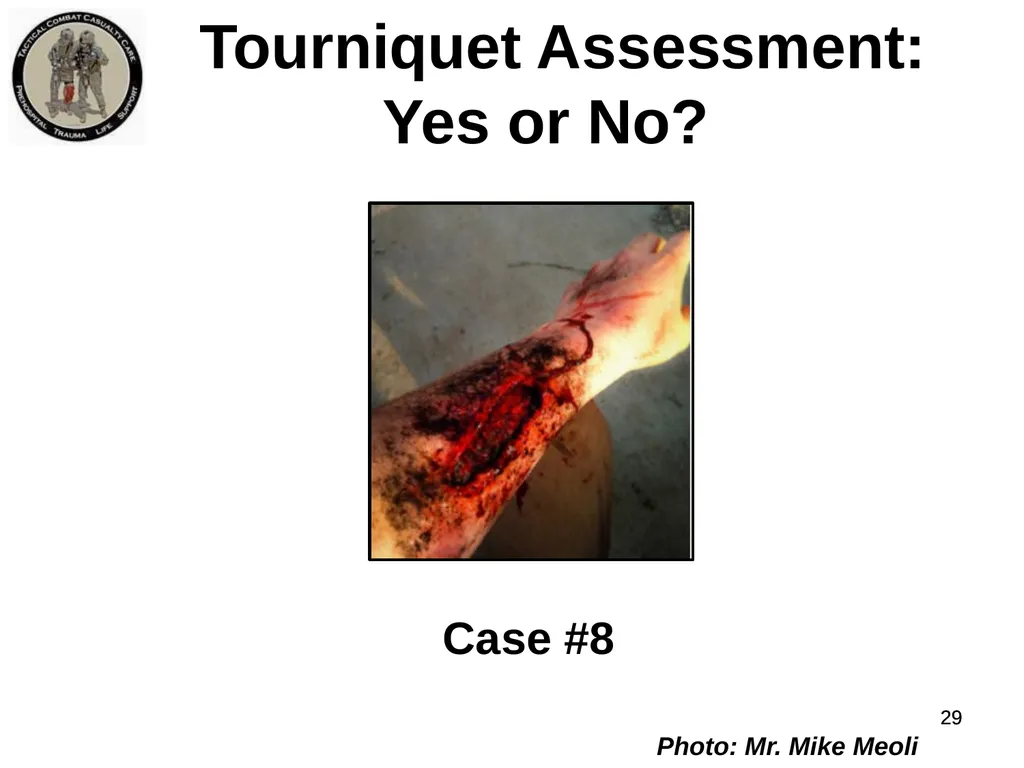
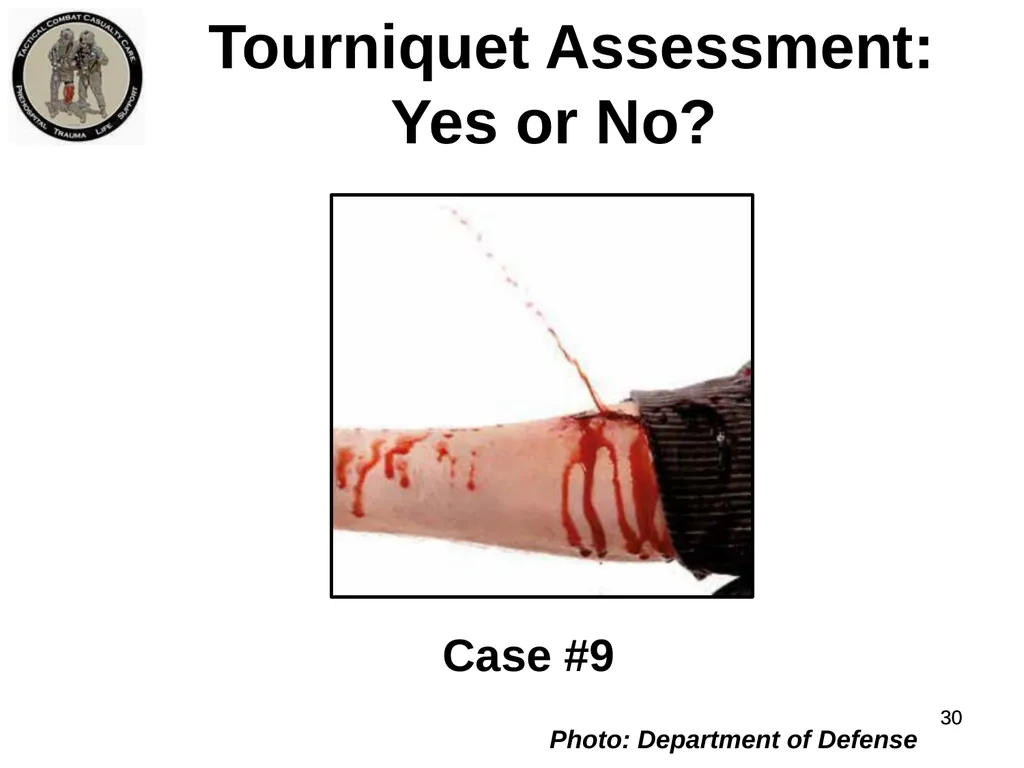
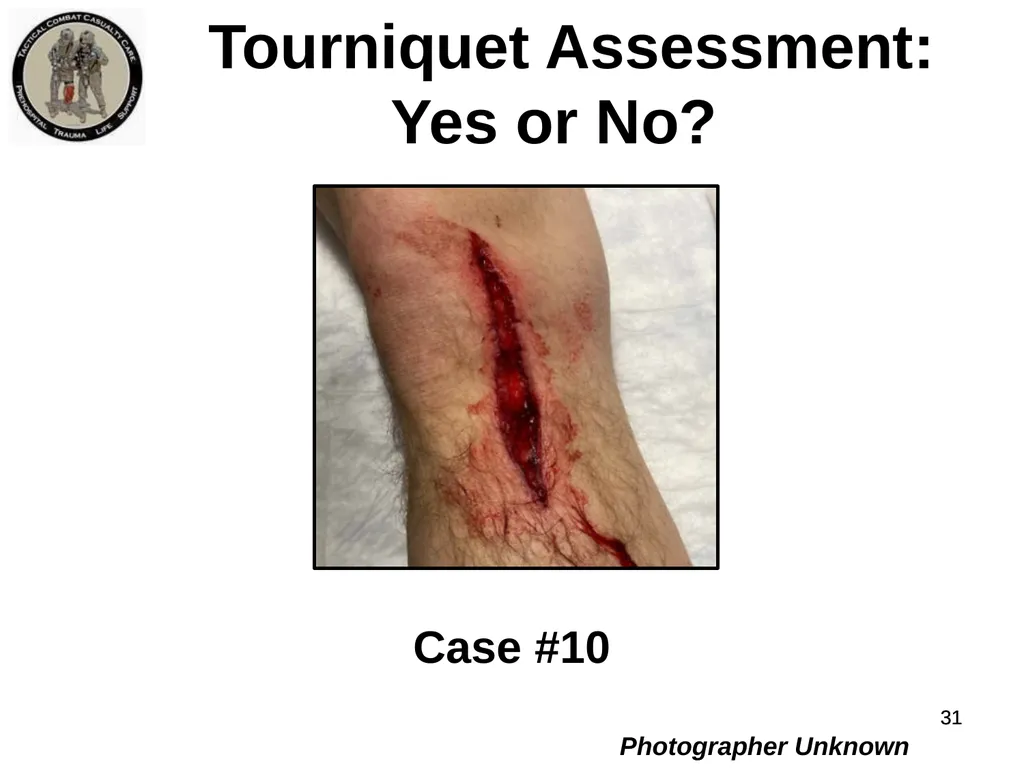
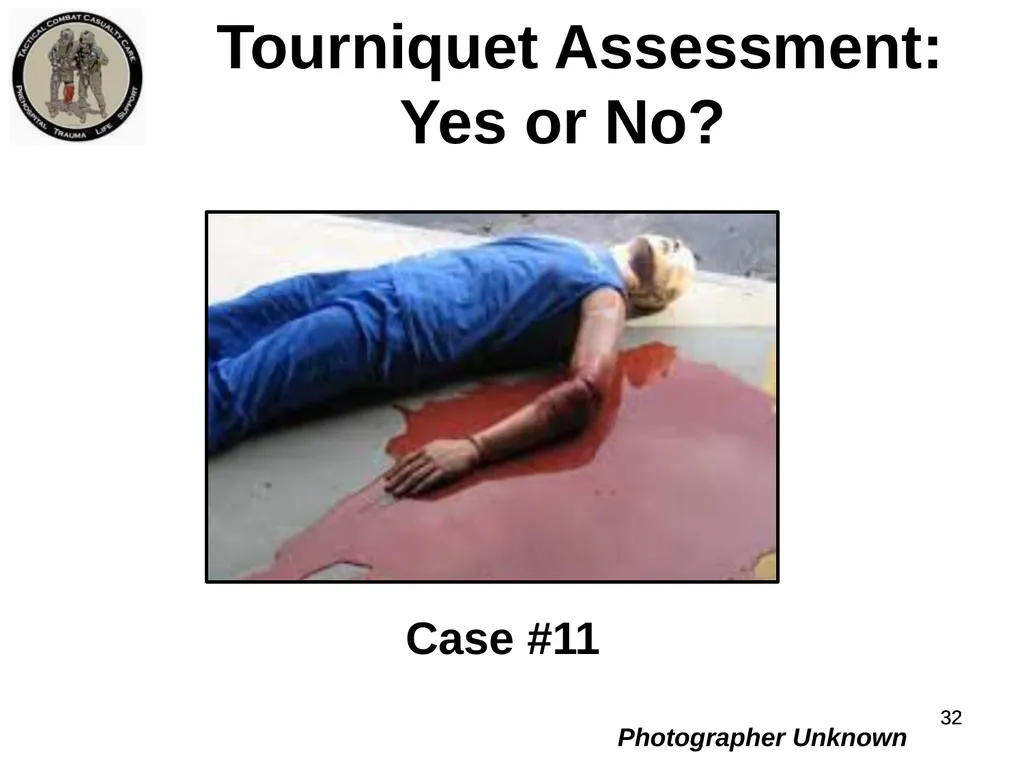
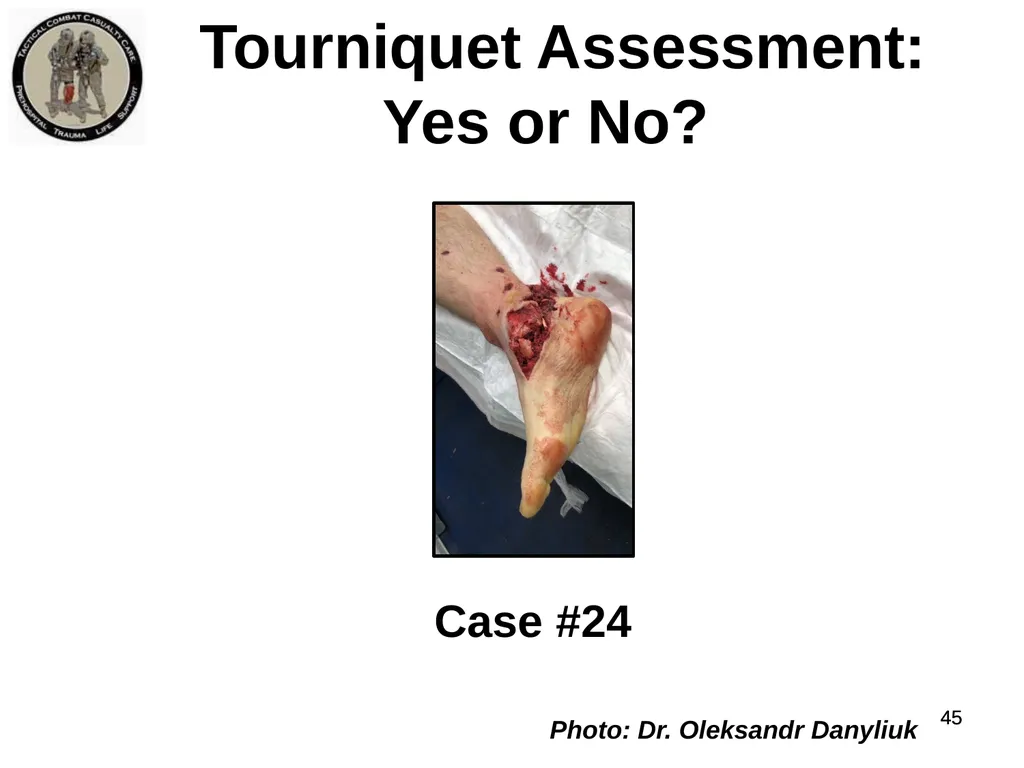
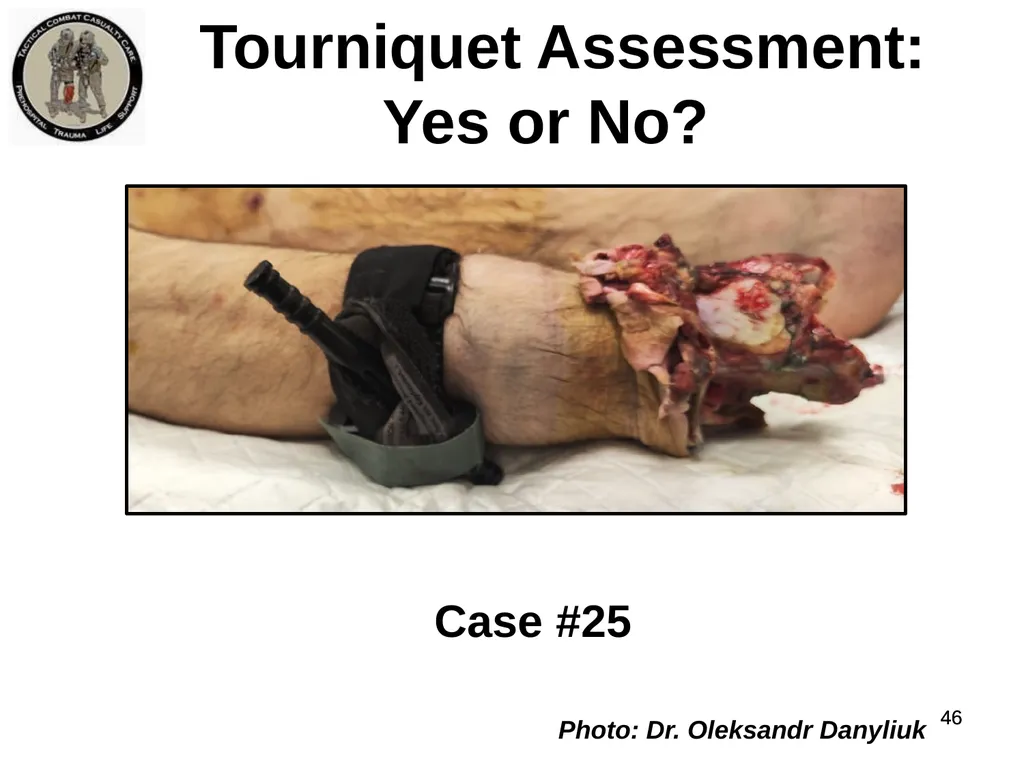
- Which of the following 25 wounds need a tourniquet (tourniquet YES) which ones do not (tourniquet NO)?
- Answers are on slide 54 at the end of this presentation.<br>
21
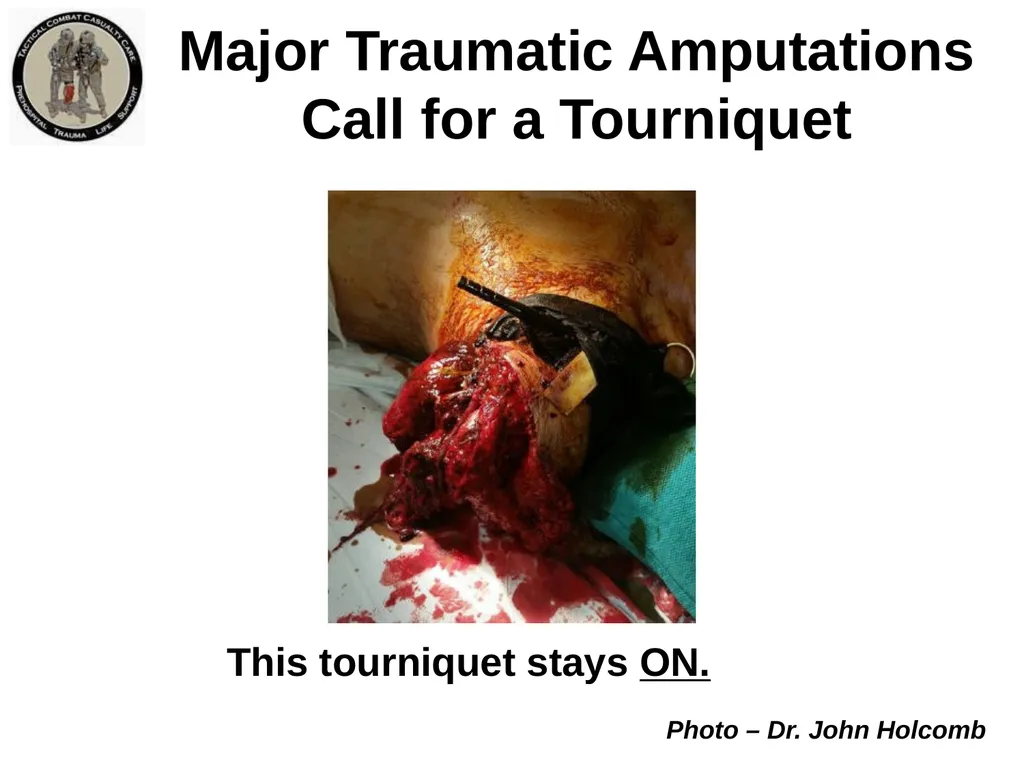
Major Traumatic Amputations
Call for a Tourniquet This tourniquet stays ON. Photo – Dr. John Holcomb<br>
Call for a Tourniquet This tourniquet stays ON. Photo – Dr. John Holcomb<br>
22
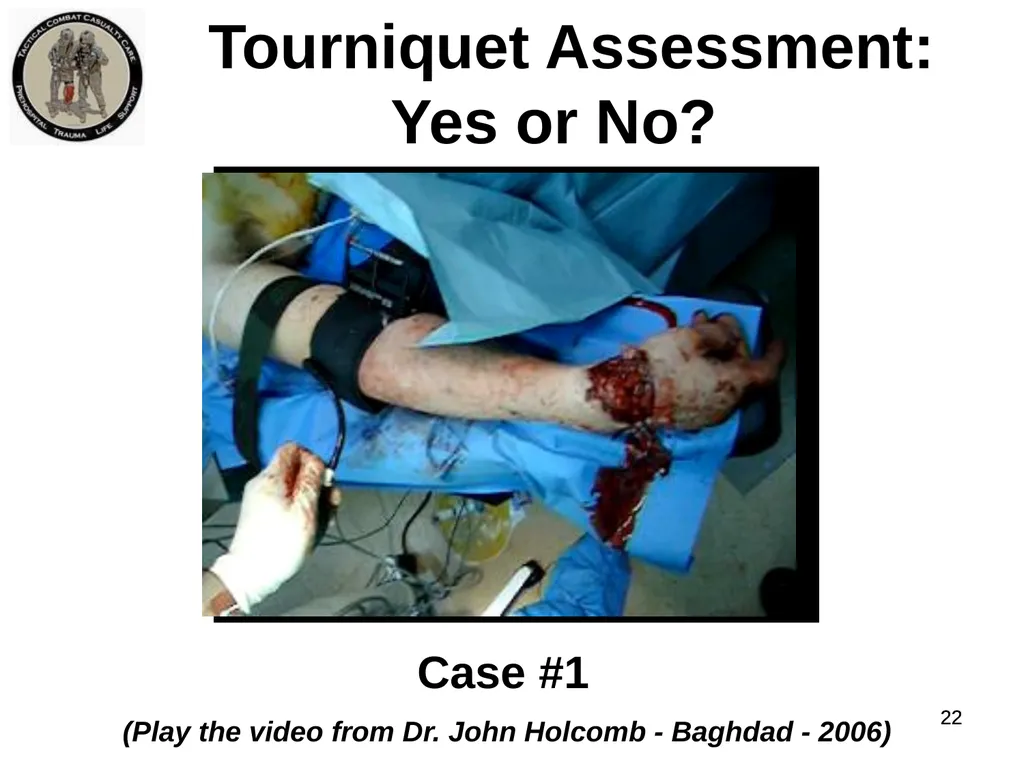
22 22 Tourniquet Assessment:
Yes or No? Case #1
(Play the video from Dr. John Holcomb - Baghdad - 2006)<br>
(Play the video from Dr. John Holcomb - Baghdad - 2006)<br>
23
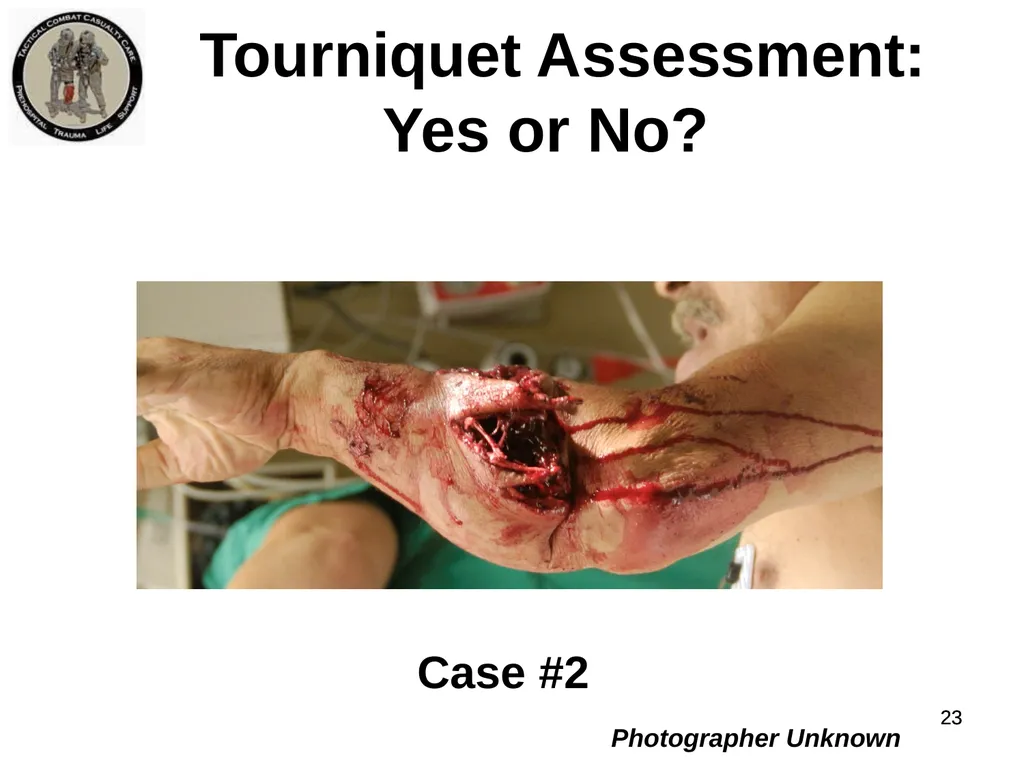
23 23 Tourniquet Assessment:
Yes or No? Case #2 Photographer Unknown<br>
24
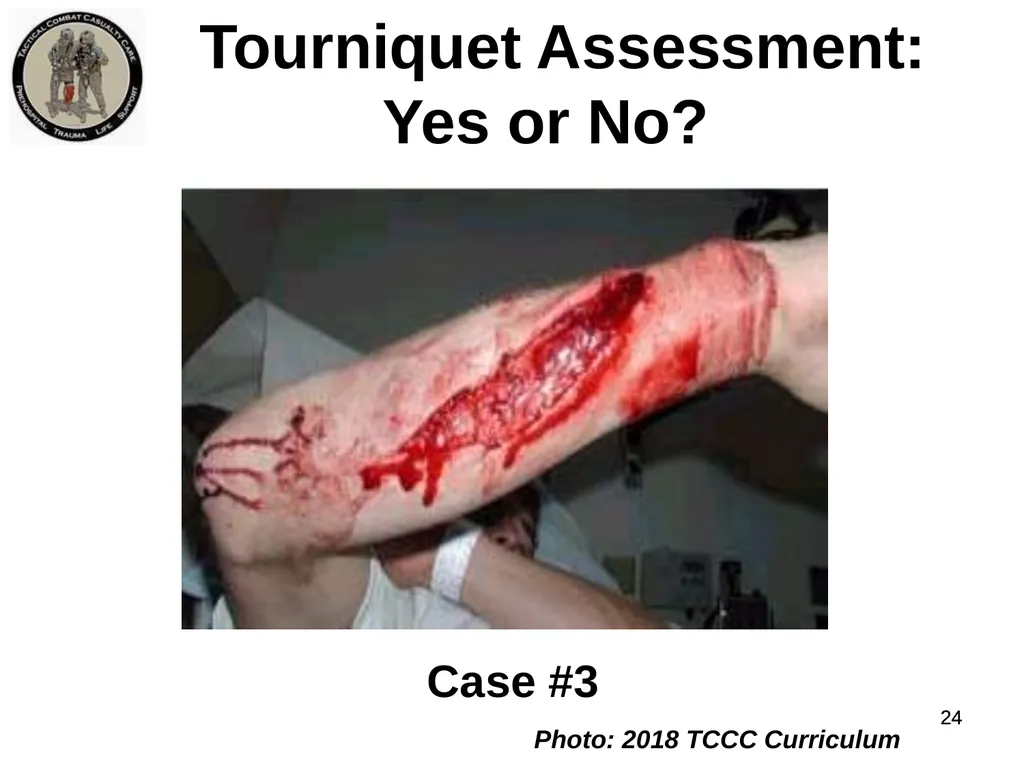
24 24 Tourniquet Assessment:
Yes or No? Case #3 Photo: 2018 TCCC Curriculum<br>
25
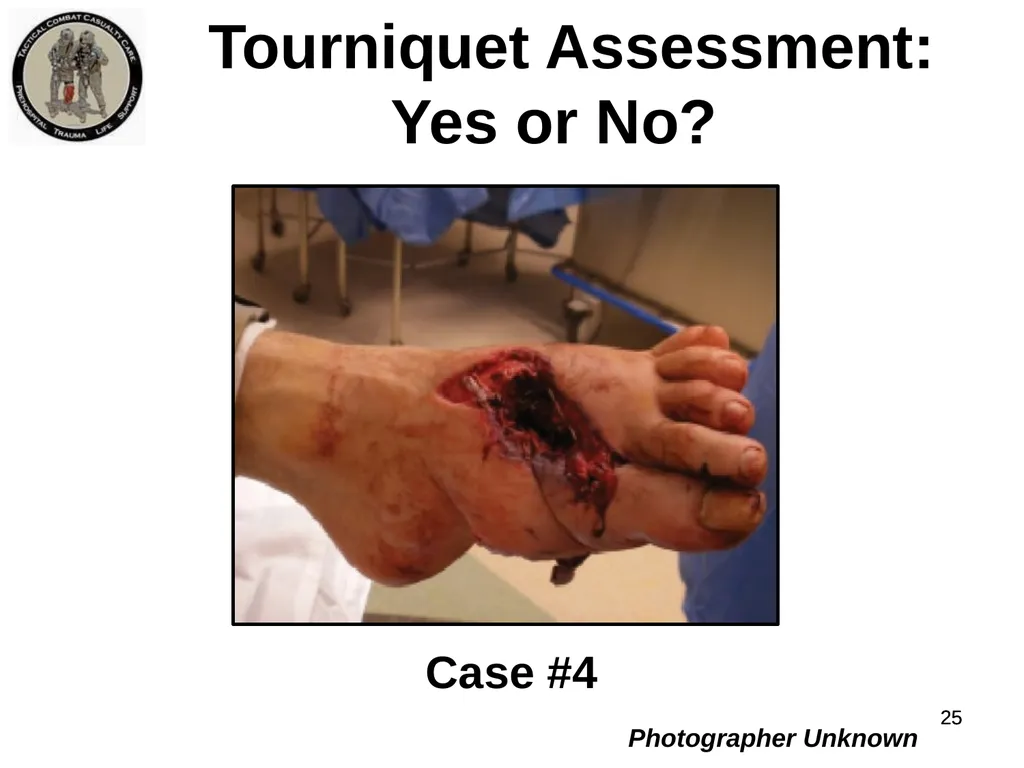
25 25 Tourniquet Assessment:
Yes or No? Case #4 Photographer Unknown<br>
26
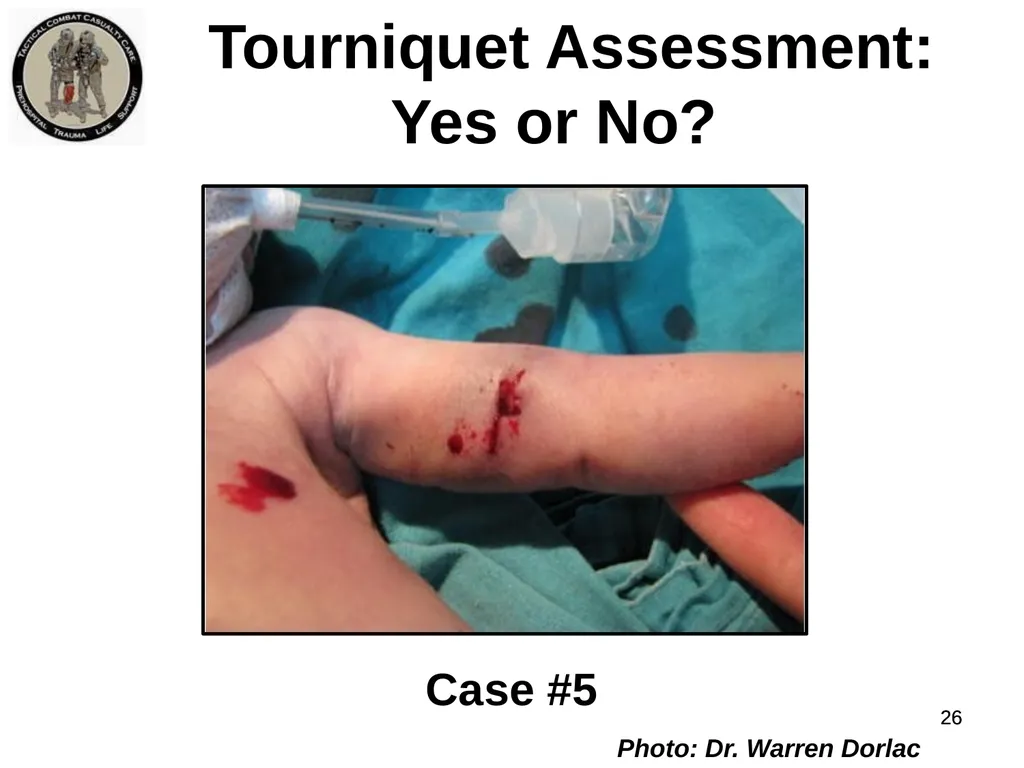
26 26 Tourniquet Assessment:
Yes or No? Case #5 Photo: Dr. Warren Dorlac<br>
27
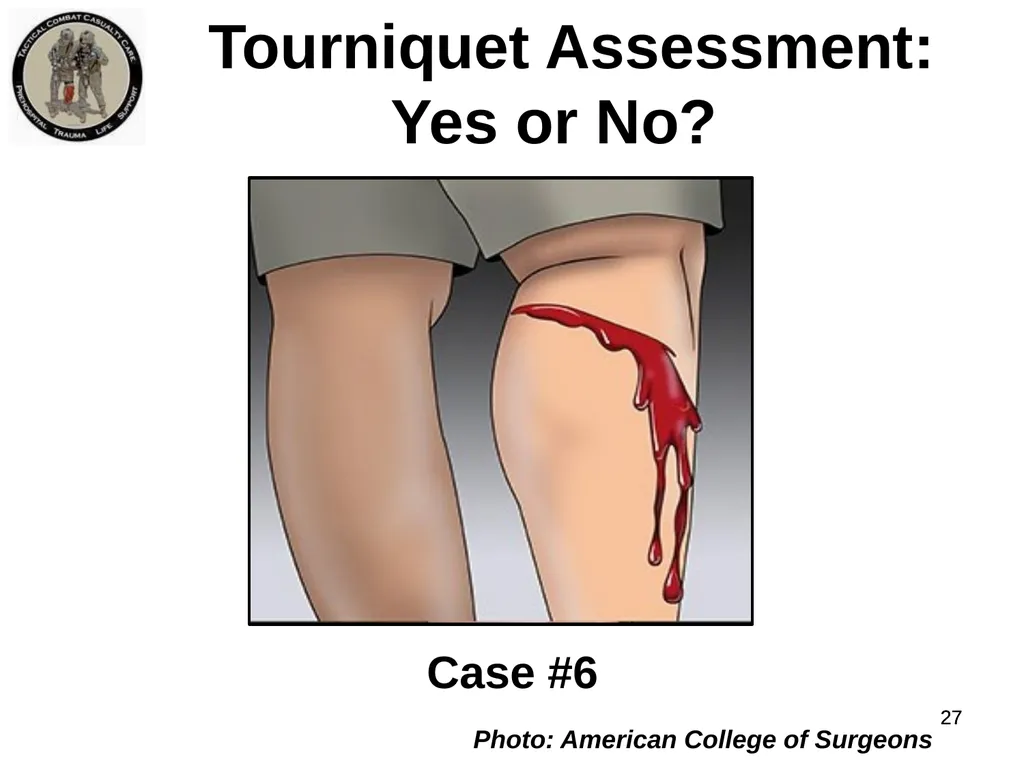
27 27 Tourniquet Assessment:
Yes or No? Case #6 Photo: American College of Surgeons<br>
28
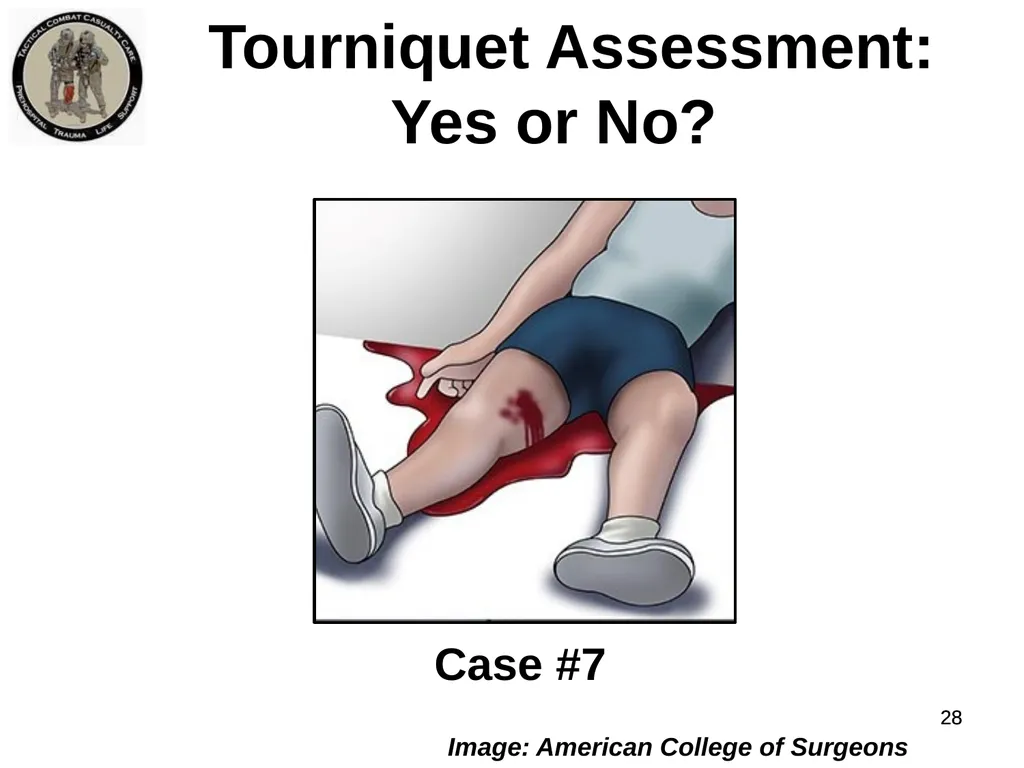
28 28 Tourniquet Assessment:
Yes or No? Case #7 Image: American College of Surgeons<br>
29
29 29 Tourniquet Assessment:
Yes or No? Case #8 Photo: Mr. Mike Meoli<br>
30
30 30 Tourniquet Assessment:
Yes or No? Case #9 Photo: Department of Defense<br>
31
31 31 Tourniquet Assessment:
Yes or No? Case #10 Photographer Unknown<br>
32
32 32 Tourniquet Assessment:
Yes or No? Case #11 Photographer Unknown<br>
33
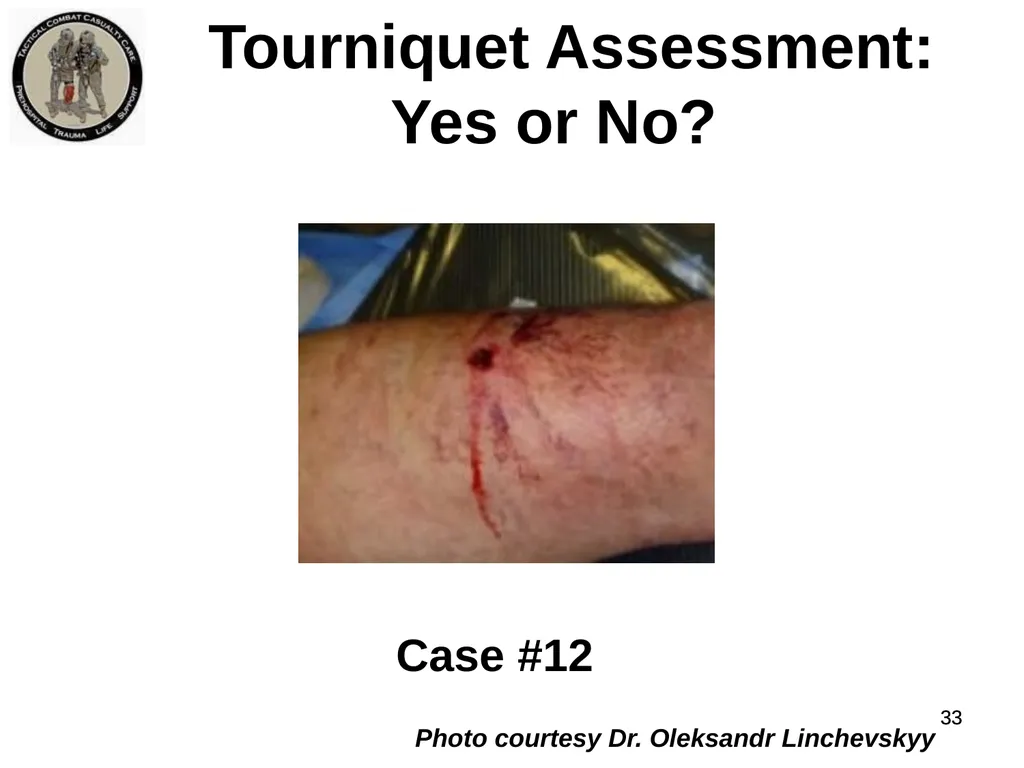
33 33 Tourniquet Assessment:
Yes or No? Case #12 Photo courtesy Dr. Oleksandr Linchevskyy<br>
34
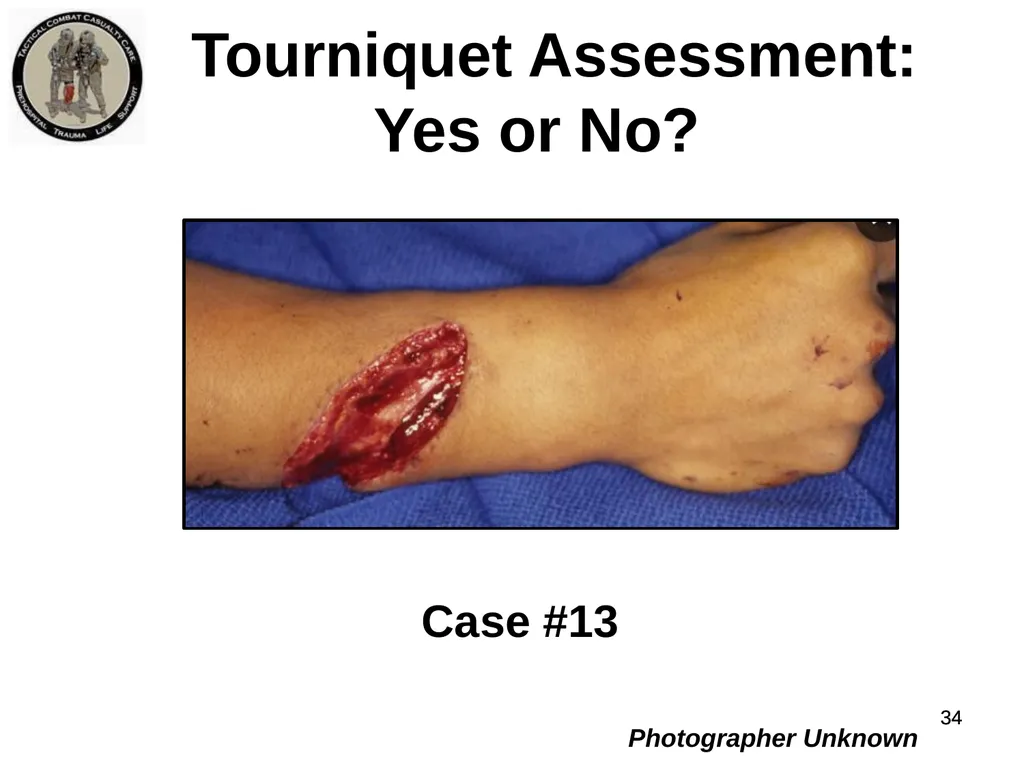
34 34 Tourniquet Assessment:
Yes or No? Case #13 Photographer Unknown<br>
35
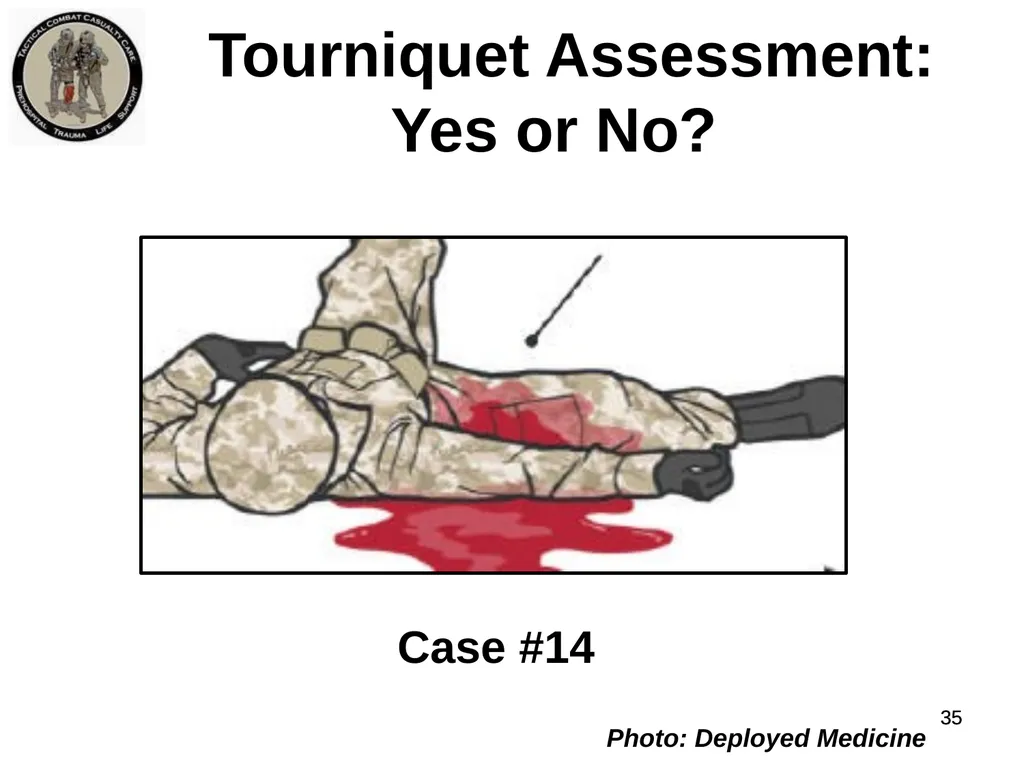
35 35 Tourniquet Assessment:
Yes or No? Case #14 Photo: Deployed Medicine<br>
36
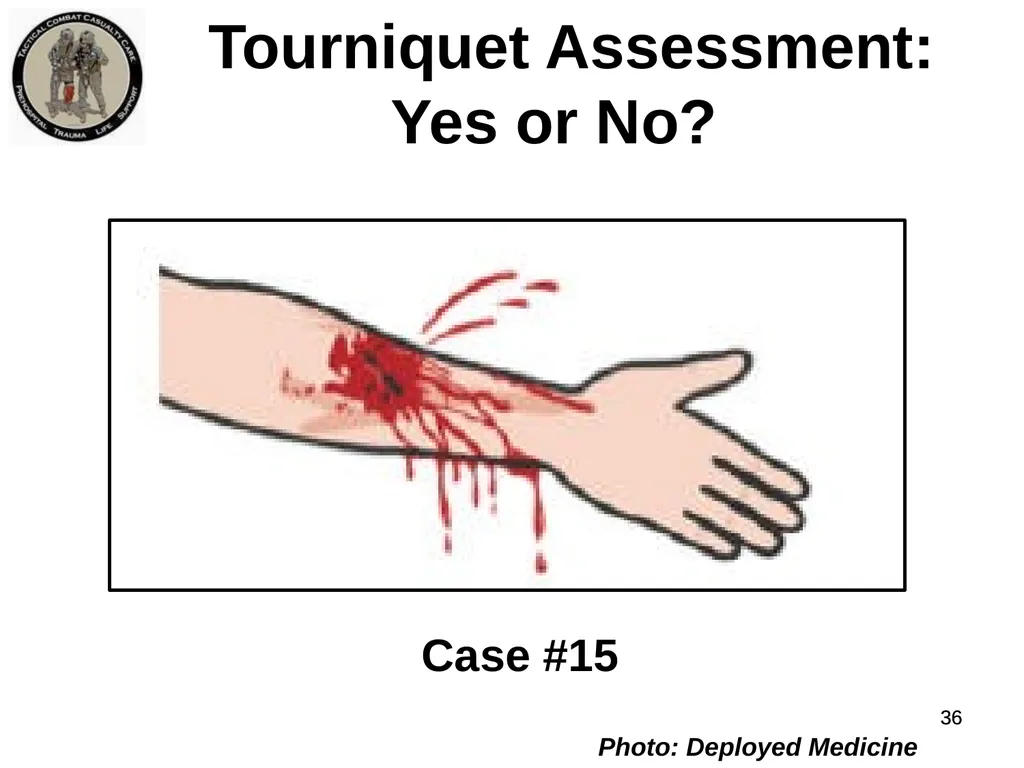
36 36 Tourniquet Assessment:
Yes or No? Case #15 Photo: Deployed Medicine<br>
37
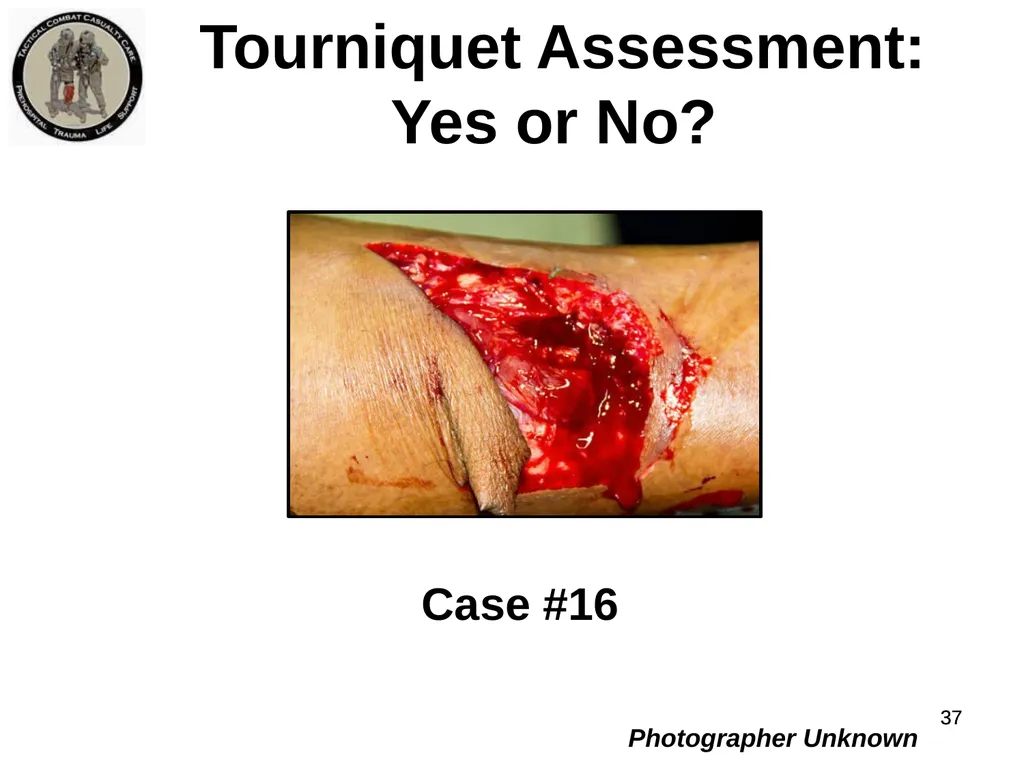
37 37 Tourniquet Assessment:
Yes or No? Case #16 Photographer Unknown<br>
38
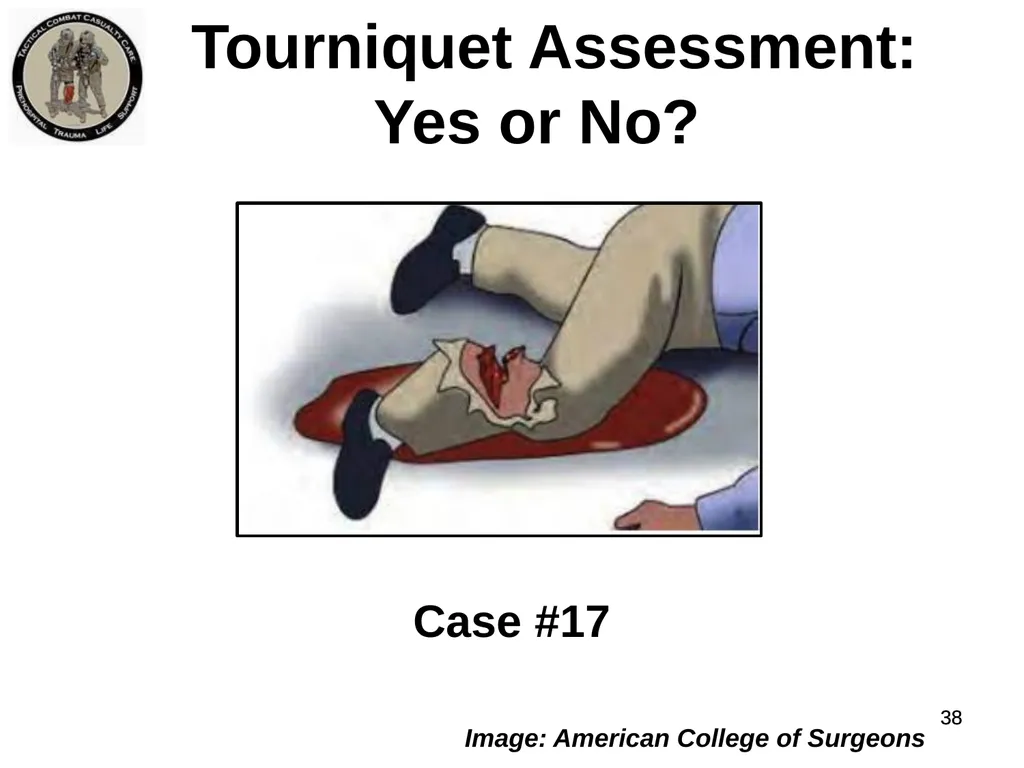
38 38 Tourniquet Assessment:
Yes or No? Case #17 Image: American College of Surgeons<br>
39
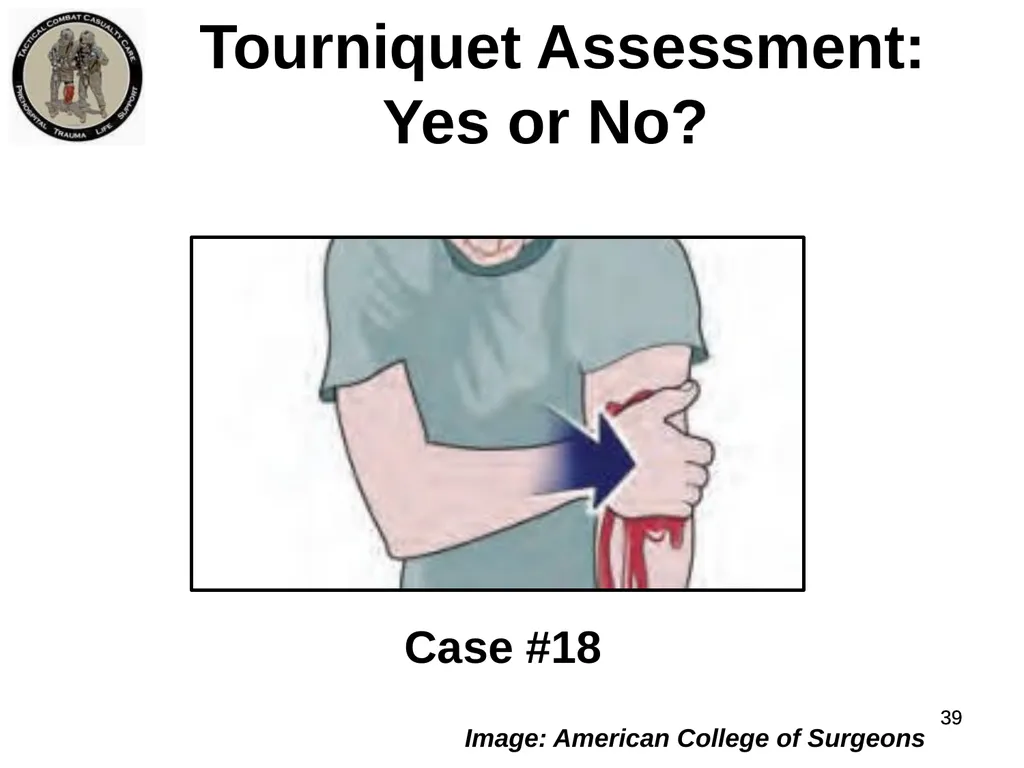
39 39 Tourniquet Assessment:
Yes or No? Case #18 Image: American College of Surgeons<br>
40
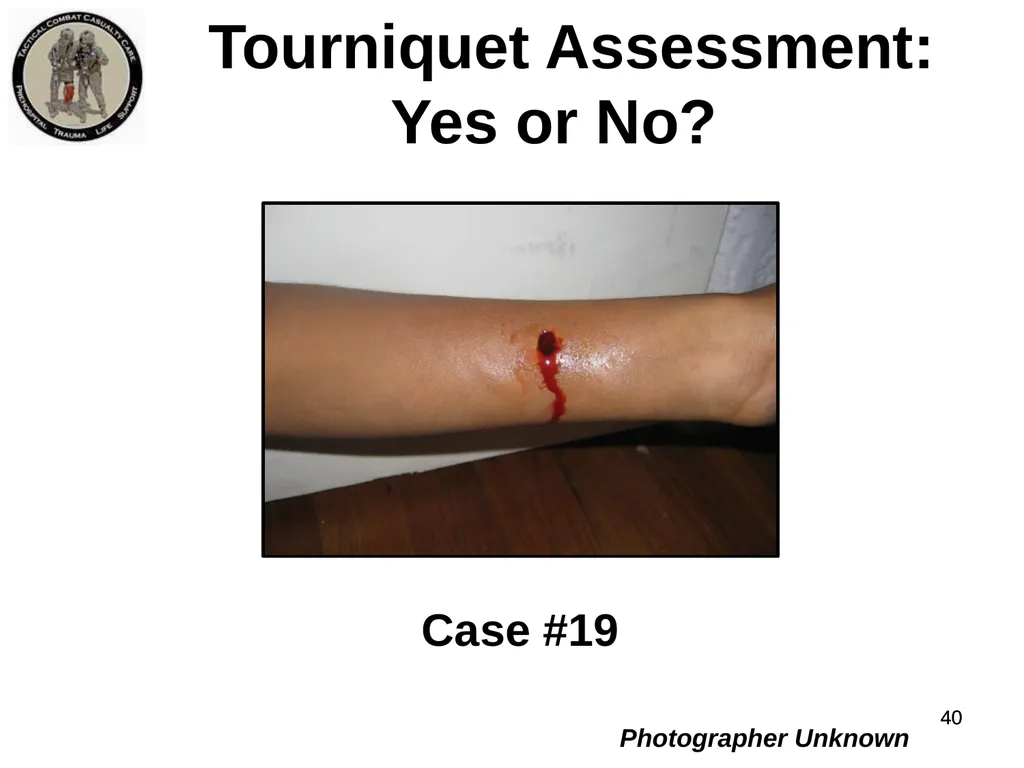
40 40 Tourniquet Assessment:
Yes or No? Case #19 Photographer Unknown<br>
41
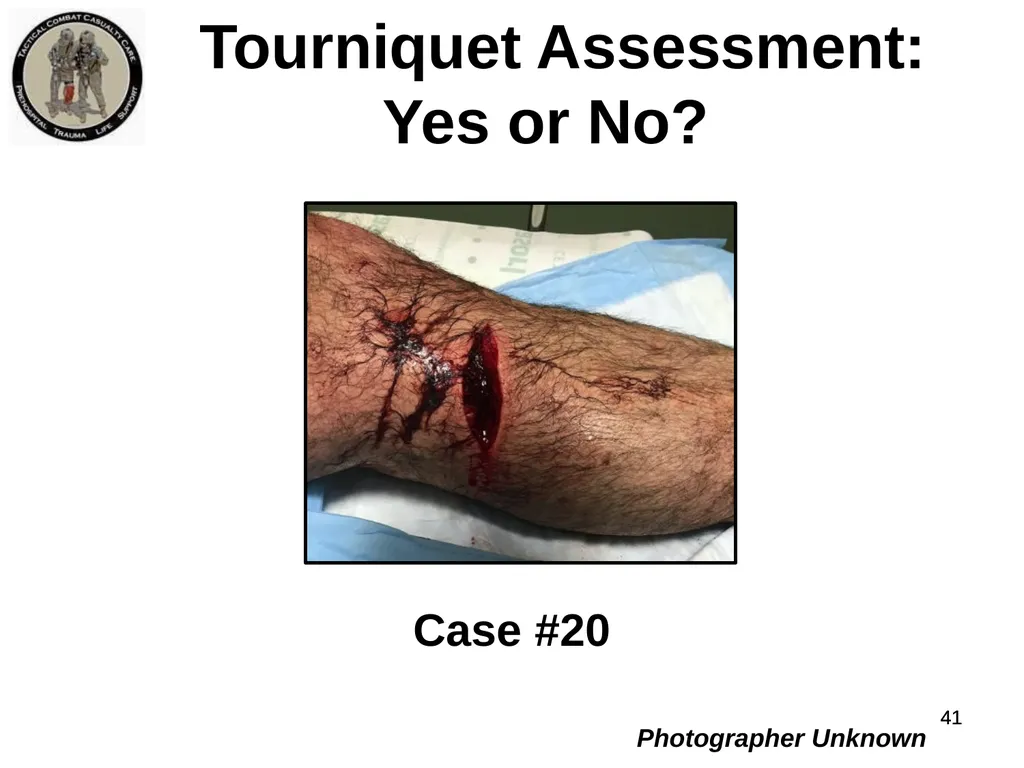
41 41 Tourniquet Assessment:
Yes or No? Case #20 Photographer Unknown<br>
42
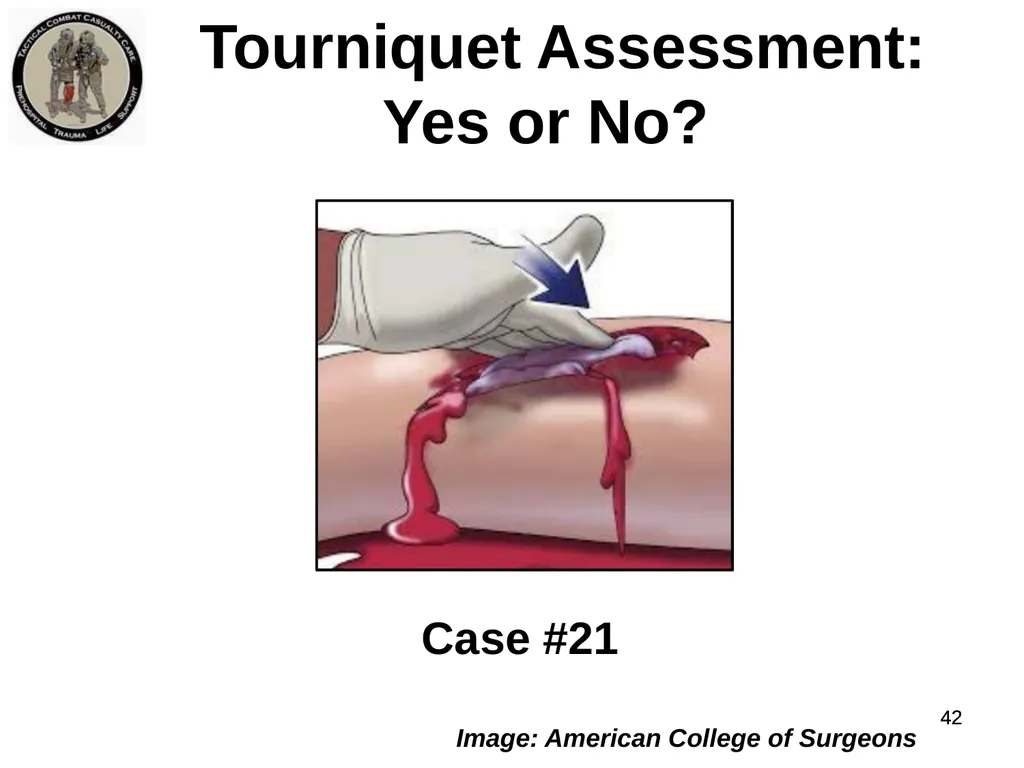
42 42 Tourniquet Assessment:
Yes or No? Case #21 Image: American College of Surgeons<br>
43
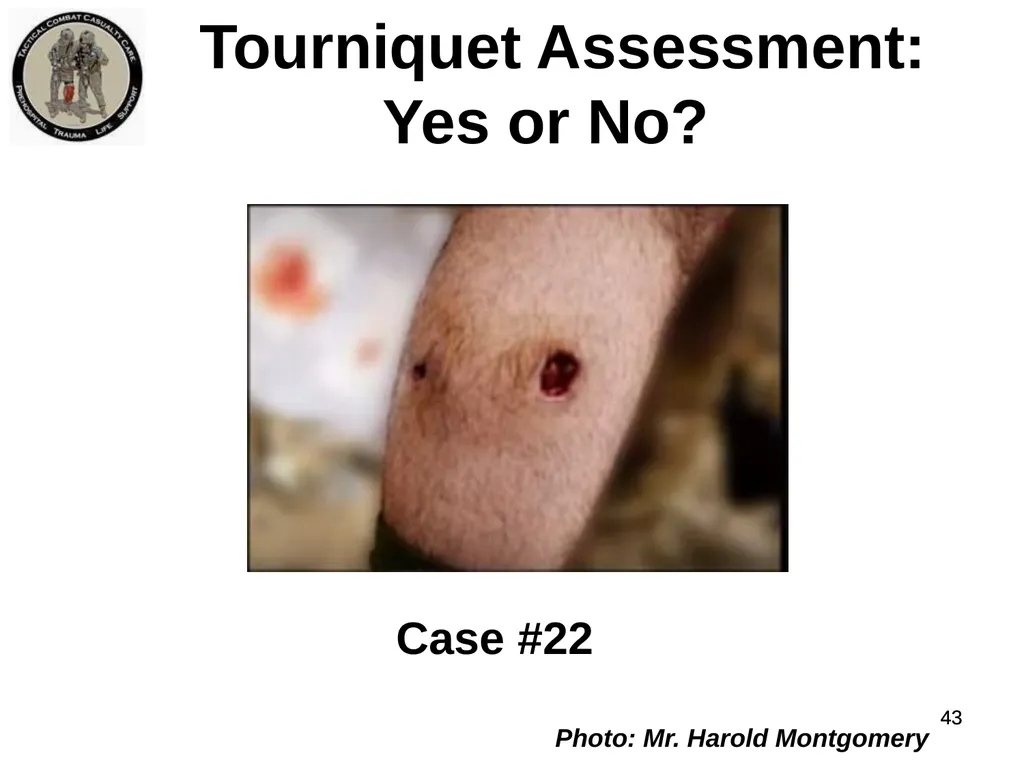
43 43 Tourniquet Assessment:
Yes or No? Case #22 Photo: Mr. Harold Montgomery<br>
44
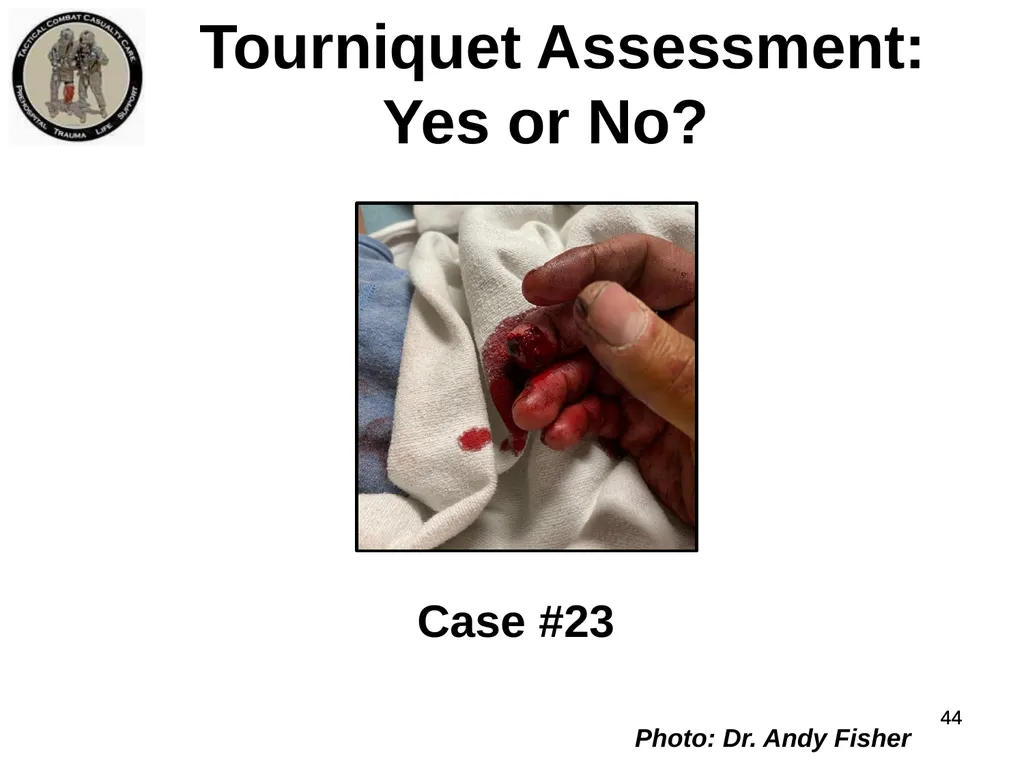
44 44 Tourniquet Assessment:
Yes or No? Case #23 Photo: Dr. Andy Fisher<br>
45
45 45 Tourniquet Assessment:
Yes or No? Case #24 Photo: Dr. Oleksandr Danyliuk<br>
46
46 46 Tourniquet Assessment:
Yes or No? Case #25 Photo: Dr. Oleksandr Danyliuk<br>
47
47 47 Reassess, Reassess, Reassess! Reassess applied tourniquets
frequently: convert, replace (reposition),
or remove as indicated
The rate of bleeding and need for a
tourniquet may change over time:
Muscle relaxation
Tourniquet loses pressure
Casualty movement
Fluid resuscitation<br>
frequently: convert, replace (reposition),
or remove as indicated
The rate of bleeding and need for a
tourniquet may change over time:
Muscle relaxation
Tourniquet loses pressure
Casualty movement
Fluid resuscitation<br>
48
48 48 Tourniquet Terminology Remove a tourniquet – take it off the injured
extremity
Replace a tourniquet – reposition a tourniquet
that was applied high on the limb during Care
Under Fire/Threat to a location 2-3 inches
above the bleeding site directly on the skin
Convert a tourniquet – apply hemostatic
dressings to control extremity hemorrhage, thus
allowing the tourniquet pressure to be released
and blood flow to the limb to be restored<br>
49
Frequent Reassessment
of Tourniquets How quickly and how frequently the individual
caring for the casualty will be able to reassess
the need for the tourniquet will vary with the
tactical scenario.
Current TCCC Guidelines call for a reassessment
to be done by two hours of tourniquet time.
Do it as soon as possible. Earlier is better!
Reassess as frequently as the tactical situation
permits but especially during periods of casualty
movement and fluid resuscitation.<br>
50
50 50 Who Should Do Tourniquet Reassessments/Conversions? In the past, TCCC recommended that tourniquet reassessment be done by a Combat Medic or more advanced provider.
2. But medics may be early casualties. Others may be needed to perform this task.
3. The Committee on TCCC has recently added
tourniquet reassessment to the Combat Lifesaver skill
set.
4. The Ukrainian military now allows All Combatants to do
tourniquet reassessment.
5. Combat units should ensure that they have sufficient
trained personnel to perform tourniquet
reassessments, conversions, and replacement.<br>
51
51 51 Training for Whoever Is Going to Do Tourniquet Reassessments Many casualties who have tourniquets applied never needed a tourniquet in the first place.
This ability to determine whether extremity bleeding is not life-threatening should be included in the skills that are objectively assessed in the TCCC training course.
Leaders (line and medical) need to ensure that reassessment of tourniquets applied during combat operations is performed as early and as often as tactically feasible, especially when evacuation will be prolonged.<br>
52
52 52 LEADERSHIP “Medical care is commander’s business…. We can delegate authority to the medical community, but not the responsibility for ensuring it is taken care of……I take this responsibility very seriously and expect that others in the command do as well.”
General Joe Votel
Heroes of Military Medicine Awards
3 May 2018<br>
General Joe Votel
Heroes of Military Medicine Awards
3 May 2018<br>
53
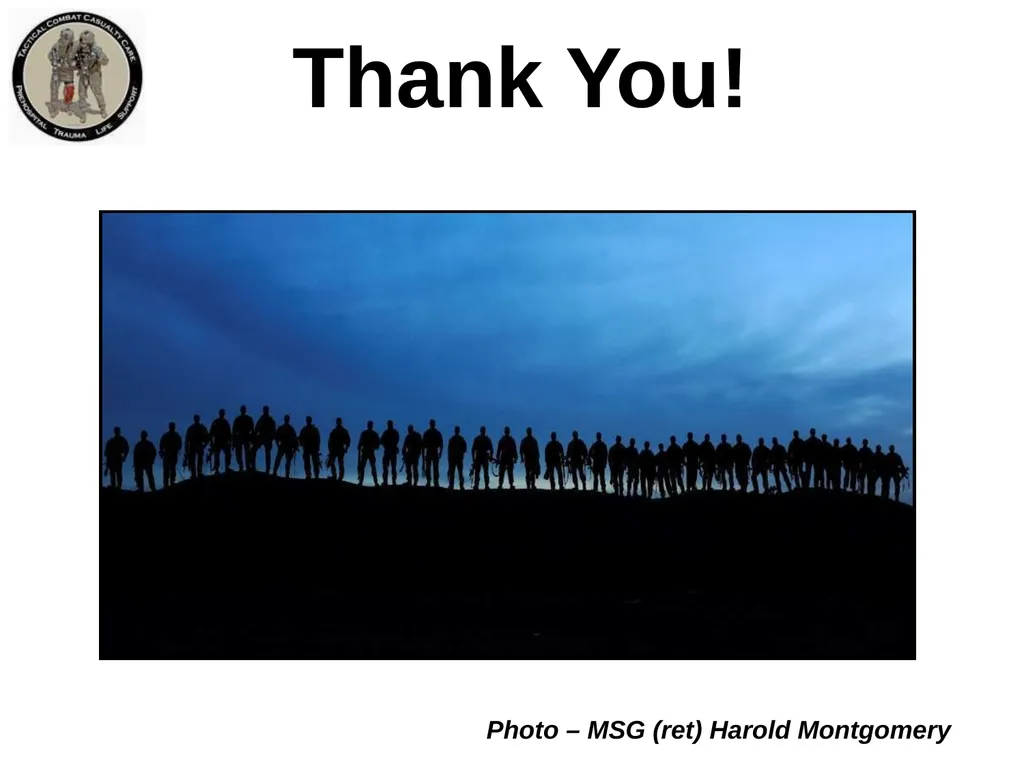
Thank You! Photo – MSG (ret) Harold Montgomery<br>
54
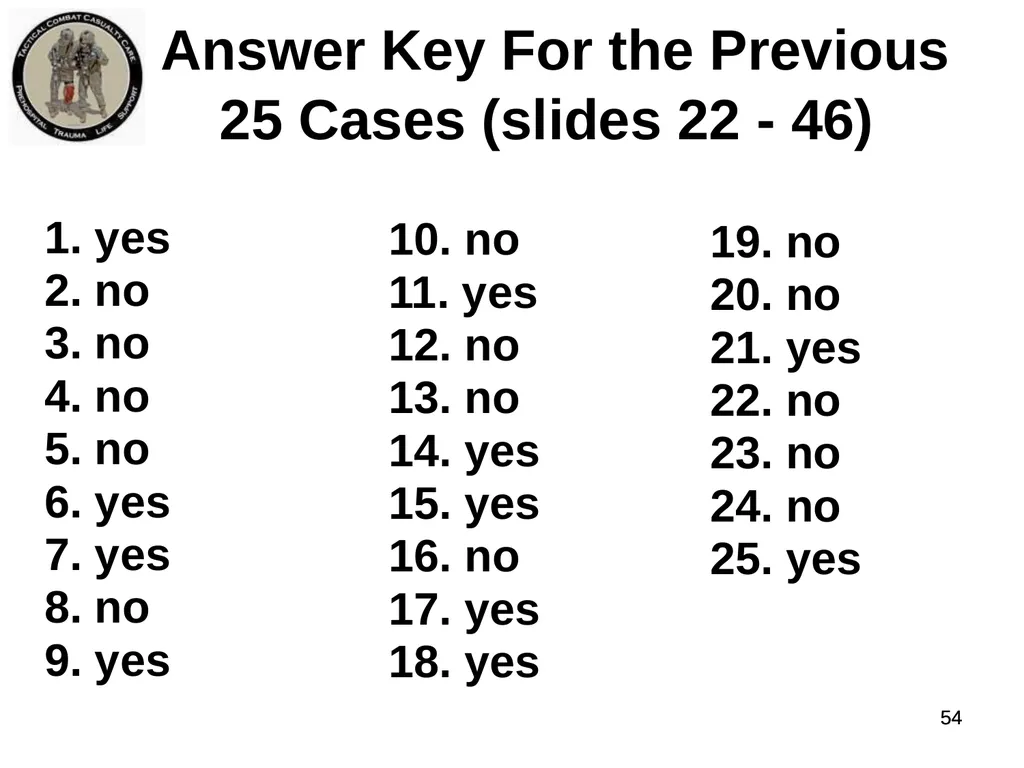
54 54 Answer Key For the Previous
25 Cases (slides 22 - 46) 1. yes
2. no
3. no
4. no
5. no
6. yes
7. yes
8. no
9. yes 10. no
11. yes
12. no
13. no
14. yes
15. yes
16. no
17. yes
18. yes 19. no
20. no
21. yes
22. no
23. no
24. no
25. yes<br>
2. no
3. no
4. no
5. no
6. yes
7. yes
8. no
9. yes 10. no
11. yes
12. no
13. no
14. yes
15. yes
16. no
17. yes
18. yes 19. no
20. no
21. yes
22. no
23. no
24. no
25. yes<br>