Why is the sea dangerous? Why does the sea change from dangerous to calm? Is the sea ever safe? Can you think of any ways the sea could be like a dog? Grade 1 Summarise the poem and explain ideas about the poem. Grade 2 Make clear
"Why is the sea dangerous? Why does the sea change" is the property of its rightful owner. Permission is granted to
download and print the materials on this website for personal, non-commercial use only, and to display it
on your personal computer provided you do not modify the materials and that you retain all copyright
notices contained in the materials. By downloading content from our website, you accept the terms of this
agreement.
Presentation Transcript
01
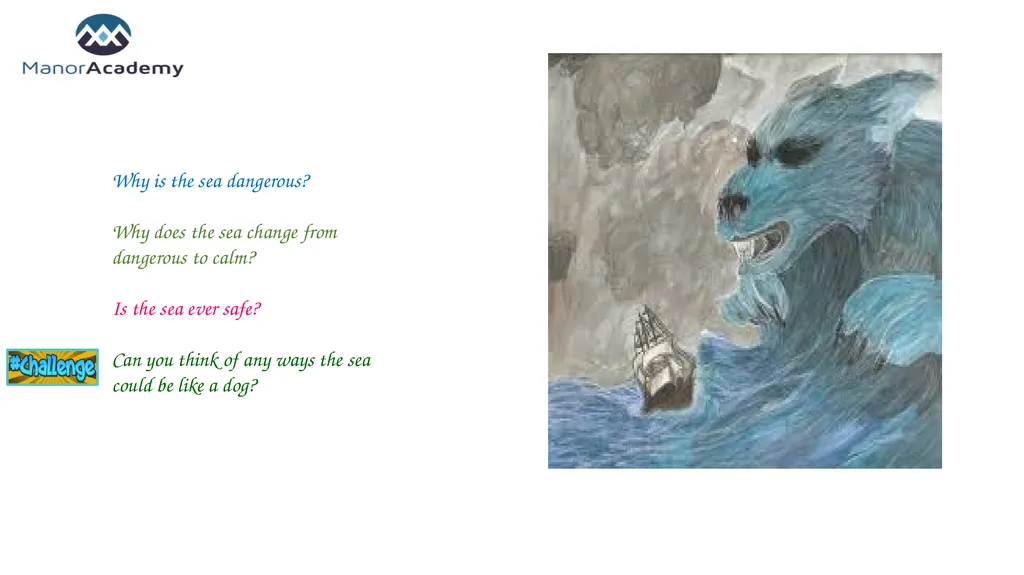
Why is the sea dangerous?
Why does the sea change from dangerous to calm?
Is the sea ever safe?
Can you think of any ways the sea could be like a dog?<br>
02
Grade 1 – Summarise the poem and explain ideas about the poem.
Grade 2 – Make clear points supported with relevant evidence from the poem and explain in detail.
Grade 3 – Make clear analysis of language.
Grade 4 – Examine the response of a reader and identify the intention of the writer.
Grade 5 – Develop a clear analysis of how structure helps portrays ideas.
Grade 6 - Will give alternative meanings of chosen evidence and explain. Aim – To analyse James Reeves’ poem The Sea.<br>
03
Starter You will see several lines of the poem.
You have 4 minutes to answer as many questions as you can.<br>
04
The sea is a hungry dog, Giant and grey. What is this poem about and how do you know?
What mood is portrayed and how do you know?
What poetic devices are used and what does it do / represent to the reader?
Are there any alternative meanings and what are they? 4 minutes<br>
05
And 'Bones, bones, bones, bones! ' The giant sea-dog moans, What is this poem about and how do you know?
What mood is portrayed and how do you know?
What poetic devices are used and what does it do / represent to the reader?
Are there any alternative meanings and what are they? 4 minutes<br>
06
He lies on the sandy shores, So quiet, so quiet, he scarcely snores. What is this poem about and how do you know?
What mood is portrayed and how do you know?
What poetic devices are used and what does it do / represent to the reader?
Are there any alternative meanings and what are they? 4 minutes<br>
07
Reflection What is this poem about and how do you know?
What mood is portrayed and how do you know?
What poetic devices are used and what does it do / represent to the reader?
Are there any alternative meanings and what are they?<br>
08
Annotating the poem What is this poem about and how do you know?
What mood is portrayed and how do you know?
What poetic devices are used and what does it do / represent to the reader?
Are there any alternative meanings and what are they? 15 minutes Don’t forget
to create a
VCOP triangle
about moods
and feelings ready
for when you feedback Explore the learning<br>
09
Reflection What is this poem about and how do you know?
What mood is portrayed and how do you know?
What poetic devices are used and what does it do / represent to the reader?
Are there any alternative meanings and what are they?<br>
10
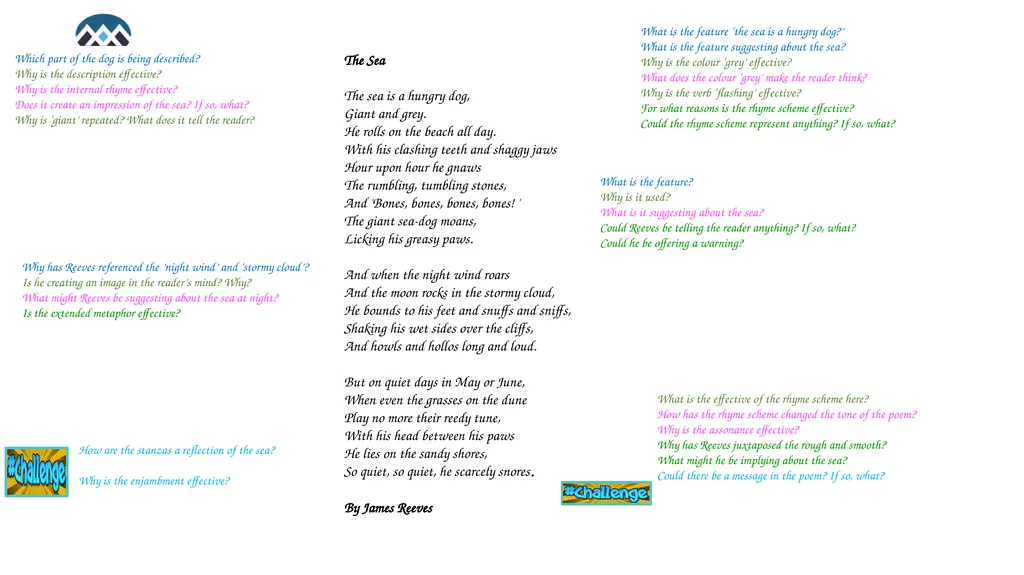
The Sea
The sea is a hungry dog, Giant and grey. He rolls on the beach all day. With his clashing teeth and shaggy jaws Hour upon hour he gnaws The rumbling, tumbling stones, And 'Bones, bones, bones, bones! ' The giant sea-dog moans, Licking his greasy paws. And when the night wind roars And the moon rocks in the stormy cloud, He bounds to his feet and snuffs and sniffs, Shaking his wet sides over the cliffs, And howls and hollos long and loud. But on quiet days in May or June, When even the grasses on the dune Play no more their reedy tune, With his head between his paws He lies on the sandy shores, So quiet, so quiet, he scarcely snores.
By James Reeves What is the feature ‘the sea is a hungry dog?’
What is the feature suggesting about the sea?
Why is the colour ‘grey’ effective?
What does the colour ‘grey’ make the reader think?
Why is the verb ‘flashing’ effective?
For what reasons is the rhyme scheme effective?
Could the rhyme scheme represent anything? If so, what? Which part of the dog is being described?
Why is the description effective?
Why is the internal rhyme effective?
Does it create an impression of the sea? If so, what?
Why is ‘giant’ repeated? What does it tell the reader? What is the feature?
Why is it used?
What is it suggesting about the sea?
Could Reeves be telling the reader anything? If so, what?
Could he be offering a warning? Why has Reeves referenced the ’night wind’ and ‘stormy cloud’?
Is he creating an image in the reader’s mind? Why?
What might Reeves be suggesting about the sea at night?
Is the extended metaphor effective? What is the effective of the rhyme scheme here?
How has the rhyme scheme changed the tone of the poem?
Why is the assonance effective?
Why has Reeves juxtaposed the rough and smooth?
What might he be implying about the sea?
Could there be a message in the poem? If so, what? How are the stanzas a reflection of the sea?
Why is the enjambment effective?<br>
11
Reflection Does the poem relate to any modern day topics/places in the world?
Look at how the people are with each other
Look if there are any choices that are made in the poem
Look at the way people live and the place they live
Look at any religious elements 5 minutes<br>
12
Grade 1 – Summarise the poem and explain ideas about the poem.
Grade 2 – Make clear points supported with relevant evidence from the poem and explain in detail.
Grade 3 – Make clear analysis of language.
Grade 4 – Examine the response of a reader and identify the intention of the writer.
Grade 5 – Develop a clear analysis of how structure helps portrays ideas.
Grade 6 - Will give alternative meanings of chosen evidence and explain. Aim – To analyse the poem Fog by Walterrean Salley.<br>