
Why XYZ Org Needs to Implement a Strategic
SB
Published · 21 slides · 0 views
1 / 1
Description
Why XYZ Org Needs to Implement a Strategic Meetings Management Programme (SMMP) Programme PPT Template developed in conjunction with Cvents Business Case Template Industry Statistics Meetings and events are a major spend category: Meeting
Related Topics
Share
Embed code
Download this presentation From Below
"Why XYZ Org Needs to Implement a Strategic" is the property of its rightful owner. Permission is granted to download and print the materials on this website for personal, non-commercial use only, and to display it on your personal computer provided you do not modify the materials and that you retain all copyright notices contained in the materials. By downloading content from our website, you accept the terms of this agreement.
Presentation Transcript
01
Why XYZ Org Needs to Implement a Strategic Meetings Management Programme (SMMP) Programme
PPT Template developed in conjunction with Cvent’s Business Case Template<br>
02
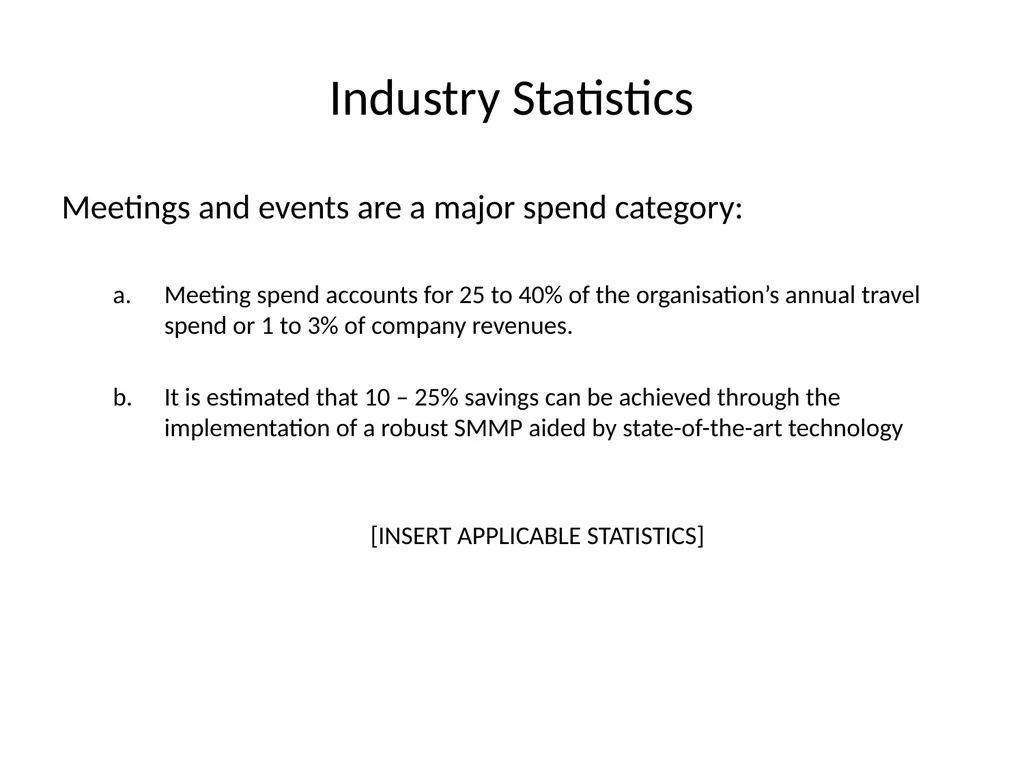
Industry Statistics Meetings and events are a major spend category:
Meeting spend accounts for 25 to 40% of the organisation’s annual travel spend or 1 to 3% of company revenues.
It is estimated that 10 – 25% savings can be achieved through the implementation of a robust SMMP aided by state-of-the-art technology
[INSERT APPLICABLE STATISTICS]<br>
Meeting spend accounts for 25 to 40% of the organisation’s annual travel spend or 1 to 3% of company revenues.
It is estimated that 10 – 25% savings can be achieved through the implementation of a robust SMMP aided by state-of-the-art technology
[INSERT APPLICABLE STATISTICS]<br>
03
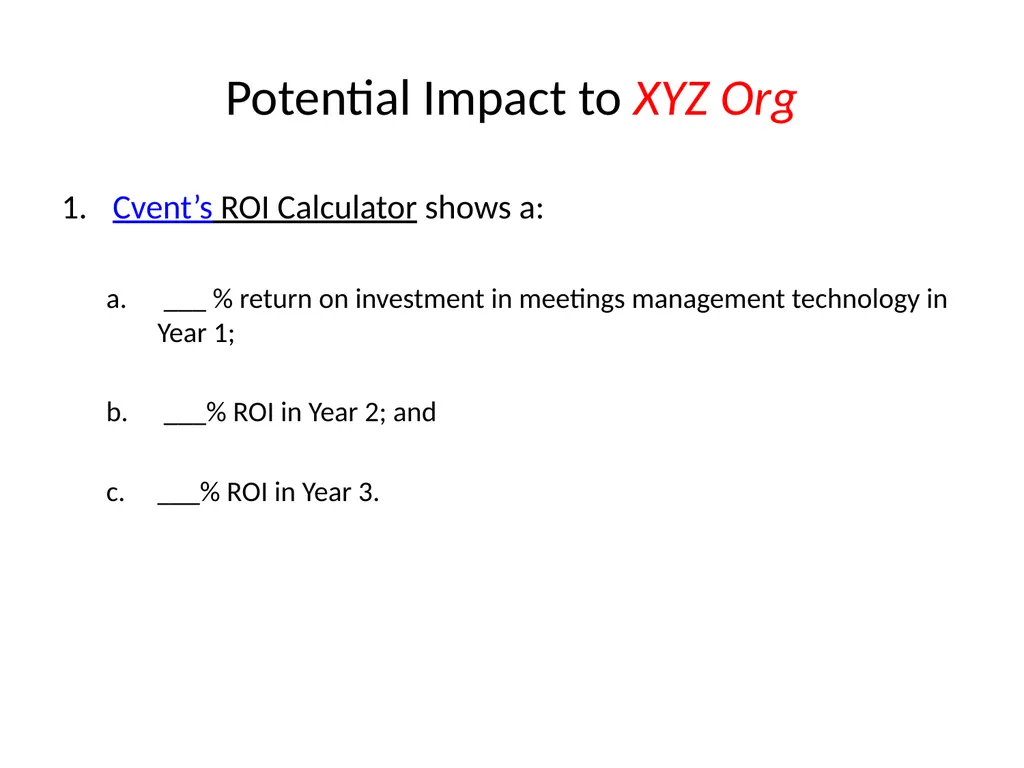
Potential Impact to XYZ Org Cvent’s ROI Calculator shows a:
___ % return on investment in meetings management technology in Year 1;
___% ROI in Year 2; and
___% ROI in Year 3.<br>
___ % return on investment in meetings management technology in Year 1;
___% ROI in Year 2; and
___% ROI in Year 3.<br>
04
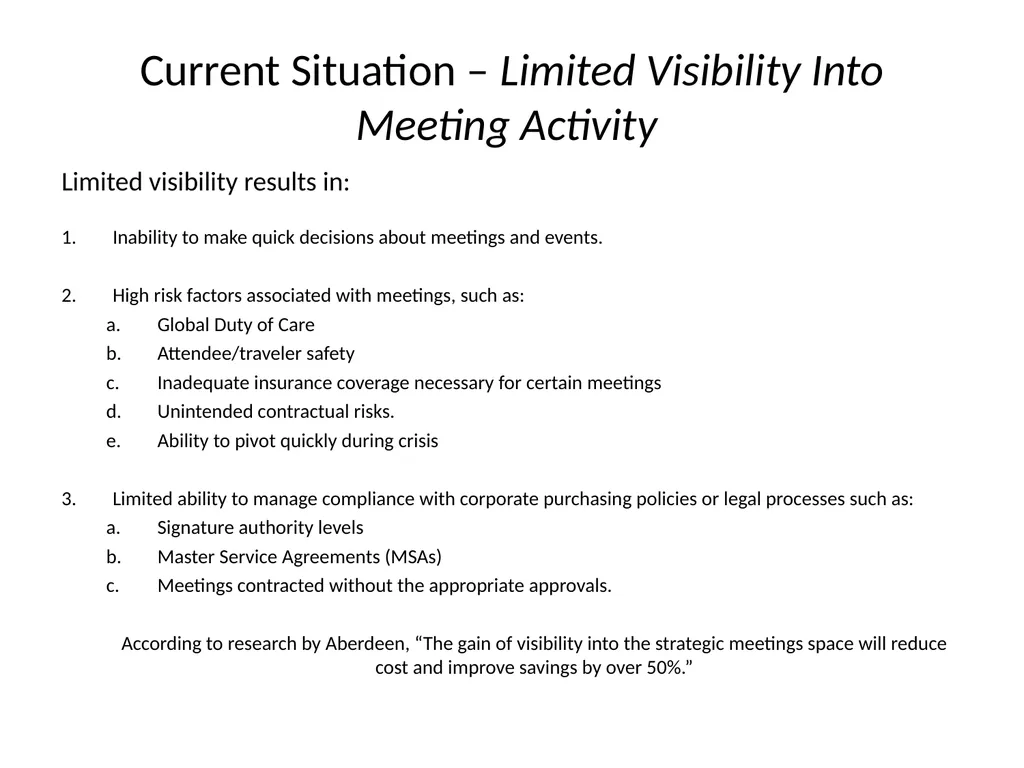
Current Situation – Limited Visibility Into Meeting Activity Limited visibility results in:
Inability to make quick decisions about meetings and events.
High risk factors associated with meetings, such as:
Global Duty of Care
Attendee/traveler safety
Inadequate insurance coverage necessary for certain meetings
Unintended contractual risks.
Ability to pivot quickly during crisis
Limited ability to manage compliance with corporate purchasing policies or legal processes such as:
Signature authority levels
Master Service Agreements (MSAs)
Meetings contracted without the appropriate approvals.
According to research by Aberdeen, “The gain of visibility into the strategic meetings space will reduce cost and improve savings by over 50%.”<br>
Inability to make quick decisions about meetings and events.
High risk factors associated with meetings, such as:
Global Duty of Care
Attendee/traveler safety
Inadequate insurance coverage necessary for certain meetings
Unintended contractual risks.
Ability to pivot quickly during crisis
Limited ability to manage compliance with corporate purchasing policies or legal processes such as:
Signature authority levels
Master Service Agreements (MSAs)
Meetings contracted without the appropriate approvals.
According to research by Aberdeen, “The gain of visibility into the strategic meetings space will reduce cost and improve savings by over 50%.”<br>
05
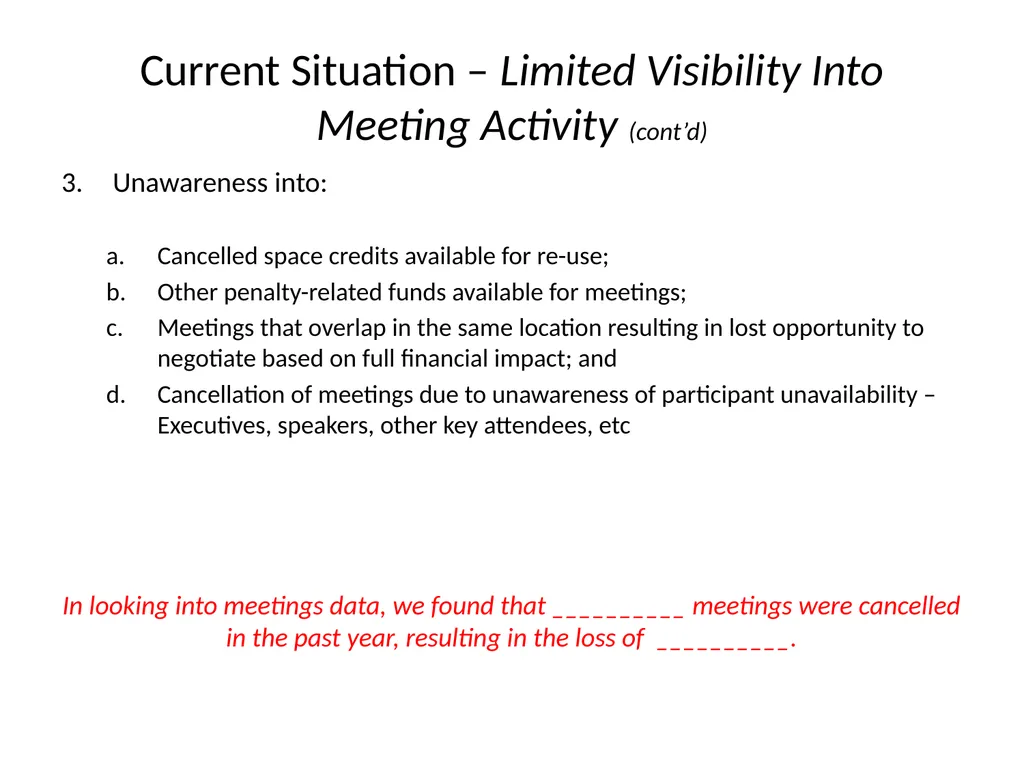
Current Situation – Limited Visibility Into Meeting Activity (cont’d) Unawareness into:
Cancelled space credits available for re-use;
Other penalty-related funds available for meetings;
Meetings that overlap in the same location resulting in lost opportunity to negotiate based on full financial impact; and
Cancellation of meetings due to unawareness of participant unavailability – Executives, speakers, other key attendees, etc
In looking into meetings data, we found that __________ meetings were cancelled in the past year, resulting in the loss of __________.<br>
Cancelled space credits available for re-use;
Other penalty-related funds available for meetings;
Meetings that overlap in the same location resulting in lost opportunity to negotiate based on full financial impact; and
Cancellation of meetings due to unawareness of participant unavailability – Executives, speakers, other key attendees, etc
In looking into meetings data, we found that __________ meetings were cancelled in the past year, resulting in the loss of __________.<br>
06
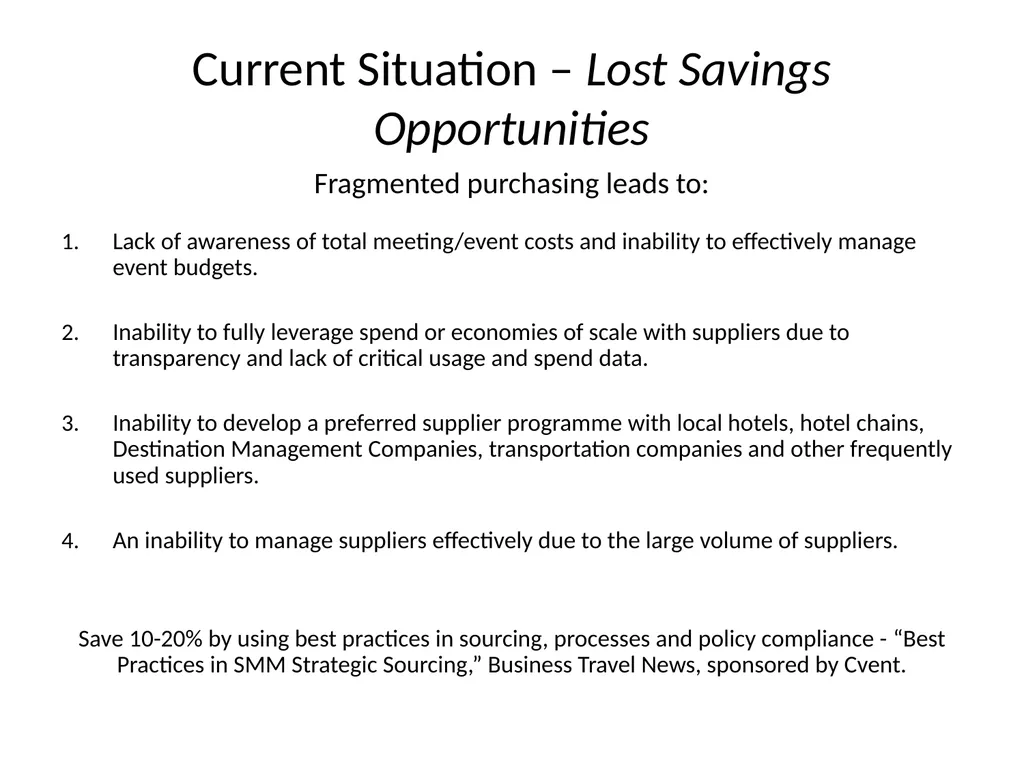
Current Situation – Lost Savings Opportunities Fragmented purchasing leads to:
Lack of awareness of total meeting/event costs and inability to effectively manage event budgets.
Inability to fully leverage spend or economies of scale with suppliers due to transparency and lack of critical usage and spend data.
Inability to develop a preferred supplier programme with local hotels, hotel chains, Destination Management Companies, transportation companies and other frequently used suppliers.
An inability to manage suppliers effectively due to the large volume of suppliers.
Save 10-20% by using best practices in sourcing, processes and policy compliance - “Best Practices in SMM Strategic Sourcing,” Business Travel News, sponsored by Cvent.<br>
Lack of awareness of total meeting/event costs and inability to effectively manage event budgets.
Inability to fully leverage spend or economies of scale with suppliers due to transparency and lack of critical usage and spend data.
Inability to develop a preferred supplier programme with local hotels, hotel chains, Destination Management Companies, transportation companies and other frequently used suppliers.
An inability to manage suppliers effectively due to the large volume of suppliers.
Save 10-20% by using best practices in sourcing, processes and policy compliance - “Best Practices in SMM Strategic Sourcing,” Business Travel News, sponsored by Cvent.<br>
07
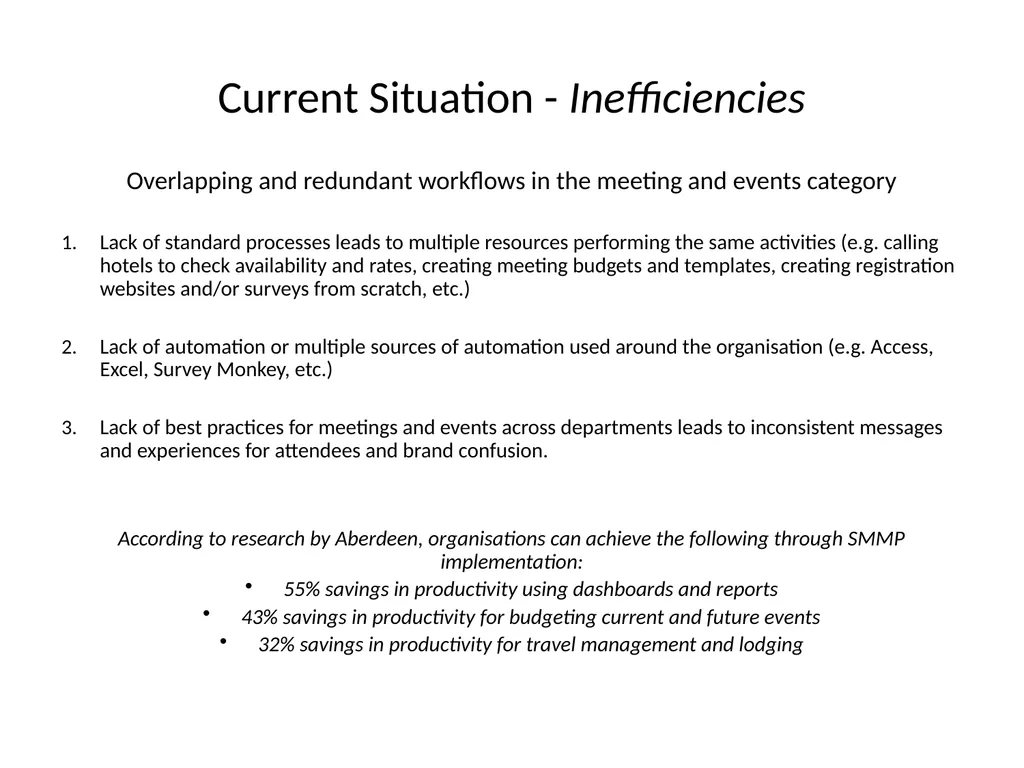
Current Situation - Inefficiencies Overlapping and redundant workflows in the meeting and events category
Lack of standard processes leads to multiple resources performing the same activities (e.g. calling hotels to check availability and rates, creating meeting budgets and templates, creating registration websites and/or surveys from scratch, etc.)
Lack of automation or multiple sources of automation used around the organisation (e.g. Access, Excel, Survey Monkey, etc.)
Lack of best practices for meetings and events across departments leads to inconsistent messages and experiences for attendees and brand confusion.
According to research by Aberdeen, organisations can achieve the following through SMMP implementation:
55% savings in productivity using dashboards and reports
43% savings in productivity for budgeting current and future events
32% savings in productivity for travel management and lodging<br>
Lack of standard processes leads to multiple resources performing the same activities (e.g. calling hotels to check availability and rates, creating meeting budgets and templates, creating registration websites and/or surveys from scratch, etc.)
Lack of automation or multiple sources of automation used around the organisation (e.g. Access, Excel, Survey Monkey, etc.)
Lack of best practices for meetings and events across departments leads to inconsistent messages and experiences for attendees and brand confusion.
According to research by Aberdeen, organisations can achieve the following through SMMP implementation:
55% savings in productivity using dashboards and reports
43% savings in productivity for budgeting current and future events
32% savings in productivity for travel management and lodging<br>
08
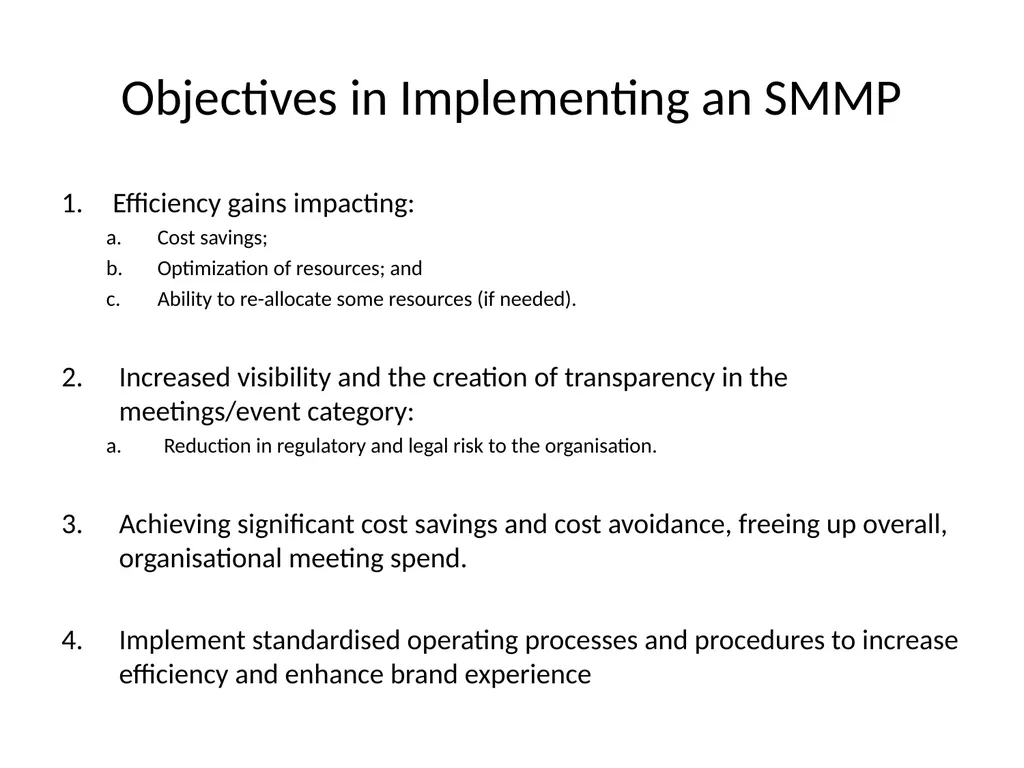
Objectives in Implementing an SMMP Efficiency gains impacting:
Cost savings;
Optimization of resources; and
Ability to re-allocate some resources (if needed).
Increased visibility and the creation of transparency in the meetings/event category:
Reduction in regulatory and legal risk to the organisation.
Achieving significant cost savings and cost avoidance, freeing up overall, organisational meeting spend.
Implement standardised operating processes and procedures to increase efficiency and enhance brand experience<br>
Cost savings;
Optimization of resources; and
Ability to re-allocate some resources (if needed).
Increased visibility and the creation of transparency in the meetings/event category:
Reduction in regulatory and legal risk to the organisation.
Achieving significant cost savings and cost avoidance, freeing up overall, organisational meeting spend.
Implement standardised operating processes and procedures to increase efficiency and enhance brand experience<br>
09
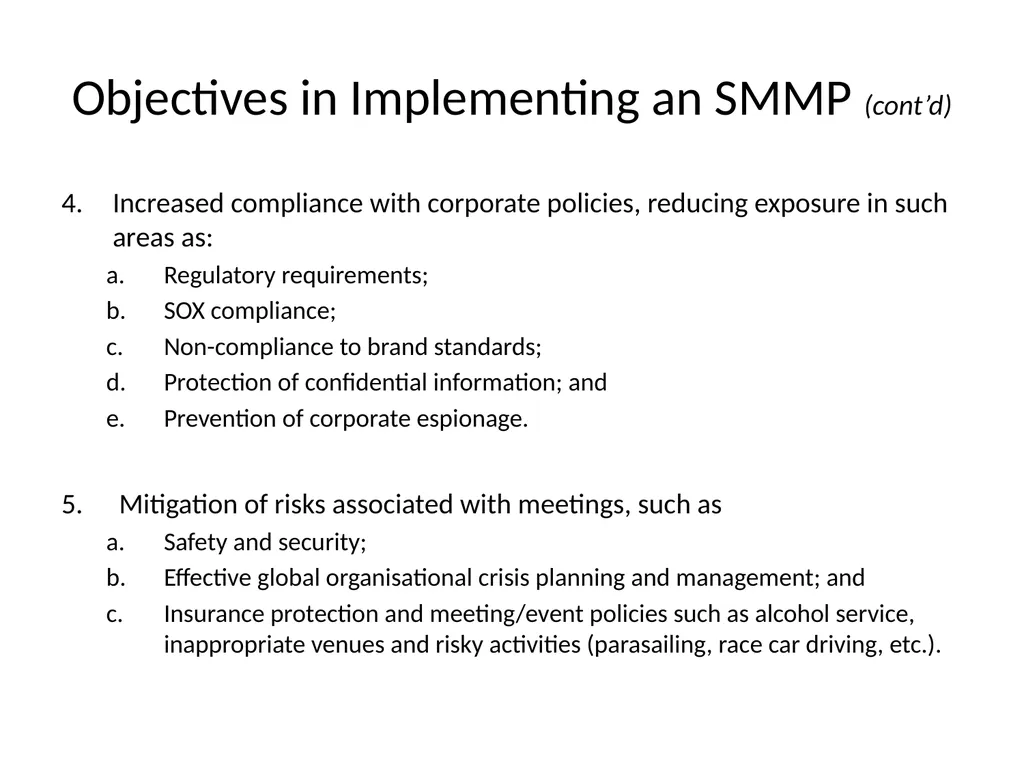
Objectives in Implementing an SMMP (cont’d) Increased compliance with corporate policies, reducing exposure in such areas as:
Regulatory requirements;
SOX compliance;
Non-compliance to brand standards;
Protection of confidential information; and
Prevention of corporate espionage.
Mitigation of risks associated with meetings, such as
Safety and security;
Effective global organisational crisis planning and management; and
Insurance protection and meeting/event policies such as alcohol service, inappropriate venues and risky activities (parasailing, race car driving, etc.).<br>
Regulatory requirements;
SOX compliance;
Non-compliance to brand standards;
Protection of confidential information; and
Prevention of corporate espionage.
Mitigation of risks associated with meetings, such as
Safety and security;
Effective global organisational crisis planning and management; and
Insurance protection and meeting/event policies such as alcohol service, inappropriate venues and risky activities (parasailing, race car driving, etc.).<br>
10
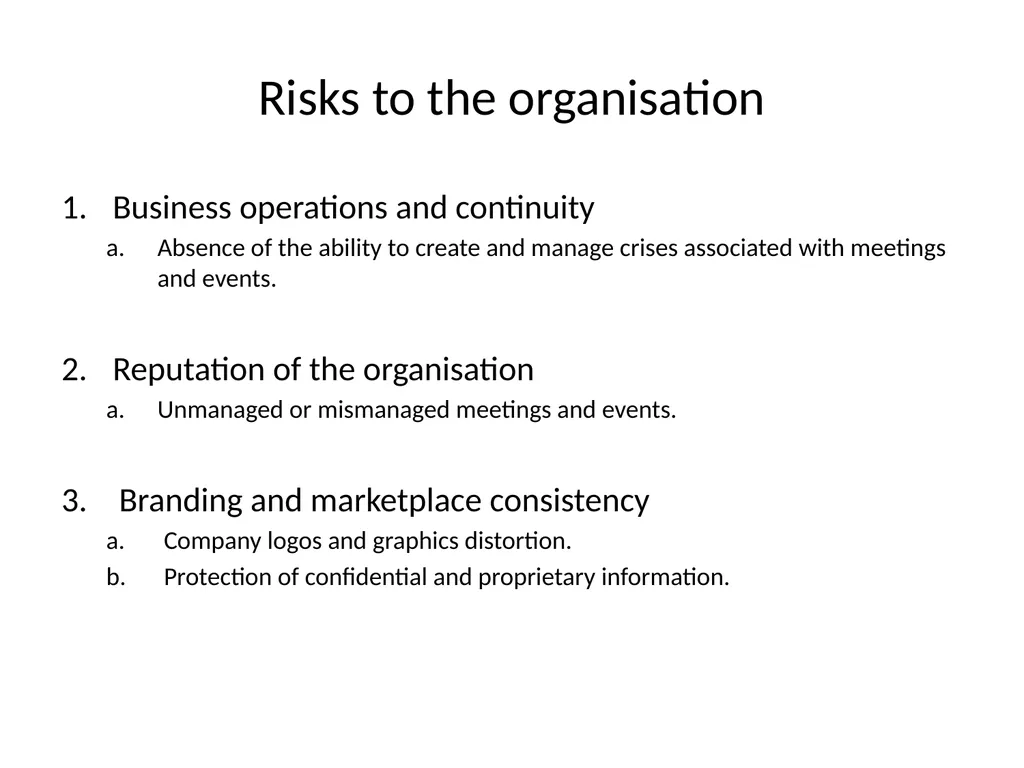
Risks to the organisation Business operations and continuity
Absence of the ability to create and manage crises associated with meetings and events.
Reputation of the organisation
Unmanaged or mismanaged meetings and events.
Branding and marketplace consistency
Company logos and graphics distortion.
Protection of confidential and proprietary information.<br>
Absence of the ability to create and manage crises associated with meetings and events.
Reputation of the organisation
Unmanaged or mismanaged meetings and events.
Branding and marketplace consistency
Company logos and graphics distortion.
Protection of confidential and proprietary information.<br>
11
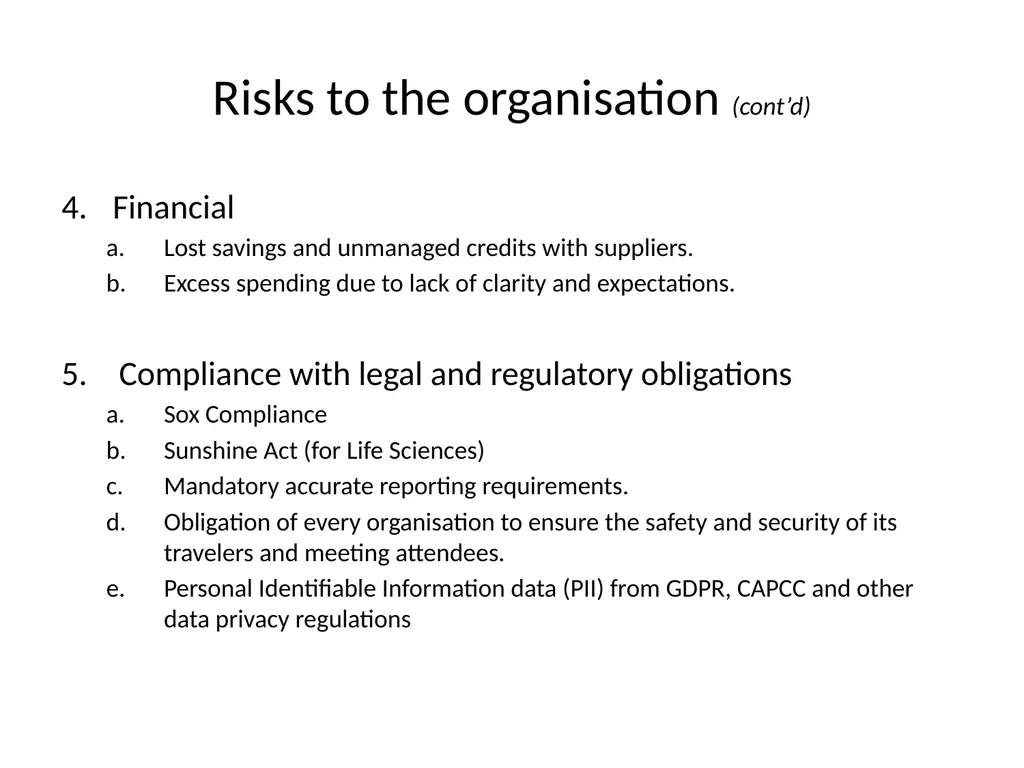
Risks to the organisation (cont’d) Financial
Lost savings and unmanaged credits with suppliers.
Excess spending due to lack of clarity and expectations.
Compliance with legal and regulatory obligations
Sox Compliance
Sunshine Act (for Life Sciences)
Mandatory accurate reporting requirements.
Obligation of every organisation to ensure the safety and security of its travelers and meeting attendees.
Personal Identifiable Information data (PII) from GDPR, CAPCC and other data privacy regulations<br>
Lost savings and unmanaged credits with suppliers.
Excess spending due to lack of clarity and expectations.
Compliance with legal and regulatory obligations
Sox Compliance
Sunshine Act (for Life Sciences)
Mandatory accurate reporting requirements.
Obligation of every organisation to ensure the safety and security of its travelers and meeting attendees.
Personal Identifiable Information data (PII) from GDPR, CAPCC and other data privacy regulations<br>
12
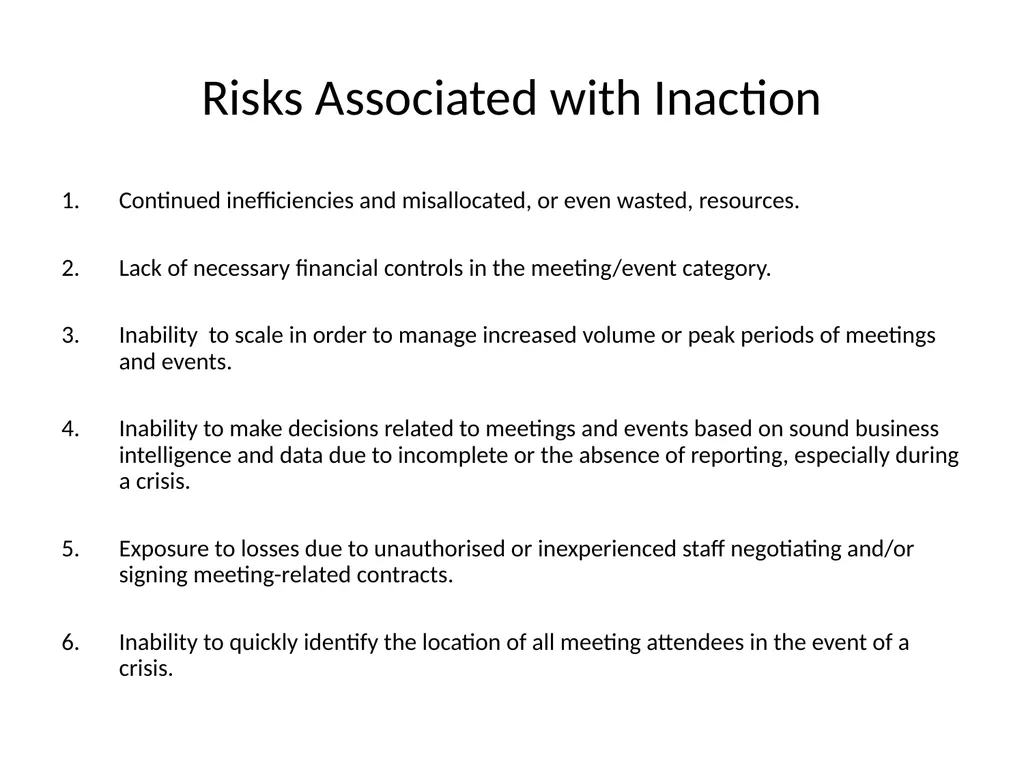
Risks Associated with Inaction Continued inefficiencies and misallocated, or even wasted, resources.
Lack of necessary financial controls in the meeting/event category.
Inability to scale in order to manage increased volume or peak periods of meetings and events.
Inability to make decisions related to meetings and events based on sound business intelligence and data due to incomplete or the absence of reporting, especially during a crisis.
Exposure to losses due to unauthorised or inexperienced staff negotiating and/or signing meeting-related contracts.
Inability to quickly identify the location of all meeting attendees in the event of a crisis.<br>
Lack of necessary financial controls in the meeting/event category.
Inability to scale in order to manage increased volume or peak periods of meetings and events.
Inability to make decisions related to meetings and events based on sound business intelligence and data due to incomplete or the absence of reporting, especially during a crisis.
Exposure to losses due to unauthorised or inexperienced staff negotiating and/or signing meeting-related contracts.
Inability to quickly identify the location of all meeting attendees in the event of a crisis.<br>
13
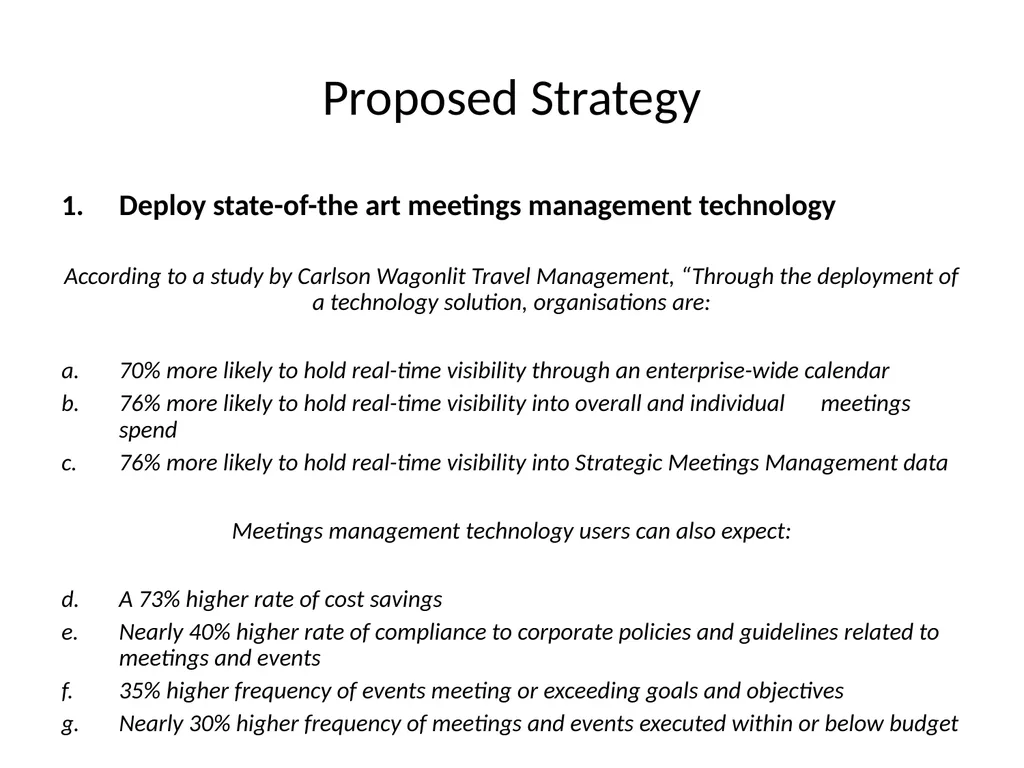
Proposed Strategy Deploy state-of-the art meetings management technology
According to a study by Carlson Wagonlit Travel Management, “Through the deployment of a technology solution, organisations are:
70% more likely to hold real-time visibility through an enterprise-wide calendar
76% more likely to hold real-time visibility into overall and individual meetings spend
76% more likely to hold real-time visibility into Strategic Meetings Management data
Meetings management technology users can also expect:
A 73% higher rate of cost savings
Nearly 40% higher rate of compliance to corporate policies and guidelines related to meetings and events
35% higher frequency of events meeting or exceeding goals and objectives
Nearly 30% higher frequency of meetings and events executed within or below budget<br>
According to a study by Carlson Wagonlit Travel Management, “Through the deployment of a technology solution, organisations are:
70% more likely to hold real-time visibility through an enterprise-wide calendar
76% more likely to hold real-time visibility into overall and individual meetings spend
76% more likely to hold real-time visibility into Strategic Meetings Management data
Meetings management technology users can also expect:
A 73% higher rate of cost savings
Nearly 40% higher rate of compliance to corporate policies and guidelines related to meetings and events
35% higher frequency of events meeting or exceeding goals and objectives
Nearly 30% higher frequency of meetings and events executed within or below budget<br>
14
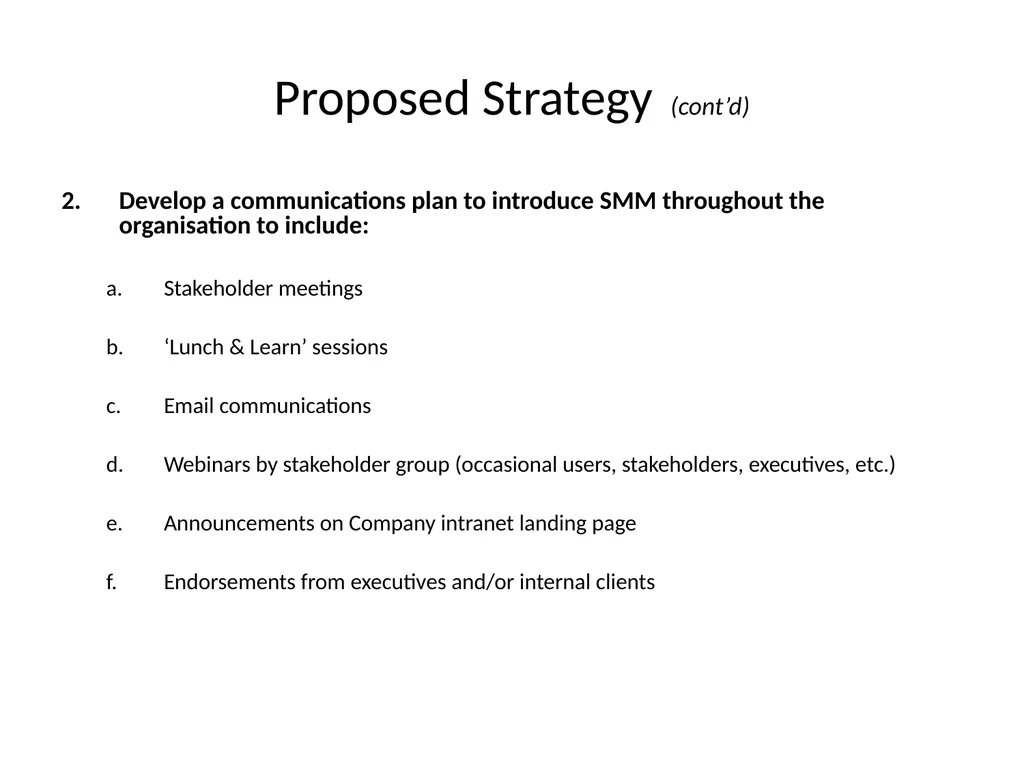
Proposed Strategy (cont’d) Develop a communications plan to introduce SMM throughout the organisation to include:
Stakeholder meetings
‘Lunch & Learn’ sessions
Email communications
Webinars by stakeholder group (occasional users, stakeholders, executives, etc.)
Announcements on Company intranet landing page
Endorsements from executives and/or internal clients<br>
Stakeholder meetings
‘Lunch & Learn’ sessions
Email communications
Webinars by stakeholder group (occasional users, stakeholders, executives, etc.)
Announcements on Company intranet landing page
Endorsements from executives and/or internal clients<br>
15
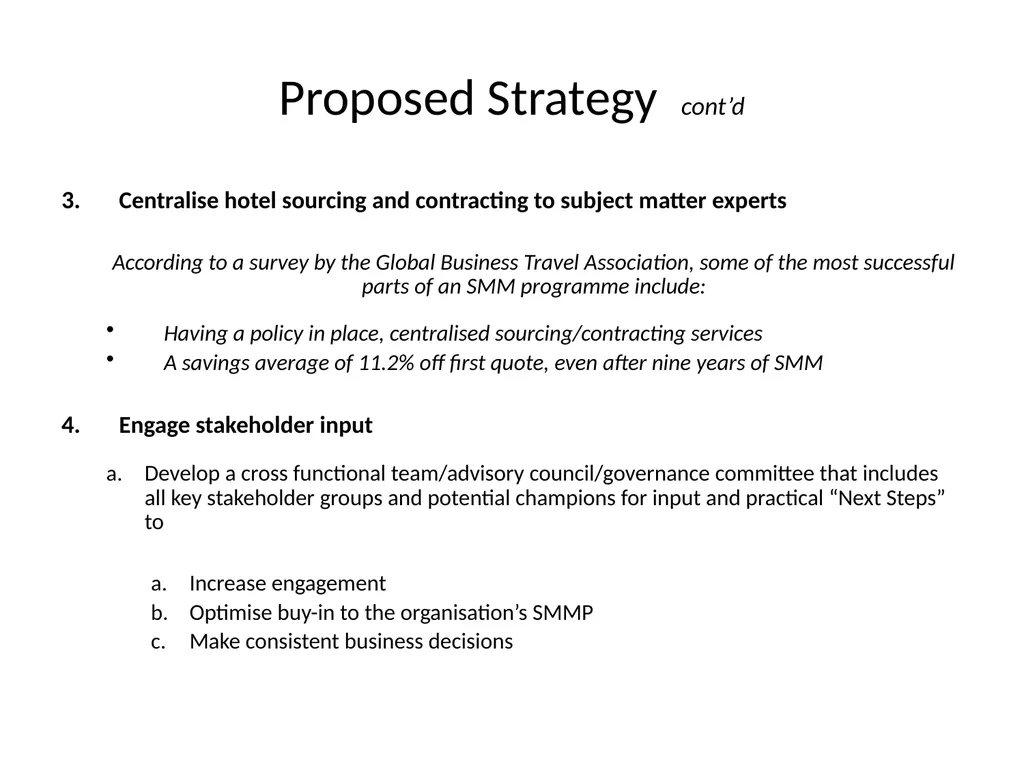
Proposed Strategy cont’d Centralise hotel sourcing and contracting to subject matter experts
According to a survey by the Global Business Travel Association, some of the most successful parts of an SMM programme include:
Having a policy in place, centralised sourcing/contracting services
A savings average of 11.2% off first quote, even after nine years of SMM
Engage stakeholder input
Develop a cross functional team/advisory council/governance committee that includes all key stakeholder groups and potential champions for input and practical “Next Steps” to
Increase engagement
Optimise buy-in to the organisation’s SMMP
Make consistent business decisions<br>
According to a survey by the Global Business Travel Association, some of the most successful parts of an SMM programme include:
Having a policy in place, centralised sourcing/contracting services
A savings average of 11.2% off first quote, even after nine years of SMM
Engage stakeholder input
Develop a cross functional team/advisory council/governance committee that includes all key stakeholder groups and potential champions for input and practical “Next Steps” to
Increase engagement
Optimise buy-in to the organisation’s SMMP
Make consistent business decisions<br>
16
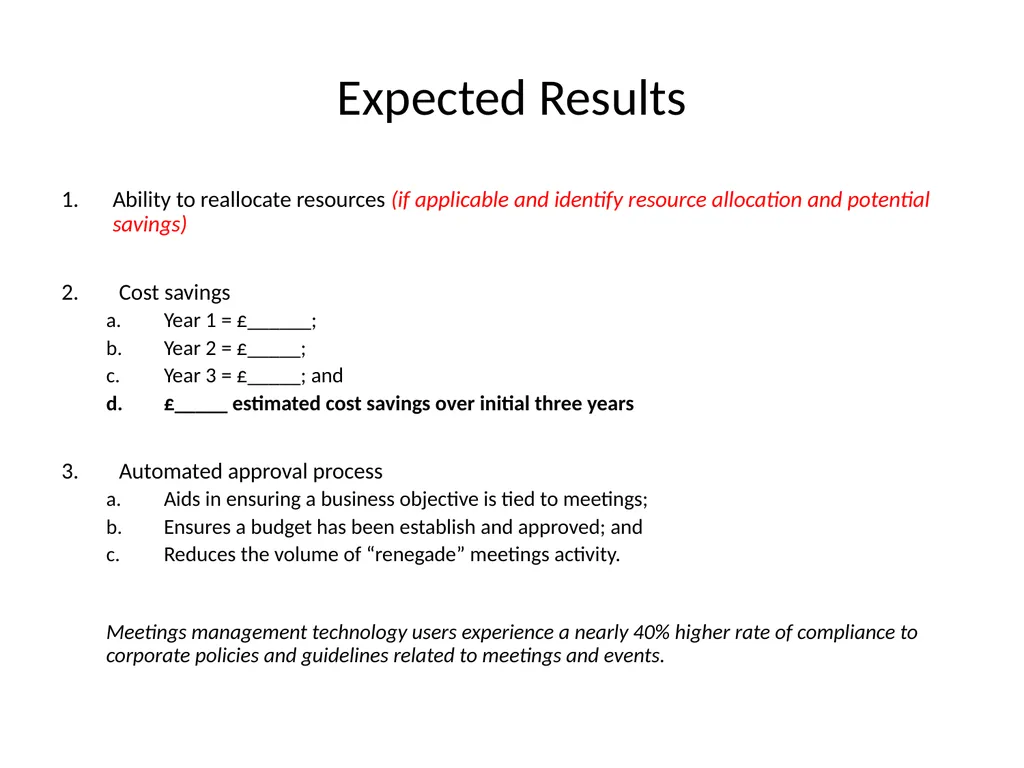
Expected Results Ability to reallocate resources (if applicable and identify resource allocation and potential savings)
Cost savings
Year 1 = £______;
Year 2 = £_____;
Year 3 = £_____; and
£_____ estimated cost savings over initial three years
Automated approval process
Aids in ensuring a business objective is tied to meetings;
Ensures a budget has been establish and approved; and
Reduces the volume of “renegade” meetings activity.
Meetings management technology users experience a nearly 40% higher rate of compliance to corporate policies and guidelines related to meetings and events.<br>
Cost savings
Year 1 = £______;
Year 2 = £_____;
Year 3 = £_____; and
£_____ estimated cost savings over initial three years
Automated approval process
Aids in ensuring a business objective is tied to meetings;
Ensures a budget has been establish and approved; and
Reduces the volume of “renegade” meetings activity.
Meetings management technology users experience a nearly 40% higher rate of compliance to corporate policies and guidelines related to meetings and events.<br>
17
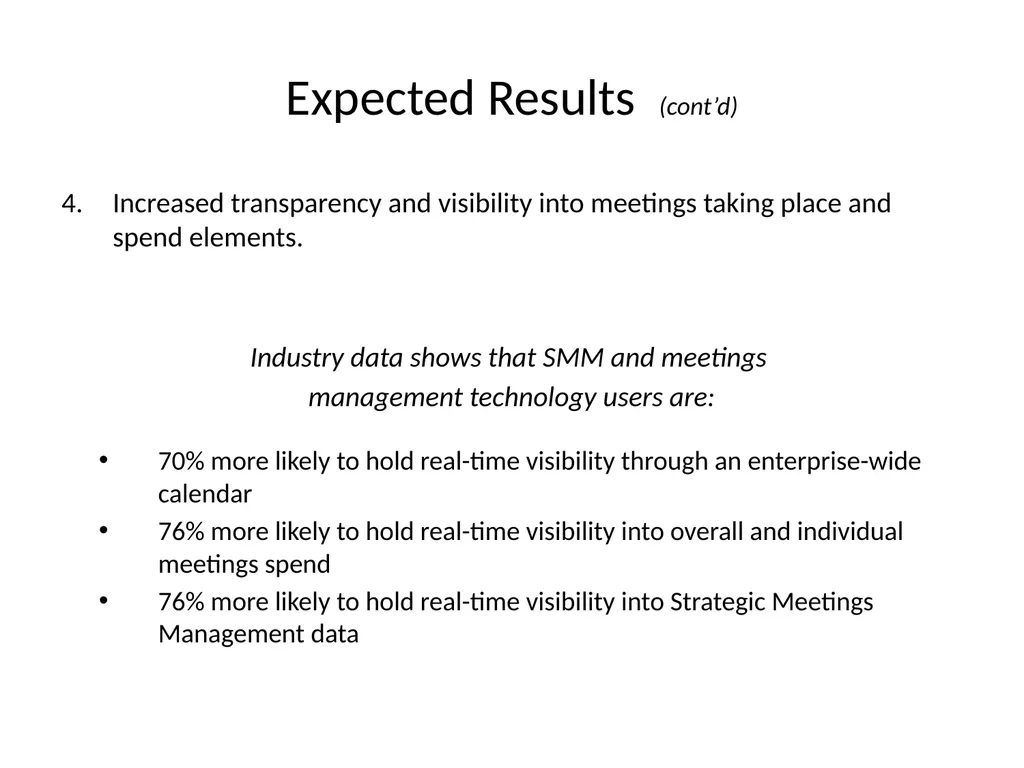
Expected Results (cont’d) Increased transparency and visibility into meetings taking place and spend elements.
Industry data shows that SMM and meetings
management technology users are:
70% more likely to hold real-time visibility through an enterprise-wide calendar
76% more likely to hold real-time visibility into overall and individual meetings spend
76% more likely to hold real-time visibility into Strategic Meetings Management data<br>
Industry data shows that SMM and meetings
management technology users are:
70% more likely to hold real-time visibility through an enterprise-wide calendar
76% more likely to hold real-time visibility into overall and individual meetings spend
76% more likely to hold real-time visibility into Strategic Meetings Management data<br>
18
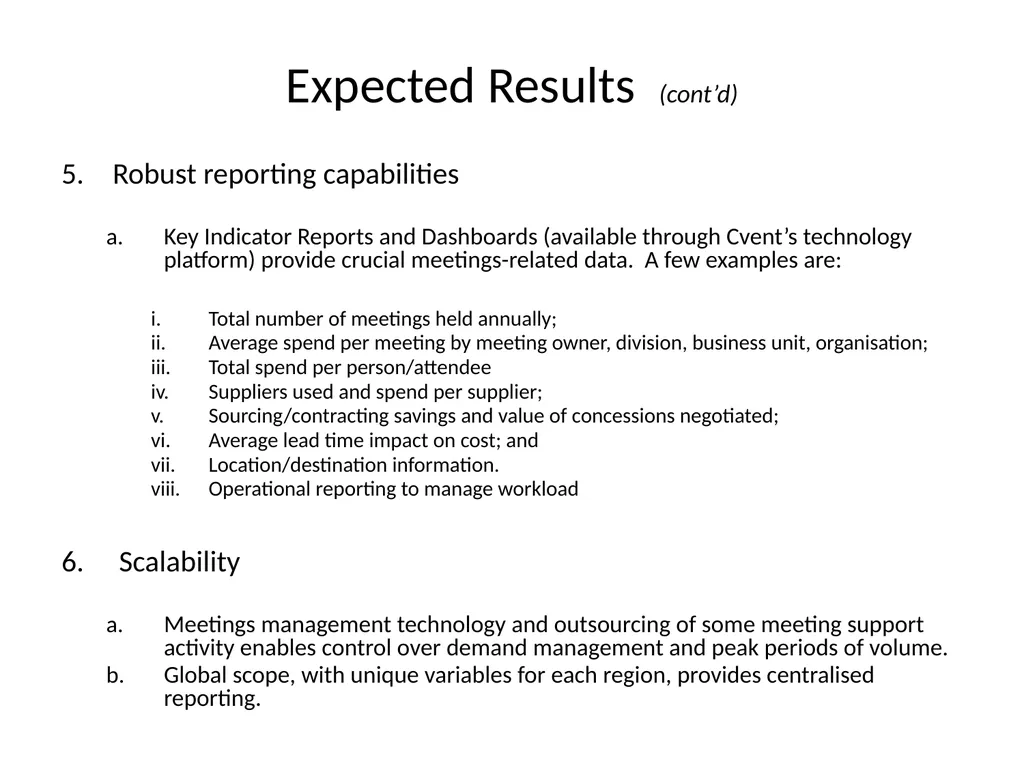
Expected Results (cont’d) Robust reporting capabilities
Key Indicator Reports and Dashboards (available through Cvent’s technology platform) provide crucial meetings-related data. A few examples are:
Total number of meetings held annually;
Average spend per meeting by meeting owner, division, business unit, organisation;
Total spend per person/attendee
Suppliers used and spend per supplier;
Sourcing/contracting savings and value of concessions negotiated;
Average lead time impact on cost; and
Location/destination information.
Operational reporting to manage workload
Scalability
Meetings management technology and outsourcing of some meeting support activity enables control over demand management and peak periods of volume.
Global scope, with unique variables for each region, provides centralised reporting.<br>
Key Indicator Reports and Dashboards (available through Cvent’s technology platform) provide crucial meetings-related data. A few examples are:
Total number of meetings held annually;
Average spend per meeting by meeting owner, division, business unit, organisation;
Total spend per person/attendee
Suppliers used and spend per supplier;
Sourcing/contracting savings and value of concessions negotiated;
Average lead time impact on cost; and
Location/destination information.
Operational reporting to manage workload
Scalability
Meetings management technology and outsourcing of some meeting support activity enables control over demand management and peak periods of volume.
Global scope, with unique variables for each region, provides centralised reporting.<br>
19
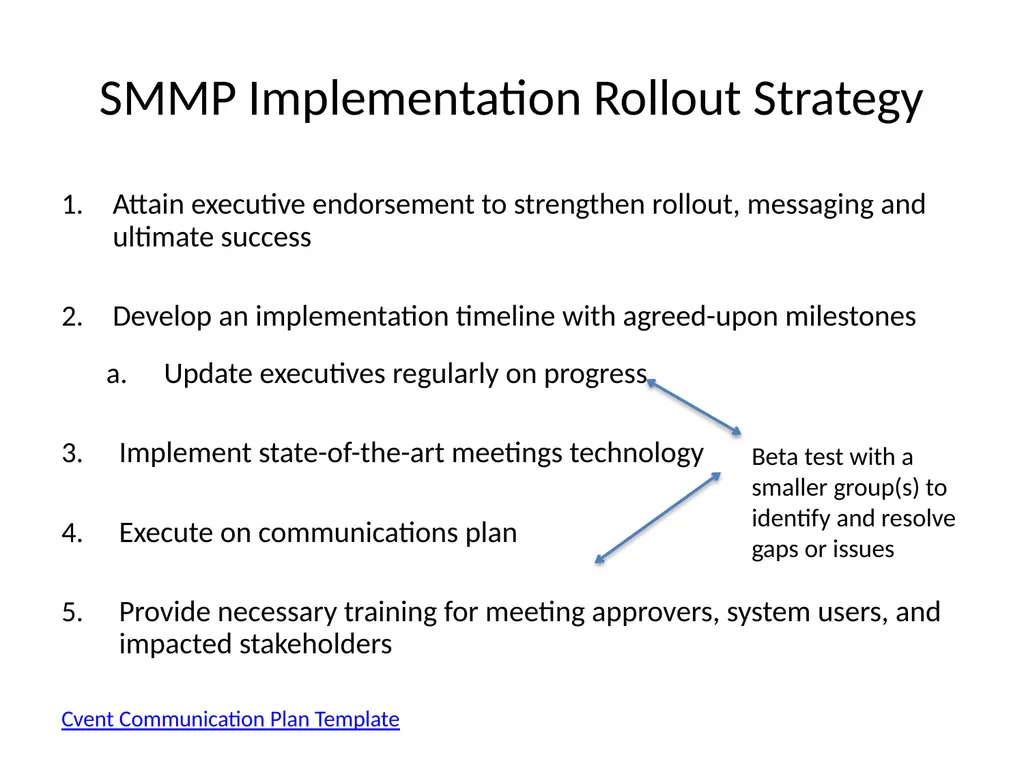
SMMP Implementation Rollout Strategy Attain executive endorsement to strengthen rollout, messaging and ultimate success
Develop an implementation timeline with agreed-upon milestones
Update executives regularly on progress
Implement state-of-the-art meetings technology
Execute on communications plan
Provide necessary training for meeting approvers, system users, and impacted stakeholders
Cvent Communication Plan Template Beta test with a smaller group(s) to identify and resolve gaps or issues<br>
Develop an implementation timeline with agreed-upon milestones
Update executives regularly on progress
Implement state-of-the-art meetings technology
Execute on communications plan
Provide necessary training for meeting approvers, system users, and impacted stakeholders
Cvent Communication Plan Template Beta test with a smaller group(s) to identify and resolve gaps or issues<br>
20
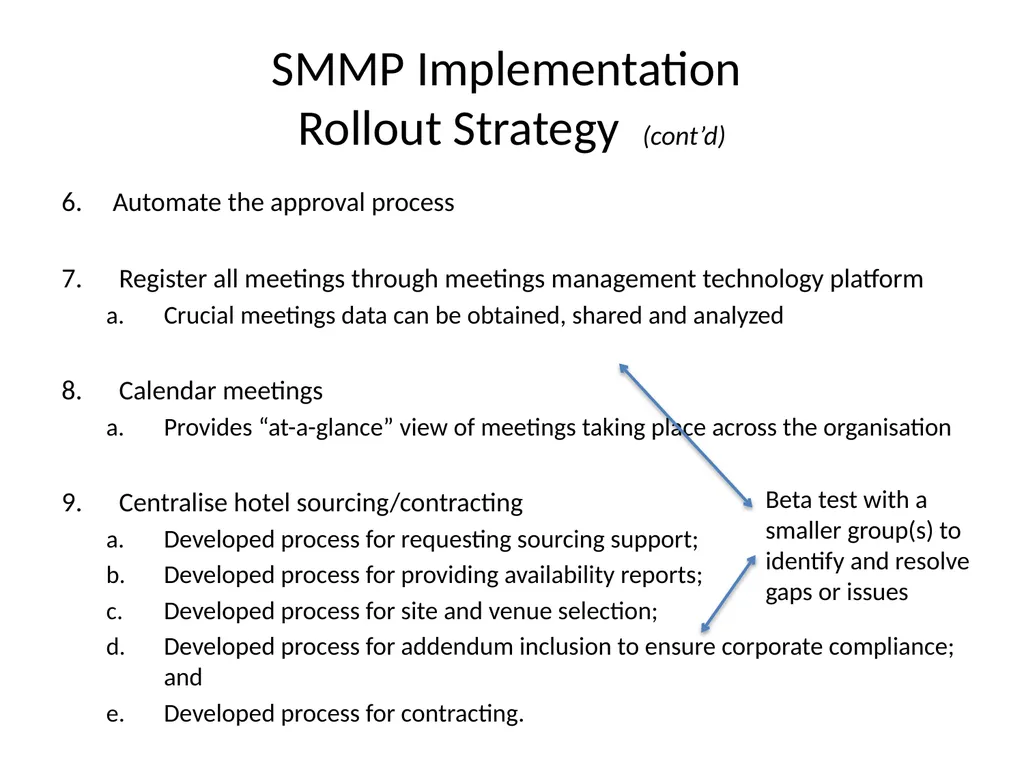
SMMP Implementation
Rollout Strategy (cont’d) Automate the approval process
Register all meetings through meetings management technology platform
Crucial meetings data can be obtained, shared and analyzed
Calendar meetings
Provides “at-a-glance” view of meetings taking place across the organisation
Centralise hotel sourcing/contracting
Developed process for requesting sourcing support;
Developed process for providing availability reports;
Developed process for site and venue selection;
Developed process for addendum inclusion to ensure corporate compliance; and
Developed process for contracting. Beta test with a smaller group(s) to identify and resolve gaps or issues<br>
Register all meetings through meetings management technology platform
Crucial meetings data can be obtained, shared and analyzed
Calendar meetings
Provides “at-a-glance” view of meetings taking place across the organisation
Centralise hotel sourcing/contracting
Developed process for requesting sourcing support;
Developed process for providing availability reports;
Developed process for site and venue selection;
Developed process for addendum inclusion to ensure corporate compliance; and
Developed process for contracting. Beta test with a smaller group(s) to identify and resolve gaps or issues<br>
21
Technology Plan Access Meetings Management Simplified for additional tips<br>