
William Charles Benjamin Tolley (Bill) 27th May
A
Published · 12 slides · 0 views

1 / 1

Description
William Charles Benjamin Tolley (Bill) 27th May 1927 -2nd April 2024 22042024 Bill Tolley 1926-2024 1 William Charles Benjamin Tolley Bill 27th May 1926 - 2nd April 2024 Late of Henstridge Somerset Stoker. IP. RN Service Number
Related Topics
Share
Embed code
Download this presentation From Below
"William Charles Benjamin Tolley (Bill) 27th May" is the property of its rightful owner. Permission is granted to download and print the materials on this website for personal, non-commercial use only, and to display it on your personal computer provided you do not modify the materials and that you retain all copyright notices contained in the materials. By downloading content from our website, you accept the terms of this agreement.
Presentation Transcript
01
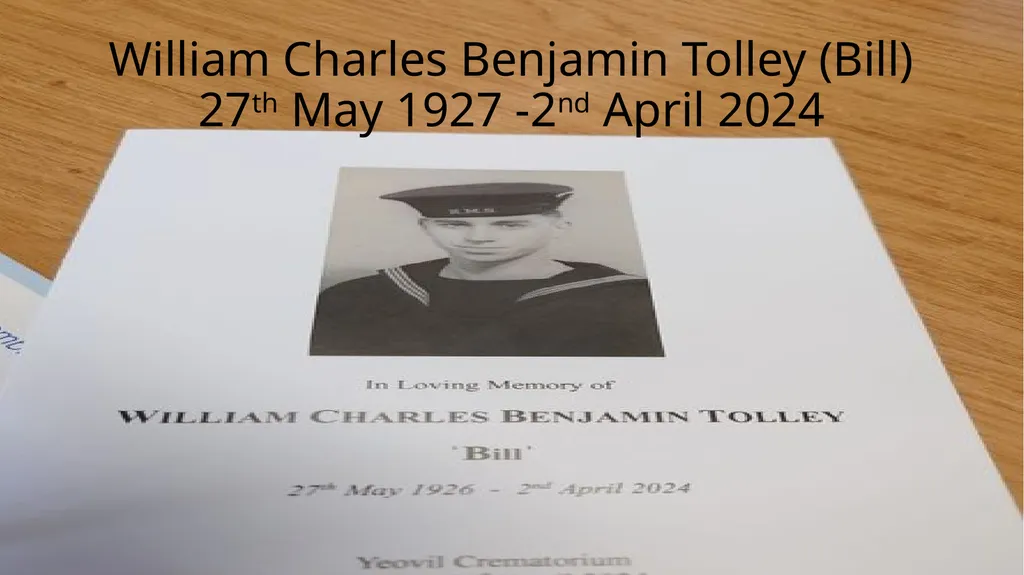
William Charles Benjamin Tolley (Bill)
27th May 1927 -2nd April 2024 22/04/2024 Bill Tolley 1926-2024 1<br>
02
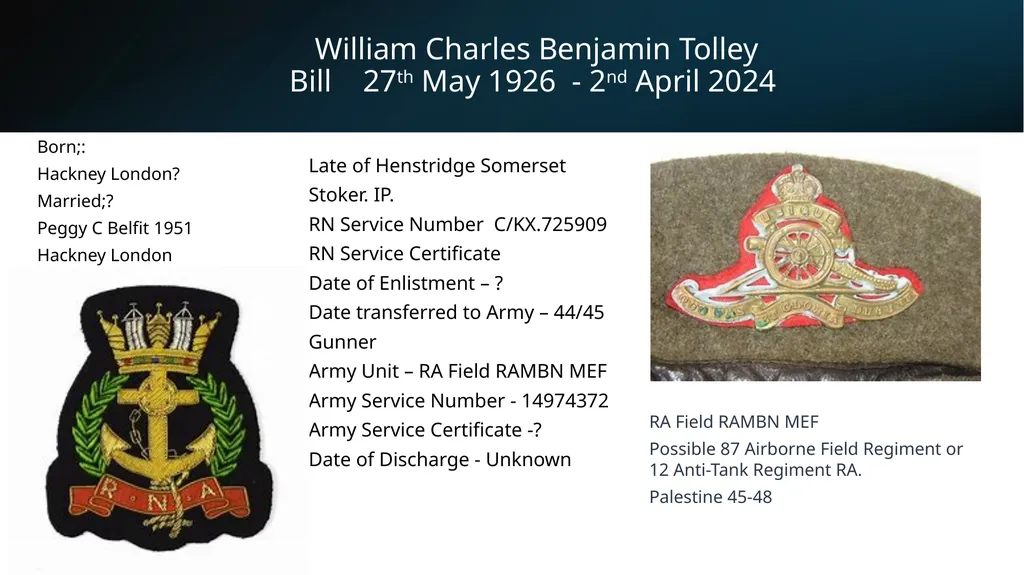
William Charles Benjamin Tolley
Bill 27th May 1926 - 2nd April 2024 Late of Henstridge Somerset
Stoker. IP.
RN Service Number C/KX.725909
RN Service Certificate
Date of Enlistment – ?
Date transferred to Army – 44/45
Gunner
Army Unit – RA Field RAMBN MEF
Army Service Number - 14974372
Army Service Certificate -?
Date of Discharge - Unknown Born;:
Hackney London?
Married;?
Peggy C Belfit 1951
Hackney London RA Field RAMBN MEF
Possible 87 Airborne Field Regiment or 12 Anti-Tank Regiment RA.
Palestine 45-48 22/04/2024 Bill Tolley 1926-2024 2<br>
03
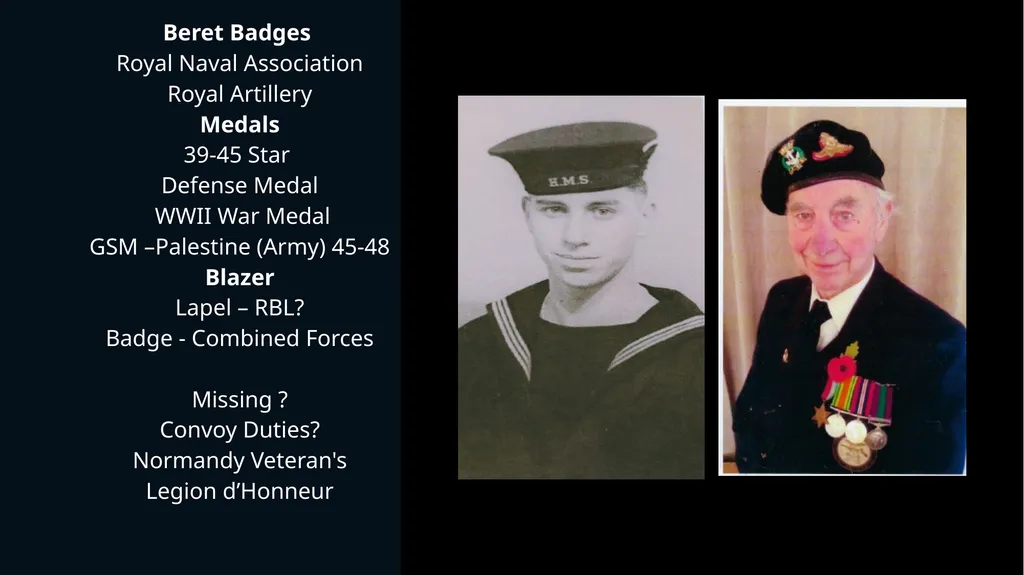
Beret Badges
Royal Naval Association
Royal Artillery
Medals
39-45 Star
Defense Medal
WWII War Medal
GSM –Palestine (Army) 45-48
Blazer
Lapel – RBL?
Badge - Combined Forces
Missing ?
Convoy Duties?
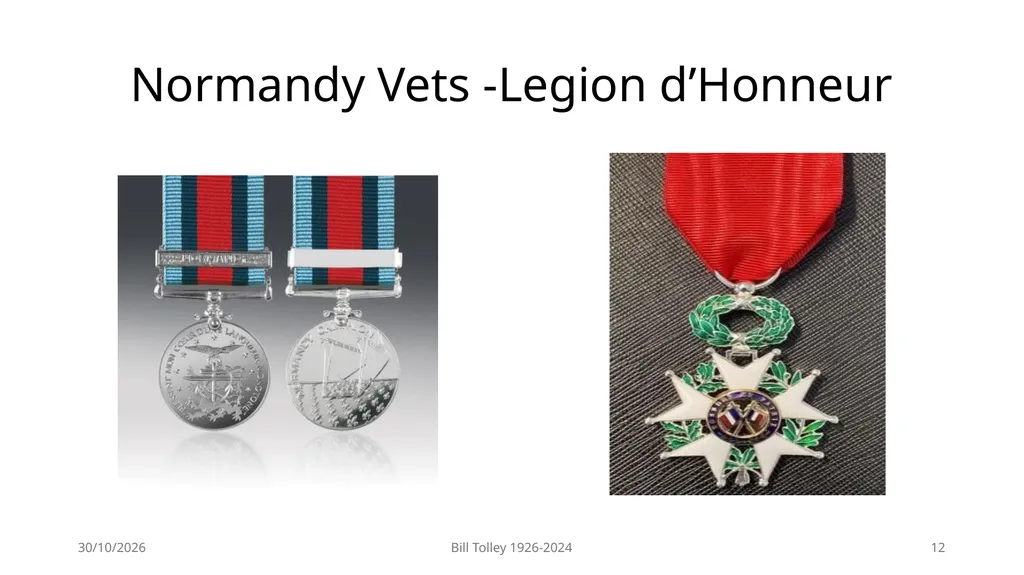
Normandy Veteran's
Legion d’Honneur 22/04/2024 Bill Tolley 1926-2024 3<br>
Royal Naval Association
Royal Artillery
Medals
39-45 Star
Defense Medal
WWII War Medal
GSM –Palestine (Army) 45-48
Blazer
Lapel – RBL?
Badge - Combined Forces
Missing ?
Convoy Duties?
Normandy Veteran's
Legion d’Honneur 22/04/2024 Bill Tolley 1926-2024 3<br>
04
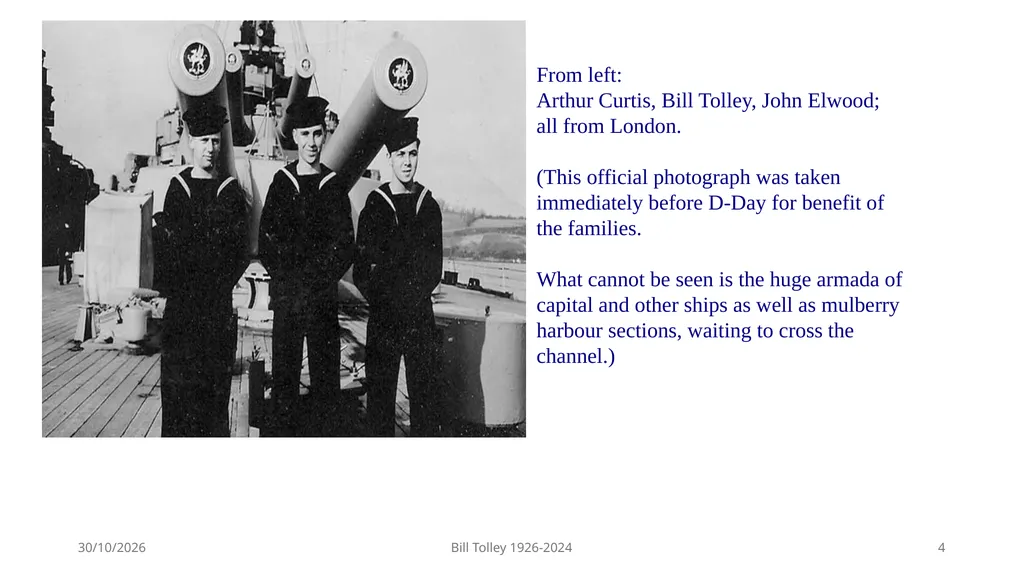
From left:
Arthur Curtis, Bill Tolley, John Elwood;
all from London.
(This official photograph was taken immediately before D-Day for benefit of the families.
What cannot be seen is the huge armada of capital and other ships as well as mulberry harbour sections, waiting to cross the channel.) 22/04/2024 Bill Tolley 1926-2024 4<br>
05
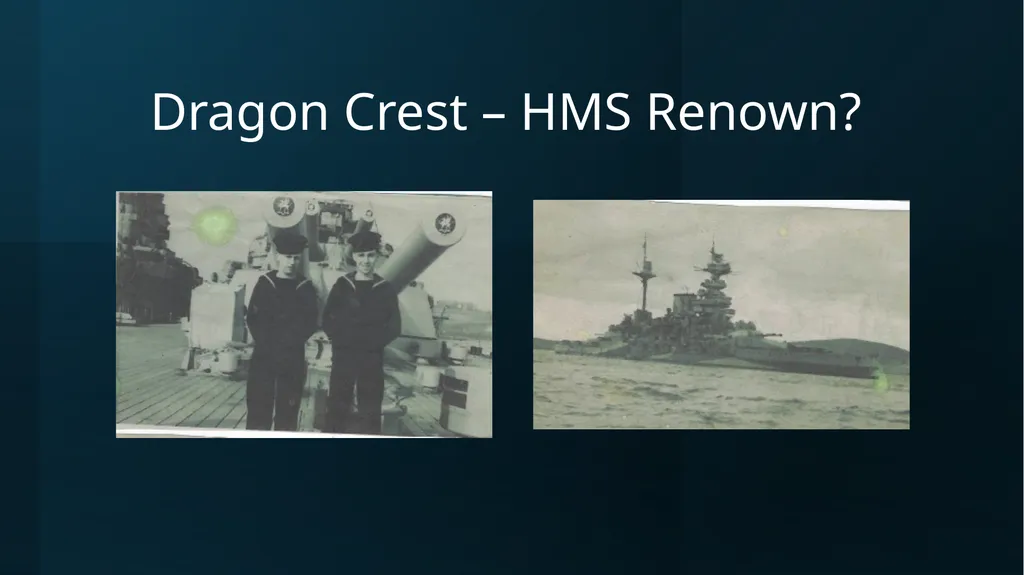
Dragon Crest – HMS Renown? 22/04/2024 Bill Tolley 1926-2024 5<br>
06
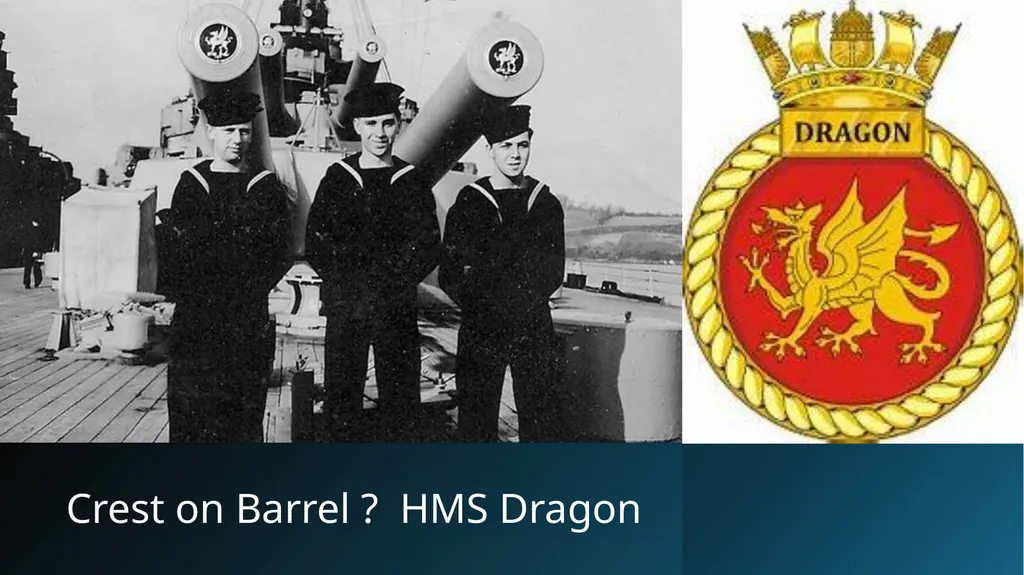
Crest on Barrel ? HMS Dragon 22/04/2024 Bill Tolley 1926-2024 6<br>
07
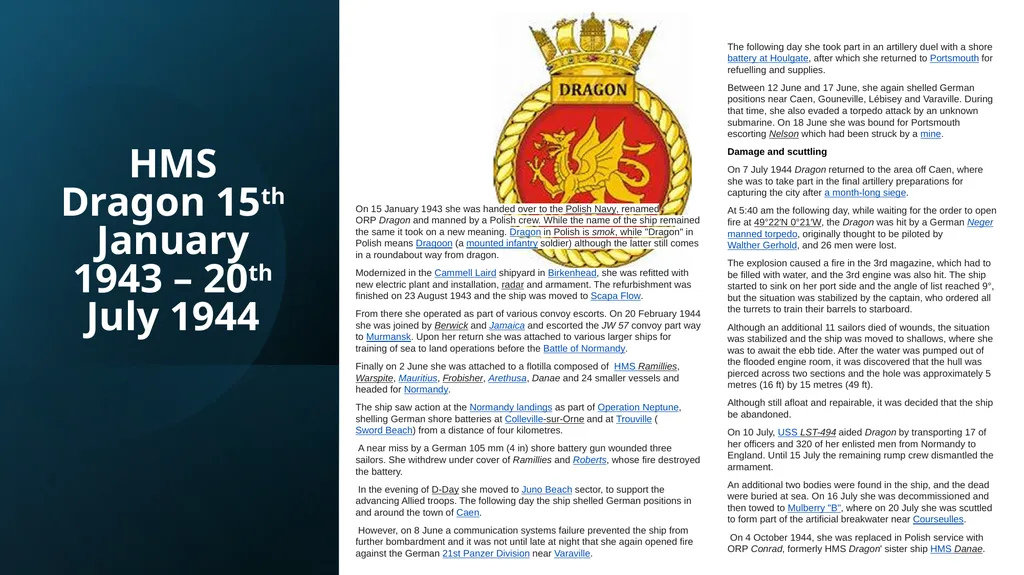
HMS Dragon 15th January 1943 – 20th July 1944 The following day she took part in an artillery duel with a shore battery at Houlgate, after which she returned to Portsmouth for refuelling and supplies.
Between 12 June and 17 June, she again shelled German positions near Caen, Gouneville, Lébisey and Varaville. During that time, she also evaded a torpedo attack by an unknown submarine. On 18 June she was bound for Portsmouth escorting Nelson which had been struck by a mine.
Damage and scuttling
On 7 July 1944 Dragon returned to the area off Caen, where she was to take part in the final artillery preparations for capturing the city after a month-long siege.
At 5:40 am the following day, while waiting for the order to open fire at 49°22′N 0°21′W, the Dragon was hit by a German Neger manned torpedo, originally thought to be piloted by Walther Gerhold, and 26 men were lost.
The explosion caused a fire in the 3rd magazine, which had to be filled with water, and the 3rd engine was also hit. The ship started to sink on her port side and the angle of list reached 9°, but the situation was stabilized by the captain, who ordered all the turrets to train their barrels to starboard.
Although an additional 11 sailors died of wounds, the situation was stabilized and the ship was moved to shallows, where she was to await the ebb tide. After the water was pumped out of the flooded engine room, it was discovered that the hull was pierced across two sections and the hole was approximately 5 metres (16 ft) by 15 metres (49 ft).
Although still afloat and repairable, it was decided that the ship be abandoned.
On 10 July, USS LST-494 aided Dragon by transporting 17 of her officers and 320 of her enlisted men from Normandy to England. Until 15 July the remaining rump crew dismantled the armament.
An additional two bodies were found in the ship, and the dead were buried at sea. On 16 July she was decommissioned and then towed to Mulberry "B", where on 20 July she was scuttled to form part of the artificial breakwater near Courseulles.
On 4 October 1944, she was replaced in Polish service with ORP Conrad, formerly HMS Dragon' sister ship HMS Danae. On 15 January 1943 she was handed over to the Polish Navy, renamed ORP Dragon and manned by a Polish crew. While the name of the ship remained the same it took on a new meaning. Dragon in Polish is smok, while "Dragon" in Polish means Dragoon (a mounted infantry soldier) although the latter still comes in a roundabout way from dragon.
Modernized in the Cammell Laird shipyard in Birkenhead, she was refitted with new electric plant and installation, radar and armament. The refurbishment was finished on 23 August 1943 and the ship was moved to Scapa Flow.
From there she operated as part of various convoy escorts. On 20 February 1944 she was joined by Berwick and Jamaica and escorted the JW 57 convoy part way to Murmansk. Upon her return she was attached to various larger ships for training of sea to land operations before the Battle of Normandy.
Finally on 2 June she was attached to a flotilla composed of HMS Ramillies, Warspite, Mauritius, Frobisher, Arethusa, Danae and 24 smaller vessels and headed for Normandy.
The ship saw action at the Normandy landings as part of Operation Neptune, shelling German shore batteries at Colleville-sur-Orne and at Trouville (Sword Beach) from a distance of four kilometres.
A near miss by a German 105 mm (4 in) shore battery gun wounded three sailors. She withdrew under cover of Ramillies and Roberts, whose fire destroyed the battery.
In the evening of D-Day she moved to Juno Beach sector, to support the advancing Allied troops. The following day the ship shelled German positions in and around the town of Caen.
However, on 8 June a communication systems failure prevented the ship from further bombardment and it was not until late at night that she again opened fire against the German 21st Panzer Division near Varaville. 22/04/2024 Bill Tolley 1926-2024 7<br>
08
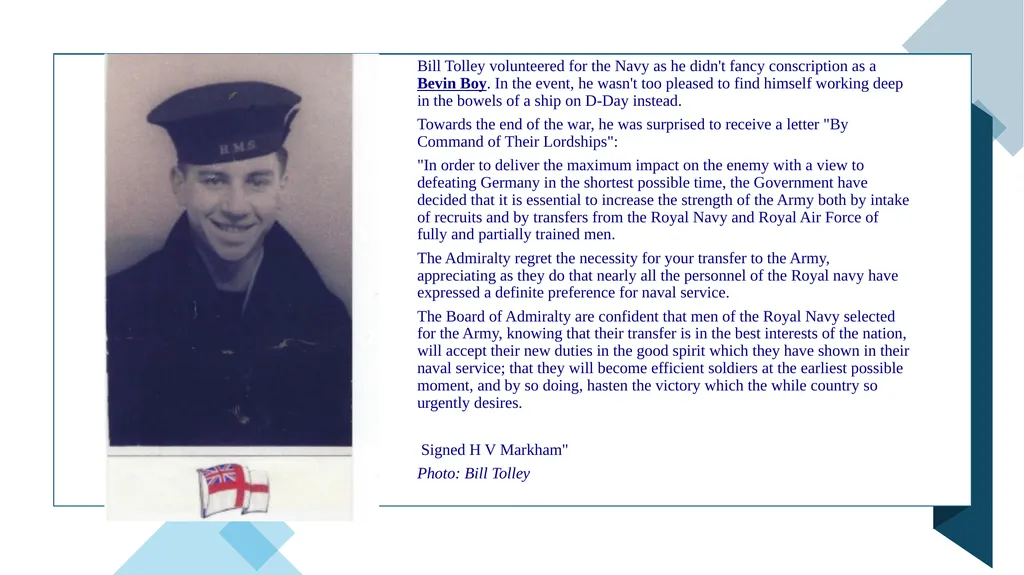
Bill Tolley volunteered for the Navy as he didn't fancy conscription as a Bevin Boy. In the event, he wasn't too pleased to find himself working deep in the bowels of a ship on D-Day instead.
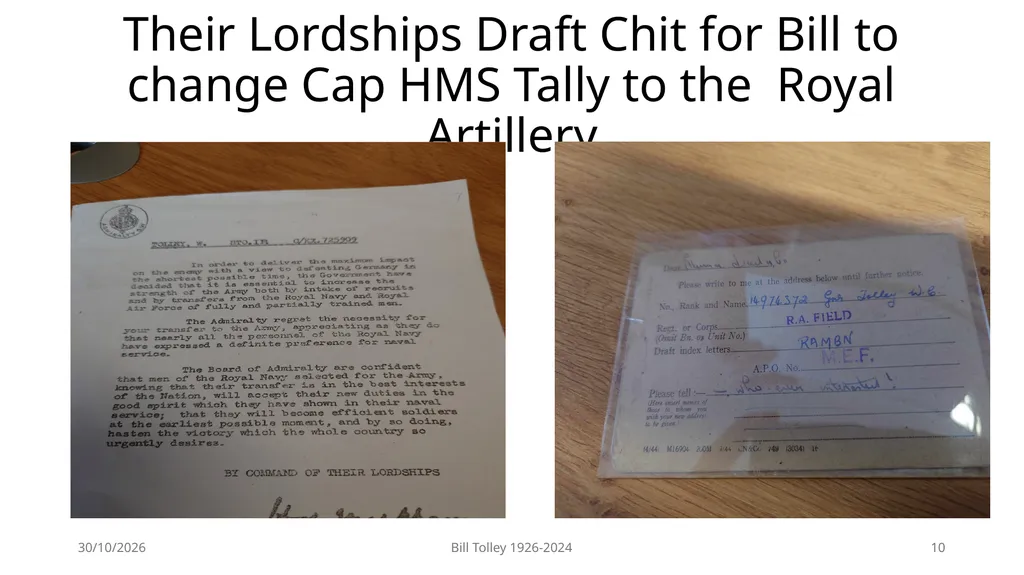
Towards the end of the war, he was surprised to receive a letter "By Command of Their Lordships":
"In order to deliver the maximum impact on the enemy with a view to defeating Germany in the shortest possible time, the Government have decided that it is essential to increase the strength of the Army both by intake of recruits and by transfers from the Royal Navy and Royal Air Force of fully and partially trained men.
The Admiralty regret the necessity for your transfer to the Army, appreciating as they do that nearly all the personnel of the Royal navy have expressed a definite preference for naval service.
The Board of Admiralty are confident that men of the Royal Navy selected for the Army, knowing that their transfer is in the best interests of the nation, will accept their new duties in the good spirit which they have shown in their naval service; that they will become efficient soldiers at the earliest possible moment, and by so doing, hasten the victory which the while country so urgently desires.
Signed H V Markham"
Photo: Bill Tolley 22/04/2024 Bill Tolley 1926-2024 8<br>
09
www.britishforcesinpalestine.org/whothere/Tolley_navy.html 18/102011 22/04/2024 Bill Tolley 1926-2024 9<br>
10
Their Lordships Draft Chit for Bill to change Cap HMS Tally to the Royal Artillery 22/04/2024 Bill Tolley 1926-2024 10<br>
11
In 1939 there were only about 10,000 service personnel in Palestine, but numbers eventually rose to 100,000. By 1945, when the violence was escalating, many servicemen had been in uniform for years and hardly seen their families so there was an urgency to get home.
By the end of WWII men aged 18-51 were eligible for conscription and on call-up they could choose to go into the Army, RAF, Marines, Navy, Merchant Navy or the Palestine Police.
Consequently, in 1945, most colonial and other troops left, and British troops began to be replaced by inexperienced conscripts who had not seen action and were not battle-hardened. Some found themselves on duty in Palestine after little training and could be issued with a weapon they knew nothing about. Experienced troops who were there were trained for war, not peace-keeping
The Arab Legion, commanded by General Glubb Pasha, was also on duty throughout Palestine, predominantly guarding RAOC depots, and the Transjordan Frontier Force, a cavalry regiment, was stationed on the northern and eastern borders. Their duties were mainly to stop illegal immigration. There were also the Iraq/Assyrian Levies serving both in the army and RAF.
There had been movement too between the services as the army had needed more troops for the Rhine crossing which was expected to take many casualties. Charlie Powell served in the RAF for 18 months before a posting to the army fire service and Bill Tolley, Royal Navy, was posted into the army at the end of the war.
Change of service was not uncommon: Brigadier Bernard Fergusson, Black Watch, also served as a senior Palestine Police Officer.
The British force consisted of 87 Airborne Field Regiment and 12 Anti-Tank Regiment RA. The record of this event in Cordon and Search states: "British troops and police were called out after an Arab attack had been launched on the Jewish settlement. On arrival of the troops the Arabs withdrew but opened fire soon after on the troops. The Arabs were soon dispersed by small-arms and gun-fire." Who was there? - British Forces in Palestine 22/04/2024 Bill Tolley 1926-2024 11<br>
12
Normandy Vets -Legion d’Honneur 22/04/2024 Bill Tolley 1926-2024 12<br>