
Workforce Disability Equality Standard (WDES)
MY
Published · 13 slides · 0 views
1 / 1
Description
Workforce Disability Equality Standard (WDES) Report 2021 2022 - Redacted Prepared by: Arden and GEM CSU EIHR Team Date: April 2023 Name and Title of Board Lead: Theresa Nelson, Chief People Officer Contents Introduction The Workforce
Related Topics
Share
Embed code
Download this presentation From Below
"Workforce Disability Equality Standard (WDES)" is the property of its rightful owner. Permission is granted to download and print the materials on this website for personal, non-commercial use only, and to display it on your personal computer provided you do not modify the materials and that you retain all copyright notices contained in the materials. By downloading content from our website, you accept the terms of this agreement.
Presentation Transcript
01
Workforce Disability Equality Standard (WDES) Report 2021 – 2022 - Redacted Prepared by: Arden and GEM CSU EIHR Team
Date: April 2023
Name and Title of Board Lead:
Theresa Nelson, Chief People Officer<br>
Date: April 2023
Name and Title of Board Lead:
Theresa Nelson, Chief People Officer<br>
02
Contents<br>
03
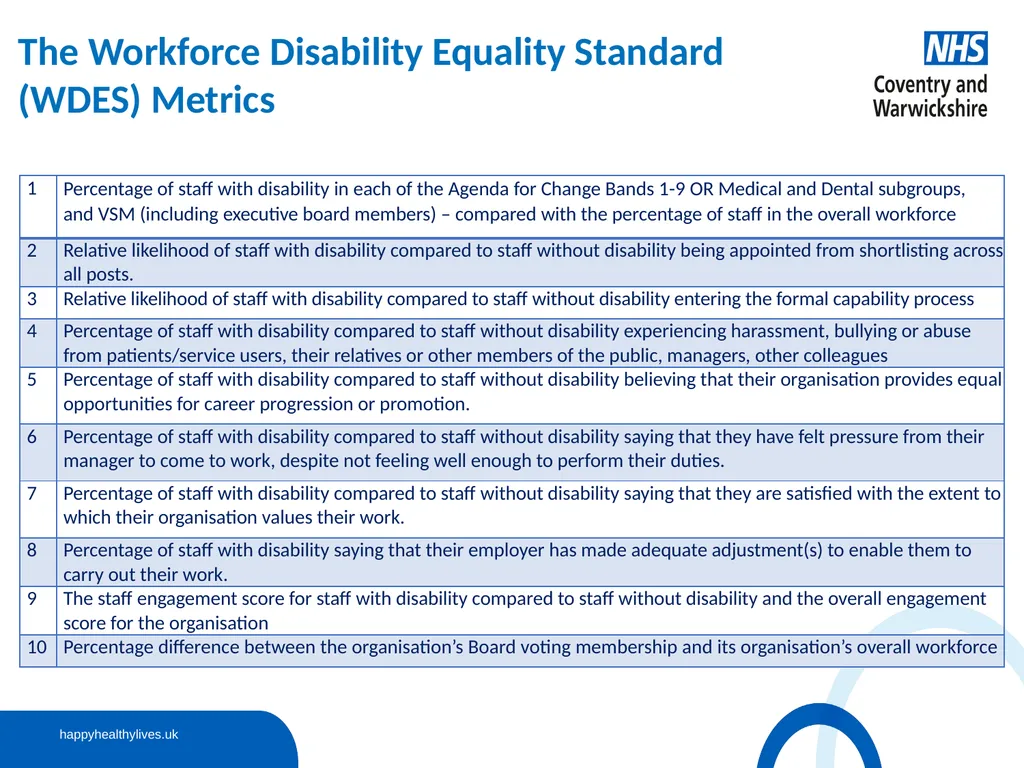
Introduction The Workforce Disability Equality Standard (WDES) is a set of ten specific measures (metrics) which enables NHS organisations to compare the workplace and career experiences of staff with disability and staff without disability. NHS organisations use the metrics data to develop and publish an action plan with year-on-year comparisons to demonstrate progress against the indicators of disability equality.
As part of our continuing improvement approach and commitment to developing good practice the ICB voluntarily completed WDES data using the NHSE submission template. The information presented in this report is directly related to the old organisation, the Coventry and Warwickshire Clinical Commissioning Group (CCG), covering 2021-2022 period. The data used is a snapshot of 31st March 2022.
However, The new organisation, the Coventry and Warwickshire Integrated Care Board, came into being on the 1st July 2022 and will take forward the related actions.
The report has the following key roles:
To enable organisations to compare their performance with others in their region and those providing similar services, aiming to encourage improvement by learning and sharing good practice
To provide a national picture of WDES in practice, to colleagues, organisations and the public on the developments in the workforce disability equality agenda
Note on data: Headcounts below 5, and any associated headcounts which could be used to calculate headcounts below 5, have been redacted.<br>
As part of our continuing improvement approach and commitment to developing good practice the ICB voluntarily completed WDES data using the NHSE submission template. The information presented in this report is directly related to the old organisation, the Coventry and Warwickshire Clinical Commissioning Group (CCG), covering 2021-2022 period. The data used is a snapshot of 31st March 2022.
However, The new organisation, the Coventry and Warwickshire Integrated Care Board, came into being on the 1st July 2022 and will take forward the related actions.
The report has the following key roles:
To enable organisations to compare their performance with others in their region and those providing similar services, aiming to encourage improvement by learning and sharing good practice
To provide a national picture of WDES in practice, to colleagues, organisations and the public on the developments in the workforce disability equality agenda
Note on data: Headcounts below 5, and any associated headcounts which could be used to calculate headcounts below 5, have been redacted.<br>
04
The Workforce Disability Equality Standard (WDES) Metrics<br>
05
Declaration Rate (data quality)
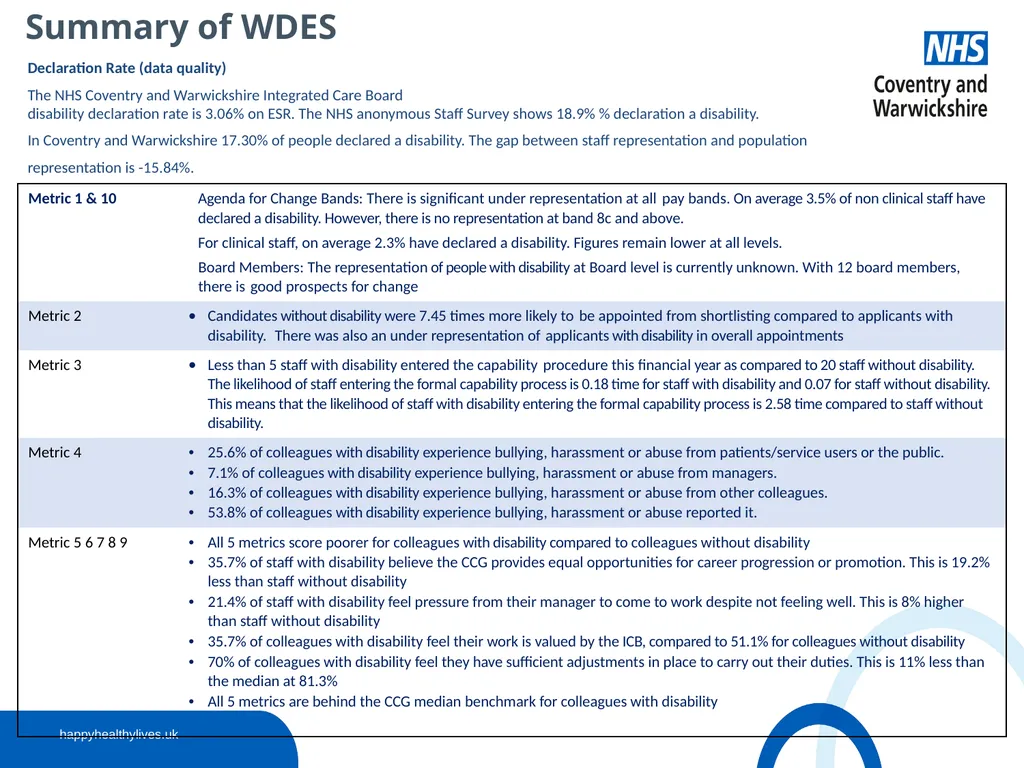
The NHS Coventry and Warwickshire Integrated Care Board disability declaration rate is 3.06% on ESR. The NHS anonymous Staff Survey shows 18.9% % declaration a disability.
In Coventry and Warwickshire 17.30% of people declared a disability. The gap between staff representation and population
representation is -15.84%. Summary of WDES<br>
The NHS Coventry and Warwickshire Integrated Care Board disability declaration rate is 3.06% on ESR. The NHS anonymous Staff Survey shows 18.9% % declaration a disability.
In Coventry and Warwickshire 17.30% of people declared a disability. The gap between staff representation and population
representation is -15.84%. Summary of WDES<br>
06
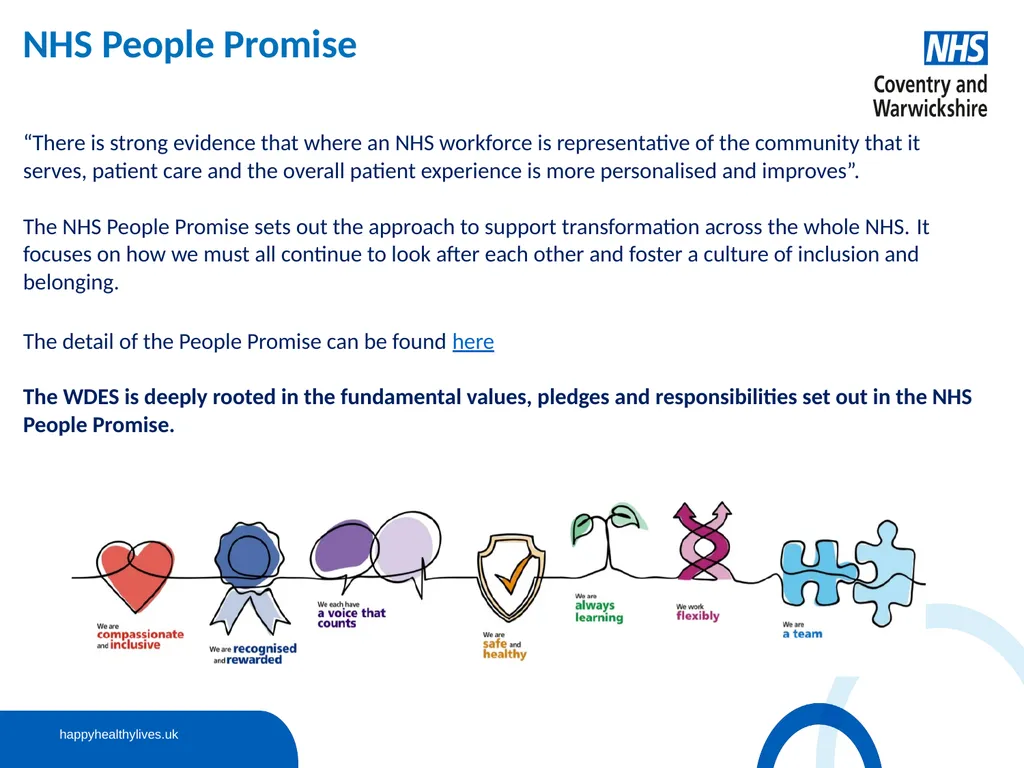
NHS People Promise<br>
07
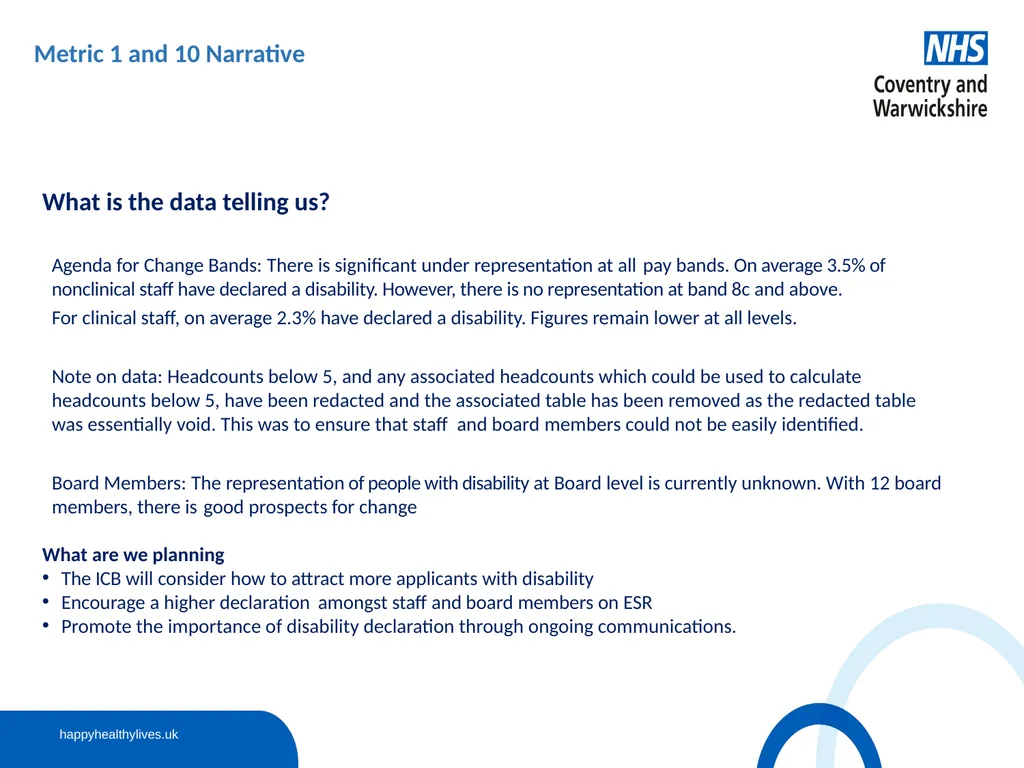
Metric 1 and 10 Narrative What is the data telling us?
Agenda for Change Bands: There is significant under representation at all pay bands. On average 3.5% of nonclinical staff have declared a disability. However, there is no representation at band 8c and above.
For clinical staff, on average 2.3% have declared a disability. Figures remain lower at all levels.
Note on data: Headcounts below 5, and any associated headcounts which could be used to calculate headcounts below 5, have been redacted and the associated table has been removed as the redacted table was essentially void. This was to ensure that staff and board members could not be easily identified.
Board Members: The representation of people with disability at Board level is currently unknown. With 12 board members, there is good prospects for change
What are we planning
The ICB will consider how to attract more applicants with disability
Encourage a higher declaration amongst staff and board members on ESR
Promote the importance of disability declaration through ongoing communications.<br>
Agenda for Change Bands: There is significant under representation at all pay bands. On average 3.5% of nonclinical staff have declared a disability. However, there is no representation at band 8c and above.
For clinical staff, on average 2.3% have declared a disability. Figures remain lower at all levels.
Note on data: Headcounts below 5, and any associated headcounts which could be used to calculate headcounts below 5, have been redacted and the associated table has been removed as the redacted table was essentially void. This was to ensure that staff and board members could not be easily identified.
Board Members: The representation of people with disability at Board level is currently unknown. With 12 board members, there is good prospects for change
What are we planning
The ICB will consider how to attract more applicants with disability
Encourage a higher declaration amongst staff and board members on ESR
Promote the importance of disability declaration through ongoing communications.<br>
08
Metric 2 What is the data telling us?
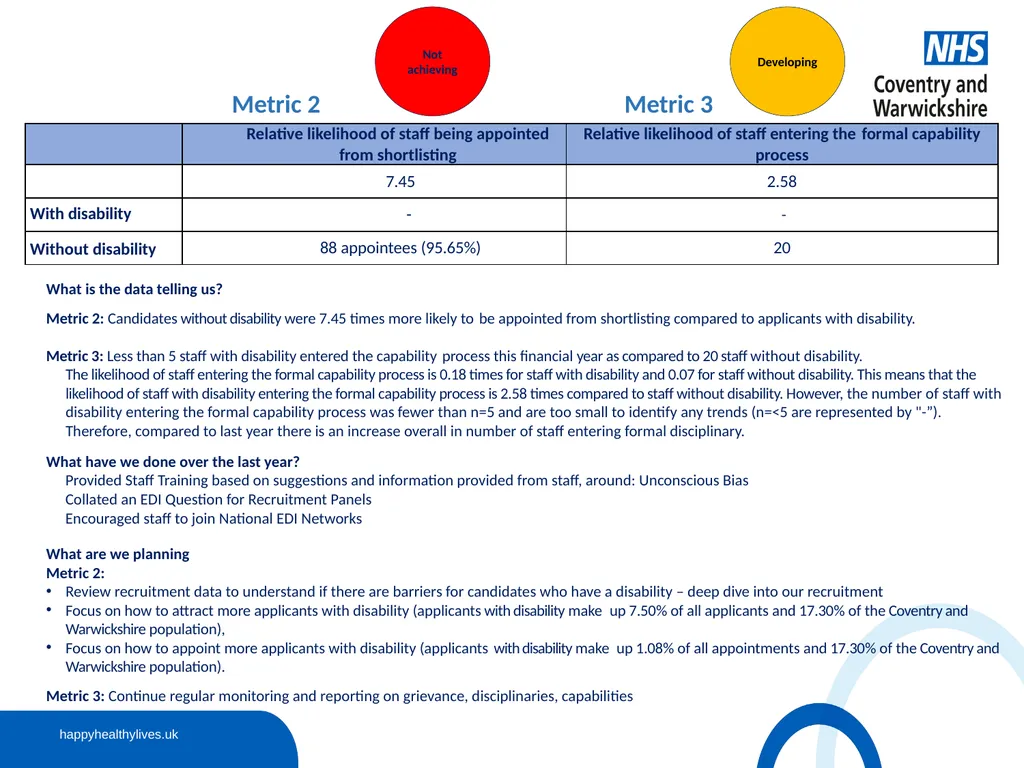
Metric 2: Candidates without disability were 7.45 times more likely to be appointed from shortlisting compared to applicants with disability.
Metric 3: Less than 5 staff with disability entered the capability process this financial year as compared to 20 staff without disability.
The likelihood of staff entering the formal capability process is 0.18 times for staff with disability and 0.07 for staff without disability. This means that the likelihood of staff with disability entering the formal capability process is 2.58 times compared to staff without disability. However, the number of staff with disability entering the formal capability process was fewer than n=5 and are too small to identify any trends (n=<5 are represented by "-”). Therefore, compared to last year there is an increase overall in number of staff entering formal disciplinary.
What have we done over the last year?
Provided Staff Training based on suggestions and information provided from staff, around: Unconscious Bias
Collated an EDI Question for Recruitment Panels
Encouraged staff to join National EDI Networks
What are we planning
Metric 2:
Review recruitment data to understand if there are barriers for candidates who have a disability – deep dive into our recruitment
Focus on how to attract more applicants with disability (applicants with disability make up 7.50% of all applicants and 17.30% of the Coventry and Warwickshire population),
Focus on how to appoint more applicants with disability (applicants with disability make up 1.08% of all appointments and 17.30% of the Coventry and Warwickshire population).
Metric 3: Continue regular monitoring and reporting on grievance, disciplinaries, capabilities Metric 3 Not
achieving Developing<br>
Metric 2: Candidates without disability were 7.45 times more likely to be appointed from shortlisting compared to applicants with disability.
Metric 3: Less than 5 staff with disability entered the capability process this financial year as compared to 20 staff without disability.
The likelihood of staff entering the formal capability process is 0.18 times for staff with disability and 0.07 for staff without disability. This means that the likelihood of staff with disability entering the formal capability process is 2.58 times compared to staff without disability. However, the number of staff with disability entering the formal capability process was fewer than n=5 and are too small to identify any trends (n=<5 are represented by "-”). Therefore, compared to last year there is an increase overall in number of staff entering formal disciplinary.
What have we done over the last year?
Provided Staff Training based on suggestions and information provided from staff, around: Unconscious Bias
Collated an EDI Question for Recruitment Panels
Encouraged staff to join National EDI Networks
What are we planning
Metric 2:
Review recruitment data to understand if there are barriers for candidates who have a disability – deep dive into our recruitment
Focus on how to attract more applicants with disability (applicants with disability make up 7.50% of all applicants and 17.30% of the Coventry and Warwickshire population),
Focus on how to appoint more applicants with disability (applicants with disability make up 1.08% of all appointments and 17.30% of the Coventry and Warwickshire population).
Metric 3: Continue regular monitoring and reporting on grievance, disciplinaries, capabilities Metric 3 Not
achieving Developing<br>
09
Metric 4 Not
achieving What is the data telling us?
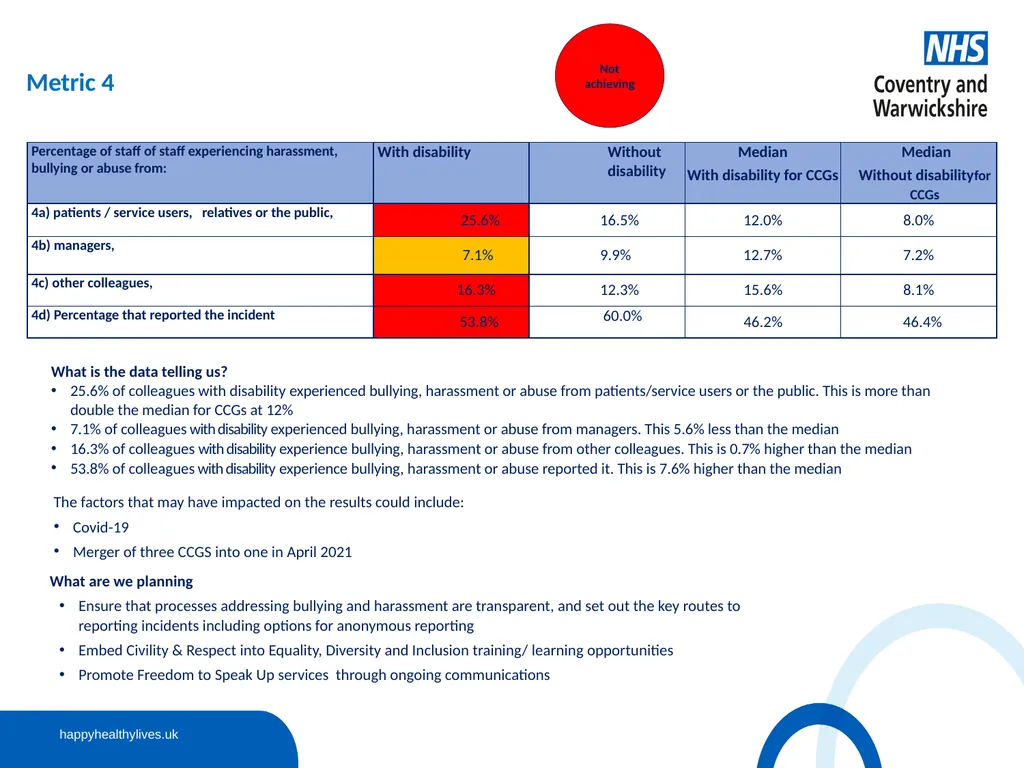
25.6% of colleagues with disability experienced bullying, harassment or abuse from patients/service users or the public. This is more than double the median for CCGs at 12%
7.1% of colleagues with disability experienced bullying, harassment or abuse from managers. This 5.6% less than the median
16.3% of colleagues with disability experience bullying, harassment or abuse from other colleagues. This is 0.7% higher than the median
53.8% of colleagues with disability experience bullying, harassment or abuse reported it. This is 7.6% higher than the median What are we planning
Ensure that processes addressing bullying and harassment are transparent, and set out the key routes to reporting incidents including options for anonymous reporting
Embed Civility & Respect into Equality, Diversity and Inclusion training/ learning opportunities
Promote Freedom to Speak Up services through ongoing communications The factors that may have impacted on the results could include:
Covid-19
Merger of three CCGS into one in April 2021<br>
achieving What is the data telling us?
25.6% of colleagues with disability experienced bullying, harassment or abuse from patients/service users or the public. This is more than double the median for CCGs at 12%
7.1% of colleagues with disability experienced bullying, harassment or abuse from managers. This 5.6% less than the median
16.3% of colleagues with disability experience bullying, harassment or abuse from other colleagues. This is 0.7% higher than the median
53.8% of colleagues with disability experience bullying, harassment or abuse reported it. This is 7.6% higher than the median What are we planning
Ensure that processes addressing bullying and harassment are transparent, and set out the key routes to reporting incidents including options for anonymous reporting
Embed Civility & Respect into Equality, Diversity and Inclusion training/ learning opportunities
Promote Freedom to Speak Up services through ongoing communications The factors that may have impacted on the results could include:
Covid-19
Merger of three CCGS into one in April 2021<br>
10
Metrics 5 - 9 Under
achieving What is the data telling us?
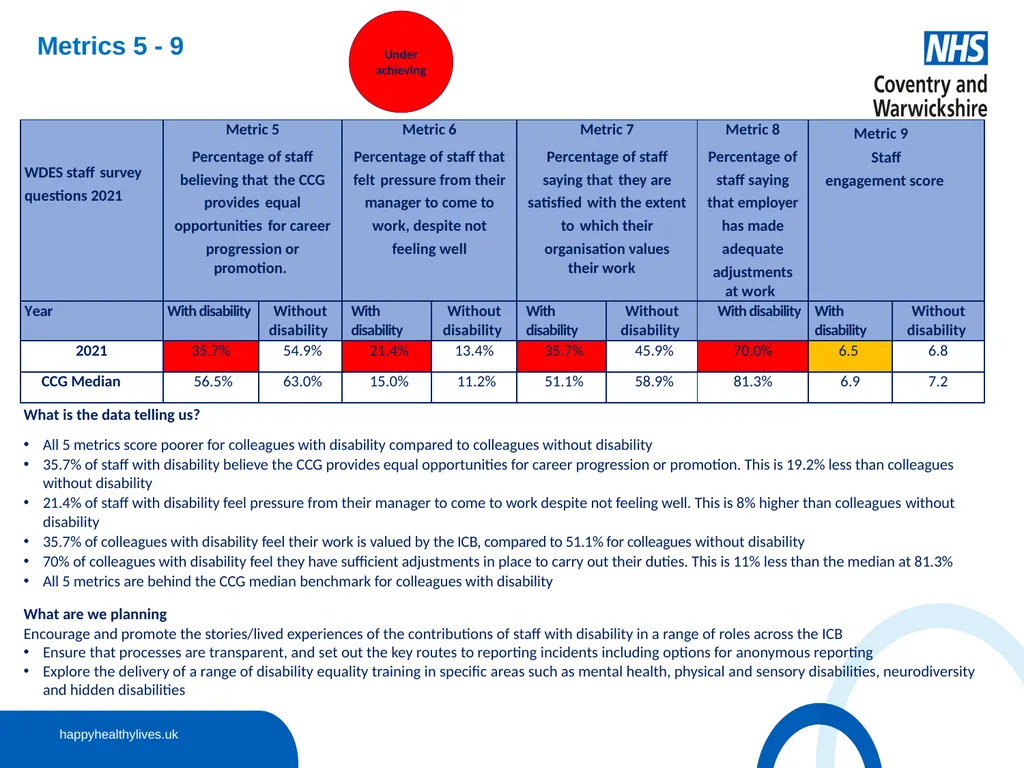
All 5 metrics score poorer for colleagues with disability compared to colleagues without disability
35.7% of staff with disability believe the CCG provides equal opportunities for career progression or promotion. This is 19.2% less than colleagues without disability
21.4% of staff with disability feel pressure from their manager to come to work despite not feeling well. This is 8% higher than colleagues without disability
35.7% of colleagues with disability feel their work is valued by the ICB, compared to 51.1% for colleagues without disability
70% of colleagues with disability feel they have sufficient adjustments in place to carry out their duties. This is 11% less than the median at 81.3%
All 5 metrics are behind the CCG median benchmark for colleagues with disability
What are we planning
Encourage and promote the stories/lived experiences of the contributions of staff with disability in a range of roles across the ICB
Ensure that processes are transparent, and set out the key routes to reporting incidents including options for anonymous reporting
Explore the delivery of a range of disability equality training in specific areas such as mental health, physical and sensory disabilities, neurodiversity and hidden disabilities<br>
achieving What is the data telling us?
All 5 metrics score poorer for colleagues with disability compared to colleagues without disability
35.7% of staff with disability believe the CCG provides equal opportunities for career progression or promotion. This is 19.2% less than colleagues without disability
21.4% of staff with disability feel pressure from their manager to come to work despite not feeling well. This is 8% higher than colleagues without disability
35.7% of colleagues with disability feel their work is valued by the ICB, compared to 51.1% for colleagues without disability
70% of colleagues with disability feel they have sufficient adjustments in place to carry out their duties. This is 11% less than the median at 81.3%
All 5 metrics are behind the CCG median benchmark for colleagues with disability
What are we planning
Encourage and promote the stories/lived experiences of the contributions of staff with disability in a range of roles across the ICB
Ensure that processes are transparent, and set out the key routes to reporting incidents including options for anonymous reporting
Explore the delivery of a range of disability equality training in specific areas such as mental health, physical and sensory disabilities, neurodiversity and hidden disabilities<br>
11
Metric 9 Staff Engagement
In adopting and implementing the WDES, the Coventry and Warwickshire ICB should engage with staff, staff networks (particularly staff with disability networks), to ensure that staff with disability feel valued, included and respected for the outstanding contribution they make. Staff with disability involvement is a fundamental part of the whole approach that underpins the WDES. It is important that staff with disability are fully involved in the WDES implementation.
For significant improvements to be achieved against the WDES metrics, it is essential that the voices of staff with disability continue to be heard. The disability network can provide an important source of knowledge, support and experience, and provide a platform for increasing the visibility of staff with disability. This provide a safe place for staff with disability to share their experiences and be listened to in a compassionate and respected way.
What have we done over the last year?
Our focus in 2021 was to promote and progress Equality, Diversity and Inclusivity around the Disabilities protected characteristic, especially those with Hidden Disabilities for those who work for the ICB and in the work of the ICB. We:
Raised awareness around Asperger Syndrome, hearing difficulties, Downs Syndrome, Epilepsy, Autism, MS, Ehlers-Danlos Syndrome, Accessibility, Learning Disabilities and Post Traumatic Stress Disorder, Dyslexia, Stammering and Sight awareness, World Hearing Day, World Alzheimer’s Day, World AIDS day
Provided resources around Unconscious Bias and Micro-Aggressions
Organised Social Event for Network Staff
Provided Staff Training based on suggestions and information provided from staff, around: Dyslexia and Neurodiversity – Performance in the Workplace, Anxiety Disorders and Stress, Bipolar & Depression, Deaf Awareness Training
Shared Disability Guides
Provided an online Signature British Sign Language (BSL) for Beginners to staff
Created a wellbeing programme based on staff feedback via a staff wellbeing survey which takes place every 6 months. Workshops have included:
Sleep
Healthy eating cooking demo
Personal Safety Awareness
Meditation
Yoga
Mental Health
Suicide Awareness (clinical lead)
Agile Working
Menopause aligned with healthy eating and mental health
We produced an informative and fun wellbeing content for the staff newsletter with a regular section.
Conducted a system wide health needs assessment across Coventry and Warwickshire with all workforces in health and social care
What are we planning
Develop a timetable of listening events with specific themes and topics in consultation with staff with disability they would like to discuss with the Executive Team.
Engage staff with disability in the delivery of reasonable adjustment training.
Wider staff engagement through the newsletter<br>
In adopting and implementing the WDES, the Coventry and Warwickshire ICB should engage with staff, staff networks (particularly staff with disability networks), to ensure that staff with disability feel valued, included and respected for the outstanding contribution they make. Staff with disability involvement is a fundamental part of the whole approach that underpins the WDES. It is important that staff with disability are fully involved in the WDES implementation.
For significant improvements to be achieved against the WDES metrics, it is essential that the voices of staff with disability continue to be heard. The disability network can provide an important source of knowledge, support and experience, and provide a platform for increasing the visibility of staff with disability. This provide a safe place for staff with disability to share their experiences and be listened to in a compassionate and respected way.
What have we done over the last year?
Our focus in 2021 was to promote and progress Equality, Diversity and Inclusivity around the Disabilities protected characteristic, especially those with Hidden Disabilities for those who work for the ICB and in the work of the ICB. We:
Raised awareness around Asperger Syndrome, hearing difficulties, Downs Syndrome, Epilepsy, Autism, MS, Ehlers-Danlos Syndrome, Accessibility, Learning Disabilities and Post Traumatic Stress Disorder, Dyslexia, Stammering and Sight awareness, World Hearing Day, World Alzheimer’s Day, World AIDS day
Provided resources around Unconscious Bias and Micro-Aggressions
Organised Social Event for Network Staff
Provided Staff Training based on suggestions and information provided from staff, around: Dyslexia and Neurodiversity – Performance in the Workplace, Anxiety Disorders and Stress, Bipolar & Depression, Deaf Awareness Training
Shared Disability Guides
Provided an online Signature British Sign Language (BSL) for Beginners to staff
Created a wellbeing programme based on staff feedback via a staff wellbeing survey which takes place every 6 months. Workshops have included:
Sleep
Healthy eating cooking demo
Personal Safety Awareness
Meditation
Yoga
Mental Health
Suicide Awareness (clinical lead)
Agile Working
Menopause aligned with healthy eating and mental health
We produced an informative and fun wellbeing content for the staff newsletter with a regular section.
Conducted a system wide health needs assessment across Coventry and Warwickshire with all workforces in health and social care
What are we planning
Develop a timetable of listening events with specific themes and topics in consultation with staff with disability they would like to discuss with the Executive Team.
Engage staff with disability in the delivery of reasonable adjustment training.
Wider staff engagement through the newsletter<br>
12
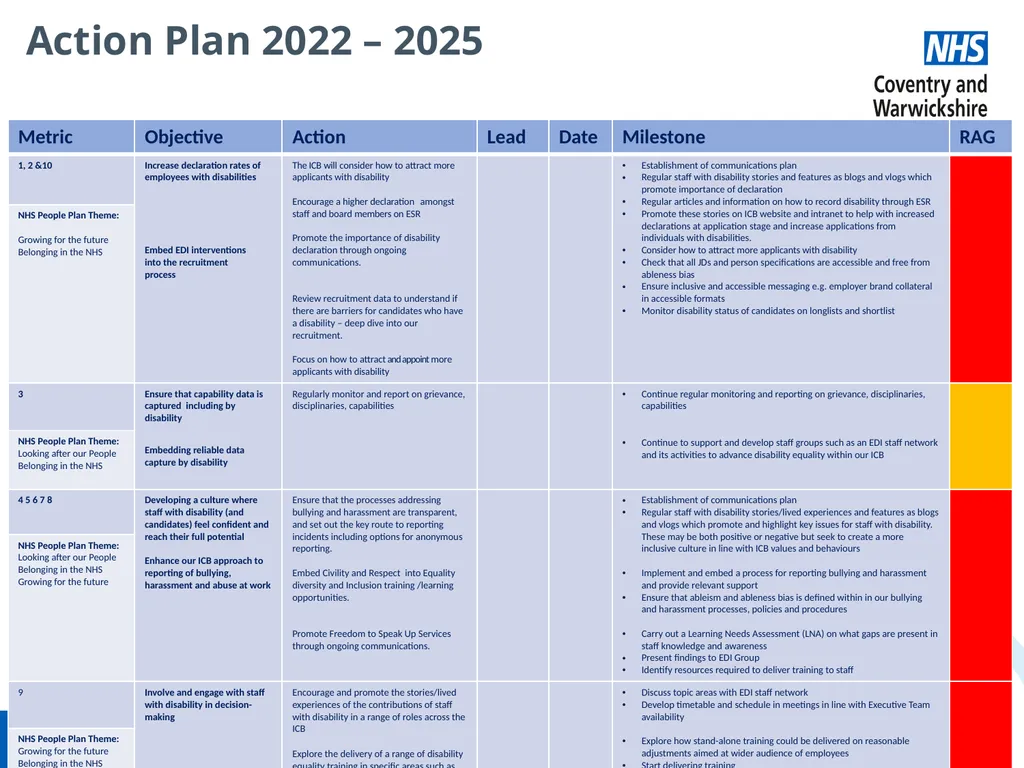
Action Plan 2022 – 2025<br>
13
Further information and contact details To know more
If you would like to discuss any element of this report, please contact:
Executive Sponsor:
Or
Equality, Inclusion and Human Right Team agcsu.equality@nhs.net<br>
If you would like to discuss any element of this report, please contact:
Executive Sponsor:
Or
Equality, Inclusion and Human Right Team agcsu.equality@nhs.net<br>