
Working with Difficult Moments: Behaviorally





Description: Working with Difficult Moments: Behaviorally Speaking Jacqueline A-Tjak Kelly Koerner with a big thank you to Matthieu Villatte Aim of this workshop Increase your sensitivity for non-verbal signals from your client Experience the power of
Related Topics
Download Presentation
"Working with Difficult Moments: Behaviorally" is the property of its rightful owner. Permission is granted to download and print the materials on this website for personal, non-commercial use only, and to display it on your personal computer provided you do not modify the materials and that you retain all copyright notices contained in the materials. By downloading content from our website, you accept the terms of this agreement.
Presentation Transcript
slide1. Working with Difficult Moments: Behaviorally Speaking Jacqueline A-Tjak & Kelly Koerner
with a big thank you to Matthieu Villatte<br>
slide2. Aim of this workshop Increase your sensitivity for non-verbal signals from your client
Experience the power of validation
Understand validation as a behavioral intervention
Understand difficult emotion (functional analysis)
Work with difficult emotion: informal exposure and emotion regulation<br>
slide3. Difficult moments can arise When people have histories of continuous unpredictable responses to their behavior (unsafe attachment, invalidating environments), they are easily overwhelmed by their emotions. The slightest signs of rejection or faults can function as signs of threat
They can only regulate their emotions by drastic, toxic control efforts
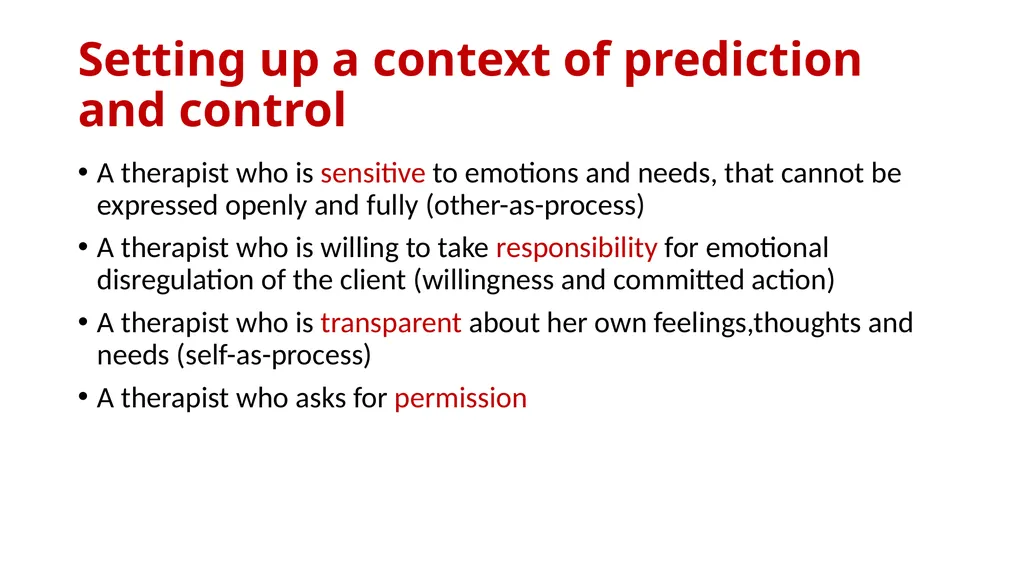
To learn new ways of relating to their emotions they need a predictable and controllable environment.<br>
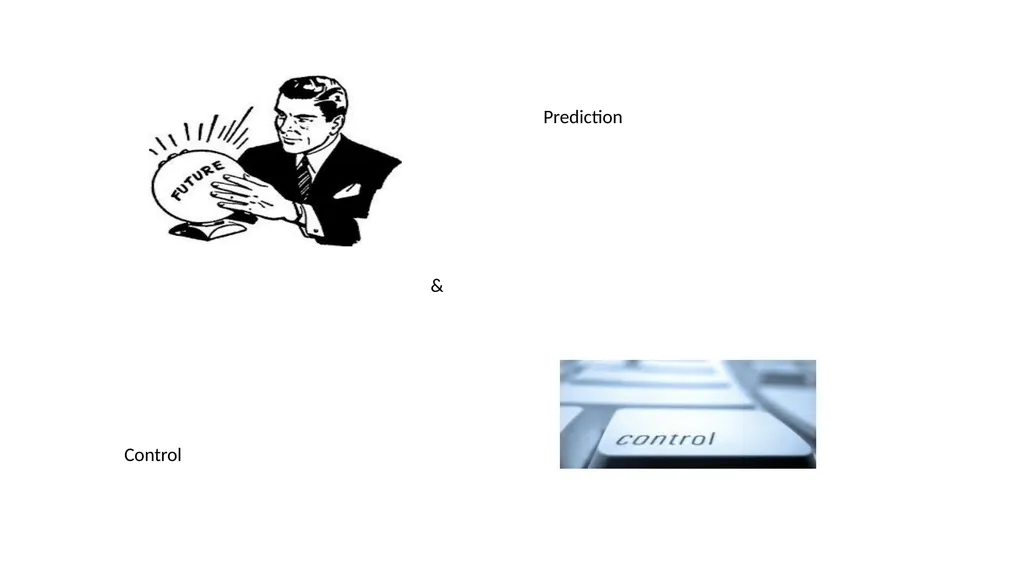
slide4. Prediction & Control<br>
slide5. Setting up a context of prediction and control A therapist who is sensitive to emotions and needs, that cannot be expressed openly and fully (other-as-process)
A therapist who is willing to take responsibility for emotional disregulation of the client (willingness and committed action)
A therapist who is transparent about her own feelings,thoughts and needs (self-as-process)
A therapist who asks for permission<br>
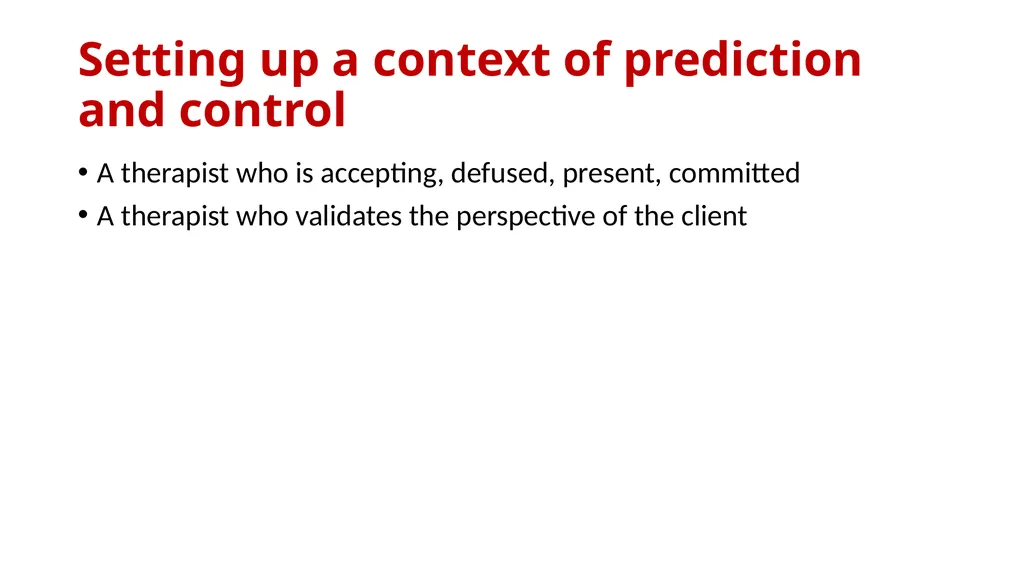
slide6. Setting up a context of prediction and control A therapist who is accepting, defused, present, committed
A therapist who validates the perspective of the client<br>
slide7. What’s hard for me right now…<br>
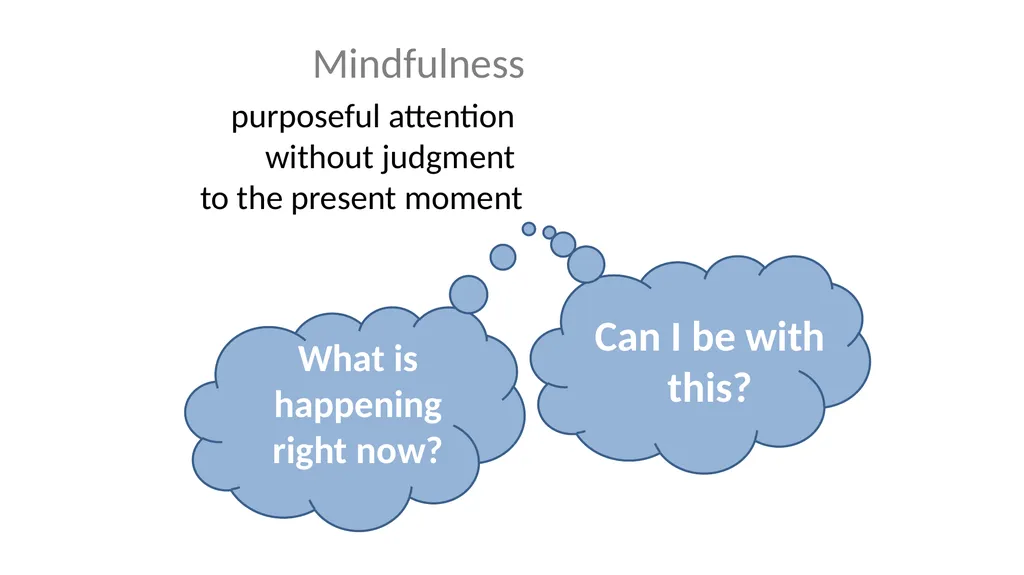
slide8. Mindfulness purposeful attention
without judgment
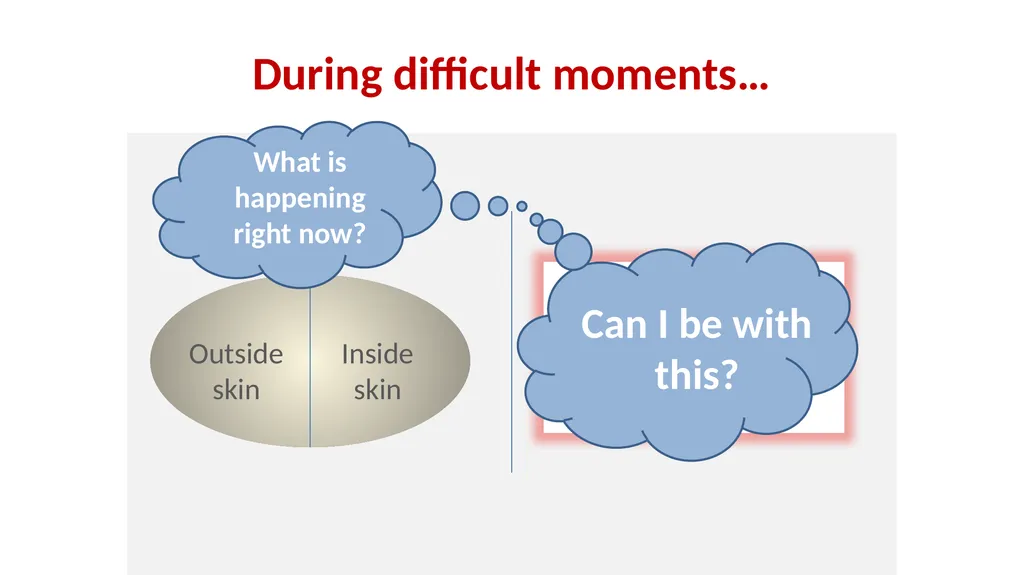
to the present moment What is happening right now? Can I be with this?<br>
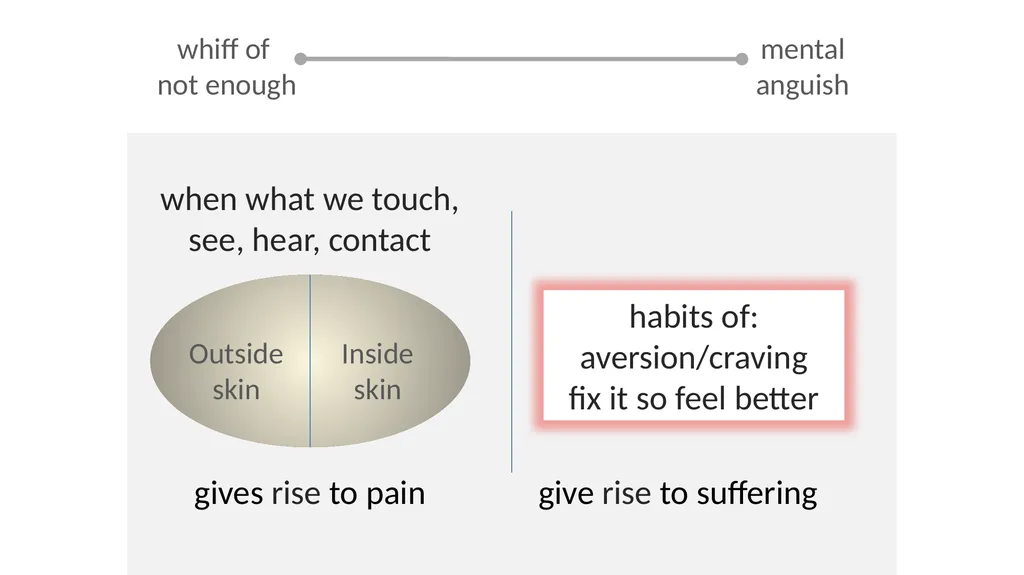
slide9. when what we touch, see, hear, contact habits of:
aversion/craving
fix it so feel better gives rise to pain give rise to suffering<br>
slide10. habits of:
aversion/craving
fix it so feel better
“movie of me” During difficult moments…<br>
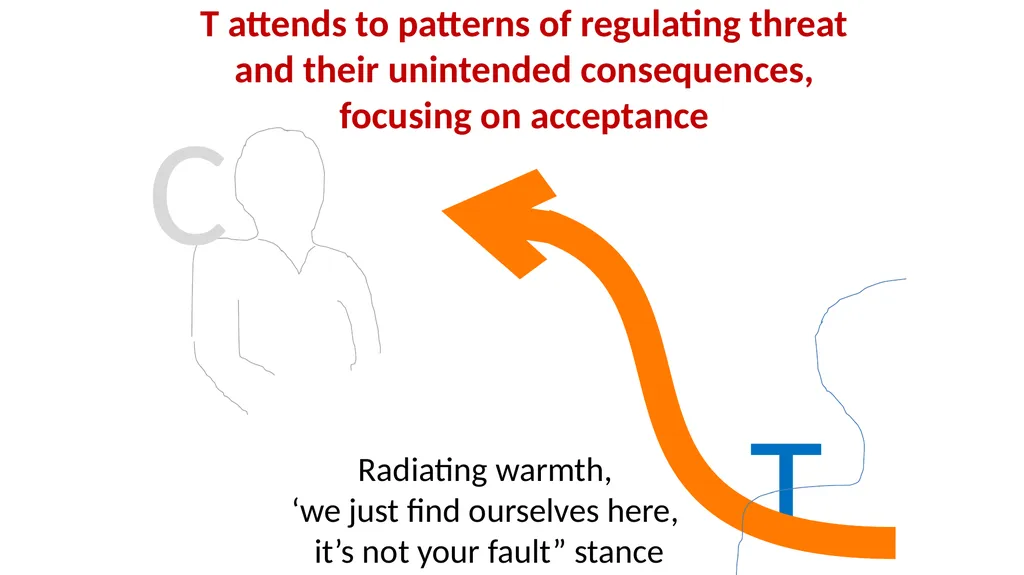
slide11. C T T attends to patterns of regulating threat and their unintended consequences, focusing on acceptance Radiating warmth,
‘we just find ourselves here,
it’s not your fault” stance<br>
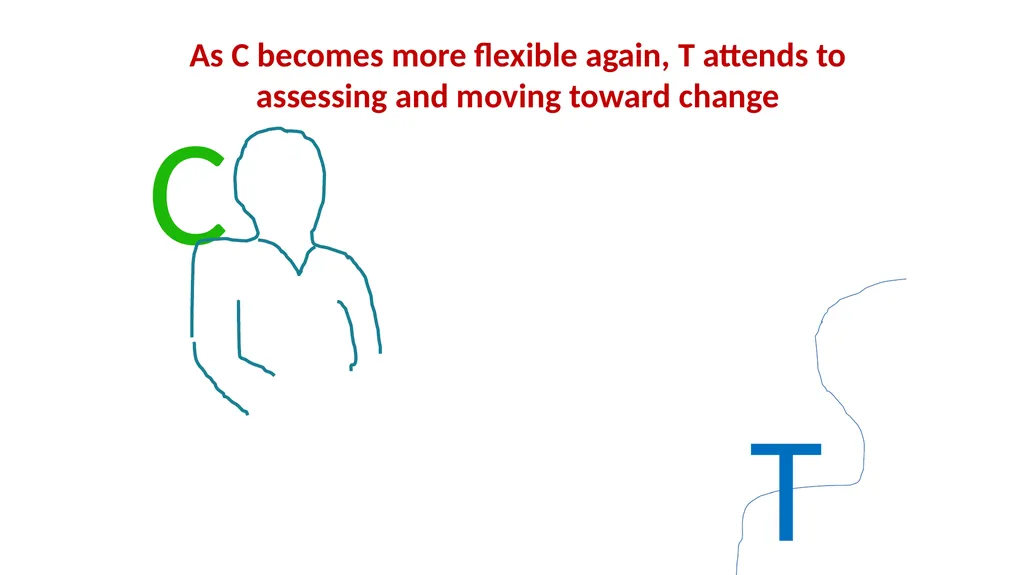
slide12. As C becomes more flexible again, T attends to assessing and moving toward change C T<br>
slide13. Validation behaviorally speaking To affirm the coherence of the story (network) of the other person
= other-as-context: seeing the perspective of the cliënt
= acceptance: accepting the perspective of the cliënt as valid
= defusion from your own story as ‘more true’.
= defusion from being right
Creates a context to open up to new information<br>
slide14. I. The bigger picture: shedding new light NOW, we add new information to the network:
= function: how does it work, short term-long term
= asking for the history: have you had that thought before?
= disconfirming experiences in the past
= metaphor
= socratic dialogue<br>
slide15. II. Labeling Calling a spade a spade
= naming, categorizing: this is fear, this is a thought
= creating a hierarchical relationship between this emotion and all emotions
Calling your own spade a spade
= modelling
= creating a safe, accepting, defused context
= creating other/self-as-context<br>
slide16. III. Alternative reaction Bringing attention to the bodily felt sensation (from fusion with there-and-then to here-and-now)
Asking questions about alternatives, for instance valued behavior: what could you do while you have this thought or emotion?<br>
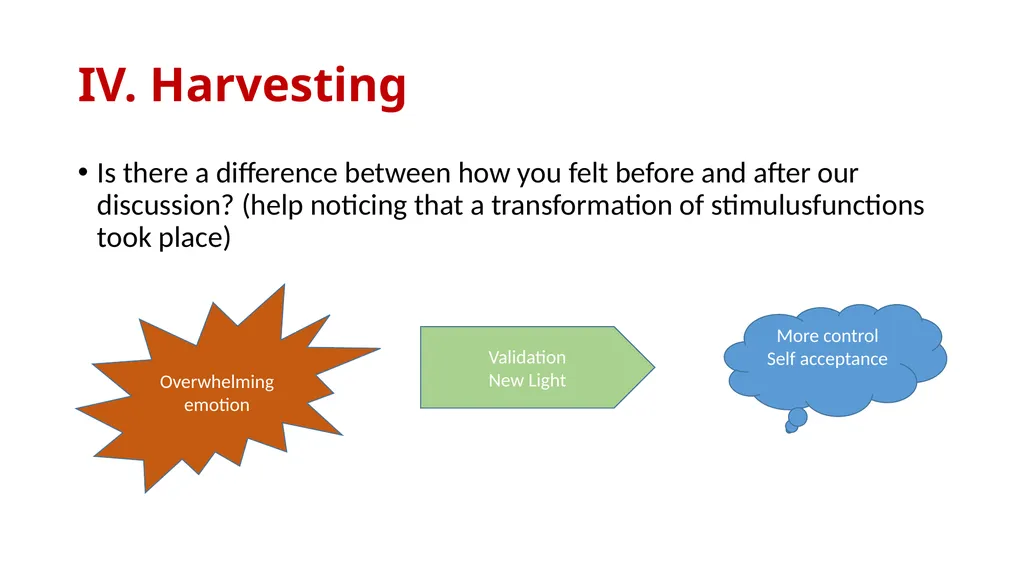
slide17. IV. Harvesting Is there a difference between how you felt before and after our discussion? (help noticing that a transformation of stimulusfunctions took place) More control
Self acceptance Overwhelming emotion Validation
New Light<br>
slide18. First exercise Have a therapist-client interaction
Client tells about a disturbing experience
Therapist tries to make the client see, that the client is seeing this the wrong way
Observer: notice the non-verbal behavior of both client and therapist: tone, volume, posture, pace, facial expression, gestures, tension.<br>
slide19. Second exercise Have a therapist-client interaction
Client tells about a disturbing experience
Observer: notice the non-verbal behavior
Therapist starts with validation
= It is logical that
= I understand that you
= If I were you, I would also ….
= It is as if ….. (metaphor)<br>
slide20. AND When clients opens up, therapist moves into ‘the bigger picture’, ‘labeling’, or ‘alternative reaction’
How could you know that it was the right time to move on to ‘adding new information’?<br>
slide21. Third exercise Have a therapist-client interaction
Client tells about a disturbing experience
Therapist starts with validation
Now, therapist moves into ‘the bigger picture’, ‘labeling’, or ‘alternative reaction’
Lastly, the therapist harvests
Observer: notice the non-verbal behavior
How could you know that it was the right time to move on to harvesting?<br>
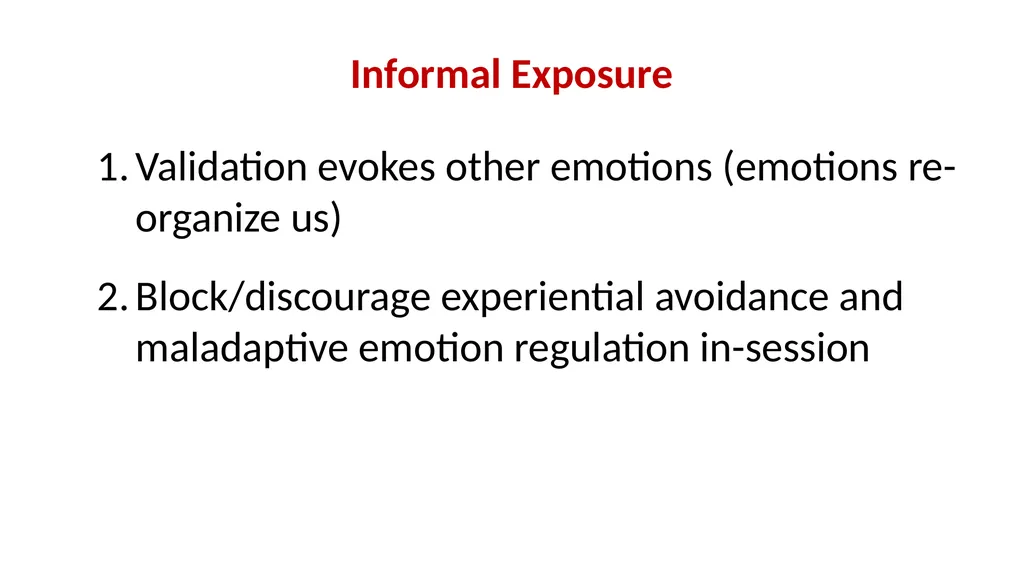
slide22. Informal Exposure Validation evokes other emotions (emotions re-organize us)
Block/discourage experiential avoidance and maladaptive emotion regulation in-session<br>
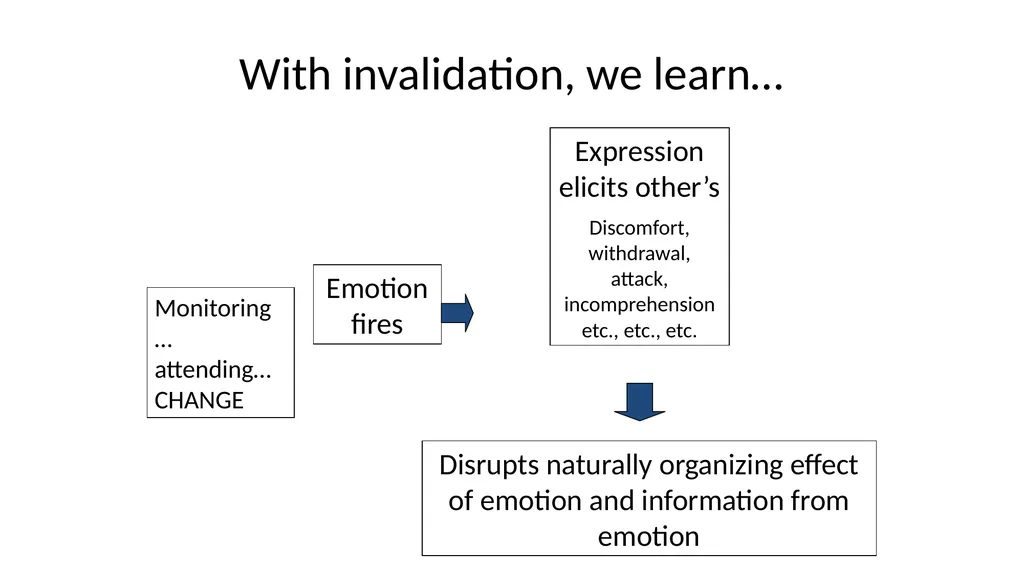
slide23. With invalidation, we learn… Monitoring…attending…CHANGE Emotion fires Disrupts naturally organizing effect of emotion and information from emotion Expression elicits other’s
Discomfort, withdrawal, attack, incomprehension etc., etc., etc.<br>
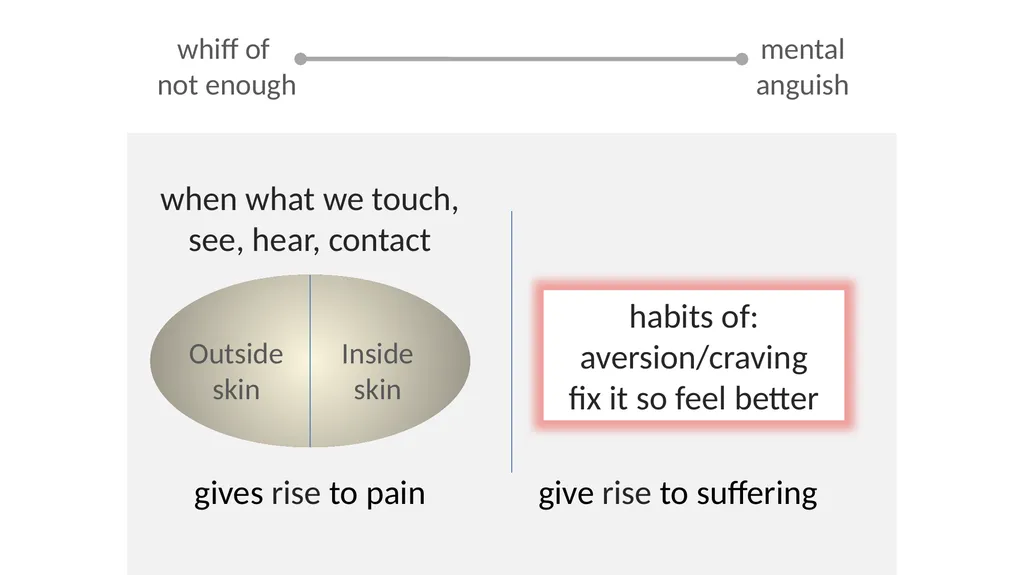
slide24. when what we touch, see, hear, contact habits of:
aversion/craving
fix it so feel better gives rise to pain give rise to suffering<br>
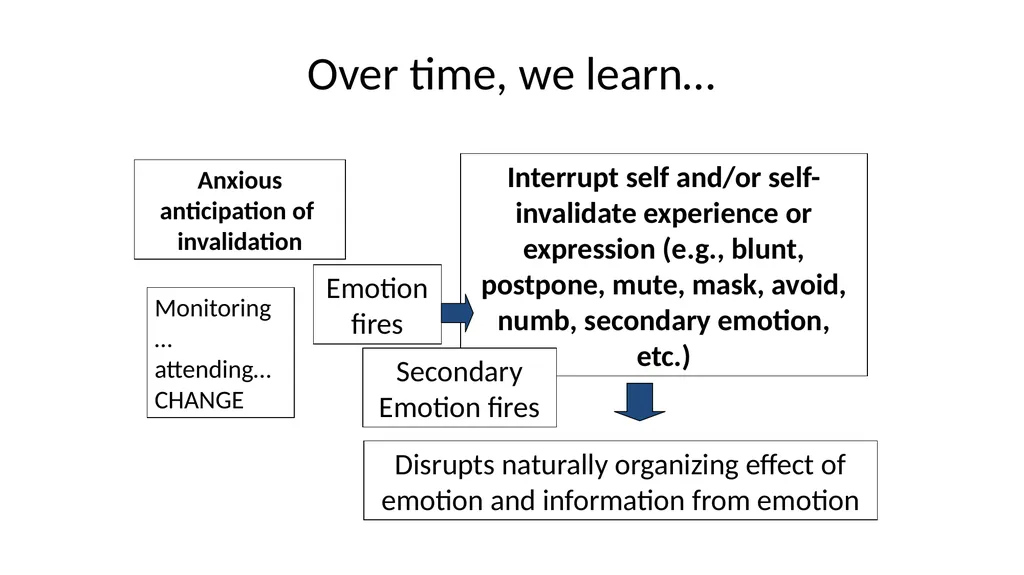
slide25. Over time, we learn… Monitoring…attending…CHANGE Emotion fires Anxious anticipation of invalidation Interrupt self and/or self-invalidate experience or expression (e.g., blunt, postpone, mute, mask, avoid, numb, secondary emotion, etc.) Disrupts naturally organizing effect of emotion and information from emotion Secondary Emotion fires<br>
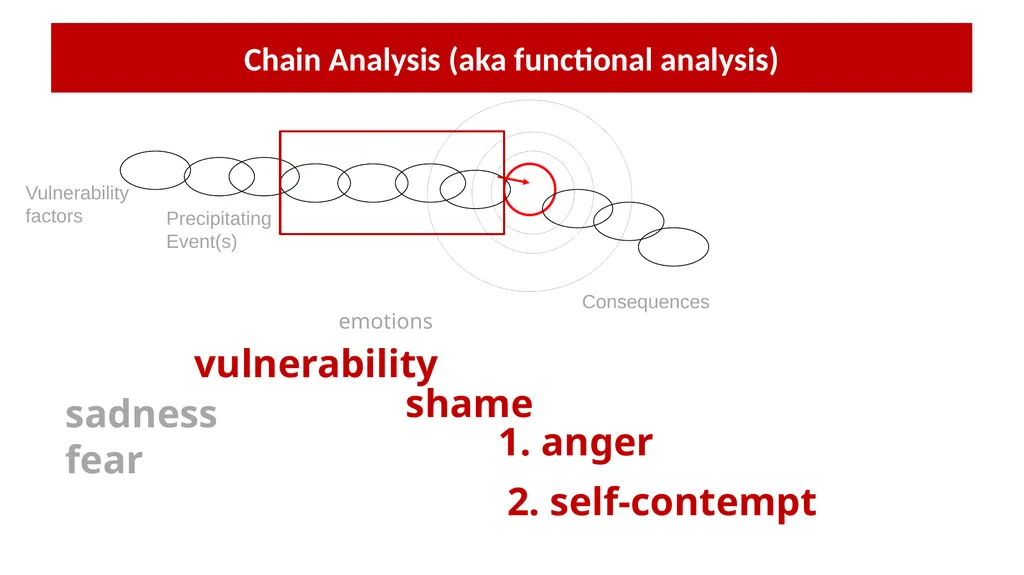
slide26. Chain Analysis (aka functional analysis) shame 1. anger emotions vulnerability sadness
fear 2. self-contempt<br>
slide27. “I” as contact with sensations from a particular location<br>
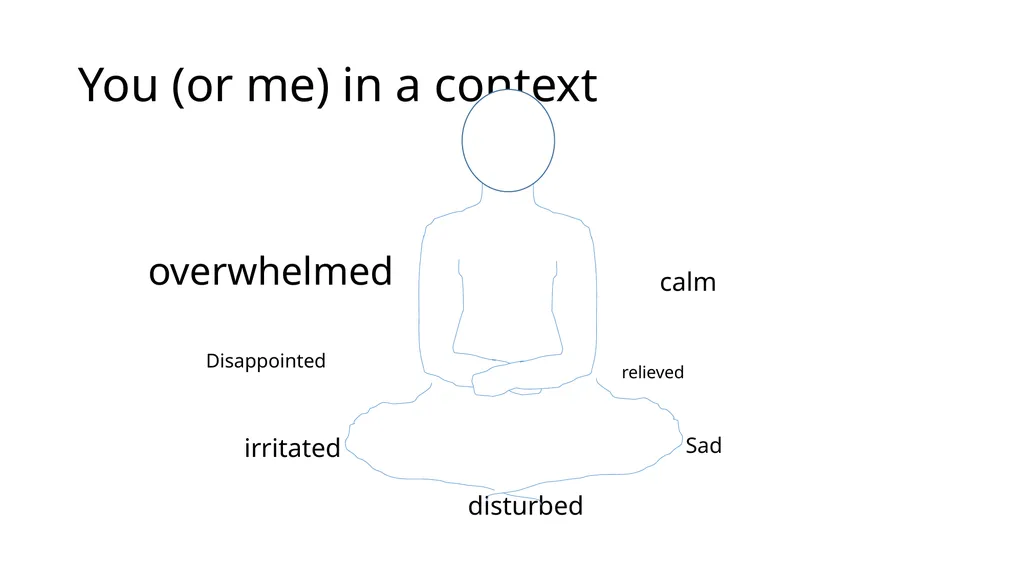
slide28. You (or me) in a context Sad overwhelmed calm Disappointed irritated disturbed relieved<br>
slide29. New cue…voila! Changed organism Shame fear ANGRY disturbed sad<br>
slide30. New cue…voila! Changed organism Shame fear Self-contempt despair sad<br>
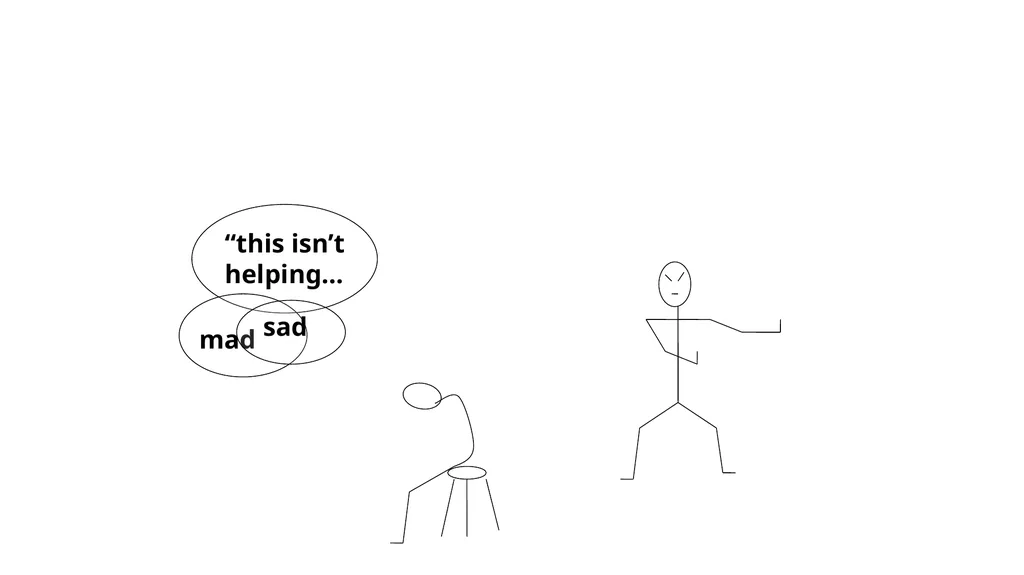
slide31. “this isn’t helping…<br>
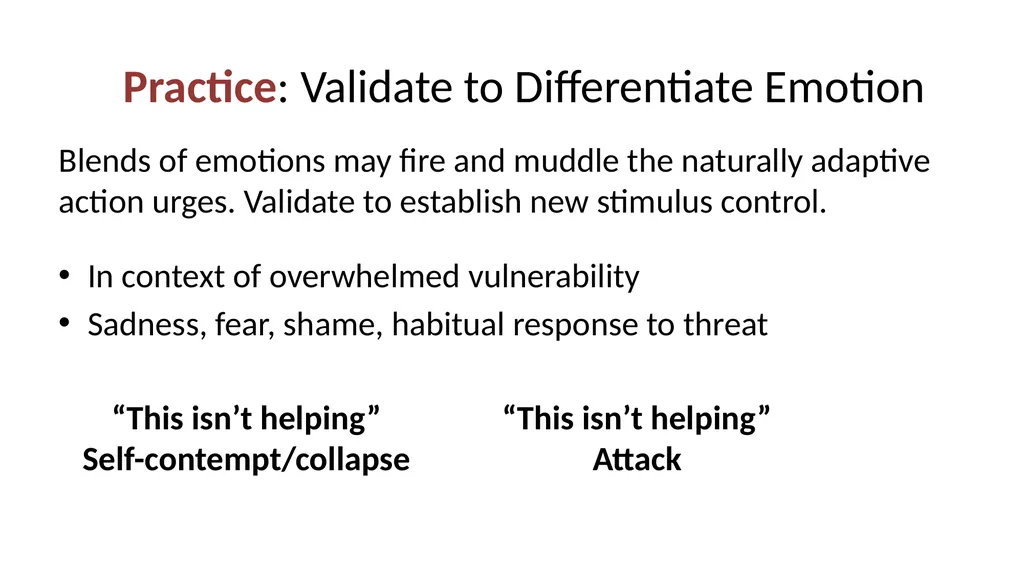
slide32. Blends of emotions may fire and muddle the naturally adaptive action urges. Validate to establish new stimulus control.
In context of overwhelmed vulnerability
Sadness, fear, shame, habitual response to threat Practice: Validate to Differentiate Emotion “This isn’t helping”
Self-contempt/collapse “This isn’t helping”
Attack<br>
slide33. Set up C: This isn’t helping (with either self-contempt or attack T)
T: VIVIDLY validate fear, validate anger, validate sadness, whatever emotion is primary and adaptive. Watch to see what natural adaptive action urges arise<br>
slide34. Example phrasing Clients—any effective lines your therapists have said?<br>
slide35. Gently block avoidance(CRB1) to shape flexibility (CRB2) Cue is sensation of overwhelm/vulnerability
Present cue
Gently block avoidance
Increase inhibitory learning (i.e., help client build new meaning about the cue, learn cue can be tolerated, worked with, habitual avoidance isn’t needed)<br>
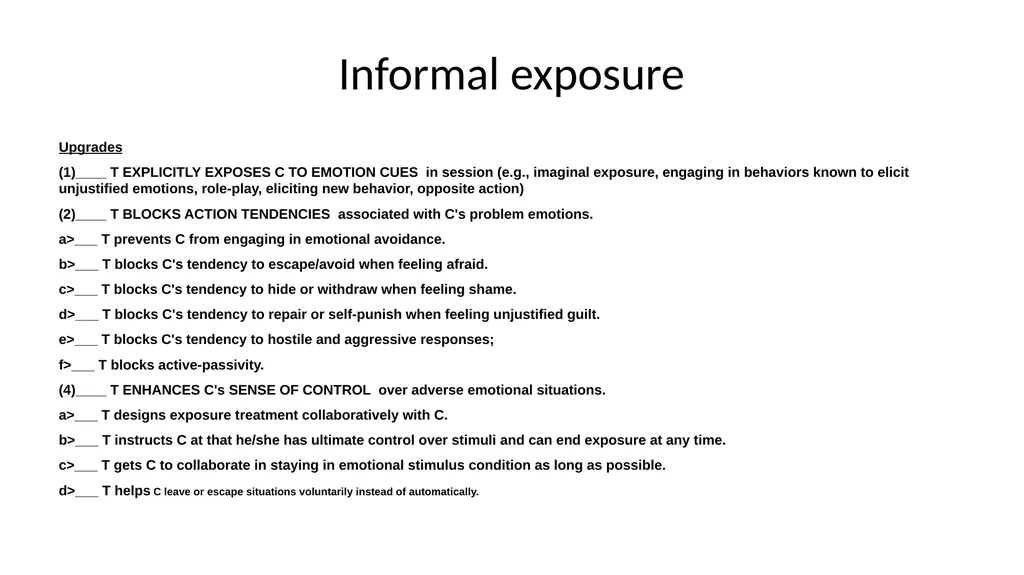
slide36. Informal exposure Upgrades
(1)____ T EXPLICITLY EXPOSES C TO EMOTION CUES in session (e.g., imaginal exposure, engaging in behaviors known to elicit unjustified emotions, role-play, eliciting new behavior, opposite action)
(2)____ T BLOCKS ACTION TENDENCIES associated with C's problem emotions.
a>___ T prevents C from engaging in emotional avoidance.
b>___ T blocks C's tendency to escape/avoid when feeling afraid.
c>___ T blocks C's tendency to hide or withdraw when feeling shame.
d>___ T blocks C's tendency to repair or self-punish when feeling unjustified guilt.
e>___ T blocks C's tendency to hostile and aggressive responses;
f>___ T blocks active-passivity.
(4)____ T ENHANCES C's SENSE OF CONTROL over adverse emotional situations.
a>___ T designs exposure treatment collaboratively with C.
b>___ T instructs C at that he/she has ultimate control over stimuli and can end exposure at any time.
c>___ T gets C to collaborate in staying in emotional stimulus condition as long as possible.
d>___ T helps C leave or escape situations voluntarily instead of automatically.<br>
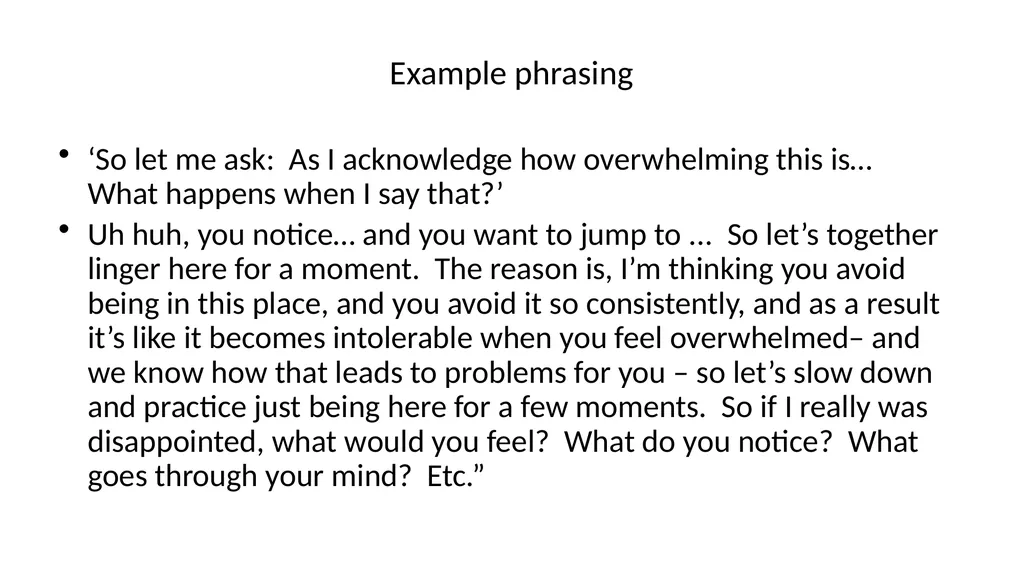
slide37. Example phrasing ‘So let me ask: As I acknowledge how overwhelming this is… What happens when I say that?’
Uh huh, you notice… and you want to jump to ... So let’s together linger here for a moment. The reason is, I’m thinking you avoid being in this place, and you avoid it so consistently, and as a result it’s like it becomes intolerable when you feel overwhelmed– and we know how that leads to problems for you – so let’s slow down and practice just being here for a few moments. So if I really was disappointed, what would you feel? What do you notice? What goes through your mind? Etc.”<br>
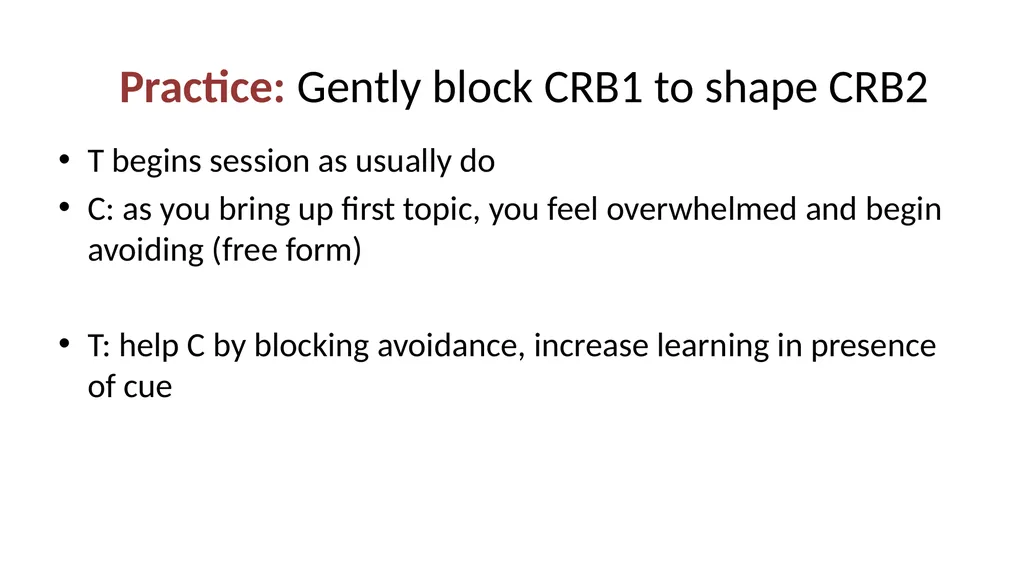
slide38. T begins session as usually do
C: as you bring up first topic, you feel overwhelmed and begin avoiding (free form)
T: help C by blocking avoidance, increase learning in presence of cue Practice: Gently block CRB1 to shape CRB2<br>
with a big thank you to Matthieu Villatte<br>
slide2. Aim of this workshop Increase your sensitivity for non-verbal signals from your client
Experience the power of validation
Understand validation as a behavioral intervention
Understand difficult emotion (functional analysis)
Work with difficult emotion: informal exposure and emotion regulation<br>
slide3. Difficult moments can arise When people have histories of continuous unpredictable responses to their behavior (unsafe attachment, invalidating environments), they are easily overwhelmed by their emotions. The slightest signs of rejection or faults can function as signs of threat
They can only regulate their emotions by drastic, toxic control efforts
To learn new ways of relating to their emotions they need a predictable and controllable environment.<br>
slide4. Prediction & Control<br>
slide5. Setting up a context of prediction and control A therapist who is sensitive to emotions and needs, that cannot be expressed openly and fully (other-as-process)
A therapist who is willing to take responsibility for emotional disregulation of the client (willingness and committed action)
A therapist who is transparent about her own feelings,thoughts and needs (self-as-process)
A therapist who asks for permission<br>
slide6. Setting up a context of prediction and control A therapist who is accepting, defused, present, committed
A therapist who validates the perspective of the client<br>
slide7. What’s hard for me right now…<br>
slide8. Mindfulness purposeful attention
without judgment
to the present moment What is happening right now? Can I be with this?<br>
slide9. when what we touch, see, hear, contact habits of:
aversion/craving
fix it so feel better gives rise to pain give rise to suffering<br>
slide10. habits of:
aversion/craving
fix it so feel better
“movie of me” During difficult moments…<br>
slide11. C T T attends to patterns of regulating threat and their unintended consequences, focusing on acceptance Radiating warmth,
‘we just find ourselves here,
it’s not your fault” stance<br>
slide12. As C becomes more flexible again, T attends to assessing and moving toward change C T<br>
slide13. Validation behaviorally speaking To affirm the coherence of the story (network) of the other person
= other-as-context: seeing the perspective of the cliënt
= acceptance: accepting the perspective of the cliënt as valid
= defusion from your own story as ‘more true’.
= defusion from being right
Creates a context to open up to new information<br>
slide14. I. The bigger picture: shedding new light NOW, we add new information to the network:
= function: how does it work, short term-long term
= asking for the history: have you had that thought before?
= disconfirming experiences in the past
= metaphor
= socratic dialogue<br>
slide15. II. Labeling Calling a spade a spade
= naming, categorizing: this is fear, this is a thought
= creating a hierarchical relationship between this emotion and all emotions
Calling your own spade a spade
= modelling
= creating a safe, accepting, defused context
= creating other/self-as-context<br>
slide16. III. Alternative reaction Bringing attention to the bodily felt sensation (from fusion with there-and-then to here-and-now)
Asking questions about alternatives, for instance valued behavior: what could you do while you have this thought or emotion?<br>
slide17. IV. Harvesting Is there a difference between how you felt before and after our discussion? (help noticing that a transformation of stimulusfunctions took place) More control
Self acceptance Overwhelming emotion Validation
New Light<br>
slide18. First exercise Have a therapist-client interaction
Client tells about a disturbing experience
Therapist tries to make the client see, that the client is seeing this the wrong way
Observer: notice the non-verbal behavior of both client and therapist: tone, volume, posture, pace, facial expression, gestures, tension.<br>
slide19. Second exercise Have a therapist-client interaction
Client tells about a disturbing experience
Observer: notice the non-verbal behavior
Therapist starts with validation
= It is logical that
= I understand that you
= If I were you, I would also ….
= It is as if ….. (metaphor)<br>
slide20. AND When clients opens up, therapist moves into ‘the bigger picture’, ‘labeling’, or ‘alternative reaction’
How could you know that it was the right time to move on to ‘adding new information’?<br>
slide21. Third exercise Have a therapist-client interaction
Client tells about a disturbing experience
Therapist starts with validation
Now, therapist moves into ‘the bigger picture’, ‘labeling’, or ‘alternative reaction’
Lastly, the therapist harvests
Observer: notice the non-verbal behavior
How could you know that it was the right time to move on to harvesting?<br>
slide22. Informal Exposure Validation evokes other emotions (emotions re-organize us)
Block/discourage experiential avoidance and maladaptive emotion regulation in-session<br>
slide23. With invalidation, we learn… Monitoring…attending…CHANGE Emotion fires Disrupts naturally organizing effect of emotion and information from emotion Expression elicits other’s
Discomfort, withdrawal, attack, incomprehension etc., etc., etc.<br>
slide24. when what we touch, see, hear, contact habits of:
aversion/craving
fix it so feel better gives rise to pain give rise to suffering<br>
slide25. Over time, we learn… Monitoring…attending…CHANGE Emotion fires Anxious anticipation of invalidation Interrupt self and/or self-invalidate experience or expression (e.g., blunt, postpone, mute, mask, avoid, numb, secondary emotion, etc.) Disrupts naturally organizing effect of emotion and information from emotion Secondary Emotion fires<br>
slide26. Chain Analysis (aka functional analysis) shame 1. anger emotions vulnerability sadness
fear 2. self-contempt<br>
slide27. “I” as contact with sensations from a particular location<br>
slide28. You (or me) in a context Sad overwhelmed calm Disappointed irritated disturbed relieved<br>
slide29. New cue…voila! Changed organism Shame fear ANGRY disturbed sad<br>
slide30. New cue…voila! Changed organism Shame fear Self-contempt despair sad<br>
slide31. “this isn’t helping…<br>
slide32. Blends of emotions may fire and muddle the naturally adaptive action urges. Validate to establish new stimulus control.
In context of overwhelmed vulnerability
Sadness, fear, shame, habitual response to threat Practice: Validate to Differentiate Emotion “This isn’t helping”
Self-contempt/collapse “This isn’t helping”
Attack<br>
slide33. Set up C: This isn’t helping (with either self-contempt or attack T)
T: VIVIDLY validate fear, validate anger, validate sadness, whatever emotion is primary and adaptive. Watch to see what natural adaptive action urges arise<br>
slide34. Example phrasing Clients—any effective lines your therapists have said?<br>
slide35. Gently block avoidance(CRB1) to shape flexibility (CRB2) Cue is sensation of overwhelm/vulnerability
Present cue
Gently block avoidance
Increase inhibitory learning (i.e., help client build new meaning about the cue, learn cue can be tolerated, worked with, habitual avoidance isn’t needed)<br>
slide36. Informal exposure Upgrades
(1)____ T EXPLICITLY EXPOSES C TO EMOTION CUES in session (e.g., imaginal exposure, engaging in behaviors known to elicit unjustified emotions, role-play, eliciting new behavior, opposite action)
(2)____ T BLOCKS ACTION TENDENCIES associated with C's problem emotions.
a>___ T prevents C from engaging in emotional avoidance.
b>___ T blocks C's tendency to escape/avoid when feeling afraid.
c>___ T blocks C's tendency to hide or withdraw when feeling shame.
d>___ T blocks C's tendency to repair or self-punish when feeling unjustified guilt.
e>___ T blocks C's tendency to hostile and aggressive responses;
f>___ T blocks active-passivity.
(4)____ T ENHANCES C's SENSE OF CONTROL over adverse emotional situations.
a>___ T designs exposure treatment collaboratively with C.
b>___ T instructs C at that he/she has ultimate control over stimuli and can end exposure at any time.
c>___ T gets C to collaborate in staying in emotional stimulus condition as long as possible.
d>___ T helps C leave or escape situations voluntarily instead of automatically.<br>
slide37. Example phrasing ‘So let me ask: As I acknowledge how overwhelming this is… What happens when I say that?’
Uh huh, you notice… and you want to jump to ... So let’s together linger here for a moment. The reason is, I’m thinking you avoid being in this place, and you avoid it so consistently, and as a result it’s like it becomes intolerable when you feel overwhelmed– and we know how that leads to problems for you – so let’s slow down and practice just being here for a few moments. So if I really was disappointed, what would you feel? What do you notice? What goes through your mind? Etc.”<br>
slide38. T begins session as usually do
C: as you bring up first topic, you feel overwhelmed and begin avoiding (free form)
T: help C by blocking avoidance, increase learning in presence of cue Practice: Gently block CRB1 to shape CRB2<br>