
Working with Veteran Populations: Research,
CP
Published · 18 slides · 0 views
1 / 1
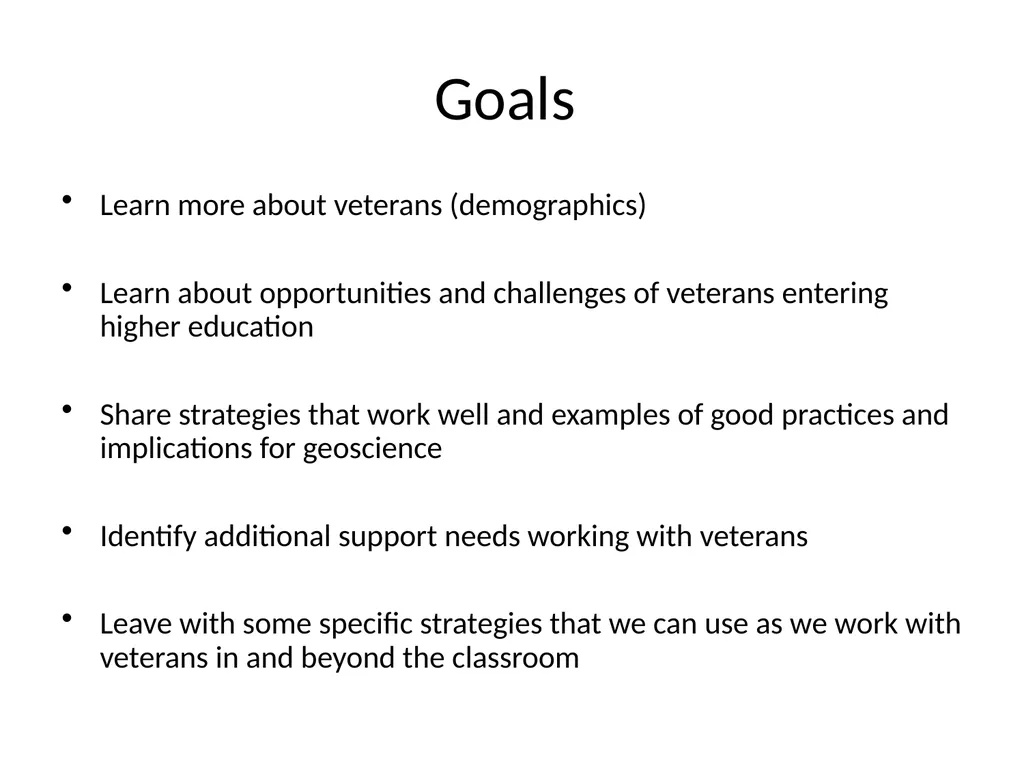
Description
Working with Veteran Populations: Research, Results and Applications for Teaching Geoscience Kim M. Frashure Assistant Professor of Energy Sustainability Bunker Hill Community College Supporting Student Success in Geoscience at Two-year
Related Topics
Share
Embed code
Download this presentation From Below
"Working with Veteran Populations: Research," is the property of its rightful owner. Permission is granted to download and print the materials on this website for personal, non-commercial use only, and to display it on your personal computer provided you do not modify the materials and that you retain all copyright notices contained in the materials. By downloading content from our website, you accept the terms of this agreement.
Presentation Transcript
01
Working with Veteran Populations: Research, Results and Applications for Teaching Geoscience Kim M. Frashure
Assistant Professor of Energy & Sustainability
Bunker Hill Community College
Supporting Student Success in Geoscience at Two-year Colleges
College of William and Mary
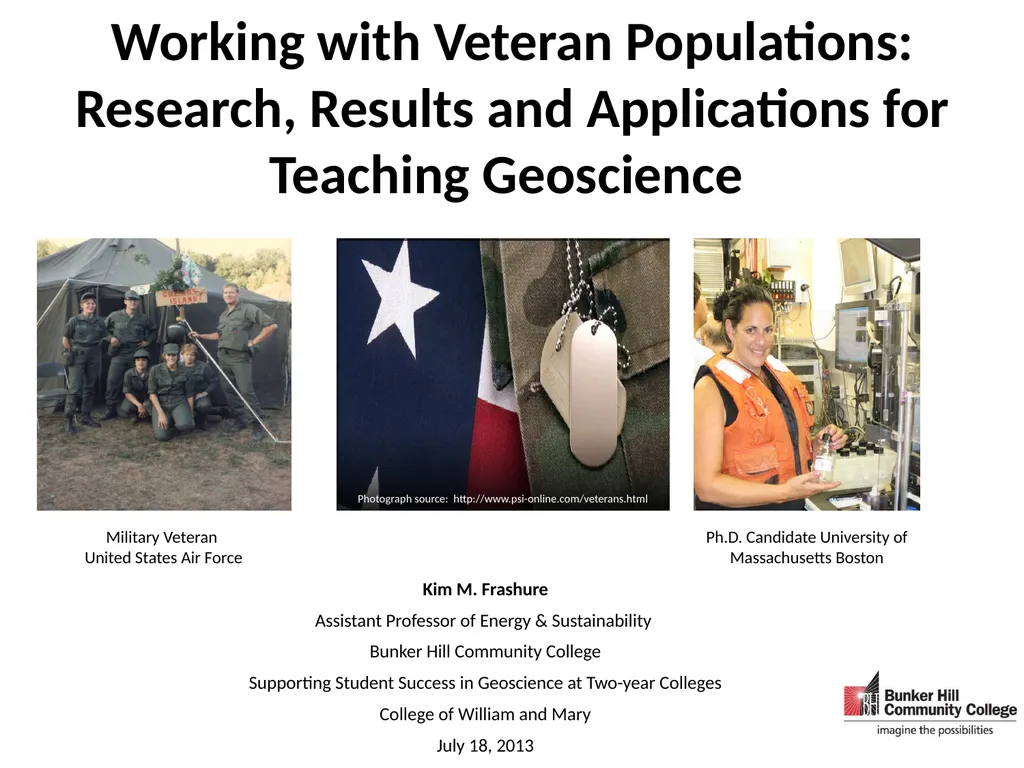
July 18, 2013 Ph.D. Candidate University of Massachusetts Boston Military Veteran
United States Air Force Photograph source: http://www.psi-online.com/veterans.html<br>
Assistant Professor of Energy & Sustainability
Bunker Hill Community College
Supporting Student Success in Geoscience at Two-year Colleges
College of William and Mary
July 18, 2013 Ph.D. Candidate University of Massachusetts Boston Military Veteran
United States Air Force Photograph source: http://www.psi-online.com/veterans.html<br>
02
Goals Learn more about veterans (demographics)
Learn about opportunities and challenges of veterans entering higher education
Share strategies that work well and examples of good practices and implications for geoscience
Identify additional support needs working with veterans
Leave with some specific strategies that we can use as we work with veterans in and beyond the classroom<br>
Learn about opportunities and challenges of veterans entering higher education
Share strategies that work well and examples of good practices and implications for geoscience
Identify additional support needs working with veterans
Leave with some specific strategies that we can use as we work with veterans in and beyond the classroom<br>
03
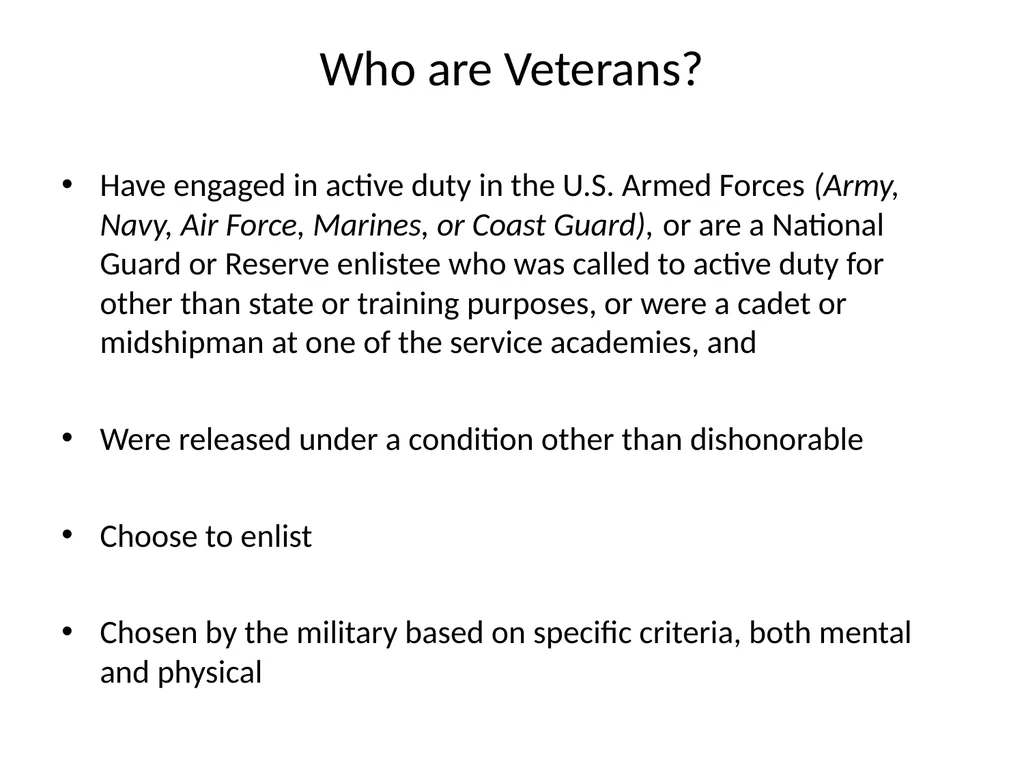
Who are Veterans? Have engaged in active duty in the U.S. Armed Forces (Army, Navy, Air Force, Marines, or Coast Guard), or are a National Guard or Reserve enlistee who was called to active duty for other than state or training purposes, or were a cadet or midshipman at one of the service academies, and
Were released under a condition other than dishonorable
Choose to enlist
Chosen by the military based on specific criteria, both mental and physical<br>
Were released under a condition other than dishonorable
Choose to enlist
Chosen by the military based on specific criteria, both mental and physical<br>
04
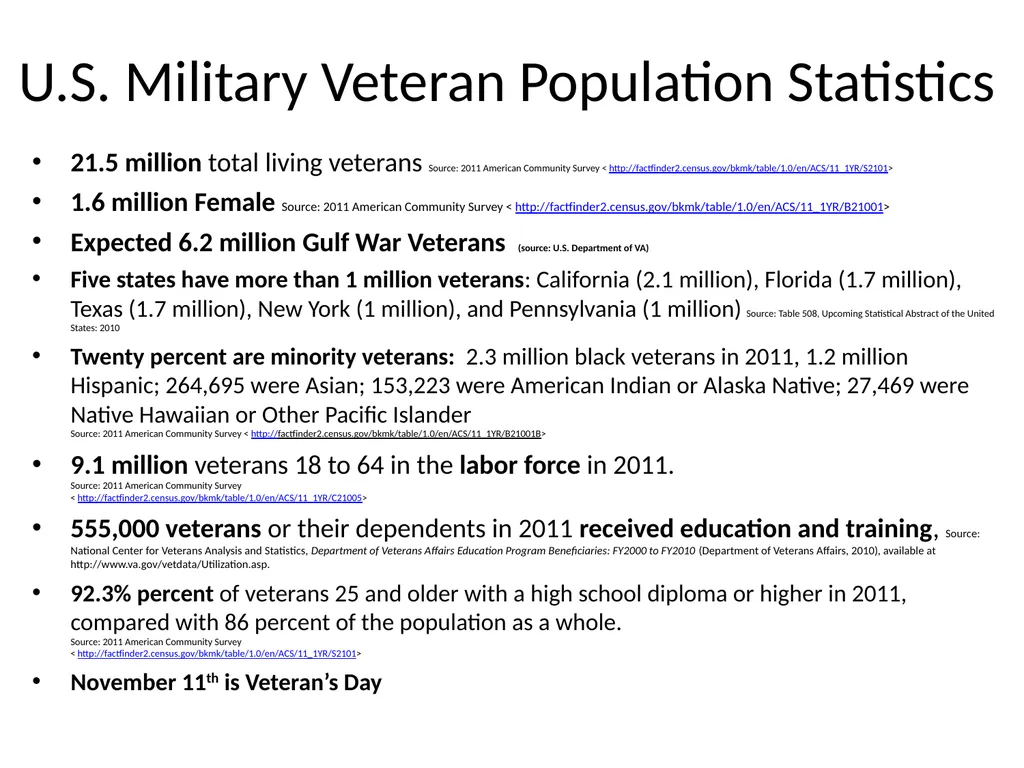
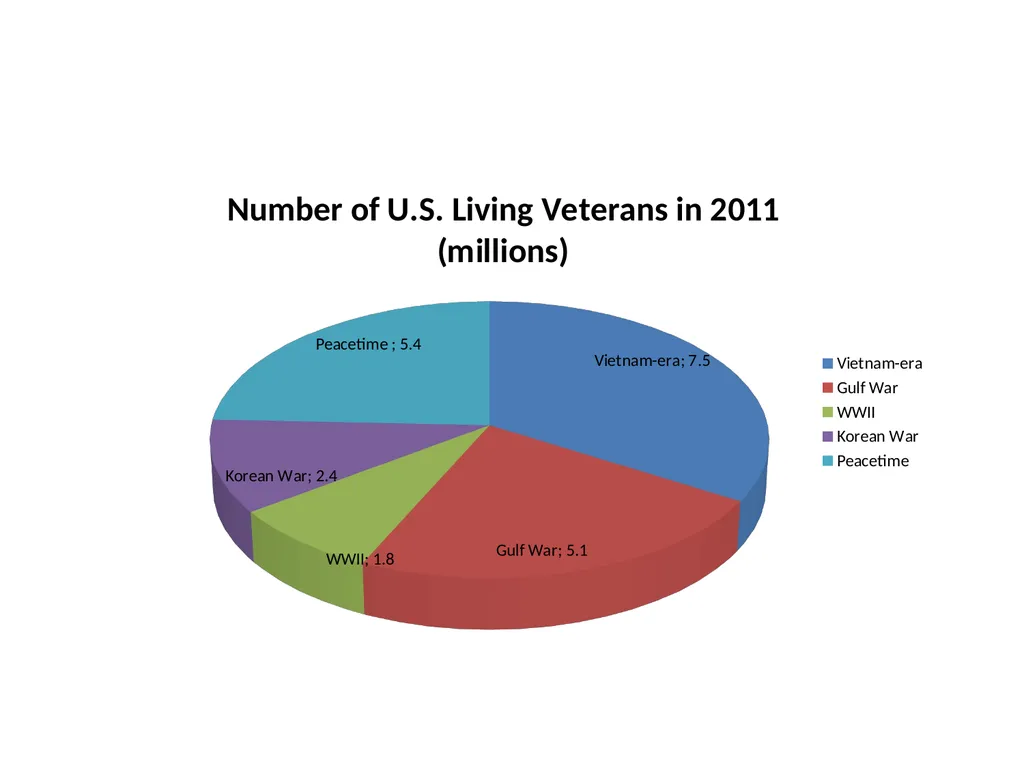
U.S. Military Veteran Population Statistics 21.5 million total living veterans Source: 2011 American Community Survey < http://factfinder2.census.gov/bkmk/table/1.0/en/ACS/11_1YR/S2101>
1.6 million Female Source: 2011 American Community Survey < http://factfinder2.census.gov/bkmk/table/1.0/en/ACS/11_1YR/B21001>
Expected 6.2 million Gulf War Veterans (source: U.S. Department of VA)
Five states have more than 1 million veterans: California (2.1 million), Florida (1.7 million), Texas (1.7 million), New York (1 million), and Pennsylvania (1 million) Source: Table 508, Upcoming Statistical Abstract of the United States: 2010
Twenty percent are minority veterans: 2.3 million black veterans in 2011, 1.2 million Hispanic; 264,695 were Asian; 153,223 were American Indian or Alaska Native; 27,469 were Native Hawaiian or Other Pacific Islander Source: 2011 American Community Survey < http://factfinder2.census.gov/bkmk/table/1.0/en/ACS/11_1YR/B21001B>
9.1 million veterans 18 to 64 in the labor force in 2011. Source: 2011 American Community Survey < http://factfinder2.census.gov/bkmk/table/1.0/en/ACS/11_1YR/C21005>
555,000 veterans or their dependents in 2011 received education and training, Source: National Center for Veterans Analysis and Statistics, Department of Veterans Affairs Education Program Beneficiaries: FY2000 to FY2010 (Department of Veterans Affairs, 2010), available at http://www.va.gov/vetdata/Utilization.asp.
92.3% percent of veterans 25 and older with a high school diploma or higher in 2011, compared with 86 percent of the population as a whole. Source: 2011 American Community Survey < http://factfinder2.census.gov/bkmk/table/1.0/en/ACS/11_1YR/S2101>
November 11th is Veteran’s Day<br>
1.6 million Female Source: 2011 American Community Survey < http://factfinder2.census.gov/bkmk/table/1.0/en/ACS/11_1YR/B21001>
Expected 6.2 million Gulf War Veterans (source: U.S. Department of VA)
Five states have more than 1 million veterans: California (2.1 million), Florida (1.7 million), Texas (1.7 million), New York (1 million), and Pennsylvania (1 million) Source: Table 508, Upcoming Statistical Abstract of the United States: 2010
Twenty percent are minority veterans: 2.3 million black veterans in 2011, 1.2 million Hispanic; 264,695 were Asian; 153,223 were American Indian or Alaska Native; 27,469 were Native Hawaiian or Other Pacific Islander Source: 2011 American Community Survey < http://factfinder2.census.gov/bkmk/table/1.0/en/ACS/11_1YR/B21001B>
9.1 million veterans 18 to 64 in the labor force in 2011. Source: 2011 American Community Survey < http://factfinder2.census.gov/bkmk/table/1.0/en/ACS/11_1YR/C21005>
555,000 veterans or their dependents in 2011 received education and training, Source: National Center for Veterans Analysis and Statistics, Department of Veterans Affairs Education Program Beneficiaries: FY2000 to FY2010 (Department of Veterans Affairs, 2010), available at http://www.va.gov/vetdata/Utilization.asp.
92.3% percent of veterans 25 and older with a high school diploma or higher in 2011, compared with 86 percent of the population as a whole. Source: 2011 American Community Survey < http://factfinder2.census.gov/bkmk/table/1.0/en/ACS/11_1YR/S2101>
November 11th is Veteran’s Day<br>
05
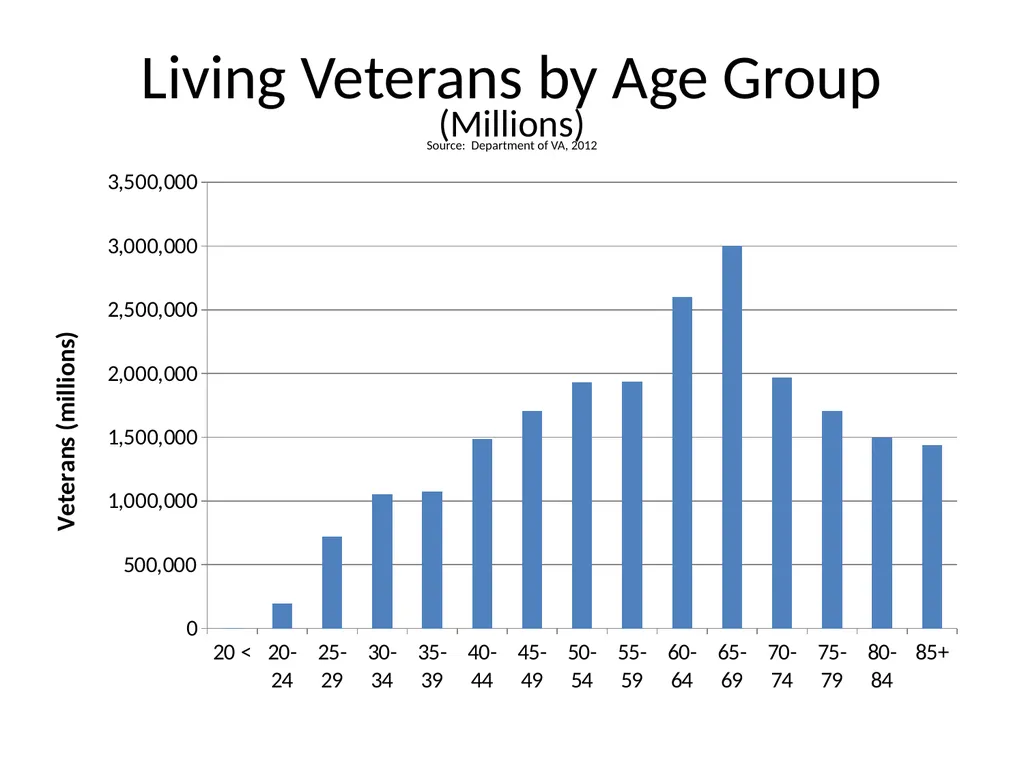
Living Veterans by Age Group (Millions)
Source: Department of VA, 2012<br>
06
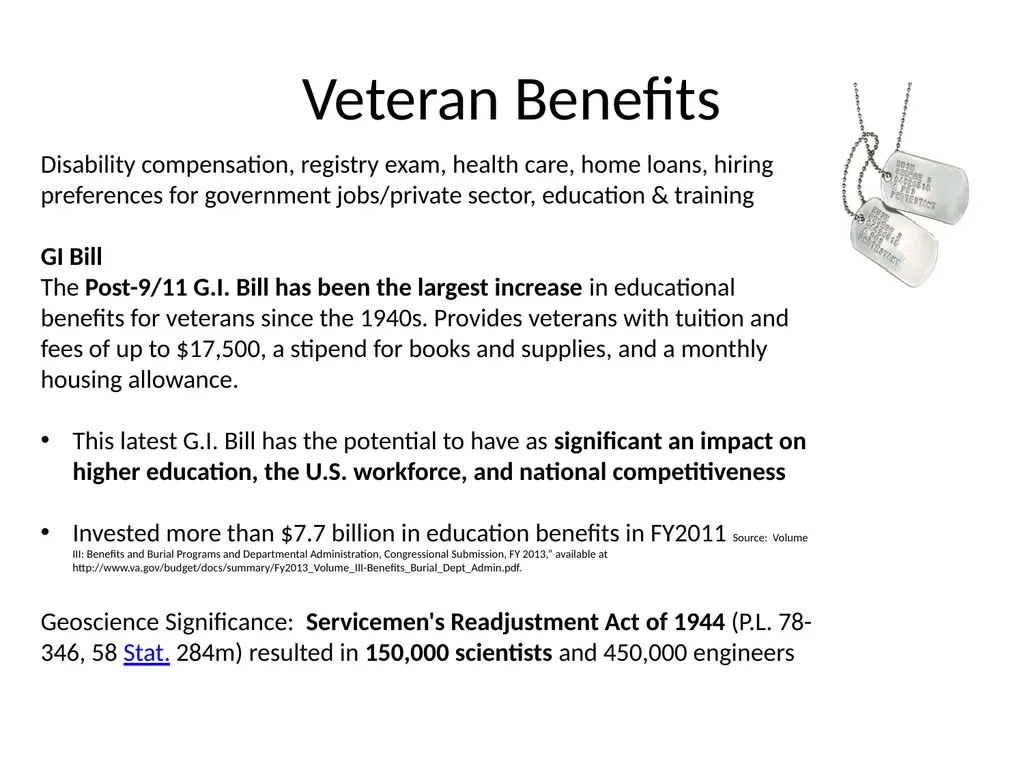
Veteran Benefits Disability compensation, registry exam, health care, home loans, hiring preferences for government jobs/private sector, education & training
GI Bill
The Post-9/11 G.I. Bill has been the largest increase in educational benefits for veterans since the 1940s. Provides veterans with tuition and fees of up to $17,500, a stipend for books and supplies, and a monthly housing allowance.
This latest G.I. Bill has the potential to have as significant an impact on higher education, the U.S. workforce, and national competitiveness
Invested more than $7.7 billion in education benefits in FY2011 Source: Volume III: Benefits and Burial Programs and Departmental Administration, Congressional Submission, FY 2013,” available at http://www.va.gov/budget/docs/summary/Fy2013_Volume_III-Benefits_Burial_Dept_Admin.pdf.
Geoscience Significance: Servicemen's Readjustment Act of 1944 (P.L. 78-346, 58 Stat. 284m) resulted in 150,000 scientists and 450,000 engineers<br>
GI Bill
The Post-9/11 G.I. Bill has been the largest increase in educational benefits for veterans since the 1940s. Provides veterans with tuition and fees of up to $17,500, a stipend for books and supplies, and a monthly housing allowance.
This latest G.I. Bill has the potential to have as significant an impact on higher education, the U.S. workforce, and national competitiveness
Invested more than $7.7 billion in education benefits in FY2011 Source: Volume III: Benefits and Burial Programs and Departmental Administration, Congressional Submission, FY 2013,” available at http://www.va.gov/budget/docs/summary/Fy2013_Volume_III-Benefits_Burial_Dept_Admin.pdf.
Geoscience Significance: Servicemen's Readjustment Act of 1944 (P.L. 78-346, 58 Stat. 284m) resulted in 150,000 scientists and 450,000 engineers<br>
07
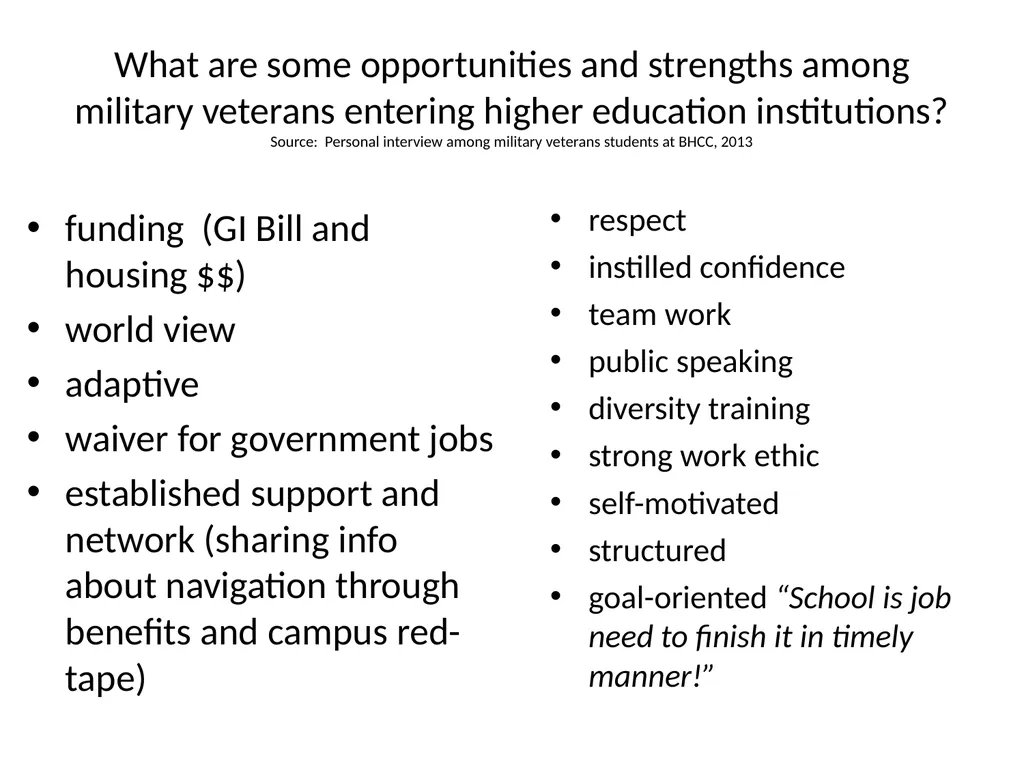
What are some opportunities and strengths among military veterans entering higher education institutions?
Source: Personal interview among military veterans students at BHCC, 2013 funding (GI Bill and housing $$)
world view
adaptive
waiver for government jobs
established support and network (sharing info about navigation through benefits and campus red-tape) respect
instilled confidence
team work
public speaking
diversity training
strong work ethic
self-motivated
structured
goal-oriented “School is job need to finish it in timely manner!”<br>
world view
adaptive
waiver for government jobs
established support and network (sharing info about navigation through benefits and campus red-tape) respect
instilled confidence
team work
public speaking
diversity training
strong work ethic
self-motivated
structured
goal-oriented “School is job need to finish it in timely manner!”<br>
08
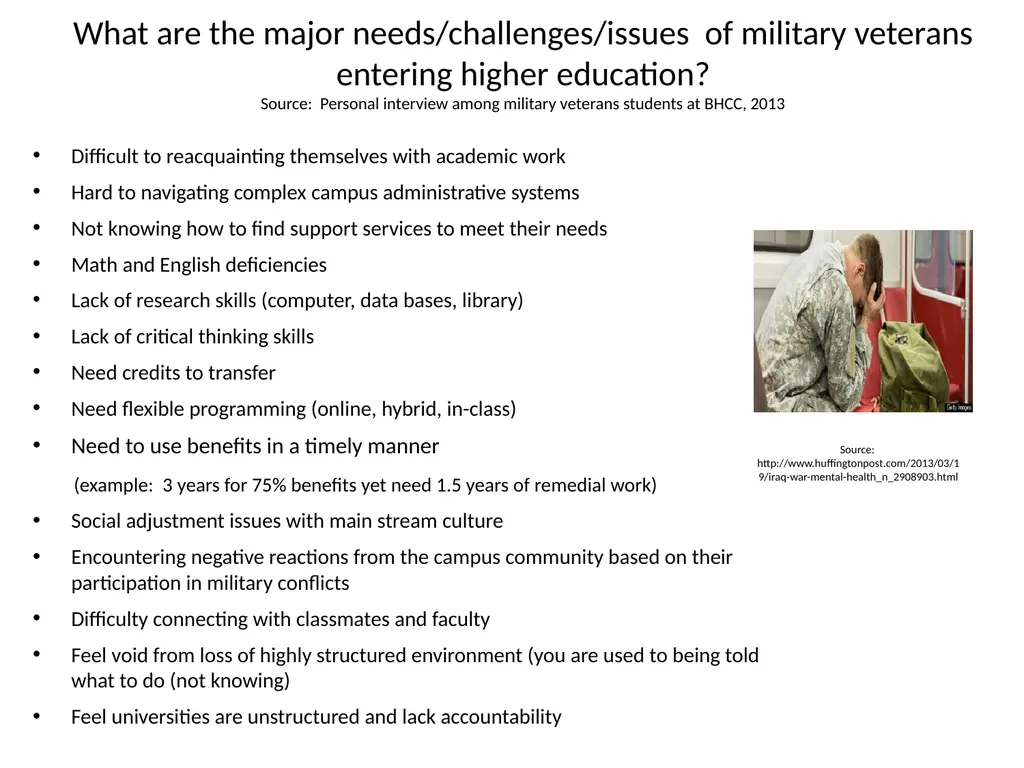
Difficult to reacquainting themselves with academic work
Hard to navigating complex campus administrative systems
Not knowing how to find support services to meet their needs
Math and English deficiencies
Lack of research skills (computer, data bases, library)
Lack of critical thinking skills
Need credits to transfer
Need flexible programming (online, hybrid, in-class)
Need to use benefits in a timely manner
(example: 3 years for 75% benefits yet need 1.5 years of remedial work)
Social adjustment issues with main stream culture
Encountering negative reactions from the campus community based on their participation in military conflicts
Difficulty connecting with classmates and faculty
Feel void from loss of highly structured environment (you are used to being told what to do (not knowing)
Feel universities are unstructured and lack accountability What are the major needs/challenges/issues of military veterans entering higher education?
Source: Personal interview among military veterans students at BHCC, 2013 Source: http://www.huffingtonpost.com/2013/03/19/iraq-war-mental-health_n_2908903.html<br>
Hard to navigating complex campus administrative systems
Not knowing how to find support services to meet their needs
Math and English deficiencies
Lack of research skills (computer, data bases, library)
Lack of critical thinking skills
Need credits to transfer
Need flexible programming (online, hybrid, in-class)
Need to use benefits in a timely manner
(example: 3 years for 75% benefits yet need 1.5 years of remedial work)
Social adjustment issues with main stream culture
Encountering negative reactions from the campus community based on their participation in military conflicts
Difficulty connecting with classmates and faculty
Feel void from loss of highly structured environment (you are used to being told what to do (not knowing)
Feel universities are unstructured and lack accountability What are the major needs/challenges/issues of military veterans entering higher education?
Source: Personal interview among military veterans students at BHCC, 2013 Source: http://www.huffingtonpost.com/2013/03/19/iraq-war-mental-health_n_2908903.html<br>
09
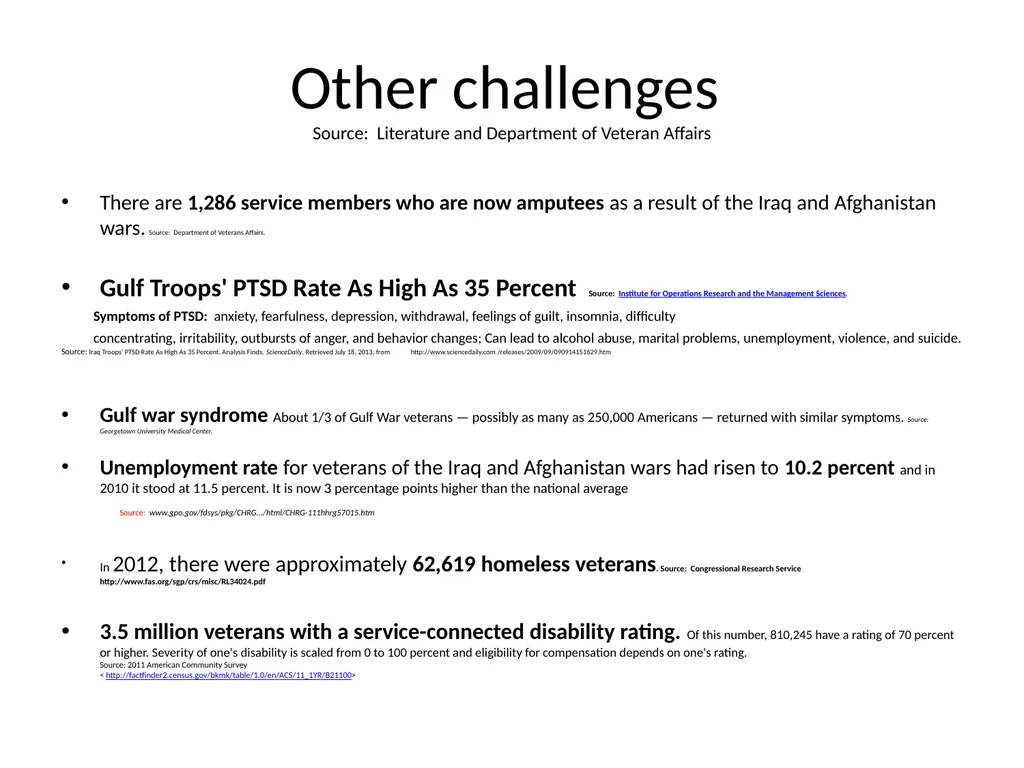
Other challenges
Source: Literature and Department of Veteran Affairs There are 1,286 service members who are now amputees as a result of the Iraq and Afghanistan wars. Source: Department of Veterans Affairs.
Gulf Troops' PTSD Rate As High As 35 Percent Source: Institute for Operations Research and the Management Sciences.
Symptoms of PTSD: anxiety, fearfulness, depression, withdrawal, feelings of guilt, insomnia, difficulty
concentrating, irritability, outbursts of anger, and behavior changes; Can lead to alcohol abuse, marital problems, unemployment, violence, and suicide. Source: Iraq Troops' PTSD Rate As High As 35 Percent, Analysis Finds. ScienceDaily. Retrieved July 18, 2013, from http://www.sciencedaily.com /releases/2009/09/090914151629.htm
Gulf war syndrome About 1/3 of Gulf War veterans — possibly as many as 250,000 Americans — returned with similar symptoms. Source: Georgetown University Medical Center.
Unemployment rate for veterans of the Iraq and Afghanistan wars had risen to 10.2 percent and in 2010 it stood at 11.5 percent. It is now 3 percentage points higher than the national average
Source: www.gpo.gov/fdsys/pkg/CHRG.../html/CHRG-111hhrg57015.htm
In 2012, there were approximately 62,619 homeless veterans. Source: Congressional Research Service http://www.fas.org/sgp/crs/misc/RL34024.pdf
3.5 million veterans with a service-connected disability rating. Of this number, 810,245 have a rating of 70 percent or higher. Severity of one's disability is scaled from 0 to 100 percent and eligibility for compensation depends on one's rating. Source: 2011 American Community Survey < http://factfinder2.census.gov/bkmk/table/1.0/en/ACS/11_1YR/B21100><br>
Gulf Troops' PTSD Rate As High As 35 Percent Source: Institute for Operations Research and the Management Sciences.
Symptoms of PTSD: anxiety, fearfulness, depression, withdrawal, feelings of guilt, insomnia, difficulty
concentrating, irritability, outbursts of anger, and behavior changes; Can lead to alcohol abuse, marital problems, unemployment, violence, and suicide. Source: Iraq Troops' PTSD Rate As High As 35 Percent, Analysis Finds. ScienceDaily. Retrieved July 18, 2013, from http://www.sciencedaily.com /releases/2009/09/090914151629.htm
Gulf war syndrome About 1/3 of Gulf War veterans — possibly as many as 250,000 Americans — returned with similar symptoms. Source: Georgetown University Medical Center.
Unemployment rate for veterans of the Iraq and Afghanistan wars had risen to 10.2 percent and in 2010 it stood at 11.5 percent. It is now 3 percentage points higher than the national average
Source: www.gpo.gov/fdsys/pkg/CHRG.../html/CHRG-111hhrg57015.htm
In 2012, there were approximately 62,619 homeless veterans. Source: Congressional Research Service http://www.fas.org/sgp/crs/misc/RL34024.pdf
3.5 million veterans with a service-connected disability rating. Of this number, 810,245 have a rating of 70 percent or higher. Severity of one's disability is scaled from 0 to 100 percent and eligibility for compensation depends on one's rating. Source: 2011 American Community Survey < http://factfinder2.census.gov/bkmk/table/1.0/en/ACS/11_1YR/B21100><br>
10
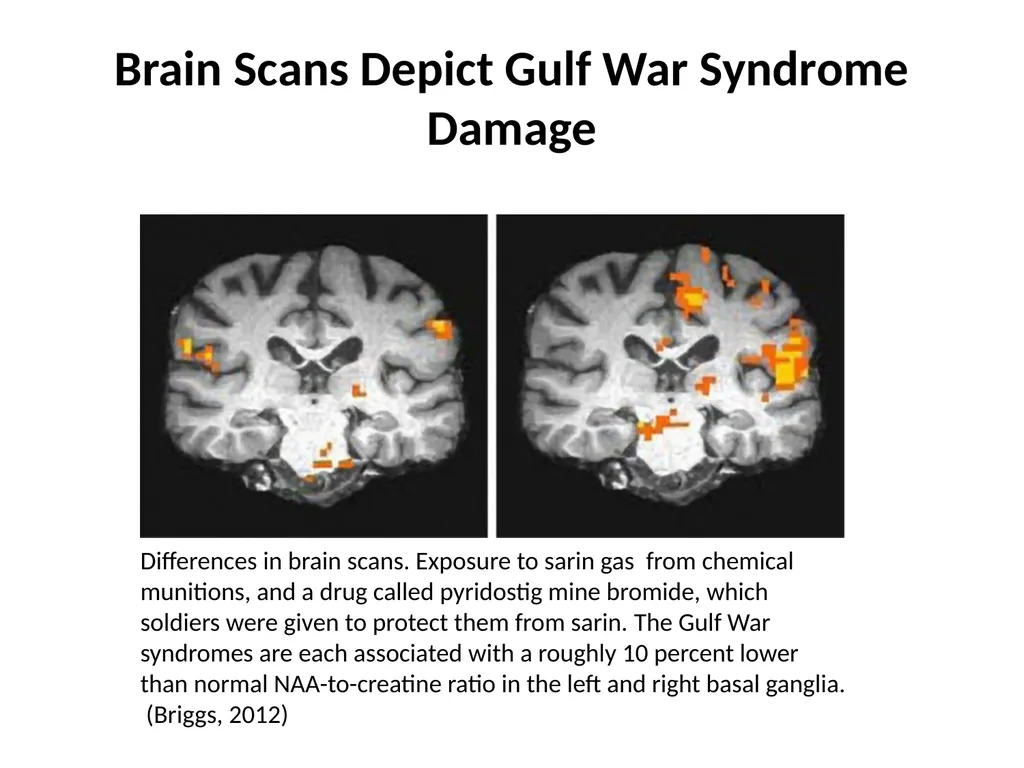
Brain Scans Depict Gulf War Syndrome Damage Differences in brain scans. Exposure to sarin gas from chemical munitions, and a drug called pyridostig mine bromide, which soldiers were given to protect them from sarin. The Gulf War syndromes are each associated with a roughly 10 percent lower than normal NAA-to-creatine ratio in the left and right basal ganglia. (Briggs, 2012)<br>
11
Issues: Higher education institutions are ill-prepared and ill-equipped for dealing with the large number of veterans enrolling
Faculty needs additional resources and strategies
Programming does not meet the needs of veterans
There is still a vital need for coordination among services<br>
Faculty needs additional resources and strategies
Programming does not meet the needs of veterans
There is still a vital need for coordination among services<br>
12
Small Group Discussion:
How do we best to serve veteran population in the geosciences? a) What support systems does your college provide to veterans (veteran friendly)?
b) What else does your college need?<br>
b) What else does your college need?<br>
13
2. How can we support veterans in geosciences? Difficult to reacquainting themselves with academic work
Hard to navigating complex campus administrative systems
Not knowing how to find support services to meet their needs
Math and English deficiencies
Lack of research skills (computer, data bases, library)
Lack of critical thinking skills
Need credits to transfer
Need flexible programming (online, hybrid, in-class)
Need to use benefits in a timely manner
(example: 3 years for 75% benefits yet need 1.5 years of remedial work)
Social adjustment issues
Encountering negative reactions from the campus community based on their participation in military conflicts
Difficulty connecting with classmates and faculty
Feel void from loss of highly structured environment (you are used to being told what to do (not knowing)
Feel universities are unstructured and lack accountability<br>
Hard to navigating complex campus administrative systems
Not knowing how to find support services to meet their needs
Math and English deficiencies
Lack of research skills (computer, data bases, library)
Lack of critical thinking skills
Need credits to transfer
Need flexible programming (online, hybrid, in-class)
Need to use benefits in a timely manner
(example: 3 years for 75% benefits yet need 1.5 years of remedial work)
Social adjustment issues
Encountering negative reactions from the campus community based on their participation in military conflicts
Difficulty connecting with classmates and faculty
Feel void from loss of highly structured environment (you are used to being told what to do (not knowing)
Feel universities are unstructured and lack accountability<br>
14
3. a) What support do you need from your institution to meet the needs of veterans entering geosciences?
b) What resources can SageY2C provide you with to support your efforts with veterans?<br>
15
Literature:
Source: Easing the Transition from Combat to Classroom Preserving America’s Investment in Higher Education for Military Veterans Through Institutional Assessment
by Kimberly Griffin and Claire Gilbert April 2012 Institutional collaboration is one way to improve campuses for student veterans through initiatives such as institution-wide committees, student groups
Mentoring programs and technical standards for course work that recognize and take into account the needs of veterans
Important for institutions to improve faculty, staff, and overall campus to have knowledge of student veterans and their offering trainings focused on this group.
Having offices on campus dedicated to serving and supporting student
Veterans are also important contributors to student veterans’ positive experiences.
Research suggests the importance of having diverse types of course options, including on-base education, weekend courses, online courses, veteran-only courses and evening classes<br>
Mentoring programs and technical standards for course work that recognize and take into account the needs of veterans
Important for institutions to improve faculty, staff, and overall campus to have knowledge of student veterans and their offering trainings focused on this group.
Having offices on campus dedicated to serving and supporting student
Veterans are also important contributors to student veterans’ positive experiences.
Research suggests the importance of having diverse types of course options, including on-base education, weekend courses, online courses, veteran-only courses and evening classes<br>
16
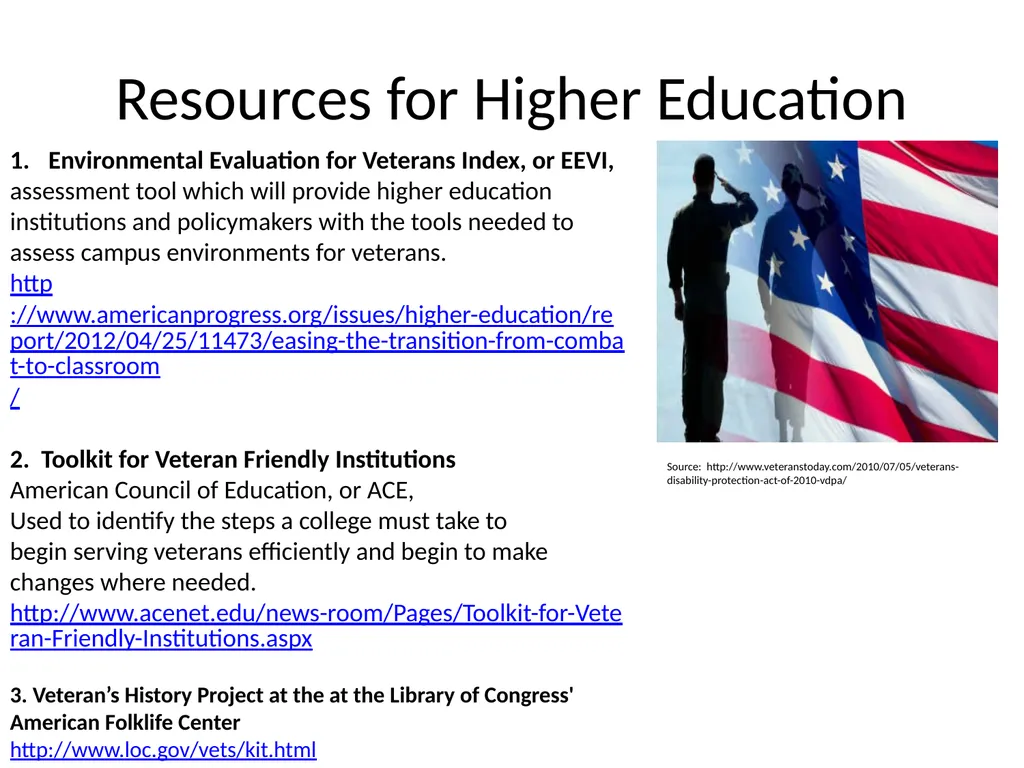
Resources for Higher Education Source: http://www.veteranstoday.com/2010/07/05/veterans-disability-protection-act-of-2010-vdpa/ Environmental Evaluation for Veterans Index, or EEVI,
assessment tool which will provide higher education institutions and policymakers with the tools needed to assess campus environments for veterans.
http://www.americanprogress.org/issues/higher-education/report/2012/04/25/11473/easing-the-transition-from-combat-to-classroom/
2. Toolkit for Veteran Friendly Institutions
American Council of Education, or ACE,
Used to identify the steps a college must take to
begin serving veterans efficiently and begin to make changes where needed.
http://www.acenet.edu/news-room/Pages/Toolkit-for-Veteran-Friendly-Institutions.aspx
3. Veteran’s History Project at the at the Library of Congress' American Folklife Center
http://www.loc.gov/vets/kit.html<br>
assessment tool which will provide higher education institutions and policymakers with the tools needed to assess campus environments for veterans.
http://www.americanprogress.org/issues/higher-education/report/2012/04/25/11473/easing-the-transition-from-combat-to-classroom/
2. Toolkit for Veteran Friendly Institutions
American Council of Education, or ACE,
Used to identify the steps a college must take to
begin serving veterans efficiently and begin to make changes where needed.
http://www.acenet.edu/news-room/Pages/Toolkit-for-Veteran-Friendly-Institutions.aspx
3. Veteran’s History Project at the at the Library of Congress' American Folklife Center
http://www.loc.gov/vets/kit.html<br>
17
Acknowledgements:
Sage Y2C Funding Mechanism: NSF Division of Undergraduate Education, National Sciences Foundation Geosciences Directorate, and National Association of Geoscience Teachers
Sage Y2C organizers with special thanks to : Heather MacDonald and Jan Hodder
Veteran Students at BHCC
Sage Y2C workshop participants for contributions Source: http://www.empowernetwork.com/gogogo/blog/a-rant-flying-the-american-flag/american-flag/<br>
Sage Y2C Funding Mechanism: NSF Division of Undergraduate Education, National Sciences Foundation Geosciences Directorate, and National Association of Geoscience Teachers
Sage Y2C organizers with special thanks to : Heather MacDonald and Jan Hodder
Veteran Students at BHCC
Sage Y2C workshop participants for contributions Source: http://www.empowernetwork.com/gogogo/blog/a-rant-flying-the-american-flag/american-flag/<br>