
Workplace Stress & Burnout: Mindfulness, an





Description: Workplace Stress Burnout: Mindfulness, an Amazing Antidote Karin E. Baughman, DNP, APRN, PMHNP-BC Brainstorm sources of stress in your workplace Identify symptoms of workplace stress Define burnout related to workplace stress List
Related Topics
Download Presentation
"Workplace Stress & Burnout: Mindfulness, an" is the property of its rightful owner. Permission is granted to download and print the materials on this website for personal, non-commercial use only, and to display it on your personal computer provided you do not modify the materials and that you retain all copyright notices contained in the materials. By downloading content from our website, you accept the terms of this agreement.
Presentation Transcript
slide1. Workplace Stress & Burnout: Mindfulness, an Amazing Antidote Karin E. Baughman, DNP, APRN, PMHNP-BC<br>
slide2. Brainstorm sources of stress in your workplace
Identify symptoms of workplace stress
Define burnout related to workplace stress
List symptoms experienced by those suffering from burnout
Describe three components of mindfulness
Explore outcomes associated with mindfulness
Participate in mindfulness exercises Objectives<br>
slide3. Close your eyes and picture yesterday at your workplace…<br>
slide4. What are sources of workplace stress?<br>
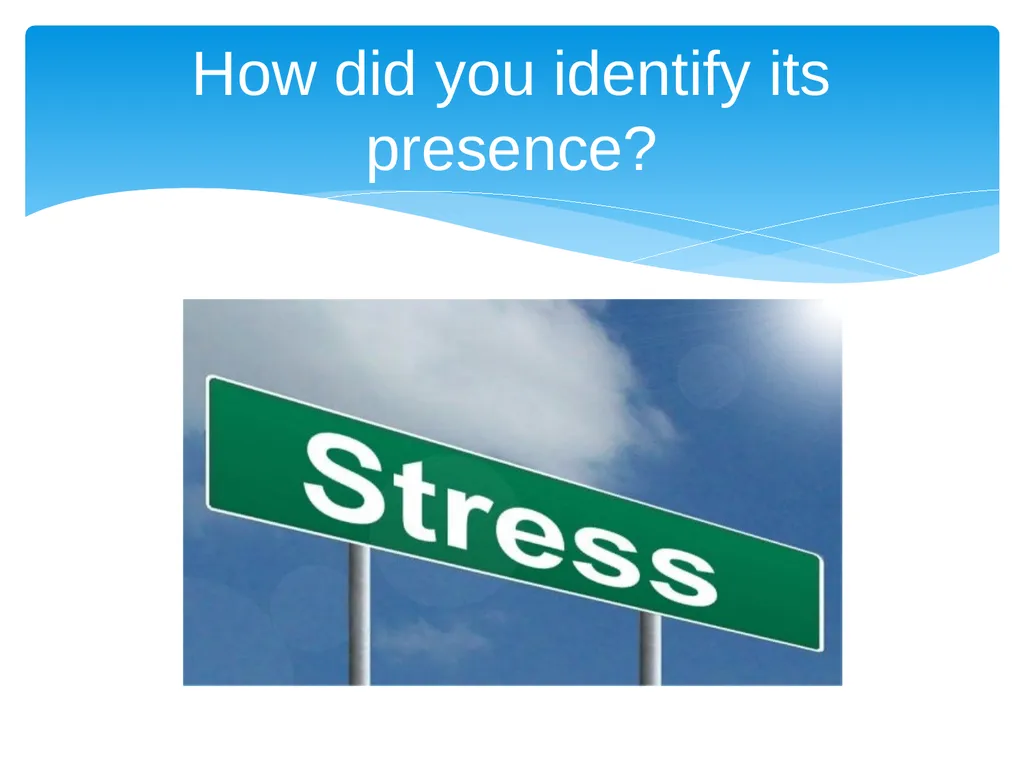
slide5. How did you identify its presence?<br>
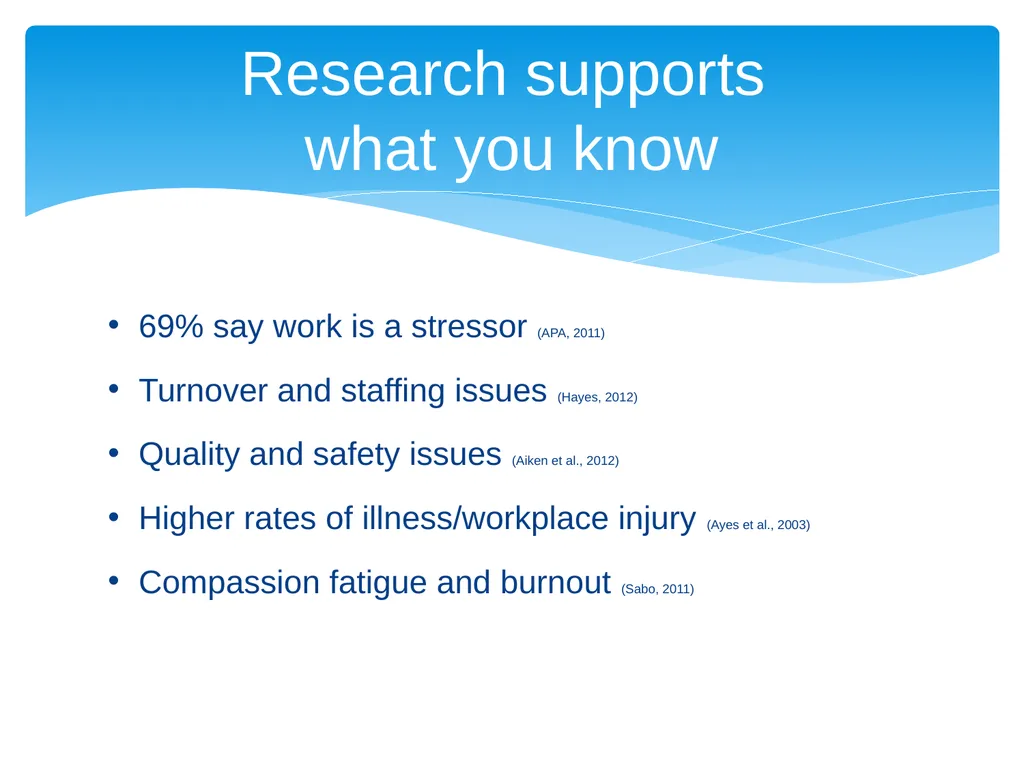
slide6. 69% say work is a stressor (APA, 2011)
Turnover and staffing issues (Hayes, 2012)
Quality and safety issues (Aiken et al., 2012)
Higher rates of illness/workplace injury (Ayes et al., 2003)
Compassion fatigue and burnout (Sabo, 2011) Research supports what you know<br>
slide7. How is burnout different? “To be burned out means you were once on fire.” Jesse Wilson, RN, MSN
Emotional exhaustion
Depersonalization
Reduced feelings of accomplishment
Result of chronic exposure to environmental stressors
Person/job mismatch
Common in “people work”<br>
slide8. What happens when we quit caring?<br>
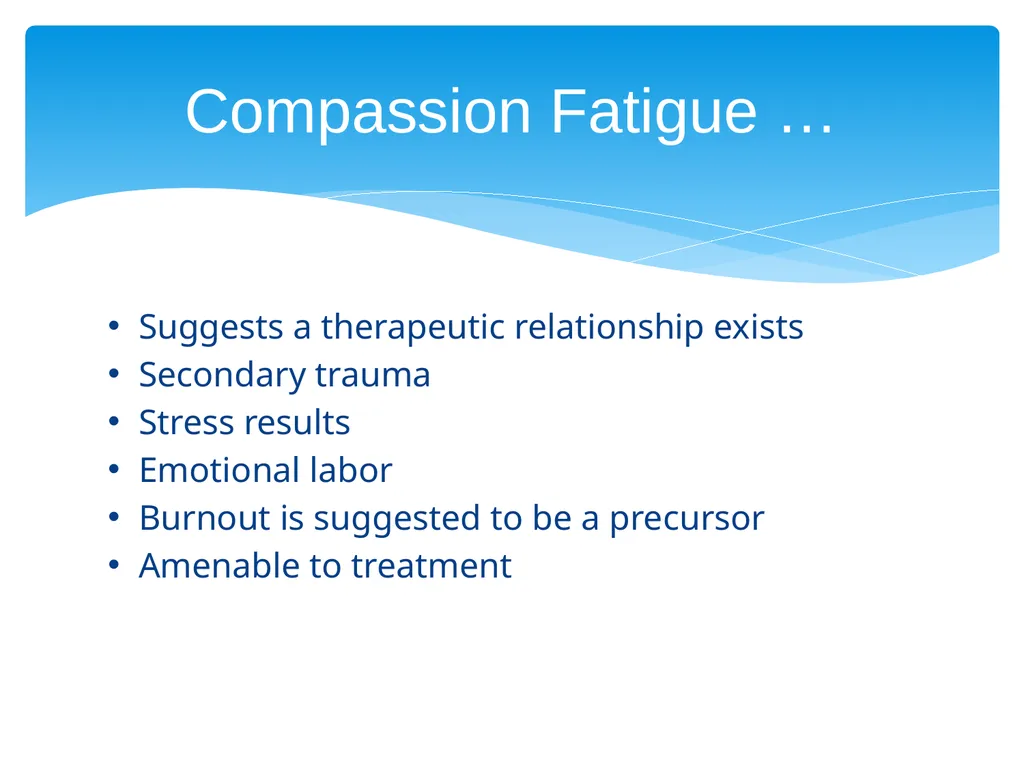
slide9. Suggests a therapeutic relationship exists
Secondary trauma
Stress results
Emotional labor
Burnout is suggested to be a precursor
Amenable to treatment Compassion Fatigue …<br>
slide10. Mindfulness as an Antidote<br>
slide11. The awareness that rises when we pay attention, on purpose, in the present moment non-judgmentally (with kindness and curiosity) - Dr. Jon Kabat-Zinn – he is the founder of Mindfulness-based Stress Reduction (MBSR). (1990)
A mental state achieved by focusing one's awareness on the present moment, while calmly acknowledging and accepting one's feelings, thoughts, and bodily sensations, used as a therapeutic technique. What is Mindfulness? 11<br>
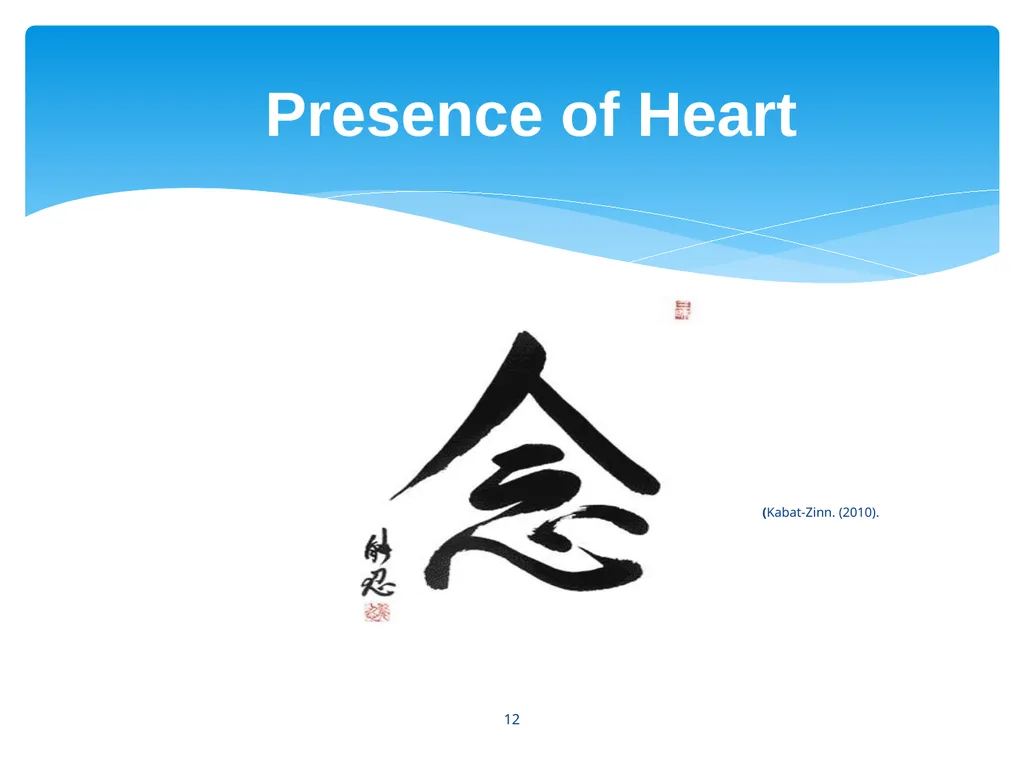
slide12. Presence of Heart
(Kabat-Zinn. (2010). 12<br>
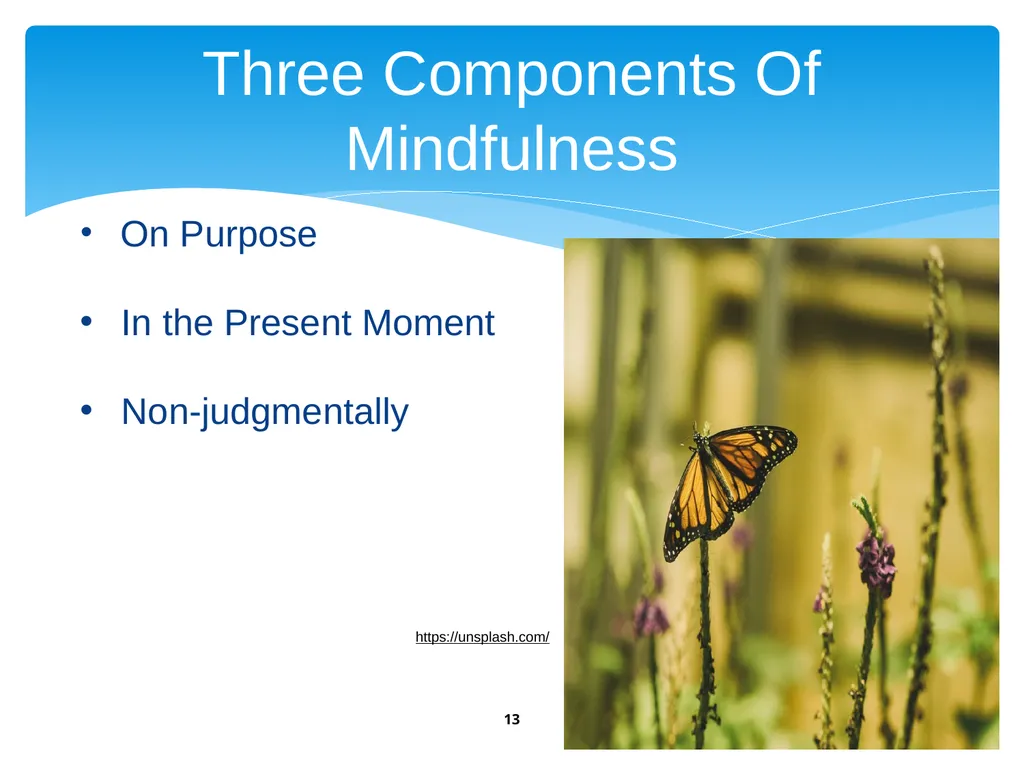
slide13. On Purpose
In the Present Moment
Non-judgmentally https://unsplash.com/ 13 Three Components Of Mindfulness<br>
slide14. Conscious and deliberate direct attention
Mindfully “awake” and aware of our current set up and surroundings
Living more consciously helps us become more aware of ourselves/others
Our attention is immersed in the present 14 On Purpose<br>
slide15. Our mind habitually wanders, rarely present in the moment
Mindful awareness is experienced when we let go of distractions
Our attention is held when we stop and accept what is here and now 15 In the Present Moment<br>
slide16. Increase awareness of mind chatter
Attend to experiences without judging or labelling them as +/-
Become a watcher of perceptions, thoughts and emotions without getting caught up in them
Watching in this way offers choice and freedom 16 Non-Judgmentally<br>
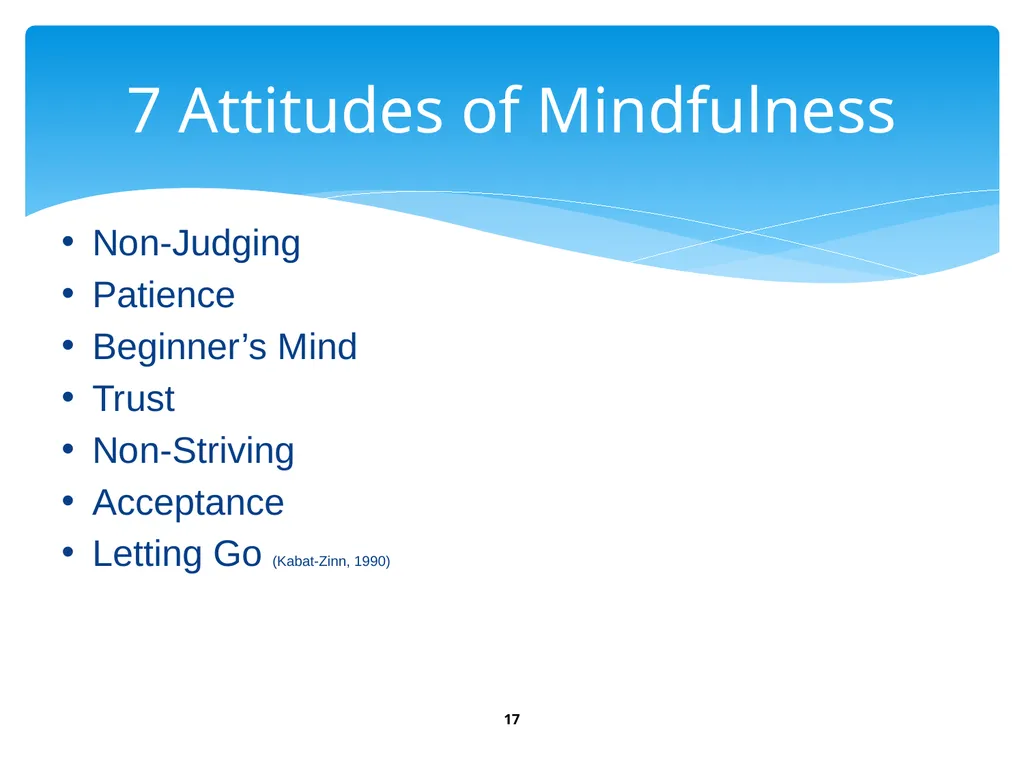
slide17. Non-Judging
Patience
Beginner’s Mind
Trust
Non-Striving
Acceptance
Letting Go (Kabat-Zinn, 1990) 17 7 Attitudes of Mindfulness<br>
slide18. Reduced stress, anxiety and other destructive emotions (Wongtongkam, et. al, 2017)
Reduced depression and insomnia (Goyal, et. al, 2014)
Improved focus and memory (Moore, Gruber, Derose, & Malinowski, 2012)
Increased compassion and emotional resilience (Marsh, 2014)
Creates clearer thinking, decreased emotionally reactive responses (Goleman & Davidson, 2017) 18 Benefits of Practicing Mindfulness<br>
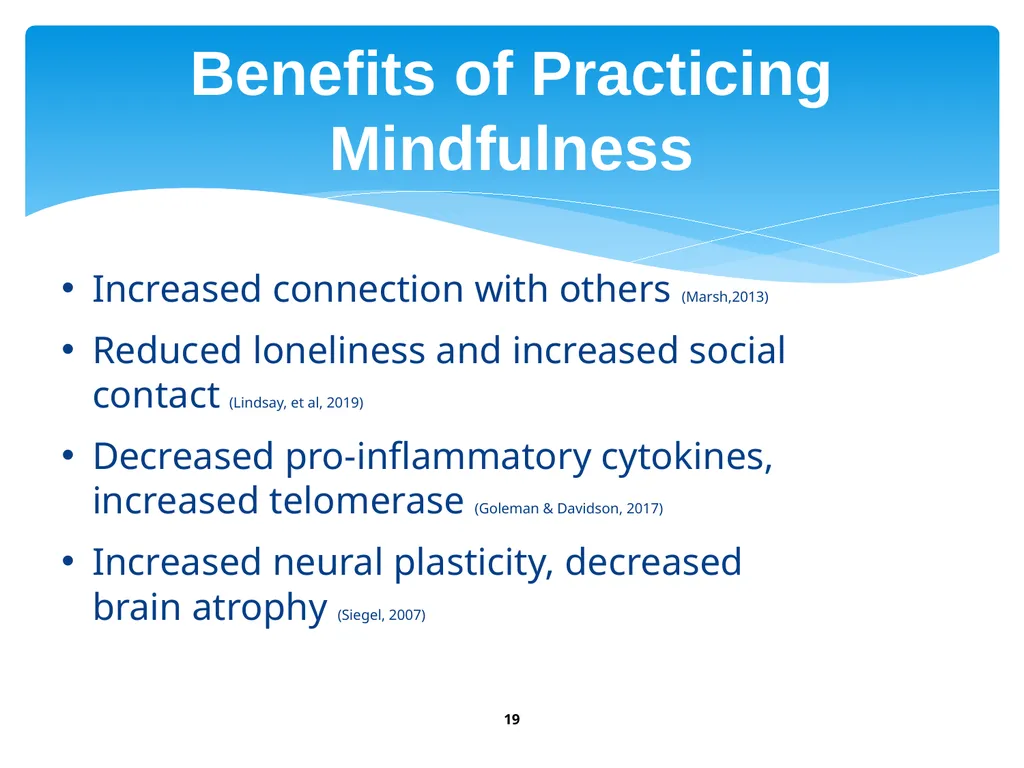
slide19. Increased connection with others (Marsh,2013)
Reduced loneliness and increased social contact (Lindsay, et al, 2019)
Decreased pro-inflammatory cytokines, increased telomerase (Goleman & Davidson, 2017)
Increased neural plasticity, decreased brain atrophy (Siegel, 2007) 19 Benefits of Practicing Mindfulness<br>
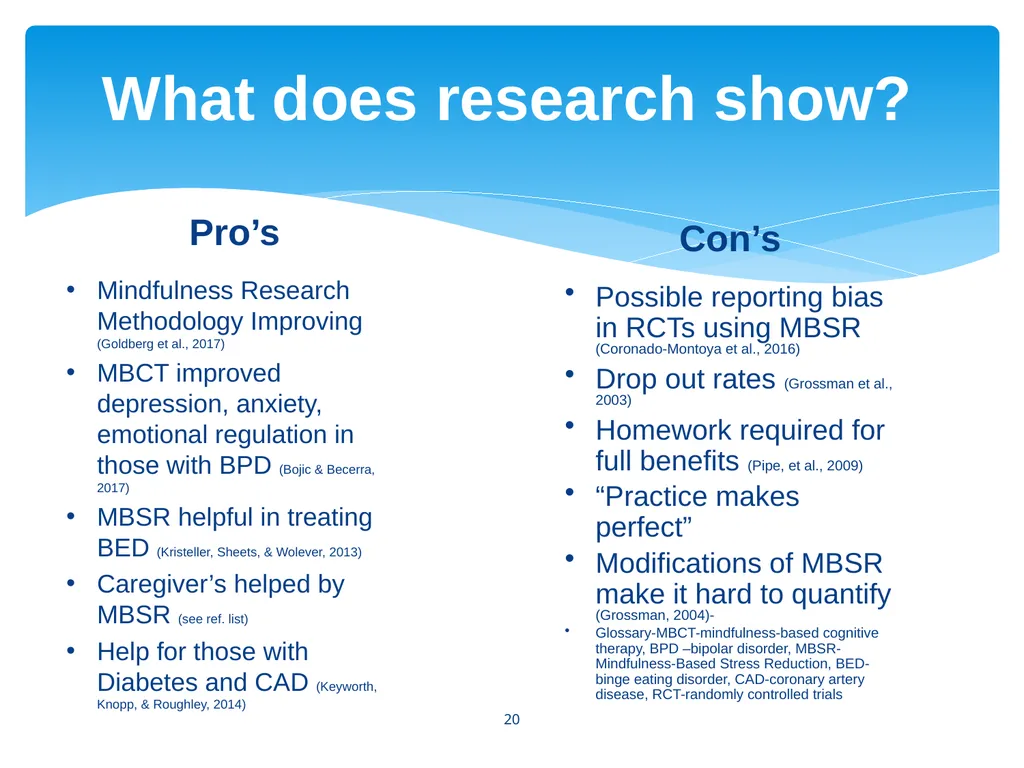
slide20. What does research show? Pro’s Mindfulness Research Methodology Improving (Goldberg et al., 2017)
MBCT improved depression, anxiety, emotional regulation in those with BPD (Bojic & Becerra, 2017)
MBSR helpful in treating BED (Kristeller, Sheets, & Wolever, 2013)
Caregiver’s helped by MBSR (see ref. list)
Help for those with Diabetes and CAD (Keyworth, Knopp, & Roughley, 2014) Con’s Possible reporting bias in RCTs using MBSR (Coronado-Montoya et al., 2016)
Drop out rates (Grossman et al., 2003)
Homework required for full benefits (Pipe, et al., 2009)
“Practice makes perfect”
Modifications of MBSR make it hard to quantify (Grossman, 2004)-
Glossary-MBCT-mindfulness-based cognitive therapy, BPD –bipolar disorder, MBSR-Mindfulness-Based Stress Reduction, BED-binge eating disorder, CAD-coronary artery disease, RCT-randomly controlled trials 20<br>
slide21. Stop and take at least 3 deep breaths when you feel stressed.
Try to take uninterrupted breaks to refocus and or stretch.
Practice a walking meditation, simply slow down your pace & notice the ground against your feet.
Participate in mindfulness offerings such as yoga, stress reduction or meditation classes.
Utilize resources such as Mindfulness Based Stress Reduction program developed by John Kabat-Zinn PhD.
Utilize meditation apps such as: The Mindfulness App, Get Some Headspace, Breathe2Relax, Calm, or MINDBODY Connect. Practicing Mindfulness at Work 21<br>
slide22. Let’s Practice<br>
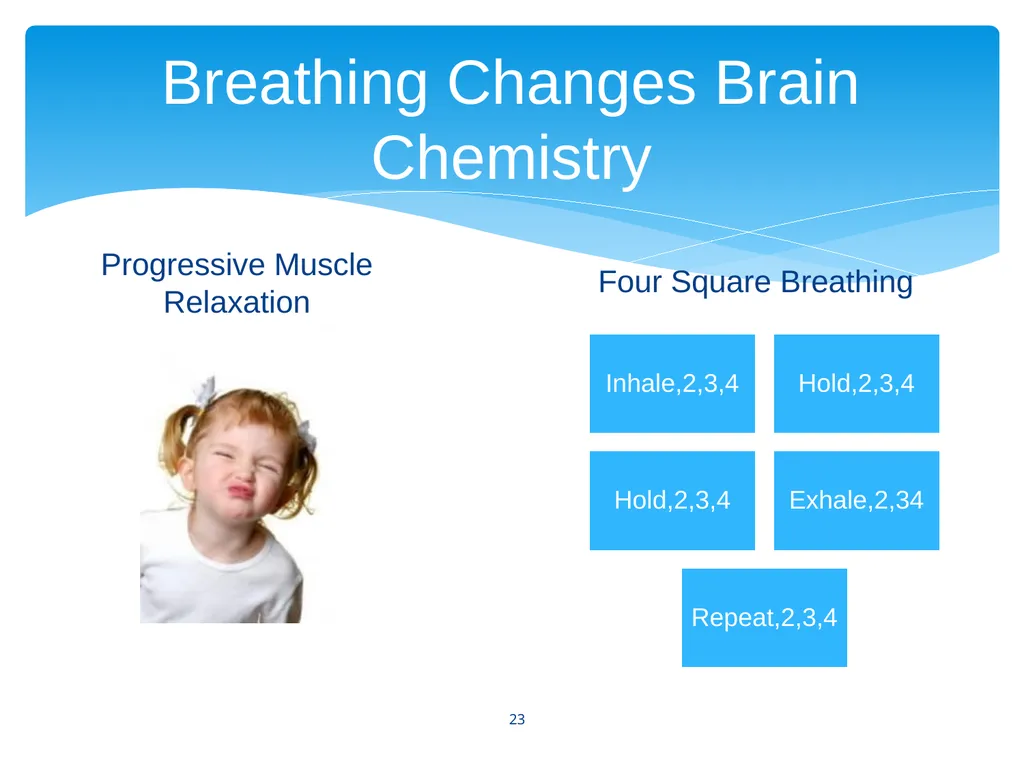
slide23. Breathing Changes Brain Chemistry Progressive Muscle Relaxation Four Square Breathing 23<br>
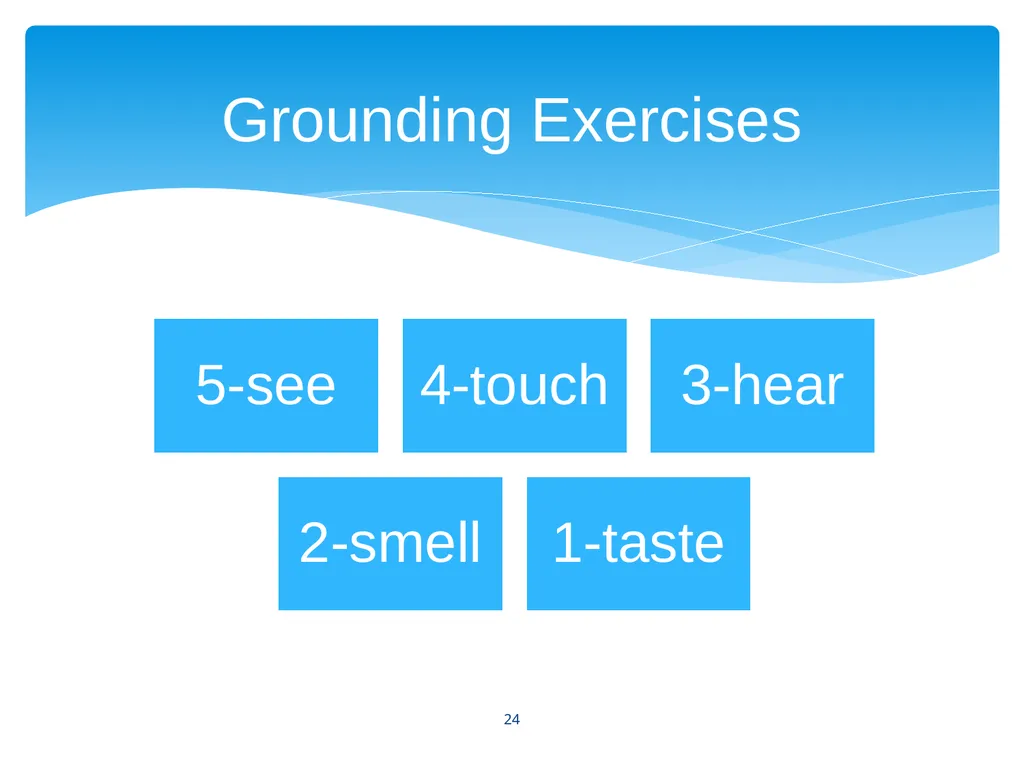
slide24. Grounding Exercises 24<br>
slide25. S: STOP
T: Take 3 breaths
O: Observe Sensations, Emotions, Thoughts
P: Proceed in a more modulated, less reactive, more responsive way
(National Wellness Institute, 2015) Increase Awareness: Remember 25<br>
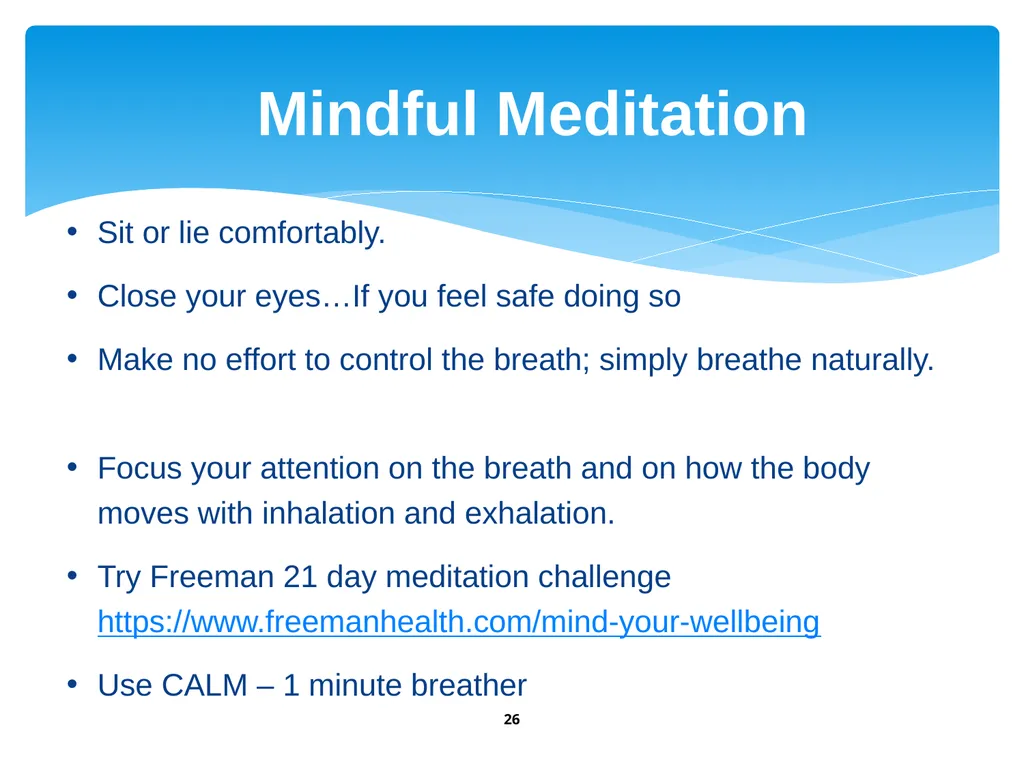
slide26. Sit or lie comfortably.
Close your eyes…If you feel safe doing so
Make no effort to control the breath; simply breathe naturally.
Focus your attention on the breath and on how the body moves with inhalation and exhalation.
Try Freeman 21 day meditation challenge https://www.freemanhealth.com/mind-your-wellbeing
Use CALM – 1 minute breather 26 Mindful Meditation<br>
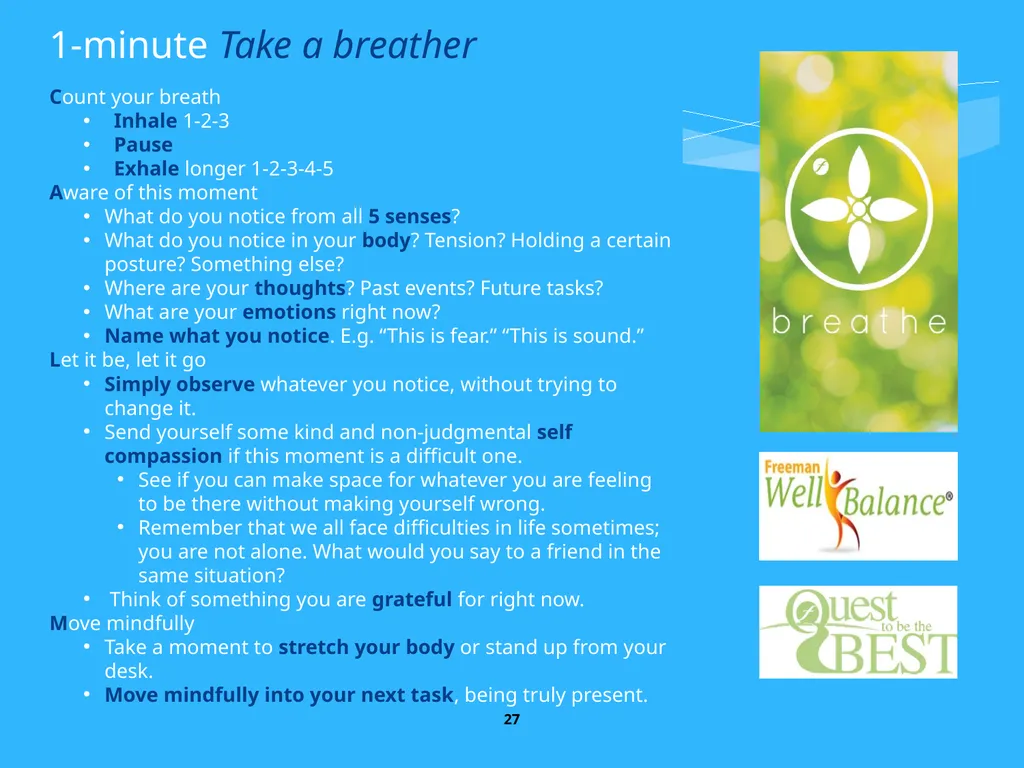
slide27. 1-minute Take a breather
Count your breath
Inhale 1-2-3
Pause
Exhale longer 1-2-3-4-5
Aware of this moment
What do you notice from all 5 senses?
What do you notice in your body? Tension? Holding a certain posture? Something else?
Where are your thoughts? Past events? Future tasks?
What are your emotions right now?
Name what you notice. E.g. “This is fear.” “This is sound.”
Let it be, let it go
Simply observe whatever you notice, without trying to change it.
Send yourself some kind and non-judgmental self compassion if this moment is a difficult one.
See if you can make space for whatever you are feeling to be there without making yourself wrong.
Remember that we all face difficulties in life sometimes; you are not alone. What would you say to a friend in the same situation?
Think of something you are grateful for right now.
Move mindfully
Take a moment to stretch your body or stand up from your desk.
Move mindfully into your next task, being truly present. 27<br>
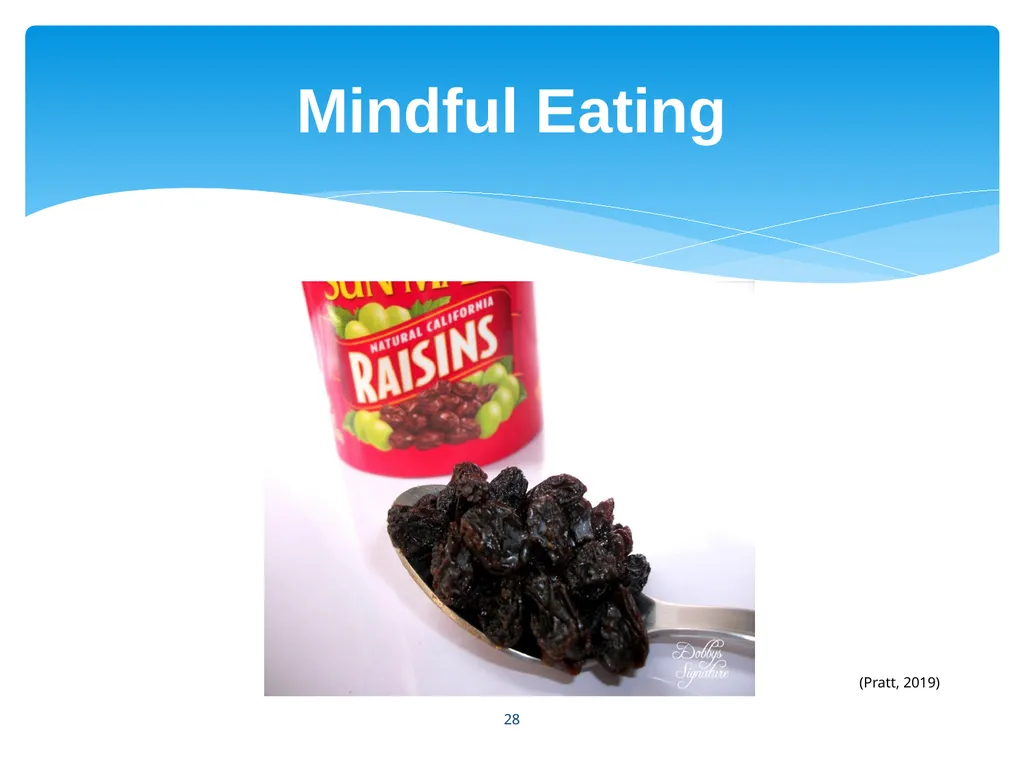
slide28. Mindful Eating 28 (Pratt, 2019)<br>
slide29. Loving Kindness Meditation: “Just Like Me” (Salzberg, 2014) 29<br>
slide30. Summary Interventions to address the unmitigated effects of workplace stress are necessary. Cascading effects of unaddressed stress include burnout and compassion fatigue. Turnover , illness, injury, and quality/safety issues are also associated outcomes. Mindfulness is an inexpensive, easy to learn, readily available intervention with strong evidence of success in many settings.<br>
slide31. Mindful Discussion…. 31<br>
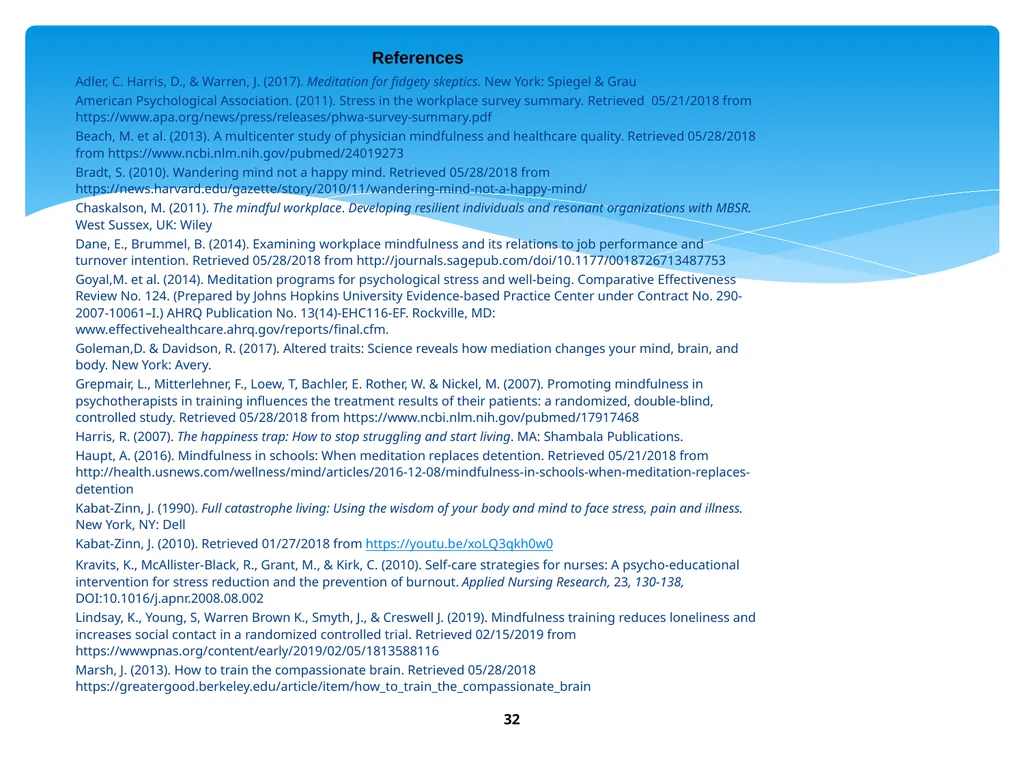
slide32. References Adler, C. Harris, D., & Warren, J. (2017). Meditation for fidgety skeptics. New York: Spiegel & Grau
American Psychological Association. (2011). Stress in the workplace survey summary. Retrieved 05/21/2018 from https://www.apa.org/news/press/releases/phwa-survey-summary.pdf
Beach, M. et al. (2013). A multicenter study of physician mindfulness and healthcare quality. Retrieved 05/28/2018 from https://www.ncbi.nlm.nih.gov/pubmed/24019273
Bradt, S. (2010). Wandering mind not a happy mind. Retrieved 05/28/2018 from https://news.harvard.edu/gazette/story/2010/11/wandering-mind-not-a-happy-mind/
Chaskalson, M. (2011). The mindful workplace. Developing resilient individuals and resonant organizations with MBSR. West Sussex, UK: Wiley
Dane, E., Brummel, B. (2014). Examining workplace mindfulness and its relations to job performance and turnover intention. Retrieved 05/28/2018 from http://journals.sagepub.com/doi/10.1177/0018726713487753
Goyal,M. et al. (2014). Meditation programs for psychological stress and well-being. Comparative Effectiveness Review No. 124. (Prepared by Johns Hopkins University Evidence-based Practice Center under Contract No. 290-2007-10061–I.) AHRQ Publication No. 13(14)-EHC116-EF. Rockville, MD: www.effectivehealthcare.ahrq.gov/reports/final.cfm.
Goleman,D. & Davidson, R. (2017). Altered traits: Science reveals how mediation changes your mind, brain, and body. New York: Avery.
Grepmair, L., Mitterlehner, F., Loew, T, Bachler, E. Rother, W. & Nickel, M. (2007). Promoting mindfulness in psychotherapists in training influences the treatment results of their patients: a randomized, double-blind, controlled study. Retrieved 05/28/2018 from https://www.ncbi.nlm.nih.gov/pubmed/17917468
Harris, R. (2007). The happiness trap: How to stop struggling and start living. MA: Shambala Publications.
Haupt, A. (2016). Mindfulness in schools: When meditation replaces detention. Retrieved 05/21/2018 from http://health.usnews.com/wellness/mind/articles/2016-12-08/mindfulness-in-schools-when-meditation-replaces-detention
Kabat-Zinn, J. (1990). Full catastrophe living: Using the wisdom of your body and mind to face stress, pain and illness. New York, NY: Dell
Kabat-Zinn, J. (2010). Retrieved 01/27/2018 from https://youtu.be/xoLQ3qkh0w0
Kravits, K., McAllister-Black, R., Grant, M., & Kirk, C. (2010). Self-care strategies for nurses: A psycho-educational intervention for stress reduction and the prevention of burnout. Applied Nursing Research, 23, 130-138, DOI:10.1016/j.apnr.2008.08.002
Lindsay, K., Young, S, Warren Brown K., Smyth, J., & Creswell J. (2019). Mindfulness training reduces loneliness and increases social contact in a randomized controlled trial. Retrieved 02/15/2019 from https://wwwpnas.org/content/early/2019/02/05/1813588116
Marsh, J. (2013). How to train the compassionate brain. Retrieved 05/28/2018 https://greatergood.berkeley.edu/article/item/how_to_train_the_compassionate_brain 32<br>
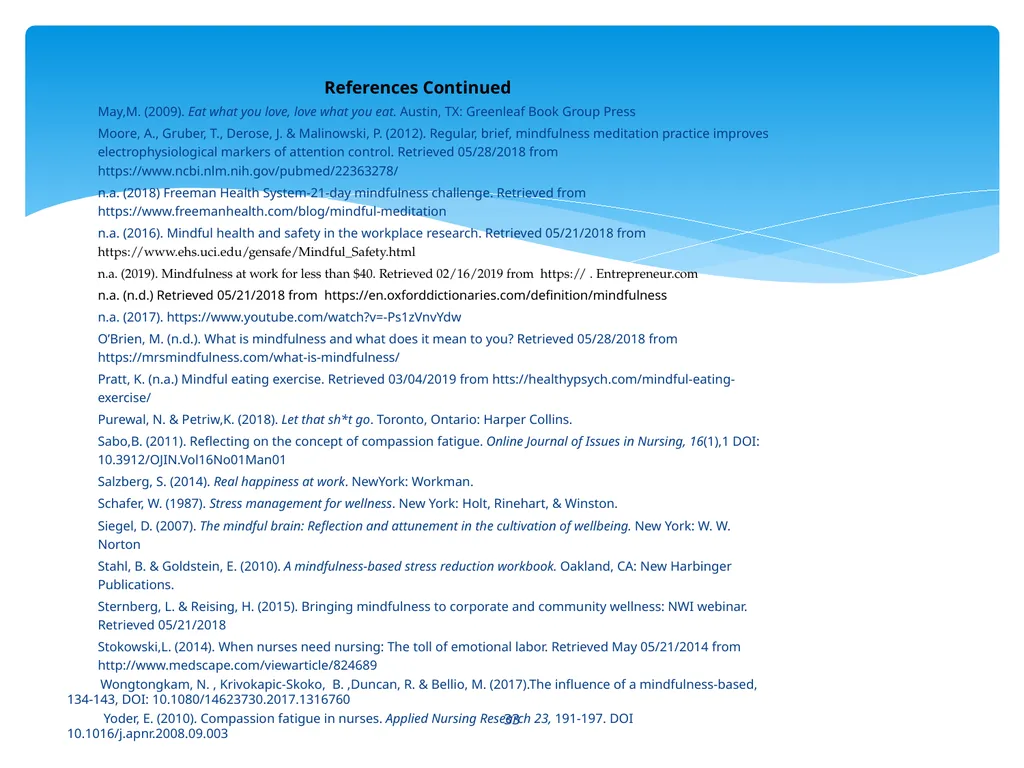
slide33. References Continued May,M. (2009). Eat what you love, love what you eat. Austin, TX: Greenleaf Book Group Press
Moore, A., Gruber, T., Derose, J. & Malinowski, P. (2012). Regular, brief, mindfulness meditation practice improves electrophysiological markers of attention control. Retrieved 05/28/2018 from https://www.ncbi.nlm.nih.gov/pubmed/22363278/
n.a. (2018) Freeman Health System-21-day mindfulness challenge. Retrieved from https://www.freemanhealth.com/blog/mindful-meditation
n.a. (2016). Mindful health and safety in the workplace research. Retrieved 05/21/2018 from https://www.ehs.uci.edu/gensafe/Mindful_Safety.html
n.a. (2019). Mindfulness at work for less than $40. Retrieved 02/16/2019 from https:// . Entrepreneur.com
n.a. (n.d.) Retrieved 05/21/2018 from https://en.oxforddictionaries.com/definition/mindfulness
n.a. (2017). https://www.youtube.com/watch?v=-Ps1zVnvYdw
O’Brien, M. (n.d.). What is mindfulness and what does it mean to you? Retrieved 05/28/2018 from https://mrsmindfulness.com/what-is-mindfulness/
Pratt, K. (n.a.) Mindful eating exercise. Retrieved 03/04/2019 from htts://healthypsych.com/mindful-eating-exercise/
Purewal, N. & Petriw,K. (2018). Let that sh*t go. Toronto, Ontario: Harper Collins.
Sabo,B. (2011). Reflecting on the concept of compassion fatigue. Online Journal of Issues in Nursing, 16(1),1 DOI: 10.3912/OJIN.Vol16No01Man01
Salzberg, S. (2014). Real happiness at work. NewYork: Workman.
Schafer, W. (1987). Stress management for wellness. New York: Holt, Rinehart, & Winston.
Siegel, D. (2007). The mindful brain: Reflection and attunement in the cultivation of wellbeing. New York: W. W. Norton
Stahl, B. & Goldstein, E. (2010). A mindfulness-based stress reduction workbook. Oakland, CA: New Harbinger Publications.
Sternberg, L. & Reising, H. (2015). Bringing mindfulness to corporate and community wellness: NWI webinar. Retrieved 05/21/2018
Stokowski,L. (2014). When nurses need nursing: The toll of emotional labor. Retrieved May 05/21/2014 from http://www.medscape.com/viewarticle/824689
Wongtongkam, N. , Krivokapic-Skoko, B. ,Duncan, R. & Bellio, M. (2017).The influence of a mindfulness-based, 134-143, DOI: 10.1080/14623730.2017.1316760
Yoder, E. (2010). Compassion fatigue in nurses. Applied Nursing Research 23, 191-197. DOI 10.1016/j.apnr.2008.09.003 33<br>
slide2. Brainstorm sources of stress in your workplace
Identify symptoms of workplace stress
Define burnout related to workplace stress
List symptoms experienced by those suffering from burnout
Describe three components of mindfulness
Explore outcomes associated with mindfulness
Participate in mindfulness exercises Objectives<br>
slide3. Close your eyes and picture yesterday at your workplace…<br>
slide4. What are sources of workplace stress?<br>
slide5. How did you identify its presence?<br>
slide6. 69% say work is a stressor (APA, 2011)
Turnover and staffing issues (Hayes, 2012)
Quality and safety issues (Aiken et al., 2012)
Higher rates of illness/workplace injury (Ayes et al., 2003)
Compassion fatigue and burnout (Sabo, 2011) Research supports what you know<br>
slide7. How is burnout different? “To be burned out means you were once on fire.” Jesse Wilson, RN, MSN
Emotional exhaustion
Depersonalization
Reduced feelings of accomplishment
Result of chronic exposure to environmental stressors
Person/job mismatch
Common in “people work”<br>
slide8. What happens when we quit caring?<br>
slide9. Suggests a therapeutic relationship exists
Secondary trauma
Stress results
Emotional labor
Burnout is suggested to be a precursor
Amenable to treatment Compassion Fatigue …<br>
slide10. Mindfulness as an Antidote<br>
slide11. The awareness that rises when we pay attention, on purpose, in the present moment non-judgmentally (with kindness and curiosity) - Dr. Jon Kabat-Zinn – he is the founder of Mindfulness-based Stress Reduction (MBSR). (1990)
A mental state achieved by focusing one's awareness on the present moment, while calmly acknowledging and accepting one's feelings, thoughts, and bodily sensations, used as a therapeutic technique. What is Mindfulness? 11<br>
slide12. Presence of Heart
(Kabat-Zinn. (2010). 12<br>
slide13. On Purpose
In the Present Moment
Non-judgmentally https://unsplash.com/ 13 Three Components Of Mindfulness<br>
slide14. Conscious and deliberate direct attention
Mindfully “awake” and aware of our current set up and surroundings
Living more consciously helps us become more aware of ourselves/others
Our attention is immersed in the present 14 On Purpose<br>
slide15. Our mind habitually wanders, rarely present in the moment
Mindful awareness is experienced when we let go of distractions
Our attention is held when we stop and accept what is here and now 15 In the Present Moment<br>
slide16. Increase awareness of mind chatter
Attend to experiences without judging or labelling them as +/-
Become a watcher of perceptions, thoughts and emotions without getting caught up in them
Watching in this way offers choice and freedom 16 Non-Judgmentally<br>
slide17. Non-Judging
Patience
Beginner’s Mind
Trust
Non-Striving
Acceptance
Letting Go (Kabat-Zinn, 1990) 17 7 Attitudes of Mindfulness<br>
slide18. Reduced stress, anxiety and other destructive emotions (Wongtongkam, et. al, 2017)
Reduced depression and insomnia (Goyal, et. al, 2014)
Improved focus and memory (Moore, Gruber, Derose, & Malinowski, 2012)
Increased compassion and emotional resilience (Marsh, 2014)
Creates clearer thinking, decreased emotionally reactive responses (Goleman & Davidson, 2017) 18 Benefits of Practicing Mindfulness<br>
slide19. Increased connection with others (Marsh,2013)
Reduced loneliness and increased social contact (Lindsay, et al, 2019)
Decreased pro-inflammatory cytokines, increased telomerase (Goleman & Davidson, 2017)
Increased neural plasticity, decreased brain atrophy (Siegel, 2007) 19 Benefits of Practicing Mindfulness<br>
slide20. What does research show? Pro’s Mindfulness Research Methodology Improving (Goldberg et al., 2017)
MBCT improved depression, anxiety, emotional regulation in those with BPD (Bojic & Becerra, 2017)
MBSR helpful in treating BED (Kristeller, Sheets, & Wolever, 2013)
Caregiver’s helped by MBSR (see ref. list)
Help for those with Diabetes and CAD (Keyworth, Knopp, & Roughley, 2014) Con’s Possible reporting bias in RCTs using MBSR (Coronado-Montoya et al., 2016)
Drop out rates (Grossman et al., 2003)
Homework required for full benefits (Pipe, et al., 2009)
“Practice makes perfect”
Modifications of MBSR make it hard to quantify (Grossman, 2004)-
Glossary-MBCT-mindfulness-based cognitive therapy, BPD –bipolar disorder, MBSR-Mindfulness-Based Stress Reduction, BED-binge eating disorder, CAD-coronary artery disease, RCT-randomly controlled trials 20<br>
slide21. Stop and take at least 3 deep breaths when you feel stressed.
Try to take uninterrupted breaks to refocus and or stretch.
Practice a walking meditation, simply slow down your pace & notice the ground against your feet.
Participate in mindfulness offerings such as yoga, stress reduction or meditation classes.
Utilize resources such as Mindfulness Based Stress Reduction program developed by John Kabat-Zinn PhD.
Utilize meditation apps such as: The Mindfulness App, Get Some Headspace, Breathe2Relax, Calm, or MINDBODY Connect. Practicing Mindfulness at Work 21<br>
slide22. Let’s Practice<br>
slide23. Breathing Changes Brain Chemistry Progressive Muscle Relaxation Four Square Breathing 23<br>
slide24. Grounding Exercises 24<br>
slide25. S: STOP
T: Take 3 breaths
O: Observe Sensations, Emotions, Thoughts
P: Proceed in a more modulated, less reactive, more responsive way
(National Wellness Institute, 2015) Increase Awareness: Remember 25<br>
slide26. Sit or lie comfortably.
Close your eyes…If you feel safe doing so
Make no effort to control the breath; simply breathe naturally.
Focus your attention on the breath and on how the body moves with inhalation and exhalation.
Try Freeman 21 day meditation challenge https://www.freemanhealth.com/mind-your-wellbeing
Use CALM – 1 minute breather 26 Mindful Meditation<br>
slide27. 1-minute Take a breather
Count your breath
Inhale 1-2-3
Pause
Exhale longer 1-2-3-4-5
Aware of this moment
What do you notice from all 5 senses?
What do you notice in your body? Tension? Holding a certain posture? Something else?
Where are your thoughts? Past events? Future tasks?
What are your emotions right now?
Name what you notice. E.g. “This is fear.” “This is sound.”
Let it be, let it go
Simply observe whatever you notice, without trying to change it.
Send yourself some kind and non-judgmental self compassion if this moment is a difficult one.
See if you can make space for whatever you are feeling to be there without making yourself wrong.
Remember that we all face difficulties in life sometimes; you are not alone. What would you say to a friend in the same situation?
Think of something you are grateful for right now.
Move mindfully
Take a moment to stretch your body or stand up from your desk.
Move mindfully into your next task, being truly present. 27<br>
slide28. Mindful Eating 28 (Pratt, 2019)<br>
slide29. Loving Kindness Meditation: “Just Like Me” (Salzberg, 2014) 29<br>
slide30. Summary Interventions to address the unmitigated effects of workplace stress are necessary. Cascading effects of unaddressed stress include burnout and compassion fatigue. Turnover , illness, injury, and quality/safety issues are also associated outcomes. Mindfulness is an inexpensive, easy to learn, readily available intervention with strong evidence of success in many settings.<br>
slide31. Mindful Discussion…. 31<br>
slide32. References Adler, C. Harris, D., & Warren, J. (2017). Meditation for fidgety skeptics. New York: Spiegel & Grau
American Psychological Association. (2011). Stress in the workplace survey summary. Retrieved 05/21/2018 from https://www.apa.org/news/press/releases/phwa-survey-summary.pdf
Beach, M. et al. (2013). A multicenter study of physician mindfulness and healthcare quality. Retrieved 05/28/2018 from https://www.ncbi.nlm.nih.gov/pubmed/24019273
Bradt, S. (2010). Wandering mind not a happy mind. Retrieved 05/28/2018 from https://news.harvard.edu/gazette/story/2010/11/wandering-mind-not-a-happy-mind/
Chaskalson, M. (2011). The mindful workplace. Developing resilient individuals and resonant organizations with MBSR. West Sussex, UK: Wiley
Dane, E., Brummel, B. (2014). Examining workplace mindfulness and its relations to job performance and turnover intention. Retrieved 05/28/2018 from http://journals.sagepub.com/doi/10.1177/0018726713487753
Goyal,M. et al. (2014). Meditation programs for psychological stress and well-being. Comparative Effectiveness Review No. 124. (Prepared by Johns Hopkins University Evidence-based Practice Center under Contract No. 290-2007-10061–I.) AHRQ Publication No. 13(14)-EHC116-EF. Rockville, MD: www.effectivehealthcare.ahrq.gov/reports/final.cfm.
Goleman,D. & Davidson, R. (2017). Altered traits: Science reveals how mediation changes your mind, brain, and body. New York: Avery.
Grepmair, L., Mitterlehner, F., Loew, T, Bachler, E. Rother, W. & Nickel, M. (2007). Promoting mindfulness in psychotherapists in training influences the treatment results of their patients: a randomized, double-blind, controlled study. Retrieved 05/28/2018 from https://www.ncbi.nlm.nih.gov/pubmed/17917468
Harris, R. (2007). The happiness trap: How to stop struggling and start living. MA: Shambala Publications.
Haupt, A. (2016). Mindfulness in schools: When meditation replaces detention. Retrieved 05/21/2018 from http://health.usnews.com/wellness/mind/articles/2016-12-08/mindfulness-in-schools-when-meditation-replaces-detention
Kabat-Zinn, J. (1990). Full catastrophe living: Using the wisdom of your body and mind to face stress, pain and illness. New York, NY: Dell
Kabat-Zinn, J. (2010). Retrieved 01/27/2018 from https://youtu.be/xoLQ3qkh0w0
Kravits, K., McAllister-Black, R., Grant, M., & Kirk, C. (2010). Self-care strategies for nurses: A psycho-educational intervention for stress reduction and the prevention of burnout. Applied Nursing Research, 23, 130-138, DOI:10.1016/j.apnr.2008.08.002
Lindsay, K., Young, S, Warren Brown K., Smyth, J., & Creswell J. (2019). Mindfulness training reduces loneliness and increases social contact in a randomized controlled trial. Retrieved 02/15/2019 from https://wwwpnas.org/content/early/2019/02/05/1813588116
Marsh, J. (2013). How to train the compassionate brain. Retrieved 05/28/2018 https://greatergood.berkeley.edu/article/item/how_to_train_the_compassionate_brain 32<br>
slide33. References Continued May,M. (2009). Eat what you love, love what you eat. Austin, TX: Greenleaf Book Group Press
Moore, A., Gruber, T., Derose, J. & Malinowski, P. (2012). Regular, brief, mindfulness meditation practice improves electrophysiological markers of attention control. Retrieved 05/28/2018 from https://www.ncbi.nlm.nih.gov/pubmed/22363278/
n.a. (2018) Freeman Health System-21-day mindfulness challenge. Retrieved from https://www.freemanhealth.com/blog/mindful-meditation
n.a. (2016). Mindful health and safety in the workplace research. Retrieved 05/21/2018 from https://www.ehs.uci.edu/gensafe/Mindful_Safety.html
n.a. (2019). Mindfulness at work for less than $40. Retrieved 02/16/2019 from https:// . Entrepreneur.com
n.a. (n.d.) Retrieved 05/21/2018 from https://en.oxforddictionaries.com/definition/mindfulness
n.a. (2017). https://www.youtube.com/watch?v=-Ps1zVnvYdw
O’Brien, M. (n.d.). What is mindfulness and what does it mean to you? Retrieved 05/28/2018 from https://mrsmindfulness.com/what-is-mindfulness/
Pratt, K. (n.a.) Mindful eating exercise. Retrieved 03/04/2019 from htts://healthypsych.com/mindful-eating-exercise/
Purewal, N. & Petriw,K. (2018). Let that sh*t go. Toronto, Ontario: Harper Collins.
Sabo,B. (2011). Reflecting on the concept of compassion fatigue. Online Journal of Issues in Nursing, 16(1),1 DOI: 10.3912/OJIN.Vol16No01Man01
Salzberg, S. (2014). Real happiness at work. NewYork: Workman.
Schafer, W. (1987). Stress management for wellness. New York: Holt, Rinehart, & Winston.
Siegel, D. (2007). The mindful brain: Reflection and attunement in the cultivation of wellbeing. New York: W. W. Norton
Stahl, B. & Goldstein, E. (2010). A mindfulness-based stress reduction workbook. Oakland, CA: New Harbinger Publications.
Sternberg, L. & Reising, H. (2015). Bringing mindfulness to corporate and community wellness: NWI webinar. Retrieved 05/21/2018
Stokowski,L. (2014). When nurses need nursing: The toll of emotional labor. Retrieved May 05/21/2014 from http://www.medscape.com/viewarticle/824689
Wongtongkam, N. , Krivokapic-Skoko, B. ,Duncan, R. & Bellio, M. (2017).The influence of a mindfulness-based, 134-143, DOI: 10.1080/14623730.2017.1316760
Yoder, E. (2010). Compassion fatigue in nurses. Applied Nursing Research 23, 191-197. DOI 10.1016/j.apnr.2008.09.003 33<br>