World Music RHYTHMIC features used in all World Music Syncopation Off-beat rhythms, syncopated rhythms Dotted Rhythms usually a pair of long then short beat patterns Polyrhythms Many rhythms played at the same time Cross rhythms - A
"World Music RHYTHMIC features used in all World" is the property of its rightful owner. Permission is granted to
download and print the materials on this website for personal, non-commercial use only, and to display it
on your personal computer provided you do not modify the materials and that you retain all copyright
notices contained in the materials. By downloading content from our website, you accept the terms of this
agreement.
Presentation Transcript
01
World Music<br>
02
RHYTHMIC features used in all World Music Syncopation – Off-beat rhythms, syncopated rhythms
Dotted Rhythms – usually a pair of long then short beat patterns
Polyrhythms – Many rhythms played at the same time
Cross rhythms - A cross-rhythm is the effect produced when two conflicting rhythms are heard together.
Accented beats – Different beats are played louder to make them stand out<br>
03
AFRICAN Music features Performed at weddings, funerals, festivals and other public ceremonies
Djembe – Drum with 3 main sounds (Bass, Tone and Slap), played with the hands/fingertips.
Dundun – Lower pitched drum that often plays an ostinato rhythm giving the pulse. Payed with a stick.
Talking Drum – A drum that is able to change pitch by squeezing it
Agogo/Bell – Bell sound that sets the pulse for other performer
Shakers – hand percussion
Balafon – African Xylophone made from wooden bars and gourds, played with beaters
Mbira – or thumb-piano, made from thin metal bars which are plucked giving a unique sound
Polyrhythmic texture – different rhythms combined in layers
Cross rhythms – two against three feel
Call & Response – drumming or singing
Master Drummer – leads the group, plays the core rhythm as well as improvises and controls the structure of the music
Strong sense of pulse/cyclic repeated sections<br>
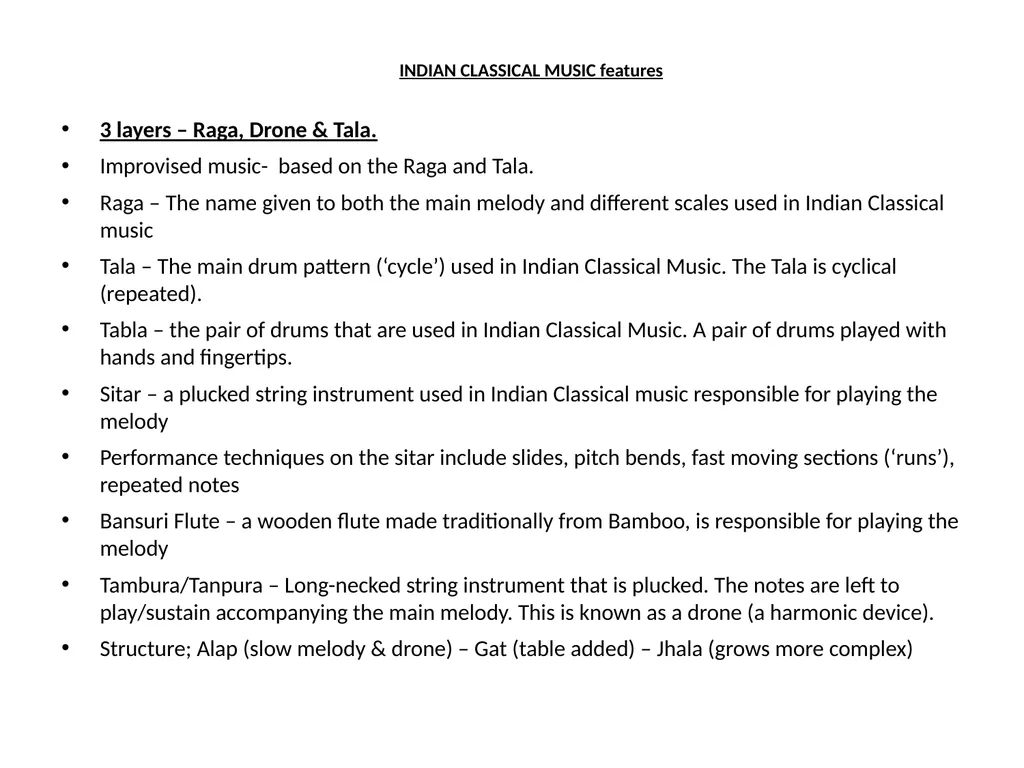
INDIAN CLASSICAL MUSIC features 3 layers – Raga, Drone & Tala.
Improvised music- based on the Raga and Tala.
Raga – The name given to both the main melody and different scales used in Indian Classical music
Tala – The main drum pattern (‘cycle’) used in Indian Classical Music. The Tala is cyclical (repeated).
Tabla – the pair of drums that are used in Indian Classical Music. A pair of drums played with hands and fingertips.
Sitar – a plucked string instrument used in Indian Classical music responsible for playing the melody
Performance techniques on the sitar include slides, pitch bends, fast moving sections (‘runs’), repeated notes
Bansuri Flute – a wooden flute made traditionally from Bamboo, is responsible for playing the melody
Tambura/Tanpura – Long-necked string instrument that is plucked. The notes are left to play/sustain accompanying the main melody. This is known as a drone (a harmonic device).
Structure; Alap (slow melody & drone) – Gat (table added) – Jhala (grows more complex)<br>
06
Listen & watch! Sitar
https://youtu.be/wLAXfkK-DPg
Tabla drums
https://youtu.be/s7gigim5ZJo<br>
07
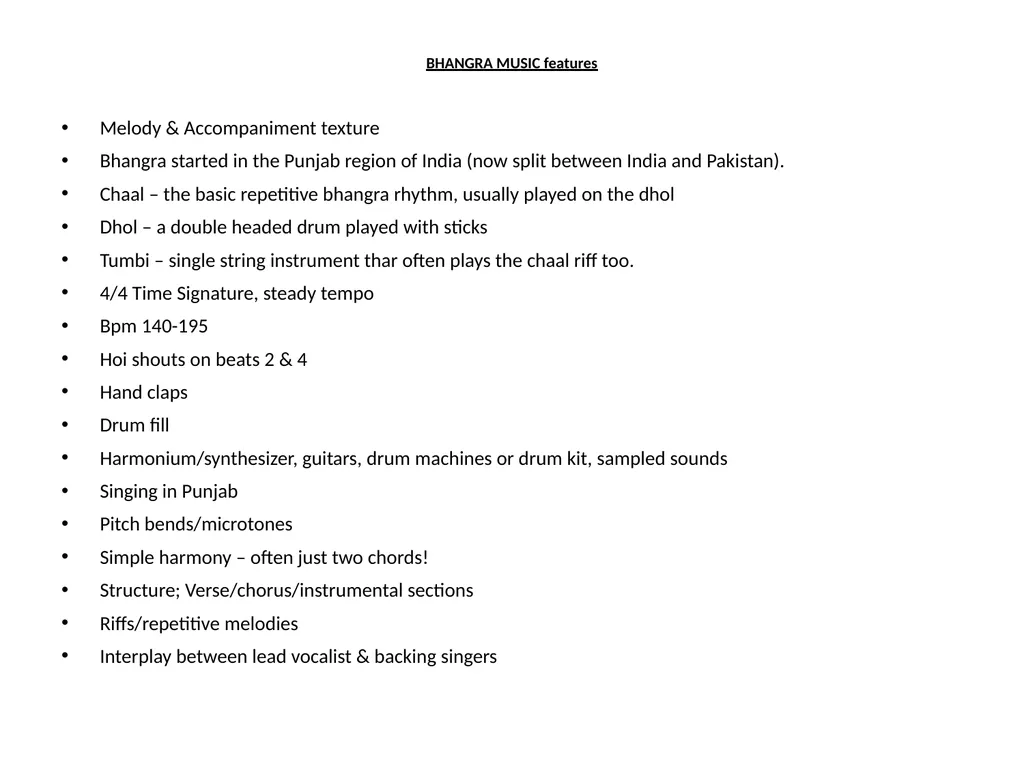
BHANGRA MUSIC features Melody & Accompaniment texture
Bhangra started in the Punjab region of India (now split between India and Pakistan).
Chaal – the basic repetitive bhangra rhythm, usually played on the dhol
Dhol – a double headed drum played with sticks
Tumbi – single string instrument thar often plays the chaal riff too.
4/4 Time Signature, steady tempo
Bpm 140-195
Hoi shouts on beats 2 & 4
Hand claps
Drum fill
Harmonium/synthesizer, guitars, drum machines or drum kit, sampled sounds
Singing in Punjab
Pitch bends/microtones
Simple harmony – often just two chords!
Structure; Verse/chorus/instrumental sections
Riffs/repetitive melodies
Interplay between lead vocalist & backing singers<br>
Traditional Eastern Mediterranean and Middle Eastern Folk Rhythms General Arabic features
Mode –an Arabic scale which contains microtones
Microtones – the notes between a semitone
A Wazn – a rhythmic pattern (similar to Indian Tala). There are hundreds!
Doumbek – a drum similar to a Djembe, played with hands/fingertips
Oud – a pear shaped string instrument, played with a pick (mainly Palestinian music)
PALESTINIAN MUSIC features
Palestinian music contains only melody and rhythm (No chords/harmonies)
Improvisation – is an important feature<br>
10
Listen & Watch! Oud
https://youtu.be/teFyiwtBjZs
Doumbek
https://youtu.be/vhfky-h_Rpw<br>
11
ISRAELI MUSIC features Music for dancing at weddings and bar mitzvah celebrations
2/4 or 4/4 time signature
Bass guitar crotchet Tonic & Dominant pulse
Off-beat chords (played on 2nd & 4th beat)
Fast tempo
Gradual accelerando
Ornaments (pitch bends & grace notes) added to melody
Clarinet, violin or accordion often play the melody<br>
12
Listen & Watch! https://youtu.be/TqtSBQUS59I<br>
13
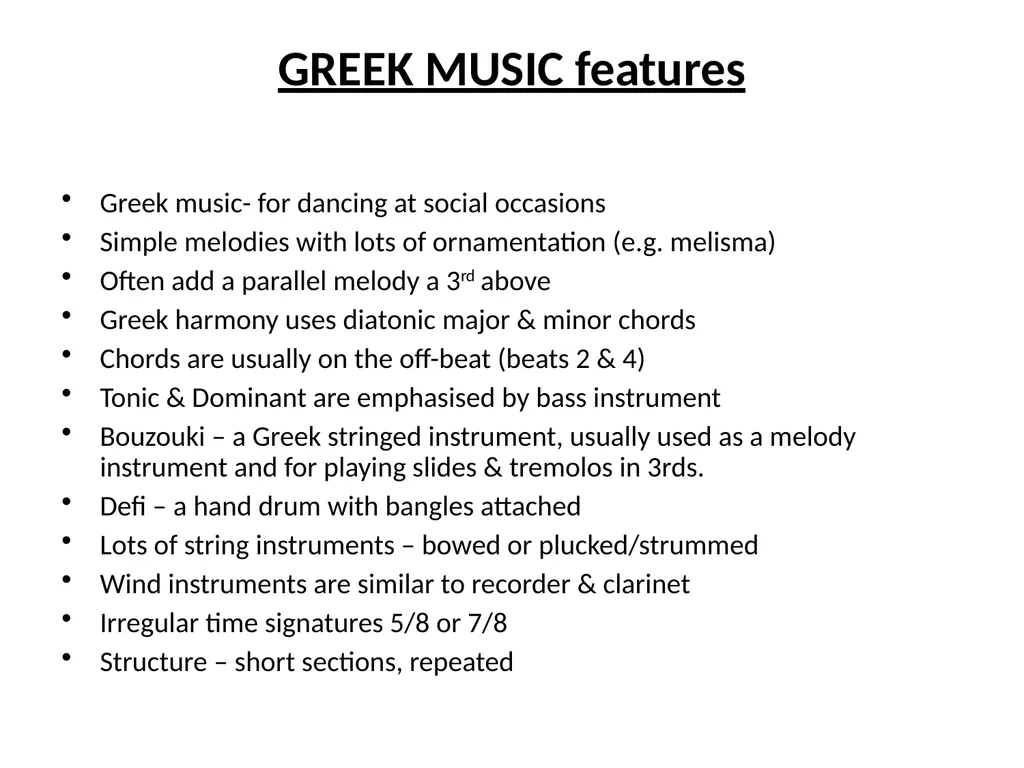
GREEK MUSIC features Greek music- for dancing at social occasions
Simple melodies with lots of ornamentation (e.g. melisma)
Often add a parallel melody a 3rd above
Greek harmony uses diatonic major & minor chords
Chords are usually on the off-beat (beats 2 & 4)
Tonic & Dominant are emphasised by bass instrument
Bouzouki – a Greek stringed instrument, usually used as a melody instrument and for playing slides & tremolos in 3rds.
Defi – a hand drum with bangles attached
Lots of string instruments – bowed or plucked/strummed
Wind instruments are similar to recorder & clarinet
Irregular time signatures 5/8 or 7/8
Structure – short sections, repeated<br>
https://youtu.be/17Z1u6vA_3E (flick through to music bits!)<br>
15
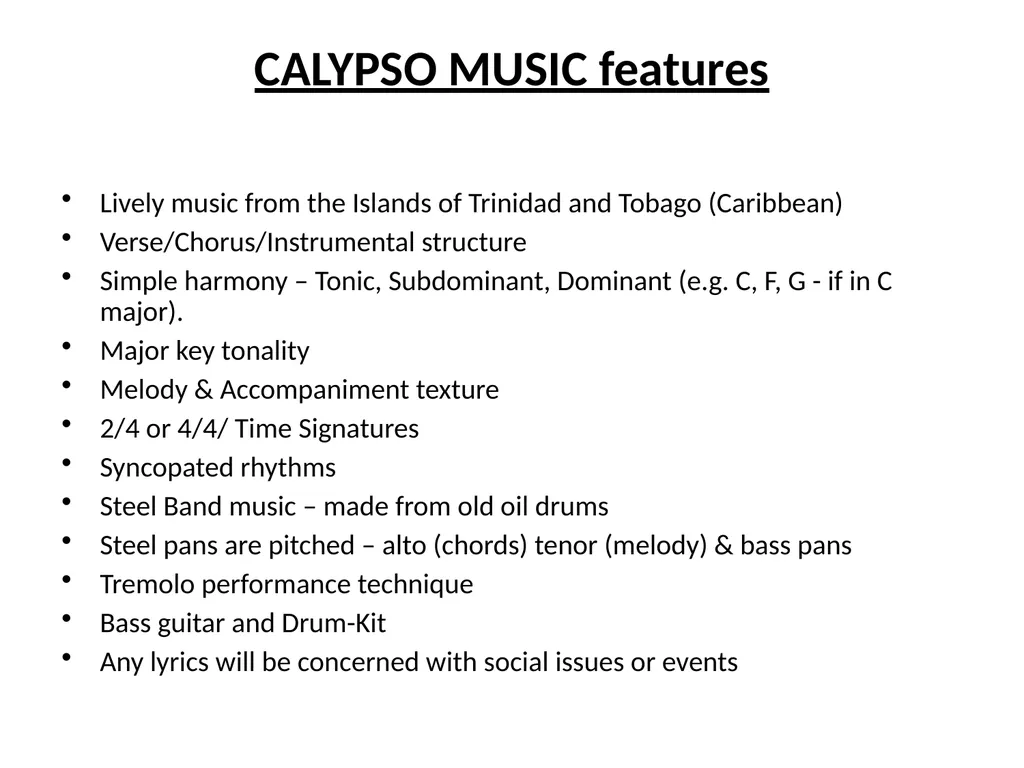
CALYPSO MUSIC features Lively music from the Islands of Trinidad and Tobago (Caribbean)
Verse/Chorus/Instrumental structure
Simple harmony – Tonic, Subdominant, Dominant (e.g. C, F, G - if in C major).
Major key tonality
Melody & Accompaniment texture
2/4 or 4/4/ Time Signatures
Syncopated rhythms
Steel Band music – made from old oil drums
Steel pans are pitched – alto (chords) tenor (melody) & bass pans
Tremolo performance technique
Bass guitar and Drum-Kit
Any lyrics will be concerned with social issues or events<br>
16
Listen & Watch! https://youtu.be/BWcwonrBw0w
https://youtu.be/uyiJT6Fl3Ro
https://www.bbc.co.uk/bitesize/guides/ztp49j6<br>
17
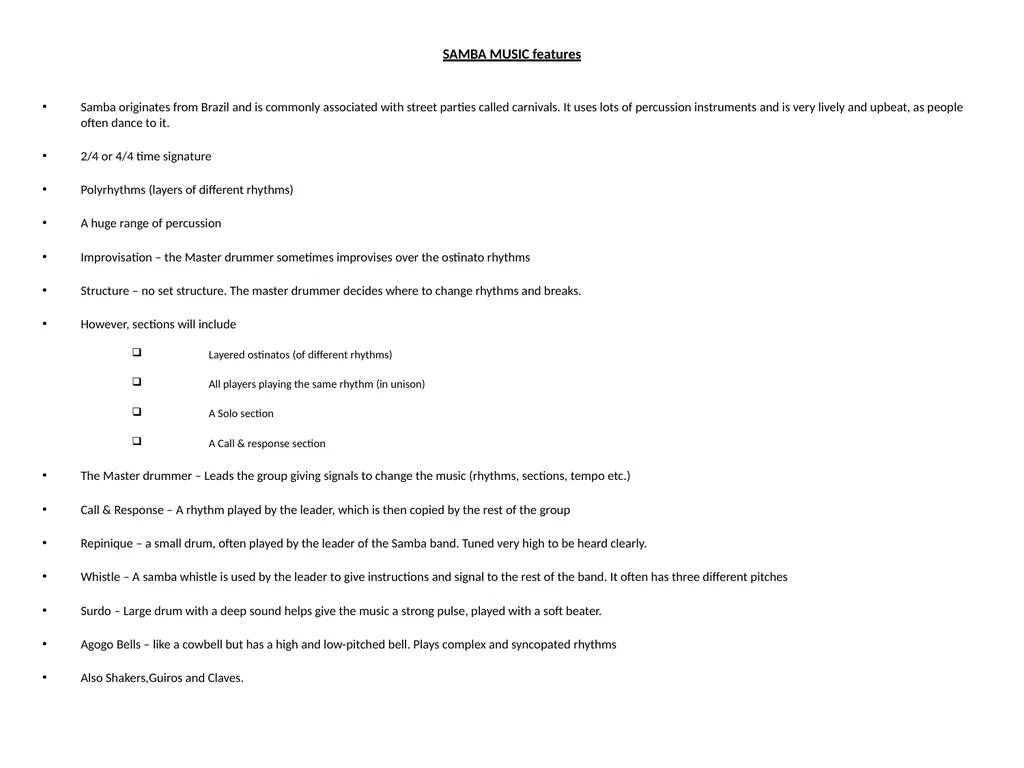
SAMBA MUSIC features Samba originates from Brazil and is commonly associated with street parties called carnivals. It uses lots of percussion instruments and is very lively and upbeat, as people often dance to it.
2/4 or 4/4 time signature
Polyrhythms (layers of different rhythms)
A huge range of percussion
Improvisation – the Master drummer sometimes improvises over the ostinato rhythms
Structure – no set structure. The master drummer decides where to change rhythms and breaks.
However, sections will include
Layered ostinatos (of different rhythms)
All players playing the same rhythm (in unison)
A Solo section
A Call & response section
The Master drummer – Leads the group giving signals to change the music (rhythms, sections, tempo etc.)
Call & Response – A rhythm played by the leader, which is then copied by the rest of the group
Repinique – a small drum, often played by the leader of the Samba band. Tuned very high to be heard clearly.
Whistle – A samba whistle is used by the leader to give instructions and signal to the rest of the band. It often has three different pitches
Surdo – Large drum with a deep sound helps give the music a strong pulse, played with a soft beater.
Agogo Bells – like a cowbell but has a high and low-pitched bell. Plays complex and syncopated rhythms
Also Shakers,Guiros and Claves.<br>