
World War - I Introduction: The single most
CM
Published · 17 slides · 0 views
1 / 1


Description
World War - I Introduction: The single most pondered question in history might be what caused World War-I? It was not a case of a single eagerness pushing others to take a military stand like the Second World War. It did not have the
Related Topics
Share
Embed code
Download this presentation From Below
"World War - I Introduction: The single most" is the property of its rightful owner. Permission is granted to download and print the materials on this website for personal, non-commercial use only, and to display it on your personal computer provided you do not modify the materials and that you retain all copyright notices contained in the materials. By downloading content from our website, you accept the terms of this agreement.
Presentation Transcript
01
World War - I Introduction:
The single most pondered question in history might be – what caused World War-I? It was not a case of a single eagerness pushing others to take a military stand like the Second World War. It did not have the moral vindication of resisting a tyrant.
Rather, a delicate but toxic balance of structural forces created a dry tinder that was lit by the assassination of Archduke Frances Ferdinand in Sarajevo. That event hurried the July Crisis, which saw the major European powers toward open conflict.<br>
The single most pondered question in history might be – what caused World War-I? It was not a case of a single eagerness pushing others to take a military stand like the Second World War. It did not have the moral vindication of resisting a tyrant.
Rather, a delicate but toxic balance of structural forces created a dry tinder that was lit by the assassination of Archduke Frances Ferdinand in Sarajevo. That event hurried the July Crisis, which saw the major European powers toward open conflict.<br>
02
Causes Militarism:
The late nineteenth century was an era of military competition, particularly between the major European powers. The policy of building a stronger military was judged relative to neighbours, creating a culture of paranoia that heightened the search for alliances. It was fed by the cultural belief that war is good for nations.
Germany in particular looked to expand its navy. However, the ‘naval race’ was never a real contest – the British always had maintained naval superiority. But the British obsession with naval dominance was strong. Government rhetoric exaggerated military expansionism. A simple naivety in the potential scale and bloodshed of a European war prevented several governments from checking their aggression.<br>
The late nineteenth century was an era of military competition, particularly between the major European powers. The policy of building a stronger military was judged relative to neighbours, creating a culture of paranoia that heightened the search for alliances. It was fed by the cultural belief that war is good for nations.
Germany in particular looked to expand its navy. However, the ‘naval race’ was never a real contest – the British always had maintained naval superiority. But the British obsession with naval dominance was strong. Government rhetoric exaggerated military expansionism. A simple naivety in the potential scale and bloodshed of a European war prevented several governments from checking their aggression.<br>
03
Alliances A web of alliances developed in Europe between 1870 and 1914 effectively creating two camps bound by commitments to maintain sovereignty or intervene militarily – the Tripple Entente (friendly understanding) and the Triple Alliance.
The Triple Alliance of 1882 linked Germany, Austria-Hungary and Italy.
The Triple Entente of 1907 linked France, Britain and Russia.
A historic point of conflict between Austria Hungary and Russia was over their incompatible Balkan interests, and France had a deep suspicion of Germany rooted in their defeat in the 1870 war.
The alliance system primarily came about because after 1870 Germany, under Bismarck, set a precedent by playing its neighbours’ imperial endeavours off one another, in order to maintain a balance of power within Europe<br>
The Triple Alliance of 1882 linked Germany, Austria-Hungary and Italy.
The Triple Entente of 1907 linked France, Britain and Russia.
A historic point of conflict between Austria Hungary and Russia was over their incompatible Balkan interests, and France had a deep suspicion of Germany rooted in their defeat in the 1870 war.
The alliance system primarily came about because after 1870 Germany, under Bismarck, set a precedent by playing its neighbours’ imperial endeavours off one another, in order to maintain a balance of power within Europe<br>
04
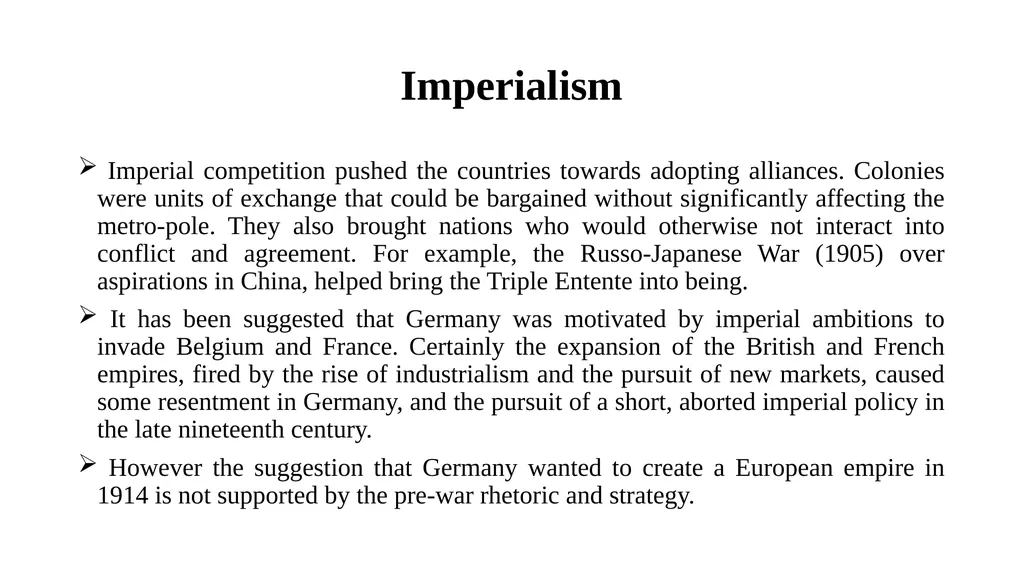
Imperialism Imperial competition pushed the countries towards adopting alliances. Colonies were units of exchange that could be bargained without significantly affecting the metro-pole. They also brought nations who would otherwise not interact into conflict and agreement. For example, the Russo-Japanese War (1905) over aspirations in China, helped bring the Triple Entente into being.
It has been suggested that Germany was motivated by imperial ambitions to invade Belgium and France. Certainly the expansion of the British and French empires, fired by the rise of industrialism and the pursuit of new markets, caused some resentment in Germany, and the pursuit of a short, aborted imperial policy in the late nineteenth century.
However the suggestion that Germany wanted to create a European empire in 1914 is not supported by the pre-war rhetoric and strategy.<br>
It has been suggested that Germany was motivated by imperial ambitions to invade Belgium and France. Certainly the expansion of the British and French empires, fired by the rise of industrialism and the pursuit of new markets, caused some resentment in Germany, and the pursuit of a short, aborted imperial policy in the late nineteenth century.
However the suggestion that Germany wanted to create a European empire in 1914 is not supported by the pre-war rhetoric and strategy.<br>
05
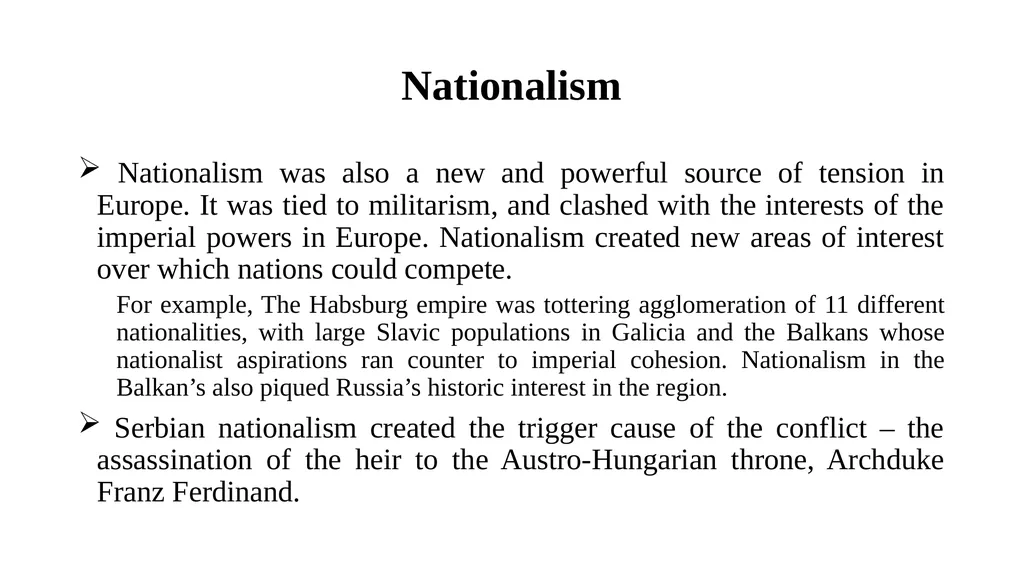
Nationalism Nationalism was also a new and powerful source of tension in Europe. It was tied to militarism, and clashed with the interests of the imperial powers in Europe. Nationalism created new areas of interest over which nations could compete.
For example, The Habsburg empire was tottering agglomeration of 11 different nationalities, with large Slavic populations in Galicia and the Balkans whose nationalist aspirations ran counter to imperial cohesion. Nationalism in the Balkan’s also piqued Russia’s historic interest in the region.
Serbian nationalism created the trigger cause of the conflict – the assassination of the heir to the Austro-Hungarian throne, Archduke Franz Ferdinand.<br>
For example, The Habsburg empire was tottering agglomeration of 11 different nationalities, with large Slavic populations in Galicia and the Balkans whose nationalist aspirations ran counter to imperial cohesion. Nationalism in the Balkan’s also piqued Russia’s historic interest in the region.
Serbian nationalism created the trigger cause of the conflict – the assassination of the heir to the Austro-Hungarian throne, Archduke Franz Ferdinand.<br>
06
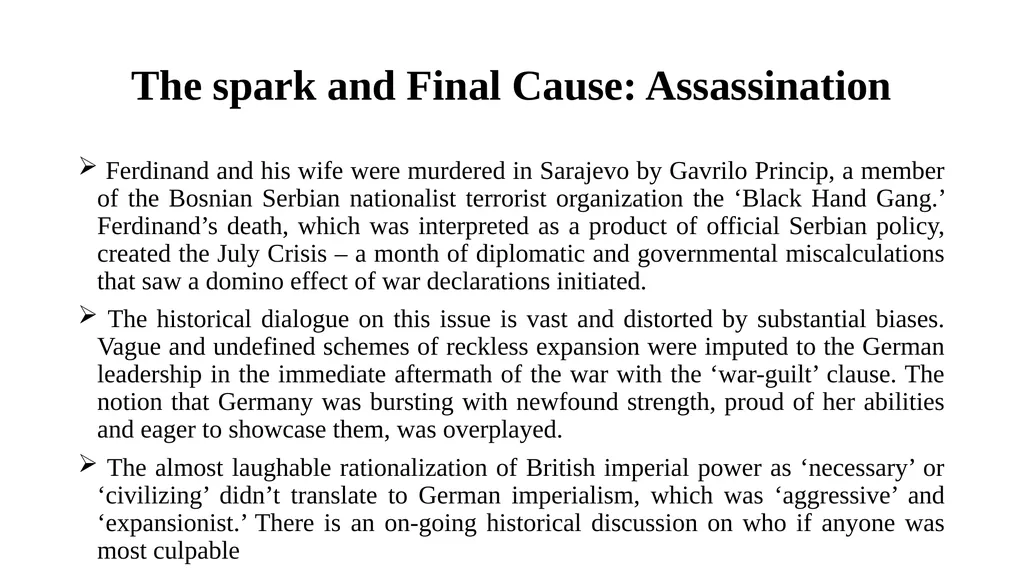
The spark and Final Cause: Assassination Ferdinand and his wife were murdered in Sarajevo by Gavrilo Princip, a member of the Bosnian Serbian nationalist terrorist organization the ‘Black Hand Gang.’ Ferdinand’s death, which was interpreted as a product of official Serbian policy, created the July Crisis – a month of diplomatic and governmental miscalculations that saw a domino effect of war declarations initiated.
The historical dialogue on this issue is vast and distorted by substantial biases. Vague and undefined schemes of reckless expansion were imputed to the German leadership in the immediate aftermath of the war with the ‘war-guilt’ clause. The notion that Germany was bursting with newfound strength, proud of her abilities and eager to showcase them, was overplayed.
The almost laughable rationalization of British imperial power as ‘necessary’ or ‘civilizing’ didn’t translate to German imperialism, which was ‘aggressive’ and ‘expansionist.’ There is an on-going historical discussion on who if anyone was most culpable<br>
The historical dialogue on this issue is vast and distorted by substantial biases. Vague and undefined schemes of reckless expansion were imputed to the German leadership in the immediate aftermath of the war with the ‘war-guilt’ clause. The notion that Germany was bursting with newfound strength, proud of her abilities and eager to showcase them, was overplayed.
The almost laughable rationalization of British imperial power as ‘necessary’ or ‘civilizing’ didn’t translate to German imperialism, which was ‘aggressive’ and ‘expansionist.’ There is an on-going historical discussion on who if anyone was most culpable<br>
07
Blame has been directed at every single combatant at one point or another, and some have said that all the major governments considered a golden opportunity for increasing popularity at home.
The Schlieffen plan could be blamed for bringing Britain into the war, the scale of the war could be blamed on Russia as the first big country to mobilise, inherent rivalries between imperialism and capitalism could be blamed for polarising the combatants. AJP Taylor’s ‘timetable theory’ emphasises the delicate, highly complex plans involved in mobilization which prompted ostensibly aggressive military preparations.
Every point has some merit, but in the end what proved most devastating was the combination of an alliance network with the widespread, misguided belief that war is good for nations, and that the best way to fight a modern war was to attack. That the war was inevitable is questionable, but certainly the notion of glorious war, of war as a good for nation-building, was strong pre-1914. By the end of the war, it was dead<br>
The Schlieffen plan could be blamed for bringing Britain into the war, the scale of the war could be blamed on Russia as the first big country to mobilise, inherent rivalries between imperialism and capitalism could be blamed for polarising the combatants. AJP Taylor’s ‘timetable theory’ emphasises the delicate, highly complex plans involved in mobilization which prompted ostensibly aggressive military preparations.
Every point has some merit, but in the end what proved most devastating was the combination of an alliance network with the widespread, misguided belief that war is good for nations, and that the best way to fight a modern war was to attack. That the war was inevitable is questionable, but certainly the notion of glorious war, of war as a good for nation-building, was strong pre-1914. By the end of the war, it was dead<br>
08
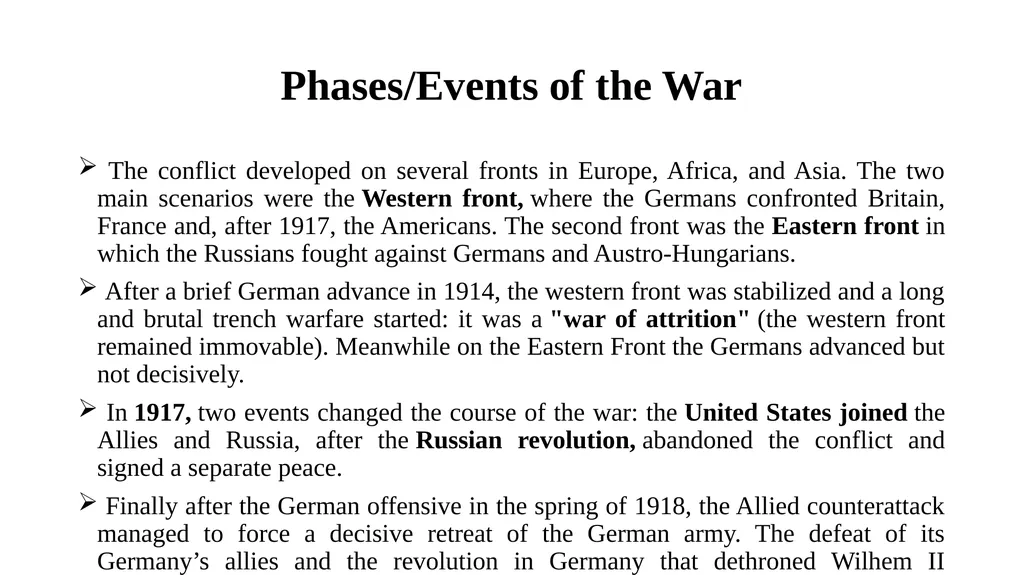
Phases/Events of the War The conflict developed on several fronts in Europe, Africa, and Asia. The two main scenarios were the Western front, where the Germans confronted Britain, France and, after 1917, the Americans. The second front was the Eastern front in which the Russians fought against Germans and Austro-Hungarians.
After a brief German advance in 1914, the western front was stabilized and a long and brutal trench warfare started: it was a "war of attrition" (the western front remained immovable). Meanwhile on the Eastern Front the Germans advanced but not decisively.
In 1917, two events changed the course of the war: the United States joined the Allies and Russia, after the Russian revolution, abandoned the conflict and signed a separate peace.
Finally after the German offensive in the spring of 1918, the Allied counterattack managed to force a decisive retreat of the German army. The defeat of its Germany’s allies and the revolution in Germany that dethroned Wilhem II (German Emperor), brought about the signing of the armistice on November 11, 1918. The Great War was over<br>
After a brief German advance in 1914, the western front was stabilized and a long and brutal trench warfare started: it was a "war of attrition" (the western front remained immovable). Meanwhile on the Eastern Front the Germans advanced but not decisively.
In 1917, two events changed the course of the war: the United States joined the Allies and Russia, after the Russian revolution, abandoned the conflict and signed a separate peace.
Finally after the German offensive in the spring of 1918, the Allied counterattack managed to force a decisive retreat of the German army. The defeat of its Germany’s allies and the revolution in Germany that dethroned Wilhem II (German Emperor), brought about the signing of the armistice on November 11, 1918. The Great War was over<br>
09
Consequences/Impacts 1. Economic consequences: World War I cost the participating countries a lot of money. Germany and Great Britain spent about 60% of the money their economy produced. Countries had to raise taxes and borrow money from their citizens. They also printed money in order to buy weapons and other things they needed for war. This led to inflation after the war.
2. Political Consequences: World War I brought an end to four monarchies: Czar Nicholas II of Russia, Kaiser Wilhelm of Germany, Emperor Charles of Austria and the sultan of the Ottoman Empire had to step down.
New countries were created out of old empires. Austria- Hungary was carved up into a number of independent states.
Russia and Germany gave land to Poland. Countries in the Middle East were put under the control of Great Britain and France.
What was left of Ottoman Empire became Turkey.<br>
2. Political Consequences: World War I brought an end to four monarchies: Czar Nicholas II of Russia, Kaiser Wilhelm of Germany, Emperor Charles of Austria and the sultan of the Ottoman Empire had to step down.
New countries were created out of old empires. Austria- Hungary was carved up into a number of independent states.
Russia and Germany gave land to Poland. Countries in the Middle East were put under the control of Great Britain and France.
What was left of Ottoman Empire became Turkey.<br>
10
Consequences Contd…. 3. Social Consequences: World war changed society completely. Birth rates declined because millions of young men died (eight million died, millions wounded, maimed, widows and orphans). Civilians lost their land and fled to other countries.
The role of women also changed. They played a major part in replacing men in factories and offices. Many countries gave women more rights after the war had ended, including the right to vote.
The upper classes lost their leading role in society. Young middle and lower class men and women demanded a say in forming their country after the war.
4. Treaty of Versailles: On June 28, 1919, World War I officially ended with the signing of the Treaty of Versailles. The Treaty of Versailles was an attempt to prevent the world from going into another war<br>
The role of women also changed. They played a major part in replacing men in factories and offices. Many countries gave women more rights after the war had ended, including the right to vote.
The upper classes lost their leading role in society. Young middle and lower class men and women demanded a say in forming their country after the war.
4. Treaty of Versailles: On June 28, 1919, World War I officially ended with the signing of the Treaty of Versailles. The Treaty of Versailles was an attempt to prevent the world from going into another war<br>
11
Important Social and Ideological changes The U.S., which had won the war but had not experienced the conflict on its territory, became a first world power.
The mass mobilization of men led to the incorporation of women into the workforce, which was a major step forward for women's rights.
The triumph of the Soviet Revolution (Russian Revolution) and the social crisis that followed the war encouraged workers in many countries to protest, creating a pre-revolutionary climate.
The extreme nationalism experienced during the war, coupled with fear of a Communist revolution, encouraged the middle-class populations of some countries to move to the extreme right. This created a hotbed of fascist movements.
Creation of the League of Nations: The League of Nations was an international diplomatic group developed after World War I as a way to solve disputes between countries before they erupted into open warfare. A precursor to the United Nations, the League achieved some victories but had a mixed record of success<br>
The mass mobilization of men led to the incorporation of women into the workforce, which was a major step forward for women's rights.
The triumph of the Soviet Revolution (Russian Revolution) and the social crisis that followed the war encouraged workers in many countries to protest, creating a pre-revolutionary climate.
The extreme nationalism experienced during the war, coupled with fear of a Communist revolution, encouraged the middle-class populations of some countries to move to the extreme right. This created a hotbed of fascist movements.
Creation of the League of Nations: The League of Nations was an international diplomatic group developed after World War I as a way to solve disputes between countries before they erupted into open warfare. A precursor to the United Nations, the League achieved some victories but had a mixed record of success<br>
12
India and World War-I India being a former British colony played a vital role in helping Britain and its allies win over Germany and allies, a role that is often overlooked.
Being a British colony, the Indian Army contributed a large number of soldiers to the European, Mediterranean and the Middle East conflicts of war in World War I.
The Indian Army fought against the German Empire in East Africa and also on the Western Front.
They served in places as diverse as France and Belgium, Mesopotamia, Egypt, Gallipoli, Palestine and Sinai.
More than 70 thousand of the Indian soldiers who served British in World War I lost their lives. Sir Claude Auchinleck, Commander-in-Chief of the Indian Army once said: " Britain couldn't have come through the wars if they hadn't had the Indian Army."
As high as 100 million British Pounds was given by India to Britain to fund their war anticipating dominion status and home rule in return.
The British raised men and money from India, as well as large supplies of food, cash, and ammunition, collected by British taxation policies. In return, the British promised to award self-rule to India at the end of the war which eventually was not delivered.
However, the “war to end all wars” turned out to be the opposite. By ensuring Germany’s economic ruin and political humiliation through the Treaty of Versatile, the post-war settlement provided fertile ground for World War II<br>
Being a British colony, the Indian Army contributed a large number of soldiers to the European, Mediterranean and the Middle East conflicts of war in World War I.
The Indian Army fought against the German Empire in East Africa and also on the Western Front.
They served in places as diverse as France and Belgium, Mesopotamia, Egypt, Gallipoli, Palestine and Sinai.
More than 70 thousand of the Indian soldiers who served British in World War I lost their lives. Sir Claude Auchinleck, Commander-in-Chief of the Indian Army once said: " Britain couldn't have come through the wars if they hadn't had the Indian Army."
As high as 100 million British Pounds was given by India to Britain to fund their war anticipating dominion status and home rule in return.
The British raised men and money from India, as well as large supplies of food, cash, and ammunition, collected by British taxation policies. In return, the British promised to award self-rule to India at the end of the war which eventually was not delivered.
However, the “war to end all wars” turned out to be the opposite. By ensuring Germany’s economic ruin and political humiliation through the Treaty of Versatile, the post-war settlement provided fertile ground for World War II<br>
13
Treaty of Versailles It is organized in several chapters each having different clauses.
Territorial clauses:
France regained Alsace and Lorraine
Eupen and Malmedy passed into the hands of Belgium
Eastern territories were annexed by Poland which caused East Prussia to become territorially isolated.
Danzig and Memel, former Baltic German cities were declared free cities
Denmark annexed northern Schleswig-Holstein
Germany lost all of its colonies and the victors annexed them<br>
Territorial clauses:
France regained Alsace and Lorraine
Eupen and Malmedy passed into the hands of Belgium
Eastern territories were annexed by Poland which caused East Prussia to become territorially isolated.
Danzig and Memel, former Baltic German cities were declared free cities
Denmark annexed northern Schleswig-Holstein
Germany lost all of its colonies and the victors annexed them<br>
14
Military clauses in the Treaty of Versailles Drastic limitation of the German navy.
Manufacture of armoured cars, tanks, submarines, airplanes, and poison gas for Germany were forbidden. Only a few specified factories were allowed to make weapons.
The general Army was restricted to (only 100,000 troops)
Demilitarization of the Rhineland region.<br>
Manufacture of armoured cars, tanks, submarines, airplanes, and poison gas for Germany were forbidden. Only a few specified factories were allowed to make weapons.
The general Army was restricted to (only 100,000 troops)
Demilitarization of the Rhineland region.<br>
15
War Reparations The treaty declared Germany and its allies responsible for all 'loss and damage' suffered by the Allies and as a consequence they were forced to pay war reparations to the victors.<br>
16
Other Treaties The Treaty of Neuilly, signed with Bulgaria (27th Nov, 1919)
The small Balkan country suffered several territorial losses, in the benefit of Romania, Greece and a brand-new country: Yugoslavia.<br>
The small Balkan country suffered several territorial losses, in the benefit of Romania, Greece and a brand-new country: Yugoslavia.<br>
17
The Treaty of Sevres (10th Aug, 1920)
signed with Turkey The Treaty of Sevres was extremely hard and led to the Turkish national rebellion, which was led by Kemal Ataturk. This also led to the war against Greece, which occupied large areas of Anatolia.<br>