
WRAP TSC/Co-Chairs Call Workplan Progress Update

Description: WRAP TSCCo-Chairs Call Workplan Progress Update August 29, 2018 Tribal Data WG Fire and Smoke WG Oil and Gas WG Regional Technical Operations WG Regional Haze Planning WG Tribal Data Work Group Tribal Data Work Group Co-Chairs: Kris Ray
Related Topics
Download Presentation
"WRAP TSC/Co-Chairs Call Workplan Progress Update" is the property of its rightful owner. Permission is granted to download and print the materials on this website for personal, non-commercial use only, and to display it on your personal computer provided you do not modify the materials and that you retain all copyright notices contained in the materials. By downloading content from our website, you accept the terms of this agreement.
Presentation Transcript
slide1. WRAP TSC/Co-Chairs Call
Workplan Progress Update
August 29, 2018 Tribal Data WG
Fire and Smoke WG
Oil and Gas WG
Regional Technical Operations WG
Regional Haze Planning WG<br>
slide2. Tribal Data Work Group<br>
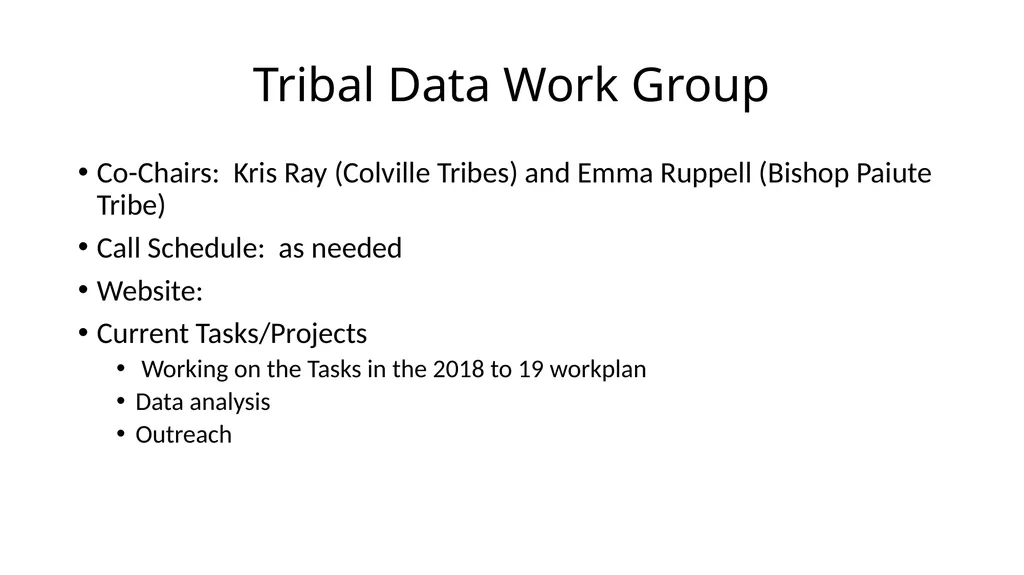
slide3. Tribal Data Work Group Co-Chairs: Kris Ray (Colville Tribes) and Emma Ruppell (Bishop Paiute Tribe)
Call Schedule: as needed
Website:
Current Tasks/Projects
Working on the Tasks in the 2018 to 19 workplan
Data analysis
Outreach<br>
slide4. Status Report for Tribal Data Work Group Approach
Reviewed current workplan
Identified work tasks
Scheduled tasks to begin
Status
Reviewing proposal from ITEP for data analysis and outreach material development
Milestones – Most products completed within 10 week of contract
Coordination and Next Steps – TDWG calls and keep other WG informed<br>
slide5. Fire and Smoke Work Group<br>
slide6. Fire & Smoke Work Group Co-Chairs: Sara Strachan, Josh Hall
Call Schedule: bimonthly, more frequent calls if/as needed
Website: http://www.wrapair2.org/FSWG.aspx
Current Tasks/Projects
2014 WRAP FETS data review
National 2016 Emissions Modeling Platform – Fires WG support for WRAP region
Steady update/maintenance work on WRAP FETS website and database<br>
slide7. Status Report for Fire & Smoke Work Group Fire season is underway…!
Approach: 4 tasks in 2018-19 by Air Sciences, Inc. (contracted work)
evaluation of the 2014 NEI, evaluation of adjustments for sensitivity testing, and evaluation of usefulness of 2016 EPA inventory effort for understanding the role of fire;
using year specific inventory to develop inventory representative of 5-year baseline;
scaling the representative inventory for sensitivity testing; and
updating the Fire Emissions Tracking System (FETS)
Status
FSWG calls scheduled August 27, October 4, and December 13
Milestones
Align with modeling input file milestones
Coordination and Next Steps
September 24th call<br>
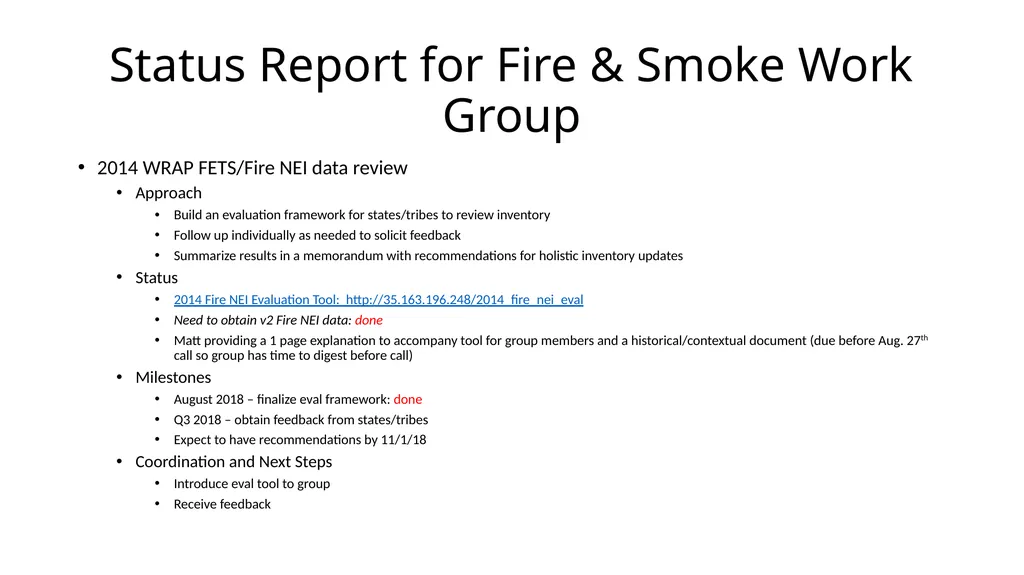
slide8. Status Report for Fire & Smoke Work Group 2014 WRAP FETS/Fire NEI data review
Approach
Build an evaluation framework for states/tribes to review inventory
Follow up individually as needed to solicit feedback
Summarize results in a memorandum with recommendations for holistic inventory updates
Status
2014 Fire NEI Evaluation Tool: http://35.163.196.248/2014_fire_nei_eval
Need to obtain v2 Fire NEI data: done
Matt providing a 1 page explanation to accompany tool for group members and a historical/contextual document (due before Aug. 27th call so group has time to digest before call)
Milestones
August 2018 – finalize eval framework: done
Q3 2018 – obtain feedback from states/tribes
Expect to have recommendations by 11/1/18
Coordination and Next Steps
Introduce eval tool to group
Receive feedback<br>
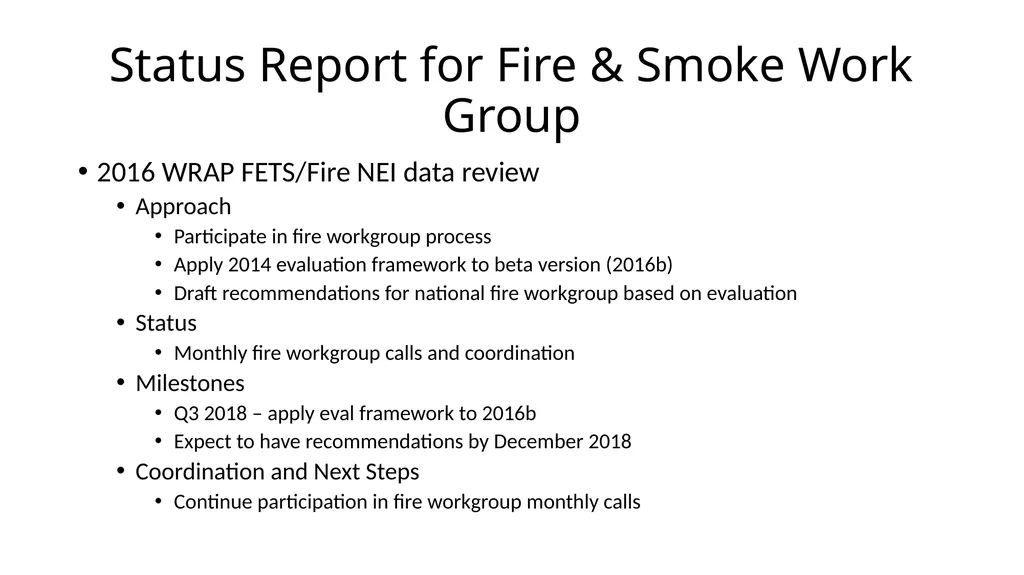
slide9. Status Report for Fire & Smoke Work Group 2016 WRAP FETS/Fire NEI data review
Approach
Participate in fire workgroup process
Apply 2014 evaluation framework to beta version (2016b)
Draft recommendations for national fire workgroup based on evaluation
Status
Monthly fire workgroup calls and coordination
Milestones
Q3 2018 – apply eval framework to 2016b
Expect to have recommendations by December 2018
Coordination and Next Steps
Continue participation in fire workgroup monthly calls<br>
slide10. Oil and Gas Work Group<br>
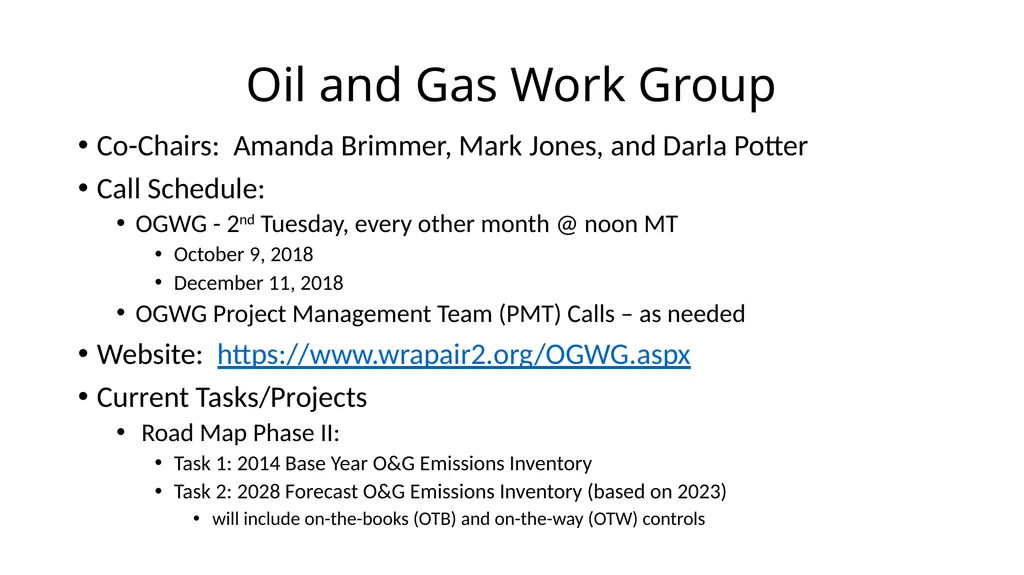
slide11. Oil and Gas Work Group Co-Chairs: Amanda Brimmer, Mark Jones, and Darla Potter
Call Schedule:
OGWG - 2nd Tuesday, every other month @ noon MT
October 9, 2018
December 11, 2018
OGWG Project Management Team (PMT) Calls – as needed
Website: https://www.wrapair2.org/OGWG.aspx
Current Tasks/Projects
Road Map Phase II:
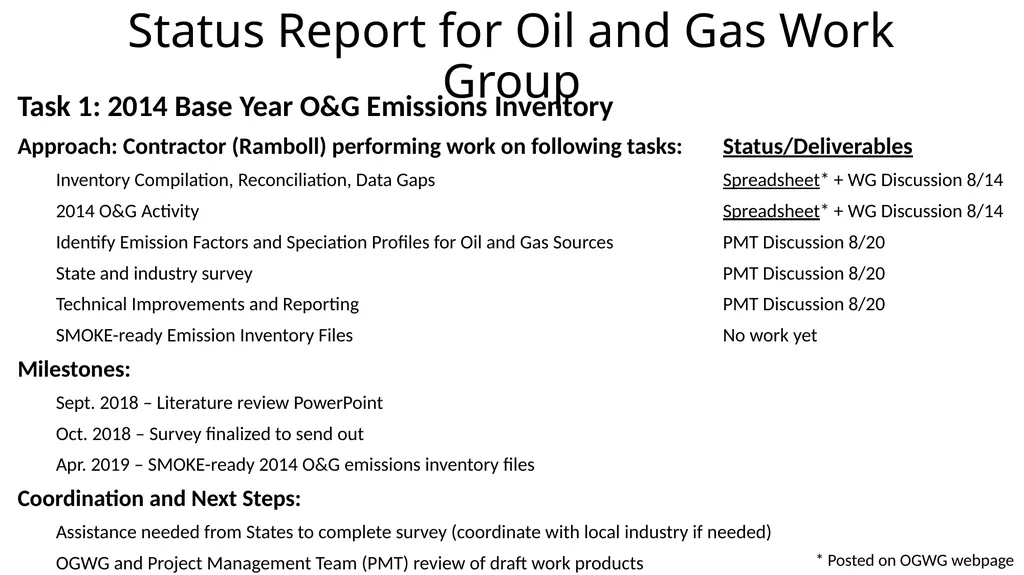
Task 1: 2014 Base Year O&G Emissions Inventory
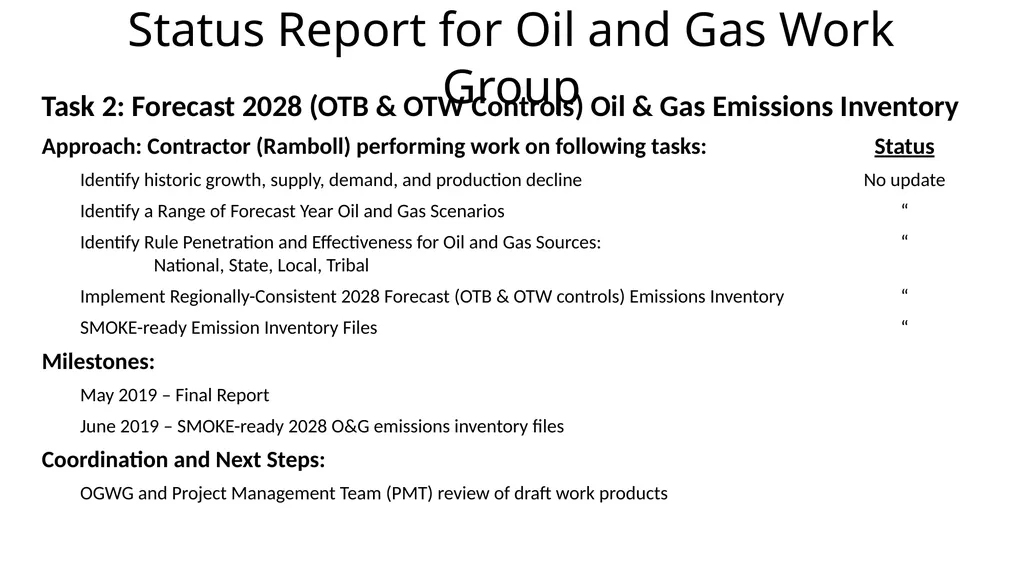
Task 2: 2028 Forecast O&G Emissions Inventory (based on 2023)
will include on-the-books (OTB) and on-the-way (OTW) controls<br>
slide12. Status Report for Oil and Gas Work Group * Posted on OGWG webpage<br>
slide13. Status Report for Oil and Gas Work Group<br>
slide14. Regional Technical Operations Work Group<br>
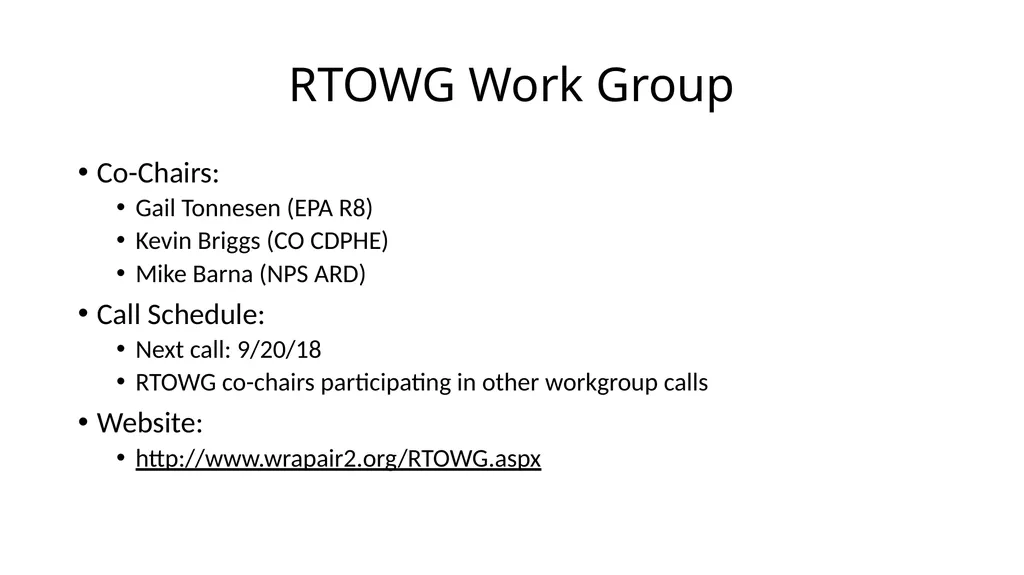
slide15. RTOWG Work Group Co-Chairs:
Gail Tonnesen (EPA R8)
Kevin Briggs (CO CDPHE)
Mike Barna (NPS ARD)
Call Schedule:
Next call: 9/20/18
RTOWG co-chairs participating in other workgroup calls
Website:
http://www.wrapair2.org/RTOWG.aspx<br>
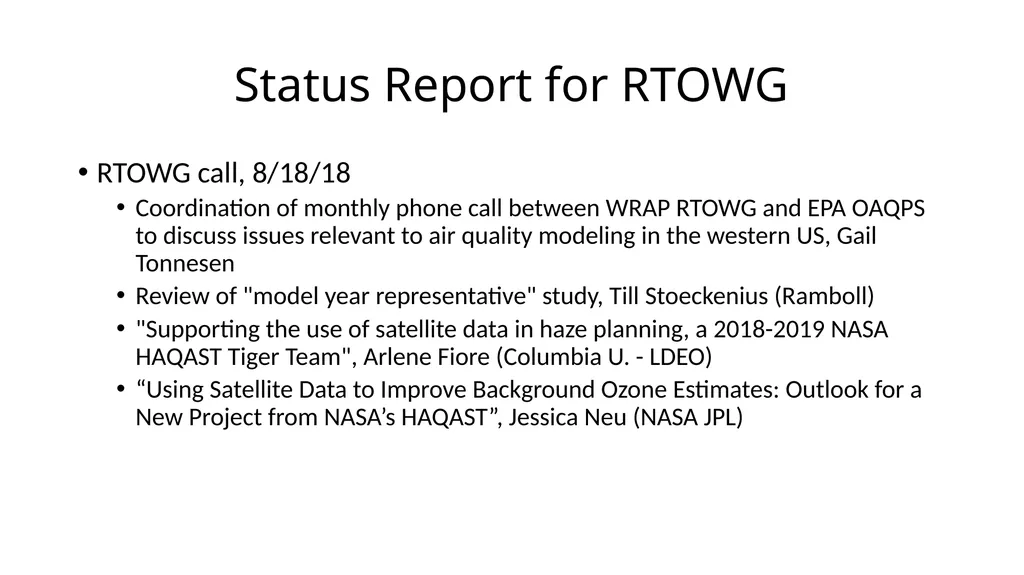
slide16. Status Report for RTOWG RTOWG call, 8/18/18
Coordination of monthly phone call between WRAP RTOWG and EPA OAQPS to discuss issues relevant to air quality modeling in the western US, Gail Tonnesen
Review of "model year representative" study, Till Stoeckenius (Ramboll)
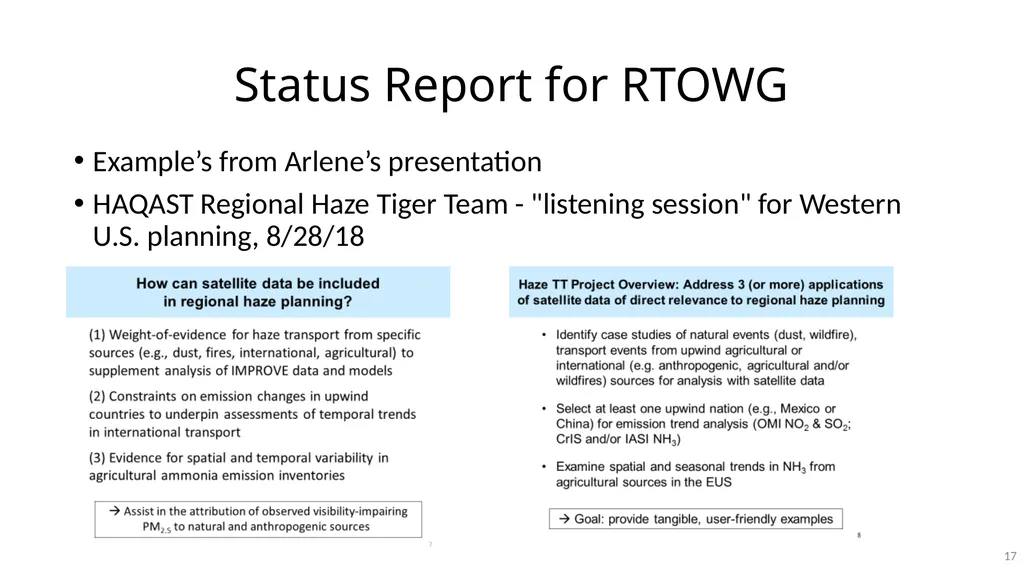
"Supporting the use of satellite data in haze planning, a 2018-2019 NASA HAQAST Tiger Team", Arlene Fiore (Columbia U. - LDEO)
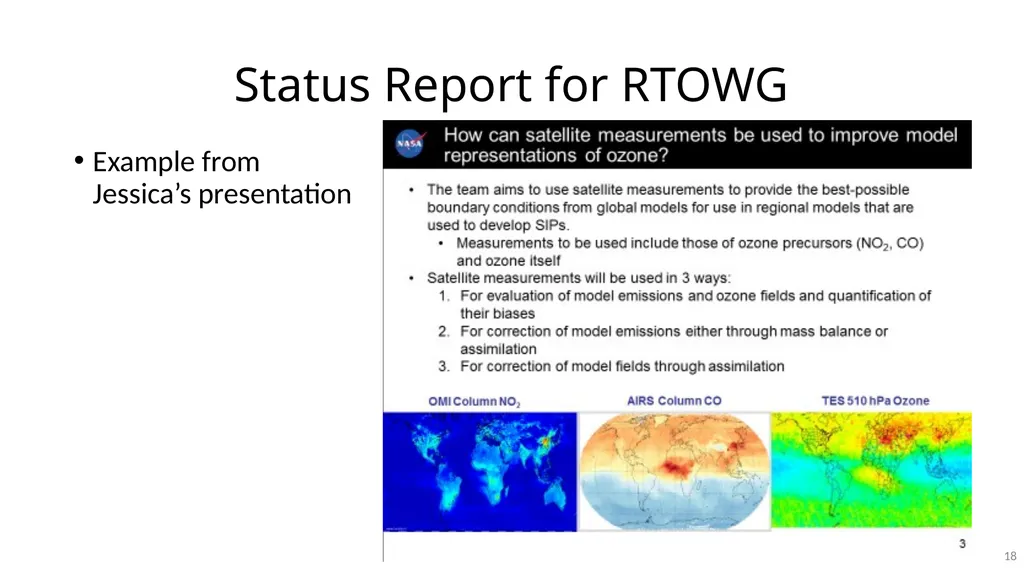
“Using Satellite Data to Improve Background Ozone Estimates: Outlook for a New Project from NASA’s HAQAST”, Jessica Neu (NASA JPL)<br>
slide17. 17 Status Report for RTOWG Example’s from Arlene’s presentation
HAQAST Regional Haze Tiger Team - "listening session" for Western U.S. planning, 8/28/18<br>
slide18. 18 Status Report for RTOWG Example from Jessica’s presentation<br>
slide19. Regional Haze Planning Work Group<br>
slide20. WRAP TSC/Co-Chairs Call Workplan Progress Update August 29, 2018 Tribal Data WG
Fire and Smoke WG
Oil and Gas WG
Regional Technical Operations WG
Regional Haze Planning WG<br>
slide21. Co-Chairs: Tina Suarez-Murias (CARB) & Jay Baker (UT DEQ)
Call Schedule: October 2, 2018 noon – 2:00 Mountain Time
1st Tuesday every even month
Website: https://www.wrapair2.org/RHPWG.aspx
Current Tasks/Projects – all related to State Regional Haze SIP preparation (2018-2019)
Review and provide feedback on the Internal & External Commitments and Schedule document
Evaluated alternatives to EPA guidance metric for selecting Most Impaired Days (MID)
Confirmed 2014 NEI v2 as base year inventory and refining state-by-state for modeling consistency
Drafted Screening Tool protocol to identify potential sources for four-factor analysis
Beta-testing shared Database “TSSv.2” for Monitoring, Emissions, and Modeling
State–State, State–FLM, State–Tribes, and Public Communication and Outreach
Coordinate with other Work Groups and WRAP Technical Steering Committee
Conference Call notes on website with presentations and links Regional Haze Planning Work Group<br>
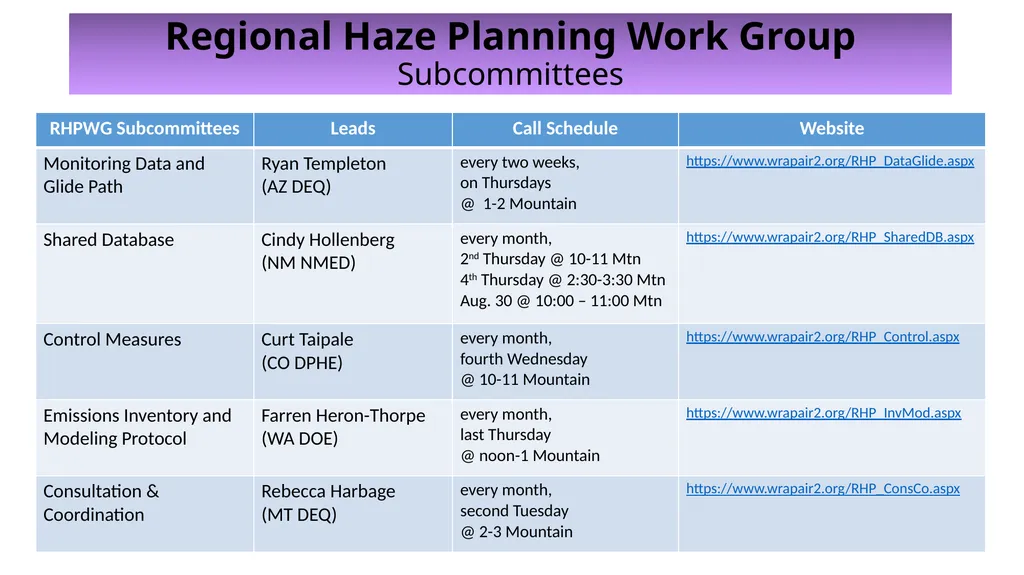
slide22. Regional Haze Planning Work Group
Subcommittees<br>
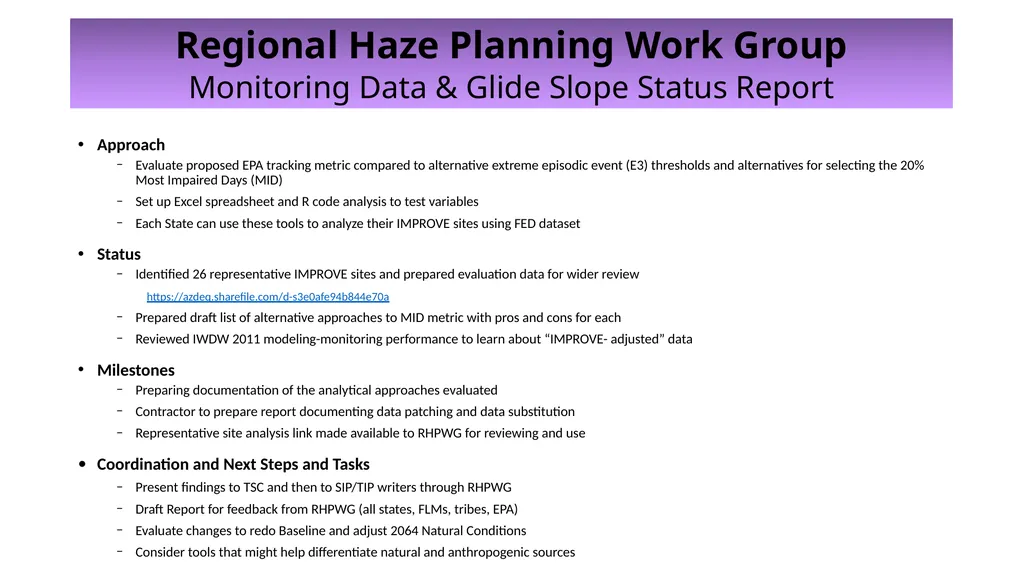
slide23. Regional Haze Planning Work Group Monitoring Data & Glide Slope Status Report Approach
Evaluate proposed EPA tracking metric compared to alternative extreme episodic event (E3) thresholds and alternatives for selecting the 20% Most Impaired Days (MID)
Set up Excel spreadsheet and R code analysis to test variables
Each State can use these tools to analyze their IMPROVE sites using FED dataset
Status
Identified 26 representative IMPROVE sites and prepared evaluation data for wider review
https://azdeq.sharefile.com/d-s3e0afe94b844e70a
Prepared draft list of alternative approaches to MID metric with pros and cons for each
Reviewed IWDW 2011 modeling-monitoring performance to learn about “IMPROVE- adjusted” data
Milestones
Preparing documentation of the analytical approaches evaluated
Contractor to prepare report documenting data patching and data substitution
Representative site analysis link made available to RHPWG for reviewing and use
Coordination and Next Steps and Tasks
Present findings to TSC and then to SIP/TIP writers through RHPWG
Draft Report for feedback from RHPWG (all states, FLMs, tribes, EPA)
Evaluate changes to redo Baseline and adjust 2064 Natural Conditions
Consider tools that might help differentiate natural and anthropogenic sources<br>
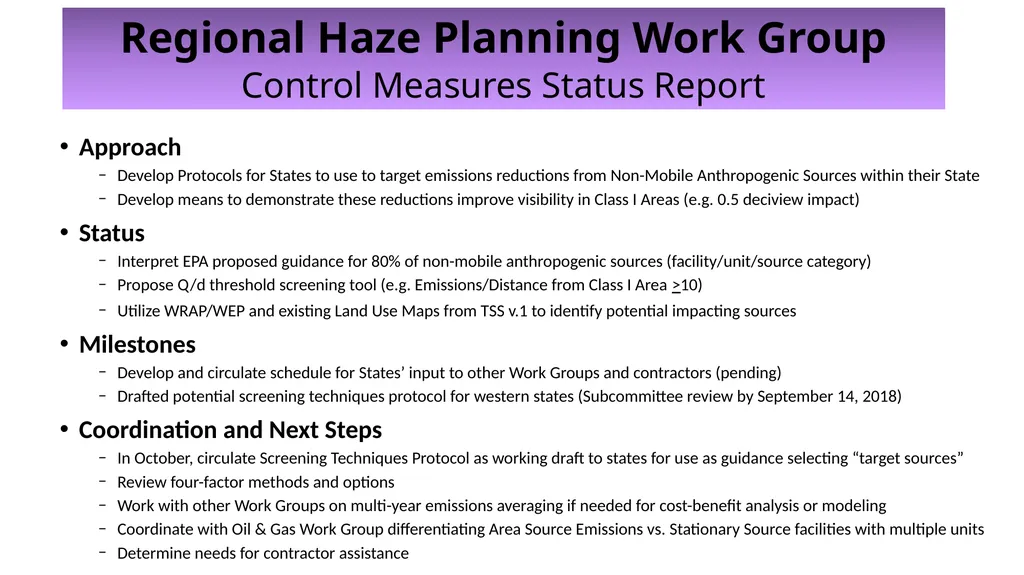
slide24. Regional Haze Planning Work Group Control Measures Status Report Approach
Develop Protocols for States to use to target emissions reductions from Non-Mobile Anthropogenic Sources within their State
Develop means to demonstrate these reductions improve visibility in Class I Areas (e.g. 0.5 deciview impact)
Status
Interpret EPA proposed guidance for 80% of non-mobile anthropogenic sources (facility/unit/source category)
Propose Q/d threshold screening tool (e.g. Emissions/Distance from Class I Area >10)
Utilize WRAP/WEP and existing Land Use Maps from TSS v.1 to identify potential impacting sources
Milestones
Develop and circulate schedule for States’ input to other Work Groups and contractors (pending)
Drafted potential screening techniques protocol for western states (Subcommittee review by September 14, 2018)
Coordination and Next Steps
In October, circulate Screening Techniques Protocol as working draft to states for use as guidance selecting “target sources”
Review four-factor methods and options
Work with other Work Groups on multi-year emissions averaging if needed for cost-benefit analysis or modeling
Coordinate with Oil & Gas Work Group differentiating Area Source Emissions vs. Stationary Source facilities with multiple units
Determine needs for contractor assistance<br>
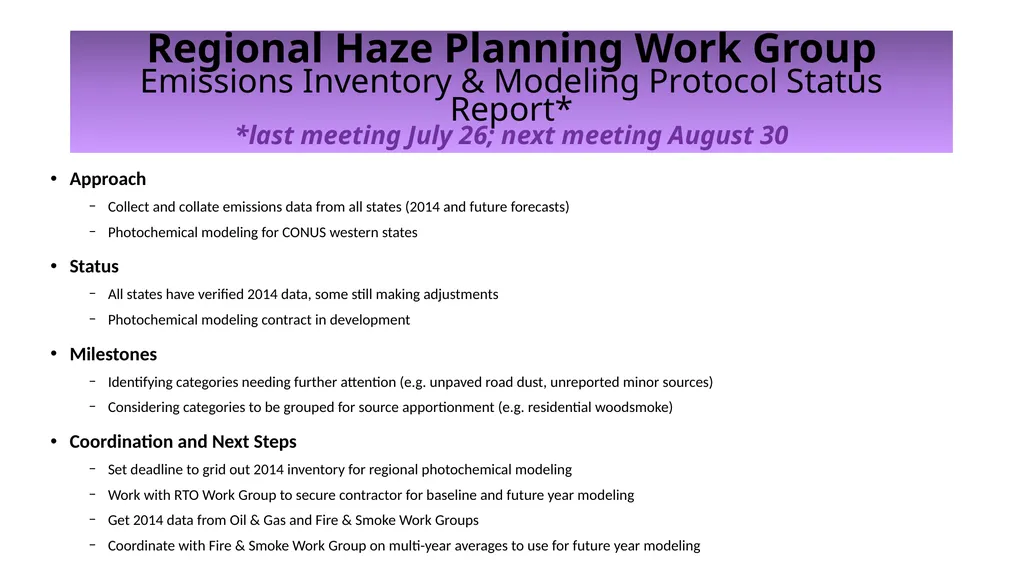
slide25. Regional Haze Planning Work Group Emissions Inventory & Modeling Protocol Status Report* *last meeting July 26; next meeting August 30 Approach
Collect and collate emissions data from all states (2014 and future forecasts)
Photochemical modeling for CONUS western states
Status
All states have verified 2014 data, some still making adjustments
Photochemical modeling contract in development
Milestones
Identifying categories needing further attention (e.g. unpaved road dust, unreported minor sources)
Considering categories to be grouped for source apportionment (e.g. residential woodsmoke)
Coordination and Next Steps
Set deadline to grid out 2014 inventory for regional photochemical modeling
Work with RTO Work Group to secure contractor for baseline and future year modeling
Get 2014 data from Oil & Gas and Fire & Smoke Work Groups
Coordinate with Fire & Smoke Work Group on multi-year averages to use for future year modeling<br>
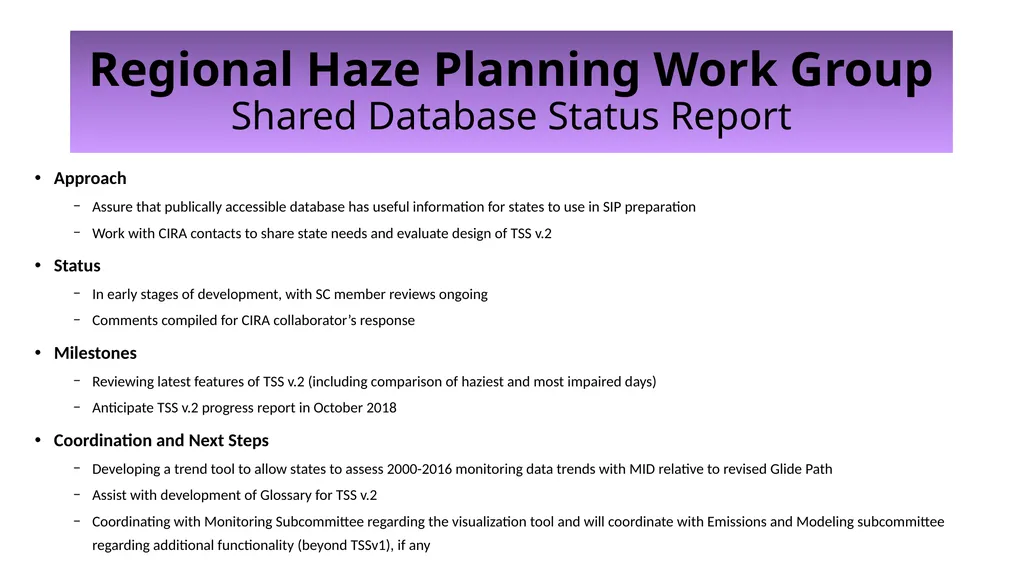
slide26. Regional Haze Planning Work Group Shared Database Status Report Approach
Assure that publically accessible database has useful information for states to use in SIP preparation
Work with CIRA contacts to share state needs and evaluate design of TSS v.2
Status
In early stages of development, with SC member reviews ongoing
Comments compiled for CIRA collaborator’s response
Milestones
Reviewing latest features of TSS v.2 (including comparison of haziest and most impaired days)
Anticipate TSS v.2 progress report in October 2018
Coordination and Next Steps
Developing a trend tool to allow states to assess 2000-2016 monitoring data trends with MID relative to revised Glide Path
Assist with development of Glossary for TSS v.2
Coordinating with Monitoring Subcommittee regarding the visualization tool and will coordinate with Emissions and Modeling subcommittee regarding additional functionality (beyond TSSv1), if any<br>
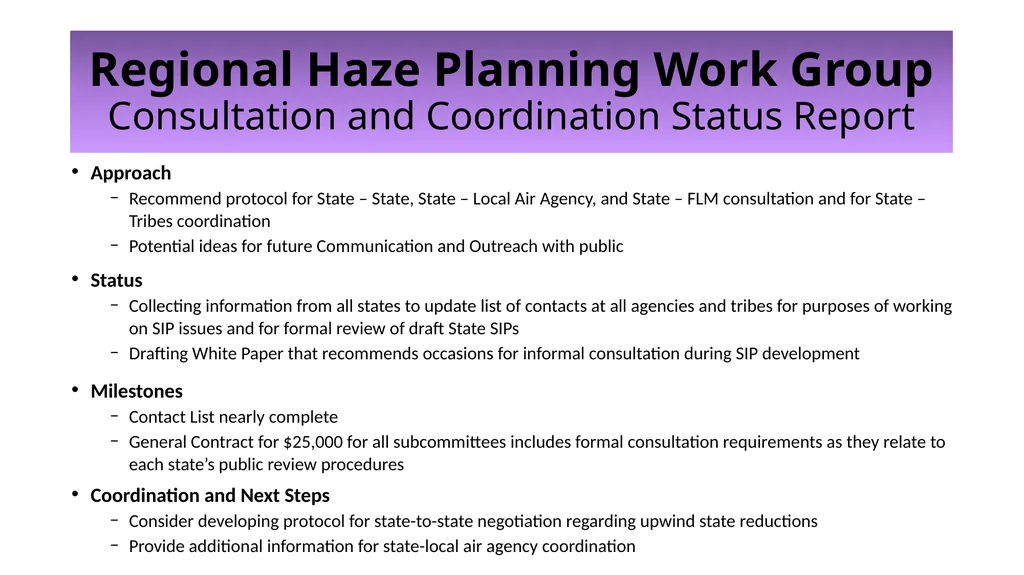
slide27. Regional Haze Planning Work Group Consultation and Coordination Status Report Approach
Recommend protocol for State – State, State – Local Air Agency, and State – FLM consultation and for State – Tribes coordination
Potential ideas for future Communication and Outreach with public
Status
Collecting information from all states to update list of contacts at all agencies and tribes for purposes of working on SIP issues and for formal review of draft State SIPs
Drafting White Paper that recommends occasions for informal consultation during SIP development
Milestones
Contact List nearly complete
General Contract for $25,000 for all subcommittees includes formal consultation requirements as they relate to each state’s public review procedures
Coordination and Next Steps
Consider developing protocol for state-to-state negotiation regarding upwind state reductions
Provide additional information for state-local air agency coordination<br>
slide28. End of Workplan Progress Update<br>
Fire and Smoke WG
Oil and Gas WG
Regional Technical Operations WG
Regional Haze Planning WG<br>
slide2. Tribal Data Work Group<br>
slide3. Tribal Data Work Group Co-Chairs: Kris Ray (Colville Tribes) and Emma Ruppell (Bishop Paiute Tribe)
Call Schedule: as needed
Website:
Current Tasks/Projects
Working on the Tasks in the 2018 to 19 workplan
Data analysis
Outreach<br>
slide4. Status Report for Tribal Data Work Group Approach
Reviewed current workplan
Identified work tasks
Scheduled tasks to begin
Status
Reviewing proposal from ITEP for data analysis and outreach material development
Milestones – Most products completed within 10 week of contract
Coordination and Next Steps – TDWG calls and keep other WG informed<br>
slide5. Fire and Smoke Work Group<br>
slide6. Fire & Smoke Work Group Co-Chairs: Sara Strachan, Josh Hall
Call Schedule: bimonthly, more frequent calls if/as needed
Website: http://www.wrapair2.org/FSWG.aspx
Current Tasks/Projects
2014 WRAP FETS data review
National 2016 Emissions Modeling Platform – Fires WG support for WRAP region
Steady update/maintenance work on WRAP FETS website and database<br>
slide7. Status Report for Fire & Smoke Work Group Fire season is underway…!
Approach: 4 tasks in 2018-19 by Air Sciences, Inc. (contracted work)
evaluation of the 2014 NEI, evaluation of adjustments for sensitivity testing, and evaluation of usefulness of 2016 EPA inventory effort for understanding the role of fire;
using year specific inventory to develop inventory representative of 5-year baseline;
scaling the representative inventory for sensitivity testing; and
updating the Fire Emissions Tracking System (FETS)
Status
FSWG calls scheduled August 27, October 4, and December 13
Milestones
Align with modeling input file milestones
Coordination and Next Steps
September 24th call<br>
slide8. Status Report for Fire & Smoke Work Group 2014 WRAP FETS/Fire NEI data review
Approach
Build an evaluation framework for states/tribes to review inventory
Follow up individually as needed to solicit feedback
Summarize results in a memorandum with recommendations for holistic inventory updates
Status
2014 Fire NEI Evaluation Tool: http://35.163.196.248/2014_fire_nei_eval
Need to obtain v2 Fire NEI data: done
Matt providing a 1 page explanation to accompany tool for group members and a historical/contextual document (due before Aug. 27th call so group has time to digest before call)
Milestones
August 2018 – finalize eval framework: done
Q3 2018 – obtain feedback from states/tribes
Expect to have recommendations by 11/1/18
Coordination and Next Steps
Introduce eval tool to group
Receive feedback<br>
slide9. Status Report for Fire & Smoke Work Group 2016 WRAP FETS/Fire NEI data review
Approach
Participate in fire workgroup process
Apply 2014 evaluation framework to beta version (2016b)
Draft recommendations for national fire workgroup based on evaluation
Status
Monthly fire workgroup calls and coordination
Milestones
Q3 2018 – apply eval framework to 2016b
Expect to have recommendations by December 2018
Coordination and Next Steps
Continue participation in fire workgroup monthly calls<br>
slide10. Oil and Gas Work Group<br>
slide11. Oil and Gas Work Group Co-Chairs: Amanda Brimmer, Mark Jones, and Darla Potter
Call Schedule:
OGWG - 2nd Tuesday, every other month @ noon MT
October 9, 2018
December 11, 2018
OGWG Project Management Team (PMT) Calls – as needed
Website: https://www.wrapair2.org/OGWG.aspx
Current Tasks/Projects
Road Map Phase II:
Task 1: 2014 Base Year O&G Emissions Inventory
Task 2: 2028 Forecast O&G Emissions Inventory (based on 2023)
will include on-the-books (OTB) and on-the-way (OTW) controls<br>
slide12. Status Report for Oil and Gas Work Group * Posted on OGWG webpage<br>
slide13. Status Report for Oil and Gas Work Group<br>
slide14. Regional Technical Operations Work Group<br>
slide15. RTOWG Work Group Co-Chairs:
Gail Tonnesen (EPA R8)
Kevin Briggs (CO CDPHE)
Mike Barna (NPS ARD)
Call Schedule:
Next call: 9/20/18
RTOWG co-chairs participating in other workgroup calls
Website:
http://www.wrapair2.org/RTOWG.aspx<br>
slide16. Status Report for RTOWG RTOWG call, 8/18/18
Coordination of monthly phone call between WRAP RTOWG and EPA OAQPS to discuss issues relevant to air quality modeling in the western US, Gail Tonnesen
Review of "model year representative" study, Till Stoeckenius (Ramboll)
"Supporting the use of satellite data in haze planning, a 2018-2019 NASA HAQAST Tiger Team", Arlene Fiore (Columbia U. - LDEO)
“Using Satellite Data to Improve Background Ozone Estimates: Outlook for a New Project from NASA’s HAQAST”, Jessica Neu (NASA JPL)<br>
slide17. 17 Status Report for RTOWG Example’s from Arlene’s presentation
HAQAST Regional Haze Tiger Team - "listening session" for Western U.S. planning, 8/28/18<br>
slide18. 18 Status Report for RTOWG Example from Jessica’s presentation<br>
slide19. Regional Haze Planning Work Group<br>
slide20. WRAP TSC/Co-Chairs Call Workplan Progress Update August 29, 2018 Tribal Data WG
Fire and Smoke WG
Oil and Gas WG
Regional Technical Operations WG
Regional Haze Planning WG<br>
slide21. Co-Chairs: Tina Suarez-Murias (CARB) & Jay Baker (UT DEQ)
Call Schedule: October 2, 2018 noon – 2:00 Mountain Time
1st Tuesday every even month
Website: https://www.wrapair2.org/RHPWG.aspx
Current Tasks/Projects – all related to State Regional Haze SIP preparation (2018-2019)
Review and provide feedback on the Internal & External Commitments and Schedule document
Evaluated alternatives to EPA guidance metric for selecting Most Impaired Days (MID)
Confirmed 2014 NEI v2 as base year inventory and refining state-by-state for modeling consistency
Drafted Screening Tool protocol to identify potential sources for four-factor analysis
Beta-testing shared Database “TSSv.2” for Monitoring, Emissions, and Modeling
State–State, State–FLM, State–Tribes, and Public Communication and Outreach
Coordinate with other Work Groups and WRAP Technical Steering Committee
Conference Call notes on website with presentations and links Regional Haze Planning Work Group<br>
slide22. Regional Haze Planning Work Group
Subcommittees<br>
slide23. Regional Haze Planning Work Group Monitoring Data & Glide Slope Status Report Approach
Evaluate proposed EPA tracking metric compared to alternative extreme episodic event (E3) thresholds and alternatives for selecting the 20% Most Impaired Days (MID)
Set up Excel spreadsheet and R code analysis to test variables
Each State can use these tools to analyze their IMPROVE sites using FED dataset
Status
Identified 26 representative IMPROVE sites and prepared evaluation data for wider review
https://azdeq.sharefile.com/d-s3e0afe94b844e70a
Prepared draft list of alternative approaches to MID metric with pros and cons for each
Reviewed IWDW 2011 modeling-monitoring performance to learn about “IMPROVE- adjusted” data
Milestones
Preparing documentation of the analytical approaches evaluated
Contractor to prepare report documenting data patching and data substitution
Representative site analysis link made available to RHPWG for reviewing and use
Coordination and Next Steps and Tasks
Present findings to TSC and then to SIP/TIP writers through RHPWG
Draft Report for feedback from RHPWG (all states, FLMs, tribes, EPA)
Evaluate changes to redo Baseline and adjust 2064 Natural Conditions
Consider tools that might help differentiate natural and anthropogenic sources<br>
slide24. Regional Haze Planning Work Group Control Measures Status Report Approach
Develop Protocols for States to use to target emissions reductions from Non-Mobile Anthropogenic Sources within their State
Develop means to demonstrate these reductions improve visibility in Class I Areas (e.g. 0.5 deciview impact)
Status
Interpret EPA proposed guidance for 80% of non-mobile anthropogenic sources (facility/unit/source category)
Propose Q/d threshold screening tool (e.g. Emissions/Distance from Class I Area >10)
Utilize WRAP/WEP and existing Land Use Maps from TSS v.1 to identify potential impacting sources
Milestones
Develop and circulate schedule for States’ input to other Work Groups and contractors (pending)
Drafted potential screening techniques protocol for western states (Subcommittee review by September 14, 2018)
Coordination and Next Steps
In October, circulate Screening Techniques Protocol as working draft to states for use as guidance selecting “target sources”
Review four-factor methods and options
Work with other Work Groups on multi-year emissions averaging if needed for cost-benefit analysis or modeling
Coordinate with Oil & Gas Work Group differentiating Area Source Emissions vs. Stationary Source facilities with multiple units
Determine needs for contractor assistance<br>
slide25. Regional Haze Planning Work Group Emissions Inventory & Modeling Protocol Status Report* *last meeting July 26; next meeting August 30 Approach
Collect and collate emissions data from all states (2014 and future forecasts)
Photochemical modeling for CONUS western states
Status
All states have verified 2014 data, some still making adjustments
Photochemical modeling contract in development
Milestones
Identifying categories needing further attention (e.g. unpaved road dust, unreported minor sources)
Considering categories to be grouped for source apportionment (e.g. residential woodsmoke)
Coordination and Next Steps
Set deadline to grid out 2014 inventory for regional photochemical modeling
Work with RTO Work Group to secure contractor for baseline and future year modeling
Get 2014 data from Oil & Gas and Fire & Smoke Work Groups
Coordinate with Fire & Smoke Work Group on multi-year averages to use for future year modeling<br>
slide26. Regional Haze Planning Work Group Shared Database Status Report Approach
Assure that publically accessible database has useful information for states to use in SIP preparation
Work with CIRA contacts to share state needs and evaluate design of TSS v.2
Status
In early stages of development, with SC member reviews ongoing
Comments compiled for CIRA collaborator’s response
Milestones
Reviewing latest features of TSS v.2 (including comparison of haziest and most impaired days)
Anticipate TSS v.2 progress report in October 2018
Coordination and Next Steps
Developing a trend tool to allow states to assess 2000-2016 monitoring data trends with MID relative to revised Glide Path
Assist with development of Glossary for TSS v.2
Coordinating with Monitoring Subcommittee regarding the visualization tool and will coordinate with Emissions and Modeling subcommittee regarding additional functionality (beyond TSSv1), if any<br>
slide27. Regional Haze Planning Work Group Consultation and Coordination Status Report Approach
Recommend protocol for State – State, State – Local Air Agency, and State – FLM consultation and for State – Tribes coordination
Potential ideas for future Communication and Outreach with public
Status
Collecting information from all states to update list of contacts at all agencies and tribes for purposes of working on SIP issues and for formal review of draft State SIPs
Drafting White Paper that recommends occasions for informal consultation during SIP development
Milestones
Contact List nearly complete
General Contract for $25,000 for all subcommittees includes formal consultation requirements as they relate to each state’s public review procedures
Coordination and Next Steps
Consider developing protocol for state-to-state negotiation regarding upwind state reductions
Provide additional information for state-local air agency coordination<br>
slide28. End of Workplan Progress Update<br>