Wrong clamps can kill your chip!!.... find them
Description: Wrong clamps can kill your chip!!.... find them early Akhil Arora , Engineer, Senior Staff Rajiv Kumar, Engineer, Senior Staff Sonik Sachdeva, Engineer, PrincipalManager Accellera Systems Initiative 1 Contents Introduction The Clamping
Related Topics
Download Presentation
"Wrong clamps can kill your chip!!.... find them" is the property of its rightful owner. Permission is granted to download and print the materials on this website for personal, non-commercial use only, and to display it on your personal computer provided you do not modify the materials and that you retain all copyright notices contained in the materials. By downloading content from our website, you accept the terms of this agreement.
Presentation Transcript
slide1. Wrong clamps can kill your chip!!.... find them early Akhil Arora , Engineer, Senior Staff
Rajiv Kumar, Engineer, Senior Staff
Sonik Sachdeva, Engineer, Principal/Manager © Accellera Systems Initiative 1<br>
slide2. Contents Introduction
The Clamping Challenge
Proposed solution
Implementation
Results
Extensions
Conclusion © Accellera Systems Initiative 2<br>
slide3. Introduction Handheld/battery operated devices are having unceasing demand for new features and yet be extremely power efficient which has led to
Power architecture complexity
PA Verification has become more demanding
Verifying iso strategies is one of the challenging tasks of PA verification © Accellera Systems Initiative 3<br>
slide4. Isolation verification : The Clamping challenge © Accellera Systems Initiative 4<br>
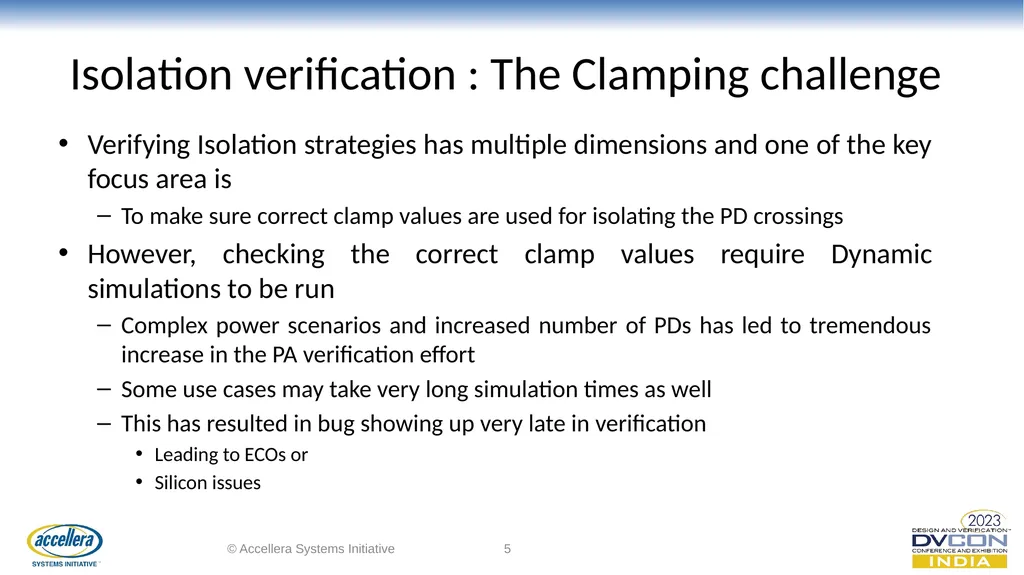
slide5. Isolation verification : The Clamping challenge Verifying Isolation strategies has multiple dimensions and one of the key focus area is
To make sure correct clamp values are used for isolating the PD crossings
However, checking the correct clamp values require Dynamic simulations to be run
Complex power scenarios and increased number of PDs has led to tremendous increase in the PA verification effort
Some use cases may take very long simulation times as well
This has resulted in bug showing up very late in verification
Leading to ECOs or
Silicon issues © Accellera Systems Initiative 5<br>
slide6. Proposed solution : ISOvsReset © Accellera Systems Initiative 6 Extract the isolated signals and their specified clamp values
Extract the post-reset values of the isolated signals from the fsdb dump of a sanity power aware test
Compare the Specified clamp values with the reset values of the isolated signals
Designer to signoff any clamp values which are different than the post-reset values
Also, provides an opportunity to cross check the clamps with latch type values<br>
slide7. ISOvsReset : Clamp Value Extraction © Accellera Systems Initiative 7 UPF files which specify the signals to be isolated and their clamp values, could be distributed across many locations at SoC level
Reuse from core to SS to SoC
May be challenging to read all UPF files and extract the specification
Wild card use also adds another level of complexity
Verification tools generally, generate reports/logs for UPF annotations done over RTL
<compile_area>/mvsim_native_reports/isolation_insertion_info.txt : Report for inferred isolation strategies mentioned in the UPF files
Report format : <isolation_control> <isolation_sense> <clamp_value> <isolated_signal><br>
slide8. ISOvsReset : Reset Value Extraction © Accellera Systems Initiative 8 Extract signal list from isolation_insertion_info.txt report
Fsdbreport tcl utility can be used to extract the reset values of isolated signals
Unix>> fsdbreport <fsdb_name> -s <list of all the isolated signals> -strobe <reset_event>
C-APIs provided by the simulator vendors can also be used for faster extraction from the waveform database for complex and big SoC designs<br>
slide9. ISOvsReset : Reset Value Extraction © Accellera Systems Initiative 9 At SoC level, there are Lacs of ISO cells inferred from Power intent
Extracting the reset values for such large number of signals from FSDB is much faster, efficient and scalable using the C-APIs Sample APIs which can be used to effectively extract design values<br>
slide10. ISOvsReset : Comparison © Accellera Systems Initiative 10 Perl/Python script can be used to compare the reset values with the expected clamp values of the isolated signals
Comparison Report:
signal name : <hierarchical name of the isolated signal> , iso_spec : <low/high/latch> , reset_value : <low/high>
Designer to review the differences between the reset and the expected isolation values and provide sign-off
Designer can also cross check the “Latch” type clamp values for correctness as per design<br>
slide11. ISOvsReset : Results © Accellera Systems Initiative 11 IsoVsReset methodology has been used for multiple SoC programs
Uncovered multiple Isolation value related bugs
All bugs were caught much before the completion of PA test suite<br>
slide12. Extensions : IsoKeepers X-Prop © Accellera Systems Initiative 12 IsoVsReset Methodology can be extended further to resolve other Problems of PA simulations
IsoKeepers can cause X-Prop in PAGLS
Required to be initialized/deposited
Without initialization can lead to considerable debug effort in X-tracing
IsoVsReset extended to find the list of IsoKeepers Switchable PD List Iso Keeper List MVSIM Report RTL UPF Switchable PD List Iso Keeper List MVSIM Report RTL UPF<br>
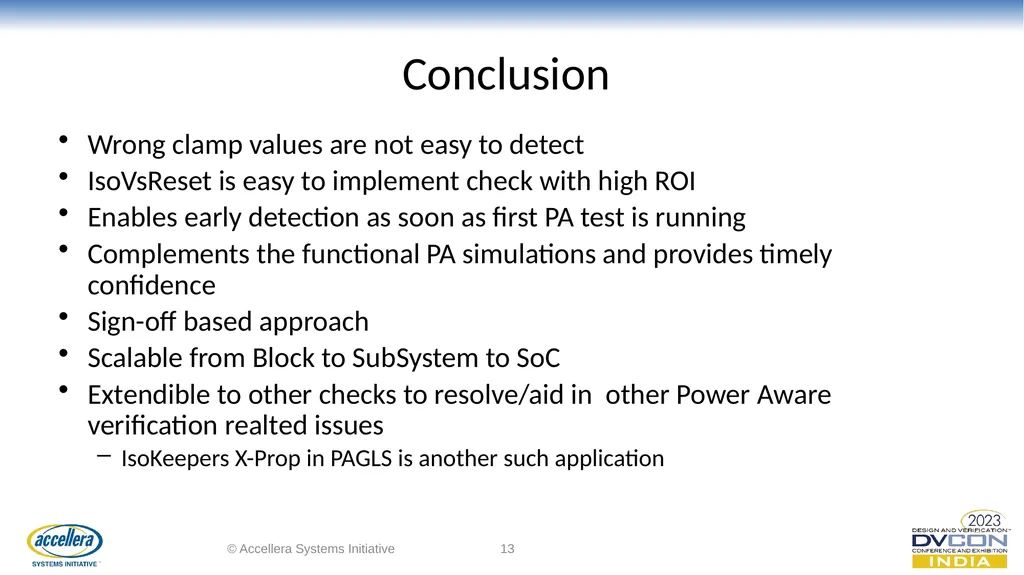
slide13. Conclusion © Accellera Systems Initiative 13 Wrong clamp values are not easy to detect
IsoVsReset is easy to implement check with high ROI
Enables early detection as soon as first PA test is running
Complements the functional PA simulations and provides timely confidence
Sign-off based approach
Scalable from Block to SubSystem to SoC
Extendible to other checks to resolve/aid in other Power Aware verification realted issues
IsoKeepers X-Prop in PAGLS is another such application<br>
slide14. Questions © Accellera Systems Initiative 14<br>
Rajiv Kumar, Engineer, Senior Staff
Sonik Sachdeva, Engineer, Principal/Manager © Accellera Systems Initiative 1<br>
slide2. Contents Introduction
The Clamping Challenge
Proposed solution
Implementation
Results
Extensions
Conclusion © Accellera Systems Initiative 2<br>
slide3. Introduction Handheld/battery operated devices are having unceasing demand for new features and yet be extremely power efficient which has led to
Power architecture complexity
PA Verification has become more demanding
Verifying iso strategies is one of the challenging tasks of PA verification © Accellera Systems Initiative 3<br>
slide4. Isolation verification : The Clamping challenge © Accellera Systems Initiative 4<br>
slide5. Isolation verification : The Clamping challenge Verifying Isolation strategies has multiple dimensions and one of the key focus area is
To make sure correct clamp values are used for isolating the PD crossings
However, checking the correct clamp values require Dynamic simulations to be run
Complex power scenarios and increased number of PDs has led to tremendous increase in the PA verification effort
Some use cases may take very long simulation times as well
This has resulted in bug showing up very late in verification
Leading to ECOs or
Silicon issues © Accellera Systems Initiative 5<br>
slide6. Proposed solution : ISOvsReset © Accellera Systems Initiative 6 Extract the isolated signals and their specified clamp values
Extract the post-reset values of the isolated signals from the fsdb dump of a sanity power aware test
Compare the Specified clamp values with the reset values of the isolated signals
Designer to signoff any clamp values which are different than the post-reset values
Also, provides an opportunity to cross check the clamps with latch type values<br>
slide7. ISOvsReset : Clamp Value Extraction © Accellera Systems Initiative 7 UPF files which specify the signals to be isolated and their clamp values, could be distributed across many locations at SoC level
Reuse from core to SS to SoC
May be challenging to read all UPF files and extract the specification
Wild card use also adds another level of complexity
Verification tools generally, generate reports/logs for UPF annotations done over RTL
<compile_area>/mvsim_native_reports/isolation_insertion_info.txt : Report for inferred isolation strategies mentioned in the UPF files
Report format : <isolation_control> <isolation_sense> <clamp_value> <isolated_signal><br>
slide8. ISOvsReset : Reset Value Extraction © Accellera Systems Initiative 8 Extract signal list from isolation_insertion_info.txt report
Fsdbreport tcl utility can be used to extract the reset values of isolated signals
Unix>> fsdbreport <fsdb_name> -s <list of all the isolated signals> -strobe <reset_event>
C-APIs provided by the simulator vendors can also be used for faster extraction from the waveform database for complex and big SoC designs<br>
slide9. ISOvsReset : Reset Value Extraction © Accellera Systems Initiative 9 At SoC level, there are Lacs of ISO cells inferred from Power intent
Extracting the reset values for such large number of signals from FSDB is much faster, efficient and scalable using the C-APIs Sample APIs which can be used to effectively extract design values<br>
slide10. ISOvsReset : Comparison © Accellera Systems Initiative 10 Perl/Python script can be used to compare the reset values with the expected clamp values of the isolated signals
Comparison Report:
signal name : <hierarchical name of the isolated signal> , iso_spec : <low/high/latch> , reset_value : <low/high>
Designer to review the differences between the reset and the expected isolation values and provide sign-off
Designer can also cross check the “Latch” type clamp values for correctness as per design<br>
slide11. ISOvsReset : Results © Accellera Systems Initiative 11 IsoVsReset methodology has been used for multiple SoC programs
Uncovered multiple Isolation value related bugs
All bugs were caught much before the completion of PA test suite<br>
slide12. Extensions : IsoKeepers X-Prop © Accellera Systems Initiative 12 IsoVsReset Methodology can be extended further to resolve other Problems of PA simulations
IsoKeepers can cause X-Prop in PAGLS
Required to be initialized/deposited
Without initialization can lead to considerable debug effort in X-tracing
IsoVsReset extended to find the list of IsoKeepers Switchable PD List Iso Keeper List MVSIM Report RTL UPF Switchable PD List Iso Keeper List MVSIM Report RTL UPF<br>
slide13. Conclusion © Accellera Systems Initiative 13 Wrong clamp values are not easy to detect
IsoVsReset is easy to implement check with high ROI
Enables early detection as soon as first PA test is running
Complements the functional PA simulations and provides timely confidence
Sign-off based approach
Scalable from Block to SubSystem to SoC
Extendible to other checks to resolve/aid in other Power Aware verification realted issues
IsoKeepers X-Prop in PAGLS is another such application<br>
slide14. Questions © Accellera Systems Initiative 14<br>