WW2: Oldham Goes to War WW2 display at Gallery
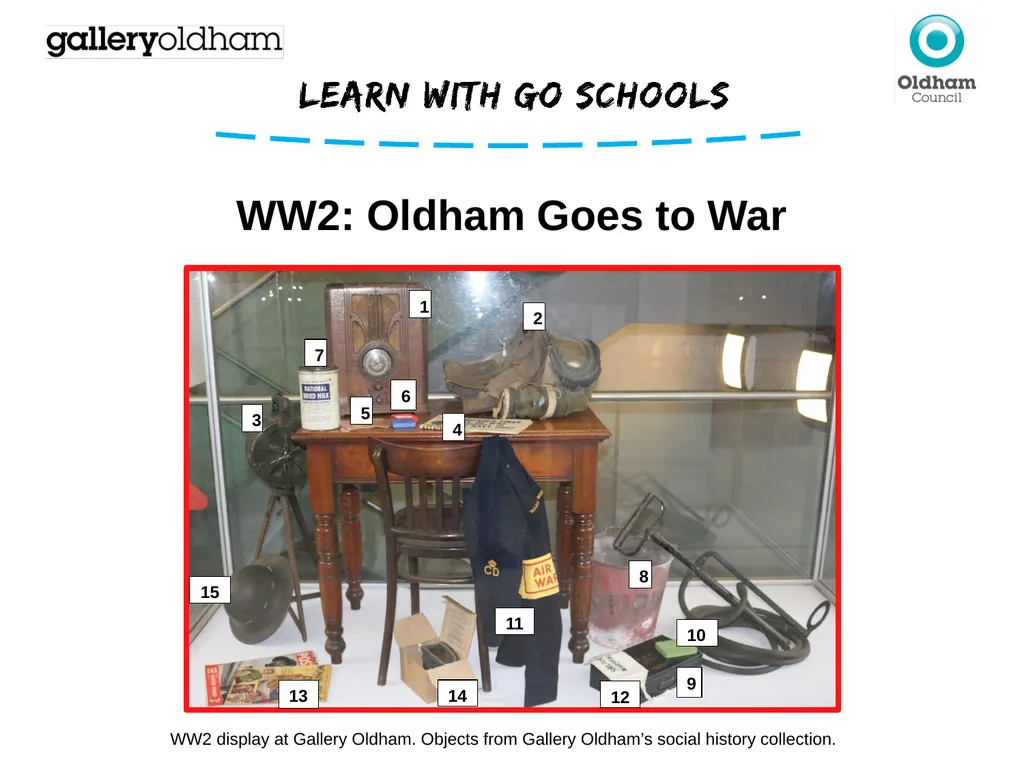
Description: WW2: Oldham Goes to War WW2 display at Gallery Oldham. Objects from Gallery Oldhams social history collection. 1 2 3 5 6 7 8 9 10 11 12 13 14 15 4 1. RADIO SET On September 3rd 1939 Prime Minister Neville Chamberlain broadcast to the
Related Topics
Download Presentation
"WW2: Oldham Goes to War WW2 display at Gallery" is the property of its rightful owner. Permission is granted to download and print the materials on this website for personal, non-commercial use only, and to display it on your personal computer provided you do not modify the materials and that you retain all copyright notices contained in the materials. By downloading content from our website, you accept the terms of this agreement.
Presentation Transcript
slide1. WW2: Oldham Goes to War WW2 display at Gallery Oldham. Objects from Gallery Oldham’s social history collection. 1 2 3 5 6 7 8 9 10 11 12 13 14 15 4<br>
slide2. 1. RADIO SET
On September 3rd 1939 Prime Minister Neville Chamberlain broadcast to the Nation that war had been declared on Germany. In wartime, a radio set was vital for hearing news and information. It also provided entertainment to boost morale and help people forget their troubles.
2. INFANT RESPIRATOR
Babies were issued with gas masks with a steel helmet anda canvas "tent" that enclosedthem. Before the war there was widespread fear that the Germans would attack British cities with poison gas bombs. Although gas was never used, carrying a gas mask at all times helped remind people that war was close to home.
3. AIR RAID SIREN
Sirens sounded a rising and falling howl when an air raid was about to happen. They warned people to head for the nearest air raid shelter. One long blast sounded the ‘all clear’ when the air raid was over.
4. NEWSPAPER (replica)
In wartime the governmentcontrolled or ‘censored’ what newspapers printed. They did not want stories of how the war was being fought to cause public alarm or give too much away to the enemy. As the war progressed the number of pages in the papers dwindled as paper was in short supply.<br>
slide3. 5. RATION BOOKS AND IDENTITY CARD
To maximise the war effort and
maintain security, the wartime government took more control over how people lived their lives. British citizens had to register their details with the authorities and carry an identity card at all times. People with foreign passports were viewed as potential enemies andimprisoned in camps. Strict rationing was also introducedto prevent food shortages. The public were given ration books with coupons to exchange for goods.
6. ARP INSIGNIA BADGES The ARP (Air Raid Precautions), refers to services set up to protect the home front from bombing raids in what became known as ‘the Blitz’. Air Raid Wardens enforced black-outs, stopping enemy planes from spotting targets lit up on the ground. The ARP also helped people to findair raid shelters, watched for fire bombs and rescued people from bombed buildings.
7. POWDERED MILK TIN
In 1939 Britain imported about 60% of its food. Imported and even home-grown food became scarce as the war progressed
and rationing increased. Ships bringing in goods were frequently sunk and remaining supplieswere needed to help the war effort. From 1941 families were allowed 3 pints of fresh milk per<br>
slide4. week, and one tin of powdered milk (said to be equal to fourpints) per month. Children under two were also entitled to full-cream National Dried Milk with added vitamin D.
8. STIRRUP PUMP AND FIRE BUCKET
As well as explosives, the enemy dropped fire bombs to set light to buildings below. Although small, they caused immense damage as they were filled with chemicals and burned for up to ten minutes. Working in teams of two or three, often stationed on rooftops, ARP fire watchers and wardens used their buckets and stirrup pumps to pump water onto the bombs until they were safely out. 9. ARP FIRST AID KIT
During the blitz, many companies
produced ARP first aid kits tohelp people cope with injuries received during air raids. They were used by families and AirRaid Wardens. This is a typical
first aid box made by the company Boots, who still have high street shops today. Just being out inthe blackout was dangerous because people could not see where they were going. Between 1939 and 1940 road accidents almost doubled in number.
10. ANTI GAS OINTMENT
Tins of anti-gas ointment were distributed widely before and during the war. It was anticipated that mustard gas, used in the trenches with devastating effect<br>
slide5. during the First World War,might be used once more. The ointment came in tubes to be applied to blisters on the skin.
11. CIVIL DEFENCE JACKET
In 1941 the ARP was renamed the Civil Defence (CD) Service. This was thought to better reflect the widening number of roles its volunteer men and women performed. These included fire and rescue work, medical assistance and welfare for those made homeless by bombing. The jacket, made of wool serge, is a civilian variation of the standard short battledress tunic worn by most British servicemen from the 1930s until the 1960s. The left breast pocket features the Civil Defence Badge, Oldham Area.
12. SHELTER WARDEN
ARMBAND
Air raid shelters came in allshapes and sizes. If you had a
garden you could build an
‘Anderson shelter’, made of corrugated iron. Some streets had their own communal shelters and most workplaces had adapted basements or outdoor shelters in case of day-time raids. In London, deep Underground stations were opened at night, allowingthousands to shelter from someof the worst raids of the Blitz.
13. MAGAZINES
Like newspapers and the radio, magazines had a vital part to play<br>
slide6. in spreading information and keeping up people’s spirits. One of the most famous magazines of the time was Picture Post, which first appeared in 1938. In an age with no television or internet it was a way of bringing imagesof the war to everybody.
14. HELMET
This fire watcher’s helmet isbased on the standard British ‘Brodie’ type helmet which wasfirst introduced in 1915. Millionsof the broad brimmed helmet were made over the next thirty years and worn by troops and civilian workers in the Second World War. The shape of thisone suggests it may have been made in New Zealand. At the beginning of the war New Zealand made a large batch of helmets for Britain as the British government could not satisfy demand.
15. GAS MASK
By the time war was declared in September 1939 no less than 38
million gas masks had beenissued in Britain. This is one ofthe most common civilian masks and can be seen in its originalbox, complete with instructions. From the outbreak of war it was compulsory for people to carry a gas mask at all times. Fines were issued if you were caught without it. The flimsy cardboard boxes tended to fall apart so, overtime, people bought or made their own personalised cases or handbags.<br>
slide7. Share your letters via librariesandgalleryschools@oldham.gov.uk or social media: Gallery Oldham @GalleryOldham @galleryoldham FURTHER RESEARCH:
Learn about the outbreak of WW2 here. Discover more about the wartime experience online here, where you can also learn about rationing and the Blitz.
Read about an Oldhamer’s war experience here. Discover the WW2 materials held by Oldham Local Studies & Archives here and Gallery Oldham here. ACTIVITY:
Write a letter to a loved one during wartime. Describe how the war is affecting Oldham and Oldhamerson the ‘Home Front’. Refer tosome of the objects featured inthis resource in your letter!
SAFETY NOTE:
Real gas masks and bags shouldnot be worn or handled today asthey contain the dangerouschemical asbestos. Theydid not realise thisin WW2.<br>
slide2. 1. RADIO SET
On September 3rd 1939 Prime Minister Neville Chamberlain broadcast to the Nation that war had been declared on Germany. In wartime, a radio set was vital for hearing news and information. It also provided entertainment to boost morale and help people forget their troubles.
2. INFANT RESPIRATOR
Babies were issued with gas masks with a steel helmet anda canvas "tent" that enclosedthem. Before the war there was widespread fear that the Germans would attack British cities with poison gas bombs. Although gas was never used, carrying a gas mask at all times helped remind people that war was close to home.
3. AIR RAID SIREN
Sirens sounded a rising and falling howl when an air raid was about to happen. They warned people to head for the nearest air raid shelter. One long blast sounded the ‘all clear’ when the air raid was over.
4. NEWSPAPER (replica)
In wartime the governmentcontrolled or ‘censored’ what newspapers printed. They did not want stories of how the war was being fought to cause public alarm or give too much away to the enemy. As the war progressed the number of pages in the papers dwindled as paper was in short supply.<br>
slide3. 5. RATION BOOKS AND IDENTITY CARD
To maximise the war effort and
maintain security, the wartime government took more control over how people lived their lives. British citizens had to register their details with the authorities and carry an identity card at all times. People with foreign passports were viewed as potential enemies andimprisoned in camps. Strict rationing was also introducedto prevent food shortages. The public were given ration books with coupons to exchange for goods.
6. ARP INSIGNIA BADGES The ARP (Air Raid Precautions), refers to services set up to protect the home front from bombing raids in what became known as ‘the Blitz’. Air Raid Wardens enforced black-outs, stopping enemy planes from spotting targets lit up on the ground. The ARP also helped people to findair raid shelters, watched for fire bombs and rescued people from bombed buildings.
7. POWDERED MILK TIN
In 1939 Britain imported about 60% of its food. Imported and even home-grown food became scarce as the war progressed
and rationing increased. Ships bringing in goods were frequently sunk and remaining supplieswere needed to help the war effort. From 1941 families were allowed 3 pints of fresh milk per<br>
slide4. week, and one tin of powdered milk (said to be equal to fourpints) per month. Children under two were also entitled to full-cream National Dried Milk with added vitamin D.
8. STIRRUP PUMP AND FIRE BUCKET
As well as explosives, the enemy dropped fire bombs to set light to buildings below. Although small, they caused immense damage as they were filled with chemicals and burned for up to ten minutes. Working in teams of two or three, often stationed on rooftops, ARP fire watchers and wardens used their buckets and stirrup pumps to pump water onto the bombs until they were safely out. 9. ARP FIRST AID KIT
During the blitz, many companies
produced ARP first aid kits tohelp people cope with injuries received during air raids. They were used by families and AirRaid Wardens. This is a typical
first aid box made by the company Boots, who still have high street shops today. Just being out inthe blackout was dangerous because people could not see where they were going. Between 1939 and 1940 road accidents almost doubled in number.
10. ANTI GAS OINTMENT
Tins of anti-gas ointment were distributed widely before and during the war. It was anticipated that mustard gas, used in the trenches with devastating effect<br>
slide5. during the First World War,might be used once more. The ointment came in tubes to be applied to blisters on the skin.
11. CIVIL DEFENCE JACKET
In 1941 the ARP was renamed the Civil Defence (CD) Service. This was thought to better reflect the widening number of roles its volunteer men and women performed. These included fire and rescue work, medical assistance and welfare for those made homeless by bombing. The jacket, made of wool serge, is a civilian variation of the standard short battledress tunic worn by most British servicemen from the 1930s until the 1960s. The left breast pocket features the Civil Defence Badge, Oldham Area.
12. SHELTER WARDEN
ARMBAND
Air raid shelters came in allshapes and sizes. If you had a
garden you could build an
‘Anderson shelter’, made of corrugated iron. Some streets had their own communal shelters and most workplaces had adapted basements or outdoor shelters in case of day-time raids. In London, deep Underground stations were opened at night, allowingthousands to shelter from someof the worst raids of the Blitz.
13. MAGAZINES
Like newspapers and the radio, magazines had a vital part to play<br>
slide6. in spreading information and keeping up people’s spirits. One of the most famous magazines of the time was Picture Post, which first appeared in 1938. In an age with no television or internet it was a way of bringing imagesof the war to everybody.
14. HELMET
This fire watcher’s helmet isbased on the standard British ‘Brodie’ type helmet which wasfirst introduced in 1915. Millionsof the broad brimmed helmet were made over the next thirty years and worn by troops and civilian workers in the Second World War. The shape of thisone suggests it may have been made in New Zealand. At the beginning of the war New Zealand made a large batch of helmets for Britain as the British government could not satisfy demand.
15. GAS MASK
By the time war was declared in September 1939 no less than 38
million gas masks had beenissued in Britain. This is one ofthe most common civilian masks and can be seen in its originalbox, complete with instructions. From the outbreak of war it was compulsory for people to carry a gas mask at all times. Fines were issued if you were caught without it. The flimsy cardboard boxes tended to fall apart so, overtime, people bought or made their own personalised cases or handbags.<br>
slide7. Share your letters via librariesandgalleryschools@oldham.gov.uk or social media: Gallery Oldham @GalleryOldham @galleryoldham FURTHER RESEARCH:
Learn about the outbreak of WW2 here. Discover more about the wartime experience online here, where you can also learn about rationing and the Blitz.
Read about an Oldhamer’s war experience here. Discover the WW2 materials held by Oldham Local Studies & Archives here and Gallery Oldham here. ACTIVITY:
Write a letter to a loved one during wartime. Describe how the war is affecting Oldham and Oldhamerson the ‘Home Front’. Refer tosome of the objects featured inthis resource in your letter!
SAFETY NOTE:
Real gas masks and bags shouldnot be worn or handled today asthey contain the dangerouschemical asbestos. Theydid not realise thisin WW2.<br>