
www.nand2tetris.org Building a Modern Computer
CS
Published · 55 slides · 0 views

1 / 1
Description
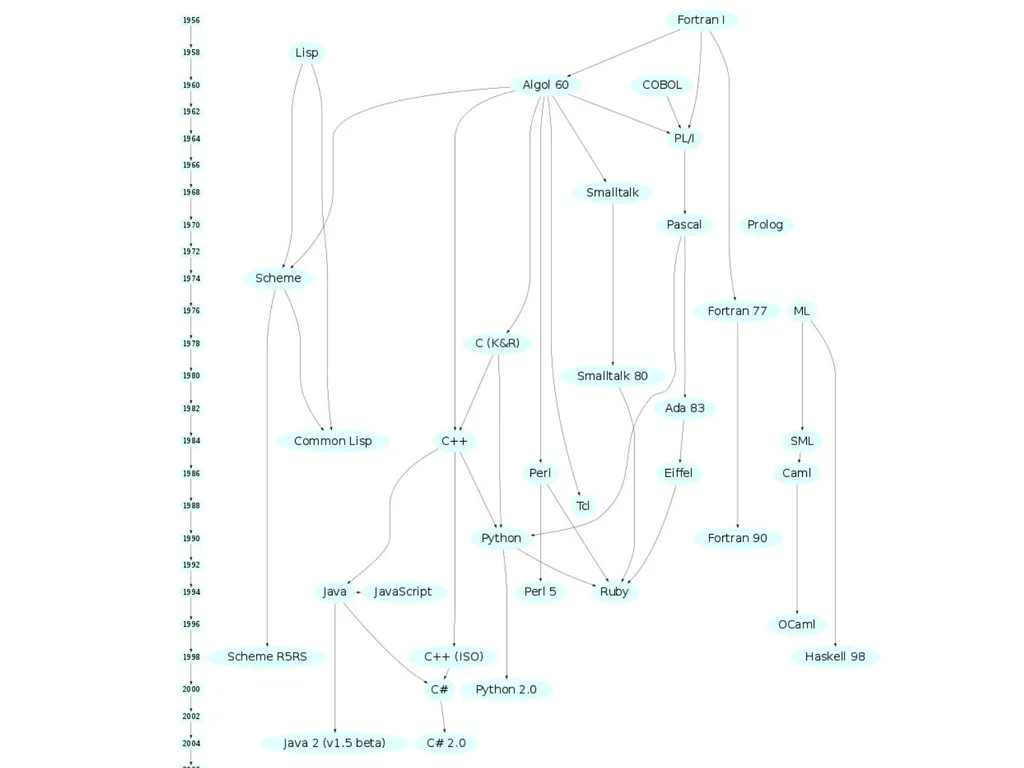
www.nand2tetris.org Building a Modern Computer From First Principles High-Level Language Where we are at: Some milestones in the evolution of programming languages Machine language (binary code) Assembly language (low-level symbolic
Related Topics
Share
Embed code
Download this presentation From Below
"www.nand2tetris.org Building a Modern Computer" is the property of its rightful owner. Permission is granted to download and print the materials on this website for personal, non-commercial use only, and to display it on your personal computer provided you do not modify the materials and that you retain all copyright notices contained in the materials. By downloading content from our website, you accept the terms of this agreement.
Presentation Transcript
01
www.nand2tetris.org Building a Modern Computer From First Principles High-Level Language<br>
02
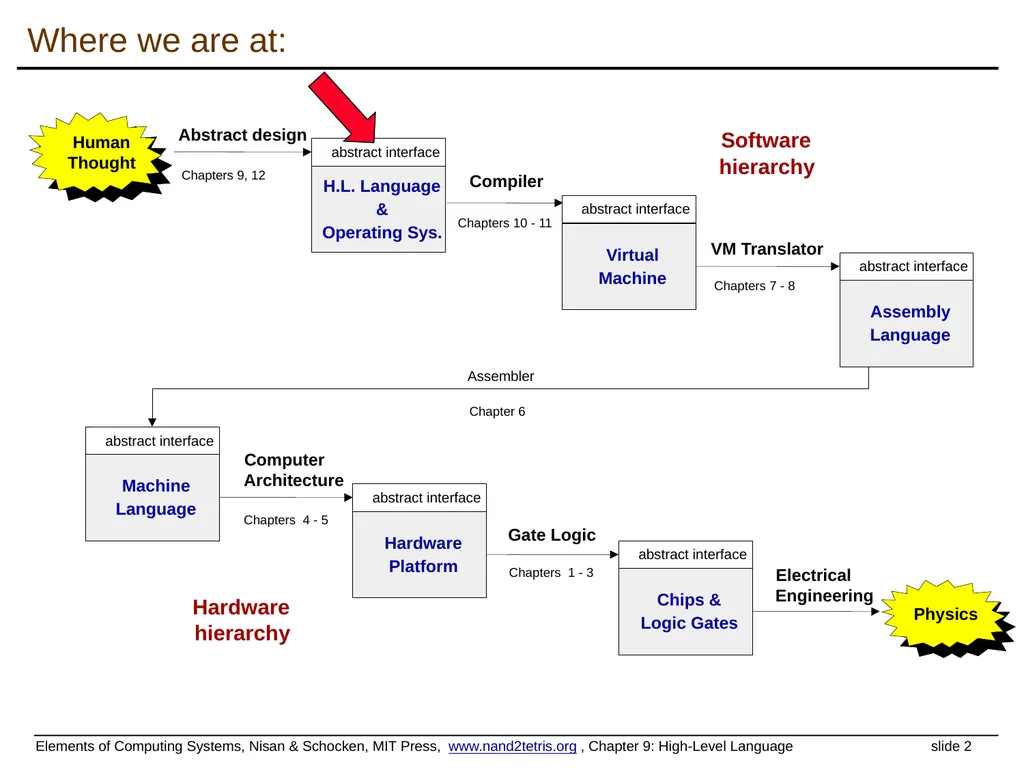
Where we are at:<br>
03
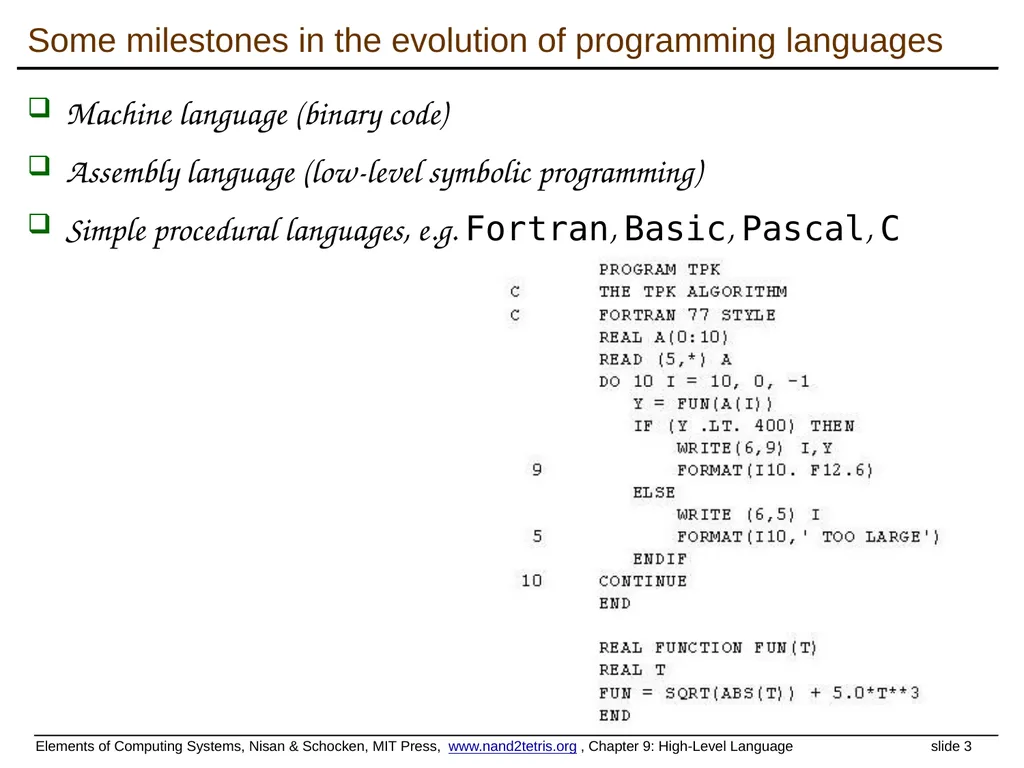
Some milestones in the evolution of programming languages Machine language (binary code)
Assembly language (low-level symbolic programming)
Simple procedural languages, e.g. Fortran, Basic, Pascal, C<br>
Assembly language (low-level symbolic programming)
Simple procedural languages, e.g. Fortran, Basic, Pascal, C<br>
04
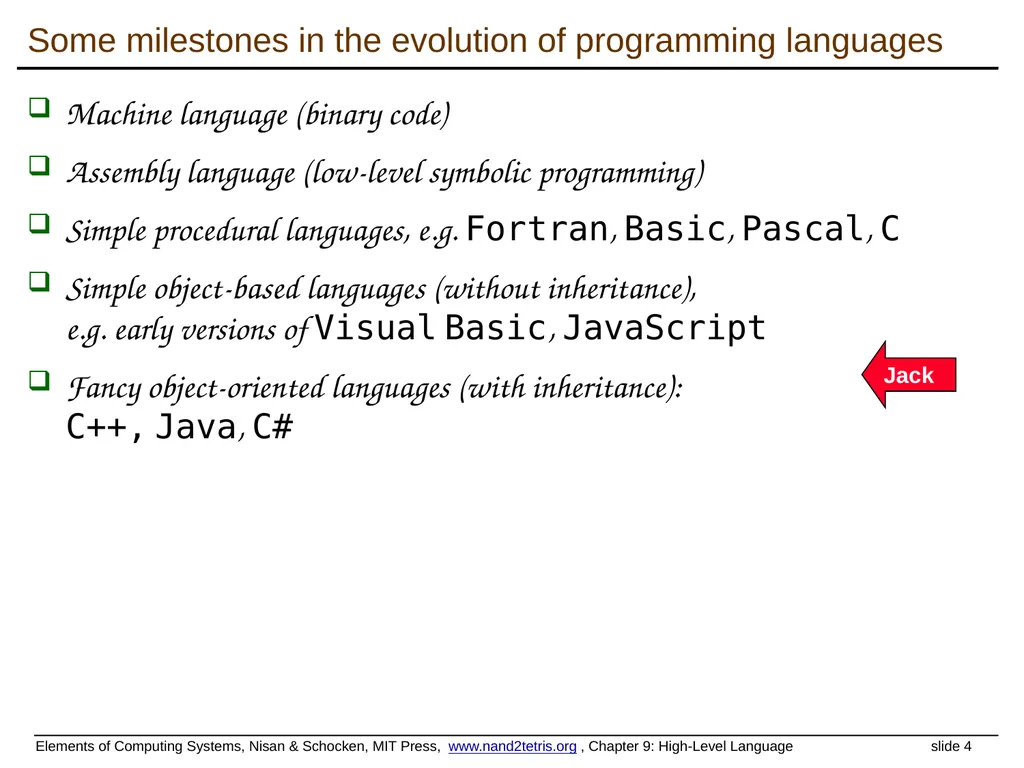
Some milestones in the evolution of programming languages Machine language (binary code)
Assembly language (low-level symbolic programming)
Simple procedural languages, e.g. Fortran, Basic, Pascal, C
Simple object-based languages (without inheritance), e.g. early versions of Visual Basic, JavaScript
Fancy object-oriented languages (with inheritance): C++, Java, C# Jack<br>
Assembly language (low-level symbolic programming)
Simple procedural languages, e.g. Fortran, Basic, Pascal, C
Simple object-based languages (without inheritance), e.g. early versions of Visual Basic, JavaScript
Fancy object-oriented languages (with inheritance): C++, Java, C# Jack<br>
05
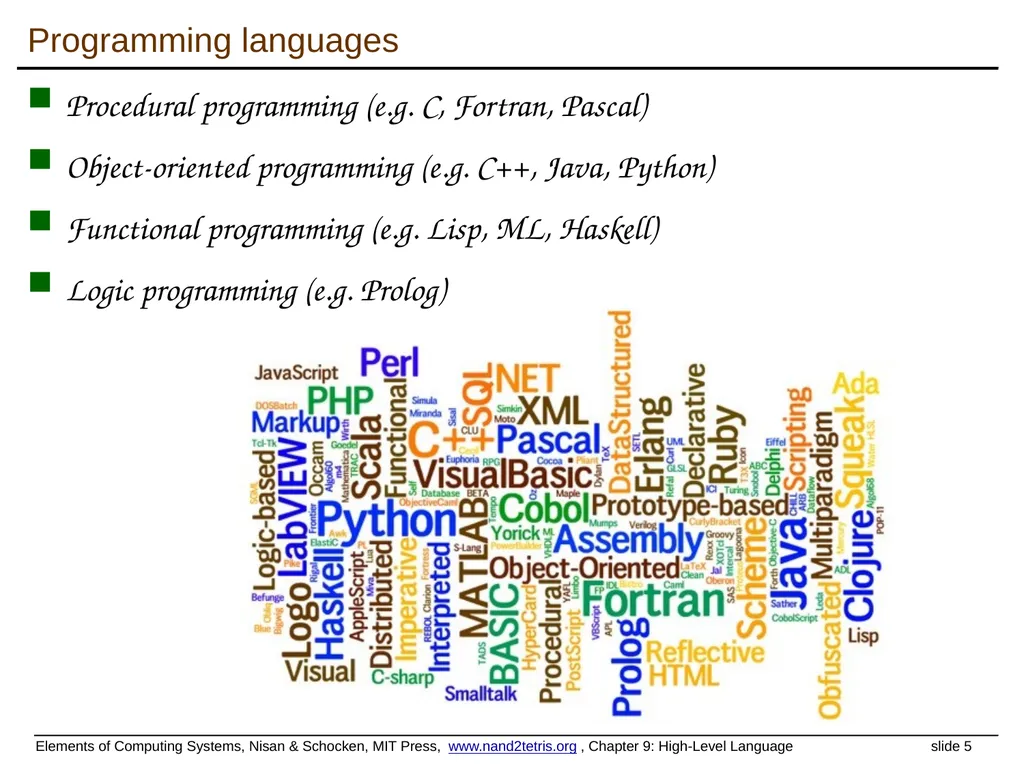
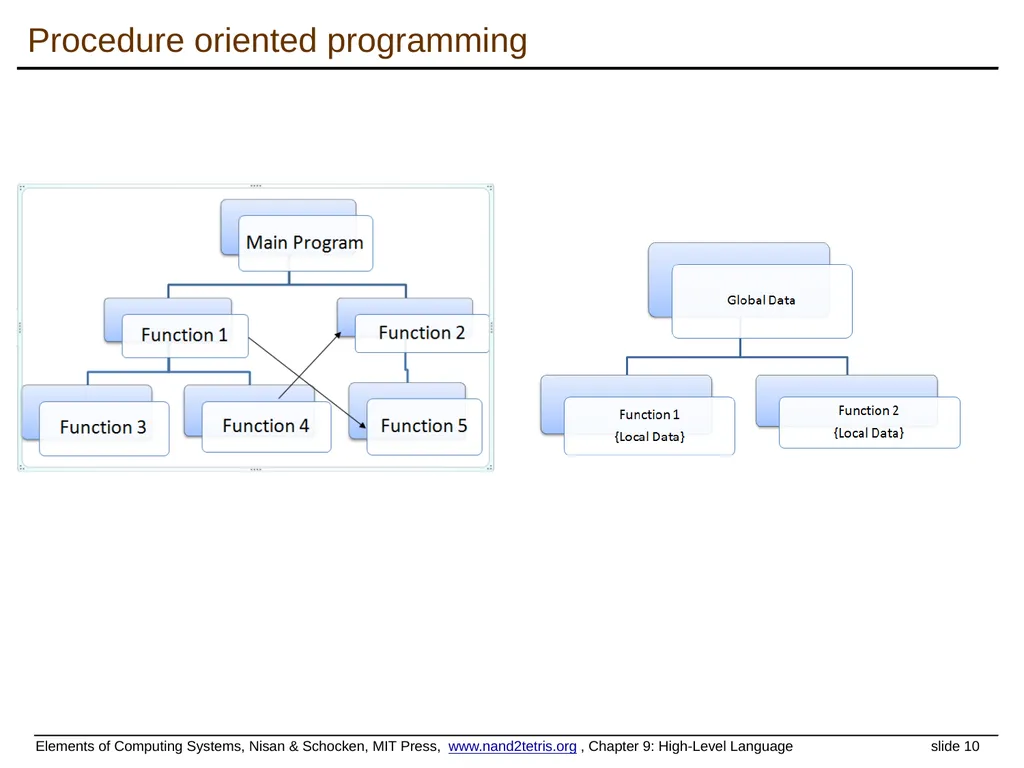
Programming languages Procedural programming (e.g. C, Fortran, Pascal)
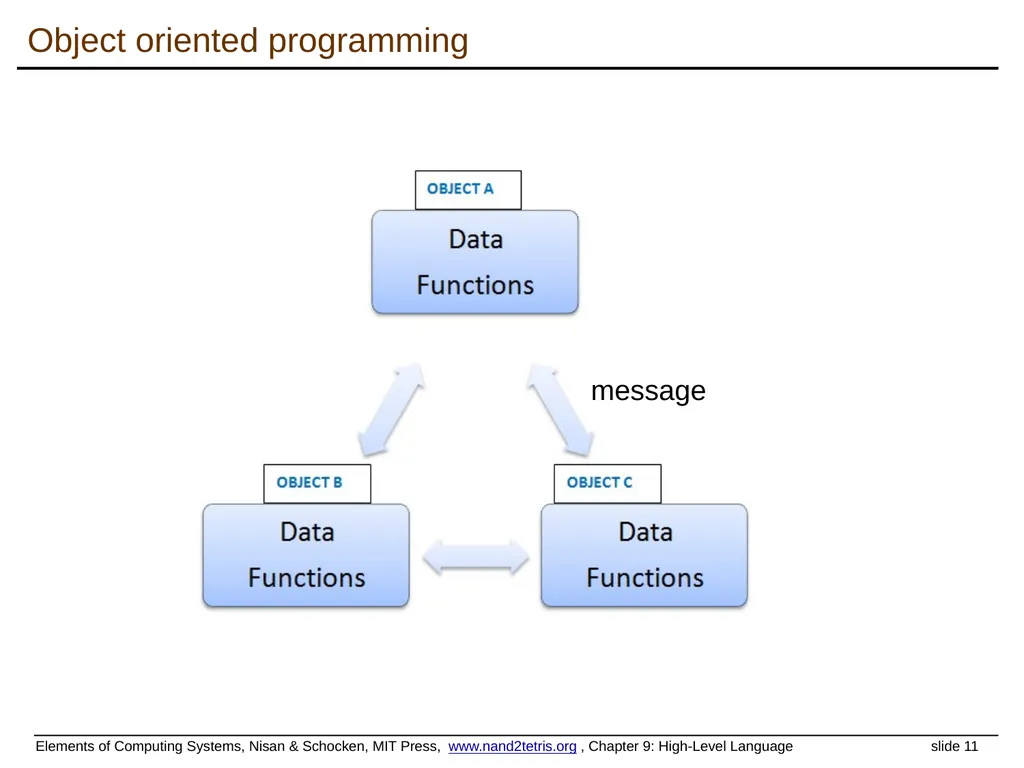
Object-oriented programming (e.g. C++, Java, Python)
Functional programming (e.g. Lisp, ML, Haskell)
Logic programming (e.g. Prolog)<br>
Object-oriented programming (e.g. C++, Java, Python)
Functional programming (e.g. Lisp, ML, Haskell)
Logic programming (e.g. Prolog)<br>
06
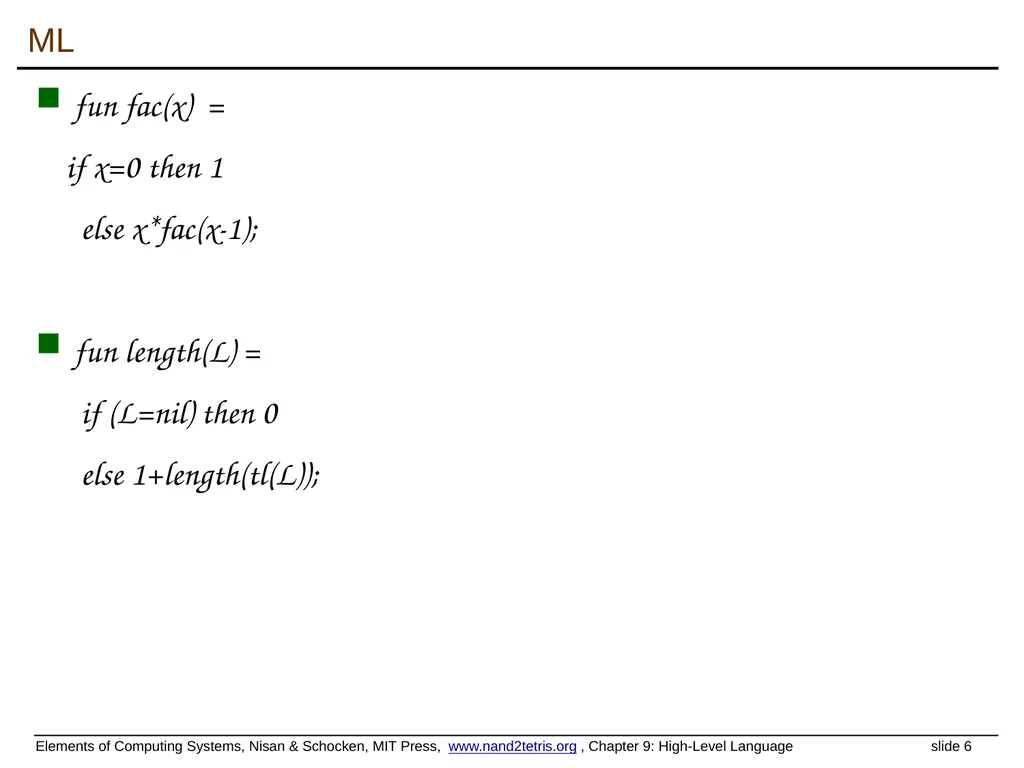
ML fun fac(x) =
if x=0 then 1
else x*fac(x-1);
fun length(L) =
if (L=nil) then 0
else 1+length(tl(L));<br>
if x=0 then 1
else x*fac(x-1);
fun length(L) =
if (L=nil) then 0
else 1+length(tl(L));<br>
07
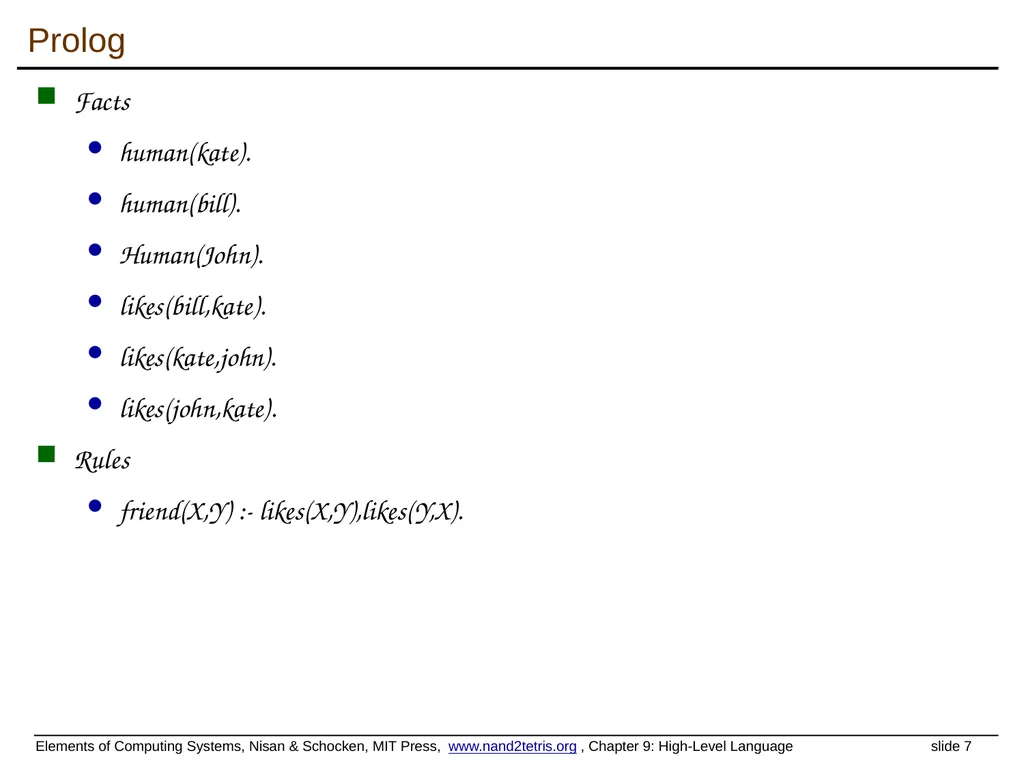
Prolog Facts
human(kate).
human(bill).
Human(John).
likes(bill,kate).
likes(kate,john).
likes(john,kate).
Rules
friend(X,Y) :- likes(X,Y),likes(Y,X).<br>
human(kate).
human(bill).
Human(John).
likes(bill,kate).
likes(kate,john).
likes(john,kate).
Rules
friend(X,Y) :- likes(X,Y),likes(Y,X).<br>
08
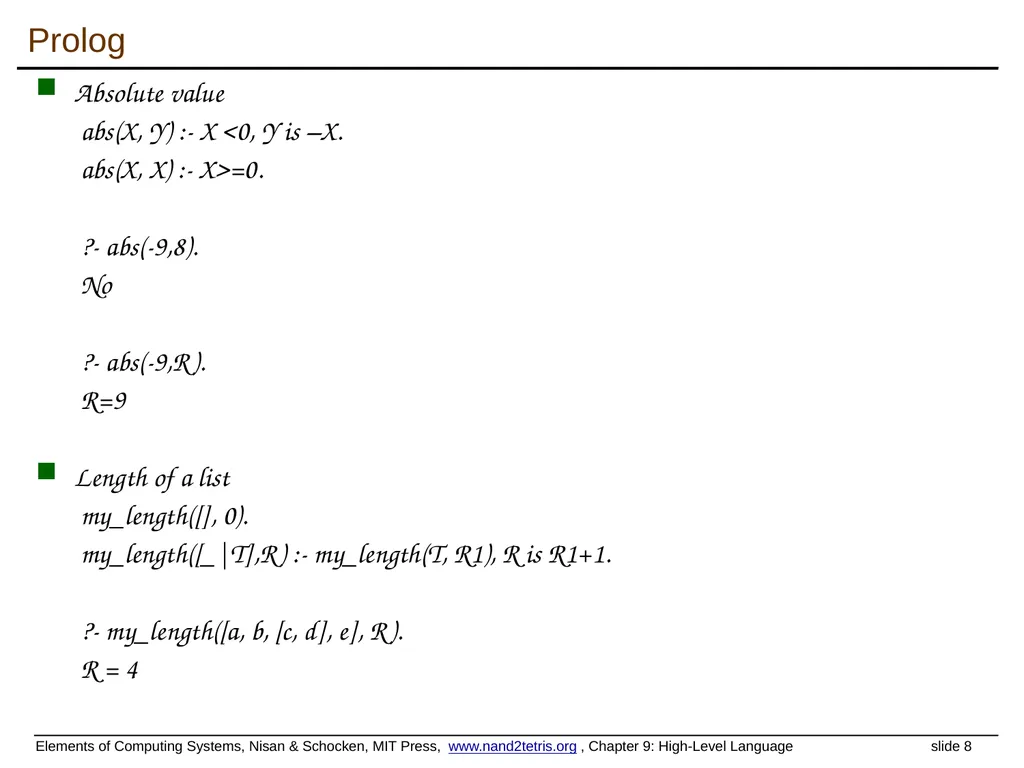
Prolog Absolute value
abs(X, Y) :- X <0, Y is –X.
abs(X, X) :- X>=0.
?- abs(-9,8).
No
?- abs(-9,R).
R=9
Length of a list
my_length([], 0).
my_length([_|T],R) :- my_length(T, R1), R is R1+1.
?- my_length([a, b, [c, d], e], R).
R = 4<br>
abs(X, Y) :- X <0, Y is –X.
abs(X, X) :- X>=0.
?- abs(-9,8).
No
?- abs(-9,R).
R=9
Length of a list
my_length([], 0).
my_length([_|T],R) :- my_length(T, R1), R is R1+1.
?- my_length([a, b, [c, d], e], R).
R = 4<br>
09
Procedure oriented programming<br>
10
Object oriented programming message<br>
11
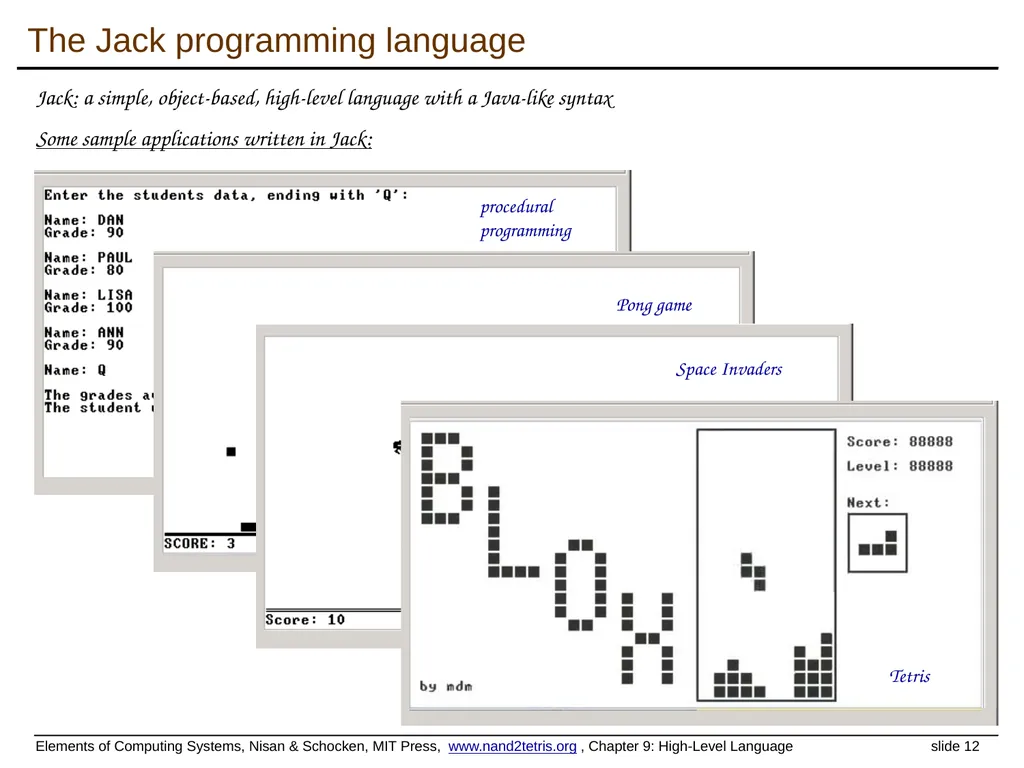
The Jack programming language Jack: a simple, object-based, high-level language with a Java-like syntax
Some sample applications written in Jack:<br>
Some sample applications written in Jack:<br>
12
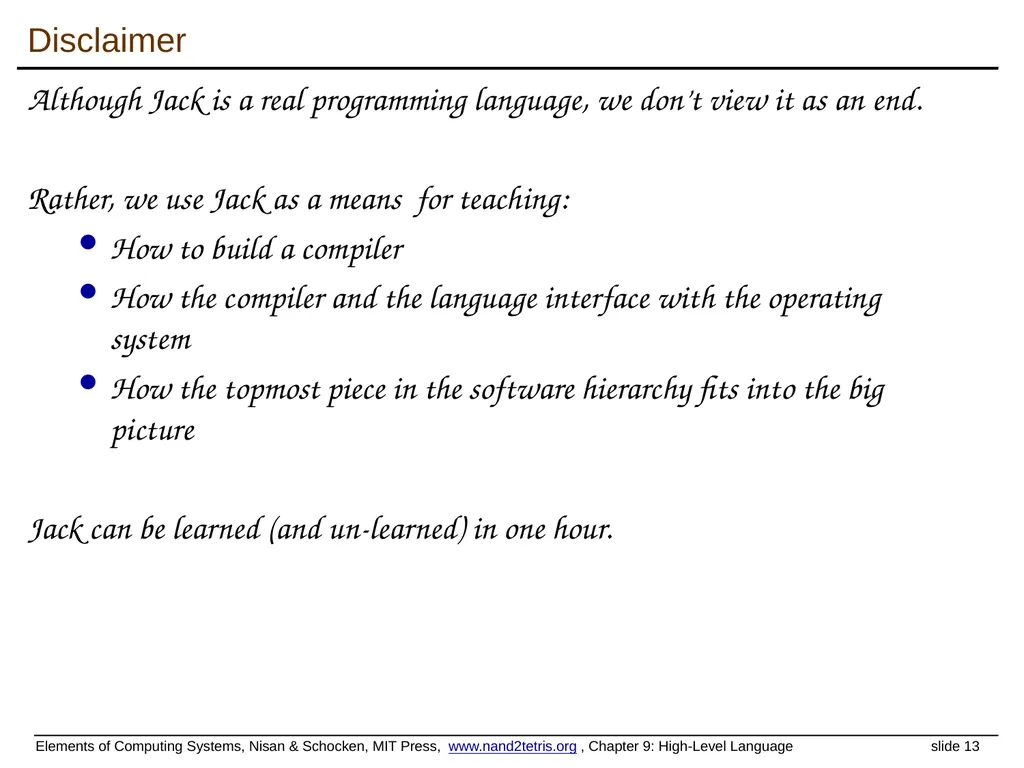
Disclaimer Although Jack is a real programming language, we don’t view it as an end.
Rather, we use Jack as a means for teaching:
How to build a compiler
How the compiler and the language interface with the operating system
How the topmost piece in the software hierarchy fits into the big picture
Jack can be learned (and un-learned) in one hour.<br>
Rather, we use Jack as a means for teaching:
How to build a compiler
How the compiler and the language interface with the operating system
How the topmost piece in the software hierarchy fits into the big picture
Jack can be learned (and un-learned) in one hour.<br>
13
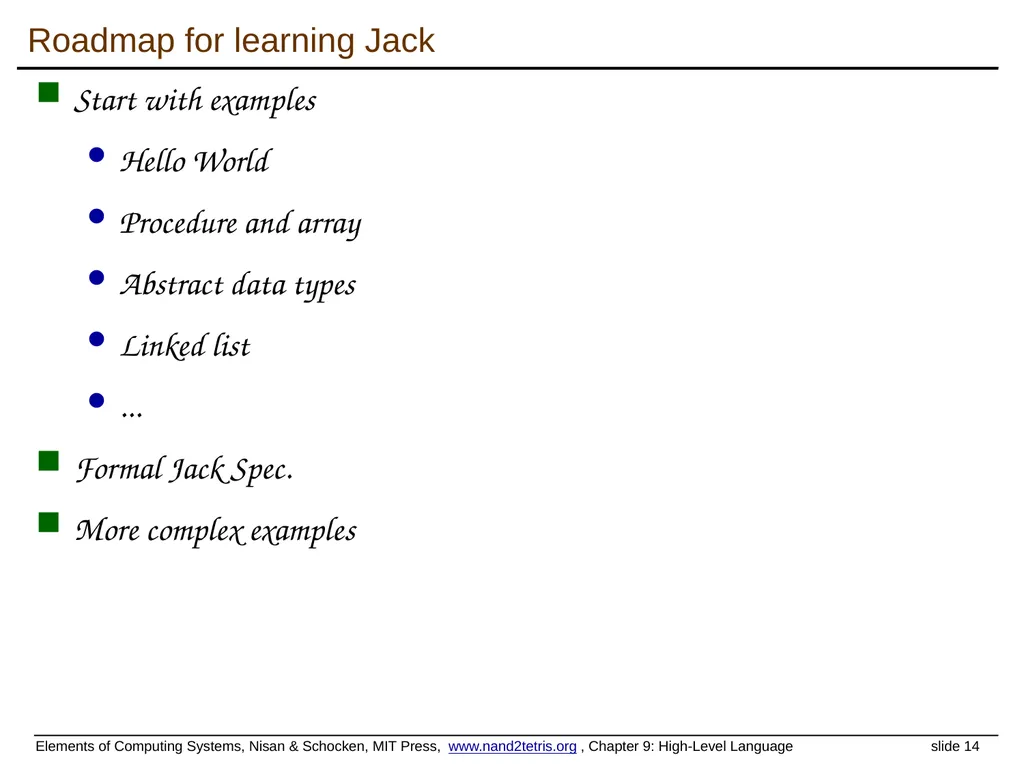
Roadmap for learning Jack Start with examples
Hello World
Procedure and array
Abstract data types
Linked list
...
Formal Jack Spec.
More complex examples<br>
Hello World
Procedure and array
Abstract data types
Linked list
...
Formal Jack Spec.
More complex examples<br>
14
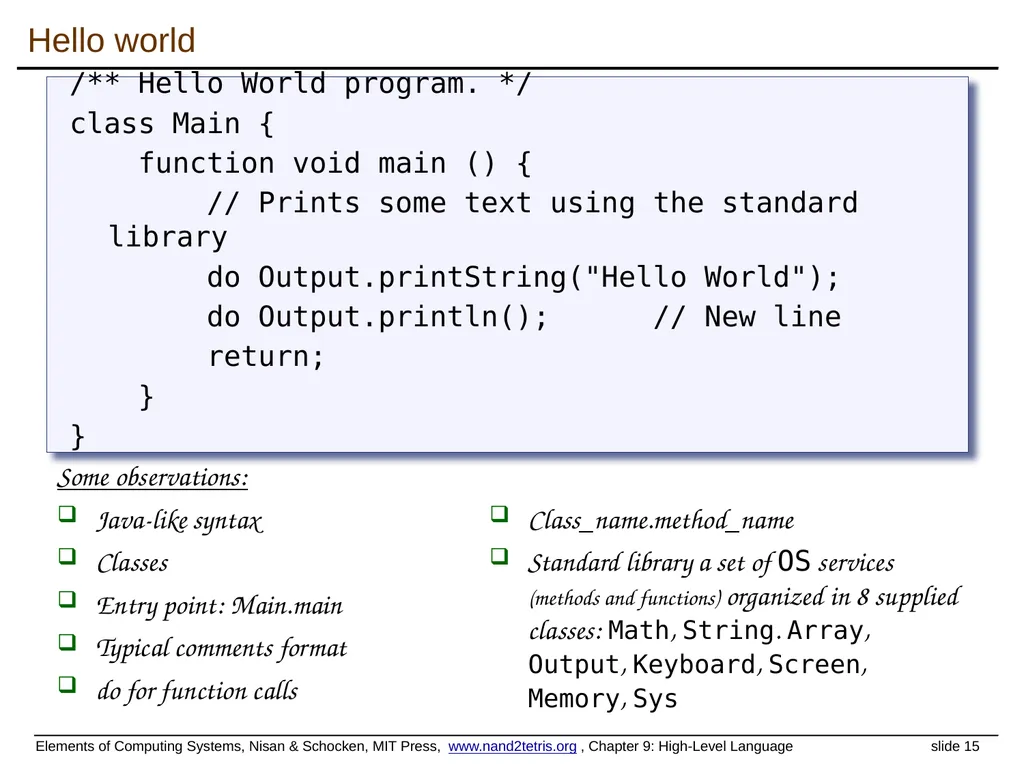
Hello world /** Hello World program. */
class Main {
function void main () {
// Prints some text using the standard library
do Output.printString("Hello World");
do Output.println(); // New line
return;
}
} Some observations:
Java-like syntax
Classes
Entry point: Main.main
Typical comments format
do for function calls Class_name.method_name
Standard library a set of OS services (methods and functions) organized in 8 supplied classes: Math, String. Array, Output, Keyboard, Screen, Memory, Sys<br>
class Main {
function void main () {
// Prints some text using the standard library
do Output.printString("Hello World");
do Output.println(); // New line
return;
}
} Some observations:
Java-like syntax
Classes
Entry point: Main.main
Typical comments format
do for function calls Class_name.method_name
Standard library a set of OS services (methods and functions) organized in 8 supplied classes: Math, String. Array, Output, Keyboard, Screen, Memory, Sys<br>
15
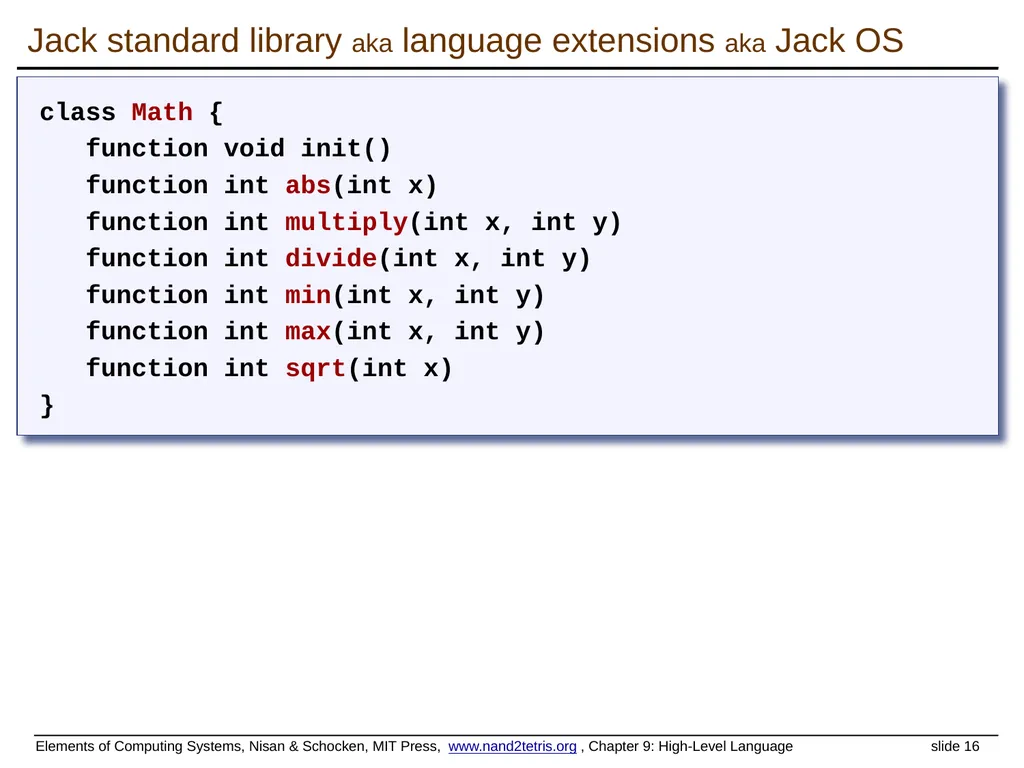
Jack standard library aka language extensions aka Jack OS class Math {
function void init()
function int abs(int x)
function int multiply(int x, int y)
function int divide(int x, int y)
function int min(int x, int y)
function int max(int x, int y)
function int sqrt(int x)
}<br>
function void init()
function int abs(int x)
function int multiply(int x, int y)
function int divide(int x, int y)
function int min(int x, int y)
function int max(int x, int y)
function int sqrt(int x)
}<br>
16
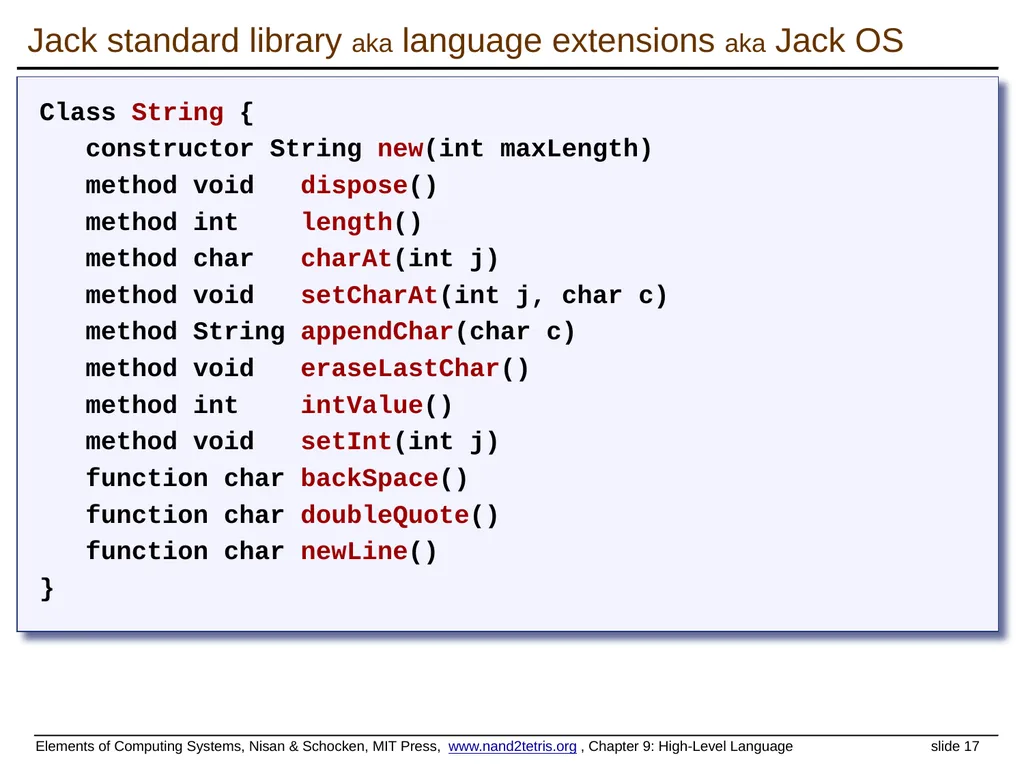
Jack standard library aka language extensions aka Jack OS Class String {
constructor String new(int maxLength)
method void dispose()
method int length()
method char charAt(int j)
method void setCharAt(int j, char c)
method String appendChar(char c)
method void eraseLastChar()
method int intValue()
method void setInt(int j)
function char backSpace()
function char doubleQuote()
function char newLine()
}<br>
constructor String new(int maxLength)
method void dispose()
method int length()
method char charAt(int j)
method void setCharAt(int j, char c)
method String appendChar(char c)
method void eraseLastChar()
method int intValue()
method void setInt(int j)
function char backSpace()
function char doubleQuote()
function char newLine()
}<br>
17
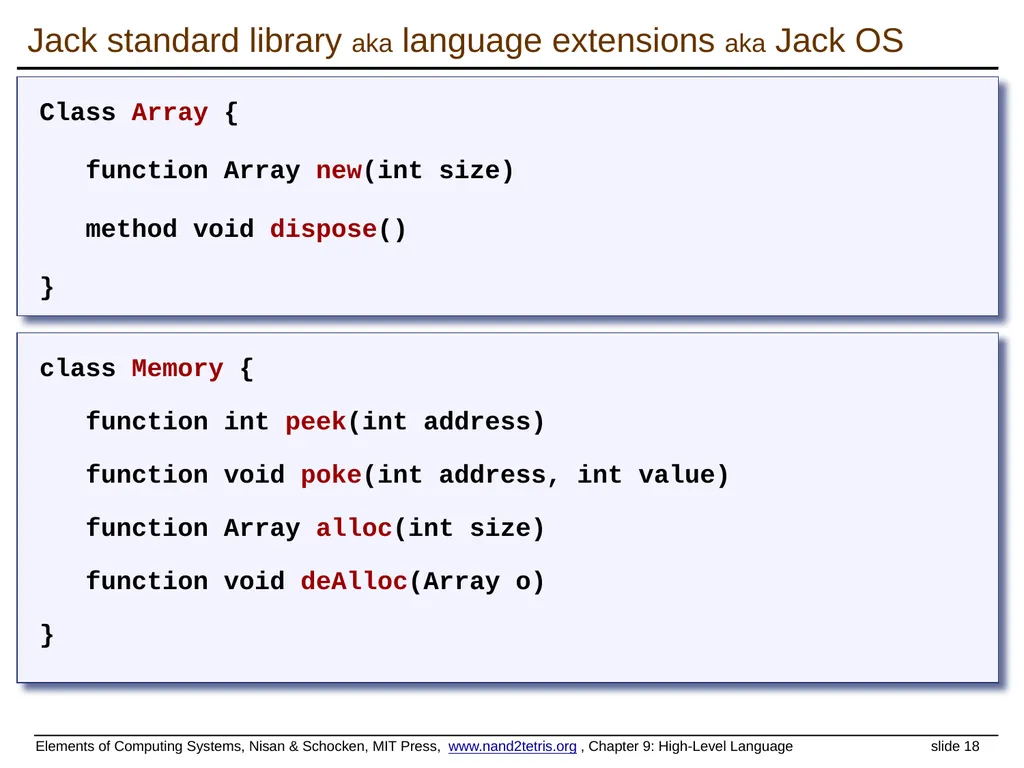
Jack standard library aka language extensions aka Jack OS Class Array {
function Array new(int size)
method void dispose()
} class Memory {
function int peek(int address)
function void poke(int address, int value)
function Array alloc(int size)
function void deAlloc(Array o)
}<br>
function Array new(int size)
method void dispose()
} class Memory {
function int peek(int address)
function void poke(int address, int value)
function Array alloc(int size)
function void deAlloc(Array o)
}<br>
18
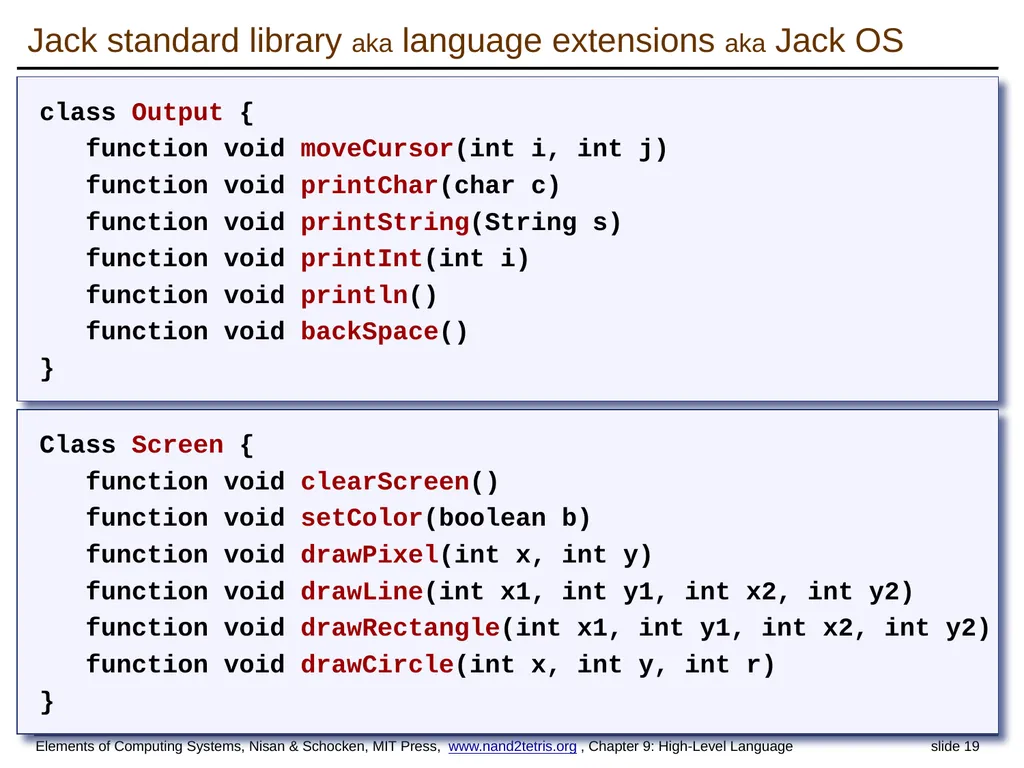
class Output {
function void moveCursor(int i, int j)
function void printChar(char c)
function void printString(String s)
function void printInt(int i)
function void println()
function void backSpace()
} Jack standard library aka language extensions aka Jack OS Class Screen {
function void clearScreen()
function void setColor(boolean b)
function void drawPixel(int x, int y)
function void drawLine(int x1, int y1, int x2, int y2)
function void drawRectangle(int x1, int y1, int x2, int y2)
function void drawCircle(int x, int y, int r)
}<br>
function void moveCursor(int i, int j)
function void printChar(char c)
function void printString(String s)
function void printInt(int i)
function void println()
function void backSpace()
} Jack standard library aka language extensions aka Jack OS Class Screen {
function void clearScreen()
function void setColor(boolean b)
function void drawPixel(int x, int y)
function void drawLine(int x1, int y1, int x2, int y2)
function void drawRectangle(int x1, int y1, int x2, int y2)
function void drawCircle(int x, int y, int r)
}<br>
19
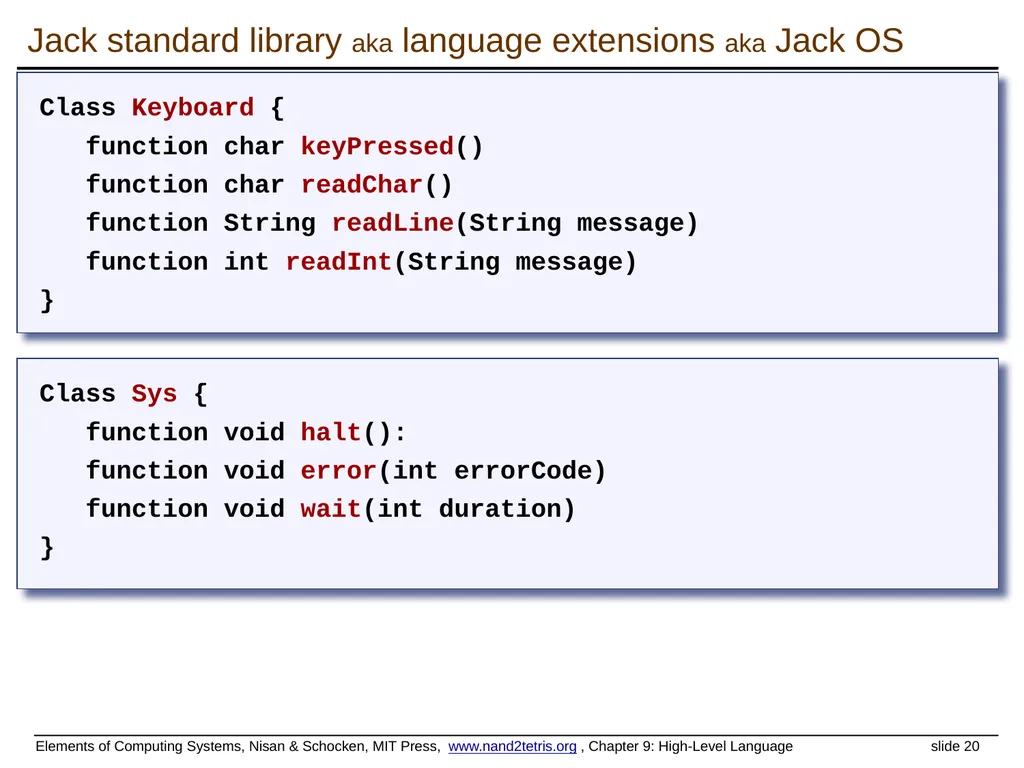
Jack standard library aka language extensions aka Jack OS Class Keyboard {
function char keyPressed()
function char readChar()
function String readLine(String message)
function int readInt(String message)
} Class Sys {
function void halt():
function void error(int errorCode)
function void wait(int duration)
}<br>
function char keyPressed()
function char readChar()
function String readLine(String message)
function int readInt(String message)
} Class Sys {
function void halt():
function void error(int errorCode)
function void wait(int duration)
}<br>
20
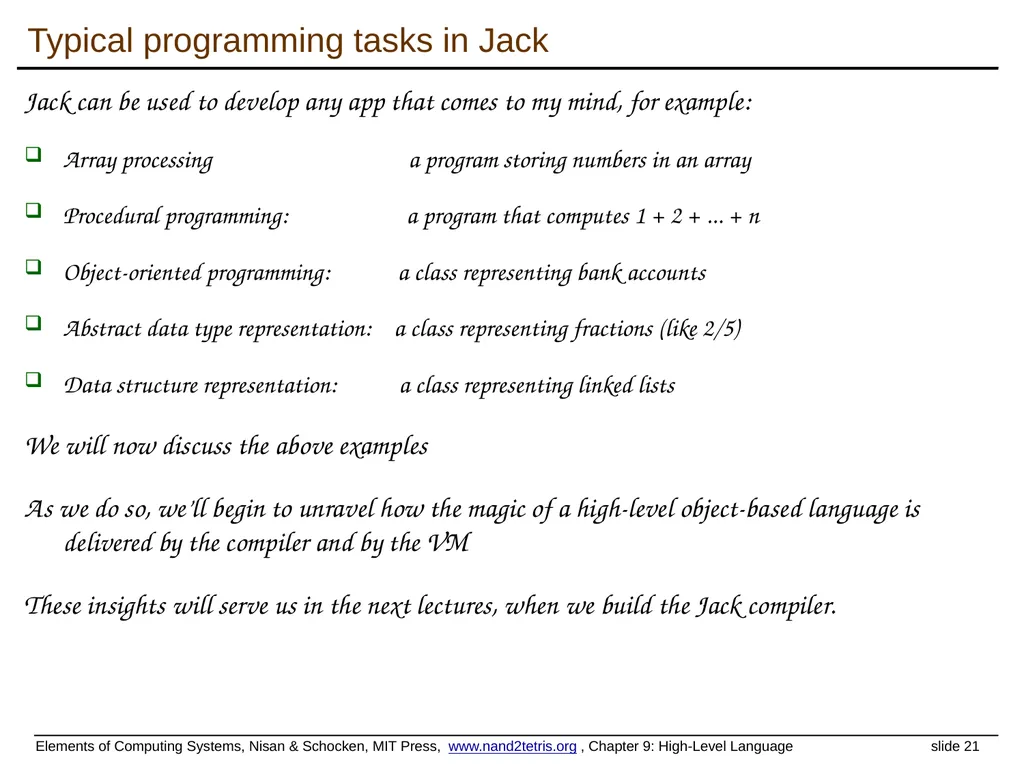
Typical programming tasks in Jack Jack can be used to develop any app that comes to my mind, for example:
Array processing a program storing numbers in an array
Procedural programming: a program that computes 1 + 2 + ... + n
Object-oriented programming: a class representing bank accounts
Abstract data type representation: a class representing fractions (like 2/5)
Data structure representation: a class representing linked lists
We will now discuss the above examples
As we do so, we’ll begin to unravel how the magic of a high-level object-based language is delivered by the compiler and by the VM
These insights will serve us in the next lectures, when we build the Jack compiler.<br>
Array processing a program storing numbers in an array
Procedural programming: a program that computes 1 + 2 + ... + n
Object-oriented programming: a class representing bank accounts
Abstract data type representation: a class representing fractions (like 2/5)
Data structure representation: a class representing linked lists
We will now discuss the above examples
As we do so, we’ll begin to unravel how the magic of a high-level object-based language is delivered by the compiler and by the VM
These insights will serve us in the next lectures, when we build the Jack compiler.<br>
21
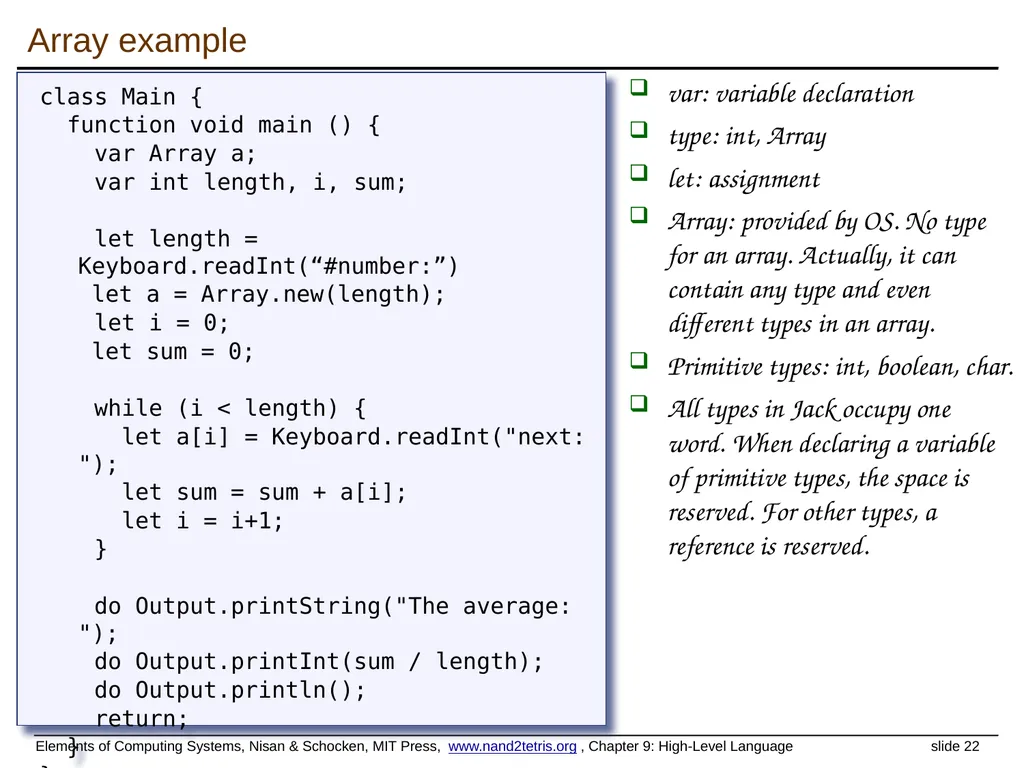
Array example class Main {
function void main () {
var Array a;
var int length, i, sum;
let length = Keyboard.readInt(“#number:”)
let a = Array.new(length);
let i = 0;
let sum = 0;
while (i < length) {
let a[i] = Keyboard.readInt("next: ");
let sum = sum + a[i];
let i = i+1;
}
do Output.printString("The average: ");
do Output.printInt(sum / length);
do Output.println();
return;
}
} var: variable declaration
type: int, Array
let: assignment
Array: provided by OS. No type for an array. Actually, it can contain any type and even different types in an array.
Primitive types: int, boolean, char.
All types in Jack occupy one word. When declaring a variable of primitive types, the space is reserved. For other types, a reference is reserved.<br>
function void main () {
var Array a;
var int length, i, sum;
let length = Keyboard.readInt(“#number:”)
let a = Array.new(length);
let i = 0;
let sum = 0;
while (i < length) {
let a[i] = Keyboard.readInt("next: ");
let sum = sum + a[i];
let i = i+1;
}
do Output.printString("The average: ");
do Output.printInt(sum / length);
do Output.println();
return;
}
} var: variable declaration
type: int, Array
let: assignment
Array: provided by OS. No type for an array. Actually, it can contain any type and even different types in an array.
Primitive types: int, boolean, char.
All types in Jack occupy one word. When declaring a variable of primitive types, the space is reserved. For other types, a reference is reserved.<br>
22
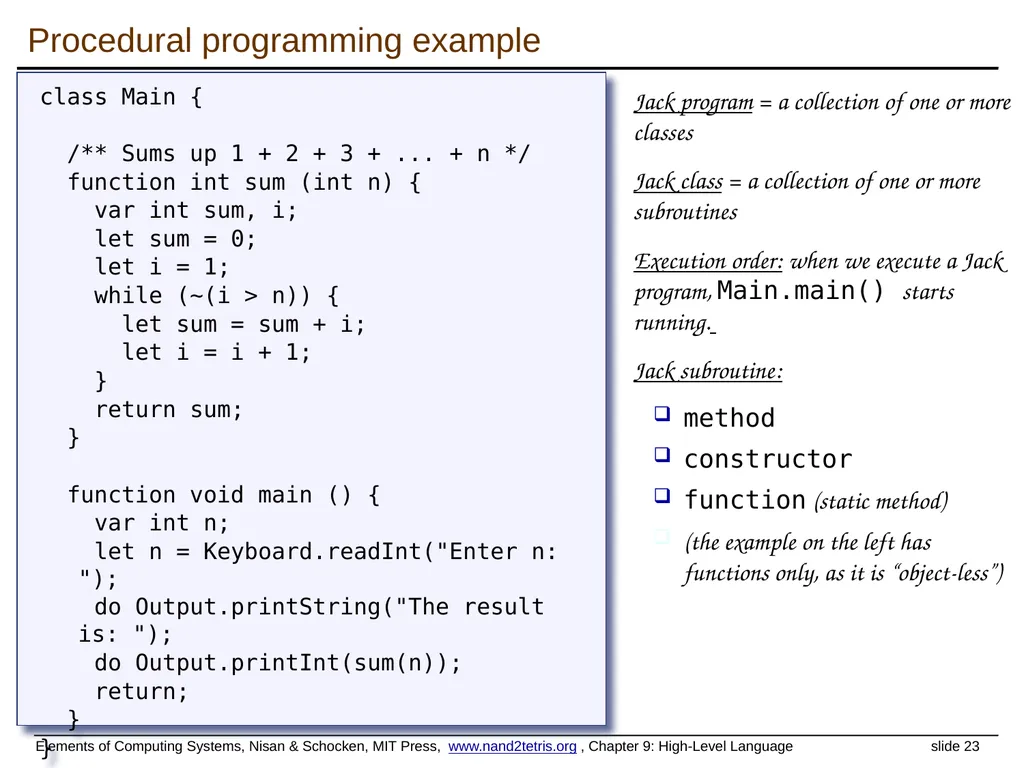
Procedural programming example Jack program = a collection of one or more classes
Jack class = a collection of one or more subroutines
Execution order: when we execute a Jack program, Main.main() starts running.
Jack subroutine:
method
constructor
function (static method)
(the example on the left has functions only, as it is “object-less”) class Main {
/** Sums up 1 + 2 + 3 + ... + n */
function int sum (int n) {
var int sum, i;
let sum = 0;
let i = 1;
while (~(i > n)) {
let sum = sum + i;
let i = i + 1;
}
return sum;
}
function void main () {
var int n;
let n = Keyboard.readInt("Enter n: ");
do Output.printString("The result is: ");
do Output.printInt(sum(n));
return;
}
}<br>
Jack class = a collection of one or more subroutines
Execution order: when we execute a Jack program, Main.main() starts running.
Jack subroutine:
method
constructor
function (static method)
(the example on the left has functions only, as it is “object-less”) class Main {
/** Sums up 1 + 2 + 3 + ... + n */
function int sum (int n) {
var int sum, i;
let sum = 0;
let i = 1;
while (~(i > n)) {
let sum = sum + i;
let i = i + 1;
}
return sum;
}
function void main () {
var int n;
let n = Keyboard.readInt("Enter n: ");
do Output.printString("The result is: ");
do Output.printInt(sum(n));
return;
}
}<br>
23
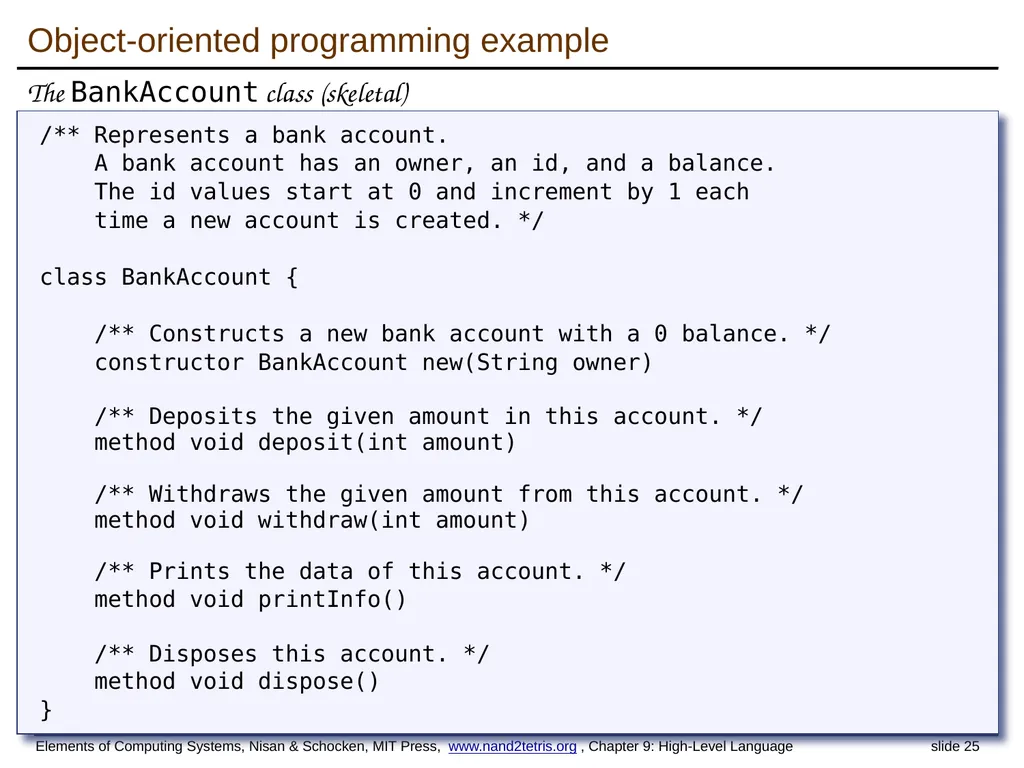
Object-oriented programming example /** Represents a bank account.
A bank account has an owner, an id, and a balance.
The id values start at 0 and increment by 1 each
time a new account is created. */
class BankAccount {
/** Constructs a new bank account with a 0 balance. */
constructor BankAccount new(String owner)
/** Deposits the given amount in this account. */
method void deposit(int amount)
/** Withdraws the given amount from this account. */
method void withdraw(int amount)
/** Prints the data of this account. */
method void printInfo()
/** Disposes this account. */
method void dispose()
} The BankAccount class (skeletal)<br>
A bank account has an owner, an id, and a balance.
The id values start at 0 and increment by 1 each
time a new account is created. */
class BankAccount {
/** Constructs a new bank account with a 0 balance. */
constructor BankAccount new(String owner)
/** Deposits the given amount in this account. */
method void deposit(int amount)
/** Withdraws the given amount from this account. */
method void withdraw(int amount)
/** Prints the data of this account. */
method void printInfo()
/** Disposes this account. */
method void dispose()
} The BankAccount class (skeletal)<br>
24
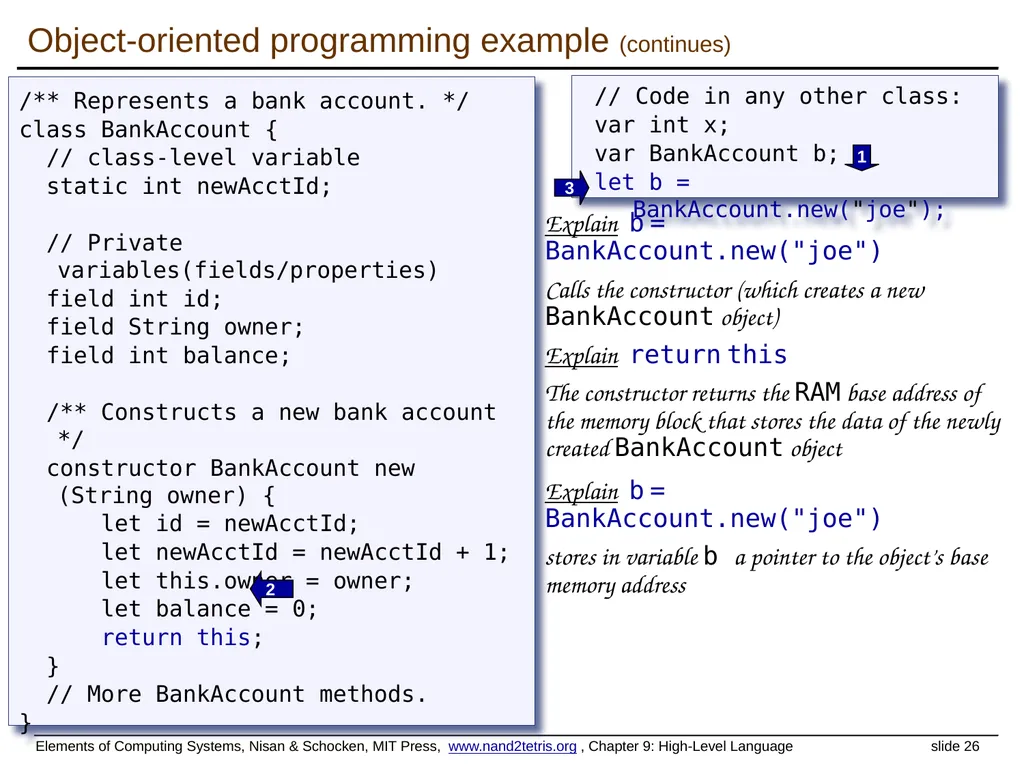
Object-oriented programming example (continues) /** Represents a bank account. */
class BankAccount {
// class-level variable
static int newAcctId;
// Private variables(fields/properties)
field int id;
field String owner;
field int balance;
/** Constructs a new bank account */
constructor BankAccount new (String owner) {
let id = newAcctId;
let newAcctId = newAcctId + 1;
let this.owner = owner;
let balance = 0;
return this;
}
// More BankAccount methods.
} // Code in any other class:
var int x;
var BankAccount b;
let b = BankAccount.new("joe"); Explain b = BankAccount.new("joe")
Calls the constructor (which creates a new BankAccount object)
Explain return this
The constructor returns the RAM base address of the memory block that stores the data of the newly created BankAccount object
Explain b = BankAccount.new("joe")
stores in variable b a pointer to the object’s base memory address<br>
class BankAccount {
// class-level variable
static int newAcctId;
// Private variables(fields/properties)
field int id;
field String owner;
field int balance;
/** Constructs a new bank account */
constructor BankAccount new (String owner) {
let id = newAcctId;
let newAcctId = newAcctId + 1;
let this.owner = owner;
let balance = 0;
return this;
}
// More BankAccount methods.
} // Code in any other class:
var int x;
var BankAccount b;
let b = BankAccount.new("joe"); Explain b = BankAccount.new("joe")
Calls the constructor (which creates a new BankAccount object)
Explain return this
The constructor returns the RAM base address of the memory block that stores the data of the newly created BankAccount object
Explain b = BankAccount.new("joe")
stores in variable b a pointer to the object’s base memory address<br>
25
Object-oriented programming example (continues) /** Represents a bank account. */
class BankAccount {
// class-level variable
static int newAcctId;
// Private variables(fields/properties)
field int id;
field String owner;
field int balance;
/** Constructs a new bank account */
constructor BankAccount new (String owner) {
let id = newAcctId;
let newAcctId = newAcctId + 1;
let this.owner = owner;
let balance = 0;
return this;
}
// More BankAccount methods.
} // Code in any other class:
var int x;
var BankAccount b;
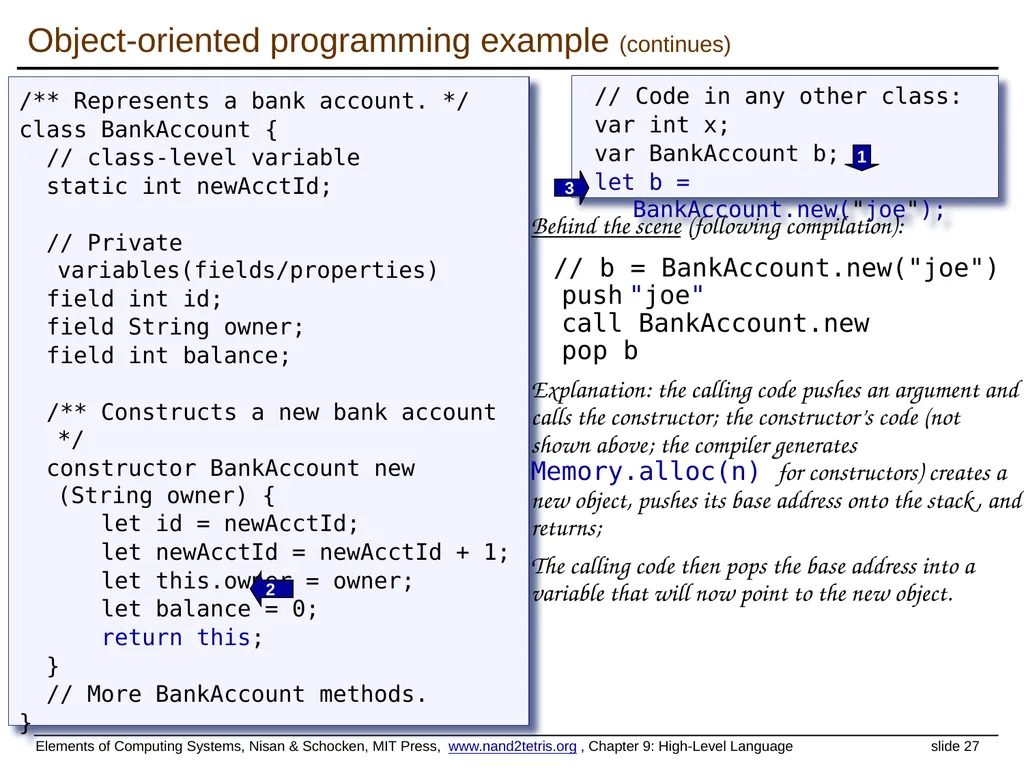
let b = BankAccount.new("joe"); Behind the scene (following compilation):
// b = BankAccount.new("joe")
push "joe" call BankAccount.new pop b
Explanation: the calling code pushes an argument and calls the constructor; the constructor’s code (not shown above; the compiler generates Memory.alloc(n) for constructors) creates a new object, pushes its base address onto the stack, and returns;
The calling code then pops the base address into a variable that will now point to the new object.<br>
class BankAccount {
// class-level variable
static int newAcctId;
// Private variables(fields/properties)
field int id;
field String owner;
field int balance;
/** Constructs a new bank account */
constructor BankAccount new (String owner) {
let id = newAcctId;
let newAcctId = newAcctId + 1;
let this.owner = owner;
let balance = 0;
return this;
}
// More BankAccount methods.
} // Code in any other class:
var int x;
var BankAccount b;
let b = BankAccount.new("joe"); Behind the scene (following compilation):
// b = BankAccount.new("joe")
push "joe" call BankAccount.new pop b
Explanation: the calling code pushes an argument and calls the constructor; the constructor’s code (not shown above; the compiler generates Memory.alloc(n) for constructors) creates a new object, pushes its base address onto the stack, and returns;
The calling code then pops the base address into a variable that will now point to the new object.<br>
26
class BankAccount {
static int nAccounts;
field int id;
field String owner;
field int balance;
// Constructor ... (omitted)
/** Handles deposits */
method void deposit (int amount) {
let balance = balance+amount;
return;
}
/** Handles withdrawls */
method void withdraw (int amount){
if (~(amount > balance)) {
let balance = balance-amount;
}
return;
}
// More BankAccount methods.
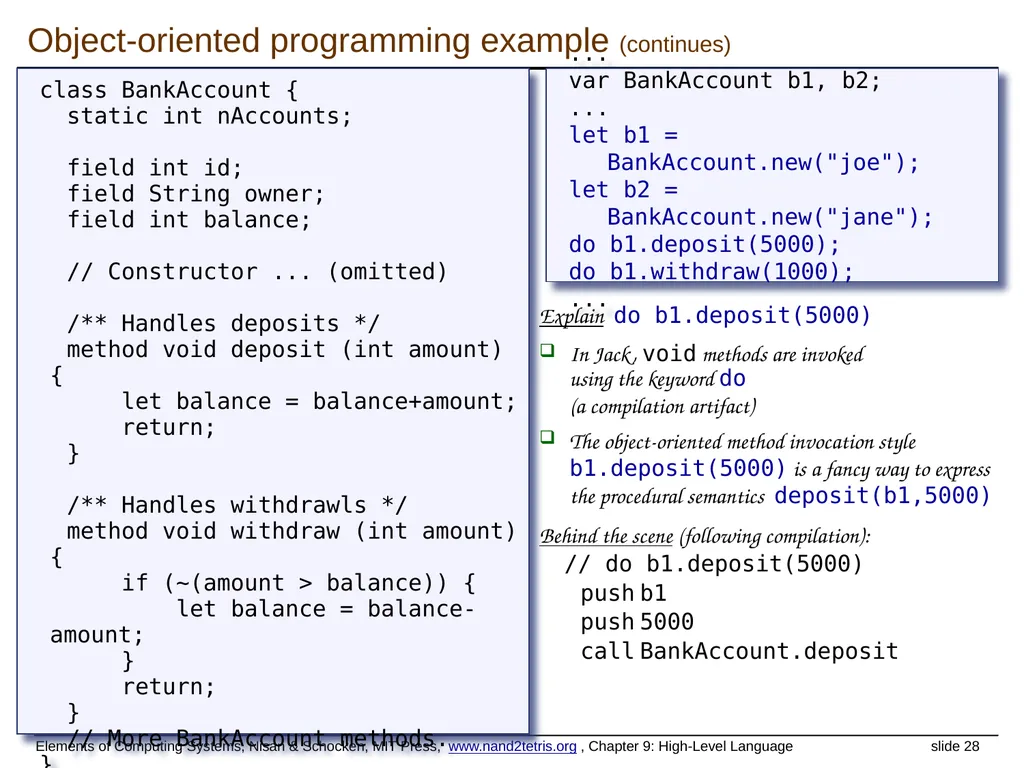
} ...
var BankAccount b1, b2;
...
let b1 = BankAccount.new("joe");
let b2 = BankAccount.new("jane");
do b1.deposit(5000);
do b1.withdraw(1000);
... Object-oriented programming example (continues) Explain do b1.deposit(5000)
In Jack, void methods are invoked using the keyword do
(a compilation artifact)
The object-oriented method invocation style b1.deposit(5000) is a fancy way to express the procedural semantics deposit(b1,5000)
Behind the scene (following compilation):
// do b1.deposit(5000)
push b1
push 5000
call BankAccount.deposit<br>
static int nAccounts;
field int id;
field String owner;
field int balance;
// Constructor ... (omitted)
/** Handles deposits */
method void deposit (int amount) {
let balance = balance+amount;
return;
}
/** Handles withdrawls */
method void withdraw (int amount){
if (~(amount > balance)) {
let balance = balance-amount;
}
return;
}
// More BankAccount methods.
} ...
var BankAccount b1, b2;
...
let b1 = BankAccount.new("joe");
let b2 = BankAccount.new("jane");
do b1.deposit(5000);
do b1.withdraw(1000);
... Object-oriented programming example (continues) Explain do b1.deposit(5000)
In Jack, void methods are invoked using the keyword do
(a compilation artifact)
The object-oriented method invocation style b1.deposit(5000) is a fancy way to express the procedural semantics deposit(b1,5000)
Behind the scene (following compilation):
// do b1.deposit(5000)
push b1
push 5000
call BankAccount.deposit<br>
27
Object-oriented programming example (continues) class BankAccount {
static int nAccounts;
field int id;
field String owner;
field int balance;
// Constructor ... (omitted)
/** Prints information about this account. */
method void printInfo () {
do Output.printInt(id);
do Output.printString(owner);
do Output.printInt(balance);
return;
}
/** Disposes this account. */
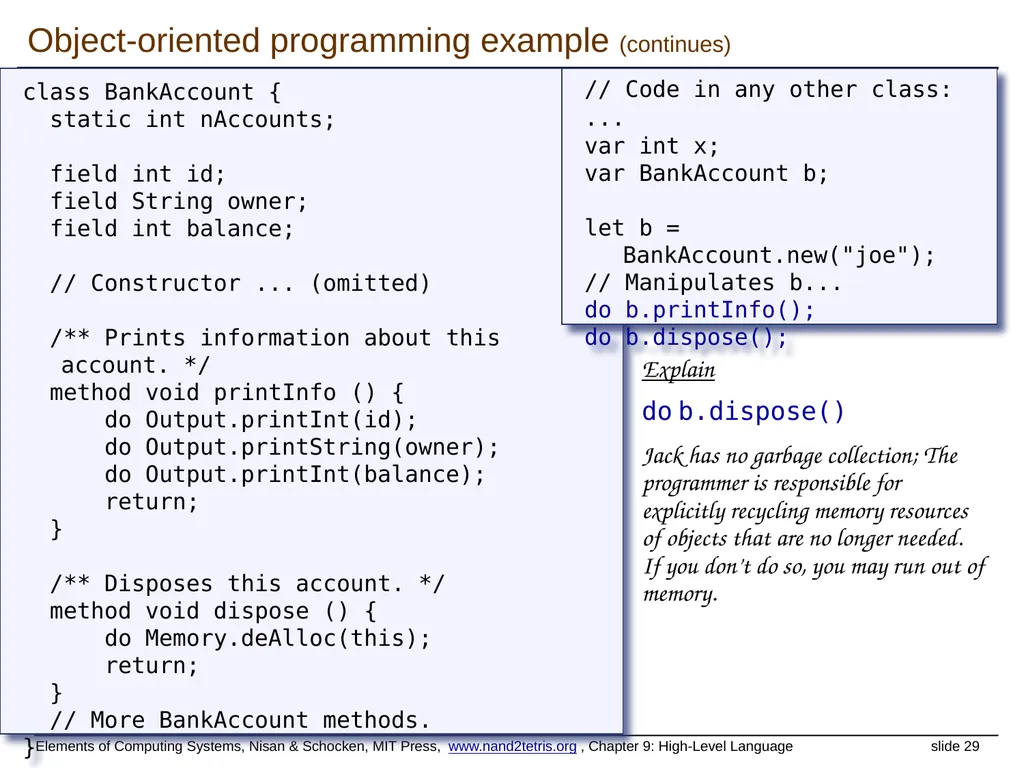
method void dispose () {
do Memory.deAlloc(this);
return;
}
// More BankAccount methods.
} // Code in any other class:
...
var int x;
var BankAccount b;
let b = BankAccount.new("joe");
// Manipulates b...
do b.printInfo();
do b.dispose(); Explain
do b.dispose()
Jack has no garbage collection; The programmer is responsible for explicitly recycling memory resources of objects that are no longer needed. If you don’t do so, you may run out of memory.<br>
static int nAccounts;
field int id;
field String owner;
field int balance;
// Constructor ... (omitted)
/** Prints information about this account. */
method void printInfo () {
do Output.printInt(id);
do Output.printString(owner);
do Output.printInt(balance);
return;
}
/** Disposes this account. */
method void dispose () {
do Memory.deAlloc(this);
return;
}
// More BankAccount methods.
} // Code in any other class:
...
var int x;
var BankAccount b;
let b = BankAccount.new("joe");
// Manipulates b...
do b.printInfo();
do b.dispose(); Explain
do b.dispose()
Jack has no garbage collection; The programmer is responsible for explicitly recycling memory resources of objects that are no longer needed. If you don’t do so, you may run out of memory.<br>
28
Object-oriented programming example (continues) class BankAccount {
static int nAccounts;
field int id;
field String owner;
field int balance;
// Constructor ... (omitted)
/** Prints information about this account. */
method void printInfo () {
do Output.printInt(id);
do Output.printString(owner);
do Output.printInt(balance);
return;
}
/** Disposes this account. */
method void dispose () {
do Memory.deAlloc(this);
return;
}
// More BankAccount methods.
} // Code in any other class:
...
var int x;
var BankAccount b;
let b = BankAccount.new("joe");
// Manipulates b...
do b.printInfo();
do b.dispose(); Explain
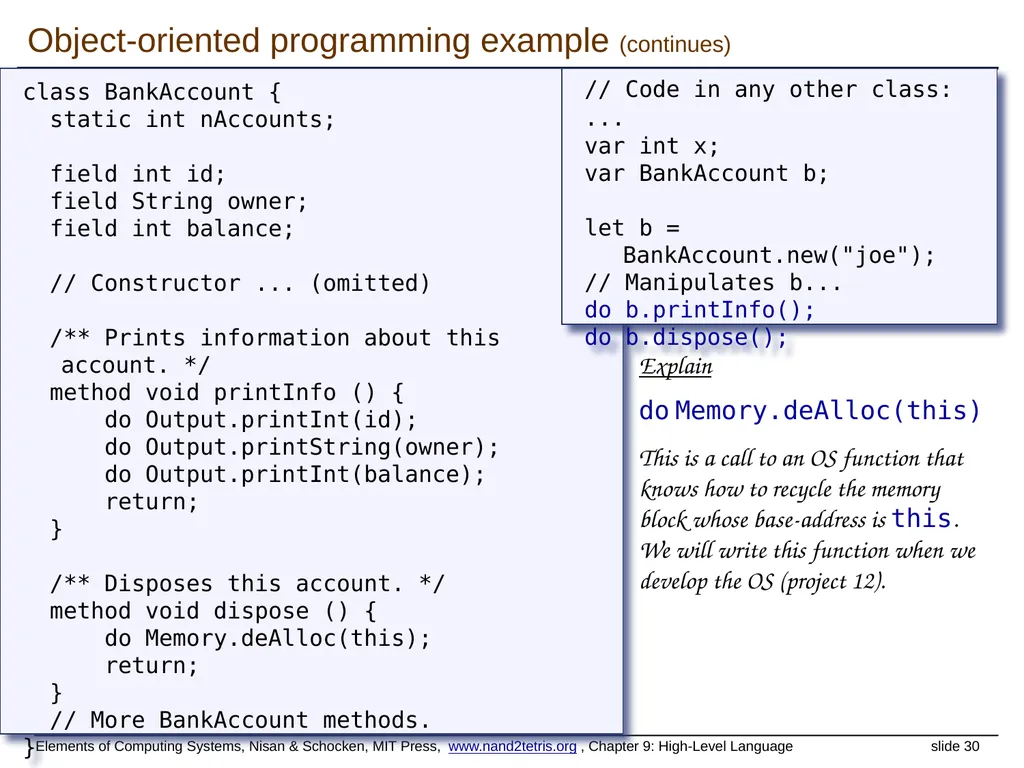
do Memory.deAlloc(this)
This is a call to an OS function that knows how to recycle the memory block whose base-address is this. We will write this function when we develop the OS (project 12).<br>
static int nAccounts;
field int id;
field String owner;
field int balance;
// Constructor ... (omitted)
/** Prints information about this account. */
method void printInfo () {
do Output.printInt(id);
do Output.printString(owner);
do Output.printInt(balance);
return;
}
/** Disposes this account. */
method void dispose () {
do Memory.deAlloc(this);
return;
}
// More BankAccount methods.
} // Code in any other class:
...
var int x;
var BankAccount b;
let b = BankAccount.new("joe");
// Manipulates b...
do b.printInfo();
do b.dispose(); Explain
do Memory.deAlloc(this)
This is a call to an OS function that knows how to recycle the memory block whose base-address is this. We will write this function when we develop the OS (project 12).<br>
29
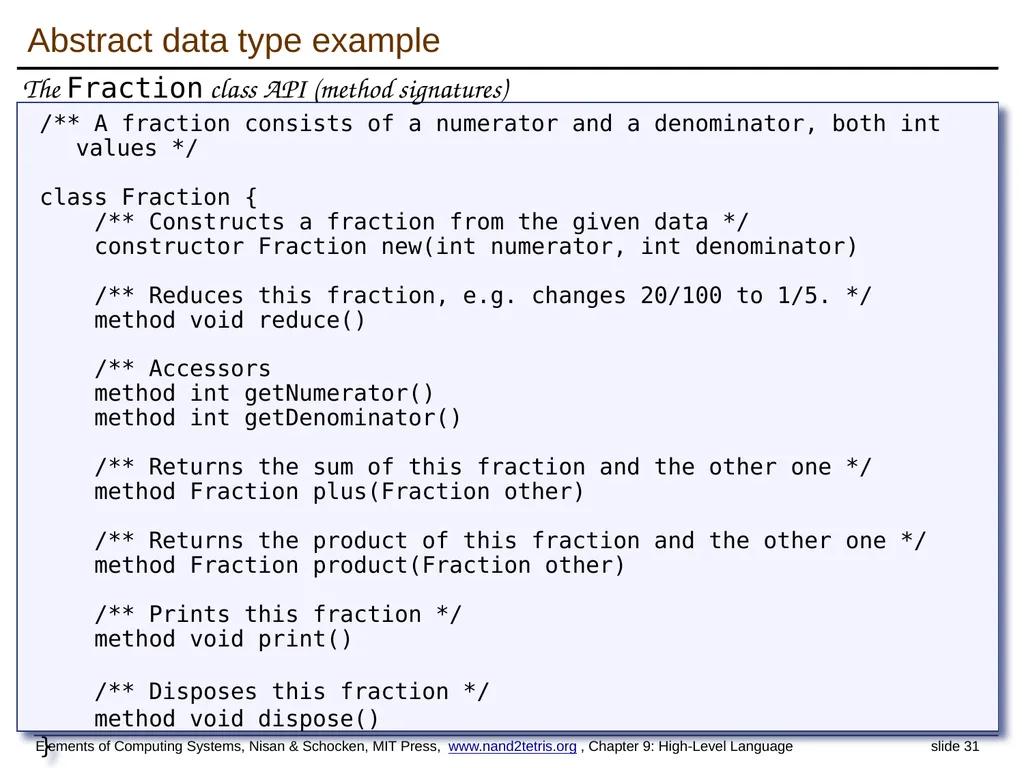
Abstract data type example /** A fraction consists of a numerator and a denominator, both int values */
class Fraction {
/** Constructs a fraction from the given data */
constructor Fraction new(int numerator, int denominator)
/** Reduces this fraction, e.g. changes 20/100 to 1/5. */
method void reduce()
/** Accessors
method int getNumerator()
method int getDenominator()
/** Returns the sum of this fraction and the other one */
method Fraction plus(Fraction other)
/** Returns the product of this fraction and the other one */
method Fraction product(Fraction other)
/** Prints this fraction */
method void print()
/** Disposes this fraction */
method void dispose()
} The Fraction class API (method signatures)<br>
class Fraction {
/** Constructs a fraction from the given data */
constructor Fraction new(int numerator, int denominator)
/** Reduces this fraction, e.g. changes 20/100 to 1/5. */
method void reduce()
/** Accessors
method int getNumerator()
method int getDenominator()
/** Returns the sum of this fraction and the other one */
method Fraction plus(Fraction other)
/** Returns the product of this fraction and the other one */
method Fraction product(Fraction other)
/** Prints this fraction */
method void print()
/** Disposes this fraction */
method void dispose()
} The Fraction class API (method signatures)<br>
30
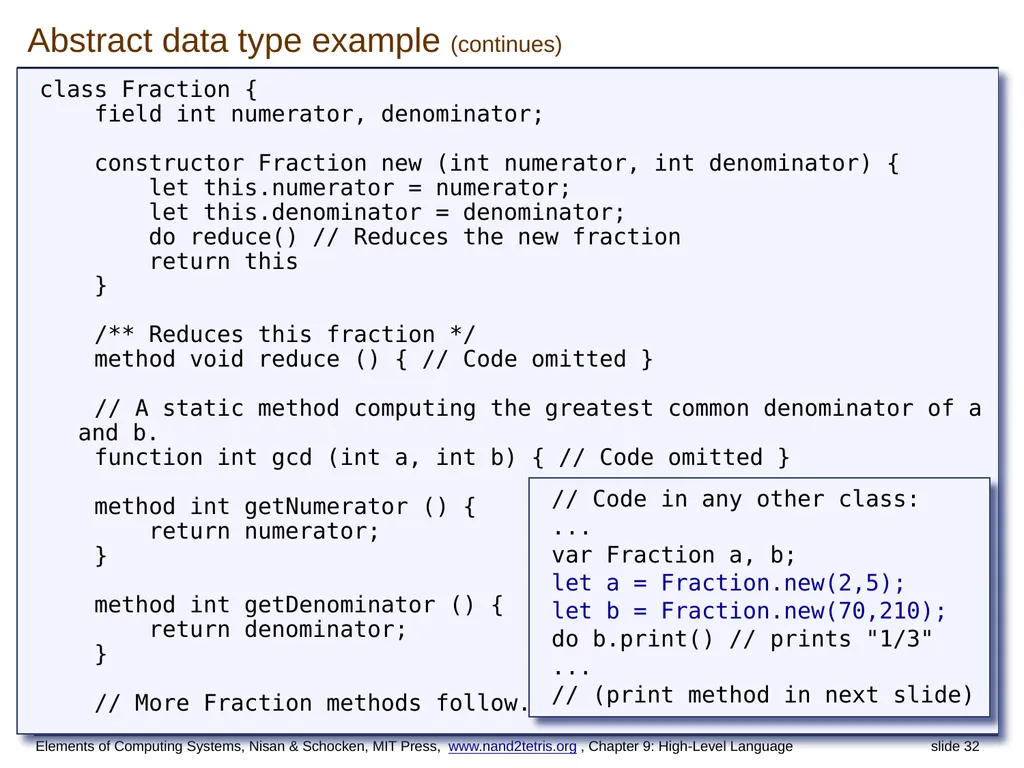
Abstract data type example (continues) class Fraction {
field int numerator, denominator;
constructor Fraction new (int numerator, int denominator) {
let this.numerator = numerator;
let this.denominator = denominator;
do reduce() // Reduces the new fraction
return this
}
/** Reduces this fraction */
method void reduce () { // Code omitted }
// A static method computing the greatest common denominator of a and b.
function int gcd (int a, int b) { // Code omitted }
method int getNumerator () {
return numerator;
}
method int getDenominator () {
return denominator;
}
// More Fraction methods follow. // Code in any other class:
...
var Fraction a, b;
let a = Fraction.new(2,5);
let b = Fraction.new(70,210);
do b.print() // prints "1/3"
...
// (print method in next slide)<br>
field int numerator, denominator;
constructor Fraction new (int numerator, int denominator) {
let this.numerator = numerator;
let this.denominator = denominator;
do reduce() // Reduces the new fraction
return this
}
/** Reduces this fraction */
method void reduce () { // Code omitted }
// A static method computing the greatest common denominator of a and b.
function int gcd (int a, int b) { // Code omitted }
method int getNumerator () {
return numerator;
}
method int getDenominator () {
return denominator;
}
// More Fraction methods follow. // Code in any other class:
...
var Fraction a, b;
let a = Fraction.new(2,5);
let b = Fraction.new(70,210);
do b.print() // prints "1/3"
...
// (print method in next slide)<br>
31
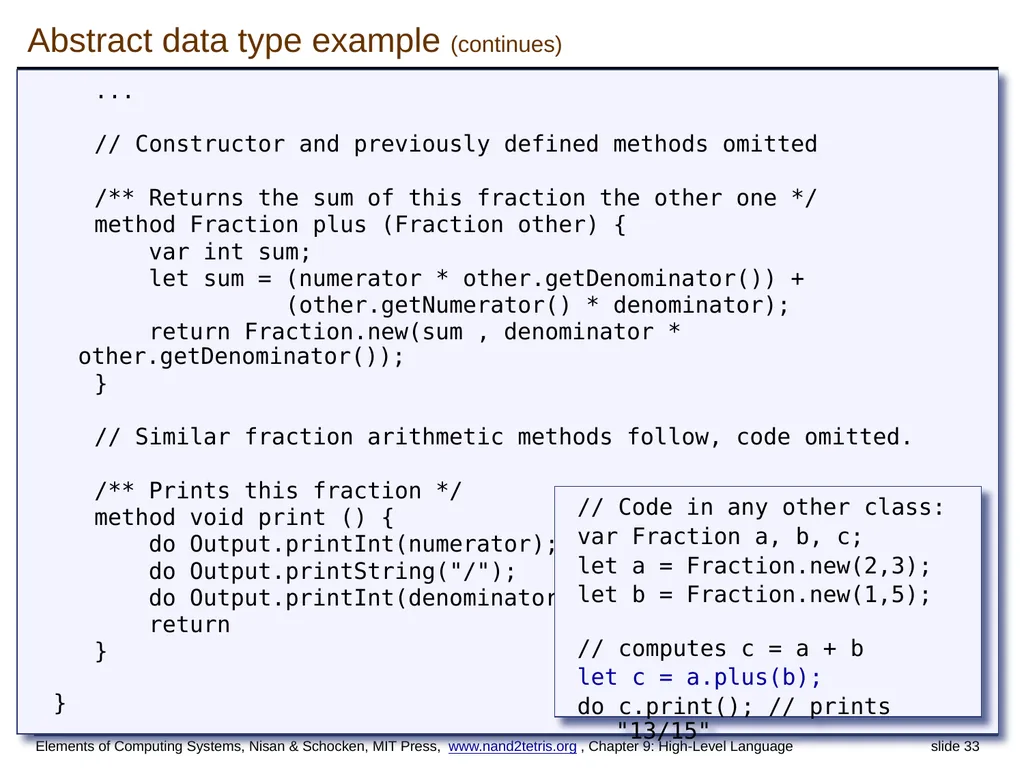
Abstract data type example (continues) ...
// Constructor and previously defined methods omitted
/** Returns the sum of this fraction the other one */
method Fraction plus (Fraction other) {
var int sum;
let sum = (numerator * other.getDenominator()) +
(other.getNumerator() * denominator);
return Fraction.new(sum , denominator * other.getDenominator());
}
// Similar fraction arithmetic methods follow, code omitted.
/** Prints this fraction */
method void print () {
do Output.printInt(numerator);
do Output.printString("/");
do Output.printInt(denominator);
return
}
} // Code in any other class:
var Fraction a, b, c;
let a = Fraction.new(2,3);
let b = Fraction.new(1,5);
// computes c = a + b
let c = a.plus(b);
do c.print(); // prints "13/15"<br>
// Constructor and previously defined methods omitted
/** Returns the sum of this fraction the other one */
method Fraction plus (Fraction other) {
var int sum;
let sum = (numerator * other.getDenominator()) +
(other.getNumerator() * denominator);
return Fraction.new(sum , denominator * other.getDenominator());
}
// Similar fraction arithmetic methods follow, code omitted.
/** Prints this fraction */
method void print () {
do Output.printInt(numerator);
do Output.printString("/");
do Output.printInt(denominator);
return
}
} // Code in any other class:
var Fraction a, b, c;
let a = Fraction.new(2,3);
let b = Fraction.new(1,5);
// computes c = a + b
let c = a.plus(b);
do c.print(); // prints "13/15"<br>
32
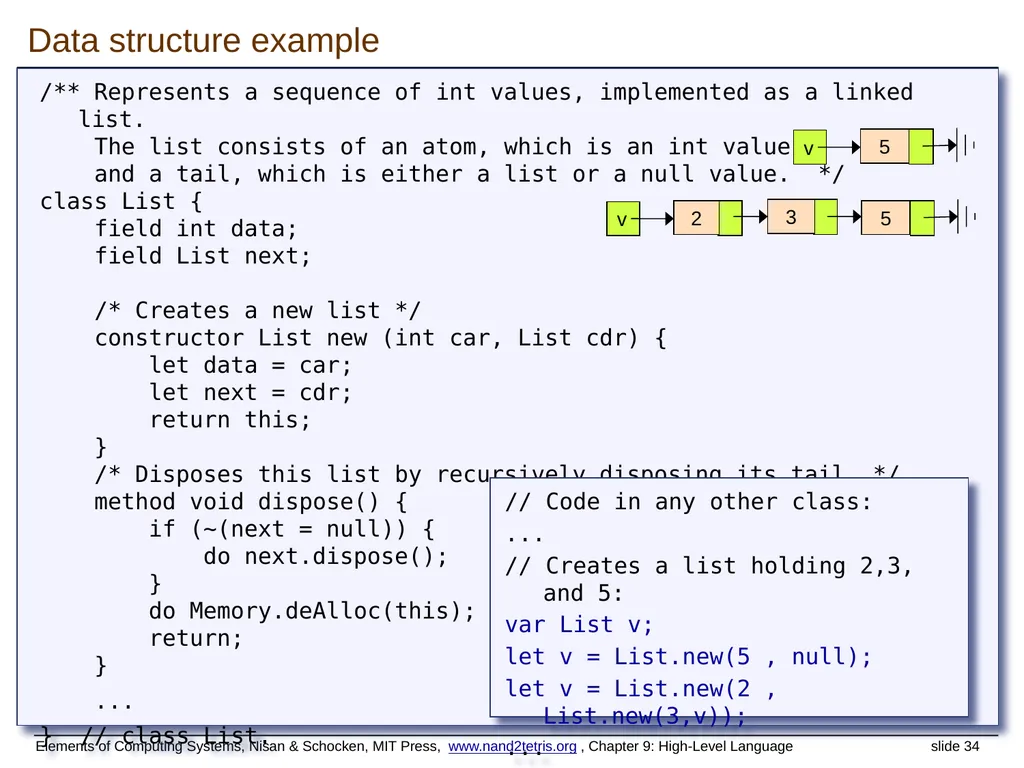
Data structure example /** Represents a sequence of int values, implemented as a linked list.
The list consists of an atom, which is an int value,
and a tail, which is either a list or a null value. */
class List {
field int data;
field List next;
/* Creates a new list */
constructor List new (int car, List cdr) {
let data = car;
let next = cdr;
return this;
}
/* Disposes this list by recursively disposing its tail. */
method void dispose() {
if (~(next = null)) {
do next.dispose();
}
do Memory.deAlloc(this);
return;
}
...
} // class List. // Code in any other class:
...
// Creates a list holding 2,3, and 5:
var List v;
let v = List.new(5 , null);
let v = List.new(2 , List.new(3,v));
...<br>
The list consists of an atom, which is an int value,
and a tail, which is either a list or a null value. */
class List {
field int data;
field List next;
/* Creates a new list */
constructor List new (int car, List cdr) {
let data = car;
let next = cdr;
return this;
}
/* Disposes this list by recursively disposing its tail. */
method void dispose() {
if (~(next = null)) {
do next.dispose();
}
do Memory.deAlloc(this);
return;
}
...
} // class List. // Code in any other class:
...
// Creates a list holding 2,3, and 5:
var List v;
let v = List.new(5 , null);
let v = List.new(2 , List.new(3,v));
...<br>
33
Jack language specification Syntax
Program structure
Data types
Variable kinds
Expressions
Statements
Subroutine calling
(for complete language specification, see the book).<br>
Program structure
Data types
Variable kinds
Expressions
Statements
Subroutine calling
(for complete language specification, see the book).<br>
34
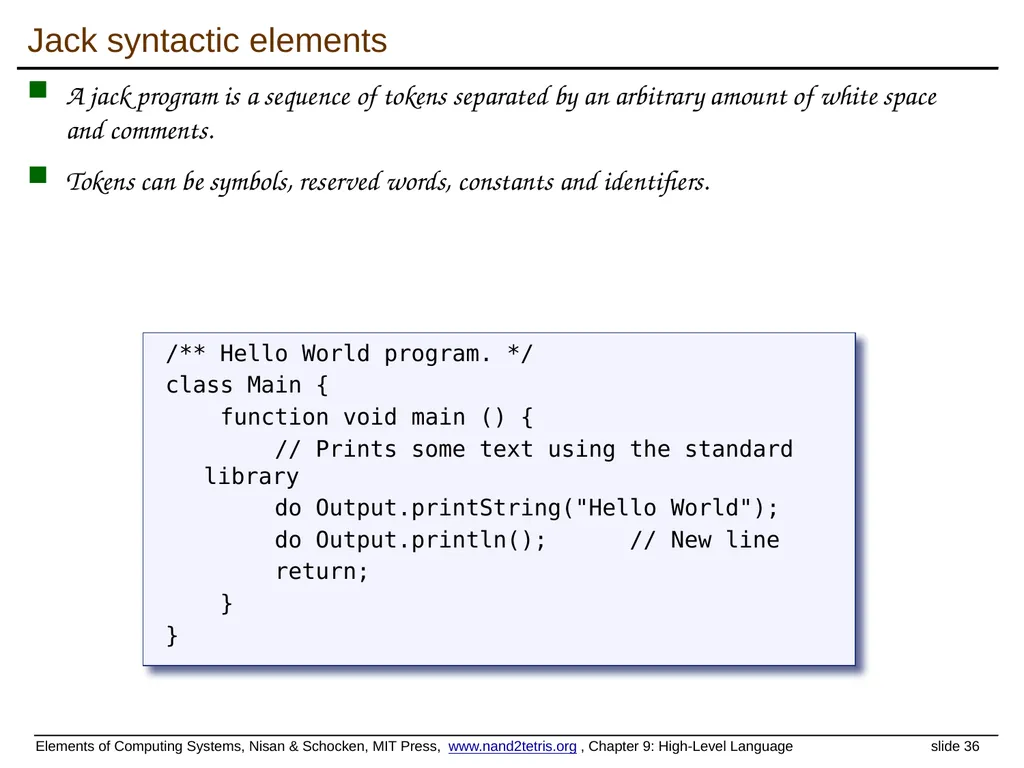
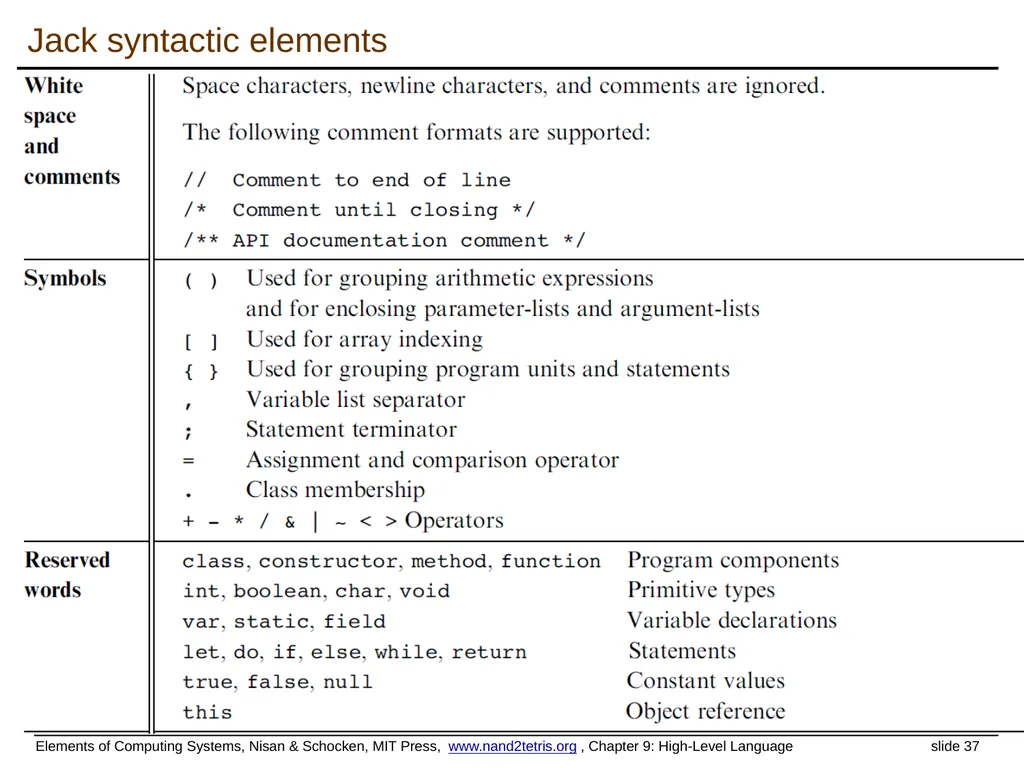
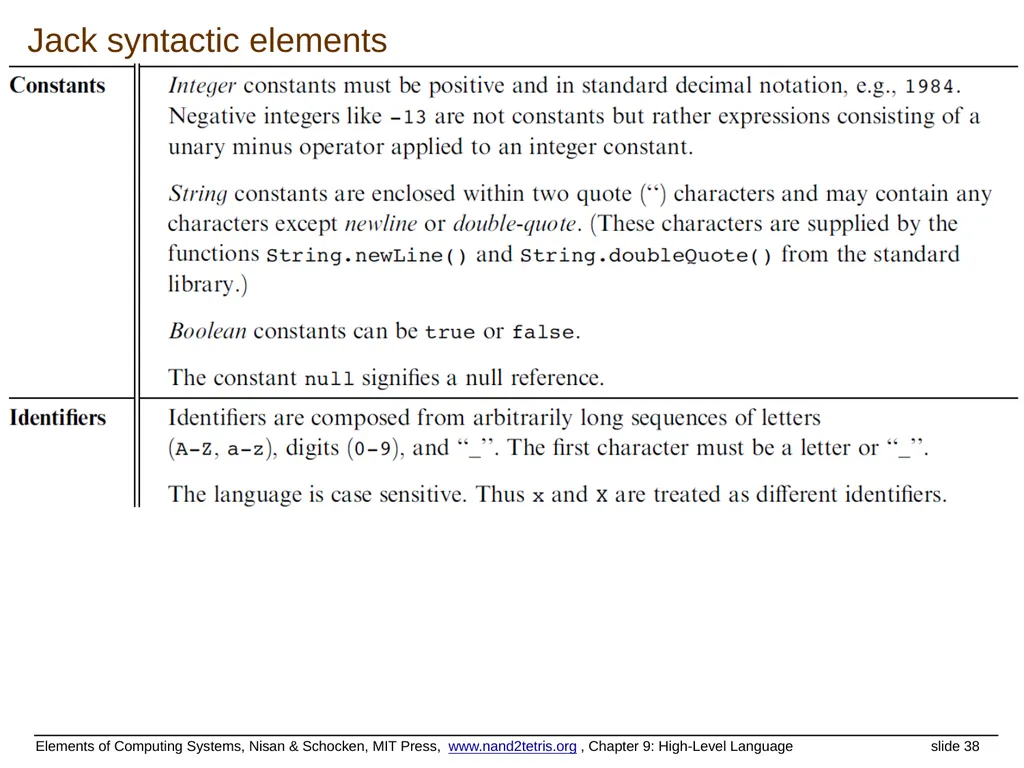
Jack syntactic elements A jack program is a sequence of tokens separated by an arbitrary amount of white space and comments.
Tokens can be symbols, reserved words, constants and identifiers. /** Hello World program. */
class Main {
function void main () {
// Prints some text using the standard library
do Output.printString("Hello World");
do Output.println(); // New line
return;
}
}<br>
Tokens can be symbols, reserved words, constants and identifiers. /** Hello World program. */
class Main {
function void main () {
// Prints some text using the standard library
do Output.printString("Hello World");
do Output.println(); // New line
return;
}
}<br>
35
Jack syntactic elements<br>
36
Jack syntactic elements<br>
37
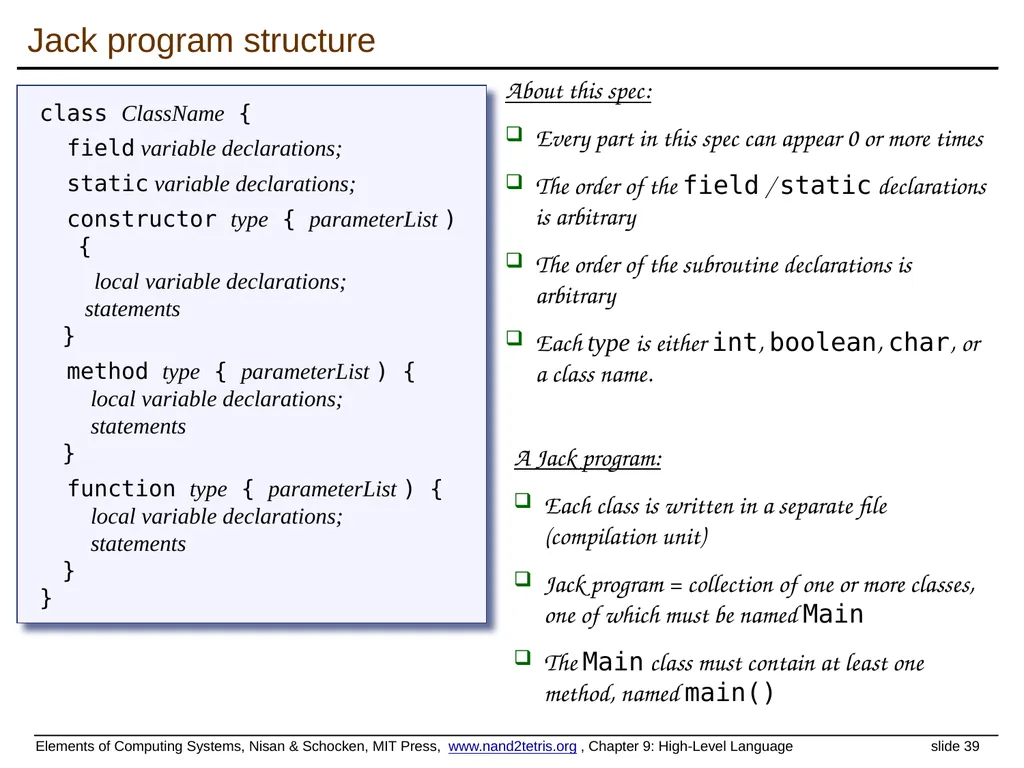
Jack program structure A Jack program:
Each class is written in a separate file (compilation unit)
Jack program = collection of one or more classes, one of which must be named Main
The Main class must contain at least one method, named main() class ClassName {
field variable declarations;
static variable declarations;
constructor type { parameterList ) {
local variable declarations;
statements
}
method type { parameterList ) {
local variable declarations;
statements
}
function type { parameterList ) {
local variable declarations;
statements
}
} About this spec:
Every part in this spec can appear 0 or more times
The order of the field / static declarations is arbitrary
The order of the subroutine declarations is arbitrary
Each type is either int, boolean, char, or a class name.<br>
Each class is written in a separate file (compilation unit)
Jack program = collection of one or more classes, one of which must be named Main
The Main class must contain at least one method, named main() class ClassName {
field variable declarations;
static variable declarations;
constructor type { parameterList ) {
local variable declarations;
statements
}
method type { parameterList ) {
local variable declarations;
statements
}
function type { parameterList ) {
local variable declarations;
statements
}
} About this spec:
Every part in this spec can appear 0 or more times
The order of the field / static declarations is arbitrary
The order of the subroutine declarations is arbitrary
Each type is either int, boolean, char, or a class name.<br>
38
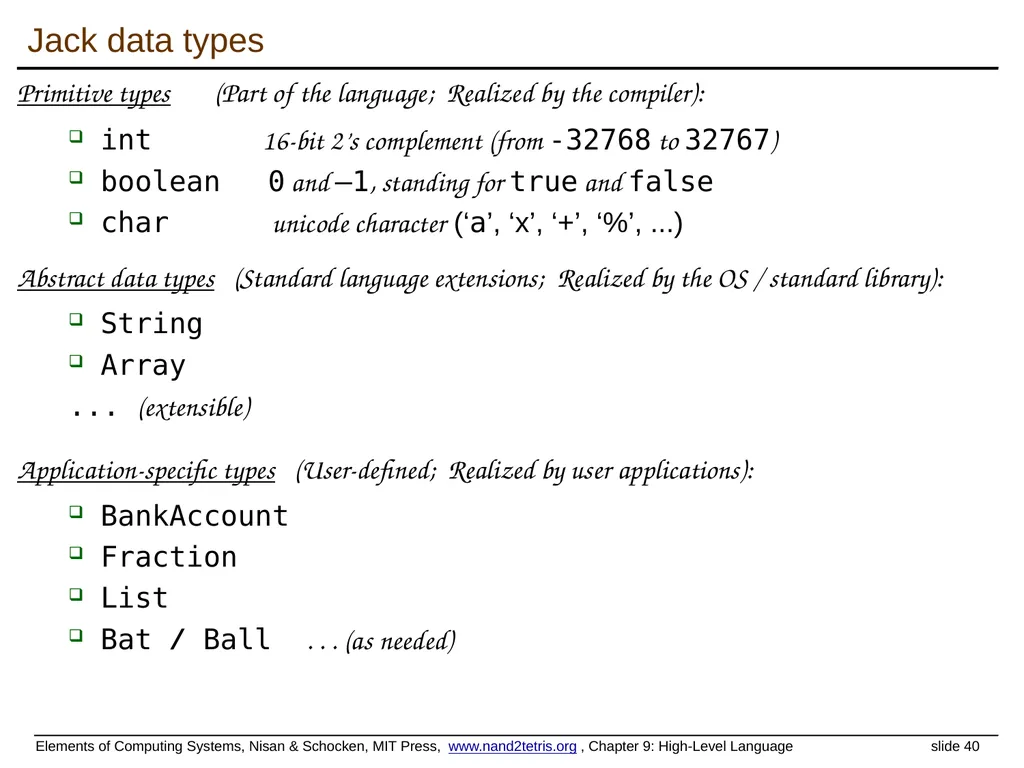
Jack data types Primitive types (Part of the language; Realized by the compiler):
int 16-bit 2’s complement (from -32768 to 32767)
boolean 0 and –1, standing for true and false
char unicode character (‘a’, ‘x’, ‘+’, ‘%’, ...)
Abstract data types (Standard language extensions; Realized by the OS / standard library):
String
Array
... (extensible)
Application-specific types (User-defined; Realized by user applications):
BankAccount
Fraction
List
Bat / Ball . . . (as needed)<br>
int 16-bit 2’s complement (from -32768 to 32767)
boolean 0 and –1, standing for true and false
char unicode character (‘a’, ‘x’, ‘+’, ‘%’, ...)
Abstract data types (Standard language extensions; Realized by the OS / standard library):
String
Array
... (extensible)
Application-specific types (User-defined; Realized by user applications):
BankAccount
Fraction
List
Bat / Ball . . . (as needed)<br>
39
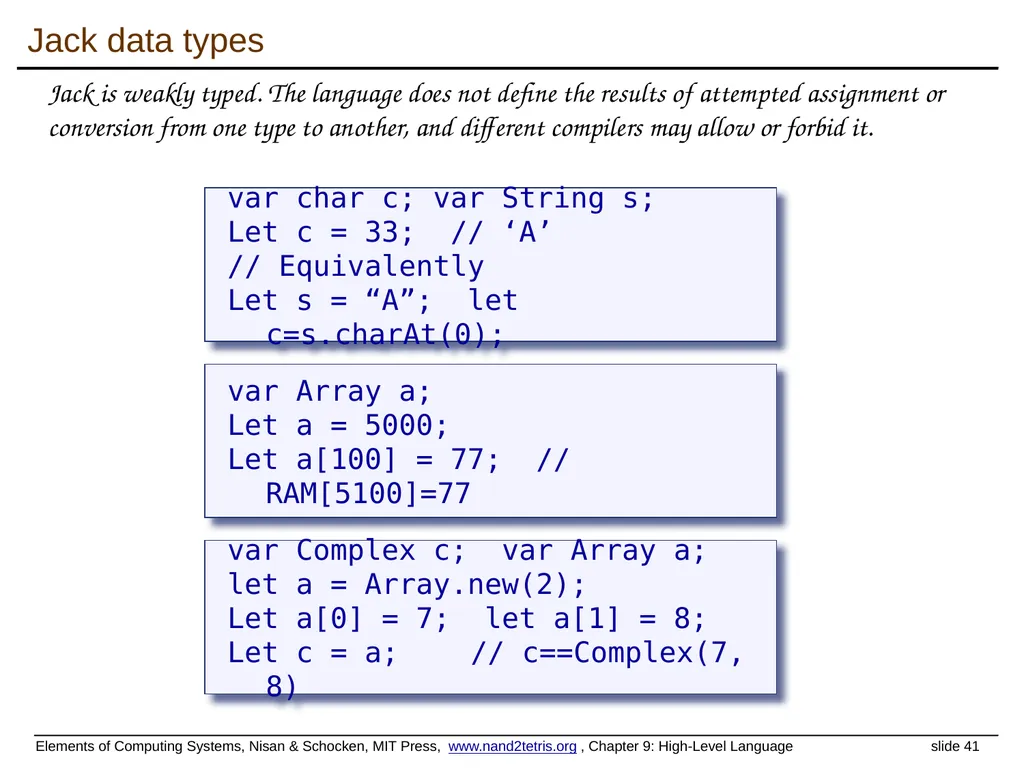
Jack data types Jack is weakly typed. The language does not define the results of attempted assignment or conversion from one type to another, and different compilers may allow or forbid it. var char c; var String s;
Let c = 33; // ‘A’
// Equivalently
Let s = “A”; let c=s.charAt(0); var Array a;
Let a = 5000;
Let a[100] = 77; // RAM[5100]=77 var Complex c; var Array a;
let a = Array.new(2);
Let a[0] = 7; let a[1] = 8;
Let c = a; // c==Complex(7, 8)<br>
Let c = 33; // ‘A’
// Equivalently
Let s = “A”; let c=s.charAt(0); var Array a;
Let a = 5000;
Let a[100] = 77; // RAM[5100]=77 var Complex c; var Array a;
let a = Array.new(2);
Let a[0] = 7; let a[1] = 8;
Let c = a; // c==Complex(7, 8)<br>
40
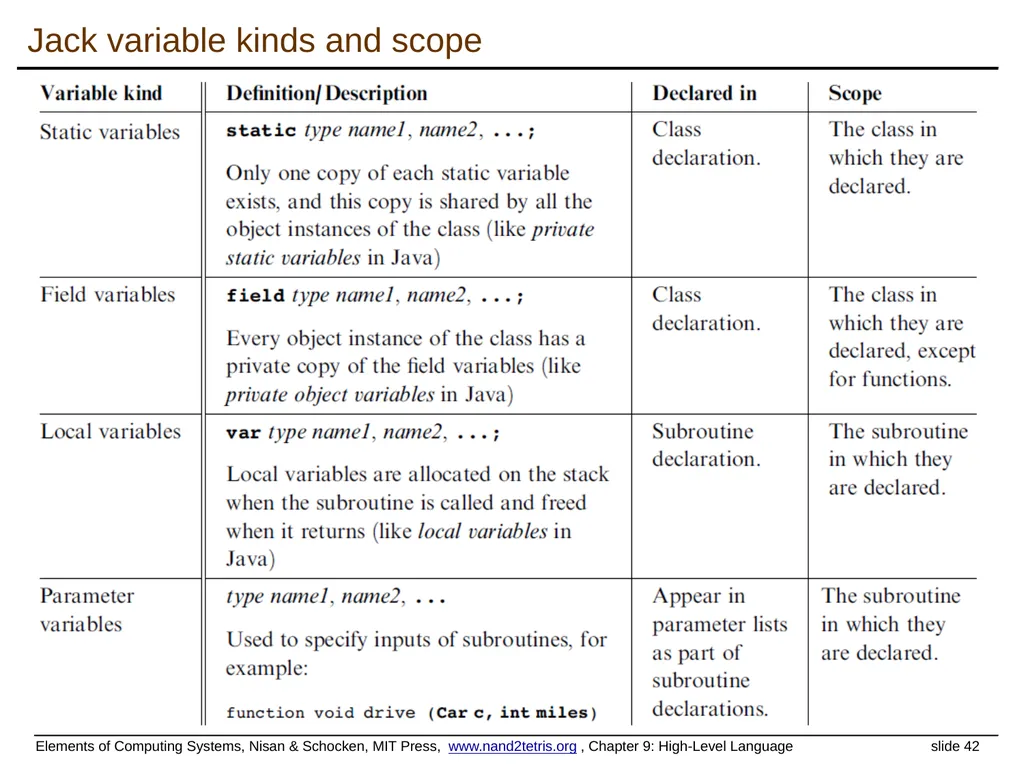
Jack variable kinds and scope<br>
41
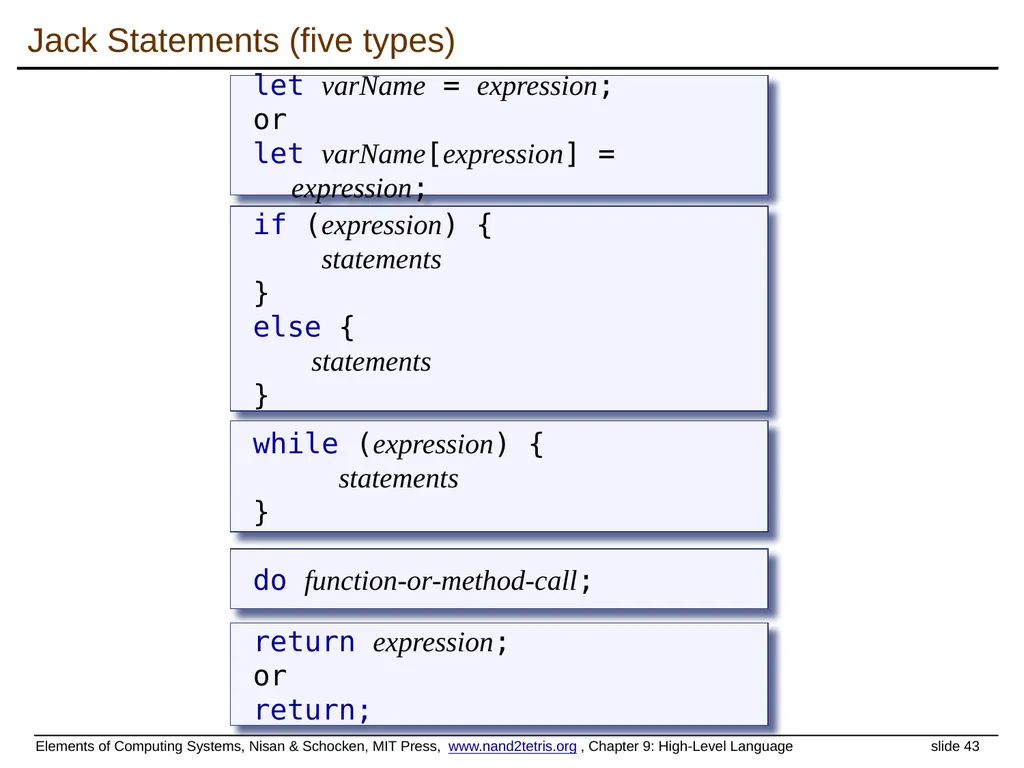
Jack Statements (five types) let varName = expression;
or
let varName[expression] = expression; if (expression) {
statements
}
else {
statements
} while (expression) {
statements
} do function-or-method-call; return expression;
or
return;<br>
or
let varName[expression] = expression; if (expression) {
statements
}
else {
statements
} while (expression) {
statements
} do function-or-method-call; return expression;
or
return;<br>
42
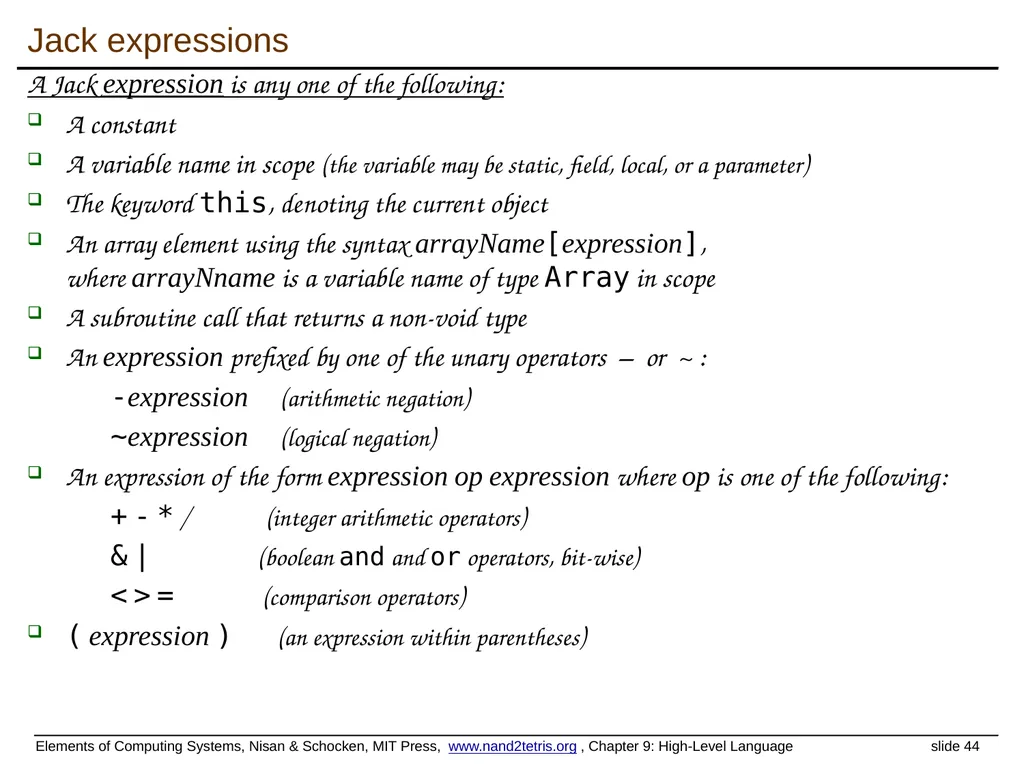
Jack expressions A Jack expression is any one of the following:
A constant
A variable name in scope (the variable may be static, field, local, or a parameter)
The keyword this, denoting the current object
An array element using the syntax arrayName[expression], where arrayNname is a variable name of type Array in scope
A subroutine call that returns a non-void type
An expression prefixed by one of the unary operators – or ~ :
-expression (arithmetic negation)
~expression (logical negation)
An expression of the form expression op expression where op is one of the following:
+ - * / (integer arithmetic operators)
& | (boolean and and or operators, bit-wise)
< > = (comparison operators)
( expression ) (an expression within parentheses)<br>
A constant
A variable name in scope (the variable may be static, field, local, or a parameter)
The keyword this, denoting the current object
An array element using the syntax arrayName[expression], where arrayNname is a variable name of type Array in scope
A subroutine call that returns a non-void type
An expression prefixed by one of the unary operators – or ~ :
-expression (arithmetic negation)
~expression (logical negation)
An expression of the form expression op expression where op is one of the following:
+ - * / (integer arithmetic operators)
& | (boolean and and or operators, bit-wise)
< > = (comparison operators)
( expression ) (an expression within parentheses)<br>
43
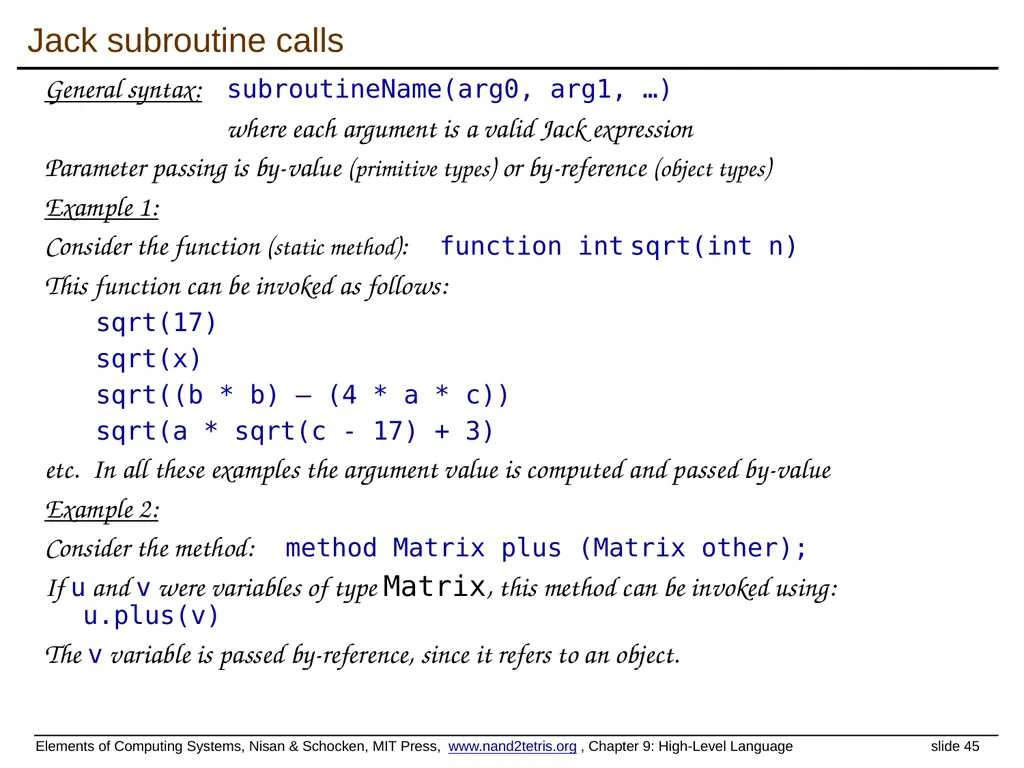
Jack subroutine calls General syntax: subroutineName(arg0, arg1, …)
where each argument is a valid Jack expression
Parameter passing is by-value (primitive types) or by-reference (object types)
Example 1:
Consider the function (static method): function int sqrt(int n)
This function can be invoked as follows:
sqrt(17)
sqrt(x)
sqrt((b * b) – (4 * a * c))
sqrt(a * sqrt(c - 17) + 3)
etc. In all these examples the argument value is computed and passed by-value
Example 2:
Consider the method: method Matrix plus (Matrix other);
If u and v were variables of type Matrix, this method can be invoked using: u.plus(v)
The v variable is passed by-reference, since it refers to an object.<br>
where each argument is a valid Jack expression
Parameter passing is by-value (primitive types) or by-reference (object types)
Example 1:
Consider the function (static method): function int sqrt(int n)
This function can be invoked as follows:
sqrt(17)
sqrt(x)
sqrt((b * b) – (4 * a * c))
sqrt(a * sqrt(c - 17) + 3)
etc. In all these examples the argument value is computed and passed by-value
Example 2:
Consider the method: method Matrix plus (Matrix other);
If u and v were variables of type Matrix, this method can be invoked using: u.plus(v)
The v variable is passed by-reference, since it refers to an object.<br>
44
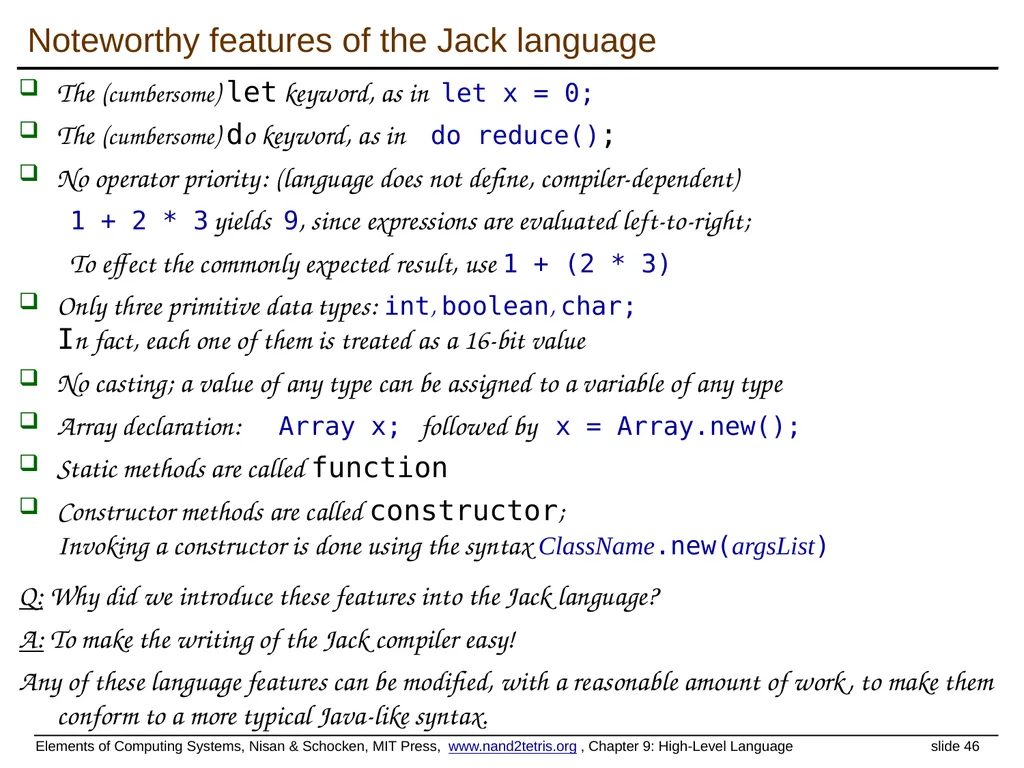
Noteworthy features of the Jack language The (cumbersome) let keyword, as in let x = 0;
The (cumbersome) do keyword, as in do reduce();
No operator priority: (language does not define, compiler-dependent)
1 + 2 * 3 yields 9, since expressions are evaluated left-to-right;
To effect the commonly expected result, use 1 + (2 * 3)
Only three primitive data types: int, boolean, char; In fact, each one of them is treated as a 16-bit value
No casting; a value of any type can be assigned to a variable of any type
Array declaration: Array x; followed by x = Array.new();
Static methods are called function
Constructor methods are called constructor; Invoking a constructor is done using the syntax ClassName.new(argsList) Q: Why did we introduce these features into the Jack language?
A: To make the writing of the Jack compiler easy!
Any of these language features can be modified, with a reasonable amount of work, to make them conform to a more typical Java-like syntax.<br>
The (cumbersome) do keyword, as in do reduce();
No operator priority: (language does not define, compiler-dependent)
1 + 2 * 3 yields 9, since expressions are evaluated left-to-right;
To effect the commonly expected result, use 1 + (2 * 3)
Only three primitive data types: int, boolean, char; In fact, each one of them is treated as a 16-bit value
No casting; a value of any type can be assigned to a variable of any type
Array declaration: Array x; followed by x = Array.new();
Static methods are called function
Constructor methods are called constructor; Invoking a constructor is done using the syntax ClassName.new(argsList) Q: Why did we introduce these features into the Jack language?
A: To make the writing of the Jack compiler easy!
Any of these language features can be modified, with a reasonable amount of work, to make them conform to a more typical Java-like syntax.<br>
45
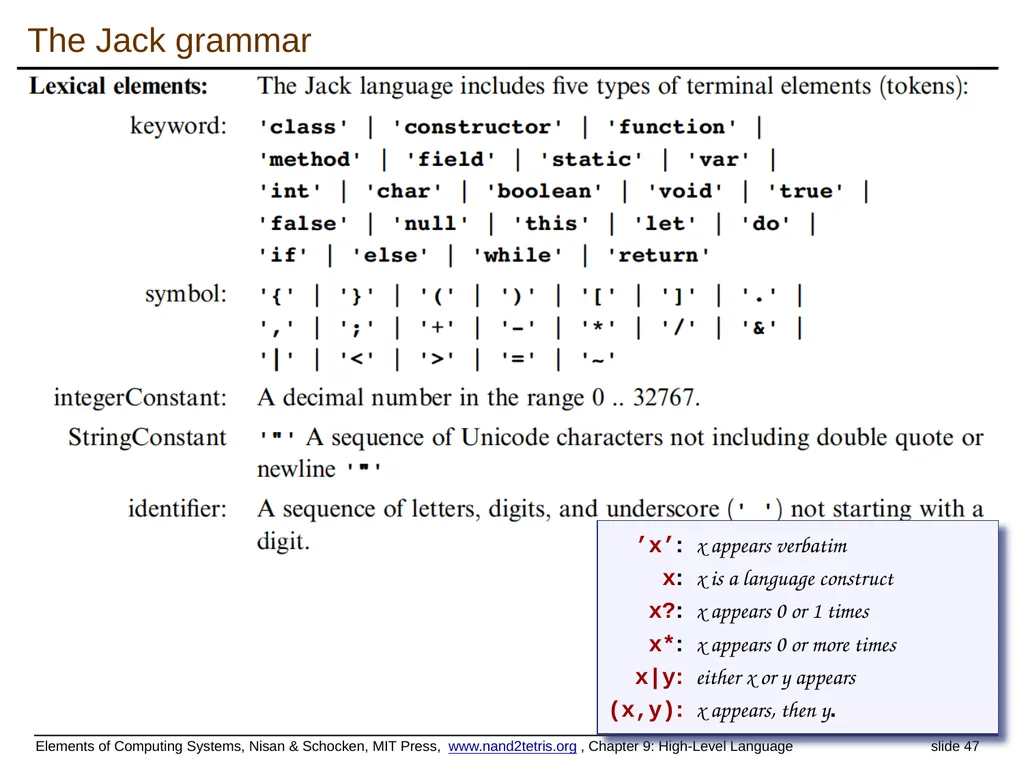
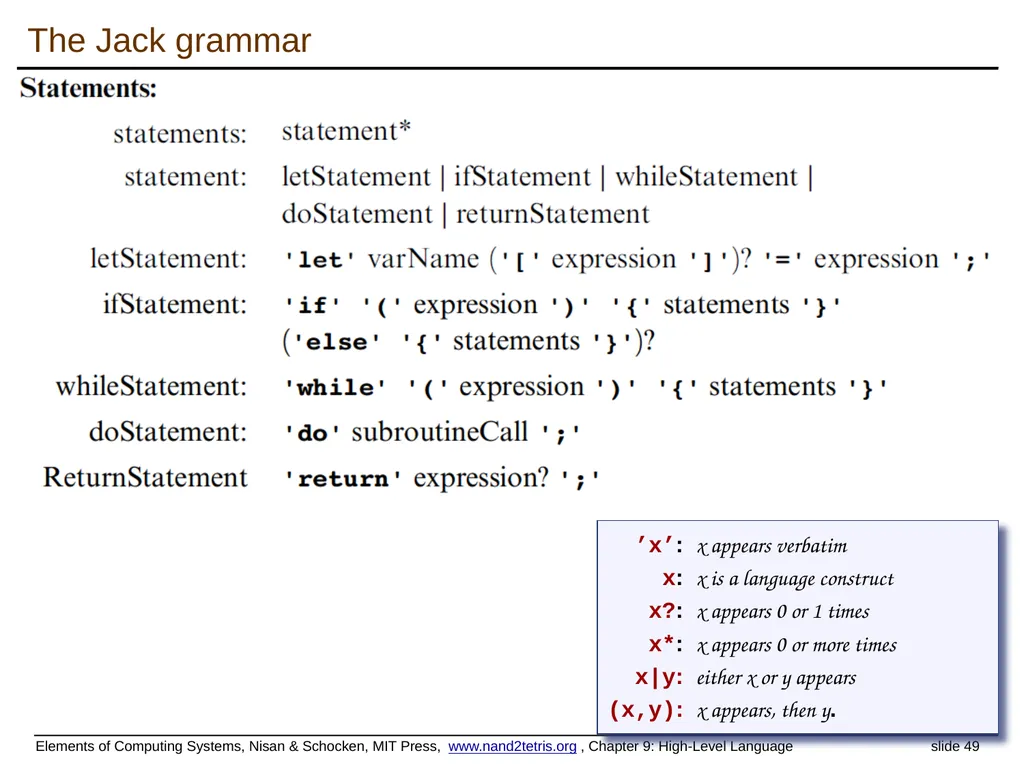
The Jack grammar ’x’: x appears verbatim
x: x is a language construct
x?: x appears 0 or 1 times
x*: x appears 0 or more times
x|y: either x or y appears
(x,y): x appears, then y.<br>
x: x is a language construct
x?: x appears 0 or 1 times
x*: x appears 0 or more times
x|y: either x or y appears
(x,y): x appears, then y.<br>
46
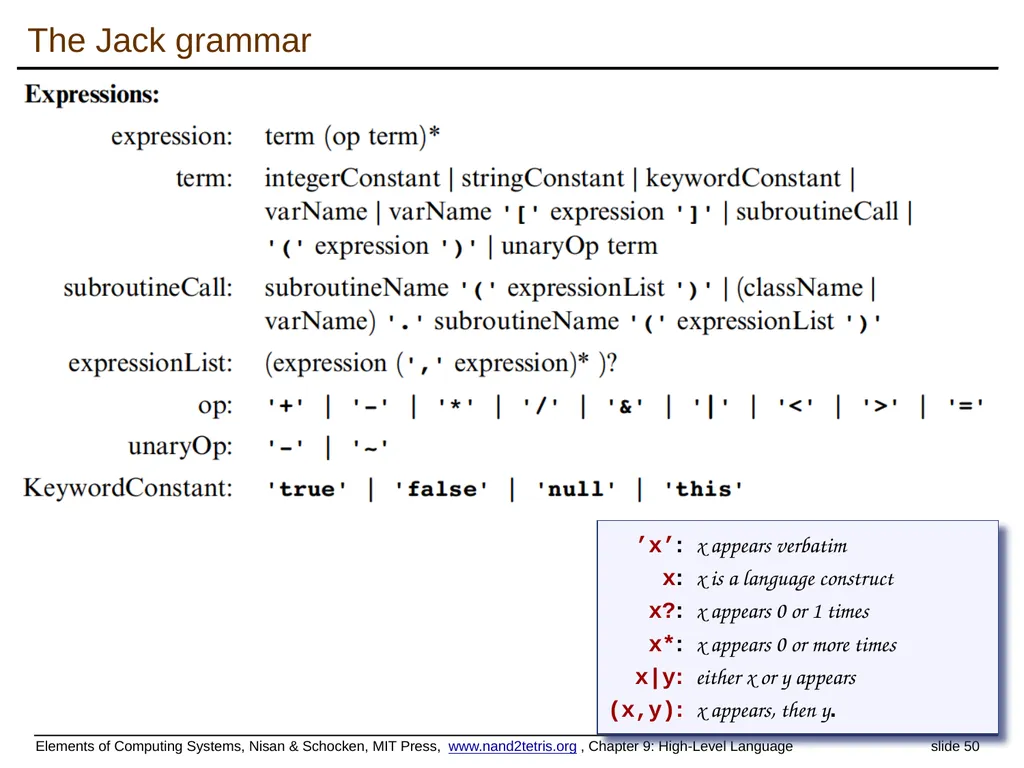
The Jack grammar ’x’: x appears verbatim
x: x is a language construct
x?: x appears 0 or 1 times
x*: x appears 0 or more times
x|y: either x or y appears
(x,y): x appears, then y.<br>
x: x is a language construct
x?: x appears 0 or 1 times
x*: x appears 0 or more times
x|y: either x or y appears
(x,y): x appears, then y.<br>
47
The Jack grammar ’x’: x appears verbatim
x: x is a language construct
x?: x appears 0 or 1 times
x*: x appears 0 or more times
x|y: either x or y appears
(x,y): x appears, then y.<br>
x: x is a language construct
x?: x appears 0 or 1 times
x*: x appears 0 or more times
x|y: either x or y appears
(x,y): x appears, then y.<br>
48
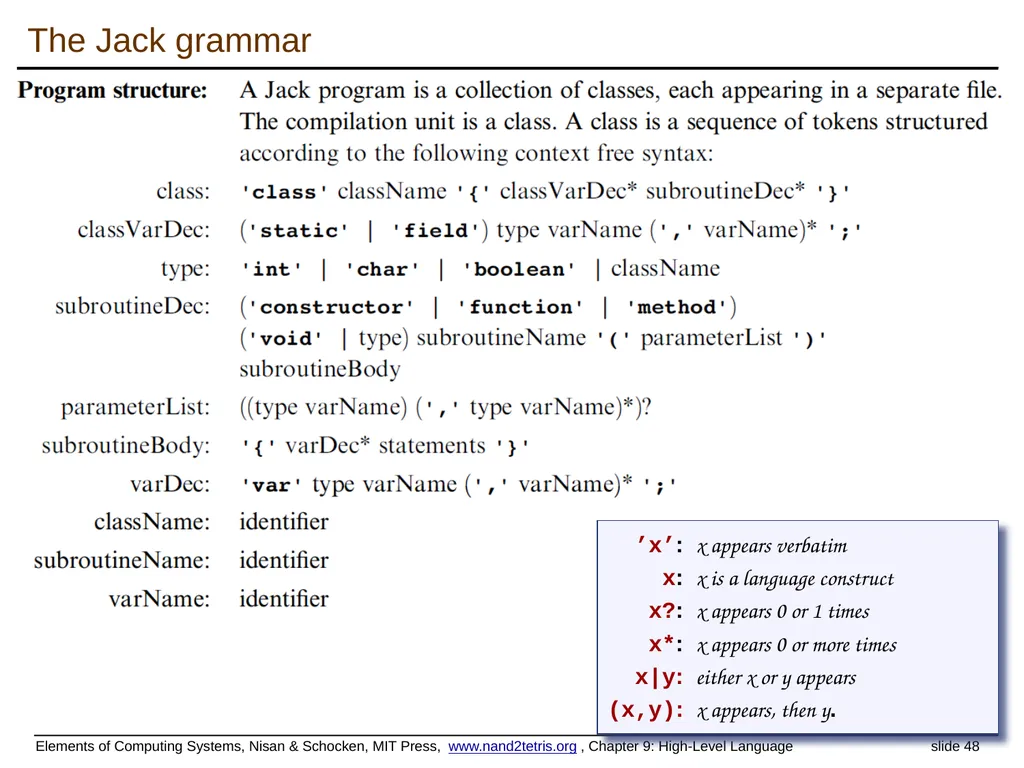
The Jack grammar ’x’: x appears verbatim
x: x is a language construct
x?: x appears 0 or 1 times
x*: x appears 0 or more times
x|y: either x or y appears
(x,y): x appears, then y.<br>
x: x is a language construct
x?: x appears 0 or 1 times
x*: x appears 0 or more times
x|y: either x or y appears
(x,y): x appears, then y.<br>
49
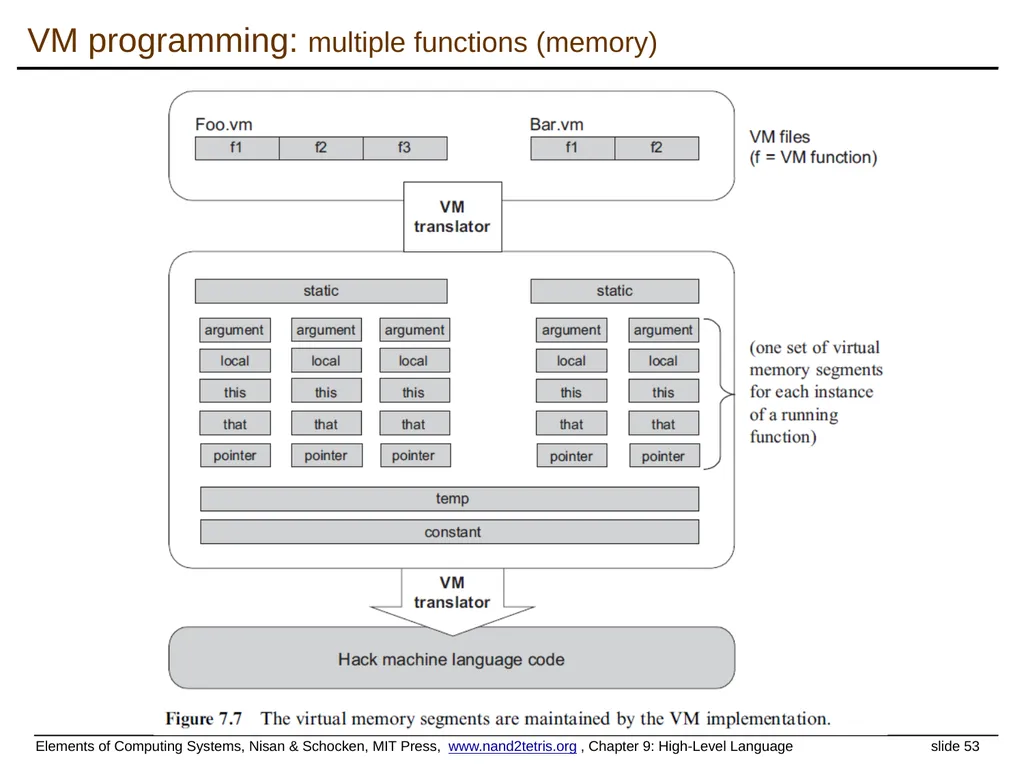
VM programming: multiple functions Compilation:
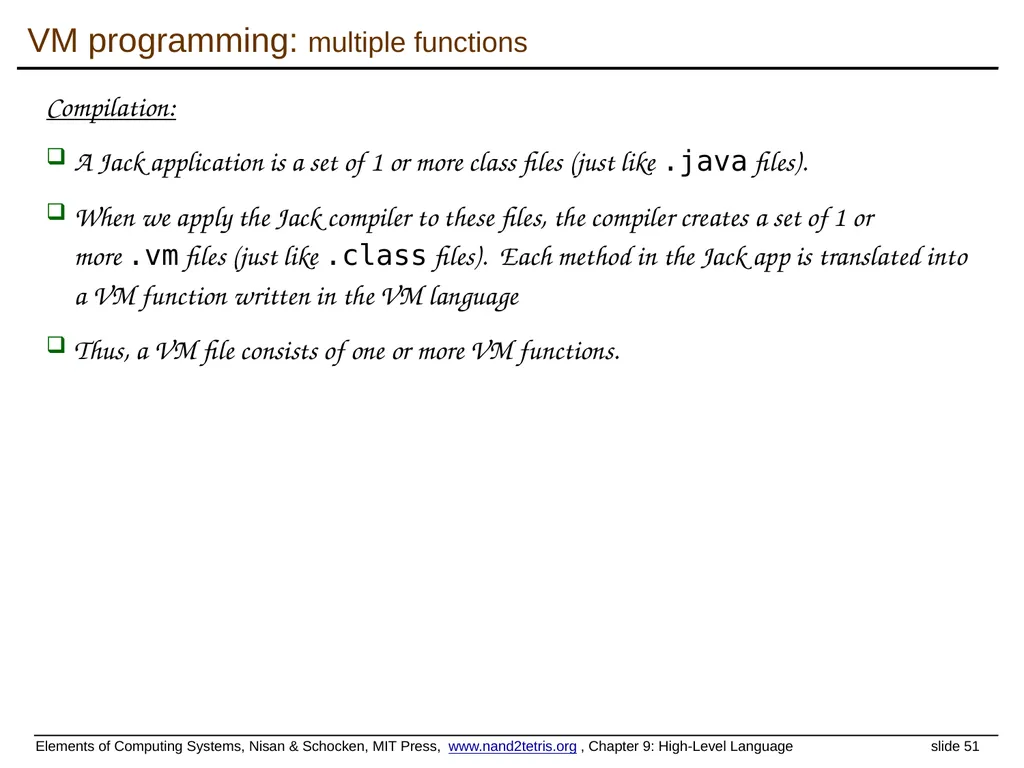
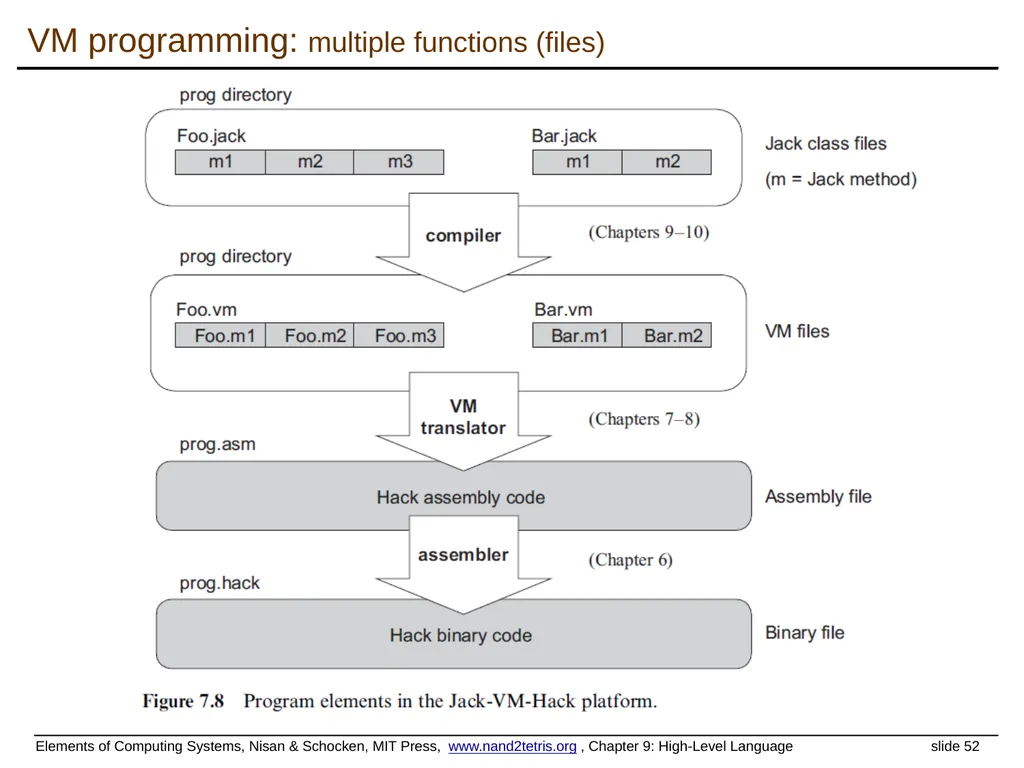
A Jack application is a set of 1 or more class files (just like .java files).
When we apply the Jack compiler to these files, the compiler creates a set of 1 or more .vm files (just like .class files). Each method in the Jack app is translated into a VM function written in the VM language
Thus, a VM file consists of one or more VM functions.<br>
A Jack application is a set of 1 or more class files (just like .java files).
When we apply the Jack compiler to these files, the compiler creates a set of 1 or more .vm files (just like .class files). Each method in the Jack app is translated into a VM function written in the VM language
Thus, a VM file consists of one or more VM functions.<br>
50
VM programming: multiple functions (files)<br>
51
VM programming: multiple functions (memory)<br>
52
A simple game: square (Demo)
Use Square as an example.
Design a class: think of its
States: data members
Behaviors: function members
Square
x, y, size
MoveUp, MoveDown, IncSize, …<br>
Use Square as an example.
Design a class: think of its
States: data members
Behaviors: function members
Square
x, y, size
MoveUp, MoveDown, IncSize, …<br>
53
Perspective Jack is an object-based language: no inheritance
Primitive type system (3 types)
Standard library
Our hidden agenda: gearing up to learn how to develop the ...
Compiler (projects 10 and 11)
OS (project 12).<br>
Primitive type system (3 types)
Standard library
Our hidden agenda: gearing up to learn how to develop the ...
Compiler (projects 10 and 11)
OS (project 12).<br>