
www.pwc.com Applications of data analytics in
KB
Published · 57 slides · 0 views

1 / 1

Description
www.pwc.com Applications of data analytics in auditing 1 Course contents Overview Key areas of application 2a Internal controls 2b Substantive testing 2c Risk assessment Case study Questions 2 Overview The right mix of mind and machine can
Related Topics
Share
Embed code
Download this presentation From Below
"www.pwc.com Applications of data analytics in" is the property of its rightful owner. Permission is granted to download and print the materials on this website for personal, non-commercial use only, and to display it on your personal computer provided you do not modify the materials and that you retain all copyright notices contained in the materials. By downloading content from our website, you accept the terms of this agreement.
Presentation Transcript
01
www.pwc.com Applications of data analytics in auditing 1<br>
02
Course contents Overview
Key areas of application
2a Internal controls
2b Substantive testing
2c Risk assessment
Case study
Questions 2<br>
Key areas of application
2a Internal controls
2b Substantive testing
2c Risk assessment
Case study
Questions 2<br>
03
Overview The right mix of mind and machine can help reduce the impact of human bias and yield more accurate answers, even for complex problems. 3 http://www.pwc.com/us/en/advisory-services/data-possibilities/big-decision-survey.html<br>
04
Learning objectives At the end of this section, students will be able to–
Explain the role data analytics has in the external audit
Outline the criteria used to gauge potential analytics candidates
Identify common pitfalls that can undermine a successful audit 4<br>
Explain the role data analytics has in the external audit
Outline the criteria used to gauge potential analytics candidates
Identify common pitfalls that can undermine a successful audit 4<br>
05
Advantages of data analytics in audit How can data analytics create advantages for external audit work? 5<br>
06
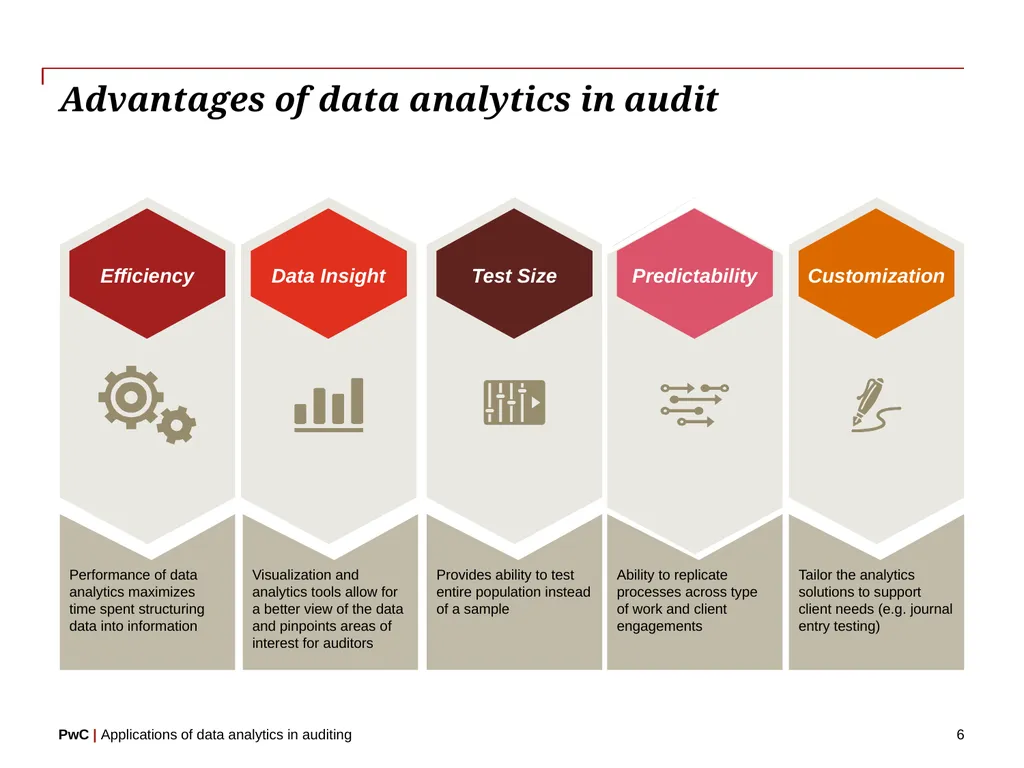
Advantages of data analytics in audit 6 Customization Tailor the analytics solutions to support client needs (e.g. journal entry testing) Predictability Ability to replicate processes across type of work and client engagements Test Size Provides ability to test entire population instead of a sample Data Insight Visualization and analytics tools allow for a better view of the data and pinpoints areas of interest for auditors Efficiency Performance of data analytics maximizes time spent structuring data into information<br>
07
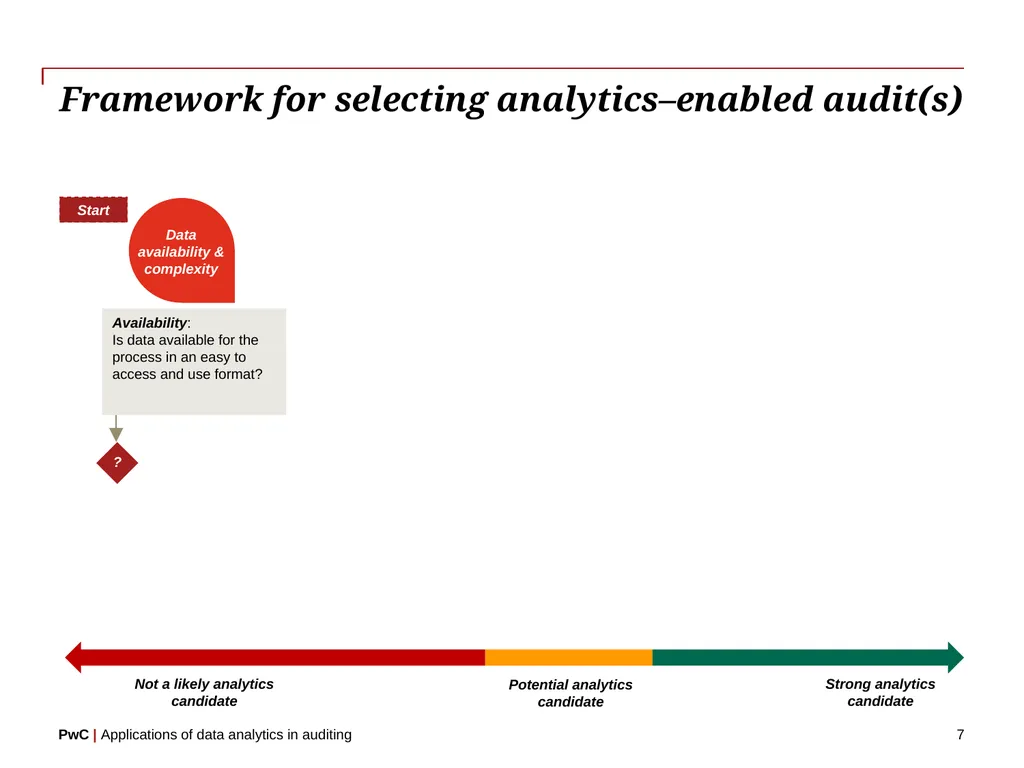
Framework for selecting analytics–enabled audit(s) 7 Data availability & complexity Availability:
Is data available for the process in an easy to access and use format? Start Not a likely analytics candidate Potential analytics candidate Strong analytics candidate ?<br>
08
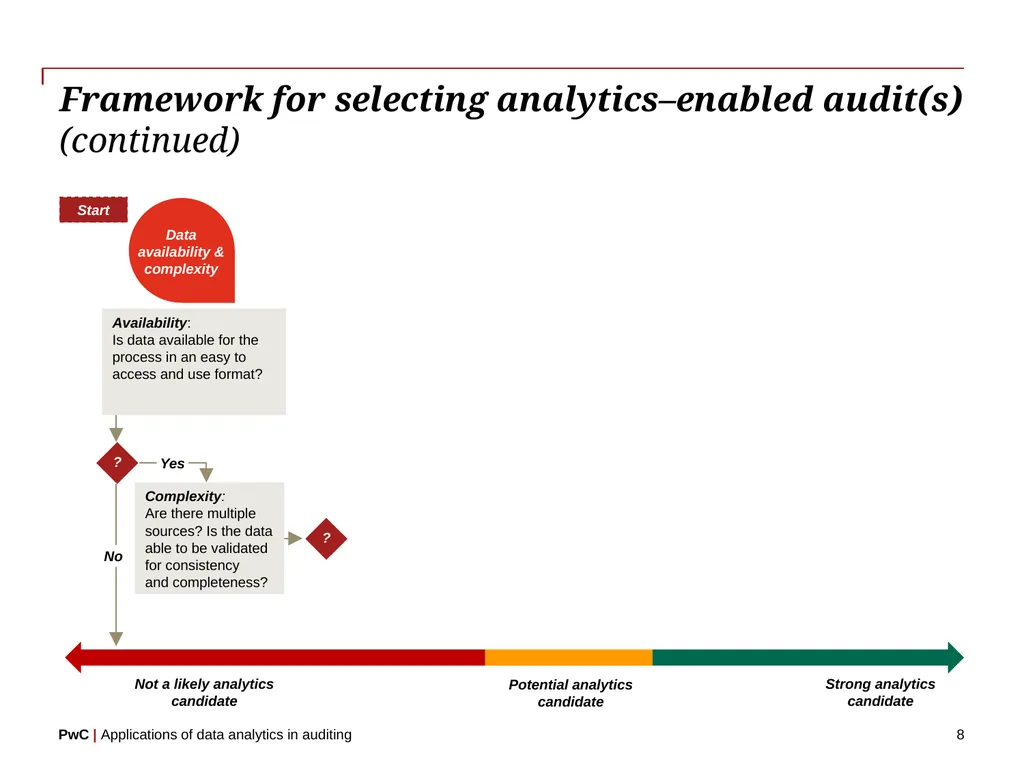
Framework for selecting analytics–enabled audit(s) (continued) 8 Availability:
Is data available for the process in an easy to access and use format? Complexity:
Are there multiple sources? Is the data able to be validated for consistency and completeness? No Yes Start Not a likely analytics candidate Potential analytics candidate Strong analytics candidate<br>
09
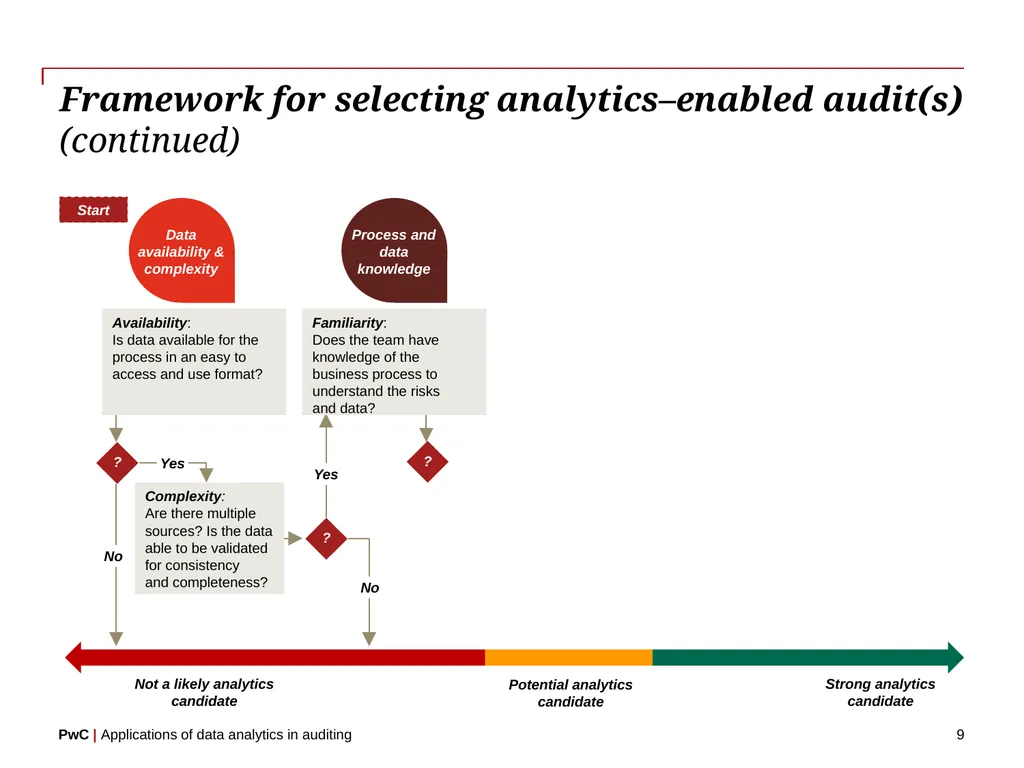
Framework for selecting analytics–enabled audit(s) (continued) 9 Availability:
Is data available for the process in an easy to access and use format? Familiarity:
Does the team have knowledge of the business process to understand the risks and data? Complexity:
Are there multiple sources? Is the data able to be validated for consistency and completeness? No No Yes Yes Start Not a likely analytics candidate Potential analytics candidate Strong analytics candidate<br>
10
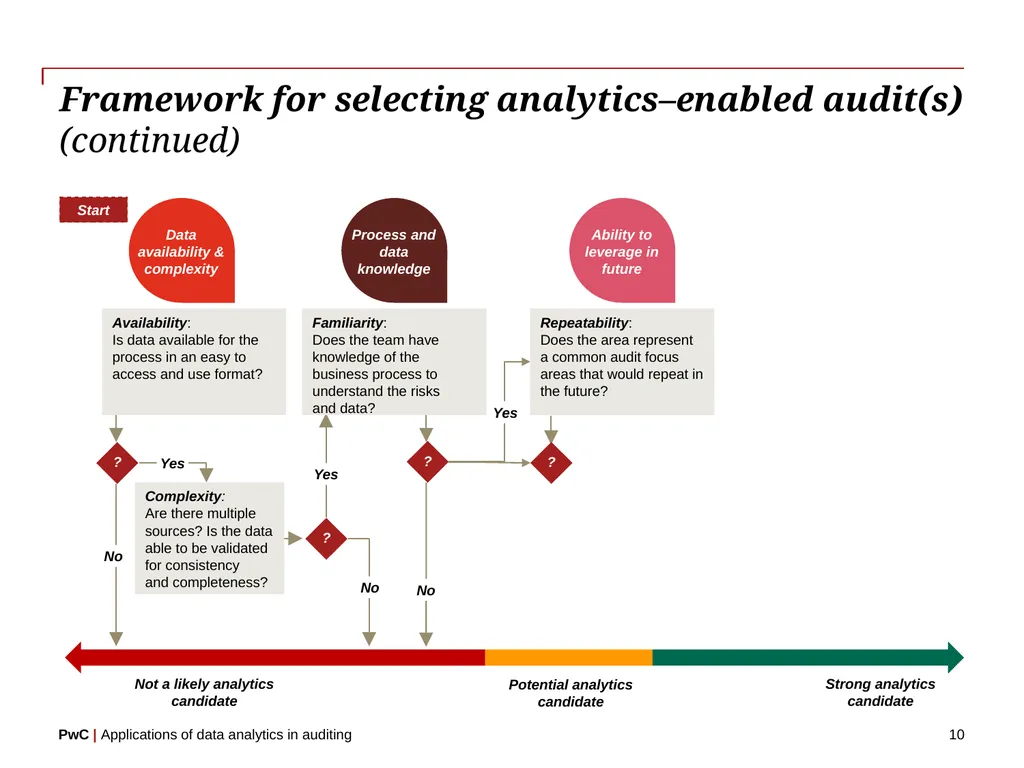
Framework for selecting analytics–enabled audit(s) (continued) 10 Availability:
Is data available for the process in an easy to access and use format? Repeatability:
Does the area represent a common audit focus areas that would repeat in the future? Familiarity:
Does the team have knowledge of the business process to understand the risks and data? Complexity:
Are there multiple sources? Is the data able to be validated for consistency and completeness? No No No Yes Yes Start Not a likely analytics candidate Potential analytics candidate Strong analytics candidate Yes<br>
11
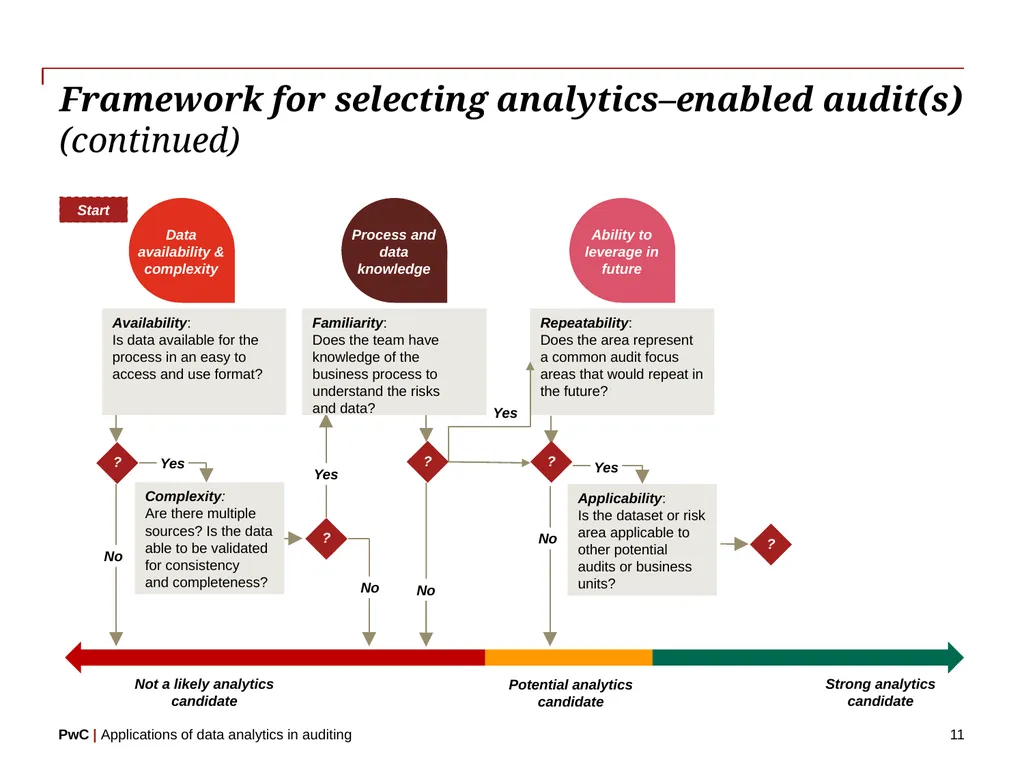
Framework for selecting analytics–enabled audit(s) (continued) 11 Availability:
Is data available for the process in an easy to access and use format? Repeatability:
Does the area represent a common audit focus areas that would repeat in the future? Familiarity:
Does the team have knowledge of the business process to understand the risks and data? Complexity:
Are there multiple sources? Is the data able to be validated for consistency and completeness? Applicability:
Is the dataset or risk area applicable to other potential audits or business units? No No No No Yes Yes Yes Start Not a likely analytics candidate Potential analytics candidate Strong analytics candidate Yes<br>
12
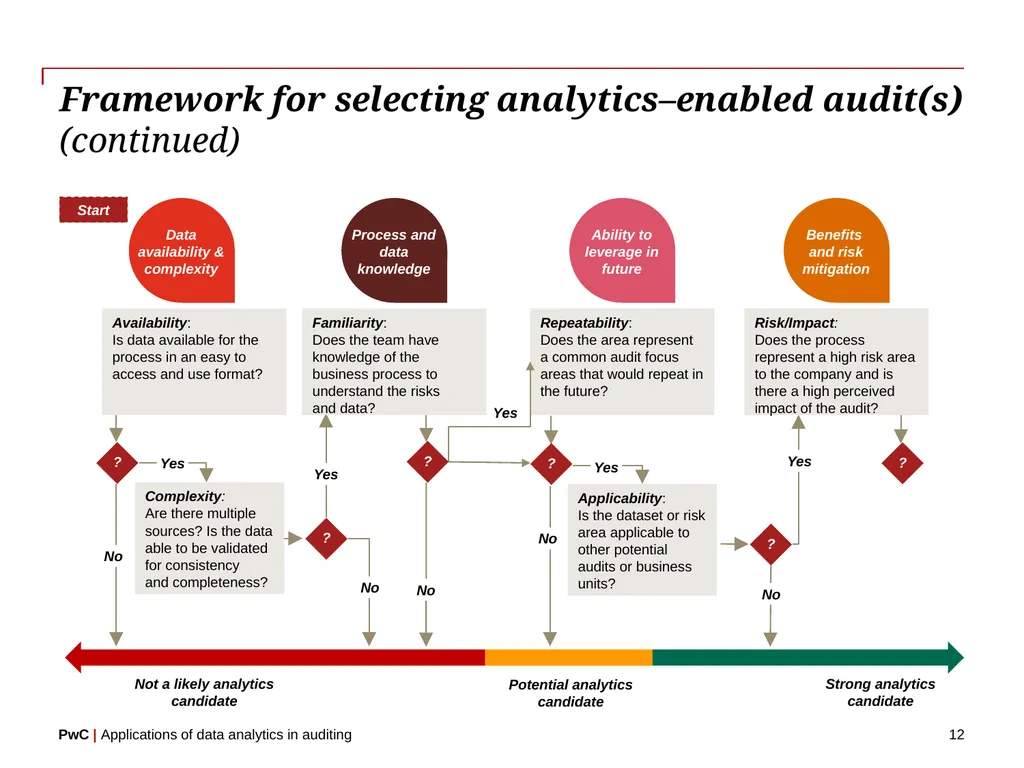
Framework for selecting analytics–enabled audit(s) (continued) 12 Availability:
Is data available for the process in an easy to access and use format? Repeatability:
Does the area represent a common audit focus areas that would repeat in the future? Risk/Impact:
Does the process represent a high risk area to the company and is there a high perceived impact of the audit? Familiarity:
Does the team have knowledge of the business process to understand the risks and data? Complexity:
Are there multiple sources? Is the data able to be validated for consistency and completeness? Applicability:
Is the dataset or risk area applicable to other potential audits or business units? No No No No No Yes Yes Yes Yes Start Not a likely analytics candidate Potential analytics candidate Strong analytics candidate Yes<br>
13
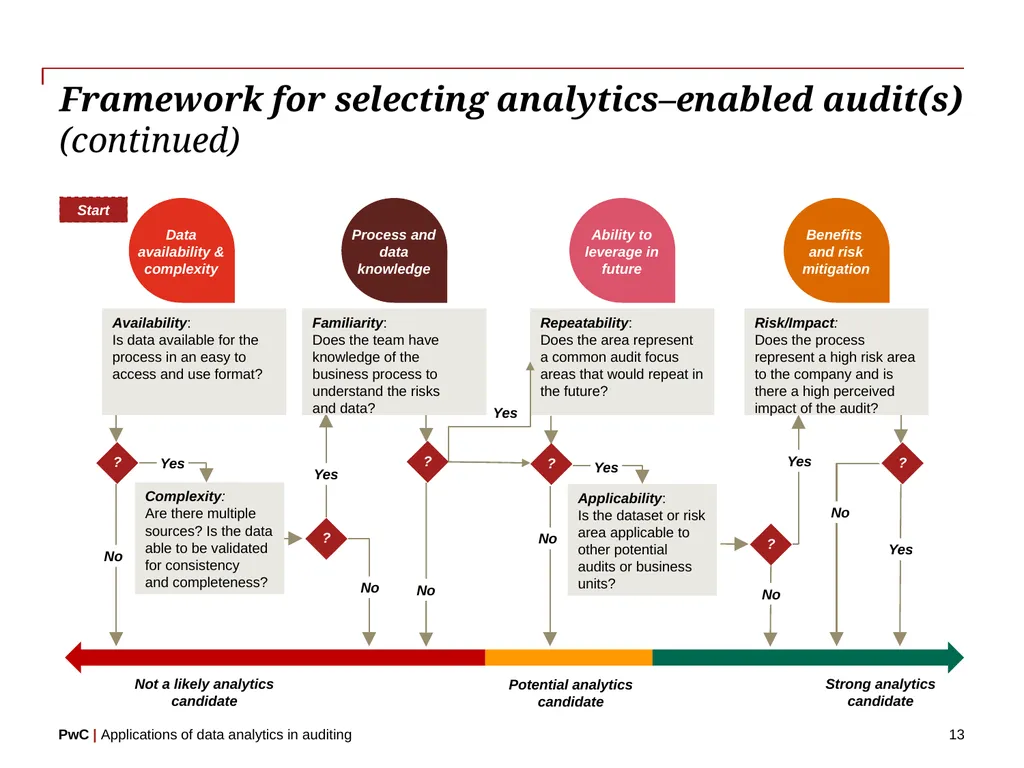
Framework for selecting analytics–enabled audit(s) (continued) 13 Availability:
Is data available for the process in an easy to access and use format? Repeatability:
Does the area represent a common audit focus areas that would repeat in the future? Risk/Impact:
Does the process represent a high risk area to the company and is there a high perceived impact of the audit? Familiarity:
Does the team have knowledge of the business process to understand the risks and data? Complexity:
Are there multiple sources? Is the data able to be validated for consistency and completeness? Applicability:
Is the dataset or risk area applicable to other potential audits or business units? No No No No No Yes Yes Yes Yes No Yes Start Not a likely analytics candidate Potential analytics candidate Strong analytics candidate Yes<br>
14
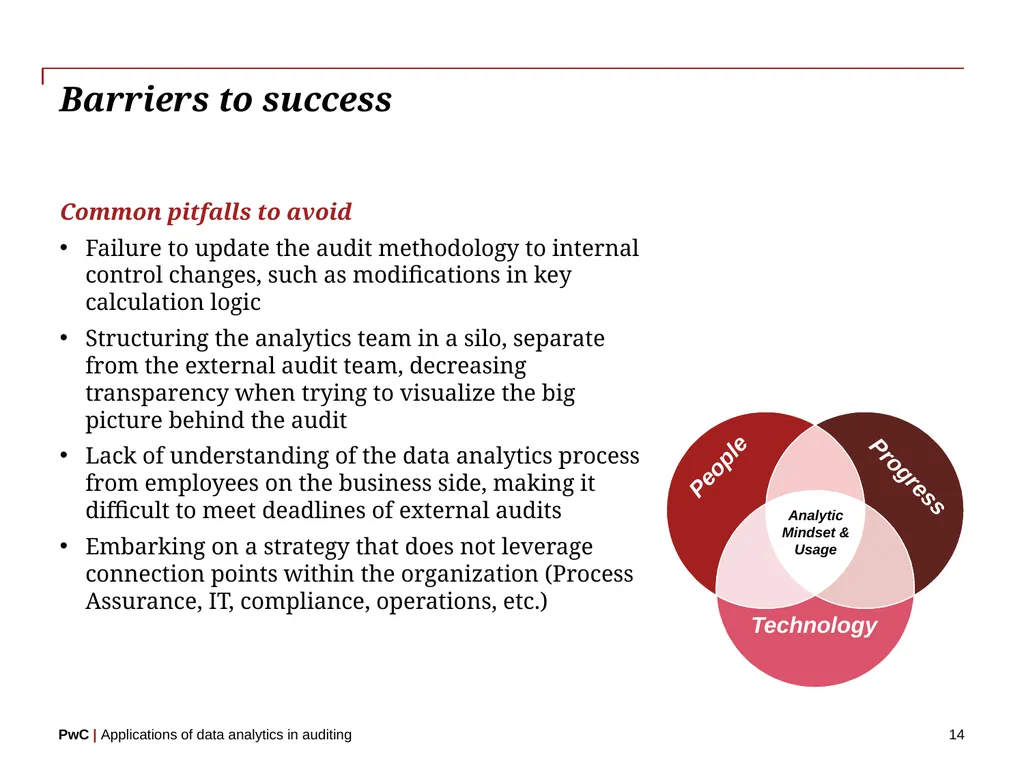
Barriers to success Common pitfalls to avoid
Failure to update the audit methodology to internal control changes, such as modifications in key calculation logic
Structuring the analytics team in a silo, separate from the external audit team, decreasing transparency when trying to visualize the big picture behind the audit
Lack of understanding of the data analytics process from employees on the business side, making it difficult to meet deadlines of external audits
Embarking on a strategy that does not leverage connection points within the organization (Process Assurance, IT, compliance, operations, etc.) 14 People Progress Technology<br>
Failure to update the audit methodology to internal control changes, such as modifications in key calculation logic
Structuring the analytics team in a silo, separate from the external audit team, decreasing transparency when trying to visualize the big picture behind the audit
Lack of understanding of the data analytics process from employees on the business side, making it difficult to meet deadlines of external audits
Embarking on a strategy that does not leverage connection points within the organization (Process Assurance, IT, compliance, operations, etc.) 14 People Progress Technology<br>
15
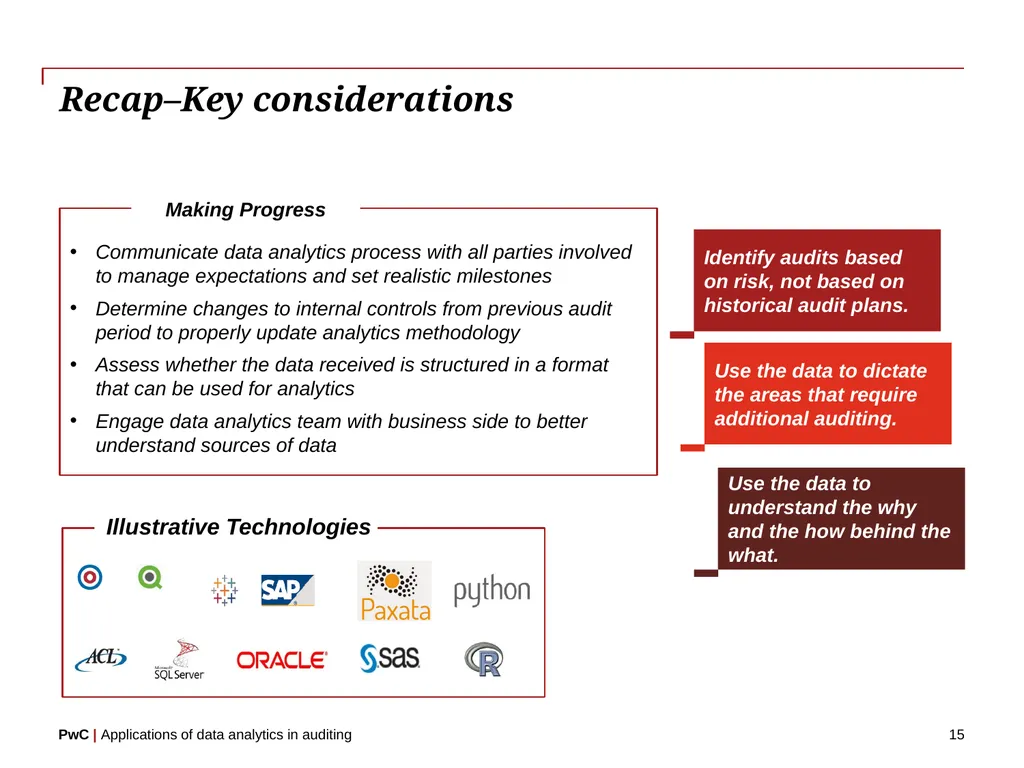
Recap–Key considerations Communicate data analytics process with all parties involved to manage expectations and set realistic milestones
Determine changes to internal controls from previous audit period to properly update analytics methodology
Assess whether the data received is structured in a format that can be used for analytics
Engage data analytics team with business side to better understand sources of data 15 Making Progress Illustrative Technologies<br>
Determine changes to internal controls from previous audit period to properly update analytics methodology
Assess whether the data received is structured in a format that can be used for analytics
Engage data analytics team with business side to better understand sources of data 15 Making Progress Illustrative Technologies<br>
16
Check on learning – Scenario #1 XYZ Company is a first-year audit client, which handles a bulk of its financial reporting on four core systems. Two of these systems were implemented in the middle of the fiscal year to replace an older system that assisted in storing and reporting the company’s transactional data in a structured format. As such, XYZ Company had to plan and execute a data migration project to transfer the financial data from the old system to the new systems before the start of the year-end audit.
Question 1: Is the client a potential analytics candidate? What factored into your decision making?
Question 2: If the client was selected for an analytics-enabled audit, what are some challenges that the audit team could face during the project? 16<br>
Question 2: If the client was selected for an analytics-enabled audit, what are some challenges that the audit team could face during the project? 16<br>
17
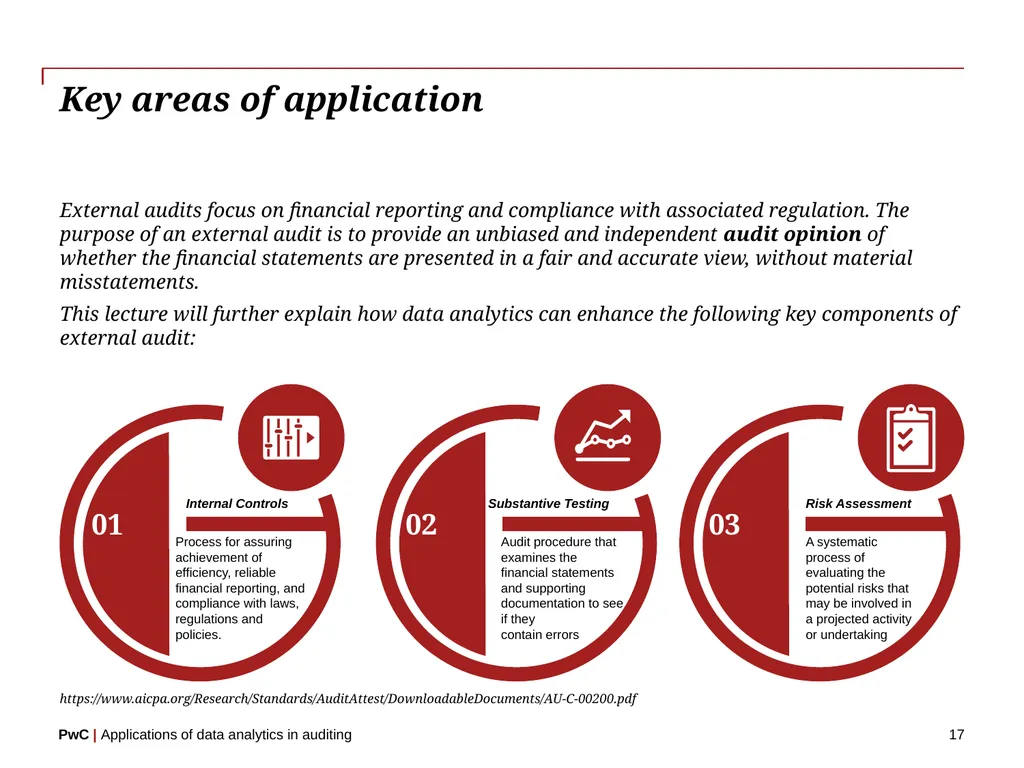
Key areas of application 17 External audits focus on financial reporting and compliance with associated regulation. The purpose of an external audit is to provide an unbiased and independent audit opinion of whether the financial statements are presented in a fair and accurate view, without material misstatements.
This lecture will further explain how data analytics can enhance the following key components of external audit: https://www.aicpa.org/Research/Standards/AuditAttest/DownloadableDocuments/AU-C-00200.pdf<br>
This lecture will further explain how data analytics can enhance the following key components of external audit: https://www.aicpa.org/Research/Standards/AuditAttest/DownloadableDocuments/AU-C-00200.pdf<br>
18
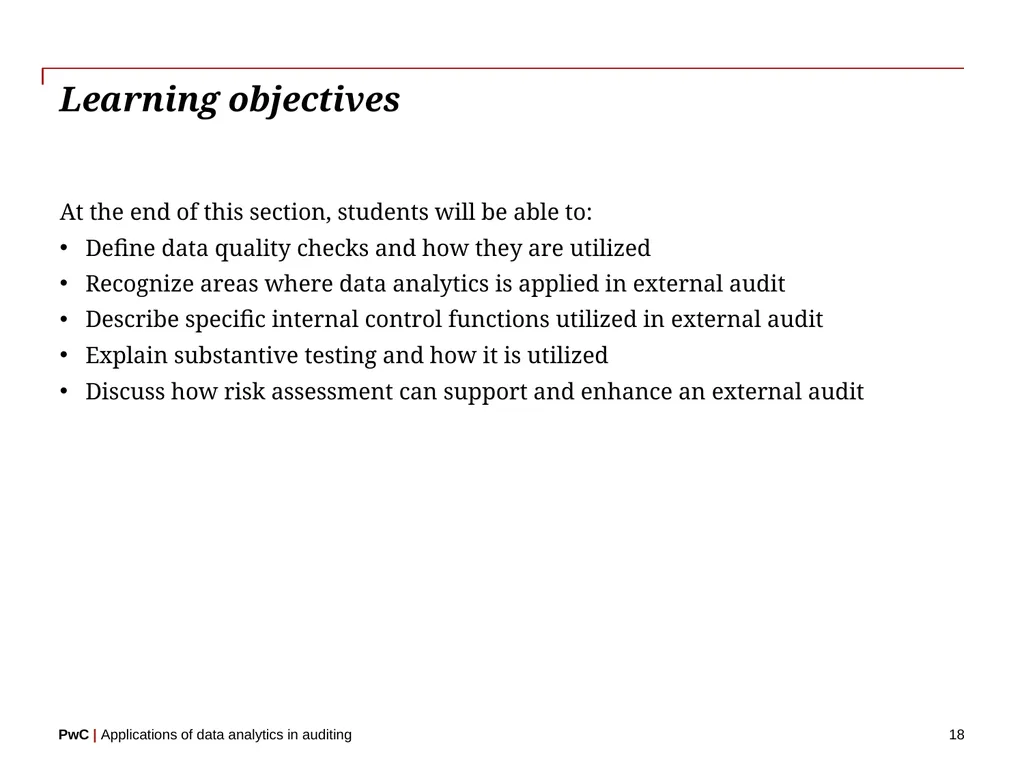
Learning objectives At the end of this section, students will be able to:
Define data quality checks and how they are utilized
Recognize areas where data analytics is applied in external audit
Describe specific internal control functions utilized in external audit
Explain substantive testing and how it is utilized
Discuss how risk assessment can support and enhance an external audit 18<br>
Define data quality checks and how they are utilized
Recognize areas where data analytics is applied in external audit
Describe specific internal control functions utilized in external audit
Explain substantive testing and how it is utilized
Discuss how risk assessment can support and enhance an external audit 18<br>
19
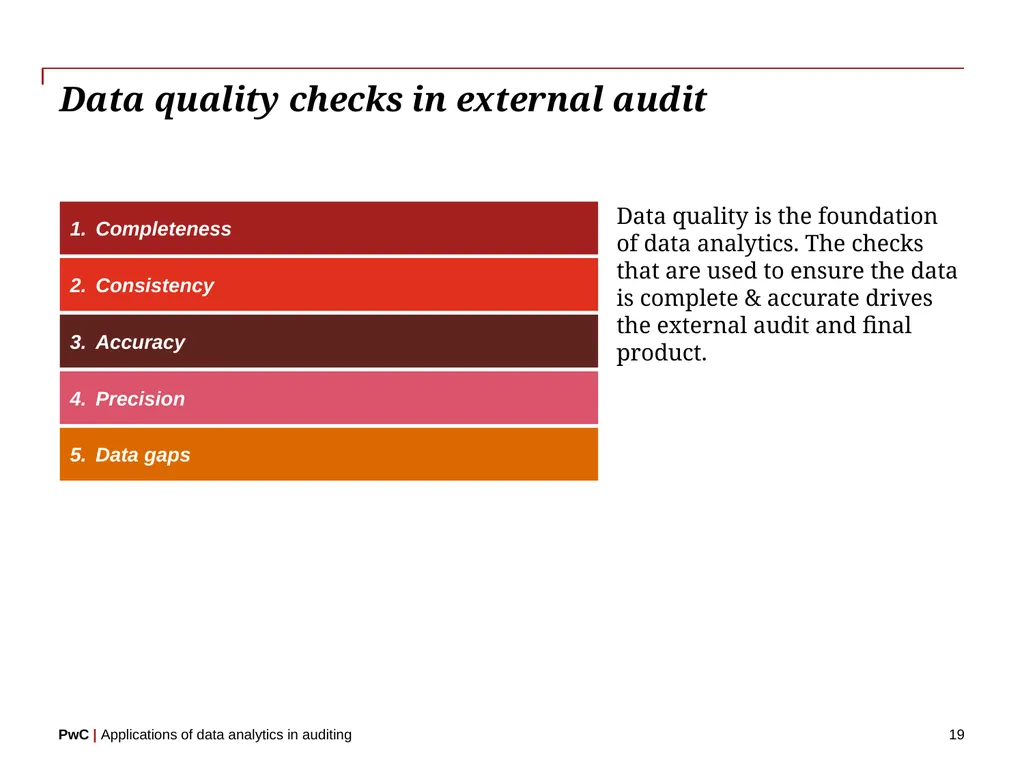
Data quality checks in external audit 19 Data quality is the foundation of data analytics. The checks that are used to ensure the data is complete & accurate drives the external audit and final product.<br>
20
Internal controls Internal controls were established under Section 302 of the Sarbanes-Oxley Act of 2002 (SOX). The function of internal controls is to ensure the accuracy of financial reporting. In order to remain compliant with SOX regulation standards, companies must regularly assess and document the effectiveness of those internal controls.
What are some of the risks that internal controls address?
What are some of the benefits of using data analytics for internal controls? 20 https://www.sec.gov/rules/proposed/s74002/card941503.pdf<br>
What are some of the risks that internal controls address?
What are some of the benefits of using data analytics for internal controls? 20 https://www.sec.gov/rules/proposed/s74002/card941503.pdf<br>
21
Internal controls (continued) Internal controls were established under Section 302 of the Sarbanes-Oxley Act of 2002 (SOX). The function of internal controls is to ensure the accuracy of financial reporting. In order to remain compliant with SOX regulation standards, companies must regularly assess and document the effectiveness of those internal controls.
What are some of the risks that internal controls address?
Material misstatements in the financial statements, transactions and account balances
Operations running ineffectively and/or not complying with laws and regulations
Users with conflicting roles that allow certain actions to go unmonitored
What are some of the benefits of using data analytics for internal controls? 21<br>
What are some of the risks that internal controls address?
Material misstatements in the financial statements, transactions and account balances
Operations running ineffectively and/or not complying with laws and regulations
Users with conflicting roles that allow certain actions to go unmonitored
What are some of the benefits of using data analytics for internal controls? 21<br>
22
Internal controls (continued) Internal controls were established under Section 302 of the Sarbanes-Oxley Act of 2002 (SOX). The function of internal controls is to ensure the accuracy of financial reporting. In order to remain compliant with SOX regulation standards, companies must regularly assess and document the effectiveness of those internal controls.
What are some of the risks that internal controls address?
Material misstatements in the financial statements, transactions and account balances
Operations running ineffectively and/or not complying with laws and regulations
Users with conflicting roles that allow certain actions to go unmonitored
What are some of the benefits of using data analytics for internal controls?
Control reliability can be tested more accurately by using entire population of input data
Complex control logic can be replicated more effectively using data analytics tools
Underlying dataset can provide a richer picture of what controls are monitoring 22<br>
What are some of the risks that internal controls address?
Material misstatements in the financial statements, transactions and account balances
Operations running ineffectively and/or not complying with laws and regulations
Users with conflicting roles that allow certain actions to go unmonitored
What are some of the benefits of using data analytics for internal controls?
Control reliability can be tested more accurately by using entire population of input data
Complex control logic can be replicated more effectively using data analytics tools
Underlying dataset can provide a richer picture of what controls are monitoring 22<br>
23
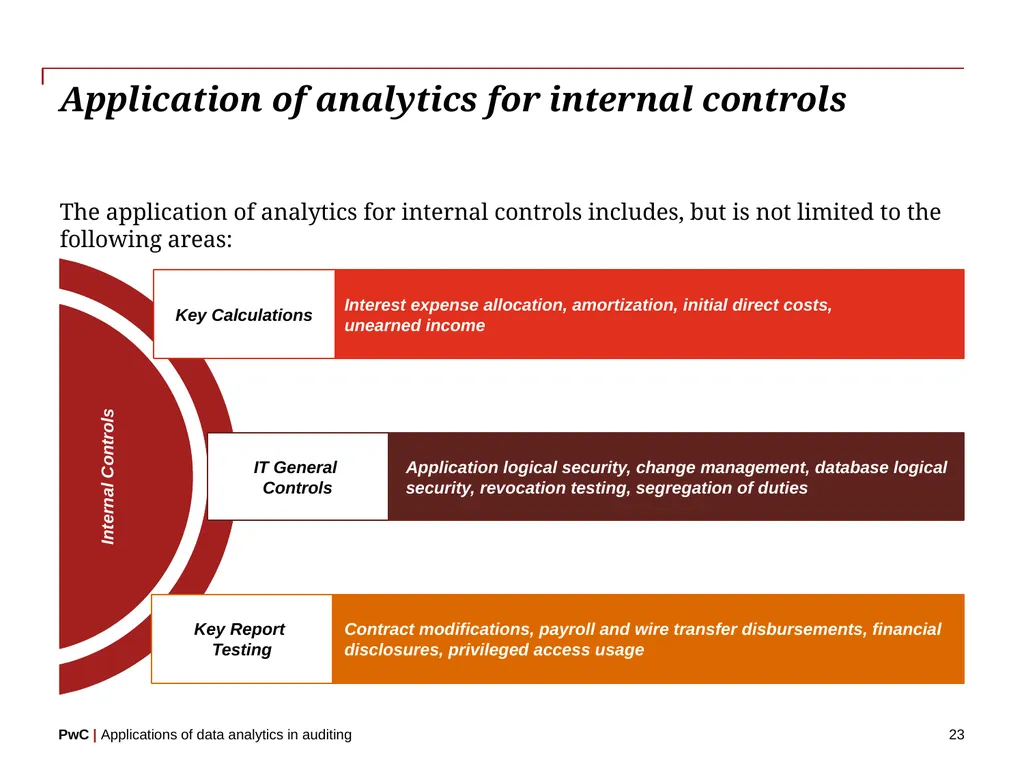
Application of analytics for internal controls The application of analytics for internal controls includes, but is not limited to the following areas: 23<br>
24
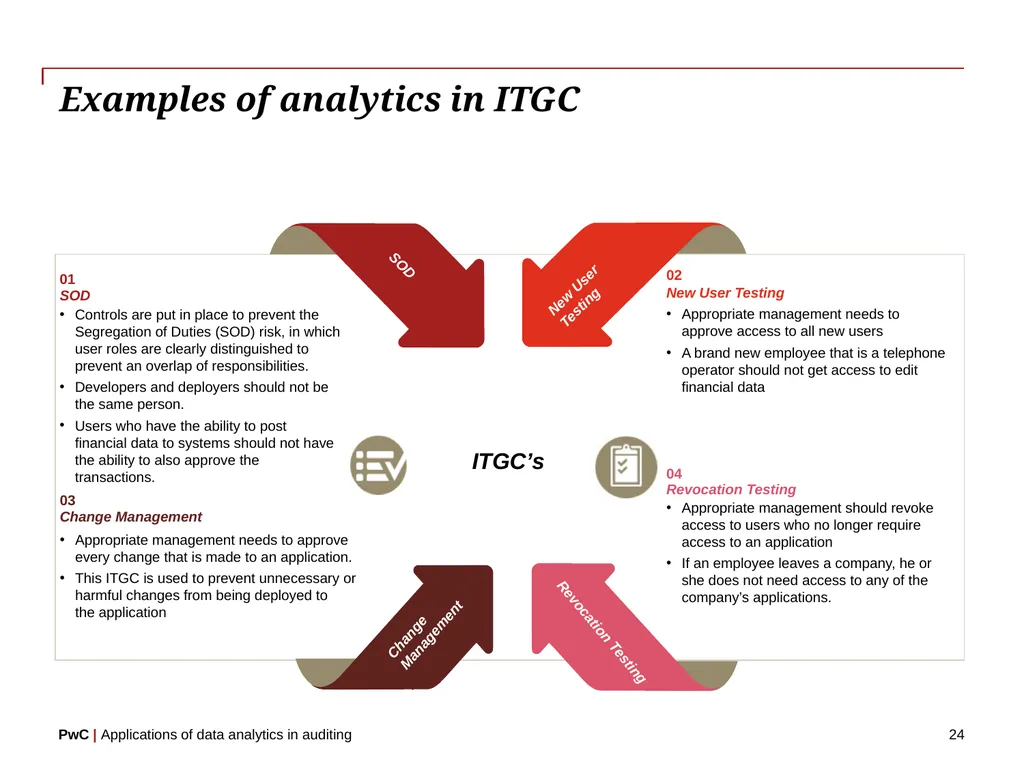
Examples of analytics in ITGC 24 02 New User Testing Appropriate management needs to approve access to all new users
A brand new employee that is a telephone operator should not get access to edit financial data 04 Revocation Testing Appropriate management should revoke access to users who no longer require access to an application
If an employee leaves a company, he or she does not need access to any of the company’s applications. ITGC’s 03 Change Management Controls are put in place to prevent the Segregation of Duties (SOD) risk, in which user roles are clearly distinguished to prevent an overlap of responsibilities.
Developers and deployers should not be the same person.
Users who have the ability to post financial data to systems should not have the ability to also approve the transactions. Appropriate management needs to approve every change that is made to an application.
This ITGC is used to prevent unnecessary or harmful changes from being deployed to the application 01 SOD<br>
A brand new employee that is a telephone operator should not get access to edit financial data 04 Revocation Testing Appropriate management should revoke access to users who no longer require access to an application
If an employee leaves a company, he or she does not need access to any of the company’s applications. ITGC’s 03 Change Management Controls are put in place to prevent the Segregation of Duties (SOD) risk, in which user roles are clearly distinguished to prevent an overlap of responsibilities.
Developers and deployers should not be the same person.
Users who have the ability to post financial data to systems should not have the ability to also approve the transactions. Appropriate management needs to approve every change that is made to an application.
This ITGC is used to prevent unnecessary or harmful changes from being deployed to the application 01 SOD<br>
25
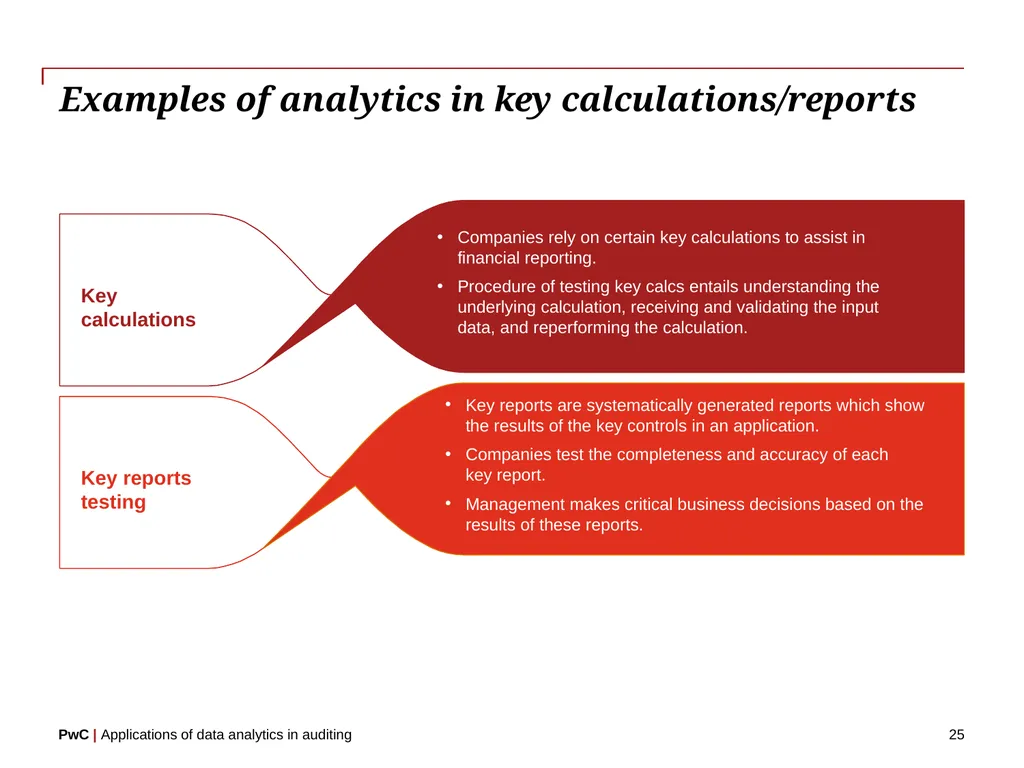
Examples of analytics in key calculations/reports 25 Companies rely on certain key calculations to assist in financial reporting.
Procedure of testing key calcs entails understanding the underlying calculation, receiving and validating the input data, and reperforming the calculation. Key calculations Key reports testing Key reports are systematically generated reports which show the results of the key controls in an application.
Companies test the completeness and accuracy of each key report.
Management makes critical business decisions based on the results of these reports.<br>
Procedure of testing key calcs entails understanding the underlying calculation, receiving and validating the input data, and reperforming the calculation. Key calculations Key reports testing Key reports are systematically generated reports which show the results of the key controls in an application.
Companies test the completeness and accuracy of each key report.
Management makes critical business decisions based on the results of these reports.<br>
26
Check on learning – Scenario #2 While looking at a ticketing tool for a financial institution, an auditor noticed that a staff member approved a supervisor’s request for access to a certain application. The supervisor needed access to the application in order to complete his work. The approval allowed the supervisor to have access and to use the application freely.
Question 1: What type of internal control is in place to make sure that each user is approved for a new application?
Question 2: Did the financial institution properly follow the internal controls that are in place?
Question 3: If not, what did the financial institution do wrong? 26<br>
Question 1: What type of internal control is in place to make sure that each user is approved for a new application?
Question 2: Did the financial institution properly follow the internal controls that are in place?
Question 3: If not, what did the financial institution do wrong? 26<br>
27
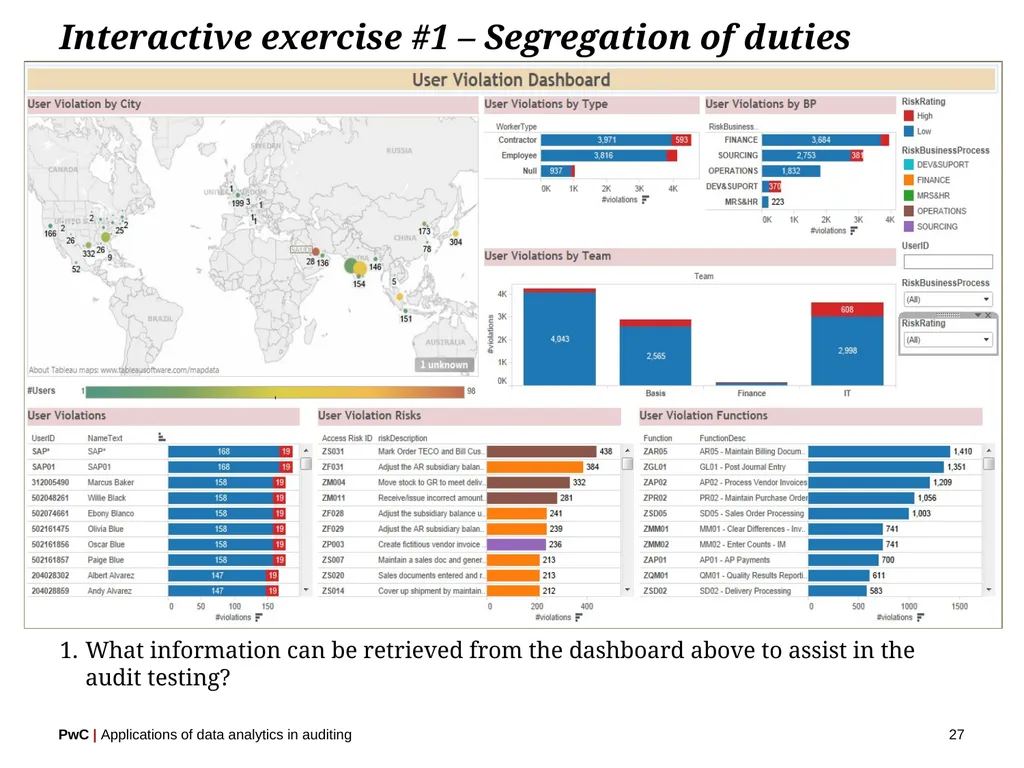
Interactive exercise #1 – Segregation of duties 27 What information can be retrieved from the dashboard above to assist in the audit testing?<br>
28
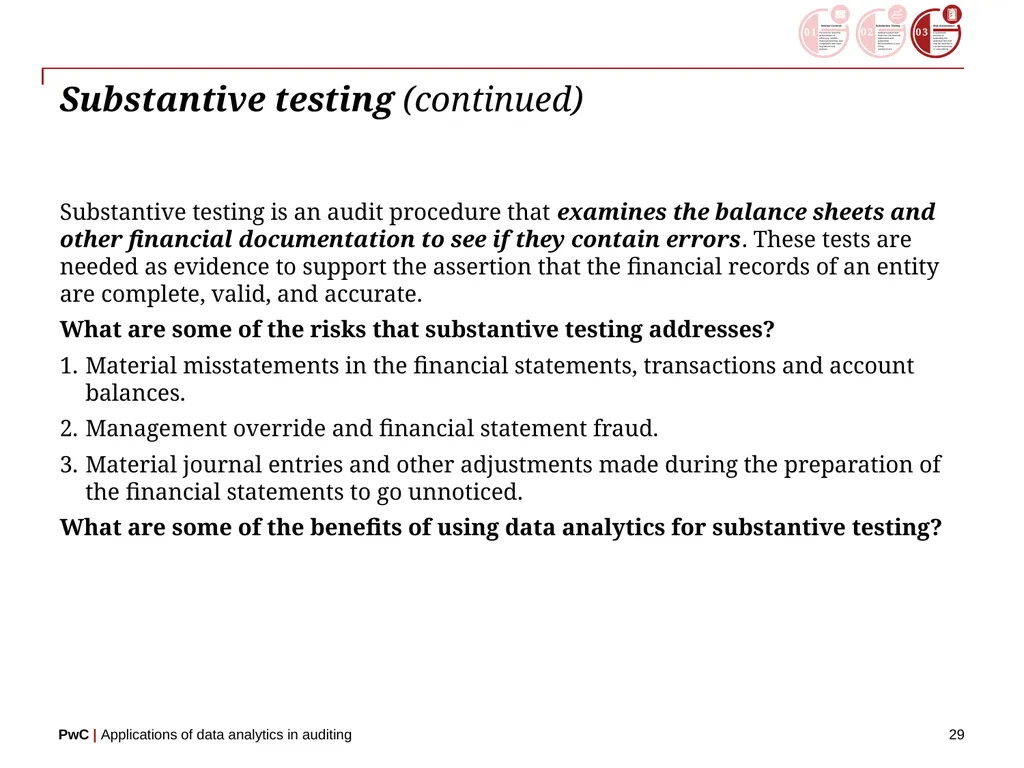
Substantive testing Substantive testing is an audit procedure that examines the balance sheets and other financial documentation to see if they contain errors. These tests are needed as evidence to support the assertion that the financial records of an entity are complete, valid, and accurate.
What are some of the risks that substantive testing addresses?
What are some of the benefits of using data analytics for substantive testing? 28 http://www.accountingtools.com/questions-and-answers/what-is-substantive-testing.html<br>
What are some of the risks that substantive testing addresses?
What are some of the benefits of using data analytics for substantive testing? 28 http://www.accountingtools.com/questions-and-answers/what-is-substantive-testing.html<br>
29
Substantive testing (continued) Substantive testing is an audit procedure that examines the balance sheets and other financial documentation to see if they contain errors. These tests are needed as evidence to support the assertion that the financial records of an entity are complete, valid, and accurate.
What are some of the risks that substantive testing addresses?
Material misstatements in the financial statements, transactions and account balances.
Management override and financial statement fraud.
Material journal entries and other adjustments made during the preparation of the financial statements to go unnoticed.
What are some of the benefits of using data analytics for substantive testing? 29<br>
What are some of the risks that substantive testing addresses?
Material misstatements in the financial statements, transactions and account balances.
Management override and financial statement fraud.
Material journal entries and other adjustments made during the preparation of the financial statements to go unnoticed.
What are some of the benefits of using data analytics for substantive testing? 29<br>
30
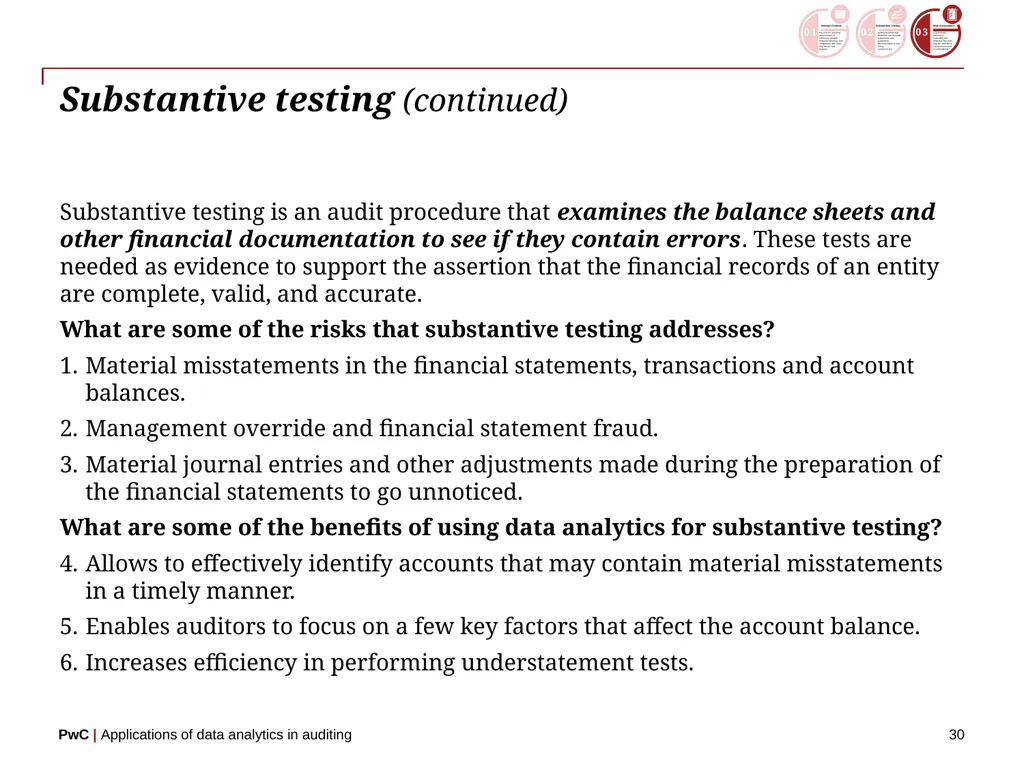
Substantive testing (continued) Substantive testing is an audit procedure that examines the balance sheets and other financial documentation to see if they contain errors. These tests are needed as evidence to support the assertion that the financial records of an entity are complete, valid, and accurate.
What are some of the risks that substantive testing addresses?
Material misstatements in the financial statements, transactions and account balances.
Management override and financial statement fraud.
Material journal entries and other adjustments made during the preparation of the financial statements to go unnoticed.
What are some of the benefits of using data analytics for substantive testing?
Allows to effectively identify accounts that may contain material misstatements in a timely manner.
Enables auditors to focus on a few key factors that affect the account balance.
Increases efficiency in performing understatement tests. 30<br>
What are some of the risks that substantive testing addresses?
Material misstatements in the financial statements, transactions and account balances.
Management override and financial statement fraud.
Material journal entries and other adjustments made during the preparation of the financial statements to go unnoticed.
What are some of the benefits of using data analytics for substantive testing?
Allows to effectively identify accounts that may contain material misstatements in a timely manner.
Enables auditors to focus on a few key factors that affect the account balance.
Increases efficiency in performing understatement tests. 30<br>
31
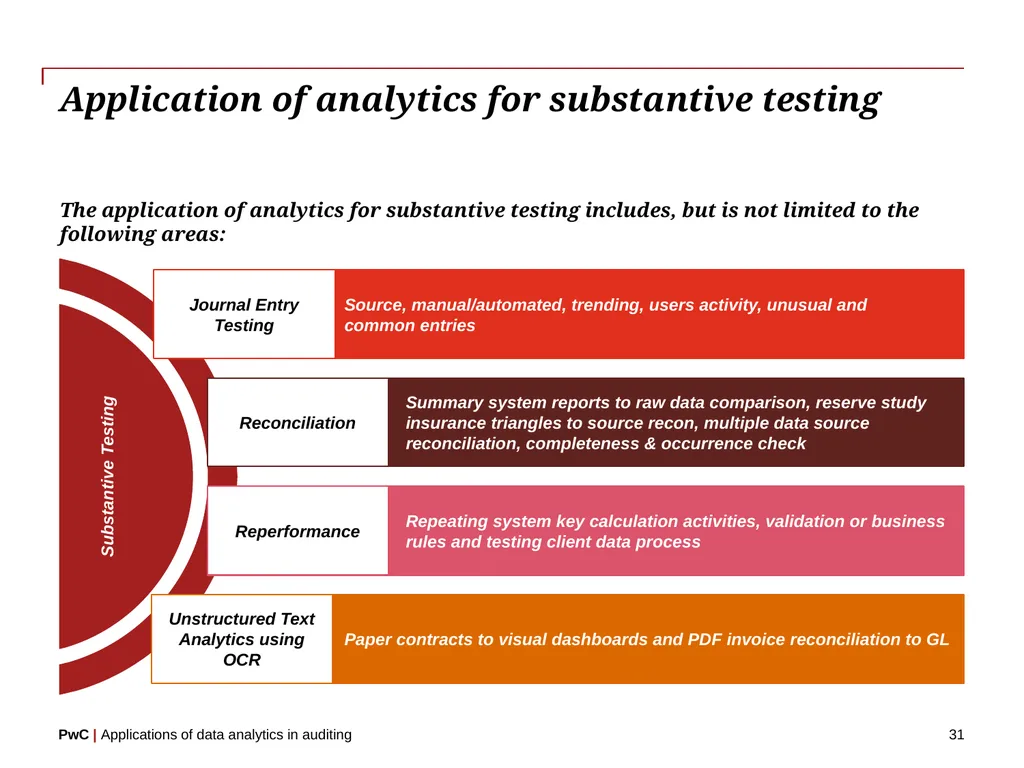
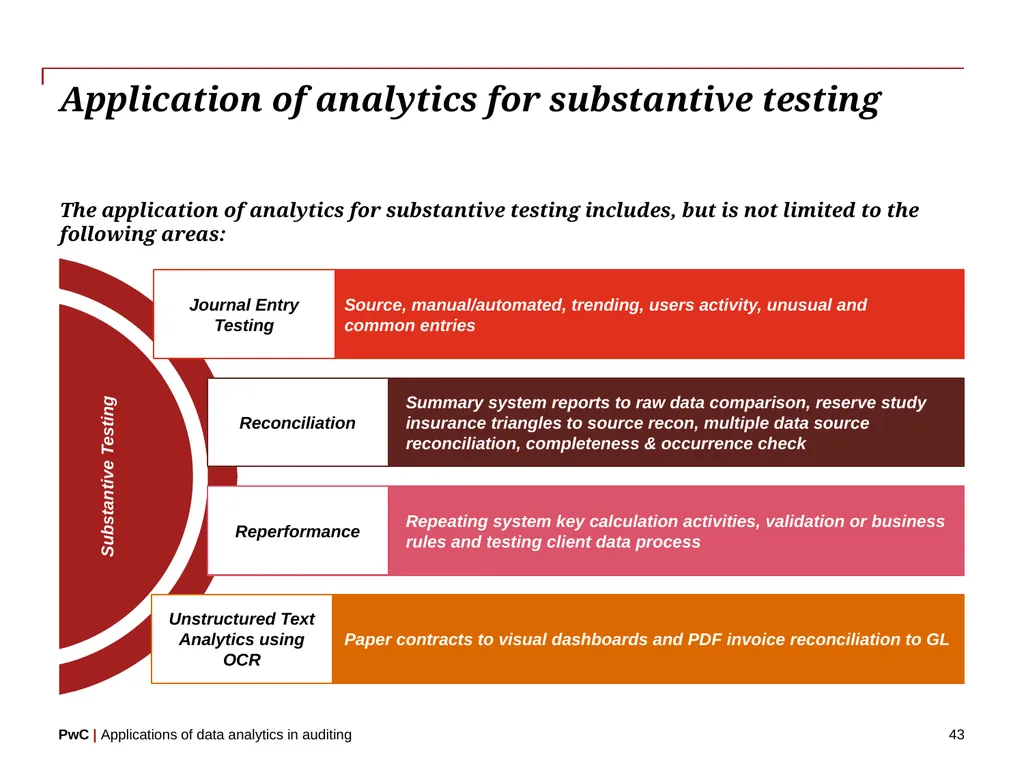
Application of analytics for substantive testing The application of analytics for substantive testing includes, but is not limited to the following areas: 31<br>
32
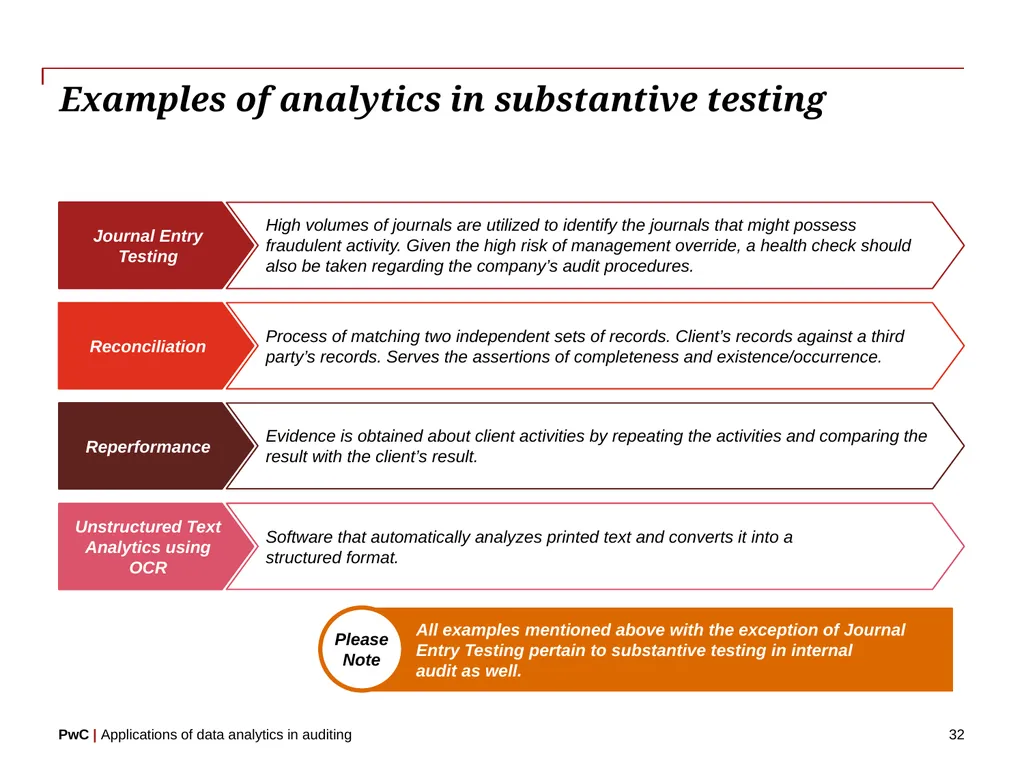
Examples of analytics in substantive testing 32 Journal Entry Testing High volumes of journals are utilized to identify the journals that might possess fraudulent activity. Given the high risk of management override, a health check should also be taken regarding the company’s audit procedures. Reperformance Evidence is obtained about client activities by repeating the activities and comparing the result with the client’s result. Reconciliation Process of matching two independent sets of records. Client’s records against a third party’s records. Serves the assertions of completeness and existence/occurrence. Software that automatically analyzes printed text and converts it into a
structured format. Unstructured Text Analytics using OCR Please Note All examples mentioned above with the exception of Journal
Entry Testing pertain to substantive testing in internal
audit as well.<br>
33
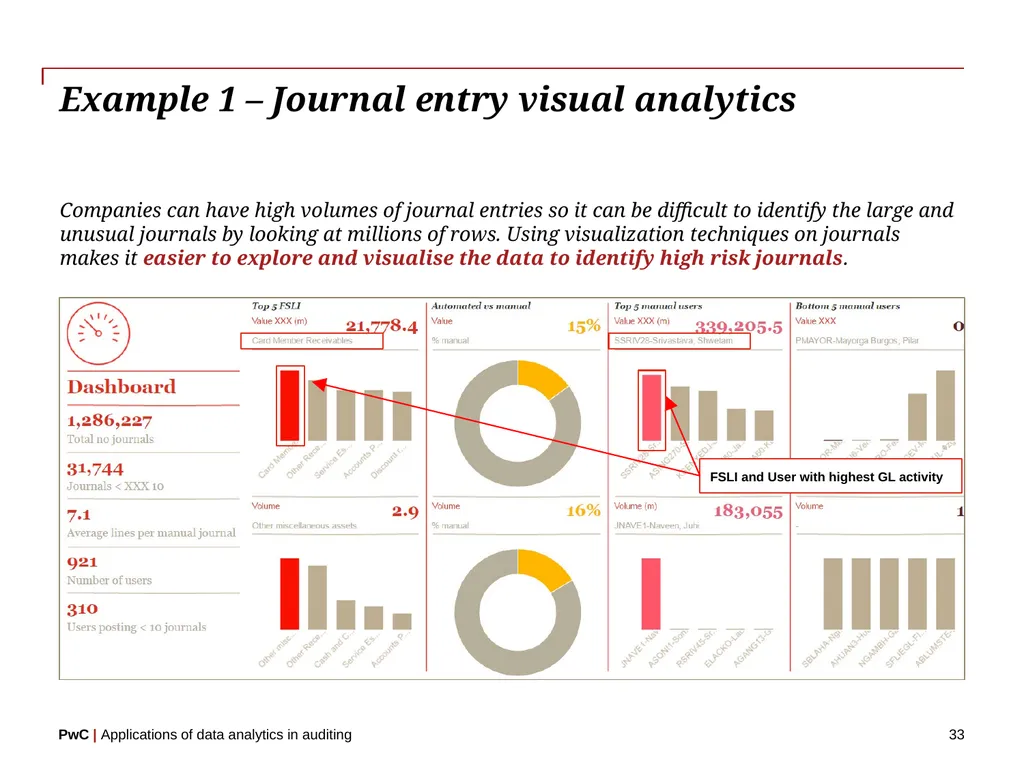
Example 1 – Journal entry visual analytics 33 Companies can have high volumes of journal entries so it can be difficult to identify the large and unusual journals by looking at millions of rows. Using visualization techniques on journals makes it easier to explore and visualise the data to identify high risk journals. FSLI and User with highest GL activity<br>
34
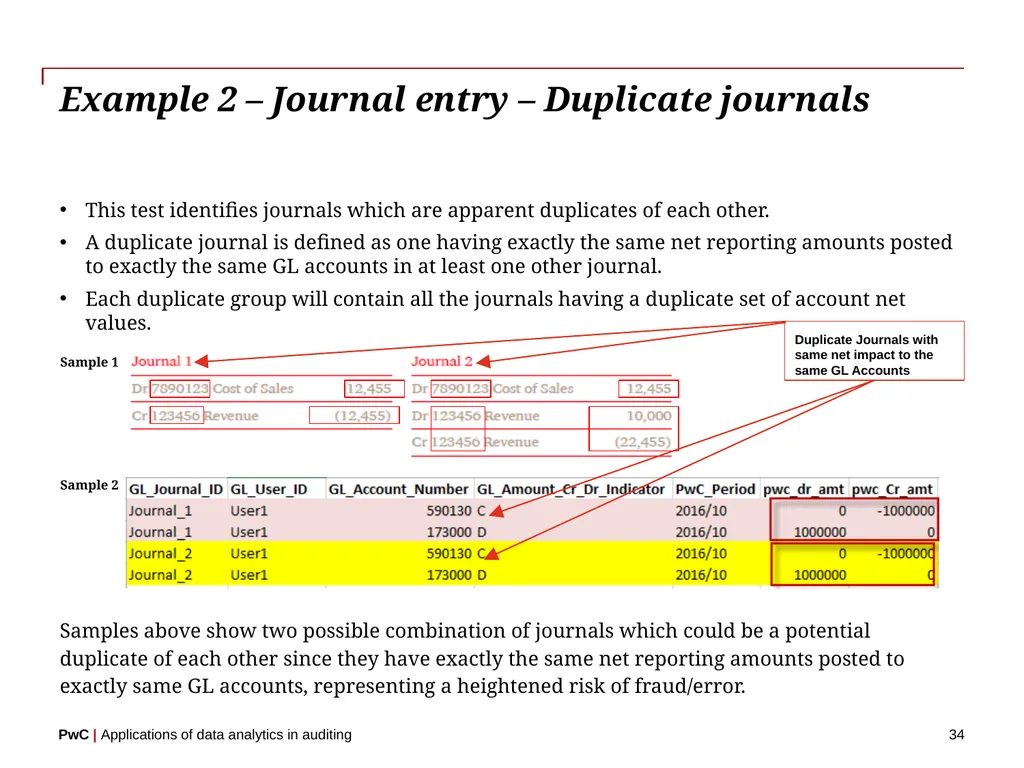
Example 2 – Journal entry – Duplicate journals 34 This test identifies journals which are apparent duplicates of each other.
A duplicate journal is defined as one having exactly the same net reporting amounts posted to exactly the same GL accounts in at least one other journal.
Each duplicate group will contain all the journals having a duplicate set of account net values. Samples above show two possible combination of journals which could be a potential duplicate of each other since they have exactly the same net reporting amounts posted to exactly same GL accounts, representing a heightened risk of fraud/error. Sample 1 Sample 2 Duplicate Journals with same net impact to the same GL Accounts<br>
A duplicate journal is defined as one having exactly the same net reporting amounts posted to exactly the same GL accounts in at least one other journal.
Each duplicate group will contain all the journals having a duplicate set of account net values. Samples above show two possible combination of journals which could be a potential duplicate of each other since they have exactly the same net reporting amounts posted to exactly same GL accounts, representing a heightened risk of fraud/error. Sample 1 Sample 2 Duplicate Journals with same net impact to the same GL Accounts<br>
35
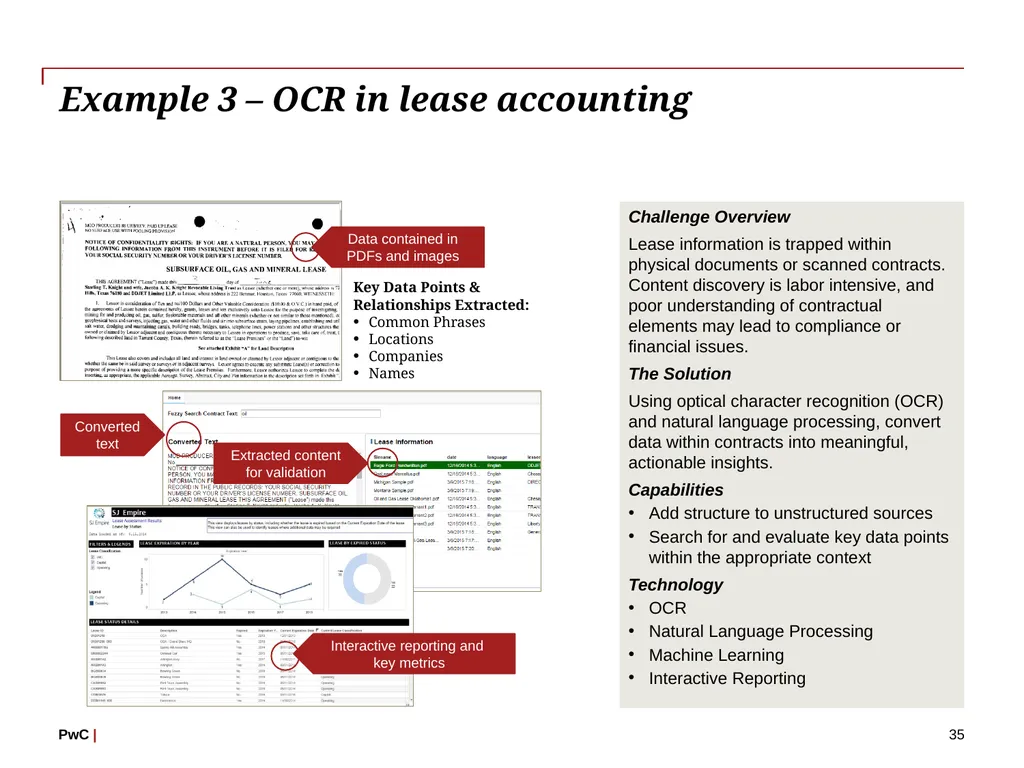
Example 3 – OCR in lease accounting 35 Challenge Overview
Lease information is trapped within physical documents or scanned contracts. Content discovery is labor intensive, and poor understanding of contractual elements may lead to compliance or financial issues.
The Solution
Using optical character recognition (OCR) and natural language processing, convert data within contracts into meaningful, actionable insights.
Capabilities
Add structure to unstructured sources
Search for and evaluate key data points within the appropriate context
Technology
OCR
Natural Language Processing
Machine Learning
Interactive Reporting Data contained in PDFs and images Key Data Points & Relationships Extracted:
Common Phrases
Locations
Companies
Names Converted text Extracted content for validation Interactive reporting and key metrics<br>
Lease information is trapped within physical documents or scanned contracts. Content discovery is labor intensive, and poor understanding of contractual elements may lead to compliance or financial issues.
The Solution
Using optical character recognition (OCR) and natural language processing, convert data within contracts into meaningful, actionable insights.
Capabilities
Add structure to unstructured sources
Search for and evaluate key data points within the appropriate context
Technology
OCR
Natural Language Processing
Machine Learning
Interactive Reporting Data contained in PDFs and images Key Data Points & Relationships Extracted:
Common Phrases
Locations
Companies
Names Converted text Extracted content for validation Interactive reporting and key metrics<br>
36
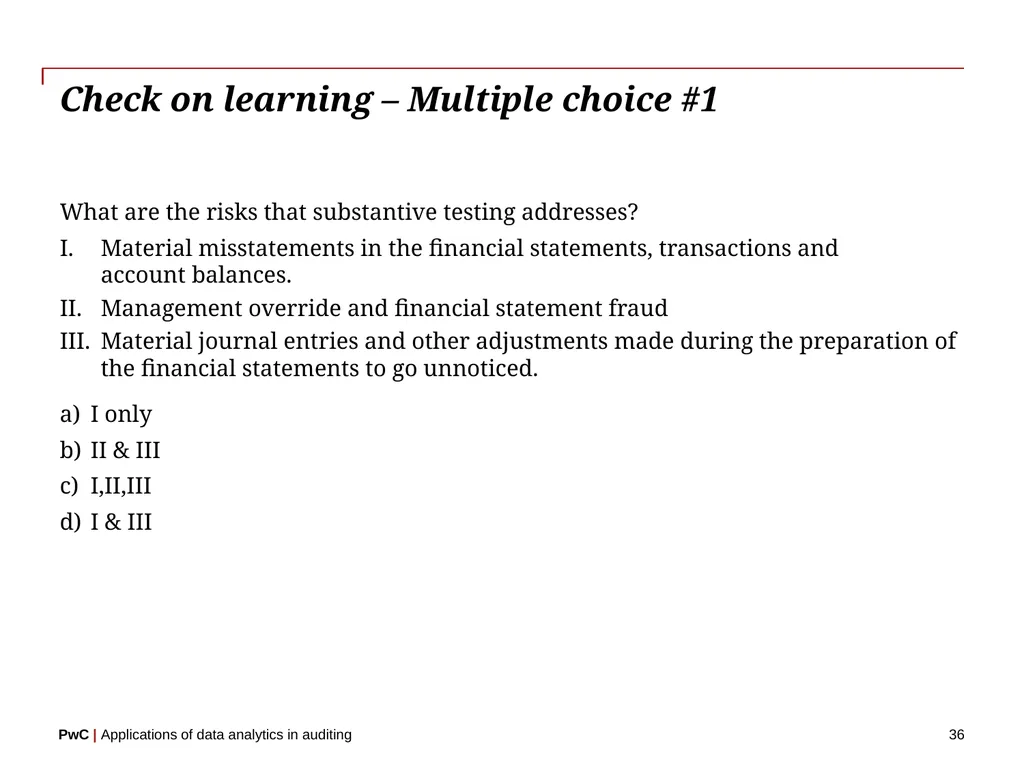
Check on learning – Multiple choice #1 What are the risks that substantive testing addresses?
Material misstatements in the financial statements, transactions and account balances.
Management override and financial statement fraud
Material journal entries and other adjustments made during the preparation of the financial statements to go unnoticed.
I only
II & III
I,II,III
I & III 36<br>
Material misstatements in the financial statements, transactions and account balances.
Management override and financial statement fraud
Material journal entries and other adjustments made during the preparation of the financial statements to go unnoticed.
I only
II & III
I,II,III
I & III 36<br>
37
Check on learning – Multiple choice #1 (Answer) What are the risks that substantive testing addresses?
Material misstatements in the financial statements, transactions and account balances.
Management override and financial statement fraud
Material journal entries and other adjustments made during the preparation of the financial statements to go unnoticed.
I,II,III 37<br>
Material misstatements in the financial statements, transactions and account balances.
Management override and financial statement fraud
Material journal entries and other adjustments made during the preparation of the financial statements to go unnoticed.
I,II,III 37<br>
38
Check on learning – Multiple choice #2 Company’s policy dictates that no employee is paid unless she has turned in a timesheet. The client states that this rule is in use for 100 percent of all paychecks. You can test this client assertion by taking a sample of payroll checks and matching them to the timesheets. Which technique of substantive testing would you apply to test it?
Completeness
Reconciliation
Reperformance
Journal Entry Testing
I
II
III
IV 38<br>
Completeness
Reconciliation
Reperformance
Journal Entry Testing
I
II
III
IV 38<br>
39
Check on learning – Multiple choice #2 (Answer) Company’s policy dictates that no employee is paid unless she has turned in a timesheet. The client states that this rule is in use for 100 percent of all paychecks. You can test this client assertion by taking a sample of payroll checks and matching them to the timesheets. Which technique of substantive testing would you apply to test it?
Completeness
Reconciliation
Reperformance
Journal Entry Testing
III 39<br>
Completeness
Reconciliation
Reperformance
Journal Entry Testing
III 39<br>
40
Risk assessment Risk assessments should identify, quantify and prioritize tasks against criteria for risk acceptance and objectives relevant to the organization. The results should guide and determine the appropriate management action, priorities for managing information systems, and priorities for implementing controls selected to protect against these risks. 40 What are some areas that risk assessment addresses? What are some of the benefits of using data analytics for risk assessment? CISA Review Manual 2014<br>
41
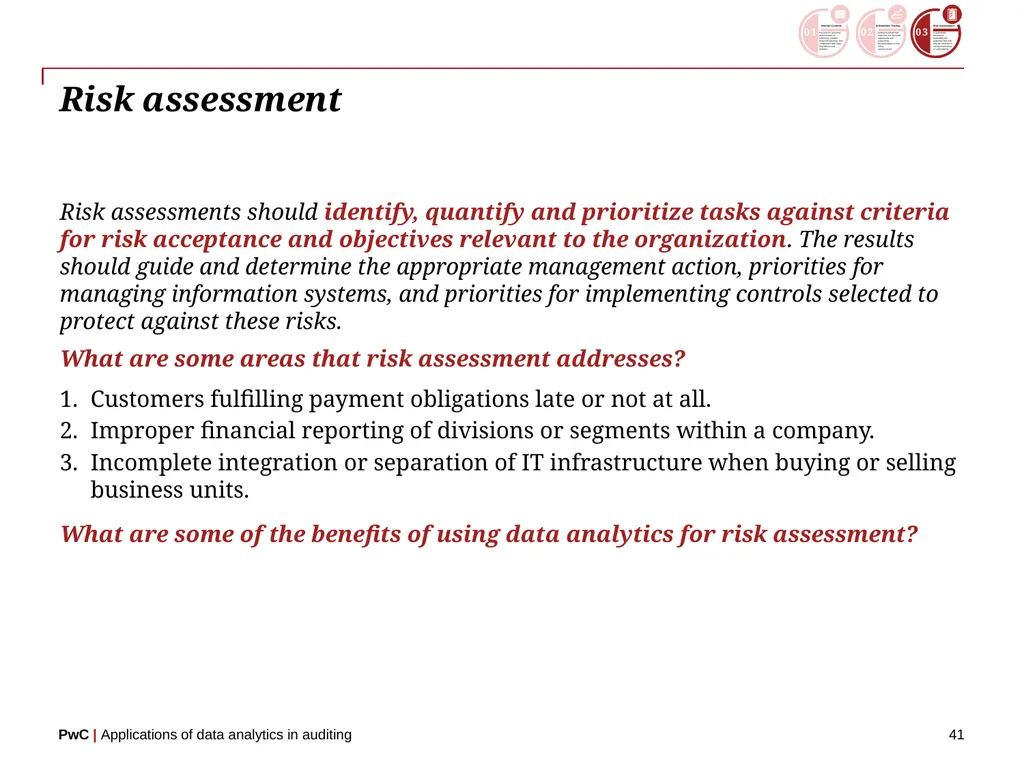
Risk assessment Risk assessments should identify, quantify and prioritize tasks against criteria for risk acceptance and objectives relevant to the organization. The results should guide and determine the appropriate management action, priorities for managing information systems, and priorities for implementing controls selected to protect against these risks. 41 What are some areas that risk assessment addresses? Customers fulfilling payment obligations late or not at all.
Improper financial reporting of divisions or segments within a company.
Incomplete integration or separation of IT infrastructure when buying or selling business units. What are some of the benefits of using data analytics for risk assessment?<br>
Improper financial reporting of divisions or segments within a company.
Incomplete integration or separation of IT infrastructure when buying or selling business units. What are some of the benefits of using data analytics for risk assessment?<br>
42
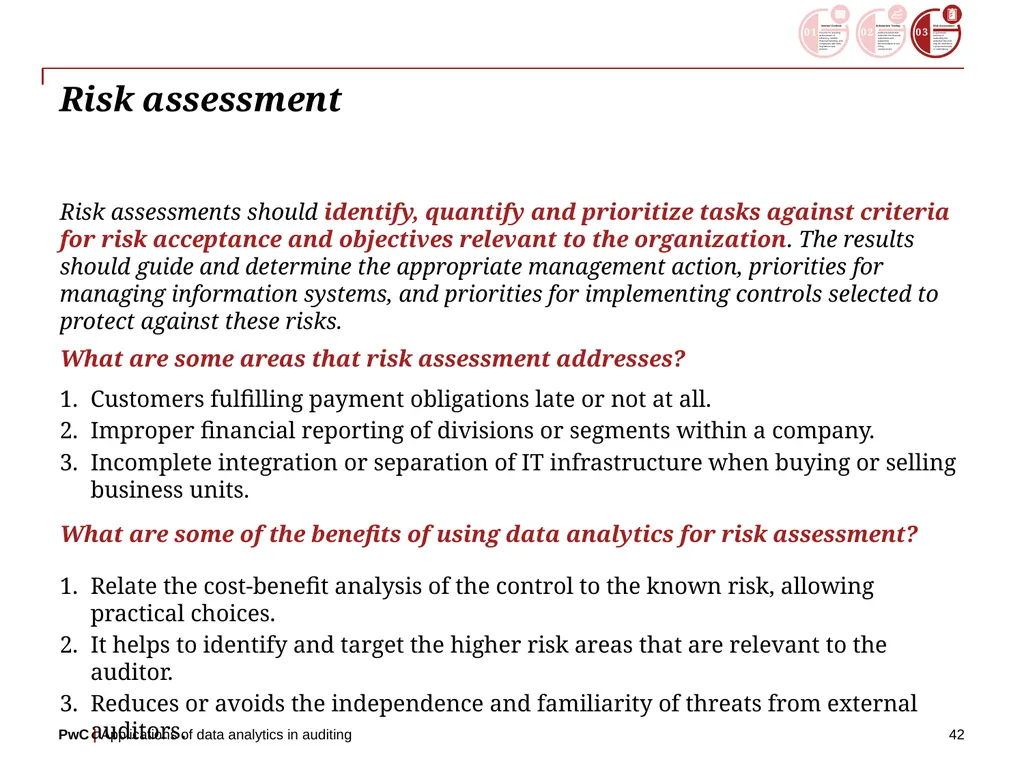
Risk assessment Risk assessments should identify, quantify and prioritize tasks against criteria for risk acceptance and objectives relevant to the organization. The results should guide and determine the appropriate management action, priorities for managing information systems, and priorities for implementing controls selected to protect against these risks. 42 What are some areas that risk assessment addresses? Customers fulfilling payment obligations late or not at all.
Improper financial reporting of divisions or segments within a company.
Incomplete integration or separation of IT infrastructure when buying or selling business units. What are some of the benefits of using data analytics for risk assessment? Relate the cost-benefit analysis of the control to the known risk, allowing practical choices.
It helps to identify and target the higher risk areas that are relevant to the auditor.
Reduces or avoids the independence and familiarity of threats from external auditors.<br>
Improper financial reporting of divisions or segments within a company.
Incomplete integration or separation of IT infrastructure when buying or selling business units. What are some of the benefits of using data analytics for risk assessment? Relate the cost-benefit analysis of the control to the known risk, allowing practical choices.
It helps to identify and target the higher risk areas that are relevant to the auditor.
Reduces or avoids the independence and familiarity of threats from external auditors.<br>
43
Application of analytics for substantive testing The application of analytics for substantive testing includes, but is not limited to the following areas: 43<br>
44
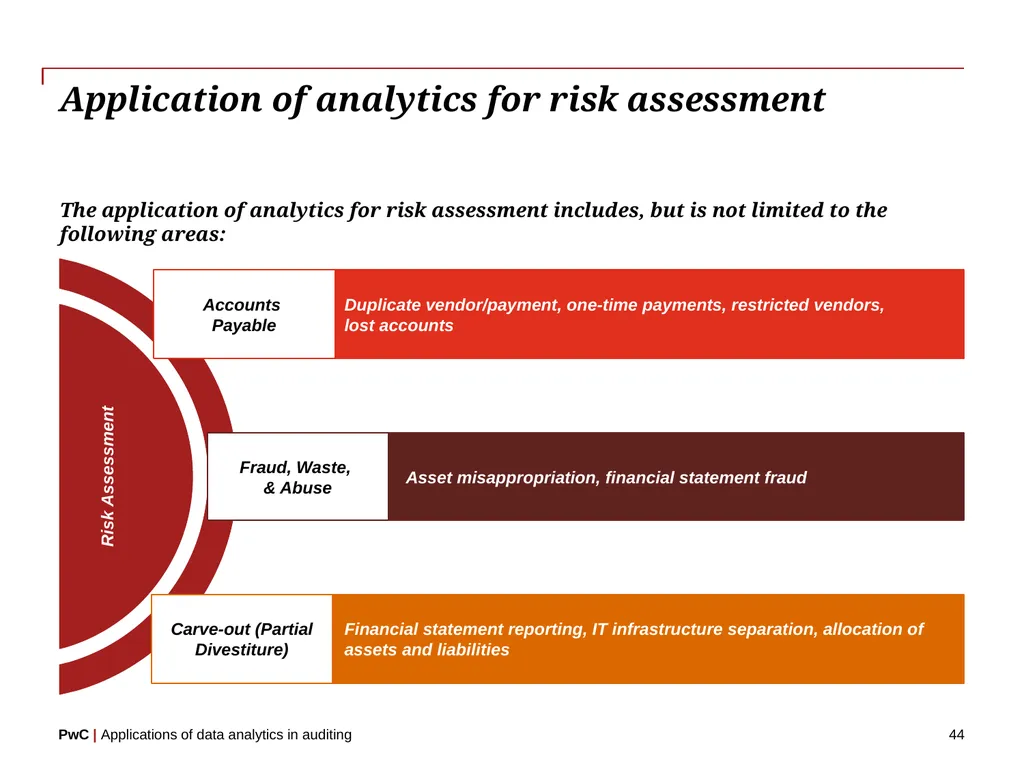
Application of analytics for risk assessment The application of analytics for risk assessment includes, but is not limited to the following areas: 44<br>
45
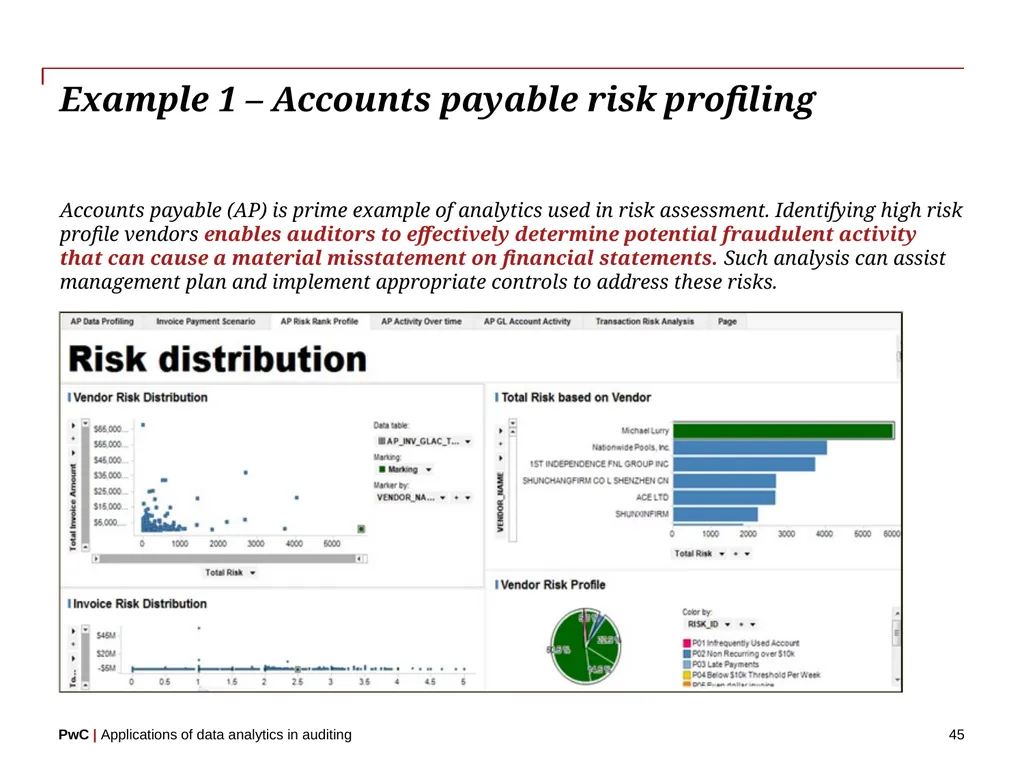
Example 1 – Accounts payable risk profiling Accounts payable (AP) is prime example of analytics used in risk assessment. Identifying high risk profile vendors enables auditors to effectively determine potential fraudulent activity that can cause a material misstatement on financial statements. Such analysis can assist management plan and implement appropriate controls to address these risks. 45<br>
46
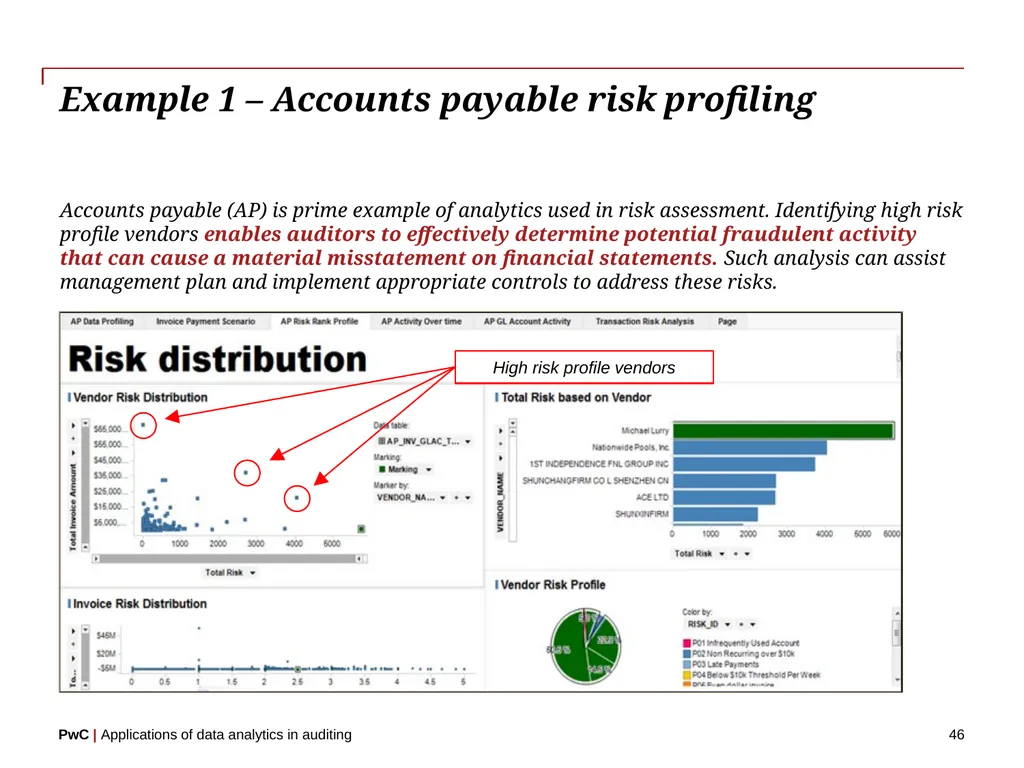
Example 1 – Accounts payable risk profiling Accounts payable (AP) is prime example of analytics used in risk assessment. Identifying high risk profile vendors enables auditors to effectively determine potential fraudulent activity that can cause a material misstatement on financial statements. Such analysis can assist management plan and implement appropriate controls to address these risks. 46 High risk profile vendors<br>
47
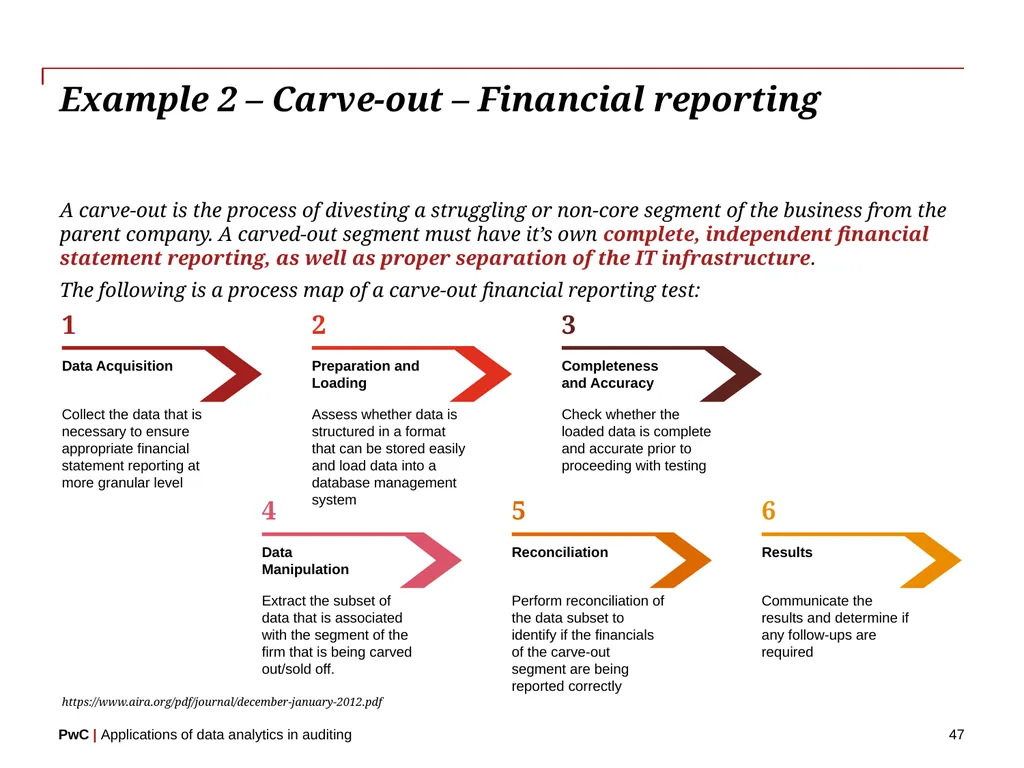
Example 2 – Carve-out – Financial reporting A carve-out is the process of divesting a struggling or non-core segment of the business from the parent company. A carved-out segment must have it’s own complete, independent financial statement reporting, as well as proper separation of the IT infrastructure.
The following is a process map of a carve-out financial reporting test: 47 Data Acquisition 1 Collect the data that is necessary to ensure appropriate financial statement reporting at more granular level Preparation and Loading 2 Assess whether data is structured in a format that can be stored easily and load data into a database management system Completeness and Accuracy 3 Check whether the loaded data is complete and accurate prior to proceeding with testing Data Manipulation 4 Extract the subset of data that is associated with the segment of the firm that is being carved out/sold off. Reconciliation 5 Perform reconciliation of the data subset to identify if the financials of the carve-out segment are being reported correctly Results 6 Communicate the results and determine if any follow-ups are required https://www.aira.org/pdf/journal/december-january-2012.pdf<br>
The following is a process map of a carve-out financial reporting test: 47 Data Acquisition 1 Collect the data that is necessary to ensure appropriate financial statement reporting at more granular level Preparation and Loading 2 Assess whether data is structured in a format that can be stored easily and load data into a database management system Completeness and Accuracy 3 Check whether the loaded data is complete and accurate prior to proceeding with testing Data Manipulation 4 Extract the subset of data that is associated with the segment of the firm that is being carved out/sold off. Reconciliation 5 Perform reconciliation of the data subset to identify if the financials of the carve-out segment are being reported correctly Results 6 Communicate the results and determine if any follow-ups are required https://www.aira.org/pdf/journal/december-january-2012.pdf<br>
48
Check on learning – Multiple choice #3 What is a benefit of using data analytics for risk assessment?
It helps to identify and target the higher risk areas that are relevant to the auditor.
Data analytics prove who should be charged with fraud
Data analytics are not specifically beneficial to risk assessment 48<br>
It helps to identify and target the higher risk areas that are relevant to the auditor.
Data analytics prove who should be charged with fraud
Data analytics are not specifically beneficial to risk assessment 48<br>
49
Check on learning – Multiple choice #3 (Answer) What is a benefit of using data analytics for risk assessment?
It helps to identify and target the higher risk areas that are relevant to the auditor. 49<br>
It helps to identify and target the higher risk areas that are relevant to the auditor. 49<br>
50
Check on learning – Scenario #3 While looking at a ticketing tool for a financial institution, an auditor noticed that a staff member approved a supervisor’s request for access to a certain application. The supervisor needed access to the application in order to complete his work. The approval allowed the supervisor to have access and to use the application freely.
Question 1: What type of internal control is in place to make sure that each user is approved for a new application?
Question 2: Did the financial institution properly follow the internal controls that are in place?
Question 3: If not, what did the financial institution do wrong? 50<br>
Question 1: What type of internal control is in place to make sure that each user is approved for a new application?
Question 2: Did the financial institution properly follow the internal controls that are in place?
Question 3: If not, what did the financial institution do wrong? 50<br>
51
Check on learning – Multiple choice #4 Lyons & Lyons CPAs are in the midst of their audit of Main Street, Inc. and are concerned about a transaction that appears to be fraudulent. How should Lyons & Lyons react?
They should maintain their planned approach to the audit.
They should plan inventory observations further in advance with the company.
They should reflect their concerns in the working papers and move on to something else.
They should review adjusting entries in detail. 51 Auditor’s Response to the Fraud Risk Assessment,<br>
They should maintain their planned approach to the audit.
They should plan inventory observations further in advance with the company.
They should reflect their concerns in the working papers and move on to something else.
They should review adjusting entries in detail. 51 Auditor’s Response to the Fraud Risk Assessment,<br>
52
Check on learning – Multiple choice #4 (Answer) Lyons & Lyons CPAs are in the midst of their audit of Main Street, Inc. and are concerned about a transaction that appears to be fraudulent. How should Lyons & Lyons react?
They should review adjusting entries in detail. 52<br>
They should review adjusting entries in detail. 52<br>
53
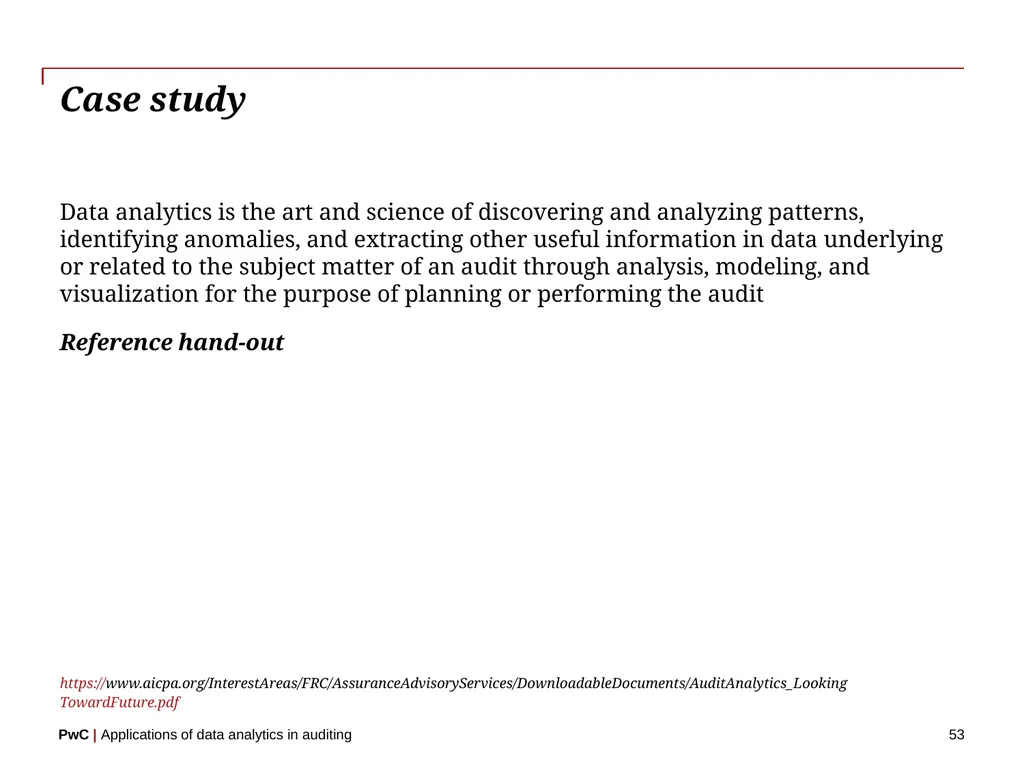
Case study Data analytics is the art and science of discovering and analyzing patterns, identifying anomalies, and extracting other useful information in data underlying or related to the subject matter of an audit through analysis, modeling, and visualization for the purpose of planning or performing the audit
Reference hand-out 53 https://www.aicpa.org/InterestAreas/FRC/AssuranceAdvisoryServices/DownloadableDocuments/AuditAnalytics_Looking TowardFuture.pdf<br>
Reference hand-out 53 https://www.aicpa.org/InterestAreas/FRC/AssuranceAdvisoryServices/DownloadableDocuments/AuditAnalytics_Looking TowardFuture.pdf<br>
54
Learning objectives At the end of this case study, students will be able to:
Identify potential fraud and other risks through utilizing analytics tools 54<br>
Identify potential fraud and other risks through utilizing analytics tools 54<br>
55
Questions? 55 55<br>
56
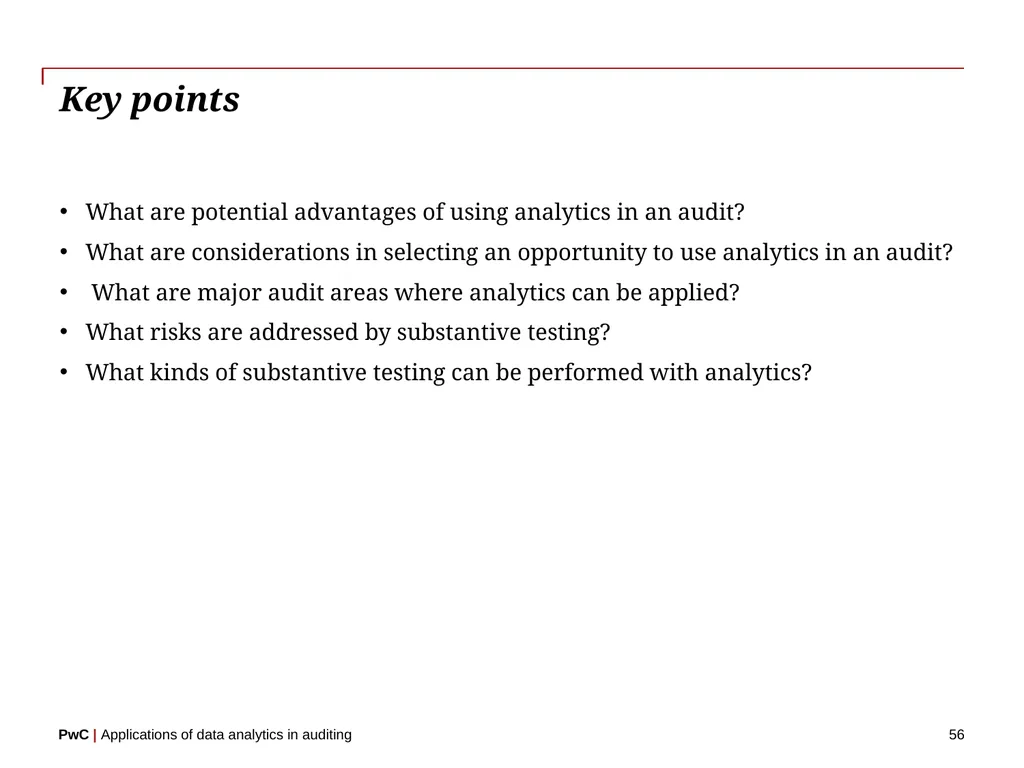
Key points What are potential advantages of using analytics in an audit?
What are considerations in selecting an opportunity to use analytics in an audit?
What are major audit areas where analytics can be applied?
What risks are addressed by substantive testing?
What kinds of substantive testing can be performed with analytics? 56<br>
What are considerations in selecting an opportunity to use analytics in an audit?
What are major audit areas where analytics can be applied?
What risks are addressed by substantive testing?
What kinds of substantive testing can be performed with analytics? 56<br>
57
© 2018 PwC. All rights reserved. PwC refers to the US member firm or one of its subsidiaries or affiliates, and may sometimes refer to the PwC network. Each member firm is a separate legal entity. Please see www.pwc.com/structure for further details<br>