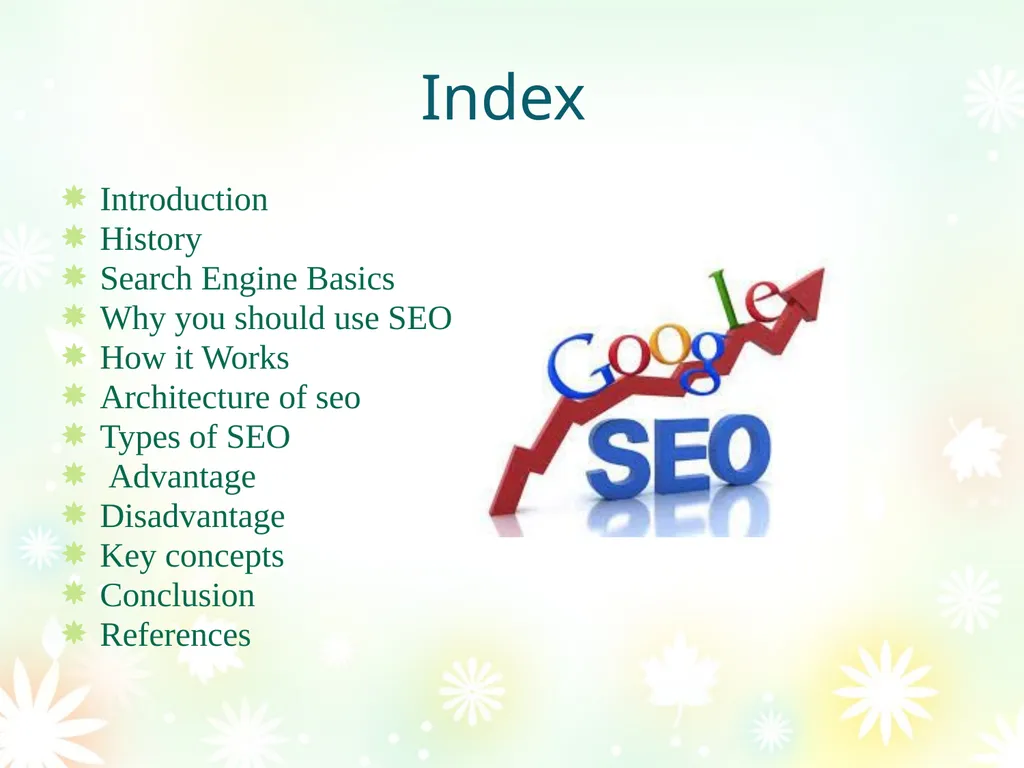
www.studymafia.org Submitted To: Submitted By: www.studymafia.org www.studymafia.org Seminar On Search Engine Optimization Index Introduction History Search Engine Basics Why you should use SEO How it Works Architecture of seo Types of SEO
"www.studymafia.org Submitted To: Submitted By:" is the property of its rightful owner. Permission is granted to
download and print the materials on this website for personal, non-commercial use only, and to display it
on your personal computer provided you do not modify the materials and that you retain all copyright
notices contained in the materials. By downloading content from our website, you accept the terms of this
agreement.
Presentation Transcript
01
www.studymafia.org Submitted To: Submitted By:
www.studymafia.org www.studymafia.org Seminar
On
Search Engine Optimization<br>
02
Index Introduction
History
Search Engine Basics
Why you should use SEO
How it Works
Architecture of seo
Types of SEO
Advantage
Disadvantage
Key concepts
Conclusion
References<br>
03
Introduction Whenever you enter a query in a search engine and hit 'enter' you get a list of web results that contain that query term. Users normally tend to visit websites that are at the top of this list as they perceive those to be more relevant to the query.
If you have ever wondered why some of these websites rank better than the others then you must know that it is because of a powerful web marketing technique called Search Engine Optimization (SEO). 3<br>
04
History…. 1995 - Yahoo Launches its Web Directory
1998 – Google Launches, DMOZ launches this same year
2000 – Yahoo Drops AltaVista, Uses Google’s Algorithm instead
2001 – Page Rank is revealed to users through the toolbar
2005 – No Follow Tag Introduced
2009 – Google Introduces Caffeine Algorithm, a major shift in SEO.
2009 – Bing and Yahoo Merge
2011 – Panda Algorithm Update. A major step in the history of SEO
April 24th 2012 – Penguin Algorithm Update
September 27th 2012 – EMD Update (Exact Match Domain)
October 4th 2012 – 65 Pack Rollout 4<br>
05
Search Engine Basics Processing queries: When a request for information comes into the search engine, the engine retrieves from its index all the document that match the query.
Ranking results: Once the search engine has determined which results are a match for the query, the engine's algorithm (a mathematical equation commonly used for sorting) runs calculations on each of the results to determine which is most relevant to the given query. 5<br>
06
Why you should use SEO Brand awareness – A web site having a high ranking means more people see the name of the company and become familiar with the company and its products, even if they haven’t made a purchase.
Targeted traffic – Search engine optimization brings paying customers to your door step.
Your competitors – Keeping ahead of your competition in the organic search results can help boost the perceived position of your company in your marketplace. 6<br>
07
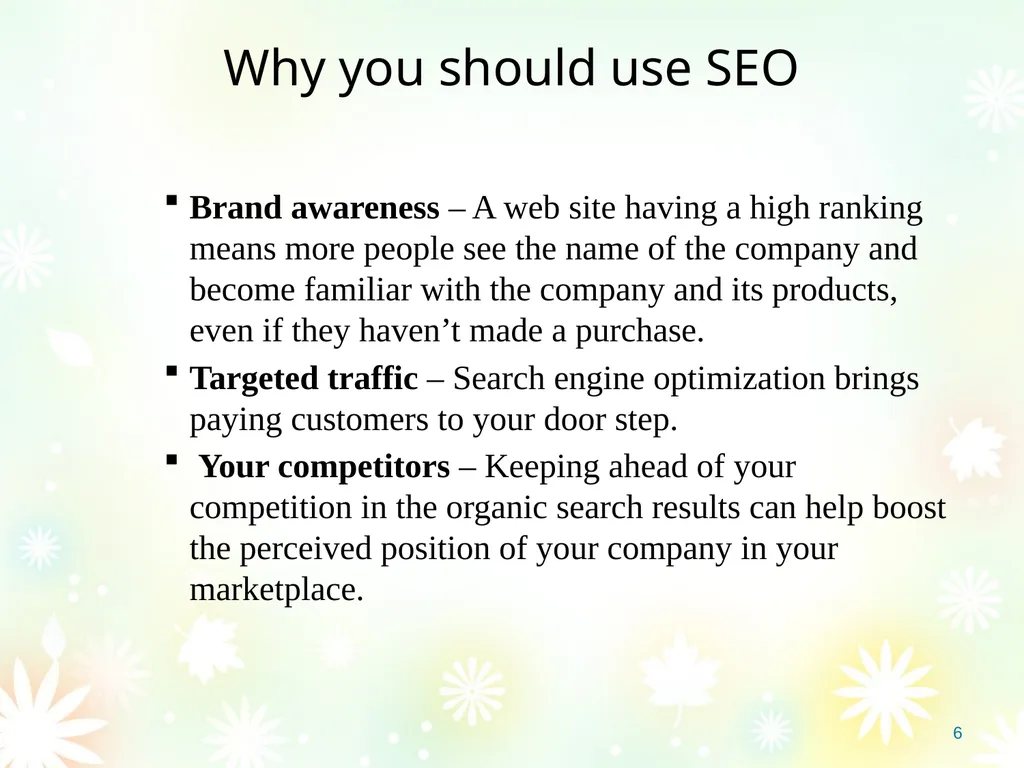
How it Works Search engines, such as Google, Yahoo!, and Bing, scour the World Wide Web. Their automated "robots" (also called "spiders") move from page to page and site to site by following links.
Along the way the read the code for the pages they visit. The information from the page code is incorporated into the search engine's vast knowledge base. 7<br>
08
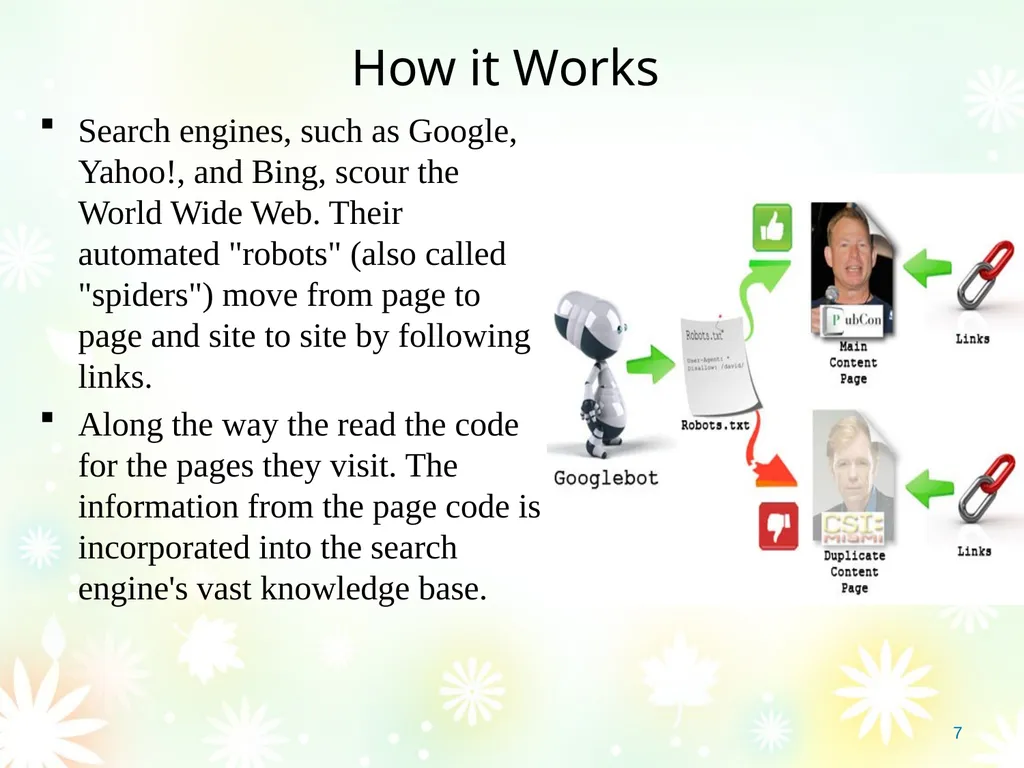
Paid and Unpaid …. 8<br>
09
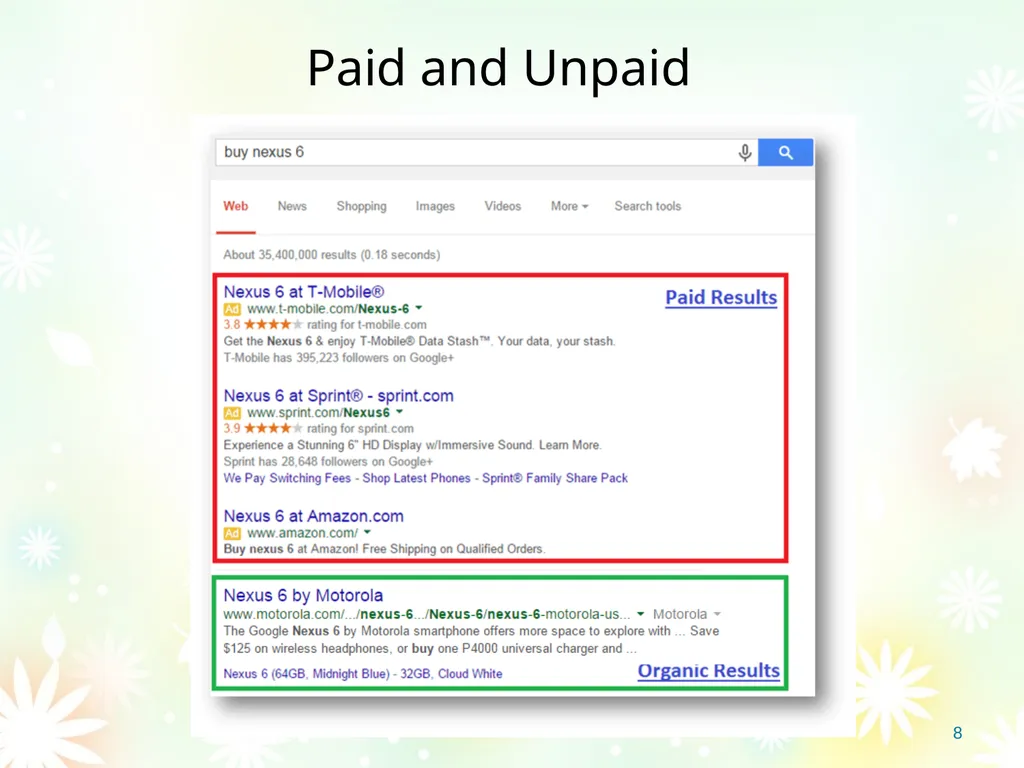
Architecture of seo 9<br>
10
Types of SEO White Hat SEO
White hat SEO is ethical SEO. It's SEO techniques that search engines accept. White hat SEO techniques are beneficial for site visitors as well as for search engines. The goal of white hat SEO is to improve search engine result positions via methods that won't cause search engines to penalize the site.
Successful white hat SEO is slower than black hat SEO and is an ongoing process. 10<br>
11
Types of SEO… Black hat SEO
Black hat SEO is the use of techniques that are unacceptable to search engines to boost a page's position in search results. These techniques are intended to trick search engines into giving pages higher positions in search results, and they have no benefit to site visitors. The goal is to improve search engine result positions no matter what it takes to do it.
Black hat SEO techniques are used for two reasons:
They work — until search engines find out about them and they don't work.
Some people don't understand that black hat SEO techniques can get their sites penalized by or banned from search engines. 11<br>
12
Types of SEO… Gray hat SEO
Gray hat SEO is SEO techniques that take more risks than white hat SEO techniques but aren't likely to get your site banned from search engines (although a search engine penality could result). They're questionable SEO techniques but not in the same category as black hat SEO techniques. However, what's considered gray hat SEO today might be black hat SEO next year. 12<br>
13
On Page Optimization Title Optimization Site Loading Page time optimization Meta keyword optimization Internal Linking URL Optimization etc. 13<br>
14
Off Page Optimization Press Release Submission Article Directory Submission Web 2.0 posting Social Bookmarking Directory Submission etc. 14<br>
15
Fundamental Principles of Off-site SEO The Principle of Search Engagement The optimizer must choose which search engine(s) for which content will be optimized.
The Principle of Resource Engagement The optimizer must leverage links by providing them with context, recognition, and an active framework in which people find the links to be part of useful resources.
The Principle of Message Engagement The optimizer must take responsibility for shaping the message that people see about a given site on other Websites. 15<br>
16
Advantage 1. it’s cost-effective. You don't have to pay the search engine to be "advertised". At this point in time is when you have to pay for almost everything; it's good to know that there are still some things which are free.
2. If well ranked, has your company greater chance at becoming visible around the world, while you stay at home. Internet is an effective marketing tool. It is actually the marketplace itself with numerous potential clienteles.
3. Once your website gets a good place, you somehow your reputation as one of the best. This implies that somehow you are properly valued in the SEO community. 16<br>
17
Disadvantage Your position in the search engine is unpredictable. Everything depends on the algorithm. As a result, you know not when the return of the investment will happen.
This is time consuming. It takes a long time before you see your standing improve a notch. Sometimes you have to wait for months or even a year to be in the spotlight.
Participants can make use of the black hat tactics. These unfair practices hinder the tree of your company. 17<br>
Conclusion While nobody can guarantee top level positioning in search engine organic results, proper search engine optimization can help. Because the search engines, such as Google, Yahoo!, and Bing, are so important today it is necessary to make each page in a Web site conform to the principles of good SEO as much as possible.
To do this it is necessary to:
Understand the basics of how search engines rate sites
Use proper keywords and phrases throughout the Web site
Avoid giving the appearance of spamming the search engines 19<br>