www.studymafia.org Submitted To: Submitted By: www.studymafia.org www.studymafia.org Seminar On Solar Energy Content What is Solar Energy? How much solar energy? Major Uses of Solar Energy Putting Solar Energy to Use: Heating Water
"www.studymafia.org Submitted To: Submitted By:" is the property of its rightful owner. Permission is granted to
download and print the materials on this website for personal, non-commercial use only, and to display it
on your personal computer provided you do not modify the materials and that you retain all copyright
notices contained in the materials. By downloading content from our website, you accept the terms of this
agreement.
Presentation Transcript
01
www.studymafia.org Submitted To: Submitted By:
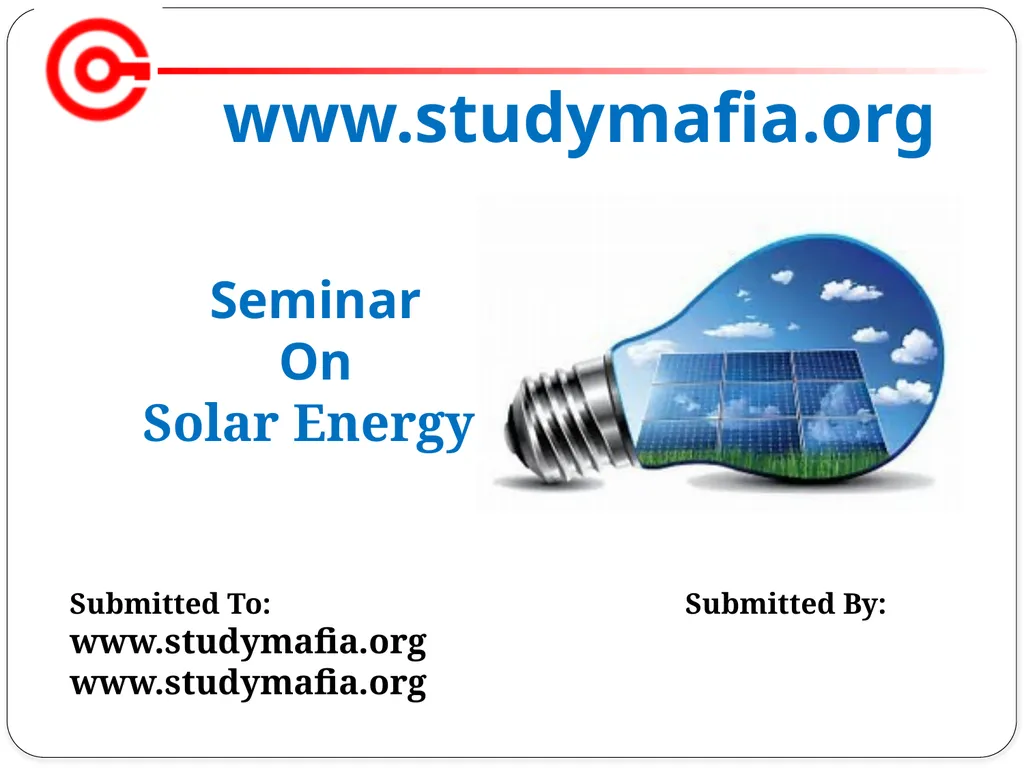
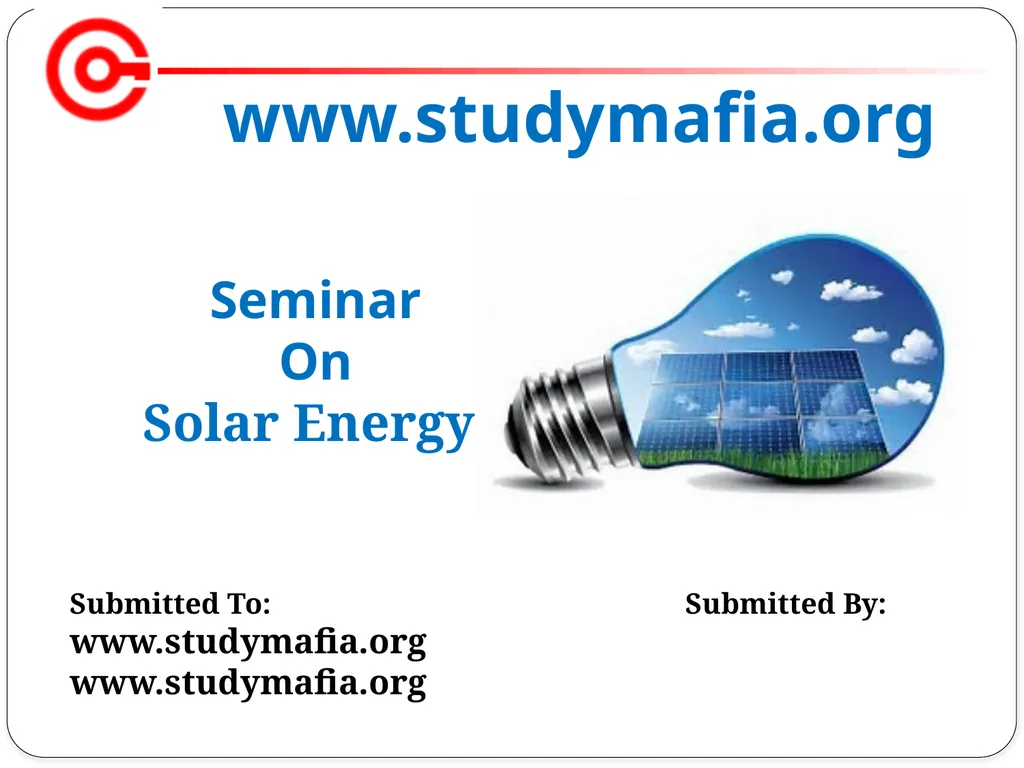
www.studymafia.org www.studymafia.org Seminar
On
Solar Energy<br>
02
Content What is Solar Energy?
How much solar energy?
Major Uses of Solar Energy
Putting Solar Energy to Use: Heating Water
Advantages of Solar Energy
Disadvantages of Solar Energy
Conclusion
References<br>
03
What is Solar Energy? Originates with the thermonuclear fusion reactions occurring in the sun.
Represents the entire electromagnetic radiation (visible light, infrared, ultraviolet, x-rays, and radio waves).<br>
04
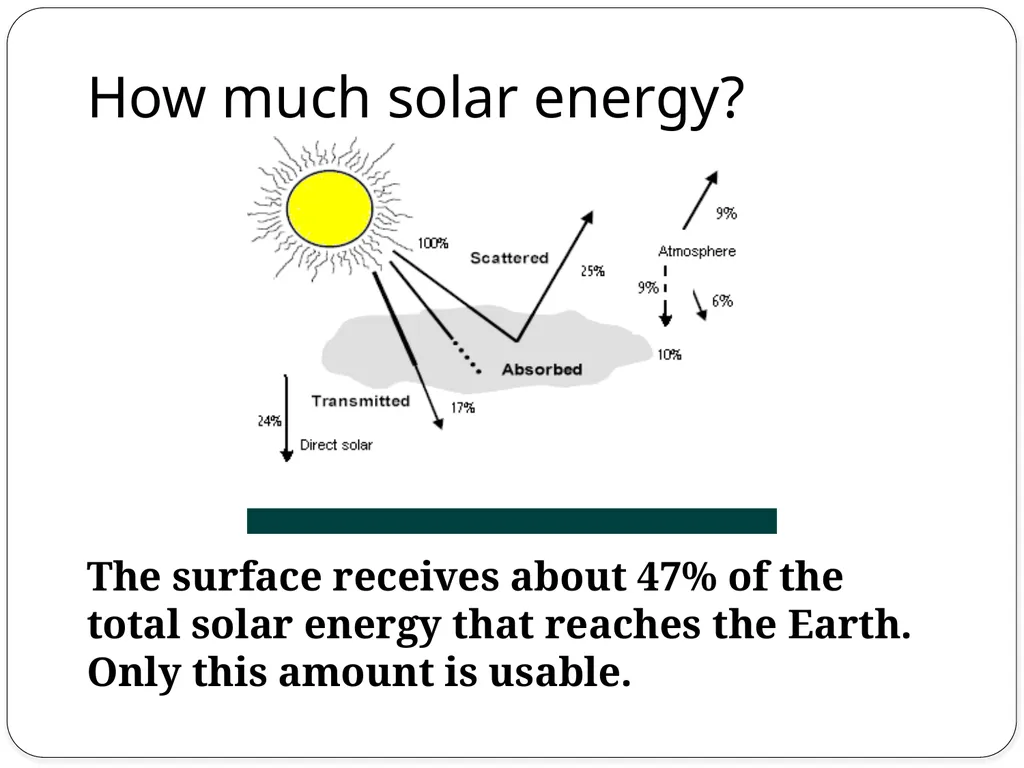
How much solar energy? The surface receives about 47% of the total solar energy that reaches the Earth. Only this amount is usable.<br>
05
Major Uses of Solar Energy Daylight
Drying Agricultural Products
Space Heating
Water Heating
Generating Electrical Power
Concentrating Solar Power (CSP)
Photovoltaics<br>
06
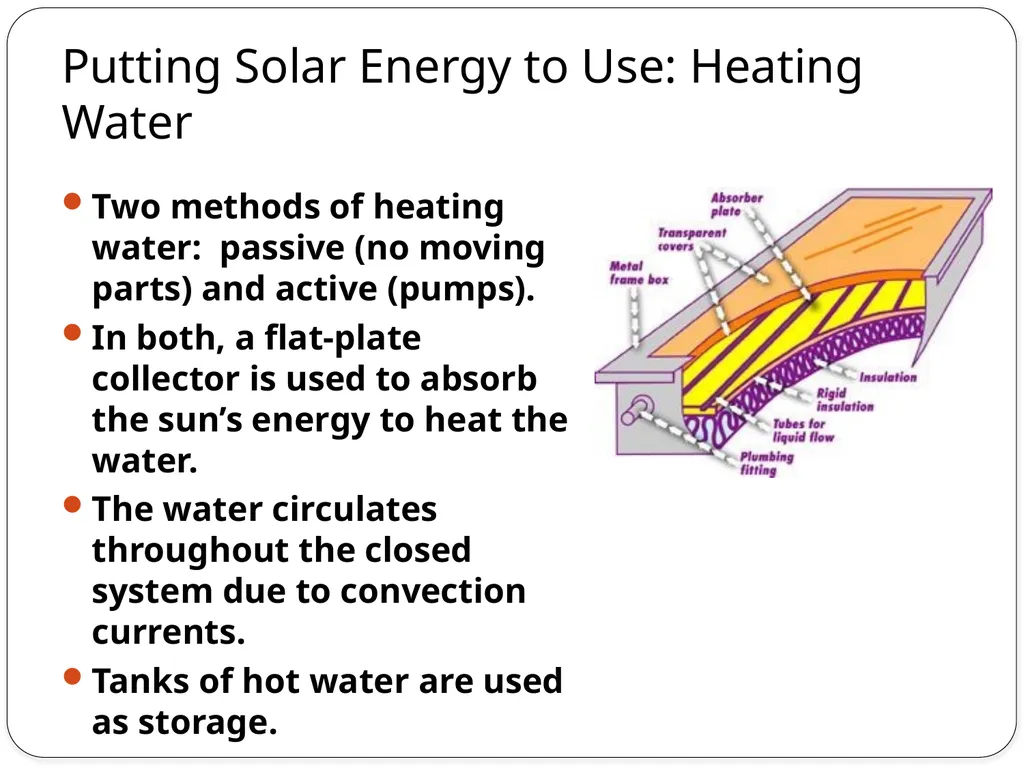
Putting Solar Energy to Use: Heating Water Two methods of heating water: passive (no moving parts) and active (pumps).
In both, a flat-plate collector is used to absorb the sun’s energy to heat the water.
The water circulates throughout the closed system due to convection currents.
Tanks of hot water are used as storage.<br>
07
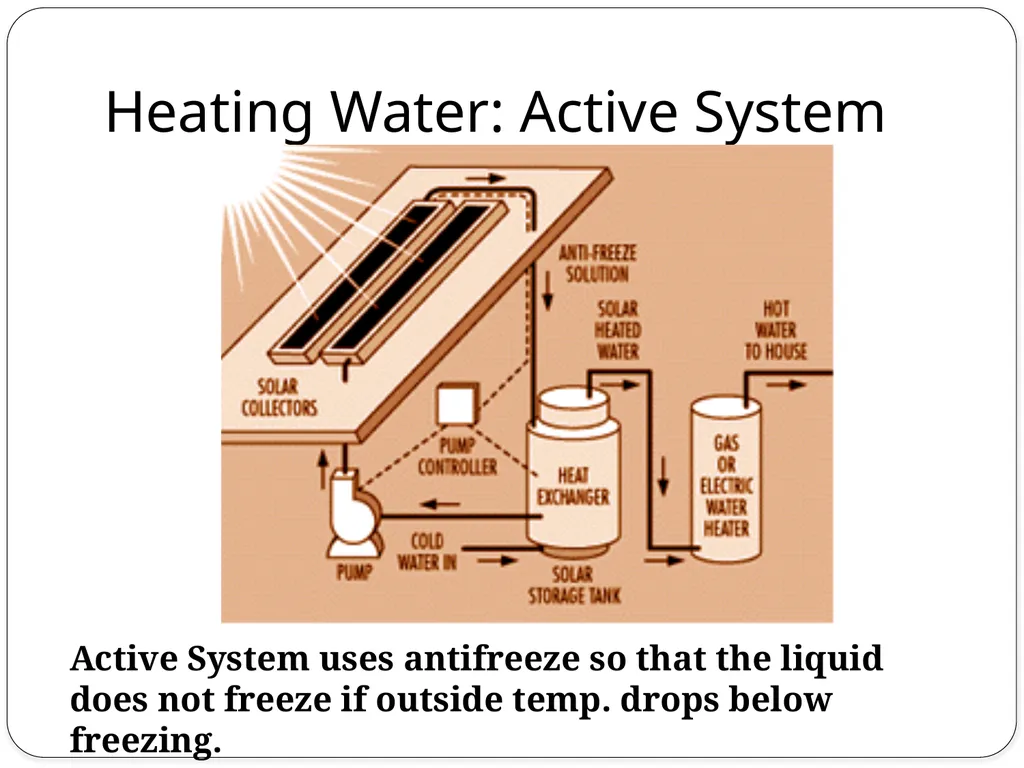
Heating Water: Active System Active System uses antifreeze so that the liquid does not freeze if outside temp. drops below freezing.<br>
08
Heating Water—Last Thoughts Efficiency of solar heating system is always less than 100% because:
% transmitted depends on angle of incidence,
Number of glass sheets (single glass sheet transmits 90-95%), and
Composition of the glass
Solar water heating saves approx. 1000 megawatts of energy a yr, equivalent to eliminating the emissions from two medium sized coal burning power plants.
By using solar water heating over gas water heater, a family will save 1200 pounds of pollution each year.
Market for flat plate collectors grew in 1980s because of increasing fossil fuels prices and federal tax credits. But by 1985, when these credits were removed and fossil fuel prices were low, the demand for flat plate collectors shrunk quickly.
While solar water heating is relatively low in the US, in other parts of the world such as Cyprus (90%) and Israel (65%), it proves to be the predominate form of water heating.<br>
09
Heating Living Spaces Best design of a building is for it to act as a solar collector and storage unit. This is achieved through three elements: insulation, collection, and storage.
Efficient heating starts with proper insulation on external walls, roof, and the floors. The doors, windows, and vents must be designed to minimize heat loss.
Collection: south-facing windows and appropriate landscaping.
Storage: Thermal mass—holds heat.
Water= 62 BTU per cubic foot per degree F.
Iron=54, Wood (oak) =29, Brick=25, concrete=22, and loose stone=20<br>
10
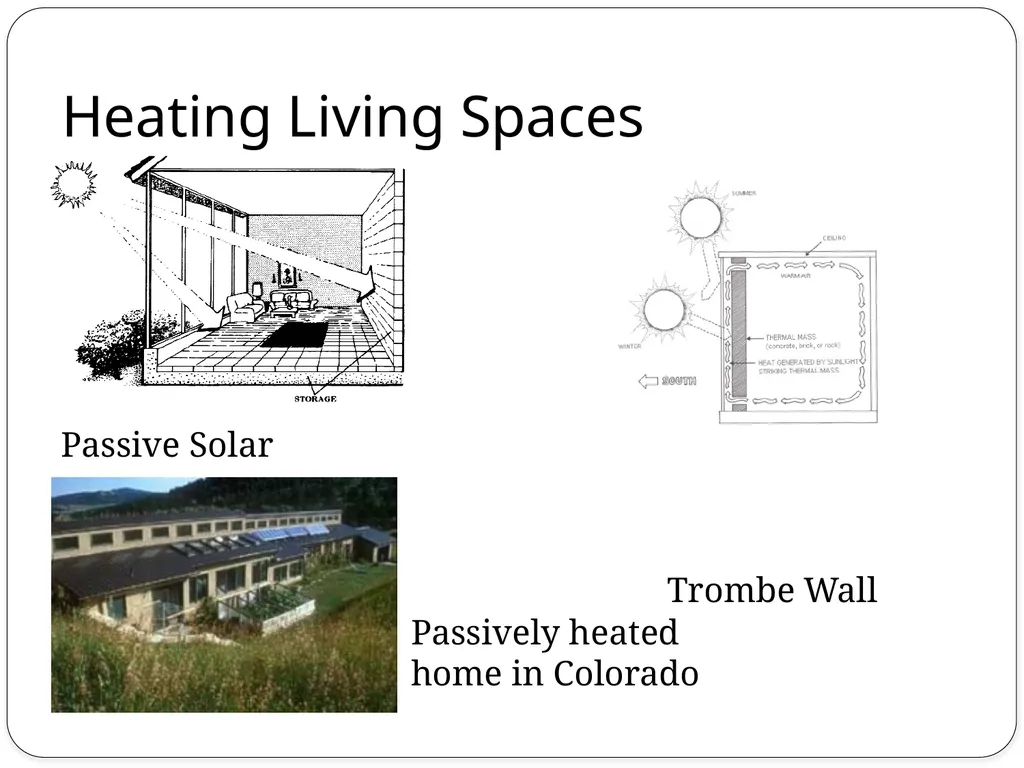
Heating Living Spaces Passive Solar Trombe Wall Passively heated home in Colorado<br>
11
Heating Living Spaces A passively heated home uses about 60-75% of the solar energy that hits its walls and windows.
The Center for Renewable Resources estimates that in almost any climate, a well-designed passive solar home can reduce energy bills by 75% with an added construction cost of only 5-10%.
About 25% of energy is used for water and space heating.
Major factor discouraging solar heating is low energy prices.<br>
12
Solar-Thermal Electricity: Power Towers General idea is to collect the light from many reflectors spread over a large area at one central point to achieve high temperature.
Example is the 10-MW solar power plant in Barstow, CA.
1900 heliostats, each 20 ft by 20 ft
a central 295 ft tower
An energy storage system allows it to generate 7 MW of electric power without sunlight.
Capital cost is greater than coal fired power plant, despite the no cost for fuel, ash disposal, and stack emissions.
Capital costs are expected to decline as more and more power towers are built with greater technological advances.
One way to reduce cost is to use the waste steam from the turbine for space heating or other industrial processes.<br>
13
Solar-Thermal Electricity: Parabolic Dishes and Troughs Focus sunlight on a smaller receiver for each device; the heated liquid drives a steam engine to generate electricity.
The first of these Solar Electric Generating Stations (SEGS) was installed in CA by an Israeli company, Luz International.
Output was 13.8 MW; cost was $6,000/peak kW and overall efficiency was 25%.
Through federal and state tax credits, Luz was able to build more SEGS, and improved reduced costs to $3,000/peak kW and the cost of electricity from 25 cents to 8 cents per kWh, barely more than the cost of nuclear or coal-fired facilities.
The more recent facilities converted a remarkable 22% of sunlight into electricity.<br>
14
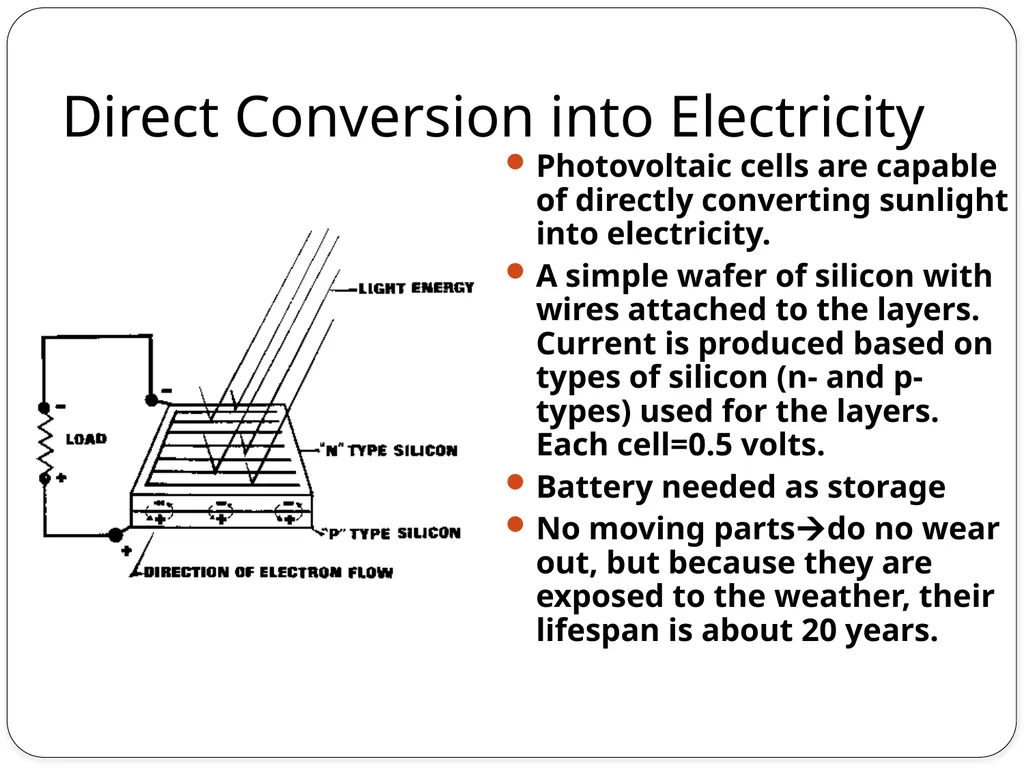
Direct Conversion into Electricity Photovoltaic cells are capable of directly converting sunlight into electricity.
A simple wafer of silicon with wires attached to the layers. Current is produced based on types of silicon (n- and p-types) used for the layers. Each cell=0.5 volts.
Battery needed as storage
No moving partsdo no wear out, but because they are exposed to the weather, their lifespan is about 20 years.<br>
15
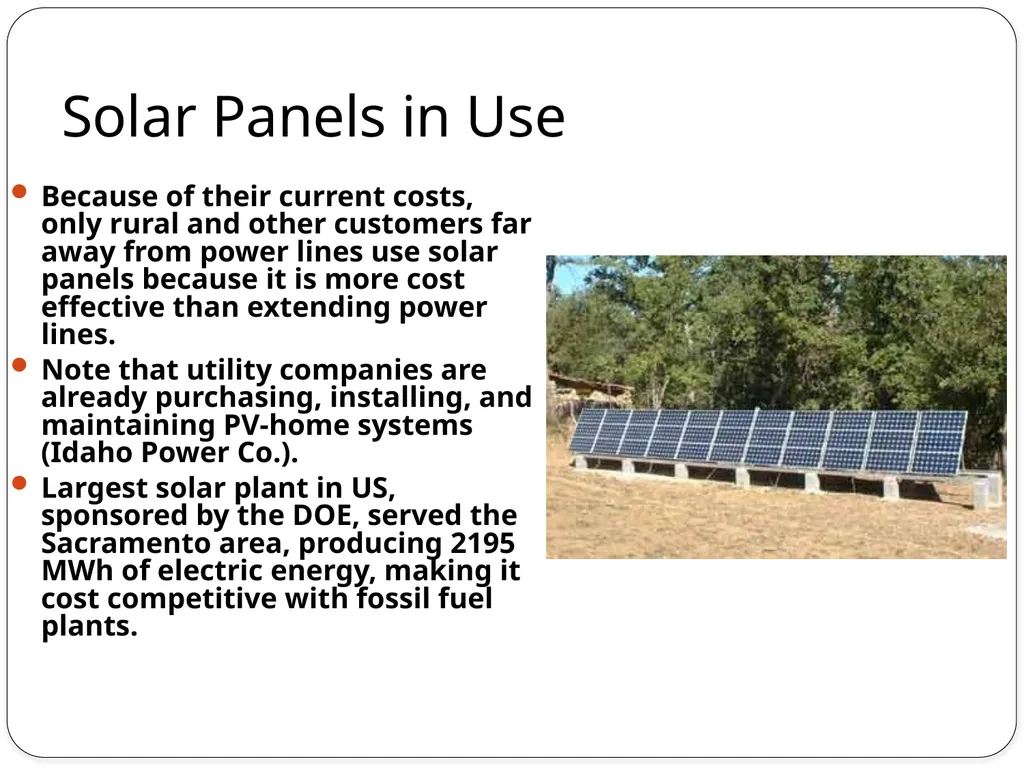
Solar Panels in Use Because of their current costs, only rural and other customers far away from power lines use solar panels because it is more cost effective than extending power lines.
Note that utility companies are already purchasing, installing, and maintaining PV-home systems (Idaho Power Co.).
Largest solar plant in US, sponsored by the DOE, served the Sacramento area, producing 2195 MWh of electric energy, making it cost competitive with fossil fuel plants.<br>
16
Advantages of Solar Energy Solar Energy is pollution-free and causes no greenhouse gases to be emitted after installation
Reduced dependence on foreign oil and fossil fuels
Renewable clean power that is available every day of the year, even cloudy days produce some power
Return on investment unlike paying for utility bills
Virtually no maintenance as solar panels last over 30 years<br>
17
Disadvantages of Solar Energy Needs lots of space as efficiency is not 100% yet
No solar power at night so there is a need for a large battery bank
Some people think they are ugly (I am definitely not one of those!)
Devices that run on DC power directly are more expensive
Depending on geographical location the size of the solar panels vary for the same power generation
Cloudy days do not produce as much energy
Solar panels are not being massed produced due to a lack of material and technology to lower the cost enough to be more affordable (this is starting to change)<br>
18
Conclusion Using a combination of Passive solar energy and photovoltaic cells can lessen pollution.
Concerns with use of Cadmium in PV cells is exaggerated when compared to electricity produced from coal
More research is needed and being done
Cost of Solar system will come down in price when production increases<br>