
Year 10 History Starter Sheets Reading Year 10
NS
Published · 11 slides · 0 views

1 / 1

Description
Year 10 History Starter Sheets Reading Year 10 Hist: The Cold War Lesson 1 Reading Activity Write down the heading. Number the paragraphs. Circle the metalanguage words : ally
Related Topics
Share
Embed code
Download this presentation From Below
"Year 10 History Starter Sheets Reading Year 10" is the property of its rightful owner. Permission is granted to download and print the materials on this website for personal, non-commercial use only, and to display it on your personal computer provided you do not modify the materials and that you retain all copyright notices contained in the materials. By downloading content from our website, you accept the terms of this agreement.
Presentation Transcript
01
Year 10 History
Starter Sheets
Reading<br>
02
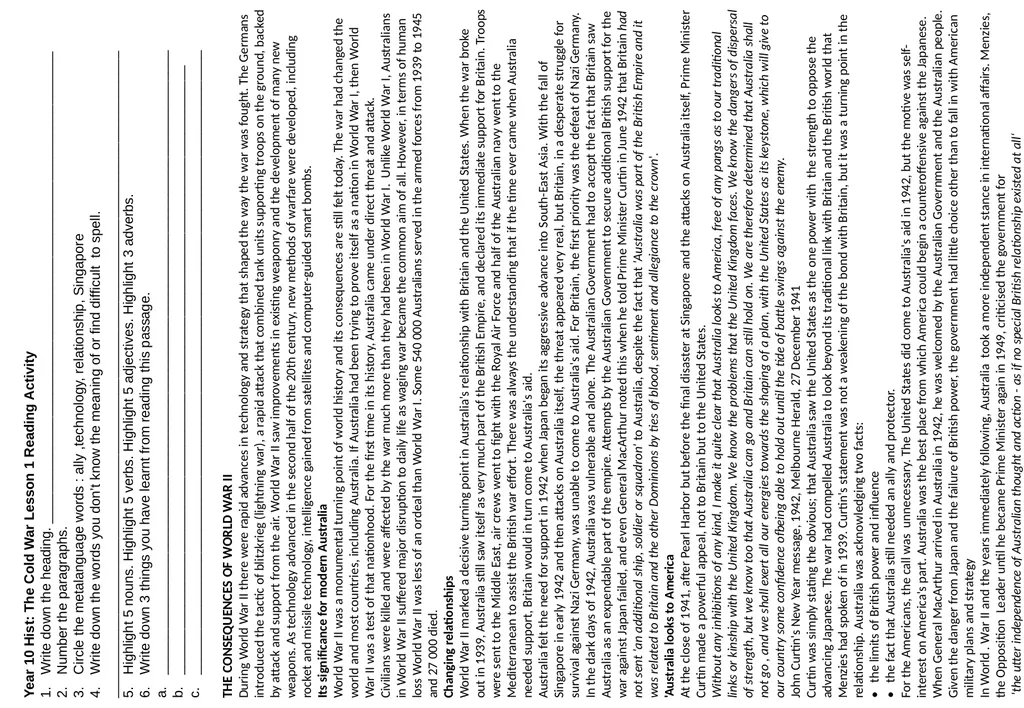
Year 10 Hist: The Cold War Lesson 1 Reading Activity
Write down the heading. ______________________________________________________________
Number the paragraphs.
Circle the metalanguage words : ally ,technology, relationship, Singapore
Write down the words you don’t know the meaning of or find difficult to spell.
_____________________________________________________________________________________
Highlight 5 nouns. Highlight 5 verbs. Highlight 5 adjectives. Highlight 3 adverbs.
Write down 3 things you have learnt from reading this passage.
__________________________________________________________________________________
________________________________________________________________________________
__________________________________________________________________________________
THE CONSEQUENCES OF WORLD WAR II
During World War II there were rapid advances in technology and strategy that shaped the way the war was fought. The Germans introduced the tactic of blitzkrieg (lightning war), a rapid attack that combined tank units supporting troops on the ground, backed by attack and support from the air. World War II saw improvements in existing weaponry and the development of many new weapons. As technology advanced in the second half of the 20th century, new methods of warfare were developed, including rocket and missile technology, intelligence gained from satellites and computer-guided smart bombs.
Its significance for modern Australia
World War II was a monumental turning point of world history and its consequences are still felt today. The war had changed the world and most countries, including Australia. If Australia had been trying to prove itself as a nation in World War I, then World War II was a test of that nationhood. For the first time in its history, Australia came under direct threat and attack.
Civilians were killed and were affected by the war much more than they had been in World War I. Unlike World War I, Australians in World War II suffered major disruption to daily life as waging war became the common aim of all. However, in terms of human loss World War II was less of an ordeal than World War I. Some 540 000 Australians served in the armed forces from 1939 to 1945 and 27 000 died.
Changing relationships
World War II marked a decisive turning point in Australia's relationship with Britain and the United States. When the war broke out in 1939, Australia still saw itself as very much part of the British Empire, and declared its immediate support for Britain. Troops were sent to the Middle East, air crews went to fight with the Royal Air Force and half of the Australian navy went to the Mediterranean to assist the British war effort. There was always the understanding that if the time ever came when Australia needed support, Britain would in turn come to Australia's aid.
Australia felt the need for support in 1942 when Japan began its aggressive advance into South-East Asia. With the fall of Singapore in early 1942 and then attacks on Australia itself, the threat appeared very real, but Britain, in a desperate struggle for survival against Nazi Germany, was unable to come to Australia's aid. For Britain, the first priority was the defeat of Nazi Germany. In the dark days of 1942, Australia was vulnerable and alone. The Australian Government had to accept the fact that Britain saw Australia as an expendable part of the empire. Attempts by the Australian Government to secure additional British support for the war against Japan failed, and even General MacArthur noted this when he told Prime Minister Curtin in June 1942 that Britain had not sent 'an additional ship, soldier or squadron' to Australia, despite the fact that 'Australia was part of the British Empire and it was related to Britain and the other Dominions by ties of blood, sentiment and allegiance to the crown'.
'Australia looks to America
At the close of 1941, after Pearl Harbor but before the final disaster at Singapore and the attacks on Australia itself, Prime Minister Curtin made a powerful appeal, not to Britain but to the United States.
Without any inhibitions of any kind, I make it quite clear that Australia looks to America, free of any pangs as to our traditional links or kinship with the United Kingdom. We know the problems that the United Kingdom faces. We know the dangers of dispersal of strength, but we know too that Australia can go and Britain can still hold on. We are therefore determined that Australia shall not go , and we shall exert all our energies towards the shaping of a plan, with the United States as its keystone, which will give to our country some confidence ofbeing able to hold out until the tide of battle swings against the enemy.
John Curtin's New Year message, 1942, Melbourne Herald, 27 December 1941
Curtin was simply stating the obvious; that Australia saw the United States as the one power with the strength to oppose the advancing Japanese. The war had compelled Australia to look beyond its traditional link with Britain and the British world that Menzies had spoken of in 1939. Curtin's statement was not a weakening of the bond with Britain, but it was a turning point in the
relationship. Australia was acknowledging two facts:
• the limits of British power and influence
• the fact that Australia still needed an ally and protector.
For the Americans, the call was unnecessary. The United States did come to Australia's aid in 1942, but the motive was self-interest on America's part. Australia was the best place from which America could begin a counteroffensive against the Japanese. When General MacArthur arrived in Australia in 1942, he was welcomed by the Australian Government and the Australian people. Given the danger from Japan and the failure of British power, the government had little choice other than to fall in with American military plans and strategy
In World . War II and the years immediately following, Australia took a more independent stance in international affairs. Menzies, the Opposition Leader until he became Prime Minister again in 1949, criticised the government for
'the utter independence of Australian thought and action - as if no special British relationship existed at all‘
( Commonwealth Parliamentary Debates, vol. 186, p. 458).<br>
Write down the heading. ______________________________________________________________
Number the paragraphs.
Circle the metalanguage words : ally ,technology, relationship, Singapore
Write down the words you don’t know the meaning of or find difficult to spell.
_____________________________________________________________________________________
Highlight 5 nouns. Highlight 5 verbs. Highlight 5 adjectives. Highlight 3 adverbs.
Write down 3 things you have learnt from reading this passage.
__________________________________________________________________________________
________________________________________________________________________________
__________________________________________________________________________________
THE CONSEQUENCES OF WORLD WAR II
During World War II there were rapid advances in technology and strategy that shaped the way the war was fought. The Germans introduced the tactic of blitzkrieg (lightning war), a rapid attack that combined tank units supporting troops on the ground, backed by attack and support from the air. World War II saw improvements in existing weaponry and the development of many new weapons. As technology advanced in the second half of the 20th century, new methods of warfare were developed, including rocket and missile technology, intelligence gained from satellites and computer-guided smart bombs.
Its significance for modern Australia
World War II was a monumental turning point of world history and its consequences are still felt today. The war had changed the world and most countries, including Australia. If Australia had been trying to prove itself as a nation in World War I, then World War II was a test of that nationhood. For the first time in its history, Australia came under direct threat and attack.
Civilians were killed and were affected by the war much more than they had been in World War I. Unlike World War I, Australians in World War II suffered major disruption to daily life as waging war became the common aim of all. However, in terms of human loss World War II was less of an ordeal than World War I. Some 540 000 Australians served in the armed forces from 1939 to 1945 and 27 000 died.
Changing relationships
World War II marked a decisive turning point in Australia's relationship with Britain and the United States. When the war broke out in 1939, Australia still saw itself as very much part of the British Empire, and declared its immediate support for Britain. Troops were sent to the Middle East, air crews went to fight with the Royal Air Force and half of the Australian navy went to the Mediterranean to assist the British war effort. There was always the understanding that if the time ever came when Australia needed support, Britain would in turn come to Australia's aid.
Australia felt the need for support in 1942 when Japan began its aggressive advance into South-East Asia. With the fall of Singapore in early 1942 and then attacks on Australia itself, the threat appeared very real, but Britain, in a desperate struggle for survival against Nazi Germany, was unable to come to Australia's aid. For Britain, the first priority was the defeat of Nazi Germany. In the dark days of 1942, Australia was vulnerable and alone. The Australian Government had to accept the fact that Britain saw Australia as an expendable part of the empire. Attempts by the Australian Government to secure additional British support for the war against Japan failed, and even General MacArthur noted this when he told Prime Minister Curtin in June 1942 that Britain had not sent 'an additional ship, soldier or squadron' to Australia, despite the fact that 'Australia was part of the British Empire and it was related to Britain and the other Dominions by ties of blood, sentiment and allegiance to the crown'.
'Australia looks to America
At the close of 1941, after Pearl Harbor but before the final disaster at Singapore and the attacks on Australia itself, Prime Minister Curtin made a powerful appeal, not to Britain but to the United States.
Without any inhibitions of any kind, I make it quite clear that Australia looks to America, free of any pangs as to our traditional links or kinship with the United Kingdom. We know the problems that the United Kingdom faces. We know the dangers of dispersal of strength, but we know too that Australia can go and Britain can still hold on. We are therefore determined that Australia shall not go , and we shall exert all our energies towards the shaping of a plan, with the United States as its keystone, which will give to our country some confidence ofbeing able to hold out until the tide of battle swings against the enemy.
John Curtin's New Year message, 1942, Melbourne Herald, 27 December 1941
Curtin was simply stating the obvious; that Australia saw the United States as the one power with the strength to oppose the advancing Japanese. The war had compelled Australia to look beyond its traditional link with Britain and the British world that Menzies had spoken of in 1939. Curtin's statement was not a weakening of the bond with Britain, but it was a turning point in the
relationship. Australia was acknowledging two facts:
• the limits of British power and influence
• the fact that Australia still needed an ally and protector.
For the Americans, the call was unnecessary. The United States did come to Australia's aid in 1942, but the motive was self-interest on America's part. Australia was the best place from which America could begin a counteroffensive against the Japanese. When General MacArthur arrived in Australia in 1942, he was welcomed by the Australian Government and the Australian people. Given the danger from Japan and the failure of British power, the government had little choice other than to fall in with American military plans and strategy
In World . War II and the years immediately following, Australia took a more independent stance in international affairs. Menzies, the Opposition Leader until he became Prime Minister again in 1949, criticised the government for
'the utter independence of Australian thought and action - as if no special British relationship existed at all‘
( Commonwealth Parliamentary Debates, vol. 186, p. 458).<br>
03
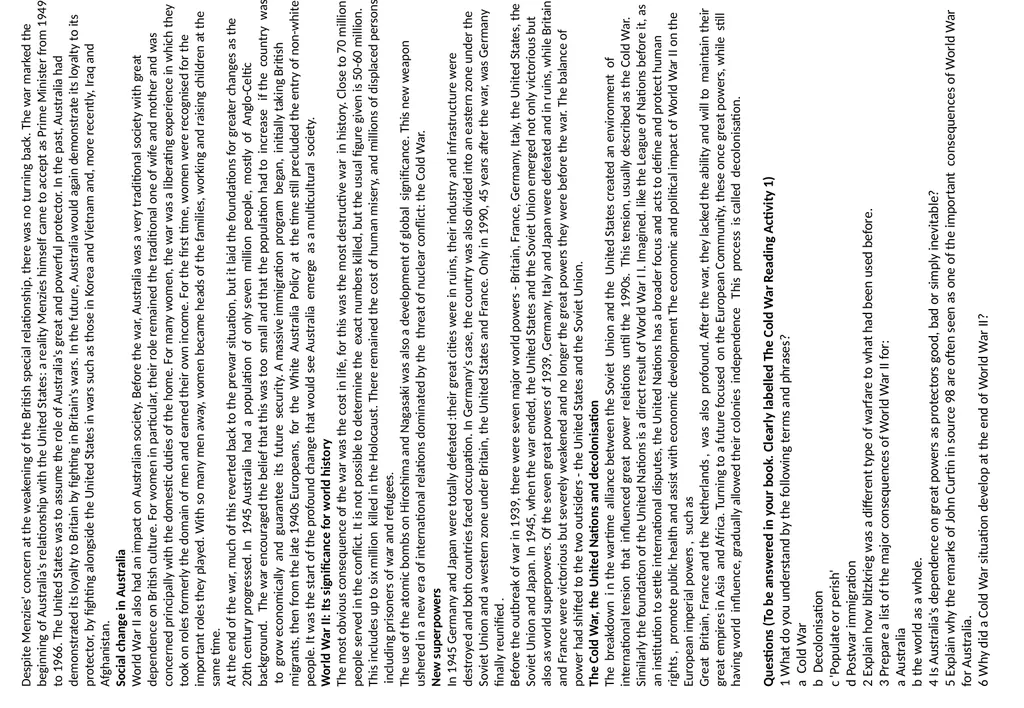
Despite Menzies' concern at the weakening of the British special relationship, there was no turning back. The war marked the beginning of Australia's relationship with the United States: a reality Menzies himself came to accept as Prime Minister from 1949 to 1966. The United States was to assume the role of Australia's great and powerful protector. In the past, Australia had demonstrated its loyalty to Britain by fighting in Britain's wars. In the future, Australia would again demonstrate its loyalty to its protector, by fighting alongside the United States in wars such as those in Korea and Vietnam and, more recently, Iraq and Afghanistan.
Social change in Australia
World War II also had an impact on Australian society. Before the war, Australia was a very traditional society with great dependence on British culture. For women in particular, their role remained the traditional one of wife and mother and was concerned principally with the domestic duties of the home. For many women, the war was a liberating experience in which they took on roles formerly the domain of men and earned their own income. For the first time, women were recognised for the important roles they played. With so many men away, women became heads of the families, working and raising children at the same time.
At the end of the war, much of this reverted back to the prewar situation, but it laid the foundations for greater changes as the 20th century progressed. In 1945 Australia had a population of only seven million people, mostly of Anglo-Celtic background. The war encouraged the belief that this was too small and that the population had to increase if the country was to grow economically and guarantee its future security. A massive immigration program began, initially taking British migrants, then from the late 1940s Europeans, for the White Australia Policy at the time still precluded the entry of non-white people. It was the start of the profound change that would see Australia emerge as a multicultural society.
World War II: Its significance for world history
The most obvious consequence of the war was the cost in life, for this was the most destructive war in history. Close to 70 million people served in the conflict. It is not possible to determine the exact numbers killed, but the usual figure given is 50-60 million. This includes up to six million killed in the Holocaust. There remained the cost of human misery, and millions of displaced persons including prisoners of war and refugees.
The use of the atomic bombs on Hiroshima and Nagasaki was also a development of global significance. This new weapon ushered in a new era of international relations dominated by the threat of nuclear conflict: the Cold War.
New superpowers
In 1945 Germany and Japan were totally defeated :their great cities were in ruins, their industry and infrastructure were destroyed and both countries faced occupation. In Germany's case, the country was also divided into an eastern zone under the Soviet Union and a western zone under Britain, the United States and France. Only in 1990, 45 years after the war, was Germany finally reunified .
Before the outbreak of war in 1939, there were seven major world powers - Britain, France, Germany, Italy, the United States, the Soviet Union and Japan. In 1945, when the war ended, the United States and the Soviet Union emerged not only victorious but also as world superpowers. Of the seven great powers of 1939, Germany, Italy and Japan were defeated and in ruins, while Britain and France were victorious but severely weakened and no longer the great powers they were before the war. The balance of power had shifted to the two outsiders - the United States and the Soviet Union.
The Cold War, the United Nations and decolonisation
The breakdown i n the wartime alliance between the Soviet Union and the United States created an environment of international tension that influenced great power relations until the 1990s. This tension, usually described as the Cold War. Similarly the foundation of the United Nations is a direct result of World War I I. Imagined. like the League of Nations before it, as an institution to settle international disputes, the United Nations has a broader focus and acts to define and protect human rights , promote public health and assist with economic development The economic and political impact of World War II on the European imperial powers , such as
Great Britain, France and the Netherlands , was also profound. After the war, they lacked the ability and will to maintain their great empires in Asia and Africa. Turning to a future focused on the European Community, these once great powers, while still having world influence, gradually allowed their colonies independence This process is called decolonisation.
Questions (To be answered in your book. Clearly labelled The Cold War Reading Activity 1)
1 What do you understand by the following terms and phrases?
a Cold War
b Decolonisation
c 'Populate or perish'
d Postwar immigration
2 Explain how blitzkrieg was a different type of warfare to what had been used before.
3 Prepare a list of the major consequences of World War II for:
a Australia
b the world as a whole.
4 Is Australia's dependence on great powers as protectors good, bad or simply inevitable?
5 Explain why the remarks of John Curtin in source 98 are often seen as one of the important consequences of World War for Australia.
6 Why did a Cold War situation develop at the end of World War II?<br>
Social change in Australia
World War II also had an impact on Australian society. Before the war, Australia was a very traditional society with great dependence on British culture. For women in particular, their role remained the traditional one of wife and mother and was concerned principally with the domestic duties of the home. For many women, the war was a liberating experience in which they took on roles formerly the domain of men and earned their own income. For the first time, women were recognised for the important roles they played. With so many men away, women became heads of the families, working and raising children at the same time.
At the end of the war, much of this reverted back to the prewar situation, but it laid the foundations for greater changes as the 20th century progressed. In 1945 Australia had a population of only seven million people, mostly of Anglo-Celtic background. The war encouraged the belief that this was too small and that the population had to increase if the country was to grow economically and guarantee its future security. A massive immigration program began, initially taking British migrants, then from the late 1940s Europeans, for the White Australia Policy at the time still precluded the entry of non-white people. It was the start of the profound change that would see Australia emerge as a multicultural society.
World War II: Its significance for world history
The most obvious consequence of the war was the cost in life, for this was the most destructive war in history. Close to 70 million people served in the conflict. It is not possible to determine the exact numbers killed, but the usual figure given is 50-60 million. This includes up to six million killed in the Holocaust. There remained the cost of human misery, and millions of displaced persons including prisoners of war and refugees.
The use of the atomic bombs on Hiroshima and Nagasaki was also a development of global significance. This new weapon ushered in a new era of international relations dominated by the threat of nuclear conflict: the Cold War.
New superpowers
In 1945 Germany and Japan were totally defeated :their great cities were in ruins, their industry and infrastructure were destroyed and both countries faced occupation. In Germany's case, the country was also divided into an eastern zone under the Soviet Union and a western zone under Britain, the United States and France. Only in 1990, 45 years after the war, was Germany finally reunified .
Before the outbreak of war in 1939, there were seven major world powers - Britain, France, Germany, Italy, the United States, the Soviet Union and Japan. In 1945, when the war ended, the United States and the Soviet Union emerged not only victorious but also as world superpowers. Of the seven great powers of 1939, Germany, Italy and Japan were defeated and in ruins, while Britain and France were victorious but severely weakened and no longer the great powers they were before the war. The balance of power had shifted to the two outsiders - the United States and the Soviet Union.
The Cold War, the United Nations and decolonisation
The breakdown i n the wartime alliance between the Soviet Union and the United States created an environment of international tension that influenced great power relations until the 1990s. This tension, usually described as the Cold War. Similarly the foundation of the United Nations is a direct result of World War I I. Imagined. like the League of Nations before it, as an institution to settle international disputes, the United Nations has a broader focus and acts to define and protect human rights , promote public health and assist with economic development The economic and political impact of World War II on the European imperial powers , such as
Great Britain, France and the Netherlands , was also profound. After the war, they lacked the ability and will to maintain their great empires in Asia and Africa. Turning to a future focused on the European Community, these once great powers, while still having world influence, gradually allowed their colonies independence This process is called decolonisation.
Questions (To be answered in your book. Clearly labelled The Cold War Reading Activity 1)
1 What do you understand by the following terms and phrases?
a Cold War
b Decolonisation
c 'Populate or perish'
d Postwar immigration
2 Explain how blitzkrieg was a different type of warfare to what had been used before.
3 Prepare a list of the major consequences of World War II for:
a Australia
b the world as a whole.
4 Is Australia's dependence on great powers as protectors good, bad or simply inevitable?
5 Explain why the remarks of John Curtin in source 98 are often seen as one of the important consequences of World War for Australia.
6 Why did a Cold War situation develop at the end of World War II?<br>
04
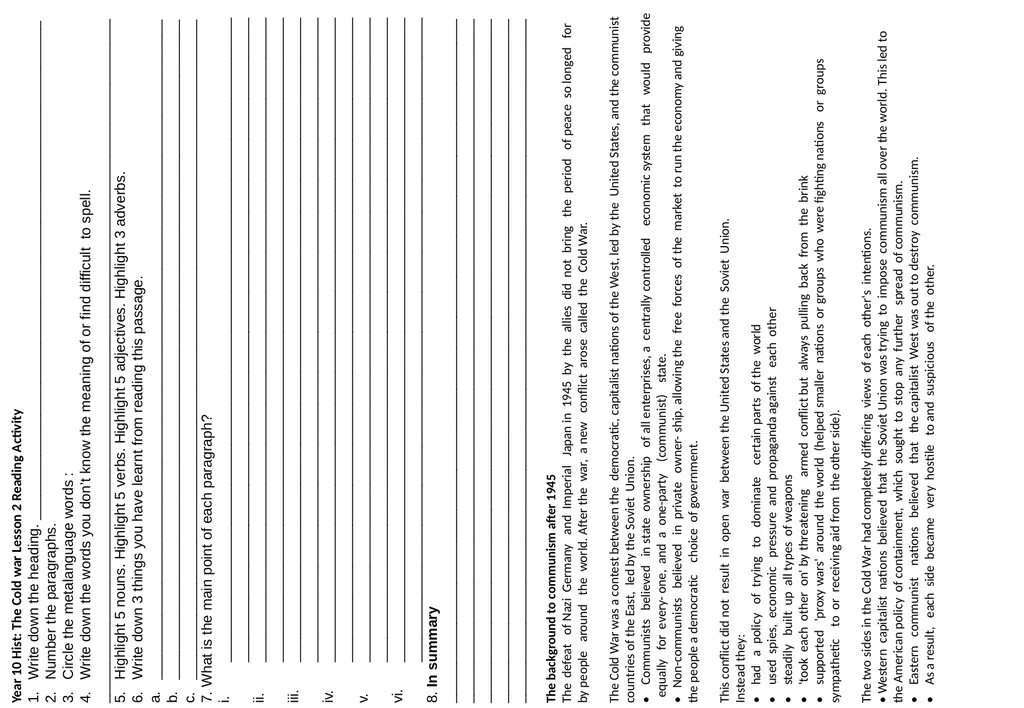
Year 10 Hist: The Cold war Lesson 2 Reading Activity
Write down the heading. ______________________________________________________________
Number the paragraphs.
Circle the metalanguage words :
Write down the words you don’t know the meaning of or find difficult to spell.
_____________________________________________________________________________________
Highlight 5 nouns. Highlight 5 verbs. Highlight 5 adjectives. Highlight 3 adverbs.
Write down 3 things you have learnt from reading this passage.
__________________________________________________________________________________
__________________________________________________________________________________
__________________________________________________________________________________
7. What is the main point of each paragraph?
________________________________________________________________________________________________________________________________________________________________
________________________________________________________________________________________________________________________________________________________________
________________________________________________________________________________________________________________________________________________________________
________________________________________________________________________________________________________________________________________________________________
________________________________________________________________________________________________________________________________________________________________
________________________________________________________________________________________________________________________________________________________________
8. In summary
_____________________________________________________________________________________
_____________________________________________________________________________________
_____________________________________________________________________________________
_____________________________________________________________________________________
_____________________________________________________________________________________
The background to communism after 1945
The defeat of Nazi Germany and Imperial Japan in 1945 by the allies did not bring the period of peace so longed for by people around the world. After the war, a new conflict arose called the Cold War.
The Cold War was a contest between the democratic, capitalist nations of the West, led by the United States, and the communist countries of the East, led by the Soviet Union.
• Communists believed in state ownership of all enterprises, a centrally controlled economic system that would provide equally for every- one, and a one-party (communist) state.
• Non-communists believed in private owner- ship, allowing the free forces of the market to run the economy and giving the people a democratic choice of government.
This conflict did not result in open war between the United States and the Soviet Union.
Instead they:
• had a policy of trying to dominate certain parts of the world
• used spies, economic pressure and propaganda against each other
• steadily built up all types of weapons
• 'took each other on' by threatening armed conflict but always pulling back from the brink
• supported 'proxy wars' around the world (helped smaller nations or groups who were fighting nations or groups sympathetic to or receiving aid from the other side).
The two sides in the Cold War had completely differing views of each other's intentions.
• Western capitalist nations believed that the Soviet Union was trying to impose communism all over the world. This led to the American policy of containment, which sought to stop any further spread of communism.
• Eastern communist nations believed that the capitalist West was out to destroy communism.
• As a result, each side became very hostile to and suspicious of the other.<br>
Write down the heading. ______________________________________________________________
Number the paragraphs.
Circle the metalanguage words :
Write down the words you don’t know the meaning of or find difficult to spell.
_____________________________________________________________________________________
Highlight 5 nouns. Highlight 5 verbs. Highlight 5 adjectives. Highlight 3 adverbs.
Write down 3 things you have learnt from reading this passage.
__________________________________________________________________________________
__________________________________________________________________________________
__________________________________________________________________________________
7. What is the main point of each paragraph?
________________________________________________________________________________________________________________________________________________________________
________________________________________________________________________________________________________________________________________________________________
________________________________________________________________________________________________________________________________________________________________
________________________________________________________________________________________________________________________________________________________________
________________________________________________________________________________________________________________________________________________________________
________________________________________________________________________________________________________________________________________________________________
8. In summary
_____________________________________________________________________________________
_____________________________________________________________________________________
_____________________________________________________________________________________
_____________________________________________________________________________________
_____________________________________________________________________________________
The background to communism after 1945
The defeat of Nazi Germany and Imperial Japan in 1945 by the allies did not bring the period of peace so longed for by people around the world. After the war, a new conflict arose called the Cold War.
The Cold War was a contest between the democratic, capitalist nations of the West, led by the United States, and the communist countries of the East, led by the Soviet Union.
• Communists believed in state ownership of all enterprises, a centrally controlled economic system that would provide equally for every- one, and a one-party (communist) state.
• Non-communists believed in private owner- ship, allowing the free forces of the market to run the economy and giving the people a democratic choice of government.
This conflict did not result in open war between the United States and the Soviet Union.
Instead they:
• had a policy of trying to dominate certain parts of the world
• used spies, economic pressure and propaganda against each other
• steadily built up all types of weapons
• 'took each other on' by threatening armed conflict but always pulling back from the brink
• supported 'proxy wars' around the world (helped smaller nations or groups who were fighting nations or groups sympathetic to or receiving aid from the other side).
The two sides in the Cold War had completely differing views of each other's intentions.
• Western capitalist nations believed that the Soviet Union was trying to impose communism all over the world. This led to the American policy of containment, which sought to stop any further spread of communism.
• Eastern communist nations believed that the capitalist West was out to destroy communism.
• As a result, each side became very hostile to and suspicious of the other.<br>
05
. The spread of communism
After 1945 there was a great fear in the West that communism had become an unstoppable force that might take over all capitalist countries. Communism had made spectacular gains after 1945.
• Between 1939 and 1945, Soviet Russia had gained control of Latvia, Estonia and Lithuania, and Bessarabia.
• By 1948 it had control of all the states of eastern Europe except Yugoslavia.
• The Soviet Union controlled East Germany and the eastern half of Berlin.
• In 1949 China became communist.
• In June 1950 communist North Korea attacked non-communist South Korea. This led to the three-year Korean
As communism seemed to be spreading all over the world, there were fears that it might come to Australia by one of two ways:
It could come from outside, perhaps by communist China pushing down through Asia. This idea is illustrated in the cartoon in Figure5.8. In the cartoon note:
Communism is seen as a monster devouring weaker countries.
It had already 'eaten up' Tibet, North Korea and Indochina and was busy eating Malaya.
Australia is seen as a future 'course'.
It could come from within, as a result of Communist Party activity in Australia, communists in the trade unions and the Labor Party, or Soviet spies being planted in Australia. As a result, the fear of communism and the cause of anti-communism became major political issues in Australia from the late 1940s to the mid-1960s
TIME LINE OF THE COLD WAR
1945 The defeat of Nazi Germany and Japan by the Allies led to a breakdown in the alliance between the United States and the Soviet Union.
The Soviet Union began to establish communist-led governments in Eastern Europe.
1947 The adoption of the Truman Doctrine committed the United States to the containment of communism around the world.
1948-49 The Berlin Blockade: the Soviets prevented road and rail travel to Berlin. Western powers supplied the city by air.
1949 NATO, the American-led North Atlantic Treaty Organisation, was established as the military alliance in Europe against the Soviet Union.
The Communists, led by Mao Zedong, came to power in China after a long civil war.
1950 The Korean War began.
1955 The Warsaw Pact, the Soviet-led military alliance in Europe, was established.
1962 The Cuban missile crisis.
1975 The Vietnam War ended with victory of the communist North Vietnamese.
1979 The Soviet Union invaded Afghanistan.
1985-86 Summits between United States President Ronald Reagan and Soviet Leader Mikhail Gorbachev suggested a thawing of tension between the two superpowers.
1989 Communist regimes in Eastern Europe broke down.
1991 The Soviet Union was dissolved.
When did the Cold War begin and end? ________________________________________________________________
In what year did China become communist? ____________________________________________________________
Who led the Communist forces in China? ______________________________________________________________
What doctrine was adopted to contain Communism? ____________________________________________________
Where in Europe did Communism begin? ______________________________________________________________
Where did it spread to in Europe? ____________________________________________________________________
How did the West break the Berlin Blockade? ___________________________________________________________
What is NATO? ___________________________________________________________________________________
What is it’s purpose? ______________________________________________________________________________
Who won the Vietnam War? _________________________________________________________________________
CARTOON
What is the message of this cartoon? _____________________________________
___________________________________________________________________
___________________________________________________________________
___________________________________________________________________
___________________________________________________________________
___________________________________________________________________
___________________________________________________________________
___________________________________________________________________
___________________________________________________________________
___________________________________________________________________<br>
After 1945 there was a great fear in the West that communism had become an unstoppable force that might take over all capitalist countries. Communism had made spectacular gains after 1945.
• Between 1939 and 1945, Soviet Russia had gained control of Latvia, Estonia and Lithuania, and Bessarabia.
• By 1948 it had control of all the states of eastern Europe except Yugoslavia.
• The Soviet Union controlled East Germany and the eastern half of Berlin.
• In 1949 China became communist.
• In June 1950 communist North Korea attacked non-communist South Korea. This led to the three-year Korean
As communism seemed to be spreading all over the world, there were fears that it might come to Australia by one of two ways:
It could come from outside, perhaps by communist China pushing down through Asia. This idea is illustrated in the cartoon in Figure5.8. In the cartoon note:
Communism is seen as a monster devouring weaker countries.
It had already 'eaten up' Tibet, North Korea and Indochina and was busy eating Malaya.
Australia is seen as a future 'course'.
It could come from within, as a result of Communist Party activity in Australia, communists in the trade unions and the Labor Party, or Soviet spies being planted in Australia. As a result, the fear of communism and the cause of anti-communism became major political issues in Australia from the late 1940s to the mid-1960s
TIME LINE OF THE COLD WAR
1945 The defeat of Nazi Germany and Japan by the Allies led to a breakdown in the alliance between the United States and the Soviet Union.
The Soviet Union began to establish communist-led governments in Eastern Europe.
1947 The adoption of the Truman Doctrine committed the United States to the containment of communism around the world.
1948-49 The Berlin Blockade: the Soviets prevented road and rail travel to Berlin. Western powers supplied the city by air.
1949 NATO, the American-led North Atlantic Treaty Organisation, was established as the military alliance in Europe against the Soviet Union.
The Communists, led by Mao Zedong, came to power in China after a long civil war.
1950 The Korean War began.
1955 The Warsaw Pact, the Soviet-led military alliance in Europe, was established.
1962 The Cuban missile crisis.
1975 The Vietnam War ended with victory of the communist North Vietnamese.
1979 The Soviet Union invaded Afghanistan.
1985-86 Summits between United States President Ronald Reagan and Soviet Leader Mikhail Gorbachev suggested a thawing of tension between the two superpowers.
1989 Communist regimes in Eastern Europe broke down.
1991 The Soviet Union was dissolved.
When did the Cold War begin and end? ________________________________________________________________
In what year did China become communist? ____________________________________________________________
Who led the Communist forces in China? ______________________________________________________________
What doctrine was adopted to contain Communism? ____________________________________________________
Where in Europe did Communism begin? ______________________________________________________________
Where did it spread to in Europe? ____________________________________________________________________
How did the West break the Berlin Blockade? ___________________________________________________________
What is NATO? ___________________________________________________________________________________
What is it’s purpose? ______________________________________________________________________________
Who won the Vietnam War? _________________________________________________________________________
CARTOON
What is the message of this cartoon? _____________________________________
___________________________________________________________________
___________________________________________________________________
___________________________________________________________________
___________________________________________________________________
___________________________________________________________________
___________________________________________________________________
___________________________________________________________________
___________________________________________________________________
___________________________________________________________________<br>
06
Year 10 Hist : The Cold War Lesson 3 Reading Activity
Write down the heading. ______________________________________________________________
Number the paragraphs.
Circle the metalanguage
Write down the words you don’t know the meaning of or find difficult to spell.
_____________________________________________________________________________________
Highlight 5 nouns. Highlight 5 verbs. Highlight 5 adjectives. Highlight 3 adverbs.
Write down 3 things you have learnt from reading this passage.
__________________________________________________________________________________
________________________________________________________________________________
__________________________________________________________________________________
7. What is the main point of each paragraph?
________________________________________________________________________________
________________________________________________________________________________
________________________________________________________________________________
________________________________________________________________________________
________________________________________________________________________________
The rise of China and India
China is now the world's second biggest economy, behind the United States. Many believe that China will dominate the 21st century and perhaps even replace the United States as the world's most powerful nation. India is also experiencing rapid growth. Both nations have populations large enough to transform the 21st-century global economy.
Source 3G
We believe that, over the next two years, India should start matching China's GDP growth of around 8.5-9 .5%, barring another global financial crisis. More importantly, we think that, by 2013-15, India will start outpacing China' s GDP growth notably . Morgan Stanley's Chief Economist for China, Qing Wang, believes that China's growth will move towards a more sustainable rate of 8% by 2015, following the remarkable 10% average over the past 30 years. We believe India's growth will accelerate to a sustainable 9-10% by 2013-15, after an average of 7 .3% over the past 10 years. In other words, over the next 10 years, we expect India's growth to outpace China' s.
Morgan Stanley,lndia and China: New Tigers of Asia, Part lll, 2011, p. 6
Australia and the postwar world
Until World War II, Australia had virtually ignored the reality of Asia. Australians saw themselves as an outpost of British civilisation that happened to be on the rim of Asia, and in 1901 the first law of the new Australian parliament was to create a White Australia Policy to keep Asians out. Before World War II, Australia gained some security from the fact that most of Asia was controlled by Britain or by other European powers.
However, in 1941 Japan swept into South-East Asia. The British were defeated in Malaya, Borneo, Singapore and Burma. The French fell in Indochina, the Dutch in the East Indies, and the Americans lost the Philippines. This was a tremendous blow to Western power and prestige and made Australia feel very insecure. In the postwar world, Australia faced the reality of the Cold War in Asia where communism appeared to be on the march . A communist government came to power in North Korea in 1948. In 1949 China, the largest nation on earth, fell to the communists when Mao Zedong led the Chinese Communist Party to victory. Australia viewed communist China as the new threat to Asia. The communists were often called 'Reds', after the red flag that was the colour of revolution . People spoke of 'Red China' and of the expanding 'red menace'.
Domino theory
There was a widely held belief in the 1950s and 1960s, particularly in the United States and Australia, that if communism was not stopped it would spread throughout the rest of South-East Asia. This belief was called the 'domino theory': if one Asian state fell to communism, then, like falling dominoes, all of Asia would soon fall to communism.
Australia became a great supporter of the United States. In 1950, when communist North Korea invaded South Korea, triggering the Korean War, Australia was one of the first nations to send forces to this conflict. This strengthened the bond with the United States, which also committed itself to the Korean War. Prime Minister Robert Menzies called the United States Australia's 'great and powerful friend'.
The belief in the domino theory influenced Australia's actions in South-East Asia in the 1950s and 1960s; in particular, the decision to send Australian troops to the Vietnam War from 1962. To the United States and its allies, including Australia, Vietnam appeared to be a classic example of the domino theory. In 1954, Vietnam had been divided into two countries when France abandoned its claim to the region - communist North Vietnam and non-communist South Vietnam. What had been a war of independence from France then became a conflict of ideologies and an attempt to unify a divided nation. Many in the United States and among its allies feared that if non-communist South Vietnam fell, communism would spread to the rest of Asia and even Australia. In the late 1960s, despite increasing opposition to the war within Australia, more combat troops, including men who had been conscripted, were sent to Vietnam. In 1975, after the withdrawal of American and Australian support, South Vietnam did fall to the communist North. Communism, however, did not continue its domino-like spread through Asia.<br>
Write down the heading. ______________________________________________________________
Number the paragraphs.
Circle the metalanguage
Write down the words you don’t know the meaning of or find difficult to spell.
_____________________________________________________________________________________
Highlight 5 nouns. Highlight 5 verbs. Highlight 5 adjectives. Highlight 3 adverbs.
Write down 3 things you have learnt from reading this passage.
__________________________________________________________________________________
________________________________________________________________________________
__________________________________________________________________________________
7. What is the main point of each paragraph?
________________________________________________________________________________
________________________________________________________________________________
________________________________________________________________________________
________________________________________________________________________________
________________________________________________________________________________
The rise of China and India
China is now the world's second biggest economy, behind the United States. Many believe that China will dominate the 21st century and perhaps even replace the United States as the world's most powerful nation. India is also experiencing rapid growth. Both nations have populations large enough to transform the 21st-century global economy.
Source 3G
We believe that, over the next two years, India should start matching China's GDP growth of around 8.5-9 .5%, barring another global financial crisis. More importantly, we think that, by 2013-15, India will start outpacing China' s GDP growth notably . Morgan Stanley's Chief Economist for China, Qing Wang, believes that China's growth will move towards a more sustainable rate of 8% by 2015, following the remarkable 10% average over the past 30 years. We believe India's growth will accelerate to a sustainable 9-10% by 2013-15, after an average of 7 .3% over the past 10 years. In other words, over the next 10 years, we expect India's growth to outpace China' s.
Morgan Stanley,lndia and China: New Tigers of Asia, Part lll, 2011, p. 6
Australia and the postwar world
Until World War II, Australia had virtually ignored the reality of Asia. Australians saw themselves as an outpost of British civilisation that happened to be on the rim of Asia, and in 1901 the first law of the new Australian parliament was to create a White Australia Policy to keep Asians out. Before World War II, Australia gained some security from the fact that most of Asia was controlled by Britain or by other European powers.
However, in 1941 Japan swept into South-East Asia. The British were defeated in Malaya, Borneo, Singapore and Burma. The French fell in Indochina, the Dutch in the East Indies, and the Americans lost the Philippines. This was a tremendous blow to Western power and prestige and made Australia feel very insecure. In the postwar world, Australia faced the reality of the Cold War in Asia where communism appeared to be on the march . A communist government came to power in North Korea in 1948. In 1949 China, the largest nation on earth, fell to the communists when Mao Zedong led the Chinese Communist Party to victory. Australia viewed communist China as the new threat to Asia. The communists were often called 'Reds', after the red flag that was the colour of revolution . People spoke of 'Red China' and of the expanding 'red menace'.
Domino theory
There was a widely held belief in the 1950s and 1960s, particularly in the United States and Australia, that if communism was not stopped it would spread throughout the rest of South-East Asia. This belief was called the 'domino theory': if one Asian state fell to communism, then, like falling dominoes, all of Asia would soon fall to communism.
Australia became a great supporter of the United States. In 1950, when communist North Korea invaded South Korea, triggering the Korean War, Australia was one of the first nations to send forces to this conflict. This strengthened the bond with the United States, which also committed itself to the Korean War. Prime Minister Robert Menzies called the United States Australia's 'great and powerful friend'.
The belief in the domino theory influenced Australia's actions in South-East Asia in the 1950s and 1960s; in particular, the decision to send Australian troops to the Vietnam War from 1962. To the United States and its allies, including Australia, Vietnam appeared to be a classic example of the domino theory. In 1954, Vietnam had been divided into two countries when France abandoned its claim to the region - communist North Vietnam and non-communist South Vietnam. What had been a war of independence from France then became a conflict of ideologies and an attempt to unify a divided nation. Many in the United States and among its allies feared that if non-communist South Vietnam fell, communism would spread to the rest of Asia and even Australia. In the late 1960s, despite increasing opposition to the war within Australia, more combat troops, including men who had been conscripted, were sent to Vietnam. In 1975, after the withdrawal of American and Australian support, South Vietnam did fall to the communist North. Communism, however, did not continue its domino-like spread through Asia.<br>
07
New relationships
The end of Australia's involvement in the Vietnam War in 1972 marked the start of a new relationship between Australia and Asia. The White Australia Policy, which had discriminated against Asian people since Federation, was gradually abolished, and Australia began to accept Asian migrants and political refugees. The impact of this changing policy in Australia is explored further in chapter 6. Australian governments from 1972 increasingly began to think of Australia as a vital part of the Asian region, recognising that our nation's future was closely
linked to enormous trade opportunities of modern Asian economies and a potential market in China.
While Australia began to establish a new relationship with Asia from the 1970s, it nonetheless maintained its close links with the United States and also began to increase its involvement in United Nations operations. In 1990, when the United Nations approved action to liberate Kuwait after it had been invaded by neighbouring Iraq, Australia was one of 30 countries to support the action. In October 2001, a month after the attack on the World Trade Center in New York, United States forces invaded Afghanistan, which had been protecting the al-Qaeda terrorist organisation. Australia and other nations sent forces to fight in the war in Afghanistan. Two years later, in March 2003, when American and British forces invaded Iraq, Australia also sent troops.
Chronology, terms and concepts
1 What was the Cold War? _______________________________________________________________________
2 Define the domino theory.______________________________________________________________________
4 Read source 3G.
a What, according to Spender, is the aim of Australia's foreign policy?___________________________________
______________________________________________________________________________________________
b Describe how Spender explains the potential danger to Australia. ____________________________________
______________________________________________________________________________________________
c Why should Spender's views appear realistic to people in the 1950s?__________________________________
______________________________________________________________________________________________
5 Examine source 3H.
a Who is the figure in this cartoon intended to represent? _____________________________________________
b Explain the name of this cartoon. ________________________________________________________________
c Find out what the symbol on the shield is intended to mean. __________________________________________
d What region of the world is this cartoon intended to represent? Explain why you came to this conclusion.
______________________________________________________________________________________________-
e What point of view is the cartoonist making by drawing this cartoon? The emotion or feeling the cartoonist is seeking to create is one of:
A anger C isolation
B fear D uncertainty
6 Examine source 31.
a Identify the person in this cartoon. ________________________________________________________________
b Which statement best explains the meaning of this cartoon?
A The Chinese want more trade with Australia.
B The Australian economy has fallen behind that of some Asian states.
C Australian industry must form links with the growing economies of Asia.
D Australian industry is very small compared with China.<br>
The end of Australia's involvement in the Vietnam War in 1972 marked the start of a new relationship between Australia and Asia. The White Australia Policy, which had discriminated against Asian people since Federation, was gradually abolished, and Australia began to accept Asian migrants and political refugees. The impact of this changing policy in Australia is explored further in chapter 6. Australian governments from 1972 increasingly began to think of Australia as a vital part of the Asian region, recognising that our nation's future was closely
linked to enormous trade opportunities of modern Asian economies and a potential market in China.
While Australia began to establish a new relationship with Asia from the 1970s, it nonetheless maintained its close links with the United States and also began to increase its involvement in United Nations operations. In 1990, when the United Nations approved action to liberate Kuwait after it had been invaded by neighbouring Iraq, Australia was one of 30 countries to support the action. In October 2001, a month after the attack on the World Trade Center in New York, United States forces invaded Afghanistan, which had been protecting the al-Qaeda terrorist organisation. Australia and other nations sent forces to fight in the war in Afghanistan. Two years later, in March 2003, when American and British forces invaded Iraq, Australia also sent troops.
Chronology, terms and concepts
1 What was the Cold War? _______________________________________________________________________
2 Define the domino theory.______________________________________________________________________
4 Read source 3G.
a What, according to Spender, is the aim of Australia's foreign policy?___________________________________
______________________________________________________________________________________________
b Describe how Spender explains the potential danger to Australia. ____________________________________
______________________________________________________________________________________________
c Why should Spender's views appear realistic to people in the 1950s?__________________________________
______________________________________________________________________________________________
5 Examine source 3H.
a Who is the figure in this cartoon intended to represent? _____________________________________________
b Explain the name of this cartoon. ________________________________________________________________
c Find out what the symbol on the shield is intended to mean. __________________________________________
d What region of the world is this cartoon intended to represent? Explain why you came to this conclusion.
______________________________________________________________________________________________-
e What point of view is the cartoonist making by drawing this cartoon? The emotion or feeling the cartoonist is seeking to create is one of:
A anger C isolation
B fear D uncertainty
6 Examine source 31.
a Identify the person in this cartoon. ________________________________________________________________
b Which statement best explains the meaning of this cartoon?
A The Chinese want more trade with Australia.
B The Australian economy has fallen behind that of some Asian states.
C Australian industry must form links with the growing economies of Asia.
D Australian industry is very small compared with China.<br>
08
Year 10 Hist : The Cold War Lesson 4 Reading Activity
Write down the heading. ______________________________________________________________
Number the paragraphs.
Circle the metalanguage words :.
Write down the words you don’t know the meaning of or find difficult to spell.
_____________________________________________________________________________________
Highlight 5 nouns. Highlight 5 verbs. Highlight 5 adjectives. Highlight 3 adverbs.
Write down 3 things you have learnt from reading this passage.
__________________________________________________________________________________
________________________________________________________________________________
__________________________________________________________________________________
Australia and regional agreements
Since 1945, Australia has involved itself increasingly with the Asia-Pacific region. In the aftermath of World War II, Australian troops took part in the allied occupation of Japan. Some of the post-war involvement in the region has been of a military-security nature that was a direct result of the Cold War. This has included:
Participation in the Korean War (1950–53) as part of the UN forces.
The signing of the ANZUS Pact in 1951.
Involvement in the Malayan Emergency with the British in the 1950s.
The signing of SEATO in 1954.
Australia’s involvement in the Vietnam War in support of the United States.
However, Australia’s participation in the region has gone well beyond the purely military in support of an ally.
The Colombo Plan
In January 1950, the foreign minister of British Commonwealth nations met in the Ceylon (Sri Lanka) capital of Colombo. It was here that Australia strongly supported the idea of providing aid to poorer Asian countries. The aid provided went beyond purely humanitarian assistance. The aim was to help these countries to develop their economies, develop their education systems and in so doing gradually lift living standards. In more recent years, aid under the plan has widened to include things like drug education, HIV awareness, technological assistance and advice on computer systems.
The Colombo Plan was originally aimed at only Commonwealth countries. It has widened its scope since 1950 to include many non-Commonwealth countries, including communist countries. The system under Colombo sets five year plans of action. In 1980 the organising committee of Colombo extended the plan indefinitely. An additional way in which Australia has contributed to the plan is to allow foreign students to study in Australia.
APEC
APEC stands for Asia-Pacific Economic Cooperation. It started in 1989. APEC contains twenty one nations that straddle the Pacific both in Asia and the Americas. Its aim is to promote trade by lowering tariffs, encouraging investment and economic development amongst its members. APEC does not link its members by means of a formal treaty, like SEATO would have done in 1954, but rather, consensus decisions are reached after negotiations. When member nations meet their talks often go beyond economic matters and they use the opportunity to discuss other issues such as security and climate change. In September 2007, the APEC meeting was held in Sydney. The days of Australia’s isolation and clinging to the apron strings of Britain are long gone. Our involvement in, and membership of, Asia is irreversible.
75% of Australia’s trade is with the countries of APEC.
When Vietnam began its modernisation program in the mid-1990s, Australian firms were key players in that process.
Our ties with the booming economies of north Asia such as China and South Korea continue to grow.
A major reason for the steady minerals boom in Australia has been the insatiable need of China’s economy for Australian raw materials.
Government ministers are now frequent visitors to Asian capitals as are Asian leaders to Canberra.
Australia plays a key security role in a range of countries stretching from East Timor to the Solomons to New Guinea.
In the 1990s, Australia was a key player in the development of the peace process in Cambodia. Foreign Minister Gareth Evans was even nominated for a Nobel Peace Prize for his efforts.
Australia has proven itself willing to quickly assist Asian nations in times of crisis. This was seen most clearly at the time of the December 2004 tsunami which devastated several Asian nations.
Our integration into Asia has even reached the area of sport. Australia’s national football (soccer) team, the Socceroos, now play as part of the Asian Football Confederation.
The ‘War on Terror’
Since 2001 the Howard government was extremely willing to support the United States in its so-called ‘War on Terror’. Following the devastating attack on the World Trade Centre in New York on 11 September 2001, the United States has been engaged in military conflict with Muslim terrorist groups.
In October 2001 it invaded Afghanistan to remove the Taliban regime which was providing sanctuary to Osama Bin Laden, who is considered to be behind the 9/11 attacks<br>
Write down the heading. ______________________________________________________________
Number the paragraphs.
Circle the metalanguage words :.
Write down the words you don’t know the meaning of or find difficult to spell.
_____________________________________________________________________________________
Highlight 5 nouns. Highlight 5 verbs. Highlight 5 adjectives. Highlight 3 adverbs.
Write down 3 things you have learnt from reading this passage.
__________________________________________________________________________________
________________________________________________________________________________
__________________________________________________________________________________
Australia and regional agreements
Since 1945, Australia has involved itself increasingly with the Asia-Pacific region. In the aftermath of World War II, Australian troops took part in the allied occupation of Japan. Some of the post-war involvement in the region has been of a military-security nature that was a direct result of the Cold War. This has included:
Participation in the Korean War (1950–53) as part of the UN forces.
The signing of the ANZUS Pact in 1951.
Involvement in the Malayan Emergency with the British in the 1950s.
The signing of SEATO in 1954.
Australia’s involvement in the Vietnam War in support of the United States.
However, Australia’s participation in the region has gone well beyond the purely military in support of an ally.
The Colombo Plan
In January 1950, the foreign minister of British Commonwealth nations met in the Ceylon (Sri Lanka) capital of Colombo. It was here that Australia strongly supported the idea of providing aid to poorer Asian countries. The aid provided went beyond purely humanitarian assistance. The aim was to help these countries to develop their economies, develop their education systems and in so doing gradually lift living standards. In more recent years, aid under the plan has widened to include things like drug education, HIV awareness, technological assistance and advice on computer systems.
The Colombo Plan was originally aimed at only Commonwealth countries. It has widened its scope since 1950 to include many non-Commonwealth countries, including communist countries. The system under Colombo sets five year plans of action. In 1980 the organising committee of Colombo extended the plan indefinitely. An additional way in which Australia has contributed to the plan is to allow foreign students to study in Australia.
APEC
APEC stands for Asia-Pacific Economic Cooperation. It started in 1989. APEC contains twenty one nations that straddle the Pacific both in Asia and the Americas. Its aim is to promote trade by lowering tariffs, encouraging investment and economic development amongst its members. APEC does not link its members by means of a formal treaty, like SEATO would have done in 1954, but rather, consensus decisions are reached after negotiations. When member nations meet their talks often go beyond economic matters and they use the opportunity to discuss other issues such as security and climate change. In September 2007, the APEC meeting was held in Sydney. The days of Australia’s isolation and clinging to the apron strings of Britain are long gone. Our involvement in, and membership of, Asia is irreversible.
75% of Australia’s trade is with the countries of APEC.
When Vietnam began its modernisation program in the mid-1990s, Australian firms were key players in that process.
Our ties with the booming economies of north Asia such as China and South Korea continue to grow.
A major reason for the steady minerals boom in Australia has been the insatiable need of China’s economy for Australian raw materials.
Government ministers are now frequent visitors to Asian capitals as are Asian leaders to Canberra.
Australia plays a key security role in a range of countries stretching from East Timor to the Solomons to New Guinea.
In the 1990s, Australia was a key player in the development of the peace process in Cambodia. Foreign Minister Gareth Evans was even nominated for a Nobel Peace Prize for his efforts.
Australia has proven itself willing to quickly assist Asian nations in times of crisis. This was seen most clearly at the time of the December 2004 tsunami which devastated several Asian nations.
Our integration into Asia has even reached the area of sport. Australia’s national football (soccer) team, the Socceroos, now play as part of the Asian Football Confederation.
The ‘War on Terror’
Since 2001 the Howard government was extremely willing to support the United States in its so-called ‘War on Terror’. Following the devastating attack on the World Trade Centre in New York on 11 September 2001, the United States has been engaged in military conflict with Muslim terrorist groups.
In October 2001 it invaded Afghanistan to remove the Taliban regime which was providing sanctuary to Osama Bin Laden, who is considered to be behind the 9/11 attacks<br>
09
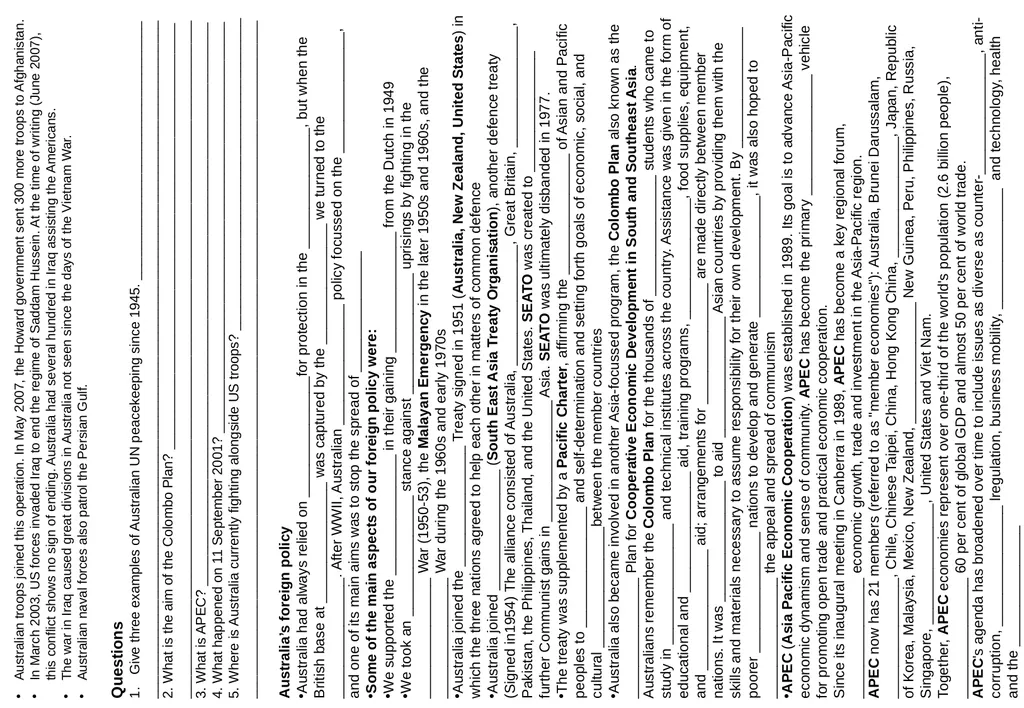
Australian troops joined this operation. In May 2007, the Howard government sent 300 more troops to Afghanistan.
In March 2003, US forces invaded Iraq to end the regime of Saddam Hussein. At the time of writing (June 2007), this conflict shows no sign of ending. Australia had several hundred in Iraq assisting the Americans.
The war in Iraq caused great divisions in Australia not seen since the days of the Vietnam War.
Australian naval forces also patrol the Persian Gulf.
Questions
Give three examples of Australian UN peacekeeping since 1945. __________________________________
_________________________________________________________________________________________
2. What is the aim of the Colombo Plan? ________________________________________________________
_________________________________________________________________________________________
3. What is APEC? __________________________________________________________________________
4. What happened on 11 September 2001? ______________________________________________________
5. Where is Australia currently fighting alongside US troops? _________________________________________
_________________________________________________________________________________________
Australia’s foreign policy
Australia had always relied on _______________for protection in the _______________, but when the British base at _______________ was captured by the _______________ we turned to the _______________. After WWII, Australian _______________ policy focussed on the _______________, and one of its main aims was to stop the spread of _______________
Some of the main aspects of our foreign policy were:
We supported the _______________ in their gaining _______________ from the Dutch in 1949
We took an _______________ stance against _______________ uprisings by fighting in the _______________ War (1950-53), the Malayan Emergency in the later 1950s and 1960s, and the _______________ War during the 1960s and early 1970s
Australia joined the _______________ Treaty signed in 1951 (Australia, New Zealand, United States) in which the three nations agreed to help each other in matters of common defence
Australia joined _______________ (South East Asia Treaty Organisation), another defence treaty (Signed in1954) The alliance consisted of Australia, _______________, Great Britain, _______________, Pakistan, the Philippines, Thailand, and the United States. SEATO was created to _______________ further Communist gains in _______________ Asia. SEATO was ultimately disbanded in 1977.
The treaty was supplemented by a Pacific Charter, affirming the _______________ of Asian and Pacific peoples to _______________ and self-determination and setting forth goals of economic, social, and cultural _______________between the member countries
Australia also became involved in another Asia-focussed program, the Colombo Plan also known as the _______________ Plan for Cooperative Economic Development in South and Southeast Asia. Australians remember the Colombo Plan for the thousands of _______________ students who came to study in _______________ and technical institutes across the country. Assistance was given in the form of educational and _______________ aid, training programs, _______________, food supplies, equipment, and _______________ aid; arrangements for _______________ are made directly between member nations. It was _______________ to aid _______________ Asian countries by providing them with the skills and materials necessary to assume responsibility for their own development. By _______________ poorer _______________ nations to develop and generate _______________, it was also hoped to _______________ the appeal and spread of communism
APEC (Asia Pacific Economic Cooperation) was established in 1989. Its goal is to advance Asia-Pacific economic dynamism and sense of community. APEC has become the primary _______________ vehicle for promoting open trade and practical economic cooperation.
Since its inaugural meeting in Canberra in 1989, APEC has become a key regional forum, _______________ economic growth, trade and investment in the Asia-Pacific region.
APEC now has 21 members (referred to as "member economies"): Australia, Brunei Darussalam, _______________, Chile, Chinese Taipei, China, Hong Kong China, _______________, Japan, Republic of Korea, Malaysia, Mexico, New Zealand, _______________ New Guinea, Peru, Philippines, Russia, Singapore, _______________, United States and Viet Nam.
Together, APEC economies represent over one-third of the world's population (2.6 billion people), _______________ 60 per cent of global GDP and almost 50 per cent of world trade.
APEC's agenda has broadened over time to include issues as diverse as counter-_______________, anti-corruption, _______________ lregulation, business mobility, _______________ and technology, health and the _______________<br>
In March 2003, US forces invaded Iraq to end the regime of Saddam Hussein. At the time of writing (June 2007), this conflict shows no sign of ending. Australia had several hundred in Iraq assisting the Americans.
The war in Iraq caused great divisions in Australia not seen since the days of the Vietnam War.
Australian naval forces also patrol the Persian Gulf.
Questions
Give three examples of Australian UN peacekeeping since 1945. __________________________________
_________________________________________________________________________________________
2. What is the aim of the Colombo Plan? ________________________________________________________
_________________________________________________________________________________________
3. What is APEC? __________________________________________________________________________
4. What happened on 11 September 2001? ______________________________________________________
5. Where is Australia currently fighting alongside US troops? _________________________________________
_________________________________________________________________________________________
Australia’s foreign policy
Australia had always relied on _______________for protection in the _______________, but when the British base at _______________ was captured by the _______________ we turned to the _______________. After WWII, Australian _______________ policy focussed on the _______________, and one of its main aims was to stop the spread of _______________
Some of the main aspects of our foreign policy were:
We supported the _______________ in their gaining _______________ from the Dutch in 1949
We took an _______________ stance against _______________ uprisings by fighting in the _______________ War (1950-53), the Malayan Emergency in the later 1950s and 1960s, and the _______________ War during the 1960s and early 1970s
Australia joined the _______________ Treaty signed in 1951 (Australia, New Zealand, United States) in which the three nations agreed to help each other in matters of common defence
Australia joined _______________ (South East Asia Treaty Organisation), another defence treaty (Signed in1954) The alliance consisted of Australia, _______________, Great Britain, _______________, Pakistan, the Philippines, Thailand, and the United States. SEATO was created to _______________ further Communist gains in _______________ Asia. SEATO was ultimately disbanded in 1977.
The treaty was supplemented by a Pacific Charter, affirming the _______________ of Asian and Pacific peoples to _______________ and self-determination and setting forth goals of economic, social, and cultural _______________between the member countries
Australia also became involved in another Asia-focussed program, the Colombo Plan also known as the _______________ Plan for Cooperative Economic Development in South and Southeast Asia. Australians remember the Colombo Plan for the thousands of _______________ students who came to study in _______________ and technical institutes across the country. Assistance was given in the form of educational and _______________ aid, training programs, _______________, food supplies, equipment, and _______________ aid; arrangements for _______________ are made directly between member nations. It was _______________ to aid _______________ Asian countries by providing them with the skills and materials necessary to assume responsibility for their own development. By _______________ poorer _______________ nations to develop and generate _______________, it was also hoped to _______________ the appeal and spread of communism
APEC (Asia Pacific Economic Cooperation) was established in 1989. Its goal is to advance Asia-Pacific economic dynamism and sense of community. APEC has become the primary _______________ vehicle for promoting open trade and practical economic cooperation.
Since its inaugural meeting in Canberra in 1989, APEC has become a key regional forum, _______________ economic growth, trade and investment in the Asia-Pacific region.
APEC now has 21 members (referred to as "member economies"): Australia, Brunei Darussalam, _______________, Chile, Chinese Taipei, China, Hong Kong China, _______________, Japan, Republic of Korea, Malaysia, Mexico, New Zealand, _______________ New Guinea, Peru, Philippines, Russia, Singapore, _______________, United States and Viet Nam.
Together, APEC economies represent over one-third of the world's population (2.6 billion people), _______________ 60 per cent of global GDP and almost 50 per cent of world trade.
APEC's agenda has broadened over time to include issues as diverse as counter-_______________, anti-corruption, _______________ lregulation, business mobility, _______________ and technology, health and the _______________<br>
10
Year 10 Hist: The Cold war Lesson 5 Reading Activity
Write down the heading. ______________________________________________________________
Number the paragraphs.
Circle the metalanguage words :
Write down the words you don’t know the meaning of or find difficult to spell.
_____________________________________________________________________________________
Highlight 5 nouns. Highlight 5 verbs. Highlight 5 adjectives. Highlight 3 adverbs.
Write down 3 things you have learnt from reading this passage.
__________________________________________________________________________________
________________________________________________________________________________
__________________________________________________________________________________
7. What is the main point of each paragraph?
________________________________________________________________________________
________________________________________________________________________________
________________________________________________________________________________
________________________________________________________________________________
________________________________________________________________________________
________________________________________________________________________________
________________________________________________________________________________
________________________________________________________________________________
________________________________________________________________________________
________________________________________________________________________________
________________________________________________________________________________
The response of Australian governments to the threat of communism
In 1949, the Liberal Party of Robert Menzies ended eight years of Labor Party rule in Australia.
Menzies would remain prime minister for the next seventeen years. He was a firm believer in fighting what he perceived to be 'the communist threat to Australia'. He pursued his line of anti- communism from the time of his election victory in 1949 right through to the mid-1960s.
The election of 1949
The Chifley Labor government (1945-49) had a proud record of reform and post-war re- construction:
• There had been large-scale immigration.
• Great projects like the Snowy Mountains scheme had started.
• The Australian National University had been set up.
• Social reforms such as increases in child endowment and pensions had been introduced.
However, Chifley's government was becoming unpopular:
• In 1947 it had tried to nationalise the banks (have the government take ownership of them).
To many this looked like communism.
• The Communist Party was influential in several unions and the late 1940s saw many major strikes. The Labor Party was being accused of being too soft on the communists.
• People were weary of the wartime restrictions that were still in place, such as petrol rationing.
In 1944, Robert Menzies created a new conservative party, the Liberal Party.
• Menzies' new party supported private enterprise and traditional values.
• It made much of its opposition to communism. Menzies frequently tried to link the Labor Party with communism. This became known to Menzies' enemies as 'kicking the communist can'.
• Menzies promised to end the wartime rationing restrictions.
The December 1949 election was easily won by the Liberal Party-Country Party coalition.
Attempt to outlaw the Communist Party, 1950-51
Menzies attempted to introduce a law into parliament that would ban the Communist Party. This was
the Communist Party Dissolution Bill of April 1950.
• The party was to be outlawed.
• Anyone who was a communist could be banned from certain jobs.
• Once accused, a person had to prove their innocence.<br>
Write down the heading. ______________________________________________________________
Number the paragraphs.
Circle the metalanguage words :
Write down the words you don’t know the meaning of or find difficult to spell.
_____________________________________________________________________________________
Highlight 5 nouns. Highlight 5 verbs. Highlight 5 adjectives. Highlight 3 adverbs.
Write down 3 things you have learnt from reading this passage.
__________________________________________________________________________________
________________________________________________________________________________
__________________________________________________________________________________
7. What is the main point of each paragraph?
________________________________________________________________________________
________________________________________________________________________________
________________________________________________________________________________
________________________________________________________________________________
________________________________________________________________________________
________________________________________________________________________________
________________________________________________________________________________
________________________________________________________________________________
________________________________________________________________________________
________________________________________________________________________________
________________________________________________________________________________
The response of Australian governments to the threat of communism
In 1949, the Liberal Party of Robert Menzies ended eight years of Labor Party rule in Australia.
Menzies would remain prime minister for the next seventeen years. He was a firm believer in fighting what he perceived to be 'the communist threat to Australia'. He pursued his line of anti- communism from the time of his election victory in 1949 right through to the mid-1960s.
The election of 1949
The Chifley Labor government (1945-49) had a proud record of reform and post-war re- construction:
• There had been large-scale immigration.
• Great projects like the Snowy Mountains scheme had started.
• The Australian National University had been set up.
• Social reforms such as increases in child endowment and pensions had been introduced.
However, Chifley's government was becoming unpopular:
• In 1947 it had tried to nationalise the banks (have the government take ownership of them).
To many this looked like communism.
• The Communist Party was influential in several unions and the late 1940s saw many major strikes. The Labor Party was being accused of being too soft on the communists.
• People were weary of the wartime restrictions that were still in place, such as petrol rationing.
In 1944, Robert Menzies created a new conservative party, the Liberal Party.
• Menzies' new party supported private enterprise and traditional values.
• It made much of its opposition to communism. Menzies frequently tried to link the Labor Party with communism. This became known to Menzies' enemies as 'kicking the communist can'.
• Menzies promised to end the wartime rationing restrictions.
The December 1949 election was easily won by the Liberal Party-Country Party coalition.
Attempt to outlaw the Communist Party, 1950-51
Menzies attempted to introduce a law into parliament that would ban the Communist Party. This was
the Communist Party Dissolution Bill of April 1950.
• The party was to be outlawed.
• Anyone who was a communist could be banned from certain jobs.
• Once accused, a person had to prove their innocence.<br>
11
Many people saw this bill as undemocratic, even if they had no sympathy for communism. They challenged the bill in the High Court and it was declared 'unconstitutional' (it could not be passed because it went against the constitution).
• Arguing the case against the Billon behalf of the Waterside Workers Movement was H. V. Evatt, the deputy leader of the Labor Party.
• Evatt believed in free speech but he was accused of supporting communism.
Menzies responded to this by calling a referendum on the issue. If the referendum passed, the High Court ruling could be overruled.
• The country' was very evenly divided on the issue. Opponents said the banning of the party was a denial of basic democratic freedoms.
• Supporters of the ban said it was necessary because of the worldwide threat of communism.
• Supporters of the ban included the Liberal Party, most of the media and the Catholic Church, including Daniel Mannix who had so strongly opposed conscription back in 1916.
The referendum was held on 22 September 1951. It was very narrowly rejected:
• 2317927 votes for
• 2 370009 votes against.
The Labor Party' narrowly lost the May election by seven seats.
• The media portrayed the Labor Party as having links to communists.
• Labor leader Evatt accused Menzies of using the Petrov Affair to hurt the Labor Party in the election; he was probably right.
• Polls before the Petrov Affair were predicting a Labor victory.
The Petrov Affair, 1954
The Petrov Affair started with the defection (the decision by a person to change their allegiance from one country to another) of Vladimir Petrov, the Third Secretary of the Soviet Embassy in Canberra, on 3 April 1954. Petrov was deserting the Soviet Union for Australia.
Menzies seized on this event to further 'kick the communist can'.
• An election was due in May 1954.
• On 13 April, Menzies announced Petrov's defection in parliament, just before it closed for the election.
• Menzies also announced that a Royal Commission, headed by three judges, would investigate Petrov's claims that there was a Soviet spy ring operating in Australia.
The affair took a dramatic turn in late April when Petrov's wife, Evdokia, was dragged onto a plane at Sydney airport by tough-looking Soviet officials to be flown back to Moscow.
• Thousands gathered at the airport to protest against this.
• It was discovered Mrs Petrov's guards were carrying guns. When the plane stopped at Darwin for refuelling, the guards were arrested and Mrs Petrov was freed.
• She was allowed to stay in Australia.
• Photographs of the distraught Mrs Petrov were sent around the world and provided wonderful propaganda for the capitalist West.
The Royal Commission reported in August 1955.
• Evatt had defended members of his staff who had been accused of having links with Soviet officials.
• The commission concluded that there was no Soviet spy ring in Australia.
• Evatt's erratic behaviour and defence of people accused of communist sympathies hurt his reputation.
The main result of the Petrov Affair and the subsequent Royal Commission was that the Australian Labor Party split.
• By March 1957, some Labor Party supporters had broken away from the party to form a new party: the Democratic Labor Party (DLP).
• The DLP had much support from anti-Communist, Catholic Labor people, some of whom belonged to the National Civic Council, a Roman Catholic group within the Victorian trade union movement.
• The DLP took support away from the ALP and gave its preferences to Menzies' Liberal Party.
In the late 1960s it held the balance of power in the Senate and backed the Liberals.
• The support the DLP gave to the Liberals was one of the main reasons Labor was kept out of power until 1972.
One of the great ironies of Menzies' strong anticommunism came in 1961. His party won the election extremely narrowly - thanks to preferences from the Communist Party!<br>
• Arguing the case against the Billon behalf of the Waterside Workers Movement was H. V. Evatt, the deputy leader of the Labor Party.
• Evatt believed in free speech but he was accused of supporting communism.
Menzies responded to this by calling a referendum on the issue. If the referendum passed, the High Court ruling could be overruled.
• The country' was very evenly divided on the issue. Opponents said the banning of the party was a denial of basic democratic freedoms.
• Supporters of the ban said it was necessary because of the worldwide threat of communism.
• Supporters of the ban included the Liberal Party, most of the media and the Catholic Church, including Daniel Mannix who had so strongly opposed conscription back in 1916.
The referendum was held on 22 September 1951. It was very narrowly rejected:
• 2317927 votes for
• 2 370009 votes against.
The Labor Party' narrowly lost the May election by seven seats.
• The media portrayed the Labor Party as having links to communists.
• Labor leader Evatt accused Menzies of using the Petrov Affair to hurt the Labor Party in the election; he was probably right.
• Polls before the Petrov Affair were predicting a Labor victory.
The Petrov Affair, 1954
The Petrov Affair started with the defection (the decision by a person to change their allegiance from one country to another) of Vladimir Petrov, the Third Secretary of the Soviet Embassy in Canberra, on 3 April 1954. Petrov was deserting the Soviet Union for Australia.
Menzies seized on this event to further 'kick the communist can'.
• An election was due in May 1954.
• On 13 April, Menzies announced Petrov's defection in parliament, just before it closed for the election.
• Menzies also announced that a Royal Commission, headed by three judges, would investigate Petrov's claims that there was a Soviet spy ring operating in Australia.
The affair took a dramatic turn in late April when Petrov's wife, Evdokia, was dragged onto a plane at Sydney airport by tough-looking Soviet officials to be flown back to Moscow.
• Thousands gathered at the airport to protest against this.
• It was discovered Mrs Petrov's guards were carrying guns. When the plane stopped at Darwin for refuelling, the guards were arrested and Mrs Petrov was freed.
• She was allowed to stay in Australia.
• Photographs of the distraught Mrs Petrov were sent around the world and provided wonderful propaganda for the capitalist West.
The Royal Commission reported in August 1955.
• Evatt had defended members of his staff who had been accused of having links with Soviet officials.
• The commission concluded that there was no Soviet spy ring in Australia.
• Evatt's erratic behaviour and defence of people accused of communist sympathies hurt his reputation.
The main result of the Petrov Affair and the subsequent Royal Commission was that the Australian Labor Party split.
• By March 1957, some Labor Party supporters had broken away from the party to form a new party: the Democratic Labor Party (DLP).
• The DLP had much support from anti-Communist, Catholic Labor people, some of whom belonged to the National Civic Council, a Roman Catholic group within the Victorian trade union movement.
• The DLP took support away from the ALP and gave its preferences to Menzies' Liberal Party.
In the late 1960s it held the balance of power in the Senate and backed the Liberals.
• The support the DLP gave to the Liberals was one of the main reasons Labor was kept out of power until 1972.
One of the great ironies of Menzies' strong anticommunism came in 1961. His party won the election extremely narrowly - thanks to preferences from the Communist Party!<br>