Year 10 Science Lesson 192 Half lives Learning objectives To explain the concept of half-life and how it is related to the random nature of active decay. To determine half life of a radioactive isotope from given information. To calculate
"Year 10 Science Lesson 192 Half lives Learning" is the property of its rightful owner. Permission is granted to
download and print the materials on this website for personal, non-commercial use only, and to display it
on your personal computer provided you do not modify the materials and that you retain all copyright
notices contained in the materials. By downloading content from our website, you accept the terms of this
agreement.
Presentation Transcript
01
Year 10
Science
Lesson 192
Half lives<br>
02
Learning objectives To explain the concept of half-life and how it is related to the random nature of active decay.
To determine half life of a radioactive isotope from given information.
To calculate the decline in radioactive emission after a given number of half-lives.<br>
03
Quiz<br>
04
Activity and Randomness Activity is the rate at which a source of unstable nuclei decays.
The unit is activity is the Becquerel (Bq).
We say that radioactive decay is a random process.
This means that we cannot predict when a particular nucleus will decay.
We also can’t do anything to influence when the decay happens. Changes to temperature, pressure, or other conditions do not affect radioactive decay.<br>
05
Count rate This is the number of decays recorded each second by a detector.
A Geiger-Muller tube can be used to determine decay<br>
06
Half-Life Although radioactive decay is random and spontaneous, a given radioisotope consisting of a huge number of nuclei will decay in a predictable pattern (by the laws of statistical probability).
Over time, fewer nuclei are left in the source to decay, so the activity decreases.<br>
07
Half-Life The time taken for half (50%) of the radioactive nuclei in a sample to decay is called the half-life.
This is also the time taken for the activity to drop to 50% of its original value.
Some radio-isotopes have half lives of billions of years, others fractions of a second.<br>
08
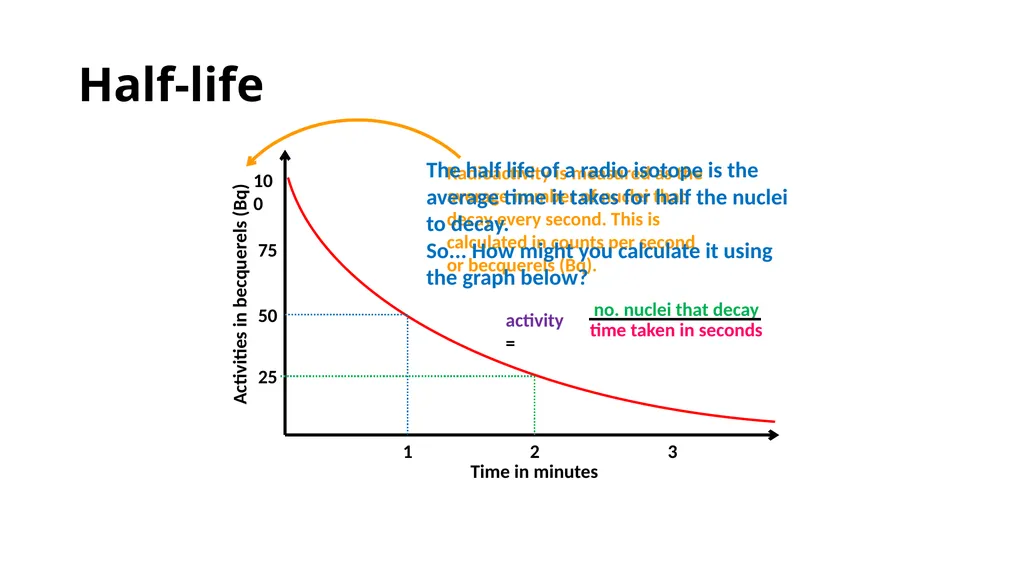
Half-life 100 50 25 75 1 2 3 Activities in becquerels (Bq) Time in minutes Radioactivity is measured as the average number of nuclei that decay every second. This is calculated in counts per second or becquerels (Bq). The half life of a radio isotope is the average time it takes for half the nuclei to decay.
So... How might you calculate it using the graph below?<br>
09
Graph showing the half-life of a radioactive source<br>
10
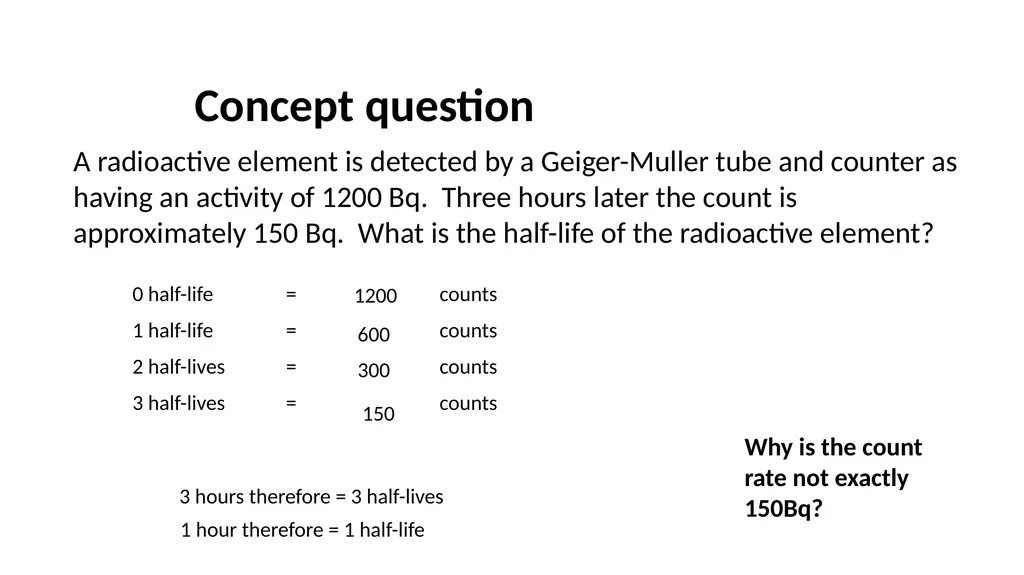
Concept question A radioactive element is detected by a Geiger-Muller tube and counter as having an activity of 1200 Bq. Three hours later the count is approximately 150 Bq. What is the half-life of the radioactive element? 0 half-life = counts
1 half-life = counts
2 half-lives = counts
3 half-lives = counts 1200 600 300 150 3 hours therefore = 3 half-lives 1 hour therefore = 1 half-life Why is the count rate not exactly 150Bq?<br>
11
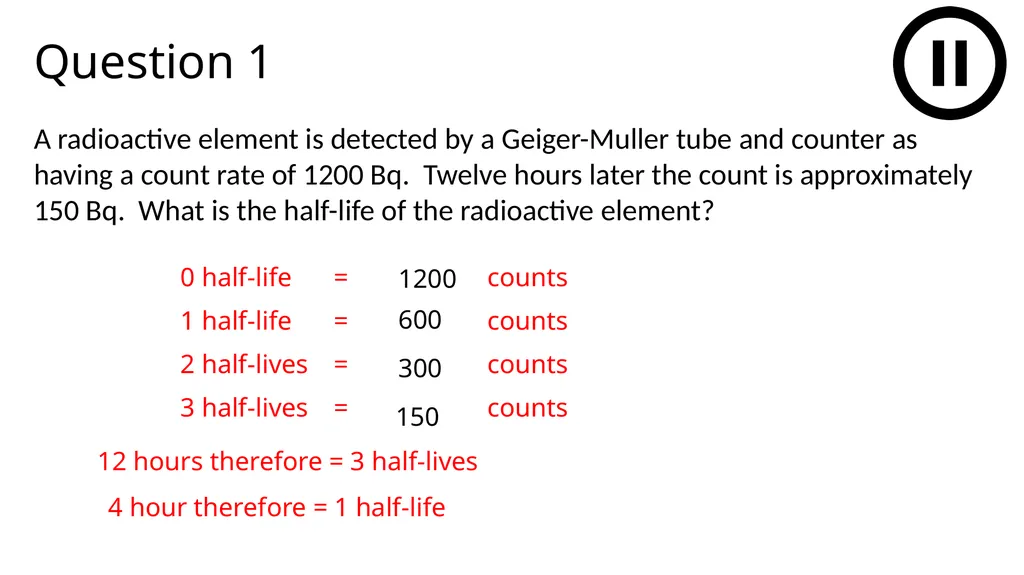
A radioactive element is detected by a Geiger-Muller tube and counter as having a count rate of 1200 Bq. Twelve hours later the count is approximately 150 Bq. What is the half-life of the radioactive element? 0 half-life = counts
1 half-life = counts
2 half-lives = counts
3 half-lives = counts 1200 600 300 150 12 hours therefore = 3 half-lives 4 hour therefore = 1 half-life Question 1<br>
12
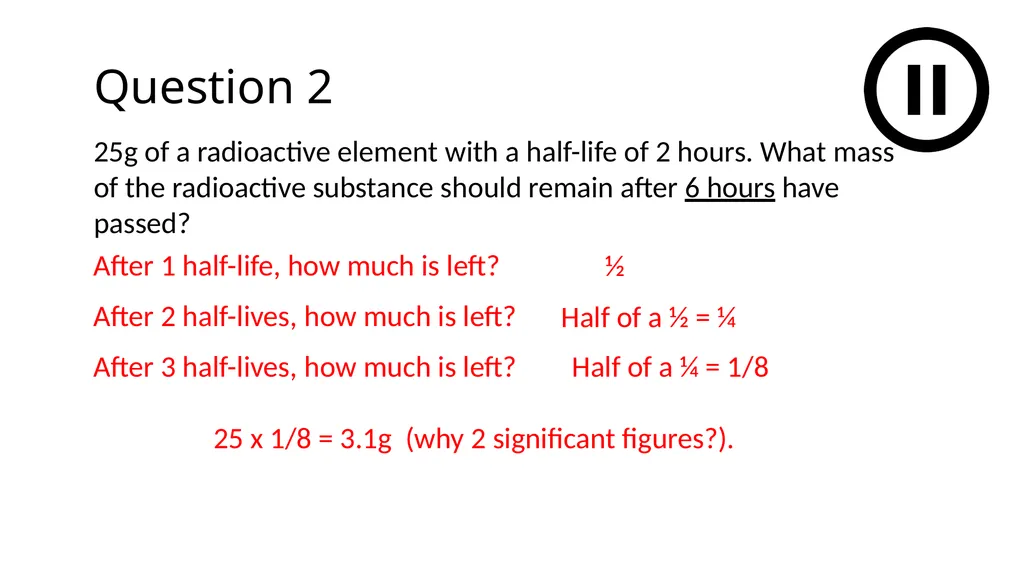
Question 2 25g of a radioactive element with a half-life of 2 hours. What mass of the radioactive substance should remain after 6 hours have passed? After 1 half-life, how much is left?
After 2 half-lives, how much is left?
After 3 half-lives, how much is left? ½ Half of a ½ = ¼ Half of a ¼ = 1/8 25 x 1/8 = 3.1g (why 2 significant figures?).<br>
13
An isotope has a mass of 125g and a half life of 8 hours. What mass of this isotope was there 32 hours before? 32/8 = 4
4 half lives
Therefore the amount of substance can be calculated thus:
125 x 2 x2 x 2 x 2 (or 125 x 24)
= 2000g (2.0kg) Question 3<br>
14
Exit ticket Well done
Now go to and complete the exit quiz for this lesson<br>