
Year 10 Study Skills Evening Thursday 12th
JO
Published · 51 slides · 0 views
1 / 1



Description
Year 10 Study Skills Evening Thursday 12th September 2024 Speakers this evening Welcome and reflection Mr Nevitt Year 10 and Organising my studies Mr Hughes Attendance Mr Kinsella Mathematics revision strategies Mrs Gatley Science courses,
Related Topics
Share
Embed code
Download this presentation From Below
"Year 10 Study Skills Evening Thursday 12th" is the property of its rightful owner. Permission is granted to download and print the materials on this website for personal, non-commercial use only, and to display it on your personal computer provided you do not modify the materials and that you retain all copyright notices contained in the materials. By downloading content from our website, you accept the terms of this agreement.
Presentation Transcript
01
Year 10 Study Skills Evening Thursday 12th September 2024<br>
02
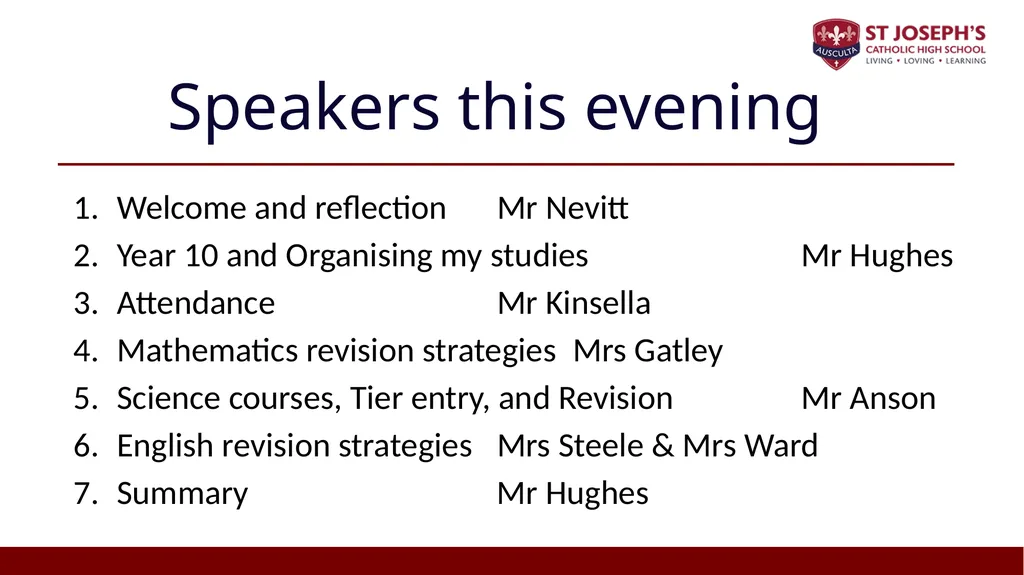
Speakers this evening Welcome and reflection Mr Nevitt
Year 10 and Organising my studies Mr Hughes
Attendance Mr Kinsella
Mathematics revision strategies Mrs Gatley
Science courses, Tier entry, and Revision Mr Anson
English revision strategies Mrs Steele & Mrs Ward
Summary Mr Hughes<br>
Year 10 and Organising my studies Mr Hughes
Attendance Mr Kinsella
Mathematics revision strategies Mrs Gatley
Science courses, Tier entry, and Revision Mr Anson
English revision strategies Mrs Steele & Mrs Ward
Summary Mr Hughes<br>
03
Welcome and reflection Mr Nevitt<br>
04
Mr Hughes
Year 10 Year 10
Mock Exams 16th June
Work Experience 23rd June<br>
Mock Exams 16th June
Work Experience 23rd June<br>
05
Organise my studies Somewhere where you can revise/work, without distractions
Table
Chair (comfortable)
Light
Resources to hand (pens, paper, books, calculator)
Phone?<br>
Table
Chair (comfortable)
Light
Resources to hand (pens, paper, books, calculator)
Phone?<br>
06
Organise my studies 2. Know what you are doing
Specifications
Topic overviews in your books
Homework tasks
Extras!<br>
Specifications
Topic overviews in your books
Homework tasks
Extras!<br>
07
Be ready for studies 3. Look after yourself
Eat healthily
Exercise
Sleep
Make time for things you enjoy
Develop yourself<br>
Eat healthily
Exercise
Sleep
Make time for things you enjoy
Develop yourself<br>
08
Year 10 Mock Exams 16th June<br>
09
Year 10 Work Experience 23rd June for 1 week
Designed for you to show your independence and maturity
Data base of placements, we help and advise
You make contact, we ensure the placement is safe for you to attend<br>
Designed for you to show your independence and maturity
Data base of placements, we help and advise
You make contact, we ensure the placement is safe for you to attend<br>
10
Attendance Mr Kinsella<br>
11
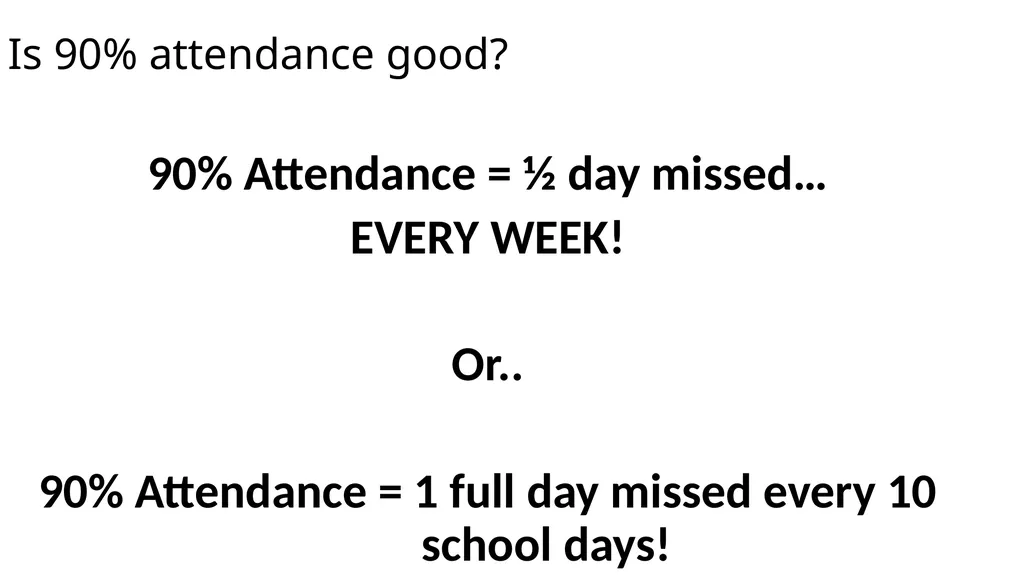
Is 90% attendance good? 90% Attendance = ½ day missed…
EVERY WEEK!
Or..
90% Attendance = 1 full day missed every 10 school days!<br>
EVERY WEEK!
Or..
90% Attendance = 1 full day missed every 10 school days!<br>
12
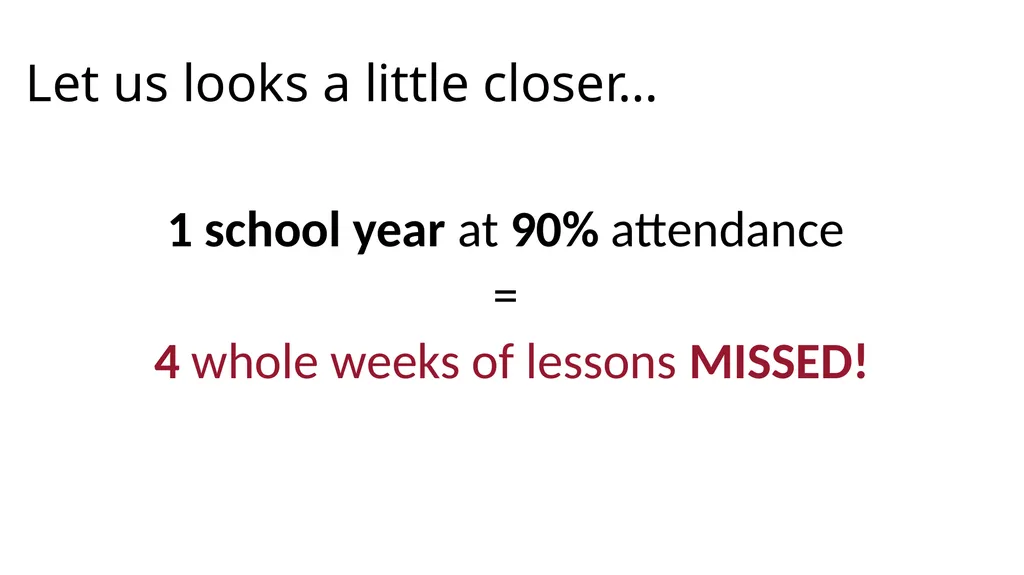
Let us looks a little closer… 1 school year at 90% attendance
=
4 whole weeks of lessons MISSED!<br>
=
4 whole weeks of lessons MISSED!<br>
13
90% attendance over 5 years of secondary school…
= ½ a school year missed!<br>
14
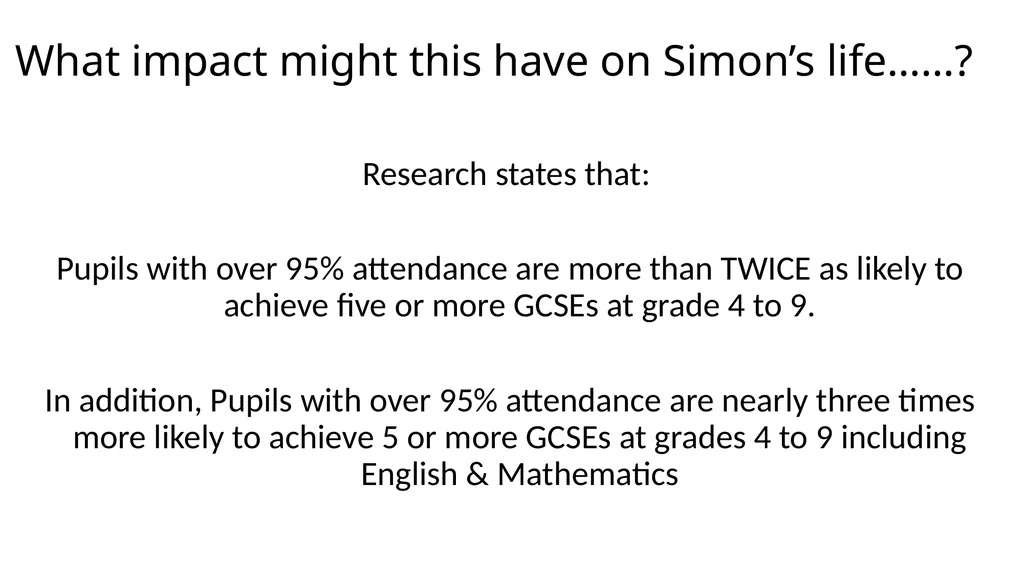
What impact might this have on Simon’s life……? Research states that:
Pupils with over 95% attendance are more than TWICE as likely to achieve five or more GCSEs at grade 4 to 9.
In addition, Pupils with over 95% attendance are nearly three times more likely to achieve 5 or more GCSEs at grades 4 to 9 including English & Mathematics<br>
Pupils with over 95% attendance are more than TWICE as likely to achieve five or more GCSEs at grade 4 to 9.
In addition, Pupils with over 95% attendance are nearly three times more likely to achieve 5 or more GCSEs at grades 4 to 9 including English & Mathematics<br>
15
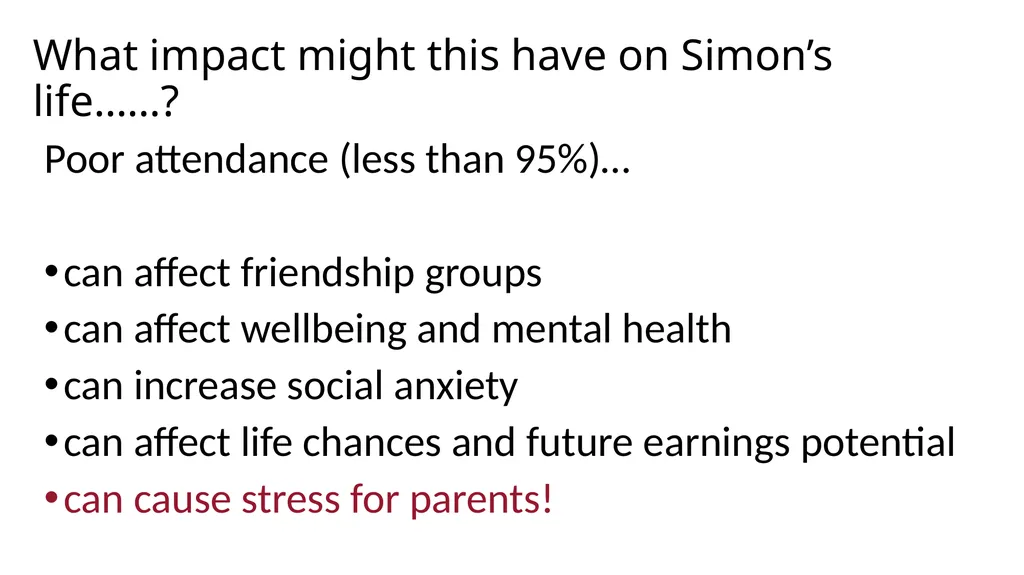
What impact might this have on Simon’s life……? Poor attendance (less than 95%)…
can affect friendship groups
can affect wellbeing and mental health
can increase social anxiety
can affect life chances and future earnings potential
can cause stress for parents!<br>
can affect friendship groups
can affect wellbeing and mental health
can increase social anxiety
can affect life chances and future earnings potential
can cause stress for parents!<br>
16
Ways for parents to encourage excellent attendance: Talk to us about your child’s attendance.
Talk to your child about school and how they feel about it.
Phone us as soon as possible to tell us why your child is absent, and when you expect them to return.
Only allow days at home for genuine illness. (you will know!)
Avoid taking holidays in school time.
Know routines of the school day to avoid issues, e.g. have they got their PE kit?
PRAISE AND REWARD GOOD ATTENDANCE: even small successes, e.g. going in promptly, even when their first lesson is their worst!<br>
17
Revision strategies Mrs Gatley<br>
18
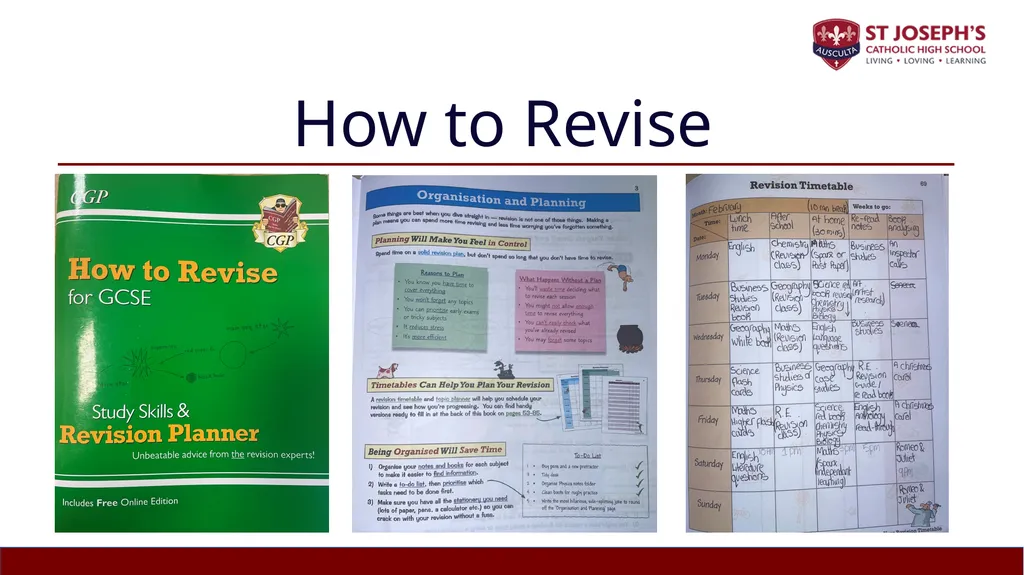
How to Revise<br>
19
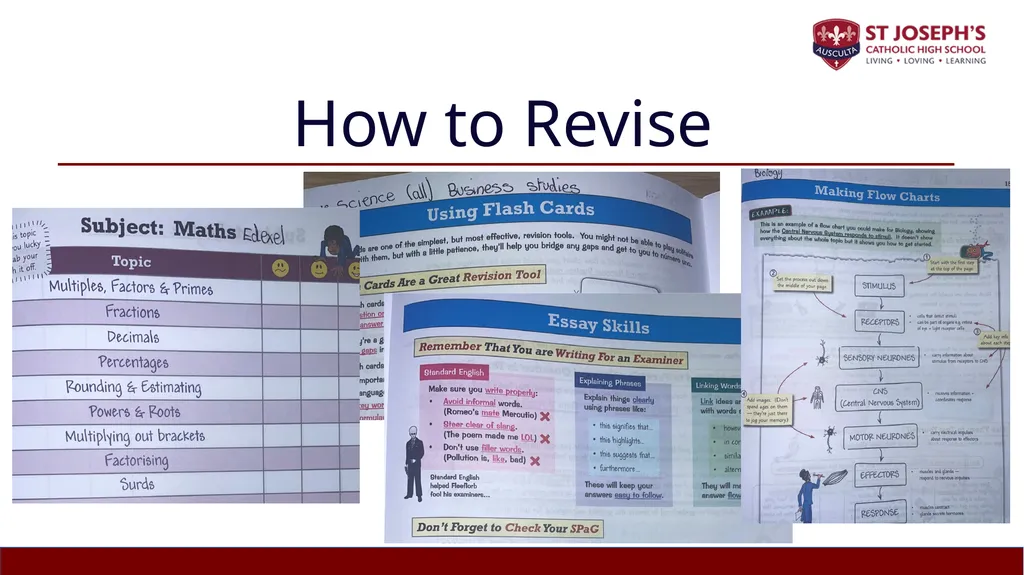
How to Revise<br>
20
How to Revise<br>
21
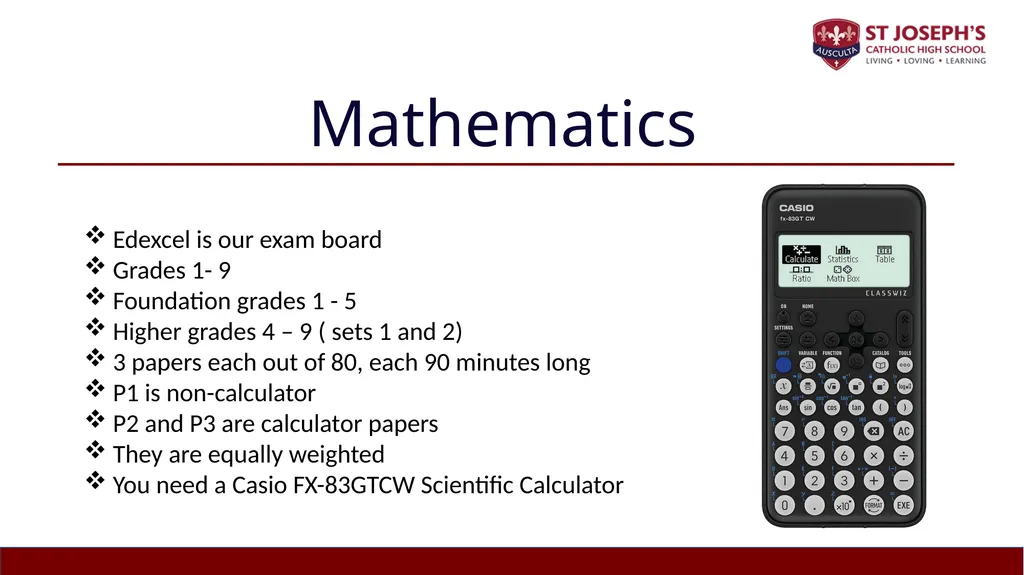
Mathematics Edexcel is our exam board
Grades 1- 9
Foundation grades 1 - 5
Higher grades 4 – 9 ( sets 1 and 2)
3 papers each out of 80, each 90 minutes long
P1 is non-calculator
P2 and P3 are calculator papers
They are equally weighted
You need a Casio FX-83GTCW Scientific Calculator<br>
Grades 1- 9
Foundation grades 1 - 5
Higher grades 4 – 9 ( sets 1 and 2)
3 papers each out of 80, each 90 minutes long
P1 is non-calculator
P2 and P3 are calculator papers
They are equally weighted
You need a Casio FX-83GTCW Scientific Calculator<br>
22
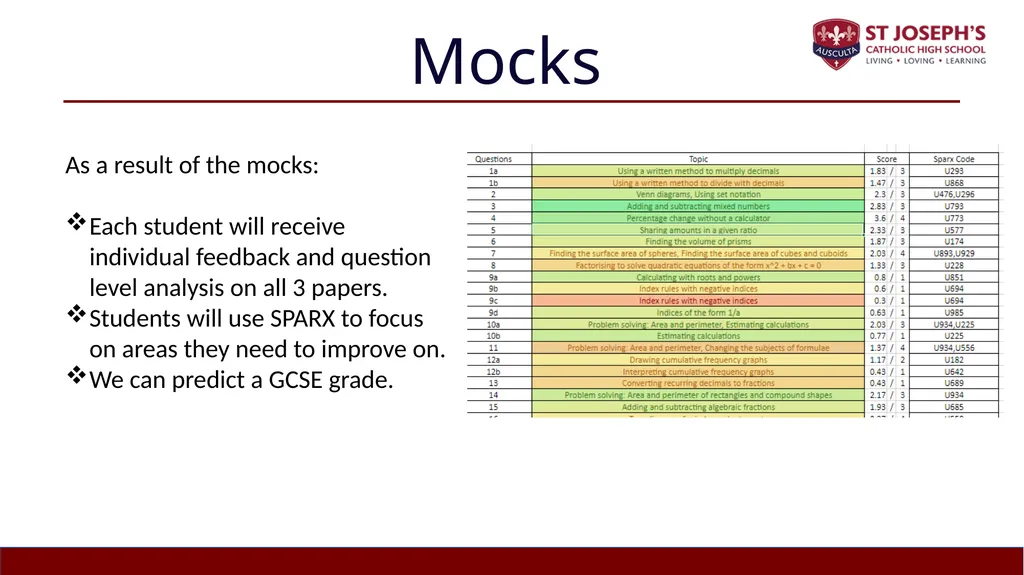
Mocks As a result of the mocks:
Each student will receive individual feedback and question level analysis on all 3 papers.
Students will use SPARX to focus on areas they need to improve on.
We can predict a GCSE grade.<br>
Each student will receive individual feedback and question level analysis on all 3 papers.
Students will use SPARX to focus on areas they need to improve on.
We can predict a GCSE grade.<br>
23
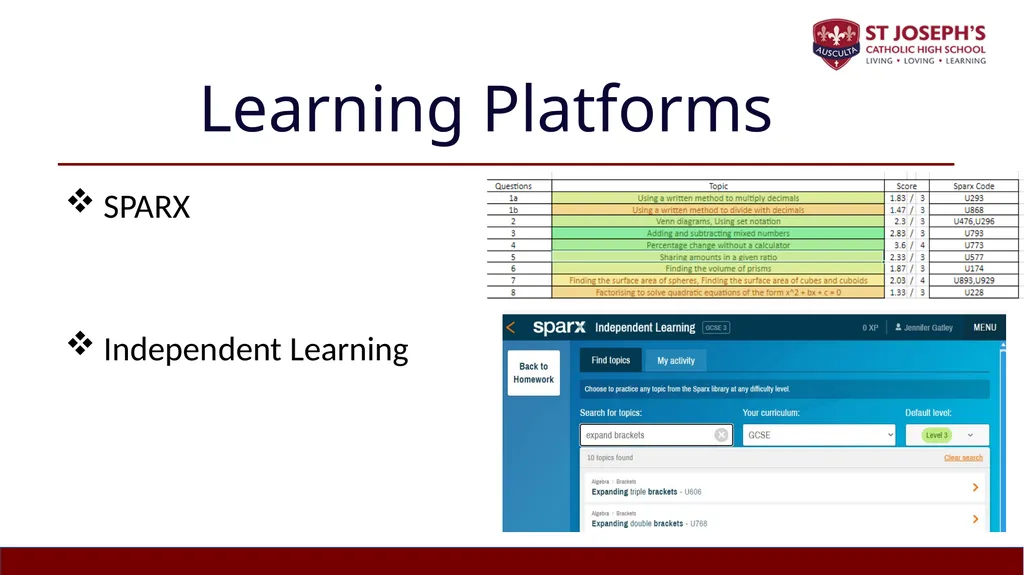
Learning Platforms SPARX
Independent Learning<br>
Independent Learning<br>
24
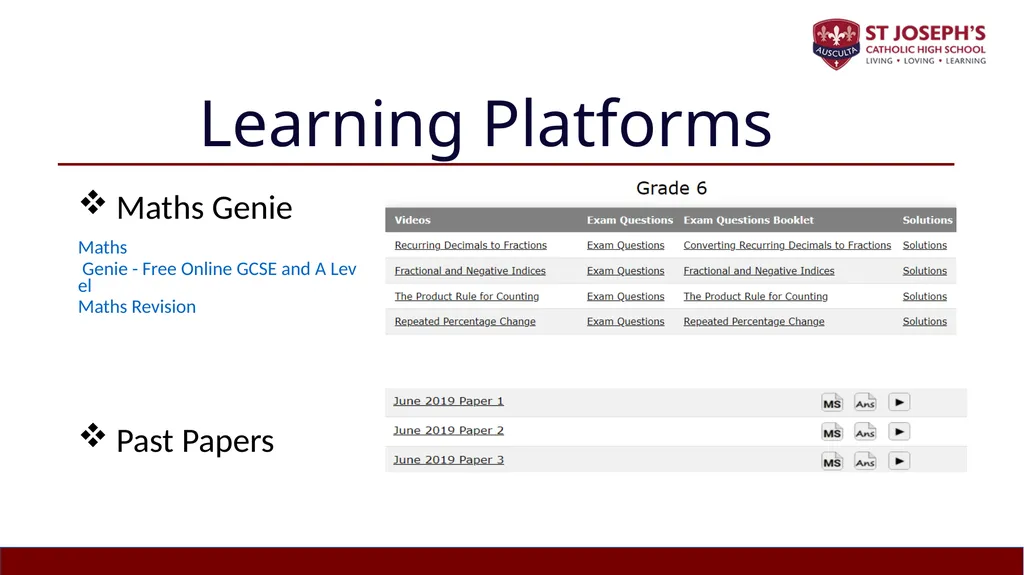
Learning Platforms Maths Genie
Maths Genie - Free Online GCSE and A Level Maths Revision
Past Papers<br>
Maths Genie - Free Online GCSE and A Level Maths Revision
Past Papers<br>
25
Extra support We have homework support after school on Monday in B2
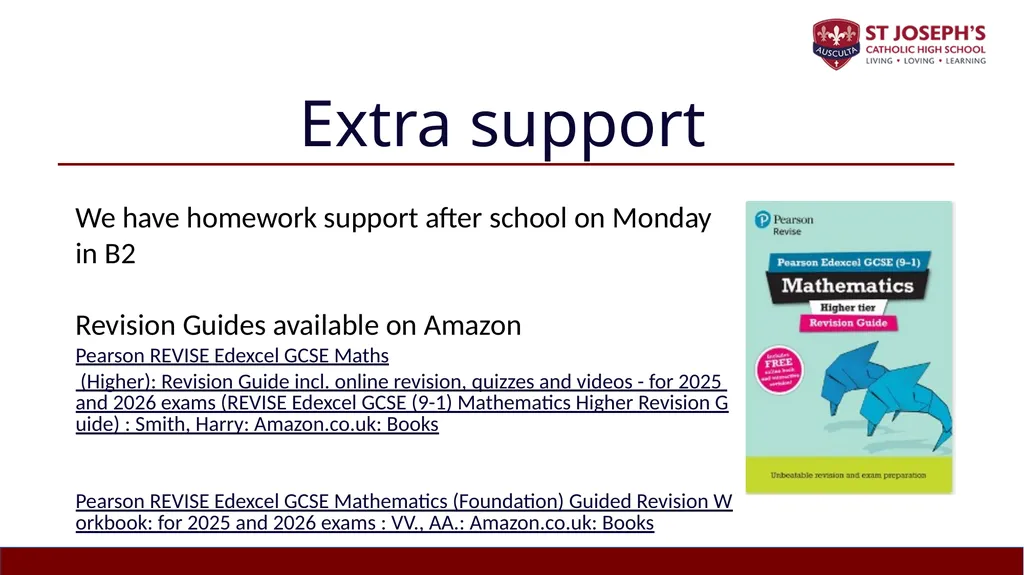
Revision Guides available on Amazon
Pearson REVISE Edexcel GCSE Maths (Higher): Revision Guide incl. online revision, quizzes and videos - for 2025 and 2026 exams (REVISE Edexcel GCSE (9-1) Mathematics Higher Revision Guide) : Smith, Harry: Amazon.co.uk: Books
Pearson REVISE Edexcel GCSE Mathematics (Foundation) Guided Revision Workbook: for 2025 and 2026 exams : VV., AA.: Amazon.co.uk: Books<br>
26
Thank you Please get in touch by email if you have any questions
Jennifer.gatley@sjchs.uk<br>
Jennifer.gatley@sjchs.uk<br>
27
Science courses, Tier entry, Revision Mr Anson
If you wish to ask a question or discuss anything further:
Contact email: Jonathan.Anson@sjchs.uk<br>
If you wish to ask a question or discuss anything further:
Contact email: Jonathan.Anson@sjchs.uk<br>
28
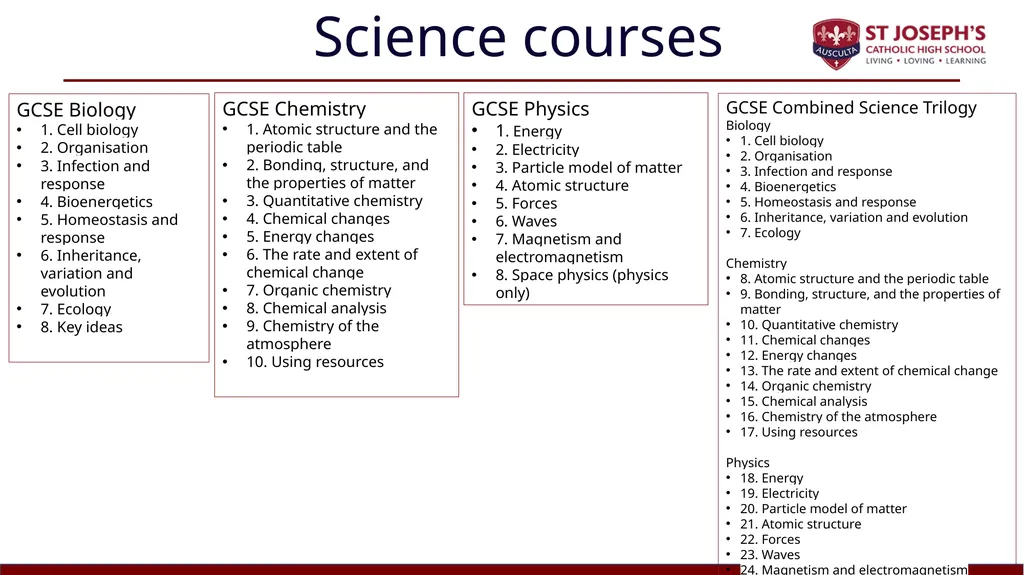
Science courses GCSE Combined Science Trilogy
Biology
1. Cell biology
2. Organisation
3. Infection and response
4. Bioenergetics
5. Homeostasis and response
6. Inheritance, variation and evolution
7. Ecology
Chemistry
8. Atomic structure and the periodic table
9. Bonding, structure, and the properties of matter
10. Quantitative chemistry
11. Chemical changes
12. Energy changes
13. The rate and extent of chemical change
14. Organic chemistry
15. Chemical analysis
16. Chemistry of the atmosphere
17. Using resources
Physics
18. Energy
19. Electricity
20. Particle model of matter
21. Atomic structure
22. Forces
23. Waves
24. Magnetism and electromagnetism GCSE Biology
1. Cell biology
2. Organisation
3. Infection and response
4. Bioenergetics
5. Homeostasis and response
6. Inheritance, variation and evolution
7. Ecology
8. Key ideas GCSE Chemistry
1. Atomic structure and the periodic table
2. Bonding, structure, and the properties of matter
3. Quantitative chemistry
4. Chemical changes
5. Energy changes
6. The rate and extent of chemical change
7. Organic chemistry
8. Chemical analysis
9. Chemistry of the atmosphere
10. Using resources GCSE Physics
1. Energy
2. Electricity
3. Particle model of matter
4. Atomic structure
5. Forces
6. Waves
7. Magnetism and electromagnetism
8. Space physics (physics only)<br>
29
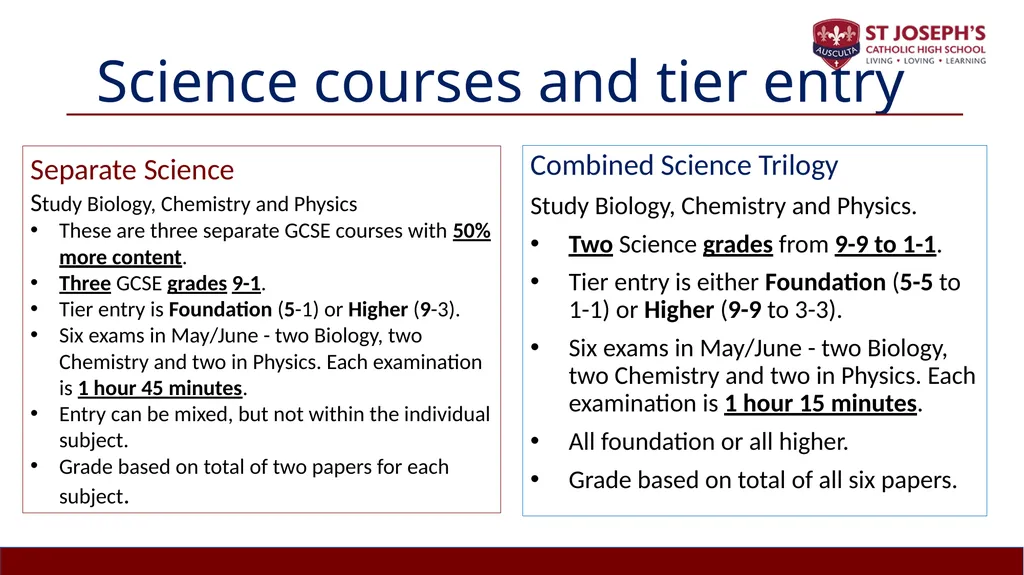
Science courses and tier entry Combined Science Trilogy
Study Biology, Chemistry and Physics.
Two Science grades from 9-9 to 1-1.
Tier entry is either Foundation (5-5 to 1-1) or Higher (9-9 to 3-3).
Six exams in May/June - two Biology, two Chemistry and two in Physics. Each examination is 1 hour 15 minutes.
All foundation or all higher.
Grade based on total of all six papers. Separate Science
Study Biology, Chemistry and Physics
These are three separate GCSE courses with 50% more content.
Three GCSE grades 9-1.
Tier entry is Foundation (5-1) or Higher (9-3).
Six exams in May/June - two Biology, two Chemistry and two in Physics. Each examination is 1 hour 45 minutes.
Entry can be mixed, but not within the individual subject.
Grade based on total of two papers for each subject.<br>
30
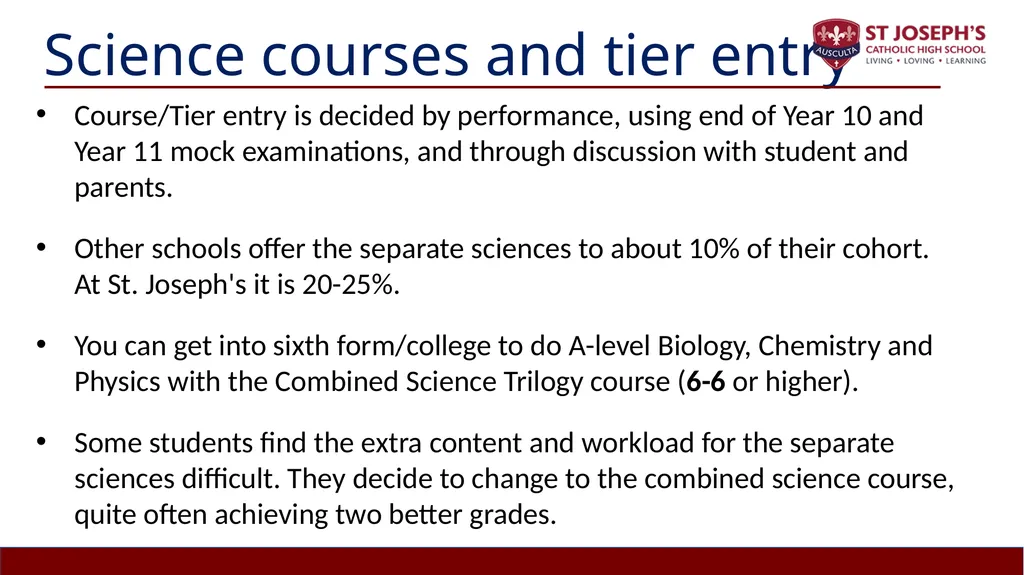
Science courses and tier entry Course/Tier entry is decided by performance, using end of Year 10 and Year 11 mock examinations, and through discussion with student and parents.
Other schools offer the separate sciences to about 10% of their cohort. At St. Joseph's it is 20-25%.
You can get into sixth form/college to do A-level Biology, Chemistry and Physics with the Combined Science Trilogy course (6-6 or higher).
Some students find the extra content and workload for the separate sciences difficult. They decide to change to the combined science course, quite often achieving two better grades.<br>
31
Science courses, Tier entry,
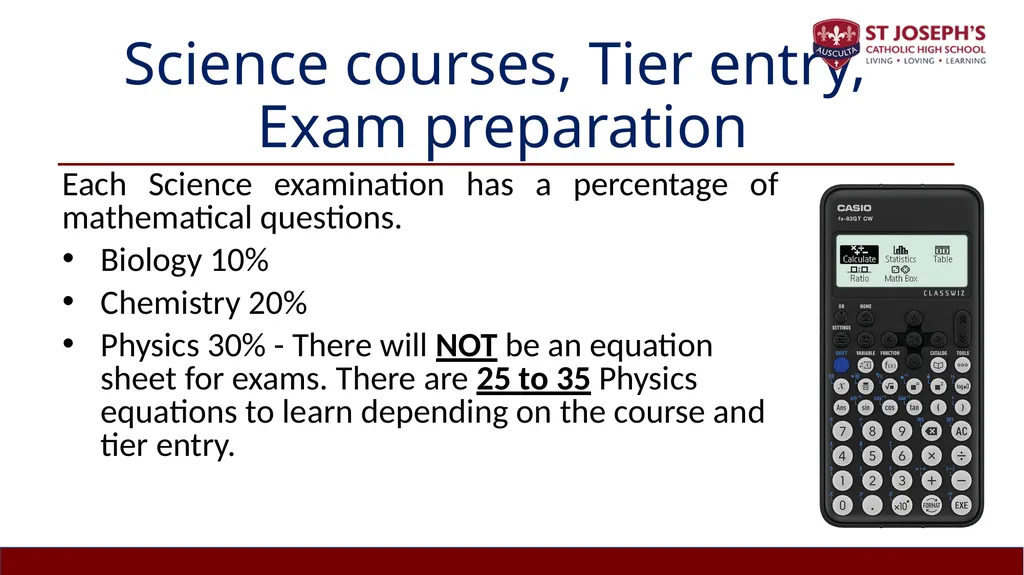
Exam preparation Each Science examination has a percentage of mathematical questions.
Biology 10%
Chemistry 20%
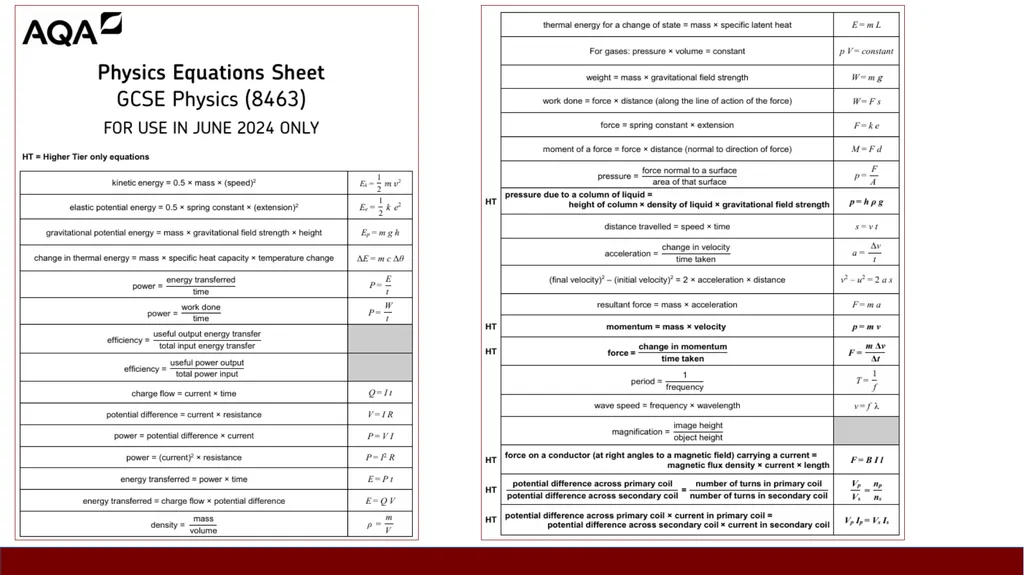
Physics 30% - There will NOT be an equation sheet for exams. There are 25 to 35 Physics equations to learn depending on the course and tier entry.<br>
Biology 10%
Chemistry 20%
Physics 30% - There will NOT be an equation sheet for exams. There are 25 to 35 Physics equations to learn depending on the course and tier entry.<br>
32
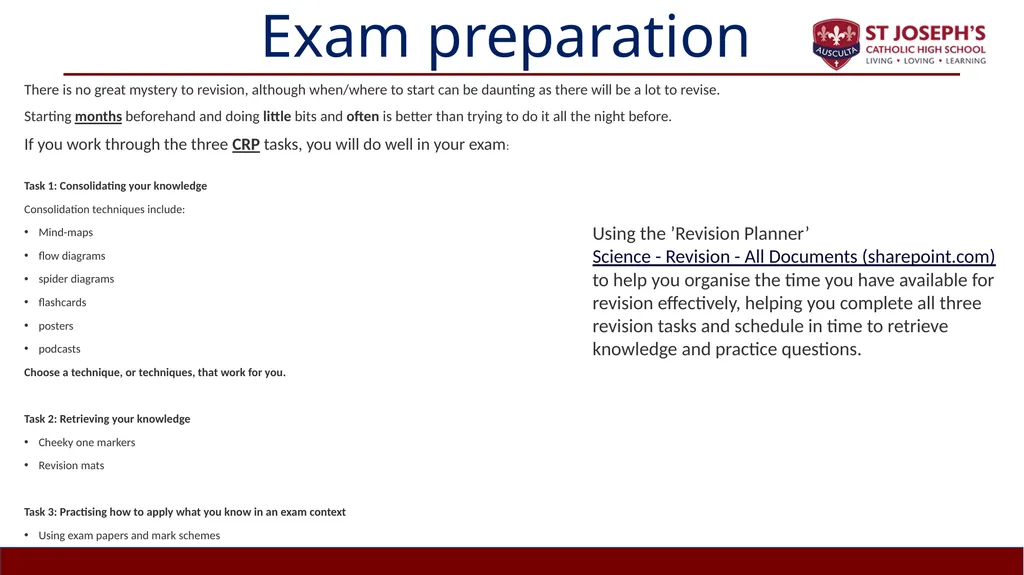
Exam preparation There is no great mystery to revision, although when/where to start can be daunting as there will be a lot to revise.
Starting months beforehand and doing little bits and often is better than trying to do it all the night before.
If you work through the three CRP tasks, you will do well in your exam:
Task 1: Consolidating your knowledge
Consolidation techniques include:
Mind-maps
flow diagrams
spider diagrams
flashcards
posters
podcasts
Choose a technique, or techniques, that work for you.
Task 2: Retrieving your knowledge
Cheeky one markers
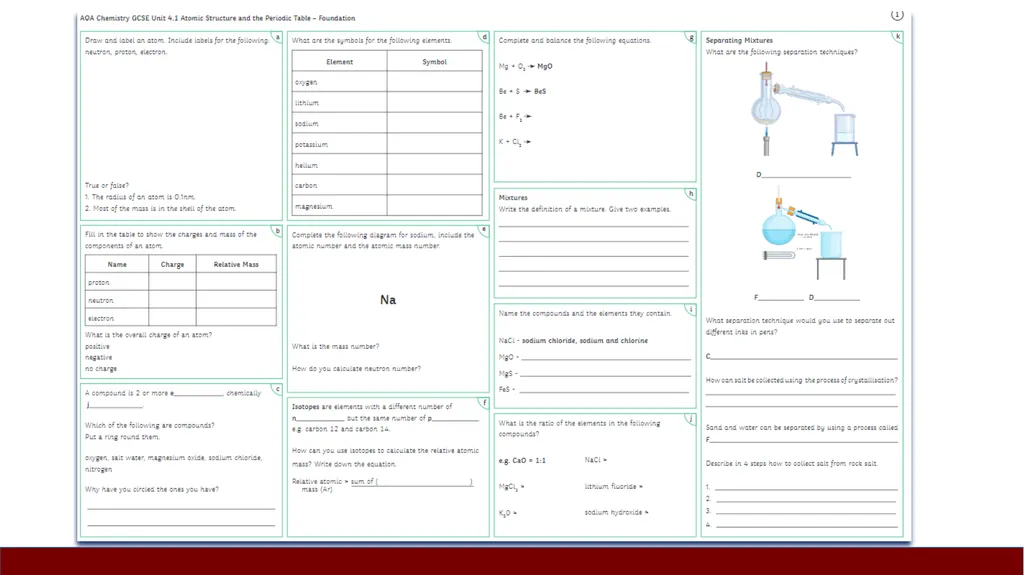
Revision mats
Task 3: Practising how to apply what you know in an exam context
Using exam papers and mark schemes Using the ’Revision Planner’
Science - Revision - All Documents (sharepoint.com) to help you organise the time you have available for revision effectively, helping you complete all three revision tasks and schedule in time to retrieve knowledge and practice questions.<br>
33
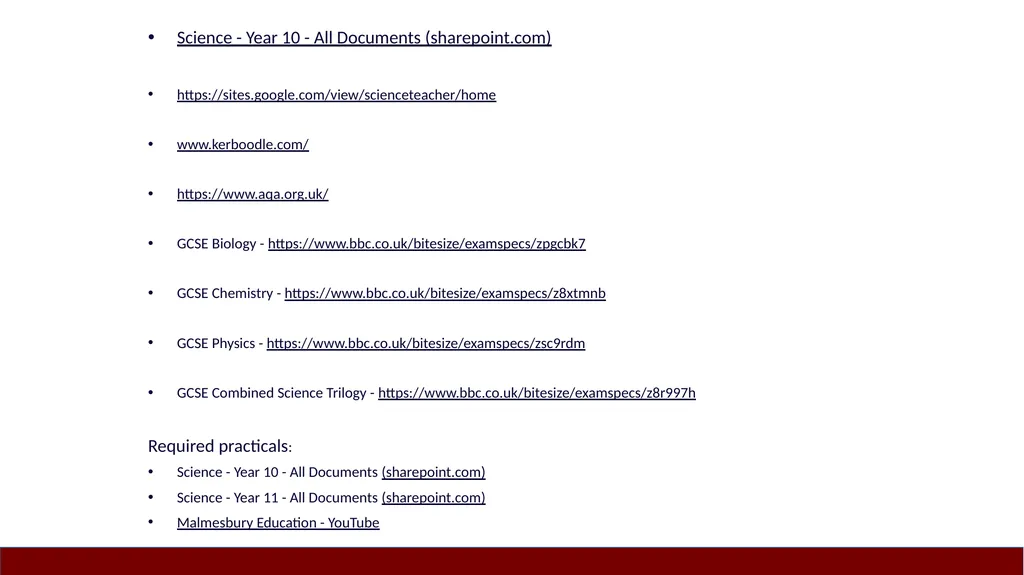
Science - Year 10 - All Documents (sharepoint.com)
https://sites.google.com/view/scienceteacher/home
www.kerboodle.com/
https://www.aqa.org.uk/
GCSE Biology - https://www.bbc.co.uk/bitesize/examspecs/zpgcbk7
GCSE Chemistry - https://www.bbc.co.uk/bitesize/examspecs/z8xtmnb
GCSE Physics - https://www.bbc.co.uk/bitesize/examspecs/zsc9rdm
GCSE Combined Science Trilogy - https://www.bbc.co.uk/bitesize/examspecs/z8r997h
Required practicals:
Science - Year 10 - All Documents (sharepoint.com)
Science - Year 11 - All Documents (sharepoint.com)
Malmesbury Education - YouTube<br>
34
Revision strategies Mrs Steele and Mrs Ward<br>
35
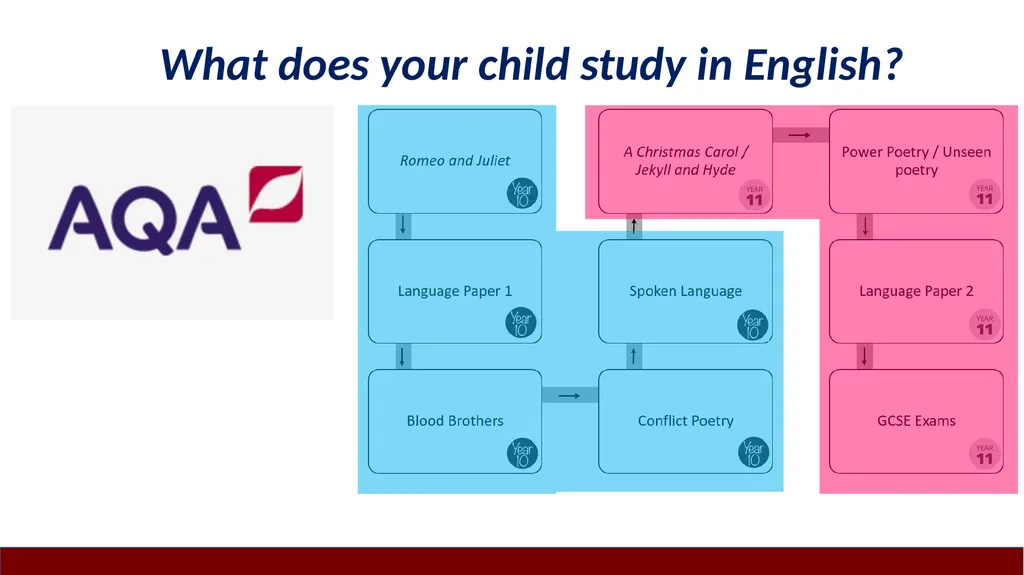
What does your child study in English?<br>
36
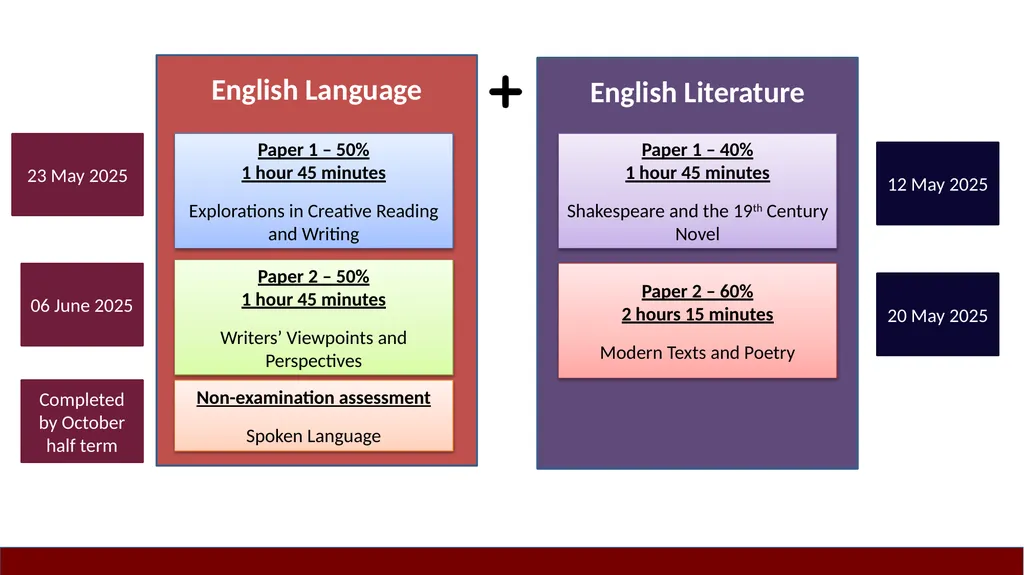
English Language English Literature Paper 1 – 50%
1 hour 45 minutes
Explorations in Creative Reading and Writing Paper 2 – 50%
1 hour 45 minutes
Writers’ Viewpoints and Perspectives Non-examination assessment
Spoken Language Paper 1 – 40%
1 hour 45 minutes
Shakespeare and the 19th Century Novel Paper 2 – 60%
2 hours 15 minutes
Modern Texts and Poetry 12 May 2025 20 May 2025 23 May 2025 06 June 2025 Completed by October half term<br>
1 hour 45 minutes
Explorations in Creative Reading and Writing Paper 2 – 50%
1 hour 45 minutes
Writers’ Viewpoints and Perspectives Non-examination assessment
Spoken Language Paper 1 – 40%
1 hour 45 minutes
Shakespeare and the 19th Century Novel Paper 2 – 60%
2 hours 15 minutes
Modern Texts and Poetry 12 May 2025 20 May 2025 23 May 2025 06 June 2025 Completed by October half term<br>
37
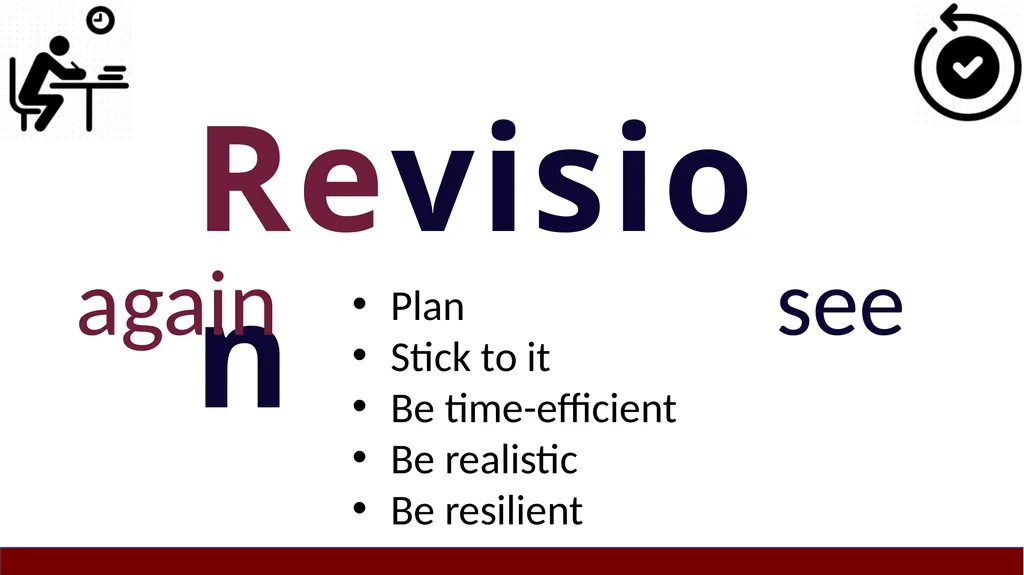
Revision again see Plan
Stick to it
Be time-efficient
Be realistic
Be resilient<br>
Stick to it
Be time-efficient
Be realistic
Be resilient<br>
38
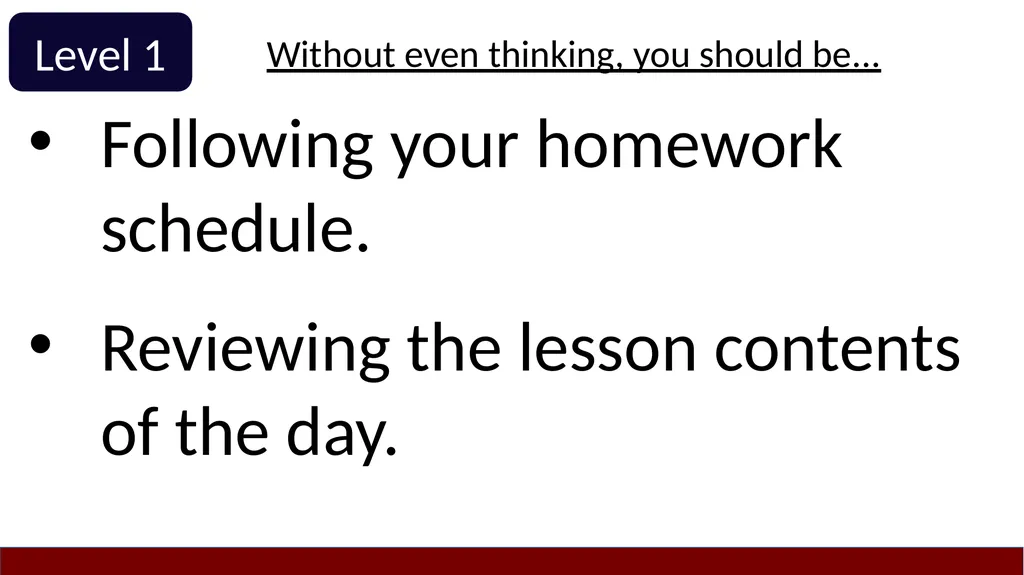
Following your homework schedule. Level 1 Reviewing the lesson contents of the day. Without even thinking, you should be...<br>
39
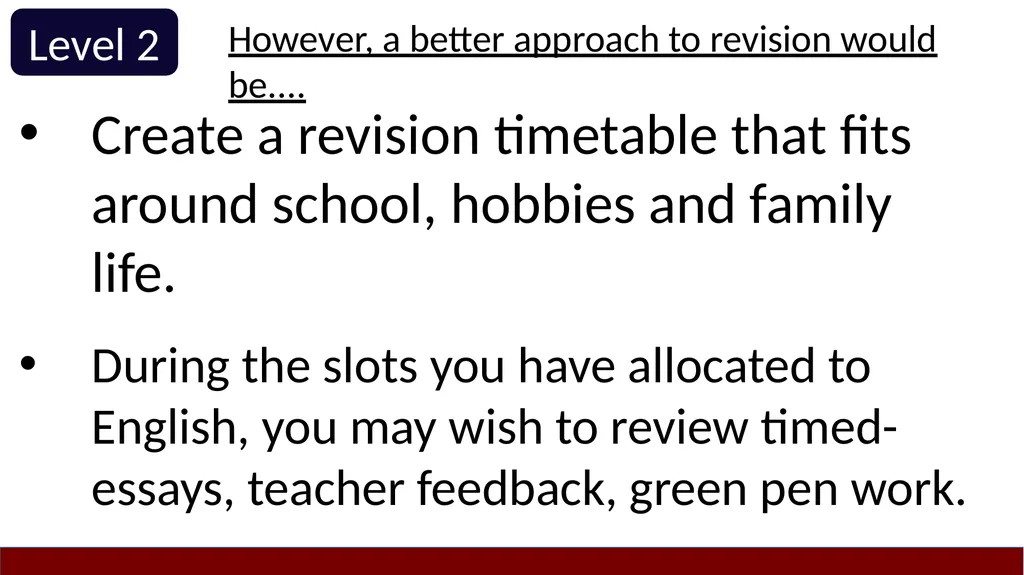
Create a revision timetable that fits around school, hobbies and family life. Level 2 During the slots you have allocated to English, you may wish to review timed-essays, teacher feedback, green pen work. However, a better approach to revision would be....<br>
40
Utilising textbooks, booklets and/or exercise books for the areas that you feel least confident with. Level 3 During your revision time, you should also be..... Practice exam questions.<br>
41
Pay attention in class and make notes on everything that is important to look back on in Year11 for revision.
Make your that you understand the basics as they are key, and you can answer correctly every single time.
If in class or after class you don’t understand something, approach your teacher or a friend to help you understand. No to little understanding = lost marks
MUST learn the foundations of the subjects. Advice from last year’s Year 11 Y10<br>
42
Advice from last year’s Year 11 Parents Understand that your child is going to get stressed, so when you can see them getting stressed, engage them in an activity that will relax them. Then, re-introduce the idea of revision and reassure them that they are capable of doing the work to pass their grades.
Ensure that they have a comfortable workspace where they won’t be disturbed/distracted.
Home is for relaxing; school is for working. Keep them at school as much as possible as the child would naturally lose focus at home and not revise as effectively.
Your child may be stressed at the thought of revision, but it is important to give them gentle reminders about doing the revision and if you can offer any support with it.<br>
43
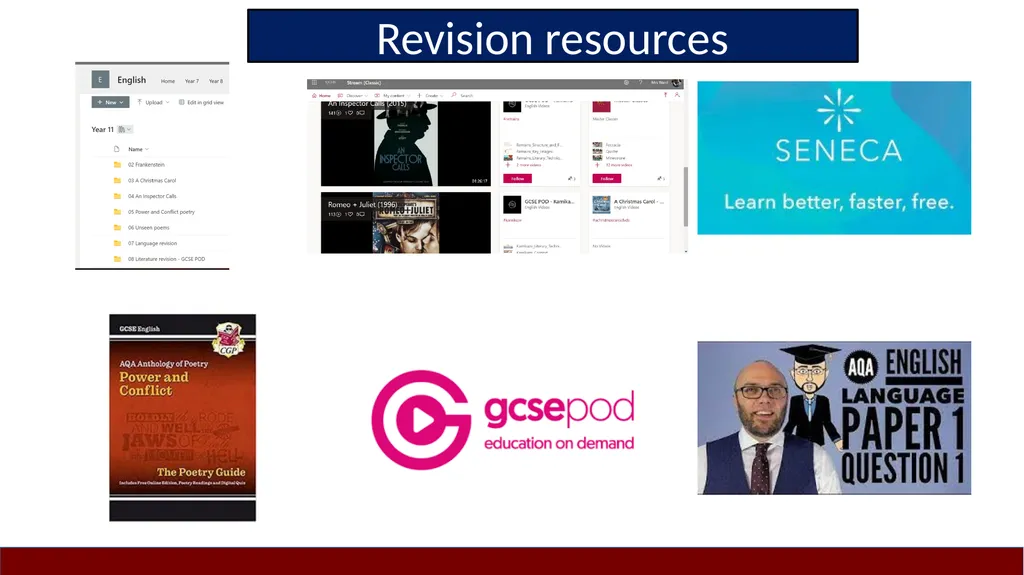
Revision resources<br>
44
Buy all 7 books for just £10<br>
45
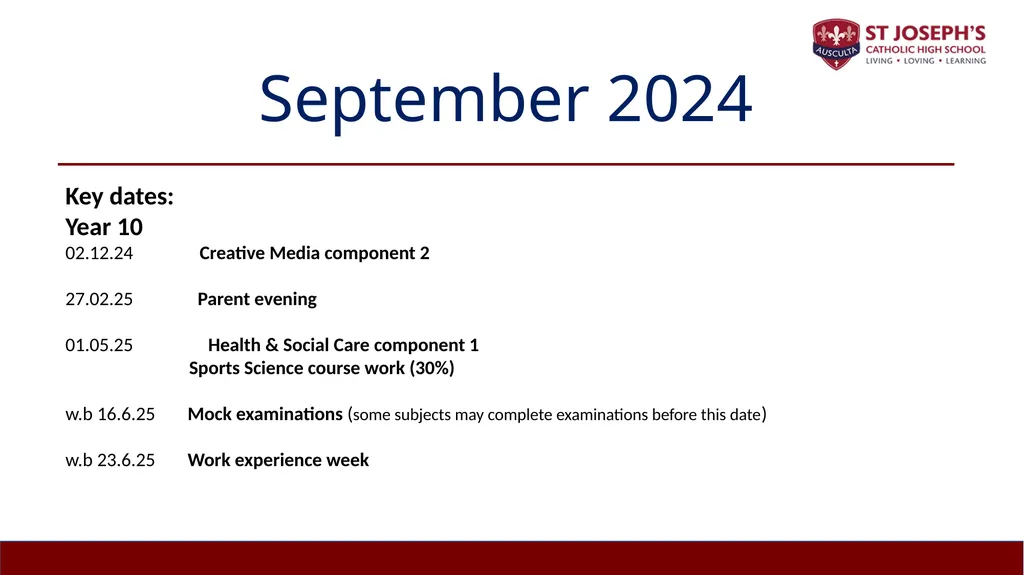
September 2024 Key dates:
Year 10
02.12.24 Creative Media component 2
27.02.25 Parent evening
01.05.25 Health & Social Care component 1
Sports Science course work (30%)
w.b 16.6.25 Mock examinations (some subjects may complete examinations before this date)
w.b 23.6.25 Work experience week<br>
Year 10
02.12.24 Creative Media component 2
27.02.25 Parent evening
01.05.25 Health & Social Care component 1
Sports Science course work (30%)
w.b 16.6.25 Mock examinations (some subjects may complete examinations before this date)
w.b 23.6.25 Work experience week<br>
46
Summary Mr Hughes<br>
47
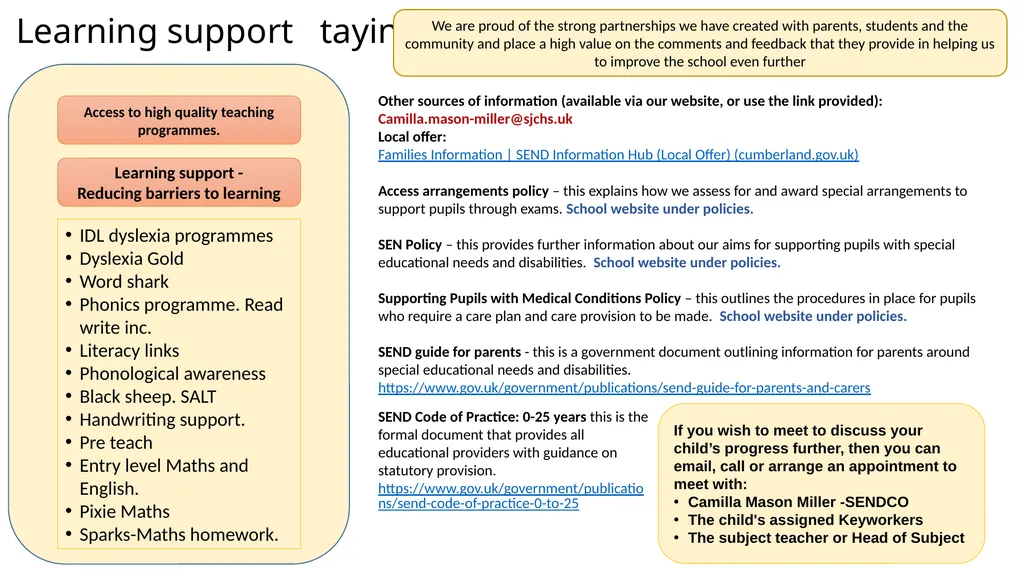
Learning support taying Informed If you wish to meet to discuss your child’s progress further, then you can email, call or arrange an appointment to meet with:
Camilla Mason Miller -SENDCO
The child's assigned Keyworkers
The subject teacher or Head of Subject We are proud of the strong partnerships we have created with parents, students and the community and place a high value on the comments and feedback that they provide in helping us to improve the school even further Other sources of information (available via our website, or use the link provided):
Camilla.mason-miller@sjchs.uk
Local offer:
Families Information | SEND Information Hub (Local Offer) (cumberland.gov.uk)
Access arrangements policy – this explains how we assess for and award special arrangements to support pupils through exams. School website under policies.
SEN Policy – this provides further information about our aims for supporting pupils with special educational needs and disabilities. School website under policies.
Supporting Pupils with Medical Conditions Policy – this outlines the procedures in place for pupils who require a care plan and care provision to be made. School website under policies.
SEND guide for parents - this is a government document outlining information for parents around special educational needs and disabilities.
https://www.gov.uk/government/publications/send-guide-for-parents-and-carers SEND Code of Practice: 0-25 years this is the formal document that provides all educational providers with guidance on statutory provision.
https://www.gov.uk/government/publications/send-code-of-practice-0-to-25 Access to high quality teaching programmes. IDL dyslexia programmes
Dyslexia Gold
Word shark
Phonics programme. Read write inc.
Literacy links
Phonological awareness
Black sheep. SALT
Handwriting support.
Pre teach
Entry level Maths and English.
Pixie Maths
Sparks-Maths homework. Learning support -
Reducing barriers to learning<br>
48
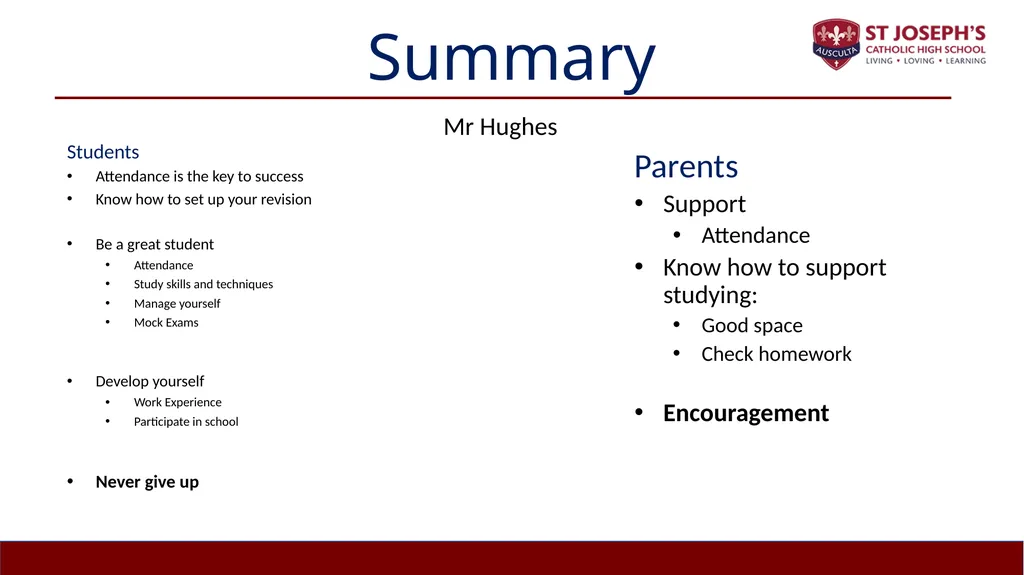
Summary Mr Hughes Students
Attendance is the key to success
Know how to set up your revision
Be a great student
Attendance
Study skills and techniques
Manage yourself
Mock Exams
Develop yourself
Work Experience
Participate in school
Never give up Parents
Support
Attendance
Know how to support studying:
Good space
Check homework
Encouragement<br>
49
End of the evening Work hard.
Never give up.
You will get the reward.<br>
Never give up.
You will get the reward.<br>