
Year 5: Properties and changes of materials Topic

Description: Year 5: Properties and changes of materials Topic overview for teachers Age 9-10 Year 5 Properties and changes of materials 2 Year 5 Properties and changes of materials 3 Properties and changes of materials 4 Exploring properties and
Related Topics
Download Presentation
"Year 5: Properties and changes of materials Topic" is the property of its rightful owner. Permission is granted to download and print the materials on this website for personal, non-commercial use only, and to display it on your personal computer provided you do not modify the materials and that you retain all copyright notices contained in the materials. By downloading content from our website, you accept the terms of this agreement.
Presentation Transcript
slide1. Year 5: Properties and changes of materials Topic overview for teachers Age 9-10<br>
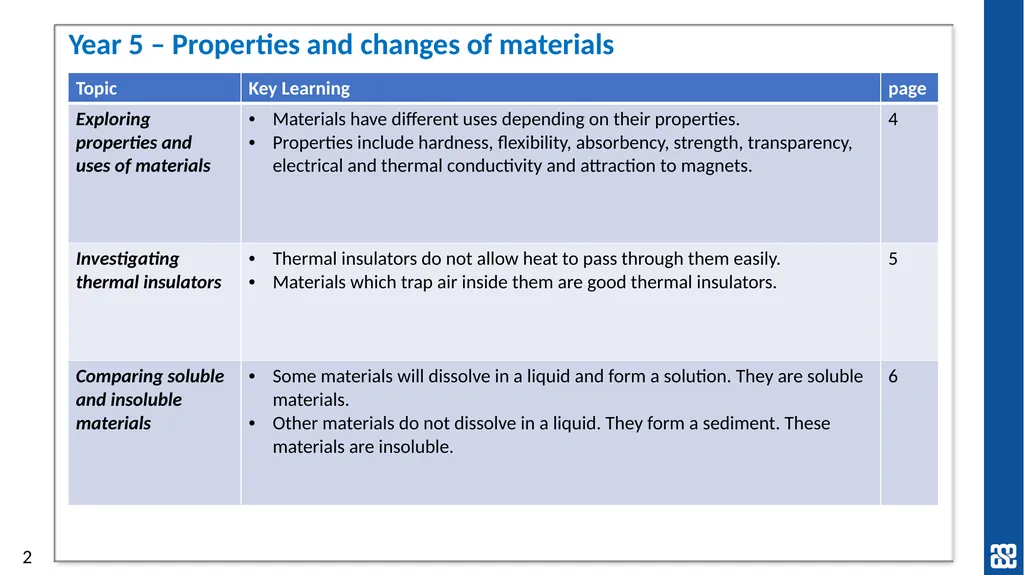
slide2. Year 5 – Properties and changes of materials 2<br>
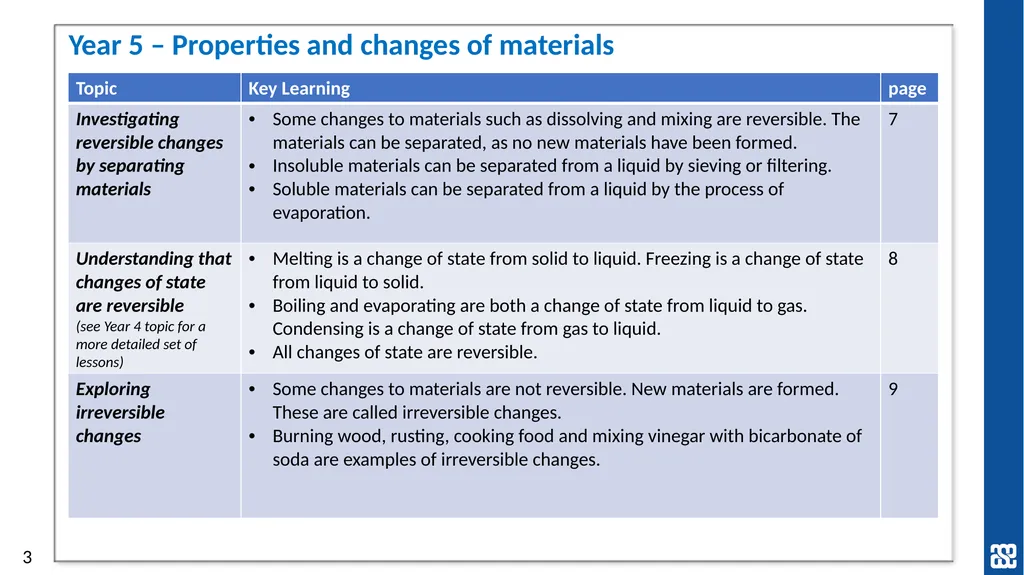
slide3. Year 5 – Properties and changes of materials 3<br>
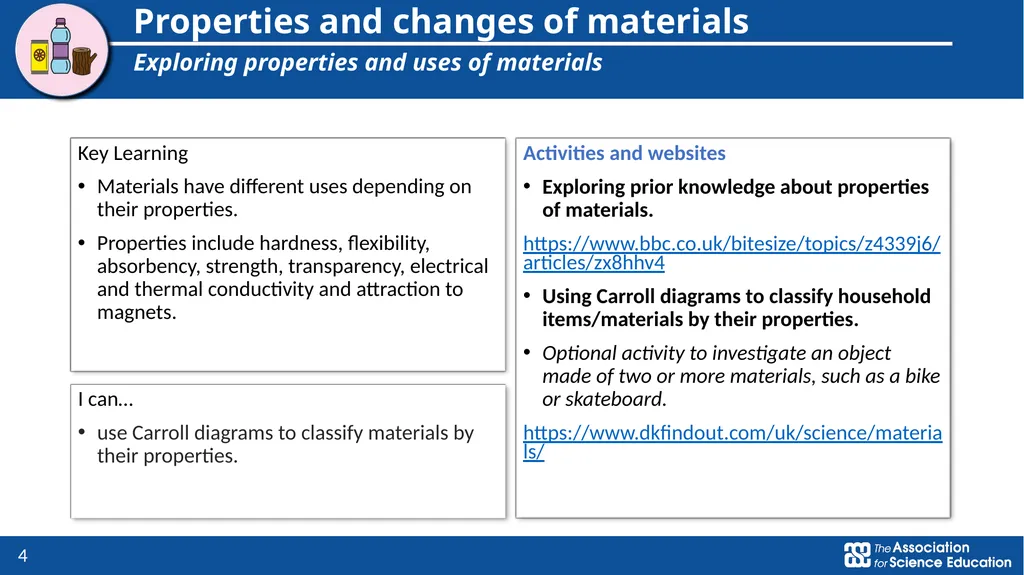
slide4. Properties and changes of materials 4 Exploring properties and uses of materials Key Learning
Materials have different uses depending on their properties.
Properties include hardness, flexibility, absorbency, strength, transparency, electrical and thermal conductivity and attraction to magnets. I can…
use Carroll diagrams to classify materials by their properties. Activities and websites
Exploring prior knowledge about properties of materials.
https://www.bbc.co.uk/bitesize/topics/z4339j6/articles/zx8hhv4
Using Carroll diagrams to classify household items/materials by their properties.
Optional activity to investigate an object made of two or more materials, such as a bike or skateboard.
https://www.dkfindout.com/uk/science/materials/<br>
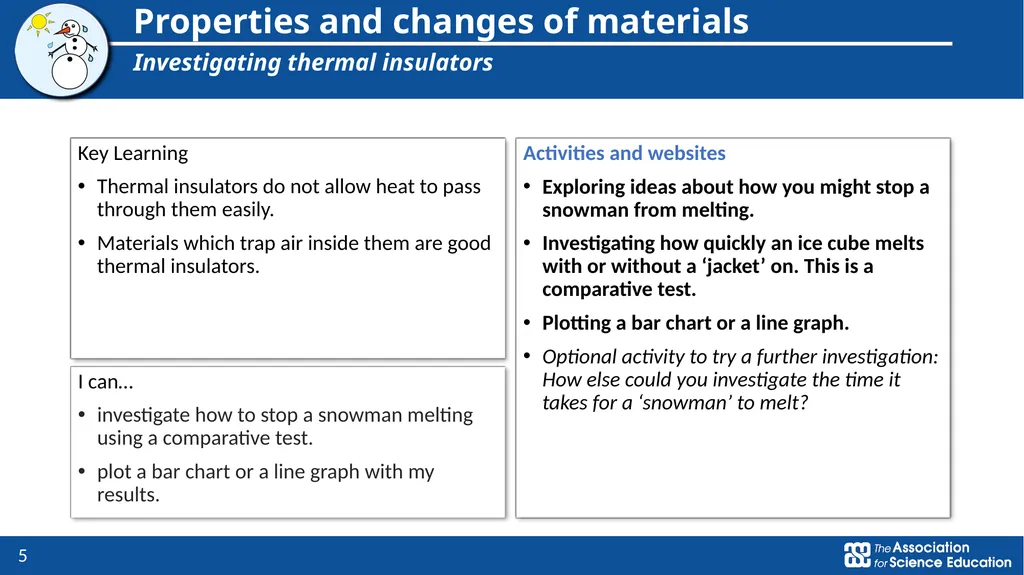
slide5. Properties and changes of materials 5 Investigating thermal insulators Key Learning
Thermal insulators do not allow heat to pass through them easily.
Materials which trap air inside them are good thermal insulators. I can…
investigate how to stop a snowman melting using a comparative test.
plot a bar chart or a line graph with my results. Activities and websites
Exploring ideas about how you might stop a snowman from melting.
Investigating how quickly an ice cube melts with or without a ‘jacket’ on. This is a comparative test.
Plotting a bar chart or a line graph.
Optional activity to try a further investigation: How else could you investigate the time it takes for a ‘snowman’ to melt?<br>
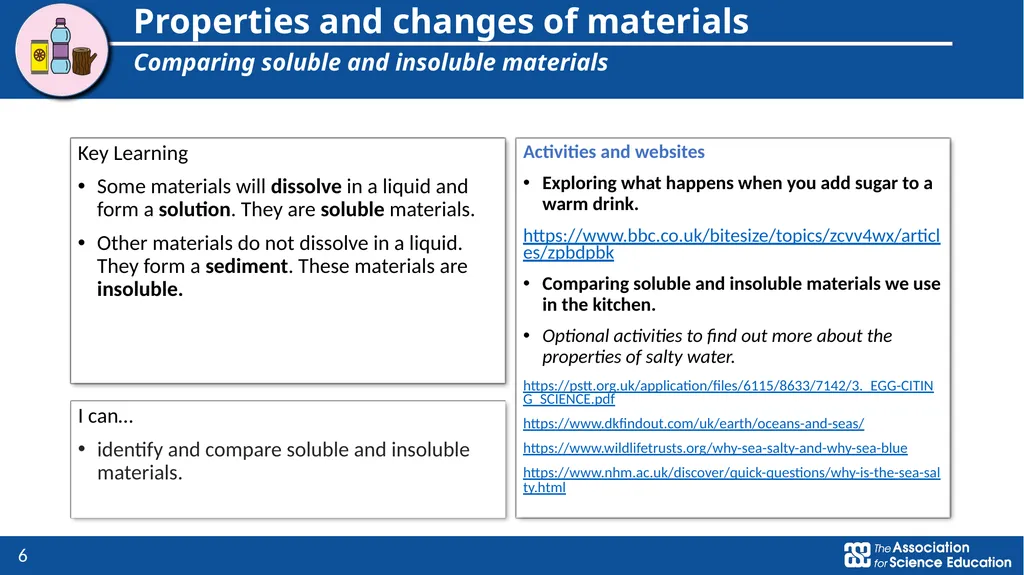
slide6. Properties and changes of materials 6 Comparing soluble and insoluble materials Key Learning
Some materials will dissolve in a liquid and form a solution. They are soluble materials.
Other materials do not dissolve in a liquid. They form a sediment. These materials are insoluble. I can…
identify and compare soluble and insoluble materials. Activities and websites
Exploring what happens when you add sugar to a warm drink.
https://www.bbc.co.uk/bitesize/topics/zcvv4wx/articles/zpbdpbk
Comparing soluble and insoluble materials we use in the kitchen.
Optional activities to find out more about the properties of salty water.
https://pstt.org.uk/application/files/6115/8633/7142/3._EGG-CITING_SCIENCE.pdf
https://www.dkfindout.com/uk/earth/oceans-and-seas/
https://www.wildlifetrusts.org/why-sea-salty-and-why-sea-blue
https://www.nhm.ac.uk/discover/quick-questions/why-is-the-sea-salty.html<br>
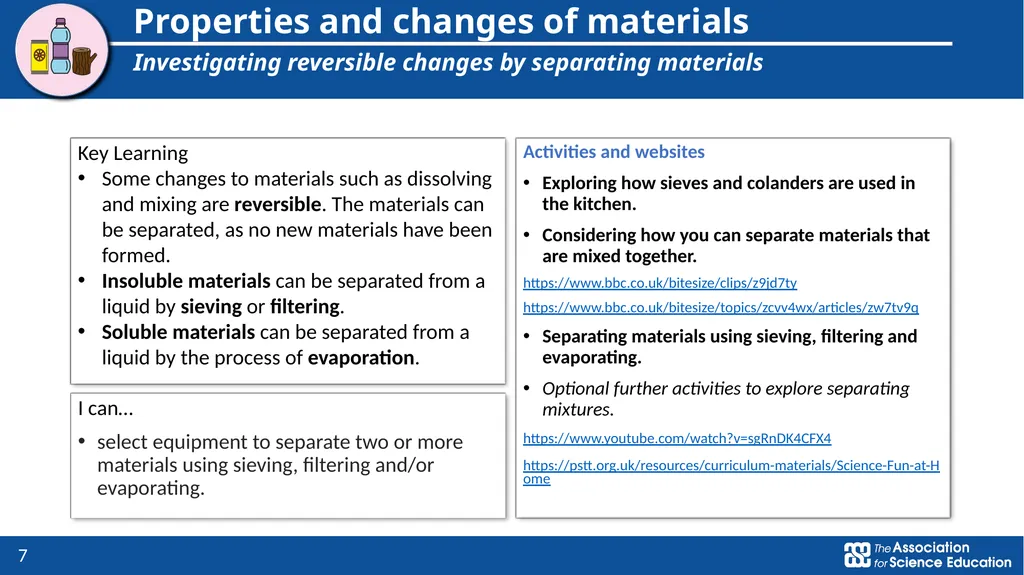
slide7. Properties and changes of materials 7 Investigating reversible changes by separating materials Key Learning
Some changes to materials such as dissolving and mixing are reversible. The materials can be separated, as no new materials have been formed.
Insoluble materials can be separated from a liquid by sieving or filtering.
Soluble materials can be separated from a liquid by the process of evaporation. I can…
select equipment to separate two or more materials using sieving, filtering and/or evaporating. Activities and websites
Exploring how sieves and colanders are used in the kitchen.
Considering how you can separate materials that are mixed together.
https://www.bbc.co.uk/bitesize/clips/z9jd7ty
https://www.bbc.co.uk/bitesize/topics/zcvv4wx/articles/zw7tv9q
Separating materials using sieving, filtering and evaporating.
Optional further activities to explore separating mixtures.
https://www.youtube.com/watch?v=sgRnDK4CFX4
https://pstt.org.uk/resources/curriculum-materials/Science-Fun-at-Home<br>
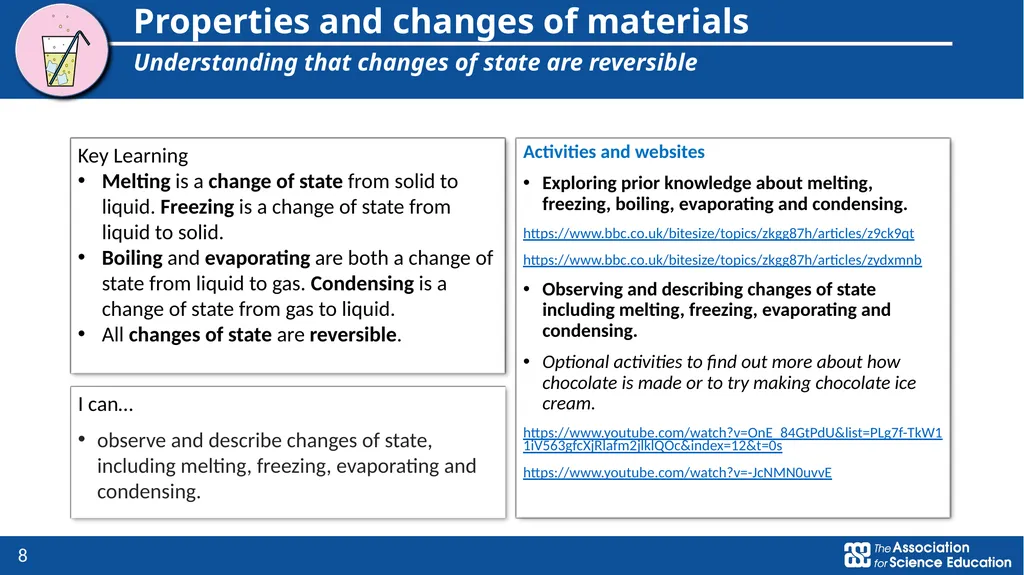
slide8. Properties and changes of materials 8 Understanding that changes of state are reversible Key Learning
Melting is a change of state from solid to liquid. Freezing is a change of state from liquid to solid.
Boiling and evaporating are both a change of state from liquid to gas. Condensing is a change of state from gas to liquid.
All changes of state are reversible. I can…
observe and describe changes of state, including melting, freezing, evaporating and condensing. Activities and websites
Exploring prior knowledge about melting, freezing, boiling, evaporating and condensing.
https://www.bbc.co.uk/bitesize/topics/zkgg87h/articles/z9ck9qt
https://www.bbc.co.uk/bitesize/topics/zkgg87h/articles/zydxmnb
Observing and describing changes of state including melting, freezing, evaporating and condensing.
Optional activities to find out more about how chocolate is made or to try making chocolate ice cream.
https://www.youtube.com/watch?v=OnE_84GtPdU&list=PLg7f-TkW11iV563gfcXjRlafm2jlklQOc&index=12&t=0s
https://www.youtube.com/watch?v=-JcNMN0uvvE<br>
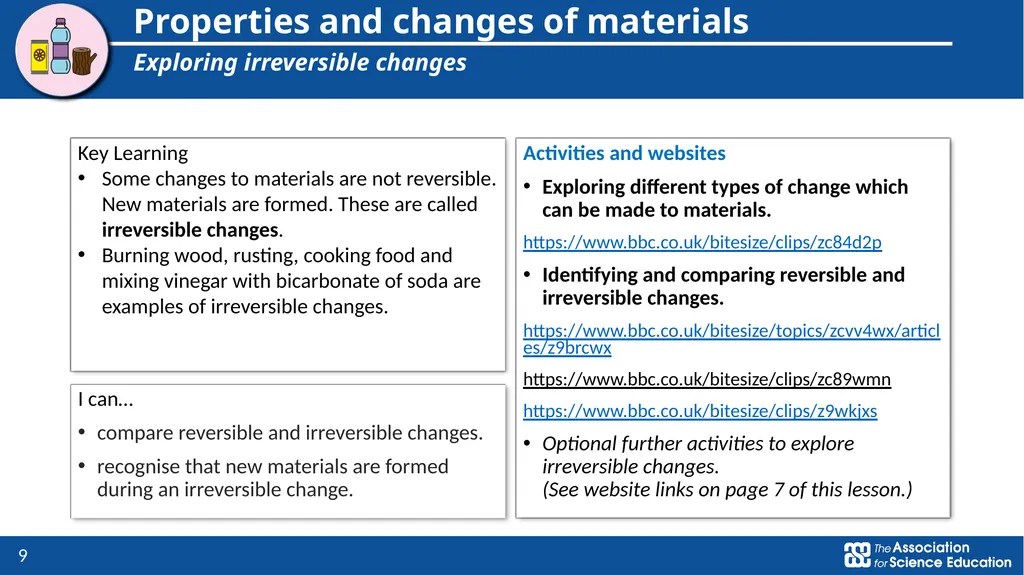
slide9. Properties and changes of materials 9 Exploring irreversible changes Key Learning
Some changes to materials are not reversible. New materials are formed. These are called irreversible changes.
Burning wood, rusting, cooking food and mixing vinegar with bicarbonate of soda are examples of irreversible changes. I can…
compare reversible and irreversible changes.
recognise that new materials are formed during an irreversible change. Activities and websites
Exploring different types of change which can be made to materials.
https://www.bbc.co.uk/bitesize/clips/zc84d2p
Identifying and comparing reversible and irreversible changes.
https://www.bbc.co.uk/bitesize/topics/zcvv4wx/articles/z9brcwx
https://www.bbc.co.uk/bitesize/clips/zc89wmn
https://www.bbc.co.uk/bitesize/clips/z9wkjxs
Optional further activities to explore irreversible changes. (See website links on page 7 of this lesson.)<br>
slide2. Year 5 – Properties and changes of materials 2<br>
slide3. Year 5 – Properties and changes of materials 3<br>
slide4. Properties and changes of materials 4 Exploring properties and uses of materials Key Learning
Materials have different uses depending on their properties.
Properties include hardness, flexibility, absorbency, strength, transparency, electrical and thermal conductivity and attraction to magnets. I can…
use Carroll diagrams to classify materials by their properties. Activities and websites
Exploring prior knowledge about properties of materials.
https://www.bbc.co.uk/bitesize/topics/z4339j6/articles/zx8hhv4
Using Carroll diagrams to classify household items/materials by their properties.
Optional activity to investigate an object made of two or more materials, such as a bike or skateboard.
https://www.dkfindout.com/uk/science/materials/<br>
slide5. Properties and changes of materials 5 Investigating thermal insulators Key Learning
Thermal insulators do not allow heat to pass through them easily.
Materials which trap air inside them are good thermal insulators. I can…
investigate how to stop a snowman melting using a comparative test.
plot a bar chart or a line graph with my results. Activities and websites
Exploring ideas about how you might stop a snowman from melting.
Investigating how quickly an ice cube melts with or without a ‘jacket’ on. This is a comparative test.
Plotting a bar chart or a line graph.
Optional activity to try a further investigation: How else could you investigate the time it takes for a ‘snowman’ to melt?<br>
slide6. Properties and changes of materials 6 Comparing soluble and insoluble materials Key Learning
Some materials will dissolve in a liquid and form a solution. They are soluble materials.
Other materials do not dissolve in a liquid. They form a sediment. These materials are insoluble. I can…
identify and compare soluble and insoluble materials. Activities and websites
Exploring what happens when you add sugar to a warm drink.
https://www.bbc.co.uk/bitesize/topics/zcvv4wx/articles/zpbdpbk
Comparing soluble and insoluble materials we use in the kitchen.
Optional activities to find out more about the properties of salty water.
https://pstt.org.uk/application/files/6115/8633/7142/3._EGG-CITING_SCIENCE.pdf
https://www.dkfindout.com/uk/earth/oceans-and-seas/
https://www.wildlifetrusts.org/why-sea-salty-and-why-sea-blue
https://www.nhm.ac.uk/discover/quick-questions/why-is-the-sea-salty.html<br>
slide7. Properties and changes of materials 7 Investigating reversible changes by separating materials Key Learning
Some changes to materials such as dissolving and mixing are reversible. The materials can be separated, as no new materials have been formed.
Insoluble materials can be separated from a liquid by sieving or filtering.
Soluble materials can be separated from a liquid by the process of evaporation. I can…
select equipment to separate two or more materials using sieving, filtering and/or evaporating. Activities and websites
Exploring how sieves and colanders are used in the kitchen.
Considering how you can separate materials that are mixed together.
https://www.bbc.co.uk/bitesize/clips/z9jd7ty
https://www.bbc.co.uk/bitesize/topics/zcvv4wx/articles/zw7tv9q
Separating materials using sieving, filtering and evaporating.
Optional further activities to explore separating mixtures.
https://www.youtube.com/watch?v=sgRnDK4CFX4
https://pstt.org.uk/resources/curriculum-materials/Science-Fun-at-Home<br>
slide8. Properties and changes of materials 8 Understanding that changes of state are reversible Key Learning
Melting is a change of state from solid to liquid. Freezing is a change of state from liquid to solid.
Boiling and evaporating are both a change of state from liquid to gas. Condensing is a change of state from gas to liquid.
All changes of state are reversible. I can…
observe and describe changes of state, including melting, freezing, evaporating and condensing. Activities and websites
Exploring prior knowledge about melting, freezing, boiling, evaporating and condensing.
https://www.bbc.co.uk/bitesize/topics/zkgg87h/articles/z9ck9qt
https://www.bbc.co.uk/bitesize/topics/zkgg87h/articles/zydxmnb
Observing and describing changes of state including melting, freezing, evaporating and condensing.
Optional activities to find out more about how chocolate is made or to try making chocolate ice cream.
https://www.youtube.com/watch?v=OnE_84GtPdU&list=PLg7f-TkW11iV563gfcXjRlafm2jlklQOc&index=12&t=0s
https://www.youtube.com/watch?v=-JcNMN0uvvE<br>
slide9. Properties and changes of materials 9 Exploring irreversible changes Key Learning
Some changes to materials are not reversible. New materials are formed. These are called irreversible changes.
Burning wood, rusting, cooking food and mixing vinegar with bicarbonate of soda are examples of irreversible changes. I can…
compare reversible and irreversible changes.
recognise that new materials are formed during an irreversible change. Activities and websites
Exploring different types of change which can be made to materials.
https://www.bbc.co.uk/bitesize/clips/zc84d2p
Identifying and comparing reversible and irreversible changes.
https://www.bbc.co.uk/bitesize/topics/zcvv4wx/articles/z9brcwx
https://www.bbc.co.uk/bitesize/clips/zc89wmn
https://www.bbc.co.uk/bitesize/clips/z9wkjxs
Optional further activities to explore irreversible changes. (See website links on page 7 of this lesson.)<br>