Year 7 Pythagoras’ Theorem Dr J Frost
Description: Year 7 Pythagoras Theorem Dr J Frost (jfrosttiffin.kingston.sch.uk) www.drfrostmaths.com Last modified: 29th April 2016 Objectives: Apply Pythagoras Theorem to 2D problems. Know common Pythagorean triples. Know what is meant by given
Related Topics
Download Presentation
"Year 7 Pythagoras’ Theorem Dr J Frost" is the property of its rightful owner. Permission is granted to download and print the materials on this website for personal, non-commercial use only, and to display it on your personal computer provided you do not modify the materials and that you retain all copyright notices contained in the materials. By downloading content from our website, you accept the terms of this agreement.
Presentation Transcript
slide1. Year 7 Pythagoras’ Theorem Dr J Frost (jfrost@tiffin.kingston.sch.uk)
www.drfrostmaths.com Last modified: 29th April 2016 Objectives: Apply Pythagoras’ Theorem to 2D problems.
Know common ‘Pythagorean triples’. Know what is meant by given an answer in ‘exact form’.
Find the perpendicular height and area of an equilateral triangle.<br>
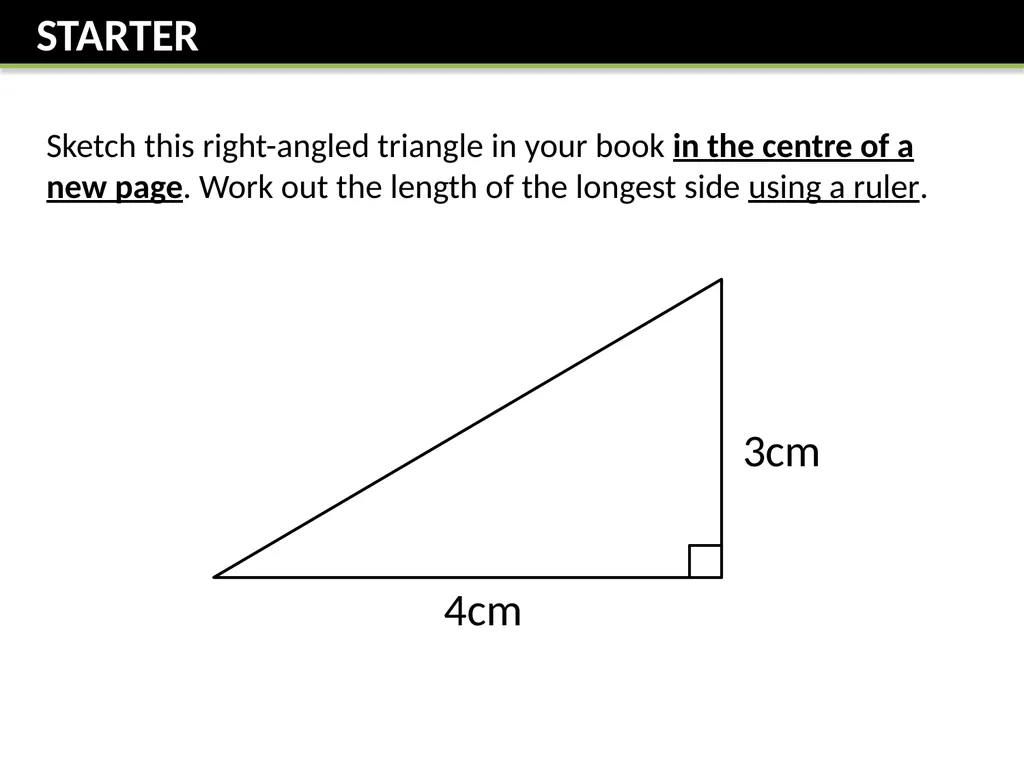
slide2. Sketch this right-angled triangle in your book in the centre of a new page. Work out the length of the longest side using a ruler. 4cm 3cm<br>
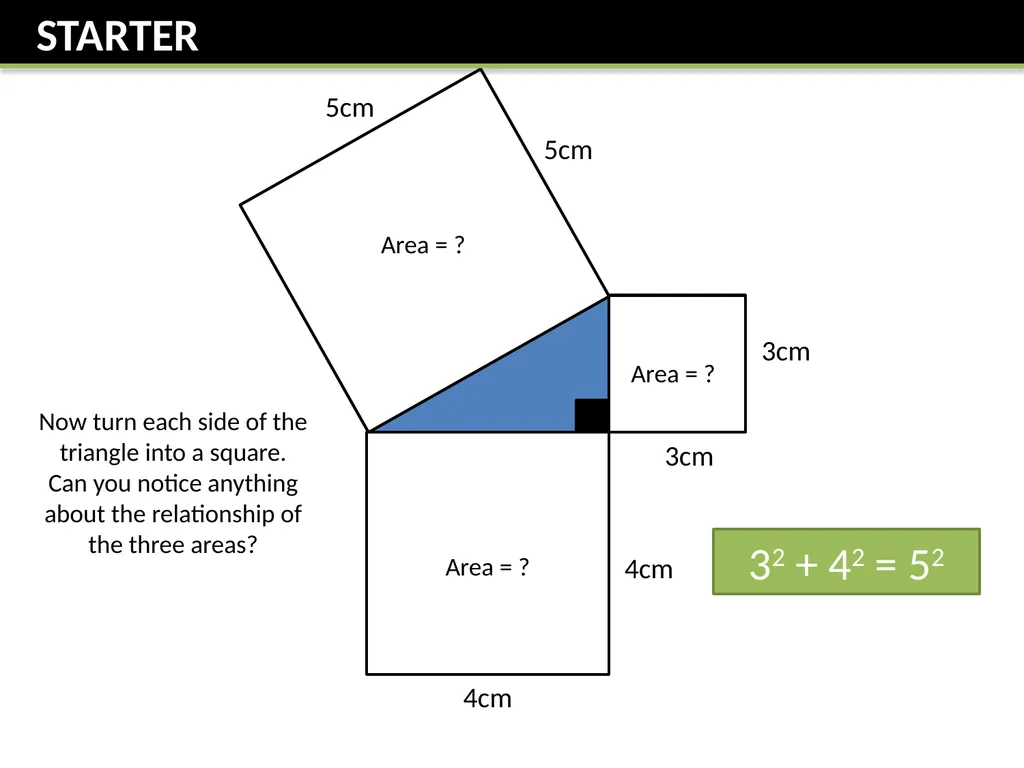
slide3. 3cm 3cm 4cm 4cm 5cm 5cm Area = ? Area = ? Area = ? Now turn each side of the triangle into a square.
Can you notice anything about the relationship of the three areas? 32 + 42 = 52<br>
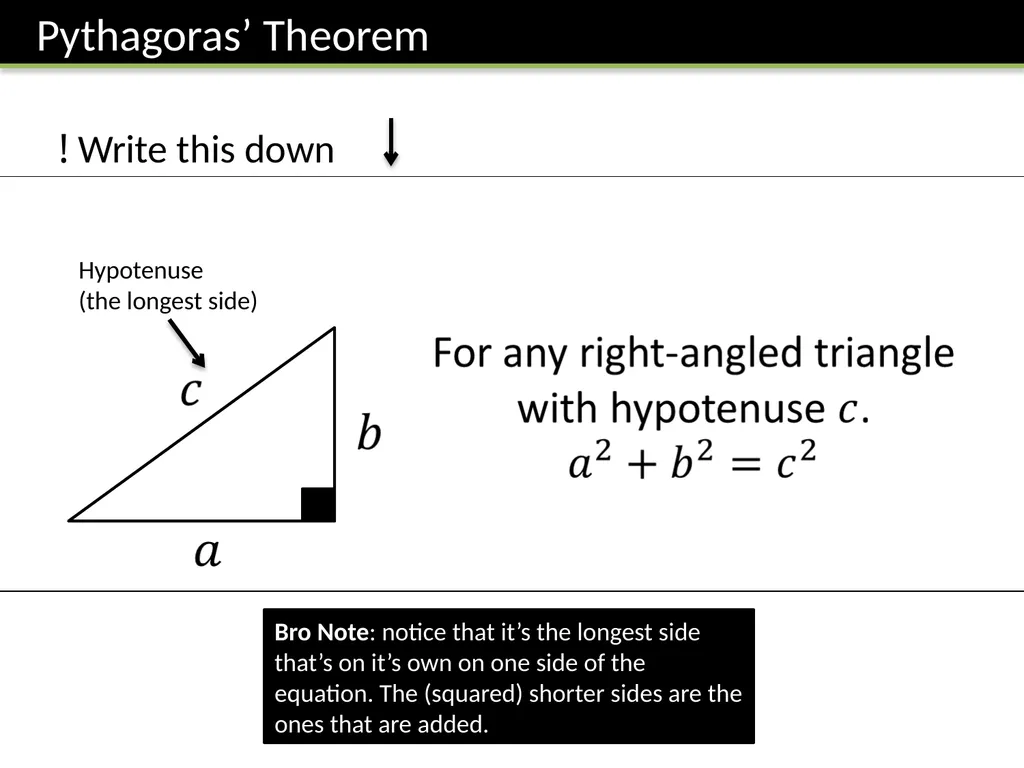
slide4. ! Write this down Bro Note: notice that it’s the longest side that’s on it’s own on one side of the equation. The (squared) shorter sides are the ones that are added.<br>
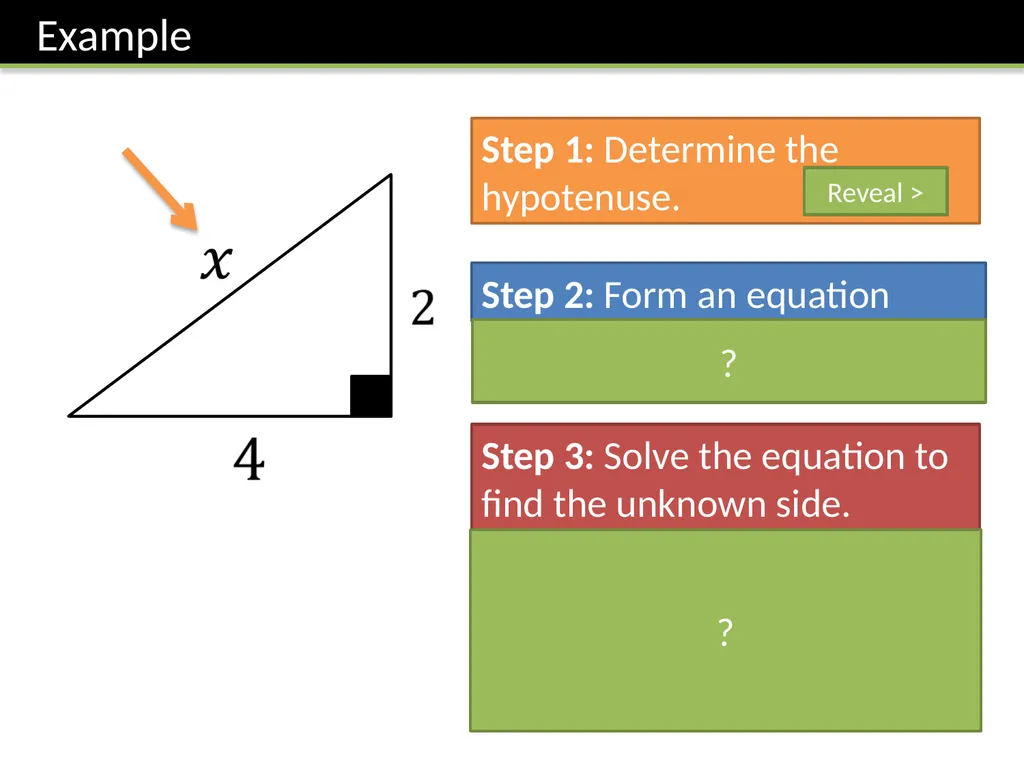
slide5. Step 1: Determine the hypotenuse. Step 2: Form an equation Step 3: Solve the equation to find the unknown side. The hypotenuse appears on its own. ? ? Reveal ><br>
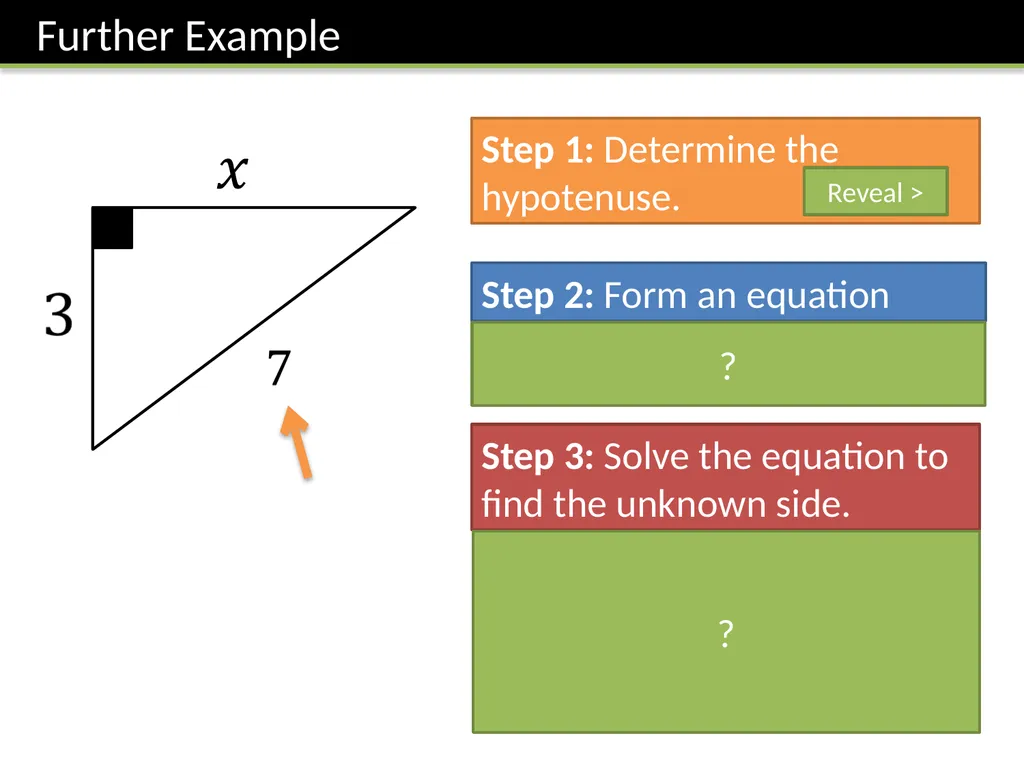
slide6. Step 1: Determine the hypotenuse. Step 2: Form an equation Step 3: Solve the equation to find the unknown side. The hypotenuse appears on its own. ? ? Reveal ><br>
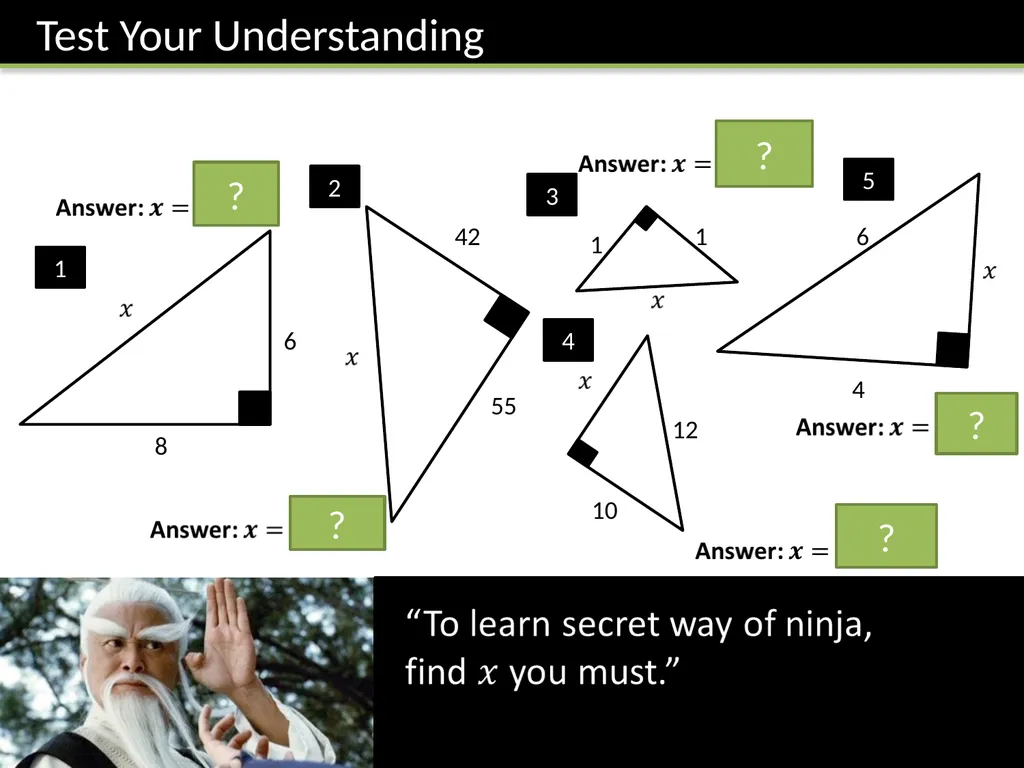
slide8. 6 8 42 55 6 4 1 1 10 12 1 2 3 4 5 ? ? ? ? ?<br>
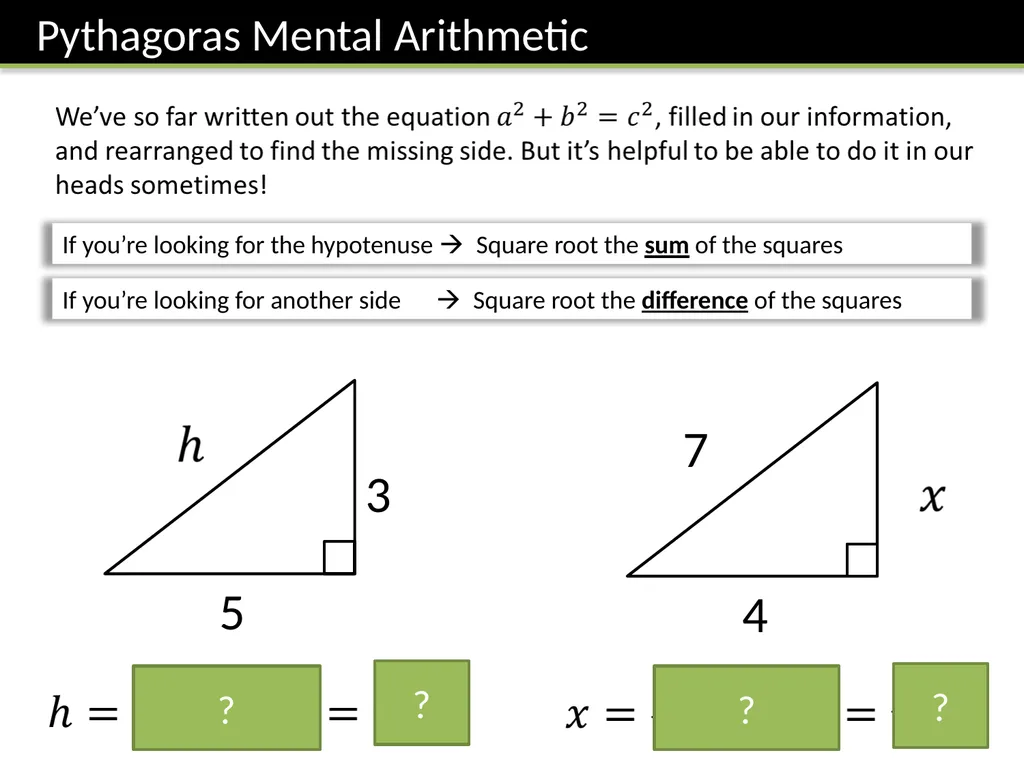
slide9. If you’re looking for the hypotenuse Square root the sum of the squares If you’re looking for another side Square root the difference of the squares 3 5 4 7 ? ? ? ?<br>
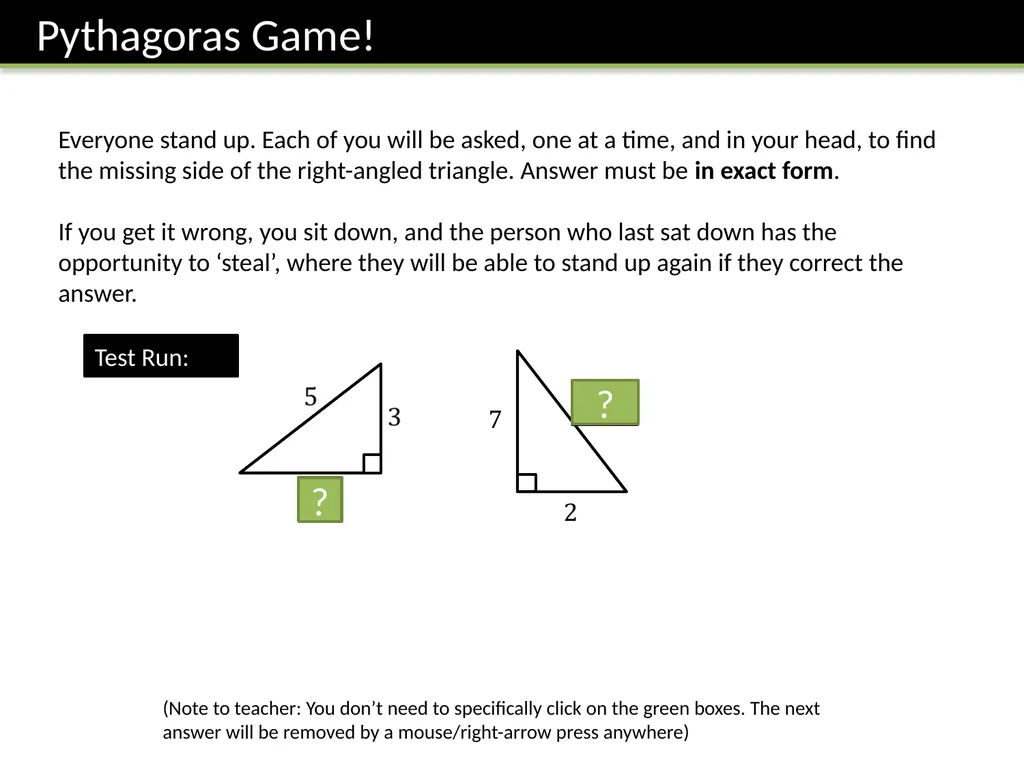
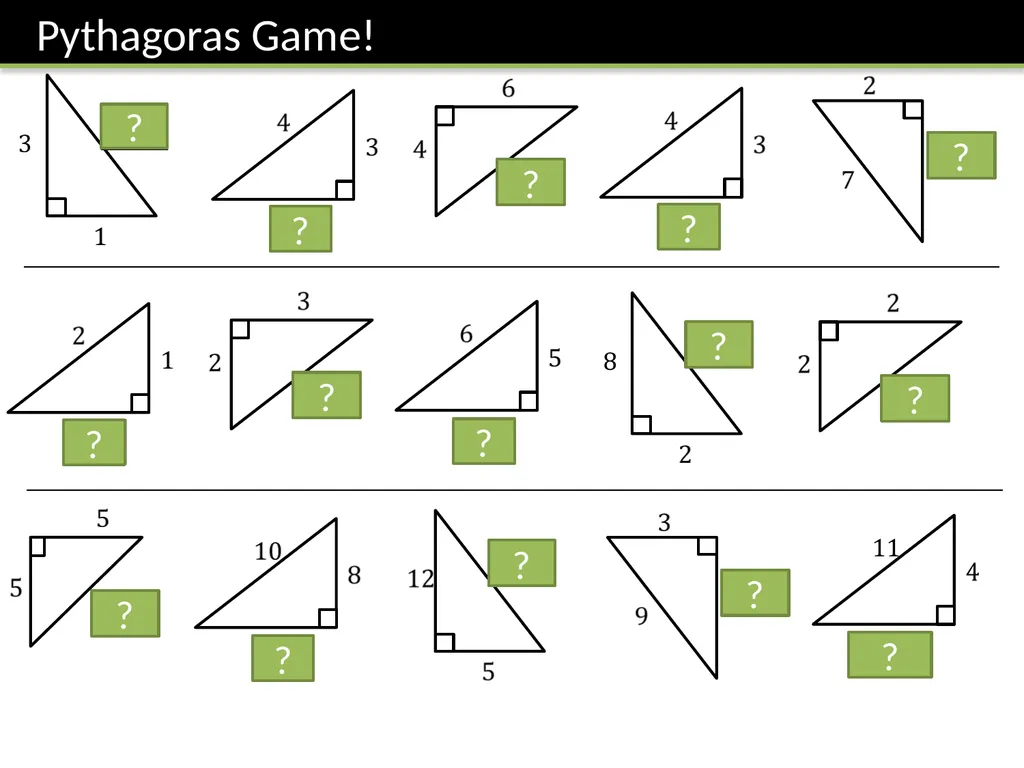
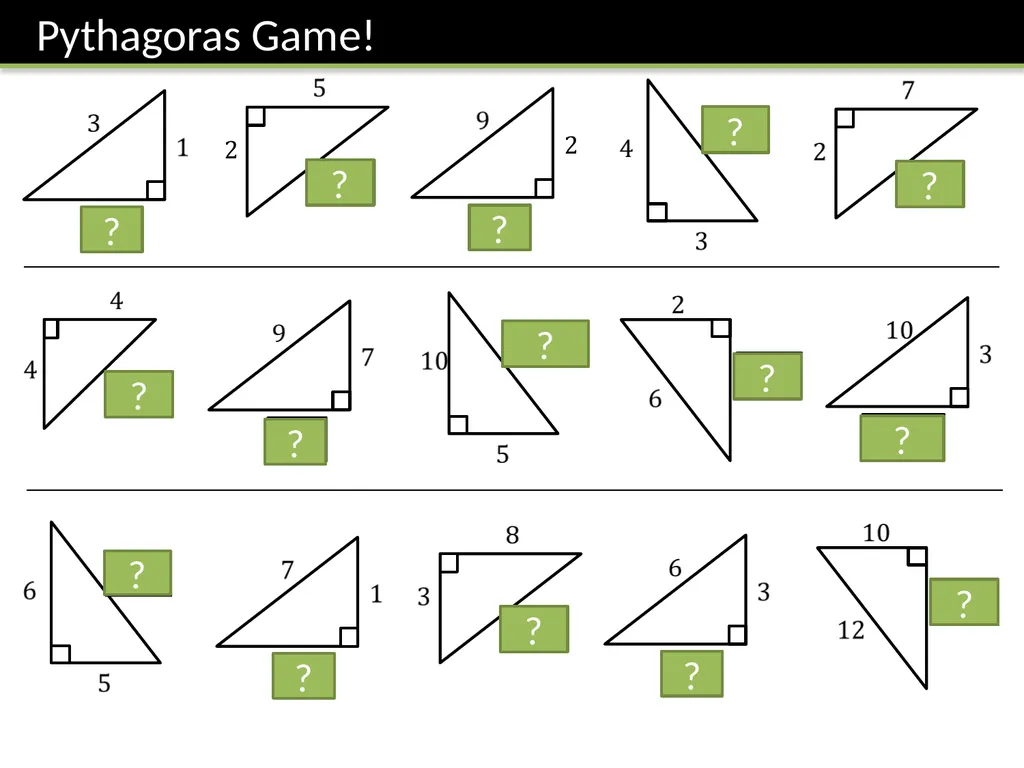
slide10. Everyone stand up. Each of you will be asked, one at a time, and in your head, to find the missing side of the right-angled triangle. Answer must be in exact form.
If you get it wrong, you sit down, and the person who last sat down has the opportunity to ‘steal’, where they will be able to stand up again if they correct the answer. ? ? Test Run: (Note to teacher: You don’t need to specifically click on the green boxes. The next answer will be removed by a mouse/right-arrow press anywhere)<br>
slide11. ? ? ? ? ? ? ? ? ? ? ? ? ? ? ?<br>
slide12. ? ? ? ? ? ? ? ? ? ? ? ? ? ? ?<br>
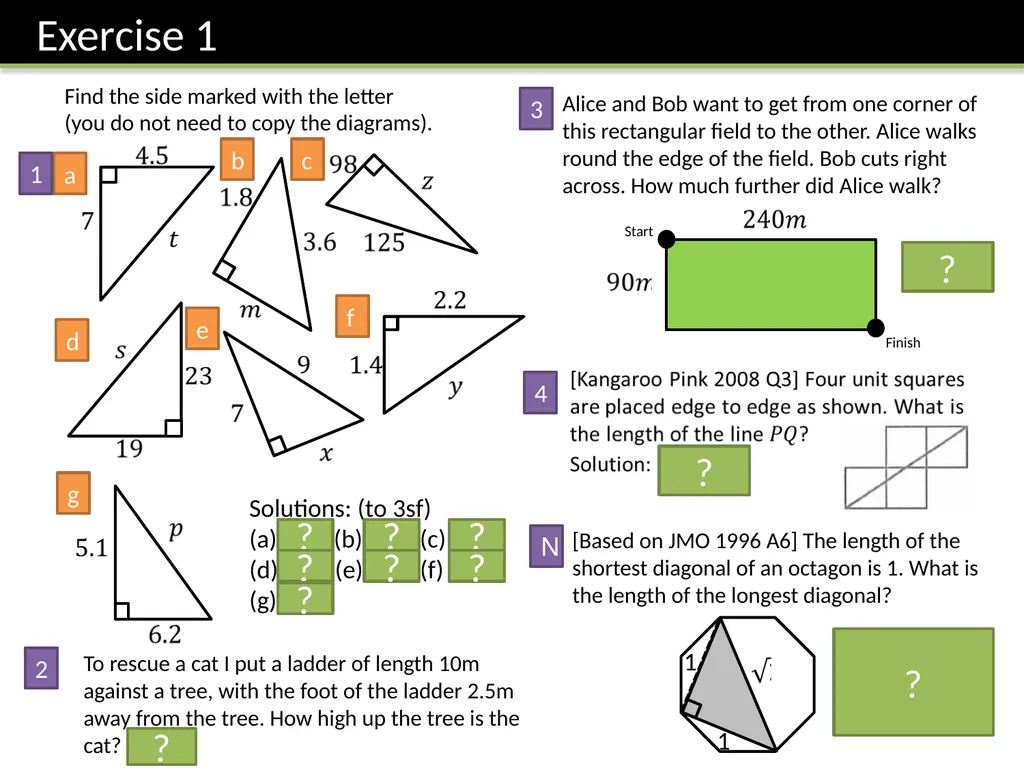
slide13. Find the side marked with the letter (you do not need to copy the diagrams). a b c d e f g Solutions: (to 3sf)
(a) 8.32 (b) 3.12 (c) 77.6
(d) 29.8 (e) 5.66 (f) 2.61
(g) 8.03 1 2 To rescue a cat I put a ladder of length 10m against a tree, with the foot of the ladder 2.5m away from the tree. How high up the tree is the cat? 9.68m Alice and Bob want to get from one corner of this rectangular field to the other. Alice walks round the edge of the field. Bob cuts right across. How much further did Alice walk? [Based on JMO 1996 A6] The length of the shortest diagonal of an octagon is 1. What is the length of the longest diagonal? Start Finish 80m 3 4 N ? ? ? ? ? ? ? ? ? ? ? 1 1<br>
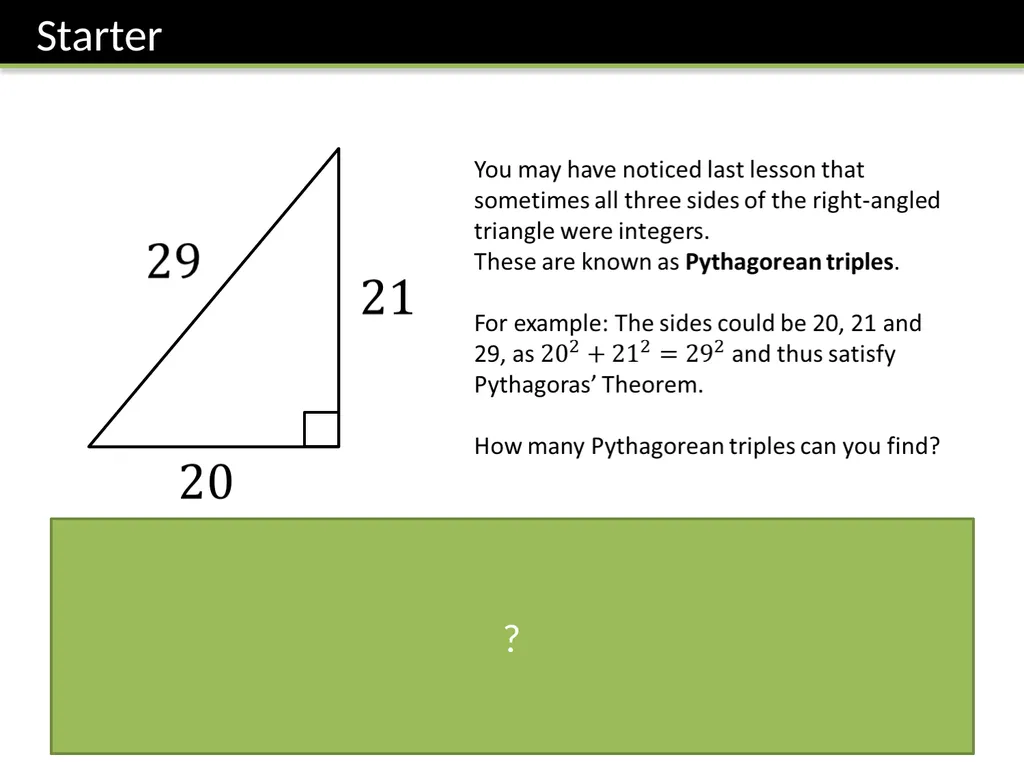
slide14. Note that you could also have any multiple of any of these triples as the triangles could be scaled in size. So for example (3, 4, 5) could become (6,8,10) and so on.
A final note is that if you changed the powers from 2 to 3, or any higher number, then there would never be any solutions. This is known as Fermat’s Last Theorem, which was unproven for hundreds of years before being proven in 1995. ?<br>
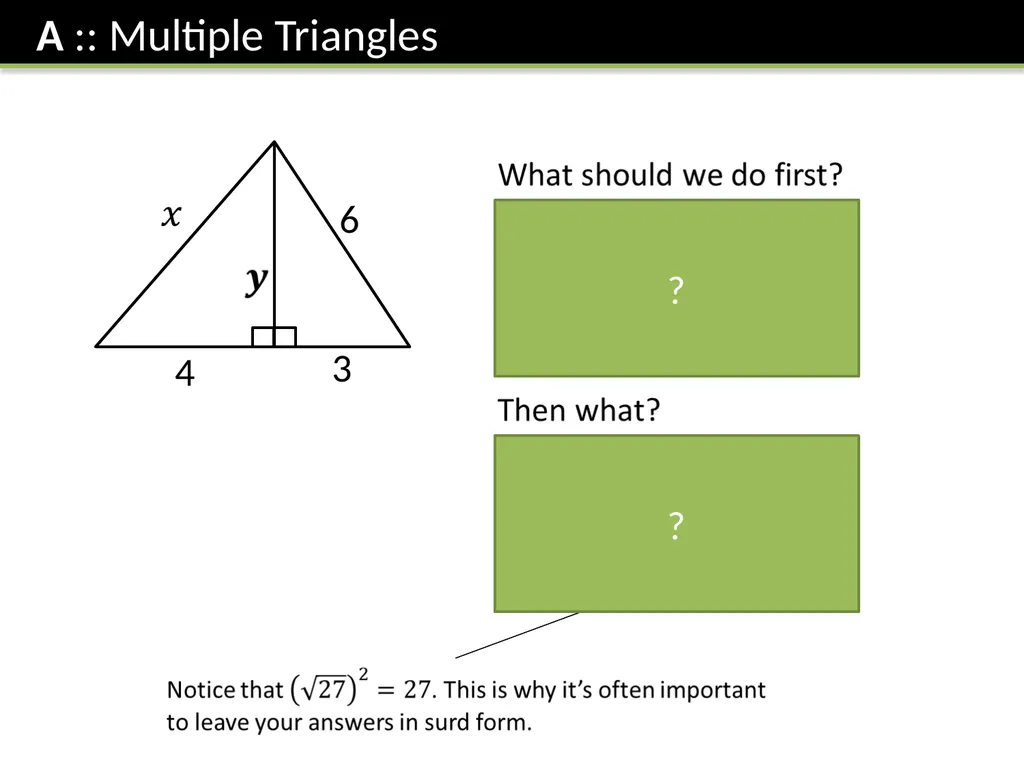
slide15. There’s a variety of ways in which Pythagoras questions could get harder: 6 3 4 Multiple triangles chained together. A B Adding lines to form right-angled triangles that weren’t originally there. Area? 2 2 2 3 7 9 C Requiring algebraic manipulation.<br>
slide16. 6 3 4 ? ?<br>
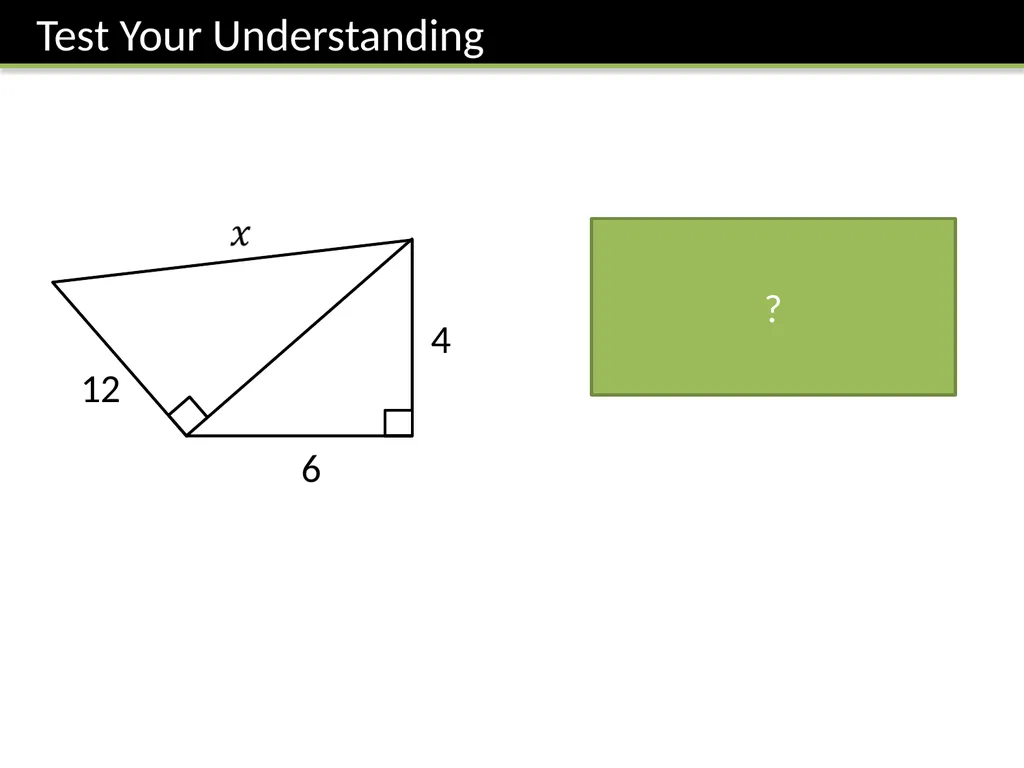
slide17. 4 6 12 ?<br>
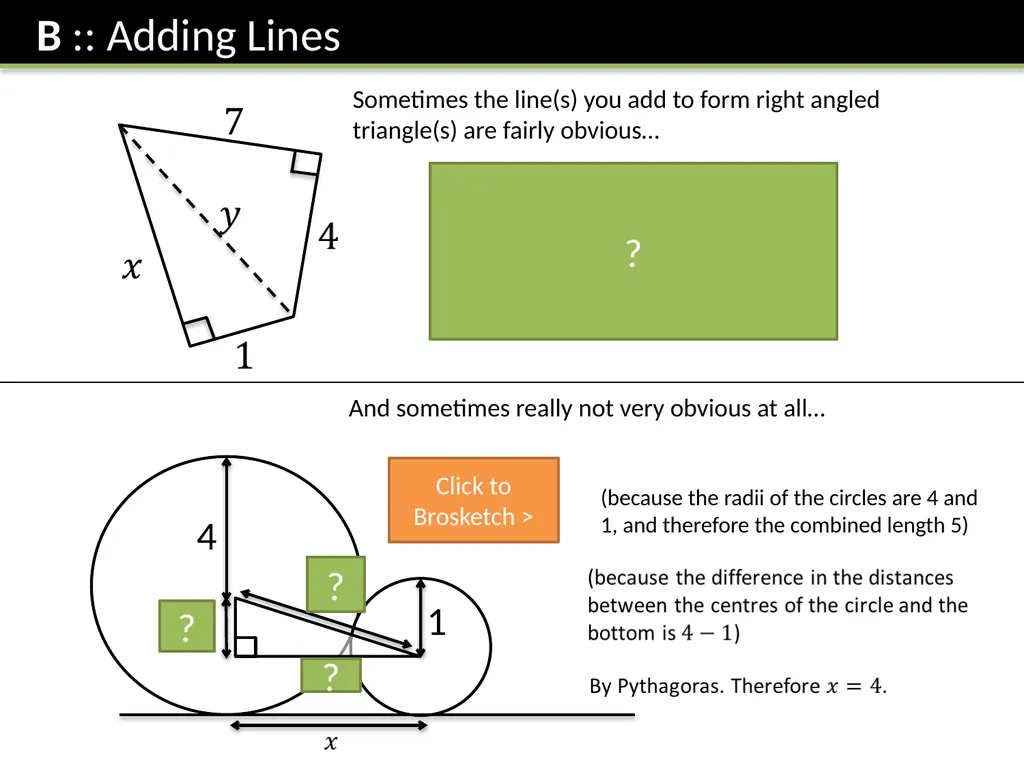
slide18. ? Sometimes the line(s) you add to form right angled triangle(s) are fairly obvious… And sometimes really not very obvious at all… 4 1 5 3 4 ? ? ? Click to Brosketch > (because the radii of the circles are 4 and 1, and therefore the combined length 5)<br>
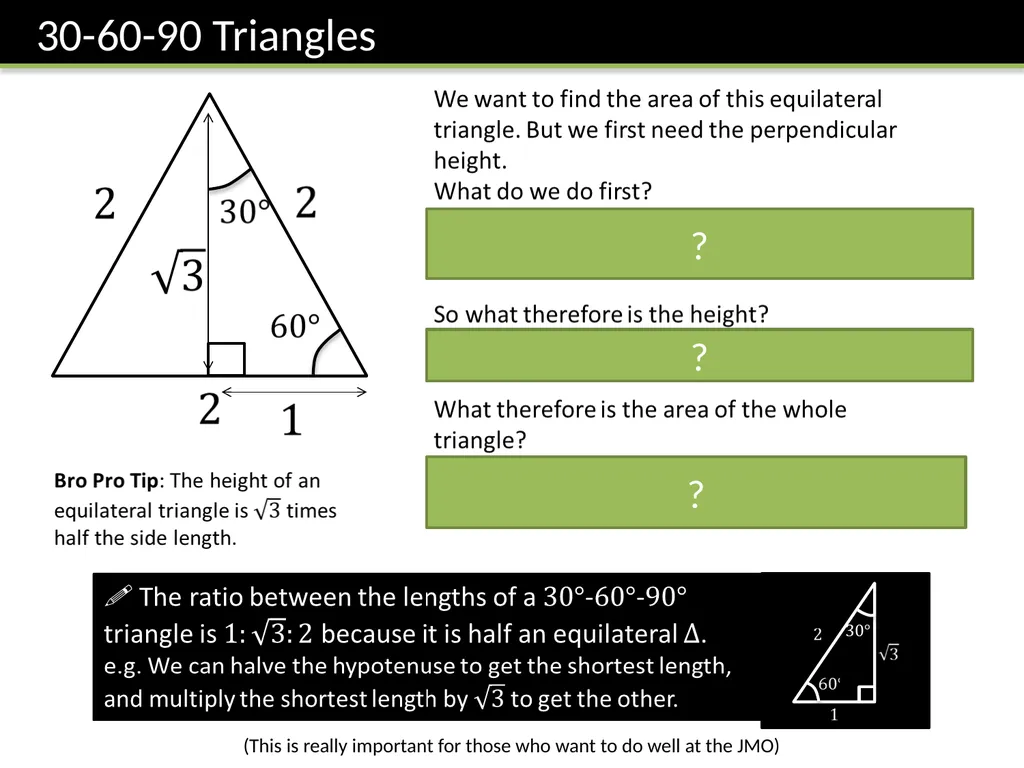
slide19. ? ? ? (This is really important for those who want to do well at the JMO)<br>
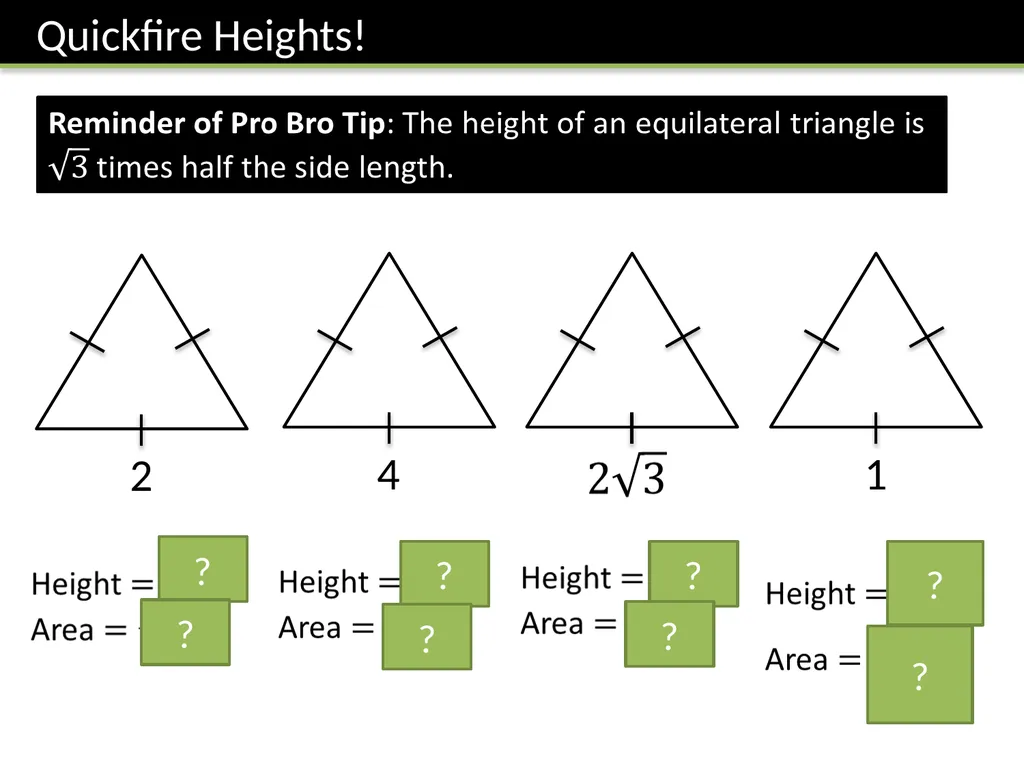
slide20. 2 ? ? 4 ? ? ? ? 1 ? ?<br>
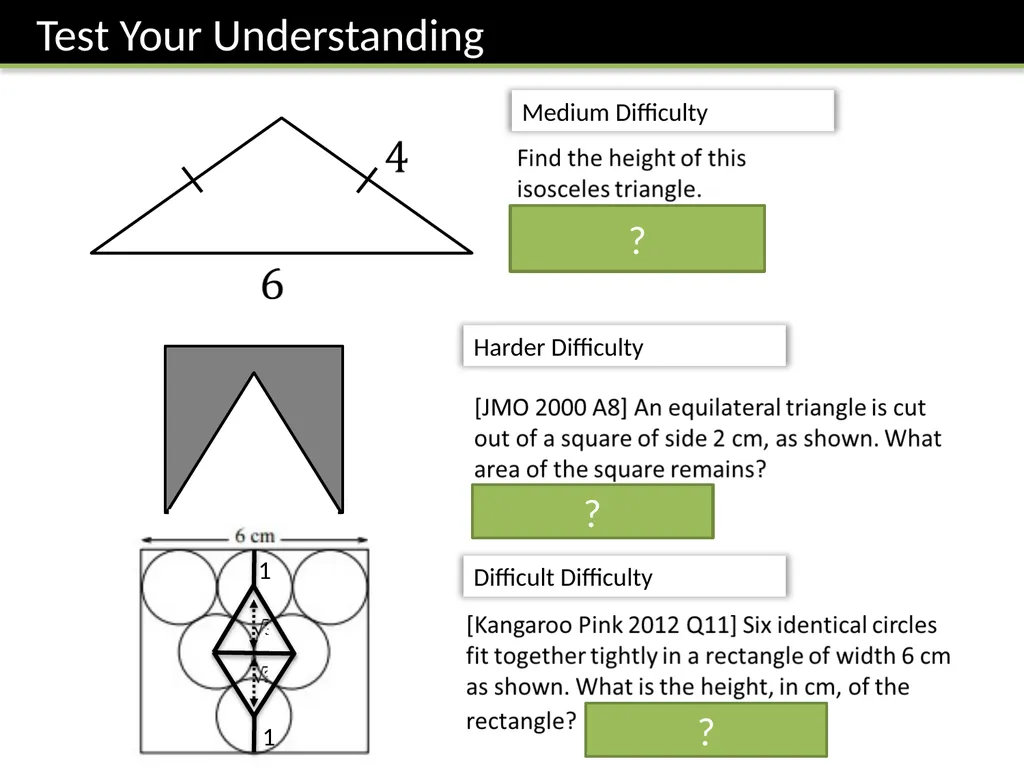
slide21. Medium Difficulty Harder Difficulty Difficult Difficulty 1 1 ? ? ?<br>
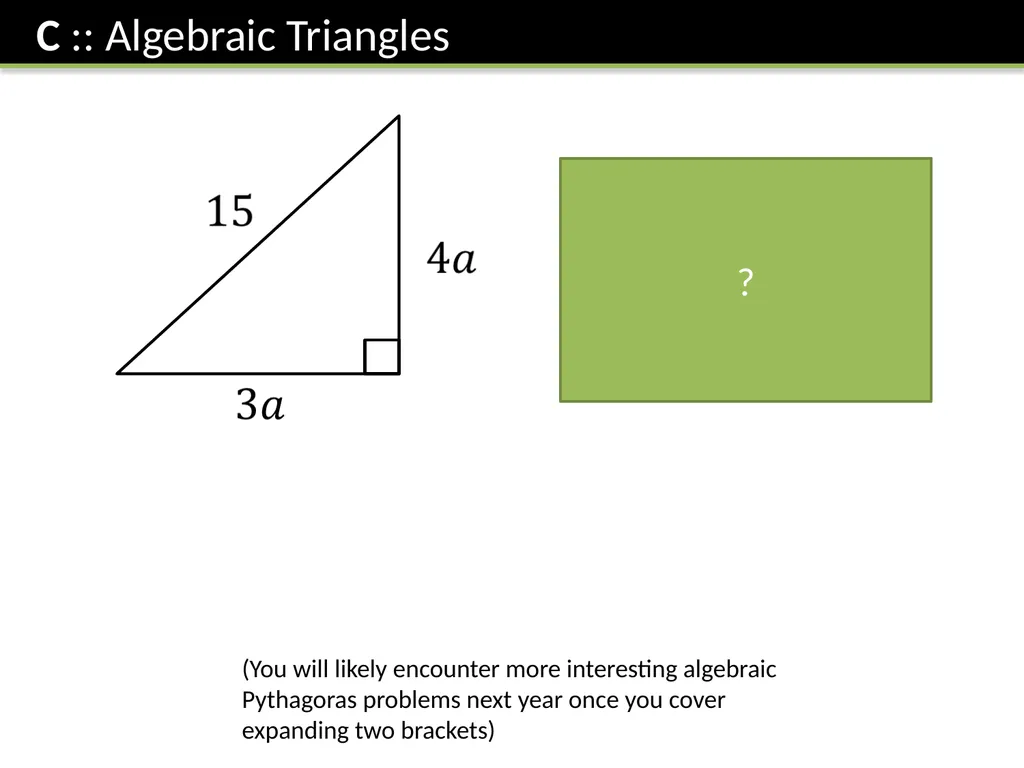
slide22. ? (You will likely encounter more interesting algebraic Pythagoras problems next year once you cover expanding two brackets)<br>
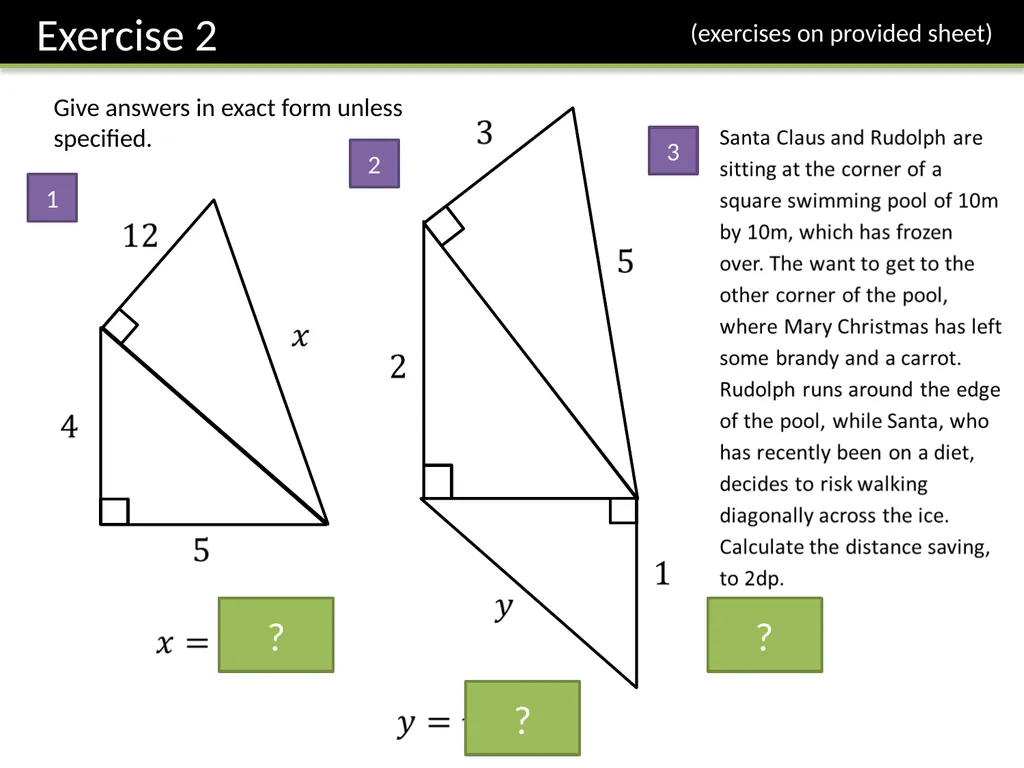
slide23. (exercises on provided sheet) Give answers in exact form unless specified. 1 2 3 ? ? ?<br>
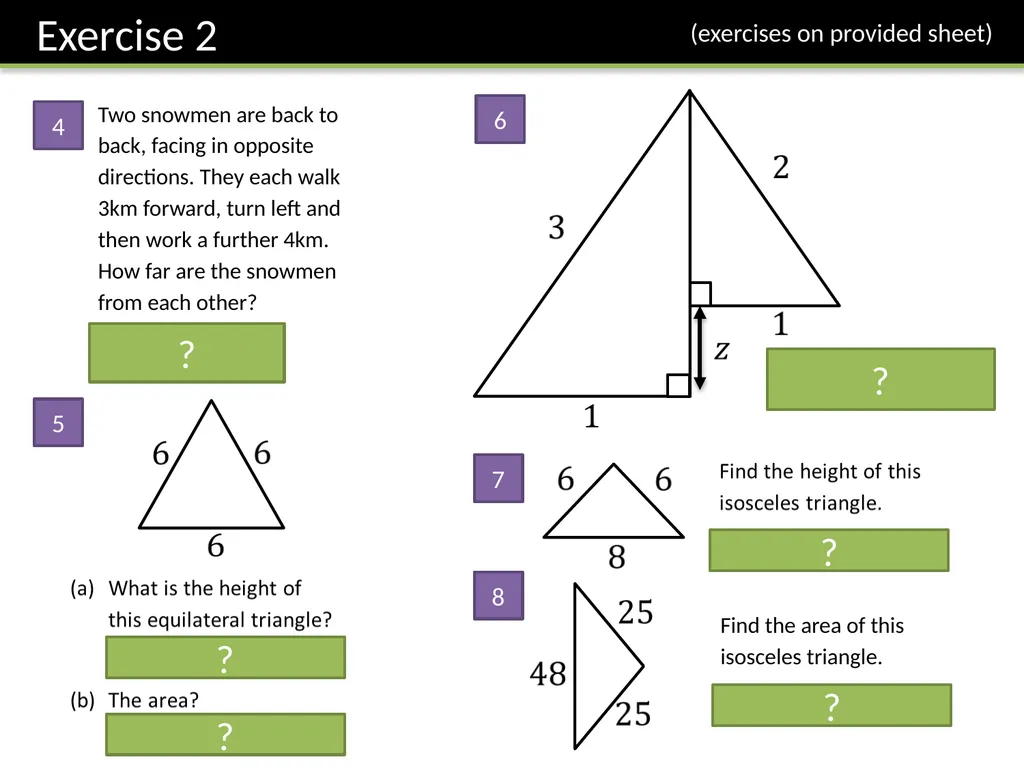
slide24. (exercises on provided sheet) Two snowmen are back to back, facing in opposite directions. They each walk 3km forward, turn left and then work a further 4km. How far are the snowmen from each other?
Solution: 10km 4 6 5 7 Find the area of this isosceles triangle.
Solution: 168 8 ? ? ? ? ? ?<br>
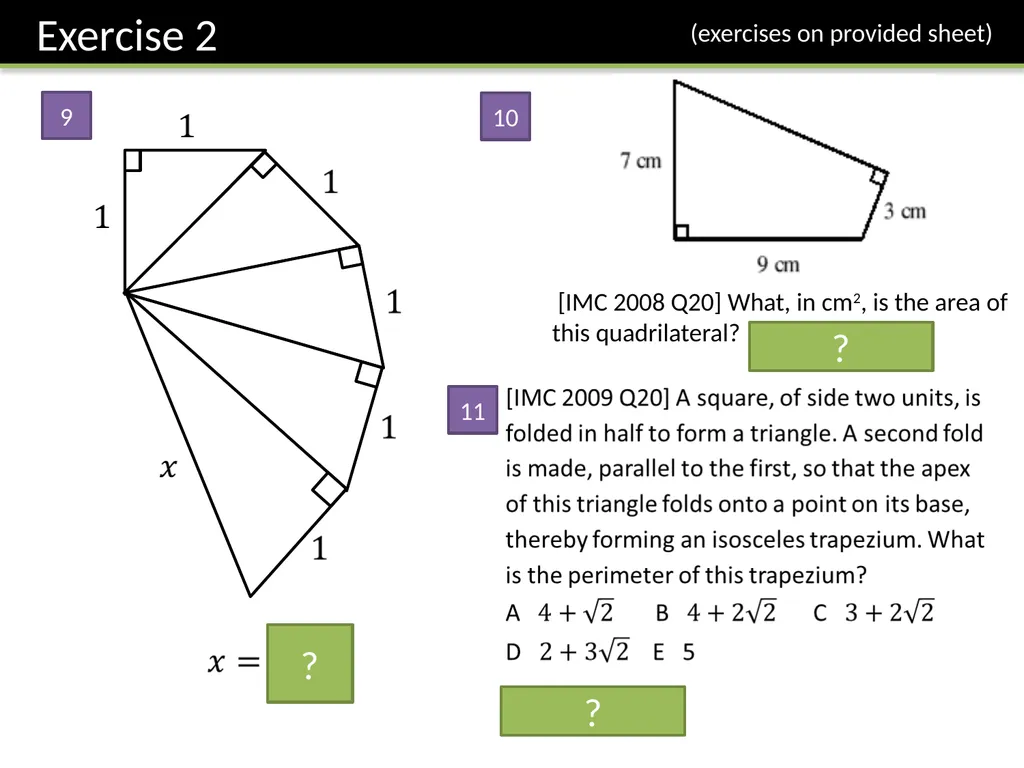
slide25. (exercises on provided sheet) 9 10 [IMC 2008 Q20] What, in cm2, is the area of this quadrilateral? Solution: 48cm2 11 ? ? ?<br>

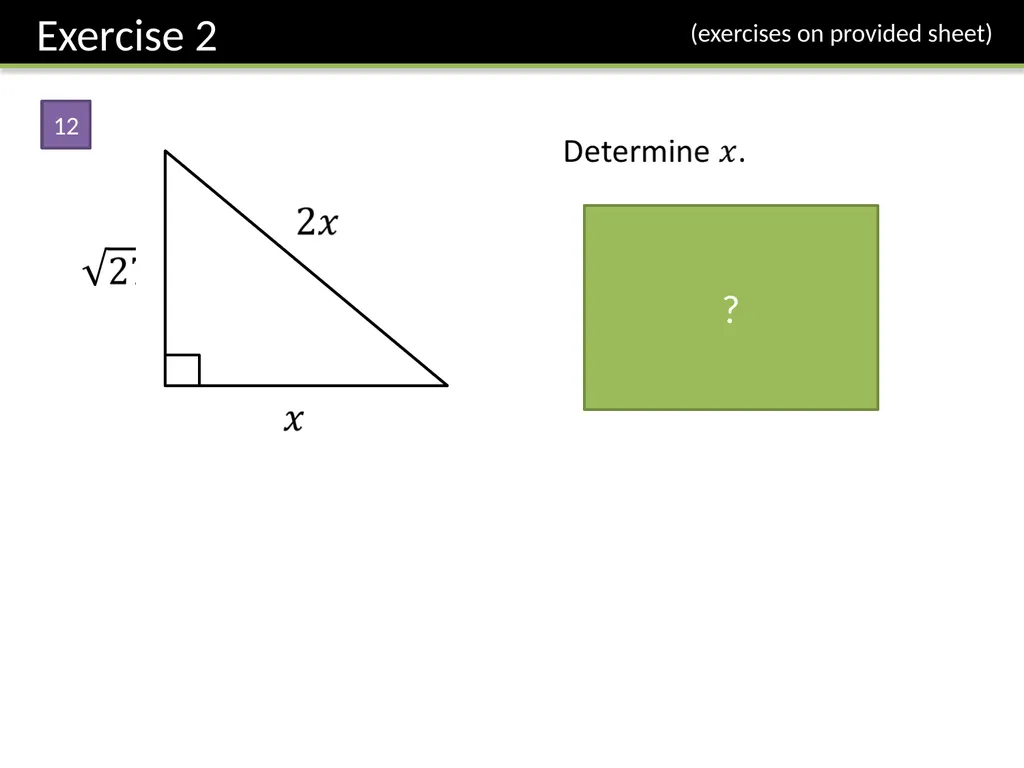
slide26. (exercises on provided sheet) 12 ?<br>
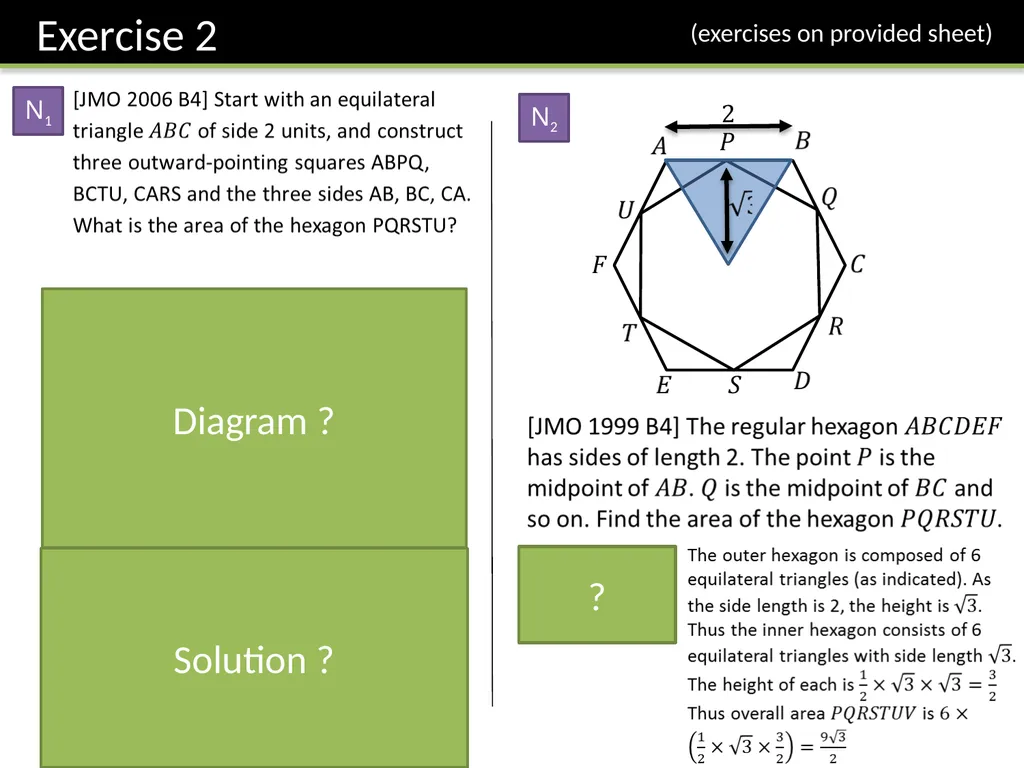
slide27. (exercises on provided sheet) ? Solution ? Diagram ? N1 N2<br>
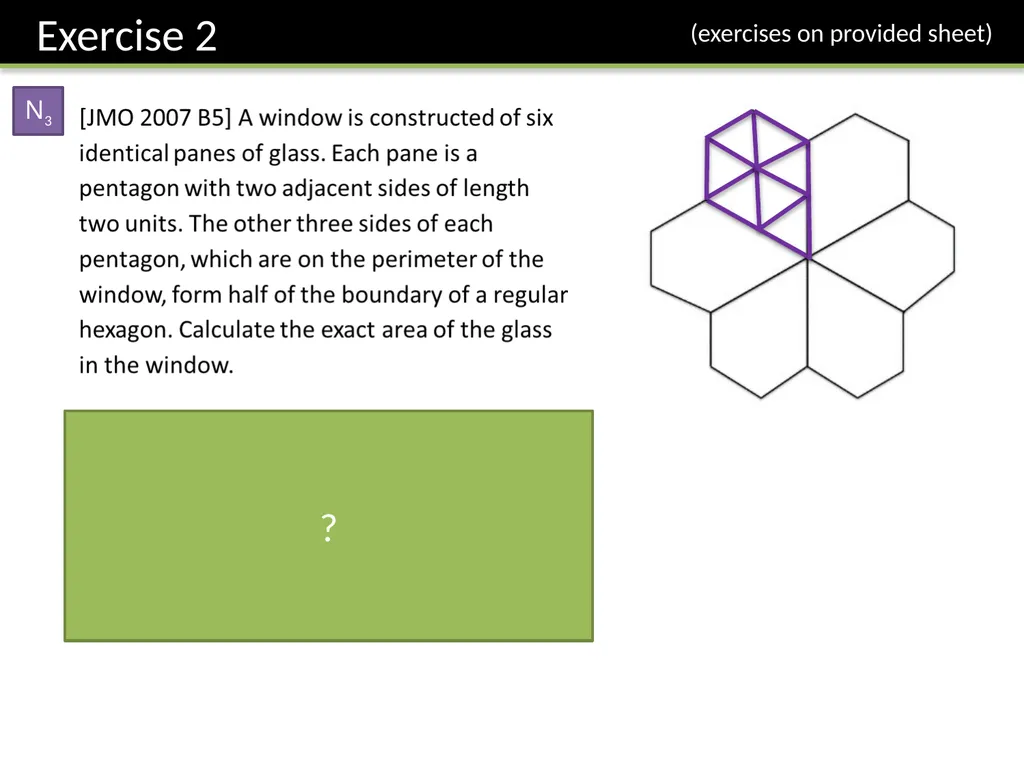
slide28. (exercises on provided sheet) ? N3<br>
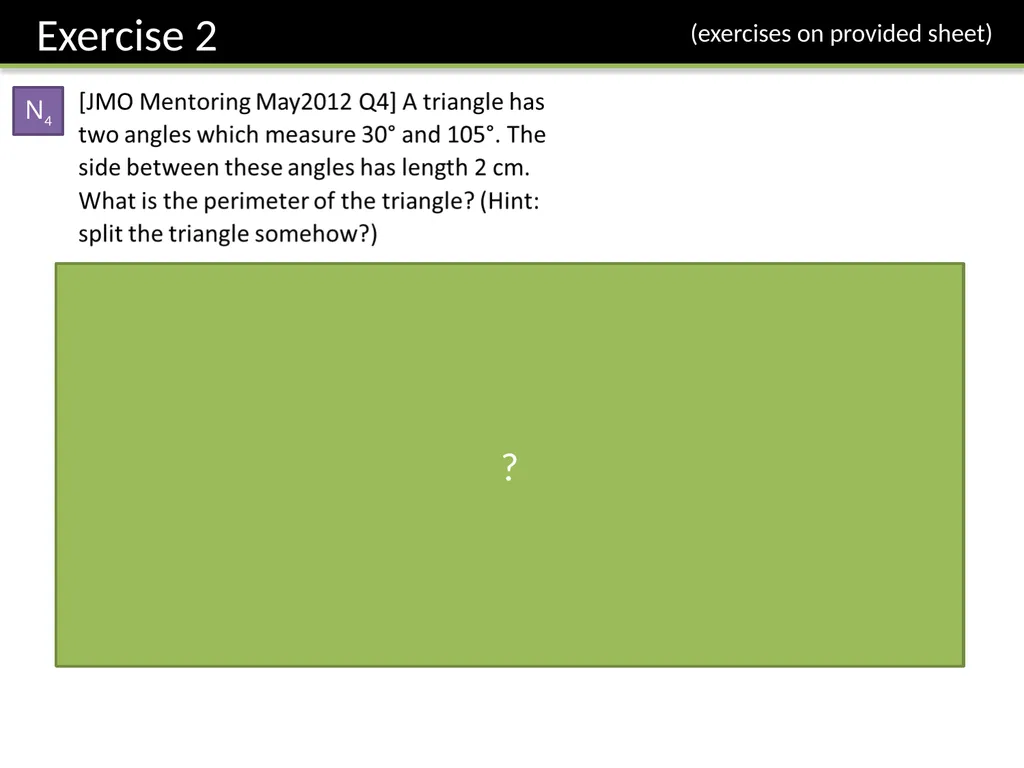
slide29. (exercises on provided sheet) N4 ?<br>
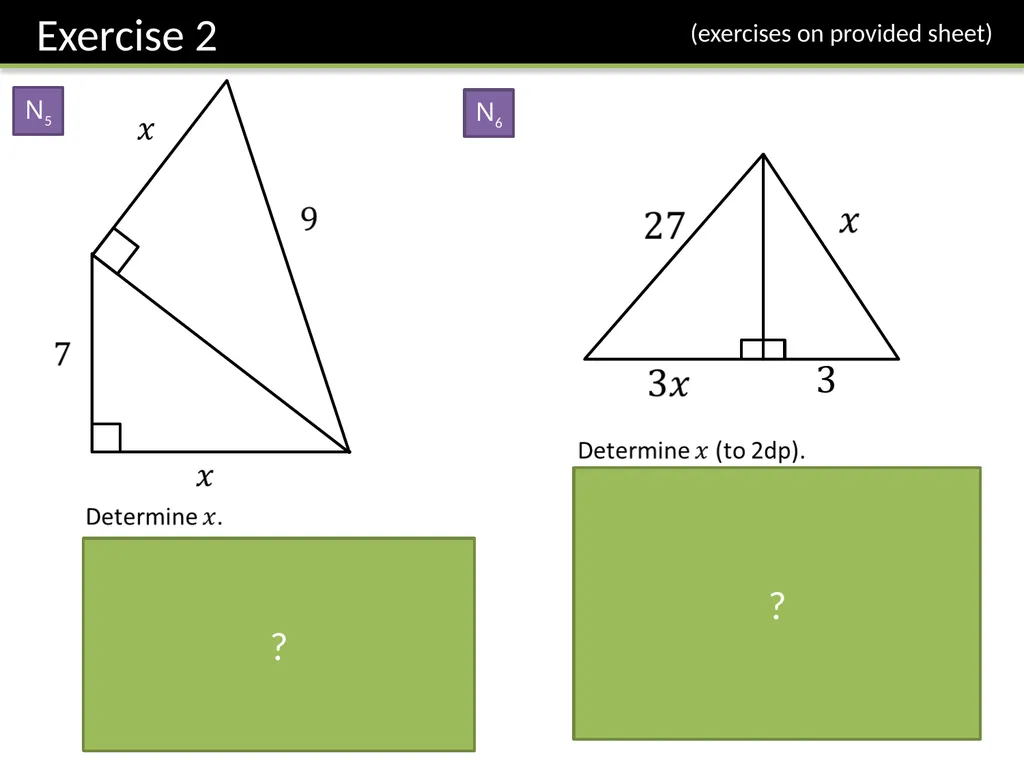
slide30. (exercises on provided sheet) N5 ? N6 ?<br>
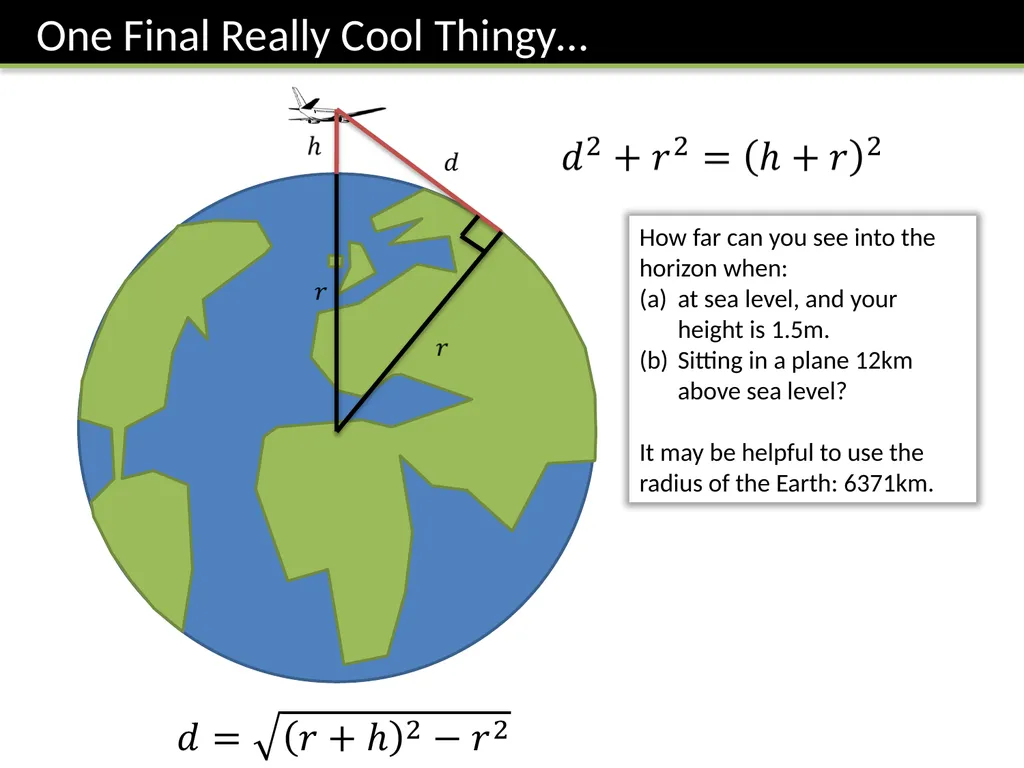
slide31. How far can you see into the horizon when:
at sea level, and your height is 1.5m.
Sitting in a plane 12km above sea level?
It may be helpful to use the radius of the Earth: 6371km.<br>
www.drfrostmaths.com Last modified: 29th April 2016 Objectives: Apply Pythagoras’ Theorem to 2D problems.
Know common ‘Pythagorean triples’. Know what is meant by given an answer in ‘exact form’.
Find the perpendicular height and area of an equilateral triangle.<br>
slide2. Sketch this right-angled triangle in your book in the centre of a new page. Work out the length of the longest side using a ruler. 4cm 3cm<br>
slide3. 3cm 3cm 4cm 4cm 5cm 5cm Area = ? Area = ? Area = ? Now turn each side of the triangle into a square.
Can you notice anything about the relationship of the three areas? 32 + 42 = 52<br>
slide4. ! Write this down Bro Note: notice that it’s the longest side that’s on it’s own on one side of the equation. The (squared) shorter sides are the ones that are added.<br>
slide5. Step 1: Determine the hypotenuse. Step 2: Form an equation Step 3: Solve the equation to find the unknown side. The hypotenuse appears on its own. ? ? Reveal ><br>
slide6. Step 1: Determine the hypotenuse. Step 2: Form an equation Step 3: Solve the equation to find the unknown side. The hypotenuse appears on its own. ? ? Reveal ><br>
slide8. 6 8 42 55 6 4 1 1 10 12 1 2 3 4 5 ? ? ? ? ?<br>
slide9. If you’re looking for the hypotenuse Square root the sum of the squares If you’re looking for another side Square root the difference of the squares 3 5 4 7 ? ? ? ?<br>
slide10. Everyone stand up. Each of you will be asked, one at a time, and in your head, to find the missing side of the right-angled triangle. Answer must be in exact form.
If you get it wrong, you sit down, and the person who last sat down has the opportunity to ‘steal’, where they will be able to stand up again if they correct the answer. ? ? Test Run: (Note to teacher: You don’t need to specifically click on the green boxes. The next answer will be removed by a mouse/right-arrow press anywhere)<br>
slide11. ? ? ? ? ? ? ? ? ? ? ? ? ? ? ?<br>
slide12. ? ? ? ? ? ? ? ? ? ? ? ? ? ? ?<br>
slide13. Find the side marked with the letter (you do not need to copy the diagrams). a b c d e f g Solutions: (to 3sf)
(a) 8.32 (b) 3.12 (c) 77.6
(d) 29.8 (e) 5.66 (f) 2.61
(g) 8.03 1 2 To rescue a cat I put a ladder of length 10m against a tree, with the foot of the ladder 2.5m away from the tree. How high up the tree is the cat? 9.68m Alice and Bob want to get from one corner of this rectangular field to the other. Alice walks round the edge of the field. Bob cuts right across. How much further did Alice walk? [Based on JMO 1996 A6] The length of the shortest diagonal of an octagon is 1. What is the length of the longest diagonal? Start Finish 80m 3 4 N ? ? ? ? ? ? ? ? ? ? ? 1 1<br>
slide14. Note that you could also have any multiple of any of these triples as the triangles could be scaled in size. So for example (3, 4, 5) could become (6,8,10) and so on.
A final note is that if you changed the powers from 2 to 3, or any higher number, then there would never be any solutions. This is known as Fermat’s Last Theorem, which was unproven for hundreds of years before being proven in 1995. ?<br>
slide15. There’s a variety of ways in which Pythagoras questions could get harder: 6 3 4 Multiple triangles chained together. A B Adding lines to form right-angled triangles that weren’t originally there. Area? 2 2 2 3 7 9 C Requiring algebraic manipulation.<br>
slide16. 6 3 4 ? ?<br>
slide17. 4 6 12 ?<br>
slide18. ? Sometimes the line(s) you add to form right angled triangle(s) are fairly obvious… And sometimes really not very obvious at all… 4 1 5 3 4 ? ? ? Click to Brosketch > (because the radii of the circles are 4 and 1, and therefore the combined length 5)<br>
slide19. ? ? ? (This is really important for those who want to do well at the JMO)<br>
slide20. 2 ? ? 4 ? ? ? ? 1 ? ?<br>
slide21. Medium Difficulty Harder Difficulty Difficult Difficulty 1 1 ? ? ?<br>
slide22. ? (You will likely encounter more interesting algebraic Pythagoras problems next year once you cover expanding two brackets)<br>
slide23. (exercises on provided sheet) Give answers in exact form unless specified. 1 2 3 ? ? ?<br>
slide24. (exercises on provided sheet) Two snowmen are back to back, facing in opposite directions. They each walk 3km forward, turn left and then work a further 4km. How far are the snowmen from each other?
Solution: 10km 4 6 5 7 Find the area of this isosceles triangle.
Solution: 168 8 ? ? ? ? ? ?<br>
slide25. (exercises on provided sheet) 9 10 [IMC 2008 Q20] What, in cm2, is the area of this quadrilateral? Solution: 48cm2 11 ? ? ?<br>
slide26. (exercises on provided sheet) 12 ?<br>
slide27. (exercises on provided sheet) ? Solution ? Diagram ? N1 N2<br>
slide28. (exercises on provided sheet) ? N3<br>
slide29. (exercises on provided sheet) N4 ?<br>
slide30. (exercises on provided sheet) N5 ? N6 ?<br>
slide31. How far can you see into the horizon when:
at sea level, and your height is 1.5m.
Sitting in a plane 12km above sea level?
It may be helpful to use the radius of the Earth: 6371km.<br>