Year 7 Written Calculations Dr J Frost (jfrosttiffin.kingston.sch.uk) www.drfrostmaths.com Last modified: 22nd July 2018 Objectives: Be able to add, subtract, multiply and divide numbers of any size (including decimals). Extension: Solve
"Year 7 Written Calculations Dr J Frost" is the property of its rightful owner. Permission is granted to
download and print the materials on this website for personal, non-commercial use only, and to display it
on your personal computer provided you do not modify the materials and that you retain all copyright
notices contained in the materials. By downloading content from our website, you accept the terms of this
agreement.
Share
Embed code
Presentation Transcript
01
Year 7 Written Calculations Dr J Frost (jfrost@tiffin.kingston.sch.uk)
www.drfrostmaths.com Last modified: 22nd July 2018 Objectives: Be able to add, subtract, multiply and divide numbers of any size (including decimals).
Extension: Solve problems involving missing digits within a multiplication/addition.<br>
02
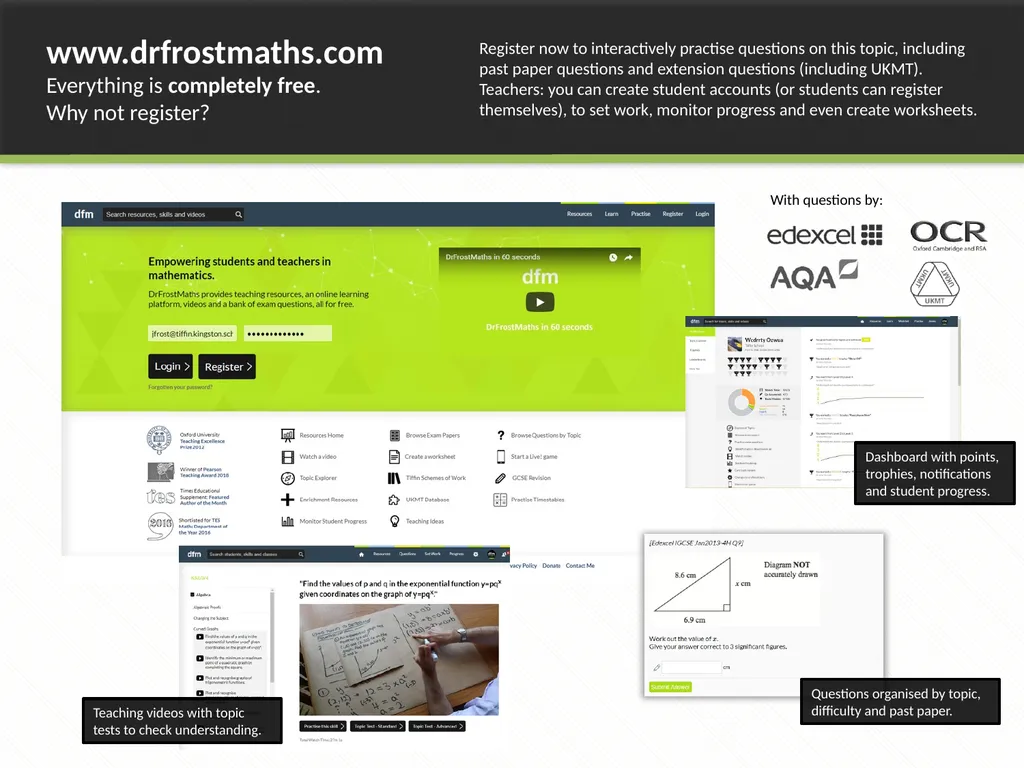
www.drfrostmaths.com
Everything is completely free.
Why not register? Teaching videos with topic tests to check understanding. Register now to interactively practise questions on this topic, including past paper questions and extension questions (including UKMT).
Teachers: you can create student accounts (or students can register themselves), to set work, monitor progress and even create worksheets. Questions organised by topic, difficulty and past paper. Dashboard with points, trophies, notifications and student progress. With questions by:<br>
03
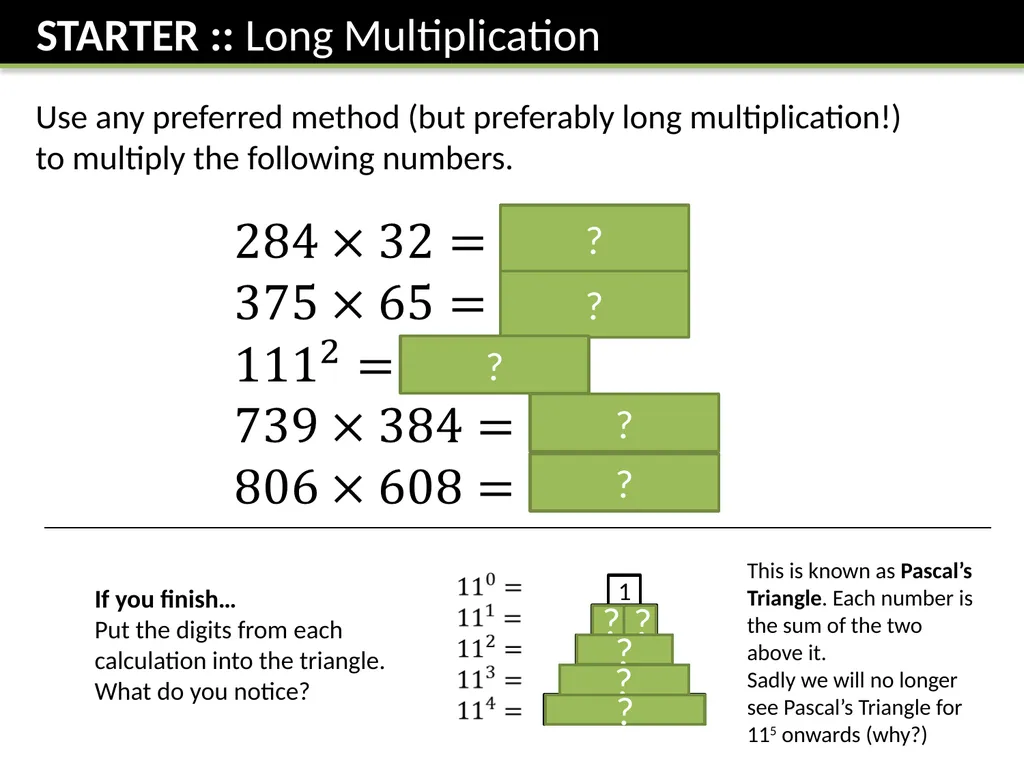
Use any preferred method (but preferably long multiplication!) to multiply the following numbers. If you finish…
Put the digits from each calculation into the triangle. What do you notice? 1 1 1 1 2 1 1 3 3 1 1 4 6 4 1 This is known as Pascal’s Triangle. Each number is the sum of the two above it.
Sadly we will no longer see Pascal’s Triangle for 115 onwards (why?) ? ? ? ? ? ? ? ? ? ?<br>
04
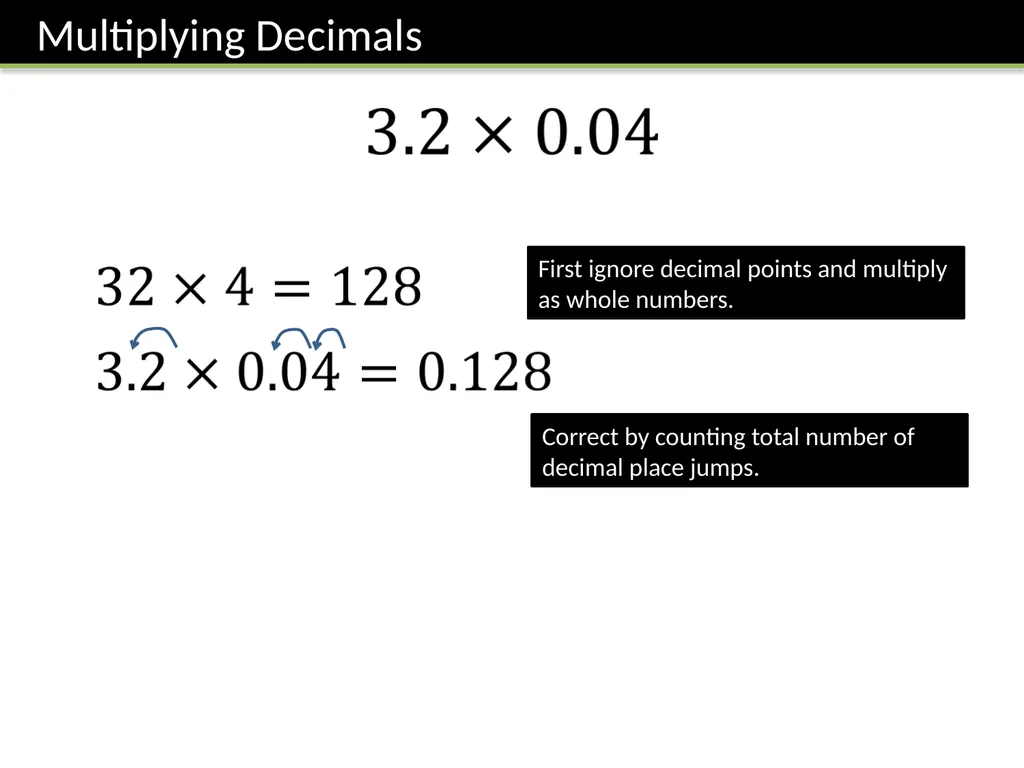
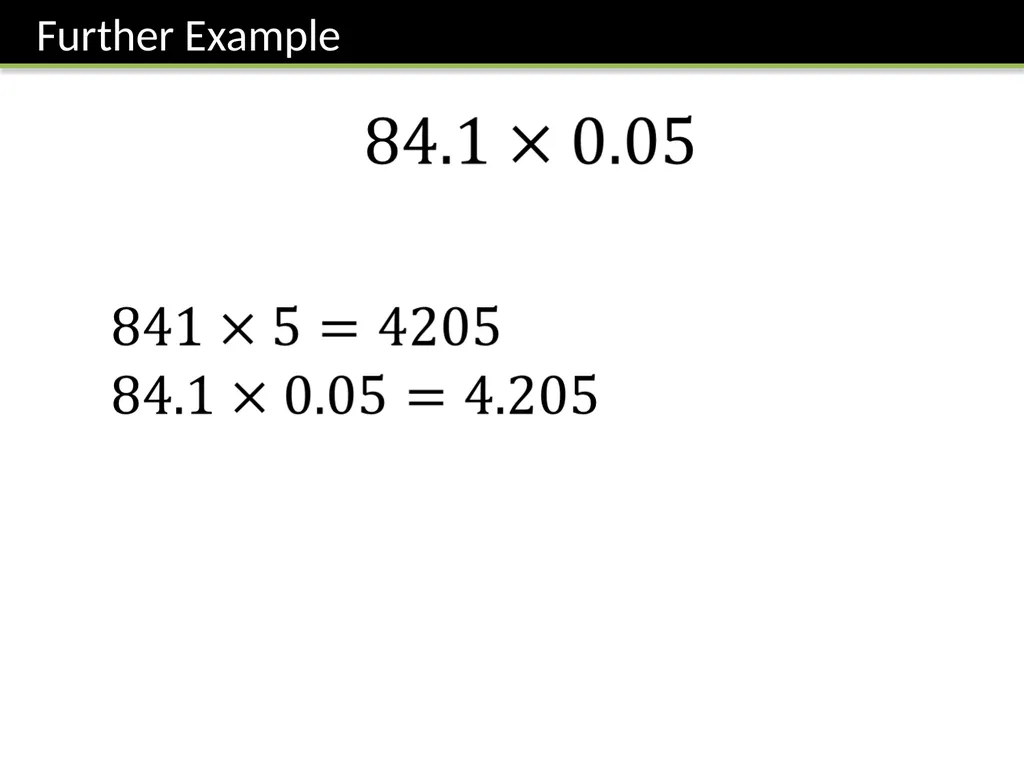
First ignore decimal points and multiply as whole numbers. Correct by counting total number of decimal place jumps.<br>
05
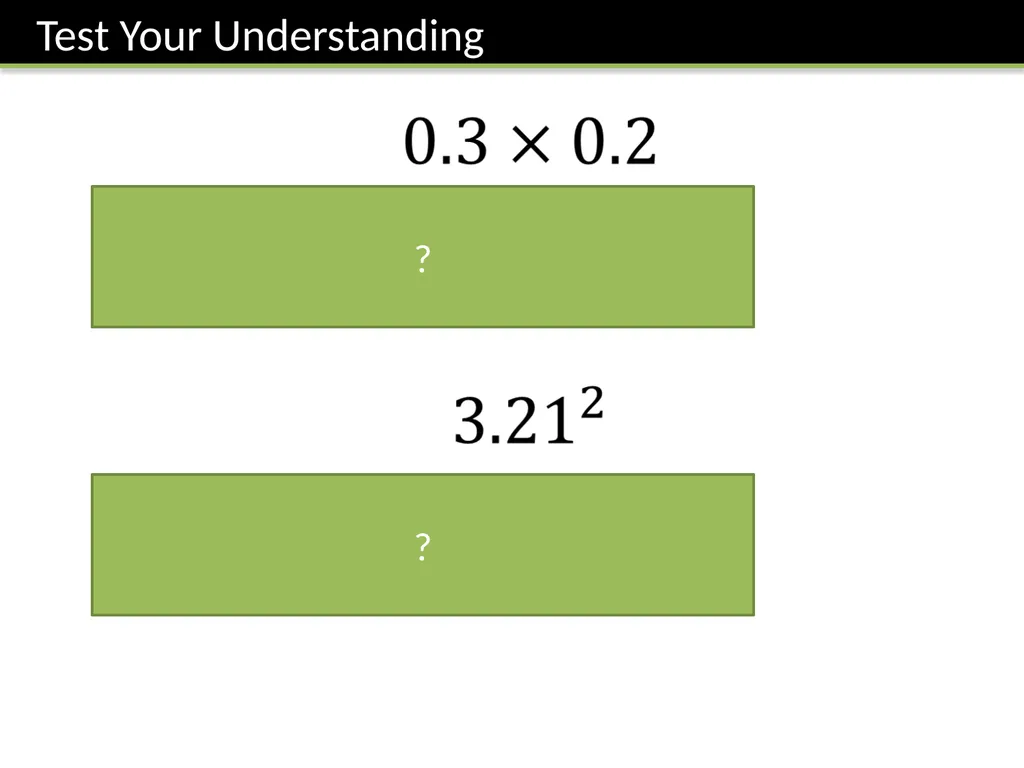
? ?<br>
06
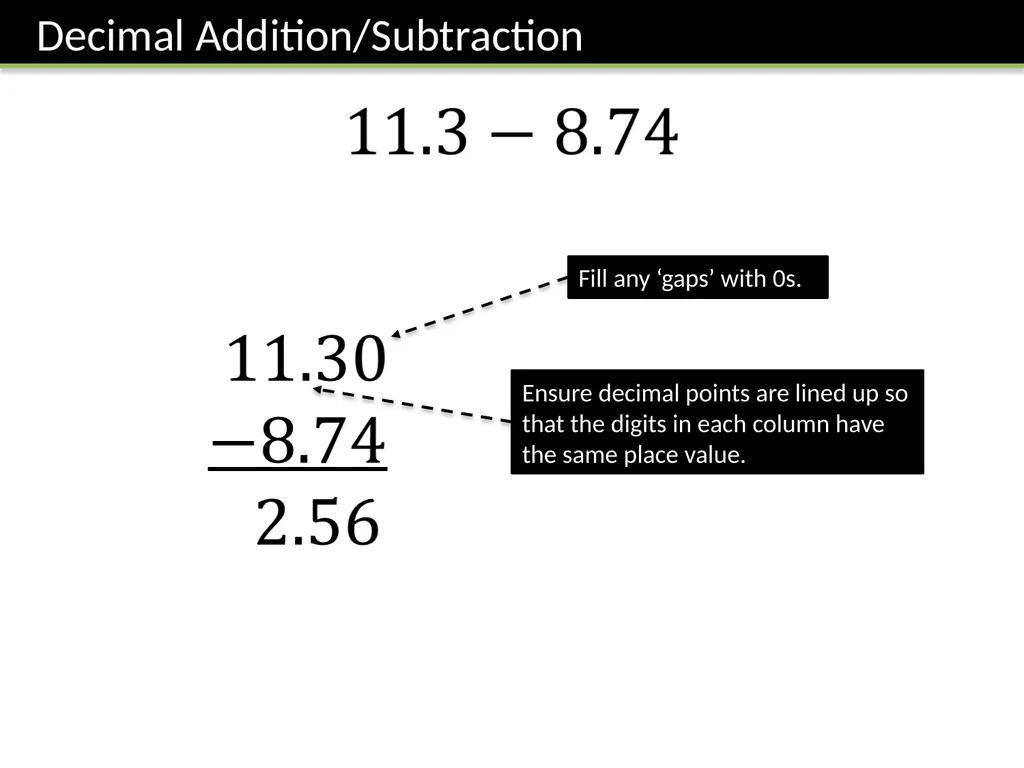
Ensure decimal points are lined up so that the digits in each column have the same place value. Fill any ‘gaps’ with 0s.<br>
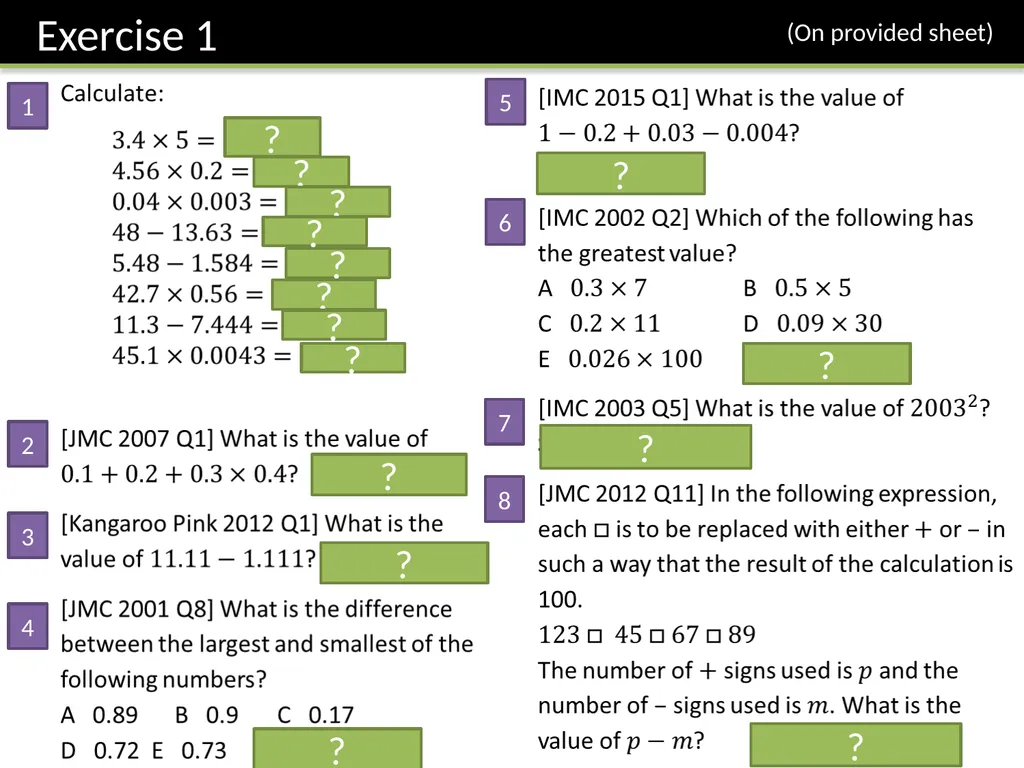
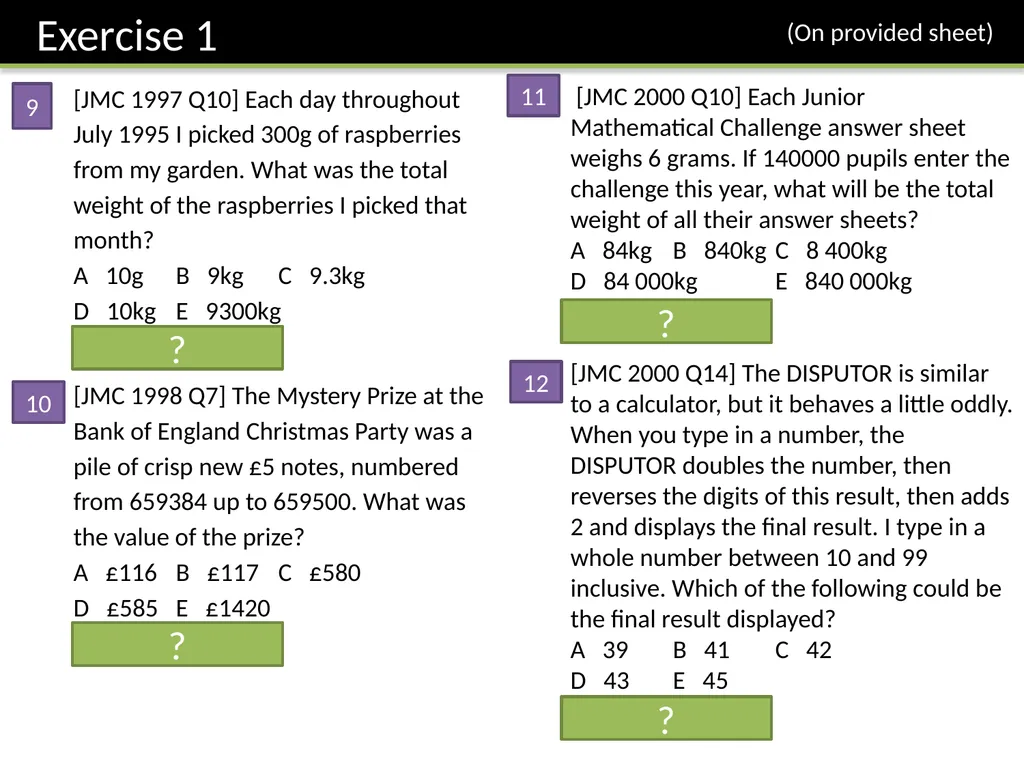
[JMC 1997 Q10] Each day throughout July 1995 I picked 300g of raspberries from my garden. What was the total weight of the raspberries I picked that month? A 10g B 9kg C 9.3kg D 10kg E 9300kg Solution: C
[JMC 1998 Q7] The Mystery Prize at the Bank of England Christmas Party was a pile of crisp new £5 notes, numbered from 659384 up to 659500. What was the value of the prize? A £116 B £117 C £580 D £585 E £1420 Solution: D 9 10 [JMC 2000 Q10] Each Junior Mathematical Challenge answer sheet weighs 6 grams. If 140000 pupils enter the challenge this year, what will be the total weight of all their answer sheets? A 84kg B 840kg C 8 400kg D 84 000kg E 840 000kg Solution: B
[JMC 2000 Q14] The DISPUTOR is similar to a calculator, but it behaves a little oddly. When you type in a number, the DISPUTOR doubles the number, then reverses the digits of this result, then adds 2 and displays the final result. I type in a whole number between 10 and 99 inclusive. Which of the following could be the final result displayed? A 39 B 41 C 42 D 43 E 45 Solution: E 11 12 ? ? ? ? (On provided sheet)<br>
10
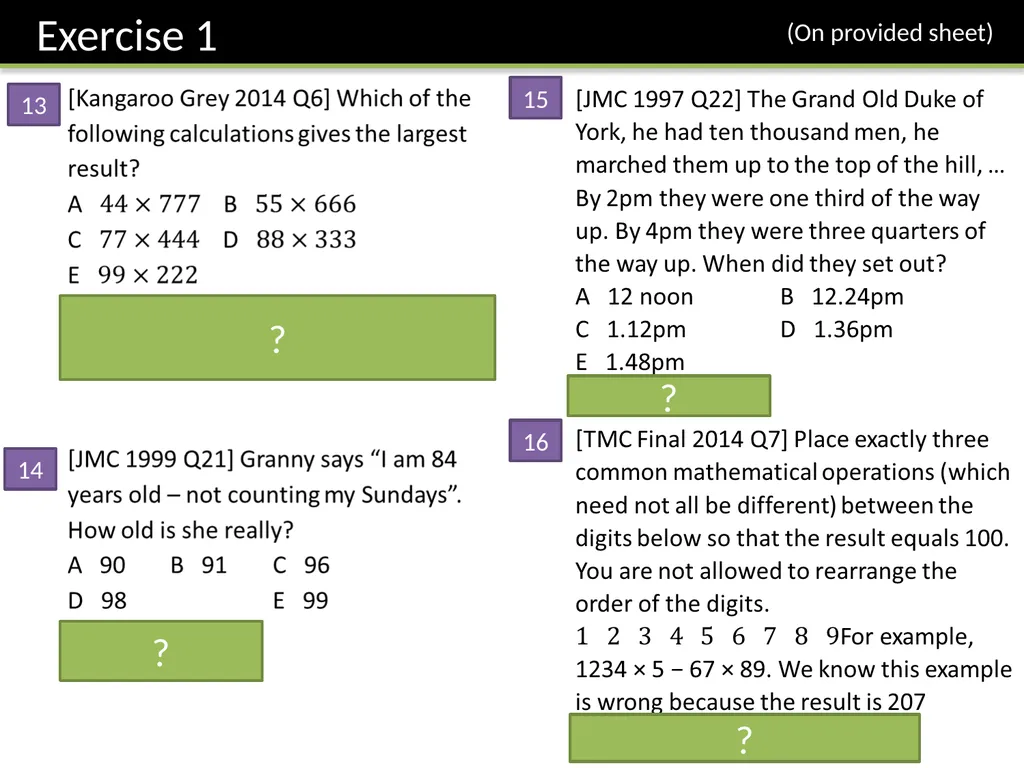
13 14 15 16 ? ? ? ? (On provided sheet)<br>
11
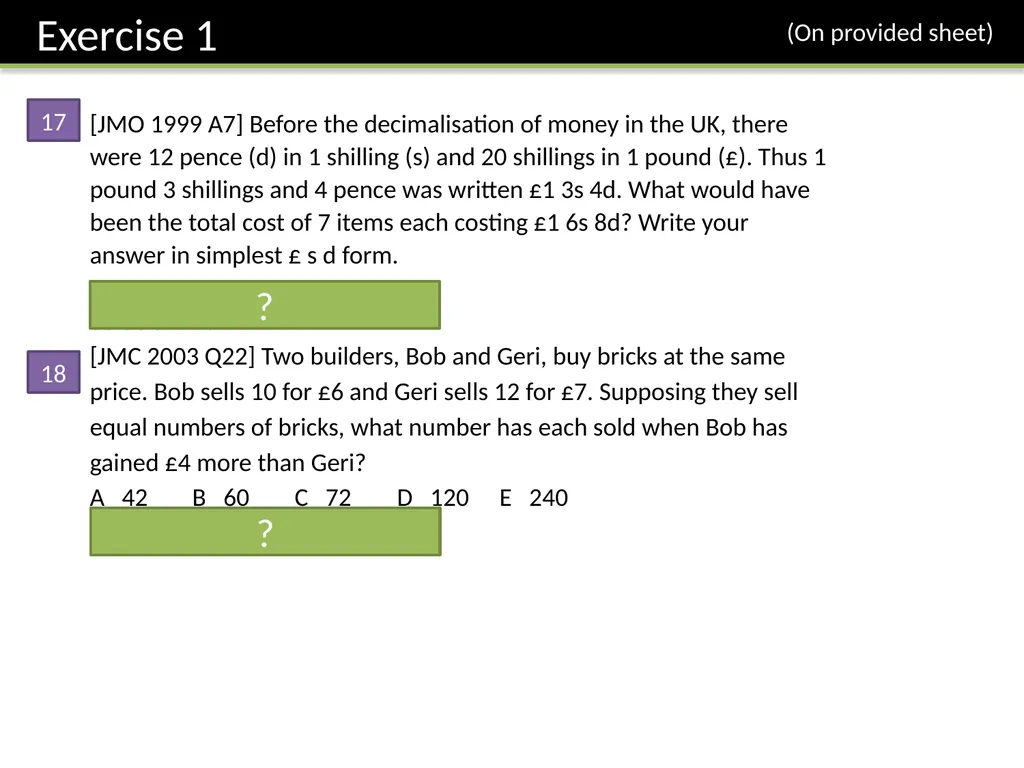
[JMO 1999 A7] Before the decimalisation of money in the UK, there were 12 pence (d) in 1 shilling (s) and 20 shillings in 1 pound (£). Thus 1 pound 3 shillings and 4 pence was written £1 3s 4d. What would have been the total cost of 7 items each costing £1 6s 8d? Write your answer in simplest £ s d form. Solution: £8
[JMC 2003 Q22] Two builders, Bob and Geri, buy bricks at the same price. Bob sells 10 for £6 and Geri sells 12 for £7. Supposing they sell equal numbers of bricks, what number has each sold when Bob has gained £4 more than Geri? A 42 B 60 C 72 D 120 E 240 Solution: E 17 18 ? ? (On provided sheet)<br>
12
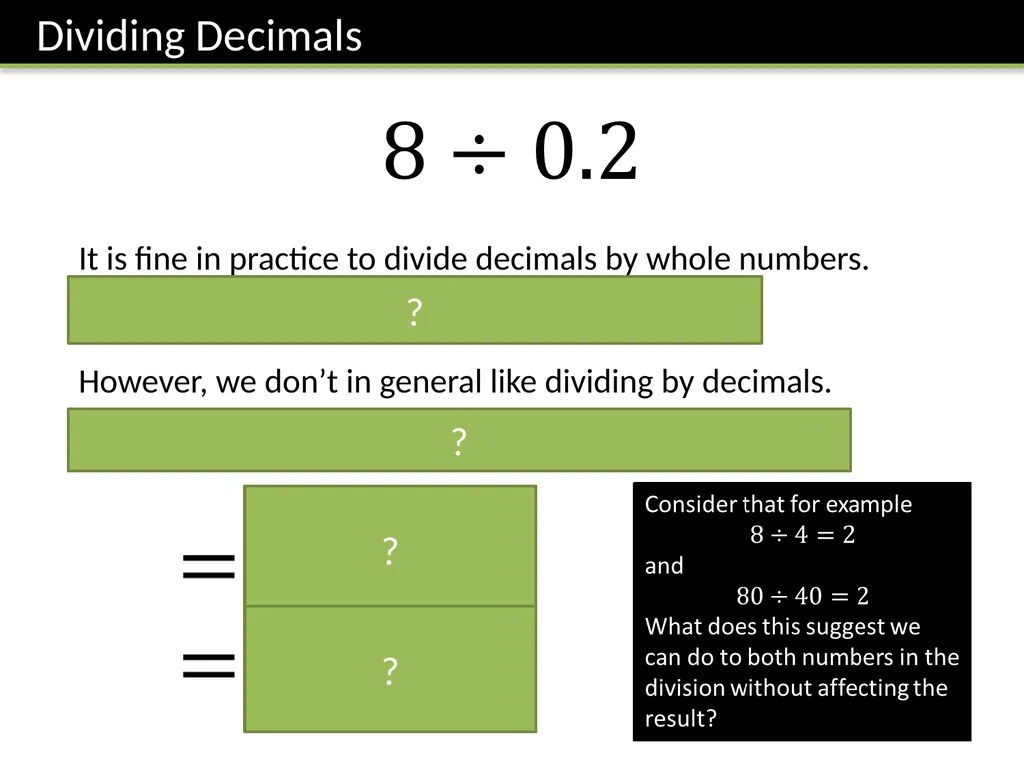
It is fine in practice to divide decimals by whole numbers.
e.g. Dividing £1.68 between 4 people.
However, we don’t in general like dividing by decimals.
e.g. Dividing £3 between 5.6 people. We can’t do that! ? ? ? ?<br>
13
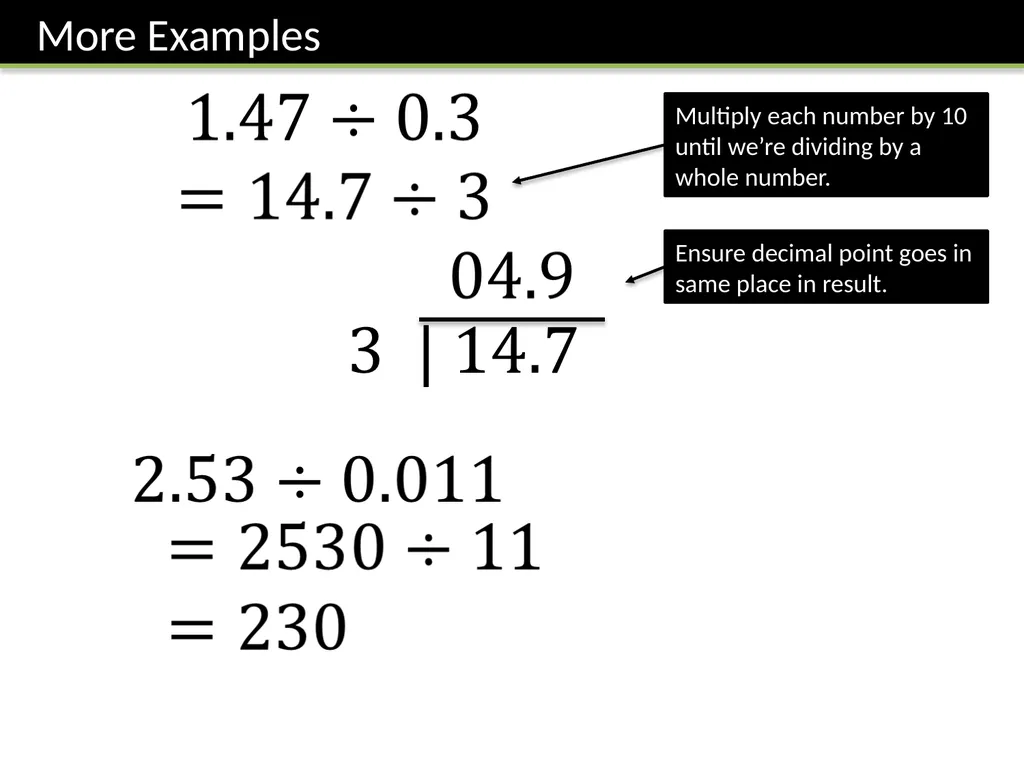
Ensure decimal point goes in same place in result.<br>
14
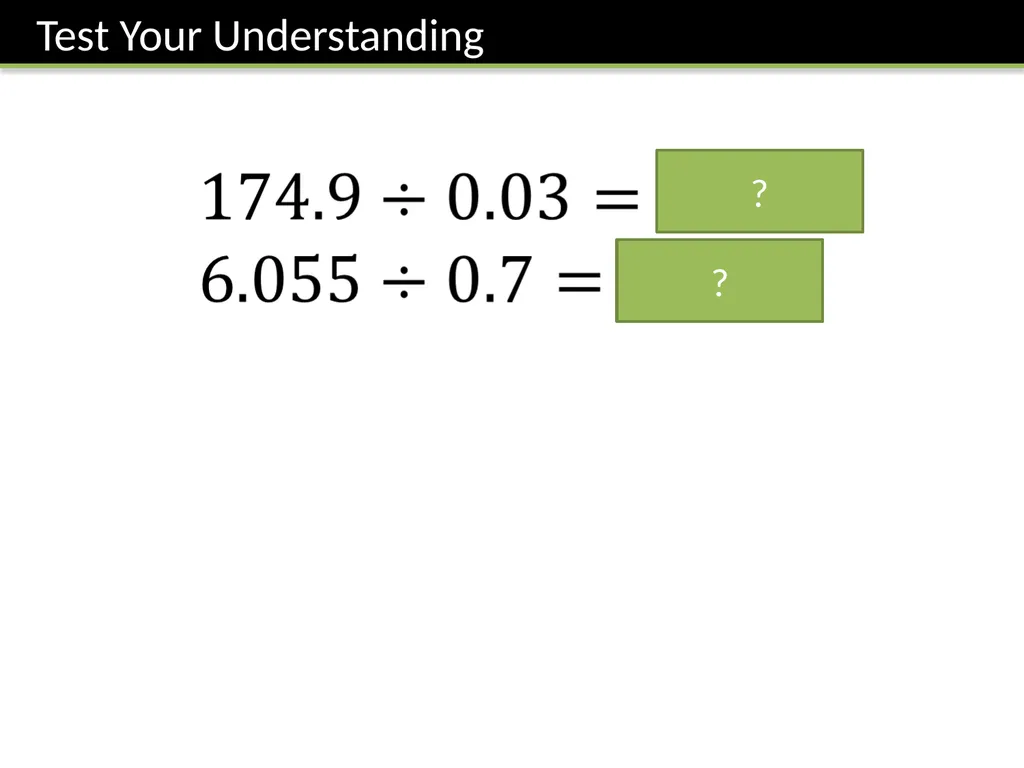
? ?<br>
15
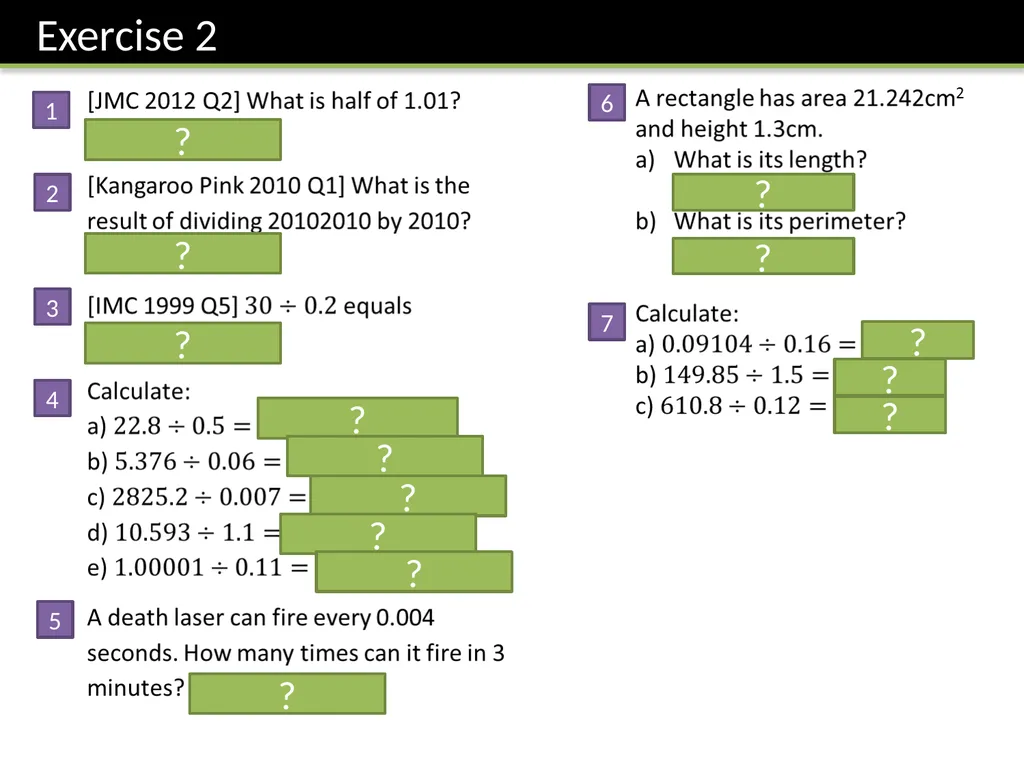
? ? ? ? ? ? ? ? ? ? ? ? ? ? 1 2 3 4 5 6 7<br>
16
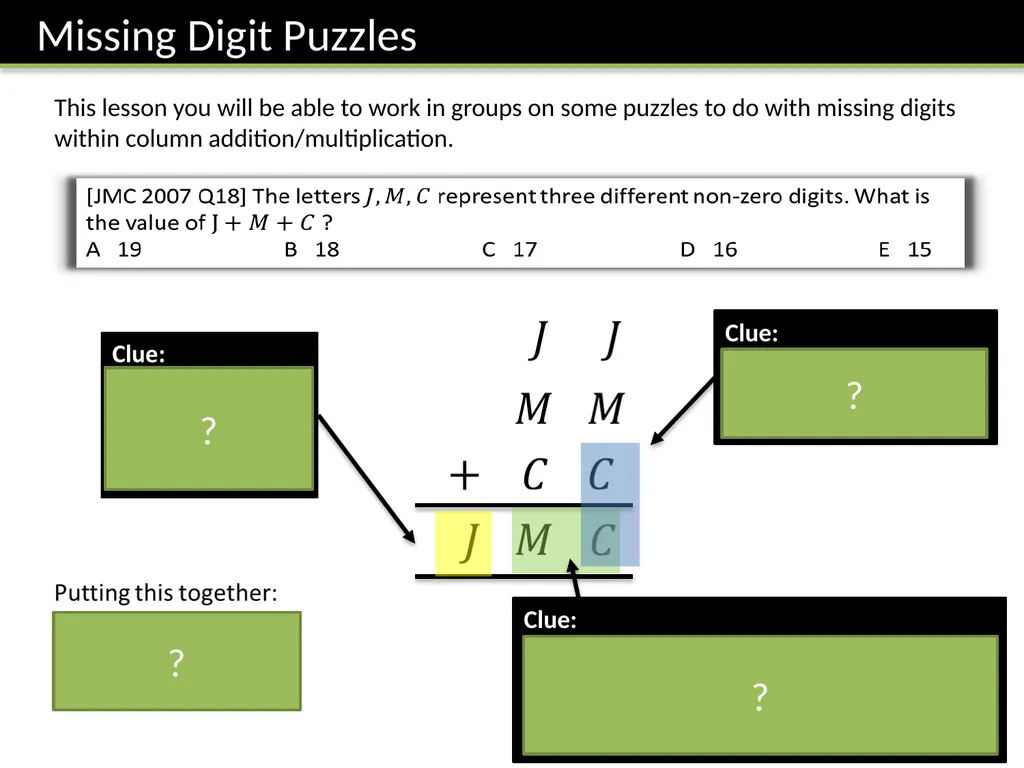
This lesson you will be able to work in groups on some puzzles to do with missing digits within column addition/multiplication. Clue:
We’re adding the same digits in each of the two columns, but get a different digit as the result. There therefore must have been a carry, and hence M is one more than C. Clue:
These two digits are the same. Thus J and M must add to 10. ? ? ? ?<br>
17
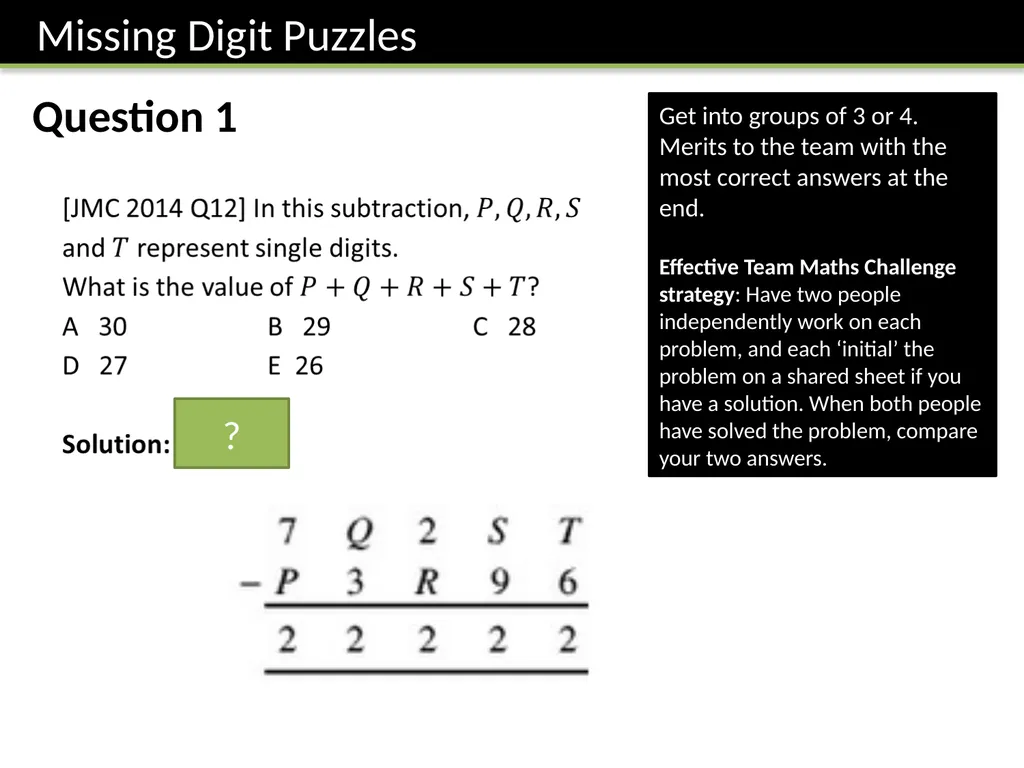
Question 1 Get into groups of 3 or 4. Merits to the team with the most correct answers at the end.
Effective Team Maths Challenge strategy: Have two people independently work on each problem, and each ‘initial’ the problem on a shared sheet if you have a solution. When both people have solved the problem, compare your two answers. ?<br>
18
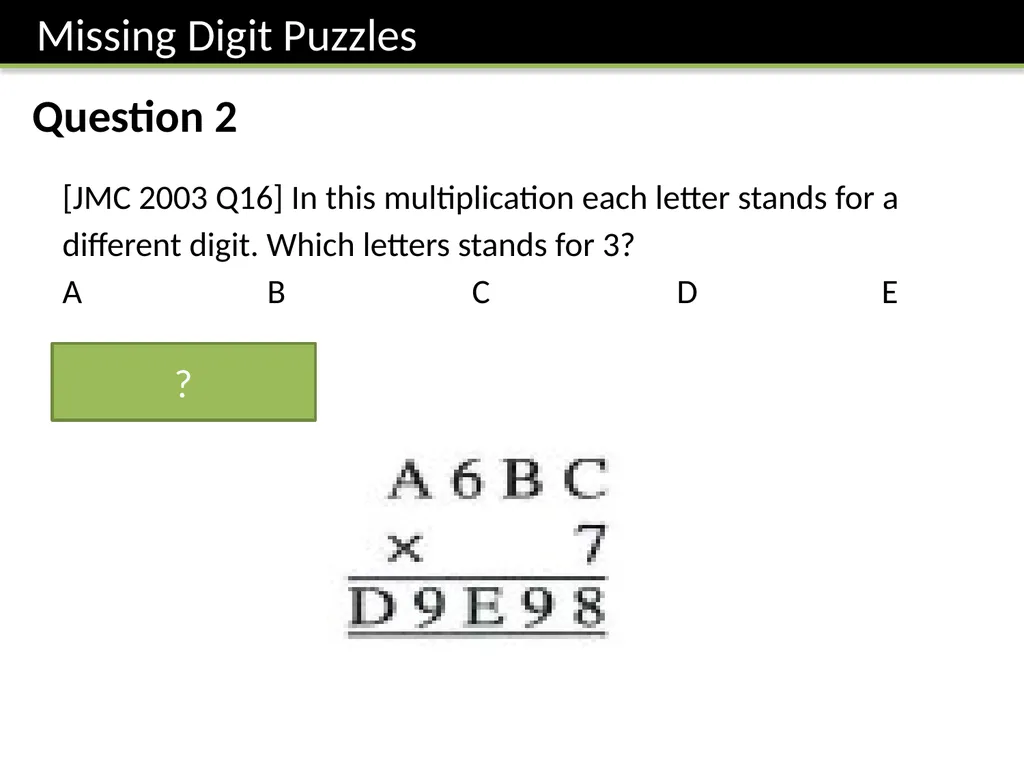
Question 2 [JMC 2003 Q16] In this multiplication each letter stands for a different digit. Which letters stands for 3? A B C D E Solution: D ?<br>
19
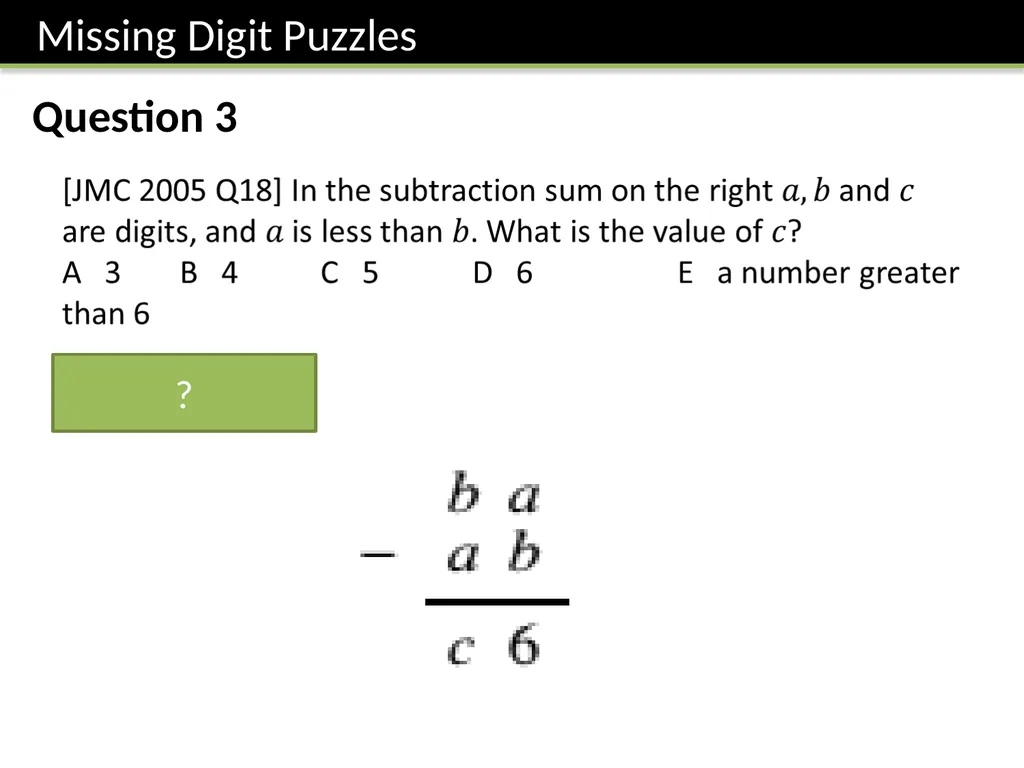
Question 3 ?<br>
20
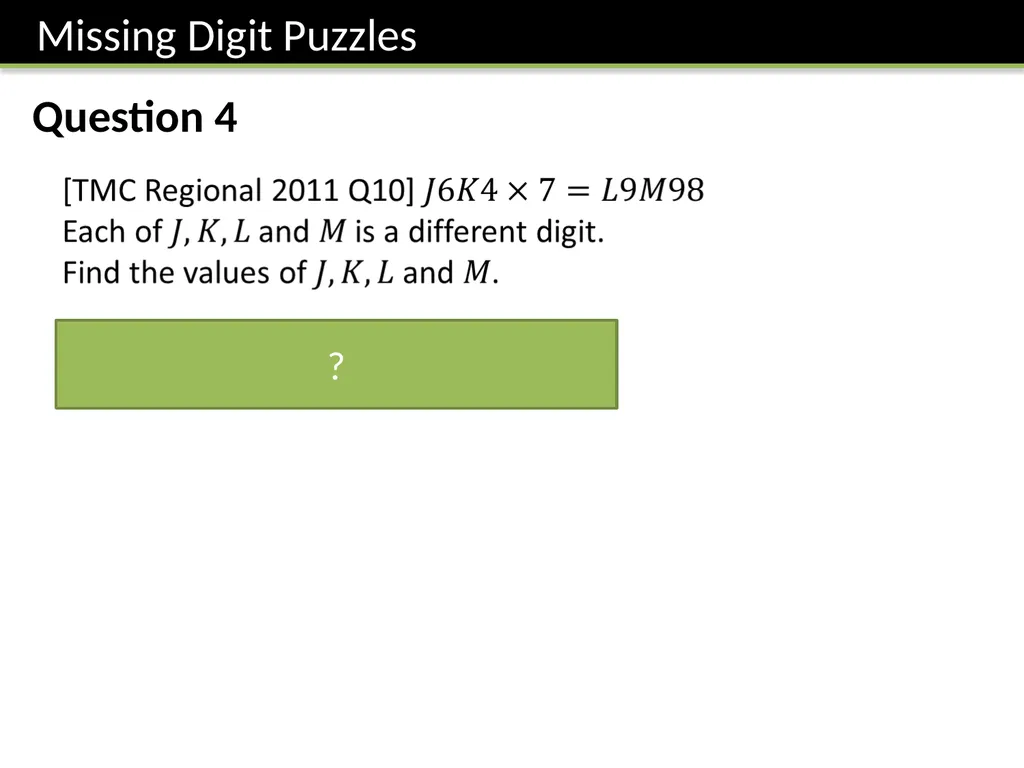
Question 4 ?<br>
21
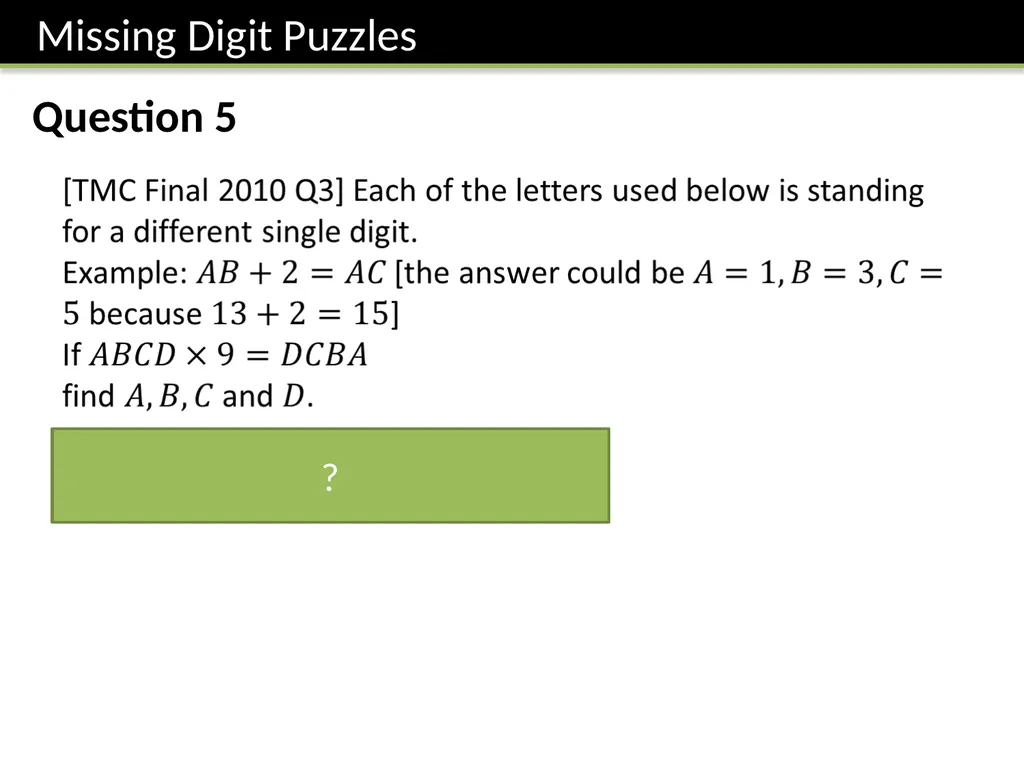
Question 5 ?<br>
22
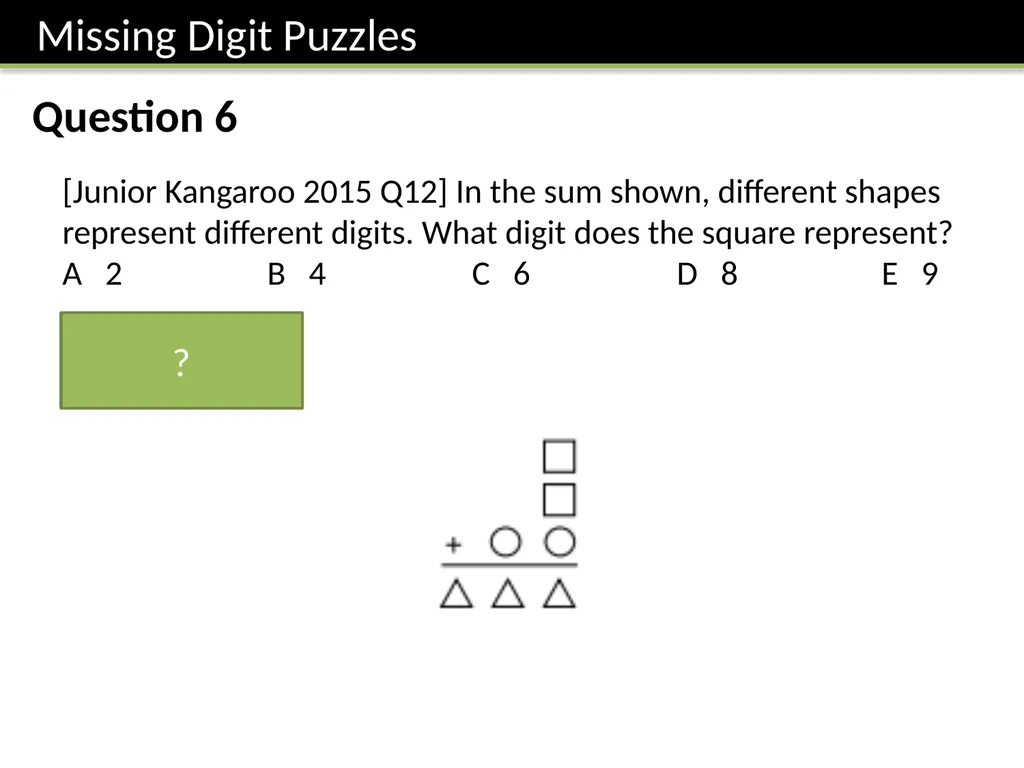
Question 6 [Junior Kangaroo 2015 Q12] In the sum shown, different shapes represent different digits. What digit does the square represent? A 2 B 4 C 6 D 8 E 9 Solution: C ?<br>
23
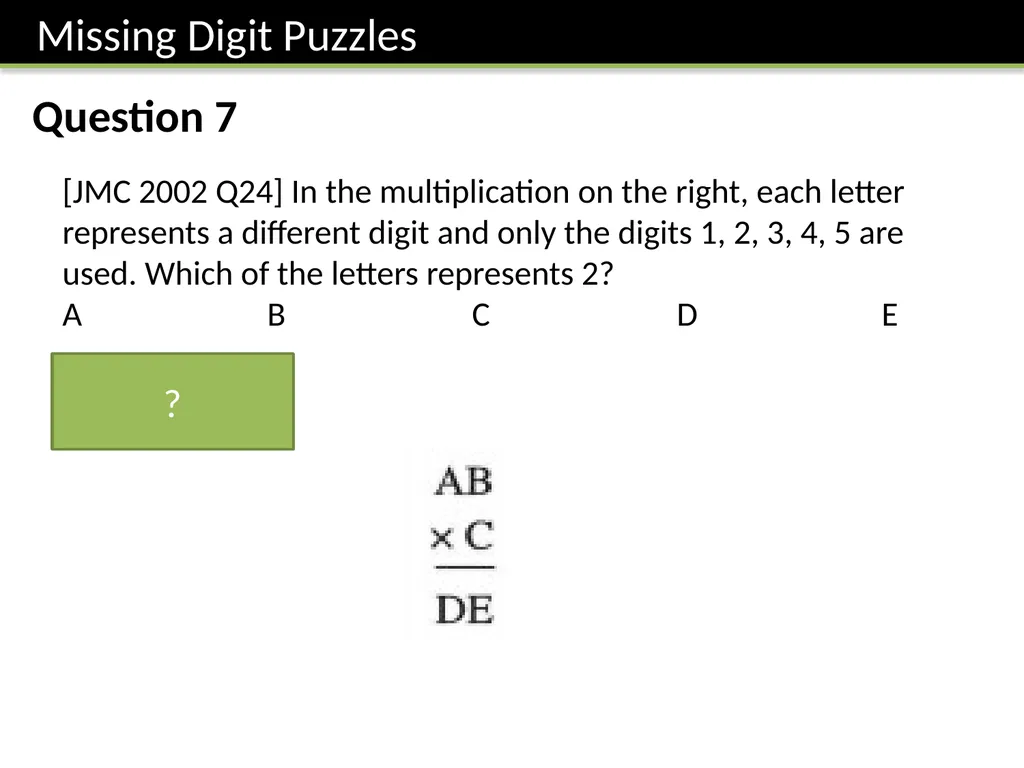
Question 7 [JMC 2002 Q24] In the multiplication on the right, each letter represents a different digit and only the digits 1, 2, 3, 4, 5 are used. Which of the letters represents 2? A B C D E Solution: E ?<br>
24
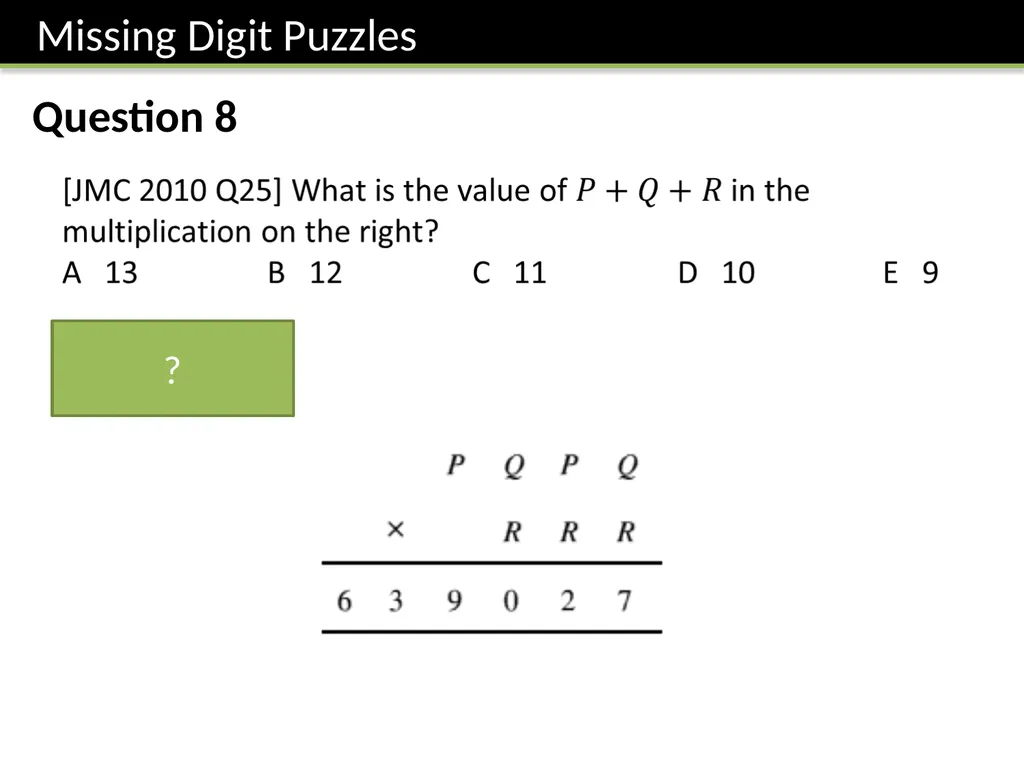
Question 8 ?<br>
25
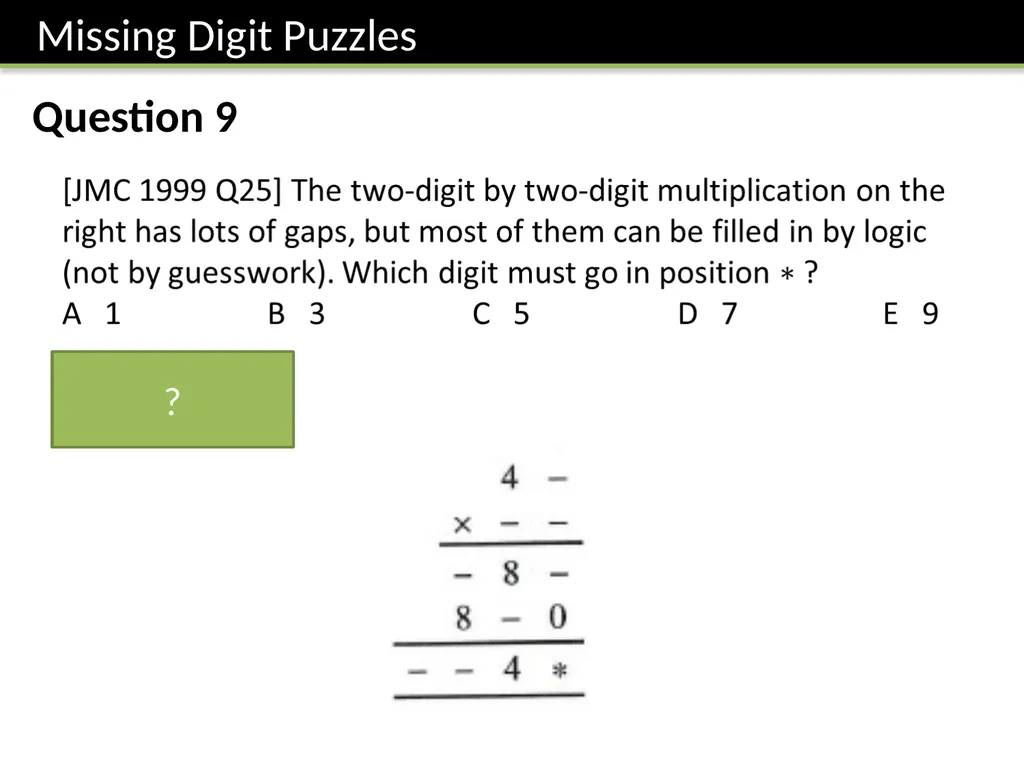
Question 9 ?<br>
26
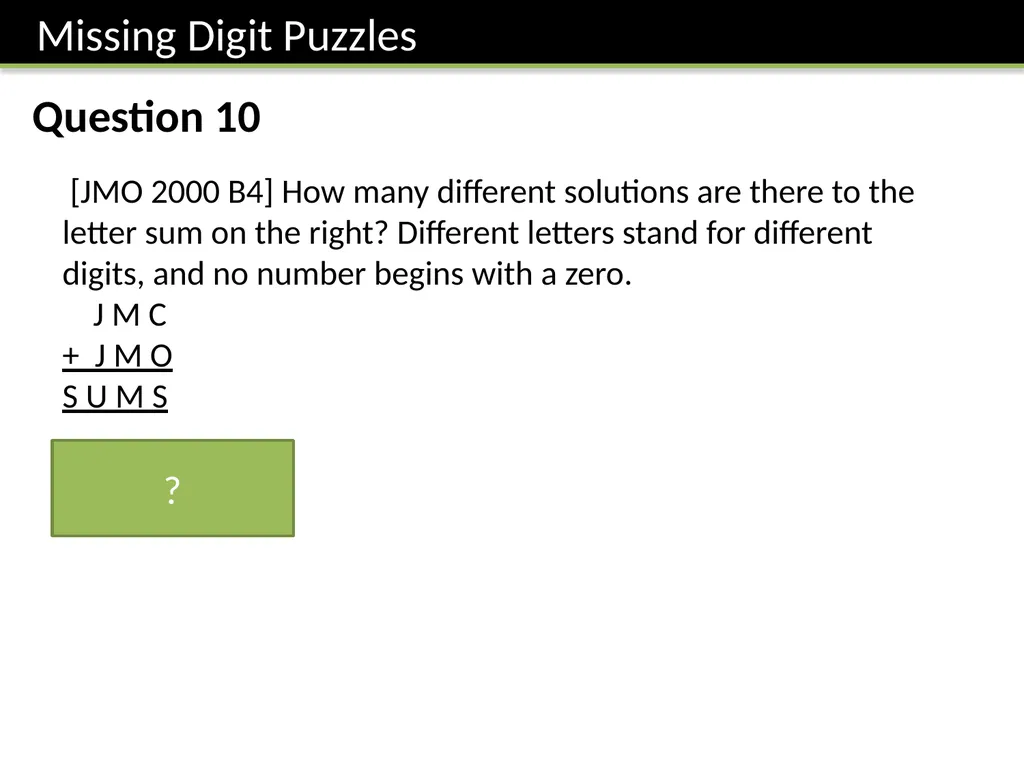
Question 10 [JMO 2000 B4] How many different solutions are there to the letter sum on the right? Different letters stand for different digits, and no number begins with a zero. J M C + J M O S U M S Solution: 6 ?<br>