04
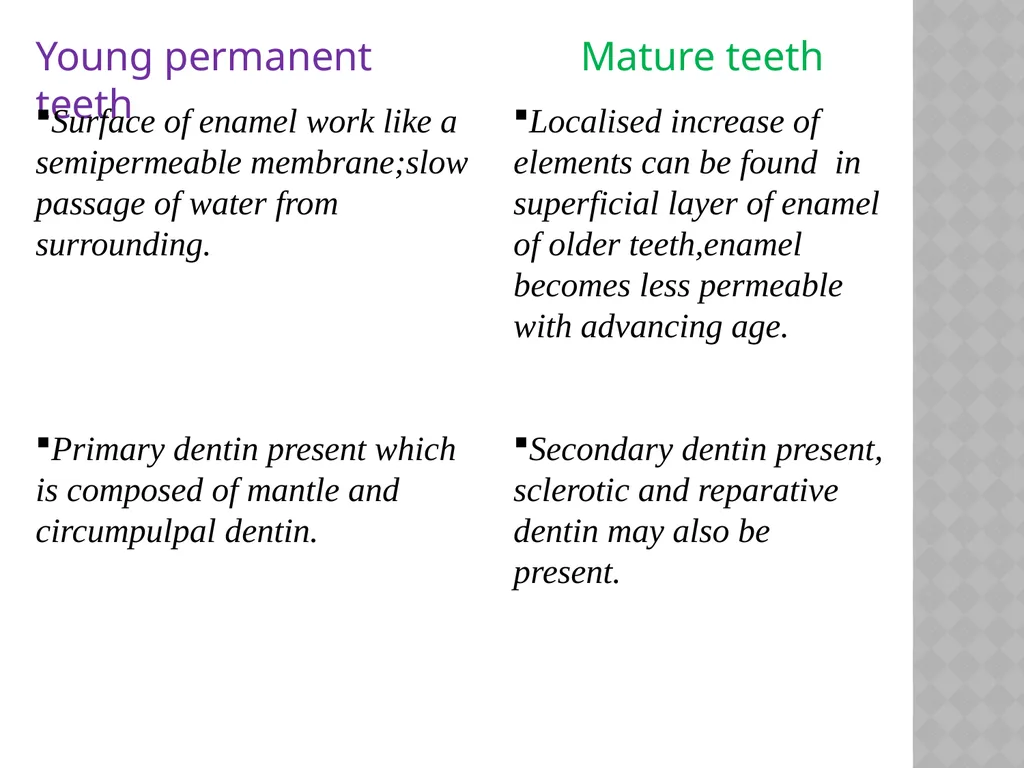
Young permanent teeth Mature teeth Surface of enamel work like a semipermeable membrane;slow passage of water from surrounding.
Primary dentin present which is composed of mantle and circumpulpal dentin. Localised increase of elements can be found in superficial layer of enamel of older teeth,enamel becomes less permeable with advancing age.
Secondary dentin present, sclerotic and reparative dentin may also be present.<br>
05
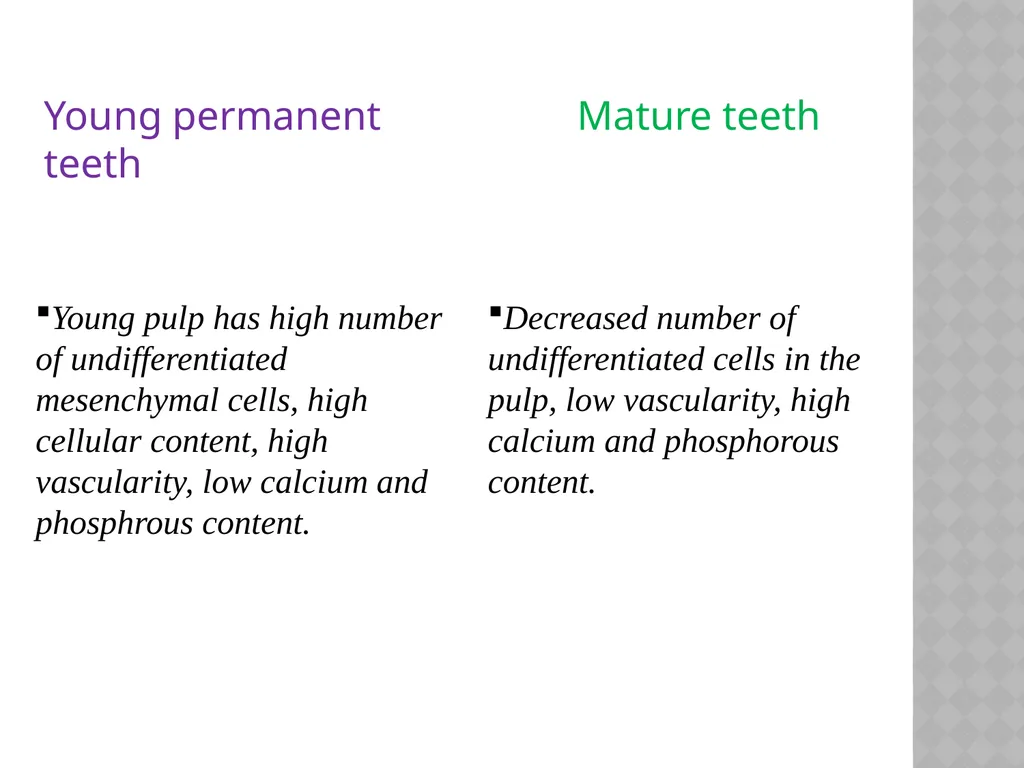
Young permanent teeth Mature teeth Young pulp has high number of undifferentiated mesenchymal cells, high cellular content, high vascularity, low calcium and phosphrous content. Decreased number of undifferentiated cells in the pulp, low vascularity, high calcium and phosphorous content.<br>
06
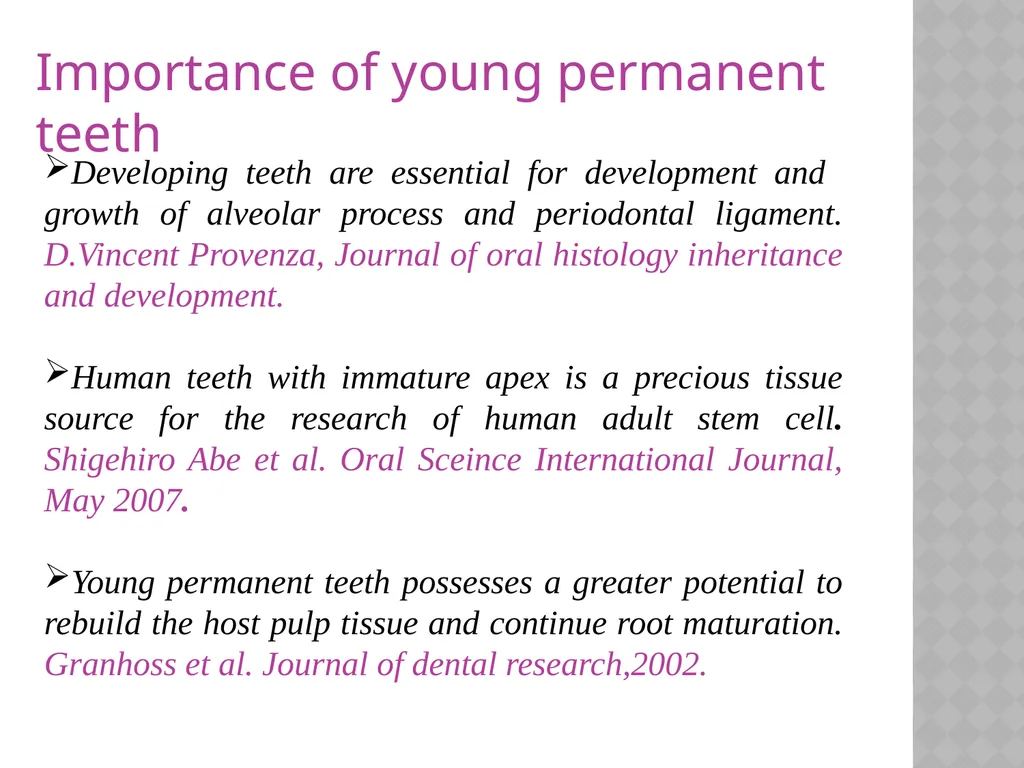
Importance of young permanent teeth Developing teeth are essential for development and growth of alveolar process and periodontal ligament. D.Vincent Provenza, Journal of oral histology inheritance and development.
Human teeth with immature apex is a precious tissue source for the research of human adult stem cell. Shigehiro Abe et al. Oral Sceince International Journal, May 2007.
Young permanent teeth possesses a greater potential to rebuild the host pulp tissue and continue root maturation. Granhoss et al. Journal of dental research,2002.<br>
07
A population of mesenchymal stem cells(MSCs) residing in the apical papilla of incompletely developed teeth, termed stem cells from the apical papilla(SCAP) can differentiate into odontoblast like cells and produce dentin like tissue in both in vitro and in vivo study systems-
Huang G. Journal of Dentistry,2008.
Auto transplantation of immature teeth have high success rate of survival. Wim Laurey et al, American Journal of Dentofacial orthopaedics.<br>
08
Window of infectivity Caufield (1993) monitored oral cavity bacterial levels from birth to 5 years and noted that initial acquisition of mutans streptococci occurs during the designated time period which is called as “window of infectivity” .
1st window of infectivity 7-31 months of age
2nd window of infectivity 6-12 years of age<br>
09
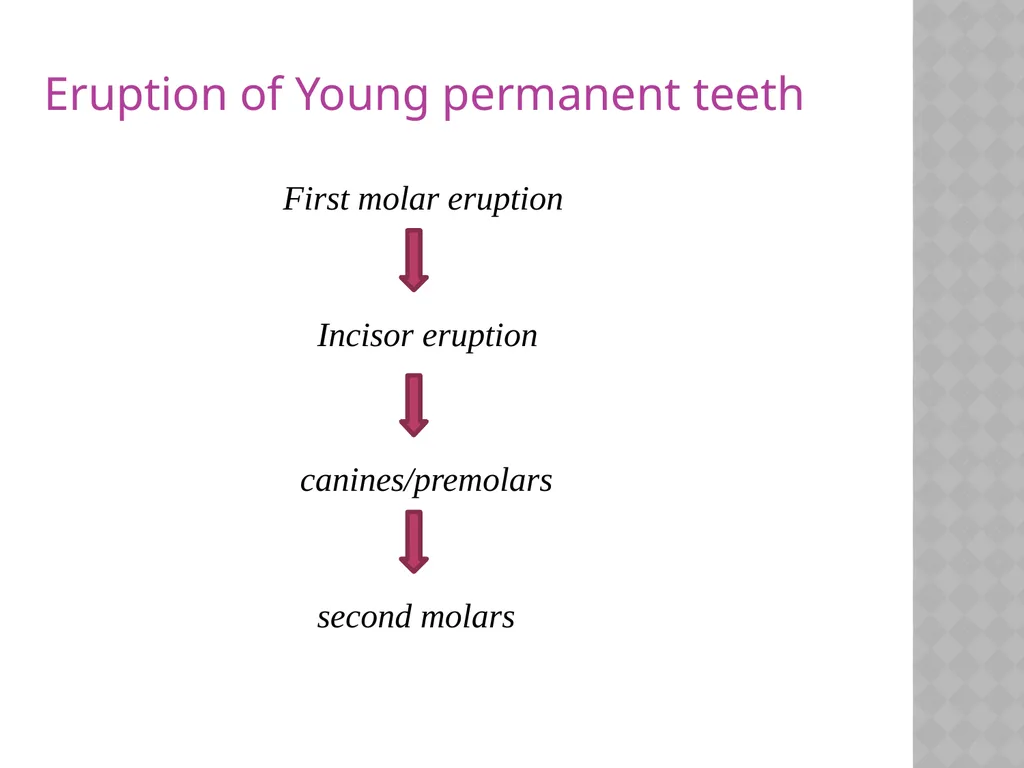
Eruption of Young permanent teeth First molar eruption Incisor eruption canines/premolars second molars<br>
10
The Early Permanent Dentition In this age group the order of susceptibility of teeth to caries attack is:
First permanent molars (Most susceptible)
Second permanent molars
Premolars
Maxillary anterior teeth
Canines and mandibular incisors (least susceptible)<br>
11
There is often a bilateral symmetry of caries attack in these children.
The occlusal surfaces of recently erupted second molars and premolars are susceptible to caries by virtue of their morphology.
By comparison, buccal and lingual surfaces of these teeth, together with permanent canines and mandibular incisors, are seldom attacked by caries.<br>
12
Secondary maturation process Although enamel is fully formed at the time of eruption the surface remains porous and soft.
Hardening is completed in the oral cavity through integration of ions from saliva. This process takes approximately 2 years from the start to finish.
During this period the permanent teeth are highly susceptible to caries.
Fluorides in the oral cavity help to harden the enamel of new permanent teeth and protect them against caries<br>
13
During this period of changing dentition and hardening of teeth good oral hygiene and sufficient fluoridation is required to prevent caries.
For optimum protection of new permanent teeth against caries it is recommended that the teeth to be brushed twice daily.<br>
14
preventive procedures As young permanent teeth are more prone to dental caries there is a need for Preventive Procedures.
These include :
Pit and fissure sealants
Preventive resin restorations<br>
15
Pulp vitality tests in young permanent teeth Methods mainly used are Thermal and Electric testing which tests the vitality based on neural response of the pulp .
Immature permanent teeth are not fully innervated with alpha-myelinated axons, the neural components responsible for the pulpal pain response.
This reduced number of pain receptors make them less responsive to stimuli giving FALSE NEGATIVE results from thermal and electric pulp testing.<br>
16
Treatment Modalities Pulp treatment modalities can be classified into 2 categories:
Vital pulp therapy:
Protective base
Indirect pulp capping
Direct pulp capping
Pulpotomy
Apexogenesis<br>
17
Non vital pulp therapy:
1.Root canal treatment
2.Apexification<br>
18
The main goal in the treatment of immature teeth is to maintain a vital tooth forming organ to allow physiological apical root formation.
To maintain arch length and tooth space.
To restore a tooth to its functionally efficient form. Goal of treatment<br>
19
Pulp protection Materials which can be used as a protective liner include glass ionomers, resin modified glass ionomers and dentin bonding agents<br>
20
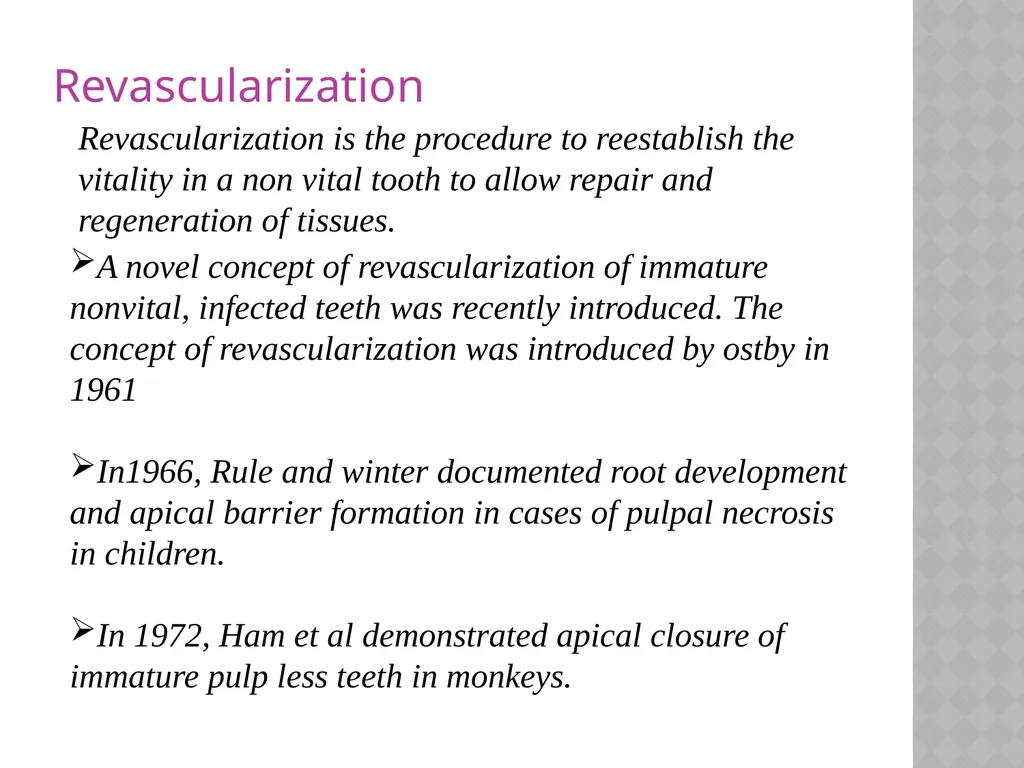
Revascularization Revascularization is the procedure to reestablish the vitality in a non vital tooth to allow repair and regeneration of tissues. A novel concept of revascularization of immature nonvital, infected teeth was recently introduced. The concept of revascularization was introduced by ostby in 1961
In1966, Rule and winter documented root development and apical barrier formation in cases of pulpal necrosis in children.
In 1972, Ham et al demonstrated apical closure of immature pulp less teeth in monkeys.<br>
21
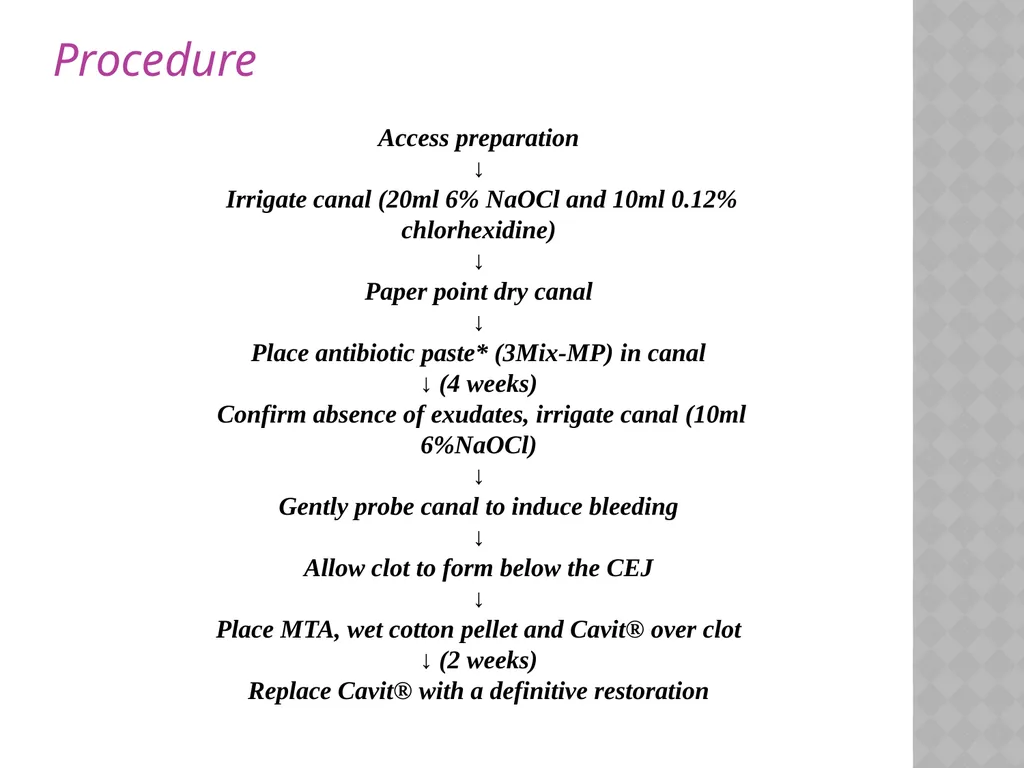
Access preparation
↓
Irrigate canal (20ml 6% NaOCl and 10ml 0.12% chlorhexidine)
↓
Paper point dry canal
↓
Place antibiotic paste* (3Mix-MP) in canal
↓ (4 weeks)
Confirm absence of exudates, irrigate canal (10ml 6%NaOCl)
↓
Gently probe canal to induce bleeding
↓
Allow clot to form below the CEJ
↓
Place MTA, wet cotton pellet and Cavit® over clot
↓ (2 weeks)
Replace Cavit® with a definitive restoration Procedure<br>
22
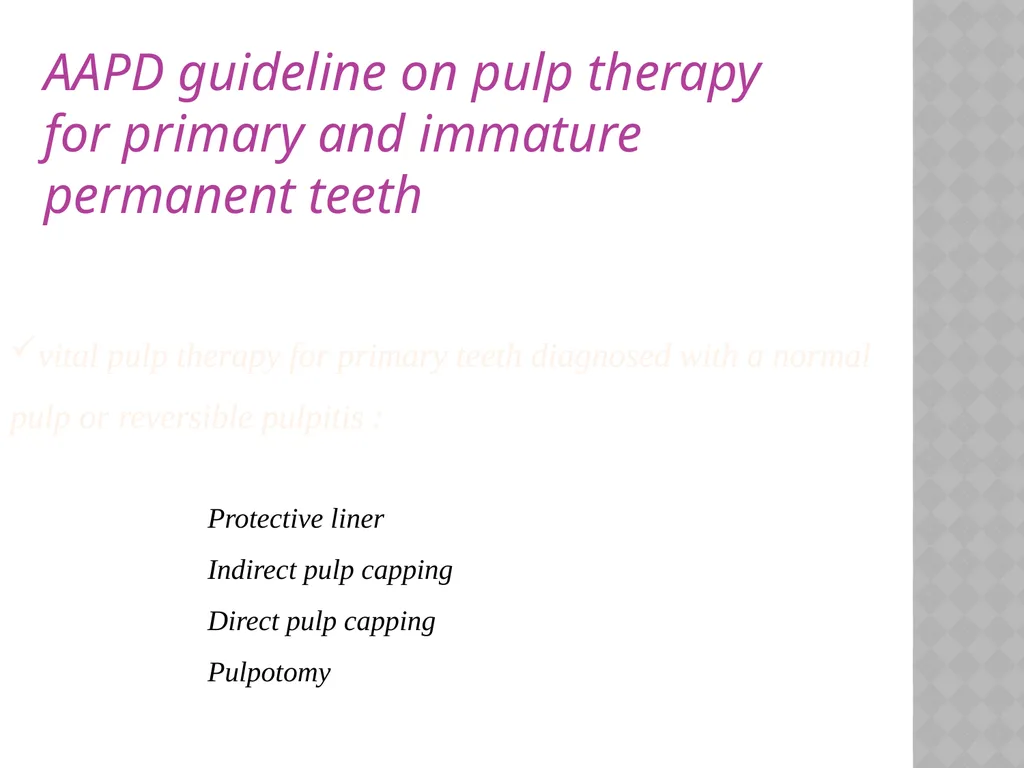
AAPD guideline on pulp therapy for primary and immature permanent teeth vital pulp therapy for primary teeth diagnosed with a normal pulp or reversible pulpitis : Protective liner
Indirect pulp capping
Direct pulp capping
Pulpotomy<br>
23
Non vital pulp treatment for primary teeth diagnosed with irreversible pulpitis or necrotic pulp Pulpectomy<br>
24
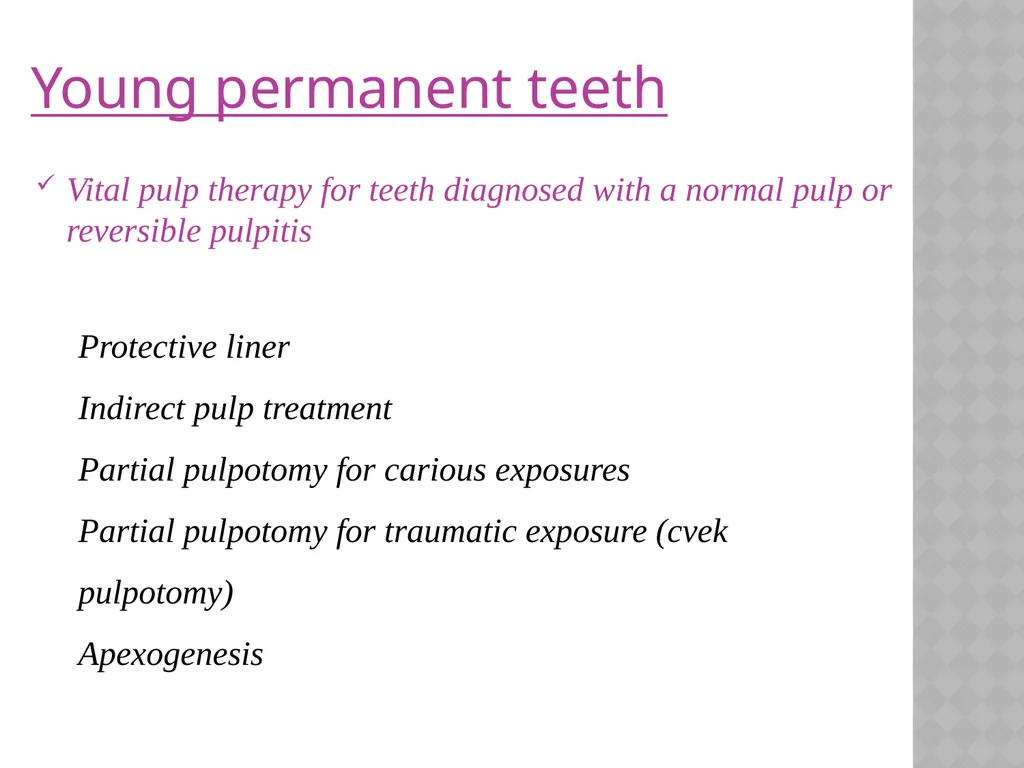
Young permanent teeth Vital pulp therapy for teeth diagnosed with a normal pulp or reversible pulpitis Protective liner
Indirect pulp treatment
Partial pulpotomy for carious exposures
Partial pulpotomy for traumatic exposure (cvek pulpotomy)
Apexogenesis<br>
25
Nonvital pulp treatment Pulpectomy (conventional root canal treatment)
Apexification (root end closure)<br>
26
Summary Therefore the aim while treating young permanent teeth is to potentiate the regenerative capacity of affected pulp, allowing reparative dentin formation and continued root maturation and thus every effort should be made to attain the genetically programmed closure of foramen that remains open because of early pulp death.<br>
27
Previous ques
Young permanent teeth (2m,2018)(4m,2012)
Characteristics & imp of young permanent teeth (9m,2007)<br>
28
Suggested books to read: Comprehensive Pediatric dentistry- Nikhil Marwah
Pediatric operative dentistry- 4th edition. Kennedy
Textbook of Pedodontics- 2nd edition. Shobha Tandon
Fundamentals of pediatric dentistry – RJ.Mathewson
Textbook of Endodontics- Nisha Garg
Text book of Endodontics-5th Edition. John I.Ingle<br>