Ytterbium, atomic number 70, is the first element in the Periodic Table to have the first four shells full. i. State the number of electrons in the fourth shell of ytterbium. 1 ii. How many orbitals are there in the third shell of
"Ytterbium, atomic number 70, is the first element" is the property of its rightful owner. Permission is granted to
download and print the materials on this website for personal, non-commercial use only, and to display it
on your personal computer provided you do not modify the materials and that you retain all copyright
notices contained in the materials. By downloading content from our website, you accept the terms of this
agreement.
Presentation Transcript
01
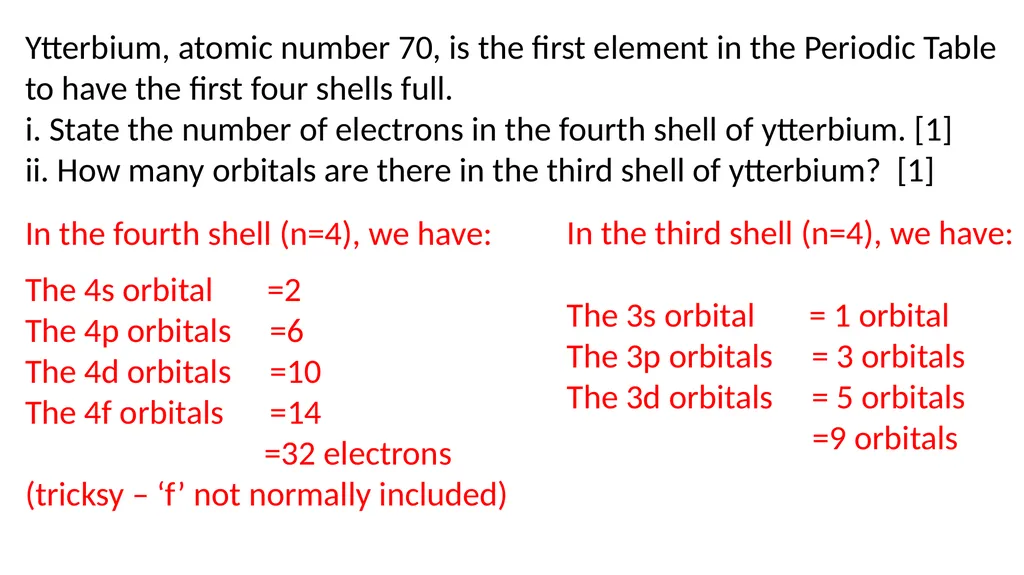
Ytterbium, atomic number 70, is the first element in the Periodic Table to have the first four shells full.
i. State the number of electrons in the fourth shell of ytterbium. [1]
ii. How many orbitals are there in the third shell of ytterbium? [1] In the fourth shell (n=4), we have:
The 4s orbital =2
The 4p orbitals =6
The 4d orbitals =10
The 4f orbitals =14
=32 electrons
(tricksy – ‘f’ not normally included) In the third shell (n=4), we have:
The 3s orbital = 1 orbital
The 3p orbitals = 3 orbitals
The 3d orbitals = 5 orbitals
=9 orbitals<br>
02
Bromine and mercury are the only two naturally occurring elements that are liquids at room temperature and pressure. Some physical properties of these two elements are given below. Bromine and mercury are the only two naturally occurring elements that are liquids at room temperature and pressure. Some physical properties of these two elements are given below. 1s22s22p63s23p63d104s24p5 allow …4s23d10… Complete the full electron configuration of a bromine atom. [1]
1s2<br>
03
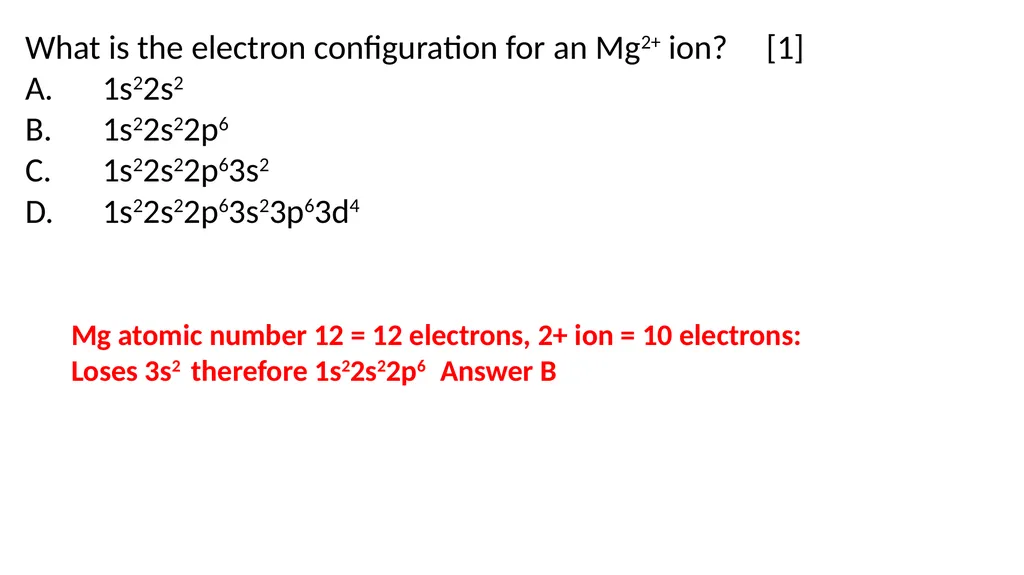
What is the electron configuration for an Mg2+ ion? [1]
1s22s2
1s22s22p6
1s22s22p63s2
1s22s22p63s23p63d4 Mg atomic number 12 = 12 electrons, 2+ ion = 10 electrons:
Loses 3s2 therefore 1s22s22p6 Answer B<br>
04
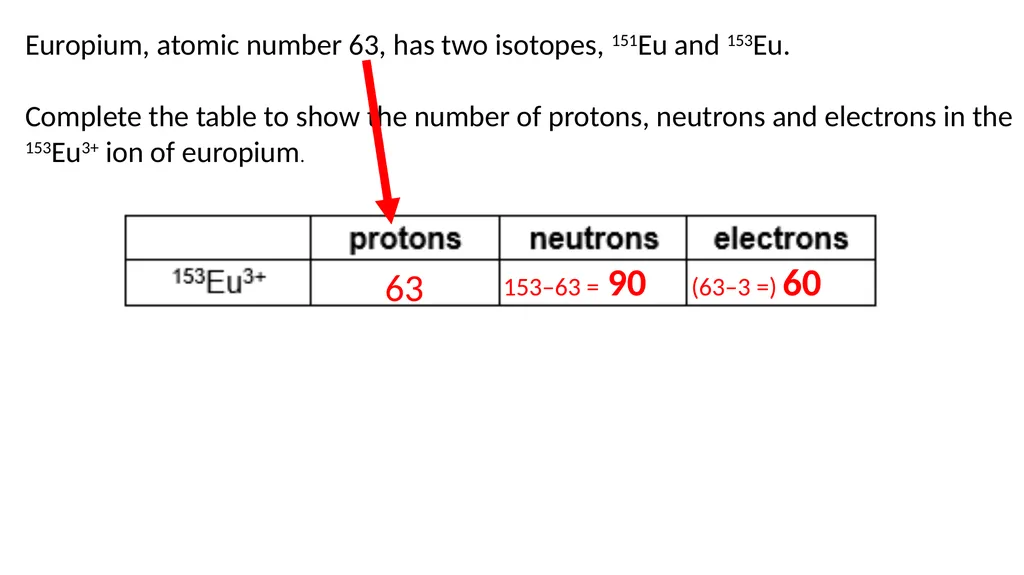
Europium, atomic number 63, has two isotopes, 151Eu and 153Eu. Complete the table to show the number of protons, neutrons and electrons in the 153Eu3+ ion of europium. 63 (63–3 =) 60 153–63 = 90<br>
05
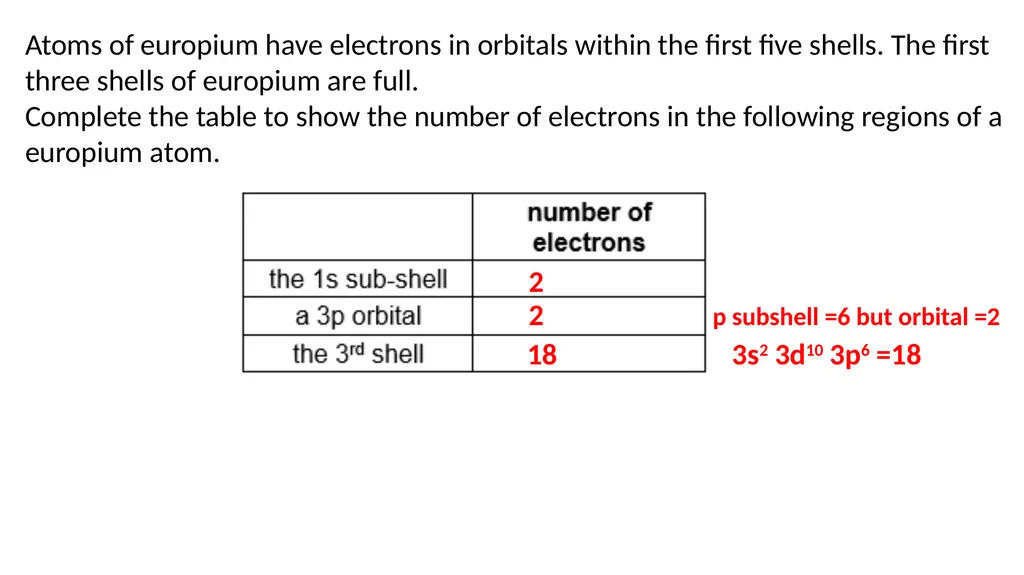
Atoms of europium have electrons in orbitals within the first five shells. The first three shells of europium are full. Complete the table to show the number of electrons in the following regions of a europium atom. 2 2 p subshell =6 but orbital =2 18 3s2 3d10 3p6 =18<br>
06
Ammonia is a gas with covalently-bonded molecules consisting of nitrogen and hydrogen atoms.
Show the electron configuration of a nitrogen atom using ‘electron-in-box’ diagrams. Label each sub-shell. 1s 2s 2p<br>
07
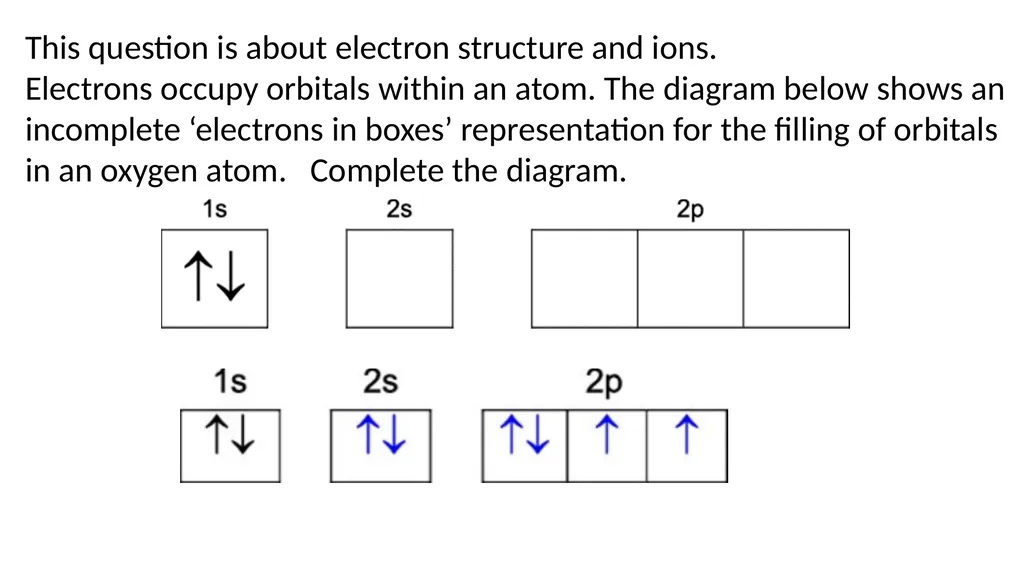
This question is about electron structure and ions.
Electrons occupy orbitals within an atom. The diagram below shows an incomplete ‘electrons in boxes’ representation for the filling of orbitals in an oxygen atom. Complete the diagram.<br>
08
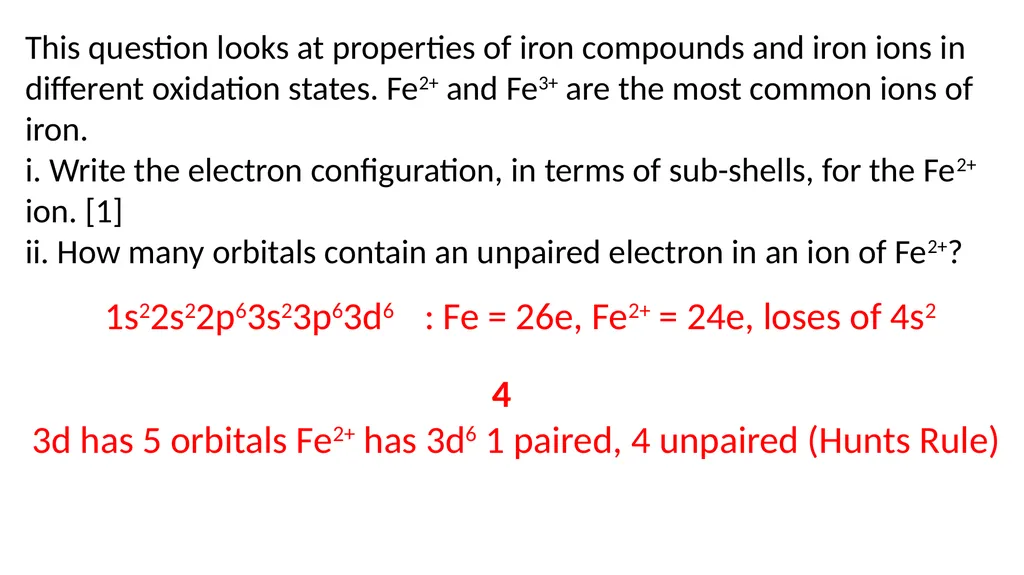
This question looks at properties of iron compounds and iron ions in different oxidation states. Fe2+ and Fe3+ are the most common ions of iron.
i. Write the electron configuration, in terms of sub-shells, for the Fe2+ ion. [1]
ii. How many orbitals contain an unpaired electron in an ion of Fe2+? 1s22s22p63s23p63d6 : Fe = 26e, Fe2+ = 24e, loses of 4s2 4
3d has 5 orbitals Fe2+ has 3d6 1 paired, 4 unpaired (Hunts Rule)<br>
09
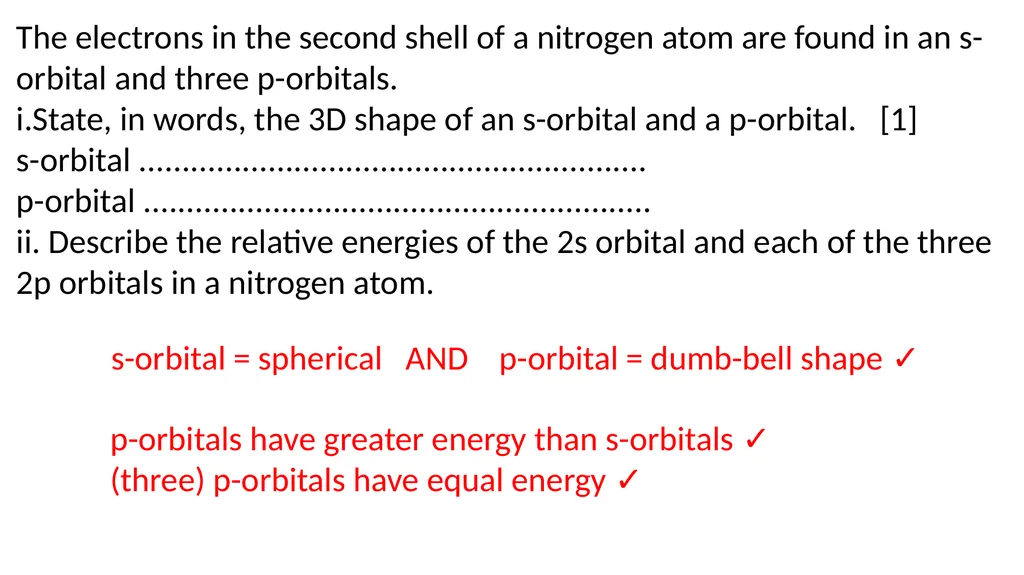
The electrons in the second shell of a nitrogen atom are found in an s-orbital and three p-orbitals.
i.State, in words, the 3D shape of an s-orbital and a p-orbital. [1]
s-orbital ...........................................................
p-orbital ...........................................................
ii. Describe the relative energies of the 2s orbital and each of the three 2p orbitals in a nitrogen atom. s-orbital = spherical AND p-orbital = dumb-bell shape ✓ p-orbitals have greater energy than s-orbitals ✓
(three) p-orbitals have equal energy ✓<br>
10
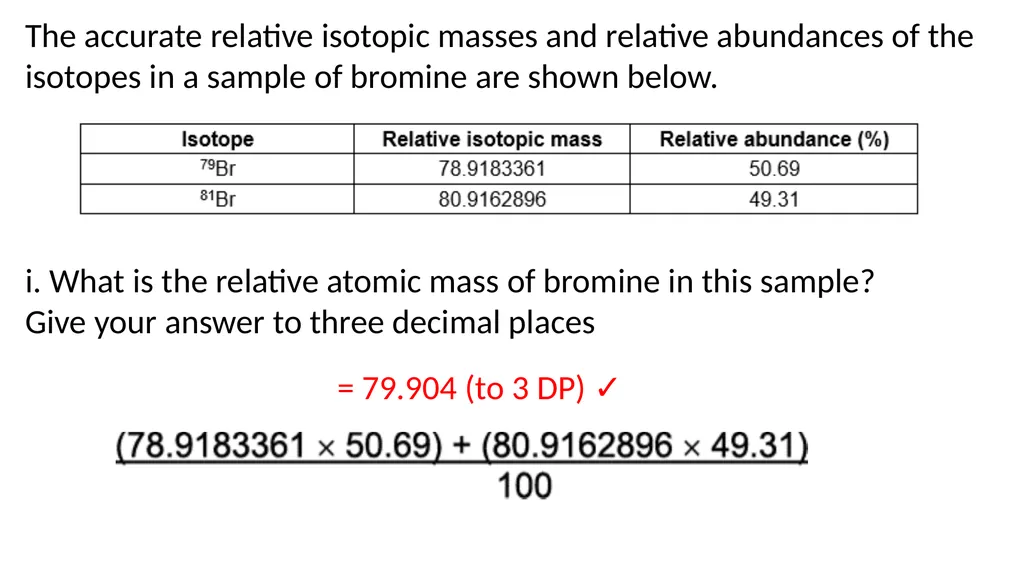
The accurate relative isotopic masses and relative abundances of the isotopes in a sample of bromine are shown below.
i. What is the relative atomic mass of bromine in this sample?
Give your answer to three decimal places = 79.904 (to 3 DP) ✓<br>