
Zoonotic infections CLS 416 Learning outcomes
AM
Published · 40 slides · 0 views

1 / 1
Description
Zoonotic infections CLS 416 Learning outcomes after the end of the lecture students should 1) define zoonotic infections 2) for the discussed zoonotic infections,link the causative agent and compare the mode of transmission to humans 3)
Related Topics
Share
Embed code
Download this presentation From Below
"Zoonotic infections CLS 416 Learning outcomes" is the property of its rightful owner. Permission is granted to download and print the materials on this website for personal, non-commercial use only, and to display it on your personal computer provided you do not modify the materials and that you retain all copyright notices contained in the materials. By downloading content from our website, you accept the terms of this agreement.
Presentation Transcript
01
Zoonotic infections CLS 416<br>
02
Learning outcomes
after the end of the lecture students should 1) define zoonotic infections
2) for the discussed zoonotic infections,link the causative agent and compare the mode of transmission to humans
3) associate animal hosts or vectors with zoonotic infections discussed in the lecture
4) correlate the pathogen ( genus and species ) that cause the zoonotic diseases discussed in the lecture .
5) Discuss the epidemiology and describe the clinical manifestations associated with each disease condition.
6) discuss the control measures<br>
2) for the discussed zoonotic infections,link the causative agent and compare the mode of transmission to humans
3) associate animal hosts or vectors with zoonotic infections discussed in the lecture
4) correlate the pathogen ( genus and species ) that cause the zoonotic diseases discussed in the lecture .
5) Discuss the epidemiology and describe the clinical manifestations associated with each disease condition.
6) discuss the control measures<br>
03
Definition Zoonotic disease (zoonoses): any infection that is transmitted from non-human sources as wild and domestic animals, to human beings.
Animal carrying the pathogen may or may not experience clinical symptoms of the infection .
Zoonoses account for over 60% of known human pathogens and 75% of emerging or re-emerging infectious diseases<br>
Animal carrying the pathogen may or may not experience clinical symptoms of the infection .
Zoonoses account for over 60% of known human pathogens and 75% of emerging or re-emerging infectious diseases<br>
04
High-risk, human populations Although zoonoses can affect everyone, certain populations
have a higher risk of becoming infected due to increased animal contact or associated environmental exposure as a result of their job or lifestyle.
In developing countries, a large proportion of the population are frequently exposed to live animals in their daily lives.
In West Africa for example, human contact with both domestic and wild animals is common, even in urban locations, and may lead to an increased burden of zoonotic diseases when compared to developed countries.<br>
In developing countries, a large proportion of the population are frequently exposed to live animals in their daily lives.
In West Africa for example, human contact with both domestic and wild animals is common, even in urban locations, and may lead to an increased burden of zoonotic diseases when compared to developed countries.<br>
05
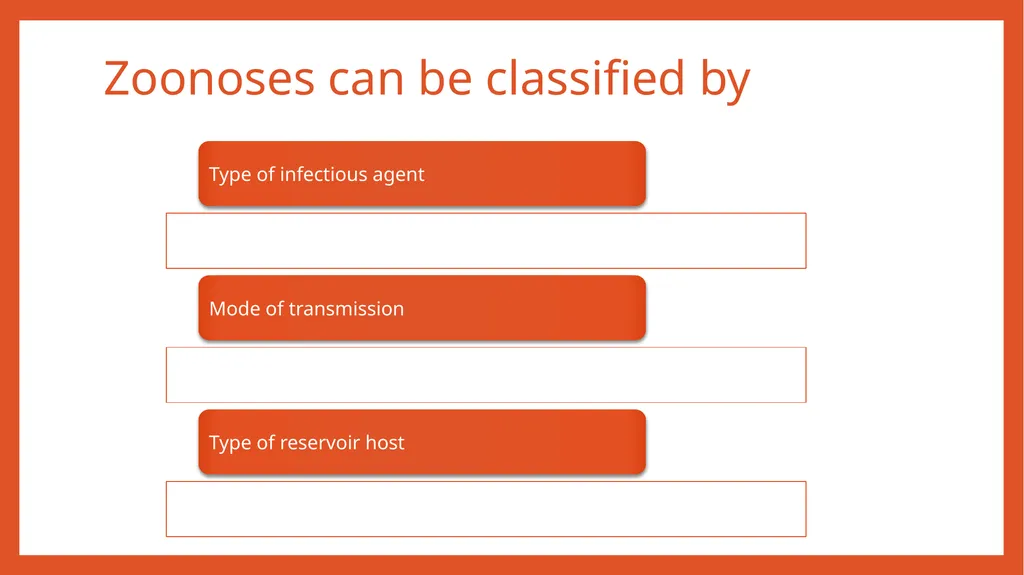
Zoonoses can be classified by<br>
06
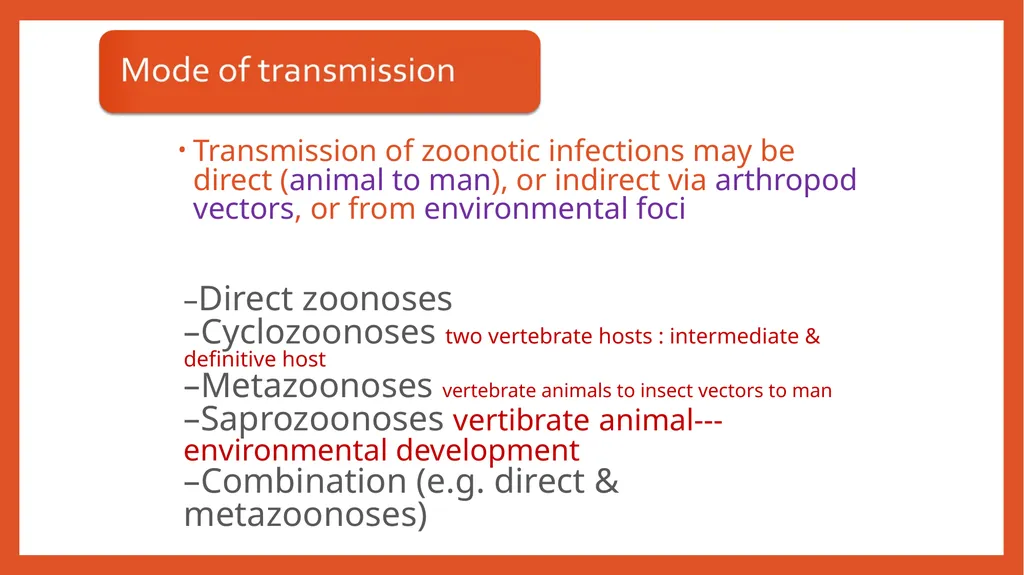
Transmission of zoonotic infections may be direct (animal to man), or indirect via arthropod vectors, or from environmental foci
–Direct zoonoses –Cyclozoonoses two vertebrate hosts : intermediate & definitive host –Metazoonoses vertebrate animals to insect vectors to man –Saprozoonoses vertibrate animal---environmental development –Combination (e.g. direct & metazoonoses)<br>
–Direct zoonoses –Cyclozoonoses two vertebrate hosts : intermediate & definitive host –Metazoonoses vertebrate animals to insect vectors to man –Saprozoonoses vertibrate animal---environmental development –Combination (e.g. direct & metazoonoses)<br>
07
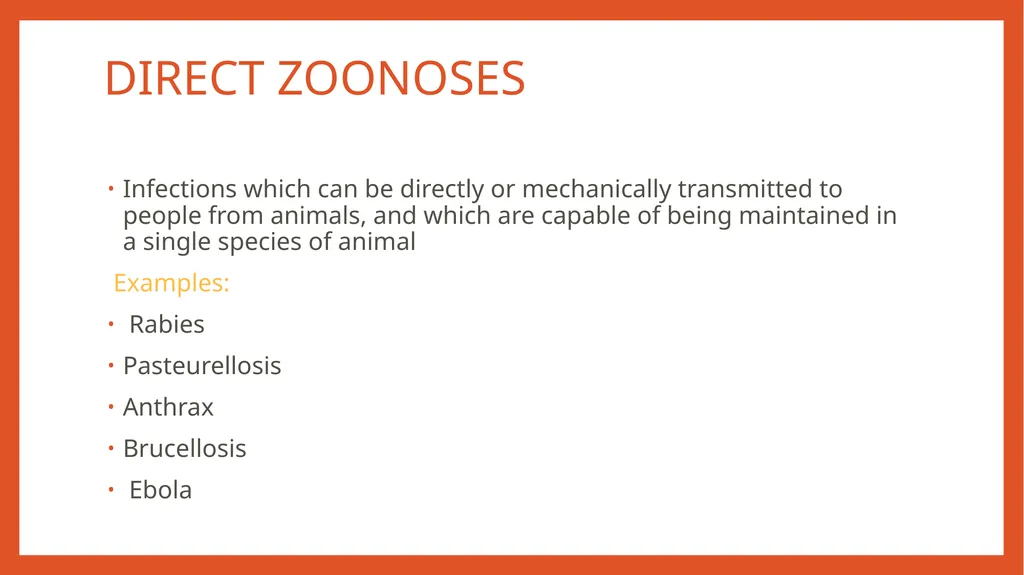
DIRECT ZOONOSES Infections which can be directly or mechanically transmitted to people from animals, and which are capable of being maintained in a single species of animal
Examples:
Rabies
Pasteurellosis
Anthrax
Brucellosis
Ebola<br>
Examples:
Rabies
Pasteurellosis
Anthrax
Brucellosis
Ebola<br>
08
Rabies ( Animal bite)
Rabies is a preventable viral disease of mammals
often transmitted through the bite of a rabid animal Etiology
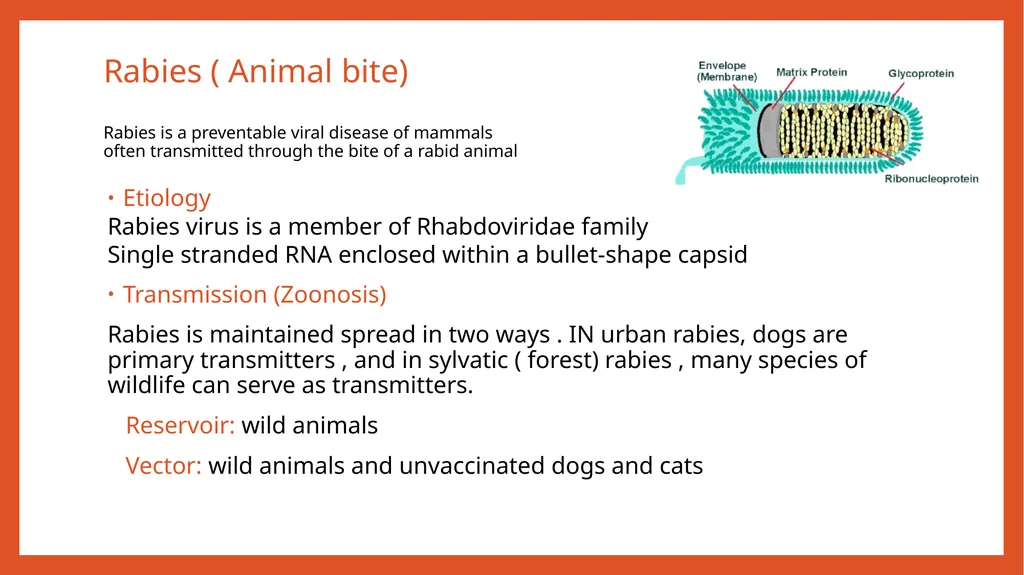
Rabies virus is a member of Rhabdoviridae family
Single stranded RNA enclosed within a bullet-shape capsid
Transmission (Zoonosis)
Rabies is maintained spread in two ways . IN urban rabies, dogs are primary transmitters , and in sylvatic ( forest) rabies , many species of wildlife can serve as transmitters.
Reservoir: wild animals
Vector: wild animals and unvaccinated dogs and cats<br>
Rabies virus is a member of Rhabdoviridae family
Single stranded RNA enclosed within a bullet-shape capsid
Transmission (Zoonosis)
Rabies is maintained spread in two ways . IN urban rabies, dogs are primary transmitters , and in sylvatic ( forest) rabies , many species of wildlife can serve as transmitters.
Reservoir: wild animals
Vector: wild animals and unvaccinated dogs and cats<br>
09
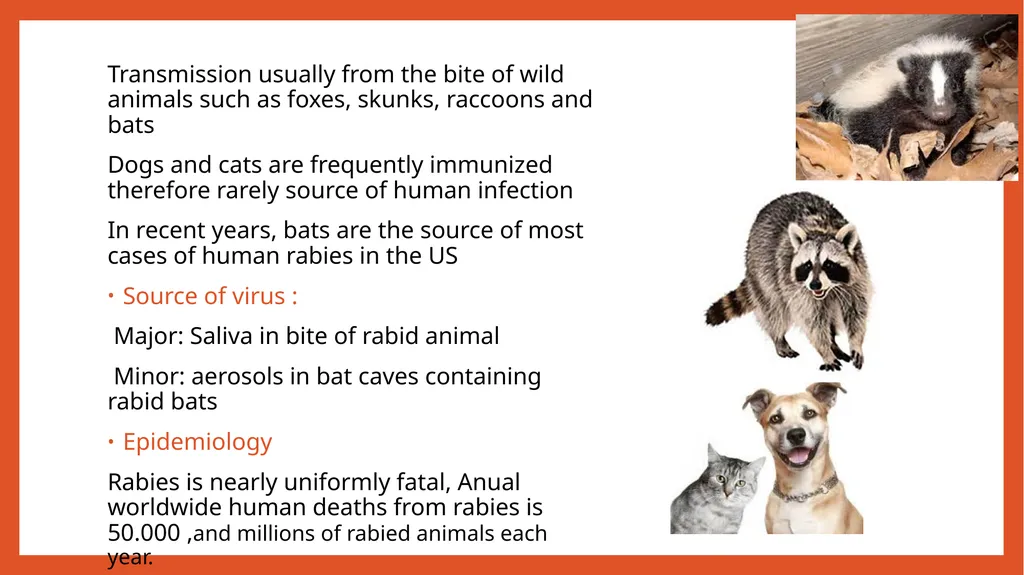
Transmission usually from the bite of wild animals such as foxes, skunks, raccoons and bats
Dogs and cats are frequently immunized therefore rarely source of human infection
In recent years, bats are the source of most cases of human rabies in the US
Source of virus :
Major: Saliva in bite of rabid animal
Minor: aerosols in bat caves containing rabid bats
Epidemiology
Rabies is nearly uniformly fatal, Anual worldwide human deaths from rabies is 50.000 ,and millions of rabied animals each year.<br>
Dogs and cats are frequently immunized therefore rarely source of human infection
In recent years, bats are the source of most cases of human rabies in the US
Source of virus :
Major: Saliva in bite of rabid animal
Minor: aerosols in bat caves containing rabid bats
Epidemiology
Rabies is nearly uniformly fatal, Anual worldwide human deaths from rabies is 50.000 ,and millions of rabied animals each year.<br>
10
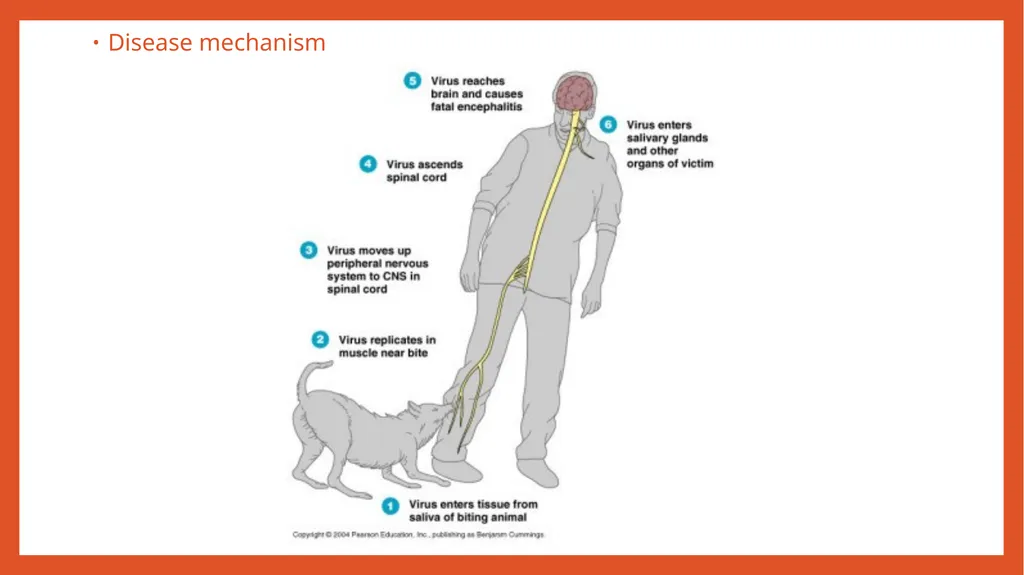
Disease mechanism<br>
11
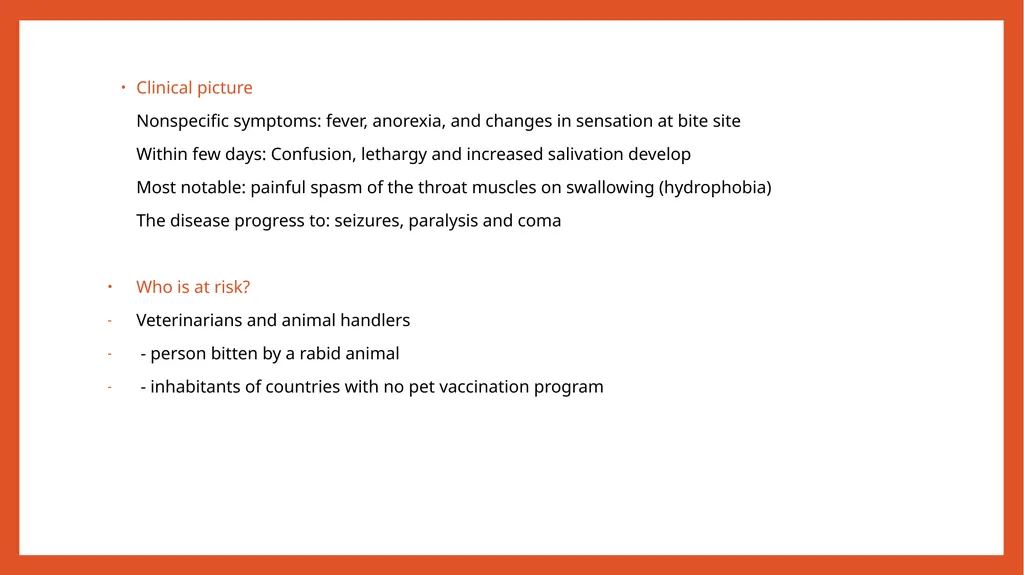
Clinical picture
Nonspecific symptoms: fever, anorexia, and changes in sensation at bite site
Within few days: Confusion, lethargy and increased salivation develop
Most notable: painful spasm of the throat muscles on swallowing (hydrophobia)
The disease progress to: seizures, paralysis and coma
Who is at risk?
Veterinarians and animal handlers
- person bitten by a rabid animal
- inhabitants of countries with no pet vaccination program<br>
Nonspecific symptoms: fever, anorexia, and changes in sensation at bite site
Within few days: Confusion, lethargy and increased salivation develop
Most notable: painful spasm of the throat muscles on swallowing (hydrophobia)
The disease progress to: seizures, paralysis and coma
Who is at risk?
Veterinarians and animal handlers
- person bitten by a rabid animal
- inhabitants of countries with no pet vaccination program<br>
12
Pasteurellosis Etiology
-Pasteurella maultocida
- pleomorphic ovoid to filamentous gram negative bacilli - present in the oral cavities of most cats and dogs
Clinical manifestations
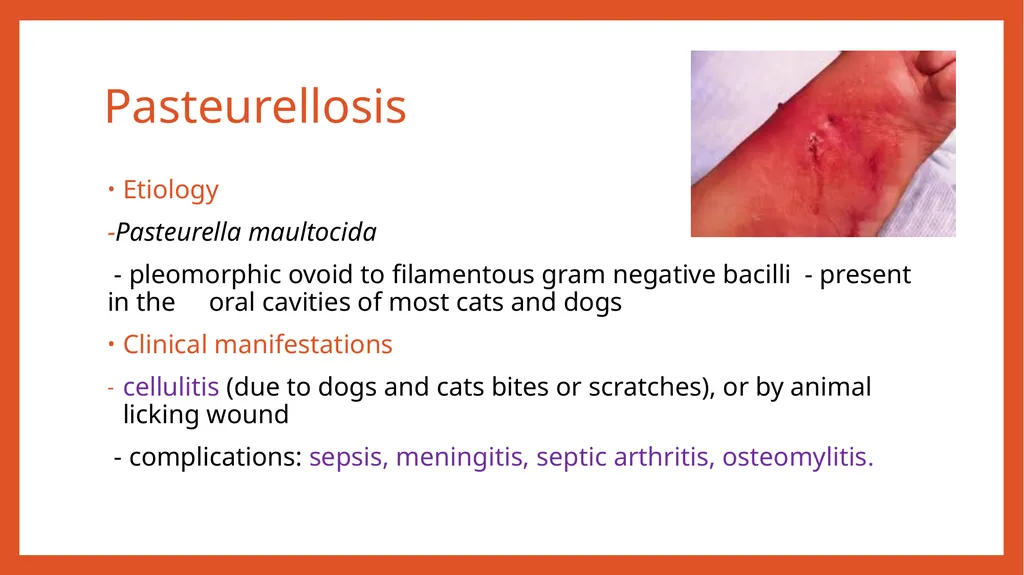
cellulitis (due to dogs and cats bites or scratches), or by animal licking wound
- complications: sepsis, meningitis, septic arthritis, osteomylitis.<br>
-Pasteurella maultocida
- pleomorphic ovoid to filamentous gram negative bacilli - present in the oral cavities of most cats and dogs
Clinical manifestations
cellulitis (due to dogs and cats bites or scratches), or by animal licking wound
- complications: sepsis, meningitis, septic arthritis, osteomylitis.<br>
13
Anthrax
( wool sorters disease) Etiology
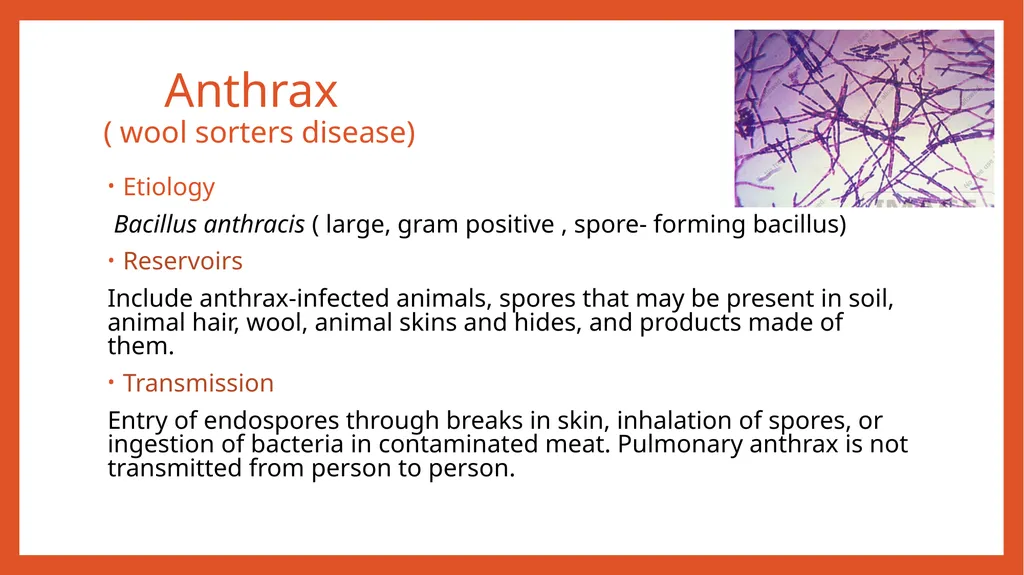
Bacillus anthracis ( large, gram positive , spore- forming bacillus)
Reservoirs
Include anthrax-infected animals, spores that may be present in soil, animal hair, wool, animal skins and hides, and products made of them.
Transmission
Entry of endospores through breaks in skin, inhalation of spores, or ingestion of bacteria in contaminated meat. Pulmonary anthrax is not transmitted from person to person.<br>
Bacillus anthracis ( large, gram positive , spore- forming bacillus)
Reservoirs
Include anthrax-infected animals, spores that may be present in soil, animal hair, wool, animal skins and hides, and products made of them.
Transmission
Entry of endospores through breaks in skin, inhalation of spores, or ingestion of bacteria in contaminated meat. Pulmonary anthrax is not transmitted from person to person.<br>
14
Anthrax Human disease occurs in three main forms
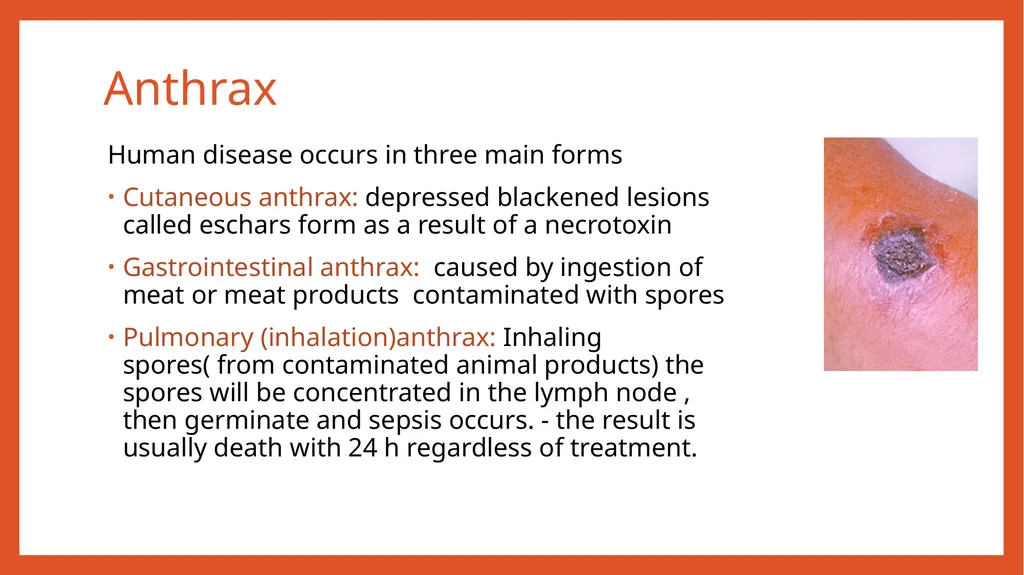
Cutaneous anthrax: depressed blackened lesions called eschars form as a result of a necrotoxin
Gastrointestinal anthrax: caused by ingestion of meat or meat products contaminated with spores
Pulmonary (inhalation)anthrax: Inhaling spores( from contaminated animal products) the spores will be concentrated in the lymph node , then germinate and sepsis occurs. - the result is usually death with 24 h regardless of treatment.<br>
Cutaneous anthrax: depressed blackened lesions called eschars form as a result of a necrotoxin
Gastrointestinal anthrax: caused by ingestion of meat or meat products contaminated with spores
Pulmonary (inhalation)anthrax: Inhaling spores( from contaminated animal products) the spores will be concentrated in the lymph node , then germinate and sepsis occurs. - the result is usually death with 24 h regardless of treatment.<br>
15
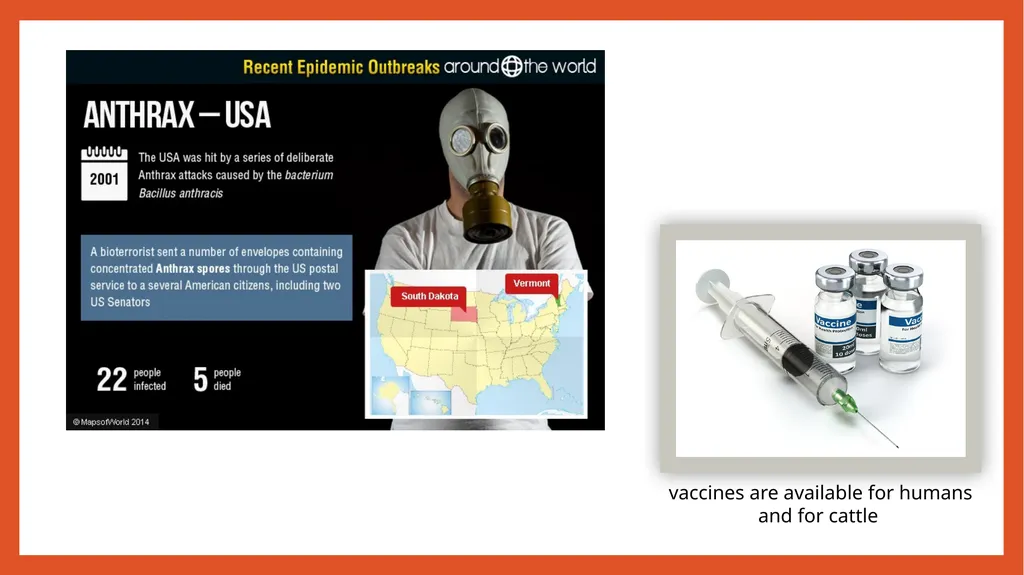
vaccines are available for humans and for cattle<br>
16
Brucellosis
( Malta fever, Mediterranean fever, undulant fever) Systemic infection with organisms multiplying inside the cells of the reticuloendothelial system producing a granulomatous reaction, then spread by bacteremia to cause destructive lesions in bones, joints and other tissue
Etiology
four species originate from animal reservoir
Brucella melitensis ( goats)
Brucella abortus ( cattle)
Brucella canis (canines)
Brucella suis (swine)<br>
Etiology
four species originate from animal reservoir
Brucella melitensis ( goats)
Brucella abortus ( cattle)
Brucella canis (canines)
Brucella suis (swine)<br>
17
Brucellosis Transmission:
Direct contact (farmers, vets, abattoir workers)
Unpasteurized milk or cheese
Inhalation (laboratory worker)
Clinical picture
-After incubation period of 1-3 weeks, nonspecific symptoms such as fever,chillis, fatigue, malaise, anorexia, and weight loss occur
-The undulating (rising-and-falling) fever pattern that gives the disease its name
-Enlarge lymph nodes, liver, and spleen
-Brucella melitensis is the most common agent of human brucellosis, occurs in many areas of the world ( Mexico, central and south america, Africa, Saudi Arabai)<br>
Direct contact (farmers, vets, abattoir workers)
Unpasteurized milk or cheese
Inhalation (laboratory worker)
Clinical picture
-After incubation period of 1-3 weeks, nonspecific symptoms such as fever,chillis, fatigue, malaise, anorexia, and weight loss occur
-The undulating (rising-and-falling) fever pattern that gives the disease its name
-Enlarge lymph nodes, liver, and spleen
-Brucella melitensis is the most common agent of human brucellosis, occurs in many areas of the world ( Mexico, central and south america, Africa, Saudi Arabai)<br>
18
Ebola Ebola virus is named for the river in Zaire that was the site of an outbreak of hemorrhagic fever in 1976
Clinical picture
the incubation period, is 2 to 21 days.
Humans are not infectious until they develop symptoms. First symptoms are the sudden onset of fever, fatigue, muscle pain, headache and sore throat.
This is followed by vomiting, diarrhea, rash, symptoms of impaired kidney and liver function,
Susequently, Hemorrhage from multiple sites ( especially the gastrointestinal tract ) and death occurs as many as 90% of patients with clinically evident disease<br>
Clinical picture
the incubation period, is 2 to 21 days.
Humans are not infectious until they develop symptoms. First symptoms are the sudden onset of fever, fatigue, muscle pain, headache and sore throat.
This is followed by vomiting, diarrhea, rash, symptoms of impaired kidney and liver function,
Susequently, Hemorrhage from multiple sites ( especially the gastrointestinal tract ) and death occurs as many as 90% of patients with clinically evident disease<br>
19
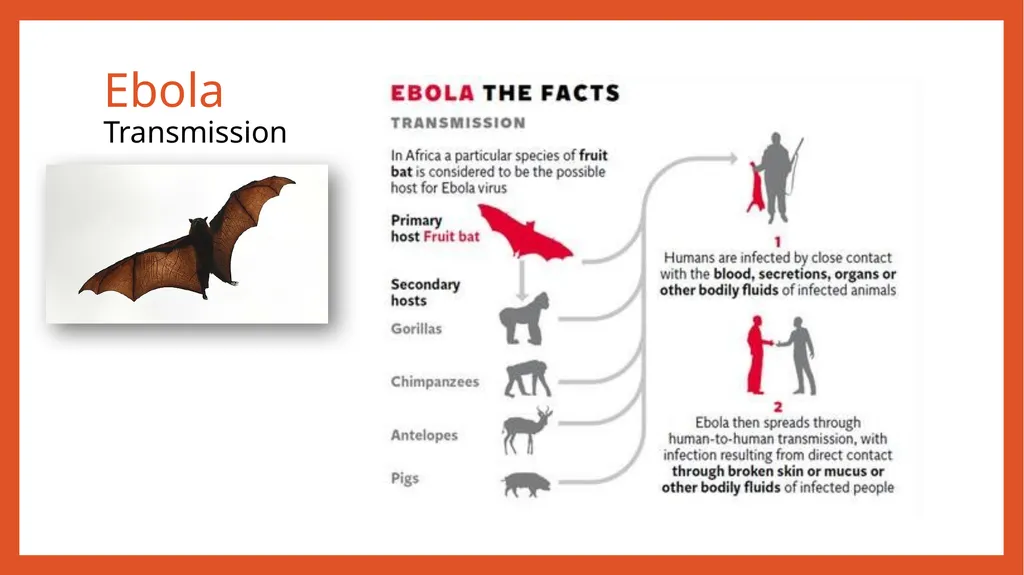
Ebola
Transmission<br>
20
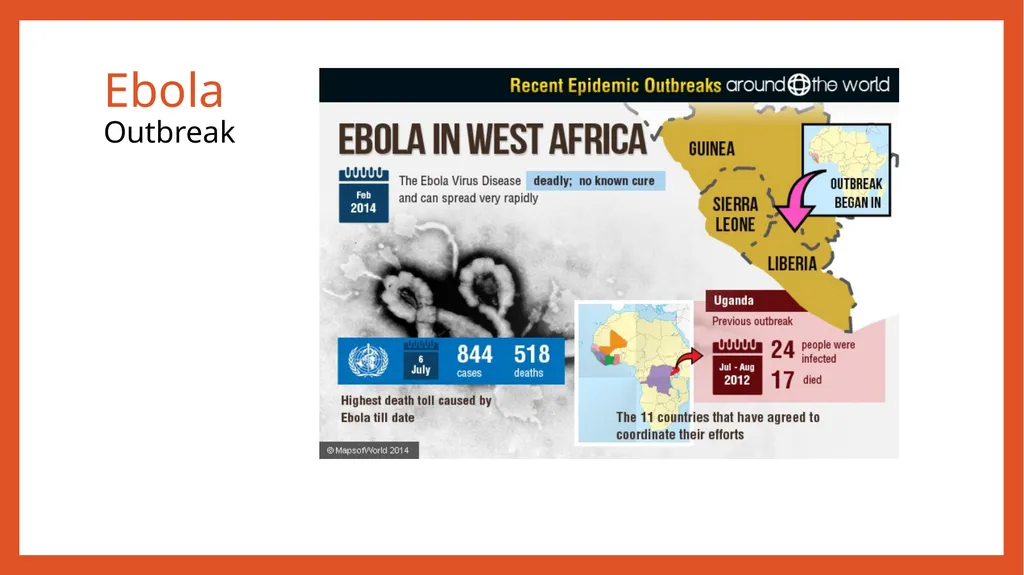
Ebola
Outbreak<br>
21
Ebola
Treatment Supportive care-rehydration with oral or intravenous fluids- and treatment of specific symptoms, improves survival.
There is no proven treatment available for EV. However, a range of potential treatments including blood products, immune therapies and drug therapies are currently being evaluated.
No licensed vaccines are available yet, but 2 potential vaccines are undergoing human safety testing.<br>
There is no proven treatment available for EV. However, a range of potential treatments including blood products, immune therapies and drug therapies are currently being evaluated.
No licensed vaccines are available yet, but 2 potential vaccines are undergoing human safety testing.<br>
22
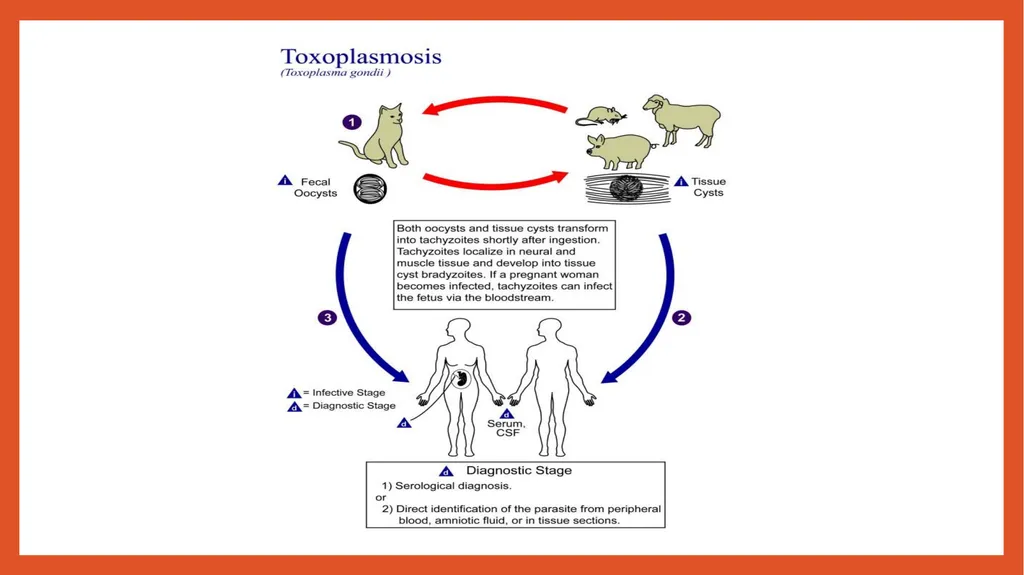
CYCLOZOONOSES Infections which require at least two vertebrate hosts, one of which may be human, to complete their life cycle eg. Taenia solium, Echinococcus granulosus,
Toxoplasma gondi<br>
Toxoplasma gondi<br>
23
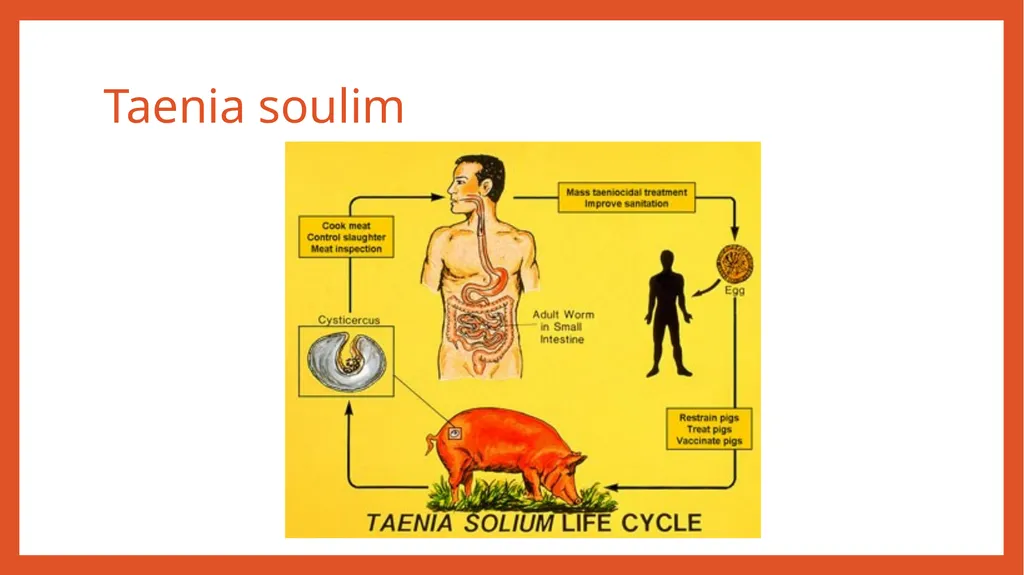
Taenia soulim<br>
24
Human echinococcosis
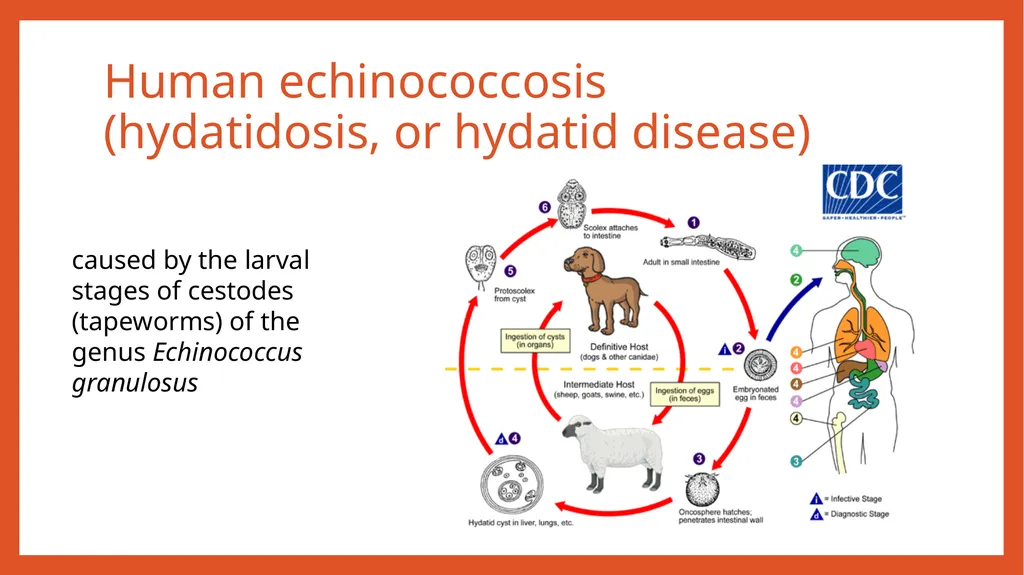
(hydatidosis, or hydatid disease) caused by the larval stages of cestodes (tapeworms) of the genus Echinococcus granulosus<br>
25
METAZOONOSES Diseases of vertebrate animals which can affect man, the infectious agents of which replicate, develop in, and are transmitted by, an invertebrate vector eg. plague, rickettsiae, lyme, borreliosis.<br>
26
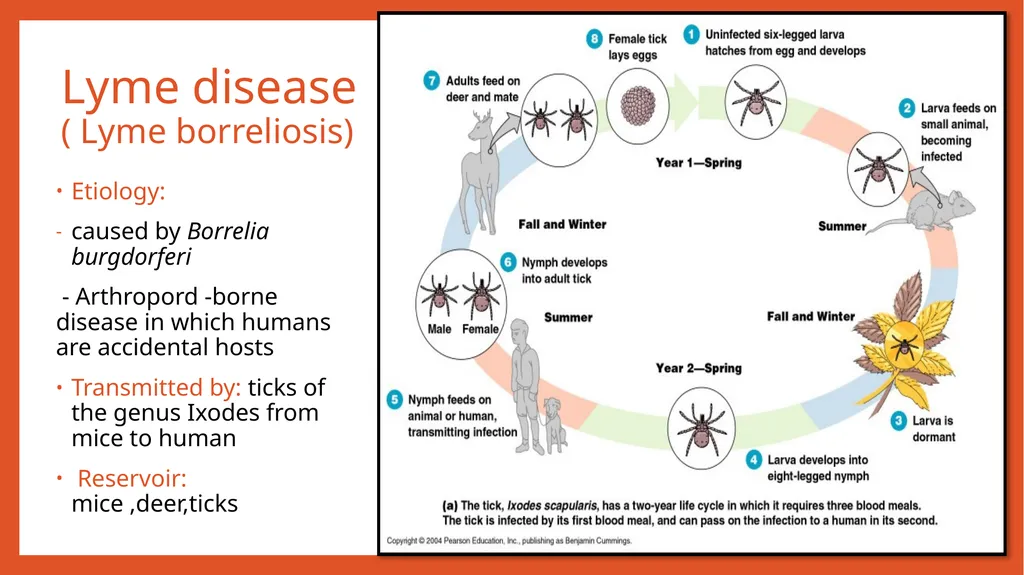
Lyme disease
( Lyme borreliosis) Etiology:
caused by Borrelia burgdorferi
- Arthropord -borne disease in which humans are accidental hosts
Transmitted by: ticks of the genus Ixodes from mice to human
Reservoir: mice ,deer,ticks<br>
caused by Borrelia burgdorferi
- Arthropord -borne disease in which humans are accidental hosts
Transmitted by: ticks of the genus Ixodes from mice to human
Reservoir: mice ,deer,ticks<br>
27
Lyme disease
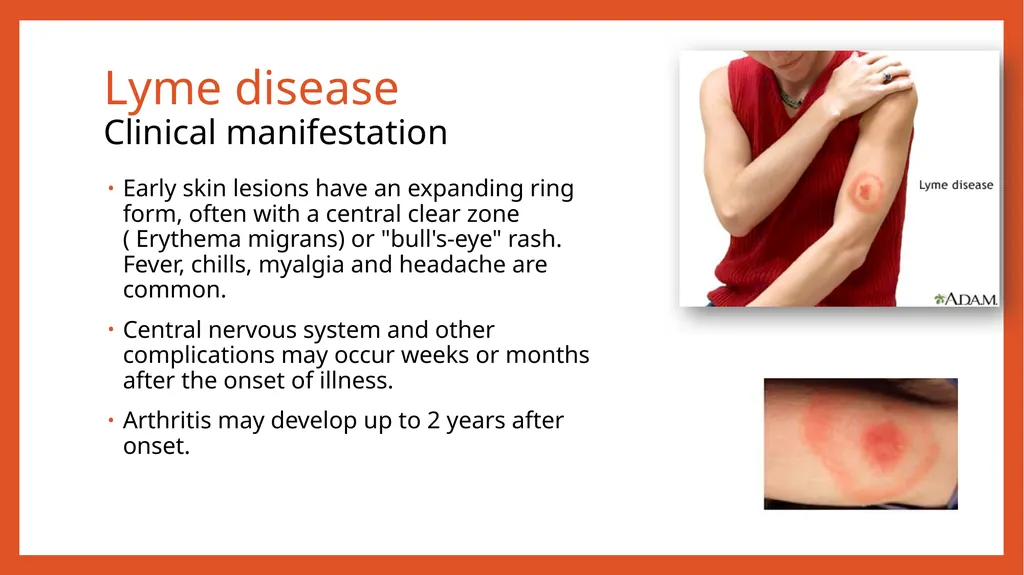
Clinical manifestation Early skin lesions have an expanding ring form, often with a central clear zone ( Erythema migrans) or "bull's-eye" rash. Fever, chills, myalgia and headache are common.
Central nervous system and other complications may occur weeks or months after the onset of illness.
Arthritis may develop up to 2 years after onset.<br>
Central nervous system and other complications may occur weeks or months after the onset of illness.
Arthritis may develop up to 2 years after onset.<br>
28
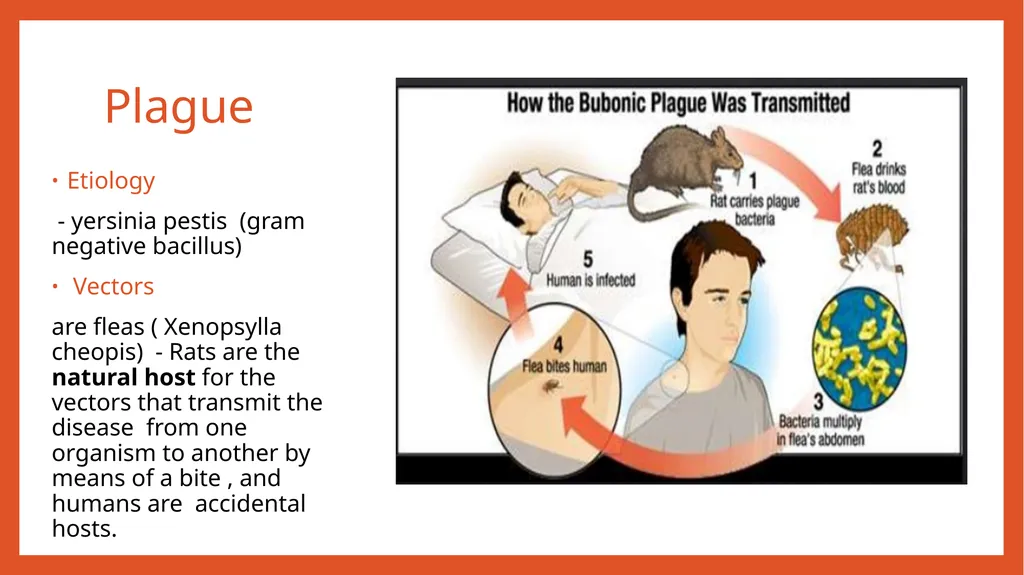
Plague Etiology
- yersinia pestis (gram negative bacillus)
Vectors
are fleas ( Xenopsylla cheopis) - Rats are the natural host for the vectors that transmit the disease from one organism to another by means of a bite , and humans are accidental hosts.<br>
- yersinia pestis (gram negative bacillus)
Vectors
are fleas ( Xenopsylla cheopis) - Rats are the natural host for the vectors that transmit the disease from one organism to another by means of a bite , and humans are accidental hosts.<br>
29
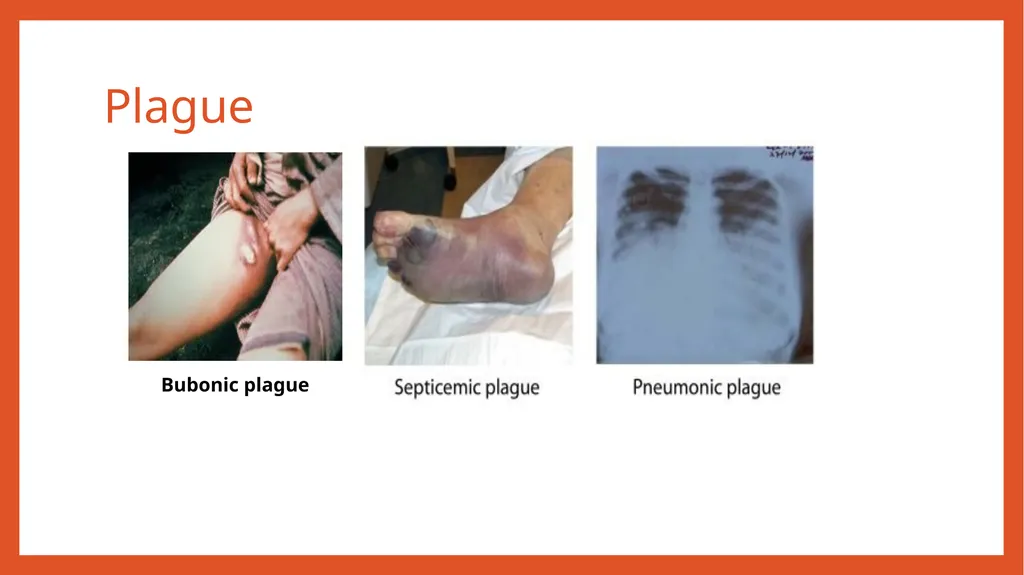
Plague
Clinical Picture Bubonic plague: Patients develop sudden onset of fever, headache, chills, and weakness , tender and painful lymph nodes (called buboes). If the patient is not treated with the appropriate antibiotics, the bacteria can spread to other parts of the body.
Septicemic plague: Skin and other tissues may turn black and die, especially on fingers, toes, and the nose. Septicemic plague can occur as the first symptom of plague, or may develop from untreated bubonic plague.
Pneumonic plague: develop from inhaling infectious droplets or from untreated bubonic or septicemic plague after the bacteria spread to the lungs. may cause respiratory failure and shock. most serious form of the disease and is the only form of plague that can be spread from person to person (by infectious droplets).<br>
Septicemic plague: Skin and other tissues may turn black and die, especially on fingers, toes, and the nose. Septicemic plague can occur as the first symptom of plague, or may develop from untreated bubonic plague.
Pneumonic plague: develop from inhaling infectious droplets or from untreated bubonic or septicemic plague after the bacteria spread to the lungs. may cause respiratory failure and shock. most serious form of the disease and is the only form of plague that can be spread from person to person (by infectious droplets).<br>
30
Plague Bubonic plague<br>
31
SAPROZOONOSES Diseases of vertebrate animals which can affect people, the infectious agents of which are either capable of replicating in inanimate sites, or require an inanimate environment for the development of an infectious stage of their life cycle eg. histoplasmosis, Toxocariasis ,certain food-borne diseases.<br>
32
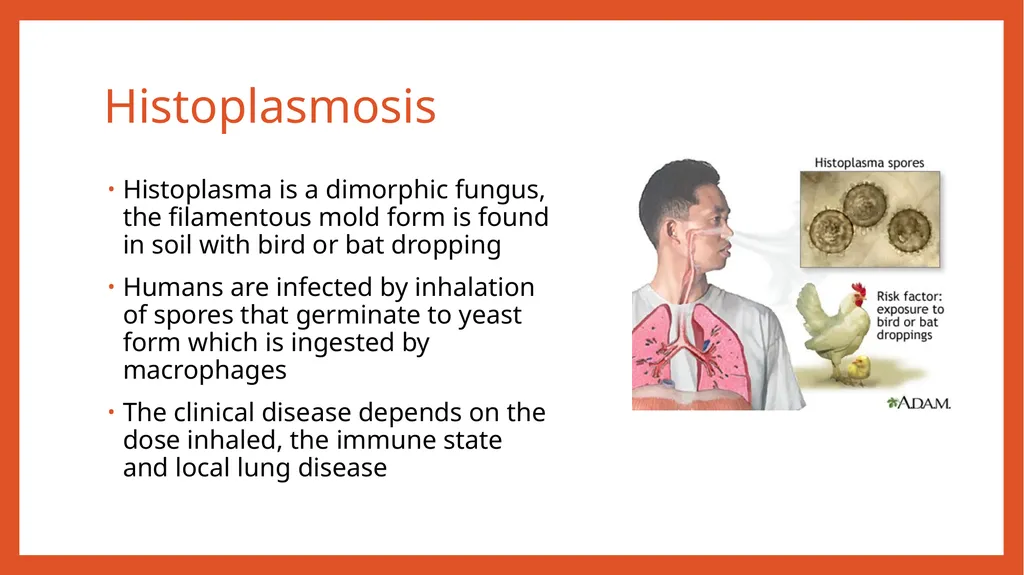
Histoplasmosis Histoplasma is a dimorphic fungus, the filamentous mold form is found in soil with bird or bat dropping
Humans are infected by inhalation of spores that germinate to yeast form which is ingested by macrophages
The clinical disease depends on the dose inhaled, the immune state and local lung disease<br>
Humans are infected by inhalation of spores that germinate to yeast form which is ingested by macrophages
The clinical disease depends on the dose inhaled, the immune state and local lung disease<br>
33
Zoonoses can be classified by: Bacterial zoonoses
Parasites
Viruses
Fungi<br>
Parasites
Viruses
Fungi<br>
34
Bacterial zoonoses foodborne zoonoses such as Salmonellosis and Campylobacteriosis which cause fever, diarrhoea, abdominal pain, malaise and nausea.
- anthrax
- brucellosis
- infection by verotoxigenic Escherichia coli
- leptospirosis,
- plague
- Q fever
- shigellosis
- Tularaemia.<br>
- anthrax
- brucellosis
- infection by verotoxigenic Escherichia coli
- leptospirosis,
- plague
- Q fever
- shigellosis
- Tularaemia.<br>
35
Parasites Cysticercosis/Taeniasis
- trematodosis,
- echinococcosis/hydatidosis,
- toxoplasmosis
- trichinellosis.<br>
- trematodosis,
- echinococcosis/hydatidosis,
- toxoplasmosis
- trichinellosis.<br>
36
Viruses - Rabies
- avian influenza,
-Congo hemorrhagic fever,
- Ebola
- Rift Valley fever.<br>
- avian influenza,
-Congo hemorrhagic fever,
- Ebola
- Rift Valley fever.<br>
37
Fungi Histoplasma
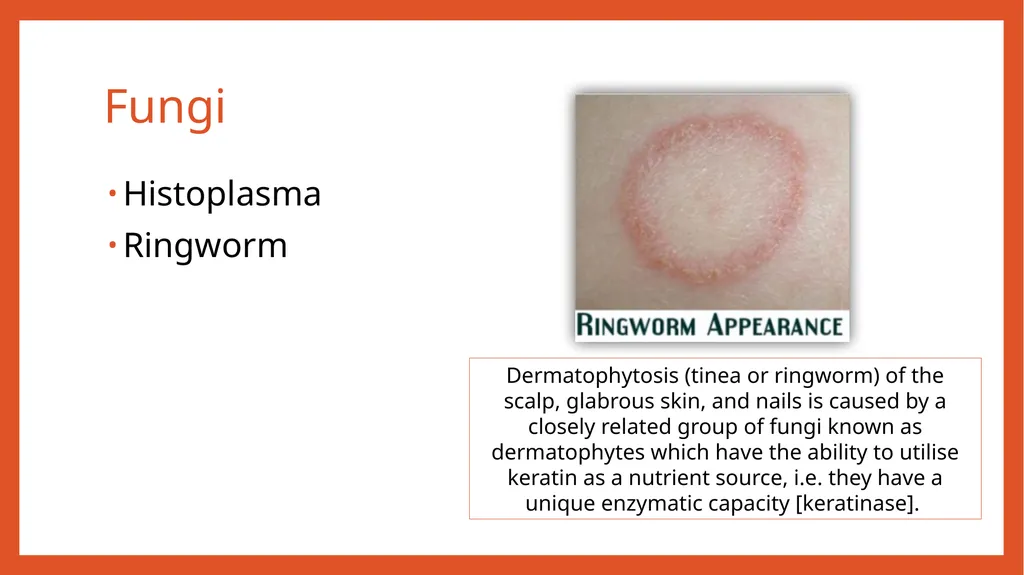
Ringworm Dermatophytosis (tinea or ringworm) of the scalp, glabrous skin, and nails is caused by a closely related group of fungi known as dermatophytes which have the ability to utilise keratin as a nutrient source, i.e. they have a unique enzymatic capacity [keratinase].<br>
Ringworm Dermatophytosis (tinea or ringworm) of the scalp, glabrous skin, and nails is caused by a closely related group of fungi known as dermatophytes which have the ability to utilise keratin as a nutrient source, i.e. they have a unique enzymatic capacity [keratinase].<br>
38
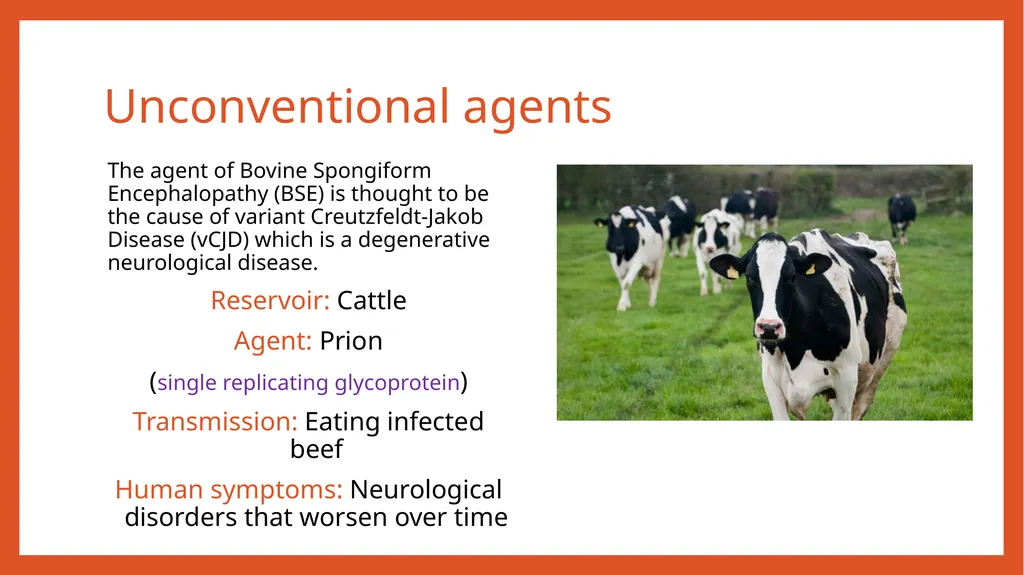
Unconventional agents The agent of Bovine Spongiform Encephalopathy (BSE) is thought to be the cause of variant Creutzfeldt-Jakob Disease (vCJD) which is a degenerative neurological disease.
Reservoir: Cattle
Agent: Prion
(single replicating glycoprotein)
Transmission: Eating infected beef
Human symptoms: Neurological disorders that worsen over time<br>
Reservoir: Cattle
Agent: Prion
(single replicating glycoprotein)
Transmission: Eating infected beef
Human symptoms: Neurological disorders that worsen over time<br>
39
CONTROL OF ZOONOTIC DISEASES Massive national and international eradication programmes eg. rabies, TB, brucellosis
Slaughter inspection of food animals
Prophylactic vaccinations mainly in animals
Therapy of animals with zoonotic diseases
Control of vector and reservoir populations (arthropods, rodents)
Prevention of environmental degradation to reduce disruption of natural balances among hosts, agents and the environment.<br>
Slaughter inspection of food animals
Prophylactic vaccinations mainly in animals
Therapy of animals with zoonotic diseases
Control of vector and reservoir populations (arthropods, rodents)
Prevention of environmental degradation to reduce disruption of natural balances among hosts, agents and the environment.<br>