
1 1926 Construction Focus Four Fall Hazards Focus
FD
Published · 47 slides · 0 views
1 / 1
Description
1 1926 Construction Focus Four Fall Hazards Focus Four 2 What is OSHA Focus Four? Construction Focus Four was developed to help workers in the construction industry understand the hazards they face, and know what their employers
Related Topics
Share
Embed code
Download this presentation From Below
"1 1926 Construction Focus Four Fall Hazards Focus" is the property of its rightful owner. Permission is granted to download and print the materials on this website for personal, non-commercial use only, and to display it on your personal computer provided you do not modify the materials and that you retain all copyright notices contained in the materials. By downloading content from our website, you accept the terms of this agreement.
Presentation Transcript
01
1 1926 Construction
Focus Four
Fall Hazards<br>
Focus Four
Fall Hazards<br>
02
Focus Four 2 What is OSHA Focus Four? Construction Focus Four was developed to help workers in the construction industry understand the hazards they face, and know what their employer’s responsibilities are regarding protecting workers from workplace hazards. Construction safety is one of OSHA's top concerns. Construction is among the most dangerous industries in the country and construction inspections comprise 60% of OSHA's total inspections. In 2009, preliminary data from the Bureau of Labor Statistics indicate that nearly one out of every five work-related deaths in the U.S were construction workers – more than in any other single industry sector.<br>
03
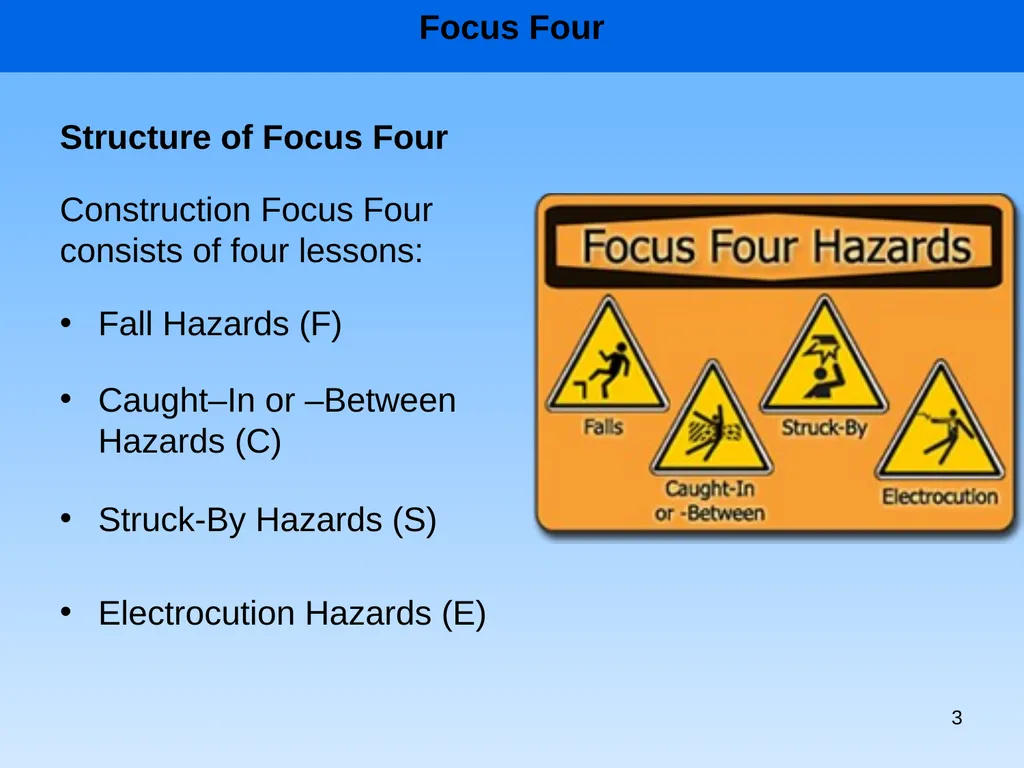
3 Focus Four Structure of Focus Four Construction Focus Four consists of four lessons: Caught–In or –Between Hazards (C) Struck-By Hazards (S) Electrocution Hazards (E) Fall Hazards (F)<br>
04
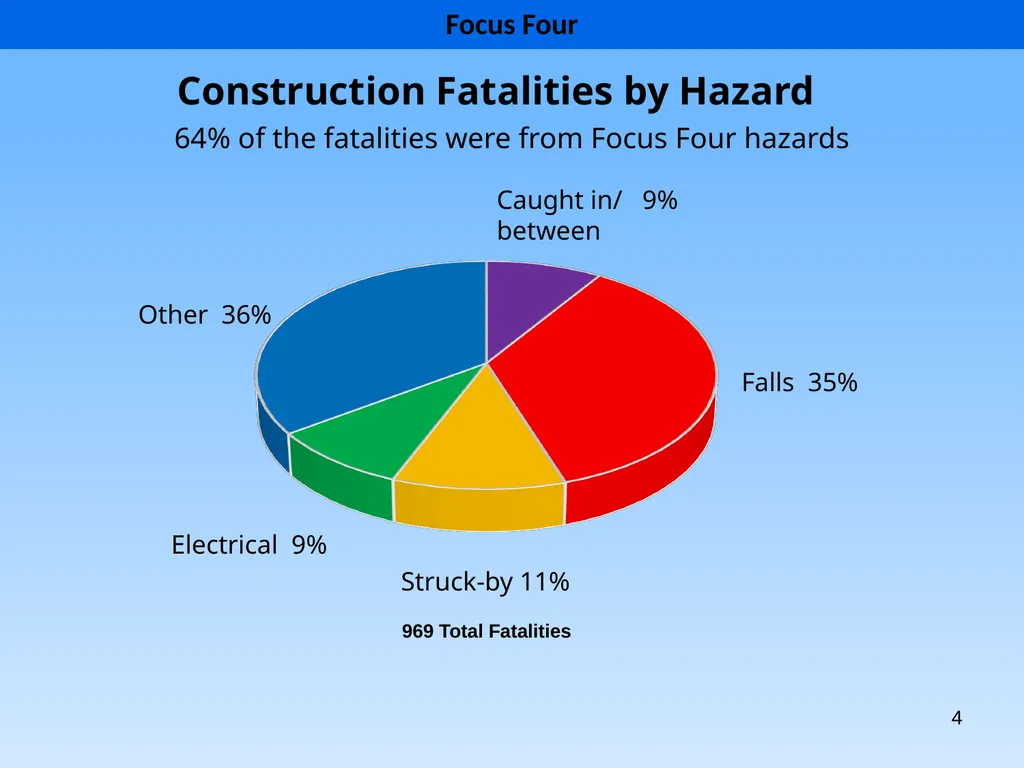
Focus Four 4 Construction Fatalities by Hazard 64% of the fatalities were from Focus Four hazards Struck-by 11% Electrical 9% Other 36% Caught in/ 9% between Falls 35% 969 Total Fatalities<br>
05
Fall Hazards
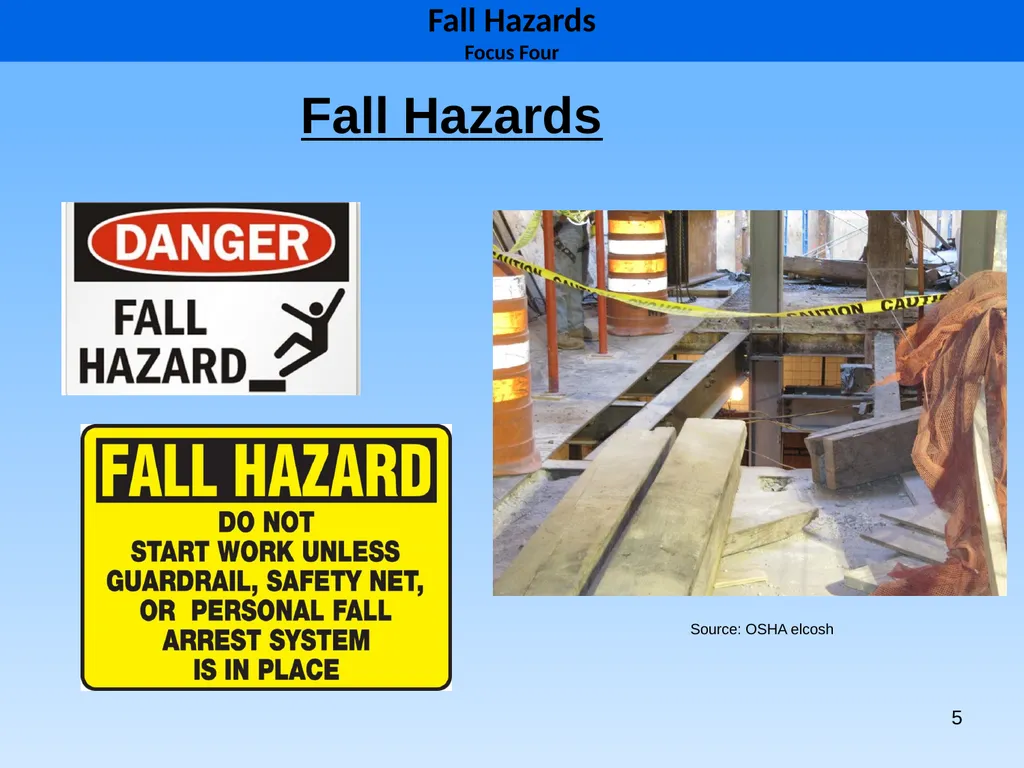
Focus Four 5 Fall Hazards Source: OSHA elcosh<br>
06
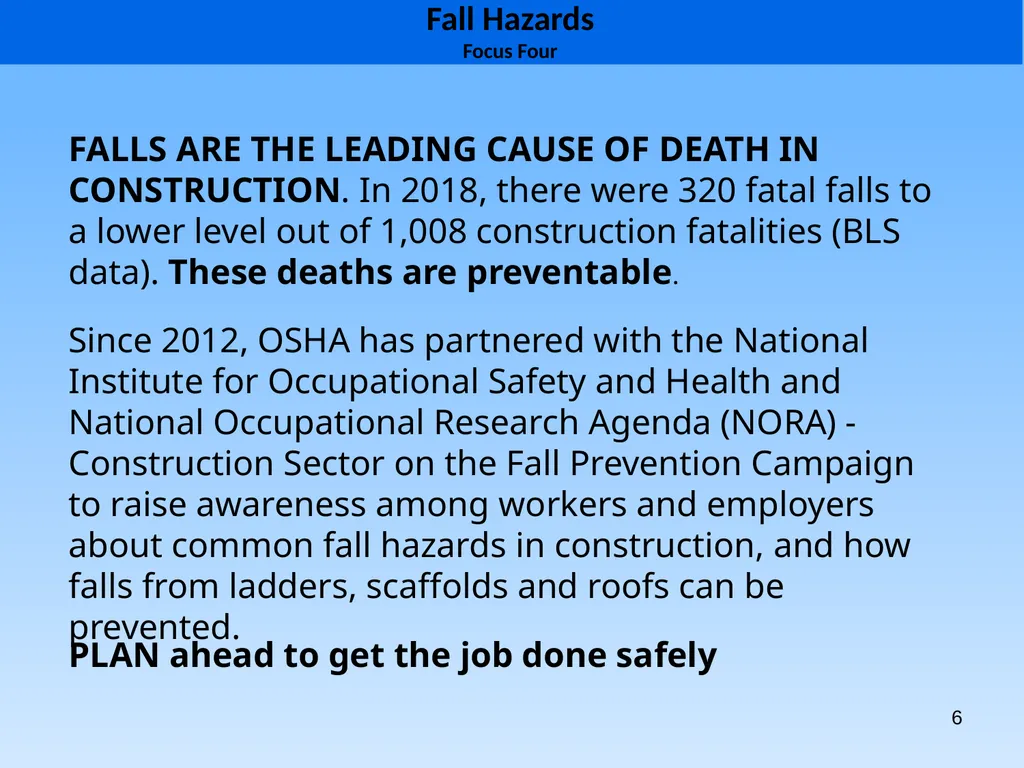
6 FALLS ARE THE LEADING CAUSE OF DEATH IN CONSTRUCTION. In 2018, there were 320 fatal falls to a lower level out of 1,008 construction fatalities (BLS data). These deaths are preventable. Since 2012, OSHA has partnered with the National Institute for Occupational Safety and Health and National Occupational Research Agenda (NORA) - Construction Sector on the Fall Prevention Campaign to raise awareness among workers and employers about common fall hazards in construction, and how falls from ladders, scaffolds and roofs can be prevented. PLAN ahead to get the job done safely Fall Hazards
Focus Four<br>
07
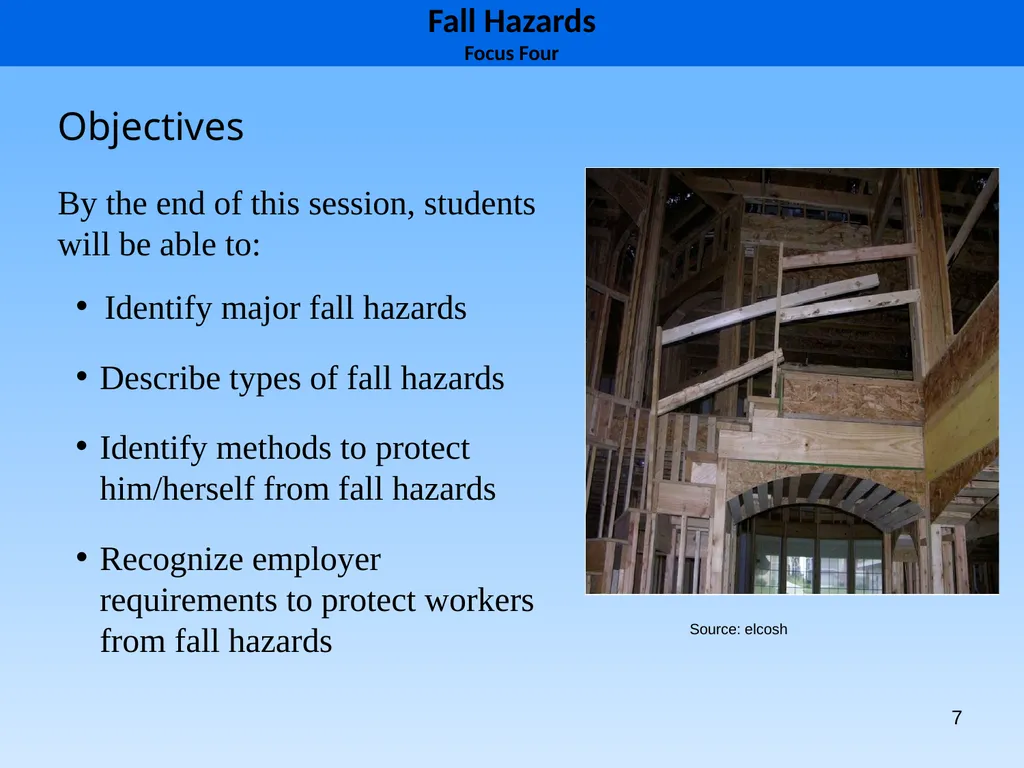
7 Objectives Identify major fall hazards Describe types of fall hazards Identify methods to protect him/herself from fall hazards Recognize employer requirements to protect workers from fall hazards Source: elcosh By the end of this session, students will be able to: Fall Hazards
Focus Four<br>
08
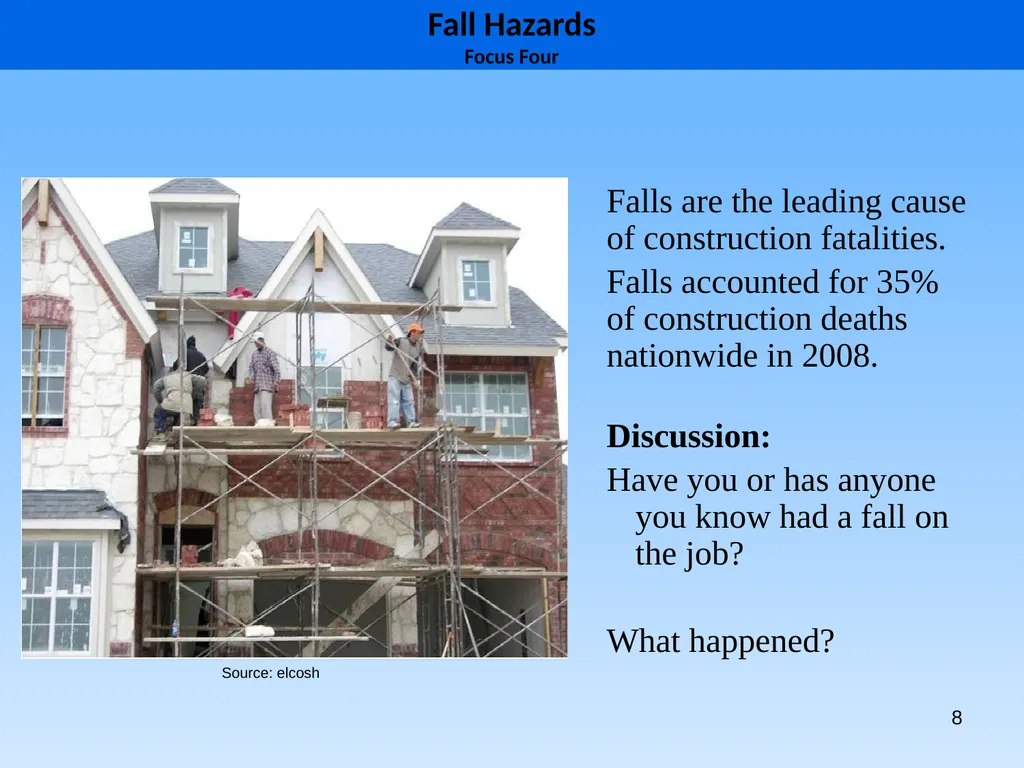
8 Falls are the leading cause of construction fatalities.
Falls accounted for 35% of construction deaths nationwide in 2008.
Discussion:
Have you or has anyone you know had a fall on the job?
What happened? Source: elcosh Fall Hazards Focus Four<br>
Falls accounted for 35% of construction deaths nationwide in 2008.
Discussion:
Have you or has anyone you know had a fall on the job?
What happened? Source: elcosh Fall Hazards Focus Four<br>
09
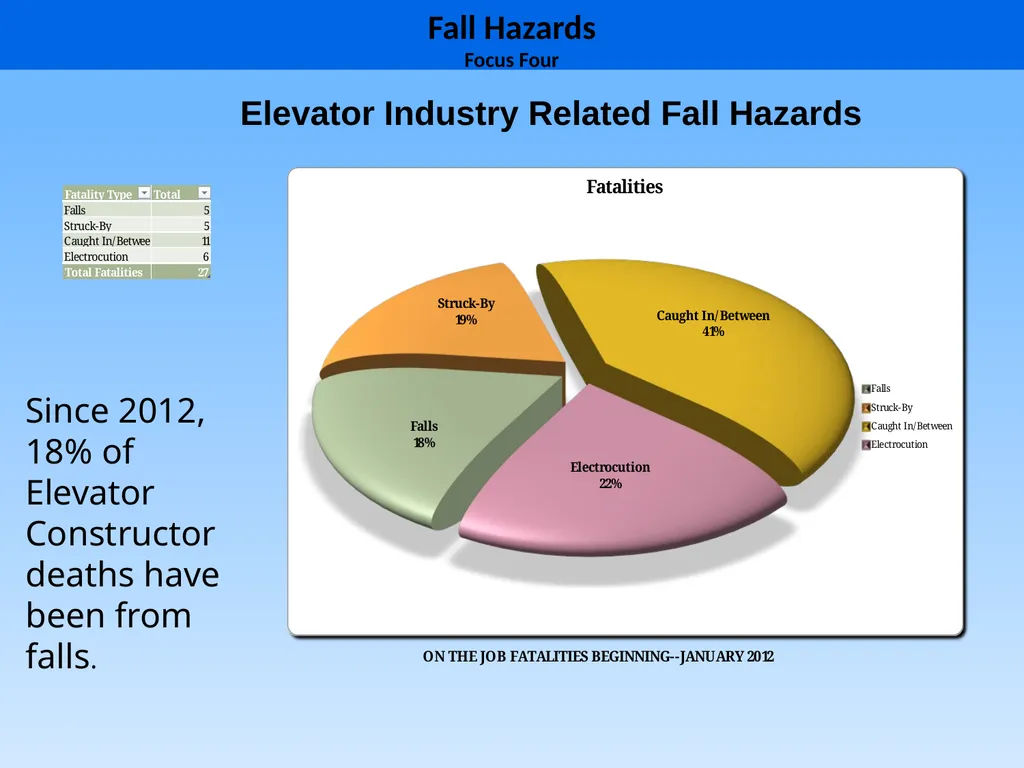
Since 2012, 18% of Elevator Constructor
deaths have been from falls. Elevator Industry Related Fall Hazards Fall Hazards Focus Four<br>
deaths have been from falls. Elevator Industry Related Fall Hazards Fall Hazards Focus Four<br>
10
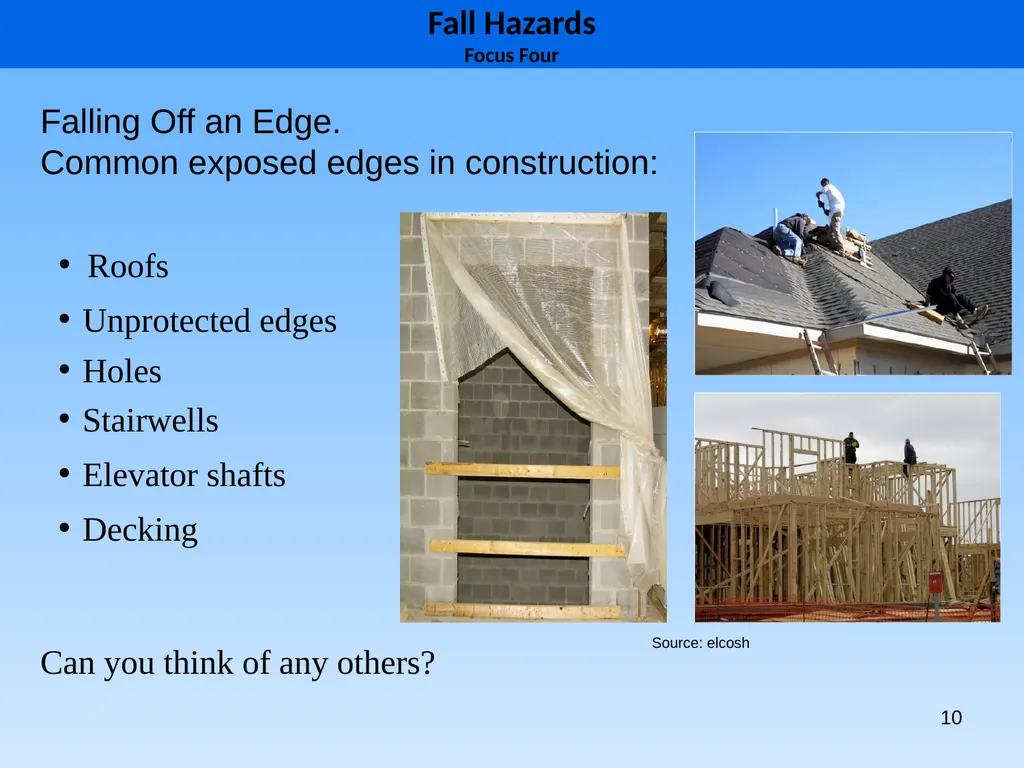
10 Falling Off an Edge.
Common exposed edges in construction: Roofs Unprotected edges Holes Stairwells Elevator shafts Decking Can you think of any others? Source: elcosh Fall Hazards
Focus Four<br>
11
11 Falls: Elevator-Related Hazards Elevator constructors are exposed to falls at hoistways, wellways, false cars, running platforms, entering pits, to name just a few. §1926.501 establishes the duty for the employer to provide fall protection. §1926.502 establishes the criteria for Fall protection systems. For Elevator Constructors on a construction site, fall protection is usually provided in one of three ways: 1. Eliminate the hazard. 2. A guardrail system 3. Personal fall arrest system Since it is rare that we can eliminate the hazard, guardrails and PFAS will be discussed in more detail later. Fall Hazards
Focus Four<br>
12
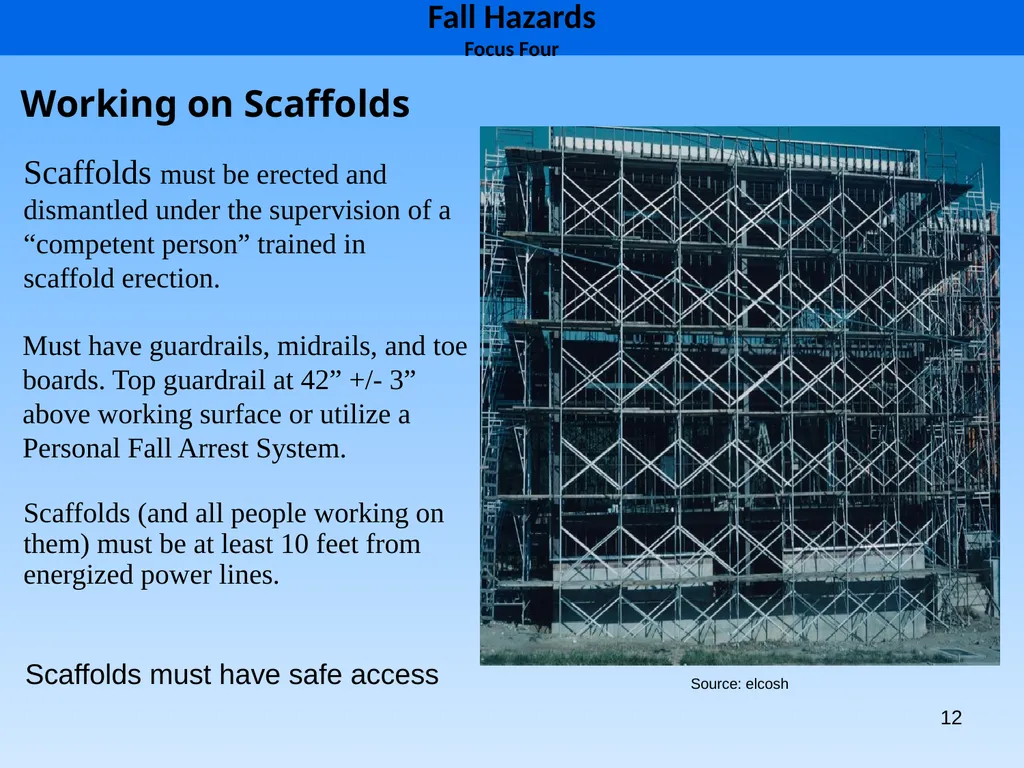
12 Working on Scaffolds Scaffolds must be erected and dismantled under the supervision of a “competent person” trained in scaffold erection. Must have guardrails, midrails, and toe boards. Top guardrail at 42” +/- 3” above working surface or utilize a Personal Fall Arrest System. Scaffolds (and all people working on them) must be at least 10 feet from energized power lines. Source: elcosh Scaffolds must have safe access Fall Hazards
Focus Four<br>
13
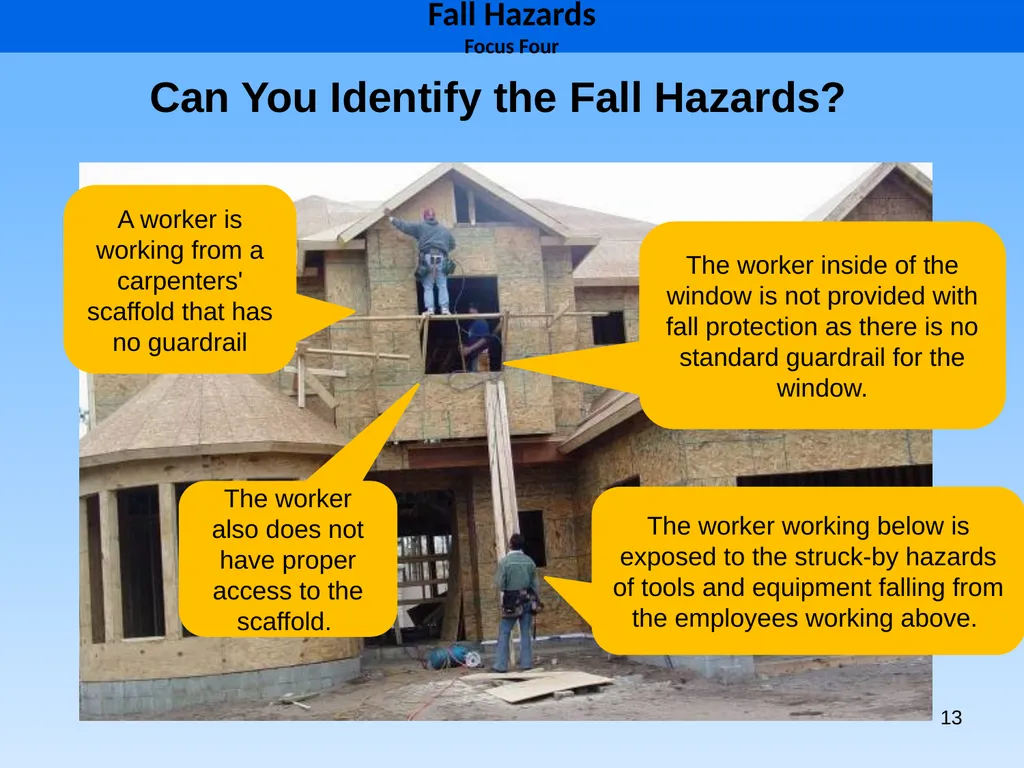
13 Can You Identify the Fall Hazards? A worker is working from a carpenters' scaffold that has no guardrail The worker also does not have proper access to the scaffold. The worker working below is exposed to the struck-by hazards of tools and equipment falling from the employees working above. The worker inside of the window is not provided with fall protection as there is no standard guardrail for the window. Fall Hazards
Focus Four<br>
14
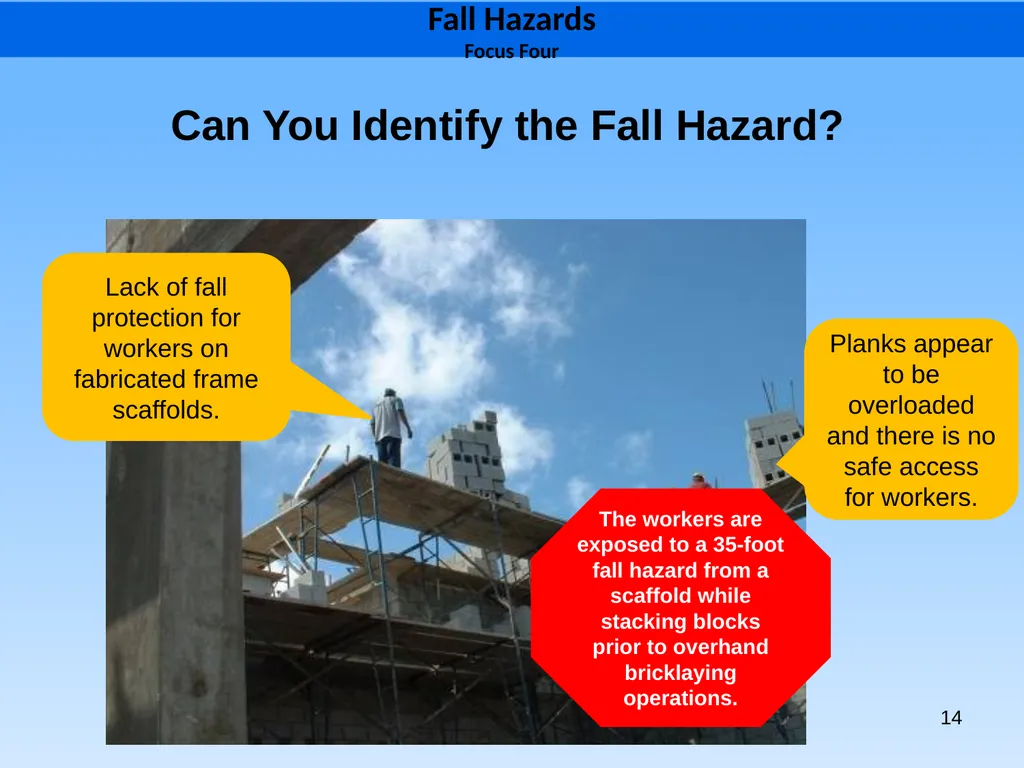
14 Can You Identify the Fall Hazard? Lack of fall protection for workers on fabricated frame scaffolds. Planks appear to be overloaded and there is no safe access for workers. The workers are exposed to a 35-foot fall hazard from a scaffold while stacking blocks prior to overhand bricklaying operations. Fall Hazards
Focus Four<br>
15
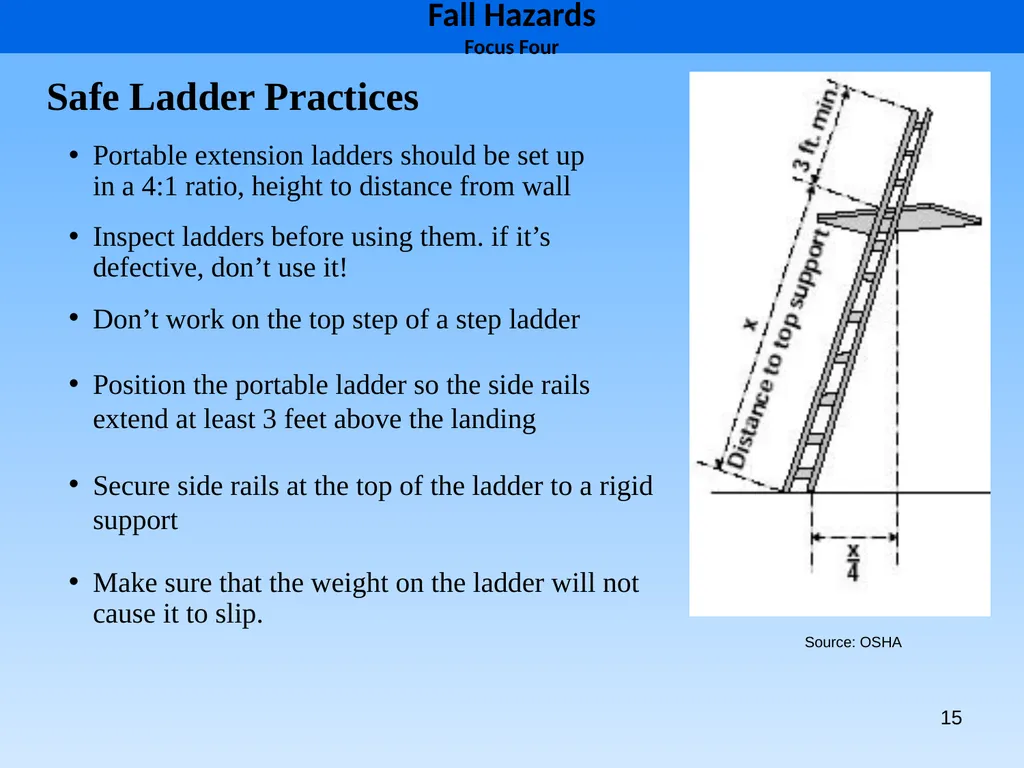
15 Safe Ladder Practices Portable extension ladders should be set up in a 4:1 ratio, height to distance from wall Inspect ladders before using them. if it’s defective, don’t use it! Don’t work on the top step of a step ladder Position the portable ladder so the side rails extend at least 3 feet above the landing Secure side rails at the top of the ladder to a rigid support Make sure that the weight on the ladder will not cause it to slip. Source: OSHA Fall Hazards
Focus Four<br>
16
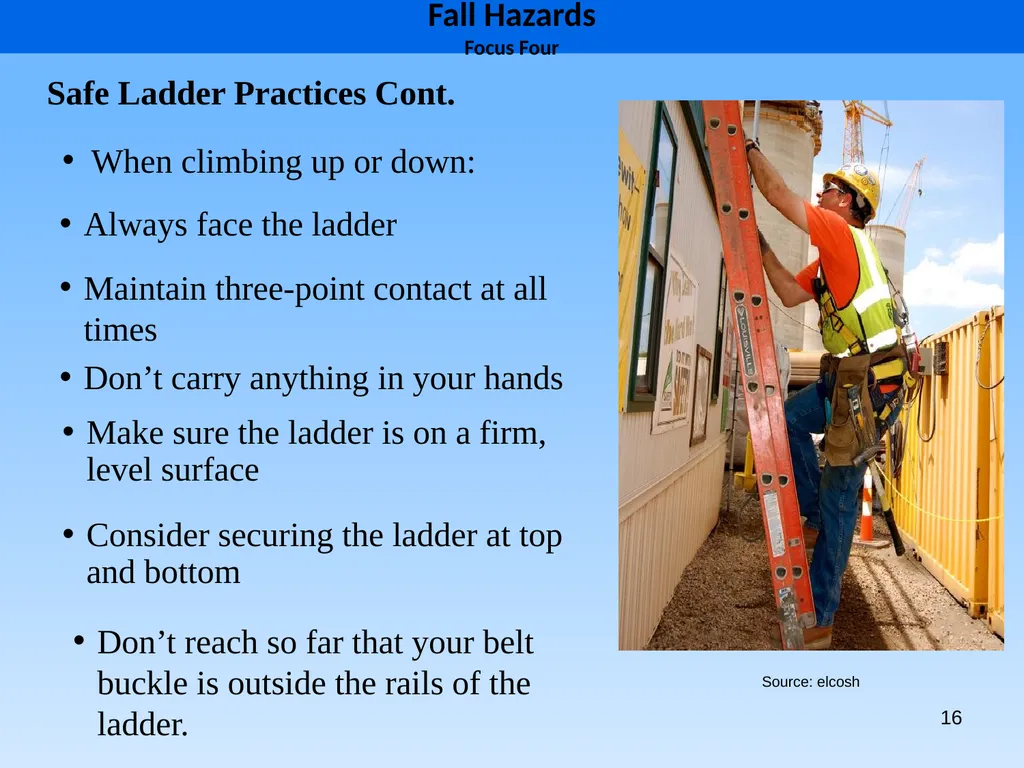
16 Safe Ladder Practices Cont. When climbing up or down: Always face the ladder Maintain three-point contact at all times Don’t carry anything in your hands Make sure the ladder is on a firm, level surface Consider securing the ladder at top and bottom Don’t reach so far that your belt buckle is outside the rails of the ladder. Source: elcosh Fall Hazards
Focus Four<br>
17
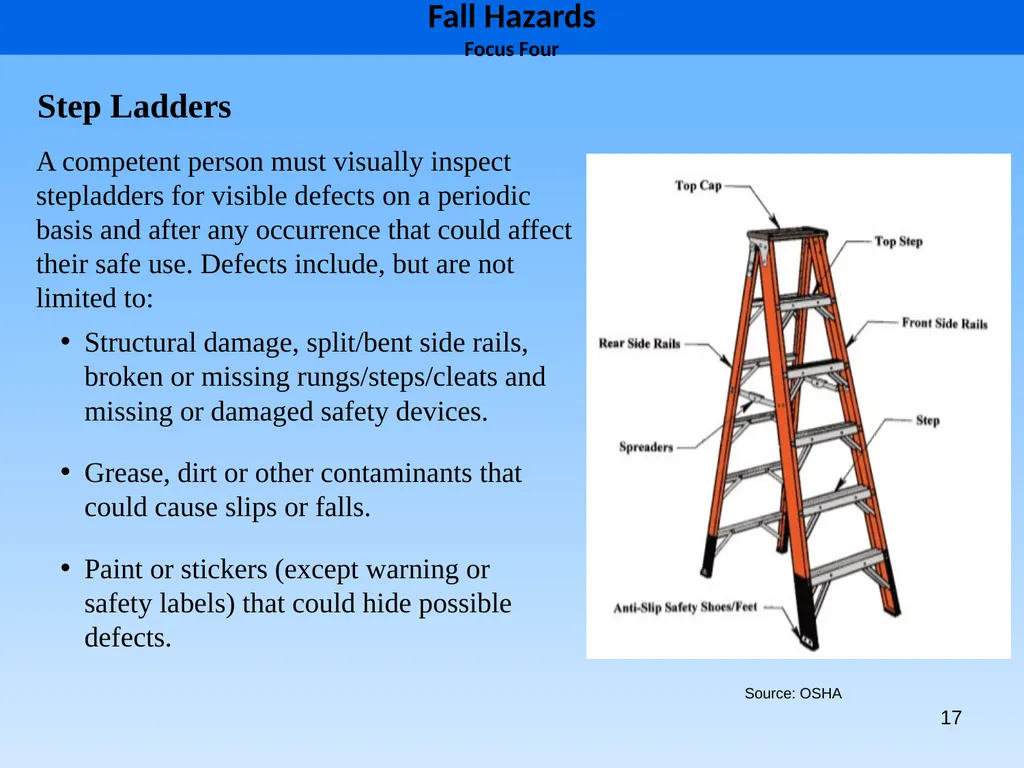
17 Source: OSHA Step Ladders A competent person must visually inspect stepladders for visible defects on a periodic basis and after any occurrence that could affect their safe use. Defects include, but are not limited to: Structural damage, split/bent side rails, broken or missing rungs/steps/cleats and missing or damaged safety devices. Grease, dirt or other contaminants that could cause slips or falls. Paint or stickers (except warning or safety labels) that could hide possible defects. Fall Hazards
Focus Four<br>
18
18 Step Ladders cont. Make sure all four feet of the portable step ladder are set on a level and stable surface, and that both ladder spreaders are fully extended and locked into place before use Keep your ladder, your body, your tools and any materials at least 10 feet away from energized electrical conductors (or even further for higher voltages exceeding 50kv) Maintain your balance and center of gravity on your portable step ladder by keeping your belt-buckle between the two side rails. Reposition the ladder instead of over-reaching Fall Hazards
Focus Four<br>
19
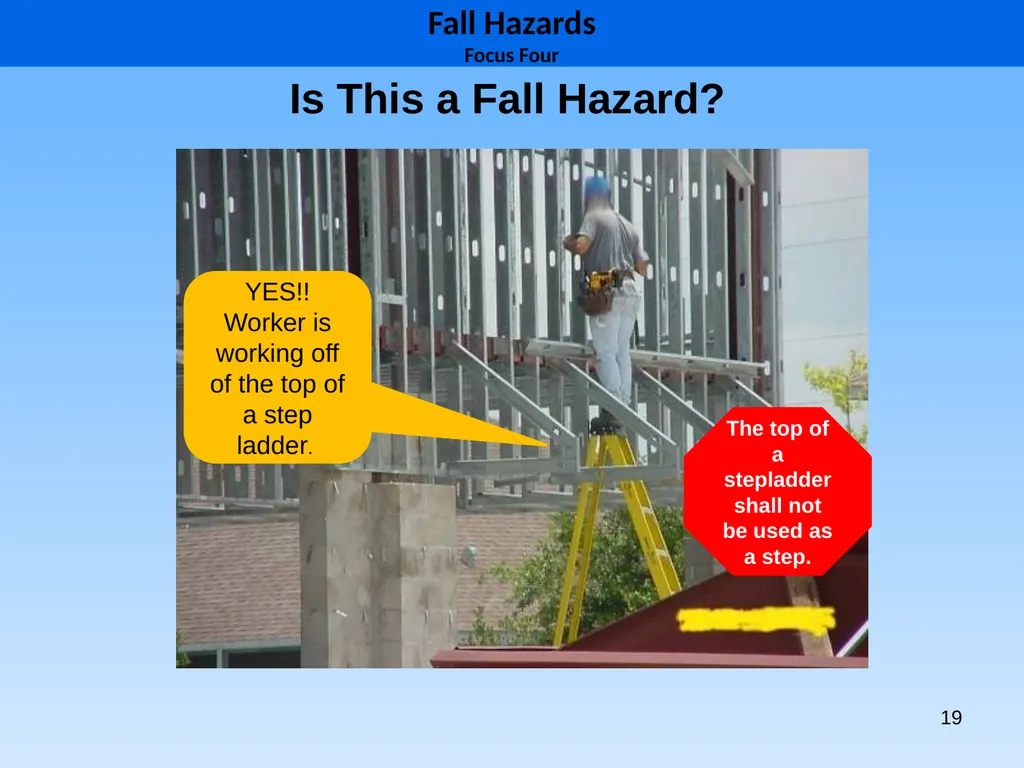
19 Is This a Fall Hazard? YES!!
Worker is working off of the top of a step ladder. The top of a stepladder shall not be used as a step. Fall Hazards Focus Four<br>
Worker is working off of the top of a step ladder. The top of a stepladder shall not be used as a step. Fall Hazards Focus Four<br>
20
20 Fall Hazards
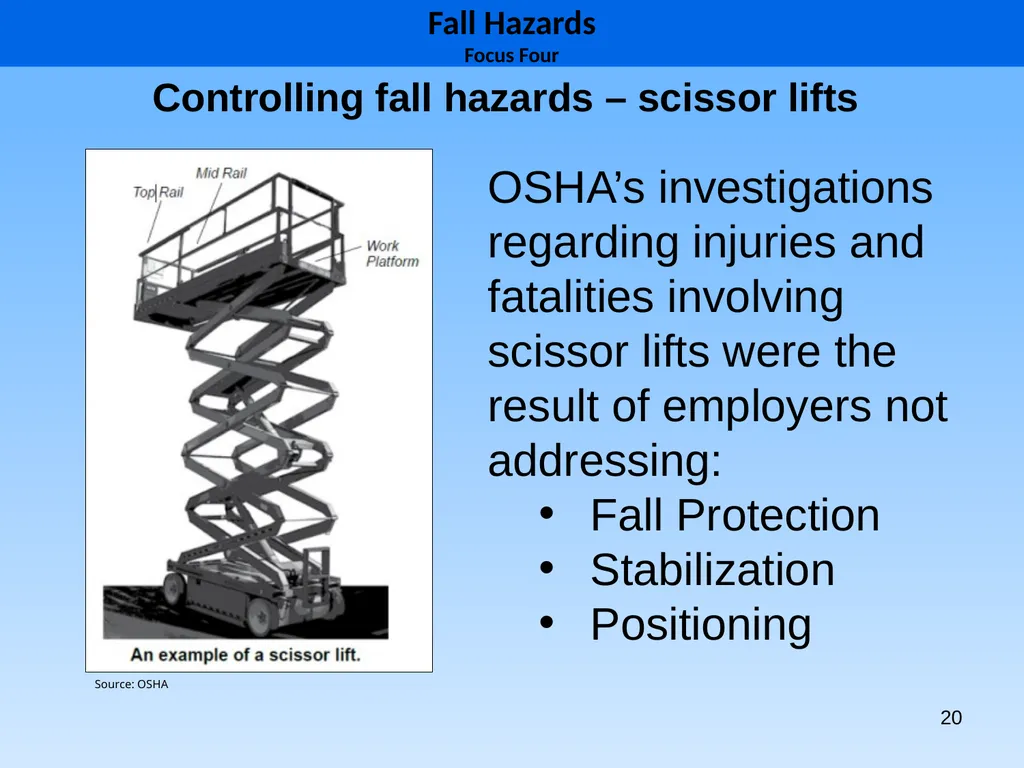
Focus Four Controlling fall hazards – scissor lifts Source: OSHA OSHA’s investigations regarding injuries and fatalities involving scissor lifts were the result of employers not addressing:
Fall Protection
Stabilization
Positioning<br>
Fall Protection
Stabilization
Positioning<br>
21
21 Fall Hazards
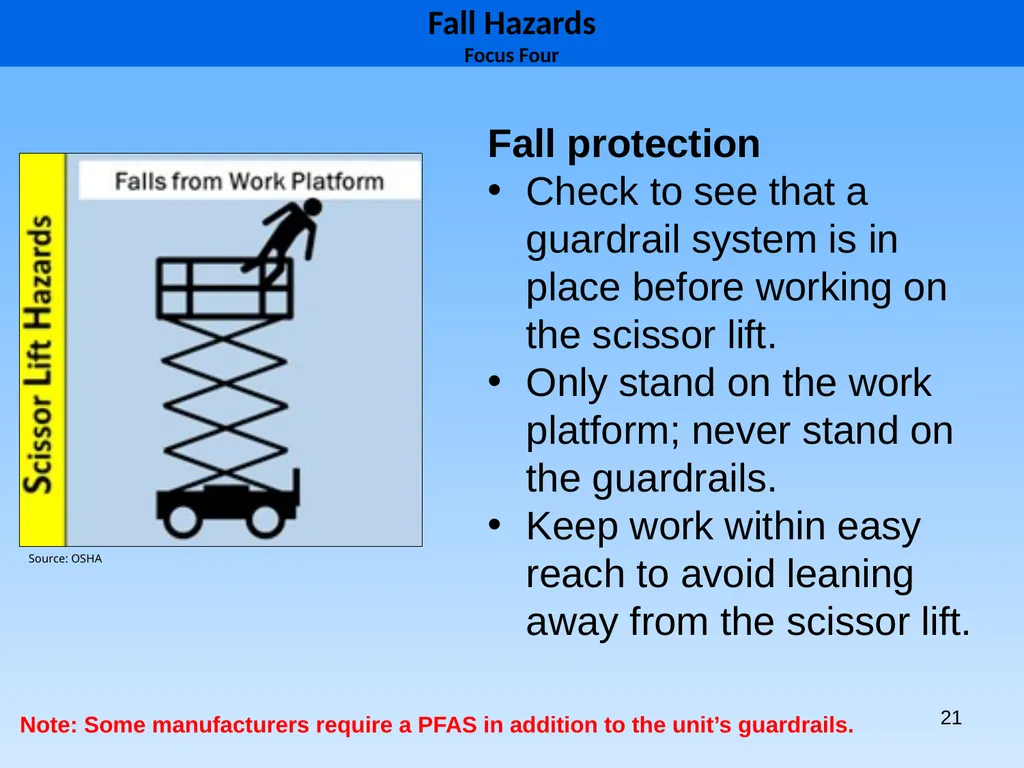
Focus Four Source: OSHA Note: Some manufacturers require a PFAS in addition to the unit’s guardrails. Fall protection
Check to see that a guardrail system is in place before working on the scissor lift.
Only stand on the work platform; never stand on the guardrails.
Keep work within easy reach to avoid leaning away from the scissor lift.<br>
Check to see that a guardrail system is in place before working on the scissor lift.
Only stand on the work platform; never stand on the guardrails.
Keep work within easy reach to avoid leaning away from the scissor lift.<br>
22
22 Fall Hazards
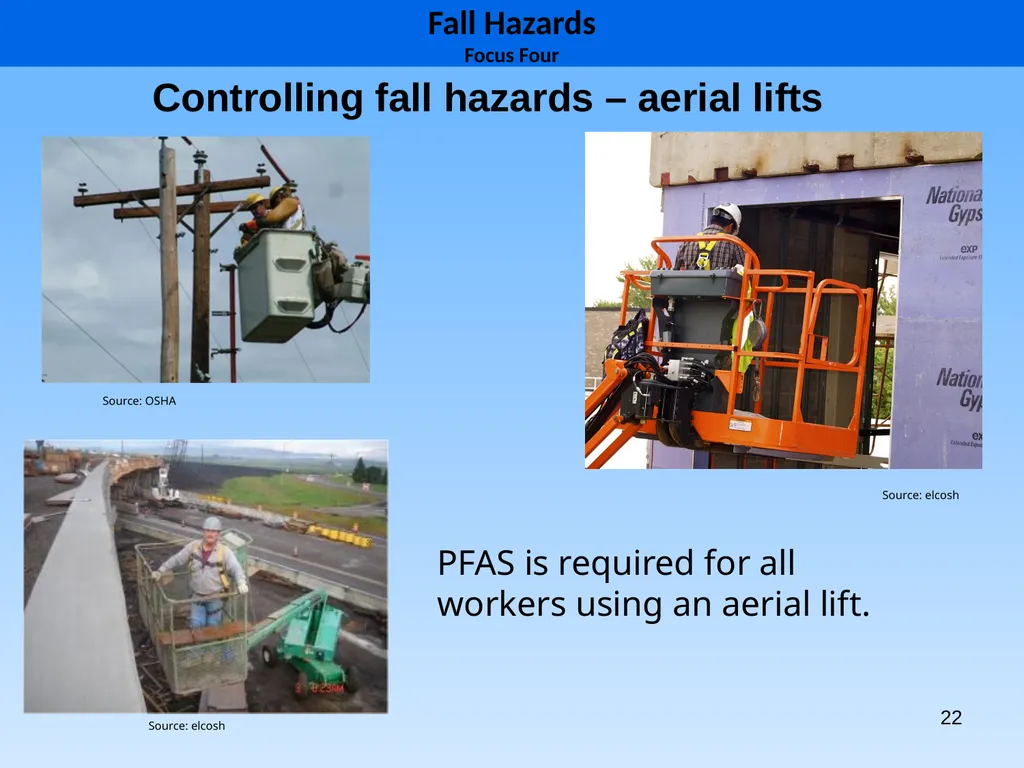
Focus Four Source: OSHA Source: elcosh Source: elcosh PFAS is required for all workers using an aerial lift. Controlling fall hazards – aerial lifts<br>
23
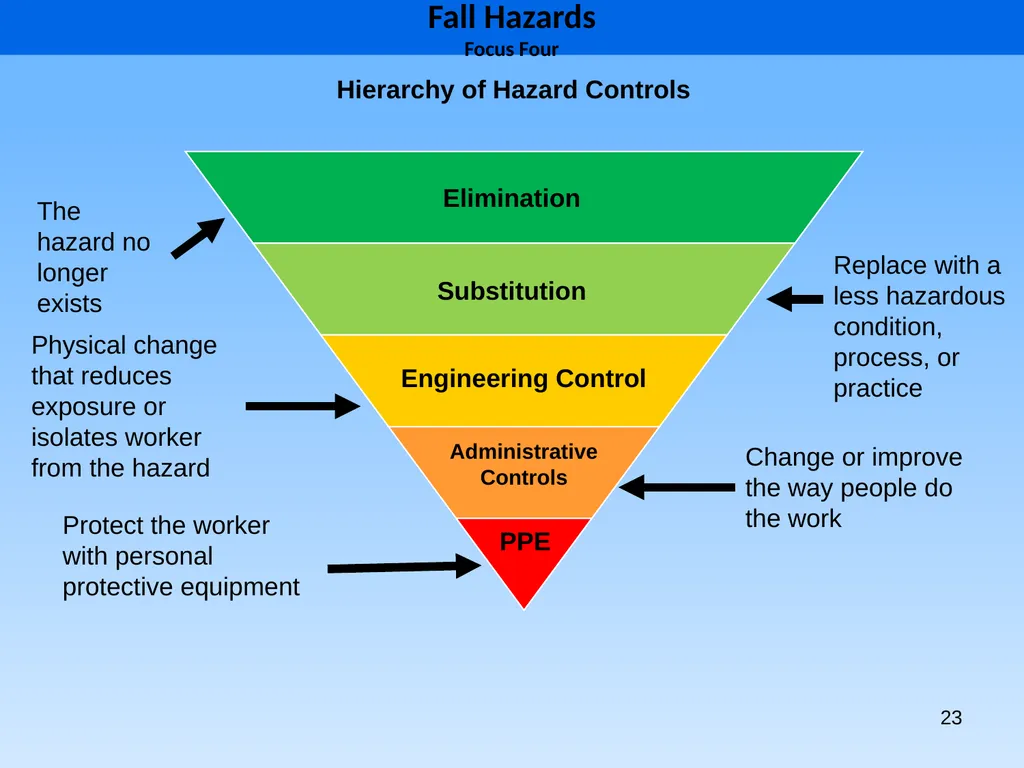
23 Hierarchy of Hazard Controls Replace with a less hazardous condition, process, or practice The hazard no longer exists Physical change that reduces exposure or isolates worker from the hazard Change or improve the way people do the work Protect the worker with personal protective equipment Elimination Substitution Engineering Control Administrative
Controls PPE Fall Hazards Focus Four<br>
Controls PPE Fall Hazards Focus Four<br>
24
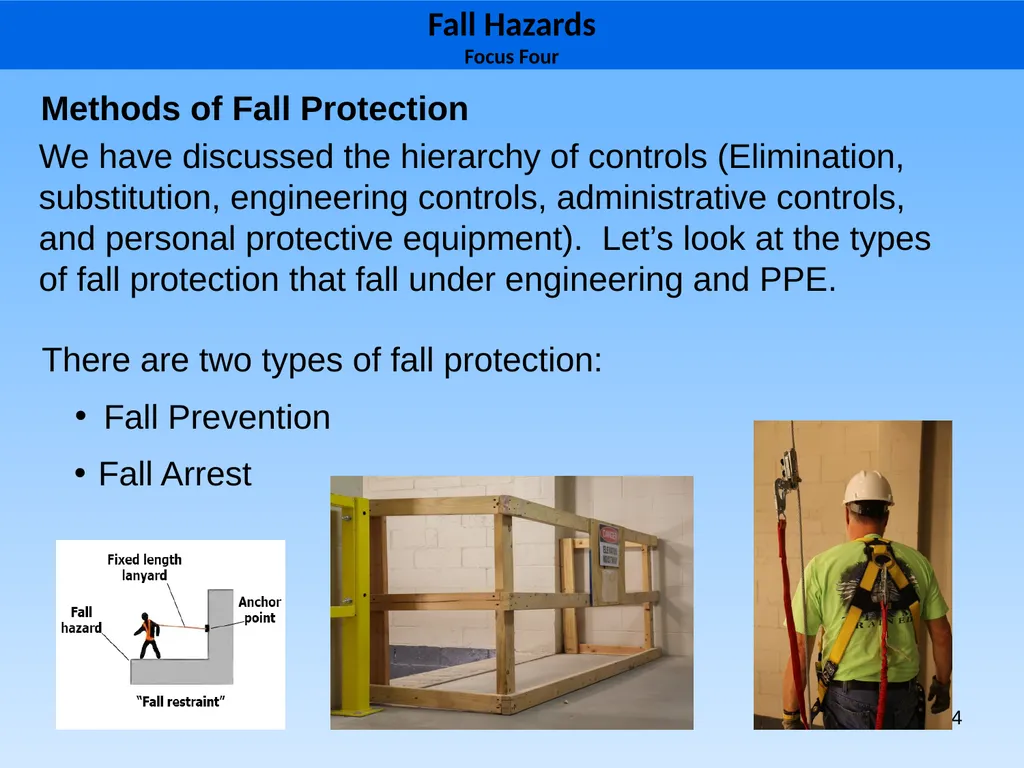
24 Methods of Fall Protection We have discussed the hierarchy of controls (Elimination, substitution, engineering controls, administrative controls, and personal protective equipment). Let’s look at the types of fall protection that fall under engineering and PPE. There are two types of fall protection: Fall Prevention Fall Arrest Fall Hazards
Focus Four<br>
25
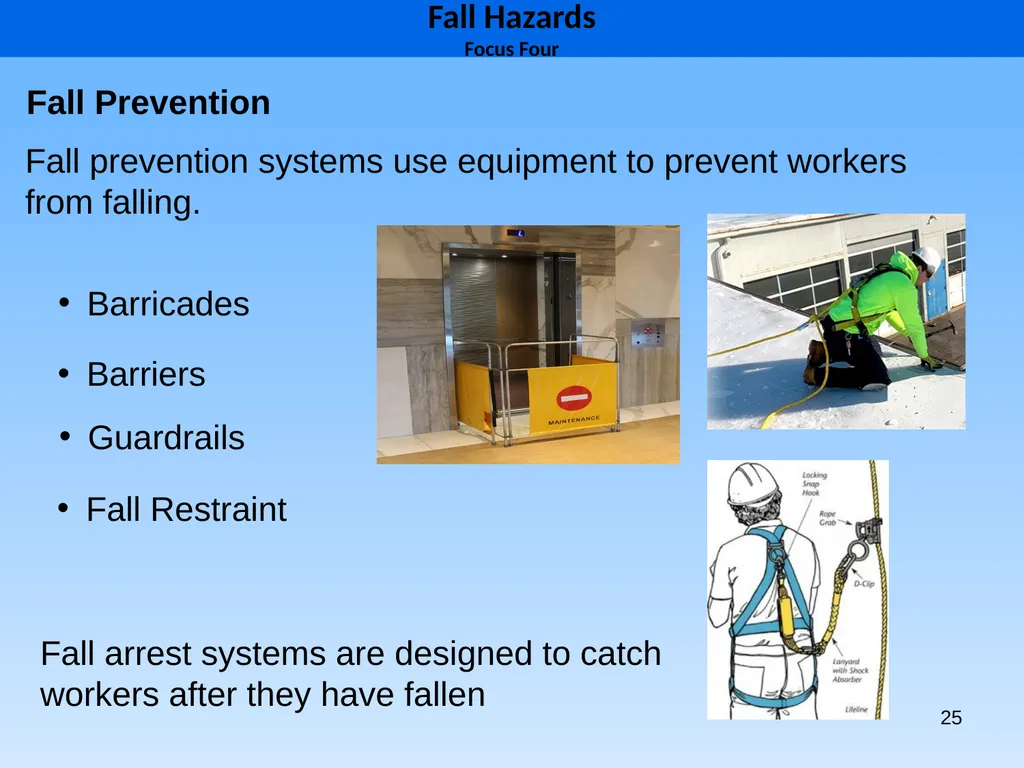
25 Fall Prevention Fall prevention systems use equipment to prevent workers from falling. Barricades Guardrails Barriers Fall Restraint Fall arrest systems are designed to catch
workers after they have fallen Fall Hazards Focus Four<br>
workers after they have fallen Fall Hazards Focus Four<br>
26
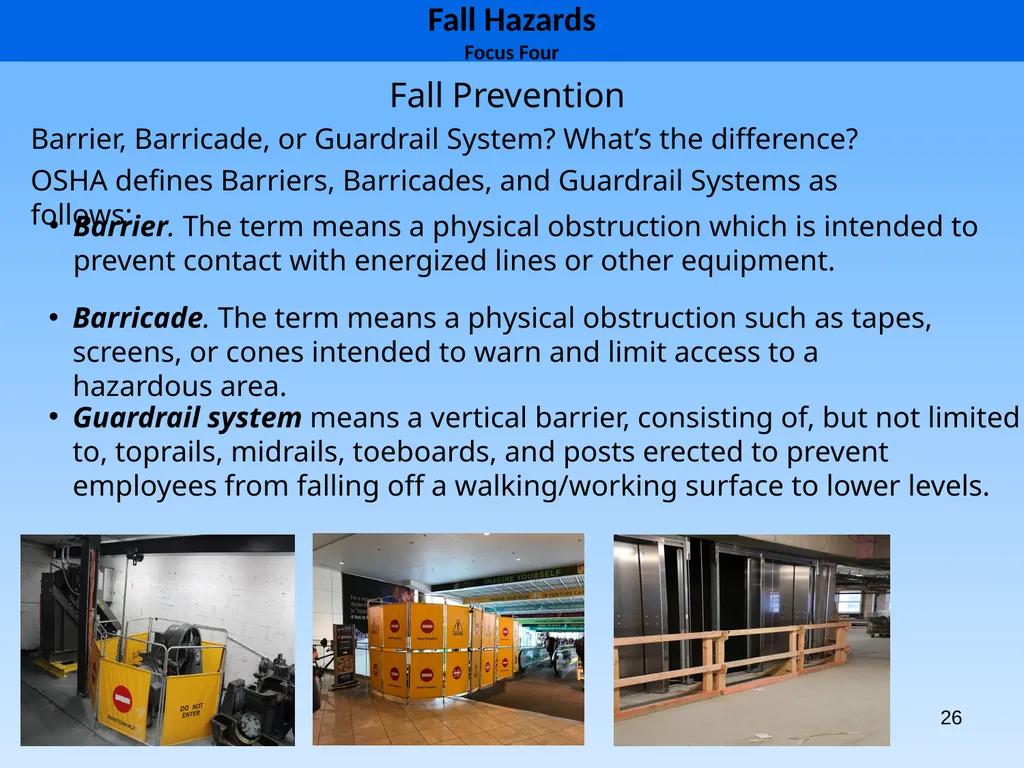
26 Fall Prevention Barrier, Barricade, or Guardrail System? What’s the difference? OSHA defines Barriers, Barricades, and Guardrail Systems as follows: Barrier. The term means a physical obstruction which is intended to prevent contact with energized lines or other equipment. Barricade. The term means a physical obstruction such as tapes, screens, or cones intended to warn and limit access to a hazardous area. Guardrail system means a vertical barrier, consisting of, but not limited to, toprails, midrails, toeboards, and posts erected to prevent employees from falling off a walking/working surface to lower levels. Fall Hazards
Focus Four<br>
27
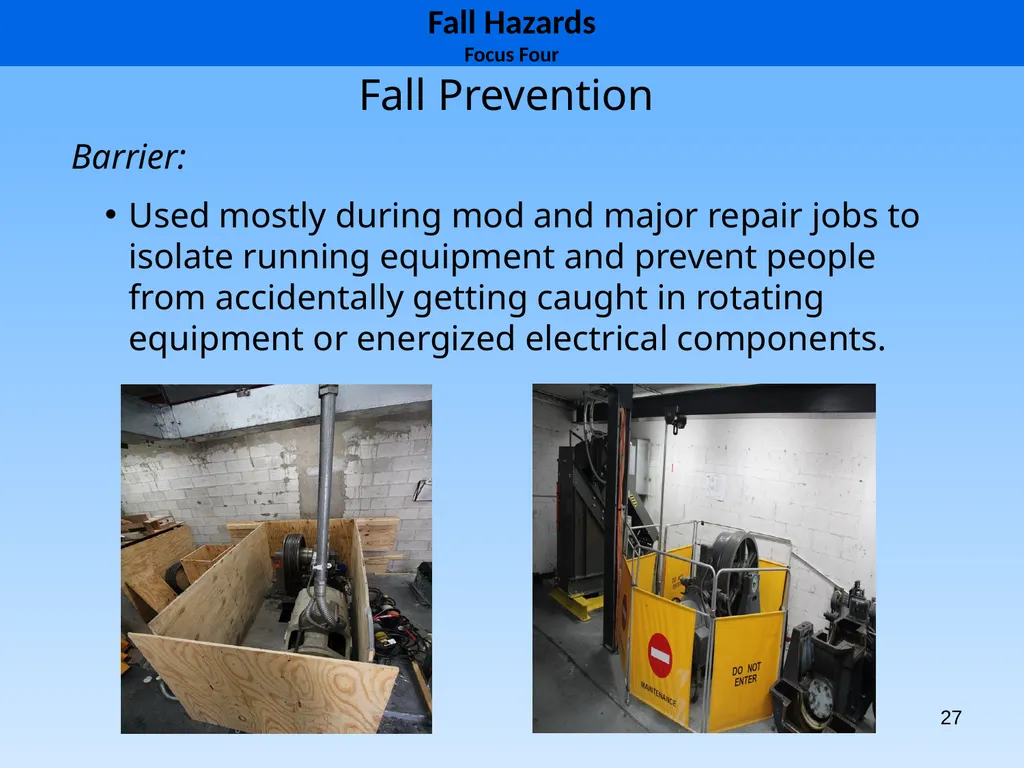
27 Fall Prevention Barrier: Used mostly during mod and major repair jobs to isolate running equipment and prevent people from accidentally getting caught in rotating equipment or energized electrical components. Fall Hazards
Focus Four<br>
28
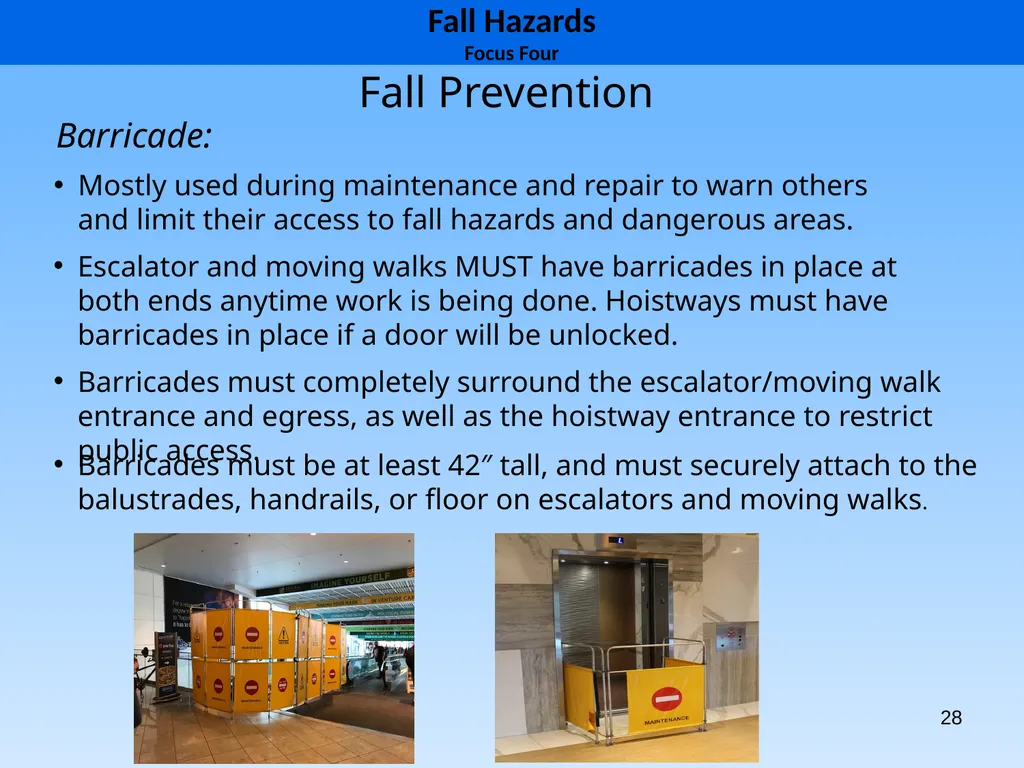
28 Fall Prevention Barricade: Mostly used during maintenance and repair to warn others and limit their access to fall hazards and dangerous areas. Escalator and moving walks MUST have barricades in place at both ends anytime work is being done. Hoistways must have barricades in place if a door will be unlocked. Barricades must completely surround the escalator/moving walk entrance and egress, as well as the hoistway entrance to restrict public access. Barricades must be at least 42″ tall, and must securely attach to the balustrades, handrails, or floor on escalators and moving walks. Fall Hazards
Focus Four<br>
29
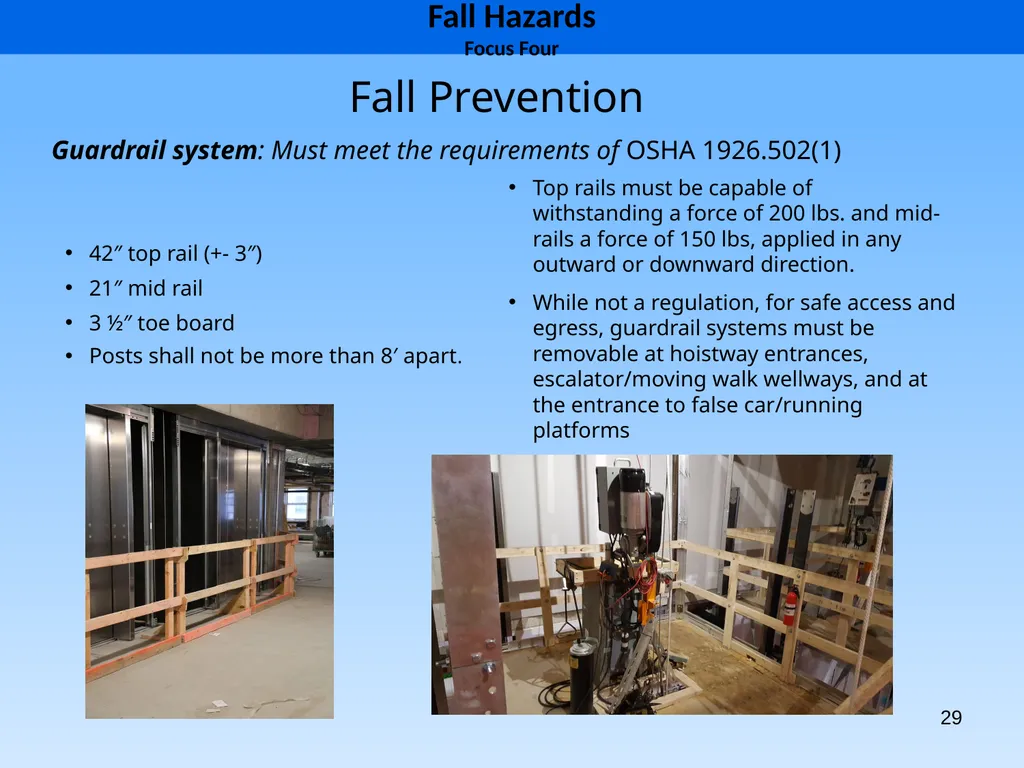
29 Fall Prevention Guardrail system: Must meet the requirements of OSHA 1926.502(1) 42″ top rail (+- 3″) 21″ mid rail 3 ½″ toe board Posts shall not be more than 8′ apart. Top rails must be capable of withstanding a force of 200 lbs. and mid-rails a force of 150 lbs, applied in any outward or downward direction. While not a regulation, for safe access and egress, guardrail systems must be removable at hoistway entrances, escalator/moving walk wellways, and at the entrance to false car/running platforms Fall Hazards
Focus Four<br>
30
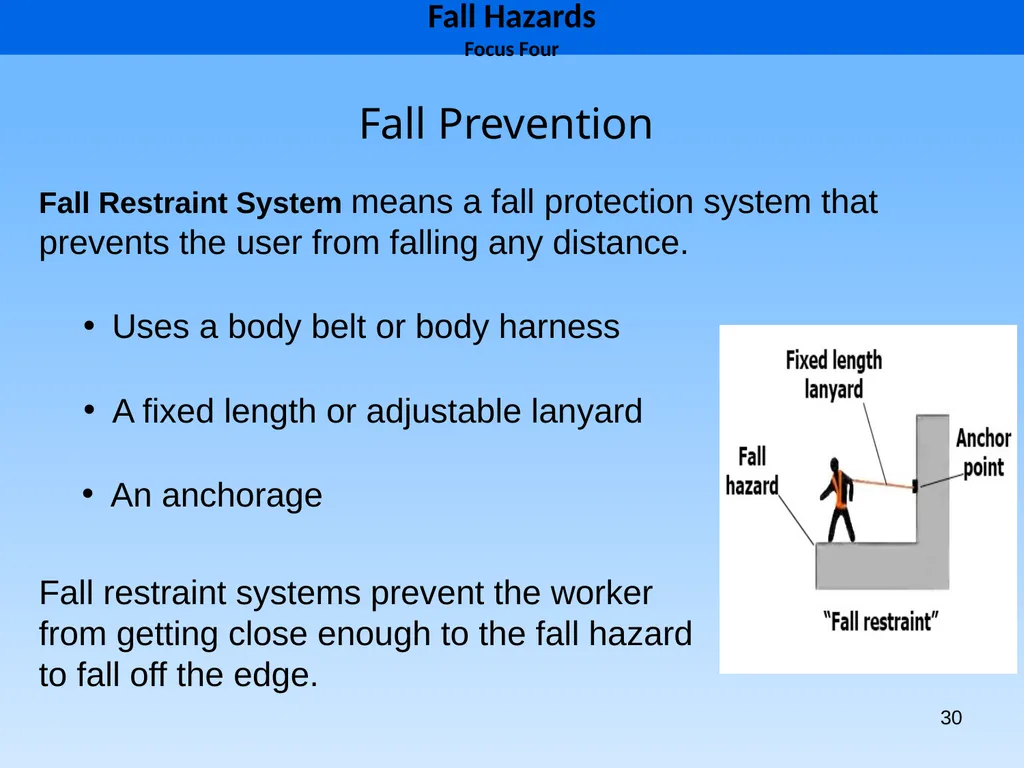
30 Fall Prevention Fall Restraint System means a fall protection system that prevents the user from falling any distance. Uses a body belt or body harness A fixed length or adjustable lanyard An anchorage Fall restraint systems prevent the worker from getting close enough to the fall hazard to fall off the edge. Fall Hazards
Focus Four<br>
31
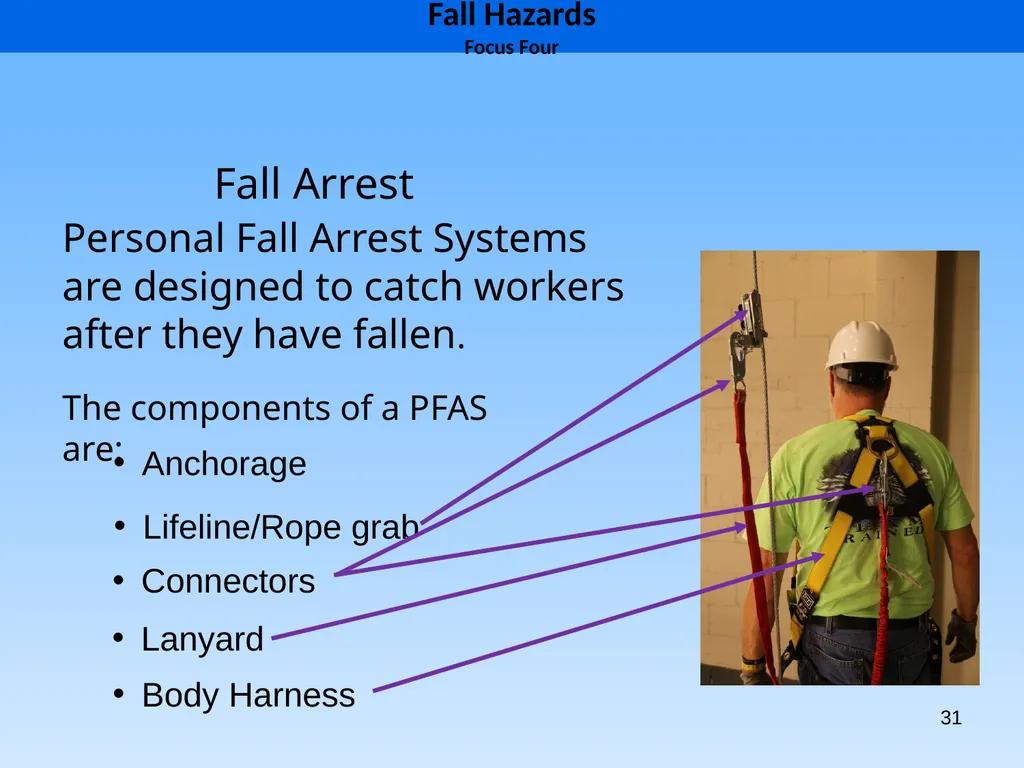
31 Fall Arrest Personal Fall Arrest Systems are designed to catch workers after they have fallen. The components of a PFAS are: Anchorage Lifeline/Rope grab Connectors Lanyard Body Harness Fall Hazards
Focus Four<br>
32
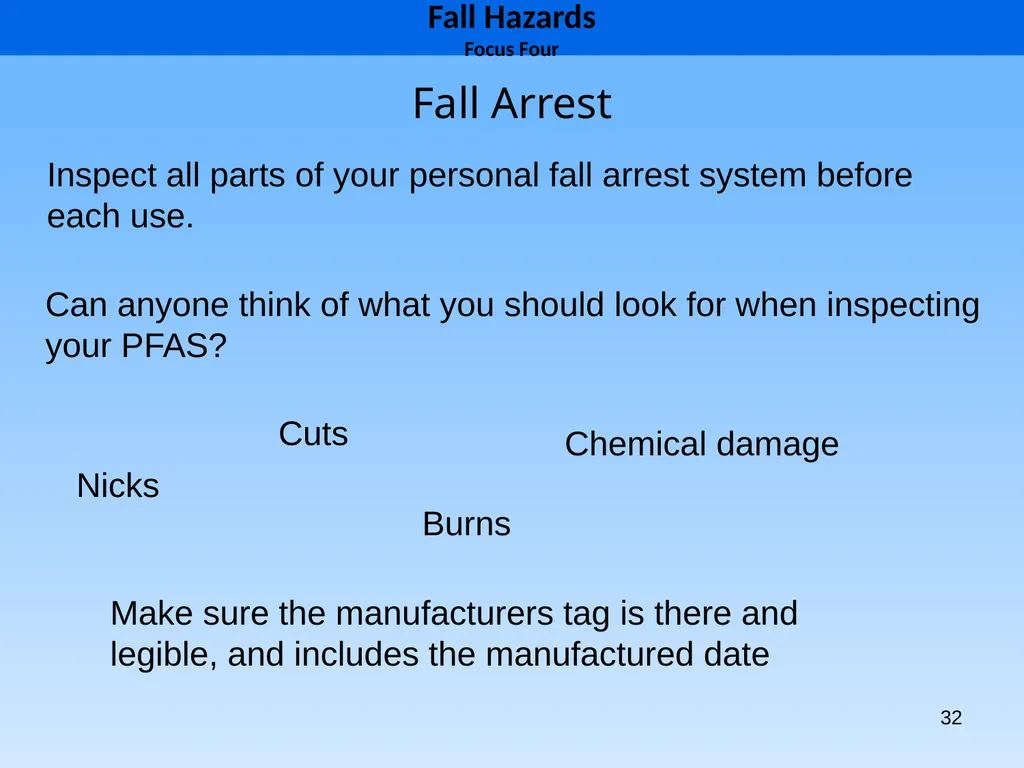
32 Fall Arrest Inspect all parts of your personal fall arrest system before each use. Can anyone think of what you should look for when inspecting
your PFAS? Cuts Nicks Burns Make sure the manufacturers tag is there and legible, and includes the manufactured date Chemical damage Fall Hazards Focus Four<br>
your PFAS? Cuts Nicks Burns Make sure the manufacturers tag is there and legible, and includes the manufactured date Chemical damage Fall Hazards Focus Four<br>
33
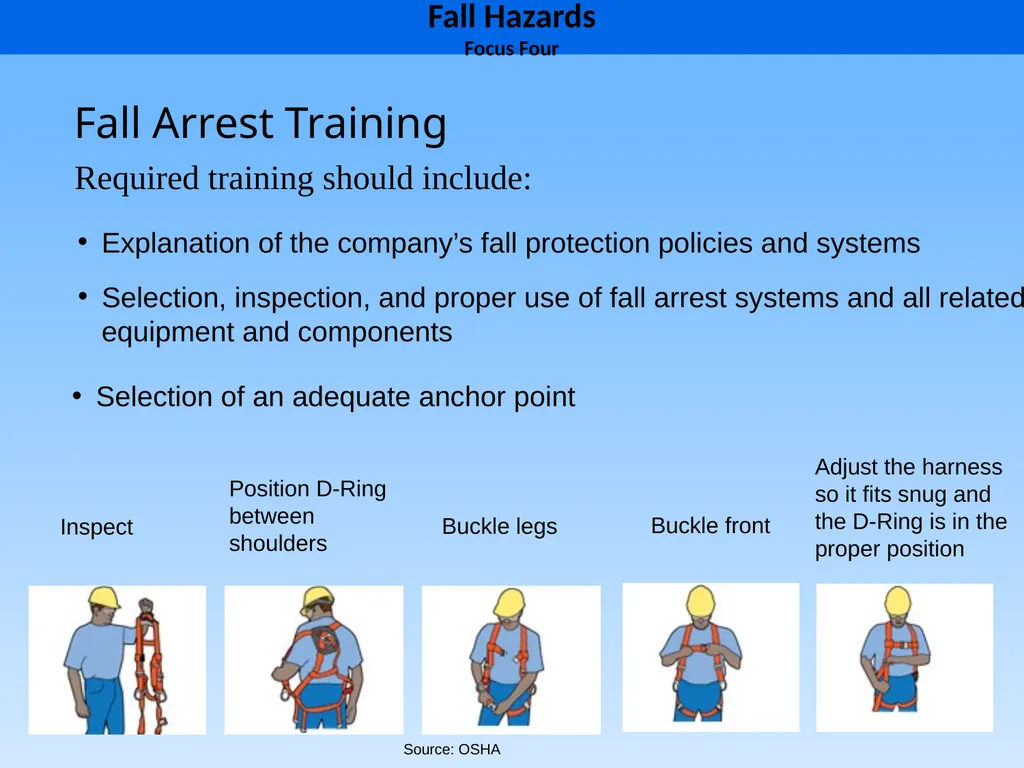
33 Fall Arrest Training Required training should include: Explanation of the company’s fall protection policies and systems Selection, inspection, and proper use of fall arrest systems and all related
equipment and components Selection of an adequate anchor point Inspect Position D-Ring
between shoulders Buckle legs Buckle front Adjust the harness so it fits snug and the D-Ring is in the proper position Source: OSHA Fall Hazards Focus Four<br>
equipment and components Selection of an adequate anchor point Inspect Position D-Ring
between shoulders Buckle legs Buckle front Adjust the harness so it fits snug and the D-Ring is in the proper position Source: OSHA Fall Hazards Focus Four<br>
34
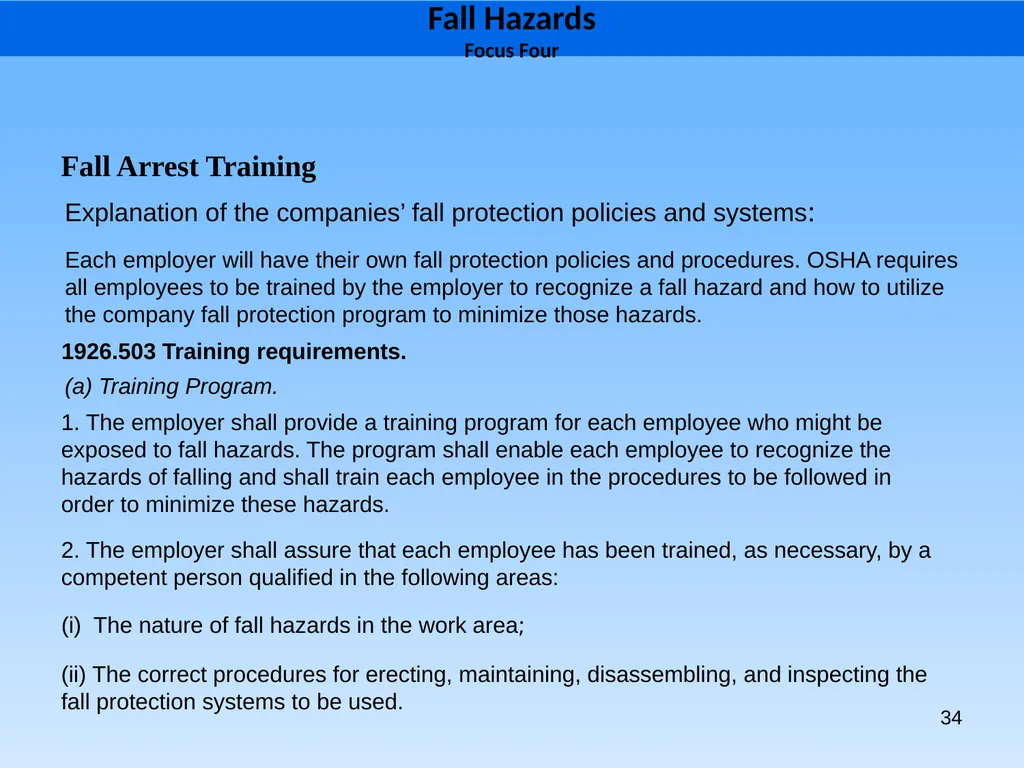
34 Fall Arrest Training Explanation of the companies’ fall protection policies and systems: Each employer will have their own fall protection policies and procedures. OSHA requires all employees to be trained by the employer to recognize a fall hazard and how to utilize the company fall protection program to minimize those hazards. 1926.503 Training requirements. (a) Training Program. 1. The employer shall provide a training program for each employee who might be exposed to fall hazards. The program shall enable each employee to recognize the hazards of falling and shall train each employee in the procedures to be followed in order to minimize these hazards. 2. The employer shall assure that each employee has been trained, as necessary, by a competent person qualified in the following areas: (i) The nature of fall hazards in the work area; (ii) The correct procedures for erecting, maintaining, disassembling, and inspecting the fall protection systems to be used. Fall Hazards
Focus Four<br>
35
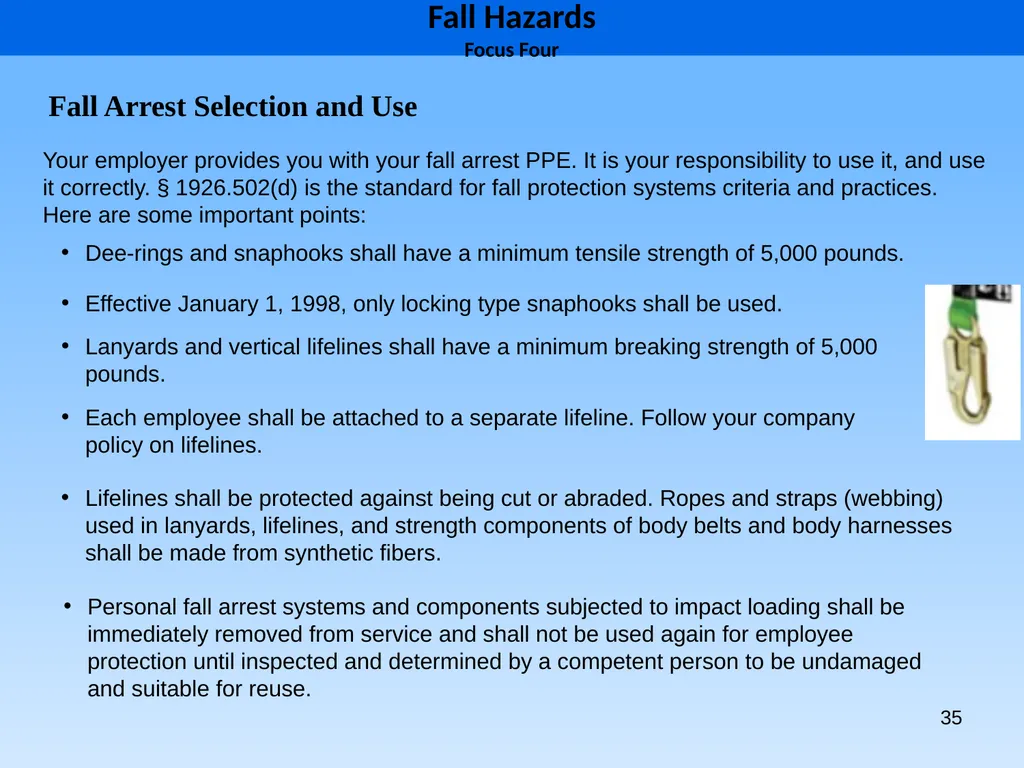
35 Fall Arrest Selection and Use Your employer provides you with your fall arrest PPE. It is your responsibility to use it, and use it correctly. § 1926.502(d) is the standard for fall protection systems criteria and practices. Here are some important points: Dee-rings and snaphooks shall have a minimum tensile strength of 5,000 pounds. Effective January 1, 1998, only locking type snaphooks shall be used. Lanyards and vertical lifelines shall have a minimum breaking strength of 5,000 pounds. Each employee shall be attached to a separate lifeline. Follow your company policy on lifelines. Lifelines shall be protected against being cut or abraded. Ropes and straps (webbing) used in lanyards, lifelines, and strength components of body belts and body harnesses shall be made from synthetic fibers. Personal fall arrest systems and components subjected to impact loading shall be immediately removed from service and shall not be used again for employee protection until inspected and determined by a competent person to be undamaged and suitable for reuse. Fall Hazards
Focus Four<br>
36
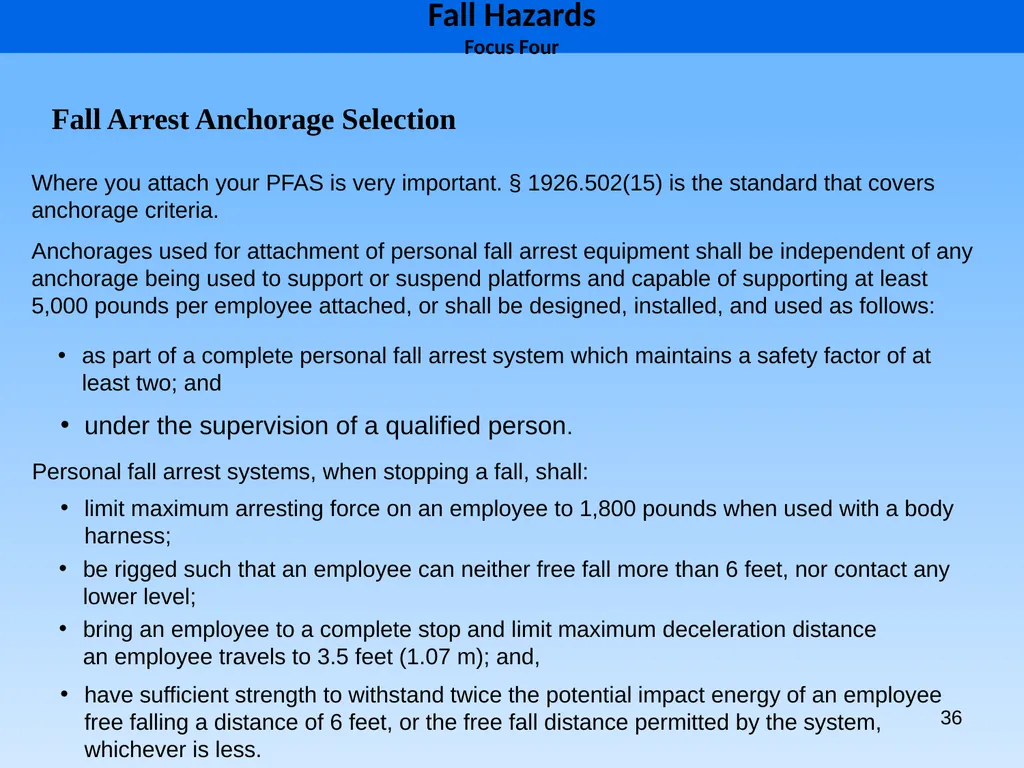
36 Fall Arrest Anchorage Selection Where you attach your PFAS is very important. § 1926.502(15) is the standard that covers anchorage criteria. Anchorages used for attachment of personal fall arrest equipment shall be independent of any anchorage being used to support or suspend platforms and capable of supporting at least 5,000 pounds per employee attached, or shall be designed, installed, and used as follows: as part of a complete personal fall arrest system which maintains a safety factor of at least two; and under the supervision of a qualified person. Personal fall arrest systems, when stopping a fall, shall: limit maximum arresting force on an employee to 1,800 pounds when used with a body harness; be rigged such that an employee can neither free fall more than 6 feet, nor contact any lower level; bring an employee to a complete stop and limit maximum deceleration distance an employee travels to 3.5 feet (1.07 m); and, have sufficient strength to withstand twice the potential impact energy of an employee free falling a distance of 6 feet, or the free fall distance permitted by the system, whichever is less. Fall Hazards
Focus Four<br>
37
37 Fall Arrest Rescue Plan § 1926.502(d)(20): The employer shall provide for prompt rescue of employees in the event of a fall or shall assure that employees are able to rescue themselves. APPENDIX C TO SUBPART M OF PART 1926—PERSONAL FALL ARREST SYSTEMS:
(f) Rescue considerations. As required by § 1926.502(d)(20), when personal fall arrest systems are used, the employer must assure that employees can be promptly rescued or can rescue themselves should a fall occur. The availability of rescue personnel, ladders or other rescue equipment should be evaluated. In some situations, equipment which allows employees to rescue themselves after the fall has been arrested may be desirable, such as devices which have descent capability. Always know the rescue plan and review it with your team members. Fall Hazards Focus Four<br>
(f) Rescue considerations. As required by § 1926.502(d)(20), when personal fall arrest systems are used, the employer must assure that employees can be promptly rescued or can rescue themselves should a fall occur. The availability of rescue personnel, ladders or other rescue equipment should be evaluated. In some situations, equipment which allows employees to rescue themselves after the fall has been arrested may be desirable, such as devices which have descent capability. Always know the rescue plan and review it with your team members. Fall Hazards Focus Four<br>
38
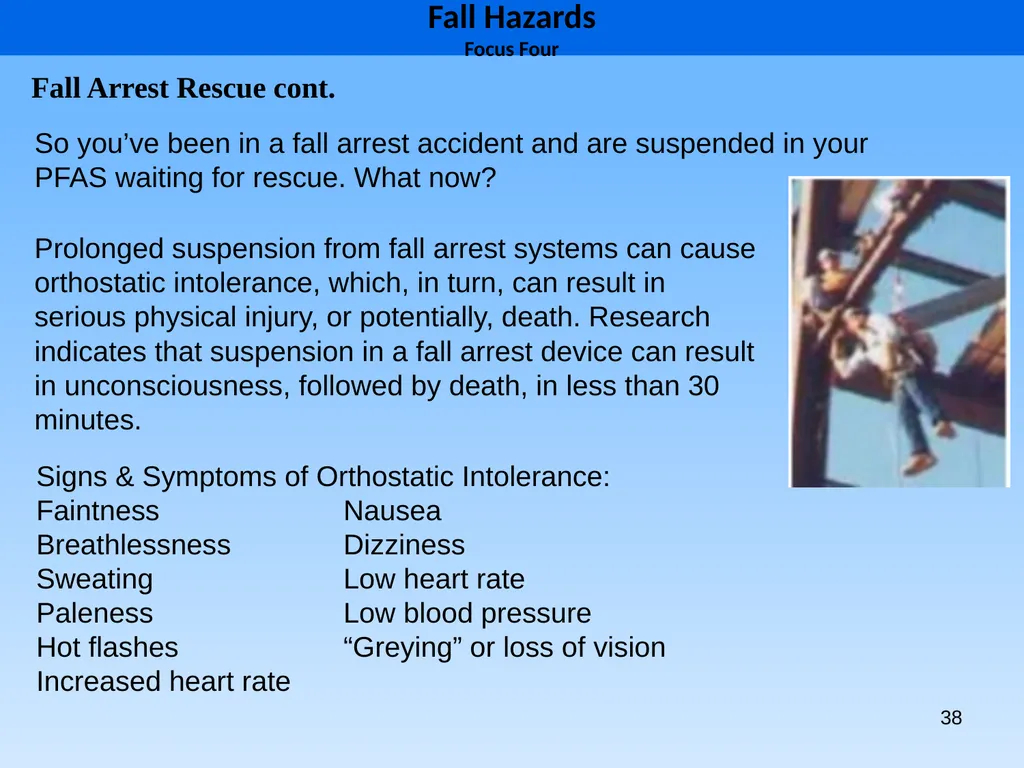
38 Fall Arrest Rescue cont. So you’ve been in a fall arrest accident and are suspended in your PFAS waiting for rescue. What now? Prolonged suspension from fall arrest systems can cause orthostatic intolerance, which, in turn, can result in serious physical injury, or potentially, death. Research indicates that suspension in a fall arrest device can result in unconsciousness, followed by death, in less than 30 minutes. Fall Hazards
Focus Four Signs & Symptoms of Orthostatic Intolerance:
Faintness Nausea
Breathlessness Dizziness
Sweating Low heart rate
Paleness Low blood pressure
Hot flashes “Greying” or loss of vision
Increased heart rate<br>
Faintness Nausea
Breathlessness Dizziness
Sweating Low heart rate
Paleness Low blood pressure
Hot flashes “Greying” or loss of vision
Increased heart rate<br>
39
39 Fall Arrest Rescue cont. Fall Hazards
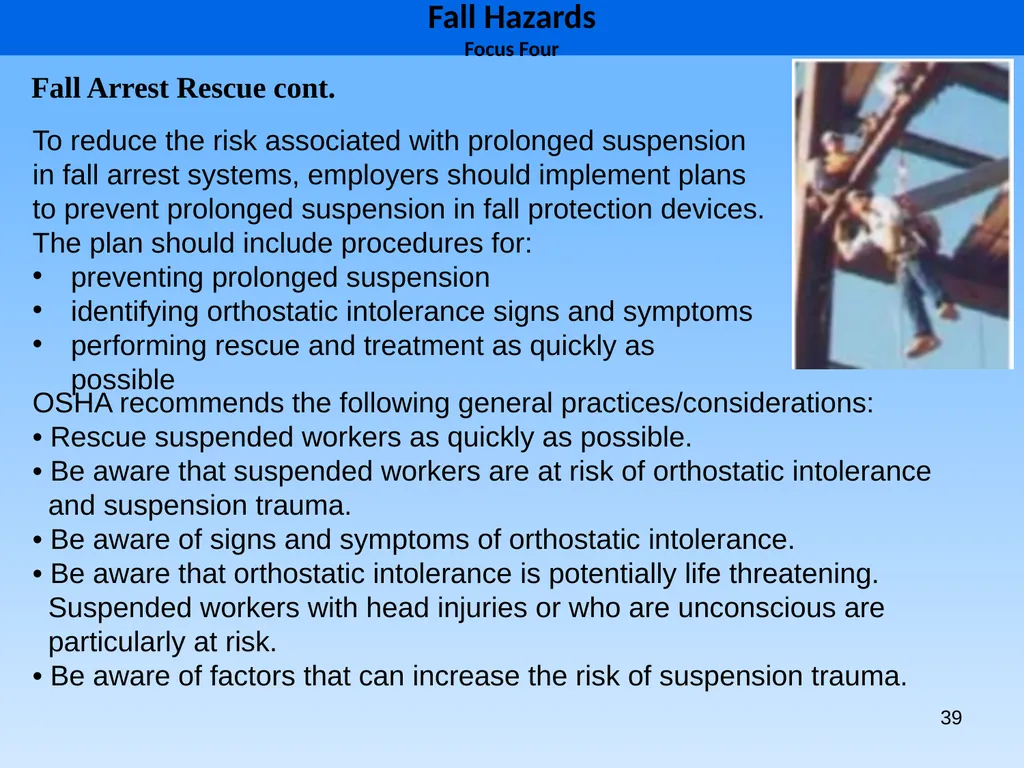
Focus Four To reduce the risk associated with prolonged suspension in fall arrest systems, employers should implement plans to prevent prolonged suspension in fall protection devices. The plan should include procedures for:
preventing prolonged suspension
identifying orthostatic intolerance signs and symptoms
performing rescue and treatment as quickly as possible OSHA recommends the following general practices/considerations:
• Rescue suspended workers as quickly as possible.
• Be aware that suspended workers are at risk of orthostatic intolerance
and suspension trauma.
• Be aware of signs and symptoms of orthostatic intolerance.
• Be aware that orthostatic intolerance is potentially life threatening.
Suspended workers with head injuries or who are unconscious are
particularly at risk.
• Be aware of factors that can increase the risk of suspension trauma.<br>
preventing prolonged suspension
identifying orthostatic intolerance signs and symptoms
performing rescue and treatment as quickly as possible OSHA recommends the following general practices/considerations:
• Rescue suspended workers as quickly as possible.
• Be aware that suspended workers are at risk of orthostatic intolerance
and suspension trauma.
• Be aware of signs and symptoms of orthostatic intolerance.
• Be aware that orthostatic intolerance is potentially life threatening.
Suspended workers with head injuries or who are unconscious are
particularly at risk.
• Be aware of factors that can increase the risk of suspension trauma.<br>
40
40 Fall Hazards: Conclusion The purpose of a fall protection program is to ensure that fall hazards are identified, a control method is implemented (eliminate the hazard, guardrail system, or personal fall arrest system), and workers are trained according to the control method, and the specific work practice (how to access, where to anchor, which system to use, etc.). For employers, ANSI/ASSE Z359.2-2017 - Minimum Requirements for a Comprehensive Managed Fall Protection Program is a great resource for guidance on how to develop and implement a fall protection program. Employees can review this standard to educate themselves on what a fully functional fall protection program requires. OSHA requires fall protection when an unprotected side or edge is greater than 6 feet above a lower level Fall Hazards
Focus Four<br>
41
41 Fall Hazards: Conclusion cont. Fall prevention keeps workers from falling:
Guardrails
Hole covers Fall arrest catches a worker after they have fallen:
Personal fall arrest system Floor openings must be covered and labeled, and covers should support twice
the intended load. Scaffolds must be erected and dismantled under the supervision of a competent
person. Set ladders at a 4:1 height-to-base ratio, and extend at least 3’ beyond the level you are accessing. Climb ladders using 3 points of contact. Fall Hazards Focus Four<br>
Guardrails
Hole covers Fall arrest catches a worker after they have fallen:
Personal fall arrest system Floor openings must be covered and labeled, and covers should support twice
the intended load. Scaffolds must be erected and dismantled under the supervision of a competent
person. Set ladders at a 4:1 height-to-base ratio, and extend at least 3’ beyond the level you are accessing. Climb ladders using 3 points of contact. Fall Hazards Focus Four<br>
42
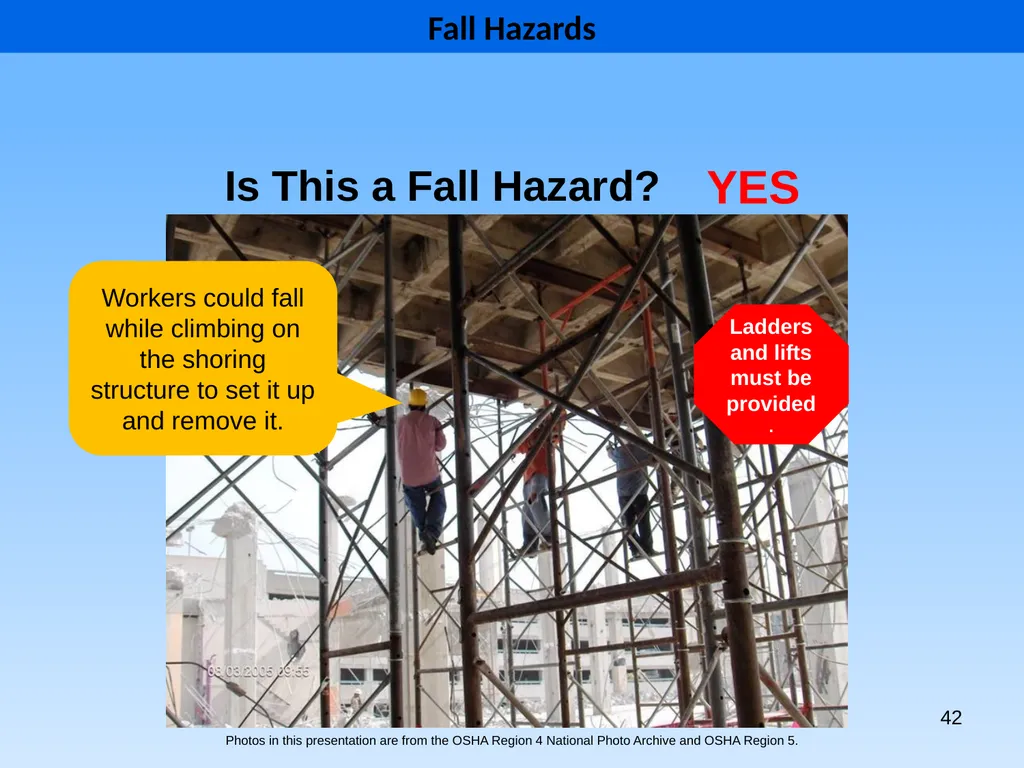
Fall Hazards 42 Is This a Fall Hazard? Photos in this presentation are from the OSHA Region 4 National Photo Archive and OSHA Region 5. Workers could fall while climbing on the shoring structure to set it up and remove it. Ladders and lifts must be provided. YES<br>
43
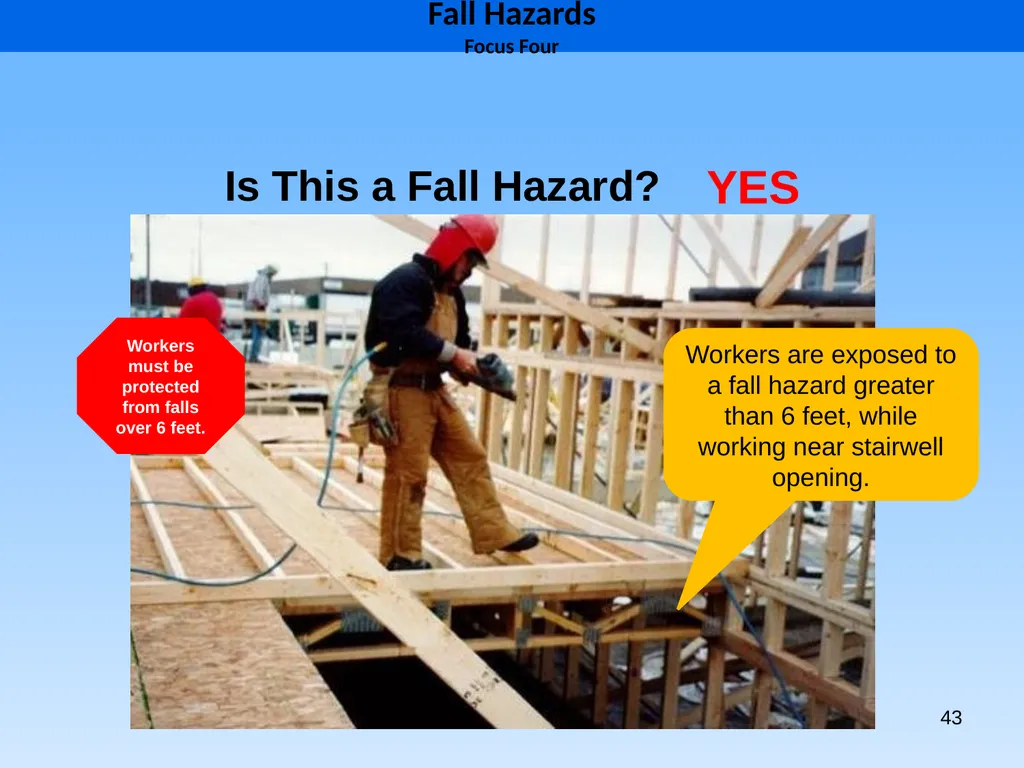
43 Is This a Fall Hazard? YES Workers are exposed to a fall hazard greater than 6 feet, while working near stairwell opening. Workers must be protected from falls over 6 feet. Fall Hazards
Focus Four<br>
44
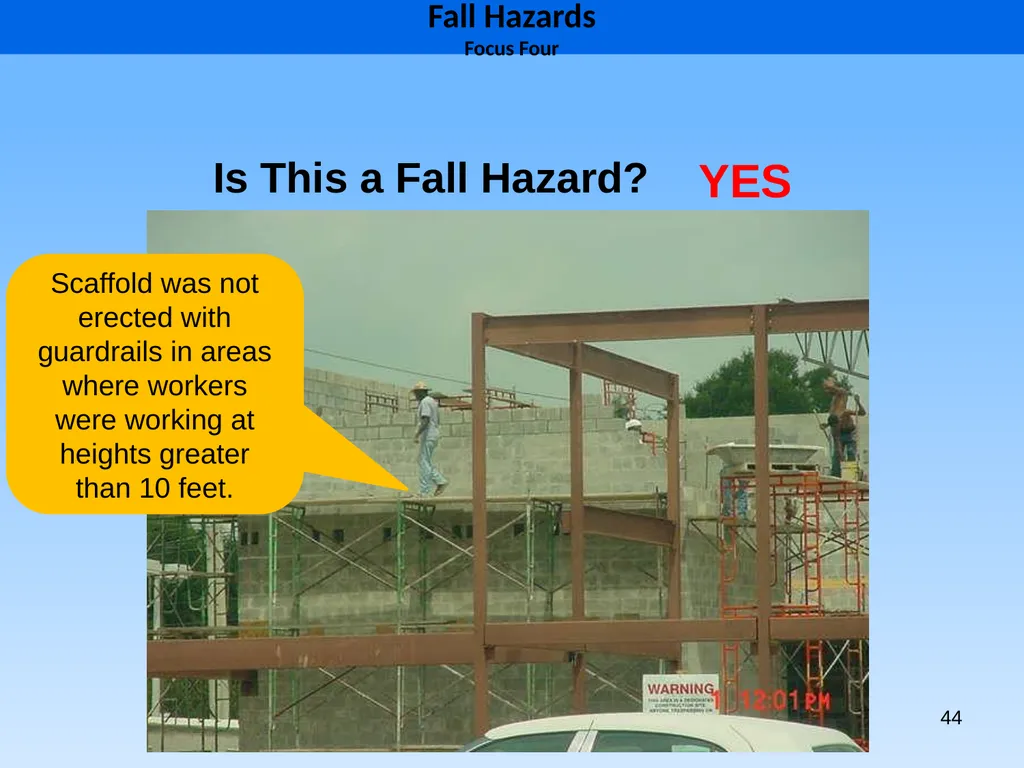
44 Is This a Fall Hazard? Scaffold was not erected with guardrails in areas where workers were working at heights greater than 10 feet. YES Fall Hazards
Focus Four<br>
45
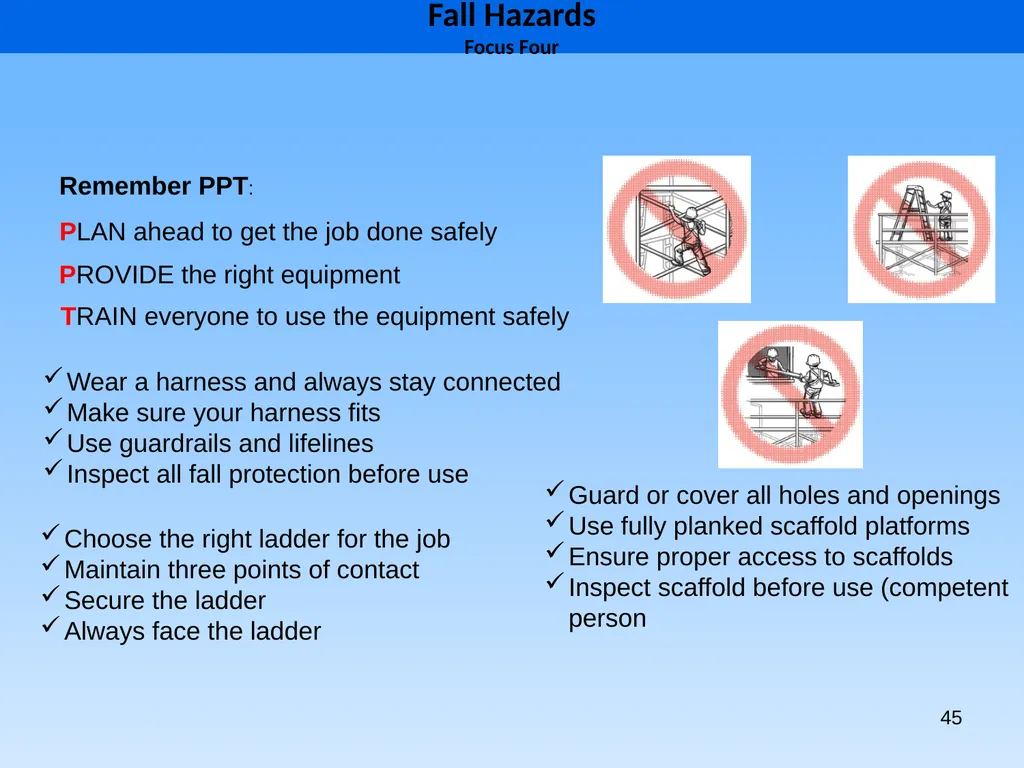
45 Remember PPT: PLAN ahead to get the job done safely PROVIDE the right equipment TRAIN everyone to use the equipment safely Wear a harness and always stay connected
Make sure your harness fits
Use guardrails and lifelines
Inspect all fall protection before use Guard or cover all holes and openings
Use fully planked scaffold platforms
Ensure proper access to scaffolds
Inspect scaffold before use (competent person Choose the right ladder for the job
Maintain three points of contact
Secure the ladder
Always face the ladder Fall Hazards Focus Four<br>
Make sure your harness fits
Use guardrails and lifelines
Inspect all fall protection before use Guard or cover all holes and openings
Use fully planked scaffold platforms
Ensure proper access to scaffolds
Inspect scaffold before use (competent person Choose the right ladder for the job
Maintain three points of contact
Secure the ladder
Always face the ladder Fall Hazards Focus Four<br>
46
46 Fall Hazards
Focus Four Through the Alliance between OSHA’s 10 Regional Offices and the Elevator Contractors of America (ECA), Elevator Industry Work Preservation Fund (EIWPF), International Union of Elevator Constructors (IUEC), National Association of Elevator Contractors (NAEC), National Elevator Industry Educational Program (NEIEP), and National Elevator Industry Inc. (NEII), collectively known as The Elevator Industry Safety Partners, developed this Industry Specific Training for informational purposes only. It does not necessarily reflect the official views of OSHA or the U.S. Department of Labor. May 2021
Under the Occupational Safety and Health Act, employers are responsible (http://www.osha.gov/as/opa/worker/employer-responsibility.html) for providing a safe and healthy workplace and workers have rights (https://www.osha.gov/workers). OSHA can help answer questions or concerns from employers and workers. OSHA's On-Site Consultation Program (https://www.osha.gov/consultation) offers free and confidential advice to small and medium-sized businesses, with priority given to high-hazard worksites. For more information, contact your regional or area OSHA office (https://www.osha.gov/contactus/bystate), call 1-800-321-OSHA (6742), or visit https://www.osha.gov/.<br>
Under the Occupational Safety and Health Act, employers are responsible (http://www.osha.gov/as/opa/worker/employer-responsibility.html) for providing a safe and healthy workplace and workers have rights (https://www.osha.gov/workers). OSHA can help answer questions or concerns from employers and workers. OSHA's On-Site Consultation Program (https://www.osha.gov/consultation) offers free and confidential advice to small and medium-sized businesses, with priority given to high-hazard worksites. For more information, contact your regional or area OSHA office (https://www.osha.gov/contactus/bystate), call 1-800-321-OSHA (6742), or visit https://www.osha.gov/.<br>
47
47 Fall Hazards
Focus Four<br>