
1 Enquiry 7 overview: An unfinished war Why was
CM
Published · 15 slides · 0 views

1 / 1


Description
1 Enquiry 7 overview: An unfinished war Why was there no peace in Korea? Lesson 7.1 Why did the Korean War drag on until 1953? Lesson 7.3 Could a hot war have erupted again in Korea during the Cold War? Lesson 7.2 How did the war leave an
Related Topics
Share
Embed code
Download this presentation From Below
"1 Enquiry 7 overview: An unfinished war Why was" is the property of its rightful owner. Permission is granted to download and print the materials on this website for personal, non-commercial use only, and to display it on your personal computer provided you do not modify the materials and that you retain all copyright notices contained in the materials. By downloading content from our website, you accept the terms of this agreement.
Presentation Transcript
01
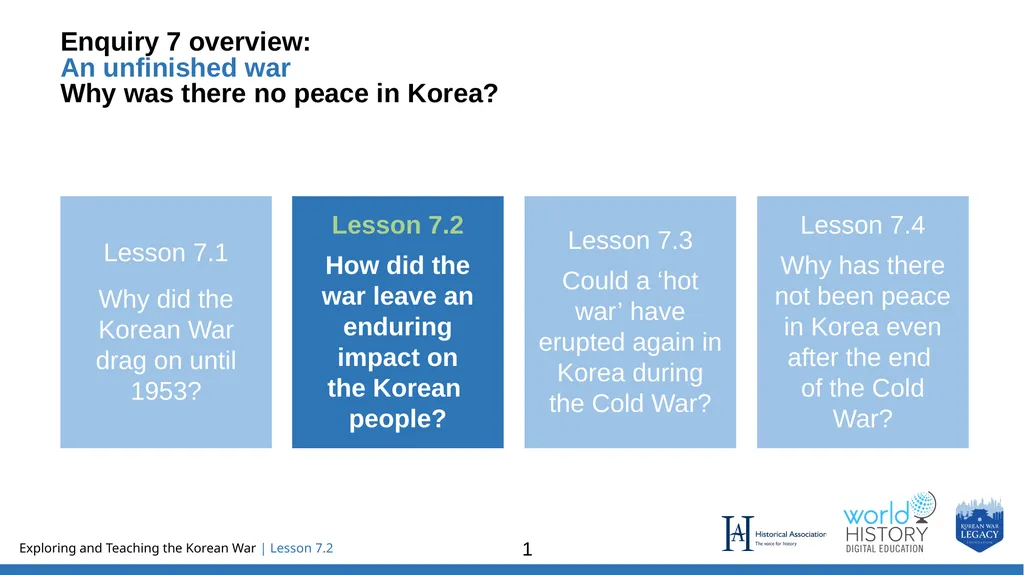
1 Enquiry 7 overview:
An unfinished war
Why was there no peace in Korea? Lesson 7.1
Why did the Korean War drag on until 1953? Lesson 7.3
Could a ‘hot war’ have erupted again in Korea during the Cold War? Lesson 7.2
How did the war leave an enduring impact on the Korean people? Lesson 7.4
Why has there not been peace in Korea even after the end of the Cold War?<br>
02
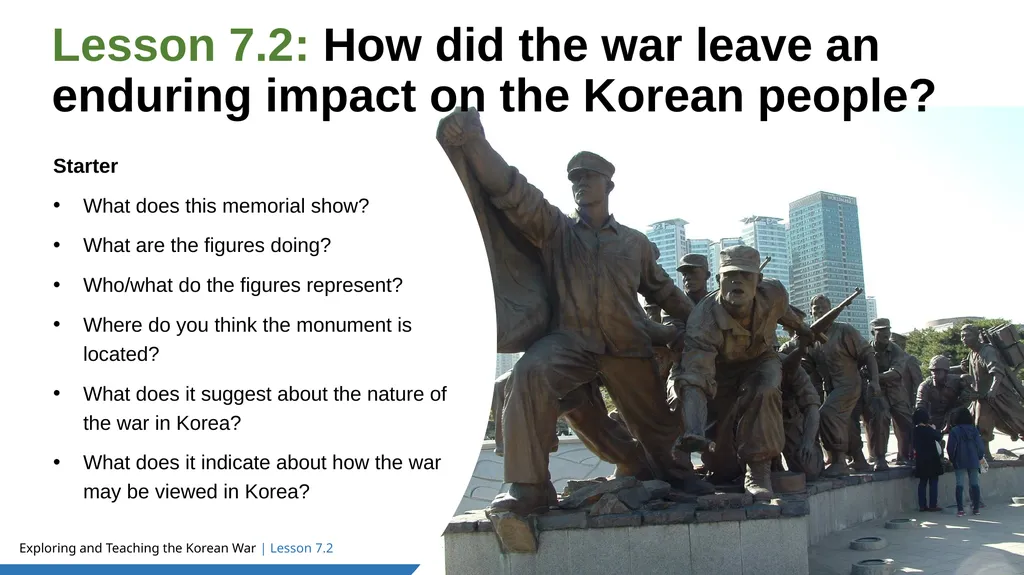
2 Starter
What does this memorial show?
What are the figures doing?
Who/what do the figures represent?
Where do you think the monument is located?
What does it suggest about the nature of the war in Korea?
What does it indicate about how the war may be viewed in Korea? Lesson 7.2: How did the war leave an enduring impact on the Korean people?<br>
03
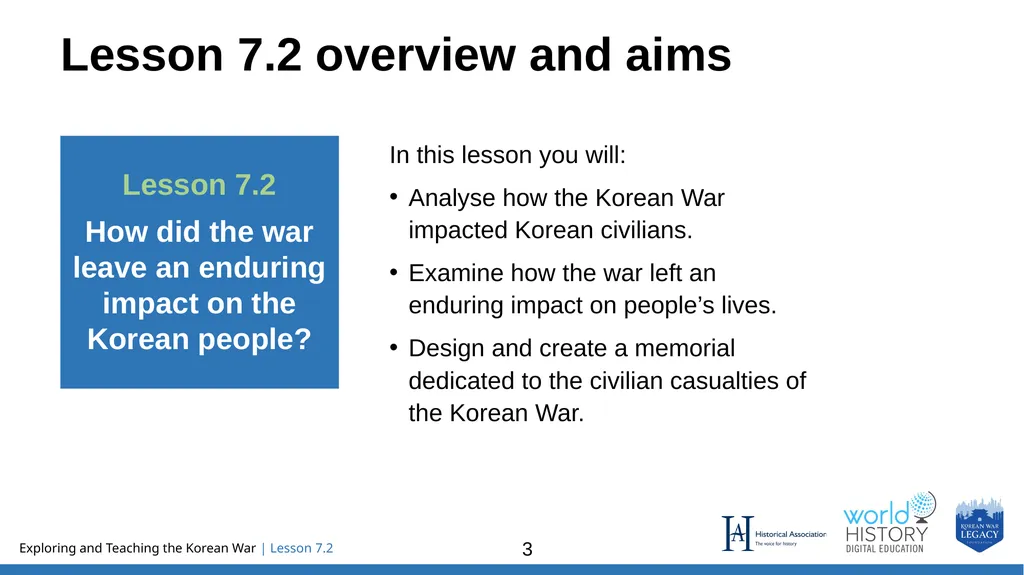
Lesson 7.2 overview and aims In this lesson you will:
Analyse how the Korean War impacted Korean civilians.
Examine how the war left an enduring impact on people’s lives.
Design and create a memorial dedicated to the civilian casualties of the Korean War. 3 Lesson 7.2
How did the war leave an enduring impact on the Korean people?<br>
04
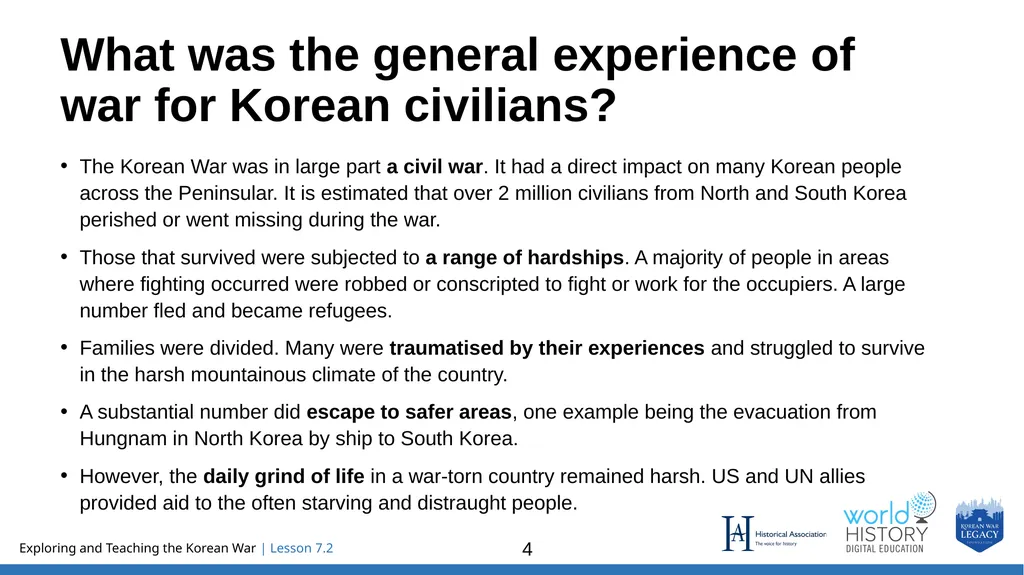
What was the general experience of war for Korean civilians? The Korean War was in large part a civil war. It had a direct impact on many Korean people across the Peninsular. It is estimated that over 2 million civilians from North and South Korea perished or went missing during the war.
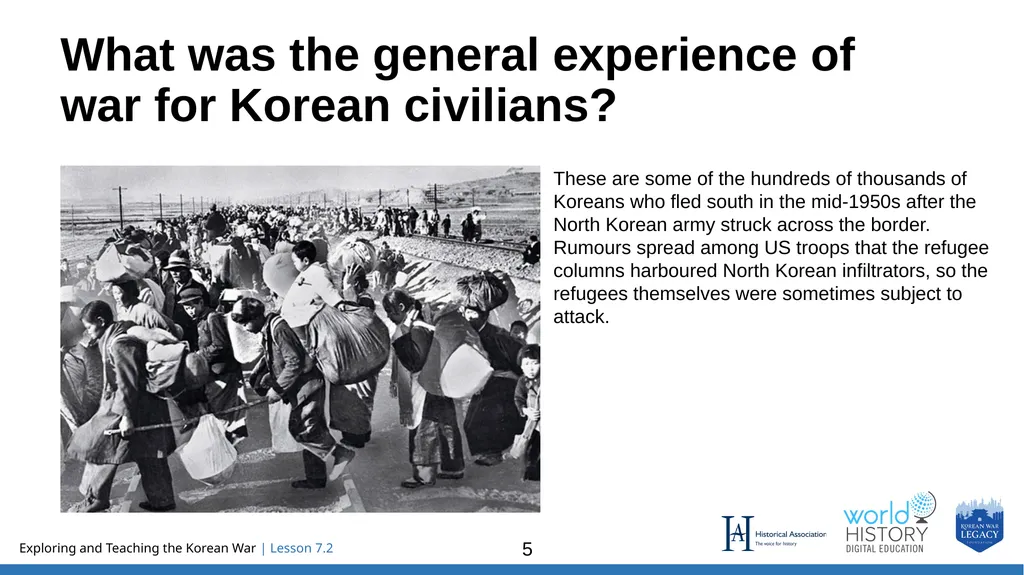
Those that survived were subjected to a range of hardships. A majority of people in areas where fighting occurred were robbed or conscripted to fight or work for the occupiers. A large number fled and became refugees.
Families were divided. Many were traumatised by their experiences and struggled to survive in the harsh mountainous climate of the country.
A substantial number did escape to safer areas, one example being the evacuation from Hungnam in North Korea by ship to South Korea.
However, the daily grind of life in a war-torn country remained harsh. US and UN allies provided aid to the often starving and distraught people. 4<br>
05
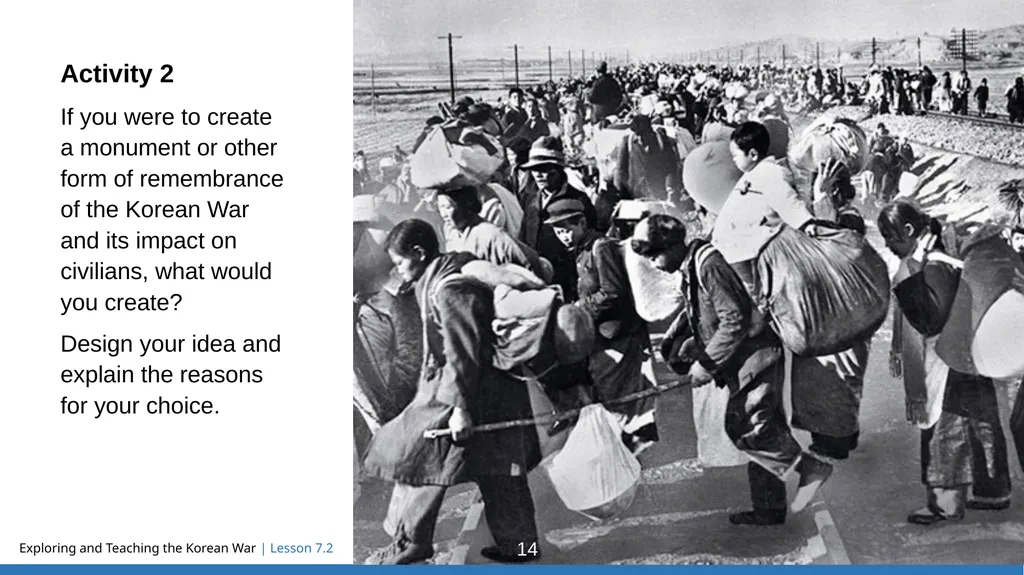
What was the general experience of war for Korean civilians? These are some of the hundreds of thousands of Koreans who fled south in the mid-1950s after the North Korean army struck across the border. Rumours spread among US troops that the refugee columns harboured North Korean infiltrators, so the refugees themselves were sometimes subject to attack. 5<br>
06
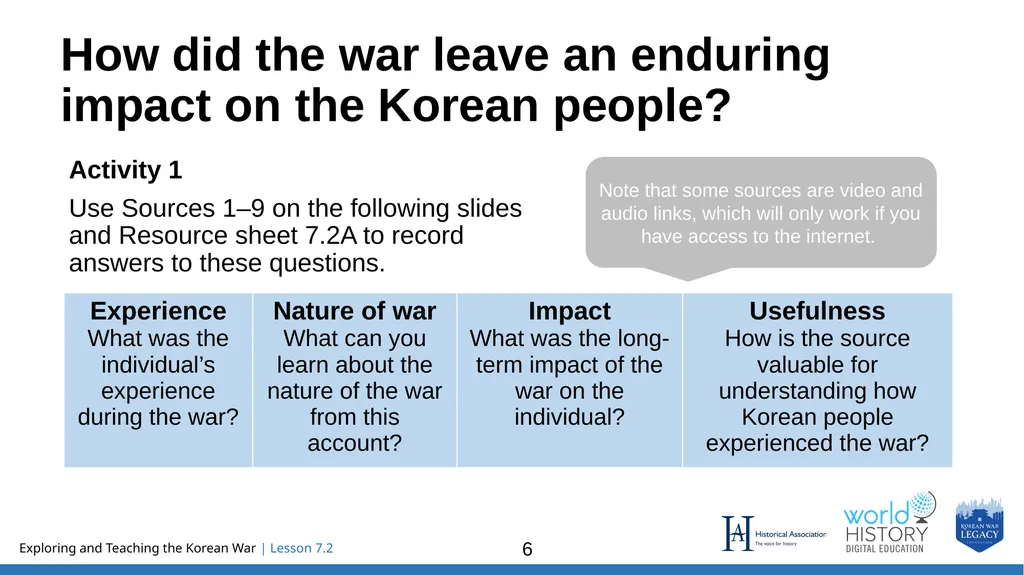
How did the war leave an enduring impact on the Korean people? Activity 1
Use Sources 1–9 on the following slides and Resource sheet 7.2A to record answers to these questions. 6 Note that some sources are video and audio links, which will only work if you have access to the internet.<br>
07
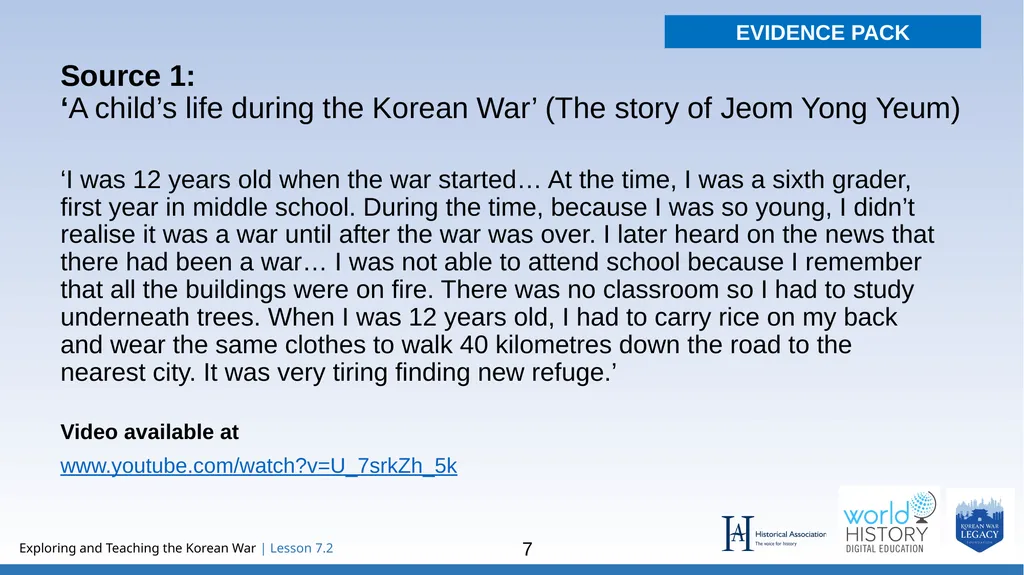
‘I was 12 years old when the war started… At the time, I was a sixth grader, first year in middle school. During the time, because I was so young, I didn’t realise it was a war until after the war was over. I later heard on the news that there had been a war… I was not able to attend school because I remember that all the buildings were on fire. There was no classroom so I had to study underneath trees. When I was 12 years old, I had to carry rice on my back and wear the same clothes to walk 40 kilometres down the road to the nearest city. It was very tiring finding new refuge.’ Video available at
www.youtube.com/watch?v=U_7srkZh_5k 7 EVIDENCE PACK Source 1: ‘A child’s life during the Korean War’ (The story of Jeom Yong Yeum)<br>
08
Jŏng-yi’s Family
They walked all the way from Chinnamp’o in North Korea to Hongsŏng in South Korea’s Ch'ungch’ŏng Province. They walked and walked, for twenty days they fled.
Yi Jŏn-hae and her sister Yi Jŏng-yi with their parents following them.
All day long walking with nothing to eat. When they found a well they drank then walked on in the flesh-biting cold.
They dreaded the American troops so they smeared their clothes with their own shit.
They spread soot from kitchen chimneys over their faces. The mother became a beggar-mom, her daughters beggar kids. Their bodies stank of shit. Instead of American troops, dogs came running.
Their robust father likewise blackened his face. The teeth inside his lips looked stronger still.
When snow fell they ventured into a village and were saved by a shed or an empty cowstall.
Three hundred miles they walked, arrived at Hongsŏng, settled there.
When China attacked in January ’51, they never reached there, being held back near the 38th parallel. They began a new life amidst the hills and fields of Hongsŏng, purchased a big hospital.
One daughter, Yi Jŏng-yi got married, became the poet Kim Young-Moo’s wife. Never late for Mass. 8 EVIDENCE PACK Source 2: A poem by Ko Un -Yi<br>
09
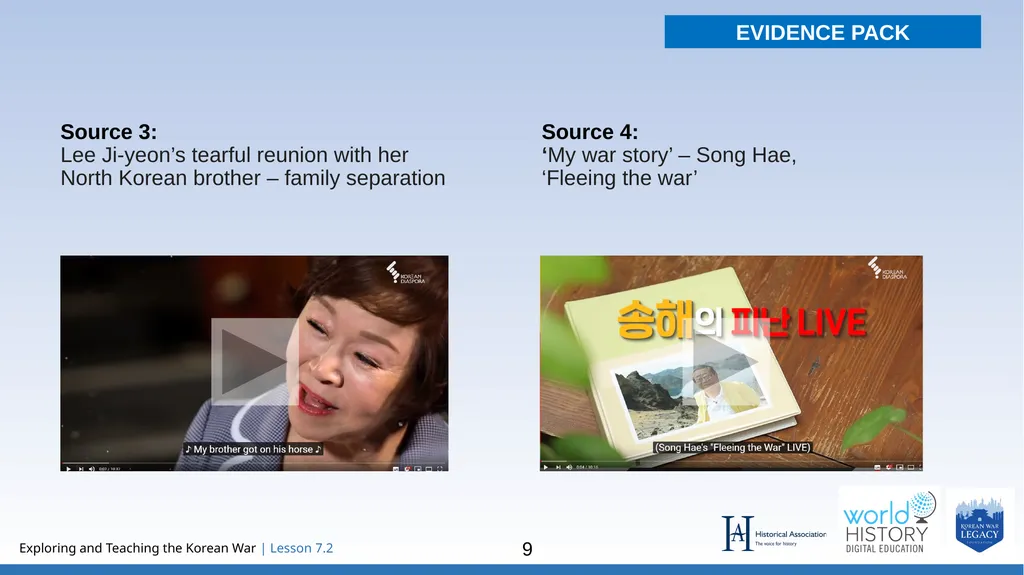
9 EVIDENCE PACK Source 3:
Lee Ji-yeon’s tearful reunion with her North Korean brother – family separation Source 4:
‘My war story’ – Song Hae,
‘Fleeing the war’<br>
10
‘During the Korean War, the North Korean army occupied Seoul in three days. The South Korean army were not prepared. Nobody thought they would attack us, but they suddenly attacked us. At the time I was staying near a Red Cross hospital. Everybody was saying we should run away, so we moved to a friend’s house in Mapo (on the edge of Seoul). I saw some soldiers were limping towards us on the way. We thought they were North Korean soldiers and I was terrified, but they were South Korean. During the occupation, there was a communist group called Woman Alliance something and some girls came to visit me several times and asked how much rice I have and how much money I had in the wardrobe. They visited me many times. I was so annoyed that they asked me about things that I owned. At that time, my husband was working in the post office and the North Korean army gave him some accounting work as he was good at mathematics. After the South Korean army recovered Seoul again, I thought we were dead because my husband had worked for the North. But fortunately a friend of my husband was able to persuade the South not to harm him. One North Korean soldier who did not know that the South had recovered Seoul found my husband and held his shoulder and asked him where he was going. He said he had to go to the head office for a budget issue and was released. The North Koreans in Seoul were later moved. I saw some people died and burned on the street. His belly was so swollen and dark. It was horrible.
When the North came again, it was really horrible that time. We had to move to Gongju (90 miles from Seoul) on foot. It was very rough and mountainous. I was holding my baby with my bare hands. We stayed in Gongju for two days, I got bad kidney problems and found it hard to urinate. After the situation changed we went to Busan. We had two chicken and we raised them so they got big. But, one night a guy tried to steal them, but their noise scared him off. However, as he ran off he caused a fire; we tried to throw water on it, but it only made things worse. We threw a chamber pot on the fire. My husband burnt his hands. In my home, there were more than 17 people living in one house, so we ran out of money. But our neighbours thought we were rich.’ 10 EVIDENCE PACK Source 5: ‘My grandmother’s real experience during the war’ (Mrs Hong – housewife)<br>
11
‘Almost 200,000 refugees gathered in Hungnam Port (in North Korea) with 100,000 Korean soldiers who failed to
retreat. According to my parents, the only escape route was by sea, so they went to the port carrying their
belongings. They went to the port everyday to try and get on a ship, but couldn’t, until one day they finally got aboard
(the SS Meredith). The cargo holds were packed with people and they couldn’t lie down or stretch their legs – they travelled for three days in a crouching position. The ship arrived at Geoje Island in December. The American soldiers gave out candy to all the refugees, telling them it was Christmas Eve.
At the time, the population of Geoje island was 100,000. 91,000 refugees from Hungnam arrived. When you added refugees from other regions there were around 150,000 refugees. The residents kindly gave the refugees cooking pots and some food. My parents rented a room in a thatched house. There was a prisoner of war camp that the Americans were managing; my father worked at that base. As for my mother, she bought eggs from famers and would go all the way to Busan to sell the eggs. She took the ferry in the morning to Busan and came back at night. Because life was so hard for refugees, however, many times she wanted to run; however she couldn’t run away and leave Korea because she didn’t know English.’ 11 EVIDENCE PACK Source 6: ‘My war story’ – President Moon, South Korean President, 2017<br>
12
‘Everybody was thirsty, hungry… my parents died. In the beginning, people carried everything. Pots and pans and blankets. Gradually they threw everything down and just walked: even a baby. They wrapped the baby in a blanket, set him in the snow and the baby cried. Nobody could pick it up.
Nobody wanted me. But one lady, thought about it a bit and she said “I can give you a room… you have to bring an American soldier.” I said “I’m scared…” so she went out and said “Who wants a wife?” to three soldiers who were outside. So, my [future] husband and two friends laughed at each other and said “Who wants a wife, let’s go see.”
I felt at the time he was just going to use me. So I wanted to run away and go someplace nobody knew what I was. So I packed up some clothes – he came to see… He showed me his hand and said that he was going to come back for me and marry me. [Marriage between US soldiers and locals was banned at the time.]
(Oksun’s husband petitioned to congressmen and various state departments. She was allowed to become the first bride of an American soldier to be allowed to go and live in the USA.) 12 EVIDENCE PACK Source 7: ‘‘A Korean war Bride’ – Pega Crimbchin (Lee Oksun)<br>
13
‘When we went to Anyang, I went too fast and lost my parents. I didn’t have any shoes. So barefoot… I was hungry and fainted. Soon after,
a strange Turkish soldier was smiling when I opened my eyes. They tried very hard to get shoes for me.’
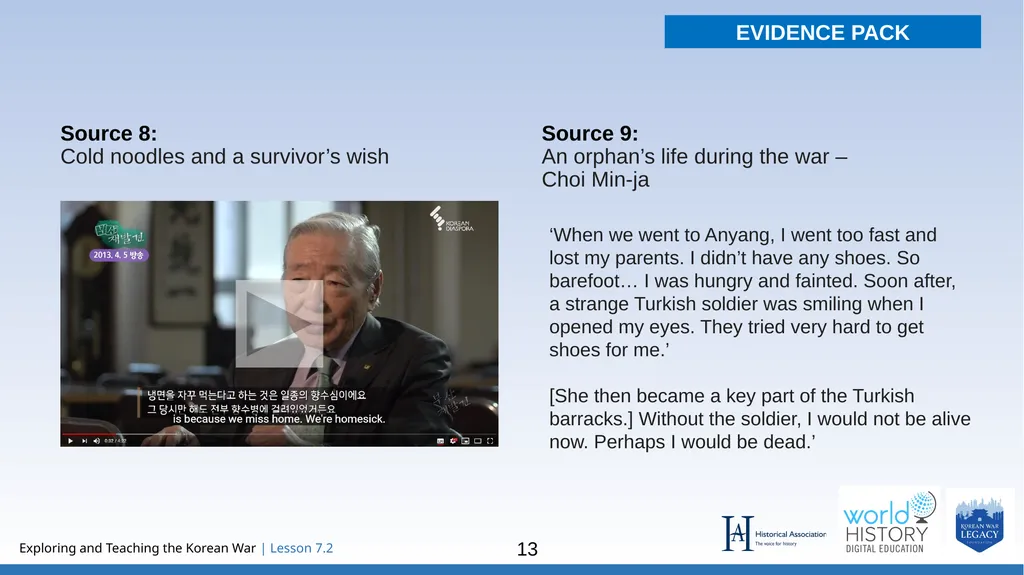
[She then became a key part of the Turkish barracks.] Without the soldier, I would not be alive now. Perhaps I would be dead.’ 13 EVIDENCE PACK Source 8: Cold noodles and a survivor’s wish Source 9: An orphan’s life during the war – Choi Min-ja<br>
14
Activity 2
If you were to create a monument or other form of remembrance of the Korean War and its impact on civilians, what would you create?
Design your idea and explain the reasons for your choice. 14<br>
15
How did the war leave an enduring impact on the Korean people? Plenary discussion
What do the sources indicate about the impact of war on ordinary civilians?
What other developments, implied or not fully indicated in the sources, may also have had an impact on Korean people?
Are there any underlying sentiments that have left a long-lasting mark on the people?
How does learning about the experiences of ordinary people in a conflict transform your understanding of war? 15<br>