
1 Icons Activating prior knowledge Remember what
MJ
Published · 50 slides · 0 views
1 / 1
Description
1 Icons Activating prior knowledge Remember what you already know about a topic before you start to learn something new, to help build connections in your long-term memory. Retrieval practice Quizzing, recall and memory activities to slow
Related Topics
Share
Embed code
Download this presentation From Below
"1 Icons Activating prior knowledge Remember what" is the property of its rightful owner. Permission is granted to download and print the materials on this website for personal, non-commercial use only, and to display it on your personal computer provided you do not modify the materials and that you retain all copyright notices contained in the materials. By downloading content from our website, you accept the terms of this agreement.
Presentation Transcript
01
1<br>
02
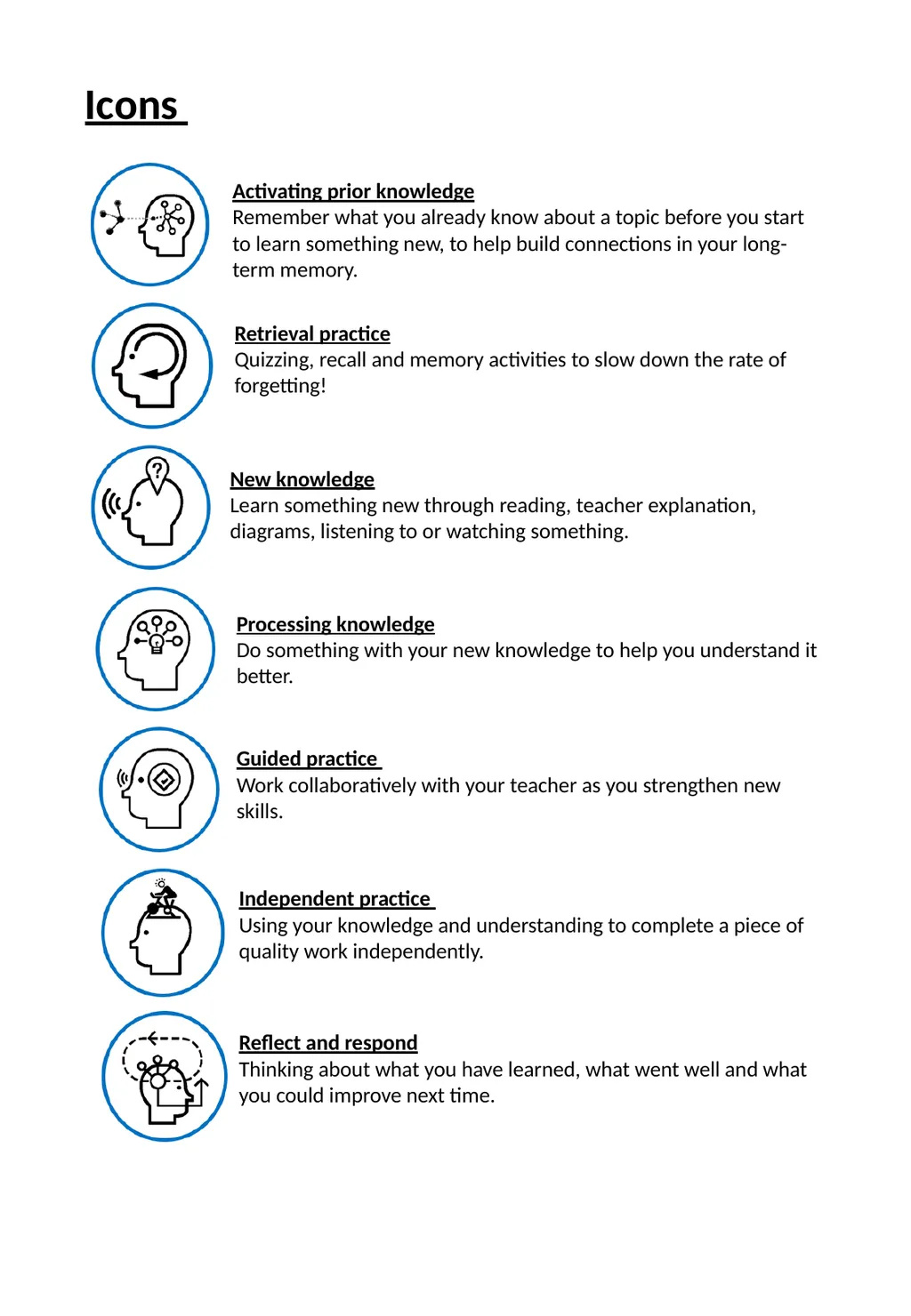
Icons Activating prior knowledge
Remember what you already know about a topic before you start to learn something new, to help build connections in your long-term memory. Retrieval practice
Quizzing, recall and memory activities to slow down the rate of forgetting! New knowledge
Learn something new through reading, teacher explanation, diagrams, listening to or watching something. Processing knowledge
Do something with your new knowledge to help you understand it better. Guided practice
Work collaboratively with your teacher as you strengthen new skills. Independent practice
Using your knowledge and understanding to complete a piece of quality work independently. Reflect and respond
Thinking about what you have learned, what went well and what you could improve next time.<br>
Remember what you already know about a topic before you start to learn something new, to help build connections in your long-term memory. Retrieval practice
Quizzing, recall and memory activities to slow down the rate of forgetting! New knowledge
Learn something new through reading, teacher explanation, diagrams, listening to or watching something. Processing knowledge
Do something with your new knowledge to help you understand it better. Guided practice
Work collaboratively with your teacher as you strengthen new skills. Independent practice
Using your knowledge and understanding to complete a piece of quality work independently. Reflect and respond
Thinking about what you have learned, what went well and what you could improve next time.<br>
03
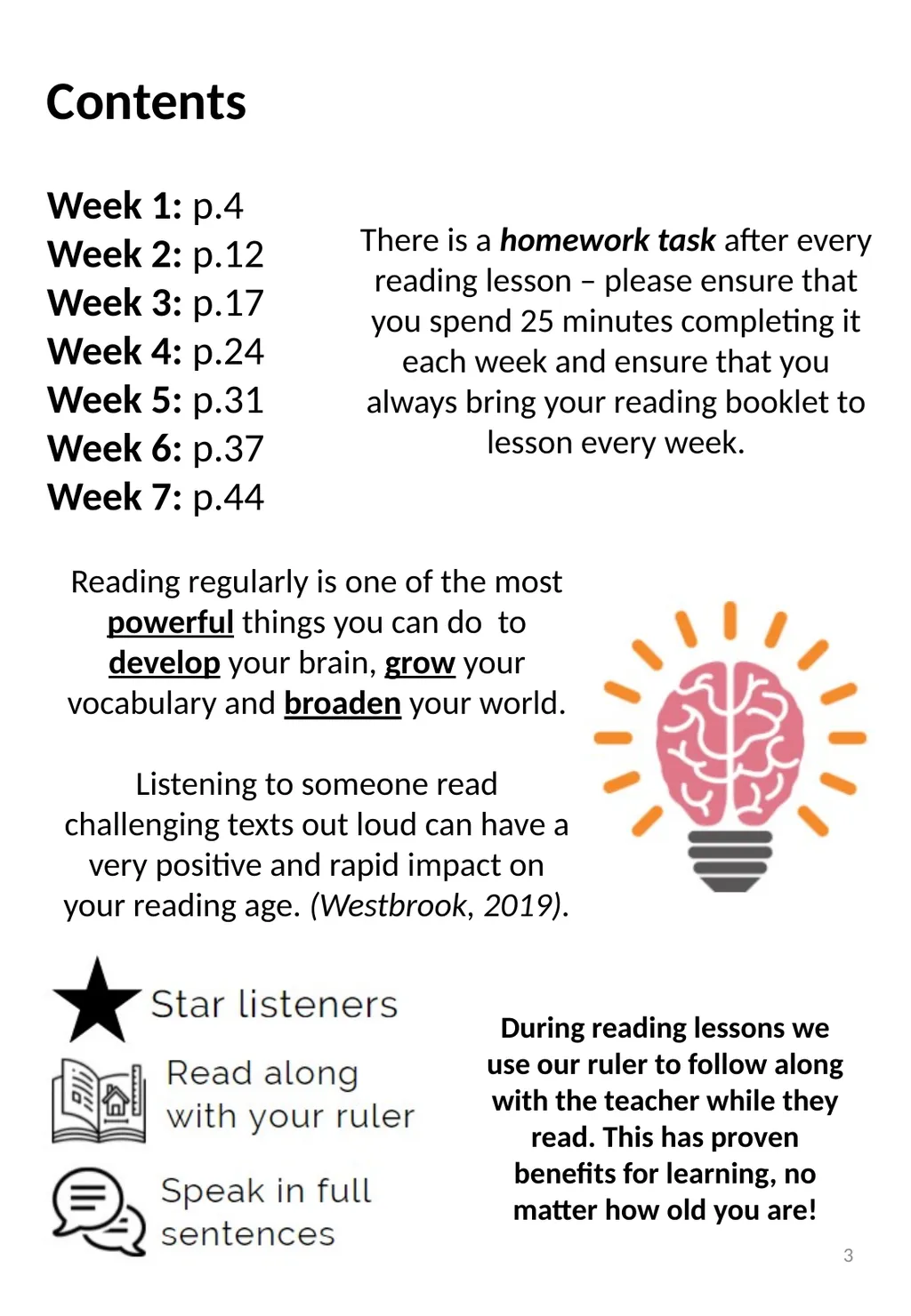
3 Contents
Week 1: p.4
Week 2: p.12
Week 3: p.17
Week 4: p.24
Week 5: p.31
Week 6: p.37
Week 7: p.44 Reading regularly is one of the most powerful things you can do to develop your brain, grow your vocabulary and broaden your world.
Listening to someone read challenging texts out loud can have a very positive and rapid impact on your reading age. (Westbrook, 2019). During reading lessons we use our ruler to follow along with the teacher while they read. This has proven benefits for learning, no matter how old you are! There is a homework task after every reading lesson – please ensure that you spend 25 minutes completing it each week and ensure that you always bring your reading booklet to lesson every week.<br>
Listening to someone read challenging texts out loud can have a very positive and rapid impact on your reading age. (Westbrook, 2019). During reading lessons we use our ruler to follow along with the teacher while they read. This has proven benefits for learning, no matter how old you are! There is a homework task after every reading lesson – please ensure that you spend 25 minutes completing it each week and ensure that you always bring your reading booklet to lesson every week.<br>
04
4 Week 1
Extract Look Both Ways: A Tale Told in Ten Blocks by
Jason Reynolds How can you hook a reader into a story in an
opening sentence?
.....................................................................................
………………................................................................................
..............................................................................................................................................................
............................................................................................................................................................................................................................................................................................................................................................................................................................................................................................. ..................................................................................................................................................................................................................................................................................................................................................................................................................................................................................................................................................................................................................................................................................................................................................................................................................................... ..................................................................................................................................................................................................................................................................................................................................................................................................................................................................................................................................................................................................................................................................................................................................................................................................................................... Do you think the title of a book always affects who chooses to read it? Why do you think books sometimes have multiple protagonists (main characters)?<br>
05
5 Look Both Ways: A Tale Told in Ten Blocks by Jason Reynolds The story was going to begin like all the best stories. With a school bus falling from the sky.
But no one saw it happen. No one heard anything. So instead, this story will begin like all the … good ones.
With boogers.
“If you don’t get all them nasty, half-baked goblins out your nose, I promise I’m not walking home with you. I’m not playin’.” Jasmine Jordan said this like she said most thigs – with her whole body. Like the words weren’t just coming out her mouth but were also rolling down her spine. She said it like she meant it.. Said it with the same don’t play with me tone her mother used whenever she was trying to talk to Jasmine about something important for her “real life”, and Jasmine turned the music up in her ears real loud to drown her mother out, and scroll on, scroll on. If you don’t take then earbugs… earbuds… airphones, or whatever they called out of your coconut head it’s gon’ be me turning up the volume and the bass, and I ain’t talking about no music.
That tone.
Jasmine’s booger-removal warning was aimed at her stuff-nosed best friend, Terrence Jumper. TJ. Well, Jasmine called him her “best friend who’s a boy,” but she didn’t have best friends who were girls, so TJ was her best friend best friend. And she was his. Been like that for a long time. Since he moved onto Marston Street, three houses down from her. Since the only way their mothers would let them be walkers was if they walked together because they were the only kids who lived on their block. Since six years, so since forever.
The bell rang, and Jasmine and TJ had just left their last class for the day, the only class they had together.
Life science with Mr. Fantana.
“You been back to school for two days and you already starting with me?” TK spun the black lock dial confidently, like he could feel the difference in the grooves and would know when he landed on the right numbers.
“How could I not? Look at them things. Honestly, TJ, I’on’t even know how you breathing right<br>
But no one saw it happen. No one heard anything. So instead, this story will begin like all the … good ones.
With boogers.
“If you don’t get all them nasty, half-baked goblins out your nose, I promise I’m not walking home with you. I’m not playin’.” Jasmine Jordan said this like she said most thigs – with her whole body. Like the words weren’t just coming out her mouth but were also rolling down her spine. She said it like she meant it.. Said it with the same don’t play with me tone her mother used whenever she was trying to talk to Jasmine about something important for her “real life”, and Jasmine turned the music up in her ears real loud to drown her mother out, and scroll on, scroll on. If you don’t take then earbugs… earbuds… airphones, or whatever they called out of your coconut head it’s gon’ be me turning up the volume and the bass, and I ain’t talking about no music.
That tone.
Jasmine’s booger-removal warning was aimed at her stuff-nosed best friend, Terrence Jumper. TJ. Well, Jasmine called him her “best friend who’s a boy,” but she didn’t have best friends who were girls, so TJ was her best friend best friend. And she was his. Been like that for a long time. Since he moved onto Marston Street, three houses down from her. Since the only way their mothers would let them be walkers was if they walked together because they were the only kids who lived on their block. Since six years, so since forever.
The bell rang, and Jasmine and TJ had just left their last class for the day, the only class they had together.
Life science with Mr. Fantana.
“You been back to school for two days and you already starting with me?” TK spun the black lock dial confidently, like he could feel the difference in the grooves and would know when he landed on the right numbers.
“How could I not? Look at them things. Honestly, TJ, I’on’t even know how you breathing right<br>
06
6 now,” Jasmine continued. Their lockers were right next to each other, luckily, because Jasmine, unlike TJ, turned her lock with an intense concentration, glaring at it as if the combination could up and change at any second, or as if her fingers might stop working at any moment. And if for some strange reason either of those things happened, at least she knew TK was right there to help.
TJ shrugged, tossing his science book onto the floor of the metal closet, the smell of feet wafting up from it like a cloud of dust, unsettled. And unsettling. The floor of his locker was littered with empty snack bags that Jasmine had slid through the door vent between classes over the last two days. Trash… yes. But Jasmine and TJ called them “friendship flags.” The litter of love.
And because Jasmine had been gone for a while, they were basically notes that said I’ve missed you. In Cheeto dust. Then, finally, with the hardened snot like tony stones rolled in front of the entrances of his nose, TJ turned the bottom of his shirt up and mopped it. A streak of slime smeared across his lip as he swiped and pinched and dug just enough for it to count as a dig, but not enough for it to count as digging’.
TJ tilted his face upward so Jasmine could get a clear line of sight into his nostrils. “Better?” he asked, half sincere, half hoping there was one more booger left and that it was somehow making a mean face at Jasmine.
Jasmine stared into TJ’s nose like she was peering through a brown microscope of flesh, and she did this totally unfazed by the fact that TJ had just used his t-shirt – the one he was wearing – as a tissue. And why would she be bothered? Not that it wasn’t disgusting (it was), but she’d known him a long time. Had seen him do thigs that made boogers on the bottom of a t-shirt seem like nothing more than added decoration. Booger bedazzle. A little flavour for his fashion. Had seen him use his fingers to pick gum off the bottom of his sneakers (and hers), and of course nothing could ever beat the time he clapped a mosquito dead right when it has bitten him, then licked the fly slime off his arm. That one Jasmine has dared him to do, Paid him a dollar for it. Worth it, for both of them.
“Y’know, I can see straight through to your brain,” Jasmine said, pretending to still be examining. “And it turns out, there's a whole lot of it missing.” She plucked TJ’s nose. “Sike, sike, sike, sike. Nah, you good. I guess I can be seen with you now.”<br>
TJ shrugged, tossing his science book onto the floor of the metal closet, the smell of feet wafting up from it like a cloud of dust, unsettled. And unsettling. The floor of his locker was littered with empty snack bags that Jasmine had slid through the door vent between classes over the last two days. Trash… yes. But Jasmine and TJ called them “friendship flags.” The litter of love.
And because Jasmine had been gone for a while, they were basically notes that said I’ve missed you. In Cheeto dust. Then, finally, with the hardened snot like tony stones rolled in front of the entrances of his nose, TJ turned the bottom of his shirt up and mopped it. A streak of slime smeared across his lip as he swiped and pinched and dug just enough for it to count as a dig, but not enough for it to count as digging’.
TJ tilted his face upward so Jasmine could get a clear line of sight into his nostrils. “Better?” he asked, half sincere, half hoping there was one more booger left and that it was somehow making a mean face at Jasmine.
Jasmine stared into TJ’s nose like she was peering through a brown microscope of flesh, and she did this totally unfazed by the fact that TJ had just used his t-shirt – the one he was wearing – as a tissue. And why would she be bothered? Not that it wasn’t disgusting (it was), but she’d known him a long time. Had seen him do thigs that made boogers on the bottom of a t-shirt seem like nothing more than added decoration. Booger bedazzle. A little flavour for his fashion. Had seen him use his fingers to pick gum off the bottom of his sneakers (and hers), and of course nothing could ever beat the time he clapped a mosquito dead right when it has bitten him, then licked the fly slime off his arm. That one Jasmine has dared him to do, Paid him a dollar for it. Worth it, for both of them.
“Y’know, I can see straight through to your brain,” Jasmine said, pretending to still be examining. “And it turns out, there's a whole lot of it missing.” She plucked TJ’s nose. “Sike, sike, sike, sike. Nah, you good. I guess I can be seen with you now.”<br>
07
7 “Whatever.” Locker slam. “I mean, we all boogers anyway.”
“You might be a booger.” Locker slam. “But me, I ain’t no booger.”
“That’s what you think,” TJ went on as they swapped backpacks. His was light. Jasmine’s was packed with every class’ textbook and all the world’s notebooks. Make up work. She could’ve carried it herself , but TJ was concerned about her back, about her muscles because she was still recovering from the attack. Summary (In your own words...)
................................................................................................................................................................................................................................................................................................................................................................................................................................................................................................................................................................................................................................................................................................................................................................................................................. DISCUSS: How does the writer created amazing dimensional characters?
DISCUSS: Why do you think that the writer introduced Jasmine’s character before hinting at her accident?<br>
“You might be a booger.” Locker slam. “But me, I ain’t no booger.”
“That’s what you think,” TJ went on as they swapped backpacks. His was light. Jasmine’s was packed with every class’ textbook and all the world’s notebooks. Make up work. She could’ve carried it herself , but TJ was concerned about her back, about her muscles because she was still recovering from the attack. Summary (In your own words...)
................................................................................................................................................................................................................................................................................................................................................................................................................................................................................................................................................................................................................................................................................................................................................................................................................. DISCUSS: How does the writer created amazing dimensional characters?
DISCUSS: Why do you think that the writer introduced Jasmine’s character before hinting at her accident?<br>
08
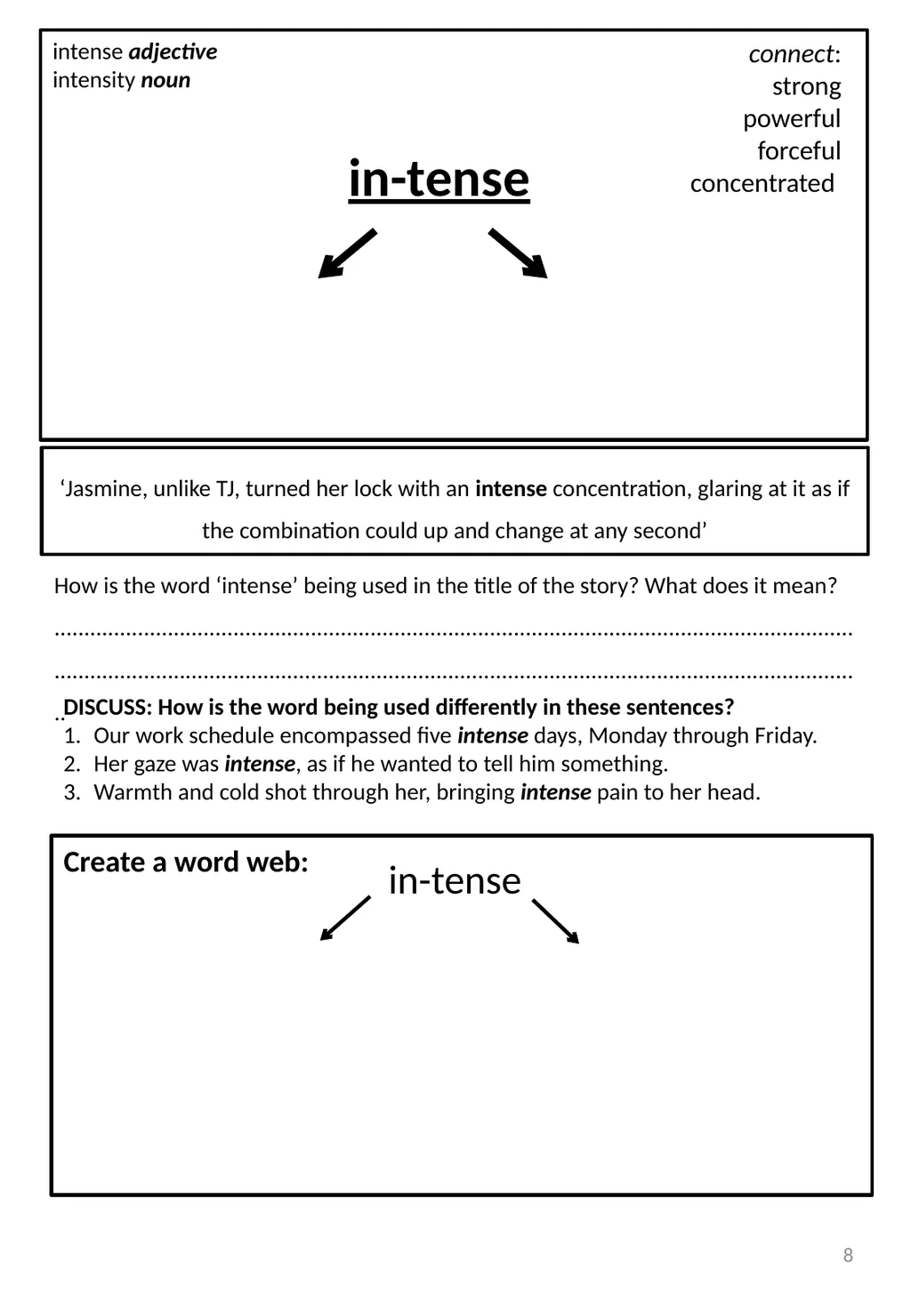
8 Create a word web: connect:
strong
powerful
forceful concentrated intense adjective intensity noun ‘Jasmine, unlike TJ, turned her lock with an intense concentration, glaring at it as if the combination could up and change at any second’ How is the word ‘intense’ being used in the title of the story? What does it mean?
.............................................................................................................................................................................................................................................................................. in-tense in-tense DISCUSS: How is the word being used differently in these sentences?
Our work schedule encompassed five intense days, Monday through Friday.
Her gaze was intense, as if he wanted to tell him something.
Warmth and cold shot through her, bringing intense pain to her head.<br>
powerful
forceful concentrated intense adjective intensity noun ‘Jasmine, unlike TJ, turned her lock with an intense concentration, glaring at it as if the combination could up and change at any second’ How is the word ‘intense’ being used in the title of the story? What does it mean?
.............................................................................................................................................................................................................................................................................. in-tense in-tense DISCUSS: How is the word being used differently in these sentences?
Our work schedule encompassed five intense days, Monday through Friday.
Her gaze was intense, as if he wanted to tell him something.
Warmth and cold shot through her, bringing intense pain to her head.<br>
09
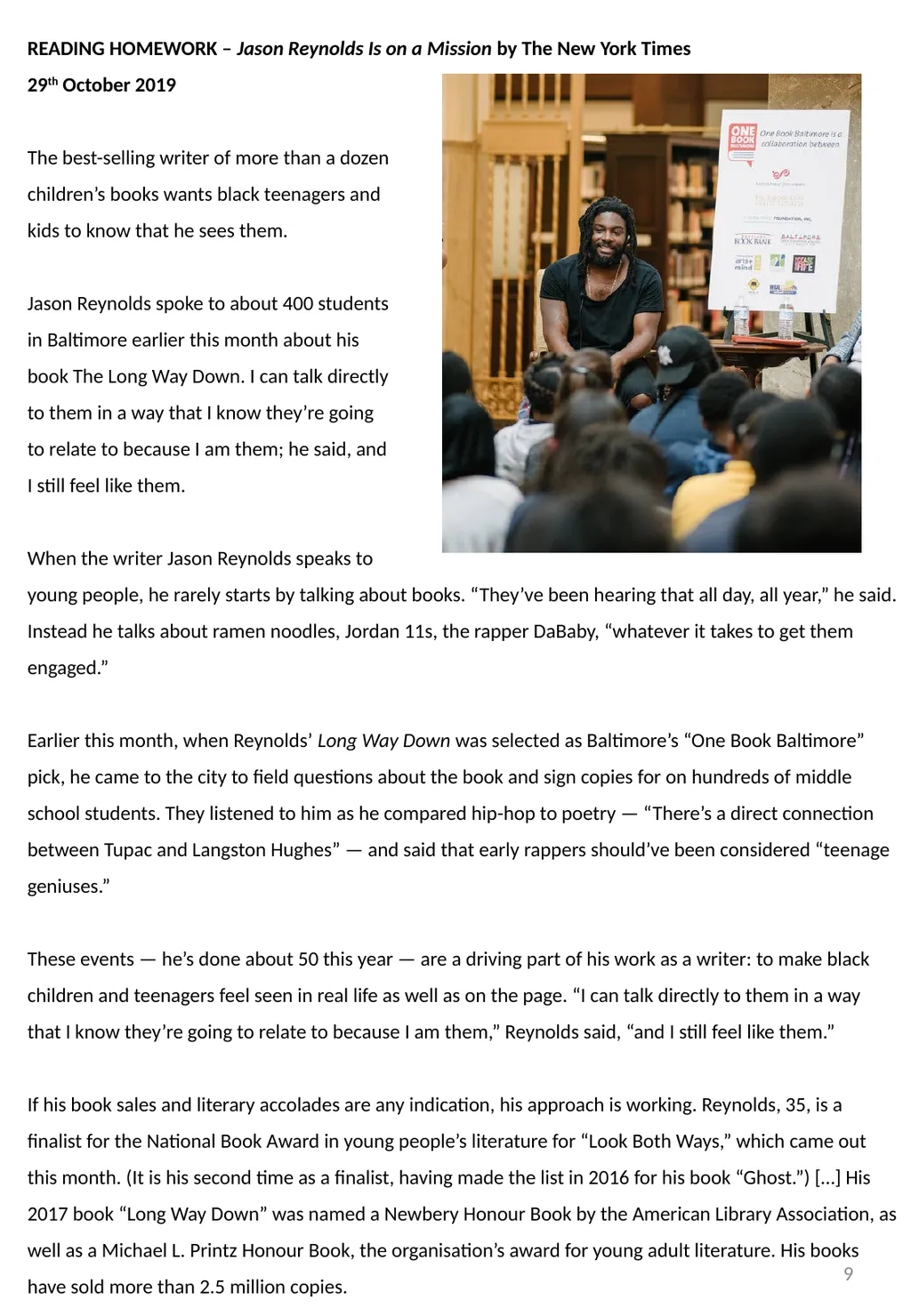
READING HOMEWORK – Jason Reynolds Is on a Mission by The New York Times
29th October 2019
The best-selling writer of more than a dozen
children’s books wants black teenagers and
kids to know that he sees them.
Jason Reynolds spoke to about 400 students
in Baltimore earlier this month about his
book The Long Way Down. I can talk directly
to them in a way that I know they’re going
to relate to because I am them; he said, and
I still feel like them.
When the writer Jason Reynolds speaks to
young people, he rarely starts by talking about books. “They’ve been hearing that all day, all year,” he said. Instead he talks about ramen noodles, Jordan 11s, the rapper DaBaby, “whatever it takes to get them engaged.”
Earlier this month, when Reynolds’ Long Way Down was selected as Baltimore’s “One Book Baltimore” pick, he came to the city to field questions about the book and sign copies for on hundreds of middle school students. They listened to him as he compared hip-hop to poetry — “There’s a direct connection between Tupac and Langston Hughes” — and said that early rappers should’ve been considered “teenage geniuses.”
These events — he’s done about 50 this year — are a driving part of his work as a writer: to make black children and teenagers feel seen in real life as well as on the page. “I can talk directly to them in a way that I know they’re going to relate to because I am them,” Reynolds said, “and I still feel like them.”
If his book sales and literary accolades are any indication, his approach is working. Reynolds, 35, is a finalist for the National Book Award in young people’s literature for “Look Both Ways,” which came out this month. (It is his second time as a finalist, having made the list in 2016 for his book “Ghost.”) […] His 2017 book “Long Way Down” was named a Newbery Honour Book by the American Library Association, as well as a Michael L. Printz Honour Book, the organisation’s award for young adult literature. His books have sold more than 2.5 million copies. 9<br>
The best-selling writer of more than a dozen
children’s books wants black teenagers and
kids to know that he sees them.
Jason Reynolds spoke to about 400 students
in Baltimore earlier this month about his
book The Long Way Down. I can talk directly
to them in a way that I know they’re going
to relate to because I am them; he said, and
I still feel like them.
When the writer Jason Reynolds speaks to
young people, he rarely starts by talking about books. “They’ve been hearing that all day, all year,” he said. Instead he talks about ramen noodles, Jordan 11s, the rapper DaBaby, “whatever it takes to get them engaged.”
Earlier this month, when Reynolds’ Long Way Down was selected as Baltimore’s “One Book Baltimore” pick, he came to the city to field questions about the book and sign copies for on hundreds of middle school students. They listened to him as he compared hip-hop to poetry — “There’s a direct connection between Tupac and Langston Hughes” — and said that early rappers should’ve been considered “teenage geniuses.”
These events — he’s done about 50 this year — are a driving part of his work as a writer: to make black children and teenagers feel seen in real life as well as on the page. “I can talk directly to them in a way that I know they’re going to relate to because I am them,” Reynolds said, “and I still feel like them.”
If his book sales and literary accolades are any indication, his approach is working. Reynolds, 35, is a finalist for the National Book Award in young people’s literature for “Look Both Ways,” which came out this month. (It is his second time as a finalist, having made the list in 2016 for his book “Ghost.”) […] His 2017 book “Long Way Down” was named a Newbery Honour Book by the American Library Association, as well as a Michael L. Printz Honour Book, the organisation’s award for young adult literature. His books have sold more than 2.5 million copies. 9<br>
10
10 “Look Both Ways” unfolds across 10 city blocks, delving into the lives of middle schoolers on their way home from school in the afternoons. It is a time when they are unsupervised, Reynolds said, and they “get to learn about the world on their own, for better or for worse.”
Writing for black children first and foremost, Reynolds attempts to portray the scope of their lives — sometimes including guns and violence but also happiness and laughter. “There’s always a joke somewhere,” he said. “You don’t go through what black and brown people have been through in this country and survive without understanding how to tap into joy.”
And he often portrays boys crying or feeling uncertainty or fear, because, he said, “I need boys to know that it’s O.K.” Reynolds, who grew up in Oxon Hill, just outside Washington, credits his success to “sheer hustling.”
It didn’t happen right away. He described his first attempts at getting published as straight out of a rapper’s playbook: cut a demo, then “run into a record company or you find Russell Simmons’s limousine and you throw it in the car.” For him, the demo was a book he and his college roommate had self-published. After graduating from the University of Maryland in 2005, they moved to New York and tried to slip it to security guards at publishing houses, hoping it would wind up in an editor’s hands.
The method didn’t work. Reynolds settled into a career in retail, and tried three times to get into M.F.A. programs but was rejected. One day, his friend Christopher Myers visited him at the Rag & Bone store he was managing and encouraged him to start writing again. When Reynolds hesitated, Myers recommended he read a book by his father, the children’s book author Walter Dean Myers, for inspiration.
Reynolds, who was not a reader growing up, in 2011 picked up “The Young Landlords,” about six teenagers tricked into taking on a rundown Harlem building. “It chemically changed me,” Reynolds said, because it gave him permission to draw from the stories of his friends and family and write the way they speak.
Soon after, he opened a notebook and started writing what would become his first solo book, “When I Was the Greatest,” published in 2014, about three black teenage boys growing up in Brooklyn’s Bedford-Stuyvesant neighbourhood.
Reynolds released his next books in rapid succession. […] Each book did better than the last, buoyed in part by a market for children’s literature that was increasingly vocal about its lack of diversity.<br>
Writing for black children first and foremost, Reynolds attempts to portray the scope of their lives — sometimes including guns and violence but also happiness and laughter. “There’s always a joke somewhere,” he said. “You don’t go through what black and brown people have been through in this country and survive without understanding how to tap into joy.”
And he often portrays boys crying or feeling uncertainty or fear, because, he said, “I need boys to know that it’s O.K.” Reynolds, who grew up in Oxon Hill, just outside Washington, credits his success to “sheer hustling.”
It didn’t happen right away. He described his first attempts at getting published as straight out of a rapper’s playbook: cut a demo, then “run into a record company or you find Russell Simmons’s limousine and you throw it in the car.” For him, the demo was a book he and his college roommate had self-published. After graduating from the University of Maryland in 2005, they moved to New York and tried to slip it to security guards at publishing houses, hoping it would wind up in an editor’s hands.
The method didn’t work. Reynolds settled into a career in retail, and tried three times to get into M.F.A. programs but was rejected. One day, his friend Christopher Myers visited him at the Rag & Bone store he was managing and encouraged him to start writing again. When Reynolds hesitated, Myers recommended he read a book by his father, the children’s book author Walter Dean Myers, for inspiration.
Reynolds, who was not a reader growing up, in 2011 picked up “The Young Landlords,” about six teenagers tricked into taking on a rundown Harlem building. “It chemically changed me,” Reynolds said, because it gave him permission to draw from the stories of his friends and family and write the way they speak.
Soon after, he opened a notebook and started writing what would become his first solo book, “When I Was the Greatest,” published in 2014, about three black teenage boys growing up in Brooklyn’s Bedford-Stuyvesant neighbourhood.
Reynolds released his next books in rapid succession. […] Each book did better than the last, buoyed in part by a market for children’s literature that was increasingly vocal about its lack of diversity.<br>
11
11 […] At the same time, Reynolds was doing dozens of events per year, at schools, conferences and prisons, finding that the interactions with the young people reading his books was energizing for him. “It was like, ‘Oh, so I get to rock with the kids? I get to rock with the teenagers? I get to have these conversations with them?’” he said. “I was like, ‘This is where I’m supposed to be.’” […]
Sidney Thomas, a teacher who attended the event in Baltimore, said her students responded to “Long Way Down,” a novel in verse about a boy contemplating revenge after his brother is fatally shot, because many have experienced similar losses. “I think they have a connection to it, and I think it feels very real,” she said.
One such student, an eighth-grader who lost her sister and other relatives to gun violence, said the book “brings back memories about losing my family, but it helps me.”
She added: “If more people would focus on these topics, then less people would be gunned down.” […]
Myers, who has known Reynolds since his early days in New York City, has observed Reynolds’ work “changing, moving, growing with him,” and Reynolds’s editor, Caitlyn Dlouhy, agreed. “He never wants to do what he’s done before,” she said. “He is always pushing his own abilities to play within the different formats, to give kids other ways to have a reading experience.”
One student in Baltimore asked the author whether the street rules in “Long Way Down” — no crying, no snitching, get revenge — were ones kids like her should be following.
“It’s complicated,” Reynolds said. He explained that he doesn’t advocate violence, but he understands the “pain and the anger” underpinning the desire for revenge.
“I think your generation has to start grappling with whether or not those rules work for you in your time,” he told the middle schoolers. “My job,” he said, “is to say, ‘I understand. I see you.’” 11 What is something that someone might admire about Reynolds as an author for young people? Why do you think this? ............................................................................................................................................................................................................................................................................................................................................................................................................................................................................................................................................................................................................................................................<br>
Sidney Thomas, a teacher who attended the event in Baltimore, said her students responded to “Long Way Down,” a novel in verse about a boy contemplating revenge after his brother is fatally shot, because many have experienced similar losses. “I think they have a connection to it, and I think it feels very real,” she said.
One such student, an eighth-grader who lost her sister and other relatives to gun violence, said the book “brings back memories about losing my family, but it helps me.”
She added: “If more people would focus on these topics, then less people would be gunned down.” […]
Myers, who has known Reynolds since his early days in New York City, has observed Reynolds’ work “changing, moving, growing with him,” and Reynolds’s editor, Caitlyn Dlouhy, agreed. “He never wants to do what he’s done before,” she said. “He is always pushing his own abilities to play within the different formats, to give kids other ways to have a reading experience.”
One student in Baltimore asked the author whether the street rules in “Long Way Down” — no crying, no snitching, get revenge — were ones kids like her should be following.
“It’s complicated,” Reynolds said. He explained that he doesn’t advocate violence, but he understands the “pain and the anger” underpinning the desire for revenge.
“I think your generation has to start grappling with whether or not those rules work for you in your time,” he told the middle schoolers. “My job,” he said, “is to say, ‘I understand. I see you.’” 11 What is something that someone might admire about Reynolds as an author for young people? Why do you think this? ............................................................................................................................................................................................................................................................................................................................................................................................................................................................................................................................................................................................................................................................<br>
12
12 Week 2
Poem by Carol Ann Duffy Education for Leisure What is first person perspective?
Why might writers choose to use first person?
...............................................................................………………………… ………………………………..........................................................................
........................................................................................................... ........................................................................................................... ........................................................................................................... ........................................................................................................... ...................................................................................................................................................................................................................................................................................................................................................................................................................................................................................................................................................................................................................................................................................................................................................................................................................................................................................................................................................................................................... ..................................................................................................................................................................................................................................................................................................................................................................................................................................................................................................................................................................................................................................................................................................................................................................................................................................... What does it mean to take a character’s view point in a story? The poem we will read today is controversial because it takes a problematic view point meaning that the character is a very bad person. Do you think it is wrong to write from the point of view of people who are ‘bad’? Why / Why not?<br>
...............................................................................………………………… ………………………………..........................................................................
........................................................................................................... ........................................................................................................... ........................................................................................................... ........................................................................................................... ...................................................................................................................................................................................................................................................................................................................................................................................................................................................................................................................................................................................................................................................................................................................................................................................................................................................................................................................................................................................................... ..................................................................................................................................................................................................................................................................................................................................................................................................................................................................................................................................................................................................................................................................................................................................................................................................................................... What does it mean to take a character’s view point in a story? The poem we will read today is controversial because it takes a problematic view point meaning that the character is a very bad person. Do you think it is wrong to write from the point of view of people who are ‘bad’? Why / Why not?<br>
13
13 Carol Ann Duffy – Education for Leisure
Today I am going to kill something. Anything.
I have had enough of being ignored and today
I am going to play God. It is an ordinary day,
a sort of grey with boredom stirring in the streets.
I squash a fly against the window with my thumb.
We did that at school. Shakespeare. It was in
another language and now the fly is in another language.
I breathe out talent on the glass to write my name.
I am a genius. I could be anything at all, with half
the chance. But today I am going to change the world.
Something’s world. The cat avoids me. The cat
knows I am a genius, and has hidden itself.
I pour the goldfish down the bog. I pull the chain.
I see that it is good. The budgie is panicking.
Once a fortnight, I walk the two miles into town
for signing on. They don’t appreciate my autograph.
There is nothing left to kill. I dial the radio
and tell the man he’s talking to a superstar.
He cuts me off. I get our bread-knife and go out.
The pavements glitter suddenly. I touch your arm. Summary (In your own words...)
......................................................................................................................................................................................................................................................................................................................................................................................................................................................................................................................................................................................................................................................................................................................................................................................................................<br>
Today I am going to kill something. Anything.
I have had enough of being ignored and today
I am going to play God. It is an ordinary day,
a sort of grey with boredom stirring in the streets.
I squash a fly against the window with my thumb.
We did that at school. Shakespeare. It was in
another language and now the fly is in another language.
I breathe out talent on the glass to write my name.
I am a genius. I could be anything at all, with half
the chance. But today I am going to change the world.
Something’s world. The cat avoids me. The cat
knows I am a genius, and has hidden itself.
I pour the goldfish down the bog. I pull the chain.
I see that it is good. The budgie is panicking.
Once a fortnight, I walk the two miles into town
for signing on. They don’t appreciate my autograph.
There is nothing left to kill. I dial the radio
and tell the man he’s talking to a superstar.
He cuts me off. I get our bread-knife and go out.
The pavements glitter suddenly. I touch your arm. Summary (In your own words...)
......................................................................................................................................................................................................................................................................................................................................................................................................................................................................................................................................................................................................................................................................................................................................................................................................................<br>
14
14 appreciate connect:
grateful
thankful appreciative adjective
appreciate verb
appreciation noun ‘They don’t appreciate my autograph.’ How is the word ‘appreciate’ being used in this sentence? What does it mean?
.............................................................................................................................................................................................................................................................................. define:………………………………………………………………………………………………………………………………………………………………………………………………………………………………………………………………………………………………… Use the word appreciate in your own sentences below, you need to use three different forms of the word correctly in a sentence:
appreciative
..................................................................................................................................................................................................................................................................................................................
appreciate
..................................................................................................................................................................................................................................................................................................................
appreciation
.................................................................................................................................................................................................................................................................................................................. DISCUSS: Why is this an interesting viewpoint to take and why might some find it offensive?
ACTIVITY: Go through the poem and highlight any language features that you can find and comment on the effect of them.<br>
appreciate verb
appreciation noun ‘They don’t appreciate my autograph.’ How is the word ‘appreciate’ being used in this sentence? What does it mean?
.............................................................................................................................................................................................................................................................................. define:………………………………………………………………………………………………………………………………………………………………………………………………………………………………………………………………………………………………… Use the word appreciate in your own sentences below, you need to use three different forms of the word correctly in a sentence:
appreciative
..................................................................................................................................................................................................................................................................................................................
appreciate
..................................................................................................................................................................................................................................................................................................................
appreciation
.................................................................................................................................................................................................................................................................................................................. DISCUSS: Why is this an interesting viewpoint to take and why might some find it offensive?
ACTIVITY: Go through the poem and highlight any language features that you can find and comment on the effect of them.<br>
15
15 READING HOMEWORK – Simon Armitage ‘Hitcher’
I'd been tired, under
the weather, but the answer phone kept screaming:
One more sick-note, mister, and you're finished. Fired.
I thumbed a lift to where the car was parked.
A Vauxhall Astra. It was hired.
I picked him up in Leeds.
He was following the sun from west to east
with just a toothbrush and the good earth for a bed. The truth,
he said, was blowin' in the wind,
or round the next bend.
I let him have it
on the top road out of Harrogate - once
with the head, then six times with the krooklok
in the face - and didn't even swerve.
I dropped it into third
and leant across
to let him out, and saw him in the mirror
bouncing off the kerb, then disappearing down the verge.
We were the same age, give or take a week.
He'd said he liked the breeze
to run its fingers
through his hair. It was twelve noon.
The outlook for the day was moderate to fair.
Stitch that, I remember thinking,
you can walk from there.<br>
I'd been tired, under
the weather, but the answer phone kept screaming:
One more sick-note, mister, and you're finished. Fired.
I thumbed a lift to where the car was parked.
A Vauxhall Astra. It was hired.
I picked him up in Leeds.
He was following the sun from west to east
with just a toothbrush and the good earth for a bed. The truth,
he said, was blowin' in the wind,
or round the next bend.
I let him have it
on the top road out of Harrogate - once
with the head, then six times with the krooklok
in the face - and didn't even swerve.
I dropped it into third
and leant across
to let him out, and saw him in the mirror
bouncing off the kerb, then disappearing down the verge.
We were the same age, give or take a week.
He'd said he liked the breeze
to run its fingers
through his hair. It was twelve noon.
The outlook for the day was moderate to fair.
Stitch that, I remember thinking,
you can walk from there.<br>
16
16 What are two similarities between the poem Education for Leisure and Hitcher?
............................................................................................................................................................................................................................................................................................................................................................................................................................................................................................................................................................................................................................
............................................................................................................................................................................................................................................................................................................................................................................................................................................................................................................................................................................................................................
Why might writers want to take the perspective of a bad person?
.................................................................................................................................................................................................................................................................................................................................................................................................................................................................................................................................................................................................................................................... What do you think has happened in the poem?
.................................................................................................................................................................................................................................................................................................................................................................................................................................................................................................................................................................................................................................................................................................................................................................................................................<br>
............................................................................................................................................................................................................................................................................................................................................................................................................................................................................................................................................................................................................................
............................................................................................................................................................................................................................................................................................................................................................................................................................................................................................................................................................................................................................
Why might writers want to take the perspective of a bad person?
.................................................................................................................................................................................................................................................................................................................................................................................................................................................................................................................................................................................................................................................... What do you think has happened in the poem?
.................................................................................................................................................................................................................................................................................................................................................................................................................................................................................................................................................................................................................................................................................................................................................................................................................<br>
17
17 Week 3
Article ‘Little Amal: telling the unpalatable truth What is art? Do you think art is limited to just crafts
and painting? Do you think it is important?
....................................................................................................... .......................................................................................…………………… ………………………………....................................................................................... ......................................................................................................................... ....................................................................................................................................... .............................................................................................................................................................................................................................................................................................................................. ...................................................................................................................................................................................................................................................................................................................................................................................................................................................................................................................................................................................................................................................................................................................................................................................................................................................................................................................................................................................................... ...................................................................................................................................................................................................................................................................................................................................................................................................................................................................................................................................................................................................................................................................................................................................................................................................................................................................................................................................................................................................... What do you know about art and society? Is art important in everyday life? Have you ever noticed art in Wakefield when you’re out and about? Do you think art has the power to change people’s opinions?<br>
....................................................................................................... .......................................................................................…………………… ………………………………....................................................................................... ......................................................................................................................... ....................................................................................................................................... .............................................................................................................................................................................................................................................................................................................................. ...................................................................................................................................................................................................................................................................................................................................................................................................................................................................................................................................................................................................................................................................................................................................................................................................................................................................................................................................................................................................... ...................................................................................................................................................................................................................................................................................................................................................................................................................................................................................................................................................................................................................................................................................................................................................................................................................................................................................................................................................................................................... What do you know about art and society? Is art important in everyday life? Have you ever noticed art in Wakefield when you’re out and about? Do you think art has the power to change people’s opinions?<br>
18
18 Little Amal: telling the unpalatable truth
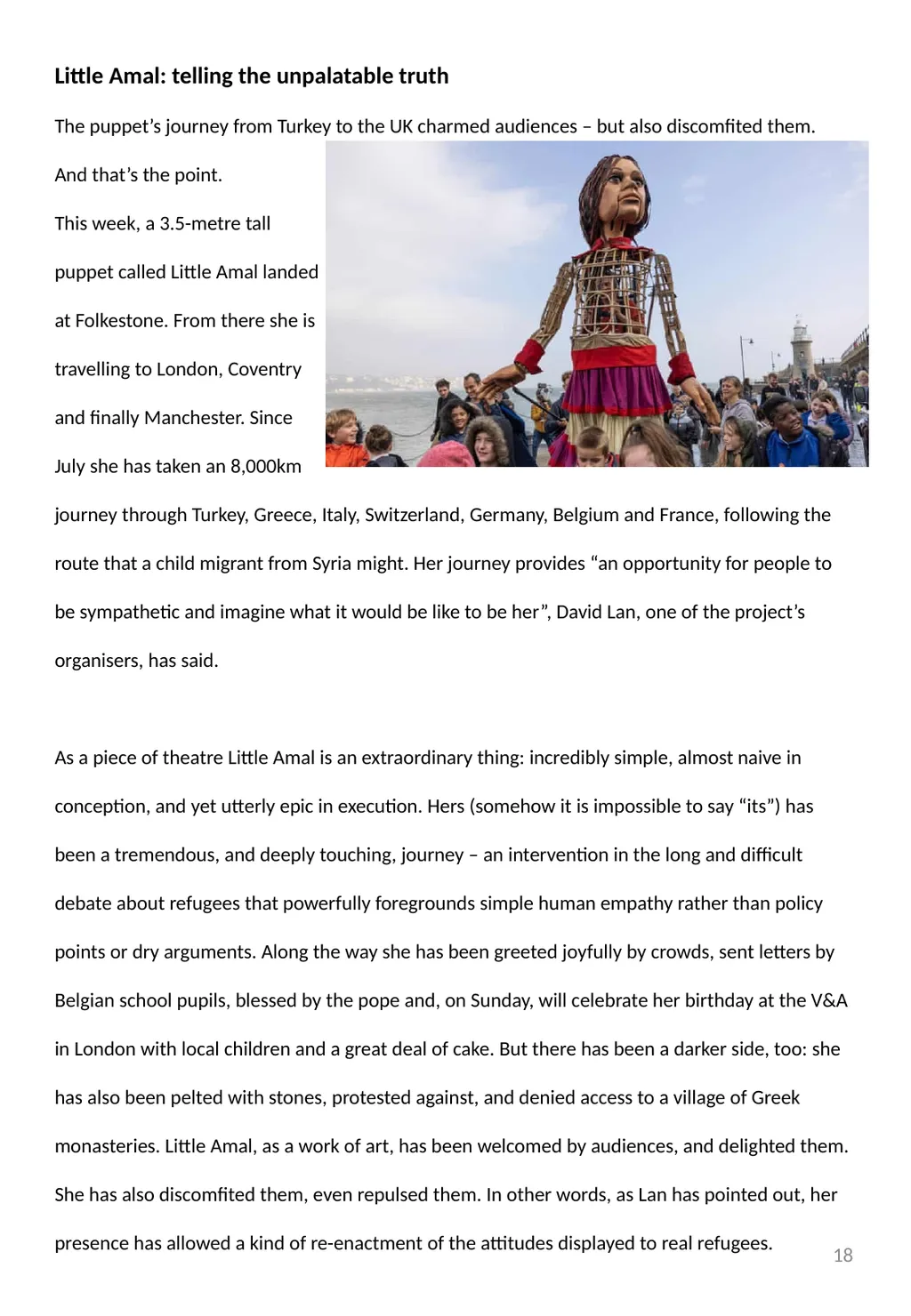
The puppet’s journey from Turkey to the UK charmed audiences – but also discomfited them. And that’s the point.
This week, a 3.5-metre tall
puppet called Little Amal landed
at Folkestone. From there she is
travelling to London, Coventry
and finally Manchester. Since
July she has taken an 8,000km
journey through Turkey, Greece, Italy, Switzerland, Germany, Belgium and France, following the route that a child migrant from Syria might. Her journey provides “an opportunity for people to be sympathetic and imagine what it would be like to be her”, David Lan, one of the project’s organisers, has said.
As a piece of theatre Little Amal is an extraordinary thing: incredibly simple, almost naive in conception, and yet utterly epic in execution. Hers (somehow it is impossible to say “its”) has been a tremendous, and deeply touching, journey – an intervention in the long and difficult debate about refugees that powerfully foregrounds simple human empathy rather than policy points or dry arguments. Along the way she has been greeted joyfully by crowds, sent letters by Belgian school pupils, blessed by the pope and, on Sunday, will celebrate her birthday at the V&A in London with local children and a great deal of cake. But there has been a darker side, too: she has also been pelted with stones, protested against, and denied access to a village of Greek monasteries. Little Amal, as a work of art, has been welcomed by audiences, and delighted them. She has also discomfited them, even repulsed them. In other words, as Lan has pointed out, her presence has allowed a kind of re-enactment of the attitudes displayed to real refugees.<br>
The puppet’s journey from Turkey to the UK charmed audiences – but also discomfited them. And that’s the point.
This week, a 3.5-metre tall
puppet called Little Amal landed
at Folkestone. From there she is
travelling to London, Coventry
and finally Manchester. Since
July she has taken an 8,000km
journey through Turkey, Greece, Italy, Switzerland, Germany, Belgium and France, following the route that a child migrant from Syria might. Her journey provides “an opportunity for people to be sympathetic and imagine what it would be like to be her”, David Lan, one of the project’s organisers, has said.
As a piece of theatre Little Amal is an extraordinary thing: incredibly simple, almost naive in conception, and yet utterly epic in execution. Hers (somehow it is impossible to say “its”) has been a tremendous, and deeply touching, journey – an intervention in the long and difficult debate about refugees that powerfully foregrounds simple human empathy rather than policy points or dry arguments. Along the way she has been greeted joyfully by crowds, sent letters by Belgian school pupils, blessed by the pope and, on Sunday, will celebrate her birthday at the V&A in London with local children and a great deal of cake. But there has been a darker side, too: she has also been pelted with stones, protested against, and denied access to a village of Greek monasteries. Little Amal, as a work of art, has been welcomed by audiences, and delighted them. She has also discomfited them, even repulsed them. In other words, as Lan has pointed out, her presence has allowed a kind of re-enactment of the attitudes displayed to real refugees.<br>
19
19 At times the language used to boost art can omit an important reason for its presence in society: to hold a mirror up to its foibles, to see through its pomp and vanity. The arts are, institutionally, adept at invoking all kinds of arguments to support their continued existence and public support: these arguments, pragmatically adopted to serve a political mood, can sometimes err in the direction of suggesting that the “cultural sector” exists mainly to support “brand Britain” – to encourage tourism, to show the nation at its most “vibrant”, to enhance the economic fortunes of this or that town by producing such-and-such a spend for every taxpayer pound invested in its theatre or arts centre.
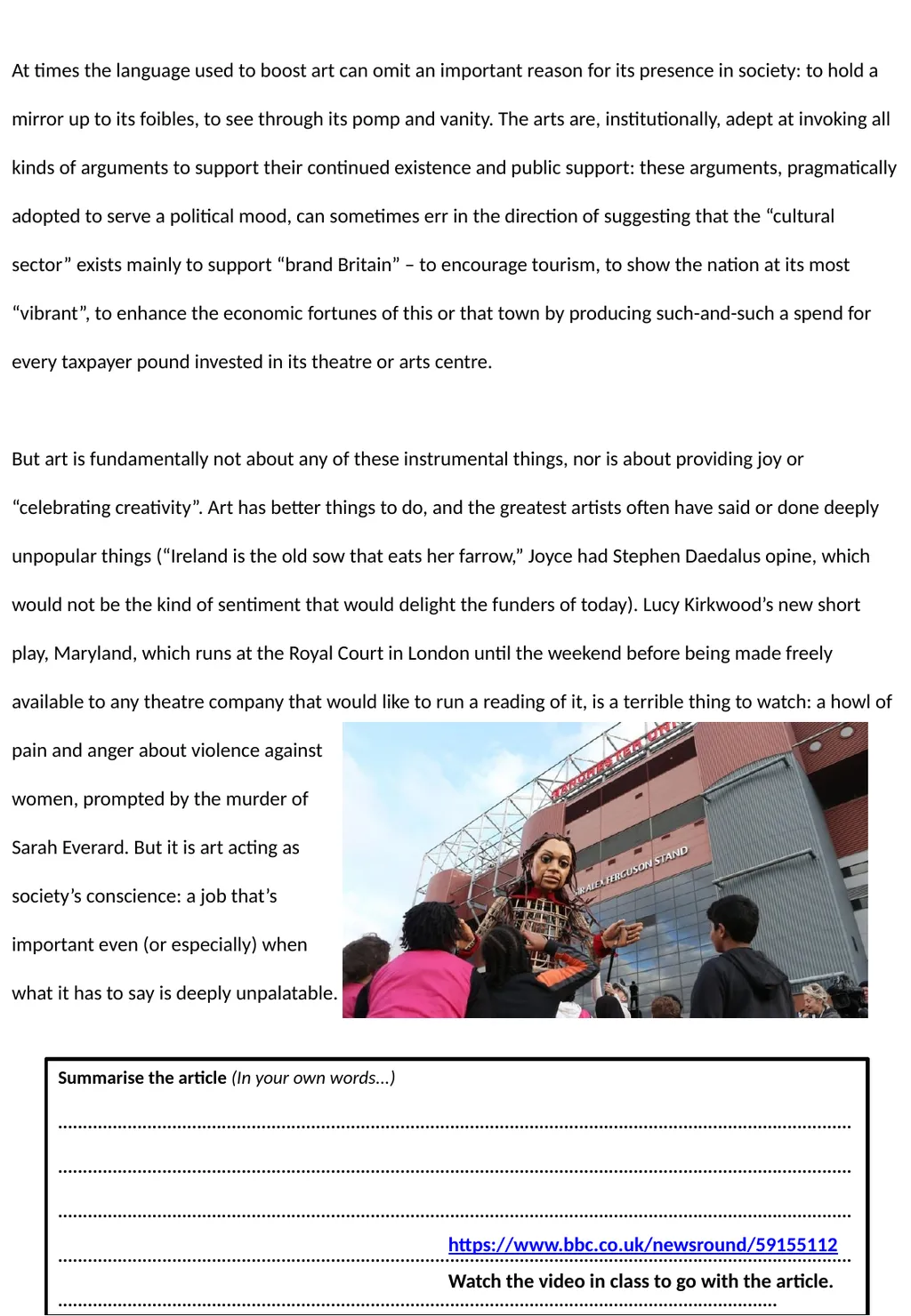
But art is fundamentally not about any of these instrumental things, nor is about providing joy or “celebrating creativity”. Art has better things to do, and the greatest artists often have said or done deeply unpopular things (“Ireland is the old sow that eats her farrow,” Joyce had Stephen Daedalus opine, which would not be the kind of sentiment that would delight the funders of today). Lucy Kirkwood’s new short play, Maryland, which runs at the Royal Court in London until the weekend before being made freely available to any theatre company that would like to run a reading of it, is a terrible thing to watch: a howl of pain and anger about violence against
women, prompted by the murder of
Sarah Everard. But it is art acting as
society’s conscience: a job that’s
important even (or especially) when
what it has to say is deeply unpalatable. Summarise the article (In your own words...)
................................................................................................................................................................................................................................................................................................................................................................................................................................................................................................................................................................................................................................................................................................................................................................................................................. https://www.bbc.co.uk/newsround/59155112
Watch the video in class to go with the article.<br>
But art is fundamentally not about any of these instrumental things, nor is about providing joy or “celebrating creativity”. Art has better things to do, and the greatest artists often have said or done deeply unpopular things (“Ireland is the old sow that eats her farrow,” Joyce had Stephen Daedalus opine, which would not be the kind of sentiment that would delight the funders of today). Lucy Kirkwood’s new short play, Maryland, which runs at the Royal Court in London until the weekend before being made freely available to any theatre company that would like to run a reading of it, is a terrible thing to watch: a howl of pain and anger about violence against
women, prompted by the murder of
Sarah Everard. But it is art acting as
society’s conscience: a job that’s
important even (or especially) when
what it has to say is deeply unpalatable. Summarise the article (In your own words...)
................................................................................................................................................................................................................................................................................................................................................................................................................................................................................................................................................................................................................................................................................................................................................................................................................. https://www.bbc.co.uk/newsround/59155112
Watch the video in class to go with the article.<br>
20
20 un-palat-able connect:
indigestible
inedible
disgusting
revolting unpalatable adjective ‘But it is art acting as society’s conscience: a job that’s important even (or especially) when what it has to say is deeply unpalatable.’ What is the meaning of unpalatable in this sentence? ............................................................................................................................................................................................................................................................................ DISCUSS: How is the word being used differently in these sentences?
His advice, however, was unpalatable and proved unsuccessful.
Bread made from bunted flour is dark in colour and unpalatable.
Her opinion was unpalatable. How have the puppeteers and artists turned Little Amal into just more than a piece of art? Discuss ideas as a class then write your answer in full sentences.
.............................................................................................................................................................................................................................................................................................................................................................................................................................................................................................................................................................................................................................................................................................................................................................................................................................................................................................................................................................................. define:…………………………………………………………………………………………………………………………………………………………………………………………………………………………………………………………………………………………………<br>
inedible
disgusting
revolting unpalatable adjective ‘But it is art acting as society’s conscience: a job that’s important even (or especially) when what it has to say is deeply unpalatable.’ What is the meaning of unpalatable in this sentence? ............................................................................................................................................................................................................................................................................ DISCUSS: How is the word being used differently in these sentences?
His advice, however, was unpalatable and proved unsuccessful.
Bread made from bunted flour is dark in colour and unpalatable.
Her opinion was unpalatable. How have the puppeteers and artists turned Little Amal into just more than a piece of art? Discuss ideas as a class then write your answer in full sentences.
.............................................................................................................................................................................................................................................................................................................................................................................................................................................................................................................................................................................................................................................................................................................................................................................................................................................................................................................................................................................. define:…………………………………………………………………………………………………………………………………………………………………………………………………………………………………………………………………………………………………<br>
21
21 READING HOMEWORK - 'We never chose this': refugees use art to imagine a better world – in pictures.
London will be the setting for a January exhibition and auction of art by people living in Moria camp, on the Greek island of Lesbos. The proceeds will go to the Hope Project, an initiative that promotes greater dignity for refugees and aims to transform the way they are seen.
Nine paintings will be exhibited in St James’s Church, Piccadilly, from 6 to 17 January 2020, while a charity auction will take place at Christie’s on 13 January.
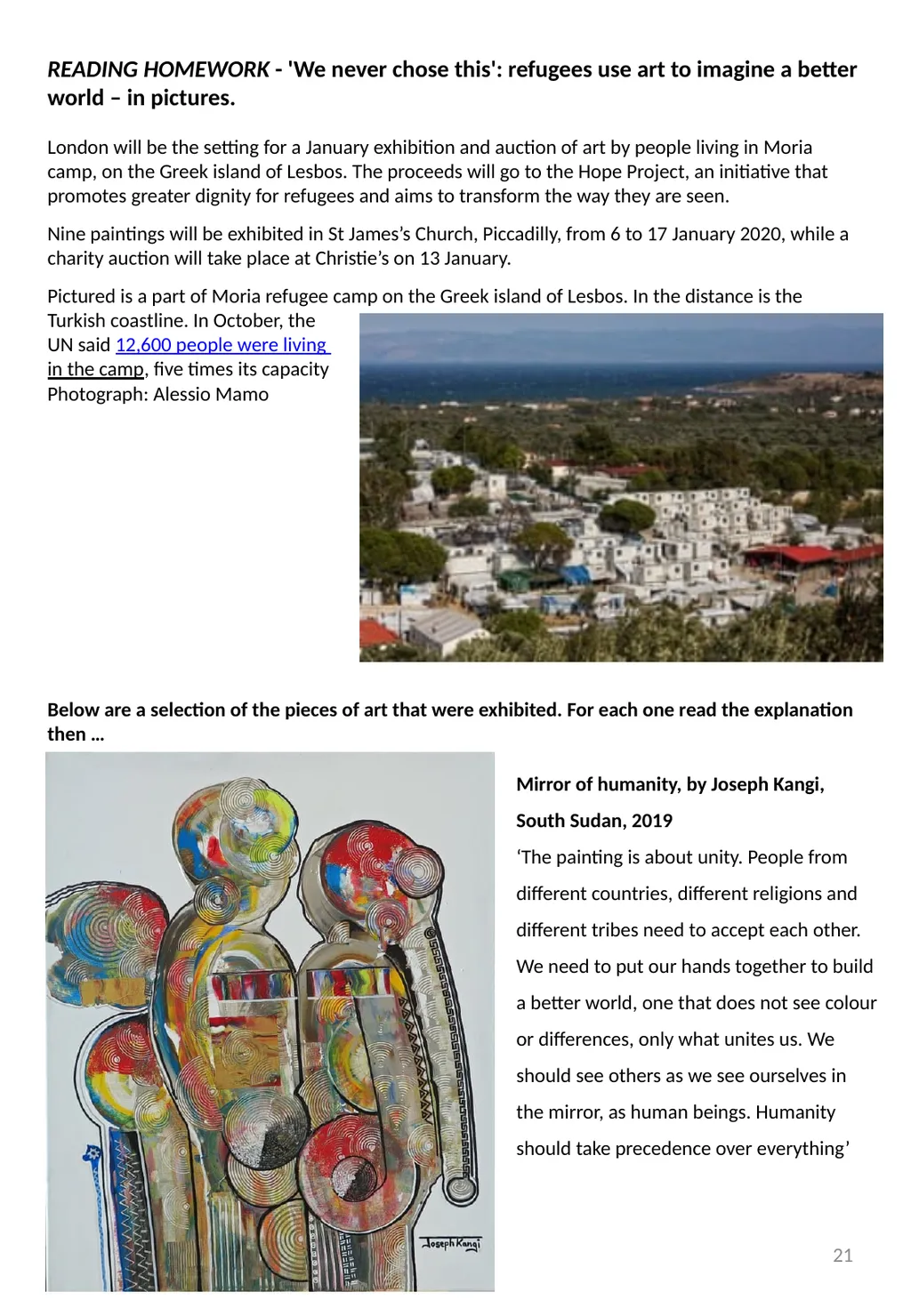
Pictured is a part of Moria refugee camp on the Greek island of Lesbos. In the distance is the Turkish coastline. In October, the
UN said 12,600 people were living
in the camp, five times its capacity
Photograph: Alessio Mamo
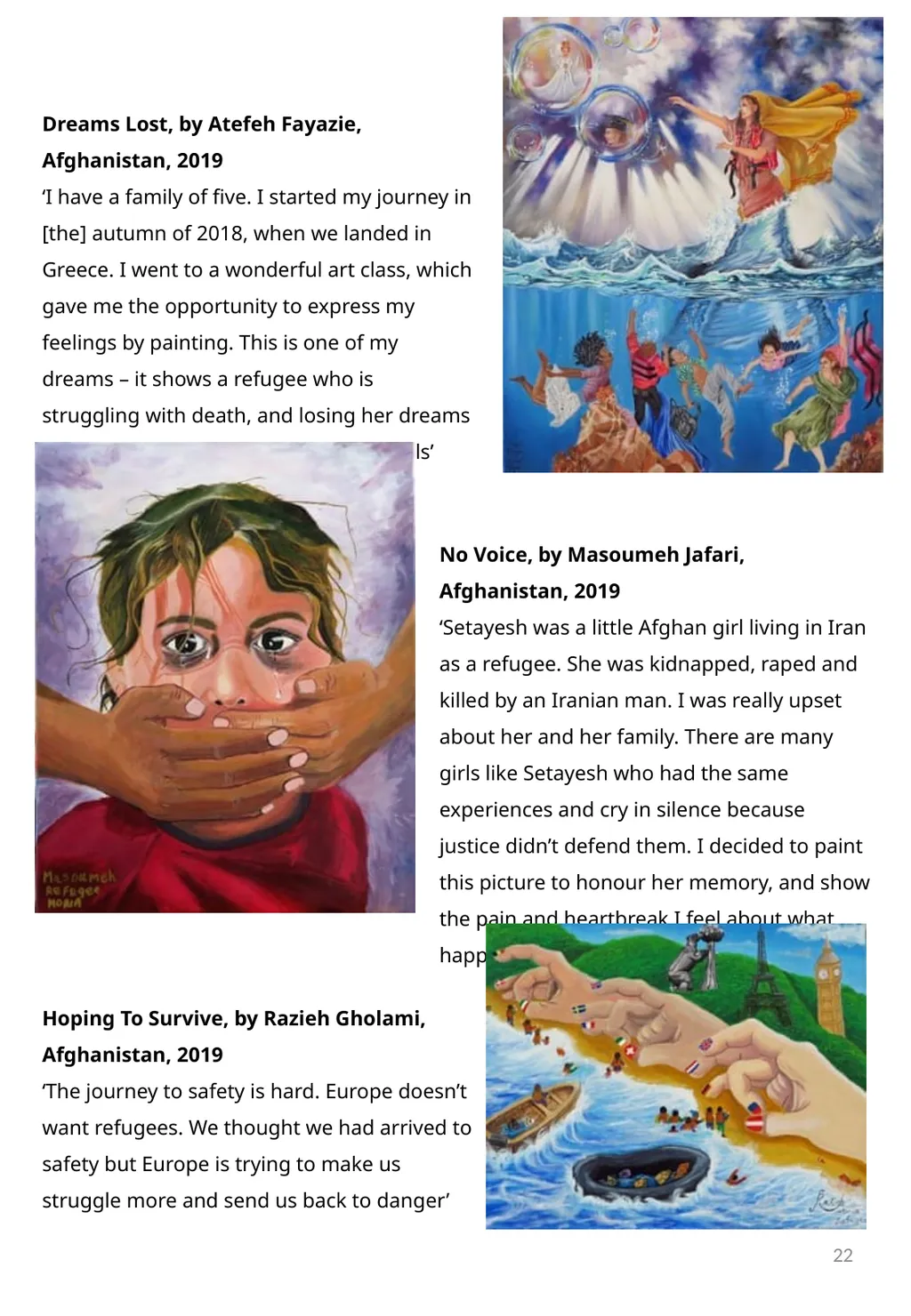
Below are a selection of the pieces of art that were exhibited. For each one read the explanation then … Mirror of humanity, by Joseph Kangi, South Sudan, 2019
‘The painting is about unity. People from different countries, different religions and different tribes need to accept each other. We need to put our hands together to build a better world, one that does not see colour or differences, only what unites us. We should see others as we see ourselves in the mirror, as human beings. Humanity should take precedence over everything’<br>
London will be the setting for a January exhibition and auction of art by people living in Moria camp, on the Greek island of Lesbos. The proceeds will go to the Hope Project, an initiative that promotes greater dignity for refugees and aims to transform the way they are seen.
Nine paintings will be exhibited in St James’s Church, Piccadilly, from 6 to 17 January 2020, while a charity auction will take place at Christie’s on 13 January.
Pictured is a part of Moria refugee camp on the Greek island of Lesbos. In the distance is the Turkish coastline. In October, the
UN said 12,600 people were living
in the camp, five times its capacity
Photograph: Alessio Mamo
Below are a selection of the pieces of art that were exhibited. For each one read the explanation then … Mirror of humanity, by Joseph Kangi, South Sudan, 2019
‘The painting is about unity. People from different countries, different religions and different tribes need to accept each other. We need to put our hands together to build a better world, one that does not see colour or differences, only what unites us. We should see others as we see ourselves in the mirror, as human beings. Humanity should take precedence over everything’<br>
22
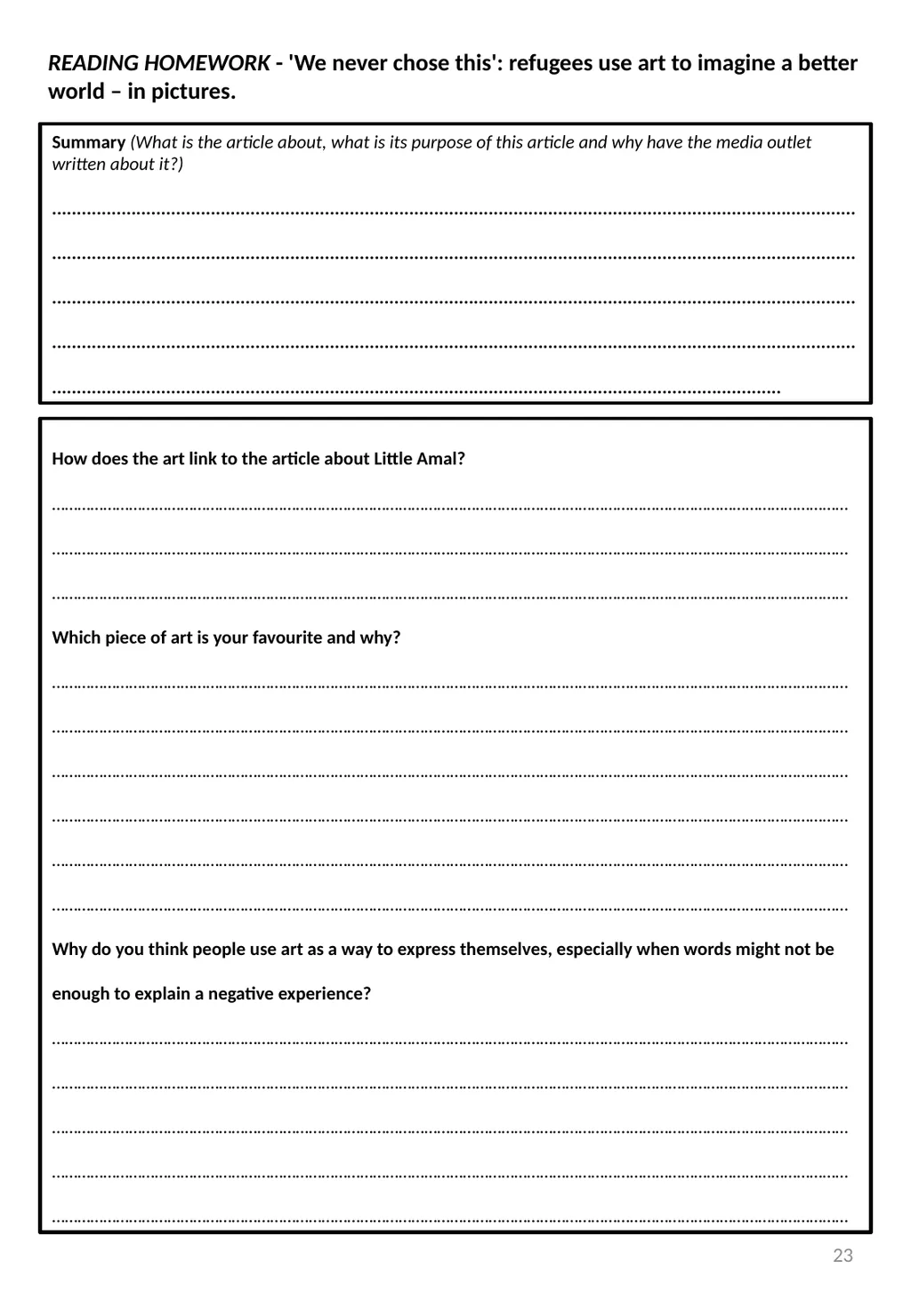
22 Dreams Lost, by Atefeh Fayazie, Afghanistan, 2019
‘I have a family of five. I started my journey in [the] autumn of 2018, when we landed in Greece. I went to a wonderful art class, which gave me the opportunity to express my feelings by painting. This is one of my dreams – it shows a refugee who is struggling with death, and losing her dreams of coming to Europe to achieve her goals’ No Voice, by Masoumeh Jafari, Afghanistan, 2019
‘Setayesh was a little Afghan girl living in Iran as a refugee. She was kidnapped, raped and killed by an Iranian man. I was really upset about her and her family. There are many girls like Setayesh who had the same experiences and cry in silence because justice didn’t defend them. I decided to paint this picture to honour her memory, and show the pain and heartbreak I feel about what happened’ Hoping To Survive, by Razieh Gholami, Afghanistan, 2019
‘The journey to safety is hard. Europe doesn’t want refugees. We thought we had arrived to safety but Europe is trying to make us struggle more and send us back to danger’<br>
‘I have a family of five. I started my journey in [the] autumn of 2018, when we landed in Greece. I went to a wonderful art class, which gave me the opportunity to express my feelings by painting. This is one of my dreams – it shows a refugee who is struggling with death, and losing her dreams of coming to Europe to achieve her goals’ No Voice, by Masoumeh Jafari, Afghanistan, 2019
‘Setayesh was a little Afghan girl living in Iran as a refugee. She was kidnapped, raped and killed by an Iranian man. I was really upset about her and her family. There are many girls like Setayesh who had the same experiences and cry in silence because justice didn’t defend them. I decided to paint this picture to honour her memory, and show the pain and heartbreak I feel about what happened’ Hoping To Survive, by Razieh Gholami, Afghanistan, 2019
‘The journey to safety is hard. Europe doesn’t want refugees. We thought we had arrived to safety but Europe is trying to make us struggle more and send us back to danger’<br>
23
23 How does the art link to the article about Little Amal?
………………………………………………………………………………………………………………………………………………………………………………………………………………………………………………………………………………………………………………………………………………………………………………………………………………………………………………………………………………………………………………
Which piece of art is your favourite and why?
……………………………………………………………………………………………………………………………………………………………………………………………………………………………………………………………………………………………………………………………………………………………………………………………………………………………………………………………………………………………………………… ………………………………………………………………………………………………………………………………………………………………………………………………………………………………………………………………………………………………………………………………………………………………………………………………………………………………………………………………………………………………………………
Why do you think people use art as a way to express themselves, especially when words might not be enough to explain a negative experience? ……………………………………………………………………………………………………………………………………………………………………………………………………………………………………………………………………………………………………………………………………………………………………………………………………………………………………………………………………………………………………………… ………………………………………………………………………………………………………………………………………………………………………………………………………………………………………………………………………………………………………………………………………… Summary (What is the article about, what is its purpose of this article and why have the media outlet written about it?)
........................................................................................................................................................................................................................................................................................................................................................................................................................................................................................................................................................................................................................................................................................................................................................................................................................... READING HOMEWORK - 'We never chose this': refugees use art to imagine a better world – in pictures.<br>
Which piece of art is your favourite and why?
……………………………………………………………………………………………………………………………………………………………………………………………………………………………………………………………………………………………………………………………………………………………………………………………………………………………………………………………………………………………………………… ………………………………………………………………………………………………………………………………………………………………………………………………………………………………………………………………………………………………………………………………………………………………………………………………………………………………………………………………………………………………………………
Why do you think people use art as a way to express themselves, especially when words might not be enough to explain a negative experience? ……………………………………………………………………………………………………………………………………………………………………………………………………………………………………………………………………………………………………………………………………………………………………………………………………………………………………………………………………………………………………………… ………………………………………………………………………………………………………………………………………………………………………………………………………………………………………………………………………………………………………………………………………… Summary (What is the article about, what is its purpose of this article and why have the media outlet written about it?)
........................................................................................................................................................................................................................................................................................................................................................................................................................................................................................................................................................................................................................................................................................................................................................................................................................... READING HOMEWORK - 'We never chose this': refugees use art to imagine a better world – in pictures.<br>
24
24 Week 4
Chapter 1 from The Hobbit by J. R. R.
Tolkien How many different mythical creatures do you
know? ...................................................................................................................................................................................................................................................................................................................................................................................................................................................................................................................................................................................................................................................................................................................................................................................................................................................................................................................................................................................................... ...................................................................................................................................................................................................................................................................................................................................................................................................................................................................................................................................................................................................................................................................................................................................................................................................................................................................................................................................................................................................... What kind of things could a writer do to show a character’s personality in a story without explicitly telling the reader what they’re like? What else do you think engages people in fantasy stories? ........................................................................................................
................................................................................………………………
……………………………..................................................................................................................................................................................................................................................................................................................................................................................................................................................................................................................................................................................................................................................................................................................................................................................................................................................................................<br>
25
25 Excerpt from The Hobbit by J. R. R. Tolkien
Chapter I - An Unexpected Party
In a hole in the ground there lived a hobbit. Not a nasty, dirty, wet hole, filled with the ends of worms and an oozy smell, nor yet a dry, bare, sandy hole with nothing in it to sit down on or to eat: it was a hobbithole, and that means comfort.
It had a perfectly round door like a porthole, painted green, with a shiny yellow brass knob in the exact middle. The door opened on to a tube-shaped hall like a tunnel: a very comfortable tunnel without smoke, with panelled walls, and floors tiled and carpeted, provided with polished chairs, and lots and lots of pegs for hats and coats the hobbit was fond of visitors. The tunnel wound on and on, going fairly but not quite straight into the side of the hill The Hill, as all the people for many miles round called it and many little round doors opened out of it, first on one side and then on another. No going upstairs for the hobbit: bedrooms, bathrooms, cellars, pantries (lots of these), wardrobes (he had whole rooms devoted to clothes), kitchens, Dining-rooms, all were on the same floor, and indeed on the same passage. The best rooms were all on the left-hand side (going in), for these were the only ones to have windows, deep-set round windows looking over his garden and meadows beyond, sloping down to the river.
This hobbit was a very well-to-do hobbit, and his name was Baggins. The Bagginses had lived in the neighbourhood of The Hill for time out of mind, and people considered them very respectable, not only because most of them were rich, but also because they never had any adventures or did anything unexpected: you could tell what a Baggins would say on any question without the bother of asking him. This is a story of how a Baggins had an adventure, found himself doing and saying things altogether unexpected. He may have lost the neighbours' respect, but he gained well, you will see whether he gained anything in the end.
The mother of our particular hobbit … what is a hobbit? I suppose hobbits need some
description nowadays, since they have become rare and shy of the Big People, as they call us.
They are (or were) a little people, about half our height, and smaller than the bearded Dwarves.<br>
Chapter I - An Unexpected Party
In a hole in the ground there lived a hobbit. Not a nasty, dirty, wet hole, filled with the ends of worms and an oozy smell, nor yet a dry, bare, sandy hole with nothing in it to sit down on or to eat: it was a hobbithole, and that means comfort.
It had a perfectly round door like a porthole, painted green, with a shiny yellow brass knob in the exact middle. The door opened on to a tube-shaped hall like a tunnel: a very comfortable tunnel without smoke, with panelled walls, and floors tiled and carpeted, provided with polished chairs, and lots and lots of pegs for hats and coats the hobbit was fond of visitors. The tunnel wound on and on, going fairly but not quite straight into the side of the hill The Hill, as all the people for many miles round called it and many little round doors opened out of it, first on one side and then on another. No going upstairs for the hobbit: bedrooms, bathrooms, cellars, pantries (lots of these), wardrobes (he had whole rooms devoted to clothes), kitchens, Dining-rooms, all were on the same floor, and indeed on the same passage. The best rooms were all on the left-hand side (going in), for these were the only ones to have windows, deep-set round windows looking over his garden and meadows beyond, sloping down to the river.
This hobbit was a very well-to-do hobbit, and his name was Baggins. The Bagginses had lived in the neighbourhood of The Hill for time out of mind, and people considered them very respectable, not only because most of them were rich, but also because they never had any adventures or did anything unexpected: you could tell what a Baggins would say on any question without the bother of asking him. This is a story of how a Baggins had an adventure, found himself doing and saying things altogether unexpected. He may have lost the neighbours' respect, but he gained well, you will see whether he gained anything in the end.
The mother of our particular hobbit … what is a hobbit? I suppose hobbits need some
description nowadays, since they have become rare and shy of the Big People, as they call us.
They are (or were) a little people, about half our height, and smaller than the bearded Dwarves.<br>
26
26 Hobbits have no beards. There is little or no magic about them, except the ordinary everyday
sort which helps them to disappear quietly and quickly when large stupid folk like you and me
come blundering along, making a noise like elephants which they can hear a mile off. They are
inclined to be at in the stomach; they dress in bright colours (chiefly green and yellow); wear
no shoes, because their feet grow natural leathery soles and thick warm brown hair like the
stuff on their heads (which is curly); have long clever brown fingers, good-natured faces, and
laugh deep fruity laughs (especially after dinner, which they have twice a day when they can
get it). Now you know enough to go on with. As I was saying, the mother of this hobbit of
Bilbo Baggins, that is was the fabulous Belladonna Took, one of the three remarkable
daughters of the Old Took, head of the hobbits who lived across The Water, the small river that
ran at the foot of The Hill. It was often said (in other families) that long ago one of the Took
ancestors must have taken a fairy wife. That was, of course, absurd, but certainly there was
still something not entirely hobbitlike about them, and once in a while members of the
Took clan would go and have adventures. They discreetly disappeared, and the family hushed
it up; but the fact remained that the Tooks were not as respectable as the Bagginses, though
they were undoubtedly richer. Not that Belladonna Took ever had any adventures after she
became Mrs. Bungo Baggins. Bungo, that was Bilbo's father, built the most luxurious
hobbithole for her (and partly with her money) that was to be found either under The Hill or
over The Hill or across The Water, and there they remained to the end of their days. Still it is probable that Bilbo, her only son, although he looked and behaved exactly like a second edition of his solid and comfortable father, got something a bit queer in his makeup from the Took side, something that only waited for a chance to come out. The chance never arrived, until Bilbo Baggins was grown up, being about fifty years old or so, and living in the beautiful hobbithole built by his father, which I have just described for you, until he had in fact apparently settled down immovably.<br>
sort which helps them to disappear quietly and quickly when large stupid folk like you and me
come blundering along, making a noise like elephants which they can hear a mile off. They are
inclined to be at in the stomach; they dress in bright colours (chiefly green and yellow); wear
no shoes, because their feet grow natural leathery soles and thick warm brown hair like the
stuff on their heads (which is curly); have long clever brown fingers, good-natured faces, and
laugh deep fruity laughs (especially after dinner, which they have twice a day when they can
get it). Now you know enough to go on with. As I was saying, the mother of this hobbit of
Bilbo Baggins, that is was the fabulous Belladonna Took, one of the three remarkable
daughters of the Old Took, head of the hobbits who lived across The Water, the small river that
ran at the foot of The Hill. It was often said (in other families) that long ago one of the Took
ancestors must have taken a fairy wife. That was, of course, absurd, but certainly there was
still something not entirely hobbitlike about them, and once in a while members of the
Took clan would go and have adventures. They discreetly disappeared, and the family hushed
it up; but the fact remained that the Tooks were not as respectable as the Bagginses, though
they were undoubtedly richer. Not that Belladonna Took ever had any adventures after she
became Mrs. Bungo Baggins. Bungo, that was Bilbo's father, built the most luxurious
hobbithole for her (and partly with her money) that was to be found either under The Hill or
over The Hill or across The Water, and there they remained to the end of their days. Still it is probable that Bilbo, her only son, although he looked and behaved exactly like a second edition of his solid and comfortable father, got something a bit queer in his makeup from the Took side, something that only waited for a chance to come out. The chance never arrived, until Bilbo Baggins was grown up, being about fifty years old or so, and living in the beautiful hobbithole built by his father, which I have just described for you, until he had in fact apparently settled down immovably.<br>
27
27 ‘The door opened on to a tube-shaped hall like a tunnel: a very comfortable tunnel without smoke, with panelled walls, and floors tiled and carpeted, provided with polished chairs, and lots and lots of pegs for hats and coats the hobbit was fond of visitors.’ How is the word comfortable being used in this sentence? What does it mean?
........................................................................................................................................................................................................................................................................................................................ connect:
cosy pleasant snuggly comfortable adjective comfort noun
comfortableness noun define:………………………………………………………………………………………………………………………………………………………………………………………………………………………………………………………………………………………………… comfort-able How has the writer engaged the audience by placing them in a fantasy setting straight away? …………………………………………………………………………………………………………………………………………………………………………………………………………………………………………………………………………………………………………………………………………………………………………………………………………………………………………………………………………………………………………………………………………………………………………………………………………………………………………………………………………………………………………………………………………………………………………………………………… DISCUSS: How is the word being used differently in these sentences?
He made his little house as comfortable as his means would allow.
She was paid well, so she was in a comfortable position.
They felt comfortable in the classroom. Summary (In your own words...)
....................................................................................................................................................................................................................................................................................................................................................................................................................................................................................................................................................................................................................................................<br>
cosy pleasant snuggly comfortable adjective comfort noun
comfortableness noun define:………………………………………………………………………………………………………………………………………………………………………………………………………………………………………………………………………………………………… comfort-able How has the writer engaged the audience by placing them in a fantasy setting straight away? …………………………………………………………………………………………………………………………………………………………………………………………………………………………………………………………………………………………………………………………………………………………………………………………………………………………………………………………………………………………………………………………………………………………………………………………………………………………………………………………………………………………………………………………………………………………………………………………………… DISCUSS: How is the word being used differently in these sentences?
He made his little house as comfortable as his means would allow.
She was paid well, so she was in a comfortable position.
They felt comfortable in the classroom. Summary (In your own words...)
....................................................................................................................................................................................................................................................................................................................................................................................................................................................................................................................................................................................................................................................<br>
28
28 READING HOMEWORK – Continuation of Chapter 1 from The Hobbit By some curious chance one morning long ago in the quiet of the world, when there was less noise and more green, and the hobbits were still numerous and prosperous, and Bilbo Baggins was standing at his door after breakfast smoking an enormous long wooden pipe that reached nearly down to his woolly toes (neatly brushed) Gandalf came by. Gandalf! If you had heard only a quarter of what I have heard about him, and I have only heard very little of all there is to hear, you would be prepared for any sort I of remarkable tale. Tales and adventures sprouted up all over the place wherever he went, in the most extraordinary fashion. He had not been down that way under The Hill for ages and ages, not since his friend the Old Took died, in fact, and the hobbits had almost forgotten what he looked like. He had been away over The Hill and across The Water on business of his own since they were all small hobbitboys and hobbitgirls. All that the unsuspecting Bilbo saw that morning was an old man with a staff. He had a tall pointed blue hat, a long grey cloak, a silver scarf over which a white beard hung down below his waist, and immense black boots.
"Good morning!" said Bilbo, and he meant it. The sun was shining, and the grass was very green. But Gandalf looked at him from under long bushy eyebrows that stuck out further than the brim of his shady hat. "What do you mean?" he said. "Do you wish me a good morning, or mean that it is a good morning whether I want not; or that you feel good this morning; or that it is morning to be good on?”
"All of them at once," said Bilbo. "And a very fine morning for a pipe of tobacco out of doors, into the bargain. If you have a pipe about you, sit down and have a fill of mine! There’s no hurry, we have all the day before us!" Then Bilbo sat down on a seat by his door, crossed his legs, and blew out a beautiful grey ring of smoke that sailed up into the air without breaking and floated away over The Hill.
"Very pretty!" said Gandalf. "But I have no time to blow smokerings this morning. I am looking for someone to share in an adventure that I am arranging, and it's very difficult to find anyone.”
“I should think so in these parts! We are plain quiet folk and have no use for adventures. Nasty disturbing uncomfortable things! Make you late for dinner! I can’t think what anybody sees in them,” said our Mr. Baggins, and stuck one thumb behind his braces, and blew out another even bigger smokering. Then he took out his morning letters, and begin to read, pretending to take no more notice of the<br>
"Good morning!" said Bilbo, and he meant it. The sun was shining, and the grass was very green. But Gandalf looked at him from under long bushy eyebrows that stuck out further than the brim of his shady hat. "What do you mean?" he said. "Do you wish me a good morning, or mean that it is a good morning whether I want not; or that you feel good this morning; or that it is morning to be good on?”
"All of them at once," said Bilbo. "And a very fine morning for a pipe of tobacco out of doors, into the bargain. If you have a pipe about you, sit down and have a fill of mine! There’s no hurry, we have all the day before us!" Then Bilbo sat down on a seat by his door, crossed his legs, and blew out a beautiful grey ring of smoke that sailed up into the air without breaking and floated away over The Hill.
"Very pretty!" said Gandalf. "But I have no time to blow smokerings this morning. I am looking for someone to share in an adventure that I am arranging, and it's very difficult to find anyone.”
“I should think so in these parts! We are plain quiet folk and have no use for adventures. Nasty disturbing uncomfortable things! Make you late for dinner! I can’t think what anybody sees in them,” said our Mr. Baggins, and stuck one thumb behind his braces, and blew out another even bigger smokering. Then he took out his morning letters, and begin to read, pretending to take no more notice of the<br>
29
29 old man. He had decided that he was not quite his sort, and wanted him to go away. But the old man did not move. He stood leaning on his stick and gazing at the hobbit without saying anything, till Bilbo got quite uncomfortable and even a little cross.
"Good morning!" he said at last. "We don't want any adventures here, thank you! You might try over The Hill or across The Water." By this he meant that the conversation was at an end.
"What a lot of things you do use Good morning for!" said Gandalf. "Now you mean that you want to get rid of me, and that it won't be good till I move off.”
"Not at all, not at all, my dear sir! Let me see, I don't think I know your name?”
"Yes, yes, my dear sir and I do know your name, Mr. Bilbo Baggins. And you do know my name, though you don't remember that I belong to it. I am Gandalf, and Gandalf means me! To think that I should have lived to be goodmorninged by Belladonna Took's son, as if I was selling buttons at the door!”
"Gandalf, Gandalf! Good gracious me! Not the wandering wizard that gave Old Took a pair of magic diamond studs that fastened themselves and never came undone till ordered? Not the fellow who used to tell such wonderful tales at parties, about dragons and goblins and giants and the rescue of princesses and the unexpected luck of widows' sons? Not the man that used to make such particularly excellent fireworks! I remember those! Old Took used to have them on Midsummer's Eve. Splendid! They used to go up like great lilies and snapdragons and laburnums of fire and hang in the twilight all evening!" You will notice already that Mr. Baggins was not quite so prosy as he liked to believe, also that he was very fond of flowers. "Dear me!" he went on. "Not the Gandalf who was responsible for so many quiet lads and lasses going off into the Blue for mad adventures. Anything from climbing trees to visiting Elves or sailing in ships, sailing to other shores! Bless me, life used to be quite inter I mean, you used to upset things badly in these parts once upon a time. I beg your pardon, but I had no idea you were still in business."<br>
"Good morning!" he said at last. "We don't want any adventures here, thank you! You might try over The Hill or across The Water." By this he meant that the conversation was at an end.
"What a lot of things you do use Good morning for!" said Gandalf. "Now you mean that you want to get rid of me, and that it won't be good till I move off.”
"Not at all, not at all, my dear sir! Let me see, I don't think I know your name?”
"Yes, yes, my dear sir and I do know your name, Mr. Bilbo Baggins. And you do know my name, though you don't remember that I belong to it. I am Gandalf, and Gandalf means me! To think that I should have lived to be goodmorninged by Belladonna Took's son, as if I was selling buttons at the door!”
"Gandalf, Gandalf! Good gracious me! Not the wandering wizard that gave Old Took a pair of magic diamond studs that fastened themselves and never came undone till ordered? Not the fellow who used to tell such wonderful tales at parties, about dragons and goblins and giants and the rescue of princesses and the unexpected luck of widows' sons? Not the man that used to make such particularly excellent fireworks! I remember those! Old Took used to have them on Midsummer's Eve. Splendid! They used to go up like great lilies and snapdragons and laburnums of fire and hang in the twilight all evening!" You will notice already that Mr. Baggins was not quite so prosy as he liked to believe, also that he was very fond of flowers. "Dear me!" he went on. "Not the Gandalf who was responsible for so many quiet lads and lasses going off into the Blue for mad adventures. Anything from climbing trees to visiting Elves or sailing in ships, sailing to other shores! Bless me, life used to be quite inter I mean, you used to upset things badly in these parts once upon a time. I beg your pardon, but I had no idea you were still in business."<br>
30
30 "Where else should I be?" said the wizard. "All the same I am pleased to find you remember something about me. You seem to remember my fireworks kindly, at any rate, land that is not without hope. Indeed for your old grandfather Took's sake, and for the sake of poor Belladonna, I will give you what you asked for.”
"I beg your pardon, I haven't asked for anything!”
"Yes, you have! Twice now. My pardon. I give it you. In fact I will go so far as to send you on this adventure. Very amusing for me, very good for you and profitable too, very likely, if you ever get over it."
"Sorry! I don't want any adventures, thank you. Not today. Good morning! But please come to tea any time you like! Why not tomorrow? Come tomorrow! Goodbye!"
With that the hobbit turned and scuttled inside his round green door, and shut it as quickly as he dared, not to seen rude. Wizards after all are wizards.
"What on earth did I ask him to tea for!" he said to himself, as he went to the pantry. He had only just had break fast, but he thought a cake or two and a drink of something would do him good after his fright. Gandalf in the meantime was still standing outside the door, and laughing long but quietly. After a while he stepped up, and with the spike of his staff scratched a queer sign on the hobbit's beautiful green front door. Then he strode away, just about the time when Bilbo was finishing his second cake and beginning to think that he had escape adventures very well. List three things that you have learnt about Hobbits.
……………………………………………………………………………………………………………………………………………………………………………………………………………………………………………………………………………………………………………………………
…………………………………………………………………………………………………………………………………………………………… ……………………………………………………………………………………………………………………………………………………………
…………………………………………………………………………………………………………………………………………………………… ……………………………………………………………………………………………………………………………………………………………<br>
"I beg your pardon, I haven't asked for anything!”
"Yes, you have! Twice now. My pardon. I give it you. In fact I will go so far as to send you on this adventure. Very amusing for me, very good for you and profitable too, very likely, if you ever get over it."
"Sorry! I don't want any adventures, thank you. Not today. Good morning! But please come to tea any time you like! Why not tomorrow? Come tomorrow! Goodbye!"
With that the hobbit turned and scuttled inside his round green door, and shut it as quickly as he dared, not to seen rude. Wizards after all are wizards.
"What on earth did I ask him to tea for!" he said to himself, as he went to the pantry. He had only just had break fast, but he thought a cake or two and a drink of something would do him good after his fright. Gandalf in the meantime was still standing outside the door, and laughing long but quietly. After a while he stepped up, and with the spike of his staff scratched a queer sign on the hobbit's beautiful green front door. Then he strode away, just about the time when Bilbo was finishing his second cake and beginning to think that he had escape adventures very well. List three things that you have learnt about Hobbits.
……………………………………………………………………………………………………………………………………………………………………………………………………………………………………………………………………………………………………………………………
…………………………………………………………………………………………………………………………………………………………… ……………………………………………………………………………………………………………………………………………………………
…………………………………………………………………………………………………………………………………………………………… ……………………………………………………………………………………………………………………………………………………………<br>
31
31 Week 5
Review in the Guardian about the book ‘Don’t Touch my Hair’ Do you think that your hair is important to you?
(Think about how you cut it, wear it, and/or style it.)
...............................................................................…………………………
………………………………..........................................................................
........................................................................................................... ........................................................................................................... ........................................................................................................... ........................................................................................................... ........................................................................................................... .................................................................................................................................................................................................................................................................................................................................................................................................................................................................................................................................................................................................................................................................... ....................................................................................................................................................................................................................................................................................................................................................................................................................................................................................................................................................................................................................................................................................................................................................................................................................................................................................................................................................................................................................................................................................................................................................................... Is there an ideal beauty standard for hair? (What do people’s hair look like in films, on TV or magazines? What comes o mind when you think of the ‘perfect hair style’?) The text we are going to read today is a review. What do you know about reviews? (Where can you find them? Are they fiction or non-fiction? Why do people write reviews?)<br>
........................................................................................................... ........................................................................................................... ........................................................................................................... ........................................................................................................... ........................................................................................................... .................................................................................................................................................................................................................................................................................................................................................................................................................................................................................................................................................................................................................................................................... ....................................................................................................................................................................................................................................................................................................................................................................................................................................................................................................................................................................................................................................................................................................................................................................................................................................................................................................................................................................................................................................................................................................................................................................... Is there an ideal beauty standard for hair? (What do people’s hair look like in films, on TV or magazines? What comes o mind when you think of the ‘perfect hair style’?) The text we are going to read today is a review. What do you know about reviews? (Where can you find them? Are they fiction or non-fiction? Why do people write reviews?)<br>
32
32 Don’t Touch My Hair by Emma Dabiri review – ground-breaking
The personal becomes political in this highly
charged history of black people’s hair.
Tue 23 Apr 2019
If you’re expecting cookie-cutter discourse
on the nature of black people’s hair, look
away now. Don’t Touch My Hair might take
its title from one of the most well-known
(if still frustratingly common) aspects of
being black in a predominantly white society, but it will quickly comb away what you thought you knew about our coils and spread out a whole new way of seeing the world around you.
This is Emma Dabiri’s first book but the academic and TV host doesn’t approach her subject matter like a novice. Black hair is personal and for her, this story begins with an upbringing in Ireland, where her hair was a “constant source of deep, deep shame”.
Mixed race, born to a white Trinidadian mother and black Nigerian father, baby Dabiri did not have the loose curls synonymous with those with a lighter skin tone. Her hair quickly became a battleground until, around seven years ago, she realised that her politics and her presentation didn’t correspond: her chemically straightened hair needed to go. It is through this personal experience, and an understanding that our racialisation as black is as much bound up in our coiled hair as it is in our colouring, that Dabiri begins to take us on an unapologetic and intellectual journey, bursting with new theories and forgotten tales.
She explores black hair history relating to her own Nigerian ancestry as well as in the US, the UK and other parts of Africa and Latin America. The way black people have been conditioned to think about their hair, as a tiresome, time-consuming burden, shifts under her pen. Colonialism has done a lot of damage to those perceived as black; crucially, it has robbed us of our time and of any kind of positive hair heritage. Making the choice to reclaim that time and change the often derogatory language we use when talking about our hair is a tiny, radical step all black women with “type four” hair can take.<br>
The personal becomes political in this highly
charged history of black people’s hair.
Tue 23 Apr 2019
If you’re expecting cookie-cutter discourse
on the nature of black people’s hair, look
away now. Don’t Touch My Hair might take
its title from one of the most well-known
(if still frustratingly common) aspects of
being black in a predominantly white society, but it will quickly comb away what you thought you knew about our coils and spread out a whole new way of seeing the world around you.
This is Emma Dabiri’s first book but the academic and TV host doesn’t approach her subject matter like a novice. Black hair is personal and for her, this story begins with an upbringing in Ireland, where her hair was a “constant source of deep, deep shame”.
Mixed race, born to a white Trinidadian mother and black Nigerian father, baby Dabiri did not have the loose curls synonymous with those with a lighter skin tone. Her hair quickly became a battleground until, around seven years ago, she realised that her politics and her presentation didn’t correspond: her chemically straightened hair needed to go. It is through this personal experience, and an understanding that our racialisation as black is as much bound up in our coiled hair as it is in our colouring, that Dabiri begins to take us on an unapologetic and intellectual journey, bursting with new theories and forgotten tales.
She explores black hair history relating to her own Nigerian ancestry as well as in the US, the UK and other parts of Africa and Latin America. The way black people have been conditioned to think about their hair, as a tiresome, time-consuming burden, shifts under her pen. Colonialism has done a lot of damage to those perceived as black; crucially, it has robbed us of our time and of any kind of positive hair heritage. Making the choice to reclaim that time and change the often derogatory language we use when talking about our hair is a tiny, radical step all black women with “type four” hair can take.<br>
33
33 She is critical of discussion that ignores wider theory around anti-consumerism, arguing that
the natural hair movement espoused by the Black Panthers in the 1960s and 70s was far more radical than ours today. While some “naturalistas” concentrate on twist-outs and slicking down baby hairs – styles that stretch back further than you might imagine and, whether we like it our not, implicitly emulate European hair textures – “picked out ’fros” were far more about the rejection of beauty ideals and, crucially, capitalism.
Her sources are rich, diverse and sometimes heartbreaking – ranging from escaped slave notices to the Black Women Oral History Project of 1976-1981 and the legends of the Orisha. They need to be because, as Dabiri points out, not only is there a lack of exploration into black hair, there is also a lack of recognition of black people in history books. Despite unmistakably grand achievements in the realms of physics, maths, social organising and feats of engineering, we are forced to learn about ourselves from livestock ledgers.
Still, Don’t Touch My Hair manages to give us something to hold on to. Even the idea of beauty itself, as something isolated from our sociological selves, is challenged by the Ashanti understanding of Fe, a concept that goes beyond physical beauty. Other sources drawn upon to resituate our hair narrative include African metaphysics.
Some books make us feel seen and for me, that is what Don’t Touch My Hair does. As a mixed-race person with tightly coiled hair like the author, who grew up in the far reaches of Scotland in
an environment that doesn’t sound too dissimilar to Dabiri’s Ireland, I was able to engage with it in a unique way. But I would urge everyone to read Don’t Touch My Hair. You may not agree with everything she writes, but the author is undeniably snappy, bringing out humour and no small amount of sass. The first title of its kind, with fresh ideas and a vivid sense of purpose, Dabiri’s book is ground-breaking. Summary (In your own words...)
......................................................................................................................................................................................................................................................................................................................................................................................................................................................................................................................................................................................................................................................................................................................................................................................................................<br>
the natural hair movement espoused by the Black Panthers in the 1960s and 70s was far more radical than ours today. While some “naturalistas” concentrate on twist-outs and slicking down baby hairs – styles that stretch back further than you might imagine and, whether we like it our not, implicitly emulate European hair textures – “picked out ’fros” were far more about the rejection of beauty ideals and, crucially, capitalism.
Her sources are rich, diverse and sometimes heartbreaking – ranging from escaped slave notices to the Black Women Oral History Project of 1976-1981 and the legends of the Orisha. They need to be because, as Dabiri points out, not only is there a lack of exploration into black hair, there is also a lack of recognition of black people in history books. Despite unmistakably grand achievements in the realms of physics, maths, social organising and feats of engineering, we are forced to learn about ourselves from livestock ledgers.
Still, Don’t Touch My Hair manages to give us something to hold on to. Even the idea of beauty itself, as something isolated from our sociological selves, is challenged by the Ashanti understanding of Fe, a concept that goes beyond physical beauty. Other sources drawn upon to resituate our hair narrative include African metaphysics.
Some books make us feel seen and for me, that is what Don’t Touch My Hair does. As a mixed-race person with tightly coiled hair like the author, who grew up in the far reaches of Scotland in
an environment that doesn’t sound too dissimilar to Dabiri’s Ireland, I was able to engage with it in a unique way. But I would urge everyone to read Don’t Touch My Hair. You may not agree with everything she writes, but the author is undeniably snappy, bringing out humour and no small amount of sass. The first title of its kind, with fresh ideas and a vivid sense of purpose, Dabiri’s book is ground-breaking. Summary (In your own words...)
......................................................................................................................................................................................................................................................................................................................................................................................................................................................................................................................................................................................................................................................................................................................................................................................................................<br>
34
34 ‘She explores black hair history relating to her own Nigerian ancestry as well as in the US, the UK and other parts of Africa and Latin America.’ How is the word ancestry being used in this sentence? What does it mean?
...................................................................................................................................................................................................................................................................... connect:
lineage descent origin
heritage ancestry noun define:………………………………………………………………………………………………………………………………………………………………………………………………………………………………………………………………………………………………… ancestry Read back over the extract independently and highlight/underline three places where the writer expresses their opinion on the book in the review.
DISCUSS: What do you know about the racist connotations associated with touching or asking to touch black hair?
DISCUSS: Do you know any other cultures which express views on hair related to their ancestry or beliefs?
DISCUSS: Why is it important to respect and stay educated on this topic and others like it?<br>
lineage descent origin
heritage ancestry noun define:………………………………………………………………………………………………………………………………………………………………………………………………………………………………………………………………………………………………… ancestry Read back over the extract independently and highlight/underline three places where the writer expresses their opinion on the book in the review.
DISCUSS: What do you know about the racist connotations associated with touching or asking to touch black hair?
DISCUSS: Do you know any other cultures which express views on hair related to their ancestry or beliefs?
DISCUSS: Why is it important to respect and stay educated on this topic and others like it?<br>
35
35 READING HOMEWORK - The Beautiful, Black History of Cornrows by AIMEE SIMEON
July 28, 2021
It's easy to feel like the beauty world is a constant revolving door. Fads and formulas come—stay for a while—and quickly disappear as the next one takes the stage. Still, few styles transcend what's trending and have rich cultural meaning. Cornrows are one of them. The style is prevalent in today's world but has roots dating back to ancient Africa. While the look is a common choice among many, there's a lot of rich history that goes unnoticed.
"The first thing to know about cornrows is they were made specifically for curly, coily, and tight-textured hair," Donaldson says, emphasizing those textures are usually delicate hair types. "A braided style, like cornrows, helps protect [hair] from moisture loss and breakage." It's why cornrows, and many other braided looks, are classified as "protective" styles.
The braiding technique is technology-first at its core, focusing on braiding various patterns (from straight to zig-zag) against your scalp. Alone, cornrows are a sleek, low-maintenance style that can last for weeks. However, they also act as a flawless base for other styles like sew-in extensions and wigs. The possibilities for cornrow looks are endless, but that doesn't mean it's exempt from criticism, discrimination, and misrepresentation.
"Braids [cornrows] are often appropriated by non-Black people," Donaldson explains. "Braids are often seen as a trend instead of a style that was created specifically for these textures." While braids of other kinds have historically been used in different cultures, cornrows were explicitly designed for afro-textured hair. Cornrows dated far back to 3000 B.C., particularly in the Horn and West coasts of Africa.
In the early 1500s, the style was used as a communication medium amongst various African societies that were later forced to migrate to the Americas as slaves, where their customs followed. "In Africa, braids were a way to show people who you were," Donaldson says. "They signified your tribe, your marital status, your wealth, religion, and more." Blacks were further dehumanized during enslavement by having their hair cut off, which alienated them from their relatives, homes, and—ultimately—their identities.<br>
July 28, 2021
It's easy to feel like the beauty world is a constant revolving door. Fads and formulas come—stay for a while—and quickly disappear as the next one takes the stage. Still, few styles transcend what's trending and have rich cultural meaning. Cornrows are one of them. The style is prevalent in today's world but has roots dating back to ancient Africa. While the look is a common choice among many, there's a lot of rich history that goes unnoticed.
"The first thing to know about cornrows is they were made specifically for curly, coily, and tight-textured hair," Donaldson says, emphasizing those textures are usually delicate hair types. "A braided style, like cornrows, helps protect [hair] from moisture loss and breakage." It's why cornrows, and many other braided looks, are classified as "protective" styles.
The braiding technique is technology-first at its core, focusing on braiding various patterns (from straight to zig-zag) against your scalp. Alone, cornrows are a sleek, low-maintenance style that can last for weeks. However, they also act as a flawless base for other styles like sew-in extensions and wigs. The possibilities for cornrow looks are endless, but that doesn't mean it's exempt from criticism, discrimination, and misrepresentation.
"Braids [cornrows] are often appropriated by non-Black people," Donaldson explains. "Braids are often seen as a trend instead of a style that was created specifically for these textures." While braids of other kinds have historically been used in different cultures, cornrows were explicitly designed for afro-textured hair. Cornrows dated far back to 3000 B.C., particularly in the Horn and West coasts of Africa.
In the early 1500s, the style was used as a communication medium amongst various African societies that were later forced to migrate to the Americas as slaves, where their customs followed. "In Africa, braids were a way to show people who you were," Donaldson says. "They signified your tribe, your marital status, your wealth, religion, and more." Blacks were further dehumanized during enslavement by having their hair cut off, which alienated them from their relatives, homes, and—ultimately—their identities.<br>
36
36 Why is it important that we have laws like The Crown Act in place?
.................................................................................................................................................................................................................................................................................................................................................................................................................................................................................................................................................................................................................................................... Summary (In your own words...)
.................................................................................................................................................................................................................................................................................................................................................................................................................................................................................................................................................................................................................................................... Black hair is Black history.
In 1999 Venus Williams wore cornrows with beaded ends, which were declared disruptive at the Australian Open. Only two years ago in 2019, Gabrielle Union filed a discrimination complaint against her employer, America's Got Talent, after receiving racially insensitive comments in regards to her hair, including that her styles were "too Black." It paints a clear picture of the disparities between Black traits and styles and the people who are policed versus those glorified.
Nonetheless, it doesn't erase the beauty of cornrows. Entertainers like Alicia Keys, Tracee Ellis Ross, Laverne Cox, Beyoncé, and more, rock cornrows on and off the red carpet—further showcasing its versatility. Stylists and influencers continue to innovate and share their work with the world on social media, serving as inspiration for millions on Instagram, Pinterest, and YouTube. Products both mass and indie are evolving to continually cater to the unique needs of Black hair textures—including braids.
Legislation, like The CROWN Act, is being implemented across the United States to ensure that Black people cannot be discriminated against based on their natural hair texture and style—including cornrows. As the pages in the history books continue to turn, so will the beautiful story of cornrows. "Braiding is a symbol of perseverance and tradition," Donaldson says. "Most importantly it reminds us that Black hair is Black history." And it should be treated and celebrated as such.<br>
.................................................................................................................................................................................................................................................................................................................................................................................................................................................................................................................................................................................................................................................... Black hair is Black history.
In 1999 Venus Williams wore cornrows with beaded ends, which were declared disruptive at the Australian Open. Only two years ago in 2019, Gabrielle Union filed a discrimination complaint against her employer, America's Got Talent, after receiving racially insensitive comments in regards to her hair, including that her styles were "too Black." It paints a clear picture of the disparities between Black traits and styles and the people who are policed versus those glorified.
Nonetheless, it doesn't erase the beauty of cornrows. Entertainers like Alicia Keys, Tracee Ellis Ross, Laverne Cox, Beyoncé, and more, rock cornrows on and off the red carpet—further showcasing its versatility. Stylists and influencers continue to innovate and share their work with the world on social media, serving as inspiration for millions on Instagram, Pinterest, and YouTube. Products both mass and indie are evolving to continually cater to the unique needs of Black hair textures—including braids.
Legislation, like The CROWN Act, is being implemented across the United States to ensure that Black people cannot be discriminated against based on their natural hair texture and style—including cornrows. As the pages in the history books continue to turn, so will the beautiful story of cornrows. "Braiding is a symbol of perseverance and tradition," Donaldson says. "Most importantly it reminds us that Black hair is Black history." And it should be treated and celebrated as such.<br>
37
37 Week 6
Extract from Charles Dickens Great Expectations What images and thoughts come to mind when you think of a bride?
...........................................................................................
...........................................................................................
.………………….......................................................................
...........................................................................................
...........................................................................................
...........................................................................................
...........................................................................................
……………………………………………………………………………………… .................................................................................................................................................................................................................................................................................................................................................................................................................................................................................................................................................................................................................................................................... ...............................................................................................................................................................................................................................................................................................................................................................................................................................................................................................................................................................................................................................................................................................................................................................................................................
.......................................................................................................................................................................................................................................................................................................................... What do you think are the most important parts of a wedding day? What emotions and feelings are associated with weddings?<br>
38
38 Extract from Great Expectations Charles Dickens
We went into the house by a side door - the great front entrance had two chains across it outside - and the first thing I noticed was, that the passages were all dark, and that she had left a candle
burning there. She took it up, and we went through more passages and up a staircase, and still it was all dark, and only the candle lighted us.
This was very uncomfortable, and I was half afraid. However, the only thing to be done being to
knock at the door, I knocked, and a voice from within said to enter. I entered and found myself in a pretty large room, well lighted with wax candles. No glimpse of daylight was to be seen in it. It was a dressing-room, as I gathered from the furniture, though much of it was old-fashioned. But
prominent in it was a draped table with a gilded looking-glass, and that I made out at first sight to be a fine lady's dressing-table.
Whether I should have made out this object so soon, if there had been no fine lady sitting at it, I
cannot say. In an arm-chair, with an elbow resting on the table and her head leaning on that hand, sat the strangest lady I have ever seen, or shall ever see.
She was dressed in rich materials - satins, and lace, and silks - all of white. Her shoes were white.
And she had a long white veil dependent from her hair, and she had bridal flowers in her hair, but
her hair was white. Some bright jewels sparkled on her neck and on her hands, and some other
jewels lay sparkling on the table. Dresses, less splendid than the dress she wore, and half-packed
trunks, were scattered about. She had not quite finished dressing, for she had but one shoe on – the other was on the table near her hand - her veil was but half arranged, her watch and chain were not put on, and some lace for her bosom lay with those trinkets, and with her handkerchief, and gloves, and some flowers, and a prayer-book, all confusedly heaped about the dressing table mirror.
I saw that everything within my view which ought to be white, had been white long ago, and had lost its brightness, and was faded and yellow. I saw that the bride within the bridal dress had withered like the dress she wore, and like the flowers, and had no brightness left but the brightness of her sunken eyes. I saw that the dress had been put upon the rounded figure of a young woman, and that the figure upon which it now hung loose, had shrunk to skin and bone.<br>
We went into the house by a side door - the great front entrance had two chains across it outside - and the first thing I noticed was, that the passages were all dark, and that she had left a candle
burning there. She took it up, and we went through more passages and up a staircase, and still it was all dark, and only the candle lighted us.
This was very uncomfortable, and I was half afraid. However, the only thing to be done being to
knock at the door, I knocked, and a voice from within said to enter. I entered and found myself in a pretty large room, well lighted with wax candles. No glimpse of daylight was to be seen in it. It was a dressing-room, as I gathered from the furniture, though much of it was old-fashioned. But
prominent in it was a draped table with a gilded looking-glass, and that I made out at first sight to be a fine lady's dressing-table.
Whether I should have made out this object so soon, if there had been no fine lady sitting at it, I
cannot say. In an arm-chair, with an elbow resting on the table and her head leaning on that hand, sat the strangest lady I have ever seen, or shall ever see.
She was dressed in rich materials - satins, and lace, and silks - all of white. Her shoes were white.
And she had a long white veil dependent from her hair, and she had bridal flowers in her hair, but
her hair was white. Some bright jewels sparkled on her neck and on her hands, and some other
jewels lay sparkling on the table. Dresses, less splendid than the dress she wore, and half-packed
trunks, were scattered about. She had not quite finished dressing, for she had but one shoe on – the other was on the table near her hand - her veil was but half arranged, her watch and chain were not put on, and some lace for her bosom lay with those trinkets, and with her handkerchief, and gloves, and some flowers, and a prayer-book, all confusedly heaped about the dressing table mirror.
I saw that everything within my view which ought to be white, had been white long ago, and had lost its brightness, and was faded and yellow. I saw that the bride within the bridal dress had withered like the dress she wore, and like the flowers, and had no brightness left but the brightness of her sunken eyes. I saw that the dress had been put upon the rounded figure of a young woman, and that the figure upon which it now hung loose, had shrunk to skin and bone.<br>
39
39 Once, I had been taken to one of our old marsh churches to see a skeleton in the ashes of a rich dress, that had been dug out of a vault under the church pavement. Now, that skeleton seemed to have dark eyes that moved and looked at me. I should have cried out, if I could.
"Who is it?" asked the lady at the table.
"Pip, ma'am.“
"Pip?“
"Mr. Pumblechook's boy, ma'am. Come - to play.“
"Come nearer; let me look at you. Come close.“ It was when I stood before her, avoiding her eyes, that I took note of the surrounding objects in detail, and saw that her watch had stopped at twenty minutes to nine, and that a clock in the room had also stopped at twenty minutes to nine.
"Look at me," said Miss Havisham. "You are not afraid of a woman who has never seen the sun since you were born?“
I regret to state that I was not afraid of telling the enormous lie comprehended in the answer "No.“
"Do you know what I touch here?" she said, laying her hands, one upon the other, on her left side.
"Yes, ma'am.“
"What do I touch?“
"Your heart.“
"Broken!“ She uttered the word with an eager look, and with strong emphasis, and with a weird smile that had a kind of boast in it. Afterwards, she kept her hands there for a little while, and slowly took them away as if they were heavy.<br>
"Who is it?" asked the lady at the table.
"Pip, ma'am.“
"Pip?“
"Mr. Pumblechook's boy, ma'am. Come - to play.“
"Come nearer; let me look at you. Come close.“ It was when I stood before her, avoiding her eyes, that I took note of the surrounding objects in detail, and saw that her watch had stopped at twenty minutes to nine, and that a clock in the room had also stopped at twenty minutes to nine.
"Look at me," said Miss Havisham. "You are not afraid of a woman who has never seen the sun since you were born?“
I regret to state that I was not afraid of telling the enormous lie comprehended in the answer "No.“
"Do you know what I touch here?" she said, laying her hands, one upon the other, on her left side.
"Yes, ma'am.“
"What do I touch?“
"Your heart.“
"Broken!“ She uttered the word with an eager look, and with strong emphasis, and with a weird smile that had a kind of boast in it. Afterwards, she kept her hands there for a little while, and slowly took them away as if they were heavy.<br>
40
40 “I am tired,” said Miss Havisham. “I want diversion, and I have done with men and women. Play.”
I think it will be conceded by my most disputatious reader, that she could hardly have directed an unfortunate boy to do anything in the wide world more difficult to be done under the circumstances.
“I sometimes have sick fancies,” she went on, “and I have a sick fancy that I want to see some play. There there!” with an impatient movement of the fingers of her right hand; “play, play, play!”
For a moment, with the fear of my sister’s working me before my eyes, I had a desperate idea of starting round the room in the assumed character of Mr. Pumblechook’s chaise-cart. But, I felt myself so unequal to the performance that I gave it up, and stood looking at Miss Havisham in what I suppose she took for a dogged manner, inasmuch as she said, when we had taken a good look at each other:
“Are you sullen and obstinate?”
“No, ma’am, I am very sorry for you, and very sorry I can’t play just now. If you complain of me I shall get into trouble with my sister, so I would do it if I could; but it’s so new here, and so strange, and so fine—and melancholy—.” I stopped, fearing I might say too much, or had already said it, and we took another look at each other.
Before she spoke again, she turned her eyes from me, and looked at the dress she wore, and at the dressing-table, and finally at herself in the looking-glass. Summary (In your own words...)
.................................................................................................................................................................................................................................................................................................................................................................................................................................................................................................................................................................................................................................................................................................................................................................................................................<br>
I think it will be conceded by my most disputatious reader, that she could hardly have directed an unfortunate boy to do anything in the wide world more difficult to be done under the circumstances.
“I sometimes have sick fancies,” she went on, “and I have a sick fancy that I want to see some play. There there!” with an impatient movement of the fingers of her right hand; “play, play, play!”
For a moment, with the fear of my sister’s working me before my eyes, I had a desperate idea of starting round the room in the assumed character of Mr. Pumblechook’s chaise-cart. But, I felt myself so unequal to the performance that I gave it up, and stood looking at Miss Havisham in what I suppose she took for a dogged manner, inasmuch as she said, when we had taken a good look at each other:
“Are you sullen and obstinate?”
“No, ma’am, I am very sorry for you, and very sorry I can’t play just now. If you complain of me I shall get into trouble with my sister, so I would do it if I could; but it’s so new here, and so strange, and so fine—and melancholy—.” I stopped, fearing I might say too much, or had already said it, and we took another look at each other.
Before she spoke again, she turned her eyes from me, and looked at the dress she wore, and at the dressing-table, and finally at herself in the looking-glass. Summary (In your own words...)
.................................................................................................................................................................................................................................................................................................................................................................................................................................................................................................................................................................................................................................................................................................................................................................................................................<br>
41
41 Create a word web:
obstinate connect:
stubborn
determined
adamant
inflexiable obstinate adjective “Are you sullen and obstinate?”
“No, ma’am, I am very sorry for you […]” How is the word ’obstinate’ being used in the sentence? What does it mean?
.............................................................................................................................................................................................................................................................................. DISCUSS: How is the word being used differently in these sentences?
He was incapable, obstinate and perfectly selfish.
Their obstinate resistance came to an end.
Molly showed an obstinate refusal to admit that things were bad. obstin-ate define:………………………………………………………………………………………………………………………………………………………………………………………………………………………………………………………………………………………………… DISCUSS: How does the extract contrast what we discussed at the start of the lesson?<br>
“No, ma’am, I am very sorry for you […]” How is the word ’obstinate’ being used in the sentence? What does it mean?
.............................................................................................................................................................................................................................................................................. DISCUSS: How is the word being used differently in these sentences?
He was incapable, obstinate and perfectly selfish.
Their obstinate resistance came to an end.
Molly showed an obstinate refusal to admit that things were bad. obstin-ate define:………………………………………………………………………………………………………………………………………………………………………………………………………………………………………………………………………………………………… DISCUSS: How does the extract contrast what we discussed at the start of the lesson?<br>
42
42 READING HOMEWORK – Read the song Remains of the Day from Tim Burton’s The Corpse Bride 42 Hey! Give me a listen you corpses of cheer
At least those of you who still got an ear
I'll tell you a story that'll make a skeleton cry
Of our own jubiliciously lovely corpse bride
Die, die we all pass away But don't wear a frown 'cause it's really okay And you might try and hide And you might try and pray But we all end up the remains of the day
Well our girl is a beauty known for miles around When a mysterious stranger came into town He's plenty good-looking, but down on his cash And our poor little baby, she fell hard and fast When her daddy said no, she just couldn't cope So our lovers came up with a plan to elope
Die, die we all pass away But don't wear a frown 'cause it's really okay And you might try and hide And you might try and pray But we all end up the remains of the day
So they conjured up a plan to meet late at night They told not a soul, kept the whole thing tight Now, her mother's wedding dress fit like a glove You don't need much when you're really in love Except for a few things, or some told Like the family jewels and a satchel of gold Then next to the graveyard by the old oak tree On a dark foggy night at a quarter to three Watch the song here in addition to reading it.
https://www.youtube.com/watch?v=j4p9WKnDQzQ<br>
Die, die we all pass away But don't wear a frown 'cause it's really okay And you might try and hide And you might try and pray But we all end up the remains of the day
Well our girl is a beauty known for miles around When a mysterious stranger came into town He's plenty good-looking, but down on his cash And our poor little baby, she fell hard and fast When her daddy said no, she just couldn't cope So our lovers came up with a plan to elope
Die, die we all pass away But don't wear a frown 'cause it's really okay And you might try and hide And you might try and pray But we all end up the remains of the day
So they conjured up a plan to meet late at night They told not a soul, kept the whole thing tight Now, her mother's wedding dress fit like a glove You don't need much when you're really in love Except for a few things, or some told Like the family jewels and a satchel of gold Then next to the graveyard by the old oak tree On a dark foggy night at a quarter to three Watch the song here in addition to reading it.
https://www.youtube.com/watch?v=j4p9WKnDQzQ<br>
43
43 She was ready to go, but where was he?
And then?
She waited
And then?
There in the shadows, was it her man?
And then?
Her little heart beat so loud
And then?
And then baby, everything went black
Now when she opened her eyes she was dead as dust Her jewels were missing and her heart was bust So she made a vow lying under that tree That she'd wait for her true love to come set her free Always waiting for someone to ask for her hand When out of the blue comes this groovy young man Who vows forever to be by her side And that's the story of our own corpse bride
Die, die we all pass away But don't wear a frown 'cause it's really okay And you might try and hide And you might try and pray But we all end up the remains of the day. Summary (In your own words...)
............................................................................................................................................................................................................................................................................................................................................................................................................................................................................................. How does the song link to the extract from Great Expectations?
...........................................................................................................................................................................................................................................................................................................................................................................................................................................................................................................................................................................................................................................................................................................................................................................................................................<br>
And then?
She waited
And then?
There in the shadows, was it her man?
And then?
Her little heart beat so loud
And then?
And then baby, everything went black
Now when she opened her eyes she was dead as dust Her jewels were missing and her heart was bust So she made a vow lying under that tree That she'd wait for her true love to come set her free Always waiting for someone to ask for her hand When out of the blue comes this groovy young man Who vows forever to be by her side And that's the story of our own corpse bride
Die, die we all pass away But don't wear a frown 'cause it's really okay And you might try and hide And you might try and pray But we all end up the remains of the day. Summary (In your own words...)
............................................................................................................................................................................................................................................................................................................................................................................................................................................................................................. How does the song link to the extract from Great Expectations?
...........................................................................................................................................................................................................................................................................................................................................................................................................................................................................................................................................................................................................................................................................................................................................................................................................................<br>
44
44 Week 5
Extract from Treasure Island by R. L.
Stevenson ..............................................................................................
..............................................................................................
..............................................................................................
..............................................................................................
.........................……………………………………………………..............
.............................................................................................. .................................................................................................................................................................................................................................................................................................................................. ................................................................................................................................................................. .................................................................................................................................................................................................................................................................................................................................. ..................................................................................................................................................................................................................................................................................................................................................................................................................................................................................................................................................................................................................................................................................................................................................................................................................................... Do you know any fictional pirates? E.g. Captain Jack Sparrow. If not describe the image of a pirate in your imagination. What do you know about adventure fiction and ‘pirate stories’? Think about stereotypical pirates. What do you know about pirates?<br>
45
45 Extract from Treasure Island by R. L. Stevenson
Chapter 8 - At the Sign of the "Spy-Glass"
When I had done breakfasting the squire gave me a note addressed to John Silver, at the sign of the Spy-Glass, and told me I should easily find the place by following the line of the docks and keeping a bright lookout for a little tavern with a large brass telescope for sign. I set off, overjoyed at this opportunity to see some more of the ships and seamen, and picked my way among a great crowd of people and carts and bales, for the dock was now at its busiest, until I found the tavern in question.
It was a bright enough little place of entertainment. The sign was newly painted; the windows had neat red curtains; the floor was cleanly sanded. There was a street on each side and an open door on both, which made the large, low room pretty clear to see in, in spite of clouds of tobacco smoke.
The customers were mostly seafaring men, and they talked so loudly that I hung at the door, almost afraid to enter.
As I was waiting, a man came out of a side room, and at a glance I was sure he must be Long John. His left leg was cut off close by the hip, and under the left shoulder he carried a crutch, which he managed with wonderful dexterity, hopping about upon it like a bird. He was very tall and strong, with a face as big as a ham — plain and pale, but intelligent and smiling. Indeed, he seemed in the most cheerful spirits, whistling as he moved about among the tables, with a merry word or a slap on the shoulder for the more favoured of his guests.
Now, to tell you the truth, from the very first mention of Long John in Squire Trelawney's letter I had taken a fear in my mind that he might prove to be the very one-legged sailor whom I had watched for so long at the old Benbow. But one look at the man before me was enough. I had seen the captain, and Black Dog, and the blind man, Pew, and I thought I knew what a buccaneer was like — a very different creature, according to me, from this clean and pleasant-tempered landlord.
I plucked up courage at once, crossed the threshold, and walked right up to the man where he stood, propped on his crutch, talking to a customer.
"Mr. Silver, sir?" I asked, holding out the note.
"Yes, my lad," said he; "such is my name, to be sure. And who may you be?" And then as he saw the squire's letter, he seemed to me to give something almost like a start.
"Oh!" said he, quite loud, and offering his hand. "I see. You are our new cabin-boy; pleased I am to see you."
And he took my hand in his large firm grasp.<br>
Chapter 8 - At the Sign of the "Spy-Glass"
When I had done breakfasting the squire gave me a note addressed to John Silver, at the sign of the Spy-Glass, and told me I should easily find the place by following the line of the docks and keeping a bright lookout for a little tavern with a large brass telescope for sign. I set off, overjoyed at this opportunity to see some more of the ships and seamen, and picked my way among a great crowd of people and carts and bales, for the dock was now at its busiest, until I found the tavern in question.
It was a bright enough little place of entertainment. The sign was newly painted; the windows had neat red curtains; the floor was cleanly sanded. There was a street on each side and an open door on both, which made the large, low room pretty clear to see in, in spite of clouds of tobacco smoke.
The customers were mostly seafaring men, and they talked so loudly that I hung at the door, almost afraid to enter.
As I was waiting, a man came out of a side room, and at a glance I was sure he must be Long John. His left leg was cut off close by the hip, and under the left shoulder he carried a crutch, which he managed with wonderful dexterity, hopping about upon it like a bird. He was very tall and strong, with a face as big as a ham — plain and pale, but intelligent and smiling. Indeed, he seemed in the most cheerful spirits, whistling as he moved about among the tables, with a merry word or a slap on the shoulder for the more favoured of his guests.
Now, to tell you the truth, from the very first mention of Long John in Squire Trelawney's letter I had taken a fear in my mind that he might prove to be the very one-legged sailor whom I had watched for so long at the old Benbow. But one look at the man before me was enough. I had seen the captain, and Black Dog, and the blind man, Pew, and I thought I knew what a buccaneer was like — a very different creature, according to me, from this clean and pleasant-tempered landlord.
I plucked up courage at once, crossed the threshold, and walked right up to the man where he stood, propped on his crutch, talking to a customer.
"Mr. Silver, sir?" I asked, holding out the note.
"Yes, my lad," said he; "such is my name, to be sure. And who may you be?" And then as he saw the squire's letter, he seemed to me to give something almost like a start.
"Oh!" said he, quite loud, and offering his hand. "I see. You are our new cabin-boy; pleased I am to see you."
And he took my hand in his large firm grasp.<br>
46
46 Just then one of the customers at the far side rose suddenly and made for the door. It was close by him, and he was out in the street in a moment. But his hurry had attracted my notice, and I recognized him at glance. It was the tallow-faced man, wanting two fingers, who had come first to the Admiral Benbow.
"Oh," I cried, "stop him! It's Black Dog!"
"I don't care two coppers who he is," cried Silver. "But he hasn't paid his score. Harry, run and catch him."
One of the others who was nearest the door leaped up and started in pursuit.
"If he were Admiral Hawke he shall pay his score," cried Silver; and then, relinquishing my hand, "Who did you say he was?" he asked. "Black what?"
"Dog, sir," said I. Has Mr. Trelawney not told you of the buccaneers? He was one of them."
"So?" cried Silver. "In my house! Ben, run and help Harry. One of those swabs, was he? Was that you drinking with him, Morgan? Step up here."
The man whom he called Morgan — an old, grey-haired, mahogany-faced sailor — came forward pretty sheepishly, rolling his quid.
"Now, Morgan," said Long John very sternly, "you never clapped your eyes on that Black — Black Dog before, did you, now?"
"Not I, sir," said Morgan with a salute.
"You didn't know his name, did you?"
"No, sir."
"By the powers, Tom Morgan, it's as good for you!" exclaimed the landlord. "If you had been mixed up with the like of that, you would never have put another foot in my house, you may lay to that. And what was he saying to you?"
"I don't rightly know, sir," answered Morgan.
"Do you call that a head on your shoulders, or a blessed dead-eye?" cried Long John. "Don't rightly know, don't you! Perhaps you don't happen to rightly know who you was speaking to, perhaps? Come, now, what was he jawing — v'yages, cap'ns, ships? Pipe up! What was it?"
"We was a-talkin' of keel-hauling," answered Morgan.
"Keel-hauling, was you? And a mighty suitable thing, too, and you may lay to that. Get back to your place for a lubber, Tom."
And then, as Morgan rolled back to his seat, Silver added to me in a confidential whisper that was very flattering, as I thought, "He's quite an honest man, Tom Morgan, on'y stupid. And now," he ran on again, aloud, "let's see — Black Dog? No, I don't know the name, not I. Yet I kind of think I've — yes, I've seen the swab. He used to come here with a blind beggar, he used."<br>
"Oh," I cried, "stop him! It's Black Dog!"
"I don't care two coppers who he is," cried Silver. "But he hasn't paid his score. Harry, run and catch him."
One of the others who was nearest the door leaped up and started in pursuit.
"If he were Admiral Hawke he shall pay his score," cried Silver; and then, relinquishing my hand, "Who did you say he was?" he asked. "Black what?"
"Dog, sir," said I. Has Mr. Trelawney not told you of the buccaneers? He was one of them."
"So?" cried Silver. "In my house! Ben, run and help Harry. One of those swabs, was he? Was that you drinking with him, Morgan? Step up here."
The man whom he called Morgan — an old, grey-haired, mahogany-faced sailor — came forward pretty sheepishly, rolling his quid.
"Now, Morgan," said Long John very sternly, "you never clapped your eyes on that Black — Black Dog before, did you, now?"
"Not I, sir," said Morgan with a salute.
"You didn't know his name, did you?"
"No, sir."
"By the powers, Tom Morgan, it's as good for you!" exclaimed the landlord. "If you had been mixed up with the like of that, you would never have put another foot in my house, you may lay to that. And what was he saying to you?"
"I don't rightly know, sir," answered Morgan.
"Do you call that a head on your shoulders, or a blessed dead-eye?" cried Long John. "Don't rightly know, don't you! Perhaps you don't happen to rightly know who you was speaking to, perhaps? Come, now, what was he jawing — v'yages, cap'ns, ships? Pipe up! What was it?"
"We was a-talkin' of keel-hauling," answered Morgan.
"Keel-hauling, was you? And a mighty suitable thing, too, and you may lay to that. Get back to your place for a lubber, Tom."
And then, as Morgan rolled back to his seat, Silver added to me in a confidential whisper that was very flattering, as I thought, "He's quite an honest man, Tom Morgan, on'y stupid. And now," he ran on again, aloud, "let's see — Black Dog? No, I don't know the name, not I. Yet I kind of think I've — yes, I've seen the swab. He used to come here with a blind beggar, he used."<br>
47
47 Does John Silver fit your idea of a pirate? Why / Why not?
.................................................................................................................................................................................................................................................................................................................................................................................................................................................................................................................................................................................................................................................... define:………………………………………………………………………………………………………………………………………………………………………………………………………………………………………………………………………………………………… ‘His left leg was cut off close by the hip, and under the left shoulder he carried a crutch, which he managed with wonderful dexterity, hopping about upon it like a bird.’ How is the word dexterity being used in this sentence? Who is it referring to? ...................................................................................................................................................................................................................................................................... DISCUSS: How is the word being used differently in these sentences?
It was a stunning display of vocal dexterity!
Nail art is a skill that requires a steady hand and dexterity.
Russ Cellan and Ron Prince both attribute Ferguson's dexterity and footwork to his extensive martial arts training. dex-terity connect: deftness skill agility nimbleness dexterity noun dexterousness noun
dexterous adjective Other than what we already know about pirates, how does Stevenson in the extract foreshadow that the protagonist Jim, should not trust John Silver? Read back through the extract and identify a quotation then explain your thinking below.
....................................................................................................................................................................................................................................................................................................................................................................................................................................................................................................................................................................................................................................................<br>
.................................................................................................................................................................................................................................................................................................................................................................................................................................................................................................................................................................................................................................................... define:………………………………………………………………………………………………………………………………………………………………………………………………………………………………………………………………………………………………… ‘His left leg was cut off close by the hip, and under the left shoulder he carried a crutch, which he managed with wonderful dexterity, hopping about upon it like a bird.’ How is the word dexterity being used in this sentence? Who is it referring to? ...................................................................................................................................................................................................................................................................... DISCUSS: How is the word being used differently in these sentences?
It was a stunning display of vocal dexterity!
Nail art is a skill that requires a steady hand and dexterity.
Russ Cellan and Ron Prince both attribute Ferguson's dexterity and footwork to his extensive martial arts training. dex-terity connect: deftness skill agility nimbleness dexterity noun dexterousness noun
dexterous adjective Other than what we already know about pirates, how does Stevenson in the extract foreshadow that the protagonist Jim, should not trust John Silver? Read back through the extract and identify a quotation then explain your thinking below.
....................................................................................................................................................................................................................................................................................................................................................................................................................................................................................................................................................................................................................................................<br>
48
48 READING HOMEWORK – Tracking the Origins of 7 Pirate Stereotypes By Mark Mancini
19th September 2021
Most fictional pirates fit a standard mold: everyone expects them to be eye-patched parrot fans with puffy Seinfeld shirts, swilling from jugs of rum while yo-ho-ho-ing below deck. Between hunting for buried treasure and sailing the seven seas, these caricatures kill time by making scallywags walk the plank. Also, they say “Arr!” a lot for some reason.
Why does everyone buy into this image? As Talk Like a Pirate Day 2015 drops anchor, let’s explore a few buccaneer stereotypes and where they came from.
1. PARROT OWNERSHIP
A good percentage of the things we all associate with pirates trace back to Robert Louis Stevenson’s Treasure Island. Published as a serial between 1881 and 1882 (and in novel form one year later), it’s been the guiding light for every buccaneer story from On Stranger Tides to Pirates of the Caribbean: Dead Man's Chest.
Treasure Island also made celebrities out of its characters—especially Long John Silver and “Captain Flint,” his faithful parrot. Stevenson hinted that the bird was an homage to Daniel Defoe's Robinson Crusoe (1719). Stranded on a desert island, Defoe’s protagonist goes for over 20 years without human contact and relies on a talking avian for company.
The literary pirate-parrot link has a slight basis in truth. Granted, the food supply was often low on many vessels, making pets a luxury that most buccaneers couldn’t afford. Nevertheless, seamen of the 16th to 18th centuries did frequently capture exotic animals as souvenirs. Since parrots sold for high prices in London’s markets, pirates were known to round them up. Stephen Haynes—a despised pirate captain—bribed high-ranking British officials with live ones.
2. WEARING EYEPATCHES
There’s an ingenious explanation for why pirates might have worn eyepatches. But this doesn’t mean that they actually used them.<br>
19th September 2021
Most fictional pirates fit a standard mold: everyone expects them to be eye-patched parrot fans with puffy Seinfeld shirts, swilling from jugs of rum while yo-ho-ho-ing below deck. Between hunting for buried treasure and sailing the seven seas, these caricatures kill time by making scallywags walk the plank. Also, they say “Arr!” a lot for some reason.
Why does everyone buy into this image? As Talk Like a Pirate Day 2015 drops anchor, let’s explore a few buccaneer stereotypes and where they came from.
1. PARROT OWNERSHIP
A good percentage of the things we all associate with pirates trace back to Robert Louis Stevenson’s Treasure Island. Published as a serial between 1881 and 1882 (and in novel form one year later), it’s been the guiding light for every buccaneer story from On Stranger Tides to Pirates of the Caribbean: Dead Man's Chest.
Treasure Island also made celebrities out of its characters—especially Long John Silver and “Captain Flint,” his faithful parrot. Stevenson hinted that the bird was an homage to Daniel Defoe's Robinson Crusoe (1719). Stranded on a desert island, Defoe’s protagonist goes for over 20 years without human contact and relies on a talking avian for company.
The literary pirate-parrot link has a slight basis in truth. Granted, the food supply was often low on many vessels, making pets a luxury that most buccaneers couldn’t afford. Nevertheless, seamen of the 16th to 18th centuries did frequently capture exotic animals as souvenirs. Since parrots sold for high prices in London’s markets, pirates were known to round them up. Stephen Haynes—a despised pirate captain—bribed high-ranking British officials with live ones.
2. WEARING EYEPATCHES
There’s an ingenious explanation for why pirates might have worn eyepatches. But this doesn’t mean that they actually used them.<br>
49
49 Adapting to darkness can take the human eye as long as 25 minutes. During a pirate raid, if you’re walking around in pitch-black gloom below deck, those are 25 minutes that you might not have. Strapping a patch over one eye for an extended period keeps it dark-adjusted and ready for immediate use in low-light conditions.
Alas, the hypothesis has one fatal flaw. By buccaneer fashion standards, eyepatches were rare accessories. In fact, the only gentleman of fortune who unambiguously wore one was Rahmah ibn Jabir al-Jalahimah, a famous Arabian ruler and pirate. Having lost an eye in combat, he donned a patch.
The whole eyepatch-touting buccaneer concept was likely inspired by a revered non-pirate. At the 1794 siege of Calvi in Corsica, Lord Horatio Nelson sustained a serious facial blow that cost him the use of his right eye. To draw attention to this handicap, artists began painting the naval officer with an eyepatch (something he probably never used). Nelson’s heroic exploits turned him into a living legend and, over time, the public subconsciously started associating eyepatches with acts of nautical bravery.
3. MAKING PEOPLE WALK THE PLANK
At best, plank-walking deserves to be regarded as a historical footnote. Trustworthy accounts of it actually happening are very scarce. We know that when Caribbean pirates seized the Dutch ship Vhan Fredericka in 1829, her captured sailors did indeed meet this terrible fate. Seven years earlier, the captain of Blessing (a Jamaican sloop) was forced off a plank’s edge and shot before he could swim back.
Still, cases like this are—by a wide margin—the exception rather than the rule. Generally speaking, pirates kept their prisoners alive as hostages. And if a captive needed to be disposed of for some reason, tossing him overboard was a good deal easier.
In the world of Treasure Island, however, walking the plank is more common—Stevenson’s bestseller references the practice twice. Perhaps he’d read about American pirate Stede Bonnet, who was said to have made his prisoners walk the plank, but no extant records back this up.<br>
Alas, the hypothesis has one fatal flaw. By buccaneer fashion standards, eyepatches were rare accessories. In fact, the only gentleman of fortune who unambiguously wore one was Rahmah ibn Jabir al-Jalahimah, a famous Arabian ruler and pirate. Having lost an eye in combat, he donned a patch.
The whole eyepatch-touting buccaneer concept was likely inspired by a revered non-pirate. At the 1794 siege of Calvi in Corsica, Lord Horatio Nelson sustained a serious facial blow that cost him the use of his right eye. To draw attention to this handicap, artists began painting the naval officer with an eyepatch (something he probably never used). Nelson’s heroic exploits turned him into a living legend and, over time, the public subconsciously started associating eyepatches with acts of nautical bravery.
3. MAKING PEOPLE WALK THE PLANK
At best, plank-walking deserves to be regarded as a historical footnote. Trustworthy accounts of it actually happening are very scarce. We know that when Caribbean pirates seized the Dutch ship Vhan Fredericka in 1829, her captured sailors did indeed meet this terrible fate. Seven years earlier, the captain of Blessing (a Jamaican sloop) was forced off a plank’s edge and shot before he could swim back.
Still, cases like this are—by a wide margin—the exception rather than the rule. Generally speaking, pirates kept their prisoners alive as hostages. And if a captive needed to be disposed of for some reason, tossing him overboard was a good deal easier.
In the world of Treasure Island, however, walking the plank is more common—Stevenson’s bestseller references the practice twice. Perhaps he’d read about American pirate Stede Bonnet, who was said to have made his prisoners walk the plank, but no extant records back this up.<br>
50
50 Summary (In your own words...)
................................................................................................................................................................................................................................................................................................................................................................................................................................................................................................................................................................................................................................................................................................................................................................................................................. 4. YELLING LIKE GRAVEL-THROATED ENGLISHMEN
In the golden age of piracy, British, French, German, and even Jewish buccaneers terrorized the oceans. So—with apologies to a certain holiday—the belief that they all spoke with a uniform “pirate dialect” is beyond ridiculous.
Treasure Island again deserves the blame here, but this time, we’re talking about Disney’s 1950 movie adaptation. Actor Robert Newton didn’t just give an inspired performance as Long John Silver—he fundamentally changed the way people think about pirates. Over 96 minutes, the man hollers and growls through an overblown West Country English accent. As linguist Molly Babel told the Vancouver Sun, “Speakers of [this] dialect tend to emphasize their r’s… They tend to replace ‘is’ and ‘are’ with ‘be,’ and indeed, use the word ‘arrr’ in place of ‘yes.’”
Newton was subsequently typecast in 1952’s Blackbeard the Pirate and 1954’s Long John Silver. Both performances came with a reprise of his harsh piratical voice, elevating it into a full-blown stereotype that’s still thriving today. If ye be celebrating Talk Like a Pirate day this year, raise yer glass in his honour. Why do you think Treasure Island has had such an impact on pirate stereotypes?
.................................................................................................................................................................................................................................................................................................................................................................................................................................................................................................................................................................................................................................................................................................................................................................................................................<br>
................................................................................................................................................................................................................................................................................................................................................................................................................................................................................................................................................................................................................................................................................................................................................................................................................. 4. YELLING LIKE GRAVEL-THROATED ENGLISHMEN
In the golden age of piracy, British, French, German, and even Jewish buccaneers terrorized the oceans. So—with apologies to a certain holiday—the belief that they all spoke with a uniform “pirate dialect” is beyond ridiculous.
Treasure Island again deserves the blame here, but this time, we’re talking about Disney’s 1950 movie adaptation. Actor Robert Newton didn’t just give an inspired performance as Long John Silver—he fundamentally changed the way people think about pirates. Over 96 minutes, the man hollers and growls through an overblown West Country English accent. As linguist Molly Babel told the Vancouver Sun, “Speakers of [this] dialect tend to emphasize their r’s… They tend to replace ‘is’ and ‘are’ with ‘be,’ and indeed, use the word ‘arrr’ in place of ‘yes.’”
Newton was subsequently typecast in 1952’s Blackbeard the Pirate and 1954’s Long John Silver. Both performances came with a reprise of his harsh piratical voice, elevating it into a full-blown stereotype that’s still thriving today. If ye be celebrating Talk Like a Pirate day this year, raise yer glass in his honour. Why do you think Treasure Island has had such an impact on pirate stereotypes?
.................................................................................................................................................................................................................................................................................................................................................................................................................................................................................................................................................................................................................................................................................................................................................................................................................<br>