
1 Instructions for use This resource is not a
Description: 1 Instructions for use This resource is not a teaching and learning program. It should be used in conjunction with (Insert unit name and link). Classroom teachers are encouraged to add and adapt slides as required to meet the needs of their
Related Topics
Download Presentation
"1 Instructions for use This resource is not a" is the property of its rightful owner. Permission is granted to download and print the materials on this website for personal, non-commercial use only, and to display it on your personal computer provided you do not modify the materials and that you retain all copyright notices contained in the materials. By downloading content from our website, you accept the terms of this agreement.
Presentation Transcript
slide1. 1 Instructions for use This resource is not a teaching and learning program. It should be used in conjunction with (Insert unit name and link).
Classroom teachers are encouraged to add and adapt slides as required to meet the needs of their students.
Save a copy of the file to make changes to the slide deck. Go to File > Download a Copy (this downloads a copy to the computer to edit in the PowerPoint app).
To convert the PowerPoint to Google Slides:
Upload the file into Google Drive and open it.
Go to File > Save as Google Slides.
(Note – conversion may cause formatting changes in the slides.)<br>
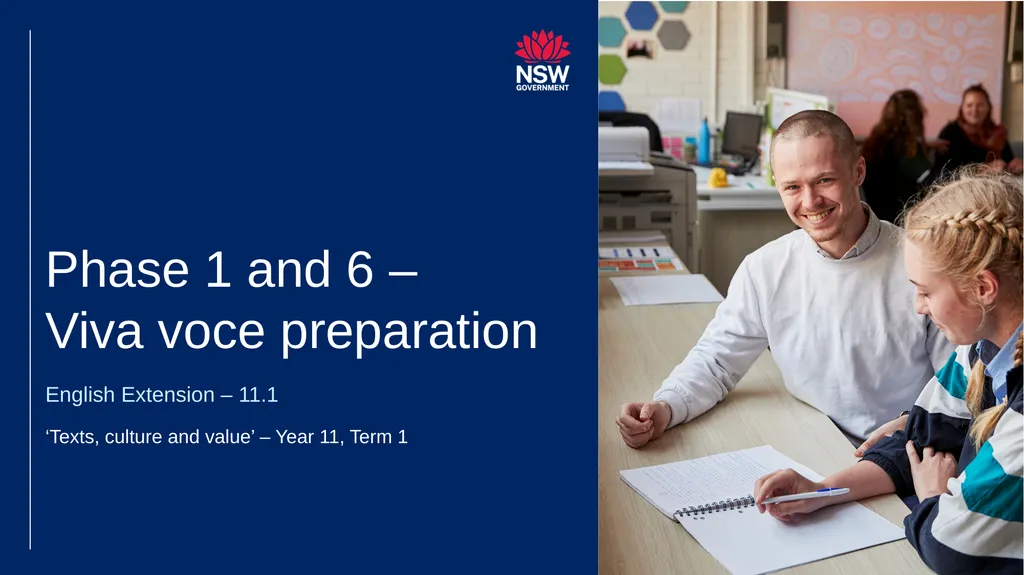
slide2. Phase 1 and 6 – Viva voce preparation English Extension – 11.1 ‘Texts, culture and value’ – Year 11, Term 1<br>
slide3. Core formative task 1 – peer-to-peer discussion 3<br>
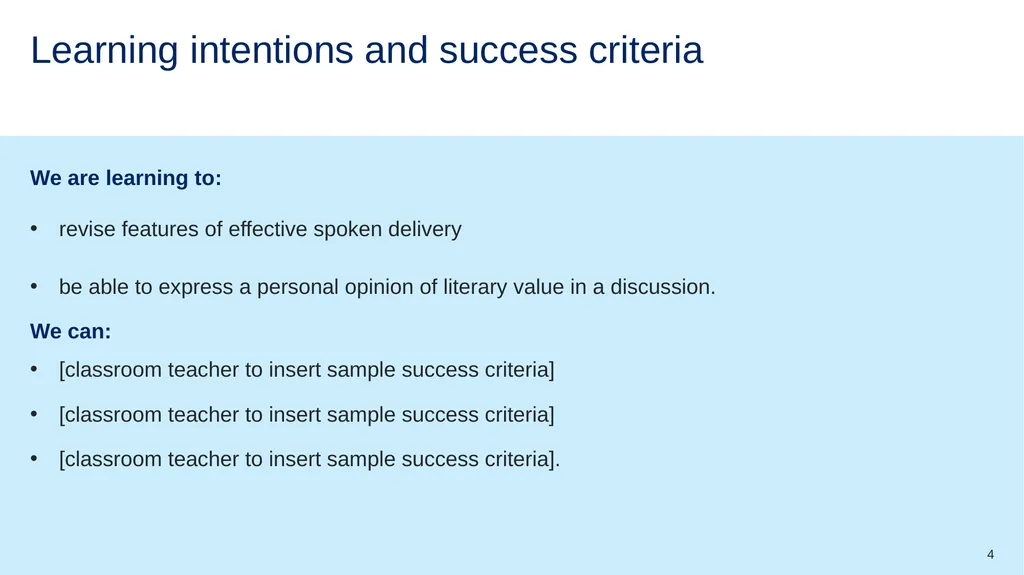
slide4. Learning intentions and success criteria We are learning to:
revise features of effective spoken delivery
be able to express a personal opinion of literary value in a discussion.
We can:
[classroom teacher to insert sample success criteria]
[classroom teacher to insert sample success criteria]
[classroom teacher to insert sample success criteria]. 4<br>
slide5. Connecting learning 5<br>
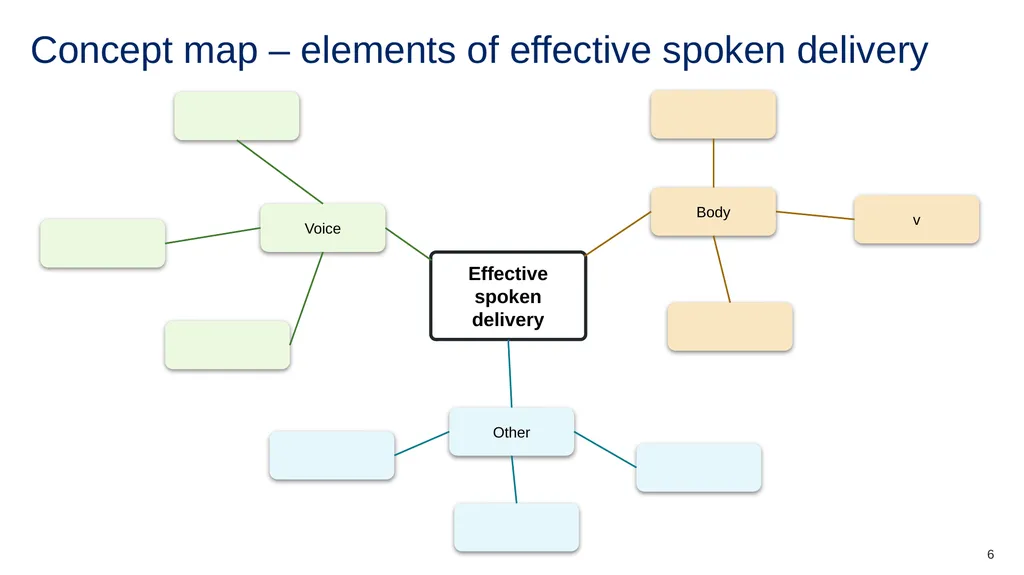
slide6. 6 Concept map – elements of effective spoken delivery Effective spoken delivery Voice Body Other v<br>
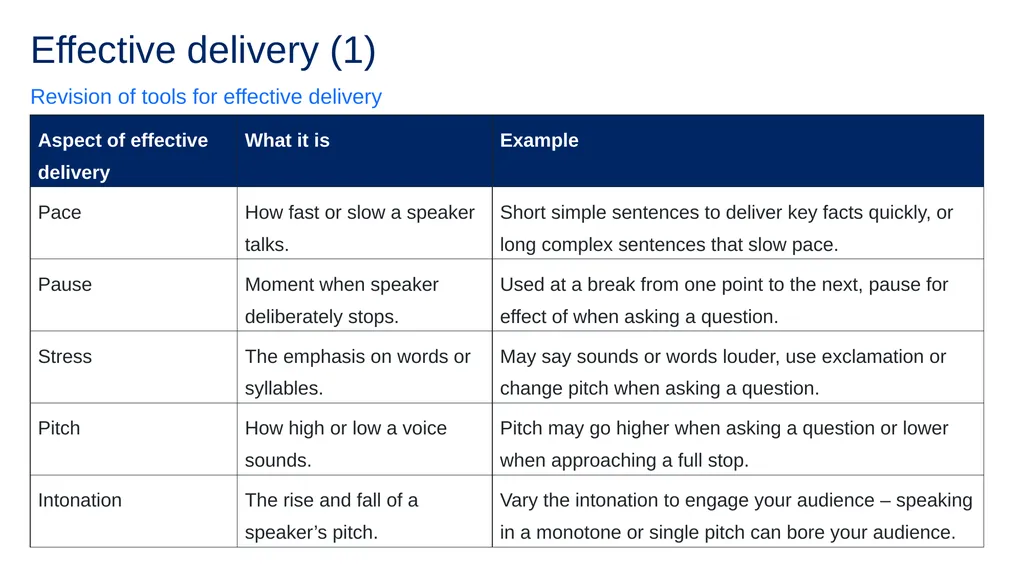
slide7. Effective delivery (1) Revision of tools for effective delivery<br>
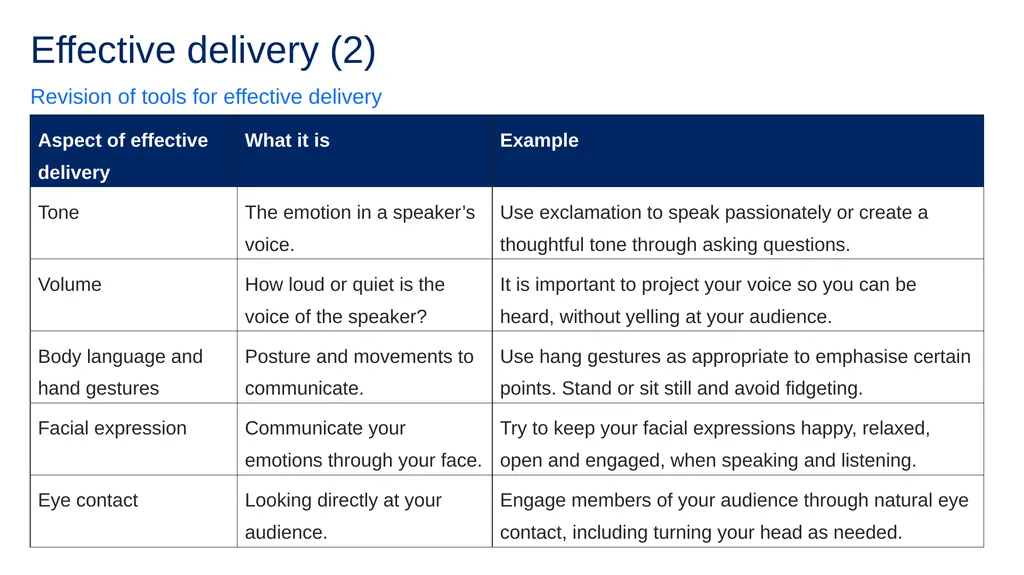
slide8. Effective delivery (2) Revision of tools for effective delivery<br>
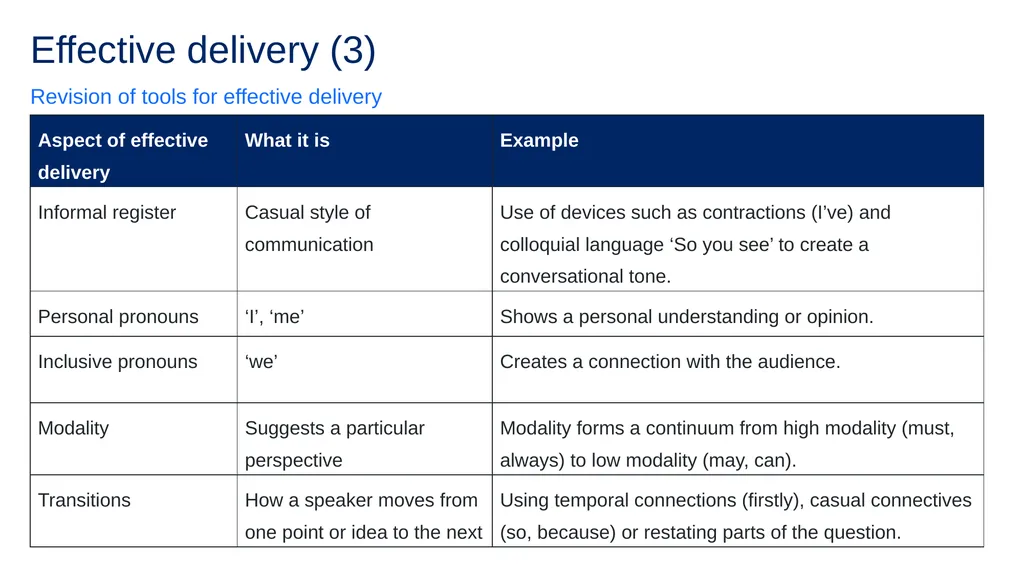
slide9. Effective delivery (3) Revision of tools for effective delivery<br>
slide10. Discussion protocols 10<br>
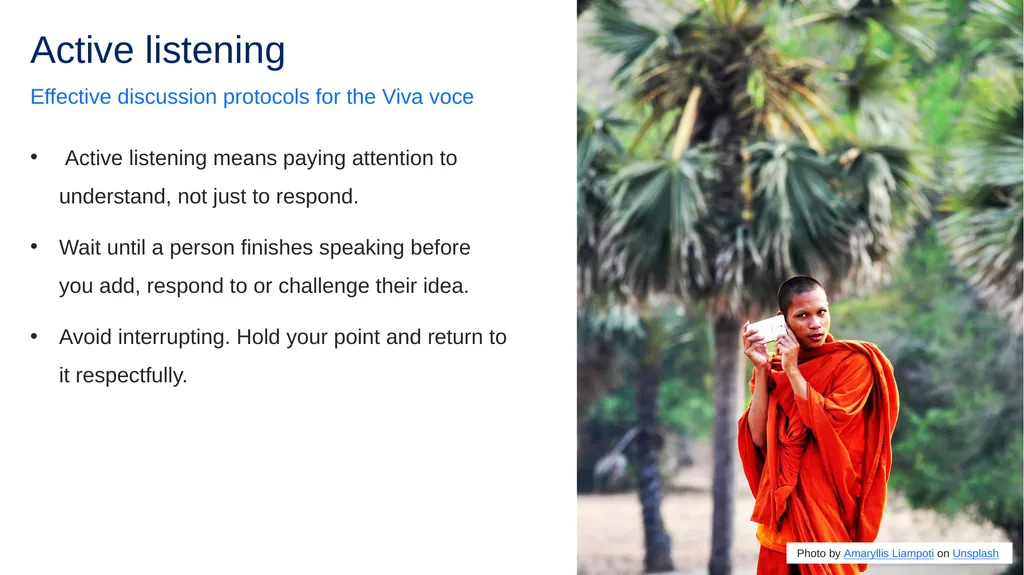
slide11. 11 Active listening Effective discussion protocols for the Viva voce Active listening means paying attention to understand, not just to respond.
Wait until a person finishes speaking before you add, respond to or challenge their idea.
Avoid interrupting. Hold your point and return to it respectfully. Photo by Amaryllis Liampoti on Unsplash<br>
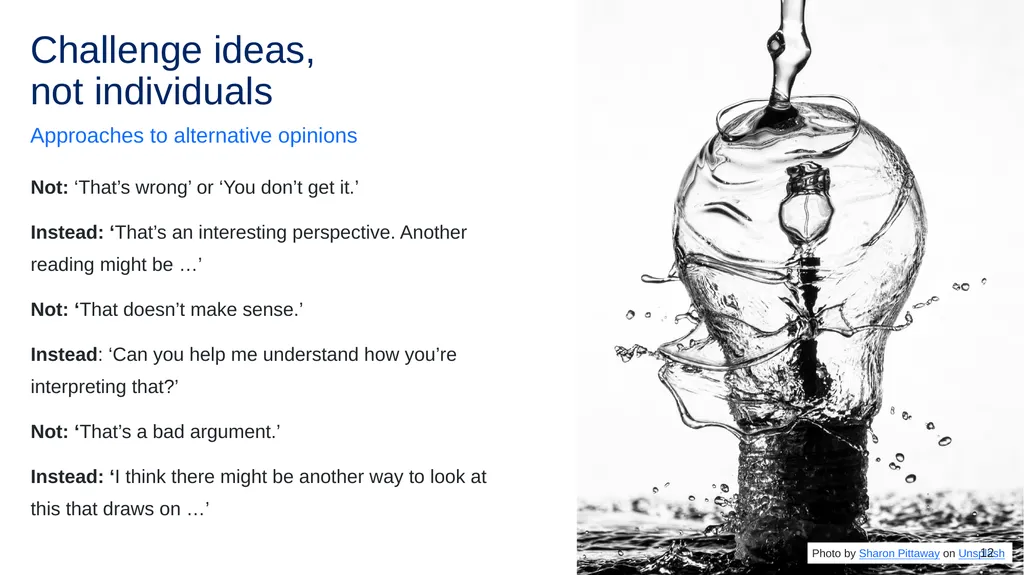
slide12. Challenge ideas, not individuals Approaches to alternative opinions Not: ‘That’s wrong’ or ‘You don’t get it.’
Instead: ‘That’s an interesting perspective. Another reading might be …’
Not: ‘That doesn’t make sense.’
Instead: ‘Can you help me understand how you’re interpreting that?’
Not: ‘That’s a bad argument.’
Instead: ‘I think there might be another way to look at this that draws on …’ Photo by Sharon Pittaway on Unsplash 12<br>
slide13. Paraphrase or summarise key points … before offering a response ‘So, you're saying that …’
‘I find what you said about … really interesting.’
‘When you mentioned … what that made me think about was …’
Restating shows you're listening and helps clarify the argument before responding. 13 Photo by Kelly Sikkema on Unsplash<br>
slide14. Curious confusion Seek clarification when needed ‘Can you explain what you mean by that?’
‘I’m not sure I follow – do you mean …?’
‘Just to make sure I’ve understood – are you suggesting that …?’
‘When you mention ‘authorial intention,’ are you referring to … or … of the narrative?’
‘I think I missed your point about form – are you saying that … adds meaning, or that it disrupts it?’
Asking for clarity strengthens, not weakens, your position. 14 Photo by Bogdan Cotos on Unsplash<br>
slide15. Phase 6, sequence 1 – preparing for the viva voce<br>
slide16. Responding to questions and prompts in the viva voce<br>
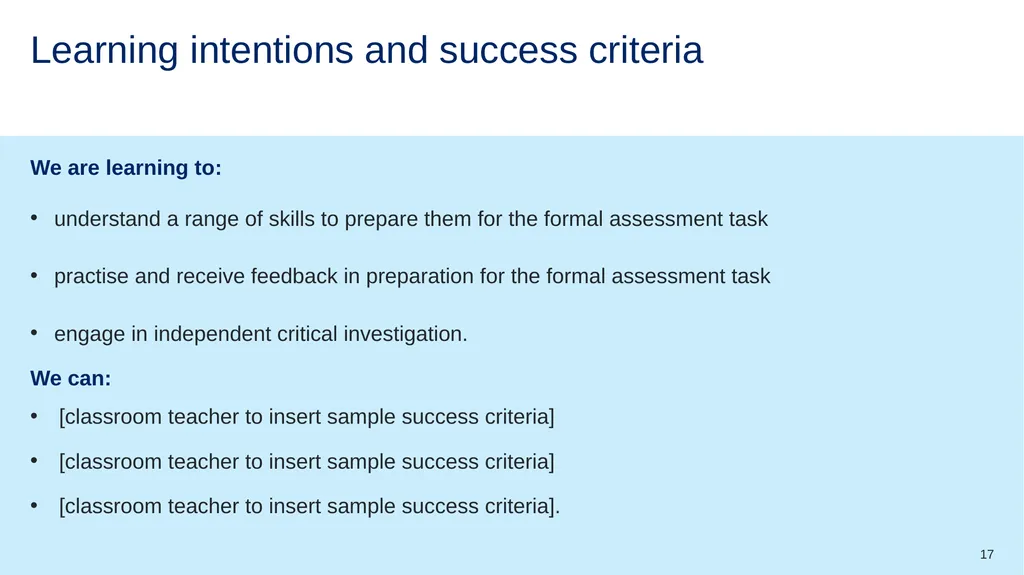
slide17. Learning intentions and success criteria We are learning to:
understand a range of skills to prepare them for the formal assessment task
practise and receive feedback in preparation for the formal assessment task
engage in independent critical investigation.
We can:
[classroom teacher to insert sample success criteria]
[classroom teacher to insert sample success criteria]
[classroom teacher to insert sample success criteria]. 17<br>
slide18. Connecting learning 18<br>
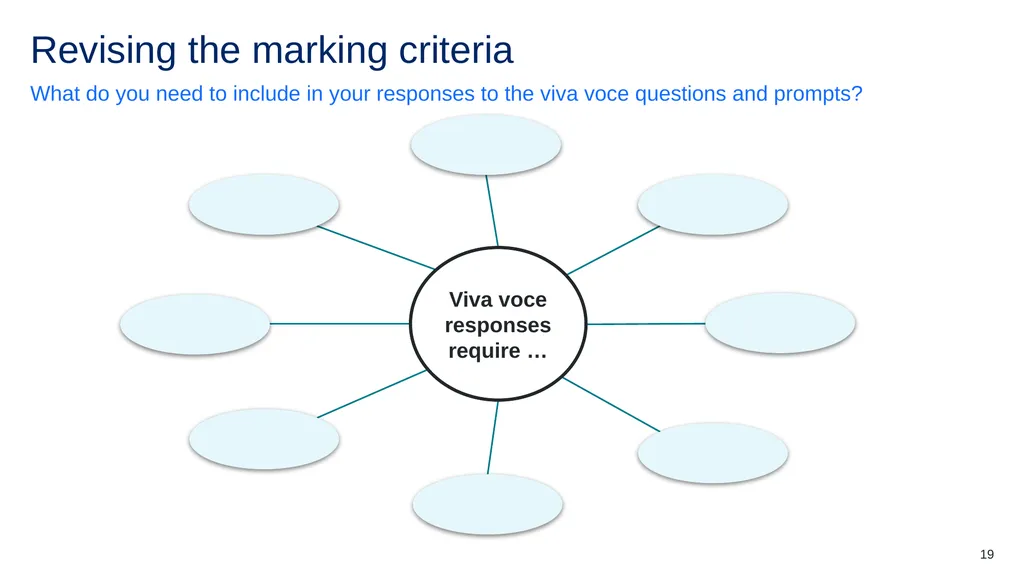
slide19. Revising the marking criteria What do you need to include in your responses to the viva voce questions and prompts? 19 Viva voce responses require …<br>
slide20. Understanding skills required for responding to the viva voce questions and prompts 20<br>
slide21. Embedding textual evidence<br>
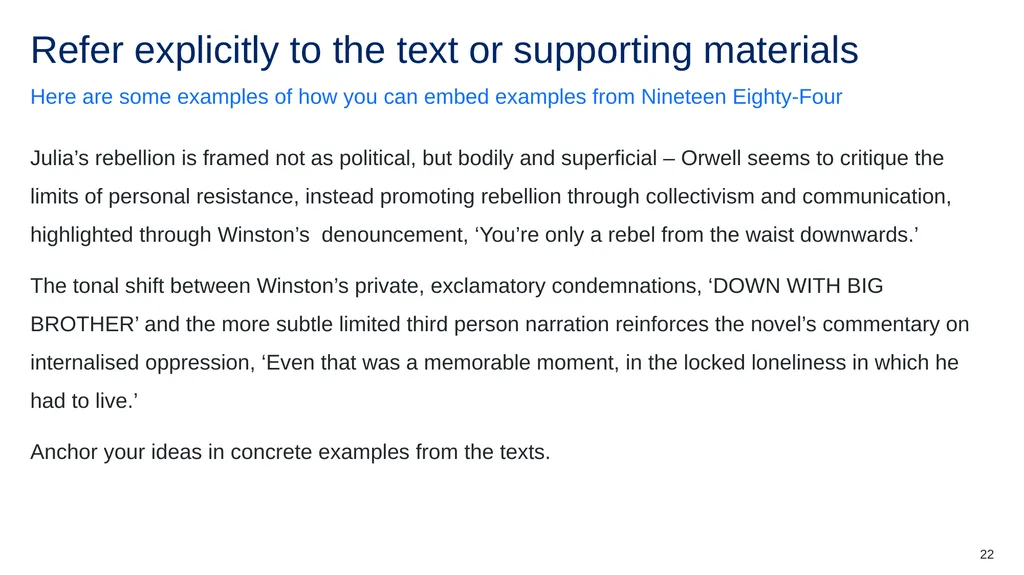
slide22. Refer explicitly to the text or supporting materials Here are some examples of how you can embed examples from Nineteen Eighty-Four Julia’s rebellion is framed not as political, but bodily and superficial – Orwell seems to critique the limits of personal resistance, instead promoting rebellion through collectivism and communication, highlighted through Winston’s denouncement, ‘You’re only a rebel from the waist downwards.’
The tonal shift between Winston’s private, exclamatory condemnations, ‘DOWN WITH BIG BROTHER’ and the more subtle limited third person narration reinforces the novel’s commentary on internalised oppression, ‘Even that was a memorable moment, in the locked loneliness in which he had to live.’
Anchor your ideas in concrete examples from the texts. 22<br>
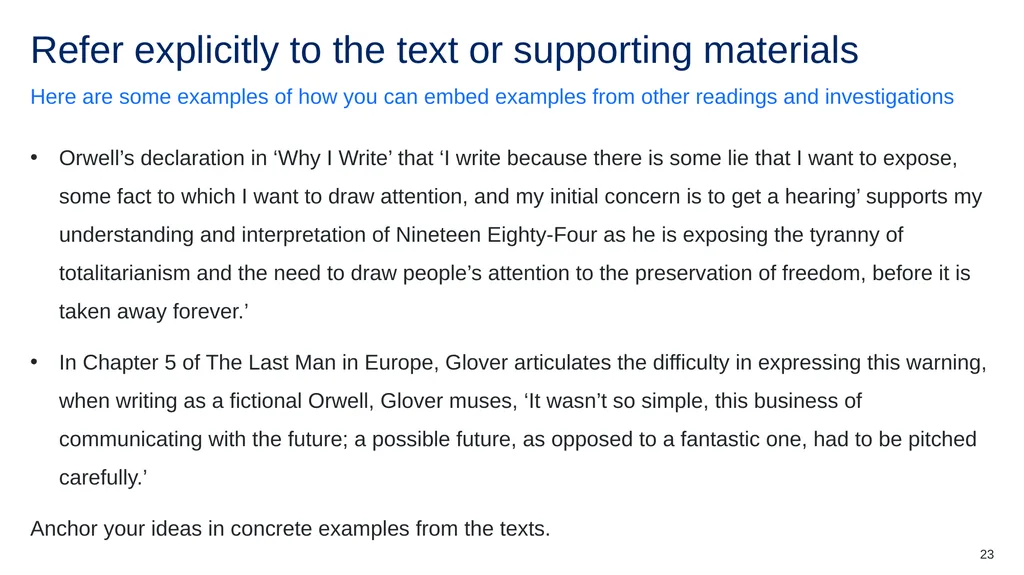
slide23. Refer explicitly to the text or supporting materials Here are some examples of how you can embed examples from other readings and investigations Orwell’s declaration in ‘Why I Write’ that ‘I write because there is some lie that I want to expose, some fact to which I want to draw attention, and my initial concern is to get a hearing’ supports my understanding and interpretation of Nineteen Eighty-Four as he is exposing the tyranny of totalitarianism and the need to draw people’s attention to the preservation of freedom, before it is taken away forever.’
In Chapter 5 of The Last Man in Europe, Glover articulates the difficulty in expressing this warning, when writing as a fictional Orwell, Glover muses, ‘It wasn’t so simple, this business of communicating with the future; a possible future, as opposed to a fantastic one, had to be pitched carefully.’
Anchor your ideas in concrete examples from the texts. 23<br>
slide24. Chunking and sequencing learning 24<br>
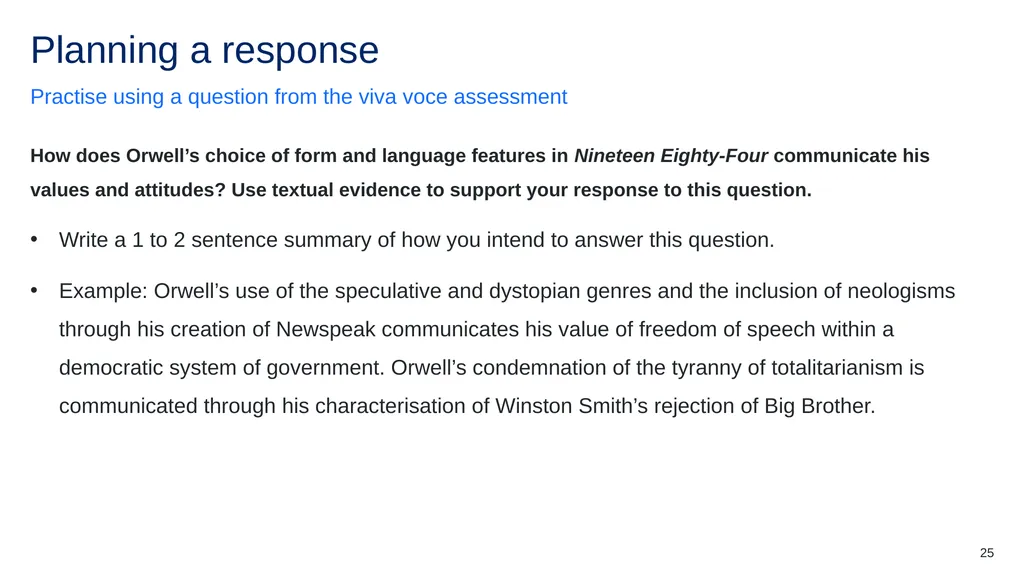
slide25. Planning a response Practise using a question from the viva voce assessment How does Orwell’s choice of form and language features in Nineteen Eighty-Four communicate his values and attitudes? Use textual evidence to support your response to this question.
Write a 1 to 2 sentence summary of how you intend to answer this question.
Example: Orwell’s use of the speculative and dystopian genres and the inclusion of neologisms through his creation of Newspeak communicates his value of freedom of speech within a democratic system of government. Orwell’s condemnation of the tyranny of totalitarianism is communicated through his characterisation of Winston Smith’s rejection of Big Brother. 25<br>
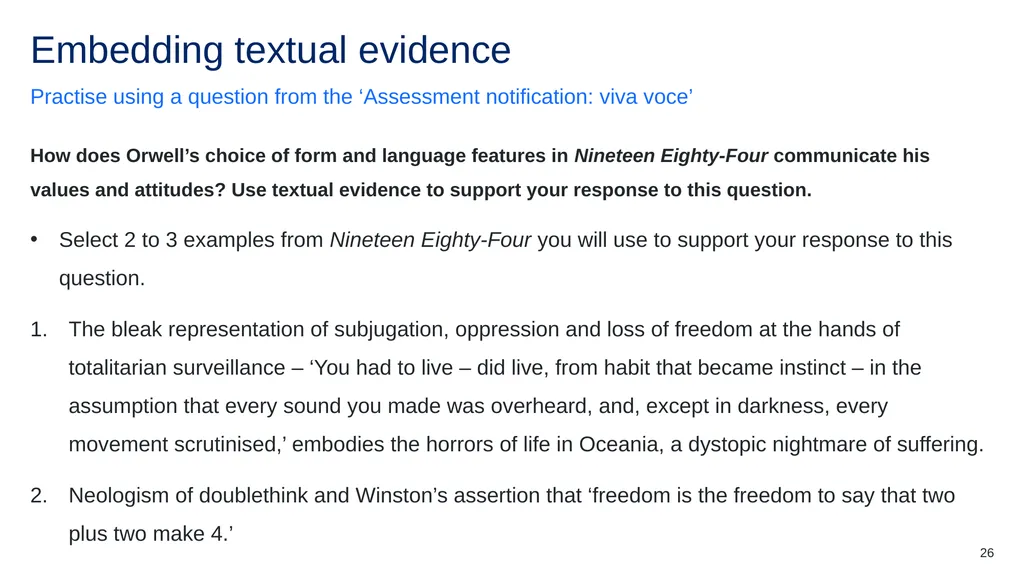
slide26. Embedding textual evidence Practise using a question from the ‘Assessment notification: viva voce’ How does Orwell’s choice of form and language features in Nineteen Eighty-Four communicate his values and attitudes? Use textual evidence to support your response to this question.
Select 2 to 3 examples from Nineteen Eighty-Four you will use to support your response to this question.
The bleak representation of subjugation, oppression and loss of freedom at the hands of totalitarian surveillance – ‘You had to live – did live, from habit that became instinct – in the assumption that every sound you made was overheard, and, except in darkness, every movement scrutinised,’ embodies the horrors of life in Oceania, a dystopic nightmare of suffering.
Neologism of doublethink and Winston’s assertion that ‘freedom is the freedom to say that two plus two make 4.’ 26<br>
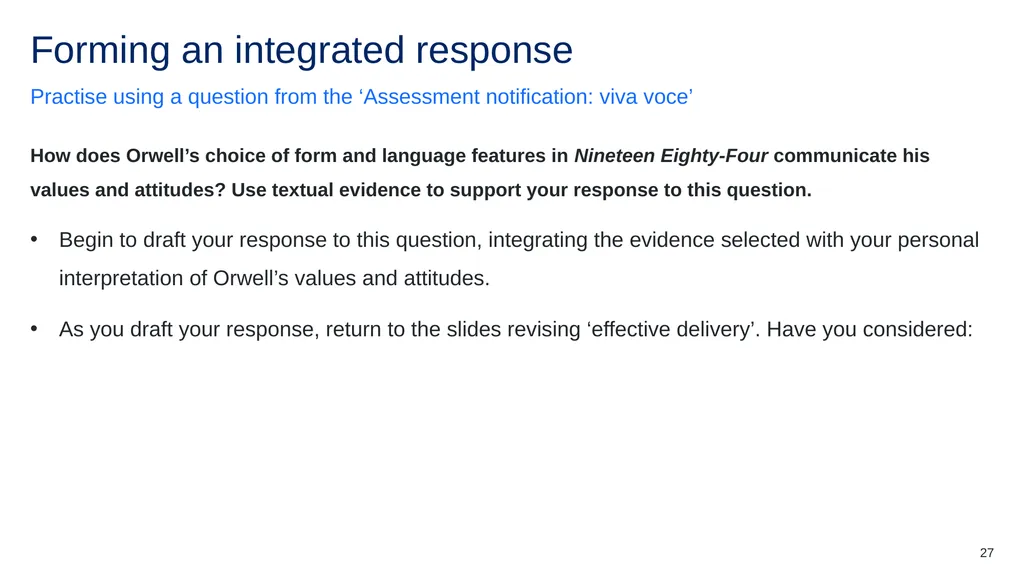
slide27. Forming an integrated response Practise using a question from the ‘Assessment notification: viva voce’ How does Orwell’s choice of form and language features in Nineteen Eighty-Four communicate his values and attitudes? Use textual evidence to support your response to this question.
Begin to draft your response to this question, integrating the evidence selected with your personal interpretation of Orwell’s values and attitudes.
As you draft your response, return to the slides revising ‘effective delivery’. Have you considered: 27<br>
slide28. Checking for understanding 28<br>
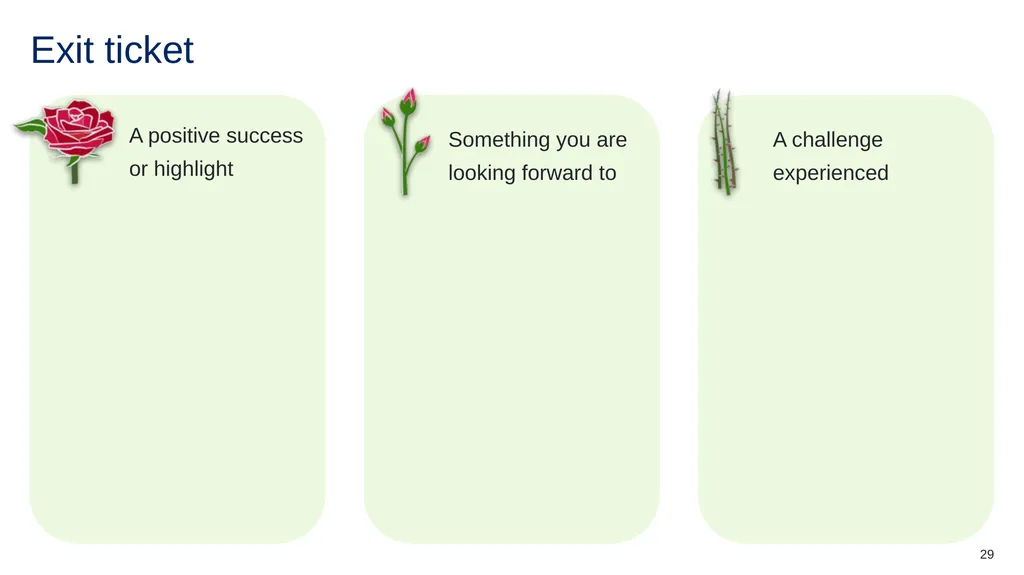
slide29. 29 Exit ticket A positive success or highlight Something you are looking forward to A challenge experienced<br>
slide30. References (1) This presentation contains NSW Curriculum and syllabus content. The NSW Curriculum is developed by the NSW Education Standards Authority. This content is prepared by NESA for and on behalf of the Crown in the right of the State of New South Wales. The material is protected by Crown copyright.
Please refer to the NESA Copyright Disclaimer for more information https://educationstandards.nsw.edu.au/wps/portal/nesa/mini-footer/copyright.
NESA holds the only official and up-to-date versions of the NSW Curriculum and syllabus documents. Please visit the NSW Education Standards Authority (NESA) website https://educationstandards.nsw.edu.au/wps/portal/nesa/home and the NSW Curriculum website https://curriculum.nsw.edu.au. English Extension 11–12 © Syllabus NSW Education Standards Authority (NESA) for and on behalf of the Crown in right of the State of New South Wales, 2024.
Australian Education Research Organisation (AERO) (2024a) Explain learning objectives, AERO, accessed 16 April 2024.
AERO (Australian Education Research Organisation) (2024b) Why explicit instruction works, AERO website, accessed 16 April 2024.
Black P and Wiliam D (2018) ‘Classroom assessment and pedagogy’, Assessment in Education Principles Policy and Practice, 25(1):1–25.
CESE (Centre for Education Statistics and Evaluation) (2017) Cognitive load theory: Research that teachers really need to understand, NSW Department of Education, accessed 16 April 2024.
Clarke S (2014) Outstanding formative assessment: culture and practice, Hodder Education, Great Britain.
Clarke S, Timperley H, Hattie J (2003) Unlocking formative assessment: Practical strategies for enhancing students’ learning in the primary and intermediate classroom, Hodder Moa Beckett, Auckland NZ, 2003.
Cotos B (2020) black round metal on brown wooden table, [image], Unsplash website, accessed 17 July 2025.
Griffin P (2018) Assessment for teaching, Cambridge University Press. 30<br>
slide31. References (1) This presentation contains NSW Curriculum and syllabus content. The NSW Curriculum is developed by the NSW Education Standards Authority. This content is prepared by NESA for and on behalf of the Crown in the right of the State of New South Wales. The material is protected by Crown copyright.
Please refer to the NESA Copyright Disclaimer for more information https://educationstandards.nsw.edu.au/wps/portal/nesa/mini-footer/copyright.
NESA holds the only official and up-to-date versions of the NSW Curriculum and syllabus documents. Please visit the NSW Education Standards Authority (NESA) website https://educationstandards.nsw.edu.au/wps/portal/nesa/home and the NSW Curriculum website https://curriculum.nsw.edu.au. Liampoti A (2016) shallow focus photography of man walking, [image], Unspash website, accessed 17 July 2025.
NESA (NSW Education Standards Authority) (n.d.) Collaborative curriculum planning, NESA website, accessed 19 May 2025.
Orwell G (1949) Nineteen Eighty-Four, Project Gutenberg Australia website, accessed 15 July 2025. This work is in the public domain.
Pittaway S (2016) water dropping on light bulb, [image] Unsplash website, accessed 17 July 2025.
Sikkema K (2018) graphing notebook, [image], Unsplash website, accessed 17 July 2025.
State of New South Wales (Department of Education) (2024.) Explicit teaching strategies, NSW Department of Education website, accessed 5 April 2024.
State of New South Wales (Department of Education) (2024) the Explicit teaching – Driving learning and engagement, Centre for Education Statistics and Evaluation website, accessed 5 April 2024.
State of New South Wales (Department of Education) (n.d.) Digital Learning Selector, NSW Department of Education website, accessed 5 April 2024.
Wiliam D (2014) ‘The right questions, the right way ’, Educational Leadership, 71(6). 31<br>
slide32. References (2) This presentation contains NSW Curriculum and syllabus content. The NSW Curriculum is developed by the NSW Education Standards Authority. This content is prepared by NESA for and on behalf of the Crown in the right of the State of New South Wales. The material is protected by Crown copyright.
Please refer to the NESA Copyright Disclaimer for more information https://educationstandards.nsw.edu.au/wps/portal/nesa/mini-footer/copyright.
NESA holds the only official and up-to-date versions of the NSW Curriculum and syllabus documents. Please visit the NSW Education Standards Authority (NESA) website https://educationstandards.nsw.edu.au/wps/portal/nesa/home and the NSW Curriculum website https://curriculum.nsw.edu.au. Liampoti A (2016) shallow focus photography of man walking, [image], Unspash website, accessed 17 July 2025.
NESA (NSW Education Standards Authority) (n.d.) Collaborative curriculum planning, NESA website, accessed 19 May 2025.
Orwell G (1949) Nineteen Eighty-Four, Project Gutenberg Australia website, accessed 15 July 2025. This work is in the public domain.
Pittaway S (2016) water dropping on light bulb, [image] Unsplash website, accessed 17 July 2025.
Sikkema K (2018) graphing notebook, [image], Unsplash website, accessed 17 July 2025.
State of New South Wales (Department of Education) (2024.) Explicit teaching strategies, NSW Department of Education website, accessed 5 April 2024.
State of New South Wales (Department of Education) (2024) the Explicit teaching – Driving learning and engagement, Centre for Education Statistics and Evaluation website, accessed 5 April 2024.
State of New South Wales (Department of Education) (n.d.) Digital Learning Selector, NSW Department of Education website, accessed 5 April 2024.
Wiliam D (2014) ‘The right questions, the right way ’, Educational Leadership, 71(6). 32<br>
slide33. Copyright © State of New South Wales (Department of Education), 2025 The copyright material published in this resource is subject to the Copyright Act 1968 (Cth) and is owned by the NSW Department of Education or, where indicated, by a party other than the NSW Department of Education (third-party material).
Copyright material available in this resource and owned by the NSW Department of Education is licensed under a Creative Commons Attribution 4.0 International (CC BY 4.0) license.
This license allows you to share and adapt the material for any purpose, even commercially.
Attribution should be given to © State of New South Wales (Department of Education), 2025.
Material in this resource not available under a Creative Commons license:
the NSW Department of Education logo, other logos and trademark-protected material
Material owned by a third party that has been reproduced with permission. You will need to obtain permission from the third party to reuse its material.
Links to third-party material and websites
Please note that the provided (reading/viewing material/list/links/texts) are a suggestion only and implies no endorsement, by the New South Wales Department of Education, of any author, publisher, or book title. School principals and teachers are best placed to assess the suitability of resources that would complement the curriculum and reflect the needs and interests of their students.
If you use the links provided in this document to access a third-party’s website, you acknowledge that the terms of use, including licence terms set out on the third-party’s website apply to the use which may be made of the materials on that third-party website or where permitted by the Copyright Act 1968 (Cth). The department accepts no responsibility for content on third-party websites. 33<br>
Classroom teachers are encouraged to add and adapt slides as required to meet the needs of their students.
Save a copy of the file to make changes to the slide deck. Go to File > Download a Copy (this downloads a copy to the computer to edit in the PowerPoint app).
To convert the PowerPoint to Google Slides:
Upload the file into Google Drive and open it.
Go to File > Save as Google Slides.
(Note – conversion may cause formatting changes in the slides.)<br>
slide2. Phase 1 and 6 – Viva voce preparation English Extension – 11.1 ‘Texts, culture and value’ – Year 11, Term 1<br>
slide3. Core formative task 1 – peer-to-peer discussion 3<br>
slide4. Learning intentions and success criteria We are learning to:
revise features of effective spoken delivery
be able to express a personal opinion of literary value in a discussion.
We can:
[classroom teacher to insert sample success criteria]
[classroom teacher to insert sample success criteria]
[classroom teacher to insert sample success criteria]. 4<br>
slide5. Connecting learning 5<br>
slide6. 6 Concept map – elements of effective spoken delivery Effective spoken delivery Voice Body Other v<br>
slide7. Effective delivery (1) Revision of tools for effective delivery<br>
slide8. Effective delivery (2) Revision of tools for effective delivery<br>
slide9. Effective delivery (3) Revision of tools for effective delivery<br>
slide10. Discussion protocols 10<br>
slide11. 11 Active listening Effective discussion protocols for the Viva voce Active listening means paying attention to understand, not just to respond.
Wait until a person finishes speaking before you add, respond to or challenge their idea.
Avoid interrupting. Hold your point and return to it respectfully. Photo by Amaryllis Liampoti on Unsplash<br>
slide12. Challenge ideas, not individuals Approaches to alternative opinions Not: ‘That’s wrong’ or ‘You don’t get it.’
Instead: ‘That’s an interesting perspective. Another reading might be …’
Not: ‘That doesn’t make sense.’
Instead: ‘Can you help me understand how you’re interpreting that?’
Not: ‘That’s a bad argument.’
Instead: ‘I think there might be another way to look at this that draws on …’ Photo by Sharon Pittaway on Unsplash 12<br>
slide13. Paraphrase or summarise key points … before offering a response ‘So, you're saying that …’
‘I find what you said about … really interesting.’
‘When you mentioned … what that made me think about was …’
Restating shows you're listening and helps clarify the argument before responding. 13 Photo by Kelly Sikkema on Unsplash<br>
slide14. Curious confusion Seek clarification when needed ‘Can you explain what you mean by that?’
‘I’m not sure I follow – do you mean …?’
‘Just to make sure I’ve understood – are you suggesting that …?’
‘When you mention ‘authorial intention,’ are you referring to … or … of the narrative?’
‘I think I missed your point about form – are you saying that … adds meaning, or that it disrupts it?’
Asking for clarity strengthens, not weakens, your position. 14 Photo by Bogdan Cotos on Unsplash<br>
slide15. Phase 6, sequence 1 – preparing for the viva voce<br>
slide16. Responding to questions and prompts in the viva voce<br>
slide17. Learning intentions and success criteria We are learning to:
understand a range of skills to prepare them for the formal assessment task
practise and receive feedback in preparation for the formal assessment task
engage in independent critical investigation.
We can:
[classroom teacher to insert sample success criteria]
[classroom teacher to insert sample success criteria]
[classroom teacher to insert sample success criteria]. 17<br>
slide18. Connecting learning 18<br>
slide19. Revising the marking criteria What do you need to include in your responses to the viva voce questions and prompts? 19 Viva voce responses require …<br>
slide20. Understanding skills required for responding to the viva voce questions and prompts 20<br>
slide21. Embedding textual evidence<br>
slide22. Refer explicitly to the text or supporting materials Here are some examples of how you can embed examples from Nineteen Eighty-Four Julia’s rebellion is framed not as political, but bodily and superficial – Orwell seems to critique the limits of personal resistance, instead promoting rebellion through collectivism and communication, highlighted through Winston’s denouncement, ‘You’re only a rebel from the waist downwards.’
The tonal shift between Winston’s private, exclamatory condemnations, ‘DOWN WITH BIG BROTHER’ and the more subtle limited third person narration reinforces the novel’s commentary on internalised oppression, ‘Even that was a memorable moment, in the locked loneliness in which he had to live.’
Anchor your ideas in concrete examples from the texts. 22<br>
slide23. Refer explicitly to the text or supporting materials Here are some examples of how you can embed examples from other readings and investigations Orwell’s declaration in ‘Why I Write’ that ‘I write because there is some lie that I want to expose, some fact to which I want to draw attention, and my initial concern is to get a hearing’ supports my understanding and interpretation of Nineteen Eighty-Four as he is exposing the tyranny of totalitarianism and the need to draw people’s attention to the preservation of freedom, before it is taken away forever.’
In Chapter 5 of The Last Man in Europe, Glover articulates the difficulty in expressing this warning, when writing as a fictional Orwell, Glover muses, ‘It wasn’t so simple, this business of communicating with the future; a possible future, as opposed to a fantastic one, had to be pitched carefully.’
Anchor your ideas in concrete examples from the texts. 23<br>
slide24. Chunking and sequencing learning 24<br>
slide25. Planning a response Practise using a question from the viva voce assessment How does Orwell’s choice of form and language features in Nineteen Eighty-Four communicate his values and attitudes? Use textual evidence to support your response to this question.
Write a 1 to 2 sentence summary of how you intend to answer this question.
Example: Orwell’s use of the speculative and dystopian genres and the inclusion of neologisms through his creation of Newspeak communicates his value of freedom of speech within a democratic system of government. Orwell’s condemnation of the tyranny of totalitarianism is communicated through his characterisation of Winston Smith’s rejection of Big Brother. 25<br>
slide26. Embedding textual evidence Practise using a question from the ‘Assessment notification: viva voce’ How does Orwell’s choice of form and language features in Nineteen Eighty-Four communicate his values and attitudes? Use textual evidence to support your response to this question.
Select 2 to 3 examples from Nineteen Eighty-Four you will use to support your response to this question.
The bleak representation of subjugation, oppression and loss of freedom at the hands of totalitarian surveillance – ‘You had to live – did live, from habit that became instinct – in the assumption that every sound you made was overheard, and, except in darkness, every movement scrutinised,’ embodies the horrors of life in Oceania, a dystopic nightmare of suffering.
Neologism of doublethink and Winston’s assertion that ‘freedom is the freedom to say that two plus two make 4.’ 26<br>
slide27. Forming an integrated response Practise using a question from the ‘Assessment notification: viva voce’ How does Orwell’s choice of form and language features in Nineteen Eighty-Four communicate his values and attitudes? Use textual evidence to support your response to this question.
Begin to draft your response to this question, integrating the evidence selected with your personal interpretation of Orwell’s values and attitudes.
As you draft your response, return to the slides revising ‘effective delivery’. Have you considered: 27<br>
slide28. Checking for understanding 28<br>
slide29. 29 Exit ticket A positive success or highlight Something you are looking forward to A challenge experienced<br>
slide30. References (1) This presentation contains NSW Curriculum and syllabus content. The NSW Curriculum is developed by the NSW Education Standards Authority. This content is prepared by NESA for and on behalf of the Crown in the right of the State of New South Wales. The material is protected by Crown copyright.
Please refer to the NESA Copyright Disclaimer for more information https://educationstandards.nsw.edu.au/wps/portal/nesa/mini-footer/copyright.
NESA holds the only official and up-to-date versions of the NSW Curriculum and syllabus documents. Please visit the NSW Education Standards Authority (NESA) website https://educationstandards.nsw.edu.au/wps/portal/nesa/home and the NSW Curriculum website https://curriculum.nsw.edu.au. English Extension 11–12 © Syllabus NSW Education Standards Authority (NESA) for and on behalf of the Crown in right of the State of New South Wales, 2024.
Australian Education Research Organisation (AERO) (2024a) Explain learning objectives, AERO, accessed 16 April 2024.
AERO (Australian Education Research Organisation) (2024b) Why explicit instruction works, AERO website, accessed 16 April 2024.
Black P and Wiliam D (2018) ‘Classroom assessment and pedagogy’, Assessment in Education Principles Policy and Practice, 25(1):1–25.
CESE (Centre for Education Statistics and Evaluation) (2017) Cognitive load theory: Research that teachers really need to understand, NSW Department of Education, accessed 16 April 2024.
Clarke S (2014) Outstanding formative assessment: culture and practice, Hodder Education, Great Britain.
Clarke S, Timperley H, Hattie J (2003) Unlocking formative assessment: Practical strategies for enhancing students’ learning in the primary and intermediate classroom, Hodder Moa Beckett, Auckland NZ, 2003.
Cotos B (2020) black round metal on brown wooden table, [image], Unsplash website, accessed 17 July 2025.
Griffin P (2018) Assessment for teaching, Cambridge University Press. 30<br>
slide31. References (1) This presentation contains NSW Curriculum and syllabus content. The NSW Curriculum is developed by the NSW Education Standards Authority. This content is prepared by NESA for and on behalf of the Crown in the right of the State of New South Wales. The material is protected by Crown copyright.
Please refer to the NESA Copyright Disclaimer for more information https://educationstandards.nsw.edu.au/wps/portal/nesa/mini-footer/copyright.
NESA holds the only official and up-to-date versions of the NSW Curriculum and syllabus documents. Please visit the NSW Education Standards Authority (NESA) website https://educationstandards.nsw.edu.au/wps/portal/nesa/home and the NSW Curriculum website https://curriculum.nsw.edu.au. Liampoti A (2016) shallow focus photography of man walking, [image], Unspash website, accessed 17 July 2025.
NESA (NSW Education Standards Authority) (n.d.) Collaborative curriculum planning, NESA website, accessed 19 May 2025.
Orwell G (1949) Nineteen Eighty-Four, Project Gutenberg Australia website, accessed 15 July 2025. This work is in the public domain.
Pittaway S (2016) water dropping on light bulb, [image] Unsplash website, accessed 17 July 2025.
Sikkema K (2018) graphing notebook, [image], Unsplash website, accessed 17 July 2025.
State of New South Wales (Department of Education) (2024.) Explicit teaching strategies, NSW Department of Education website, accessed 5 April 2024.
State of New South Wales (Department of Education) (2024) the Explicit teaching – Driving learning and engagement, Centre for Education Statistics and Evaluation website, accessed 5 April 2024.
State of New South Wales (Department of Education) (n.d.) Digital Learning Selector, NSW Department of Education website, accessed 5 April 2024.
Wiliam D (2014) ‘The right questions, the right way ’, Educational Leadership, 71(6). 31<br>
slide32. References (2) This presentation contains NSW Curriculum and syllabus content. The NSW Curriculum is developed by the NSW Education Standards Authority. This content is prepared by NESA for and on behalf of the Crown in the right of the State of New South Wales. The material is protected by Crown copyright.
Please refer to the NESA Copyright Disclaimer for more information https://educationstandards.nsw.edu.au/wps/portal/nesa/mini-footer/copyright.
NESA holds the only official and up-to-date versions of the NSW Curriculum and syllabus documents. Please visit the NSW Education Standards Authority (NESA) website https://educationstandards.nsw.edu.au/wps/portal/nesa/home and the NSW Curriculum website https://curriculum.nsw.edu.au. Liampoti A (2016) shallow focus photography of man walking, [image], Unspash website, accessed 17 July 2025.
NESA (NSW Education Standards Authority) (n.d.) Collaborative curriculum planning, NESA website, accessed 19 May 2025.
Orwell G (1949) Nineteen Eighty-Four, Project Gutenberg Australia website, accessed 15 July 2025. This work is in the public domain.
Pittaway S (2016) water dropping on light bulb, [image] Unsplash website, accessed 17 July 2025.
Sikkema K (2018) graphing notebook, [image], Unsplash website, accessed 17 July 2025.
State of New South Wales (Department of Education) (2024.) Explicit teaching strategies, NSW Department of Education website, accessed 5 April 2024.
State of New South Wales (Department of Education) (2024) the Explicit teaching – Driving learning and engagement, Centre for Education Statistics and Evaluation website, accessed 5 April 2024.
State of New South Wales (Department of Education) (n.d.) Digital Learning Selector, NSW Department of Education website, accessed 5 April 2024.
Wiliam D (2014) ‘The right questions, the right way ’, Educational Leadership, 71(6). 32<br>
slide33. Copyright © State of New South Wales (Department of Education), 2025 The copyright material published in this resource is subject to the Copyright Act 1968 (Cth) and is owned by the NSW Department of Education or, where indicated, by a party other than the NSW Department of Education (third-party material).
Copyright material available in this resource and owned by the NSW Department of Education is licensed under a Creative Commons Attribution 4.0 International (CC BY 4.0) license.
This license allows you to share and adapt the material for any purpose, even commercially.
Attribution should be given to © State of New South Wales (Department of Education), 2025.
Material in this resource not available under a Creative Commons license:
the NSW Department of Education logo, other logos and trademark-protected material
Material owned by a third party that has been reproduced with permission. You will need to obtain permission from the third party to reuse its material.
Links to third-party material and websites
Please note that the provided (reading/viewing material/list/links/texts) are a suggestion only and implies no endorsement, by the New South Wales Department of Education, of any author, publisher, or book title. School principals and teachers are best placed to assess the suitability of resources that would complement the curriculum and reflect the needs and interests of their students.
If you use the links provided in this document to access a third-party’s website, you acknowledge that the terms of use, including licence terms set out on the third-party’s website apply to the use which may be made of the materials on that third-party website or where permitted by the Copyright Act 1968 (Cth). The department accepts no responsibility for content on third-party websites. 33<br>