
Instructions for use This resource is not a









Description: Instructions for use This resource is not a teaching and learning program. It should be used in conjunction with Thriving in health and wellness teaching and learning program. Classroom teachers are encouraged to add and adapt slides as
Related Topics
Download Presentation
"Instructions for use This resource is not a" is the property of its rightful owner. Permission is granted to download and print the materials on this website for personal, non-commercial use only, and to display it on your personal computer provided you do not modify the materials and that you retain all copyright notices contained in the materials. By downloading content from our website, you accept the terms of this agreement.
Presentation Transcript
slide1. Instructions for use This resource is not a teaching and learning program. It should be used in conjunction with Thriving in health and wellness teaching and learning program.
Classroom teachers are encouraged to add and adapt slides as required to meet the needs of their students.
Save a copy of the file to make changes to the slide deck. Go to File > Download a Copy (this downloads a copy to the computer to edit in the PowerPoint app).
To convert the PowerPoint to Google Slides:
Upload the file into Google Drive and open it.
Go to File > Save as Google Slides.
(Note – conversion may cause formatting changes in the slides.) 1<br>
slide2. Thriving in health and wellness PDHPE – Stage 5 – Year 9 Term 3 Illustration by Salman Ahmad on Unsplash<br>
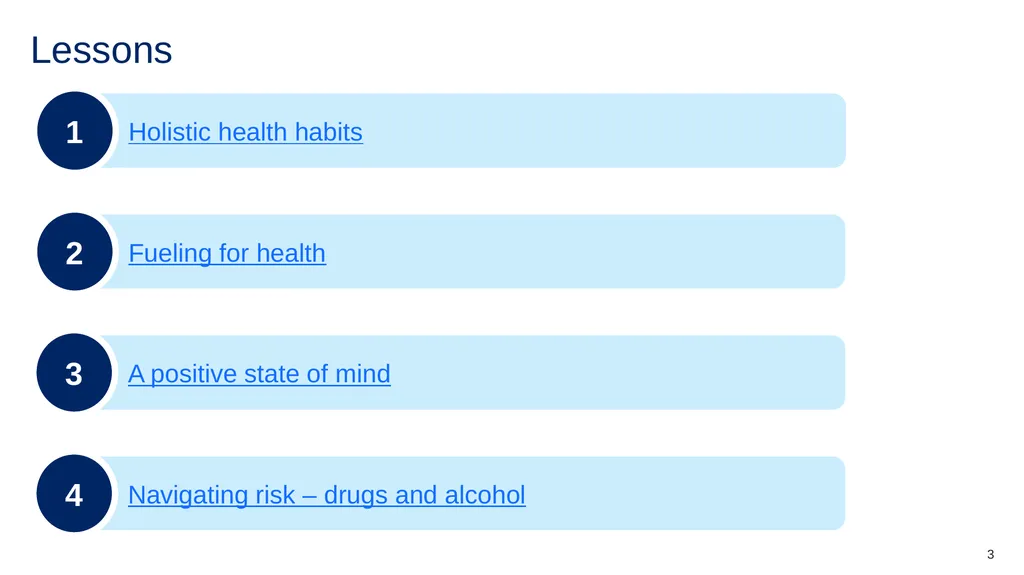
slide3. Lessons 3<br>
slide4. Holistic health habits<br>
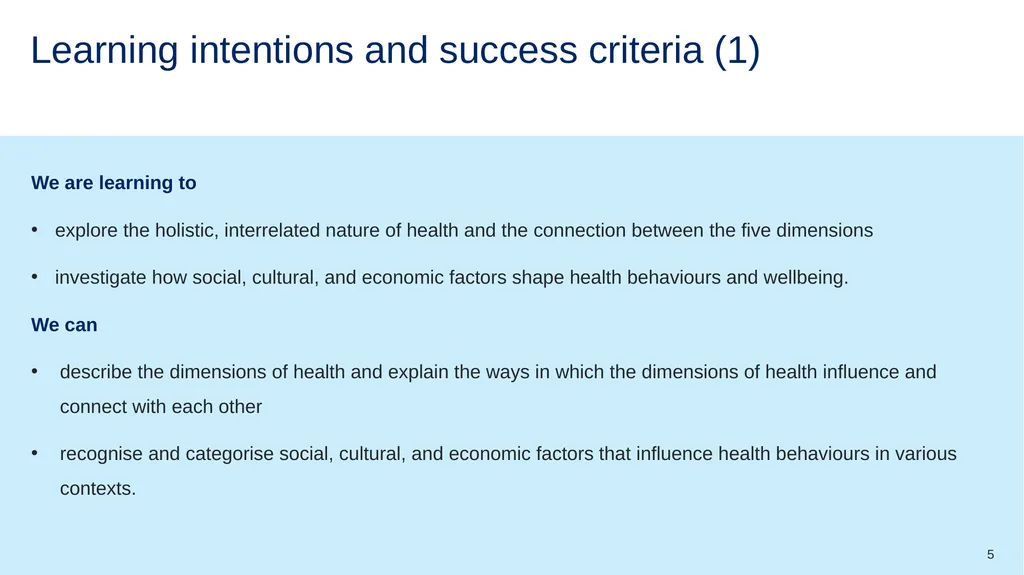
slide5. Learning intentions and success criteria (1) We are learning to
explore the holistic, interrelated nature of health and the connection between the five dimensions
investigate how social, cultural, and economic factors shape health behaviours and wellbeing.
We can
describe the dimensions of health and explain the ways in which the dimensions of health influence and connect with each other
recognise and categorise social, cultural, and economic factors that influence health behaviours in various contexts. 5<br>
slide6. Activity – what is health? Pair activity – turn and talk ‘Health is a state of complete physical, mental and social well-being and not merely the absence of disease or infirmity’
World Health Organisation (WHO)
Instructions
With your partner, consider what you like about this definition and what you wonder about this definition. 6 Image by Htc Erl from Pixabay<br>
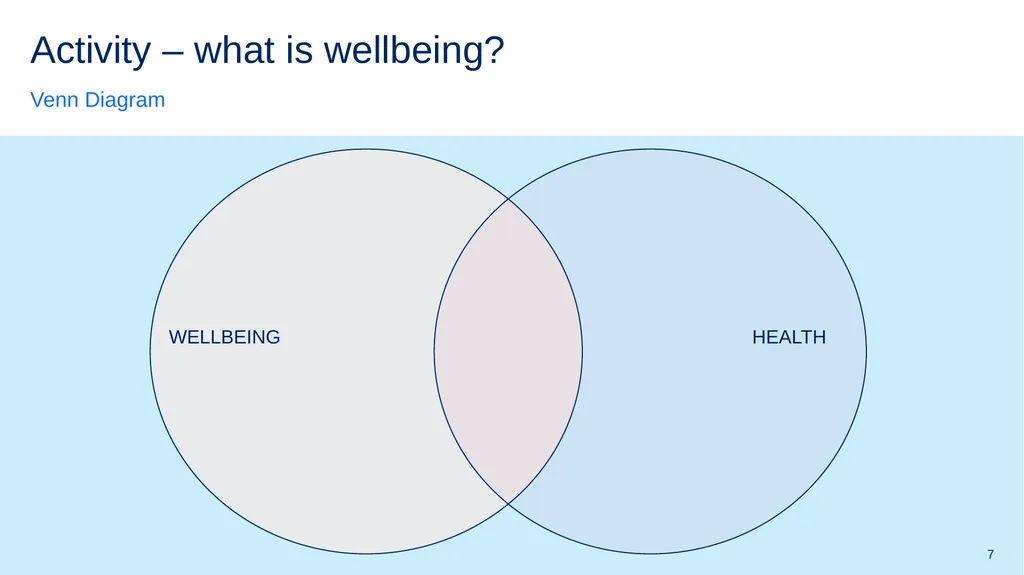
slide7. Activity – what is wellbeing? Venn Diagram 7<br>
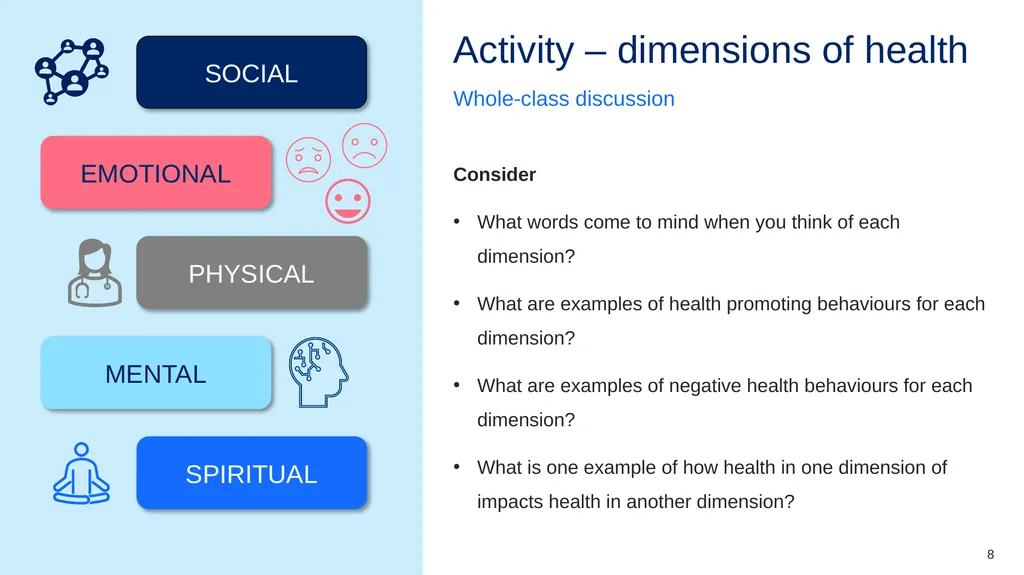
slide8. Activity – dimensions of health Whole-class discussion Consider
What words come to mind when you think of each dimension?
What are examples of health promoting behaviours for each dimension?
What are examples of negative health behaviours for each dimension?
What is one example of how health in one dimension of impacts health in another dimension? 8<br>
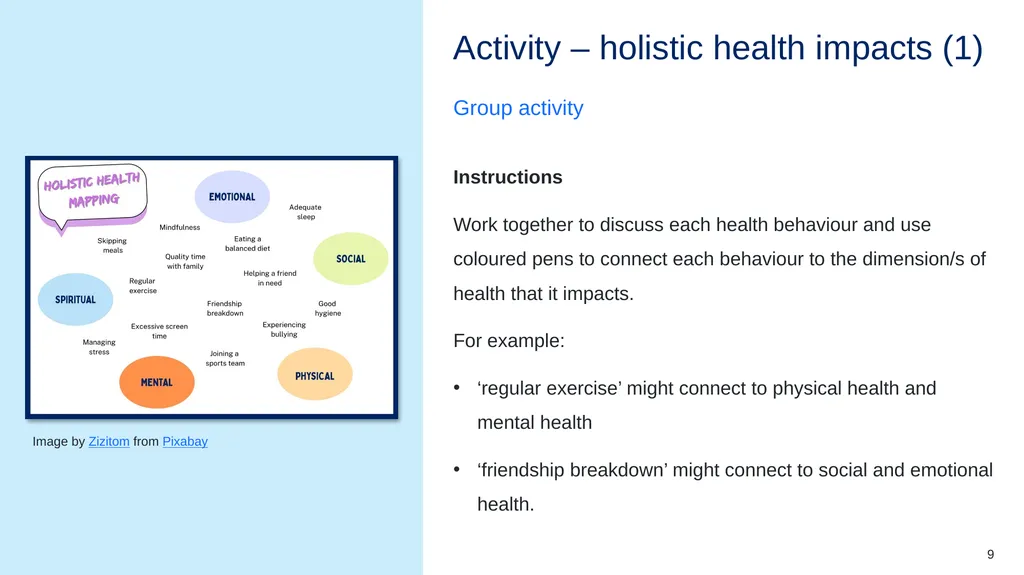
slide9. Activity – holistic health impacts (1) Group activity Instructions
Work together to discuss each health behaviour and use coloured pens to connect each behaviour to the dimension/s of health that it impacts.
For example:
‘regular exercise’ might connect to physical health and mental health
‘friendship breakdown’ might connect to social and emotional health. Image by Zizitom from Pixabay 9<br>
slide10. Photo by Zainul Yasni on Unsplash Activity – holistic health impacts (2) Scenario analysis Sample scenario
Alex broke his leg playing basketball and how now must take a break from sports for several months. Alex feels frustrated because his social life revolves around the basketball team.
Being unable to play, Alex notices he’s gaining weight and feels more tired during the day. His mood has also been low, and he’s finding it harder to focus on schoolwork. 10<br>
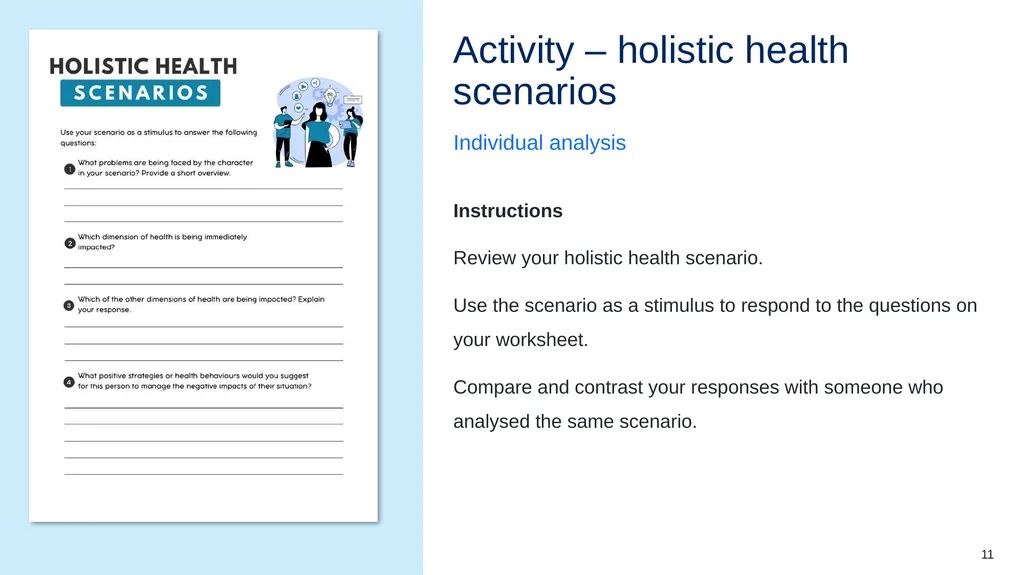
slide11. Activity – holistic health scenarios Individual analysis Instructions
Review your holistic health scenario.
Use the scenario as a stimulus to respond to the questions on your worksheet.
Compare and contrast your responses with someone who analysed the same scenario. 11<br>
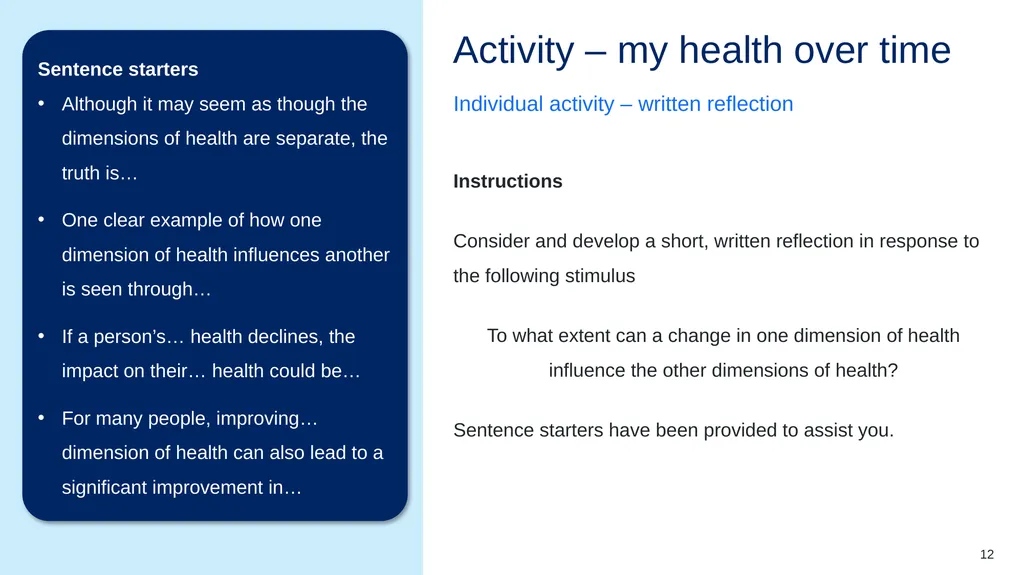
slide12. Activity – my health over time Sentence starters
Although it may seem as though the dimensions of health are separate, the truth is…
One clear example of how one dimension of health influences another is seen through…
If a person’s… health declines, the impact on their… health could be…
For many people, improving… dimension of health can also lead to a significant improvement in… Individual activity – written reflection Instructions
Consider and develop a short, written reflection in response to the following stimulus
To what extent can a change in one dimension of health influence the other dimensions of health?
Sentence starters have been provided to assist you. 12<br>
slide13. Image by Mohamed Hassan from Pixabay Activity – lifestyle behaviours (1) Individual activity – pie chart Instructions
Consider a typical week and add up the time you spend on:
Sleeping
Exercising
Sedentary activities (not including screen time)
Using a device/screen
Socialising
Using Microsoft Excel, develop a pie chart to show the allocation of time. 13<br>
slide14. Image by Clker-Free-Vector-Images from Pixabay Activity – lifestyle behaviours (2) Individual activity – written reflection Instructions
Reflect on your pie chart and propose 5 ways you could achieve a more balanced lifestyle.
Or, if your lifestyle is already balanced, propose 5 ways you could ensure you are able to maintain your current balance.
For each strategy or recommendation, list the barriers which may prevent you from achieving or maintaining a balanced lifestyle. 14<br>
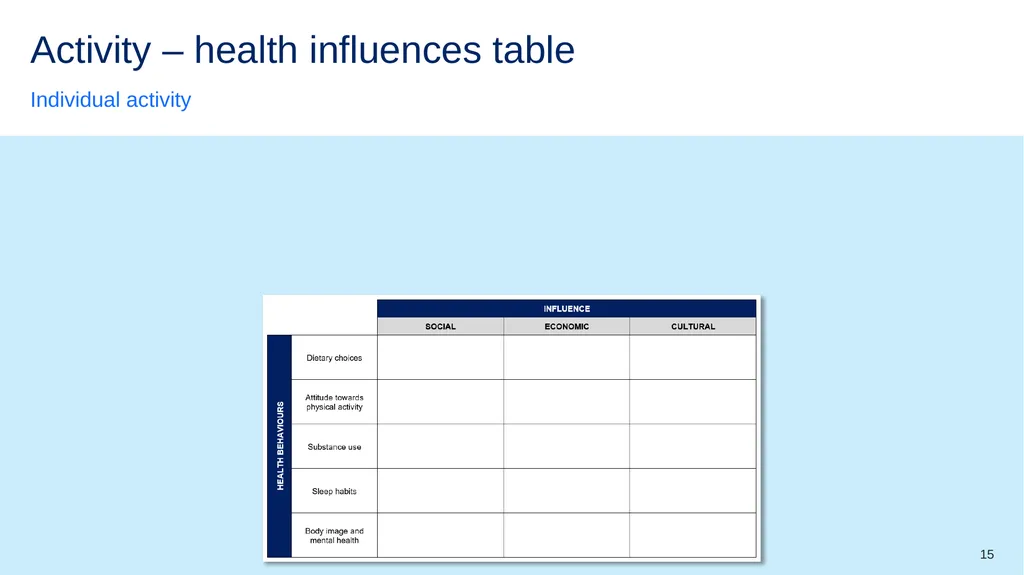
slide15. Activity – health influences table Individual activity Use your worksheet to record examples of how social, cultural, and economic factors may shape decision-making for each of the listed health behaviours. Remember to consider both positive and negative influences! 15<br>
slide16. Image by OpenClipart-Vectors from Pixabay Activity – from surviving to thriving Group activity – research task Instructions
Each member of the group must research one support service from the list provided and complete a PMI chart, recording the positive elements (plus), limitations (minus), and any surprising aspects of the service (interesting).
Reconvene as a group and take turns to share an overview of your service.
As a group, evaluate and rank the services in order of which would be most effective and suitable for young people. 16<br>
slide17. Fuelling for health<br>
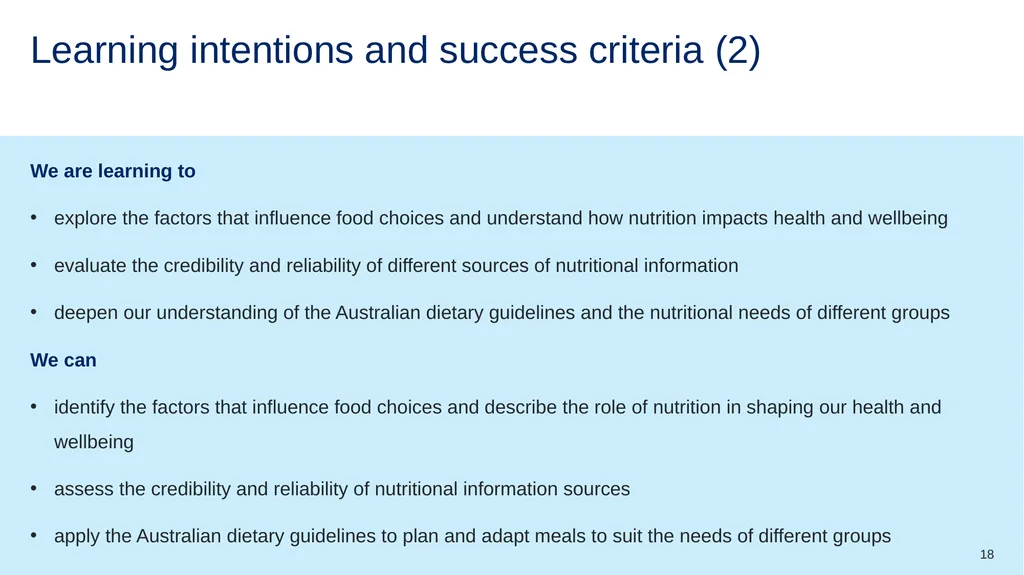
slide18. Learning intentions and success criteria (2) We are learning to
explore the factors that influence food choices and understand how nutrition impacts health and wellbeing
evaluate the credibility and reliability of different sources of nutritional information
deepen our understanding of the Australian dietary guidelines and the nutritional needs of different groups
We can
identify the factors that influence food choices and describe the role of nutrition in shaping our health and wellbeing
assess the credibility and reliability of nutritional information sources
apply the Australian dietary guidelines to plan and adapt meals to suit the needs of different groups 18<br>
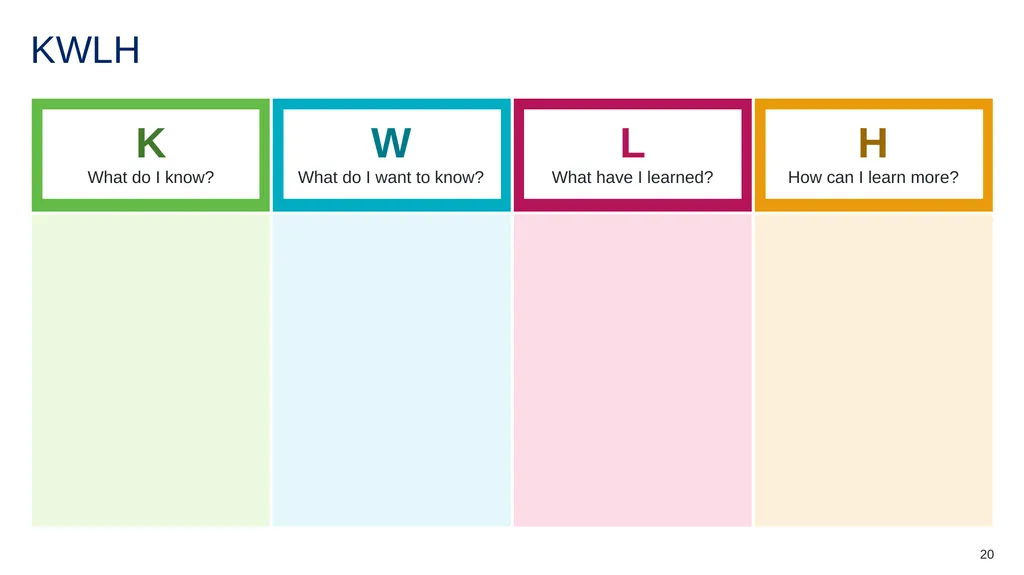
slide19. Image by Nhi Nguyễn Tường from Pixabay Activity – introduction to nutrition and food choices KWLH – activating prior knowledge Instructions
Record what you already know about nutrition and health eating, including definitions, examples and personal experiences, in the K column of the chart.
Record what you would like to learn about these key terms, and any curiosities or questions that you have, in the W column of the chart. 19<br>
slide20. KWLH 20<br>
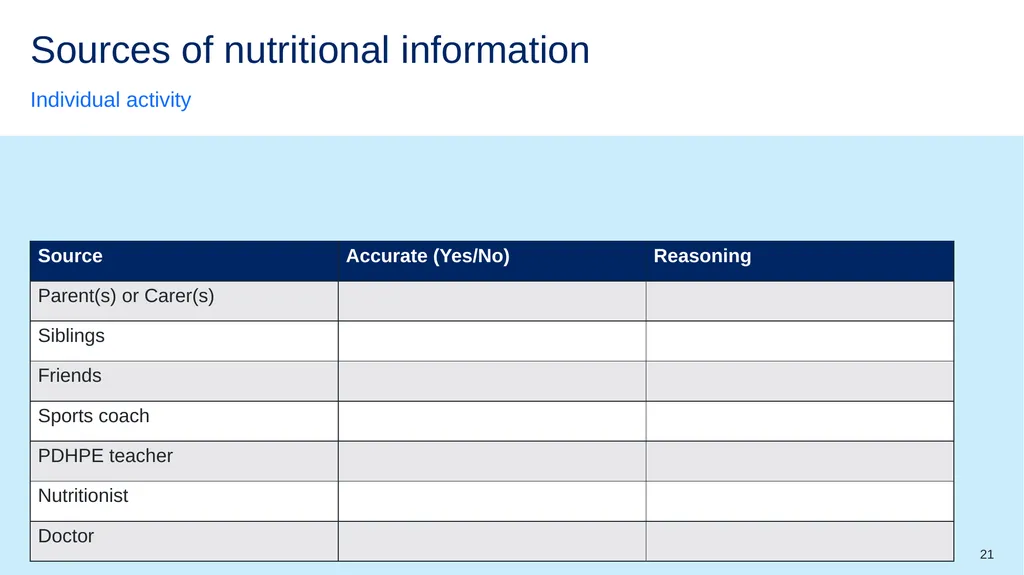
slide21. Sources of nutritional information Individual activity Complete the table by providing a judgement as to the accuracy of each source and clear reasoning to support your judgement. 21<br>
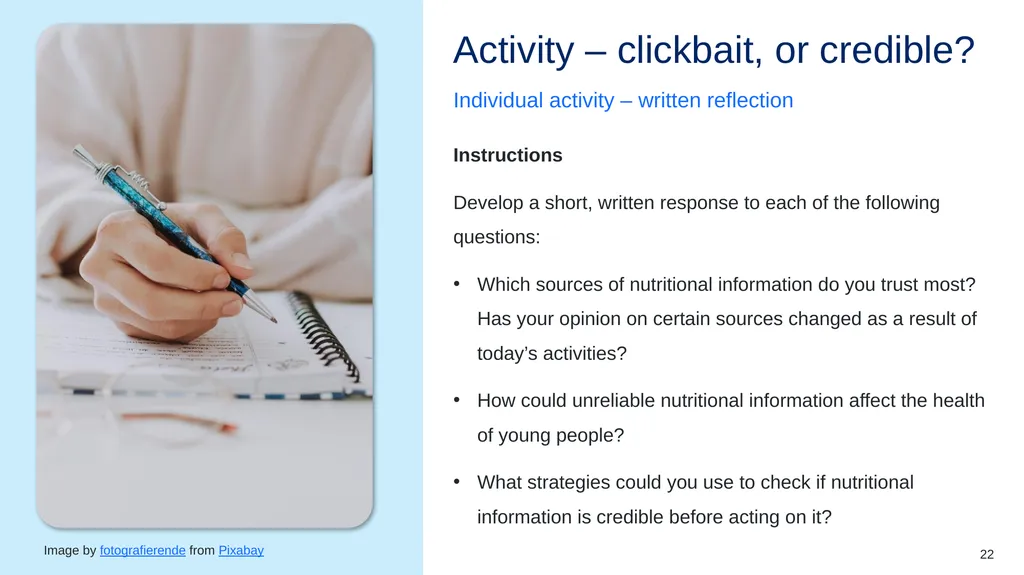
slide22. Activity – clickbait, or credible? Individual activity – written reflection Instructions
Develop a short, written response to each of the following questions:
Which sources of nutritional information do you trust most? Has your opinion on certain sources changed as a result of today’s activities?
How could unreliable nutritional information affect the health of young people?
What strategies could you use to check if nutritional information is credible before acting on it? 22 Image by fotografierende from Pixabay<br>
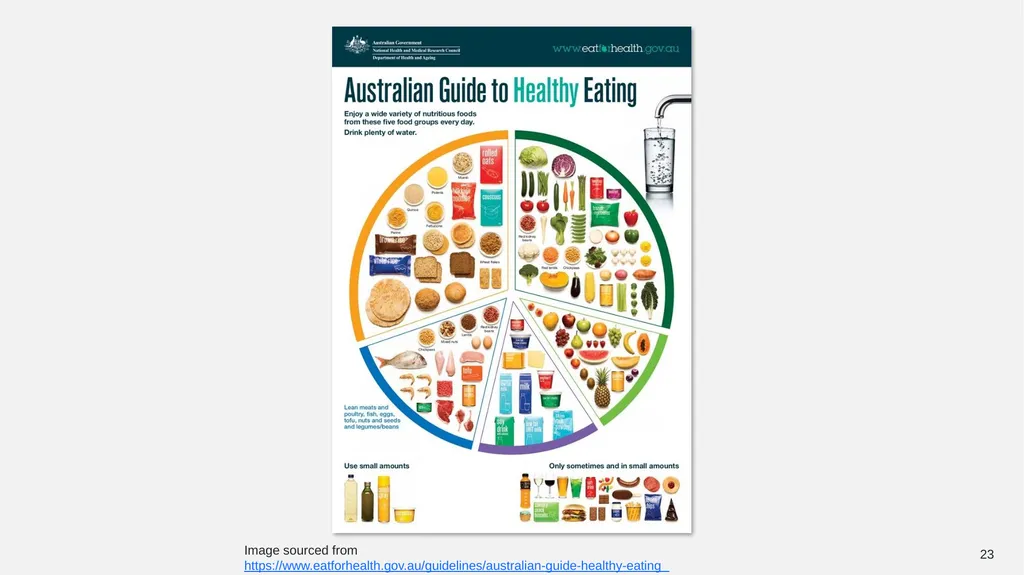
slide23. Australian Guide to Healthy Eating 23 Image sourced from https://www.eatforhealth.gov.au/guidelines/australian-guide-healthy-eating<br>
slide24. Activity – ‘quick quiz’ (1) Australian guide to healthy eating Why is it important to eat a variety of different coloured vegetables and legumes each day?
Because different colours provide different nutrients
Because colour makes food taste better
Because only green vegetables are healthy
Because legumes are high in sugar 24<br>
slide25. Activity – ‘quick quiz’ (2) Australian guide to healthy eating Which of the following is the best way to include more fruit in your diet?
Drink fruit juice every day
Eat fresh fruit whole or cut up as a snack
Only eat canned fruit with syrup
Eat fruit only once a week 25<br>
slide26. Activity – ‘quick quiz’ (3) Australian guide to healthy eating Which type of grain food is recommended by the Australian Guide to Healthy Eating?
Refined white bread and pasta
Wholegrain or high-fibre breads and cereals
Pastries and cakes
Fried rice 26<br>
slide27. Activity – ‘quick quiz’ (4) Australian guide to healthy eating Which of the following is a plant-based source of protein recommended in the Australian Guide to Healthy Eating?
Chicken
Tofu
Cheese
Fish 27<br>
slide28. Activity – ‘quick quiz’ (5) Australian guide to healthy eating What is a healthy choice in the dairy group?
Full cream milk and cream-based desserts only
Reduced-fat milk, yoghurt, and cheese options
Avoid dairy completely
Only eat cheese 28<br>
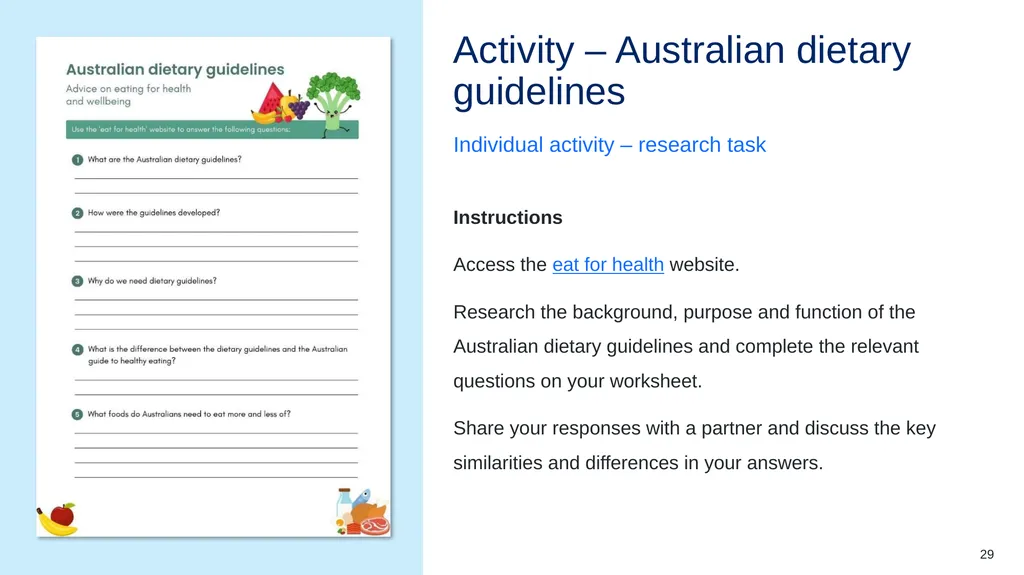
slide29. Activity – Australian dietary guidelines Individual activity – research task Instructions
Access the eat for health website.
Research the background, purpose and function of the Australian dietary guidelines and complete the relevant questions on your worksheet.
Share your responses with a partner and discuss the key similarities and differences in your answers. 29<br>
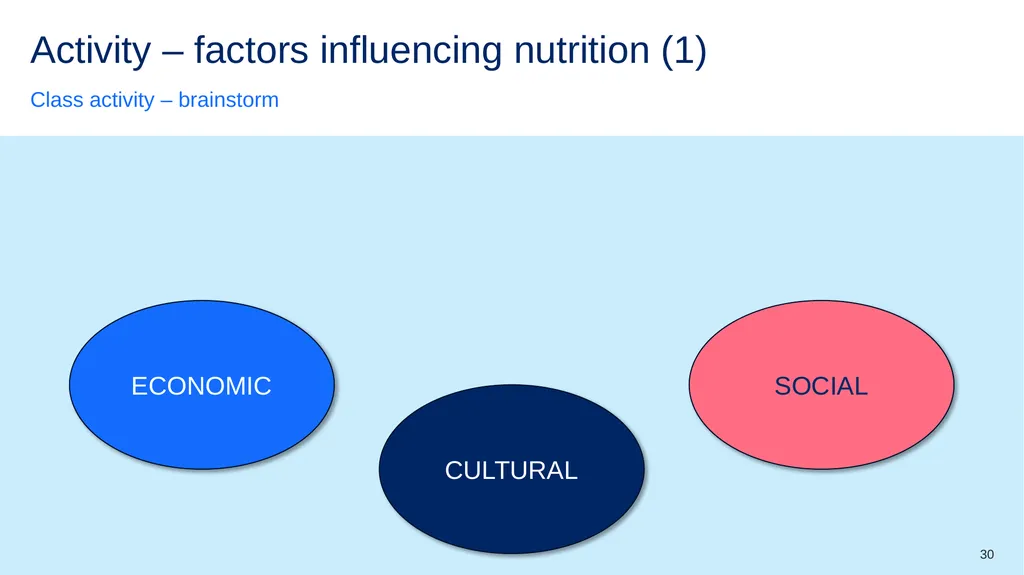
slide30. Activity – factors influencing nutrition (1) Class activity – brainstorm Instructions
Brainstorm the specific influences on our food habits which you believe relate to each category. ECONOMIC CULTURAL SOCIAL 30<br>
slide31. Image by Manfred Steger from Pixabay Activity – factors influencing nutrition (2) Group activity – scenario analysis Instructions
Read each scenario and identify the key influences that may be impacting the person’s food choices.
Classify these influences under the appropriate category (social, cultural or economic).
Make some realistic suggestions for the individual in each scenario to make more positive or health-promoting food choices. 31<br>
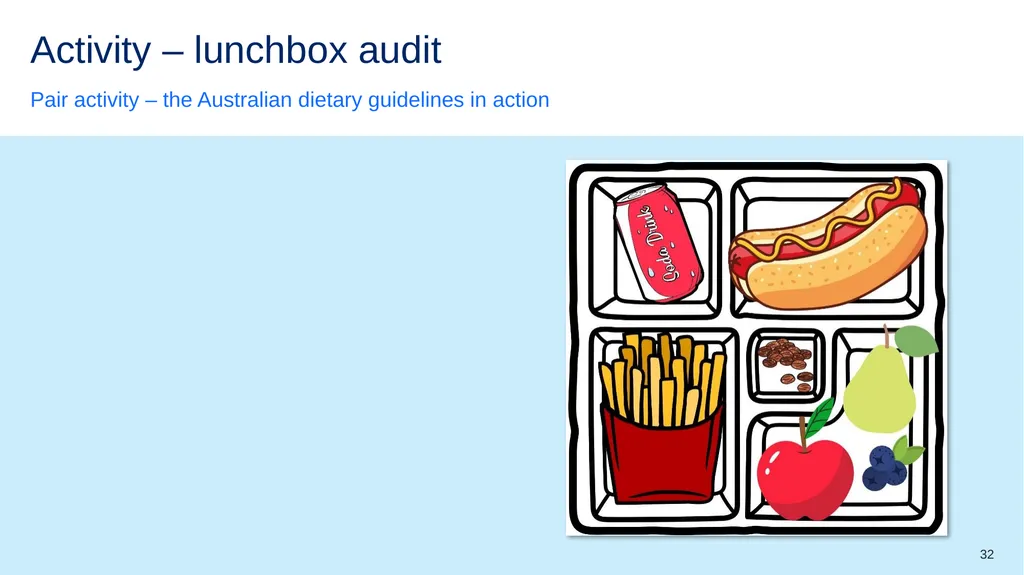
slide32. Activity – lunchbox audit Pair activity – the Australian dietary guidelines in action Instructions
Assess the contents of the lunchbox against the first three of the Australian dietary guidelines. For each guideline:
allocate a score on a scale of 1–5 for how well the contents of the lunchbox align with the guideline
provide a short, written justification explaining your score and the reasons behind your judgement. 32<br>
slide33. Activity – a range of nutritional needs Individual activity – research task Instructions
Prepare a 1-page report or fact sheet which summarises the following:
the specific nutritional needs of your group
the common challenges or barriers these individuals face
suitable strategies or adaptations that could help them in maintaining a balanced diet. 33 Image by poli_ from Pixabay<br>
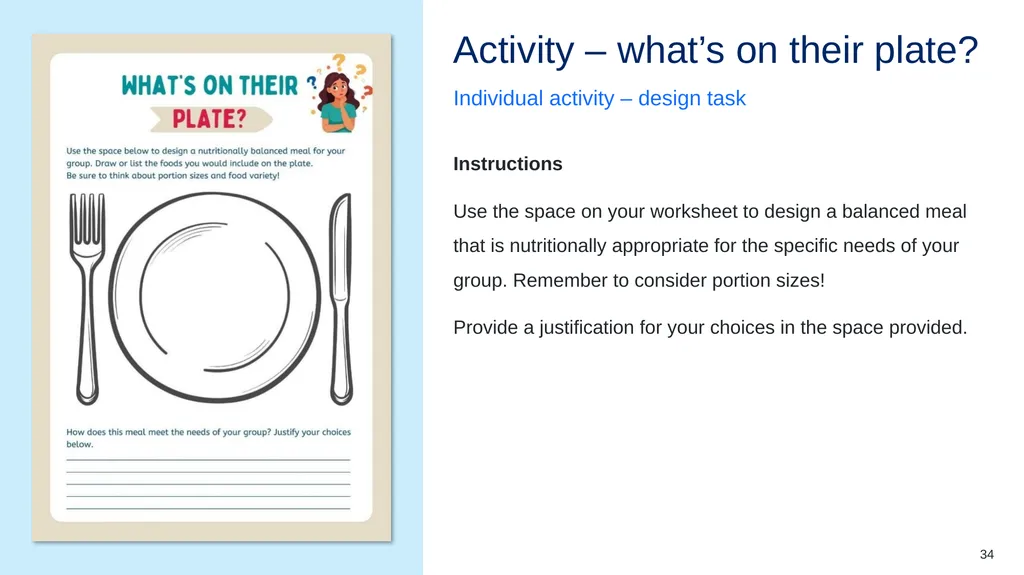
slide34. Activity – what’s on their plate? Individual activity – design task Instructions
Use the space on your worksheet to design a balanced meal that is nutritionally appropriate for the specific needs of your group. Remember to consider portion sizes!
Provide a justification for your choices in the space provided. 34<br>
slide35. Illegal Energy Drinks - Behind the News (3:53) 35<br>
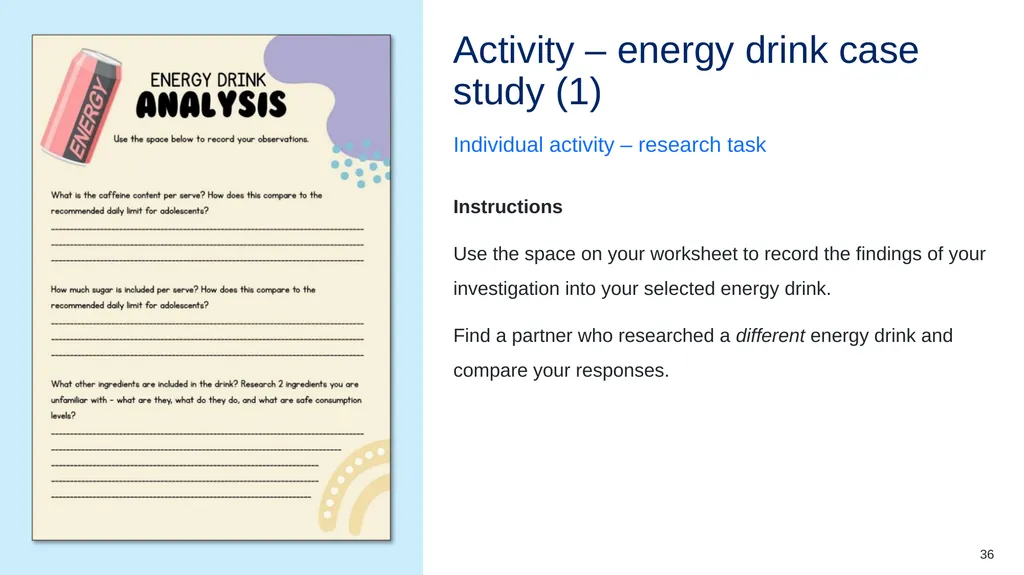
slide36. Activity – energy drink case study (1) Individual activity – research task Instructions
Use the space on your worksheet to record the findings of your investigation into your selected energy drink.
Find a partner who researched a different energy drink and compare your responses. 36<br>
slide37. Image by Arya W from Pixabay Activity – energy drink case study (2) Whole-class discussion Questions to consider
Which energy drink had the highest caffeine or sugar content?
How do these products generally compare to the recommended daily limits for adolescents?
How might regular consumption of energy drinks influence someone’s health?
Would you recommend that young people consume these drinks? Why? 37<br>
slide38. Illustration by Aditya Sahu on Unsplash Activity – persuasive writing Individual activity – letter to the student advisory group Instructions
Your school’s canteen is considering selling energy drinks. You’ve been asked to join a student advisory group who is providing feedback to the canteen operators about the proposal. What is your recommendation?
Develop a response which clearly states your position, includes at least three reasons to support your point of view, and uses evidence from the Australian dietary guidelines or other credible sources to justify your arguments. 38<br>
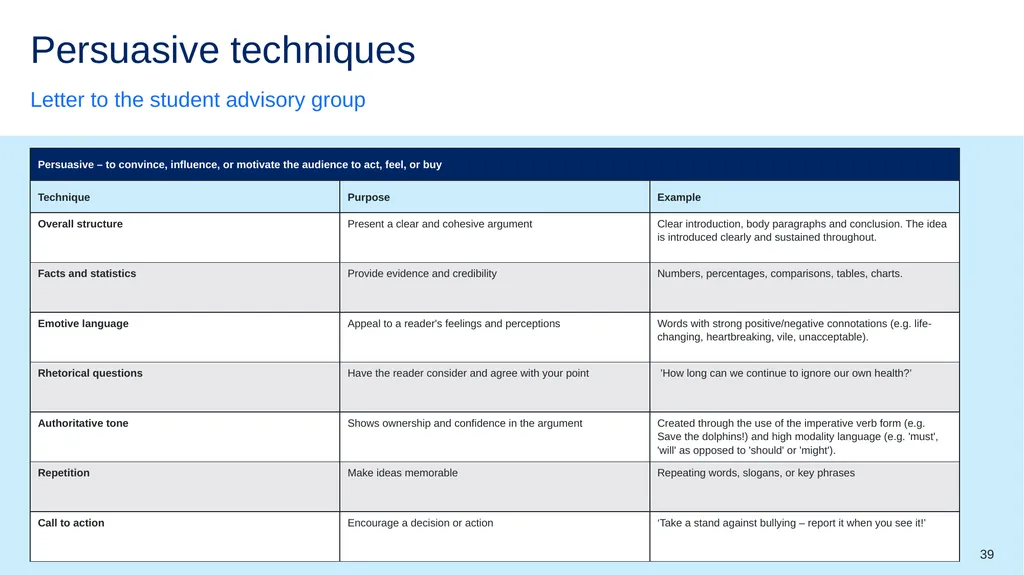
slide39. Persuasive techniques Letter to the student advisory group 39<br>
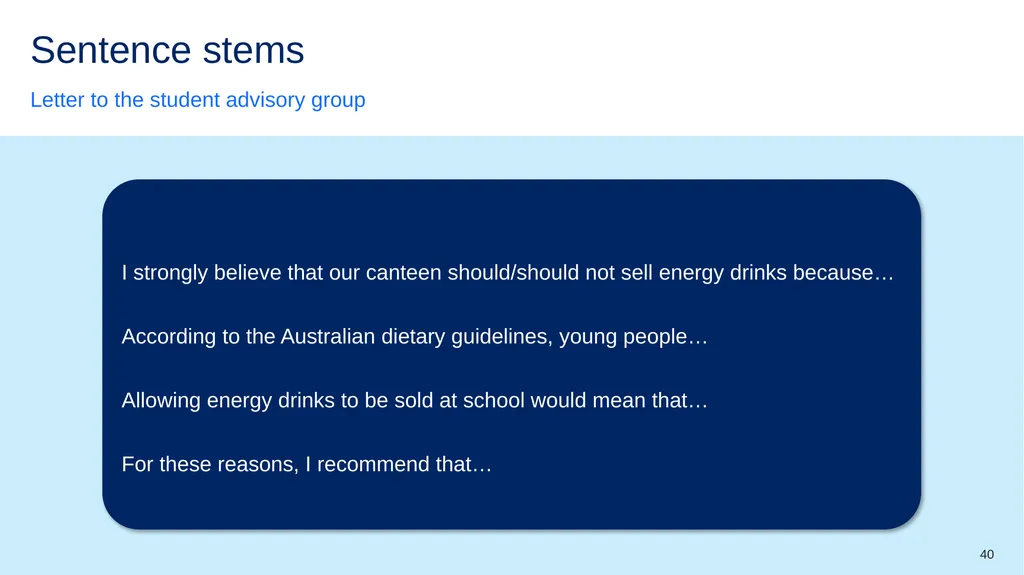
slide40. Sentence stems Letter to the student advisory group I strongly believe that our canteen should/should not sell energy drinks because…
According to the Australian dietary guidelines, young people…
Allowing energy drinks to be sold at school would mean that…
For these reasons, I recommend that… 40<br>
slide41. A positive state of mind<br>
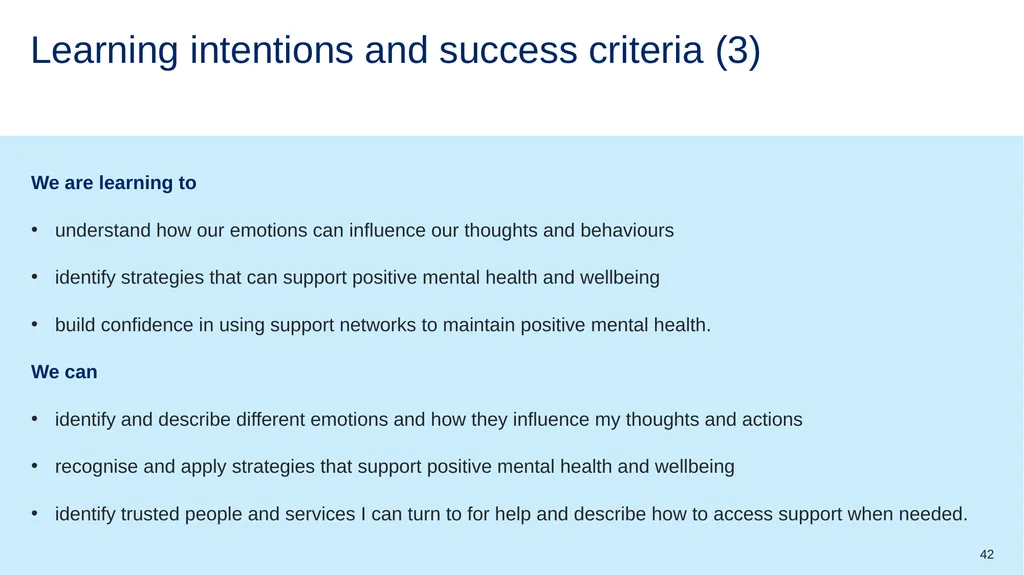
slide42. Learning intentions and success criteria (3) We are learning to
understand how our emotions can influence our thoughts and behaviours
identify strategies that can support positive mental health and wellbeing
build confidence in using support networks to maintain positive mental health.
We can
identify and describe different emotions and how they influence my thoughts and actions
recognise and apply strategies that support positive mental health and wellbeing
identify trusted people and services I can turn to for help and describe how to access support when needed. 42<br>
slide43. Activity – understanding our emotions (2) Group activity – scenario analysis Instructions
Review each scenario.
Discuss the range of emotions which are likely to be felt in each instance.
Use the language from ‘feelings wheel’ to identify each emotion correctly and record this information on the back of the scenario. 43 Illustration by Deep on Unsplash<br>
slide44. Photo by Fa Barboza on Unsplash Activity – understanding our emotions (3) Individual activity – written reflection Instructions
Complete a short, written reflection for one scenario which responds to the following:
What emotions or feelings would I have in this situation?
How might these emotions or feels impact my thinking and behaviour?
What strategies could I use to respond in a positive way? 44<br>
slide45. Activity – unpacking mental health (1) Whole-class discussion ‘Mental health is a state of mental well-being that enables people to cope with the stresses of life, realise their abilities, learn well and work well, and contribute to their community.’
World Health Organisation (WHO) 45 Image by Shawn Suttle from Pixabay<br>
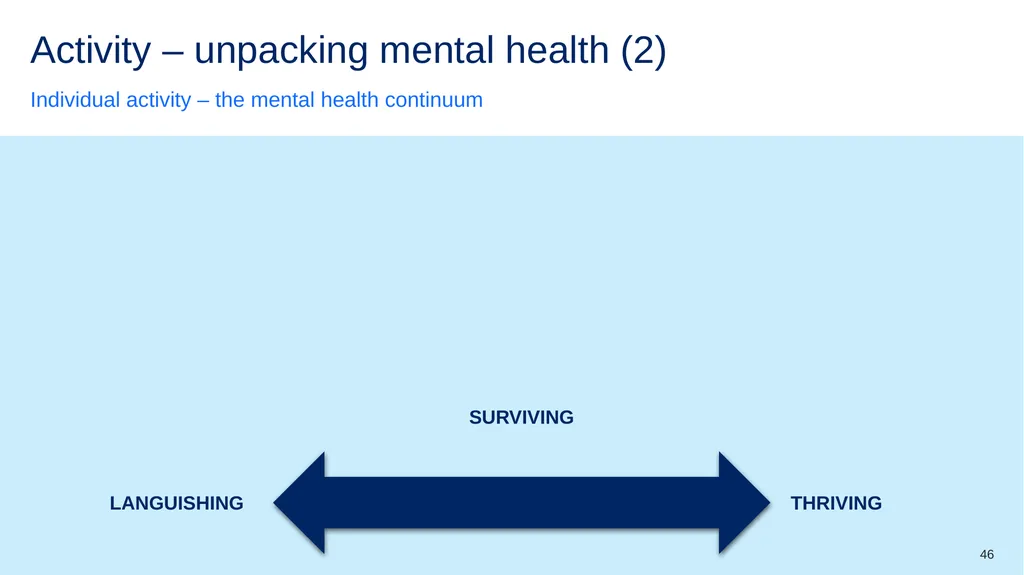
slide46. Activity – unpacking mental health (2) Individual activity – the mental health continuum Instructions
Draw a continuum in your workbooks and label one end ‘languishing’, the middle ‘surviving’ and the other end ‘thriving’.
Brainstorm as many behaviours as you can think of for each point on the continuum. LANGUISHING SURVIVING THRIVING 46<br>
slide47. Image by Zizitom from Pixabay Activity – unpacking mental health (3) Whole-class discussion Questions to consider
Is our mental health a fixed state, or is it constantly shifting?
For behaviours that are towards the ‘languishing’ end of the continuum, what would some realistic, practical coping or support strategies be?
For behaviours that are towards the ‘flourishing’ end of the continuum, what could we do to sustain and support them? 47<br>
slide48. Photo by Nathália Rosa on Unsplash Activity – body image Class activity – brainstorm Instructions
Brainstorm the various influences you can think of that might affect our body image, including where we get ideas about what bodies should look like.
Turn to a partner to share your thinking.
Share your ideas with the class and work together to develop a list of the seven most common influences. 48<br>
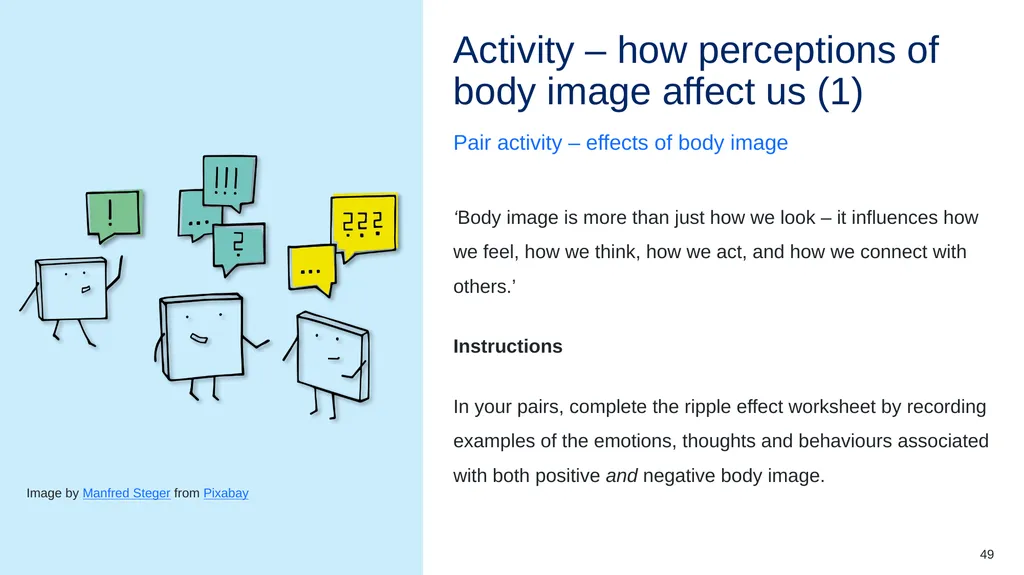
slide49. Image by Manfred Steger from Pixabay Activity – how perceptions of body image affect us (1) Pair activity – effects of body image ‘Body image is more than just how we look – it influences how we feel, how we think, how we act, and how we connect with others.’
Instructions
In your pairs, complete the ripple effect worksheet by recording examples of the emotions, thoughts and behaviours associated with both positive and negative body image. 49<br>
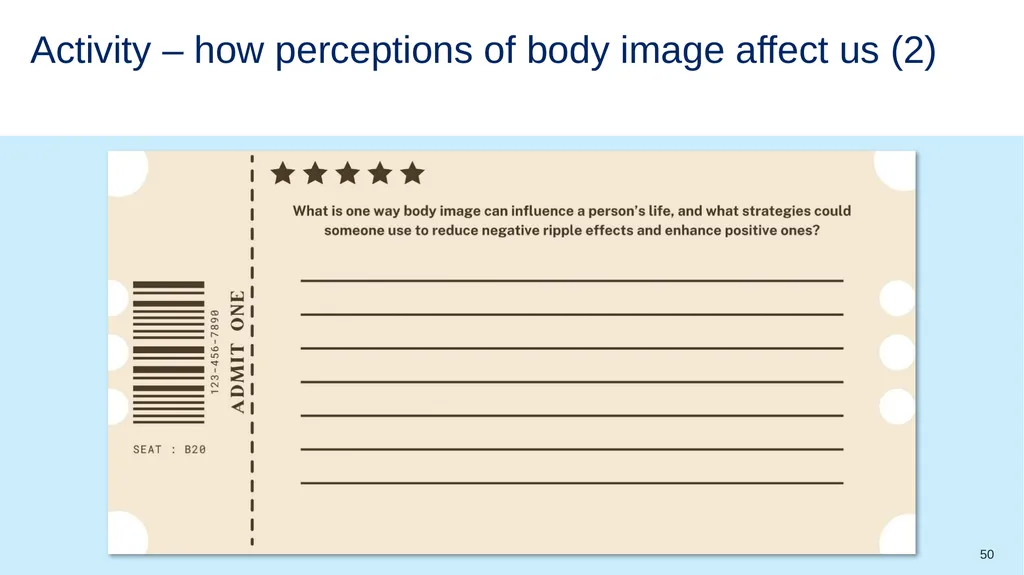
slide50. Activity – how perceptions of body image affect us (2) 50<br>
slide51. Let's Talk Eating Disorders (4:56) 51<br>
slide52. Activity – eating disorders – fact vs. fiction (1) Group activity Instructions
Consider each of the eating disorder statement cards that have been provided.
Sort each of the statements into piles labelled ‘True’, ‘Untrue’ or ‘Not sure’. 52 Image by Muhammad Naufal Subhiansyah from Pixabay<br>
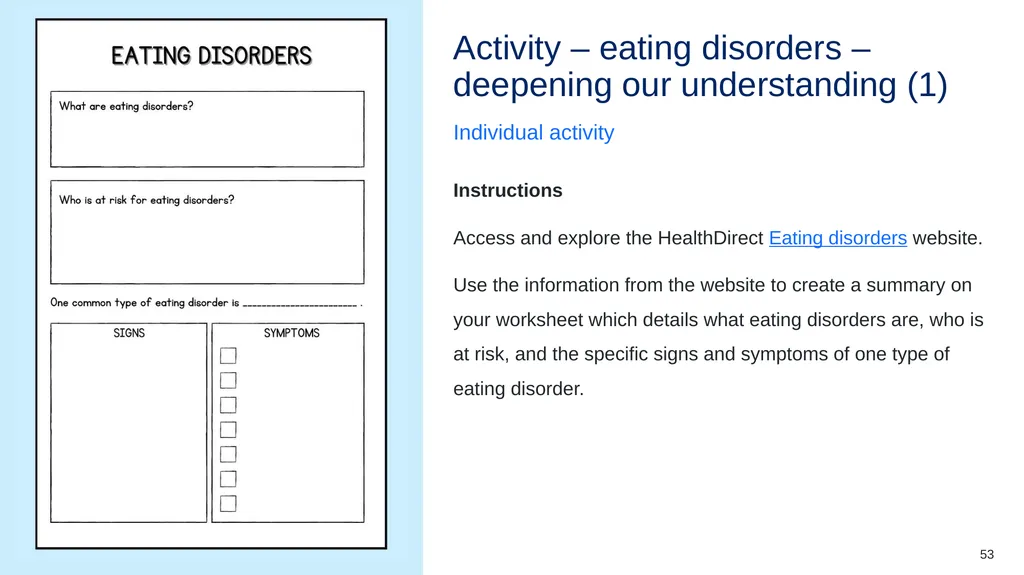
slide53. Activity – eating disorders – deepening our understanding (1) Individual activity Instructions
Access and explore the HealthDirect Eating disorders website.
Use the information from the website to create a summary on your worksheet which details what eating disorders are, who is at risk, and the specific signs and symptoms of one type of eating disorder. 53<br>
slide54. Activity – eating disorders – deepening our understanding (2) Instructions
Working individually, complete a short, written reflection on your learning. Use the following prompts to guide your response.
How can an eating disorder affect a person’s health? Consider the holistic nature of health in your response.
What are some factors that might increase a person’s risk of developing an eating disorder, and how could understanding these risk factors help in prevention or early intervention?
Why is it important to recognise the signs and symptoms of an eating disorder early, and how could this knowledge help you support someone who may be struggling? 54<br>
slide55. Activity – eating disorders – fact vs. fiction (2) Group activity Instructions
Analyse your case study and identify the following:
Warning signs (e.g. the physical, psychological or behavioural signs that the person may be at risk of an eating disorder).
Risk factors (e.g. the social-cultural, personal and psychological risk factors that might increase the person’s vulnerability)
Support strategies (e.g. the actions or resources could help this person. Consider trusted adults, school counsellors, health professionals or support services). 55<br>
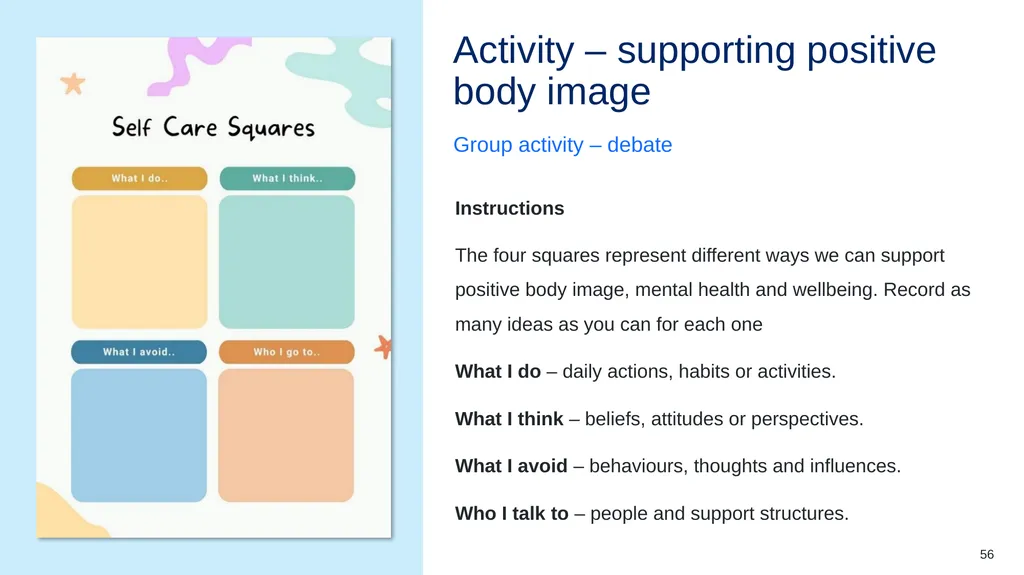
slide56. Activity – supporting positive body image Group activity – debate Instructions
The four squares represent different ways we can support positive body image, mental health and wellbeing. Record as many ideas as you can for each one
What I do – daily actions, habits or activities.
What I think – beliefs, attitudes or perspectives.
What I avoid – behaviours, thoughts and influences.
Who I talk to – people and support structures. 56<br>
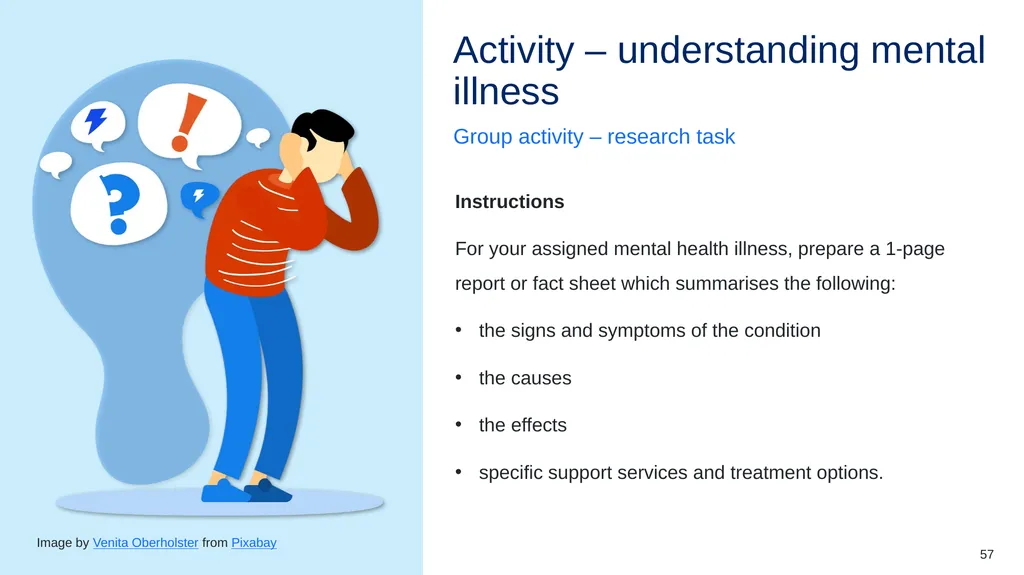
slide57. Activity – understanding mental illness Group activity – research task Instructions
For your assigned mental health illness, prepare a 1-page report or fact sheet which summarises the following:
the signs and symptoms of the condition
the causes
the effects
specific support services and treatment options. 57 Image by Venita Oberholster from Pixabay<br>
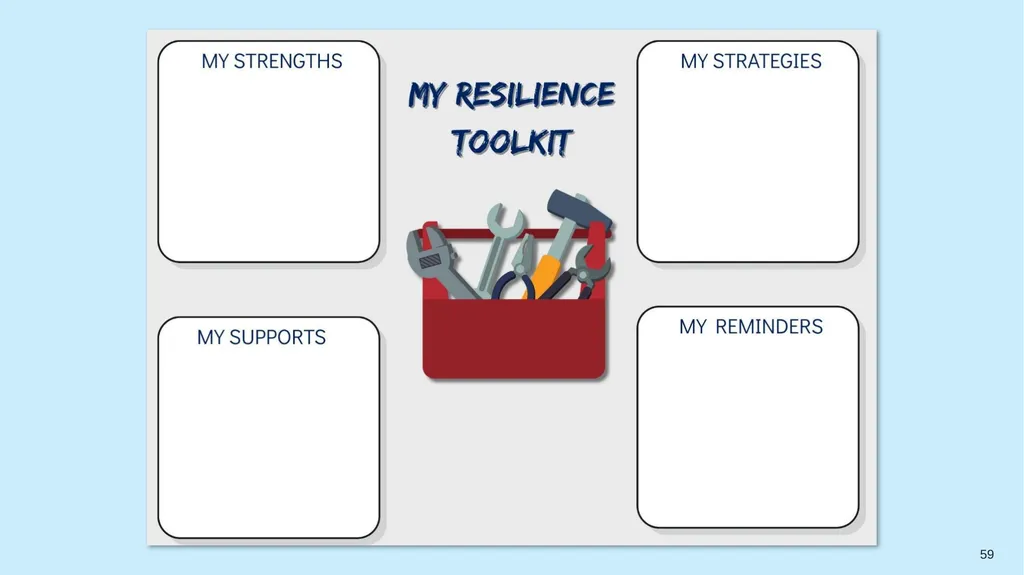
slide58. Activity – the role of resilience Individual activity – resilience toolkit Instructions
In the ‘My Strengths’ section, identify three personal qualities that help you cope with challenges.
In the ‘My Supports’ section, identify three trusted people or networks you can turn to when you need help.
In the ‘My Strategies’ section, identify three coping techniques that you could use when facing a challenge.
In the ‘My Reminders’ section, identify three short affirmations or quotes which help you stay positive when things are tough. 58<br>
slide59. My Resilience Toolkit 59<br>
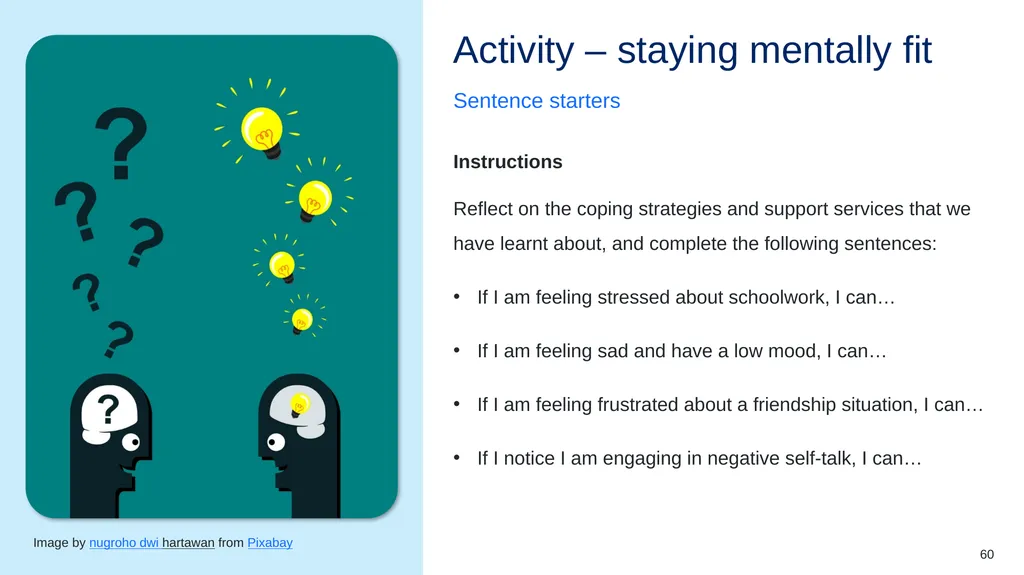
slide60. Activity – staying mentally fit Sentence starters Instructions
Reflect on the coping strategies and support services that we have learnt about, and complete the following sentences:
If I am feeling stressed about schoolwork, I can…
If I am feeling sad and have a low mood, I can…
If I am feeling frustrated about a friendship situation, I can…
If I notice I am engaging in negative self-talk, I can… 60 Image by nugroho dwi hartawan from Pixabay<br>
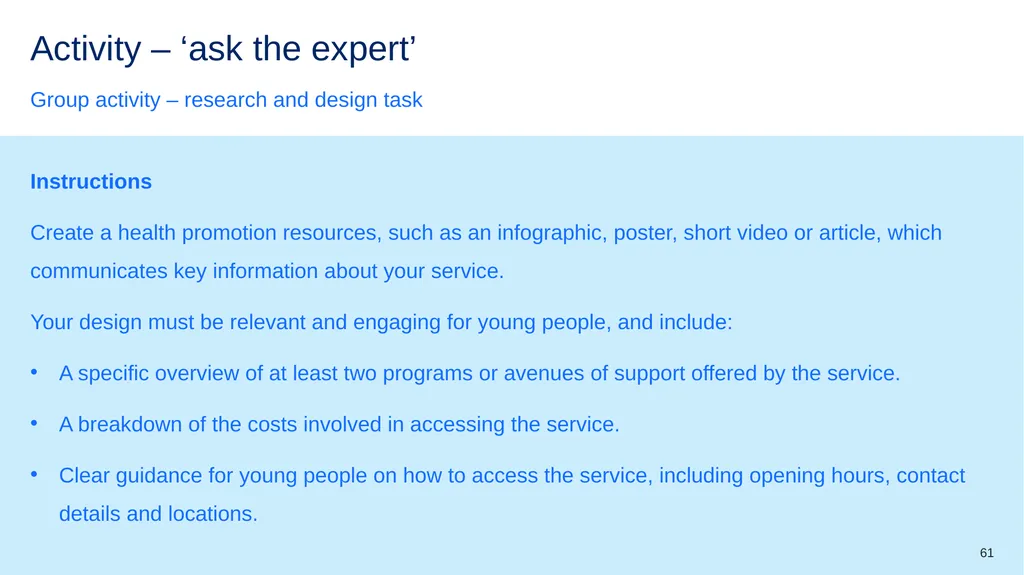
slide61. Activity – ‘ask the expert’ Group activity – research and design task Instructions
Create a health promotion resources, such as an infographic, poster, short video or article, which communicates key information about your service.
Your design must be relevant and engaging for young people, and include:
A specific overview of at least two programs or avenues of support offered by the service.
A breakdown of the costs involved in accessing the service.
Clear guidance for young people on how to access the service, including opening hours, contact details and locations. 61<br>
slide62. Navigating risk – drugs and alcohol<br>
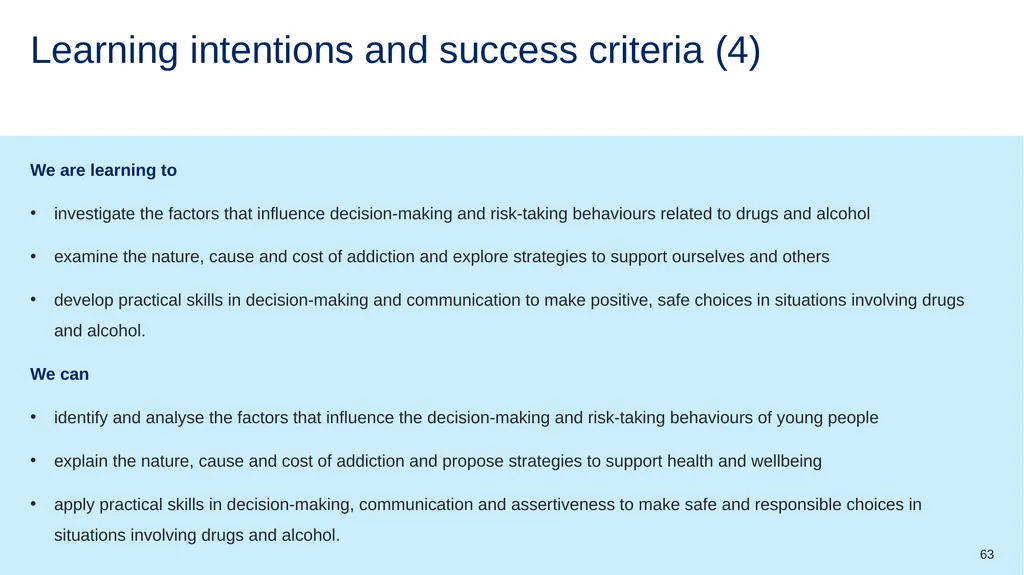
slide63. Learning intentions and success criteria (4) We are learning to
investigate the factors that influence decision-making and risk-taking behaviours related to drugs and alcohol
examine the nature, cause and cost of addiction and explore strategies to support ourselves and others
develop practical skills in decision-making and communication to make positive, safe choices in situations involving drugs and alcohol.
We can
identify and analyse the factors that influence the decision-making and risk-taking behaviours of young people
explain the nature, cause and cost of addiction and propose strategies to support health and wellbeing
apply practical skills in decision-making, communication and assertiveness to make safe and responsible choices in situations involving drugs and alcohol. 63<br>
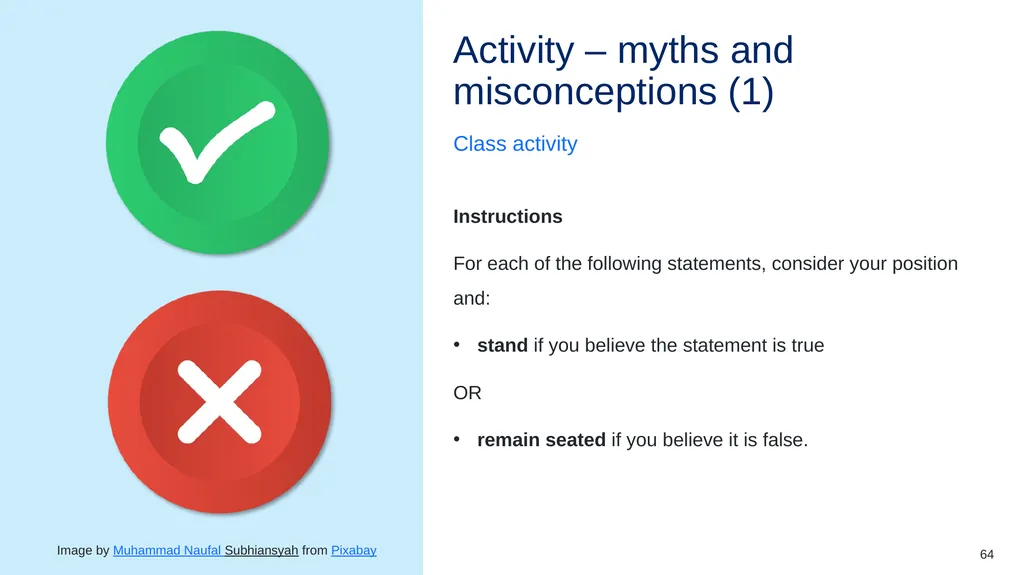
slide64. Activity – myths and misconceptions (1) Class activity Instructions
For each of the following statements, consider your position and:
stand if you believe the statement is true
OR
remain seated if you believe it is false. 64 Image by Muhammad Naufal Subhiansyah from Pixabay<br>
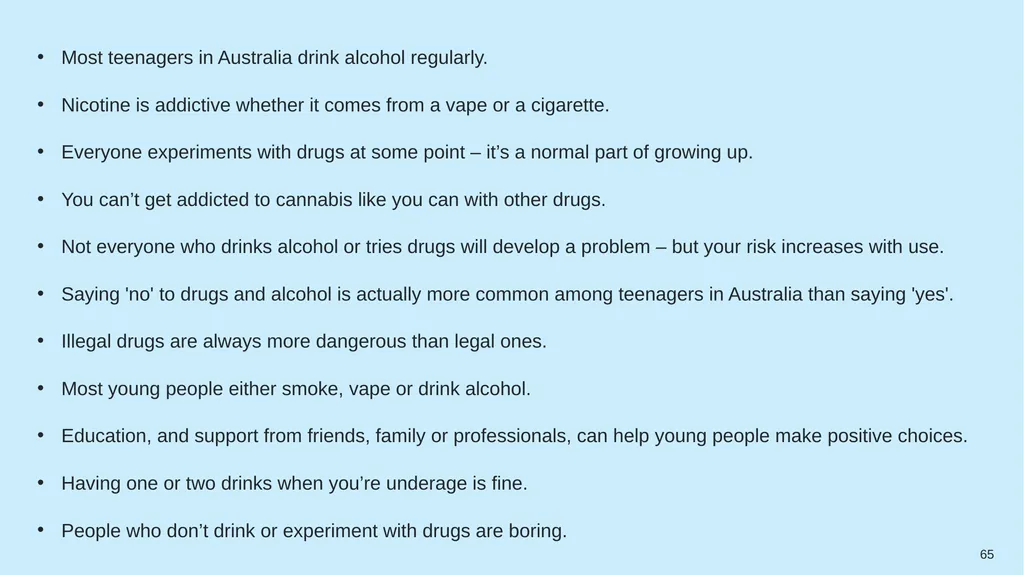
slide65. Activity – myths and misconceptions (2) Most teenagers in Australia drink alcohol regularly.
Nicotine is addictive whether it comes from a vape or a cigarette.
Everyone experiments with drugs at some point – it’s a normal part of growing up.
You can’t get addicted to cannabis like you can with other drugs.
Not everyone who drinks alcohol or tries drugs will develop a problem – but your risk increases with use.
Saying 'no' to drugs and alcohol is actually more common among teenagers in Australia than saying 'yes'.
Illegal drugs are always more dangerous than legal ones.
Most young people either smoke, vape or drink alcohol.
Education, and support from friends, family or professionals, can help young people make positive choices.
Having one or two drinks when you’re underage is fine.
People who don’t drink or experiment with drugs are boring. 65<br>
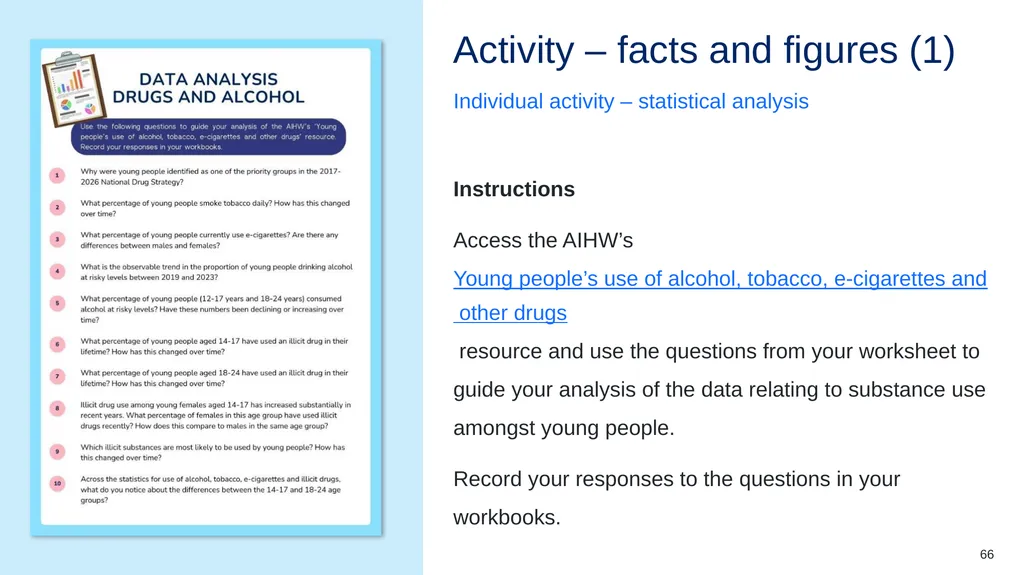
slide66. Activity – facts and figures (1) Individual activity – statistical analysis Instructions
Access the AIHW’s Young people’s use of alcohol, tobacco, e-cigarettes and other drugs resource and use the questions from your worksheet to guide your analysis of the data relating to substance use amongst young people.
Record your responses to the questions in your workbooks. 66<br>
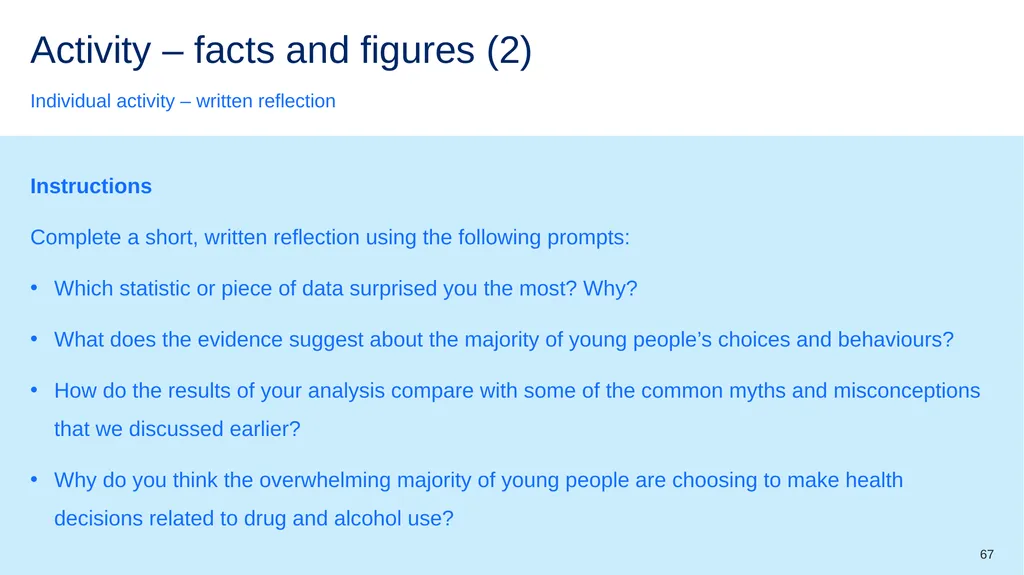
slide67. Activity – facts and figures (2) Individual activity – written reflection Instructions
Complete a short, written reflection using the following prompts:
Which statistic or piece of data surprised you the most? Why?
What does the evidence suggest about the majority of young people’s choices and behaviours?
How do the results of your analysis compare with some of the common myths and misconceptions that we discussed earlier?
Why do you think the overwhelming majority of young people are choosing to make health decisions related to drug and alcohol use? 67<br>
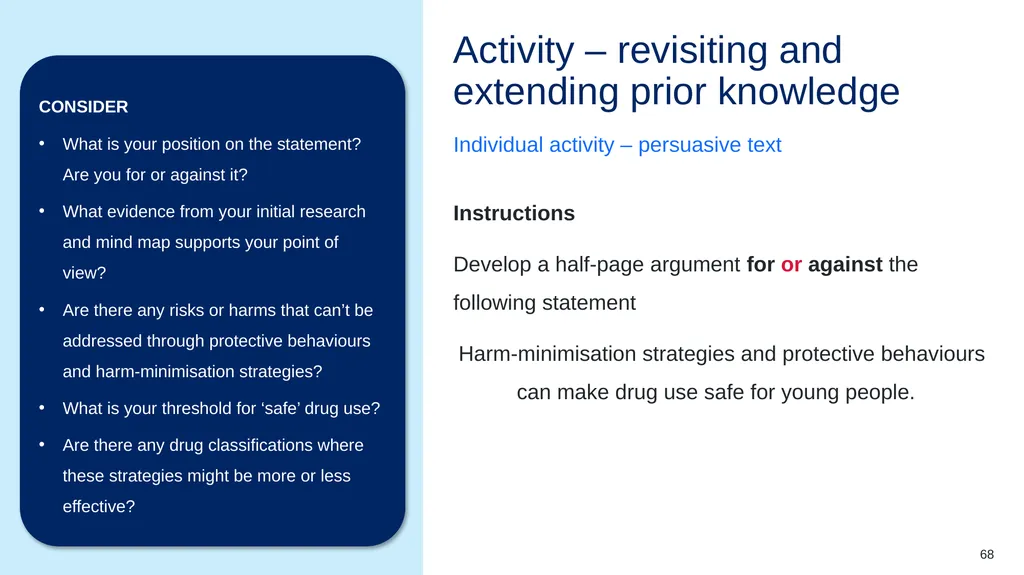
slide68. Activity – revisiting and extending prior knowledge CONSIDER
What is your position on the statement? Are you for or against it?
What evidence from your initial research and mind map supports your point of view?
Are there any risks or harms that can’t be addressed through protective behaviours and harm-minimisation strategies?
What is your threshold for ‘safe’ drug use?
Are there any drug classifications where these strategies might be more or less effective? Instructions
Develop a half-page argument for or against the following statement
Harm-minimisation strategies and protective behaviours can make drug use safe for young people. Individual activity – persuasive text 68<br>
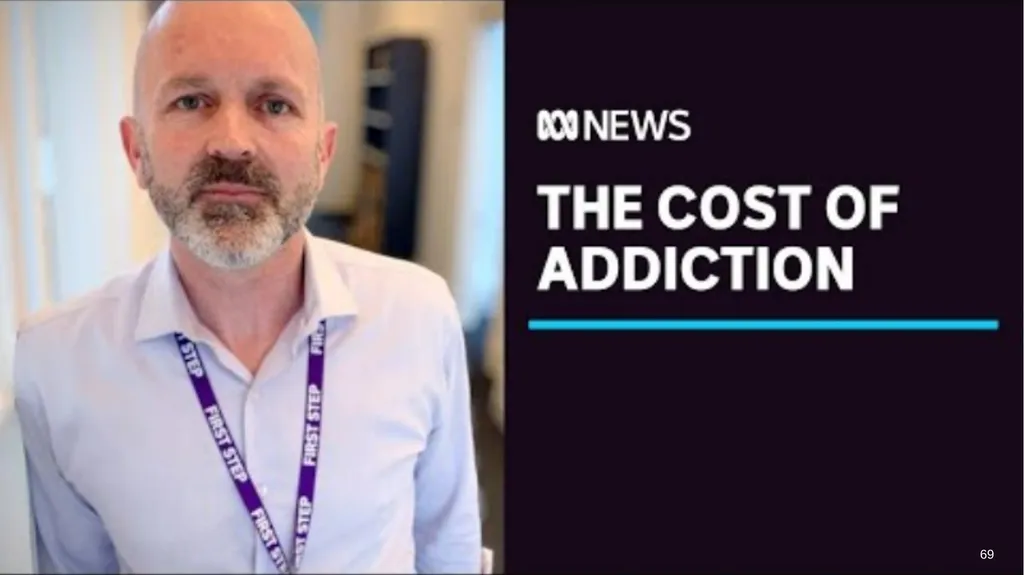
slide69. 69 Drug, alcohol and smoking addiction costing Australia billions, new report shows | ABC News (1:54)<br>
slide70. Image by YeriLee from Pixabay Activity – what influences our decision-making? Individual activity – short story analysis Instructions
Analyse the story and make short annotations which identify:
each of the decisions being made by the characters in the story
the factors that you believe are influencing the decision-making process.
Share a summary of your story and an overview of your annotations with a partner. 70<br>
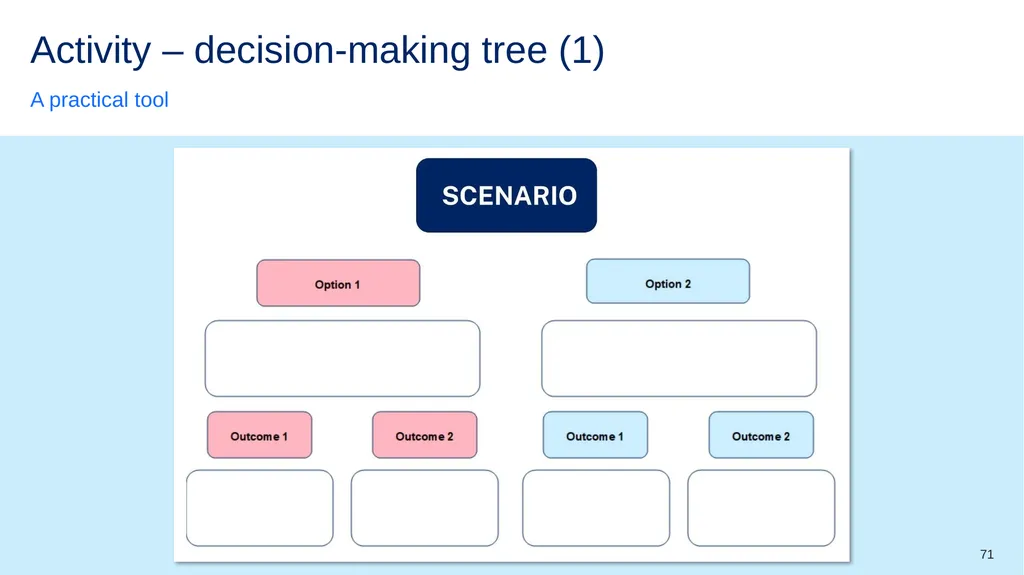
slide71. Activity – decision-making tree (1) A practical tool 71<br>
slide72. Image by Gerd Altmann from Pixabay Activity – decision-making tree (2) Individual activity – scenario analysis Instructions
Consider your scenario.
Identify the ‘decision point’ and the various options available to the characters.
Complete both sides of the decision-making tree, outlining the specific details of each choice and the potential outcomes that may follow. 72<br>
slide73. References (1) This presentation contains NSW Curriculum and syllabus content. The NSW Curriculum is developed by the NSW Education Standards Authority. This content is prepared by NESA for and on behalf of the Crown in the right of the State of New South Wales. The material is protected by Crown copyright.
Please refer to the NESA Copyright Disclaimer for more information https://educationstandards.nsw.edu.au/wps/portal/nesa/mini-footer/copyright.
NESA holds the only official and up-to-date versions of the NSW Curriculum and syllabus documents. Please visit the NSW Education Standards Authority (NESA) website https://educationstandards.nsw.edu.au/wps/portal/nesa/home and the NSW Curriculum website https://curriculum.nsw.edu.au. Personal Development, Health and Physical Education 7–10 Syllabus © NSW Education Standards Authority (NESA) for and on behalf of the Crown in right of the State of New South Wales, 2024.
Australian Government Department of Health, Disability and Ageing (2021). Types of drugs. Accessed July 30, 2025, from https://www.health.gov.au/topics/drugs/about-drugs/types-of-drugs
Australian Government Department of Health, Disability and Ageing (n.d.). Australian Guide to Healthy Eating. Accessed August 1, 2025, from https://www.eatforhealth.gov.au/guidelines/australian-guide-healthy-eating
Australian Government Department of Health, Disability and Ageing (n.d.). The guidelines. Accessed August 5, 2025, from https://www.eatforhealth.gov.au/guidelines/guidelines 73<br>
slide74. References (2) Australian Institute of Health and Welfare (2021). Australia’s youth: Nutrition. Accessed August 4, 2025, from https://www.aihw.gov.au/reports/children-youth/nutrition
Australian Institute of Health and Welfare (2024). Young people’s use of alcohol, tobacco, e-cigarettes and other drugs. Accessed August 5, 2025, from https://www.aihw.gov.au/reports/children-youth/young-people-alcohol-smoking-drugs
Calm (n.d.). Feelings wheel. Accessed August 1, 2025, from https://www.calm.com/s/Feelings-Wheel-Download-ables.pdf
Cancer Council NSW (n.d.). Lunch box builder. Accessed July 30, 2025, from https://www.eatforhealth.gov.au/guidelines/guidelines
HealthDirect (2023). Eating disorders. Accessed August 13, 2025 from https://www.healthdirect.gov.au/eating-disorders
Healthdirect (2025). What is addiction? Accessed August 11, 2025, from https://www.healthdirect.gov.au/what-is-addiction
NSW Health (2017). Energy drinks and caffeine. Retrieved July 28 2025, from https://www.health.nsw.gov.au/aod/resources/Factsheets/energy-drinks-and-caffeine.pdf
The Butterfly Foundation (n.d.) Eating disorders and body image. Accessed August 13, 2025 from https://butterfly.org.au/eating-disorders-body-image/
World Health Organization (n.d.). Constitution of the World Health Organization. Accessed July 30, 2025, from https://www.who.int/about/governance/constitution 74<br>
slide75. Copyright © State of New South Wales (Department of Education), 2025 The copyright material published in this resource is subject to the Copyright Act 1968 (Cth) and is owned by the NSW Department of Education or, where indicated, by a party other than the NSW Department of Education (third-party material).
Copyright material available in this resource and owned by the NSW Department of Education is licensed under a Creative Commons Attribution 4.0 International (CC BY 4.0) license.
This license allows you to share and adapt the material for any purpose, even commercially.
Attribution should be given to © State of New South Wales (Department of Education), 2025.
Material in this resource not available under a Creative Commons license:
the NSW Department of Education logo, other logos and trademark-protected material
Material owned by a third party that has been reproduced with permission. You will need to obtain permission from the third party to reuse its material.
Links to third-party material and websites
Please note that the provided (reading/viewing material/list/links/texts) are a suggestion only and implies no endorsement, by the New South Wales Department of Education, of any author, publisher, or book title. School principals and teachers are best placed to assess the suitability of resources that would complement the curriculum and reflect the needs and interests of their students.
If you use the links provided in this document to access a third-party’s website, you acknowledge that the terms of use, including licence terms set out on the third-party’s website apply to the use which may be made of the materials on that third-party website or where permitted by the Copyright Act 1968 (Cth). The department accepts no responsibility for content on third-party websites.<br>
Classroom teachers are encouraged to add and adapt slides as required to meet the needs of their students.
Save a copy of the file to make changes to the slide deck. Go to File > Download a Copy (this downloads a copy to the computer to edit in the PowerPoint app).
To convert the PowerPoint to Google Slides:
Upload the file into Google Drive and open it.
Go to File > Save as Google Slides.
(Note – conversion may cause formatting changes in the slides.) 1<br>
slide2. Thriving in health and wellness PDHPE – Stage 5 – Year 9 Term 3 Illustration by Salman Ahmad on Unsplash<br>
slide3. Lessons 3<br>
slide4. Holistic health habits<br>
slide5. Learning intentions and success criteria (1) We are learning to
explore the holistic, interrelated nature of health and the connection between the five dimensions
investigate how social, cultural, and economic factors shape health behaviours and wellbeing.
We can
describe the dimensions of health and explain the ways in which the dimensions of health influence and connect with each other
recognise and categorise social, cultural, and economic factors that influence health behaviours in various contexts. 5<br>
slide6. Activity – what is health? Pair activity – turn and talk ‘Health is a state of complete physical, mental and social well-being and not merely the absence of disease or infirmity’
World Health Organisation (WHO)
Instructions
With your partner, consider what you like about this definition and what you wonder about this definition. 6 Image by Htc Erl from Pixabay<br>
slide7. Activity – what is wellbeing? Venn Diagram 7<br>
slide8. Activity – dimensions of health Whole-class discussion Consider
What words come to mind when you think of each dimension?
What are examples of health promoting behaviours for each dimension?
What are examples of negative health behaviours for each dimension?
What is one example of how health in one dimension of impacts health in another dimension? 8<br>
slide9. Activity – holistic health impacts (1) Group activity Instructions
Work together to discuss each health behaviour and use coloured pens to connect each behaviour to the dimension/s of health that it impacts.
For example:
‘regular exercise’ might connect to physical health and mental health
‘friendship breakdown’ might connect to social and emotional health. Image by Zizitom from Pixabay 9<br>
slide10. Photo by Zainul Yasni on Unsplash Activity – holistic health impacts (2) Scenario analysis Sample scenario
Alex broke his leg playing basketball and how now must take a break from sports for several months. Alex feels frustrated because his social life revolves around the basketball team.
Being unable to play, Alex notices he’s gaining weight and feels more tired during the day. His mood has also been low, and he’s finding it harder to focus on schoolwork. 10<br>
slide11. Activity – holistic health scenarios Individual analysis Instructions
Review your holistic health scenario.
Use the scenario as a stimulus to respond to the questions on your worksheet.
Compare and contrast your responses with someone who analysed the same scenario. 11<br>
slide12. Activity – my health over time Sentence starters
Although it may seem as though the dimensions of health are separate, the truth is…
One clear example of how one dimension of health influences another is seen through…
If a person’s… health declines, the impact on their… health could be…
For many people, improving… dimension of health can also lead to a significant improvement in… Individual activity – written reflection Instructions
Consider and develop a short, written reflection in response to the following stimulus
To what extent can a change in one dimension of health influence the other dimensions of health?
Sentence starters have been provided to assist you. 12<br>
slide13. Image by Mohamed Hassan from Pixabay Activity – lifestyle behaviours (1) Individual activity – pie chart Instructions
Consider a typical week and add up the time you spend on:
Sleeping
Exercising
Sedentary activities (not including screen time)
Using a device/screen
Socialising
Using Microsoft Excel, develop a pie chart to show the allocation of time. 13<br>
slide14. Image by Clker-Free-Vector-Images from Pixabay Activity – lifestyle behaviours (2) Individual activity – written reflection Instructions
Reflect on your pie chart and propose 5 ways you could achieve a more balanced lifestyle.
Or, if your lifestyle is already balanced, propose 5 ways you could ensure you are able to maintain your current balance.
For each strategy or recommendation, list the barriers which may prevent you from achieving or maintaining a balanced lifestyle. 14<br>
slide15. Activity – health influences table Individual activity Use your worksheet to record examples of how social, cultural, and economic factors may shape decision-making for each of the listed health behaviours. Remember to consider both positive and negative influences! 15<br>
slide16. Image by OpenClipart-Vectors from Pixabay Activity – from surviving to thriving Group activity – research task Instructions
Each member of the group must research one support service from the list provided and complete a PMI chart, recording the positive elements (plus), limitations (minus), and any surprising aspects of the service (interesting).
Reconvene as a group and take turns to share an overview of your service.
As a group, evaluate and rank the services in order of which would be most effective and suitable for young people. 16<br>
slide17. Fuelling for health<br>
slide18. Learning intentions and success criteria (2) We are learning to
explore the factors that influence food choices and understand how nutrition impacts health and wellbeing
evaluate the credibility and reliability of different sources of nutritional information
deepen our understanding of the Australian dietary guidelines and the nutritional needs of different groups
We can
identify the factors that influence food choices and describe the role of nutrition in shaping our health and wellbeing
assess the credibility and reliability of nutritional information sources
apply the Australian dietary guidelines to plan and adapt meals to suit the needs of different groups 18<br>
slide19. Image by Nhi Nguyễn Tường from Pixabay Activity – introduction to nutrition and food choices KWLH – activating prior knowledge Instructions
Record what you already know about nutrition and health eating, including definitions, examples and personal experiences, in the K column of the chart.
Record what you would like to learn about these key terms, and any curiosities or questions that you have, in the W column of the chart. 19<br>
slide20. KWLH 20<br>
slide21. Sources of nutritional information Individual activity Complete the table by providing a judgement as to the accuracy of each source and clear reasoning to support your judgement. 21<br>
slide22. Activity – clickbait, or credible? Individual activity – written reflection Instructions
Develop a short, written response to each of the following questions:
Which sources of nutritional information do you trust most? Has your opinion on certain sources changed as a result of today’s activities?
How could unreliable nutritional information affect the health of young people?
What strategies could you use to check if nutritional information is credible before acting on it? 22 Image by fotografierende from Pixabay<br>
slide23. Australian Guide to Healthy Eating 23 Image sourced from https://www.eatforhealth.gov.au/guidelines/australian-guide-healthy-eating<br>
slide24. Activity – ‘quick quiz’ (1) Australian guide to healthy eating Why is it important to eat a variety of different coloured vegetables and legumes each day?
Because different colours provide different nutrients
Because colour makes food taste better
Because only green vegetables are healthy
Because legumes are high in sugar 24<br>
slide25. Activity – ‘quick quiz’ (2) Australian guide to healthy eating Which of the following is the best way to include more fruit in your diet?
Drink fruit juice every day
Eat fresh fruit whole or cut up as a snack
Only eat canned fruit with syrup
Eat fruit only once a week 25<br>
slide26. Activity – ‘quick quiz’ (3) Australian guide to healthy eating Which type of grain food is recommended by the Australian Guide to Healthy Eating?
Refined white bread and pasta
Wholegrain or high-fibre breads and cereals
Pastries and cakes
Fried rice 26<br>
slide27. Activity – ‘quick quiz’ (4) Australian guide to healthy eating Which of the following is a plant-based source of protein recommended in the Australian Guide to Healthy Eating?
Chicken
Tofu
Cheese
Fish 27<br>
slide28. Activity – ‘quick quiz’ (5) Australian guide to healthy eating What is a healthy choice in the dairy group?
Full cream milk and cream-based desserts only
Reduced-fat milk, yoghurt, and cheese options
Avoid dairy completely
Only eat cheese 28<br>
slide29. Activity – Australian dietary guidelines Individual activity – research task Instructions
Access the eat for health website.
Research the background, purpose and function of the Australian dietary guidelines and complete the relevant questions on your worksheet.
Share your responses with a partner and discuss the key similarities and differences in your answers. 29<br>
slide30. Activity – factors influencing nutrition (1) Class activity – brainstorm Instructions
Brainstorm the specific influences on our food habits which you believe relate to each category. ECONOMIC CULTURAL SOCIAL 30<br>
slide31. Image by Manfred Steger from Pixabay Activity – factors influencing nutrition (2) Group activity – scenario analysis Instructions
Read each scenario and identify the key influences that may be impacting the person’s food choices.
Classify these influences under the appropriate category (social, cultural or economic).
Make some realistic suggestions for the individual in each scenario to make more positive or health-promoting food choices. 31<br>
slide32. Activity – lunchbox audit Pair activity – the Australian dietary guidelines in action Instructions
Assess the contents of the lunchbox against the first three of the Australian dietary guidelines. For each guideline:
allocate a score on a scale of 1–5 for how well the contents of the lunchbox align with the guideline
provide a short, written justification explaining your score and the reasons behind your judgement. 32<br>
slide33. Activity – a range of nutritional needs Individual activity – research task Instructions
Prepare a 1-page report or fact sheet which summarises the following:
the specific nutritional needs of your group
the common challenges or barriers these individuals face
suitable strategies or adaptations that could help them in maintaining a balanced diet. 33 Image by poli_ from Pixabay<br>
slide34. Activity – what’s on their plate? Individual activity – design task Instructions
Use the space on your worksheet to design a balanced meal that is nutritionally appropriate for the specific needs of your group. Remember to consider portion sizes!
Provide a justification for your choices in the space provided. 34<br>
slide35. Illegal Energy Drinks - Behind the News (3:53) 35<br>
slide36. Activity – energy drink case study (1) Individual activity – research task Instructions
Use the space on your worksheet to record the findings of your investigation into your selected energy drink.
Find a partner who researched a different energy drink and compare your responses. 36<br>
slide37. Image by Arya W from Pixabay Activity – energy drink case study (2) Whole-class discussion Questions to consider
Which energy drink had the highest caffeine or sugar content?
How do these products generally compare to the recommended daily limits for adolescents?
How might regular consumption of energy drinks influence someone’s health?
Would you recommend that young people consume these drinks? Why? 37<br>
slide38. Illustration by Aditya Sahu on Unsplash Activity – persuasive writing Individual activity – letter to the student advisory group Instructions
Your school’s canteen is considering selling energy drinks. You’ve been asked to join a student advisory group who is providing feedback to the canteen operators about the proposal. What is your recommendation?
Develop a response which clearly states your position, includes at least three reasons to support your point of view, and uses evidence from the Australian dietary guidelines or other credible sources to justify your arguments. 38<br>
slide39. Persuasive techniques Letter to the student advisory group 39<br>
slide40. Sentence stems Letter to the student advisory group I strongly believe that our canteen should/should not sell energy drinks because…
According to the Australian dietary guidelines, young people…
Allowing energy drinks to be sold at school would mean that…
For these reasons, I recommend that… 40<br>
slide41. A positive state of mind<br>
slide42. Learning intentions and success criteria (3) We are learning to
understand how our emotions can influence our thoughts and behaviours
identify strategies that can support positive mental health and wellbeing
build confidence in using support networks to maintain positive mental health.
We can
identify and describe different emotions and how they influence my thoughts and actions
recognise and apply strategies that support positive mental health and wellbeing
identify trusted people and services I can turn to for help and describe how to access support when needed. 42<br>
slide43. Activity – understanding our emotions (2) Group activity – scenario analysis Instructions
Review each scenario.
Discuss the range of emotions which are likely to be felt in each instance.
Use the language from ‘feelings wheel’ to identify each emotion correctly and record this information on the back of the scenario. 43 Illustration by Deep on Unsplash<br>
slide44. Photo by Fa Barboza on Unsplash Activity – understanding our emotions (3) Individual activity – written reflection Instructions
Complete a short, written reflection for one scenario which responds to the following:
What emotions or feelings would I have in this situation?
How might these emotions or feels impact my thinking and behaviour?
What strategies could I use to respond in a positive way? 44<br>
slide45. Activity – unpacking mental health (1) Whole-class discussion ‘Mental health is a state of mental well-being that enables people to cope with the stresses of life, realise their abilities, learn well and work well, and contribute to their community.’
World Health Organisation (WHO) 45 Image by Shawn Suttle from Pixabay<br>
slide46. Activity – unpacking mental health (2) Individual activity – the mental health continuum Instructions
Draw a continuum in your workbooks and label one end ‘languishing’, the middle ‘surviving’ and the other end ‘thriving’.
Brainstorm as many behaviours as you can think of for each point on the continuum. LANGUISHING SURVIVING THRIVING 46<br>
slide47. Image by Zizitom from Pixabay Activity – unpacking mental health (3) Whole-class discussion Questions to consider
Is our mental health a fixed state, or is it constantly shifting?
For behaviours that are towards the ‘languishing’ end of the continuum, what would some realistic, practical coping or support strategies be?
For behaviours that are towards the ‘flourishing’ end of the continuum, what could we do to sustain and support them? 47<br>
slide48. Photo by Nathália Rosa on Unsplash Activity – body image Class activity – brainstorm Instructions
Brainstorm the various influences you can think of that might affect our body image, including where we get ideas about what bodies should look like.
Turn to a partner to share your thinking.
Share your ideas with the class and work together to develop a list of the seven most common influences. 48<br>
slide49. Image by Manfred Steger from Pixabay Activity – how perceptions of body image affect us (1) Pair activity – effects of body image ‘Body image is more than just how we look – it influences how we feel, how we think, how we act, and how we connect with others.’
Instructions
In your pairs, complete the ripple effect worksheet by recording examples of the emotions, thoughts and behaviours associated with both positive and negative body image. 49<br>
slide50. Activity – how perceptions of body image affect us (2) 50<br>
slide51. Let's Talk Eating Disorders (4:56) 51<br>
slide52. Activity – eating disorders – fact vs. fiction (1) Group activity Instructions
Consider each of the eating disorder statement cards that have been provided.
Sort each of the statements into piles labelled ‘True’, ‘Untrue’ or ‘Not sure’. 52 Image by Muhammad Naufal Subhiansyah from Pixabay<br>
slide53. Activity – eating disorders – deepening our understanding (1) Individual activity Instructions
Access and explore the HealthDirect Eating disorders website.
Use the information from the website to create a summary on your worksheet which details what eating disorders are, who is at risk, and the specific signs and symptoms of one type of eating disorder. 53<br>
slide54. Activity – eating disorders – deepening our understanding (2) Instructions
Working individually, complete a short, written reflection on your learning. Use the following prompts to guide your response.
How can an eating disorder affect a person’s health? Consider the holistic nature of health in your response.
What are some factors that might increase a person’s risk of developing an eating disorder, and how could understanding these risk factors help in prevention or early intervention?
Why is it important to recognise the signs and symptoms of an eating disorder early, and how could this knowledge help you support someone who may be struggling? 54<br>
slide55. Activity – eating disorders – fact vs. fiction (2) Group activity Instructions
Analyse your case study and identify the following:
Warning signs (e.g. the physical, psychological or behavioural signs that the person may be at risk of an eating disorder).
Risk factors (e.g. the social-cultural, personal and psychological risk factors that might increase the person’s vulnerability)
Support strategies (e.g. the actions or resources could help this person. Consider trusted adults, school counsellors, health professionals or support services). 55<br>
slide56. Activity – supporting positive body image Group activity – debate Instructions
The four squares represent different ways we can support positive body image, mental health and wellbeing. Record as many ideas as you can for each one
What I do – daily actions, habits or activities.
What I think – beliefs, attitudes or perspectives.
What I avoid – behaviours, thoughts and influences.
Who I talk to – people and support structures. 56<br>
slide57. Activity – understanding mental illness Group activity – research task Instructions
For your assigned mental health illness, prepare a 1-page report or fact sheet which summarises the following:
the signs and symptoms of the condition
the causes
the effects
specific support services and treatment options. 57 Image by Venita Oberholster from Pixabay<br>
slide58. Activity – the role of resilience Individual activity – resilience toolkit Instructions
In the ‘My Strengths’ section, identify three personal qualities that help you cope with challenges.
In the ‘My Supports’ section, identify three trusted people or networks you can turn to when you need help.
In the ‘My Strategies’ section, identify three coping techniques that you could use when facing a challenge.
In the ‘My Reminders’ section, identify three short affirmations or quotes which help you stay positive when things are tough. 58<br>
slide59. My Resilience Toolkit 59<br>
slide60. Activity – staying mentally fit Sentence starters Instructions
Reflect on the coping strategies and support services that we have learnt about, and complete the following sentences:
If I am feeling stressed about schoolwork, I can…
If I am feeling sad and have a low mood, I can…
If I am feeling frustrated about a friendship situation, I can…
If I notice I am engaging in negative self-talk, I can… 60 Image by nugroho dwi hartawan from Pixabay<br>
slide61. Activity – ‘ask the expert’ Group activity – research and design task Instructions
Create a health promotion resources, such as an infographic, poster, short video or article, which communicates key information about your service.
Your design must be relevant and engaging for young people, and include:
A specific overview of at least two programs or avenues of support offered by the service.
A breakdown of the costs involved in accessing the service.
Clear guidance for young people on how to access the service, including opening hours, contact details and locations. 61<br>
slide62. Navigating risk – drugs and alcohol<br>
slide63. Learning intentions and success criteria (4) We are learning to
investigate the factors that influence decision-making and risk-taking behaviours related to drugs and alcohol
examine the nature, cause and cost of addiction and explore strategies to support ourselves and others
develop practical skills in decision-making and communication to make positive, safe choices in situations involving drugs and alcohol.
We can
identify and analyse the factors that influence the decision-making and risk-taking behaviours of young people
explain the nature, cause and cost of addiction and propose strategies to support health and wellbeing
apply practical skills in decision-making, communication and assertiveness to make safe and responsible choices in situations involving drugs and alcohol. 63<br>
slide64. Activity – myths and misconceptions (1) Class activity Instructions
For each of the following statements, consider your position and:
stand if you believe the statement is true
OR
remain seated if you believe it is false. 64 Image by Muhammad Naufal Subhiansyah from Pixabay<br>
slide65. Activity – myths and misconceptions (2) Most teenagers in Australia drink alcohol regularly.
Nicotine is addictive whether it comes from a vape or a cigarette.
Everyone experiments with drugs at some point – it’s a normal part of growing up.
You can’t get addicted to cannabis like you can with other drugs.
Not everyone who drinks alcohol or tries drugs will develop a problem – but your risk increases with use.
Saying 'no' to drugs and alcohol is actually more common among teenagers in Australia than saying 'yes'.
Illegal drugs are always more dangerous than legal ones.
Most young people either smoke, vape or drink alcohol.
Education, and support from friends, family or professionals, can help young people make positive choices.
Having one or two drinks when you’re underage is fine.
People who don’t drink or experiment with drugs are boring. 65<br>
slide66. Activity – facts and figures (1) Individual activity – statistical analysis Instructions
Access the AIHW’s Young people’s use of alcohol, tobacco, e-cigarettes and other drugs resource and use the questions from your worksheet to guide your analysis of the data relating to substance use amongst young people.
Record your responses to the questions in your workbooks. 66<br>
slide67. Activity – facts and figures (2) Individual activity – written reflection Instructions
Complete a short, written reflection using the following prompts:
Which statistic or piece of data surprised you the most? Why?
What does the evidence suggest about the majority of young people’s choices and behaviours?
How do the results of your analysis compare with some of the common myths and misconceptions that we discussed earlier?
Why do you think the overwhelming majority of young people are choosing to make health decisions related to drug and alcohol use? 67<br>
slide68. Activity – revisiting and extending prior knowledge CONSIDER
What is your position on the statement? Are you for or against it?
What evidence from your initial research and mind map supports your point of view?
Are there any risks or harms that can’t be addressed through protective behaviours and harm-minimisation strategies?
What is your threshold for ‘safe’ drug use?
Are there any drug classifications where these strategies might be more or less effective? Instructions
Develop a half-page argument for or against the following statement
Harm-minimisation strategies and protective behaviours can make drug use safe for young people. Individual activity – persuasive text 68<br>
slide69. 69 Drug, alcohol and smoking addiction costing Australia billions, new report shows | ABC News (1:54)<br>
slide70. Image by YeriLee from Pixabay Activity – what influences our decision-making? Individual activity – short story analysis Instructions
Analyse the story and make short annotations which identify:
each of the decisions being made by the characters in the story
the factors that you believe are influencing the decision-making process.
Share a summary of your story and an overview of your annotations with a partner. 70<br>
slide71. Activity – decision-making tree (1) A practical tool 71<br>
slide72. Image by Gerd Altmann from Pixabay Activity – decision-making tree (2) Individual activity – scenario analysis Instructions
Consider your scenario.
Identify the ‘decision point’ and the various options available to the characters.
Complete both sides of the decision-making tree, outlining the specific details of each choice and the potential outcomes that may follow. 72<br>
slide73. References (1) This presentation contains NSW Curriculum and syllabus content. The NSW Curriculum is developed by the NSW Education Standards Authority. This content is prepared by NESA for and on behalf of the Crown in the right of the State of New South Wales. The material is protected by Crown copyright.
Please refer to the NESA Copyright Disclaimer for more information https://educationstandards.nsw.edu.au/wps/portal/nesa/mini-footer/copyright.
NESA holds the only official and up-to-date versions of the NSW Curriculum and syllabus documents. Please visit the NSW Education Standards Authority (NESA) website https://educationstandards.nsw.edu.au/wps/portal/nesa/home and the NSW Curriculum website https://curriculum.nsw.edu.au. Personal Development, Health and Physical Education 7–10 Syllabus © NSW Education Standards Authority (NESA) for and on behalf of the Crown in right of the State of New South Wales, 2024.
Australian Government Department of Health, Disability and Ageing (2021). Types of drugs. Accessed July 30, 2025, from https://www.health.gov.au/topics/drugs/about-drugs/types-of-drugs
Australian Government Department of Health, Disability and Ageing (n.d.). Australian Guide to Healthy Eating. Accessed August 1, 2025, from https://www.eatforhealth.gov.au/guidelines/australian-guide-healthy-eating
Australian Government Department of Health, Disability and Ageing (n.d.). The guidelines. Accessed August 5, 2025, from https://www.eatforhealth.gov.au/guidelines/guidelines 73<br>
slide74. References (2) Australian Institute of Health and Welfare (2021). Australia’s youth: Nutrition. Accessed August 4, 2025, from https://www.aihw.gov.au/reports/children-youth/nutrition
Australian Institute of Health and Welfare (2024). Young people’s use of alcohol, tobacco, e-cigarettes and other drugs. Accessed August 5, 2025, from https://www.aihw.gov.au/reports/children-youth/young-people-alcohol-smoking-drugs
Calm (n.d.). Feelings wheel. Accessed August 1, 2025, from https://www.calm.com/s/Feelings-Wheel-Download-ables.pdf
Cancer Council NSW (n.d.). Lunch box builder. Accessed July 30, 2025, from https://www.eatforhealth.gov.au/guidelines/guidelines
HealthDirect (2023). Eating disorders. Accessed August 13, 2025 from https://www.healthdirect.gov.au/eating-disorders
Healthdirect (2025). What is addiction? Accessed August 11, 2025, from https://www.healthdirect.gov.au/what-is-addiction
NSW Health (2017). Energy drinks and caffeine. Retrieved July 28 2025, from https://www.health.nsw.gov.au/aod/resources/Factsheets/energy-drinks-and-caffeine.pdf
The Butterfly Foundation (n.d.) Eating disorders and body image. Accessed August 13, 2025 from https://butterfly.org.au/eating-disorders-body-image/
World Health Organization (n.d.). Constitution of the World Health Organization. Accessed July 30, 2025, from https://www.who.int/about/governance/constitution 74<br>
slide75. Copyright © State of New South Wales (Department of Education), 2025 The copyright material published in this resource is subject to the Copyright Act 1968 (Cth) and is owned by the NSW Department of Education or, where indicated, by a party other than the NSW Department of Education (third-party material).
Copyright material available in this resource and owned by the NSW Department of Education is licensed under a Creative Commons Attribution 4.0 International (CC BY 4.0) license.
This license allows you to share and adapt the material for any purpose, even commercially.
Attribution should be given to © State of New South Wales (Department of Education), 2025.
Material in this resource not available under a Creative Commons license:
the NSW Department of Education logo, other logos and trademark-protected material
Material owned by a third party that has been reproduced with permission. You will need to obtain permission from the third party to reuse its material.
Links to third-party material and websites
Please note that the provided (reading/viewing material/list/links/texts) are a suggestion only and implies no endorsement, by the New South Wales Department of Education, of any author, publisher, or book title. School principals and teachers are best placed to assess the suitability of resources that would complement the curriculum and reflect the needs and interests of their students.
If you use the links provided in this document to access a third-party’s website, you acknowledge that the terms of use, including licence terms set out on the third-party’s website apply to the use which may be made of the materials on that third-party website or where permitted by the Copyright Act 1968 (Cth). The department accepts no responsibility for content on third-party websites.<br>