
1 PERSONALISED CARE FOR LONDON Embedding the 3
DJ
Published · 23 slides · 0 views

1 / 1
Description
1 PERSONALISED CARE FOR LONDON Embedding the 3 personalised care ARRS roles SPLDN hlp.socialprescribingnhs.net 2 Plan for today... SPLDN hlp.socialprescribingnhs.net It is an informal session talk to each other share resources in
Related Topics
Share
Embed code
Download this presentation From Below
"1 PERSONALISED CARE FOR LONDON Embedding the 3" is the property of its rightful owner. Permission is granted to download and print the materials on this website for personal, non-commercial use only, and to display it on your personal computer provided you do not modify the materials and that you retain all copyright notices contained in the materials. By downloading content from our website, you accept the terms of this agreement.
Presentation Transcript
01
1 PERSONALISED CARE FOR LONDON
Embedding the 3 personalised care ARRS roles @SP_LDN
hlp.socialprescribing@nhs.net<br>
Embedding the 3 personalised care ARRS roles @SP_LDN
hlp.socialprescribing@nhs.net<br>
02
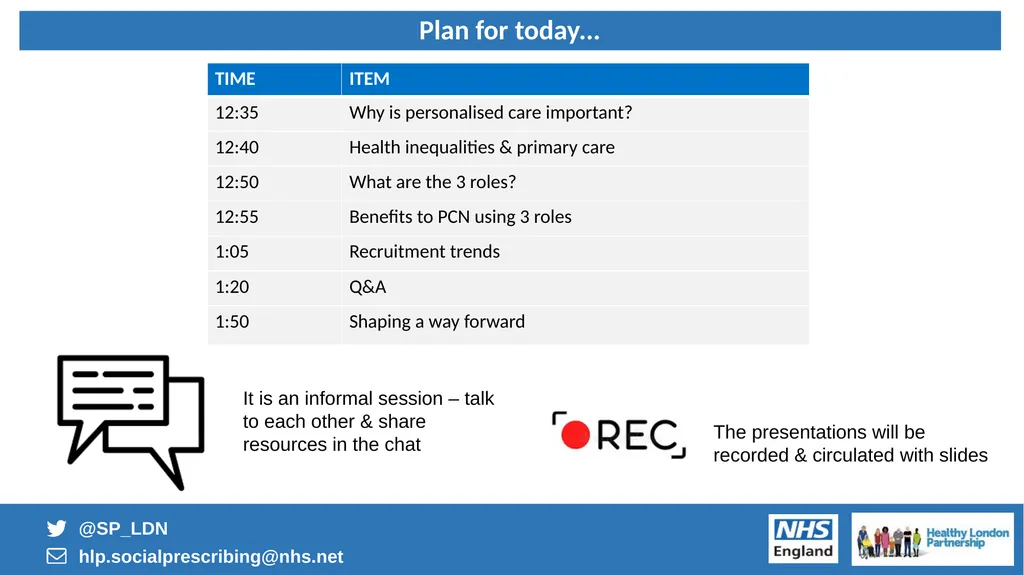
2 Plan for today... @SP_LDN
hlp.socialprescribing@nhs.net It is an informal session – talk to each other & share resources in the chat The presentations will be recorded & circulated with slides<br>
hlp.socialprescribing@nhs.net It is an informal session – talk to each other & share resources in the chat The presentations will be recorded & circulated with slides<br>
03
3 PCN Advisors – working 2 days a week until Apr 22 @SP_LDN
hlp.socialprescribing@nhs.net Purpose of the role:
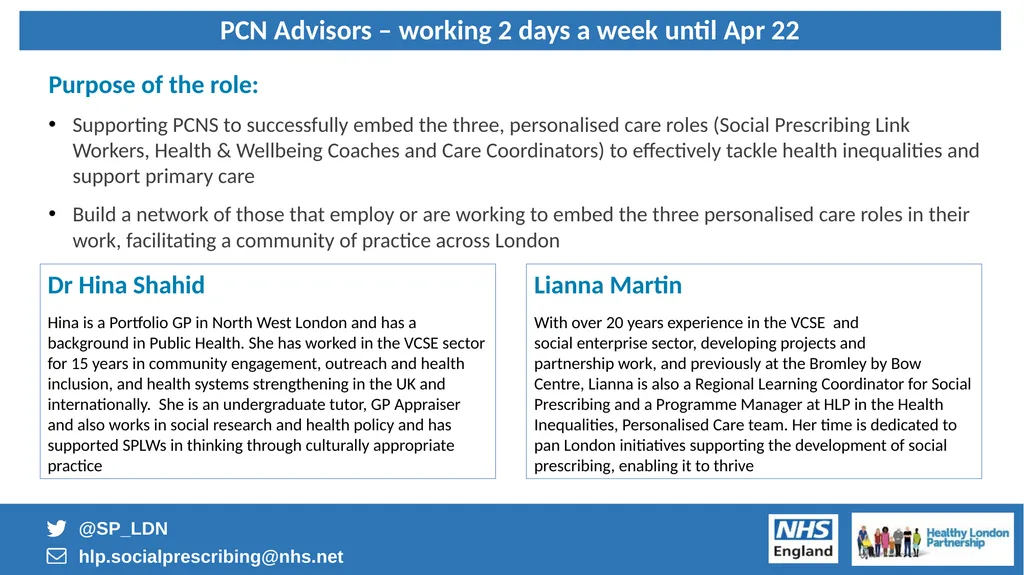
Supporting PCNS to successfully embed the three, personalised care roles (Social Prescribing Link Workers, Health & Wellbeing Coaches and Care Coordinators) to effectively tackle health inequalities and support primary care
Build a network of those that employ or are working to embed the three personalised care roles in their work, facilitating a community of practice across London Dr Hina Shahid
Hina is a Portfolio GP in North West London and has a background in Public Health. She has worked in the VCSE sector for 15 years in community engagement, outreach and health inclusion, and health systems strengthening in the UK and internationally. She is an undergraduate tutor, GP Appraiser and also works in social research and health policy and has supported SPLWs in thinking through culturally appropriate practice Lianna Martin
With over 20 years experience in the VCSE and social enterprise sector, developing projects and partnership work, and previously at the Bromley by Bow Centre, Lianna is also a Regional Learning Coordinator for Social Prescribing and a Programme Manager at HLP in the Health Inequalities, Personalised Care team. Her time is dedicated to pan London initiatives supporting the development of social prescribing, enabling it to thrive<br>
hlp.socialprescribing@nhs.net Purpose of the role:
Supporting PCNS to successfully embed the three, personalised care roles (Social Prescribing Link Workers, Health & Wellbeing Coaches and Care Coordinators) to effectively tackle health inequalities and support primary care
Build a network of those that employ or are working to embed the three personalised care roles in their work, facilitating a community of practice across London Dr Hina Shahid
Hina is a Portfolio GP in North West London and has a background in Public Health. She has worked in the VCSE sector for 15 years in community engagement, outreach and health inclusion, and health systems strengthening in the UK and internationally. She is an undergraduate tutor, GP Appraiser and also works in social research and health policy and has supported SPLWs in thinking through culturally appropriate practice Lianna Martin
With over 20 years experience in the VCSE and social enterprise sector, developing projects and partnership work, and previously at the Bromley by Bow Centre, Lianna is also a Regional Learning Coordinator for Social Prescribing and a Programme Manager at HLP in the Health Inequalities, Personalised Care team. Her time is dedicated to pan London initiatives supporting the development of social prescribing, enabling it to thrive<br>
04
4 Personalised care for London @SP_LDN
hlp.socialprescribing@nhs.net What it is:
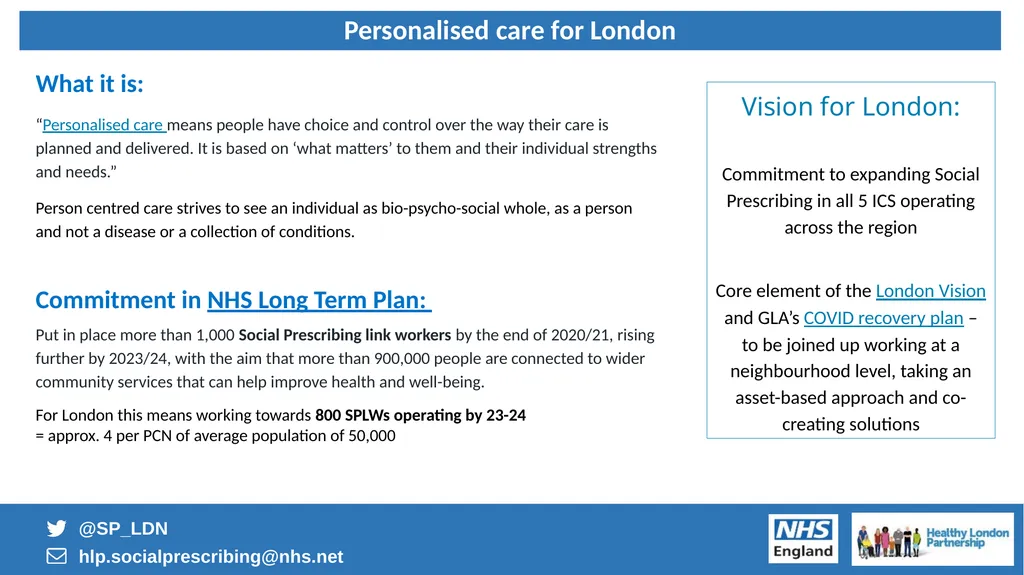
“Personalised care means people have choice and control over the way their care is planned and delivered. It is based on ‘what matters’ to them and their individual strengths and needs.”
Person centred care strives to see an individual as bio-psycho-social whole, as a person and not a disease or a collection of conditions.
Commitment in NHS Long Term Plan:
Put in place more than 1,000 Social Prescribing link workers by the end of 2020/21, rising further by 2023/24, with the aim that more than 900,000 people are connected to wider community services that can help improve health and well-being.
For London this means working towards 800 SPLWs operating by 23-24
= approx. 4 per PCN of average population of 50,000 Vision for London:
Commitment to expanding Social Prescribing in all 5 ICS operating across the region
Core element of the London Vision and GLA’s COVID recovery plan – to be joined up working at a neighbourhood level, taking an asset-based approach and co-creating solutions<br>
hlp.socialprescribing@nhs.net What it is:
“Personalised care means people have choice and control over the way their care is planned and delivered. It is based on ‘what matters’ to them and their individual strengths and needs.”
Person centred care strives to see an individual as bio-psycho-social whole, as a person and not a disease or a collection of conditions.
Commitment in NHS Long Term Plan:
Put in place more than 1,000 Social Prescribing link workers by the end of 2020/21, rising further by 2023/24, with the aim that more than 900,000 people are connected to wider community services that can help improve health and well-being.
For London this means working towards 800 SPLWs operating by 23-24
= approx. 4 per PCN of average population of 50,000 Vision for London:
Commitment to expanding Social Prescribing in all 5 ICS operating across the region
Core element of the London Vision and GLA’s COVID recovery plan – to be joined up working at a neighbourhood level, taking an asset-based approach and co-creating solutions<br>
05
5 Why is it important? @SP_LDN
hlp.socialprescribing@nhs.net 5 London boroughs in top 10% most deprived boroughs in UK – PC role intrinsic tool for PCNs in community recovery
Uses appropriate team according local population needs & ensure roles working together, embedded in PCNs and being used in the right way
Impact these roles can have on patients, community & surgeries can be significant
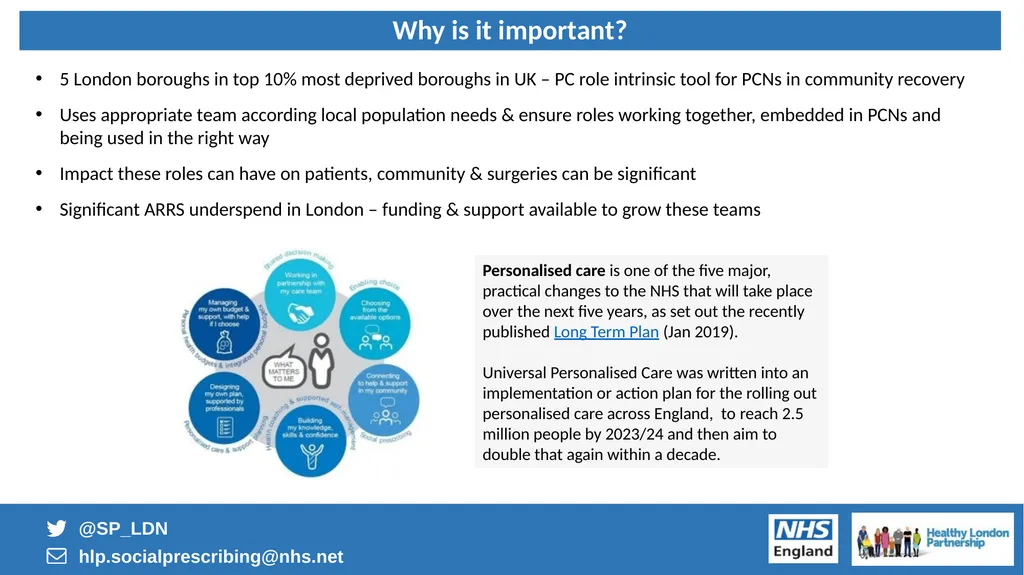
Significant ARRS underspend in London – funding & support available to grow these teams Personalised care is one of the five major, practical changes to the NHS that will take place over the next five years, as set out the recently published Long Term Plan (Jan 2019).
Universal Personalised Care was written into an implementation or action plan for the rolling out personalised care across England, to reach 2.5 million people by 2023/24 and then aim to double that again within a decade.<br>
hlp.socialprescribing@nhs.net 5 London boroughs in top 10% most deprived boroughs in UK – PC role intrinsic tool for PCNs in community recovery
Uses appropriate team according local population needs & ensure roles working together, embedded in PCNs and being used in the right way
Impact these roles can have on patients, community & surgeries can be significant
Significant ARRS underspend in London – funding & support available to grow these teams Personalised care is one of the five major, practical changes to the NHS that will take place over the next five years, as set out the recently published Long Term Plan (Jan 2019).
Universal Personalised Care was written into an implementation or action plan for the rolling out personalised care across England, to reach 2.5 million people by 2023/24 and then aim to double that again within a decade.<br>
06
6 Health inequalities, inequities and primary care @SP_LDN
hlp.socialprescribing@nhs.net Over 80% of health outcomes are socially determined
Inequities: systematic, avoidable and unfair differences in mental or physical health between groups of people
Health disparities are widening in the UK- highest in London
COVID-19: vital community health function of general practice (RCGP)
The exceptional potential of PCNs- “anchor institutions” Address and optimise individual and population health outcomes
Drive engagement between primary care and communities
Cross-sector working<br>
hlp.socialprescribing@nhs.net Over 80% of health outcomes are socially determined
Inequities: systematic, avoidable and unfair differences in mental or physical health between groups of people
Health disparities are widening in the UK- highest in London
COVID-19: vital community health function of general practice (RCGP)
The exceptional potential of PCNs- “anchor institutions” Address and optimise individual and population health outcomes
Drive engagement between primary care and communities
Cross-sector working<br>
07
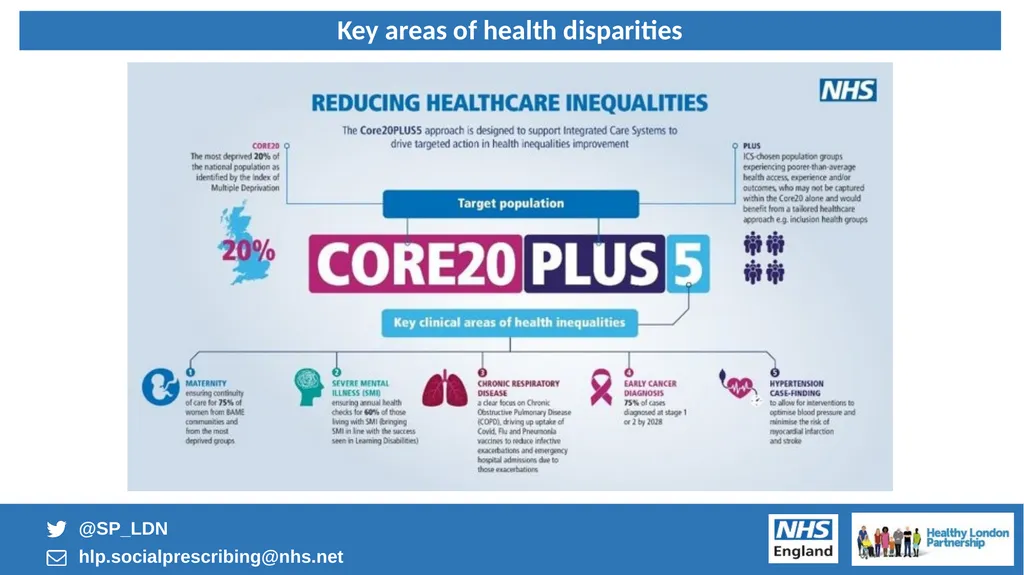
7 Key areas of health disparities @SP_LDN
hlp.socialprescribing@nhs.net<br>
hlp.socialprescribing@nhs.net<br>
08
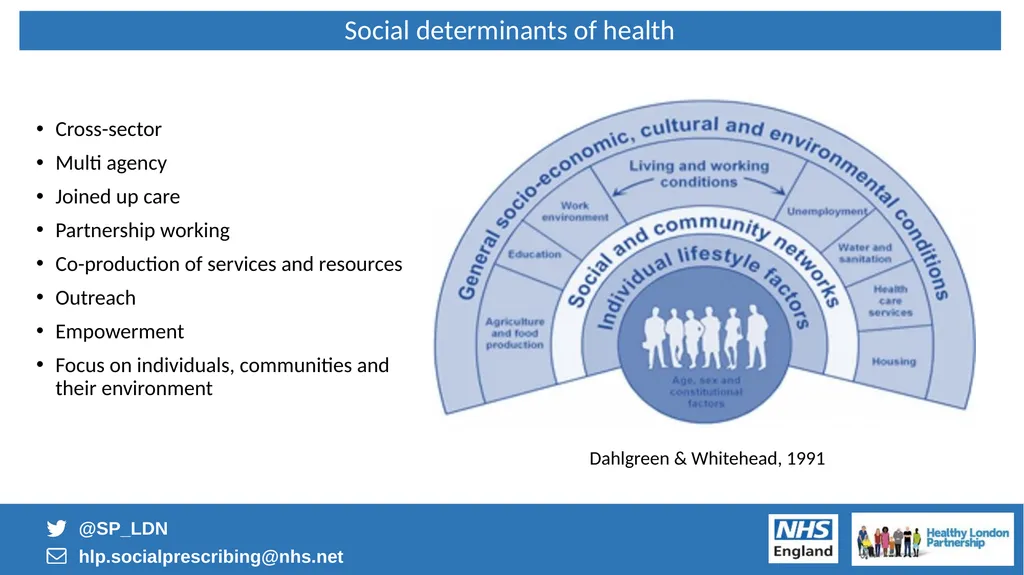
8 Social determinants of health @SP_LDN
hlp.socialprescribing@nhs.net Cross-sector
Multi agency
Joined up care
Partnership working
Co-production of services and resources
Outreach
Empowerment
Focus on individuals, communities and their environment Dahlgreen & Whitehead, 1991<br>
hlp.socialprescribing@nhs.net Cross-sector
Multi agency
Joined up care
Partnership working
Co-production of services and resources
Outreach
Empowerment
Focus on individuals, communities and their environment Dahlgreen & Whitehead, 1991<br>
09
9 Integrated care systems @SP_LDN
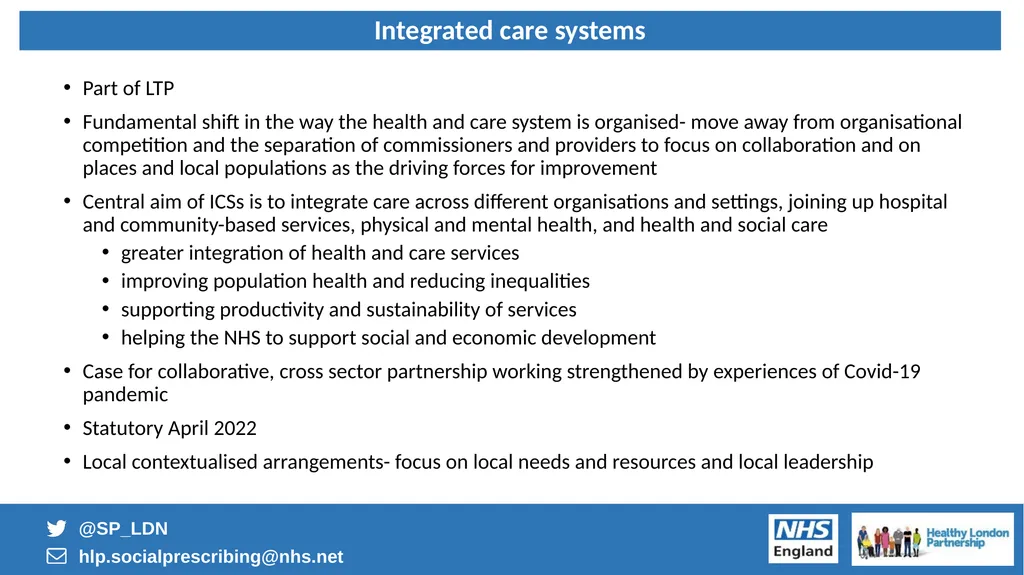
hlp.socialprescribing@nhs.net Part of LTP
Fundamental shift in the way the health and care system is organised- move away from organisational competition and the separation of commissioners and providers to focus on collaboration and on places and local populations as the driving forces for improvement
Central aim of ICSs is to integrate care across different organisations and settings, joining up hospital and community-based services, physical and mental health, and health and social care
greater integration of health and care services
improving population health and reducing inequalities
supporting productivity and sustainability of services
helping the NHS to support social and economic development
Case for collaborative, cross sector partnership working strengthened by experiences of Covid-19 pandemic
Statutory April 2022
Local contextualised arrangements- focus on local needs and resources and local leadership<br>
hlp.socialprescribing@nhs.net Part of LTP
Fundamental shift in the way the health and care system is organised- move away from organisational competition and the separation of commissioners and providers to focus on collaboration and on places and local populations as the driving forces for improvement
Central aim of ICSs is to integrate care across different organisations and settings, joining up hospital and community-based services, physical and mental health, and health and social care
greater integration of health and care services
improving population health and reducing inequalities
supporting productivity and sustainability of services
helping the NHS to support social and economic development
Case for collaborative, cross sector partnership working strengthened by experiences of Covid-19 pandemic
Statutory April 2022
Local contextualised arrangements- focus on local needs and resources and local leadership<br>
10
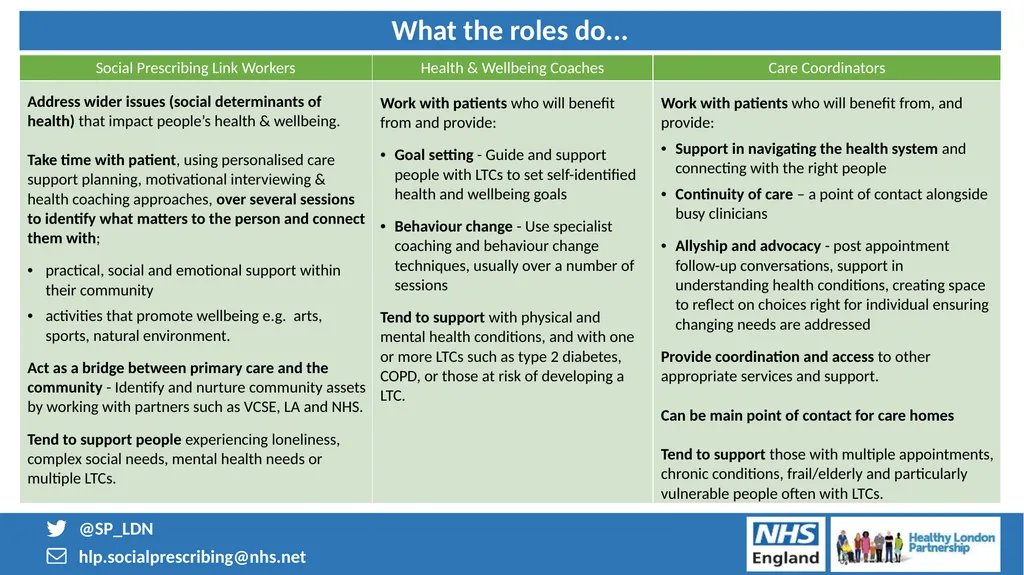
10 What the roles do... @SP_LDN
hlp.socialprescribing@nhs.net<br>
hlp.socialprescribing@nhs.net<br>
11
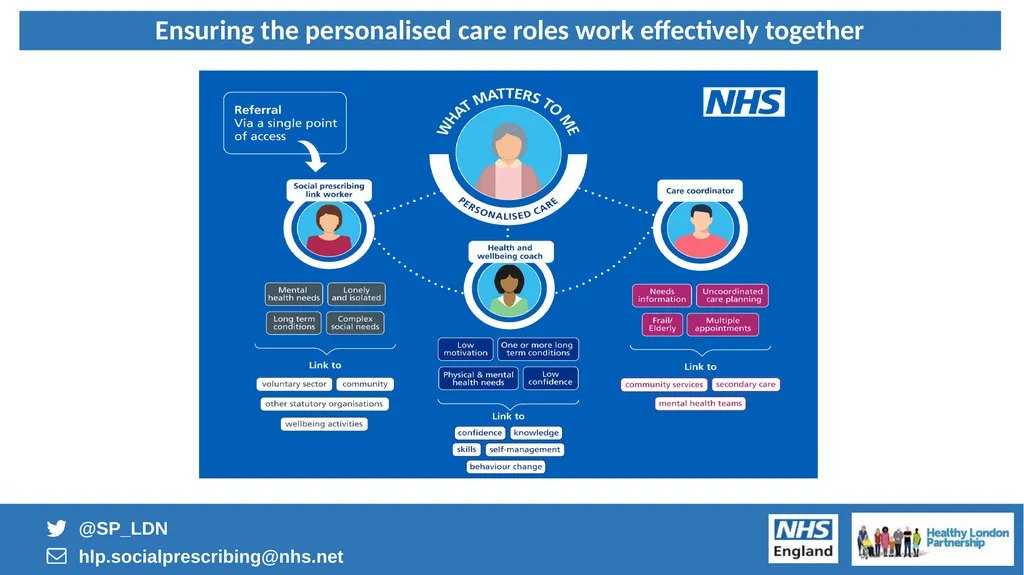
11 Ensuring the personalised care roles work effectively together @SP_LDN
hlp.socialprescribing@nhs.net<br>
hlp.socialprescribing@nhs.net<br>
12
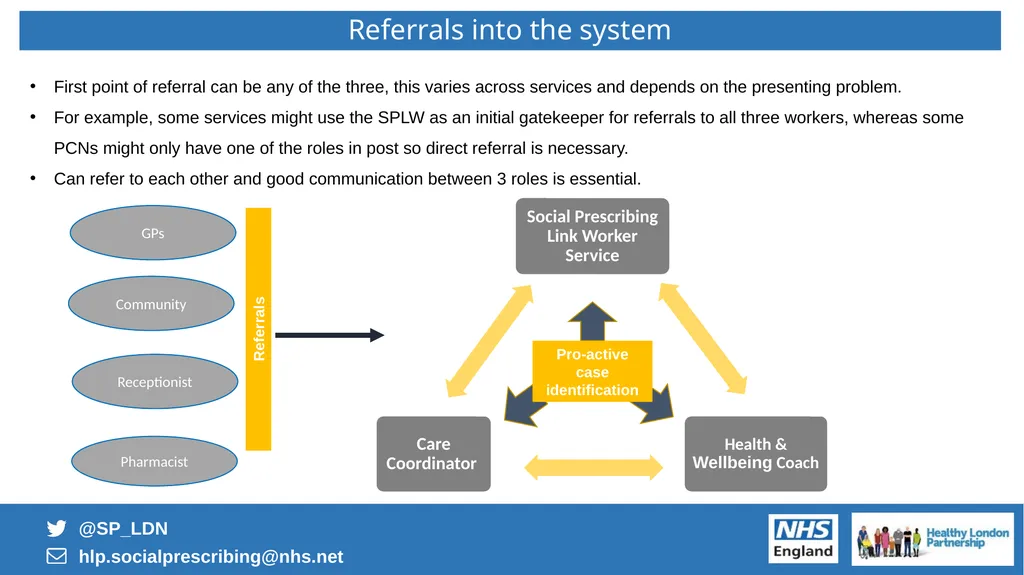
12 Referrals into the system @SP_LDN
hlp.socialprescribing@nhs.net First point of referral can be any of the three, this varies across services and depends on the presenting problem.
For example, some services might use the SPLW as an initial gatekeeper for referrals to all three workers, whereas some PCNs might only have one of the roles in post so direct referral is necessary.
Can refer to each other and good communication between 3 roles is essential. Pro-active case identification Referrals GPs Pharmacist Receptionist Community<br>
hlp.socialprescribing@nhs.net First point of referral can be any of the three, this varies across services and depends on the presenting problem.
For example, some services might use the SPLW as an initial gatekeeper for referrals to all three workers, whereas some PCNs might only have one of the roles in post so direct referral is necessary.
Can refer to each other and good communication between 3 roles is essential. Pro-active case identification Referrals GPs Pharmacist Receptionist Community<br>
13
13 Optimising individual and population health and wellbeing @SP_LDN
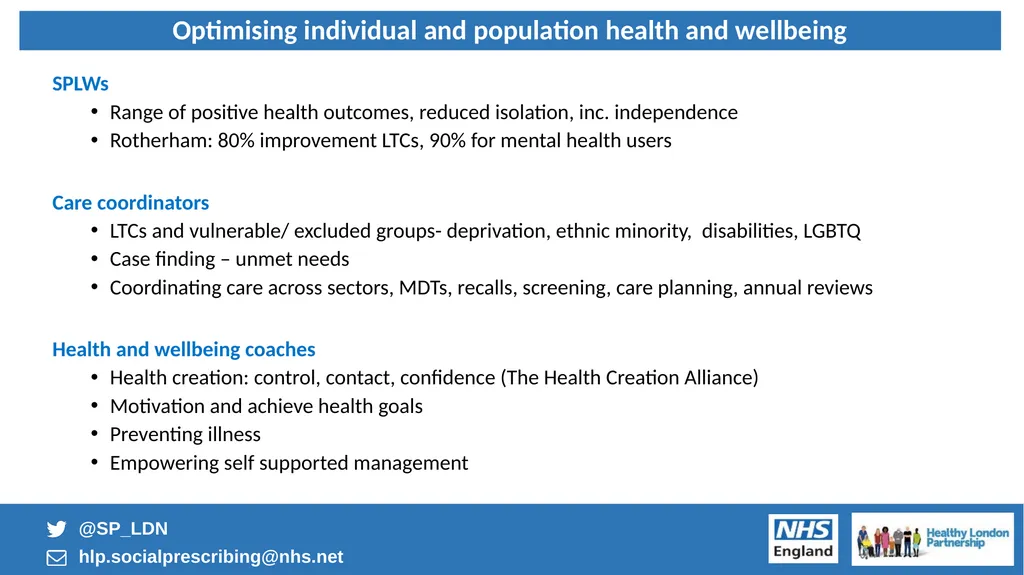
hlp.socialprescribing@nhs.net SPLWs
Range of positive health outcomes, reduced isolation, inc. independence
Rotherham: 80% improvement LTCs, 90% for mental health users
Care coordinators
LTCs and vulnerable/ excluded groups- deprivation, ethnic minority, disabilities, LGBTQ
Case finding – unmet needs
Coordinating care across sectors, MDTs, recalls, screening, care planning, annual reviews
Health and wellbeing coaches
Health creation: control, contact, confidence (The Health Creation Alliance)
Motivation and achieve health goals
Preventing illness
Empowering self supported management<br>
hlp.socialprescribing@nhs.net SPLWs
Range of positive health outcomes, reduced isolation, inc. independence
Rotherham: 80% improvement LTCs, 90% for mental health users
Care coordinators
LTCs and vulnerable/ excluded groups- deprivation, ethnic minority, disabilities, LGBTQ
Case finding – unmet needs
Coordinating care across sectors, MDTs, recalls, screening, care planning, annual reviews
Health and wellbeing coaches
Health creation: control, contact, confidence (The Health Creation Alliance)
Motivation and achieve health goals
Preventing illness
Empowering self supported management<br>
14
14 Supporting the clinical workforce @SP_LDN
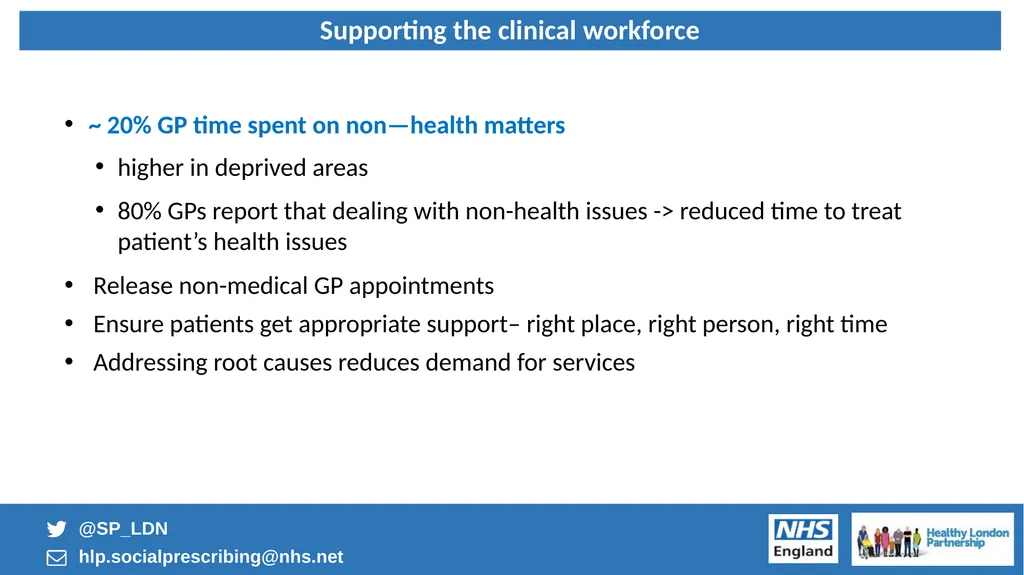
hlp.socialprescribing@nhs.net ~ 20% GP time spent on non—health matters
higher in deprived areas
80% GPs report that dealing with non-health issues -> reduced time to treat patient’s health issues
Release non-medical GP appointments
Ensure patients get appropriate support– right place, right person, right time
Addressing root causes reduces demand for services<br>
hlp.socialprescribing@nhs.net ~ 20% GP time spent on non—health matters
higher in deprived areas
80% GPs report that dealing with non-health issues -> reduced time to treat patient’s health issues
Release non-medical GP appointments
Ensure patients get appropriate support– right place, right person, right time
Addressing root causes reduces demand for services<br>
15
15 The positive impact... @SP_LDN
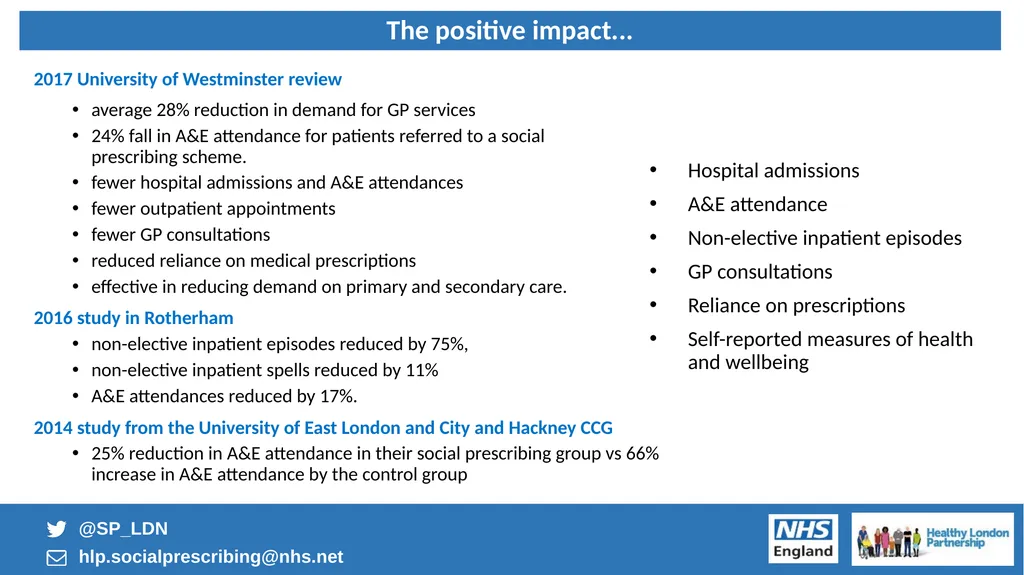
hlp.socialprescribing@nhs.net 2017 University of Westminster review
average 28% reduction in demand for GP services
24% fall in A&E attendance for patients referred to a social prescribing scheme.
fewer hospital admissions and A&E attendances
fewer outpatient appointments
fewer GP consultations
reduced reliance on medical prescriptions
effective in reducing demand on primary and secondary care.
2016 study in Rotherham
non-elective inpatient episodes reduced by 75%,
non-elective inpatient spells reduced by 11%
A&E attendances reduced by 17%.
2014 study from the University of East London and City and Hackney CCG
25% reduction in A&E attendance in their social prescribing group vs 66% increase in A&E attendance by the control group Hospital admissions
A&E attendance
Non-elective inpatient episodes
GP consultations
Reliance on prescriptions
Self-reported measures of health and wellbeing<br>
hlp.socialprescribing@nhs.net 2017 University of Westminster review
average 28% reduction in demand for GP services
24% fall in A&E attendance for patients referred to a social prescribing scheme.
fewer hospital admissions and A&E attendances
fewer outpatient appointments
fewer GP consultations
reduced reliance on medical prescriptions
effective in reducing demand on primary and secondary care.
2016 study in Rotherham
non-elective inpatient episodes reduced by 75%,
non-elective inpatient spells reduced by 11%
A&E attendances reduced by 17%.
2014 study from the University of East London and City and Hackney CCG
25% reduction in A&E attendance in their social prescribing group vs 66% increase in A&E attendance by the control group Hospital admissions
A&E attendance
Non-elective inpatient episodes
GP consultations
Reliance on prescriptions
Self-reported measures of health and wellbeing<br>
16
16 Evaluating cost effectiveness... @SP_LDN
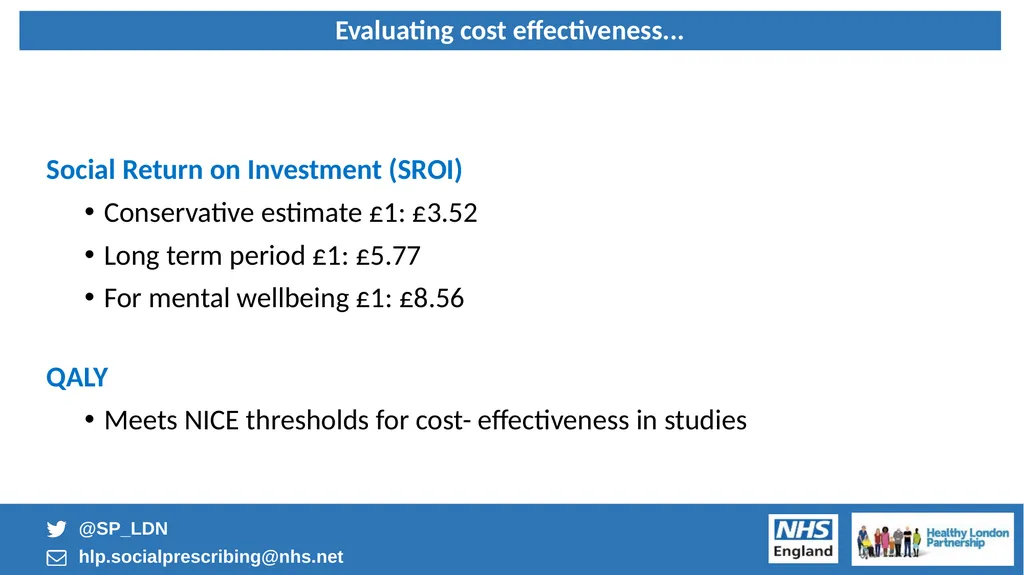
hlp.socialprescribing@nhs.net Social Return on Investment (SROI)
Conservative estimate £1: £3.52
Long term period £1: £5.77
For mental wellbeing £1: £8.56
QALY
Meets NICE thresholds for cost- effectiveness in studies<br>
hlp.socialprescribing@nhs.net Social Return on Investment (SROI)
Conservative estimate £1: £3.52
Long term period £1: £5.77
For mental wellbeing £1: £8.56
QALY
Meets NICE thresholds for cost- effectiveness in studies<br>
17
17 What is working... @SP_LDN
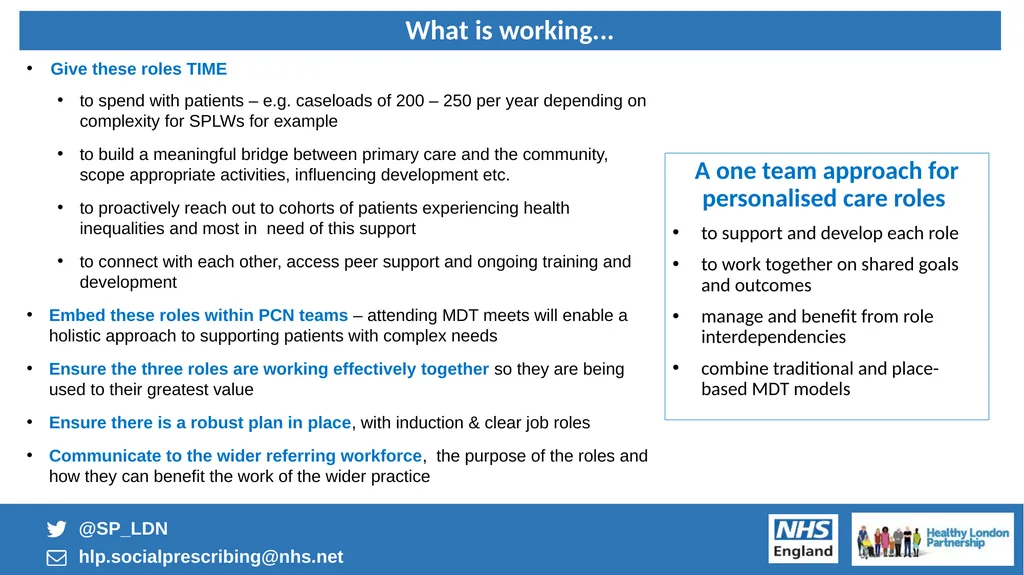
hlp.socialprescribing@nhs.net Give these roles TIME
to spend with patients – e.g. caseloads of 200 – 250 per year depending on complexity for SPLWs for example
to build a meaningful bridge between primary care and the community, scope appropriate activities, influencing development etc.
to proactively reach out to cohorts of patients experiencing health inequalities and most in need of this support
to connect with each other, access peer support and ongoing training and development
Embed these roles within PCN teams – attending MDT meets will enable a holistic approach to supporting patients with complex needs
Ensure the three roles are working effectively together so they are being used to their greatest value
Ensure there is a robust plan in place, with induction & clear job roles
Communicate to the wider referring workforce, the purpose of the roles and how they can benefit the work of the wider practice A one team approach for personalised care roles
to support and develop each role
to work together on shared goals and outcomes
manage and benefit from role interdependencies
combine traditional and place-based MDT models<br>
hlp.socialprescribing@nhs.net Give these roles TIME
to spend with patients – e.g. caseloads of 200 – 250 per year depending on complexity for SPLWs for example
to build a meaningful bridge between primary care and the community, scope appropriate activities, influencing development etc.
to proactively reach out to cohorts of patients experiencing health inequalities and most in need of this support
to connect with each other, access peer support and ongoing training and development
Embed these roles within PCN teams – attending MDT meets will enable a holistic approach to supporting patients with complex needs
Ensure the three roles are working effectively together so they are being used to their greatest value
Ensure there is a robust plan in place, with induction & clear job roles
Communicate to the wider referring workforce, the purpose of the roles and how they can benefit the work of the wider practice A one team approach for personalised care roles
to support and develop each role
to work together on shared goals and outcomes
manage and benefit from role interdependencies
combine traditional and place-based MDT models<br>
18
18 Examples of good practice in PCNs @SP_LDN
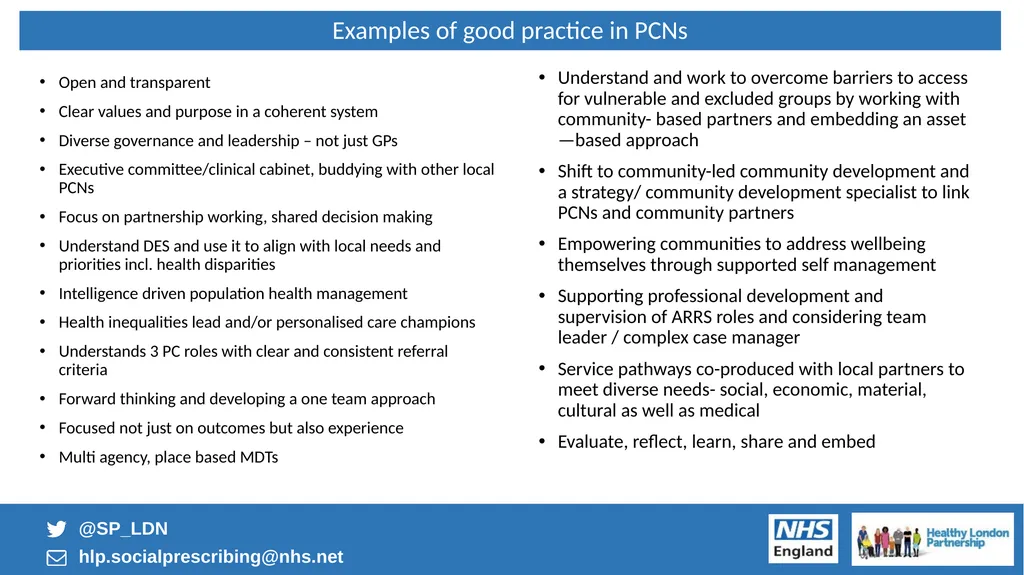
hlp.socialprescribing@nhs.net Open and transparent
Clear values and purpose in a coherent system
Diverse governance and leadership – not just GPs
Executive committee/clinical cabinet, buddying with other local PCNs
Focus on partnership working, shared decision making
Understand DES and use it to align with local needs and priorities incl. health disparities
Intelligence driven population health management
Health inequalities lead and/or personalised care champions
Understands 3 PC roles with clear and consistent referral criteria
Forward thinking and developing a one team approach
Focused not just on outcomes but also experience
Multi agency, place based MDTs Understand and work to overcome barriers to access for vulnerable and excluded groups by working with community- based partners and embedding an asset—based approach
Shift to community-led community development and a strategy/ community development specialist to link PCNs and community partners
Empowering communities to address wellbeing themselves through supported self management
Supporting professional development and supervision of ARRS roles and considering team leader / complex case manager
Service pathways co-produced with local partners to meet diverse needs- social, economic, material, cultural as well as medical
Evaluate, reflect, learn, share and embed<br>
hlp.socialprescribing@nhs.net Open and transparent
Clear values and purpose in a coherent system
Diverse governance and leadership – not just GPs
Executive committee/clinical cabinet, buddying with other local PCNs
Focus on partnership working, shared decision making
Understand DES and use it to align with local needs and priorities incl. health disparities
Intelligence driven population health management
Health inequalities lead and/or personalised care champions
Understands 3 PC roles with clear and consistent referral criteria
Forward thinking and developing a one team approach
Focused not just on outcomes but also experience
Multi agency, place based MDTs Understand and work to overcome barriers to access for vulnerable and excluded groups by working with community- based partners and embedding an asset—based approach
Shift to community-led community development and a strategy/ community development specialist to link PCNs and community partners
Empowering communities to address wellbeing themselves through supported self management
Supporting professional development and supervision of ARRS roles and considering team leader / complex case manager
Service pathways co-produced with local partners to meet diverse needs- social, economic, material, cultural as well as medical
Evaluate, reflect, learn, share and embed<br>
19
19 Support available in London @SP_LDN
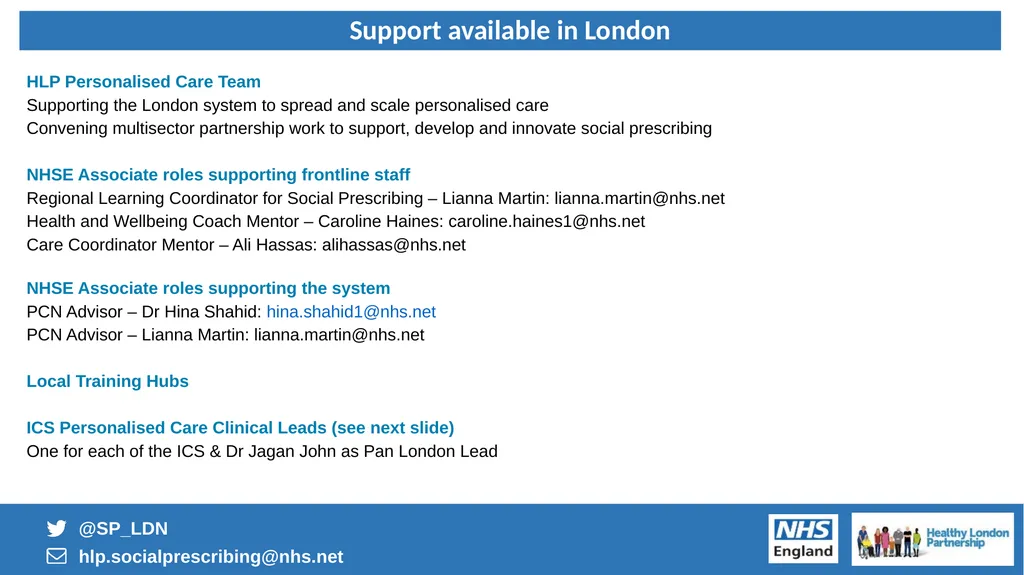
hlp.socialprescribing@nhs.net HLP Personalised Care Team
Supporting the London system to spread and scale personalised care
Convening multisector partnership work to support, develop and innovate social prescribing
NHSE Associate roles supporting frontline staff
Regional Learning Coordinator for Social Prescribing – Lianna Martin: lianna.martin@nhs.net
Health and Wellbeing Coach Mentor – Caroline Haines: caroline.haines1@nhs.net
Care Coordinator Mentor – Ali Hassas: alihassas@nhs.net
NHSE Associate roles supporting the system
PCN Advisor – Dr Hina Shahid: hina.shahid1@nhs.net
PCN Advisor – Lianna Martin: lianna.martin@nhs.net
Local Training Hubs
ICS Personalised Care Clinical Leads (see next slide)
One for each of the ICS & Dr Jagan John as Pan London Lead<br>
hlp.socialprescribing@nhs.net HLP Personalised Care Team
Supporting the London system to spread and scale personalised care
Convening multisector partnership work to support, develop and innovate social prescribing
NHSE Associate roles supporting frontline staff
Regional Learning Coordinator for Social Prescribing – Lianna Martin: lianna.martin@nhs.net
Health and Wellbeing Coach Mentor – Caroline Haines: caroline.haines1@nhs.net
Care Coordinator Mentor – Ali Hassas: alihassas@nhs.net
NHSE Associate roles supporting the system
PCN Advisor – Dr Hina Shahid: hina.shahid1@nhs.net
PCN Advisor – Lianna Martin: lianna.martin@nhs.net
Local Training Hubs
ICS Personalised Care Clinical Leads (see next slide)
One for each of the ICS & Dr Jagan John as Pan London Lead<br>
20
20 Support for PCNs... @SP_LDN
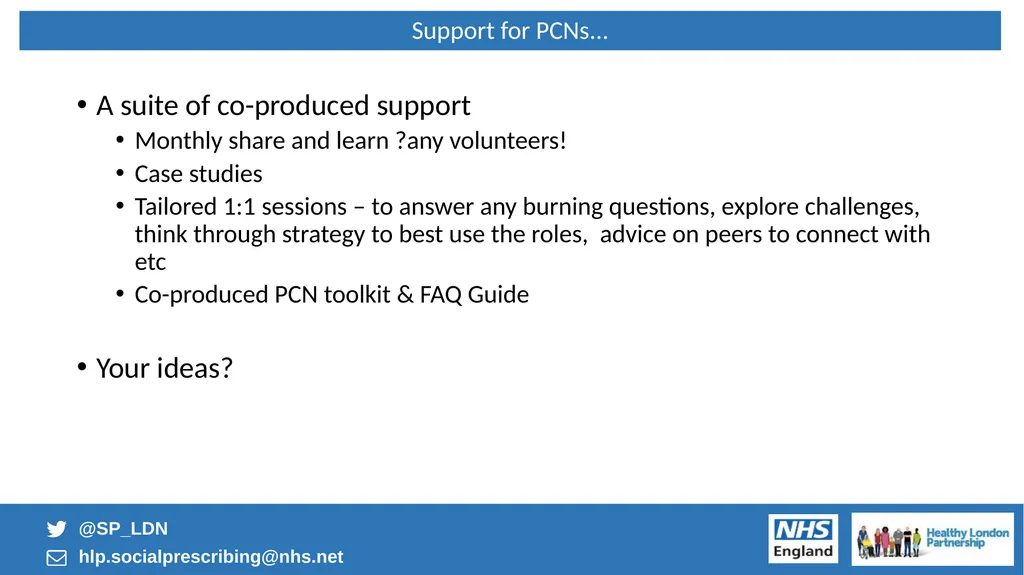
hlp.socialprescribing@nhs.net A suite of co-produced support
Monthly share and learn ?any volunteers!
Case studies
Tailored 1:1 sessions – to answer any burning questions, explore challenges, think through strategy to best use the roles, advice on peers to connect with etc
Co-produced PCN toolkit & FAQ Guide
Your ideas?<br>
hlp.socialprescribing@nhs.net A suite of co-produced support
Monthly share and learn ?any volunteers!
Case studies
Tailored 1:1 sessions – to answer any burning questions, explore challenges, think through strategy to best use the roles, advice on peers to connect with etc
Co-produced PCN toolkit & FAQ Guide
Your ideas?<br>
21
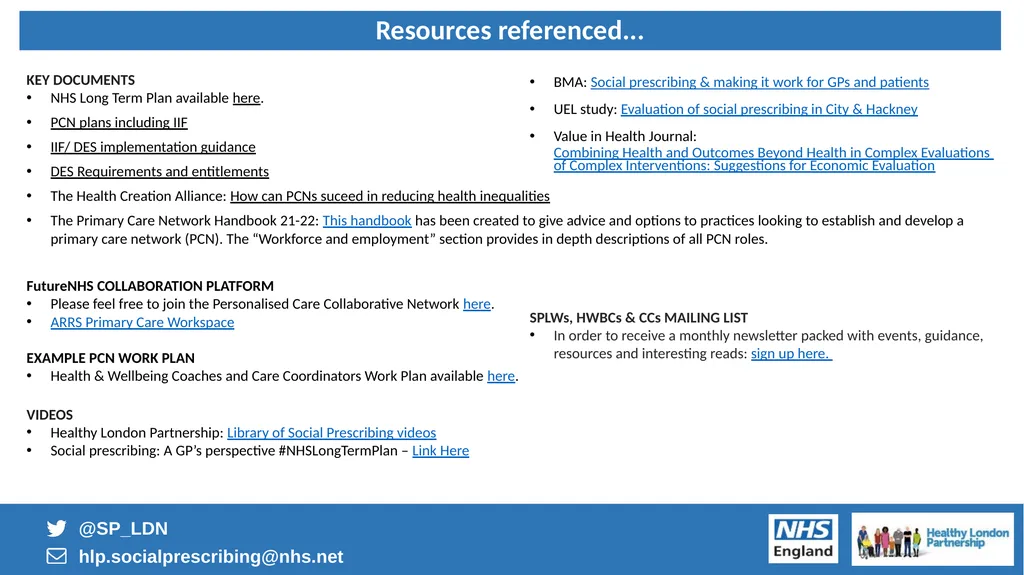
21 Resources referenced... @SP_LDN
hlp.socialprescribing@nhs.net KEY DOCUMENTS
NHS Long Term Plan available here.
PCN plans including IIF
IIF/ DES implementation guidance
DES Requirements and entitlements
The Health Creation Alliance: How can PCNs suceed in reducing health inequalities
The Primary Care Network Handbook 21-22: This handbook has been created to give advice and options to practices looking to establish and develop a primary care network (PCN). The “Workforce and employment” section provides in depth descriptions of all PCN roles.
FutureNHS COLLABORATION PLATFORM
Please feel free to join the Personalised Care Collaborative Network here.
ARRS Primary Care Workspace
EXAMPLE PCN WORK PLAN
Health & Wellbeing Coaches and Care Coordinators Work Plan available here.
VIDEOS
Healthy London Partnership: Library of Social Prescribing videos
Social prescribing: A GP’s perspective #NHSLongTermPlan – Link Here BMA: Social prescribing & making it work for GPs and patients
UEL study: Evaluation of social prescribing in City & Hackney
Value in Health Journal: Combining Health and Outcomes Beyond Health in Complex Evaluations of Complex Interventions: Suggestions for Economic Evaluation
SPLWs, HWBCs & CCs MAILING LIST
In order to receive a monthly newsletter packed with events, guidance, resources and interesting reads: sign up here.<br>
hlp.socialprescribing@nhs.net KEY DOCUMENTS
NHS Long Term Plan available here.
PCN plans including IIF
IIF/ DES implementation guidance
DES Requirements and entitlements
The Health Creation Alliance: How can PCNs suceed in reducing health inequalities
The Primary Care Network Handbook 21-22: This handbook has been created to give advice and options to practices looking to establish and develop a primary care network (PCN). The “Workforce and employment” section provides in depth descriptions of all PCN roles.
FutureNHS COLLABORATION PLATFORM
Please feel free to join the Personalised Care Collaborative Network here.
ARRS Primary Care Workspace
EXAMPLE PCN WORK PLAN
Health & Wellbeing Coaches and Care Coordinators Work Plan available here.
VIDEOS
Healthy London Partnership: Library of Social Prescribing videos
Social prescribing: A GP’s perspective #NHSLongTermPlan – Link Here BMA: Social prescribing & making it work for GPs and patients
UEL study: Evaluation of social prescribing in City & Hackney
Value in Health Journal: Combining Health and Outcomes Beyond Health in Complex Evaluations of Complex Interventions: Suggestions for Economic Evaluation
SPLWs, HWBCs & CCs MAILING LIST
In order to receive a monthly newsletter packed with events, guidance, resources and interesting reads: sign up here.<br>
22
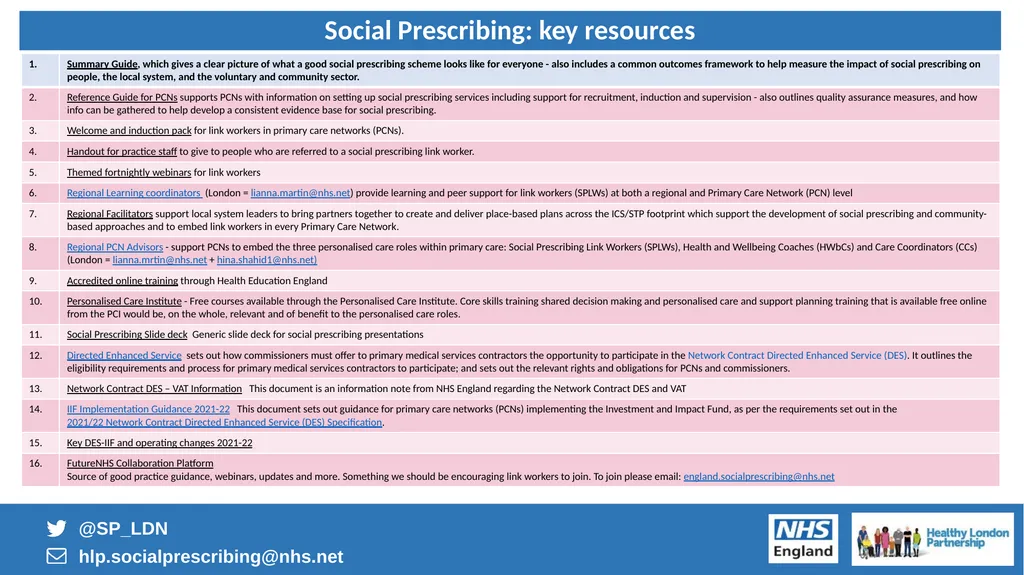
22 Social Prescribing: key resources @SP_LDN
hlp.socialprescribing@nhs.net<br>
hlp.socialprescribing@nhs.net<br>
23
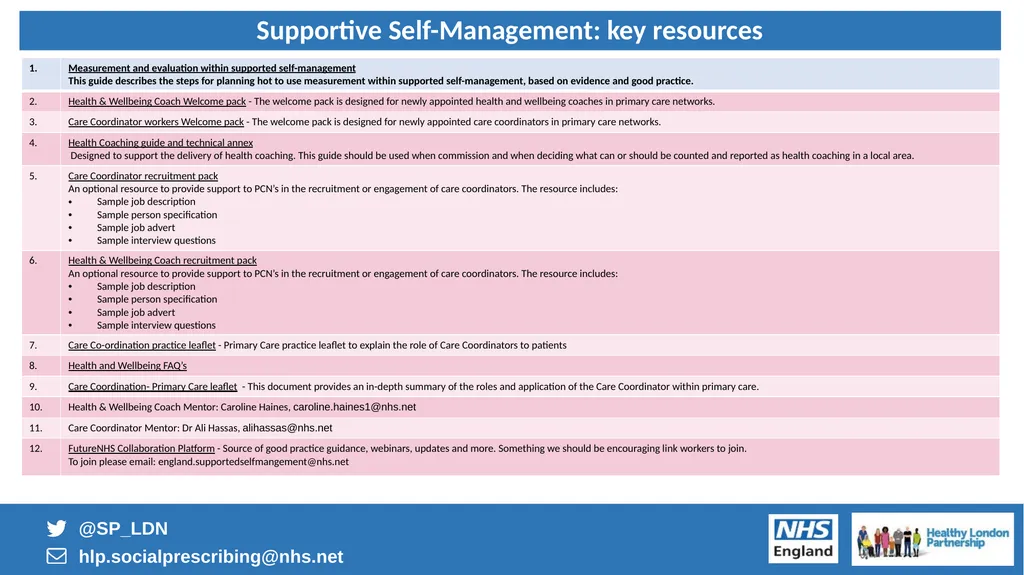
23 Supportive Self-Management: key resources @SP_LDN
hlp.socialprescribing@nhs.net<br>
hlp.socialprescribing@nhs.net<br>