
@SP_LDN rf-tr.socialprescribing@nhs.net Improving
TF
Published · 15 slides · 0 views

1 / 1




Description
SPLDN rf-tr.socialprescribingnhs.net Improving access to personalised care in secondary care London Community of Practice Terms of Reference (ToR) Social Prescribing Community Led Prevention Value of Personalised Care in Secondary Care
Related Topics
Share
Embed code
Download this presentation From Below
"@SP_LDN rf-tr.socialprescribing@nhs.net Improving" is the property of its rightful owner. Permission is granted to download and print the materials on this website for personal, non-commercial use only, and to display it on your personal computer provided you do not modify the materials and that you retain all copyright notices contained in the materials. By downloading content from our website, you accept the terms of this agreement.
Presentation Transcript
01
@SP_LDN
rf-tr.socialprescribing@nhs.net Improving access to personalised
care in secondary care London
Community of Practice
Terms of Reference (ToR)
Social Prescribing &
Community Led Prevention<br>
rf-tr.socialprescribing@nhs.net Improving access to personalised
care in secondary care London
Community of Practice
Terms of Reference (ToR)
Social Prescribing &
Community Led Prevention<br>
02
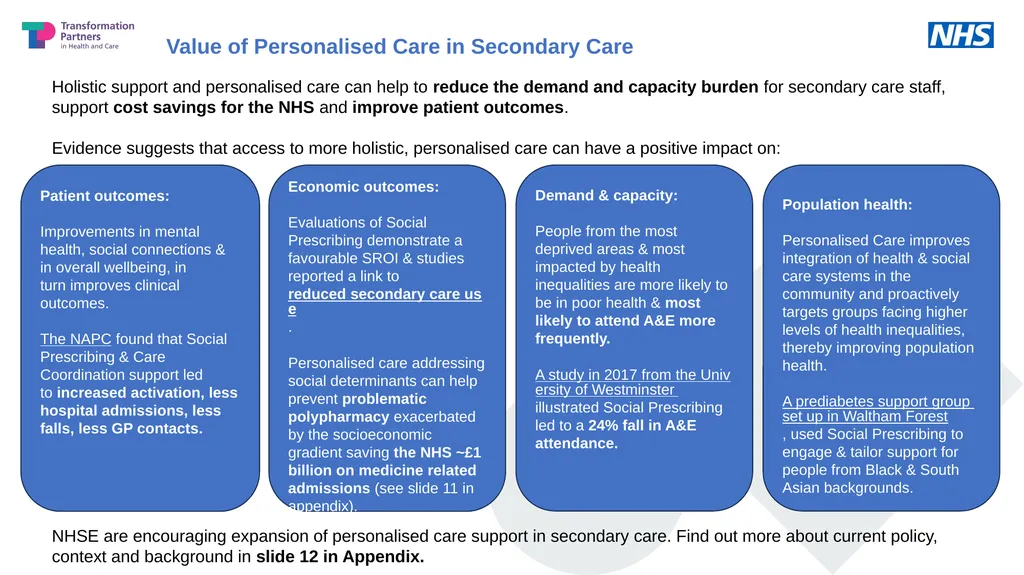
Value of Personalised Care in Secondary Care Holistic support and personalised care can help to reduce the demand and capacity burden for secondary care staff, support cost savings for the NHS and improve patient outcomes.
Evidence suggests that access to more holistic, personalised care can have a positive impact on:
NHSE are encouraging expansion of personalised care support in secondary care. Find out more about current policy, context and background in slide 12 in Appendix. Patient outcomes:
Improvements in mental health, social connections & in overall wellbeing, in turn improves clinical outcomes.
The NAPC found that Social Prescribing & Care Coordination support led to increased activation, less hospital admissions, less falls, less GP contacts. Economic outcomes:
Evaluations of Social Prescribing demonstrate a favourable SROI & studies reported a link to reduced secondary care use.
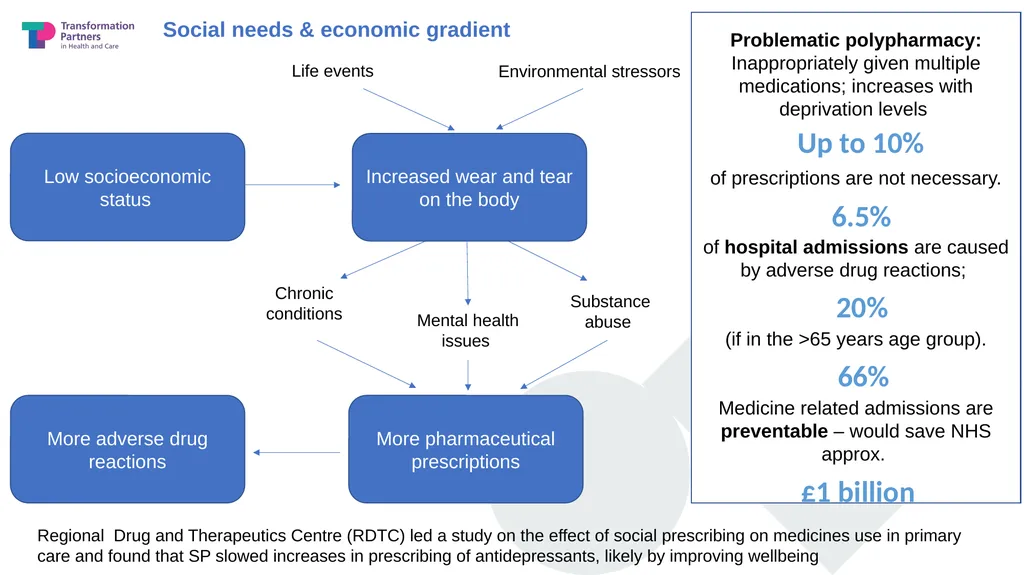
Personalised care addressing social determinants can help prevent problematic polypharmacy exacerbated by the socioeconomic gradient saving the NHS ~£1 billion on medicine related admissions (see slide 11 in appendix). Demand & capacity:
People from the most deprived areas & most impacted by health inequalities are more likely to be in poor health & most likely to attend A&E more frequently.
A study in 2017 from the University of Westminster illustrated Social Prescribing led to a 24% fall in A&E attendance. Population health:
Personalised Care improves integration of health & social care systems in the community and proactively targets groups facing higher levels of health inequalities, thereby improving population health.
A prediabetes support group set up in Waltham Forest, used Social Prescribing to engage & tailor support for people from Black & South Asian backgrounds.<br>
Evidence suggests that access to more holistic, personalised care can have a positive impact on:
NHSE are encouraging expansion of personalised care support in secondary care. Find out more about current policy, context and background in slide 12 in Appendix. Patient outcomes:
Improvements in mental health, social connections & in overall wellbeing, in turn improves clinical outcomes.
The NAPC found that Social Prescribing & Care Coordination support led to increased activation, less hospital admissions, less falls, less GP contacts. Economic outcomes:
Evaluations of Social Prescribing demonstrate a favourable SROI & studies reported a link to reduced secondary care use.
Personalised care addressing social determinants can help prevent problematic polypharmacy exacerbated by the socioeconomic gradient saving the NHS ~£1 billion on medicine related admissions (see slide 11 in appendix). Demand & capacity:
People from the most deprived areas & most impacted by health inequalities are more likely to be in poor health & most likely to attend A&E more frequently.
A study in 2017 from the University of Westminster illustrated Social Prescribing led to a 24% fall in A&E attendance. Population health:
Personalised Care improves integration of health & social care systems in the community and proactively targets groups facing higher levels of health inequalities, thereby improving population health.
A prediabetes support group set up in Waltham Forest, used Social Prescribing to engage & tailor support for people from Black & South Asian backgrounds.<br>
03
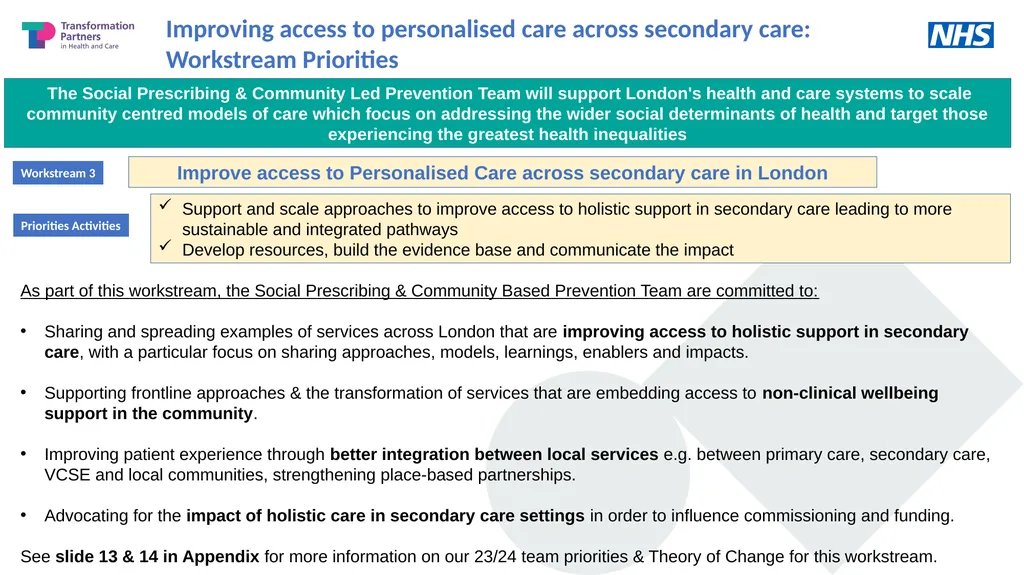
Improving access to personalised care across secondary care: Workstream Priorities As part of this workstream, the Social Prescribing & Community Based Prevention Team are committed to:
Sharing and spreading examples of services across London that are improving access to holistic support in secondary care, with a particular focus on sharing approaches, models, learnings, enablers and impacts.
Supporting frontline approaches & the transformation of services that are embedding access to non-clinical wellbeing support in the community.
Improving patient experience through better integration between local services e.g. between primary care, secondary care, VCSE and local communities, strengthening place-based partnerships.
Advocating for the impact of holistic care in secondary care settings in order to influence commissioning and funding.
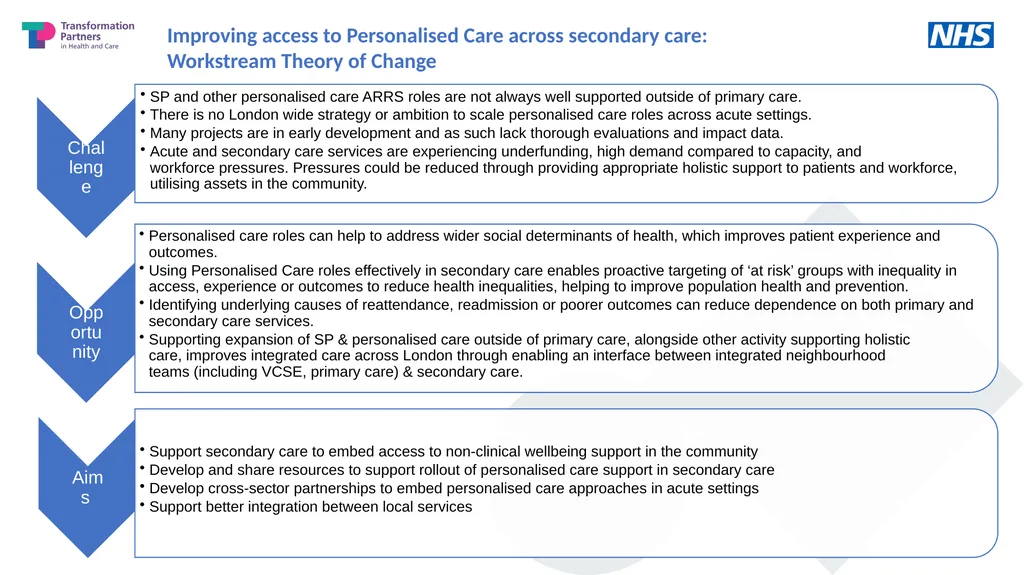
See slide 13 & 14 in Appendix for more information on our 23/24 team priorities & Theory of Change for this workstream. Workstream 3 Priorities Activities<br>
Sharing and spreading examples of services across London that are improving access to holistic support in secondary care, with a particular focus on sharing approaches, models, learnings, enablers and impacts.
Supporting frontline approaches & the transformation of services that are embedding access to non-clinical wellbeing support in the community.
Improving patient experience through better integration between local services e.g. between primary care, secondary care, VCSE and local communities, strengthening place-based partnerships.
Advocating for the impact of holistic care in secondary care settings in order to influence commissioning and funding.
See slide 13 & 14 in Appendix for more information on our 23/24 team priorities & Theory of Change for this workstream. Workstream 3 Priorities Activities<br>
04
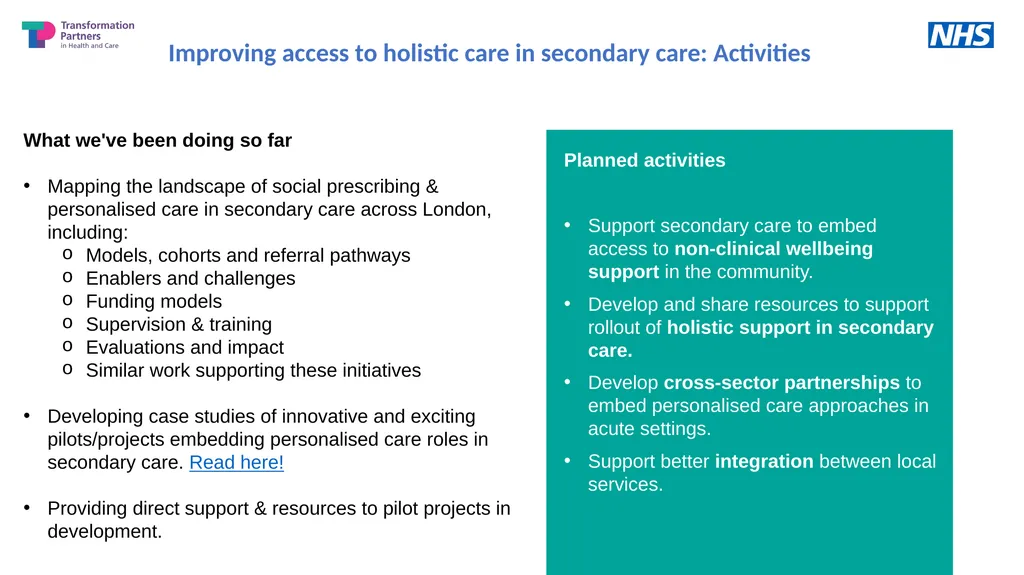
Planned activities
Support secondary care to embed access to non-clinical wellbeing support in the community.
Develop and share resources to support rollout of holistic support in secondary care.
Develop cross-sector partnerships to embed personalised care approaches in acute settings.
Support better integration between local services. Improving access to holistic care in secondary care: Activities What we've been doing so far
Mapping the landscape of social prescribing & personalised care in secondary care across London, including:
Models, cohorts and referral pathways
Enablers and challenges
Funding models
Supervision & training
Evaluations and impact
Similar work supporting these initiatives
Developing case studies of innovative and exciting pilots/projects embedding personalised care roles in secondary care. Read here!
Providing direct support & resources to pilot projects in development.<br>
Support secondary care to embed access to non-clinical wellbeing support in the community.
Develop and share resources to support rollout of holistic support in secondary care.
Develop cross-sector partnerships to embed personalised care approaches in acute settings.
Support better integration between local services. Improving access to holistic care in secondary care: Activities What we've been doing so far
Mapping the landscape of social prescribing & personalised care in secondary care across London, including:
Models, cohorts and referral pathways
Enablers and challenges
Funding models
Supervision & training
Evaluations and impact
Similar work supporting these initiatives
Developing case studies of innovative and exciting pilots/projects embedding personalised care roles in secondary care. Read here!
Providing direct support & resources to pilot projects in development.<br>
05
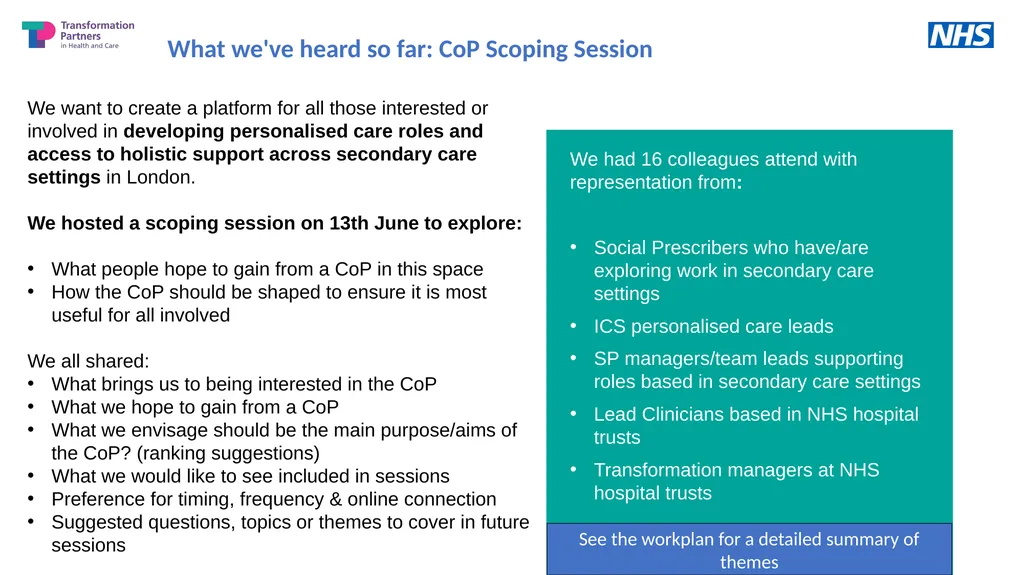
We had 16 colleagues attend with representation from:
Social Prescribers who have/are exploring work in secondary care settings
ICS personalised care leads
SP managers/team leads supporting roles based in secondary care settings
Lead Clinicians based in NHS hospital trusts
Transformation managers at NHS hospital trusts What we've heard so far: CoP Scoping Session We want to create a platform for all those interested or involved in developing personalised care roles and access to holistic support across secondary care settings in London.
We hosted a scoping session on 13th June to explore:
What people hope to gain from a CoP in this space
How the CoP should be shaped to ensure it is most useful for all involved
We all shared:
What brings us to being interested in the CoP
What we hope to gain from a CoP
What we envisage should be the main purpose/aims of the CoP? (ranking suggestions)
What we would like to see included in sessions
Preference for timing, frequency & online connection
Suggested questions, topics or themes to cover in future sessions See the workplan for a detailed summary of themes<br>
Social Prescribers who have/are exploring work in secondary care settings
ICS personalised care leads
SP managers/team leads supporting roles based in secondary care settings
Lead Clinicians based in NHS hospital trusts
Transformation managers at NHS hospital trusts What we've heard so far: CoP Scoping Session We want to create a platform for all those interested or involved in developing personalised care roles and access to holistic support across secondary care settings in London.
We hosted a scoping session on 13th June to explore:
What people hope to gain from a CoP in this space
How the CoP should be shaped to ensure it is most useful for all involved
We all shared:
What brings us to being interested in the CoP
What we hope to gain from a CoP
What we envisage should be the main purpose/aims of the CoP? (ranking suggestions)
What we would like to see included in sessions
Preference for timing, frequency & online connection
Suggested questions, topics or themes to cover in future sessions See the workplan for a detailed summary of themes<br>
06
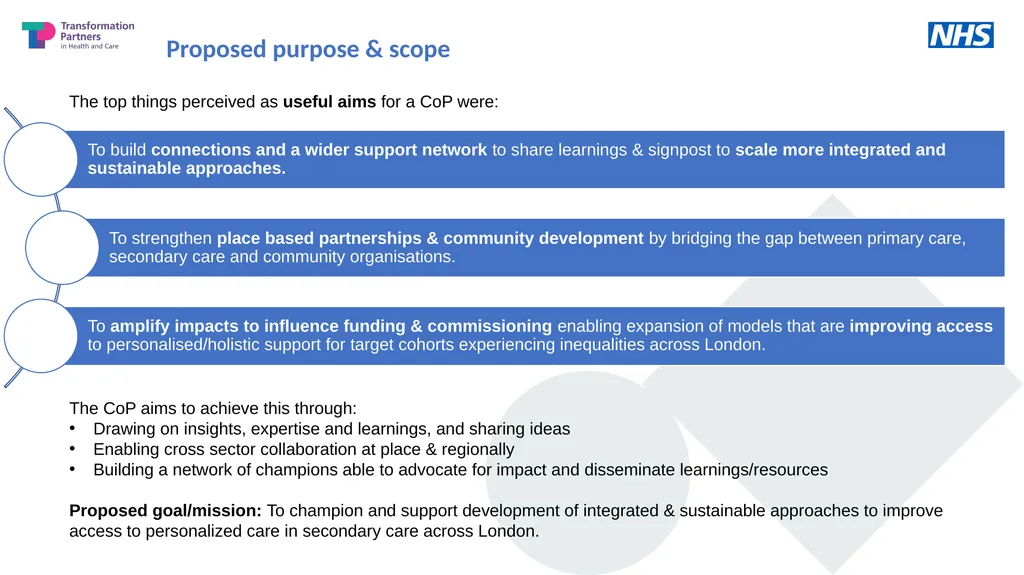
Proposed purpose & scope The top things perceived as useful aims for a CoP were:
The CoP aims to achieve this through:
Drawing on insights, expertise and learnings, and sharing ideas
Enabling cross sector collaboration at place & regionally
Building a network of champions able to advocate for impact and disseminate learnings/resources
Proposed goal/mission: To champion and support development of integrated & sustainable approaches to improve access to personalized care in secondary care across London.<br>
The CoP aims to achieve this through:
Drawing on insights, expertise and learnings, and sharing ideas
Enabling cross sector collaboration at place & regionally
Building a network of champions able to advocate for impact and disseminate learnings/resources
Proposed goal/mission: To champion and support development of integrated & sustainable approaches to improve access to personalized care in secondary care across London.<br>
07
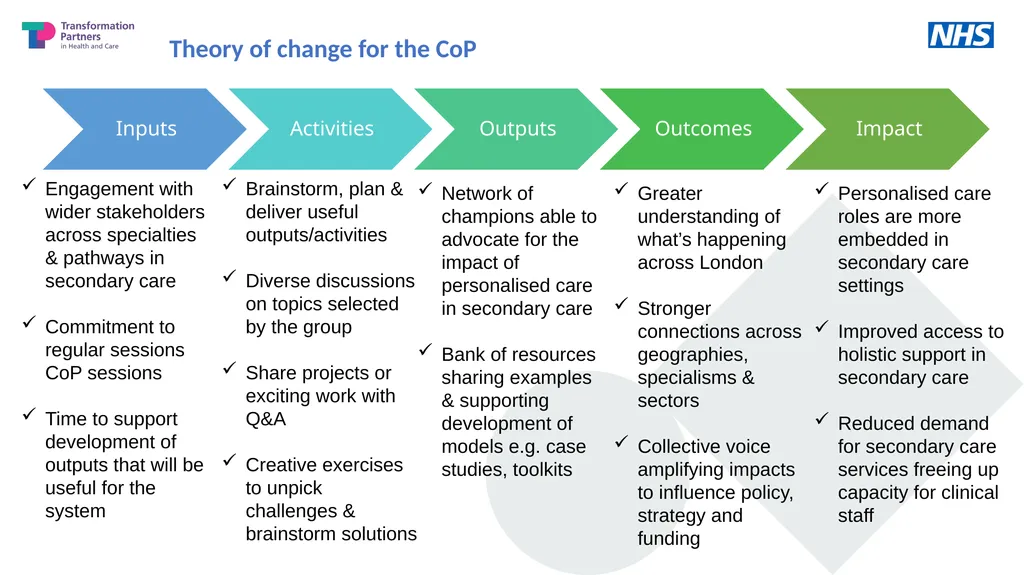
Theory of change for the CoP Engagement with wider stakeholders across specialties & pathways in secondary care
Commitment to regular sessions CoP sessions
Time to support development of outputs that will be useful for the system Network of champions able to advocate for the impact of personalised care in secondary care
Bank of resources sharing examples & supporting development of models e.g. case studies, toolkits Greater understanding of what’s happening across London
Stronger connections across geographies, specialisms & sectors
Collective voice amplifying impacts to influence policy, strategy and funding Personalised care roles are more embedded in secondary care settings
Improved access to holistic support in secondary care
Reduced demand for secondary care services freeing up capacity for clinical staff Brainstorm, plan & deliver useful outputs/activities
Diverse discussions on topics selected by the group
Share projects or exciting work with Q&A
Creative exercises to unpick challenges & brainstorm solutions<br>
Commitment to regular sessions CoP sessions
Time to support development of outputs that will be useful for the system Network of champions able to advocate for the impact of personalised care in secondary care
Bank of resources sharing examples & supporting development of models e.g. case studies, toolkits Greater understanding of what’s happening across London
Stronger connections across geographies, specialisms & sectors
Collective voice amplifying impacts to influence policy, strategy and funding Personalised care roles are more embedded in secondary care settings
Improved access to holistic support in secondary care
Reduced demand for secondary care services freeing up capacity for clinical staff Brainstorm, plan & deliver useful outputs/activities
Diverse discussions on topics selected by the group
Share projects or exciting work with Q&A
Creative exercises to unpick challenges & brainstorm solutions<br>
08
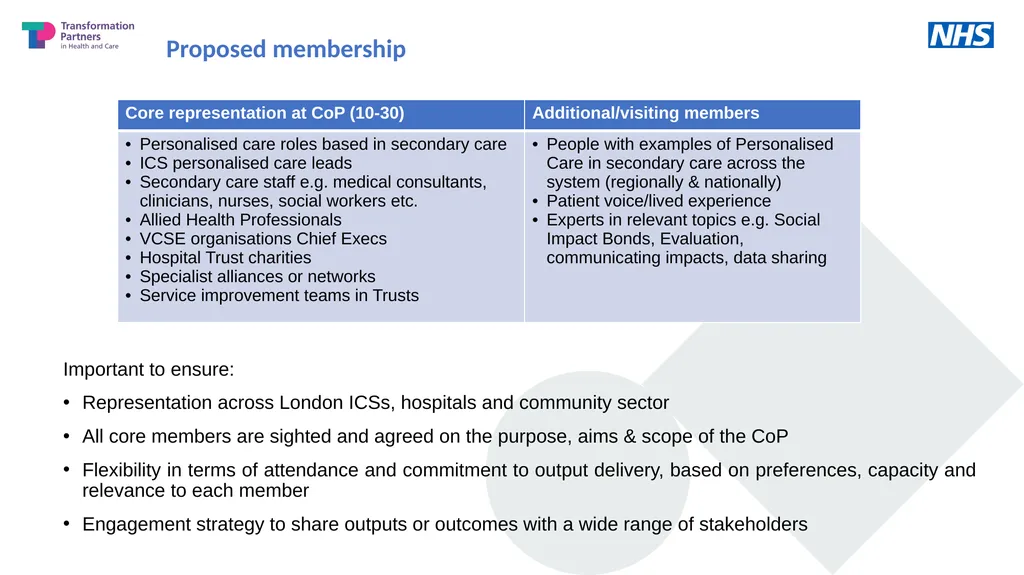
Proposed membership Important to ensure:
Representation across London ICSs, hospitals and community sector
All core members are sighted and agreed on the purpose, aims & scope of the CoP
Flexibility in terms of attendance and commitment to output delivery, based on preferences, capacity and relevance to each member
Engagement strategy to share outputs or outcomes with a wide range of stakeholders<br>
Representation across London ICSs, hospitals and community sector
All core members are sighted and agreed on the purpose, aims & scope of the CoP
Flexibility in terms of attendance and commitment to output delivery, based on preferences, capacity and relevance to each member
Engagement strategy to share outputs or outcomes with a wide range of stakeholders<br>
09
Core CoP Membership – Dec 2023<br>
10
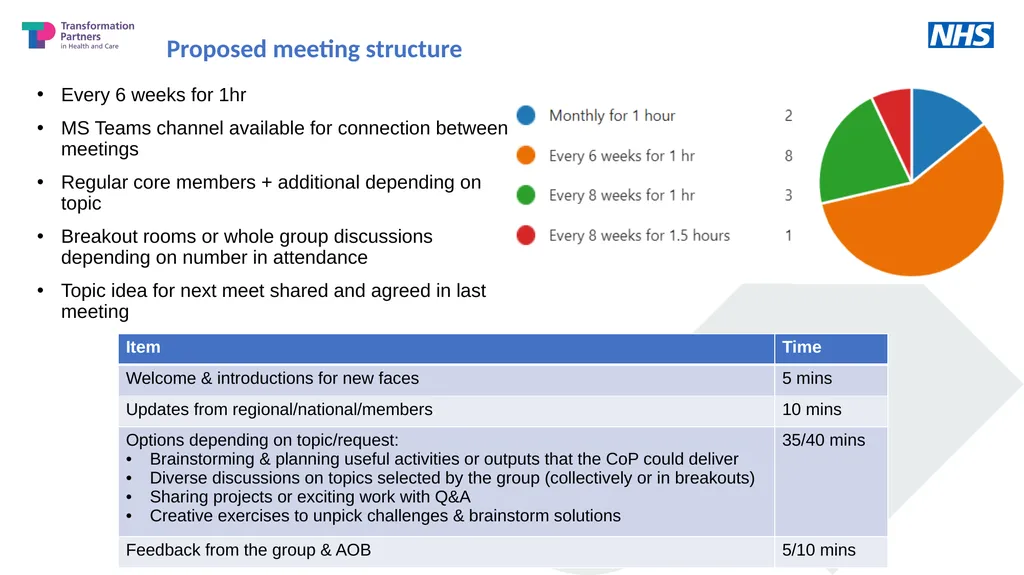
Every 6 weeks for 1hr
MS Teams channel available for connection between meetings
Regular core members + additional depending on topic
Breakout rooms or whole group discussions depending on number in attendance
Topic idea for next meet shared and agreed in last meeting Proposed meeting structure<br>
MS Teams channel available for connection between meetings
Regular core members + additional depending on topic
Breakout rooms or whole group discussions depending on number in attendance
Topic idea for next meet shared and agreed in last meeting Proposed meeting structure<br>
11
Appendix<br>
12
Social needs & economic gradient Low socioeconomic status Life events Environmental stressors More pharmaceutical prescriptions More adverse drug reactions Chronic conditions Substance abuse Problematic polypharmacy:
Inappropriately given multiple medications; increases with deprivation levels
of prescriptions are not necessary.
of hospital admissions are caused by adverse drug reactions;
(if in the >65 years age group).
Medicine related admissions are preventable – would save NHS approx. Up to 10% 6.5% 20% 66% £1 billion Increased wear and tear on the body Mental health issues Regional Drug and Therapeutics Centre (RDTC) led a study on the effect of social prescribing on medicines use in primary care and found that SP slowed increases in prescribing of antidepressants, likely by improving wellbeing<br>
Inappropriately given multiple medications; increases with deprivation levels
of prescriptions are not necessary.
of hospital admissions are caused by adverse drug reactions;
(if in the >65 years age group).
Medicine related admissions are preventable – would save NHS approx. Up to 10% 6.5% 20% 66% £1 billion Increased wear and tear on the body Mental health issues Regional Drug and Therapeutics Centre (RDTC) led a study on the effect of social prescribing on medicines use in primary care and found that SP slowed increases in prescribing of antidepressants, likely by improving wellbeing<br>
13
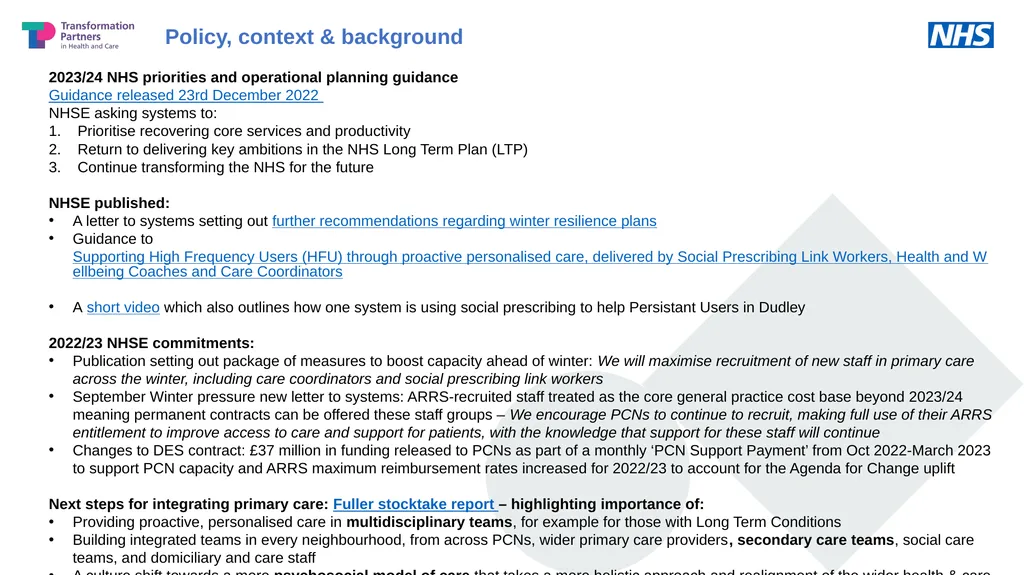
Policy, context & background 2023/24 NHS priorities and operational planning guidance
Guidance released 23rd December 2022
NHSE asking systems to:
Prioritise recovering core services and productivity
Return to delivering key ambitions in the NHS Long Term Plan (LTP)
Continue transforming the NHS for the future
NHSE published:
A letter to systems setting out further recommendations regarding winter resilience plans
Guidance to Supporting High Frequency Users (HFU) through proactive personalised care, delivered by Social Prescribing Link Workers, Health and Wellbeing Coaches and Care Coordinators
A short video which also outlines how one system is using social prescribing to help Persistant Users in Dudley
2022/23 NHSE commitments:
Publication setting out package of measures to boost capacity ahead of winter: We will maximise recruitment of new staff in primary care across the winter, including care coordinators and social prescribing link workers
September Winter pressure new letter to systems: ARRS-recruited staff treated as the core general practice cost base beyond 2023/24 meaning permanent contracts can be offered these staff groups – We encourage PCNs to continue to recruit, making full use of their ARRS entitlement to improve access to care and support for patients, with the knowledge that support for these staff will continue
Changes to DES contract: £37 million in funding released to PCNs as part of a monthly ‘PCN Support Payment’ from Oct 2022-March 2023 to support PCN capacity and ARRS maximum reimbursement rates increased for 2022/23 to account for the Agenda for Change uplift
Next steps for integrating primary care: Fuller stocktake report – highlighting importance of:
Providing proactive, personalised care in multidisciplinary teams, for example for those with Long Term Conditions
Building integrated teams in every neighbourhood, from across PCNs, wider primary care providers, secondary care teams, social care teams, and domiciliary and care staff
A culture shift towards a more psychosocial model of care that takes a more holistic approach and realignment of the wider health & care system to a population-based approach e.g. through aligning secondary care specialists to neighbourhood teams<br>
Guidance released 23rd December 2022
NHSE asking systems to:
Prioritise recovering core services and productivity
Return to delivering key ambitions in the NHS Long Term Plan (LTP)
Continue transforming the NHS for the future
NHSE published:
A letter to systems setting out further recommendations regarding winter resilience plans
Guidance to Supporting High Frequency Users (HFU) through proactive personalised care, delivered by Social Prescribing Link Workers, Health and Wellbeing Coaches and Care Coordinators
A short video which also outlines how one system is using social prescribing to help Persistant Users in Dudley
2022/23 NHSE commitments:
Publication setting out package of measures to boost capacity ahead of winter: We will maximise recruitment of new staff in primary care across the winter, including care coordinators and social prescribing link workers
September Winter pressure new letter to systems: ARRS-recruited staff treated as the core general practice cost base beyond 2023/24 meaning permanent contracts can be offered these staff groups – We encourage PCNs to continue to recruit, making full use of their ARRS entitlement to improve access to care and support for patients, with the knowledge that support for these staff will continue
Changes to DES contract: £37 million in funding released to PCNs as part of a monthly ‘PCN Support Payment’ from Oct 2022-March 2023 to support PCN capacity and ARRS maximum reimbursement rates increased for 2022/23 to account for the Agenda for Change uplift
Next steps for integrating primary care: Fuller stocktake report – highlighting importance of:
Providing proactive, personalised care in multidisciplinary teams, for example for those with Long Term Conditions
Building integrated teams in every neighbourhood, from across PCNs, wider primary care providers, secondary care teams, social care teams, and domiciliary and care staff
A culture shift towards a more psychosocial model of care that takes a more holistic approach and realignment of the wider health & care system to a population-based approach e.g. through aligning secondary care specialists to neighbourhood teams<br>
14
Supporting London’s health and care systems to develop more proactive, preventative and community centred approaches to improve the health and wellbeing of those most impacted by health inequity To deliver maximum impact for London we will:
Establish cross sector partnerships to harness collective assets and resources
Provide a voice for community prevention in London and a platform to share latest guidance, updates, innovations, good practice and evidence
Deliver “once for London” projects, co-produce shared resources, and hold regional events and webinars to share best practice to support local delivery
Continue to develop the evidence across all our activity and remain outcome and impact driven to support sustainable long-term transformation
Convene stakeholders to shape our work ensuring its adding value to local systems and support systems to align with regional and national priorities
Offer bespoke tailored support based on local priorities. This includes specific support to ICSs, boroughs, neighbourhoods, providers, and other regional programmes as agreed. Social Prescribing & Community Led Prevention<br>
Establish cross sector partnerships to harness collective assets and resources
Provide a voice for community prevention in London and a platform to share latest guidance, updates, innovations, good practice and evidence
Deliver “once for London” projects, co-produce shared resources, and hold regional events and webinars to share best practice to support local delivery
Continue to develop the evidence across all our activity and remain outcome and impact driven to support sustainable long-term transformation
Convene stakeholders to shape our work ensuring its adding value to local systems and support systems to align with regional and national priorities
Offer bespoke tailored support based on local priorities. This includes specific support to ICSs, boroughs, neighbourhoods, providers, and other regional programmes as agreed. Social Prescribing & Community Led Prevention<br>
15
Improving access to Personalised Care across secondary care: Workstream Theory of Change<br>