
1 PRESENTATION TO THE PORTFOLIO COMMITEE ON
T
Published · 26 slides · 0 views

1 / 1


Description
1 PRESENTATION TO THE PORTFOLIO COMMITEE ON COOPERATIVE GOVERNANCE AND TRADITIONAL AFFAIRS REPORT ON COMPLIANCE BY MADIBENG LOCAL MUNICIPALITY AND SUPPORT PROVIDED BY PROVINCIAL TREASURY 2 Presented by: Ms M Rosho MEC for Finance TABLE OF
Related Topics
Share
Embed code
Download this presentation From Below
"1 PRESENTATION TO THE PORTFOLIO COMMITEE ON" is the property of its rightful owner. Permission is granted to download and print the materials on this website for personal, non-commercial use only, and to display it on your personal computer provided you do not modify the materials and that you retain all copyright notices contained in the materials. By downloading content from our website, you accept the terms of this agreement.
Presentation Transcript
01
1<br>
02
PRESENTATION TO THE
PORTFOLIO COMMITEE ON COOPERATIVE GOVERNANCE AND TRADITIONAL AFFAIRS
REPORT ON COMPLIANCE BY MADIBENG LOCAL MUNICIPALITY AND SUPPORT PROVIDED BY PROVINCIAL TREASURY 2 Presented by: Ms M Rosho
MEC for Finance<br>
MEC for Finance<br>
03
TABLE OF CONTENTS Purpose
Background
Compliance Matters
3.1 Budget Management
3.2 Budget Implementation and Performance
3.3 Reporting
4. Financial Health
5. Support
6. Conclusion 3<br>
Background
Compliance Matters
3.1 Budget Management
3.2 Budget Implementation and Performance
3.3 Reporting
4. Financial Health
5. Support
6. Conclusion 3<br>
04
To provide the Portfolio Committee with a report on compliance by Madibeng Local Municipality and support provided by Provincial Treasury 4 PURPOSE<br>
05
BACKGROUND In terms of the Constitution of the Republic of South Africa, National and Provincial governments are required to support and strengthen the capacity of municipalities to manage their own affairs (S154), have the executive and legislative authority to see to the effective performance of municipalities (S155) and can regulate the exercise of a municipality’s executive authority (S155).
The Provincial Treasury has a responsibility to provide technical support in building financial management capacity, resolution of municipal financial problems through the development of financial recovery plans, transparent reporting and support municipalities to strengthen fiscal discipline.
The primary focus of the support and capacity building initiatives is on improving budget compliance which requires adoption of a funded budgets, management of the revenue value chain. 5<br>
The Provincial Treasury has a responsibility to provide technical support in building financial management capacity, resolution of municipal financial problems through the development of financial recovery plans, transparent reporting and support municipalities to strengthen fiscal discipline.
The primary focus of the support and capacity building initiatives is on improving budget compliance which requires adoption of a funded budgets, management of the revenue value chain. 5<br>
06
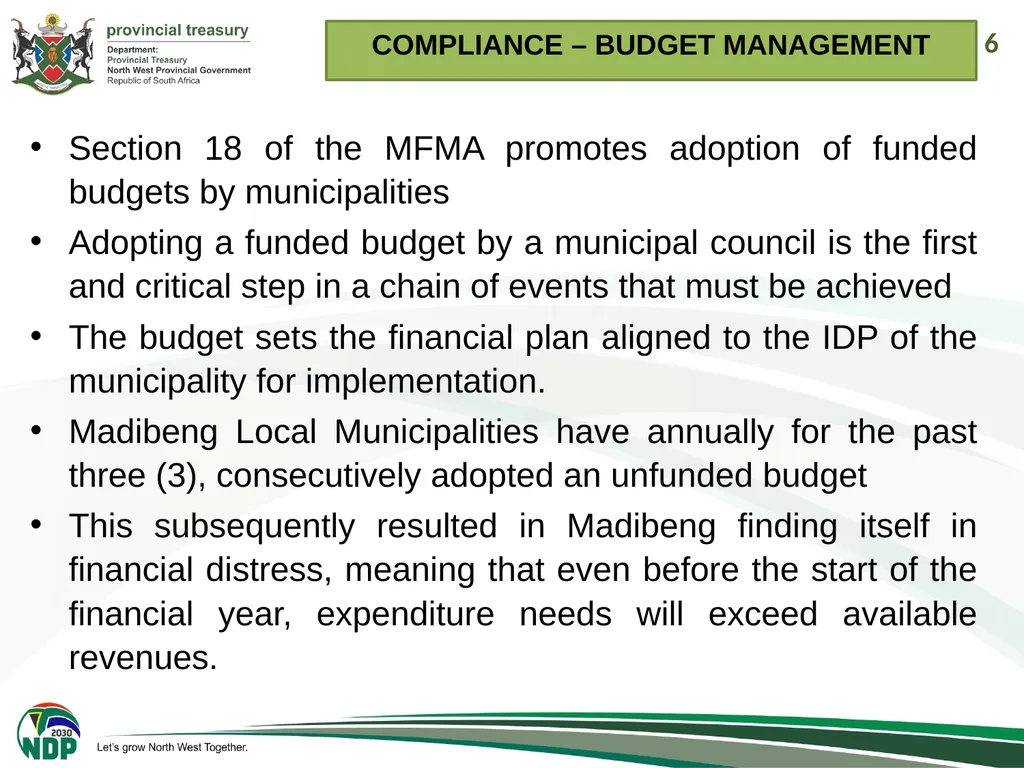
COMPLIANCE – BUDGET MANAGEMENT Section 18 of the MFMA promotes adoption of funded budgets by municipalities
Adopting a funded budget by a municipal council is the first and critical step in a chain of events that must be achieved
The budget sets the financial plan aligned to the IDP of the municipality for implementation.
Madibeng Local Municipalities have annually for the past three (3), consecutively adopted an unfunded budget
This subsequently resulted in Madibeng finding itself in financial distress, meaning that even before the start of the financial year, expenditure needs will exceed available revenues. 6<br>
Adopting a funded budget by a municipal council is the first and critical step in a chain of events that must be achieved
The budget sets the financial plan aligned to the IDP of the municipality for implementation.
Madibeng Local Municipalities have annually for the past three (3), consecutively adopted an unfunded budget
This subsequently resulted in Madibeng finding itself in financial distress, meaning that even before the start of the financial year, expenditure needs will exceed available revenues. 6<br>
07
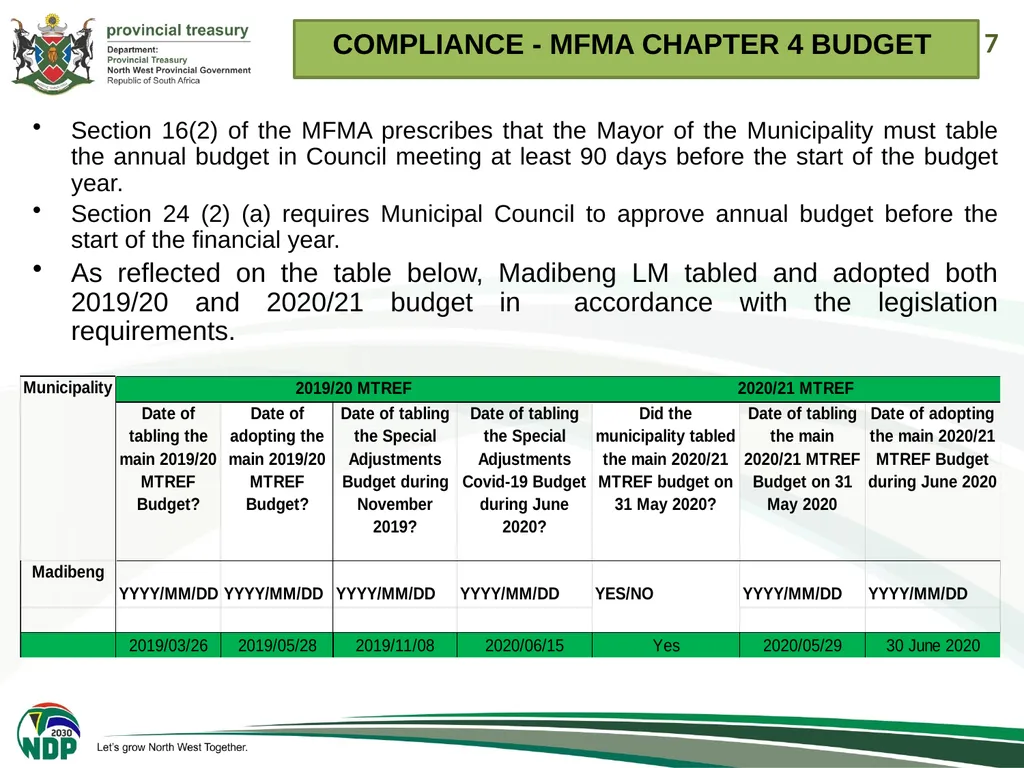
Section 16(2) of the MFMA prescribes that the Mayor of the Municipality must table the annual budget in Council meeting at least 90 days before the start of the budget year.
Section 24 (2) (a) requires Municipal Council to approve annual budget before the start of the financial year.
As reflected on the table below, Madibeng LM tabled and adopted both 2019/20 and 2020/21 budget in accordance with the legislation requirements. 7 COMPLIANCE - MFMA CHAPTER 4 BUDGET<br>
Section 24 (2) (a) requires Municipal Council to approve annual budget before the start of the financial year.
As reflected on the table below, Madibeng LM tabled and adopted both 2019/20 and 2020/21 budget in accordance with the legislation requirements. 7 COMPLIANCE - MFMA CHAPTER 4 BUDGET<br>
08
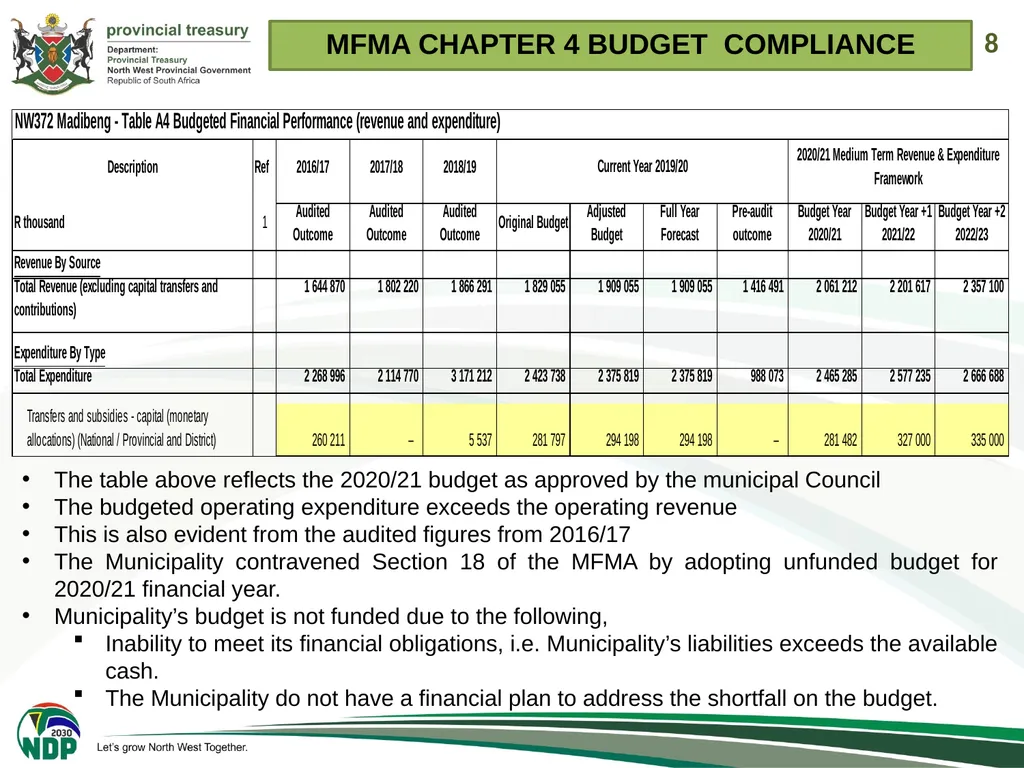
8 MFMA CHAPTER 4 BUDGET COMPLIANCE The table above reflects the 2020/21 budget as approved by the municipal Council
The budgeted operating expenditure exceeds the operating revenue
This is also evident from the audited figures from 2016/17
The Municipality contravened Section 18 of the MFMA by adopting unfunded budget for 2020/21 financial year.
Municipality’s budget is not funded due to the following,
Inability to meet its financial obligations, i.e. Municipality’s liabilities exceeds the available cash.
The Municipality do not have a financial plan to address the shortfall on the budget.<br>
The budgeted operating expenditure exceeds the operating revenue
This is also evident from the audited figures from 2016/17
The Municipality contravened Section 18 of the MFMA by adopting unfunded budget for 2020/21 financial year.
Municipality’s budget is not funded due to the following,
Inability to meet its financial obligations, i.e. Municipality’s liabilities exceeds the available cash.
The Municipality do not have a financial plan to address the shortfall on the budget.<br>
09
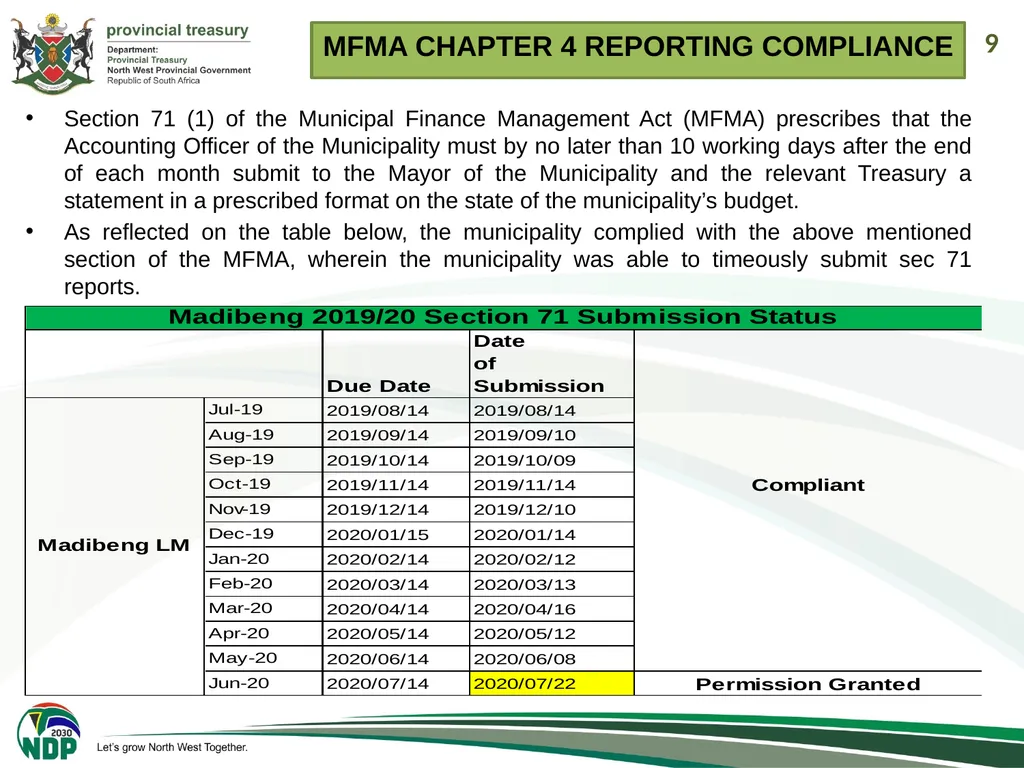
Section 71 (1) of the Municipal Finance Management Act (MFMA) prescribes that the Accounting Officer of the Municipality must by no later than 10 working days after the end of each month submit to the Mayor of the Municipality and the relevant Treasury a statement in a prescribed format on the state of the municipality’s budget.
As reflected on the table below, the municipality complied with the above mentioned section of the MFMA, wherein the municipality was able to timeously submit sec 71 reports. 9 MFMA CHAPTER 4 REPORTING COMPLIANCE<br>
As reflected on the table below, the municipality complied with the above mentioned section of the MFMA, wherein the municipality was able to timeously submit sec 71 reports. 9 MFMA CHAPTER 4 REPORTING COMPLIANCE<br>
10
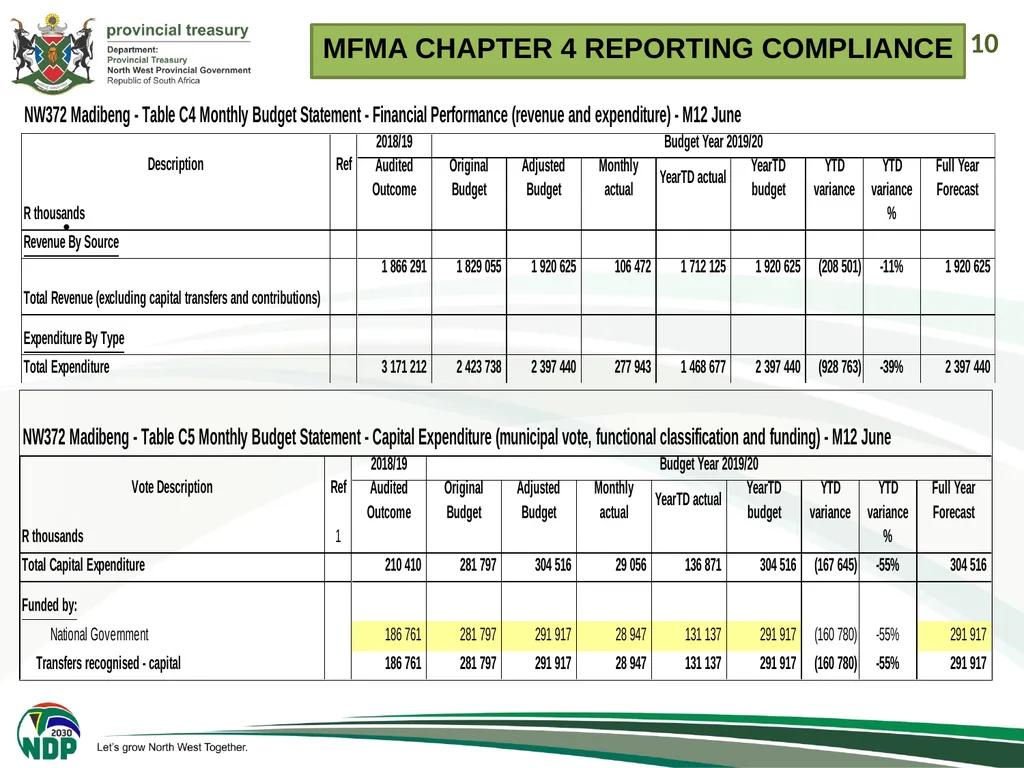
10 . MFMA CHAPTER 4 REPORTING COMPLIANCE<br>
11
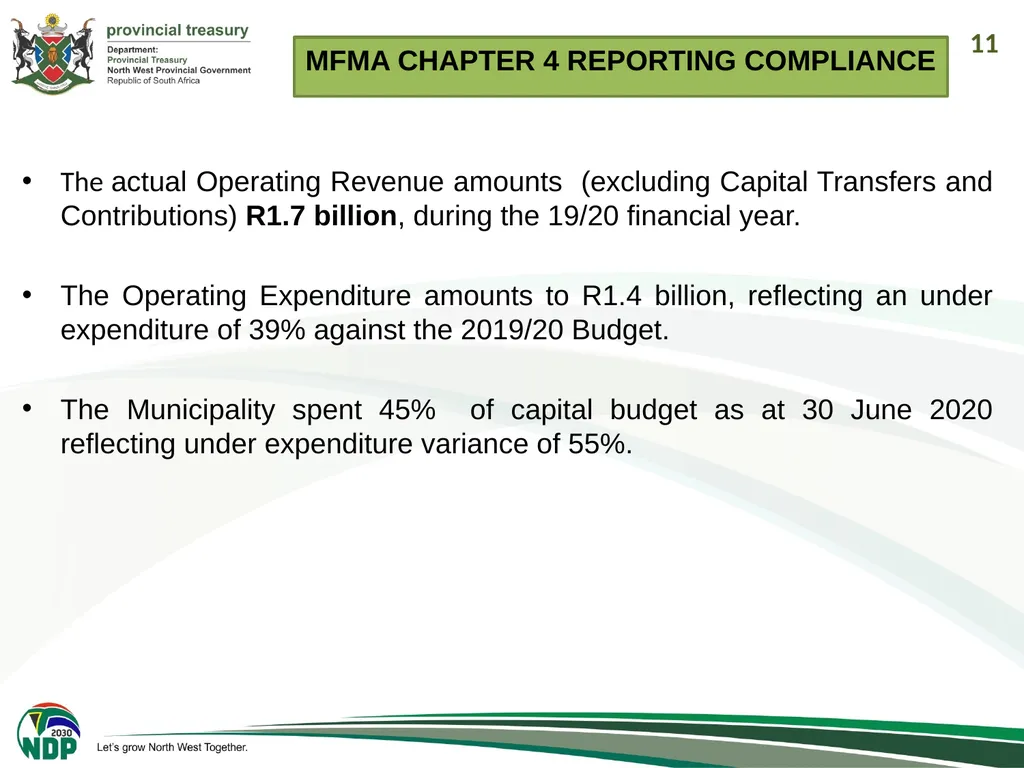
The actual Operating Revenue amounts (excluding Capital Transfers and Contributions) R1.7 billion, during the 19/20 financial year.
The Operating Expenditure amounts to R1.4 billion, reflecting an under expenditure of 39% against the 2019/20 Budget.
The Municipality spent 45% of capital budget as at 30 June 2020 reflecting under expenditure variance of 55%. 11 MFMA CHAPTER 4 REPORTING COMPLIANCE<br>
The Operating Expenditure amounts to R1.4 billion, reflecting an under expenditure of 39% against the 2019/20 Budget.
The Municipality spent 45% of capital budget as at 30 June 2020 reflecting under expenditure variance of 55%. 11 MFMA CHAPTER 4 REPORTING COMPLIANCE<br>
12
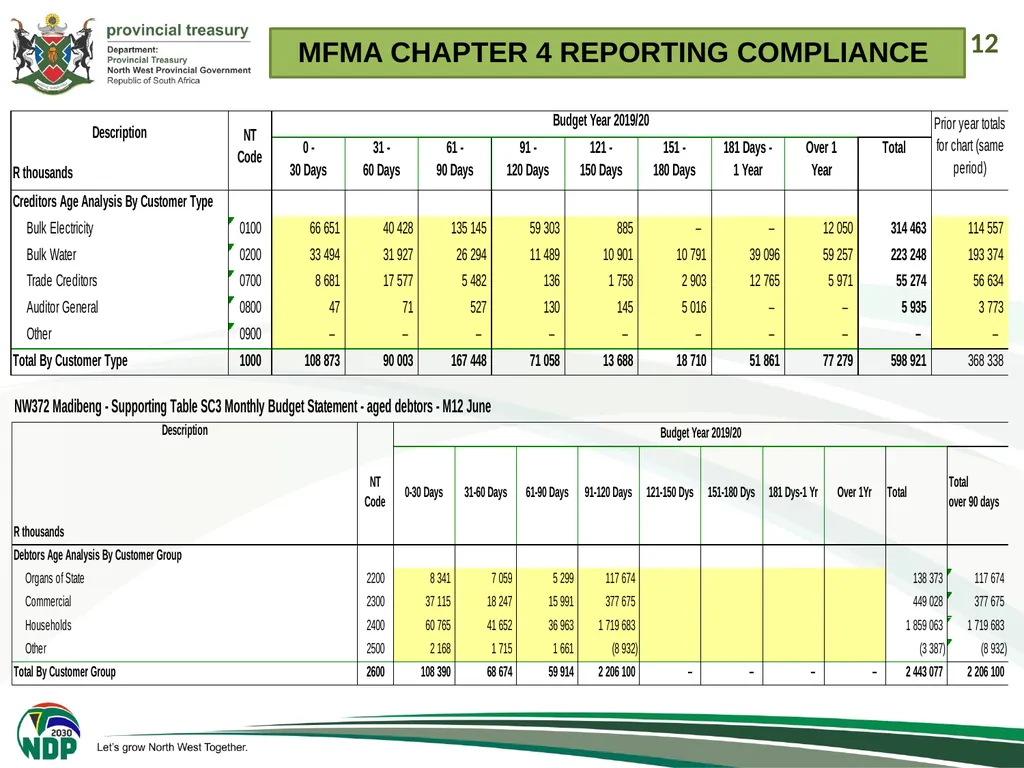
12 MFMA CHAPTER 4 REPORTING COMPLIANCE<br>
13
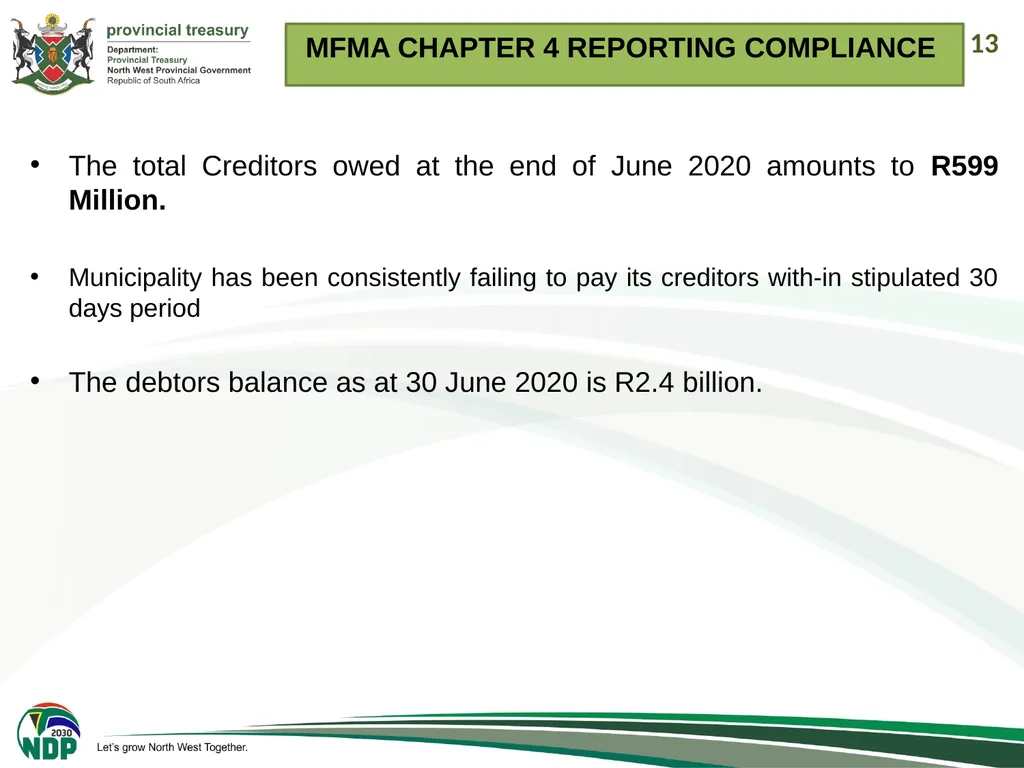
The total Creditors owed at the end of June 2020 amounts to R599 Million.
Municipality has been consistently failing to pay its creditors with-in stipulated 30 days period
The debtors balance as at 30 June 2020 is R2.4 billion. 13 MFMA CHAPTER 4 REPORTING COMPLIANCE<br>
Municipality has been consistently failing to pay its creditors with-in stipulated 30 days period
The debtors balance as at 30 June 2020 is R2.4 billion. 13 MFMA CHAPTER 4 REPORTING COMPLIANCE<br>
14
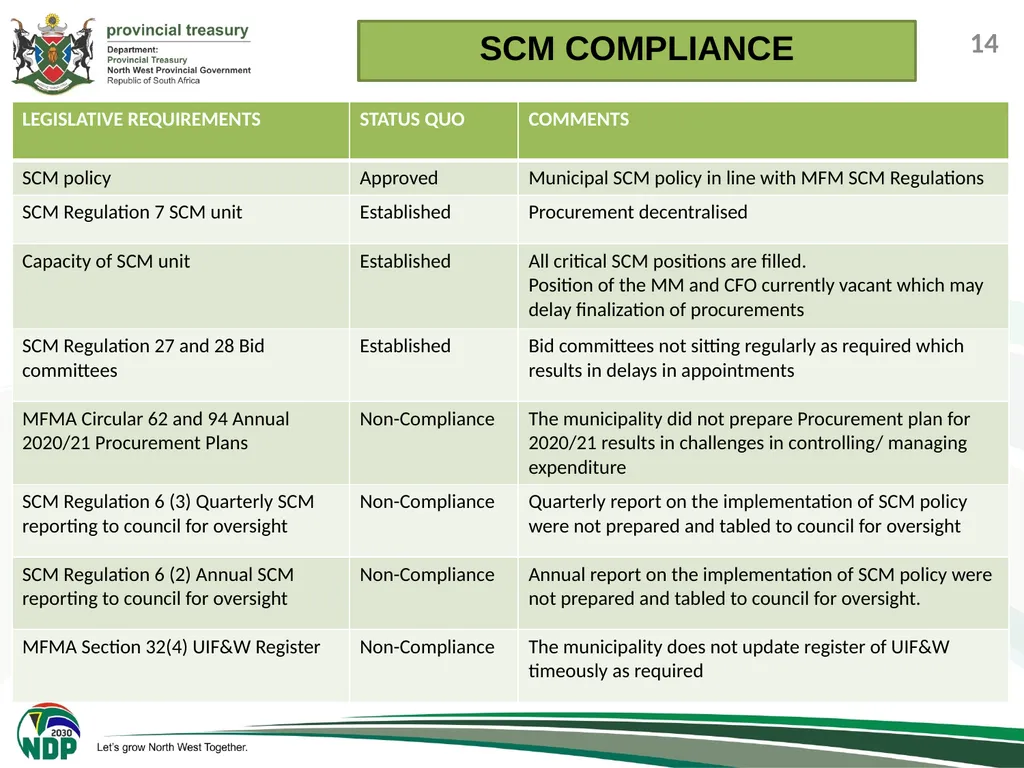
SCM COMPLIANCE 14<br>
15
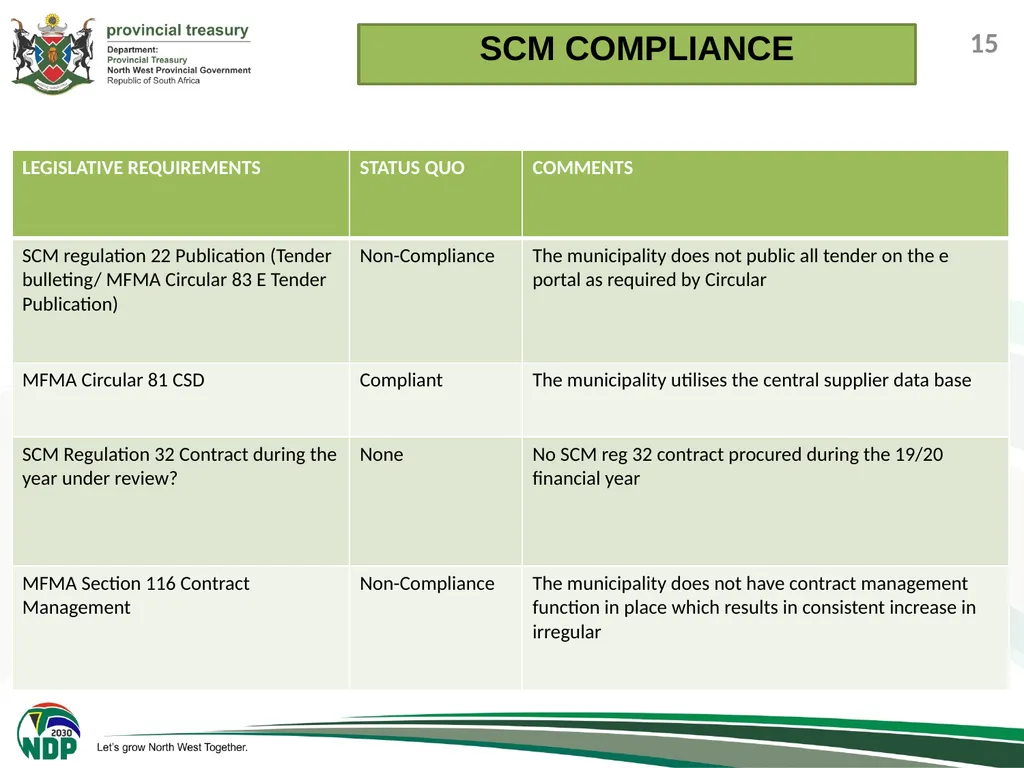
SCM COMPLIANCE 15<br>
16
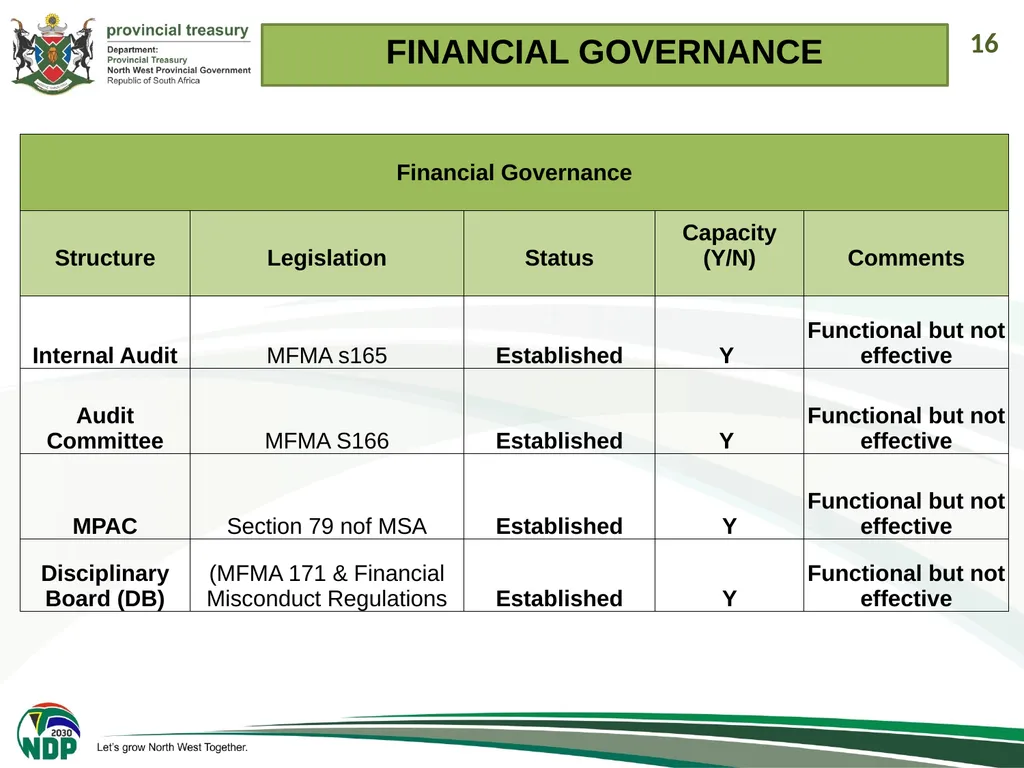
16 FINANCIAL GOVERNANCE<br>
17
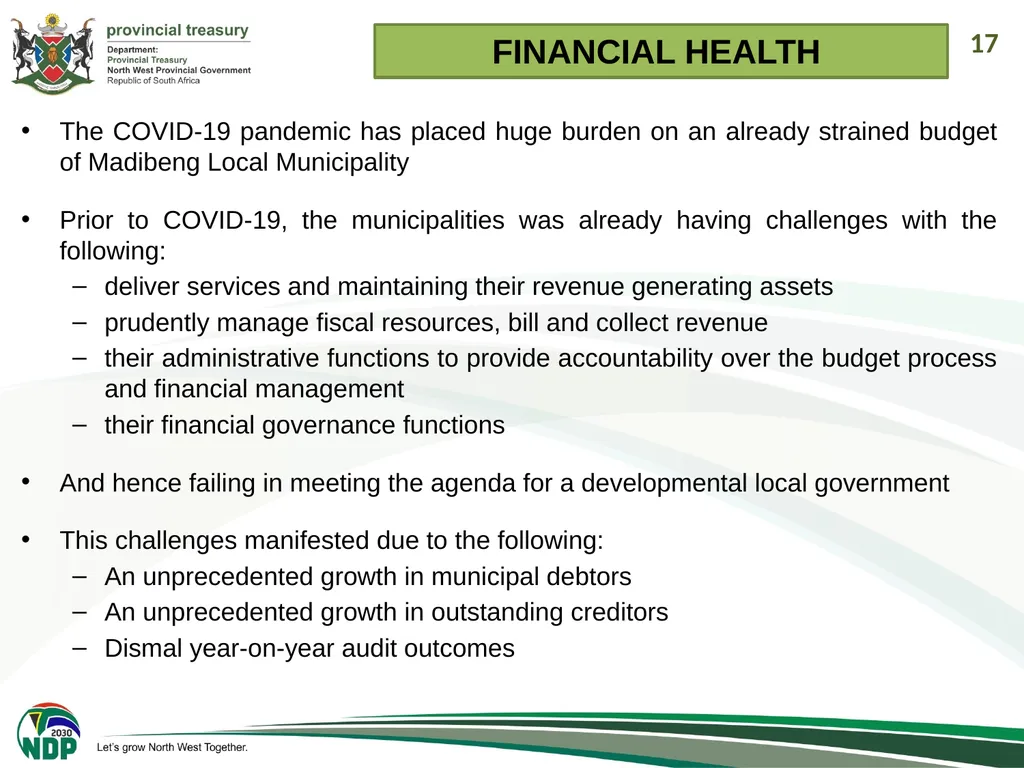
FINANCIAL HEALTH The COVID-19 pandemic has placed huge burden on an already strained budget of Madibeng Local Municipality
Prior to COVID-19, the municipalities was already having challenges with the following:
deliver services and maintaining their revenue generating assets
prudently manage fiscal resources, bill and collect revenue
their administrative functions to provide accountability over the budget process and financial management
their financial governance functions
And hence failing in meeting the agenda for a developmental local government
This challenges manifested due to the following:
An unprecedented growth in municipal debtors
An unprecedented growth in outstanding creditors
Dismal year-on-year audit outcomes 17<br>
Prior to COVID-19, the municipalities was already having challenges with the following:
deliver services and maintaining their revenue generating assets
prudently manage fiscal resources, bill and collect revenue
their administrative functions to provide accountability over the budget process and financial management
their financial governance functions
And hence failing in meeting the agenda for a developmental local government
This challenges manifested due to the following:
An unprecedented growth in municipal debtors
An unprecedented growth in outstanding creditors
Dismal year-on-year audit outcomes 17<br>
18
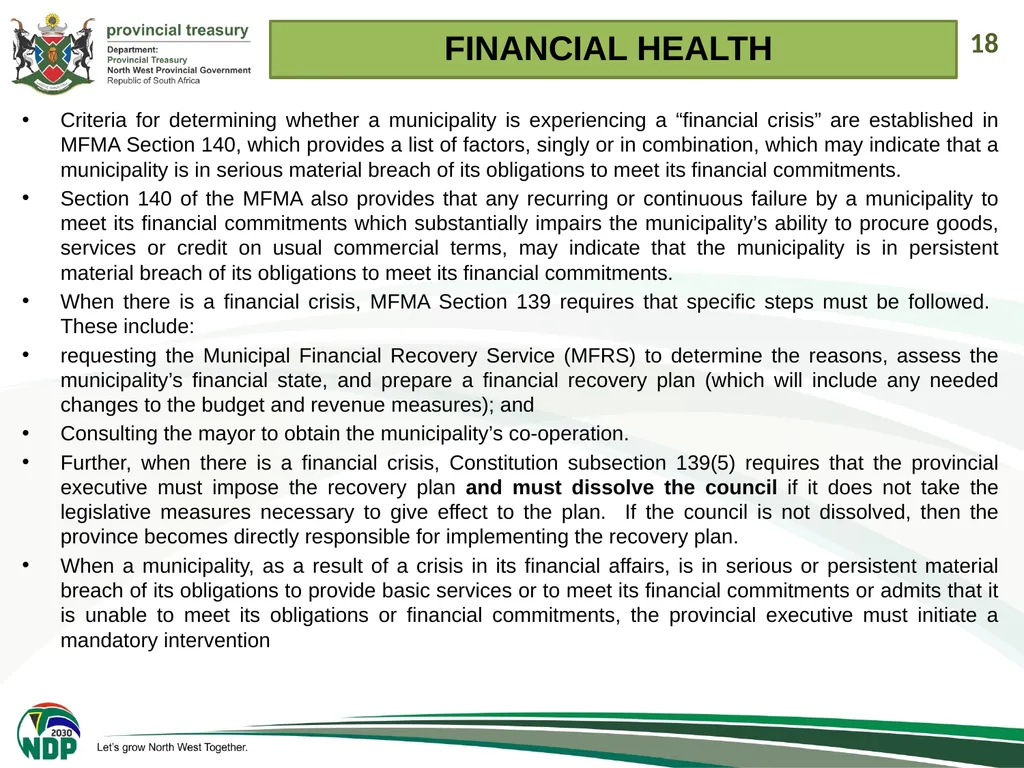
FINANCIAL HEALTH Criteria for determining whether a municipality is experiencing a “financial crisis” are established in MFMA Section 140, which provides a list of factors, singly or in combination, which may indicate that a municipality is in serious material breach of its obligations to meet its financial commitments.
Section 140 of the MFMA also provides that any recurring or continuous failure by a municipality to meet its financial commitments which substantially impairs the municipality’s ability to procure goods, services or credit on usual commercial terms, may indicate that the municipality is in persistent material breach of its obligations to meet its financial commitments.
When there is a financial crisis, MFMA Section 139 requires that specific steps must be followed. These include:
requesting the Municipal Financial Recovery Service (MFRS) to determine the reasons, assess the municipality’s financial state, and prepare a financial recovery plan (which will include any needed changes to the budget and revenue measures); and
Consulting the mayor to obtain the municipality’s co-operation.
Further, when there is a financial crisis, Constitution subsection 139(5) requires that the provincial executive must impose the recovery plan and must dissolve the council if it does not take the legislative measures necessary to give effect to the plan. If the council is not dissolved, then the province becomes directly responsible for implementing the recovery plan.
When a municipality, as a result of a crisis in its financial affairs, is in serious or persistent material breach of its obligations to provide basic services or to meet its financial commitments or admits that it is unable to meet its obligations or financial commitments, the provincial executive must initiate a mandatory intervention 18<br>
Section 140 of the MFMA also provides that any recurring or continuous failure by a municipality to meet its financial commitments which substantially impairs the municipality’s ability to procure goods, services or credit on usual commercial terms, may indicate that the municipality is in persistent material breach of its obligations to meet its financial commitments.
When there is a financial crisis, MFMA Section 139 requires that specific steps must be followed. These include:
requesting the Municipal Financial Recovery Service (MFRS) to determine the reasons, assess the municipality’s financial state, and prepare a financial recovery plan (which will include any needed changes to the budget and revenue measures); and
Consulting the mayor to obtain the municipality’s co-operation.
Further, when there is a financial crisis, Constitution subsection 139(5) requires that the provincial executive must impose the recovery plan and must dissolve the council if it does not take the legislative measures necessary to give effect to the plan. If the council is not dissolved, then the province becomes directly responsible for implementing the recovery plan.
When a municipality, as a result of a crisis in its financial affairs, is in serious or persistent material breach of its obligations to provide basic services or to meet its financial commitments or admits that it is unable to meet its obligations or financial commitments, the provincial executive must initiate a mandatory intervention 18<br>
19
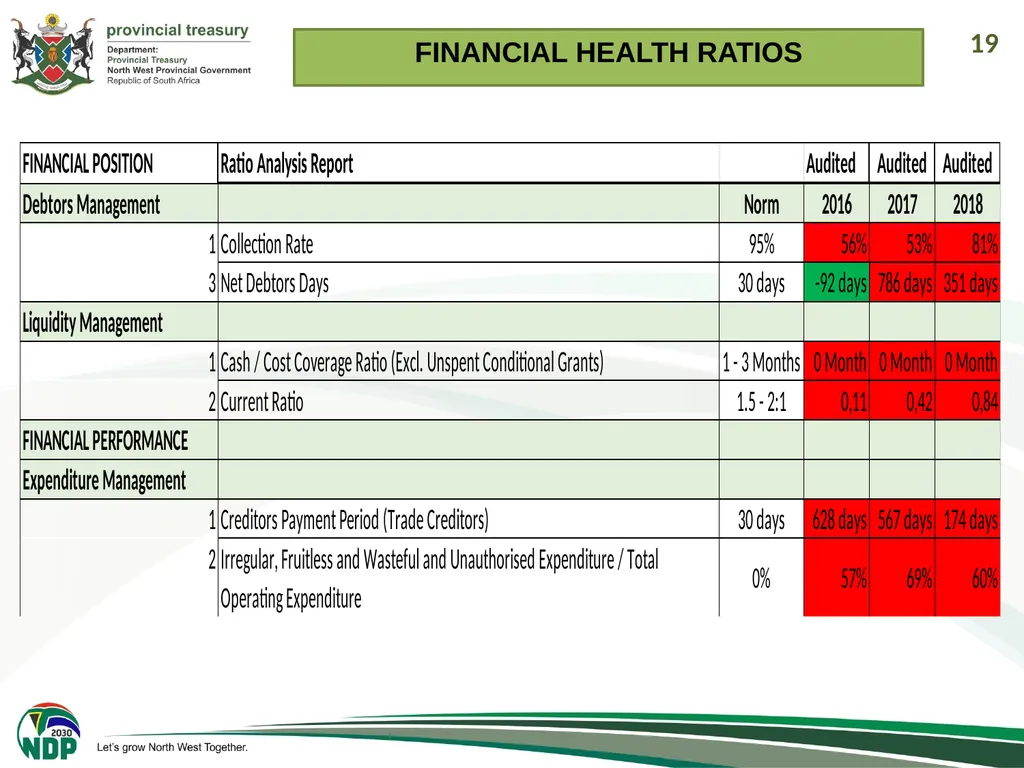
19 FINANCIAL HEALTH RATIOS<br>
20
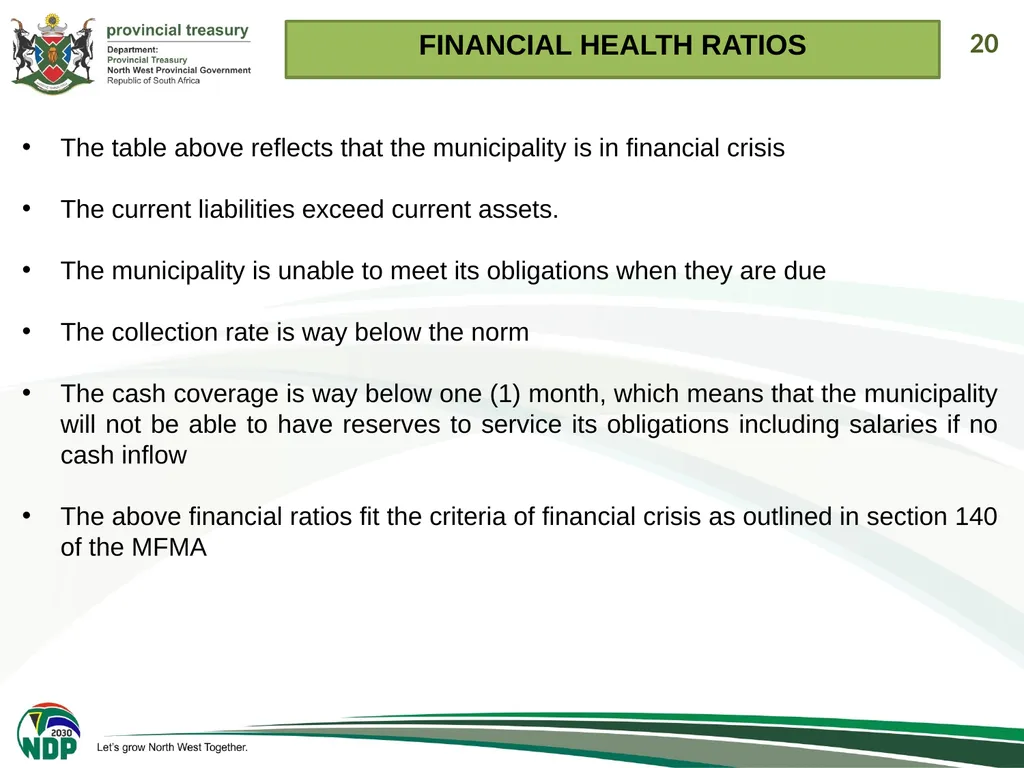
The table above reflects that the municipality is in financial crisis
The current liabilities exceed current assets.
The municipality is unable to meet its obligations when they are due
The collection rate is way below the norm
The cash coverage is way below one (1) month, which means that the municipality will not be able to have reserves to service its obligations including salaries if no cash inflow
The above financial ratios fit the criteria of financial crisis as outlined in section 140 of the MFMA 20 FINANCIAL HEALTH RATIOS<br>
The current liabilities exceed current assets.
The municipality is unable to meet its obligations when they are due
The collection rate is way below the norm
The cash coverage is way below one (1) month, which means that the municipality will not be able to have reserves to service its obligations including salaries if no cash inflow
The above financial ratios fit the criteria of financial crisis as outlined in section 140 of the MFMA 20 FINANCIAL HEALTH RATIOS<br>
21
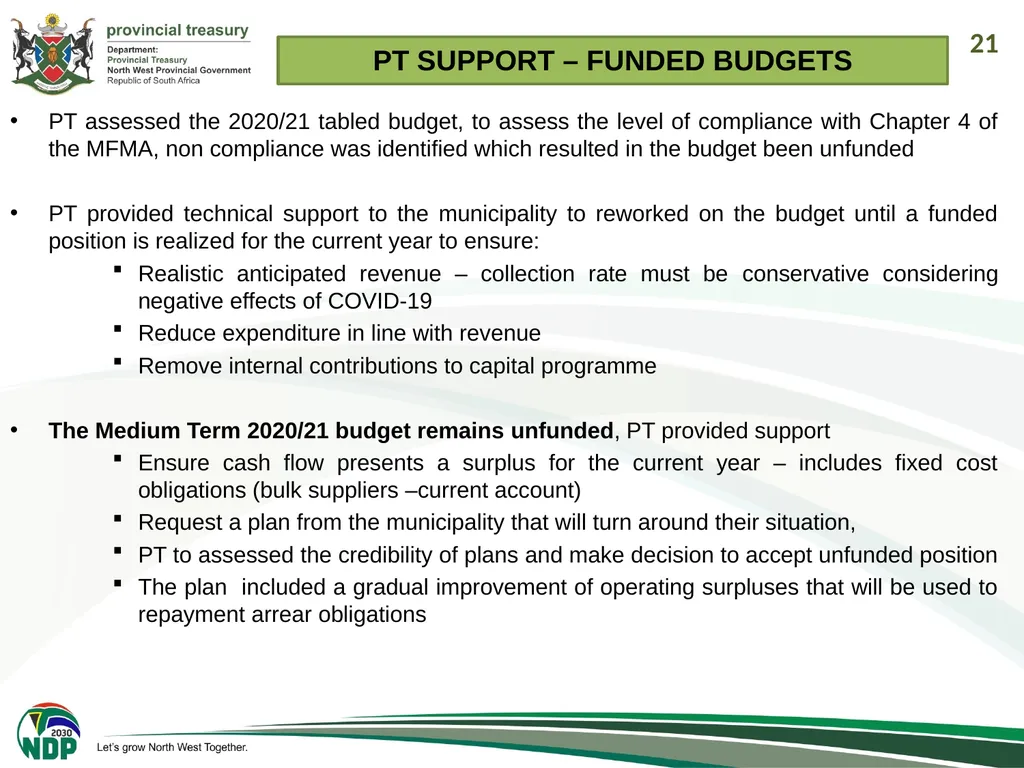
PT SUPPORT – FUNDED BUDGETS PT assessed the 2020/21 tabled budget, to assess the level of compliance with Chapter 4 of the MFMA, non compliance was identified which resulted in the budget been unfunded
PT provided technical support to the municipality to reworked on the budget until a funded position is realized for the current year to ensure:
Realistic anticipated revenue – collection rate must be conservative considering negative effects of COVID-19
Reduce expenditure in line with revenue
Remove internal contributions to capital programme
The Medium Term 2020/21 budget remains unfunded, PT provided support
Ensure cash flow presents a surplus for the current year – includes fixed cost obligations (bulk suppliers –current account)
Request a plan from the municipality that will turn around their situation,
PT to assessed the credibility of plans and make decision to accept unfunded position
The plan included a gradual improvement of operating surpluses that will be used to repayment arrear obligations 21<br>
PT provided technical support to the municipality to reworked on the budget until a funded position is realized for the current year to ensure:
Realistic anticipated revenue – collection rate must be conservative considering negative effects of COVID-19
Reduce expenditure in line with revenue
Remove internal contributions to capital programme
The Medium Term 2020/21 budget remains unfunded, PT provided support
Ensure cash flow presents a surplus for the current year – includes fixed cost obligations (bulk suppliers –current account)
Request a plan from the municipality that will turn around their situation,
PT to assessed the credibility of plans and make decision to accept unfunded position
The plan included a gradual improvement of operating surpluses that will be used to repayment arrear obligations 21<br>
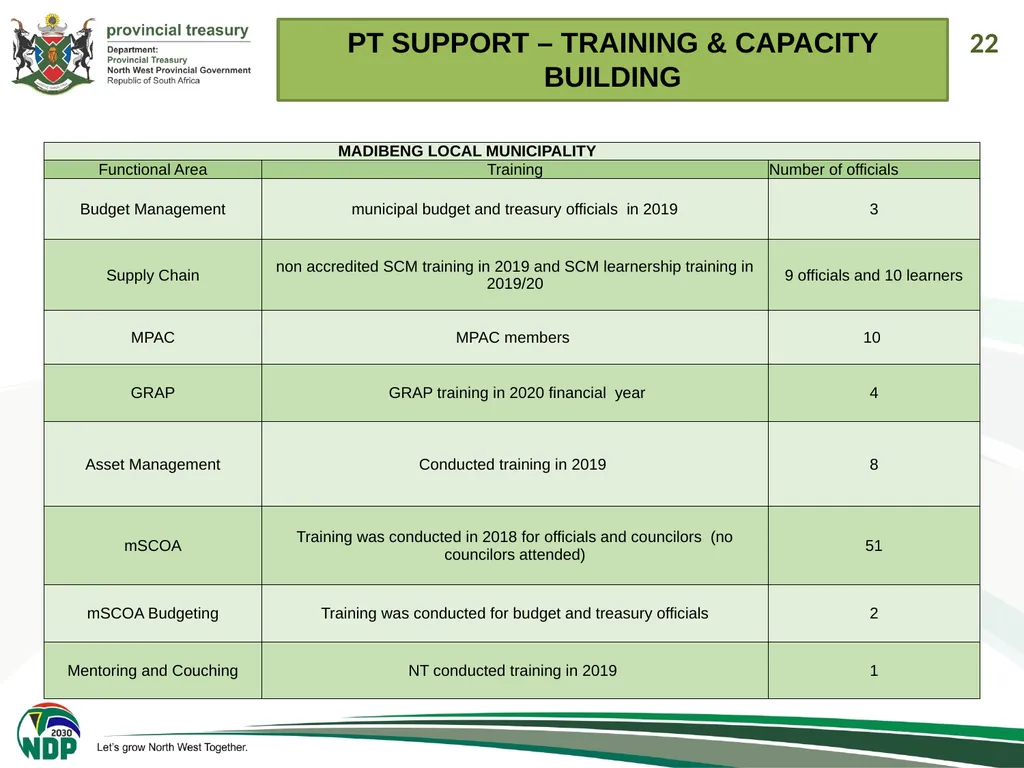
22
22 PT SUPPORT – TRAINING & CAPACITY BUILDING<br>
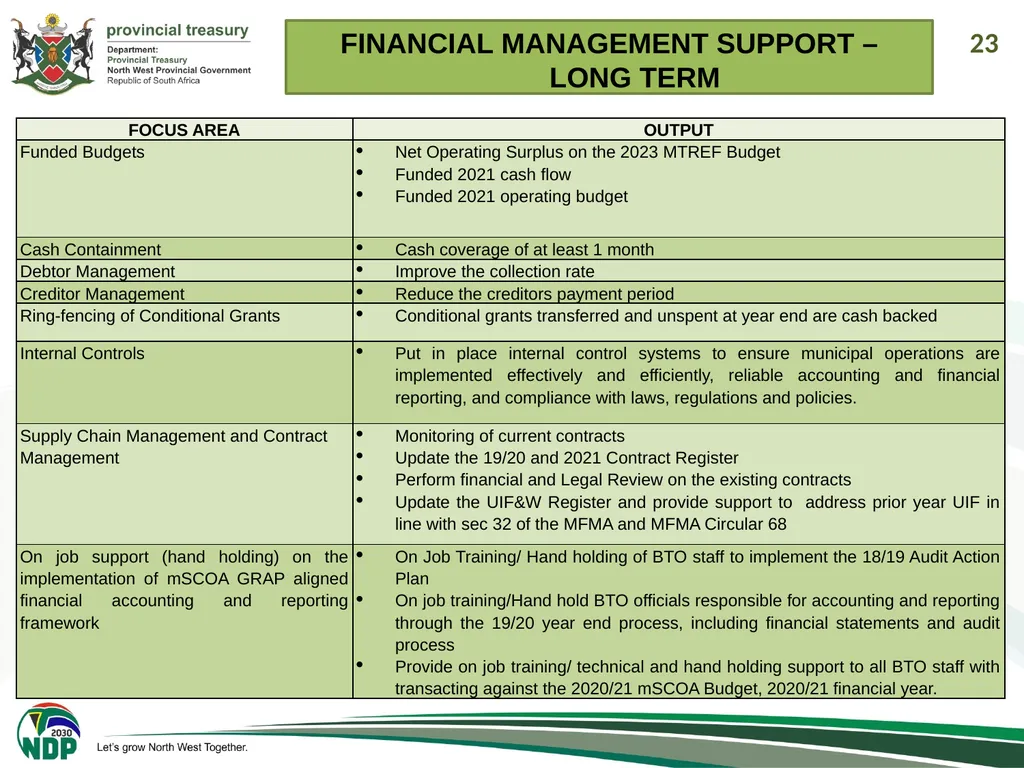
23
FINANCIAL MANAGEMENT SUPPORT – LONG TERM 23<br>
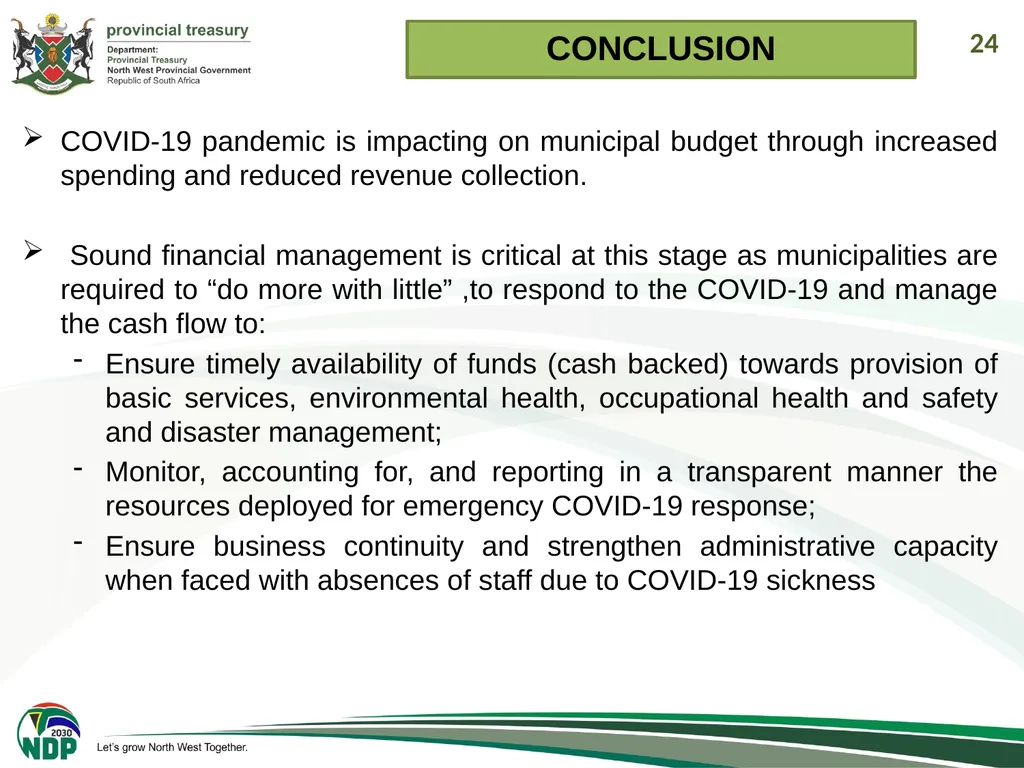
24
CONCLUSION COVID-19 pandemic is impacting on municipal budget through increased spending and reduced revenue collection.
Sound financial management is critical at this stage as municipalities are required to “do more with little” ,to respond to the COVID-19 and manage the cash flow to:
Ensure timely availability of funds (cash backed) towards provision of basic services, environmental health, occupational health and safety and disaster management;
Monitor, accounting for, and reporting in a transparent manner the resources deployed for emergency COVID-19 response;
Ensure business continuity and strengthen administrative capacity when faced with absences of staff due to COVID-19 sickness 24<br>
Sound financial management is critical at this stage as municipalities are required to “do more with little” ,to respond to the COVID-19 and manage the cash flow to:
Ensure timely availability of funds (cash backed) towards provision of basic services, environmental health, occupational health and safety and disaster management;
Monitor, accounting for, and reporting in a transparent manner the resources deployed for emergency COVID-19 response;
Ensure business continuity and strengthen administrative capacity when faced with absences of staff due to COVID-19 sickness 24<br>
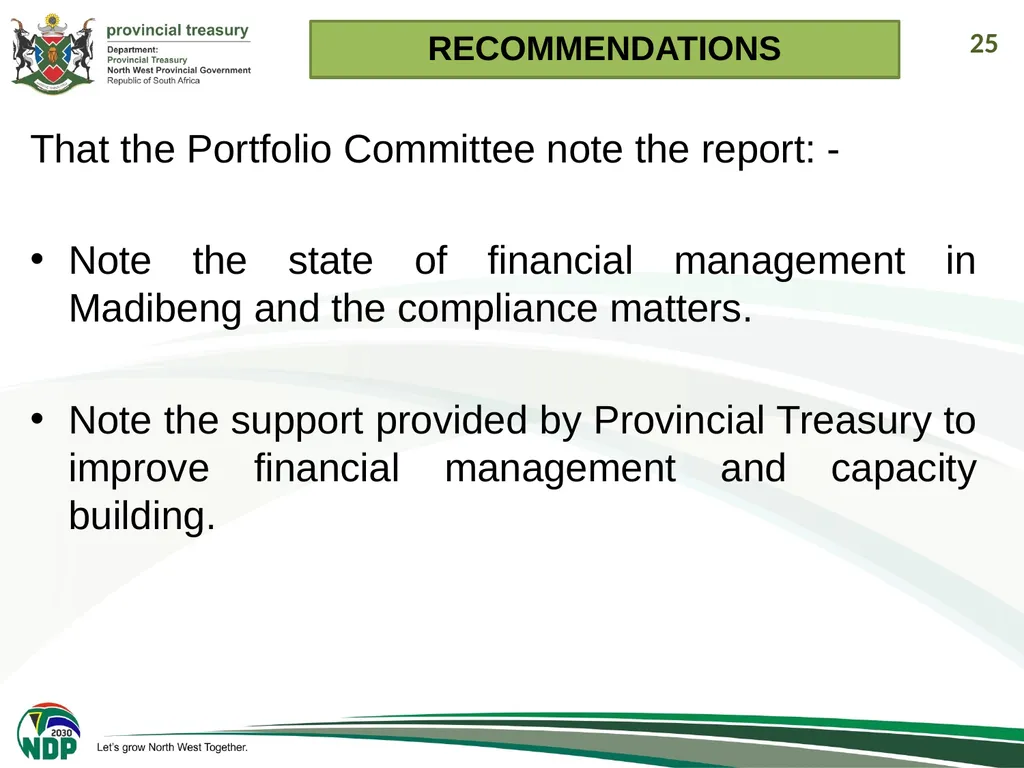
25
RECOMMENDATIONS That the Portfolio Committee note the report: -
Note the state of financial management in Madibeng and the compliance matters.
Note the support provided by Provincial Treasury to improve financial management and capacity building. 25<br>
Note the state of financial management in Madibeng and the compliance matters.
Note the support provided by Provincial Treasury to improve financial management and capacity building. 25<br>
26
Thank You!
BAIE DANKIE! 26<br>