1 Retaining Employees with Disabilities Disability Inclusion Best Practices for the Employee Lifecycle What is an accommodation request? When an applicant or employee requests an adjustment or change at work for a reason related to a
"1 Retaining Employees with Disabilities Disability" is the property of its rightful owner. Permission is granted to
download and print the materials on this website for personal, non-commercial use only, and to display it
on your personal computer provided you do not modify the materials and that you retain all copyright
notices contained in the materials. By downloading content from our website, you accept the terms of this
agreement.
Presentation Transcript
01
1 Retaining Employees with Disabilities Disability Inclusion & Best Practices for the Employee Lifecycle<br>
02
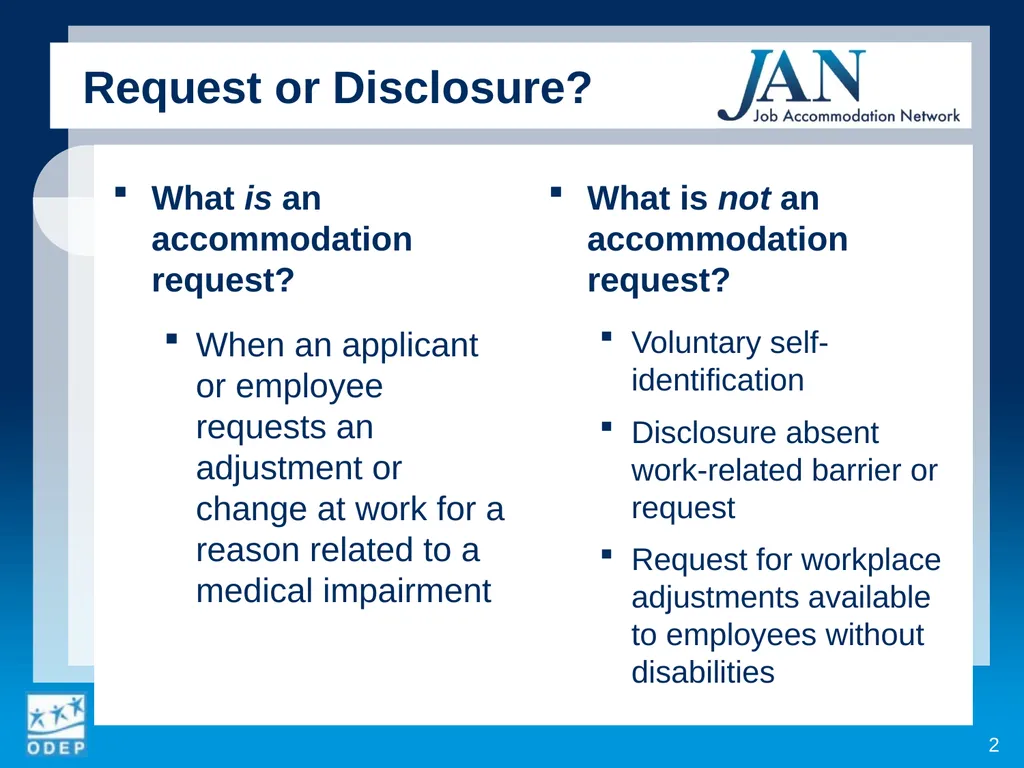
What is an accommodation request?
When an applicant or employee requests an adjustment or change at work for a reason related to a medical impairment What is not an accommodation request?
Voluntary self-identification
Disclosure absent work-related barrier or request
Request for workplace adjustments available to employees without disabilities 2 Request or Disclosure?<br>
03
About the medical impairment:
What is the nature of the impairment?
What are the limitations/restrictions?
How long will the impairment last?
What is the duration of restrictions? 3 Questions to Consider Can medical documentation be obtained?
Yes, when the disability and need for accommodation are not known or obvious<br>
04
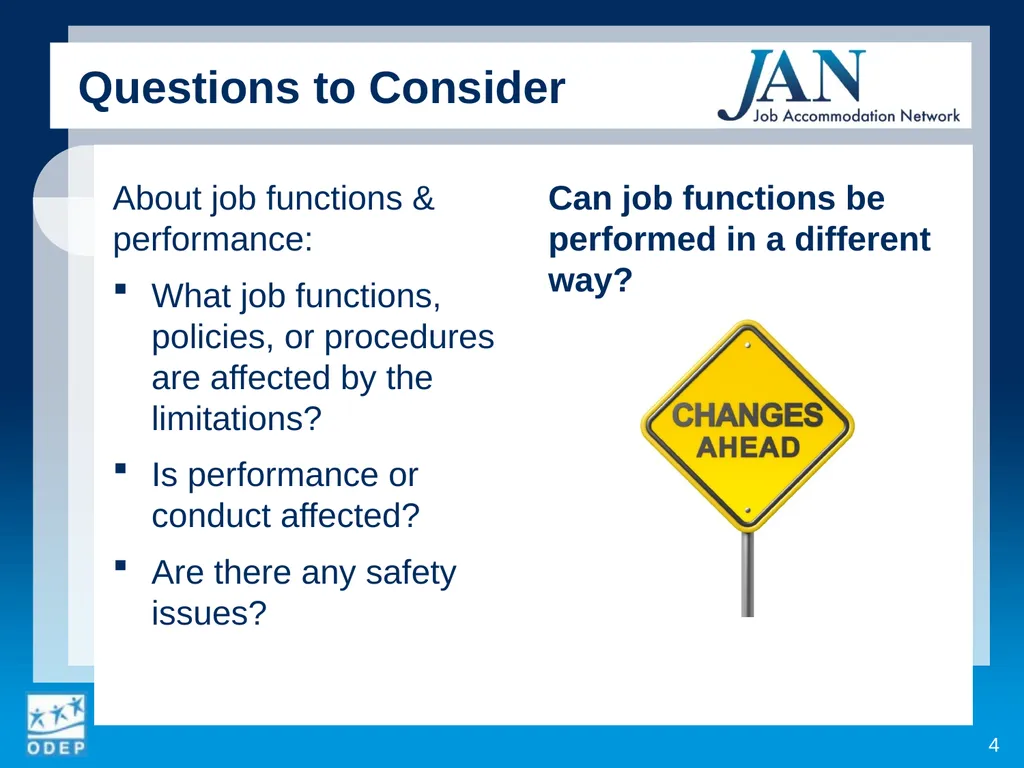
About job functions & performance:
What job functions, policies, or procedures are affected by the limitations?
Is performance or conduct affected?
Are there any safety issues? 4 Questions to Consider Can job functions be performed in a different way?<br>
05
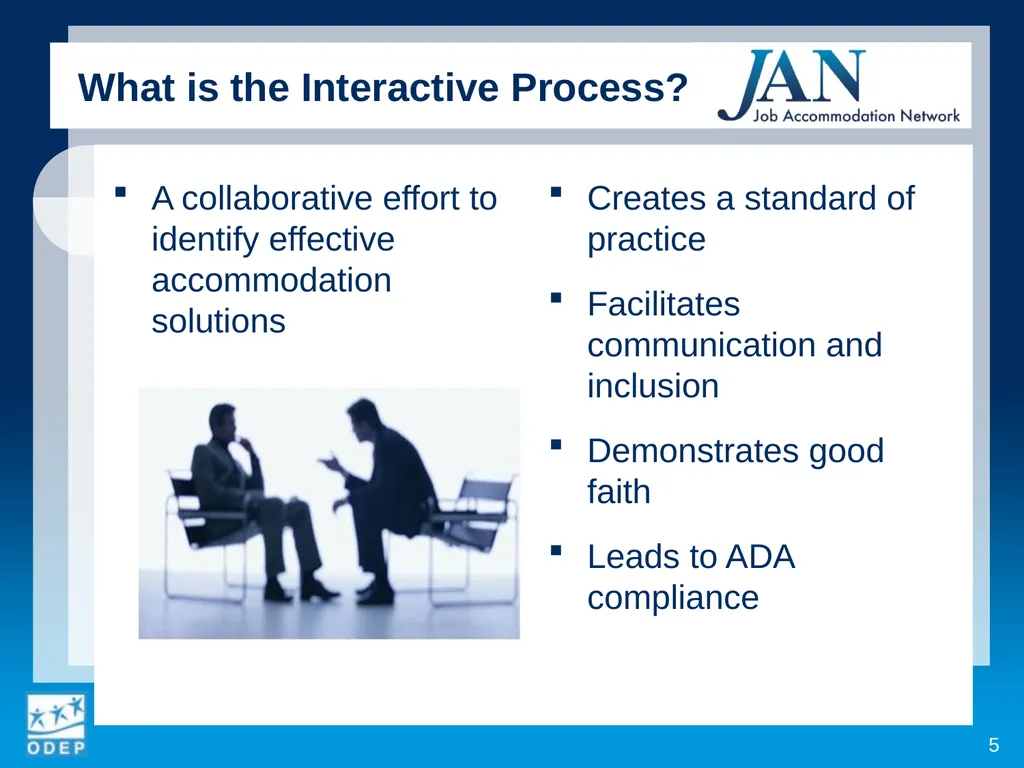
A collaborative effort to identify effective accommodation solutions Creates a standard of practice
Facilitates communication and inclusion
Demonstrates good faith
Leads to ADA compliance 5 What is the Interactive Process?<br>
06
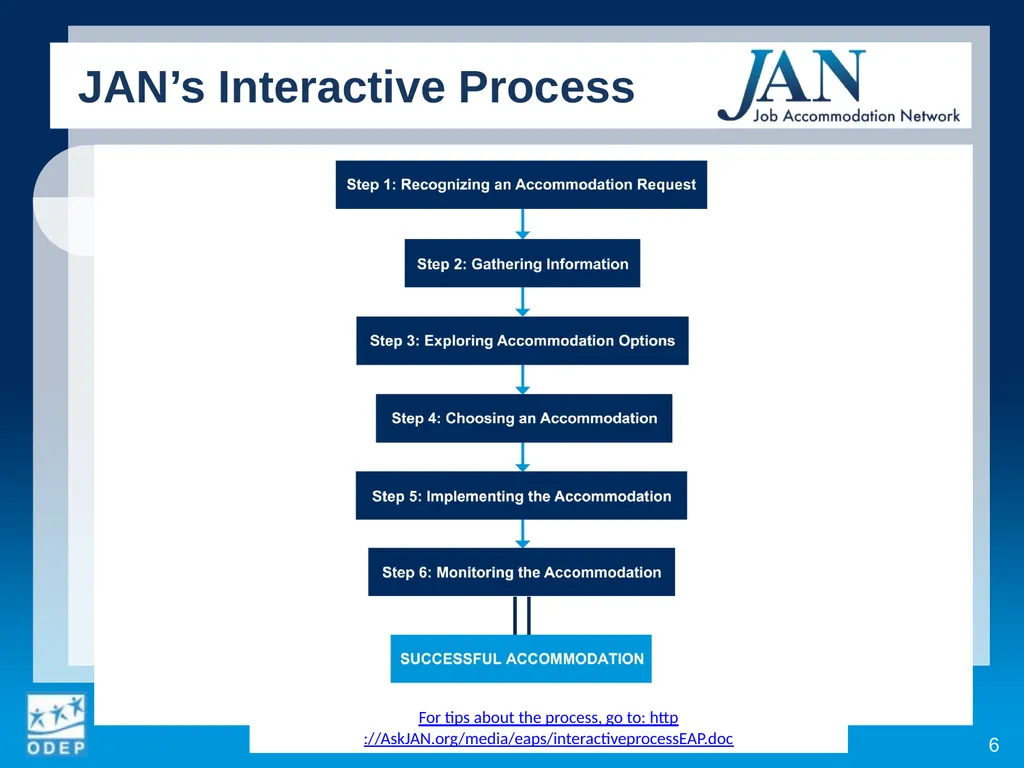
6 JAN’s Interactive Process For tips about the process, go to: http://AskJAN.org/media/eaps/interactiveprocessEAP.doc<br>
07
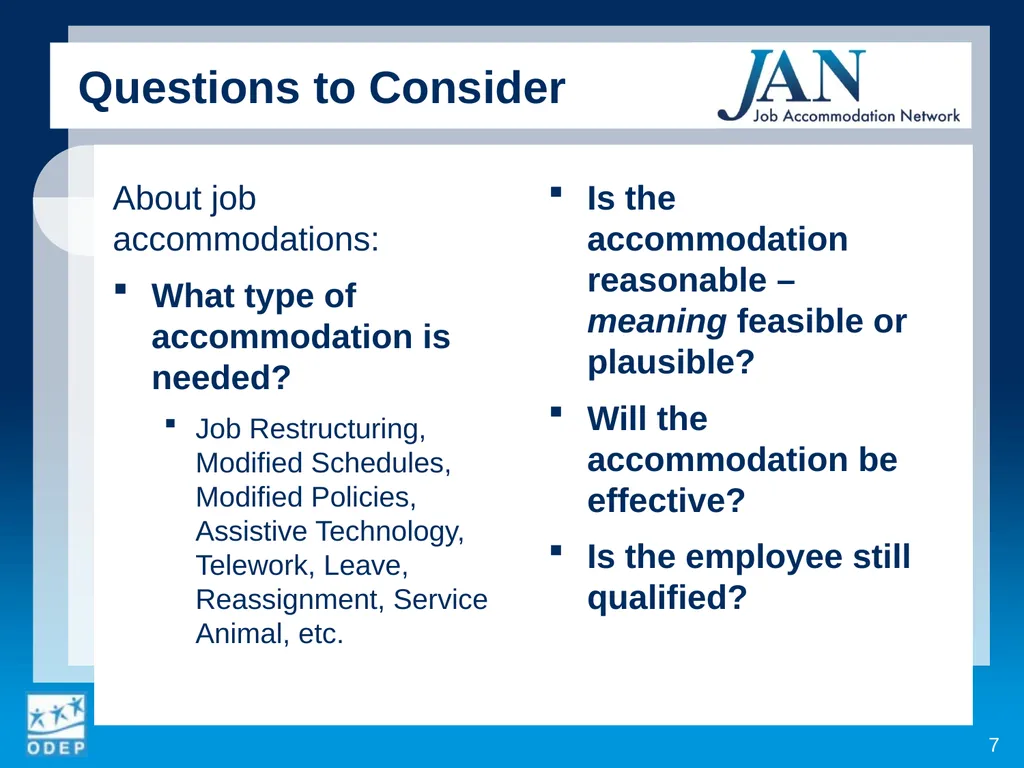
About job accommodations:
What type of accommodation is needed?
Job Restructuring, Modified Schedules, Modified Policies, Assistive Technology, Telework, Leave, Reassignment, Service Animal, etc. 7 Questions to Consider Is the accommodation reasonable – meaning feasible or plausible?
Will the accommodation be effective?
Is the employee still qualified?<br>
08
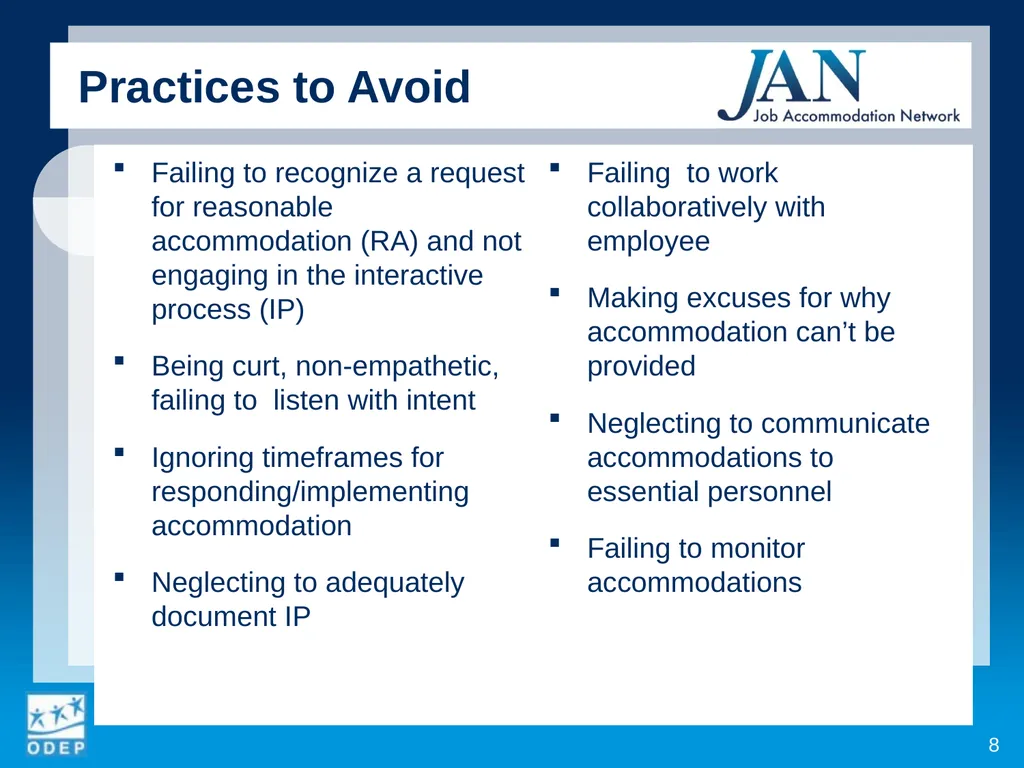
Failing to recognize a request for reasonable accommodation (RA) and not engaging in the interactive process (IP)
Being curt, non-empathetic, failing to listen with intent
Ignoring timeframes for responding/implementing accommodation
Neglecting to adequately document IP Failing to work collaboratively with employee
Making excuses for why accommodation can’t be provided
Neglecting to communicate accommodations to essential personnel
Failing to monitor accommodations 8 Practices to Avoid<br>
09
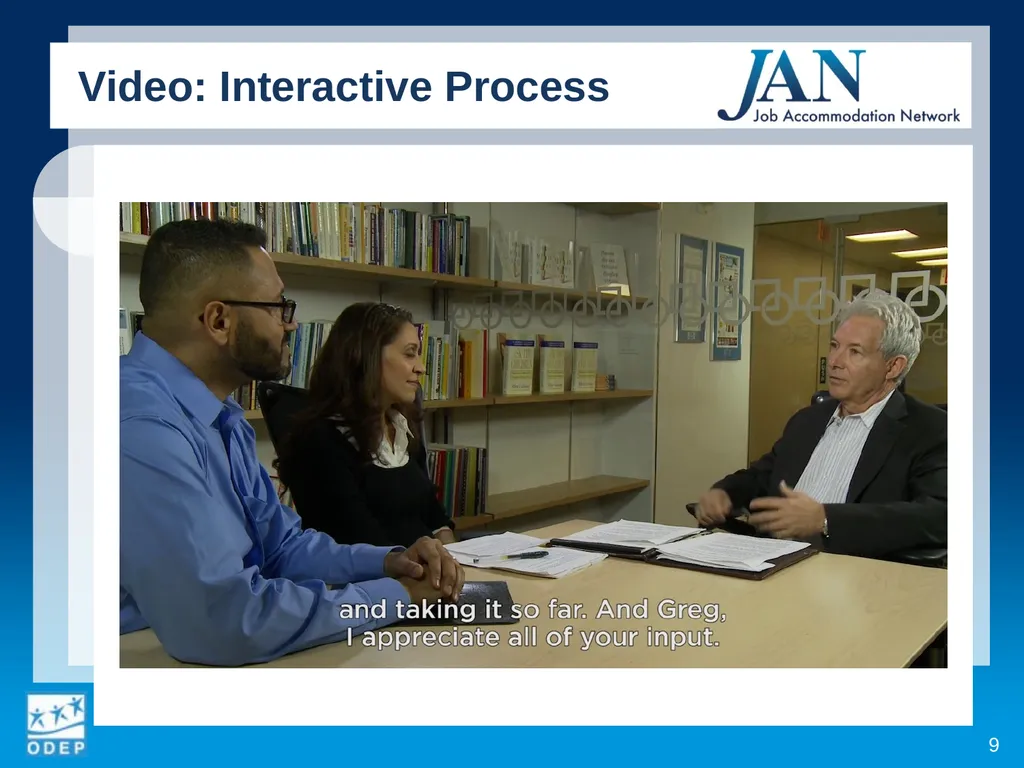
9 Video: Interactive Process<br>
10
Educate workforce about RA policy and encourage all employees to discuss, with management/HR, modifications/tools needed to be successful Train hiring managers and supervisors to recognize when an accommodation request is received, respond without delay, and document actions 10 Interactive Process Best Practices<br>
11
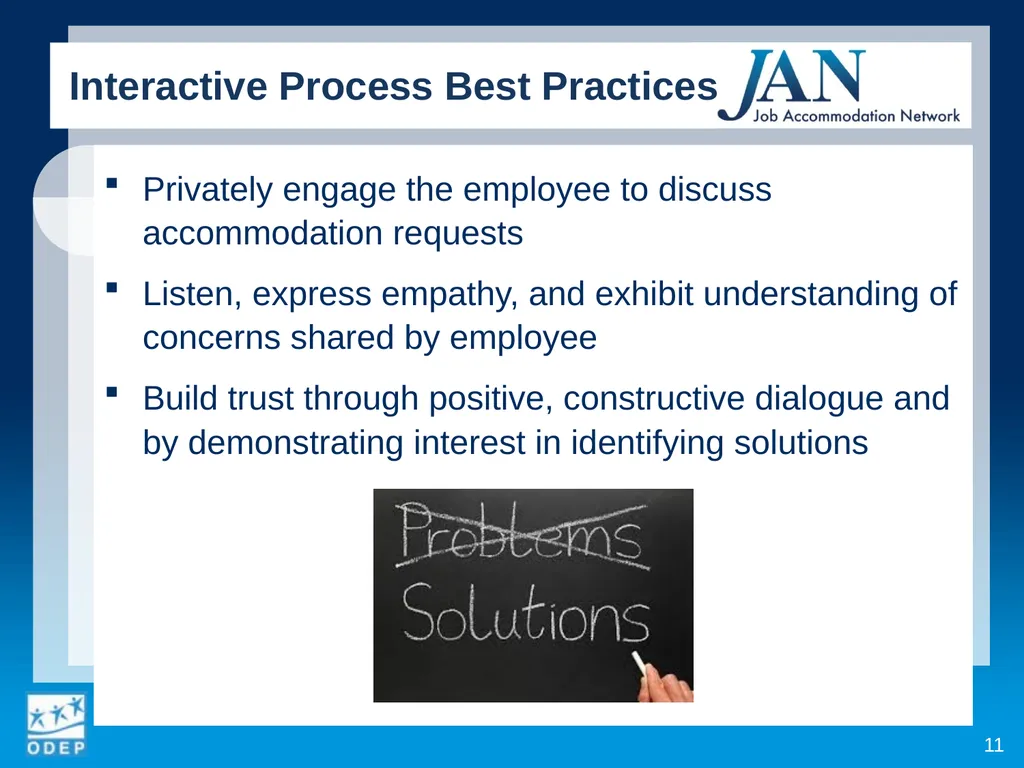
Privately engage the employee to discuss accommodation requests
Listen, express empathy, and exhibit understanding of concerns shared by employee
Build trust through positive, constructive dialogue and by demonstrating interest in identifying solutions 11 Interactive Process Best Practices<br>
12
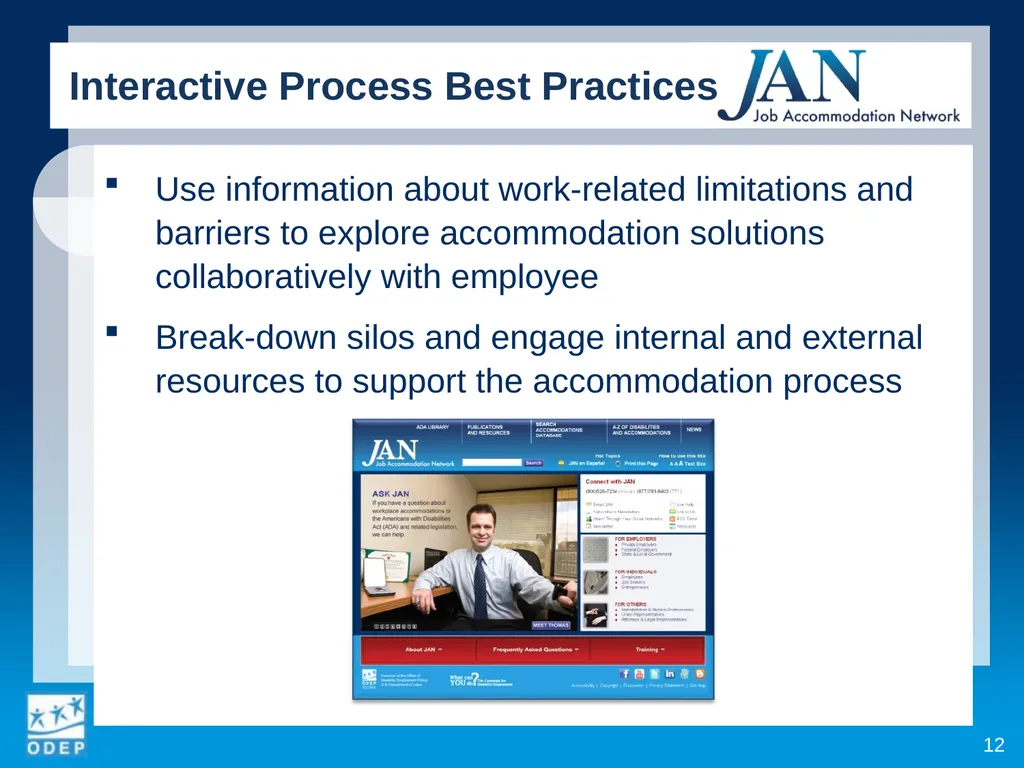
Use information about work-related limitations and barriers to explore accommodation solutions collaboratively with employee
Break-down silos and engage internal and external resources to support the accommodation process 12 Interactive Process Best Practices<br>
13
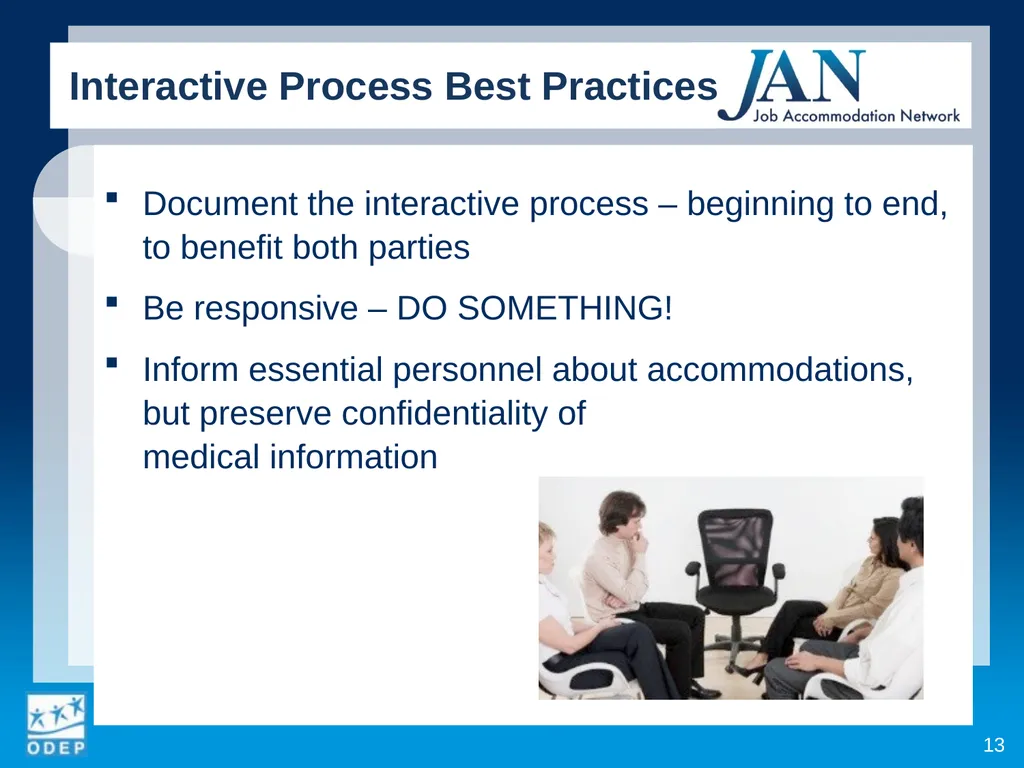
Document the interactive process – beginning to end, to benefit both parties
Be responsive – DO SOMETHING!
Inform essential personnel about accommodations, but preserve confidentiality of medical information 13 Interactive Process Best Practices<br>
14
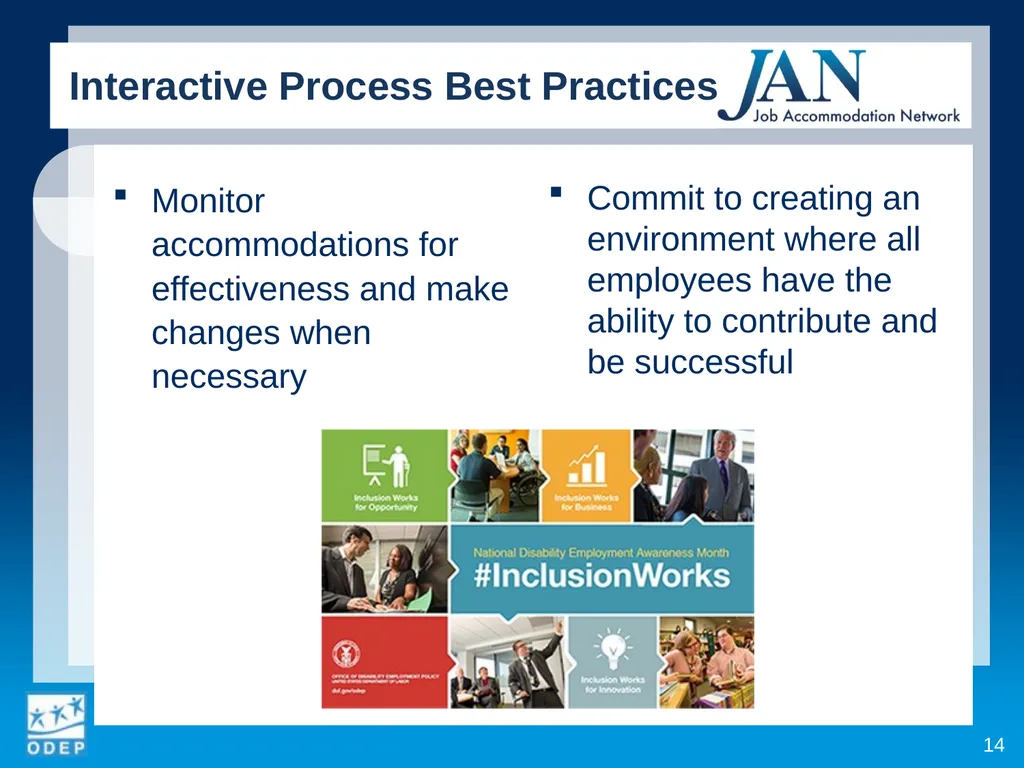
Monitor accommodations for effectiveness and make changes when necessary Commit to creating an environment where all employees have the ability to contribute and be successful 14 Interactive Process Best Practices<br>
15
Keep disability and accommodation-related information confidential 15 Retention Best Practices Made a business decision for personal reasons and do not discuss employees' personal information with others Let employees know who to contact if there is a need for a modification at work due to a personal reason, so the issue can be addressed privately<br>
16
16 (800) 526-7234 (V) - (877) 781-9403 (TTY)
AskJAN.org
jan@askjan.org
(304) 216-8189 via Text
janconsultants via Skype Contact JAN<br>