
1 Sheep 2 Border Leicester Origin: Northumberland,
PT
Published · 45 slides · 0 views

1 / 1


Description
1 Sheep 2 Border Leicester Origin: Northumberland, England; developed in 1767 by George and Matthew Culley. Characteristics: no wool on the head or legs face and lower legs are white and may be blue tinged or black spotted lips and nostrils
Related Topics
Download this presentation From Below
"1 Sheep 2 Border Leicester Origin: Northumberland," is the property of its rightful owner. Permission is granted to download and print the materials on this website for personal, non-commercial use only, and to display it on your personal computer provided you do not modify the materials and that you retain all copyright notices contained in the materials. By downloading content from our website, you accept the terms of this agreement.
Share
Embed code
Presentation Transcript
01
1 Sheep<br>
02
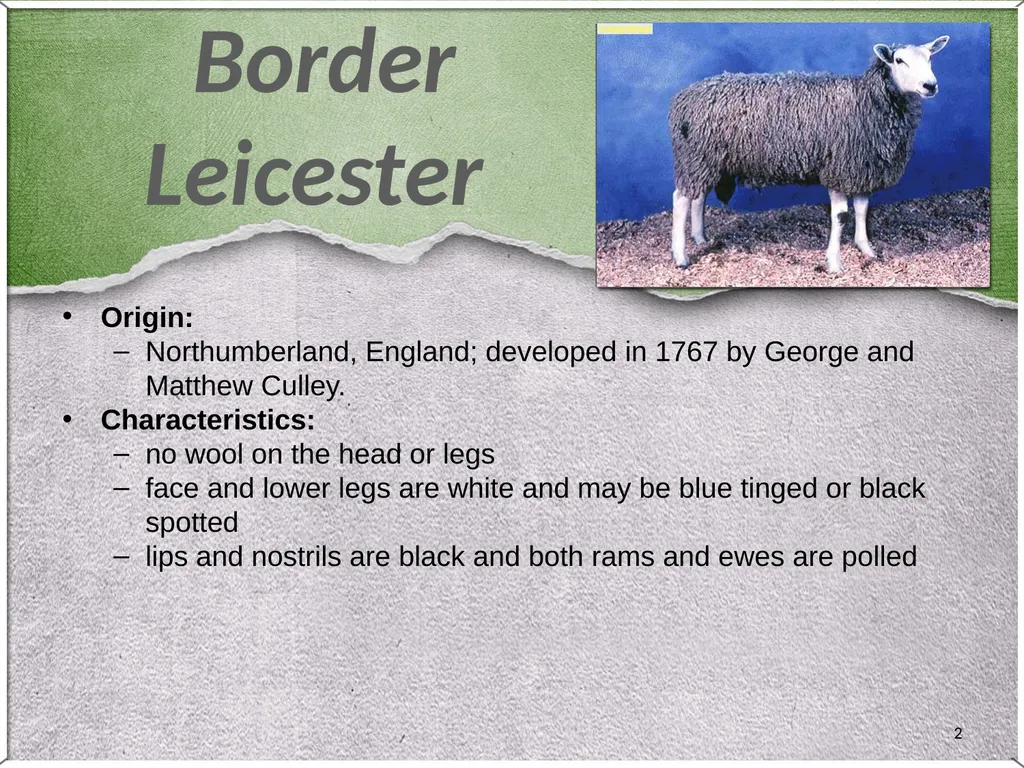
2 Border Leicester Origin:
Northumberland, England; developed in 1767 by George and Matthew Culley.
Characteristics:
no wool on the head or legs
face and lower legs are white and may be blue tinged or black spotted
lips and nostrils are black and both rams and ewes are polled<br>
Northumberland, England; developed in 1767 by George and Matthew Culley.
Characteristics:
no wool on the head or legs
face and lower legs are white and may be blue tinged or black spotted
lips and nostrils are black and both rams and ewes are polled<br>
03
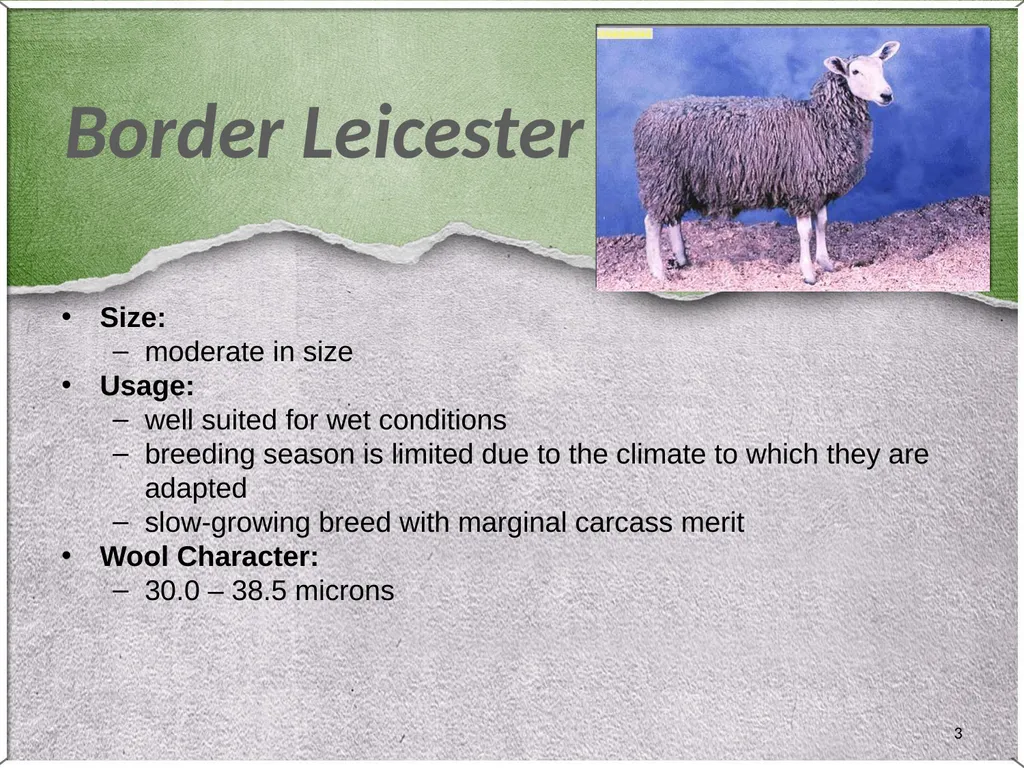
3 Border Leicester Size:
moderate in size
Usage:
well suited for wet conditions
breeding season is limited due to the climate to which they are adapted
slow-growing breed with marginal carcass merit
Wool Character:
30.0 – 38.5 microns<br>
moderate in size
Usage:
well suited for wet conditions
breeding season is limited due to the climate to which they are adapted
slow-growing breed with marginal carcass merit
Wool Character:
30.0 – 38.5 microns<br>
04
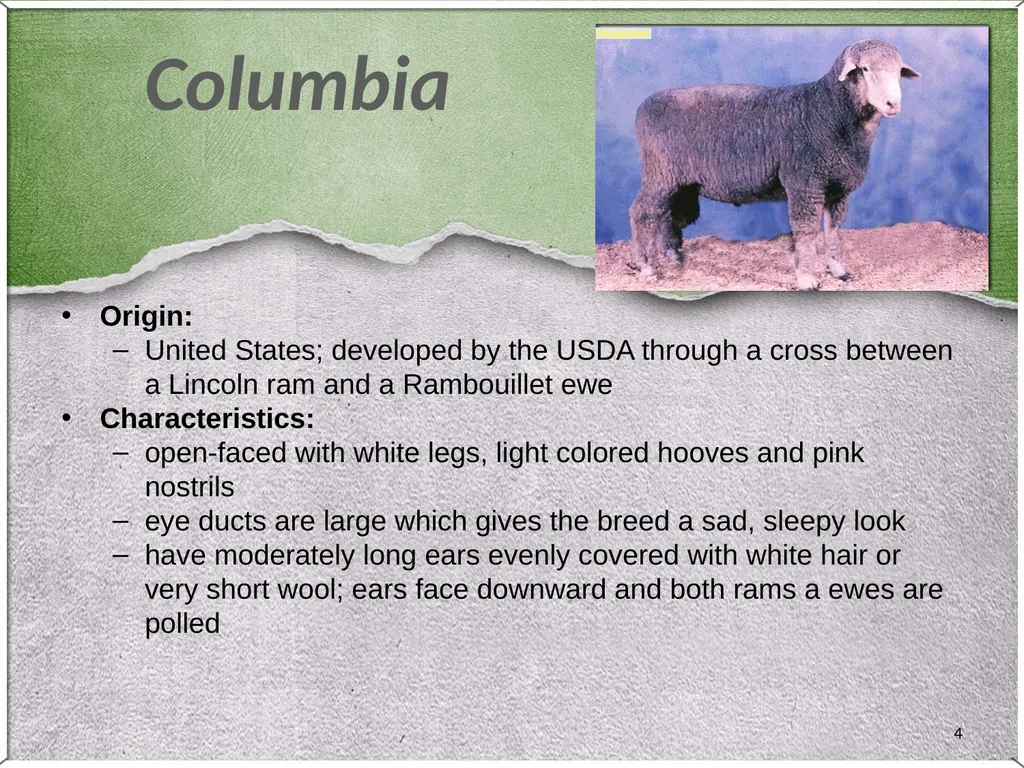
4 Columbia Origin:
United States; developed by the USDA through a cross between a Lincoln ram and a Rambouillet ewe
Characteristics:
open-faced with white legs, light colored hooves and pink nostrils
eye ducts are large which gives the breed a sad, sleepy look
have moderately long ears evenly covered with white hair or very short wool; ears face downward and both rams a ewes are polled<br>
United States; developed by the USDA through a cross between a Lincoln ram and a Rambouillet ewe
Characteristics:
open-faced with white legs, light colored hooves and pink nostrils
eye ducts are large which gives the breed a sad, sleepy look
have moderately long ears evenly covered with white hair or very short wool; ears face downward and both rams a ewes are polled<br>
05
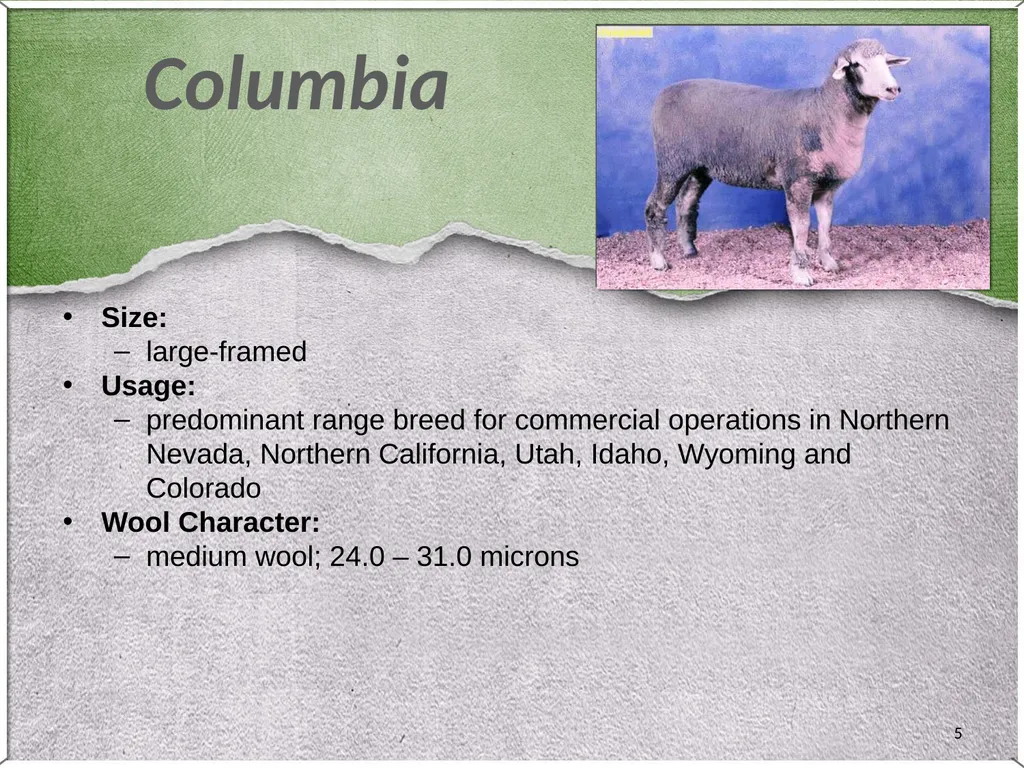
5 Columbia Size:
large-framed
Usage:
predominant range breed for commercial operations in Northern Nevada, Northern California, Utah, Idaho, Wyoming and Colorado
Wool Character:
medium wool; 24.0 – 31.0 microns<br>
large-framed
Usage:
predominant range breed for commercial operations in Northern Nevada, Northern California, Utah, Idaho, Wyoming and Colorado
Wool Character:
medium wool; 24.0 – 31.0 microns<br>
06
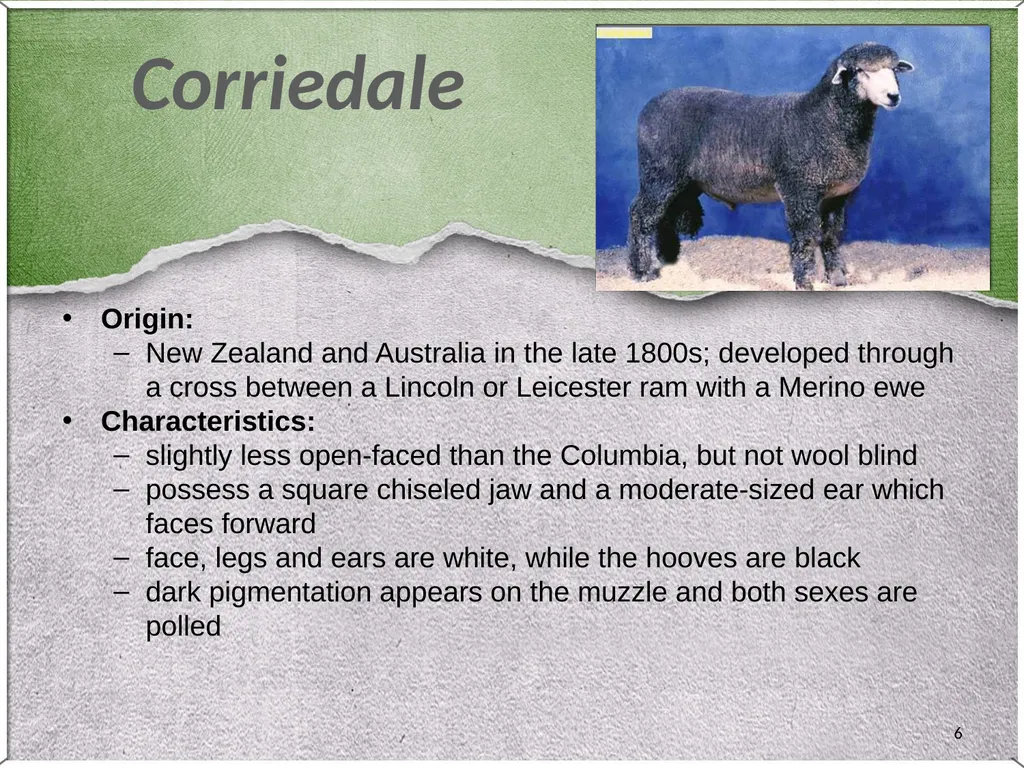
6 Corriedale Origin:
New Zealand and Australia in the late 1800s; developed through a cross between a Lincoln or Leicester ram with a Merino ewe
Characteristics:
slightly less open-faced than the Columbia, but not wool blind
possess a square chiseled jaw and a moderate-sized ear which faces forward
face, legs and ears are white, while the hooves are black
dark pigmentation appears on the muzzle and both sexes are polled<br>
New Zealand and Australia in the late 1800s; developed through a cross between a Lincoln or Leicester ram with a Merino ewe
Characteristics:
slightly less open-faced than the Columbia, but not wool blind
possess a square chiseled jaw and a moderate-sized ear which faces forward
face, legs and ears are white, while the hooves are black
dark pigmentation appears on the muzzle and both sexes are polled<br>
07
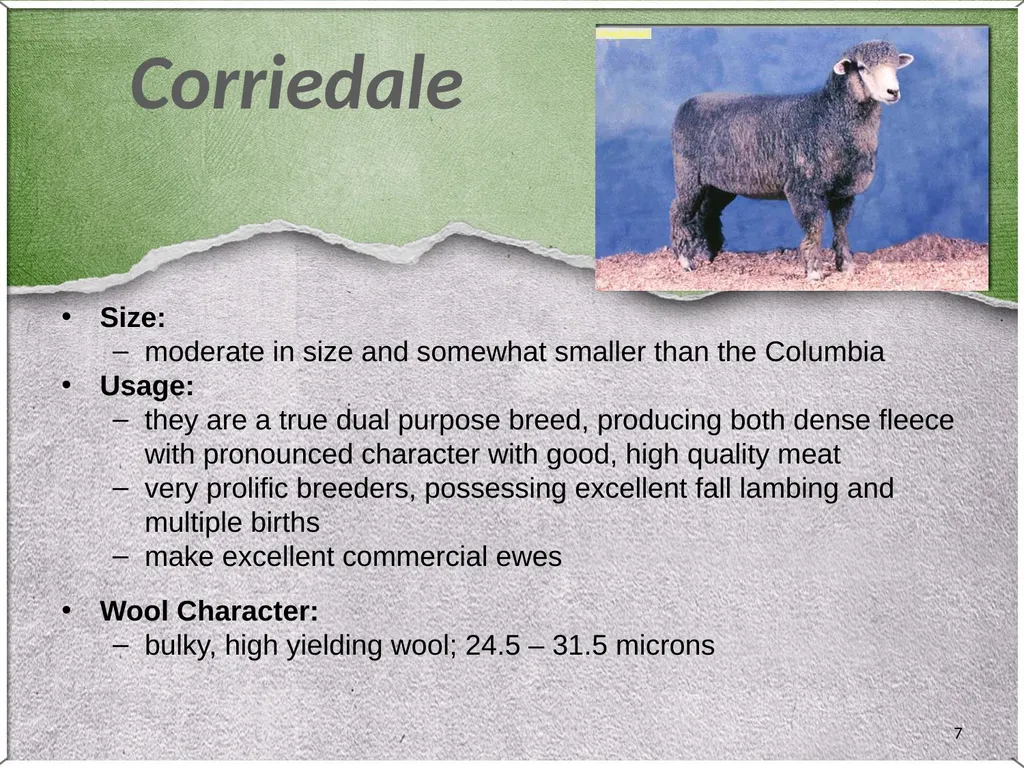
7 Corriedale Size:
moderate in size and somewhat smaller than the Columbia
Usage:
they are a true dual purpose breed, producing both dense fleece with pronounced character with good, high quality meat
very prolific breeders, possessing excellent fall lambing and multiple births
make excellent commercial ewes
Wool Character:
bulky, high yielding wool; 24.5 – 31.5 microns<br>
moderate in size and somewhat smaller than the Columbia
Usage:
they are a true dual purpose breed, producing both dense fleece with pronounced character with good, high quality meat
very prolific breeders, possessing excellent fall lambing and multiple births
make excellent commercial ewes
Wool Character:
bulky, high yielding wool; 24.5 – 31.5 microns<br>
08
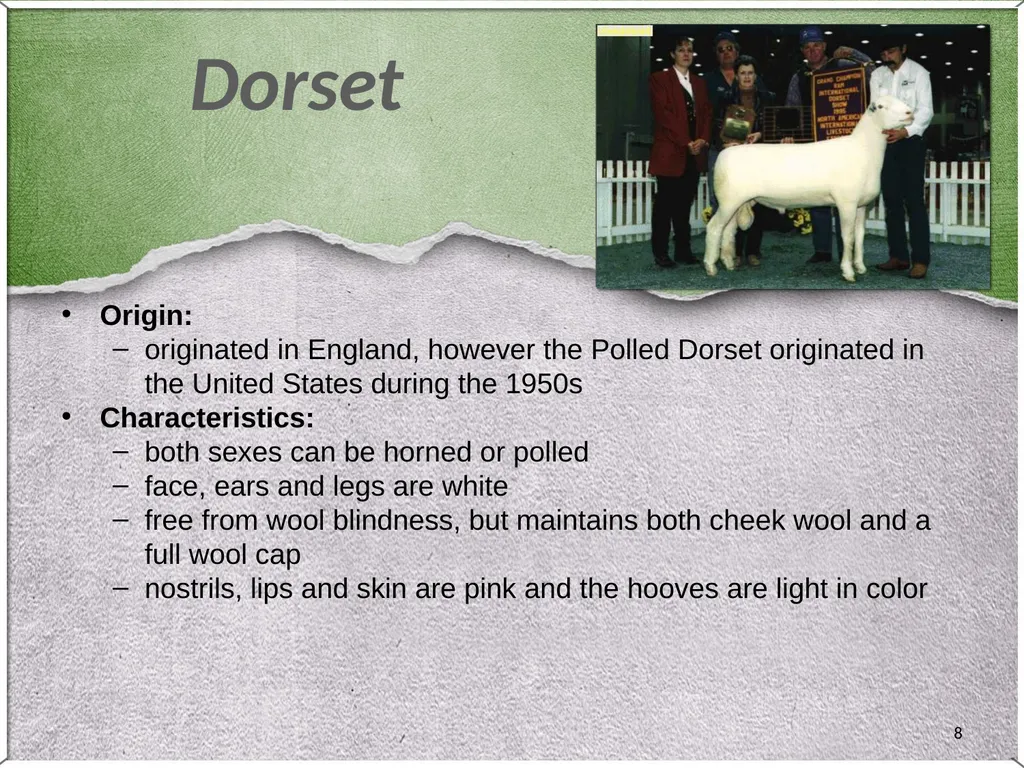
8 Dorset Origin:
originated in England, however the Polled Dorset originated in the United States during the 1950s
Characteristics:
both sexes can be horned or polled
face, ears and legs are white
free from wool blindness, but maintains both cheek wool and a full wool cap
nostrils, lips and skin are pink and the hooves are light in color<br>
originated in England, however the Polled Dorset originated in the United States during the 1950s
Characteristics:
both sexes can be horned or polled
face, ears and legs are white
free from wool blindness, but maintains both cheek wool and a full wool cap
nostrils, lips and skin are pink and the hooves are light in color<br>
09
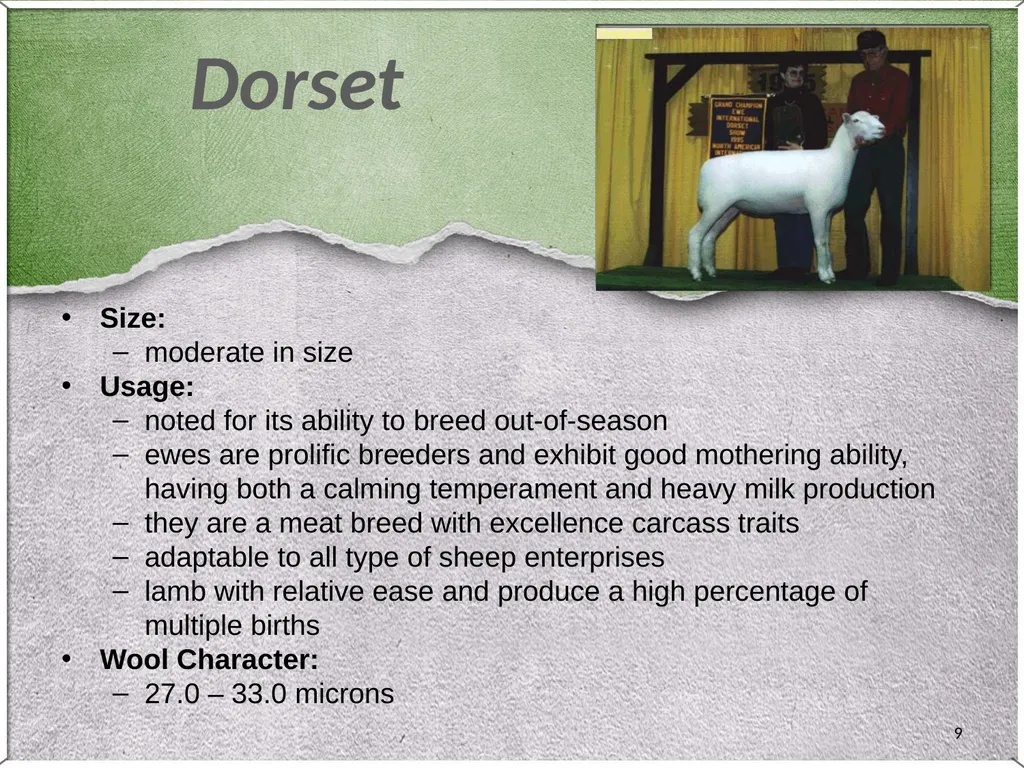
9 Dorset Size:
moderate in size
Usage:
noted for its ability to breed out-of-season
ewes are prolific breeders and exhibit good mothering ability, having both a calming temperament and heavy milk production
they are a meat breed with excellence carcass traits
adaptable to all type of sheep enterprises
lamb with relative ease and produce a high percentage of multiple births
Wool Character:
27.0 – 33.0 microns<br>
moderate in size
Usage:
noted for its ability to breed out-of-season
ewes are prolific breeders and exhibit good mothering ability, having both a calming temperament and heavy milk production
they are a meat breed with excellence carcass traits
adaptable to all type of sheep enterprises
lamb with relative ease and produce a high percentage of multiple births
Wool Character:
27.0 – 33.0 microns<br>
10
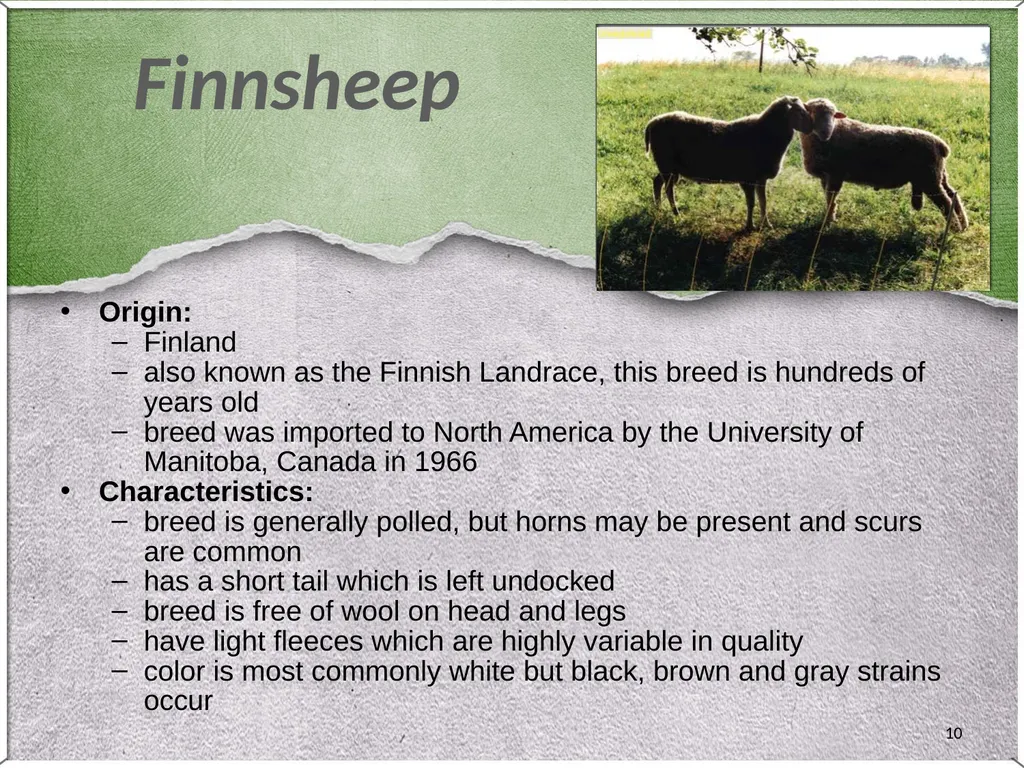
10 Finnsheep Origin:
Finland
also known as the Finnish Landrace, this breed is hundreds of years old
breed was imported to North America by the University of Manitoba, Canada in 1966
Characteristics:
breed is generally polled, but horns may be present and scurs are common
has a short tail which is left undocked
breed is free of wool on head and legs
have light fleeces which are highly variable in quality
color is most commonly white but black, brown and gray strains occur<br>
Finland
also known as the Finnish Landrace, this breed is hundreds of years old
breed was imported to North America by the University of Manitoba, Canada in 1966
Characteristics:
breed is generally polled, but horns may be present and scurs are common
has a short tail which is left undocked
breed is free of wool on head and legs
have light fleeces which are highly variable in quality
color is most commonly white but black, brown and gray strains occur<br>
11
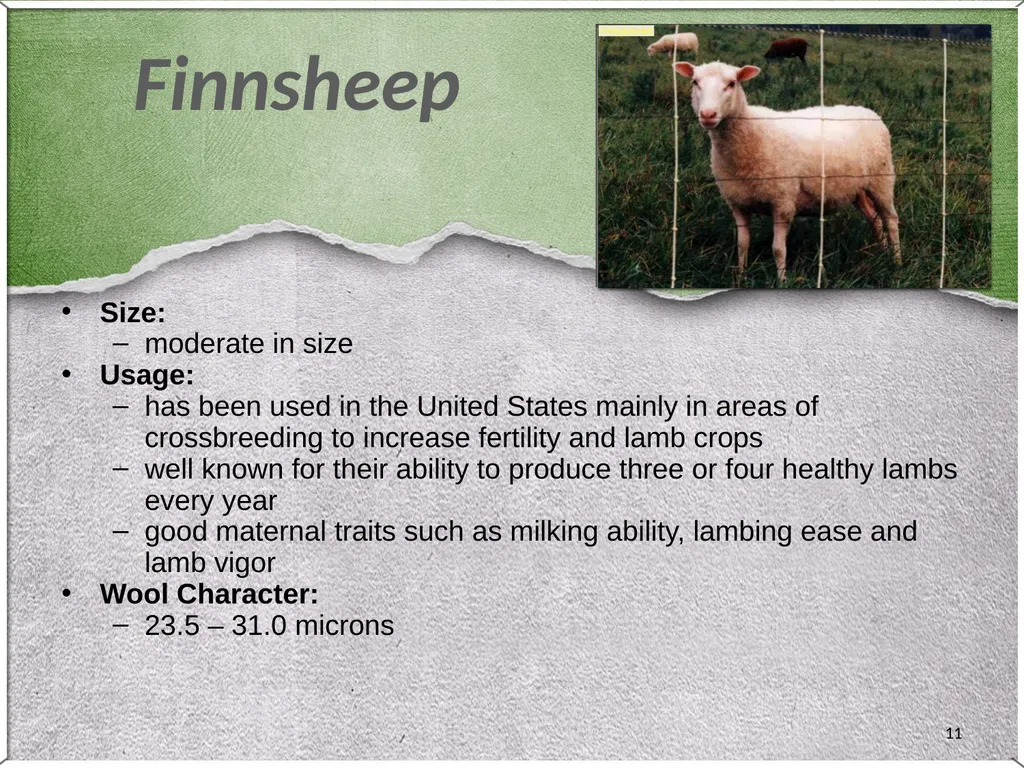
11 Finnsheep Size:
moderate in size
Usage:
has been used in the United States mainly in areas of crossbreeding to increase fertility and lamb crops
well known for their ability to produce three or four healthy lambs every year
good maternal traits such as milking ability, lambing ease and lamb vigor
Wool Character:
23.5 – 31.0 microns<br>
moderate in size
Usage:
has been used in the United States mainly in areas of crossbreeding to increase fertility and lamb crops
well known for their ability to produce three or four healthy lambs every year
good maternal traits such as milking ability, lambing ease and lamb vigor
Wool Character:
23.5 – 31.0 microns<br>
12
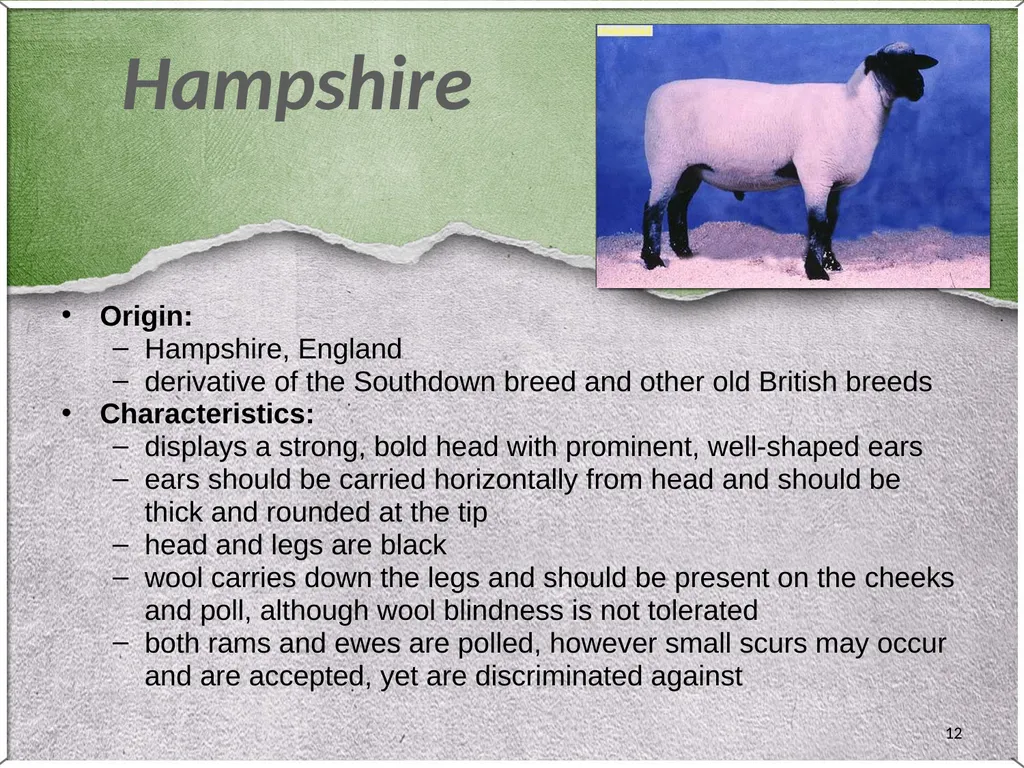
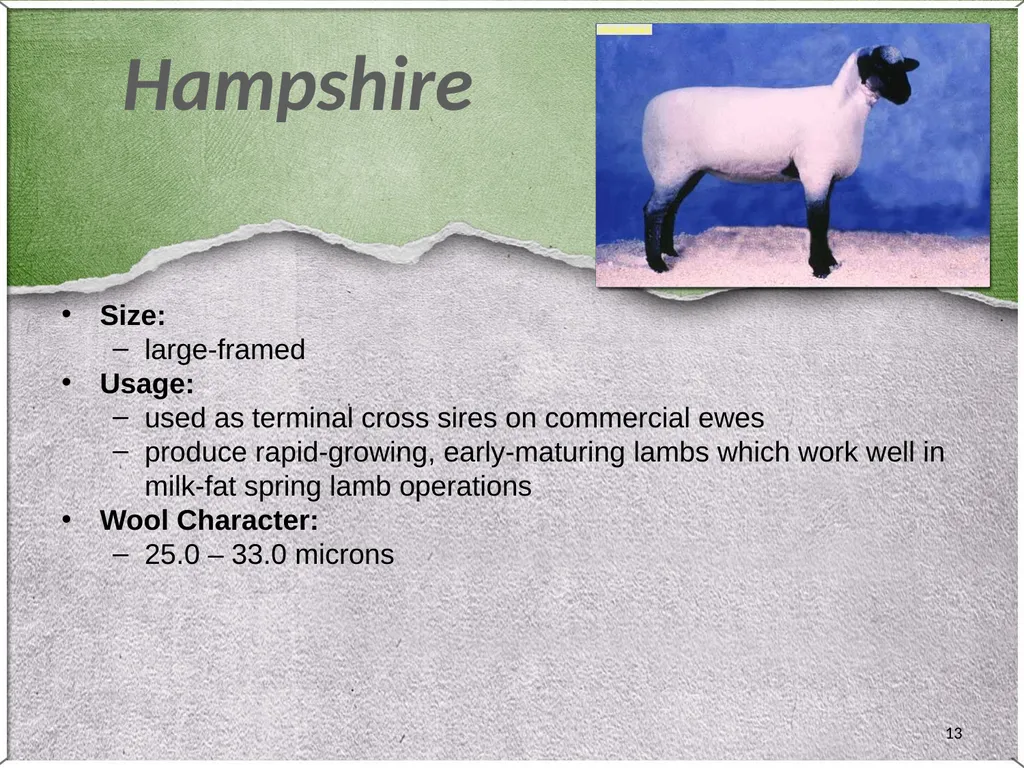
12 Hampshire Origin:
Hampshire, England
derivative of the Southdown breed and other old British breeds
Characteristics:
displays a strong, bold head with prominent, well-shaped ears
ears should be carried horizontally from head and should be thick and rounded at the tip
head and legs are black
wool carries down the legs and should be present on the cheeks and poll, although wool blindness is not tolerated
both rams and ewes are polled, however small scurs may occur and are accepted, yet are discriminated against<br>
Hampshire, England
derivative of the Southdown breed and other old British breeds
Characteristics:
displays a strong, bold head with prominent, well-shaped ears
ears should be carried horizontally from head and should be thick and rounded at the tip
head and legs are black
wool carries down the legs and should be present on the cheeks and poll, although wool blindness is not tolerated
both rams and ewes are polled, however small scurs may occur and are accepted, yet are discriminated against<br>
13
13 Hampshire Size:
large-framed
Usage:
used as terminal cross sires on commercial ewes
produce rapid-growing, early-maturing lambs which work well in milk-fat spring lamb operations
Wool Character:
25.0 – 33.0 microns<br>
large-framed
Usage:
used as terminal cross sires on commercial ewes
produce rapid-growing, early-maturing lambs which work well in milk-fat spring lamb operations
Wool Character:
25.0 – 33.0 microns<br>
14
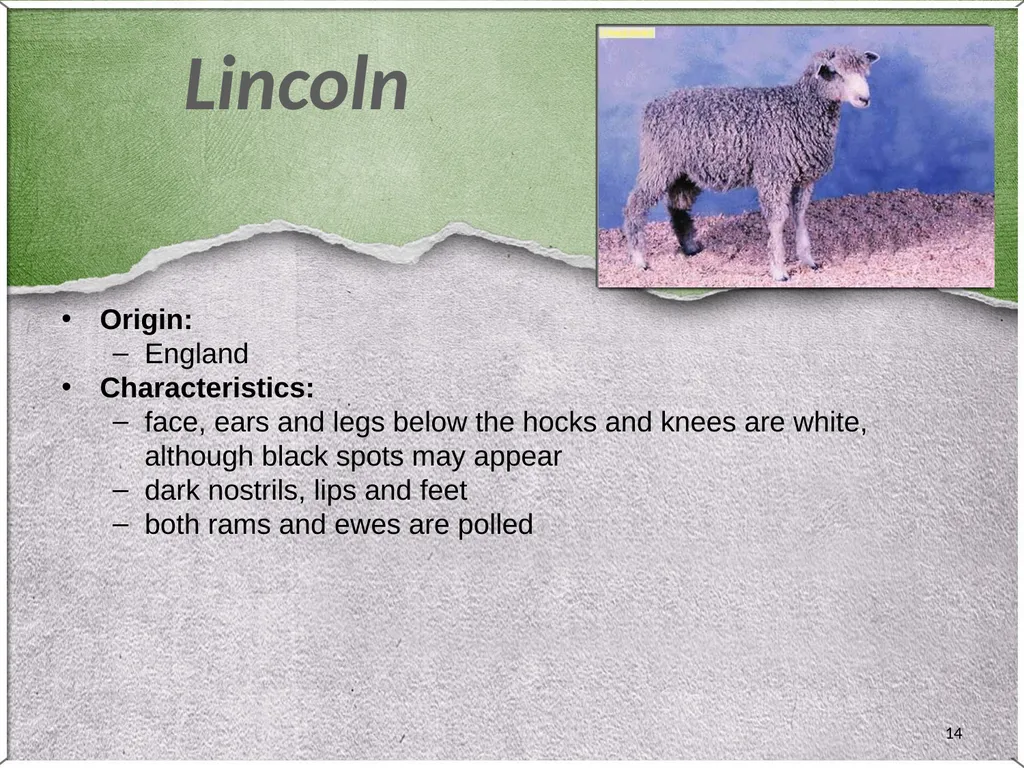
14 Lincoln Origin:
England
Characteristics:
face, ears and legs below the hocks and knees are white, although black spots may appear
dark nostrils, lips and feet
both rams and ewes are polled<br>
England
Characteristics:
face, ears and legs below the hocks and knees are white, although black spots may appear
dark nostrils, lips and feet
both rams and ewes are polled<br>
15
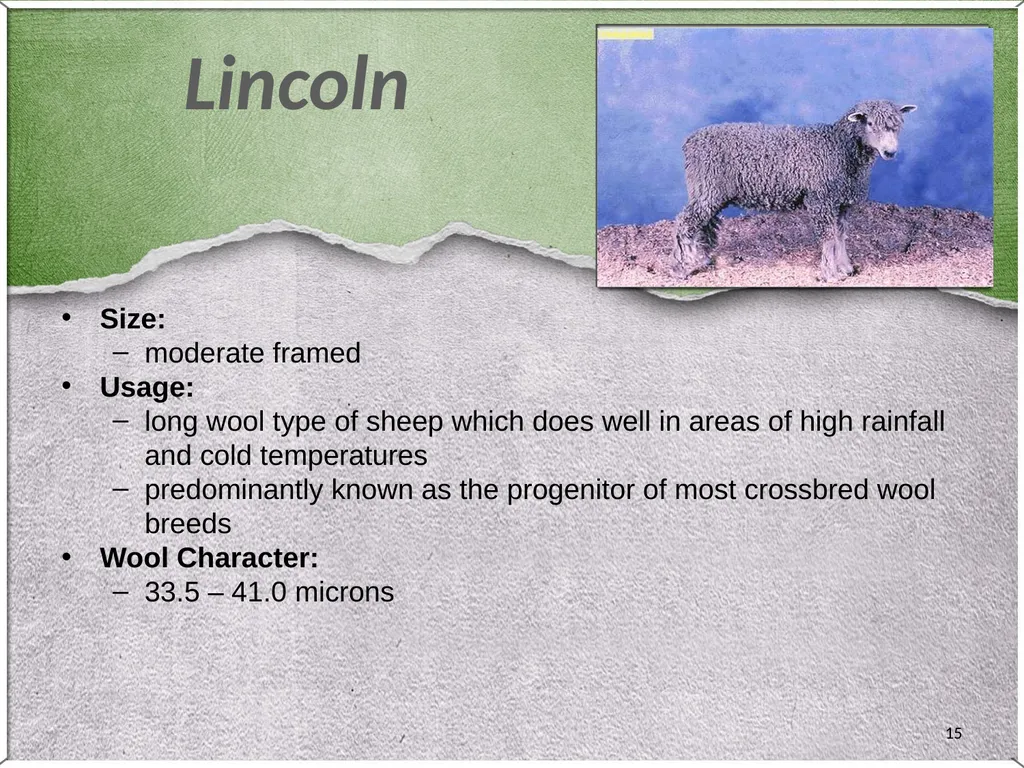
15 Lincoln Size:
moderate framed
Usage:
long wool type of sheep which does well in areas of high rainfall and cold temperatures
predominantly known as the progenitor of most crossbred wool breeds
Wool Character:
33.5 – 41.0 microns<br>
moderate framed
Usage:
long wool type of sheep which does well in areas of high rainfall and cold temperatures
predominantly known as the progenitor of most crossbred wool breeds
Wool Character:
33.5 – 41.0 microns<br>
16
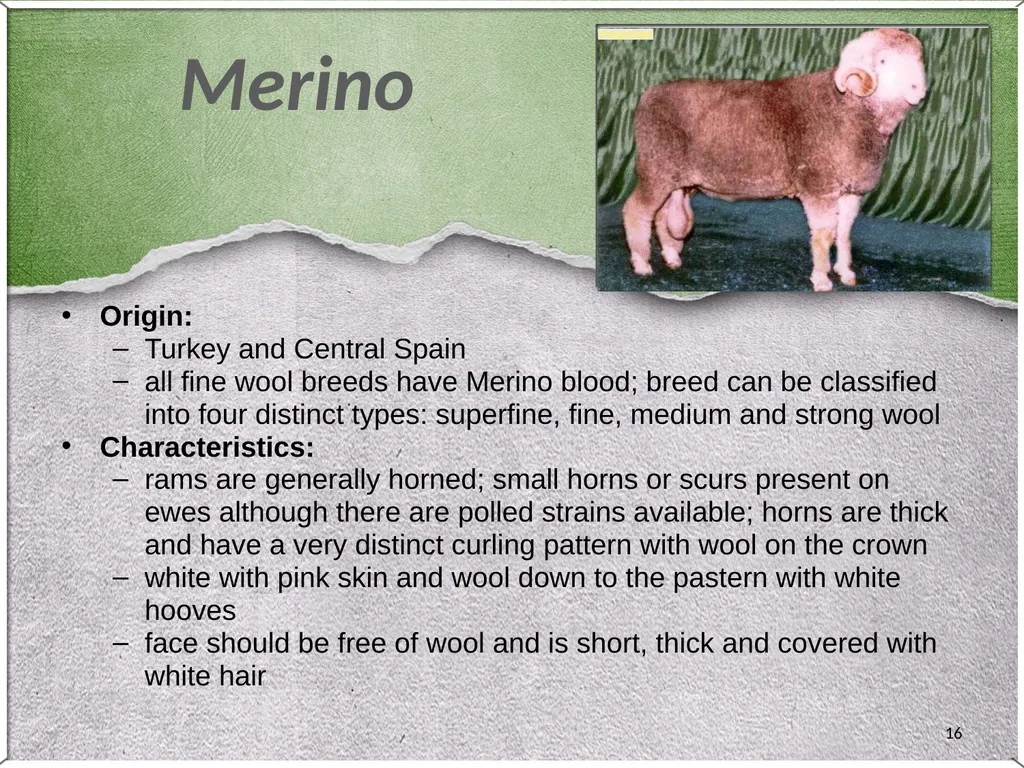
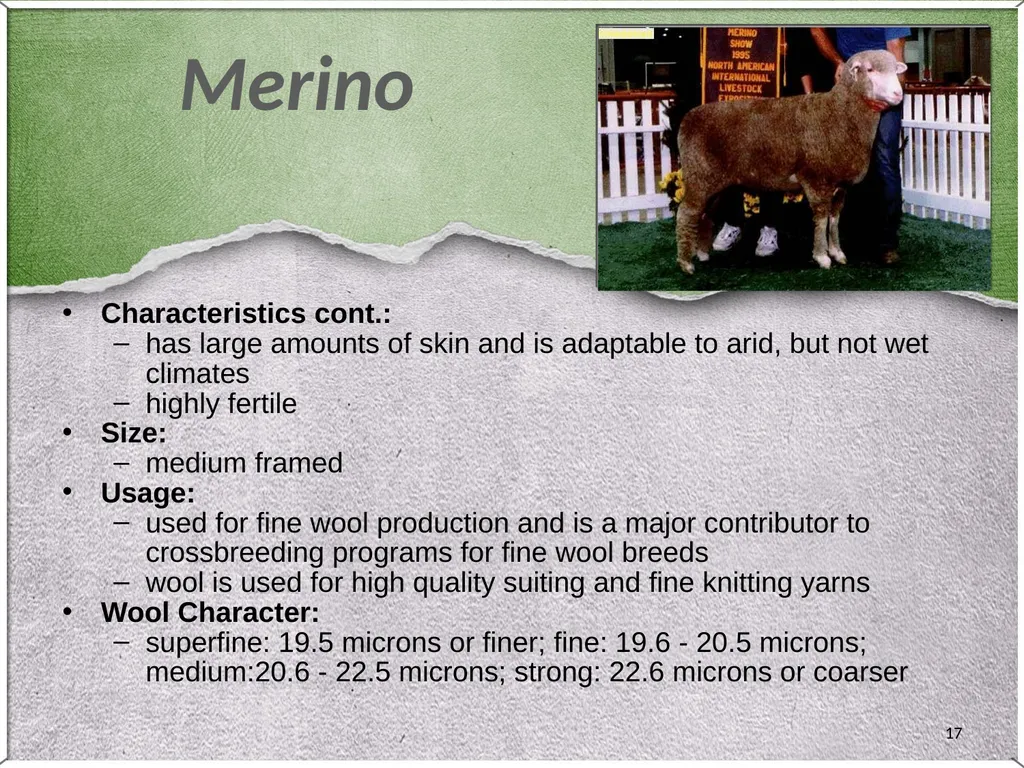
16 Merino Origin:
Turkey and Central Spain
all fine wool breeds have Merino blood; breed can be classified into four distinct types: superfine, fine, medium and strong wool
Characteristics:
rams are generally horned; small horns or scurs present on ewes although there are polled strains available; horns are thick and have a very distinct curling pattern with wool on the crown
white with pink skin and wool down to the pastern with white hooves
face should be free of wool and is short, thick and covered with white hair<br>
Turkey and Central Spain
all fine wool breeds have Merino blood; breed can be classified into four distinct types: superfine, fine, medium and strong wool
Characteristics:
rams are generally horned; small horns or scurs present on ewes although there are polled strains available; horns are thick and have a very distinct curling pattern with wool on the crown
white with pink skin and wool down to the pastern with white hooves
face should be free of wool and is short, thick and covered with white hair<br>
17
17 Merino Characteristics cont.:
has large amounts of skin and is adaptable to arid, but not wet climates
highly fertile
Size:
medium framed
Usage:
used for fine wool production and is a major contributor to crossbreeding programs for fine wool breeds
wool is used for high quality suiting and fine knitting yarns
Wool Character:
superfine: 19.5 microns or finer; fine: 19.6 - 20.5 microns; medium:20.6 - 22.5 microns; strong: 22.6 microns or coarser<br>
has large amounts of skin and is adaptable to arid, but not wet climates
highly fertile
Size:
medium framed
Usage:
used for fine wool production and is a major contributor to crossbreeding programs for fine wool breeds
wool is used for high quality suiting and fine knitting yarns
Wool Character:
superfine: 19.5 microns or finer; fine: 19.6 - 20.5 microns; medium:20.6 - 22.5 microns; strong: 22.6 microns or coarser<br>
18
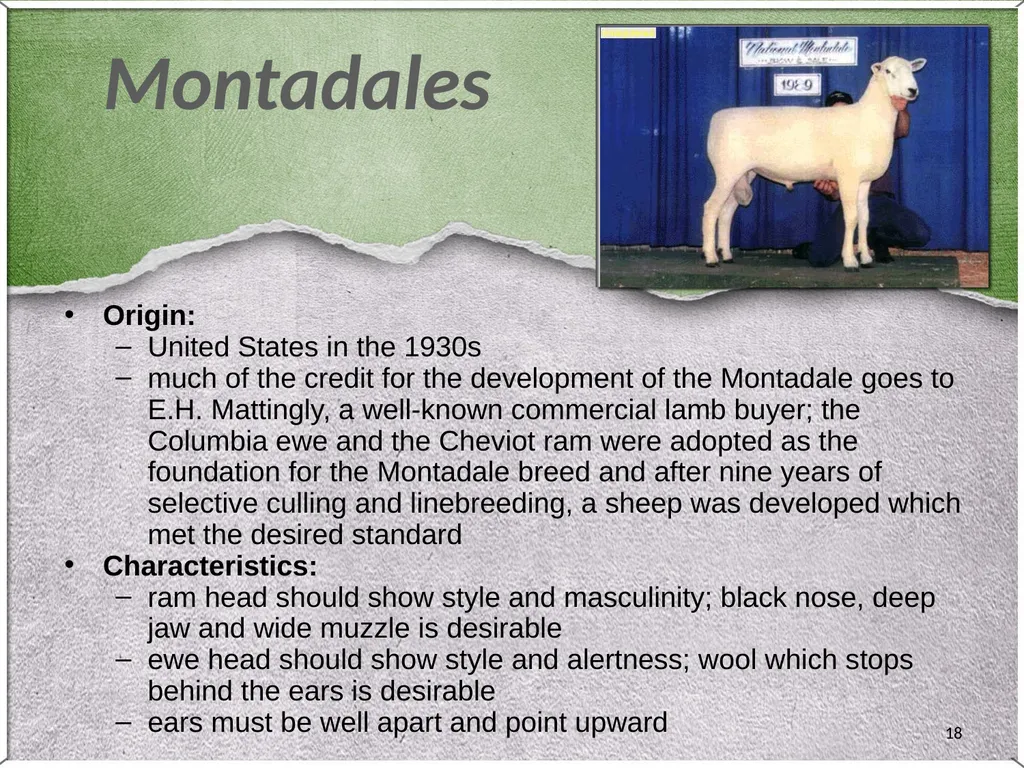
18 Montadales Origin:
United States in the 1930s
much of the credit for the development of the Montadale goes to E.H. Mattingly, a well-known commercial lamb buyer; the Columbia ewe and the Cheviot ram were adopted as the foundation for the Montadale breed and after nine years of selective culling and linebreeding, a sheep was developed which met the desired standard
Characteristics:
ram head should show style and masculinity; black nose, deep jaw and wide muzzle is desirable
ewe head should show style and alertness; wool which stops behind the ears is desirable
ears must be well apart and point upward<br>
United States in the 1930s
much of the credit for the development of the Montadale goes to E.H. Mattingly, a well-known commercial lamb buyer; the Columbia ewe and the Cheviot ram were adopted as the foundation for the Montadale breed and after nine years of selective culling and linebreeding, a sheep was developed which met the desired standard
Characteristics:
ram head should show style and masculinity; black nose, deep jaw and wide muzzle is desirable
ewe head should show style and alertness; wool which stops behind the ears is desirable
ears must be well apart and point upward<br>
19
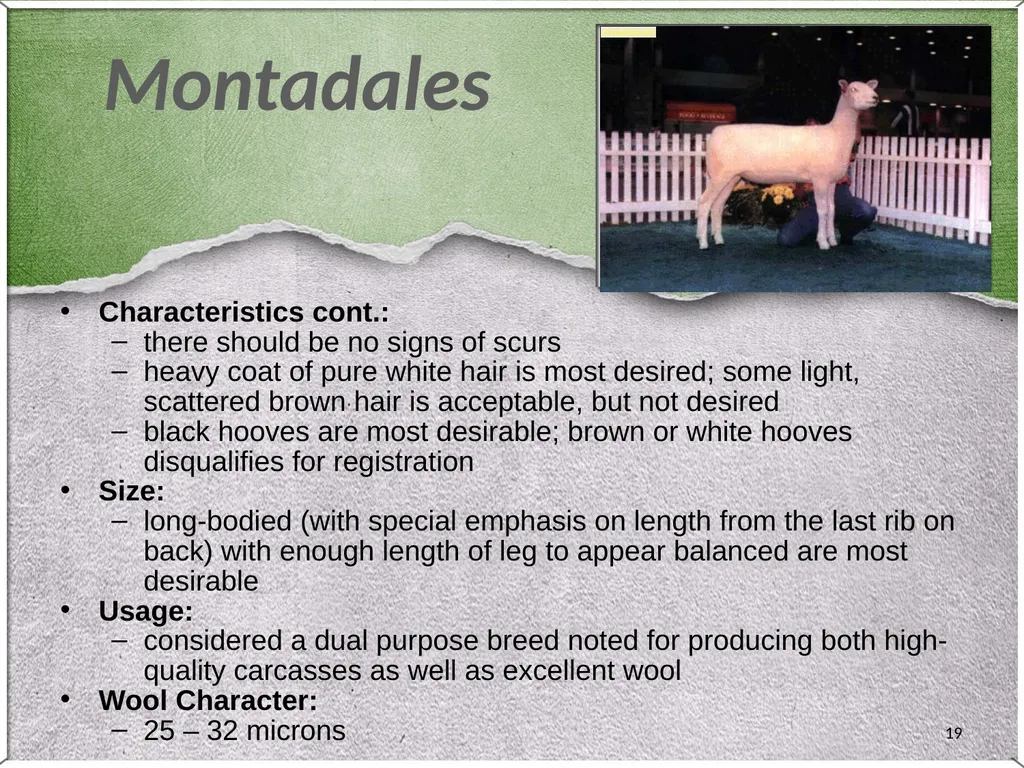
19 Montadales Characteristics cont.:
there should be no signs of scurs
heavy coat of pure white hair is most desired; some light, scattered brown hair is acceptable, but not desired
black hooves are most desirable; brown or white hooves disqualifies for registration
Size:
long-bodied (with special emphasis on length from the last rib on back) with enough length of leg to appear balanced are most desirable
Usage:
considered a dual purpose breed noted for producing both high- quality carcasses as well as excellent wool
Wool Character:
25 – 32 microns<br>
there should be no signs of scurs
heavy coat of pure white hair is most desired; some light, scattered brown hair is acceptable, but not desired
black hooves are most desirable; brown or white hooves disqualifies for registration
Size:
long-bodied (with special emphasis on length from the last rib on back) with enough length of leg to appear balanced are most desirable
Usage:
considered a dual purpose breed noted for producing both high- quality carcasses as well as excellent wool
Wool Character:
25 – 32 microns<br>
20
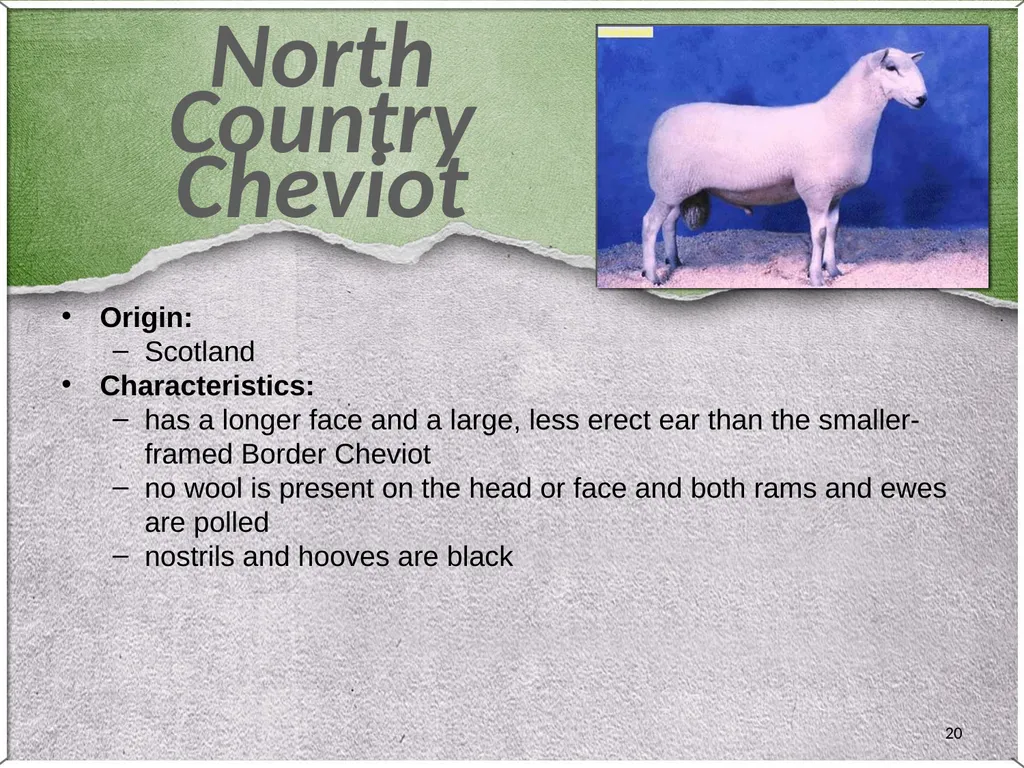
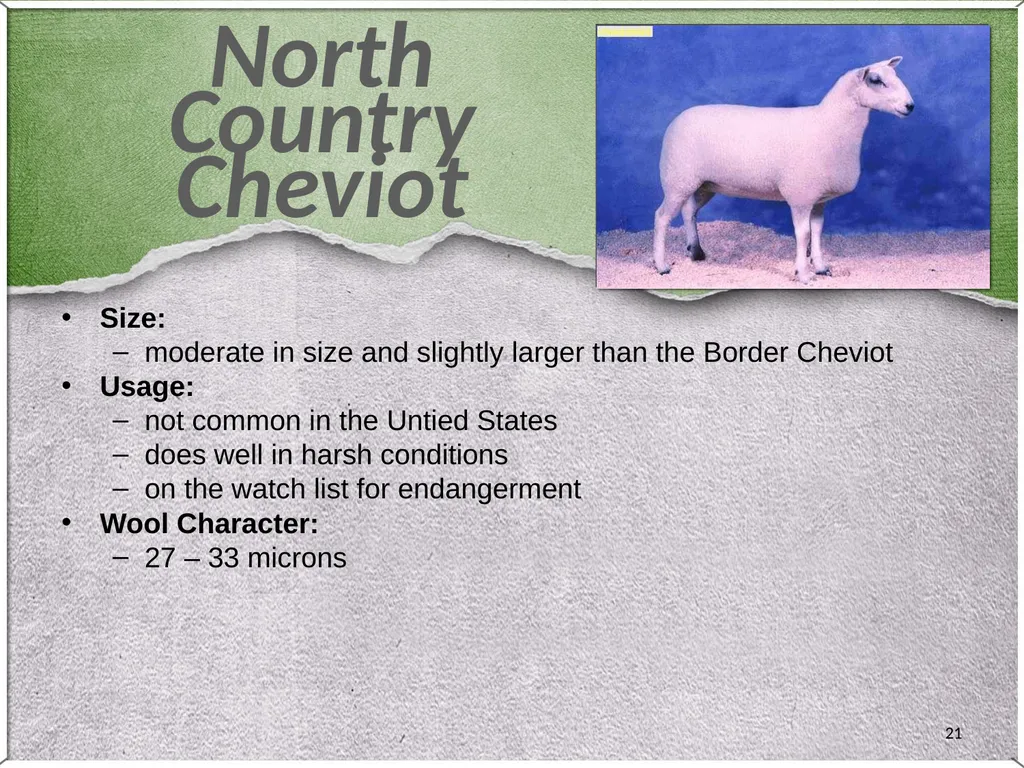
20 North
Country
Cheviot Origin:
Scotland
Characteristics:
has a longer face and a large, less erect ear than the smaller- framed Border Cheviot
no wool is present on the head or face and both rams and ewes are polled
nostrils and hooves are black<br>
Scotland
Characteristics:
has a longer face and a large, less erect ear than the smaller- framed Border Cheviot
no wool is present on the head or face and both rams and ewes are polled
nostrils and hooves are black<br>
21
21 Size:
moderate in size and slightly larger than the Border Cheviot
Usage:
not common in the Untied States
does well in harsh conditions
on the watch list for endangerment
Wool Character:
27 – 33 microns North Country Cheviot<br>
moderate in size and slightly larger than the Border Cheviot
Usage:
not common in the Untied States
does well in harsh conditions
on the watch list for endangerment
Wool Character:
27 – 33 microns North Country Cheviot<br>
22
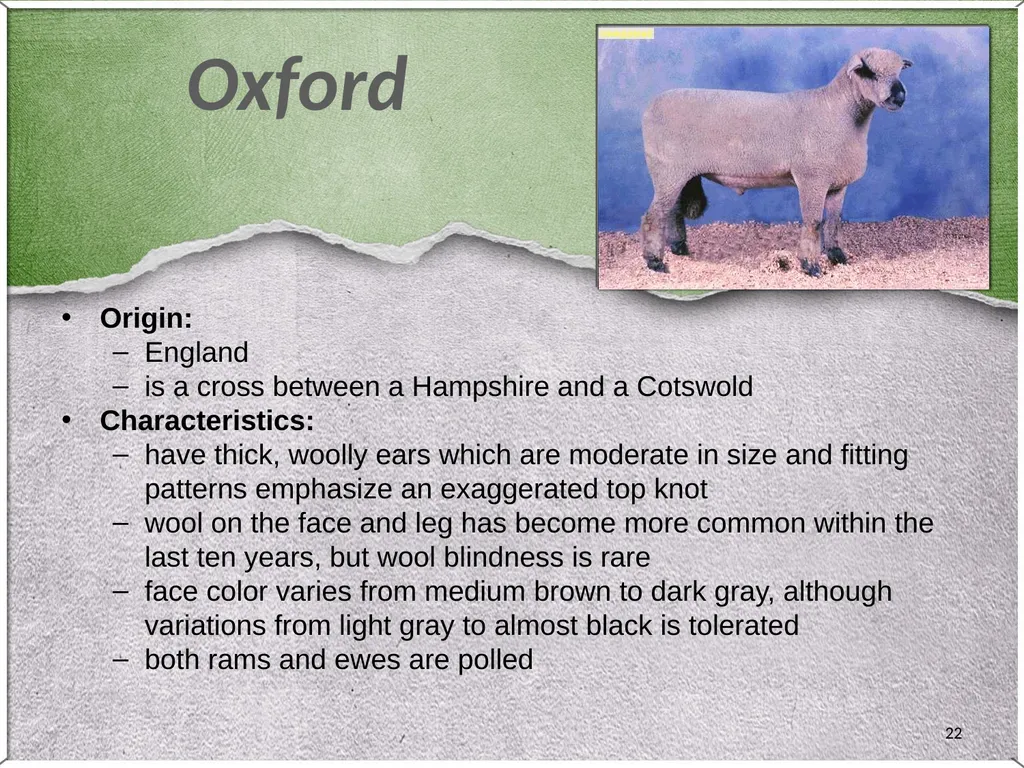
22 Oxford Origin:
England
is a cross between a Hampshire and a Cotswold
Characteristics:
have thick, woolly ears which are moderate in size and fitting patterns emphasize an exaggerated top knot
wool on the face and leg has become more common within the last ten years, but wool blindness is rare
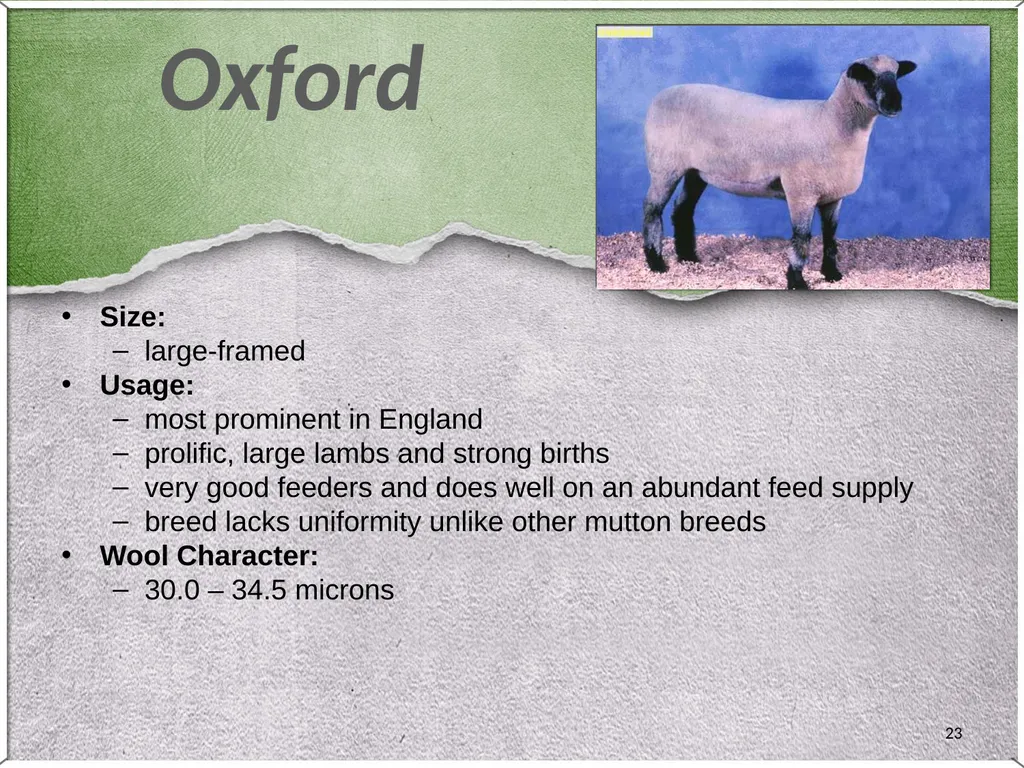
face color varies from medium brown to dark gray, although variations from light gray to almost black is tolerated
both rams and ewes are polled<br>
England
is a cross between a Hampshire and a Cotswold
Characteristics:
have thick, woolly ears which are moderate in size and fitting patterns emphasize an exaggerated top knot
wool on the face and leg has become more common within the last ten years, but wool blindness is rare
face color varies from medium brown to dark gray, although variations from light gray to almost black is tolerated
both rams and ewes are polled<br>
23
23 Oxford Size:
large-framed
Usage:
most prominent in England
prolific, large lambs and strong births
very good feeders and does well on an abundant feed supply
breed lacks uniformity unlike other mutton breeds
Wool Character:
30.0 – 34.5 microns<br>
large-framed
Usage:
most prominent in England
prolific, large lambs and strong births
very good feeders and does well on an abundant feed supply
breed lacks uniformity unlike other mutton breeds
Wool Character:
30.0 – 34.5 microns<br>
24
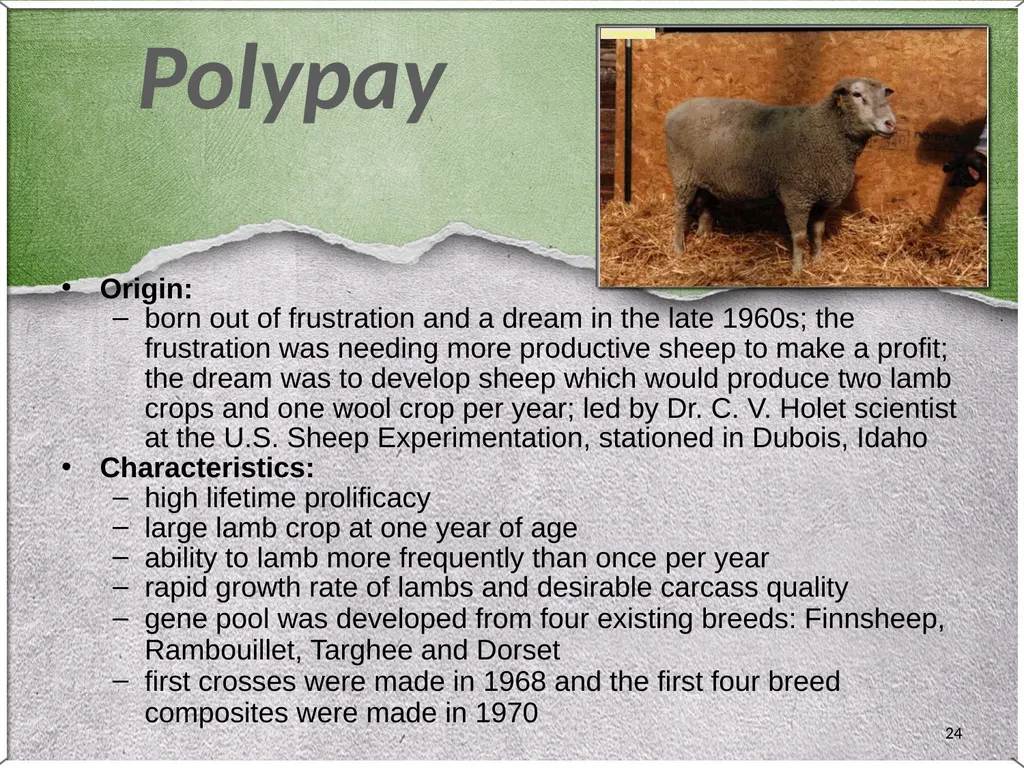
24 Polypay Origin:
born out of frustration and a dream in the late 1960s; the frustration was needing more productive sheep to make a profit; the dream was to develop sheep which would produce two lamb crops and one wool crop per year; led by Dr. C. V. Holet scientist at the U.S. Sheep Experimentation, stationed in Dubois, Idaho
Characteristics:
high lifetime prolificacy
large lamb crop at one year of age
ability to lamb more frequently than once per year
rapid growth rate of lambs and desirable carcass quality
gene pool was developed from four existing breeds: Finnsheep, Rambouillet, Targhee and Dorset
first crosses were made in 1968 and the first four breed composites were made in 1970<br>
born out of frustration and a dream in the late 1960s; the frustration was needing more productive sheep to make a profit; the dream was to develop sheep which would produce two lamb crops and one wool crop per year; led by Dr. C. V. Holet scientist at the U.S. Sheep Experimentation, stationed in Dubois, Idaho
Characteristics:
high lifetime prolificacy
large lamb crop at one year of age
ability to lamb more frequently than once per year
rapid growth rate of lambs and desirable carcass quality
gene pool was developed from four existing breeds: Finnsheep, Rambouillet, Targhee and Dorset
first crosses were made in 1968 and the first four breed composites were made in 1970<br>
25
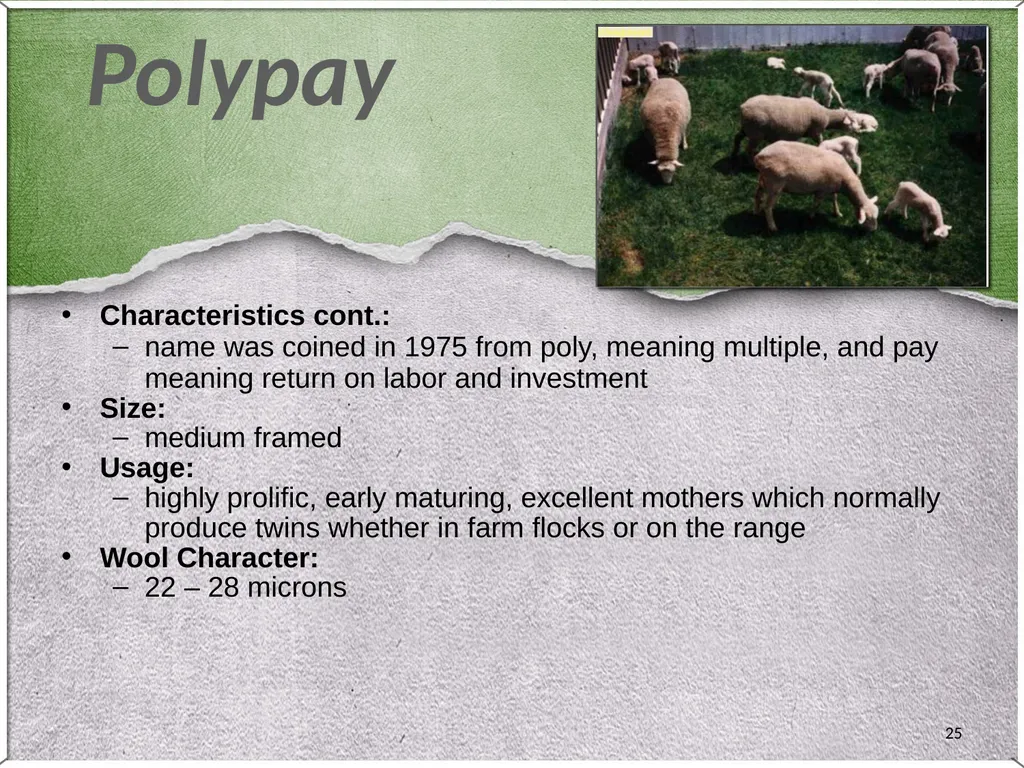
25 Polypay Characteristics cont.:
name was coined in 1975 from poly, meaning multiple, and pay meaning return on labor and investment
Size:
medium framed
Usage:
highly prolific, early maturing, excellent mothers which normally produce twins whether in farm flocks or on the range
Wool Character:
22 – 28 microns<br>
name was coined in 1975 from poly, meaning multiple, and pay meaning return on labor and investment
Size:
medium framed
Usage:
highly prolific, early maturing, excellent mothers which normally produce twins whether in farm flocks or on the range
Wool Character:
22 – 28 microns<br>
26
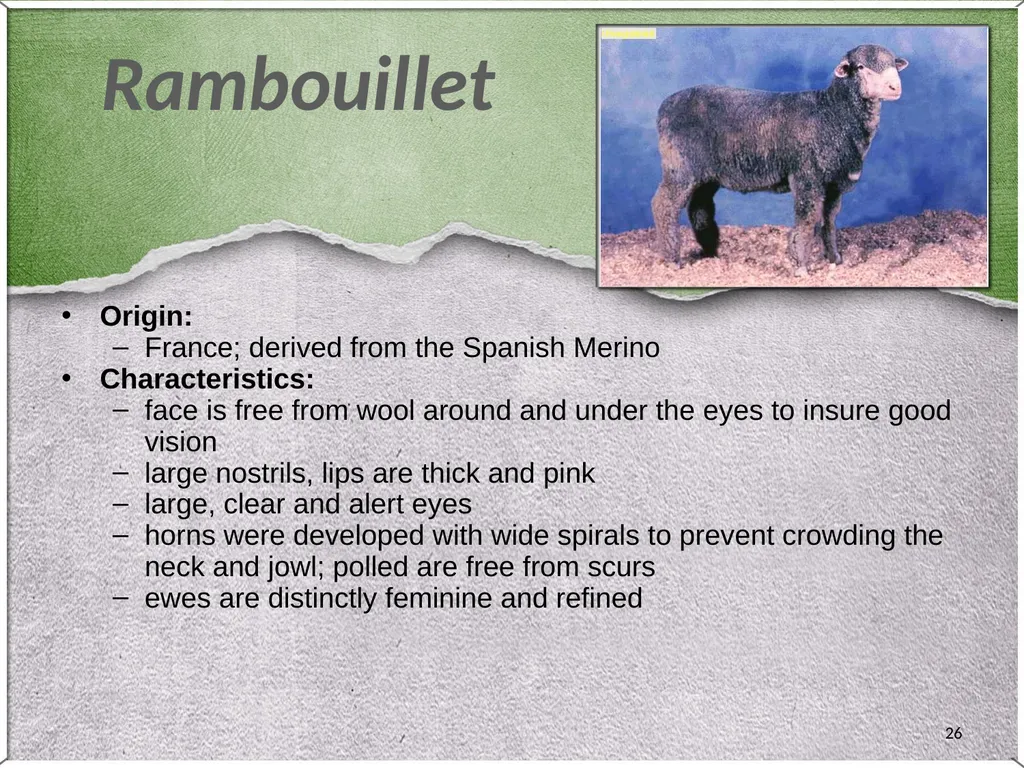
26 Rambouillet Origin:
France; derived from the Spanish Merino
Characteristics:
face is free from wool around and under the eyes to insure good vision
large nostrils, lips are thick and pink
large, clear and alert eyes
horns were developed with wide spirals to prevent crowding the neck and jowl; polled are free from scurs
ewes are distinctly feminine and refined<br>
France; derived from the Spanish Merino
Characteristics:
face is free from wool around and under the eyes to insure good vision
large nostrils, lips are thick and pink
large, clear and alert eyes
horns were developed with wide spirals to prevent crowding the neck and jowl; polled are free from scurs
ewes are distinctly feminine and refined<br>
27
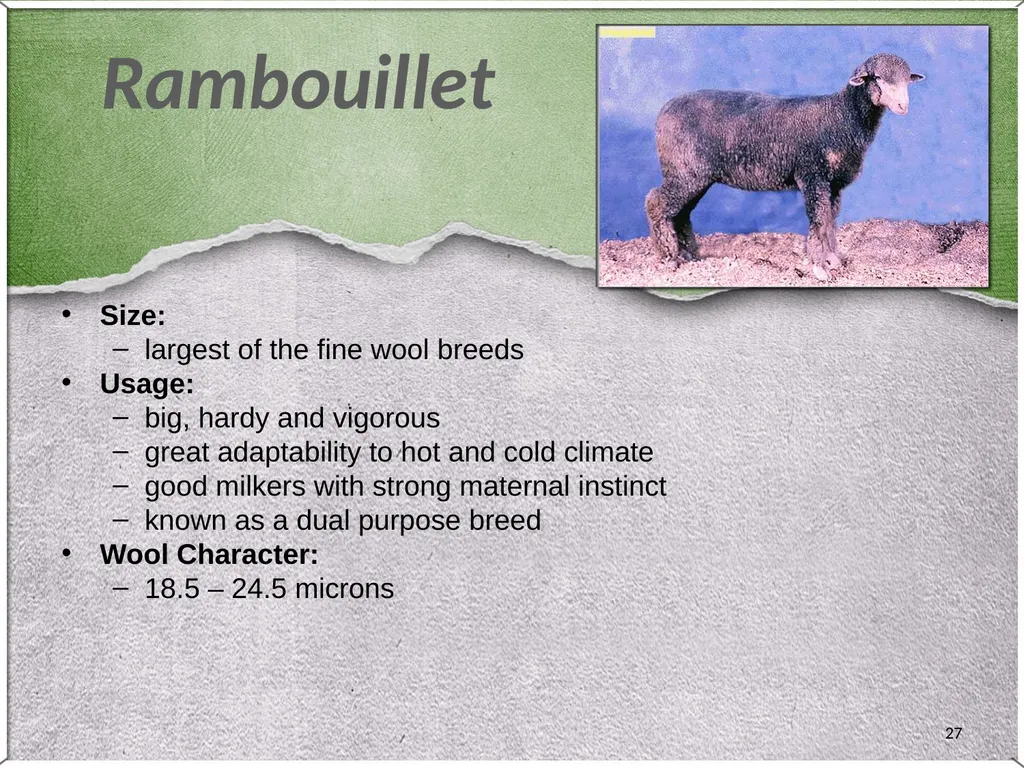
27 Rambouillet Size:
largest of the fine wool breeds
Usage:
big, hardy and vigorous
great adaptability to hot and cold climate
good milkers with strong maternal instinct
known as a dual purpose breed
Wool Character:
18.5 – 24.5 microns<br>
largest of the fine wool breeds
Usage:
big, hardy and vigorous
great adaptability to hot and cold climate
good milkers with strong maternal instinct
known as a dual purpose breed
Wool Character:
18.5 – 24.5 microns<br>
28
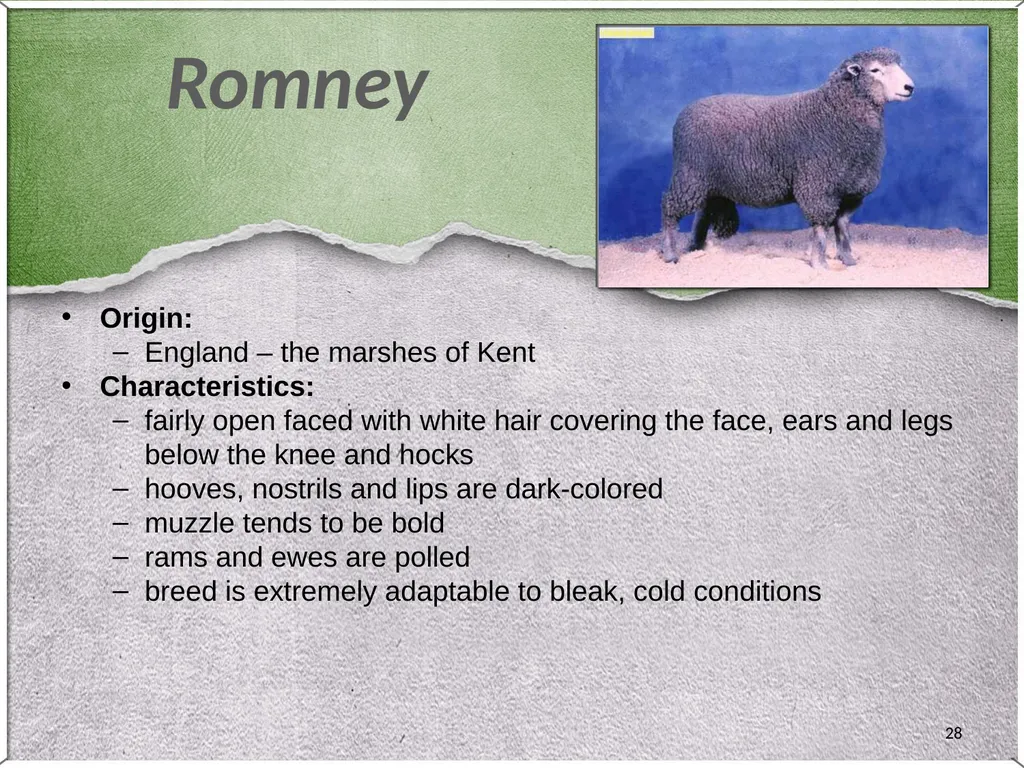
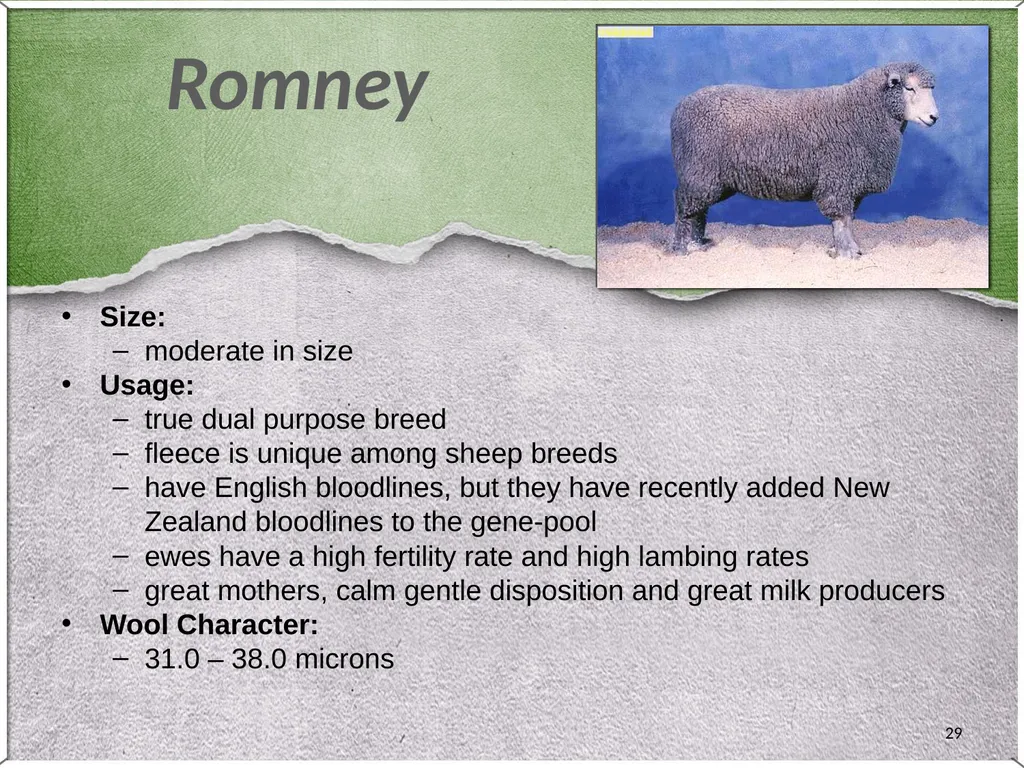
28 Romney Origin:
England – the marshes of Kent
Characteristics:
fairly open faced with white hair covering the face, ears and legs below the knee and hocks
hooves, nostrils and lips are dark-colored
muzzle tends to be bold
rams and ewes are polled
breed is extremely adaptable to bleak, cold conditions<br>
England – the marshes of Kent
Characteristics:
fairly open faced with white hair covering the face, ears and legs below the knee and hocks
hooves, nostrils and lips are dark-colored
muzzle tends to be bold
rams and ewes are polled
breed is extremely adaptable to bleak, cold conditions<br>
29
29 Romney Size:
moderate in size
Usage:
true dual purpose breed
fleece is unique among sheep breeds
have English bloodlines, but they have recently added New Zealand bloodlines to the gene-pool
ewes have a high fertility rate and high lambing rates
great mothers, calm gentle disposition and great milk producers
Wool Character:
31.0 – 38.0 microns<br>
moderate in size
Usage:
true dual purpose breed
fleece is unique among sheep breeds
have English bloodlines, but they have recently added New Zealand bloodlines to the gene-pool
ewes have a high fertility rate and high lambing rates
great mothers, calm gentle disposition and great milk producers
Wool Character:
31.0 – 38.0 microns<br>
30
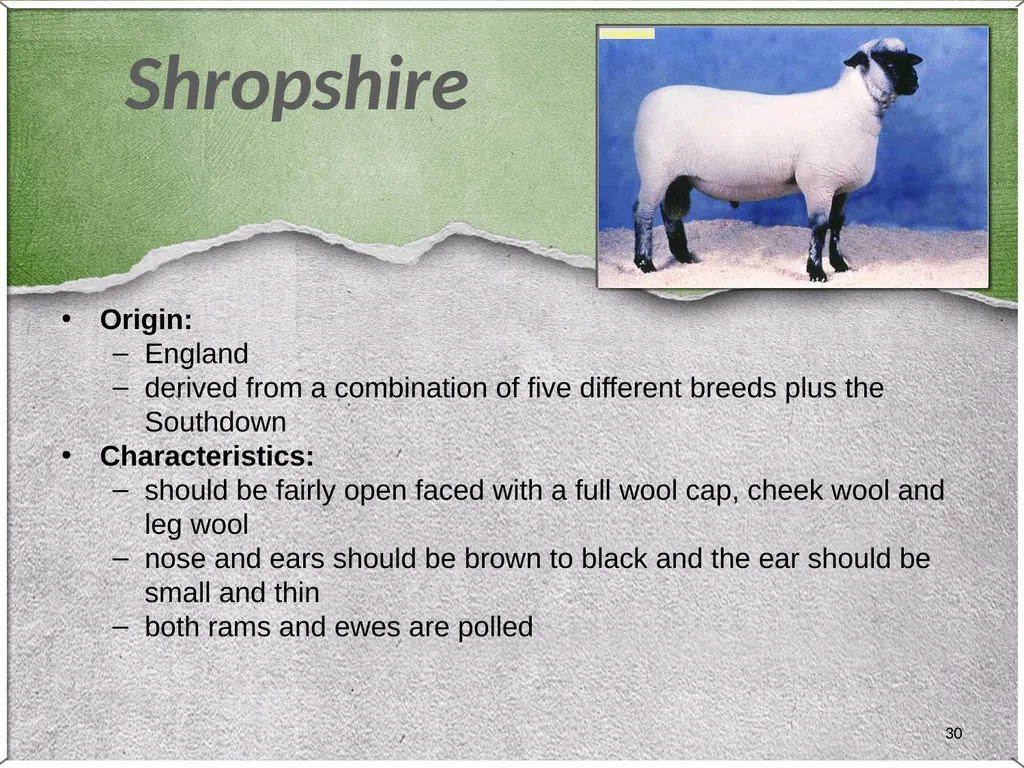
30 Shropshire Origin:
England
derived from a combination of five different breeds plus the Southdown
Characteristics:
should be fairly open faced with a full wool cap, cheek wool and leg wool
nose and ears should be brown to black and the ear should be small and thin
both rams and ewes are polled<br>
England
derived from a combination of five different breeds plus the Southdown
Characteristics:
should be fairly open faced with a full wool cap, cheek wool and leg wool
nose and ears should be brown to black and the ear should be small and thin
both rams and ewes are polled<br>
31
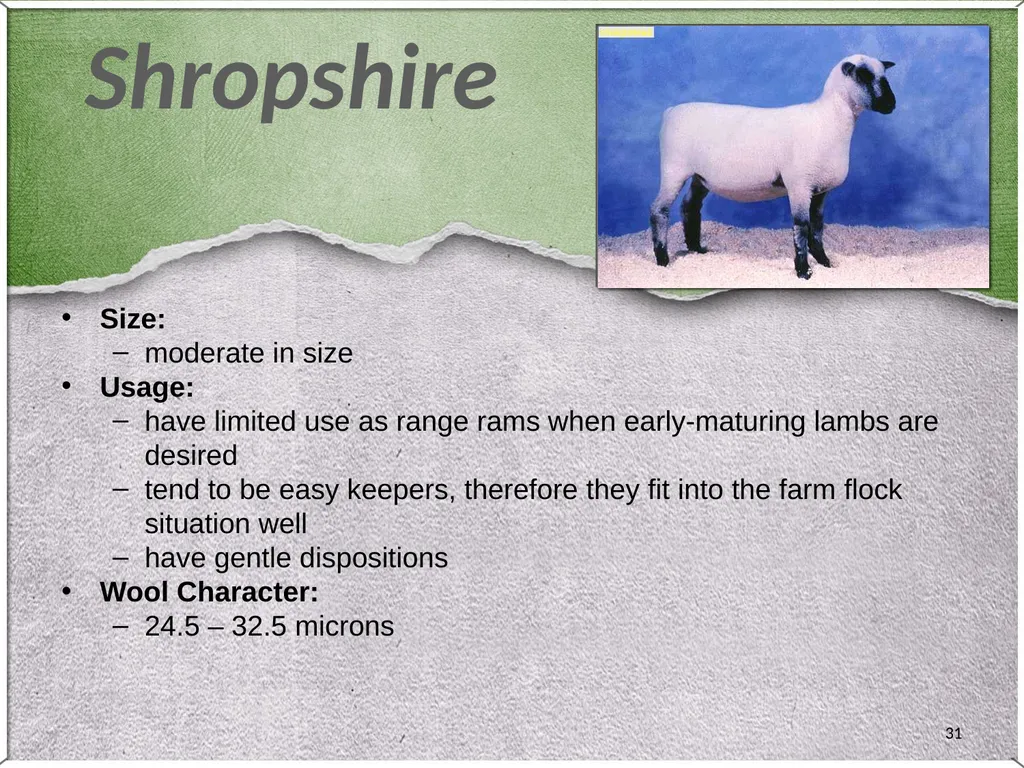
31 Shropshire Size:
moderate in size
Usage:
have limited use as range rams when early-maturing lambs are desired
tend to be easy keepers, therefore they fit into the farm flock situation well
have gentle dispositions
Wool Character:
24.5 – 32.5 microns<br>
moderate in size
Usage:
have limited use as range rams when early-maturing lambs are desired
tend to be easy keepers, therefore they fit into the farm flock situation well
have gentle dispositions
Wool Character:
24.5 – 32.5 microns<br>
32
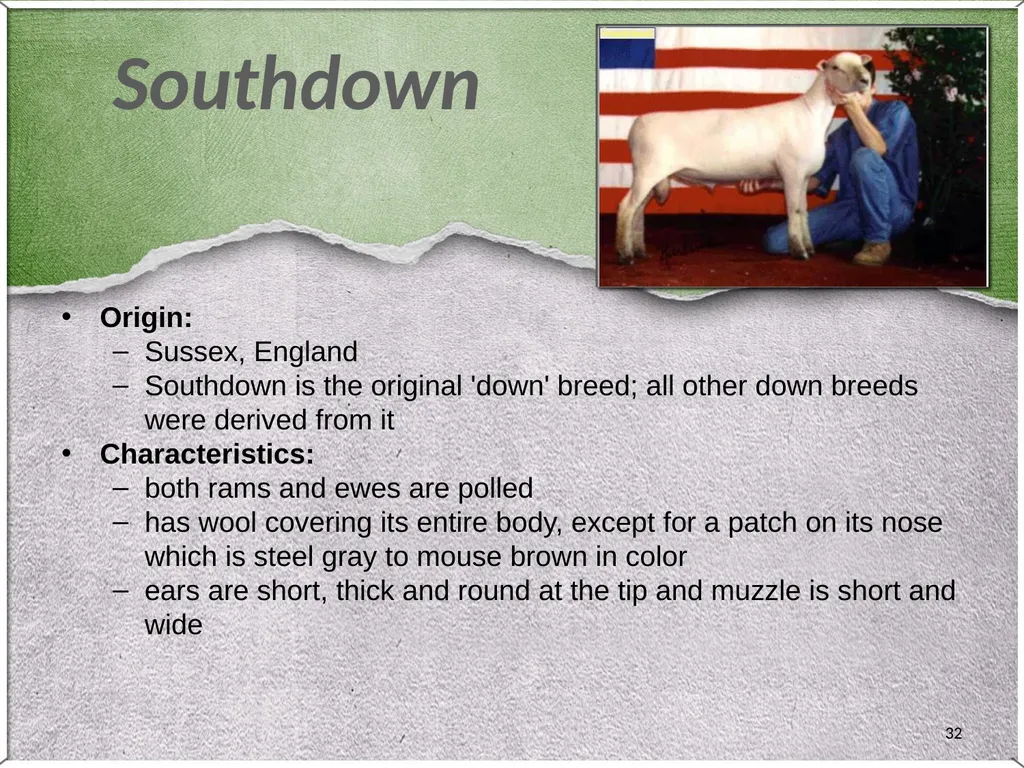
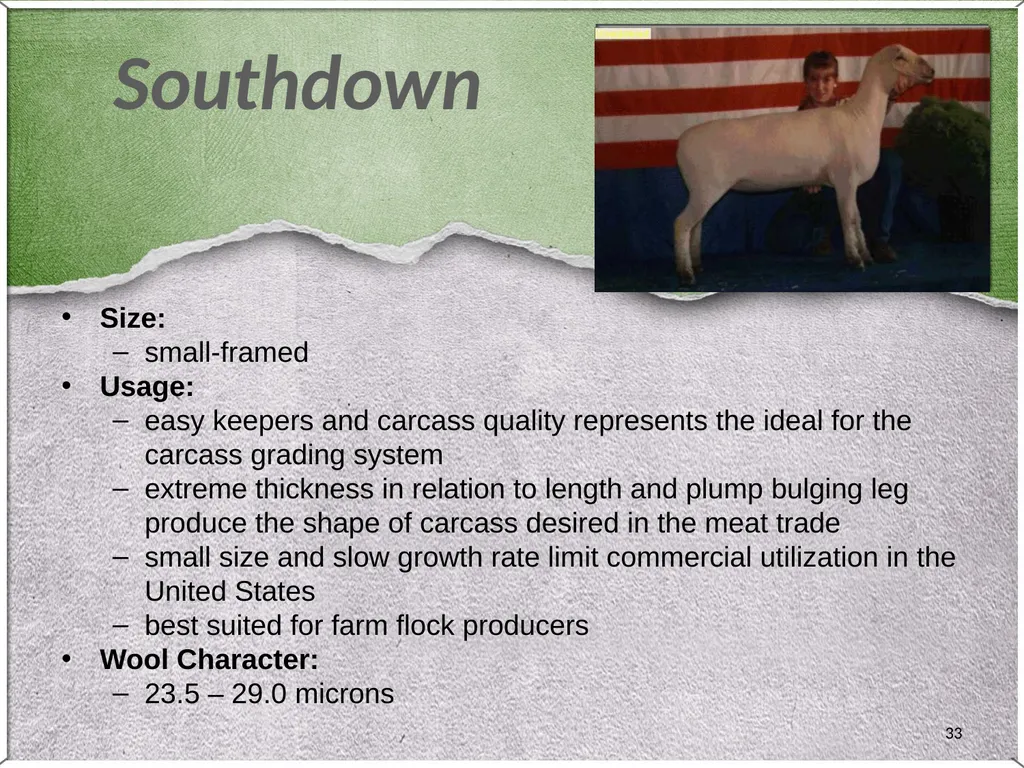
32 Southdown Origin:
Sussex, England
Southdown is the original 'down' breed; all other down breeds were derived from it
Characteristics:
both rams and ewes are polled
has wool covering its entire body, except for a patch on its nose which is steel gray to mouse brown in color
ears are short, thick and round at the tip and muzzle is short and wide<br>
Sussex, England
Southdown is the original 'down' breed; all other down breeds were derived from it
Characteristics:
both rams and ewes are polled
has wool covering its entire body, except for a patch on its nose which is steel gray to mouse brown in color
ears are short, thick and round at the tip and muzzle is short and wide<br>
33
33 Southdown Size:
small-framed
Usage:
easy keepers and carcass quality represents the ideal for the carcass grading system
extreme thickness in relation to length and plump bulging leg produce the shape of carcass desired in the meat trade
small size and slow growth rate limit commercial utilization in the United States
best suited for farm flock producers
Wool Character:
23.5 – 29.0 microns<br>
small-framed
Usage:
easy keepers and carcass quality represents the ideal for the carcass grading system
extreme thickness in relation to length and plump bulging leg produce the shape of carcass desired in the meat trade
small size and slow growth rate limit commercial utilization in the United States
best suited for farm flock producers
Wool Character:
23.5 – 29.0 microns<br>
34
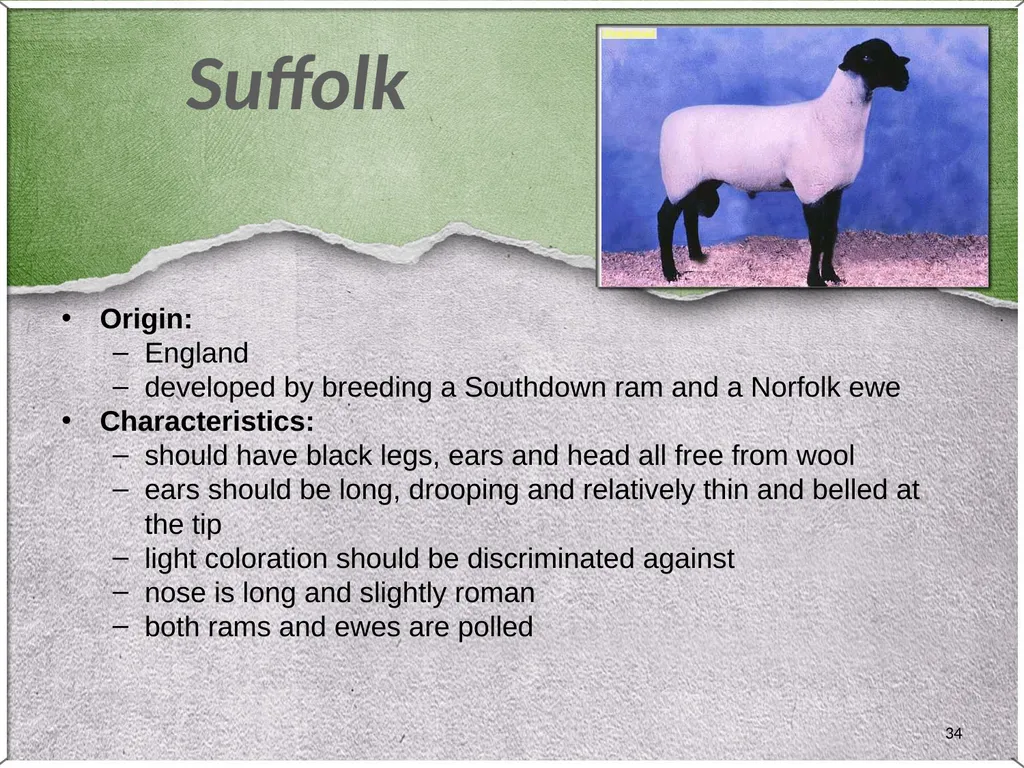
34 Suffolk Origin:
England
developed by breeding a Southdown ram and a Norfolk ewe
Characteristics:
should have black legs, ears and head all free from wool
ears should be long, drooping and relatively thin and belled at the tip
light coloration should be discriminated against
nose is long and slightly roman
both rams and ewes are polled<br>
England
developed by breeding a Southdown ram and a Norfolk ewe
Characteristics:
should have black legs, ears and head all free from wool
ears should be long, drooping and relatively thin and belled at the tip
light coloration should be discriminated against
nose is long and slightly roman
both rams and ewes are polled<br>
35
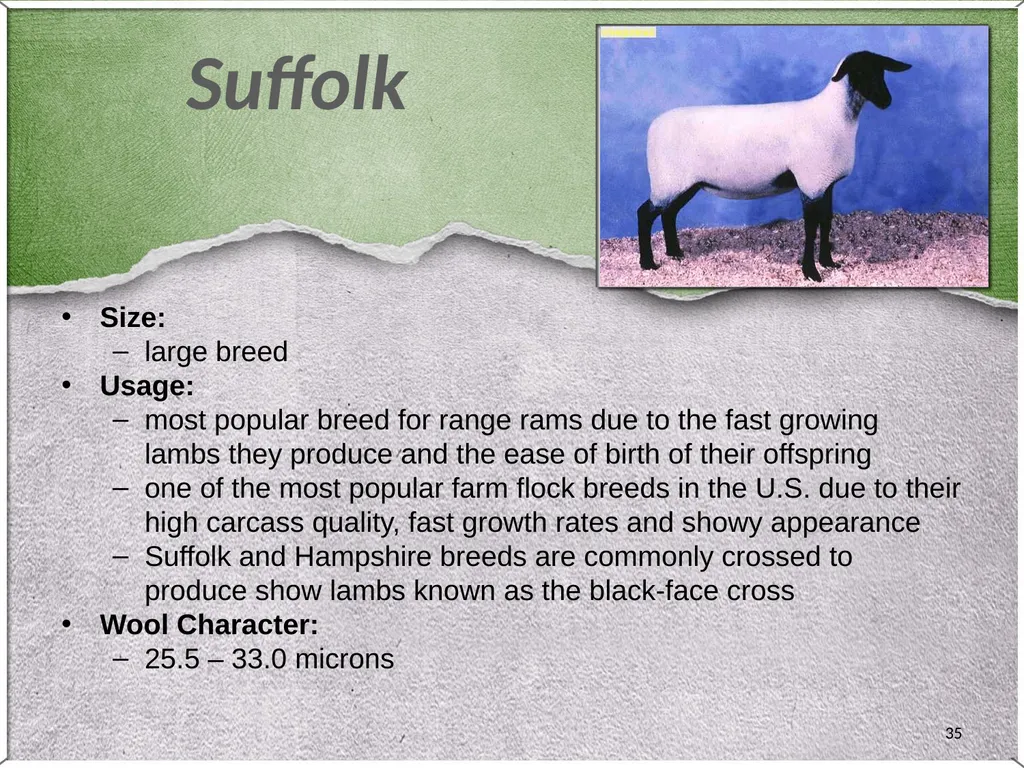
35 Suffolk Size:
large breed
Usage:
most popular breed for range rams due to the fast growing lambs they produce and the ease of birth of their offspring
one of the most popular farm flock breeds in the U.S. due to their high carcass quality, fast growth rates and showy appearance
Suffolk and Hampshire breeds are commonly crossed to produce show lambs known as the black-face cross
Wool Character:
25.5 – 33.0 microns<br>
large breed
Usage:
most popular breed for range rams due to the fast growing lambs they produce and the ease of birth of their offspring
one of the most popular farm flock breeds in the U.S. due to their high carcass quality, fast growth rates and showy appearance
Suffolk and Hampshire breeds are commonly crossed to produce show lambs known as the black-face cross
Wool Character:
25.5 – 33.0 microns<br>
36
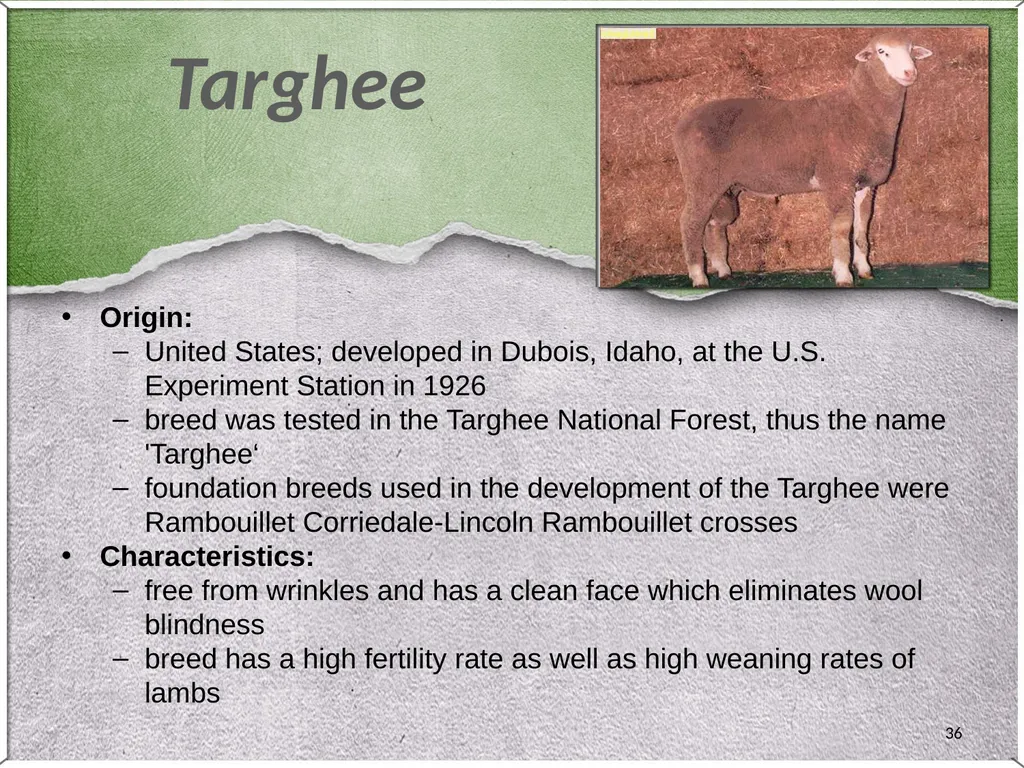
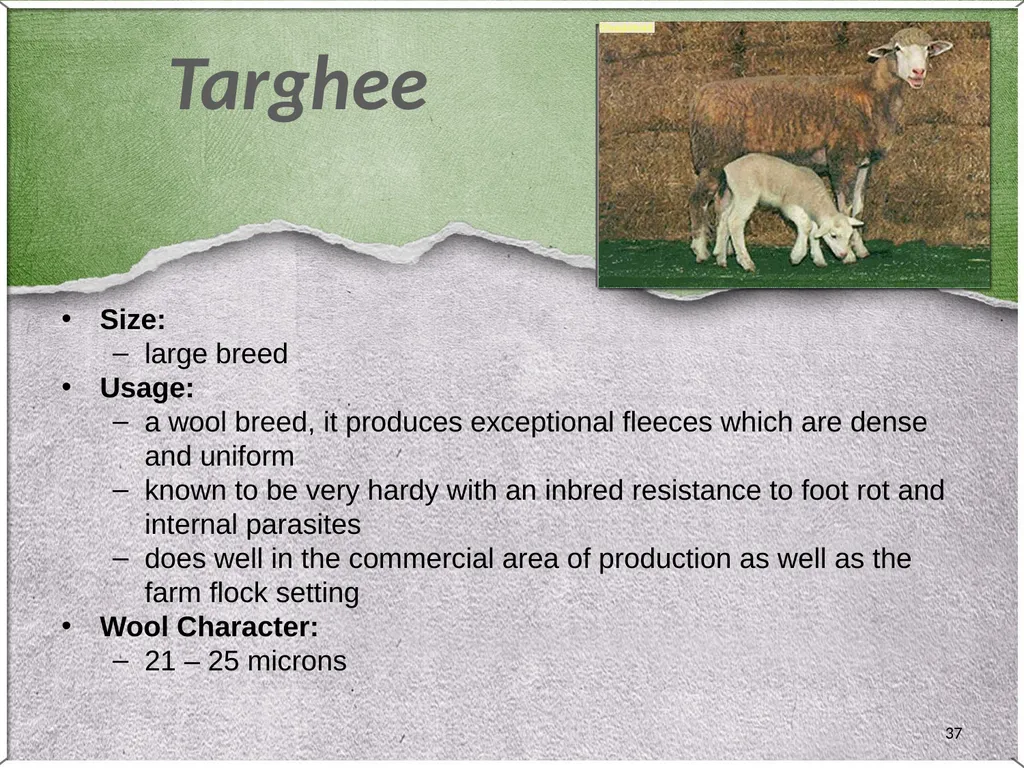
36 Targhee Origin:
United States; developed in Dubois, Idaho, at the U.S. Experiment Station in 1926
breed was tested in the Targhee National Forest, thus the name 'Targhee‘
foundation breeds used in the development of the Targhee were Rambouillet Corriedale-Lincoln Rambouillet crosses
Characteristics:
free from wrinkles and has a clean face which eliminates wool blindness
breed has a high fertility rate as well as high weaning rates of lambs<br>
United States; developed in Dubois, Idaho, at the U.S. Experiment Station in 1926
breed was tested in the Targhee National Forest, thus the name 'Targhee‘
foundation breeds used in the development of the Targhee were Rambouillet Corriedale-Lincoln Rambouillet crosses
Characteristics:
free from wrinkles and has a clean face which eliminates wool blindness
breed has a high fertility rate as well as high weaning rates of lambs<br>
37
37 Targhee Size:
large breed
Usage:
a wool breed, it produces exceptional fleeces which are dense and uniform
known to be very hardy with an inbred resistance to foot rot and internal parasites
does well in the commercial area of production as well as the farm flock setting
Wool Character:
21 – 25 microns<br>
large breed
Usage:
a wool breed, it produces exceptional fleeces which are dense and uniform
known to be very hardy with an inbred resistance to foot rot and internal parasites
does well in the commercial area of production as well as the farm flock setting
Wool Character:
21 – 25 microns<br>
38
Assessment 38 Sheep<br>
39
1. The Corriedale was developed through a cross between which of the following?
A. A Lincoln ram and a Rambouillet ewe
B. A Lincoln ram and a Merino ewe
C. A Merino ram and a Lincoln ewe
D. A Southdown ram and a Lincoln ewe
2. Why is the Dorset a popular breed in the U.S. for show lamb production?
A. Its ability to produce three or four lambs per year
B. Its ability to mature very early
C. Its mothering and milking abilities
D. Its carcass qualities, docile nature and showy appearance Assessment 39<br>
A. A Lincoln ram and a Rambouillet ewe
B. A Lincoln ram and a Merino ewe
C. A Merino ram and a Lincoln ewe
D. A Southdown ram and a Lincoln ewe
2. Why is the Dorset a popular breed in the U.S. for show lamb production?
A. Its ability to produce three or four lambs per year
B. Its ability to mature very early
C. Its mothering and milking abilities
D. Its carcass qualities, docile nature and showy appearance Assessment 39<br>
40
3. The Polypay gene pool was developed from which four existing breeds?
A. Hampshire, Southdown, Lincoln and Rambouillet
B. Targhee, Finnsheep, Romney and Dorset
C. Finnsheep, Rambouillet, Targhee and Dorset
D. Rambouillet, Targhee, Lincoln and Finnsheep
4. What is the original “down” breed?
A. Shropshire
B. Southdown
C. Suffolk
D. Hampshire Assessment 40<br>
A. Hampshire, Southdown, Lincoln and Rambouillet
B. Targhee, Finnsheep, Romney and Dorset
C. Finnsheep, Rambouillet, Targhee and Dorset
D. Rambouillet, Targhee, Lincoln and Finnsheep
4. What is the original “down” breed?
A. Shropshire
B. Southdown
C. Suffolk
D. Hampshire Assessment 40<br>
41
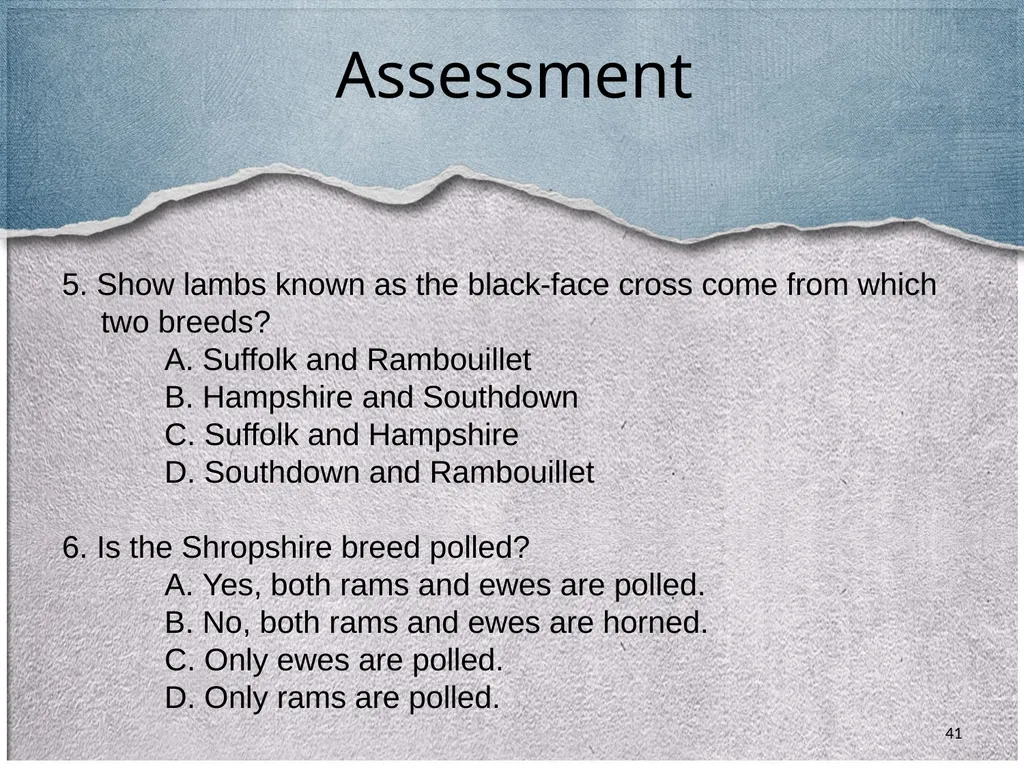
5. Show lambs known as the black-face cross come from which two breeds?
A. Suffolk and Rambouillet
B. Hampshire and Southdown
C. Suffolk and Hampshire
D. Southdown and Rambouillet
6. Is the Shropshire breed polled?
A. Yes, both rams and ewes are polled.
B. No, both rams and ewes are horned.
C. Only ewes are polled.
D. Only rams are polled. Assessment 41<br>
A. Suffolk and Rambouillet
B. Hampshire and Southdown
C. Suffolk and Hampshire
D. Southdown and Rambouillet
6. Is the Shropshire breed polled?
A. Yes, both rams and ewes are polled.
B. No, both rams and ewes are horned.
C. Only ewes are polled.
D. Only rams are polled. Assessment 41<br>
42
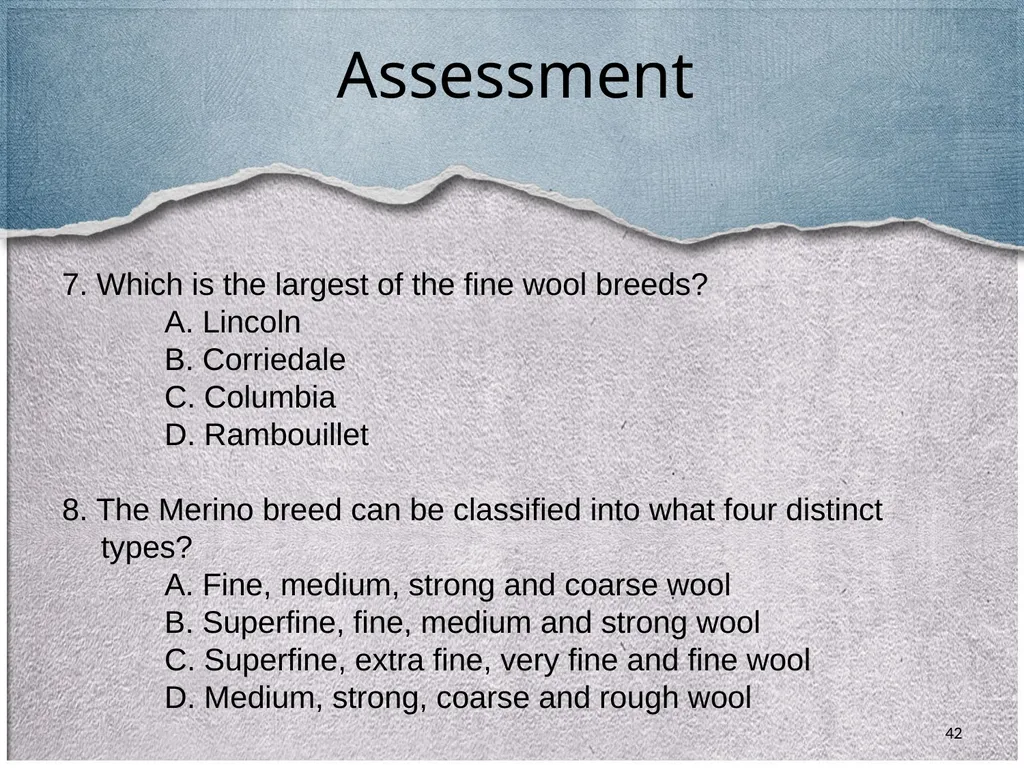
7. Which is the largest of the fine wool breeds?
A. Lincoln
B. Corriedale
C. Columbia
D. Rambouillet
8. The Merino breed can be classified into what four distinct types?
A. Fine, medium, strong and coarse wool
B. Superfine, fine, medium and strong wool
C. Superfine, extra fine, very fine and fine wool
D. Medium, strong, coarse and rough wool Assessment 42<br>
A. Lincoln
B. Corriedale
C. Columbia
D. Rambouillet
8. The Merino breed can be classified into what four distinct types?
A. Fine, medium, strong and coarse wool
B. Superfine, fine, medium and strong wool
C. Superfine, extra fine, very fine and fine wool
D. Medium, strong, coarse and rough wool Assessment 42<br>
43
9. In what type of climate does the Lincoln do well?
A. Areas with cold temperature and high rainfall
B. Areas with high temperatures and little rainfall
C. Humid areas
D. Dry, arid areas
10. Where did the Finnsheep originate?
A. England
B. Switzerland
C. Finland
D. Scotland Assessment 43<br>
A. Areas with cold temperature and high rainfall
B. Areas with high temperatures and little rainfall
C. Humid areas
D. Dry, arid areas
10. Where did the Finnsheep originate?
A. England
B. Switzerland
C. Finland
D. Scotland Assessment 43<br>
44
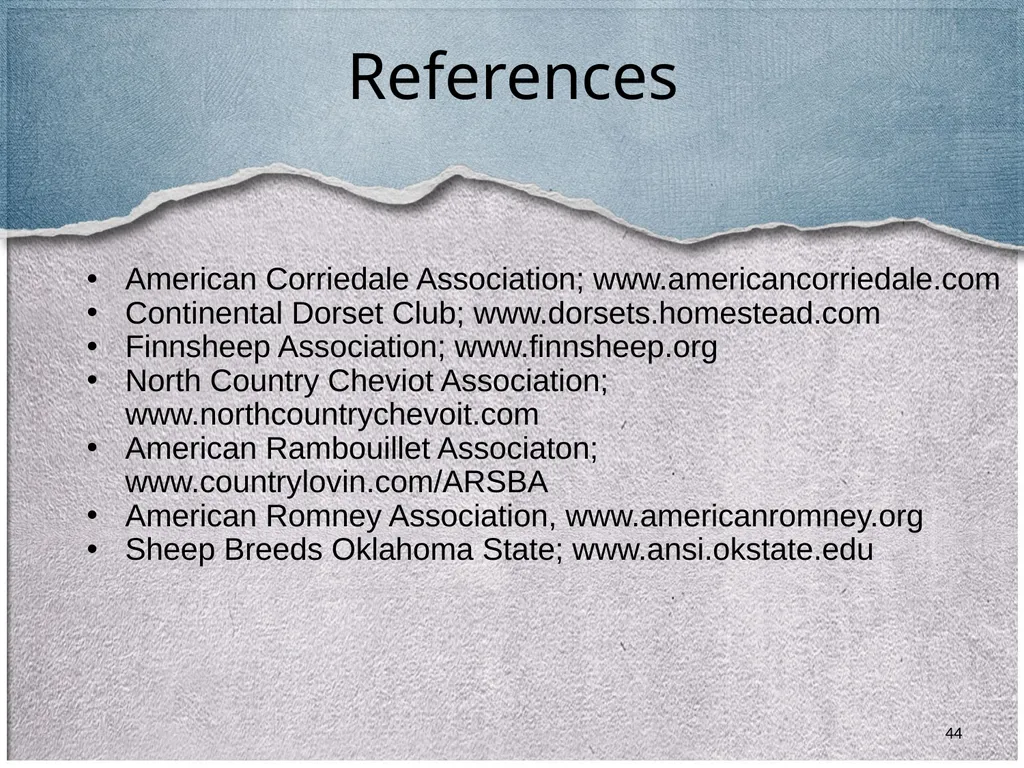
References 44 American Corriedale Association; www.americancorriedale.com
Continental Dorset Club; www.dorsets.homestead.com
Finnsheep Association; www.finnsheep.org
North Country Cheviot Association; www.northcountrychevoit.com
American Rambouillet Associaton; www.countrylovin.com/ARSBA
American Romney Association, www.americanromney.org
Sheep Breeds Oklahoma State; www.ansi.okstate.edu<br>
Continental Dorset Club; www.dorsets.homestead.com
Finnsheep Association; www.finnsheep.org
North Country Cheviot Association; www.northcountrychevoit.com
American Rambouillet Associaton; www.countrylovin.com/ARSBA
American Romney Association, www.americanromney.org
Sheep Breeds Oklahoma State; www.ansi.okstate.edu<br>
45
Acknowledgments Executive Producer
Gordon W. Davis, Ph.D. Production Coordinators
Breeanna Roland
Daniel Johnson
Jessica Odom
Graphic Designer
Daniel Johnson
Technical Writer
Jessica Odom
V.P. of Brand Management
Clayton Franklin © MMXV
CEV Multimedia, Ltd. 45<br>
Gordon W. Davis, Ph.D. Production Coordinators
Breeanna Roland
Daniel Johnson
Jessica Odom
Graphic Designer
Daniel Johnson
Technical Writer
Jessica Odom
V.P. of Brand Management
Clayton Franklin © MMXV
CEV Multimedia, Ltd. 45<br>