1 Structural steels designation, Grouping system for metallic materials and welding consumables standards Structural steel Requirements on structural steel Strength (also at high temperature) Fatigue properties Toughness Homogeneity, also
"1 Structural steels designation, Grouping system" is the property of its rightful owner. Permission is granted to
download and print the materials on this website for personal, non-commercial use only, and to display it
on your personal computer provided you do not modify the materials and that you retain all copyright
notices contained in the materials. By downloading content from our website, you accept the terms of this
agreement.
Presentation Transcript
01
1 Structural steels designation,
Grouping system for metallic materials and welding consumables standards<br>
02
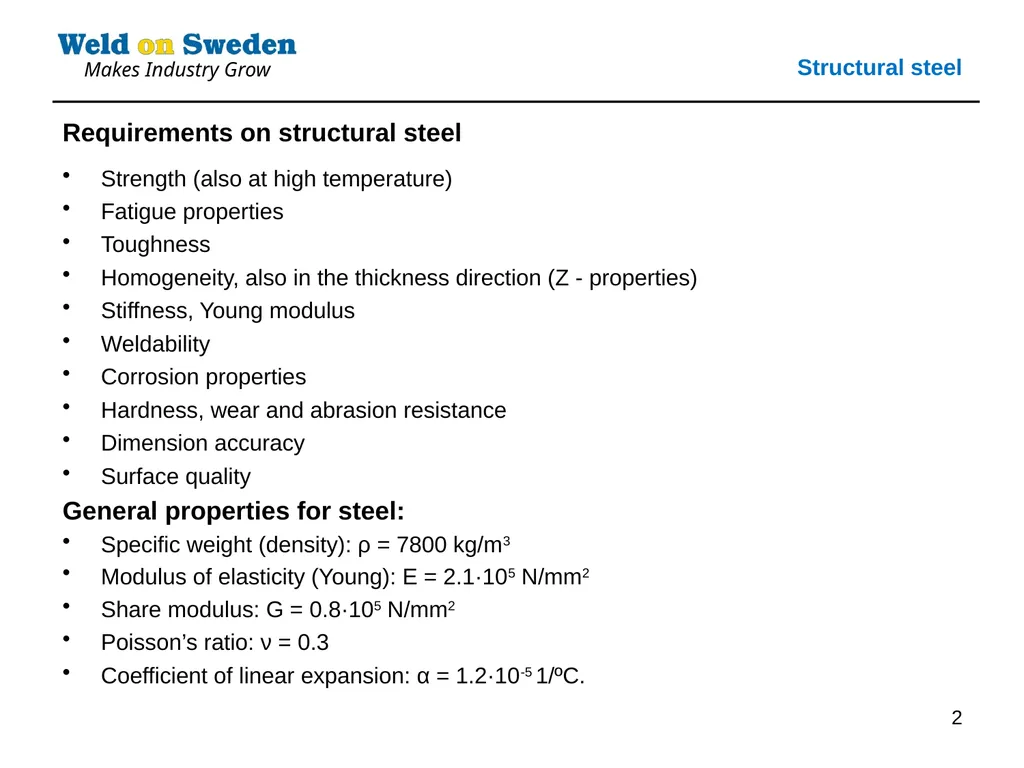
Structural steel Requirements on structural steel
Strength (also at high temperature)
Fatigue properties
Toughness
Homogeneity, also in the thickness direction (Z - properties)
Stiffness, Young modulus
Weldability
Corrosion properties
Hardness, wear and abrasion resistance
Dimension accuracy
Surface quality
General properties for steel:
Specific weight (density): ρ = 7800 kg/m3
Modulus of elasticity (Young): E = 2.1·105 N/mm2
Share modulus: G = 0.8·105 N/mm2
Poisson’s ratio: ν = 0.3
Coefficient of linear expansion: α = 1.2·10-5 1/ºC. 2<br>
03
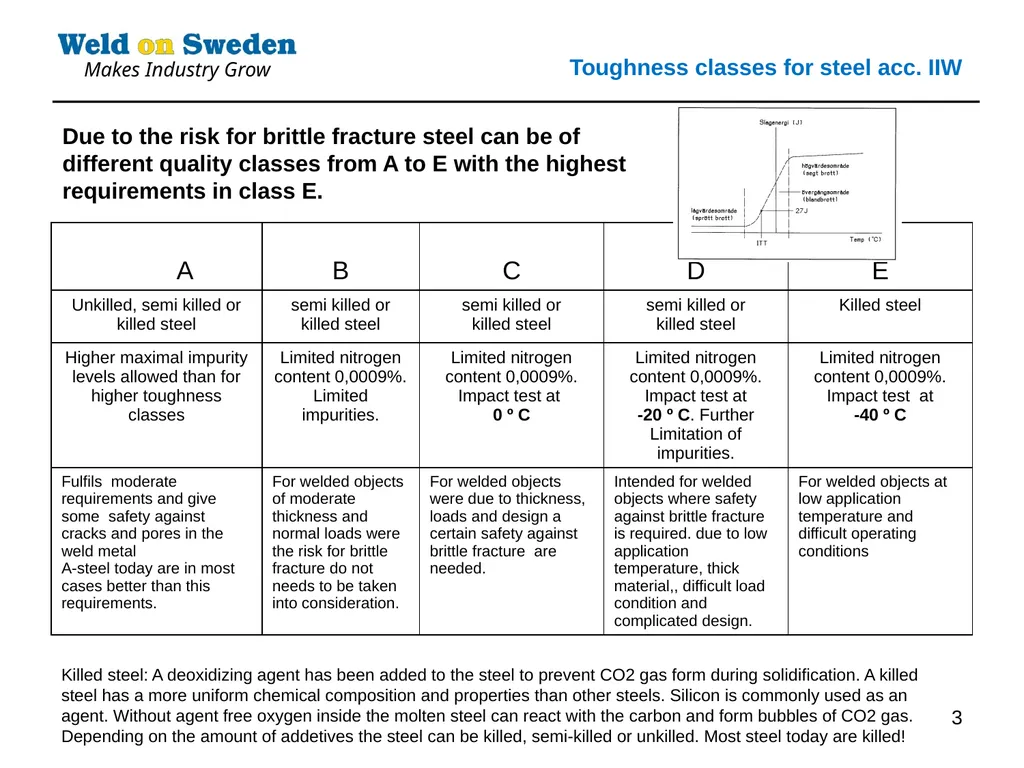
Toughness classes for steel acc. IIW Due to the risk for brittle fracture steel can be of different quality classes from A to E with the highest requirements in class E. 3 Killed steel: A deoxidizing agent has been added to the steel to prevent CO2 gas form during solidification. A killed steel has a more uniform chemical composition and properties than other steels. Silicon is commonly used as an agent. Without agent free oxygen inside the molten steel can react with the carbon and form bubbles of CO2 gas. Depending on the amount of addetives the steel can be killed, semi-killed or unkilled. Most steel today are killed!<br>
04
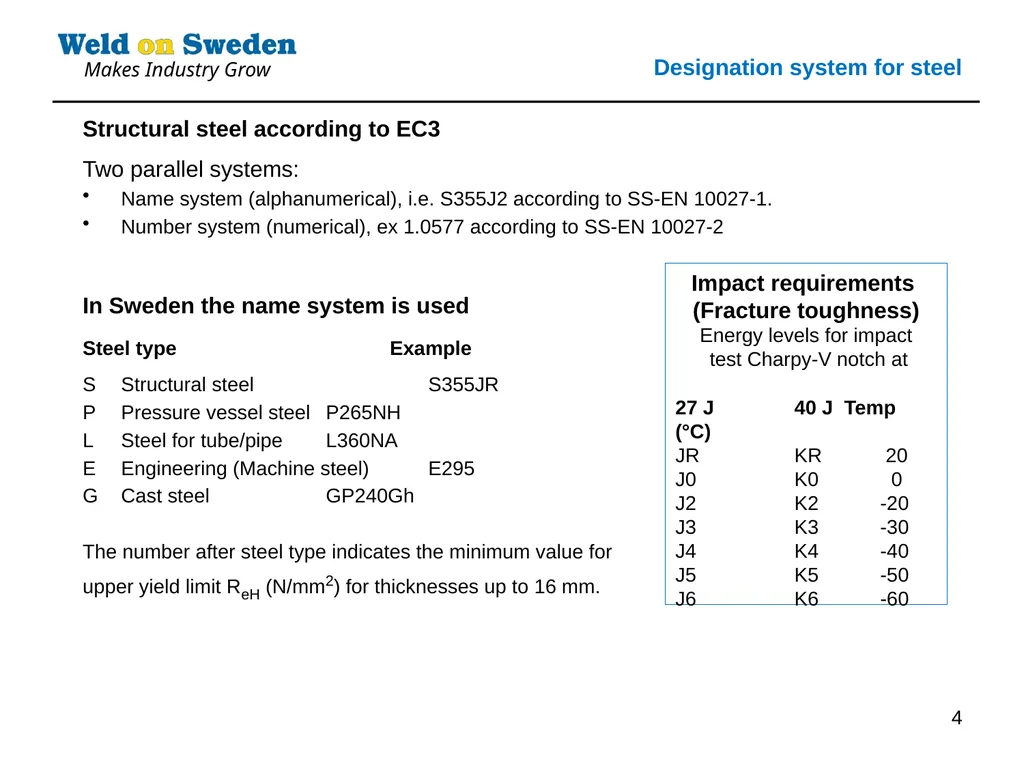
Designation system for steel Structural steel according to EC3
Two parallel systems:
Name system (alphanumerical), i.e. S355J2 according to SS-EN 10027-1.
Number system (numerical), ex 1.0577 according to SS-EN 10027-2
In Sweden the name system is used
Steel type Example
S Structural steel S355JR
P Pressure vessel steel P265NH
L Steel for tube/pipe L360NA
E Engineering (Machine steel) E295
G Cast steel GP240Gh
The number after steel type indicates the minimum value for
upper yield limit ReH (N/mm2) for thicknesses up to 16 mm. Impact requirements
(Fracture toughness)
Energy levels for impact
test Charpy-V notch at
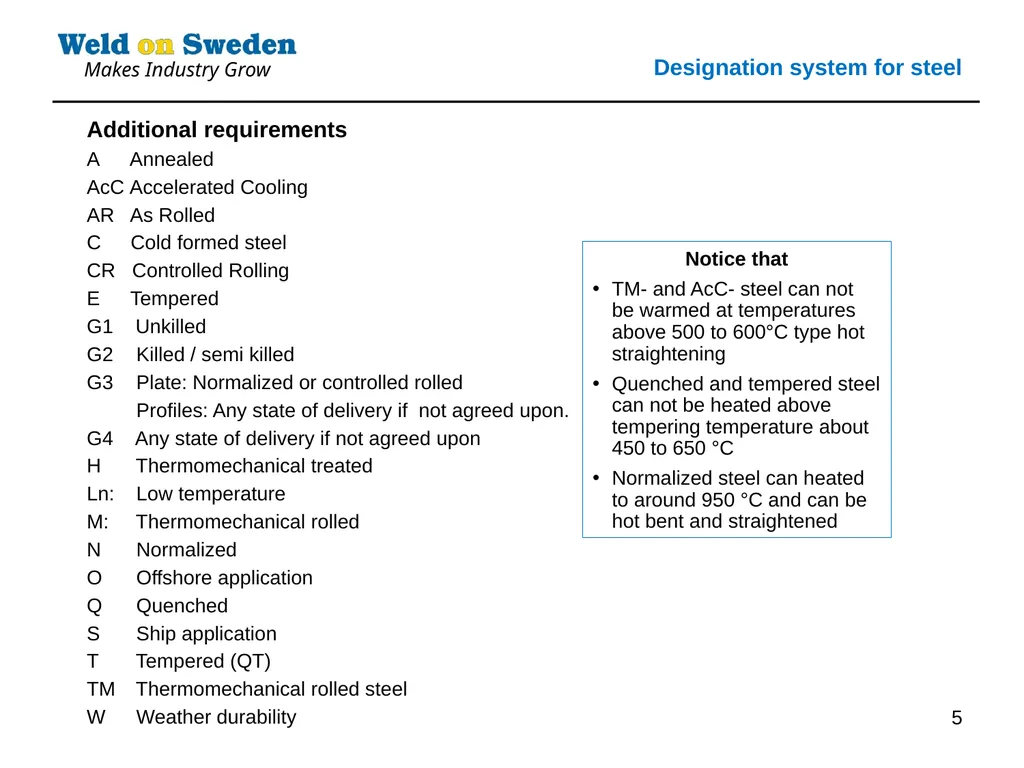
Additional requirements
A Annealed
AcC Accelerated Cooling
AR As Rolled
C Cold formed steel
CR Controlled Rolling
E Tempered
G1 Unkilled
G2 Killed / semi killed
G3 Plate: Normalized or controlled rolled
Profiles: Any state of delivery if not agreed upon.
G4 Any state of delivery if not agreed upon
H Thermomechanical treated
Ln: Low temperature
M: Thermomechanical rolled
N Normalized
O Offshore application
Q Quenched
S Ship application
T Tempered (QT)
TM Thermomechanical rolled steel
W Weather durability 5 Notice that
TM- and AcC- steel can not be warmed at temperatures above 500 to 600°C type hot straightening
Quenched and tempered steel can not be heated above tempering temperature about 450 to 650 °C
Normalized steel can heated to around 950 °C and can be hot bent and straightened Designation system for steel<br>
06
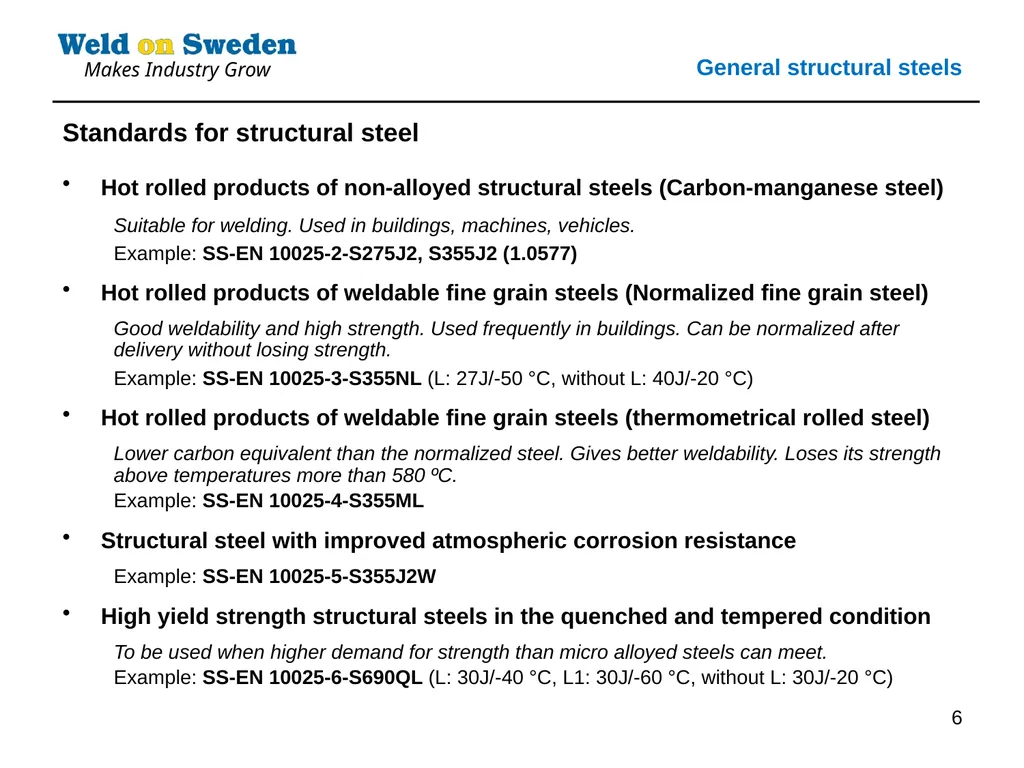
General structural steels Standards for structural steel
Hot rolled products of non-alloyed structural steels (Carbon-manganese steel)
Suitable for welding. Used in buildings, machines, vehicles.
Example: SS-EN 10025-2-S275J2, S355J2 (1.0577)
Hot rolled products of weldable fine grain steels (Normalized fine grain steel)
Good weldability and high strength. Used frequently in buildings. Can be normalized after delivery without losing strength.
Example: SS-EN 10025-3-S355NL (L: 27J/-50 °C, without L: 40J/-20 °C)
Hot rolled products of weldable fine grain steels (thermometrical rolled steel)
Lower carbon equivalent than the normalized steel. Gives better weldability. Loses its strength above temperatures more than 580 ºC.
Example: SS-EN 10025-4-S355ML
Structural steel with improved atmospheric corrosion resistance
Example: SS-EN 10025-5-S355J2W
High yield strength structural steels in the quenched and tempered condition
To be used when higher demand for strength than micro alloyed steels can meet.
Example: SS-EN 10025-6-S690QL (L: 30J/-40 °C, L1: 30J/-60 °C, without L: 30J/-20 °C) 6<br>
07
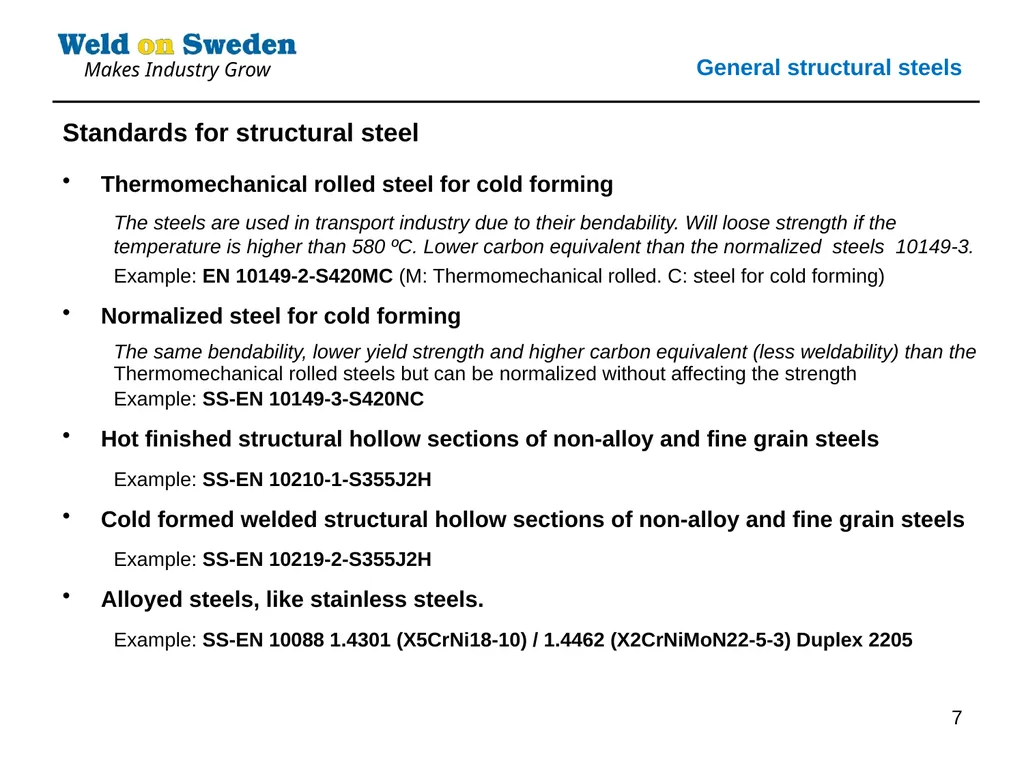
Standards for structural steel
Thermomechanical rolled steel for cold forming
The steels are used in transport industry due to their bendability. Will loose strength if the temperature is higher than 580 ºC. Lower carbon equivalent than the normalized steels 10149-3.
Example: EN 10149-2-S420MC (M: Thermomechanical rolled. C: steel for cold forming)
Normalized steel for cold forming
The same bendability, lower yield strength and higher carbon equivalent (less weldability) than the Thermomechanical rolled steels but can be normalized without affecting the strength
Example: SS-EN 10149-3-S420NC
Hot finished structural hollow sections of non-alloy and fine grain steels
Example: SS-EN 10210-1-S355J2H
Cold formed welded structural hollow sections of non-alloy and fine grain steels
Example: SS-EN 10219-2-S355J2H
Alloyed steels, like stainless steels.
Example: SS-EN 10088 1.4301 (X5CrNi18-10) / 1.4462 (X2CrNiMoN22-5-3) Duplex 2205 7 General structural steels<br>
08
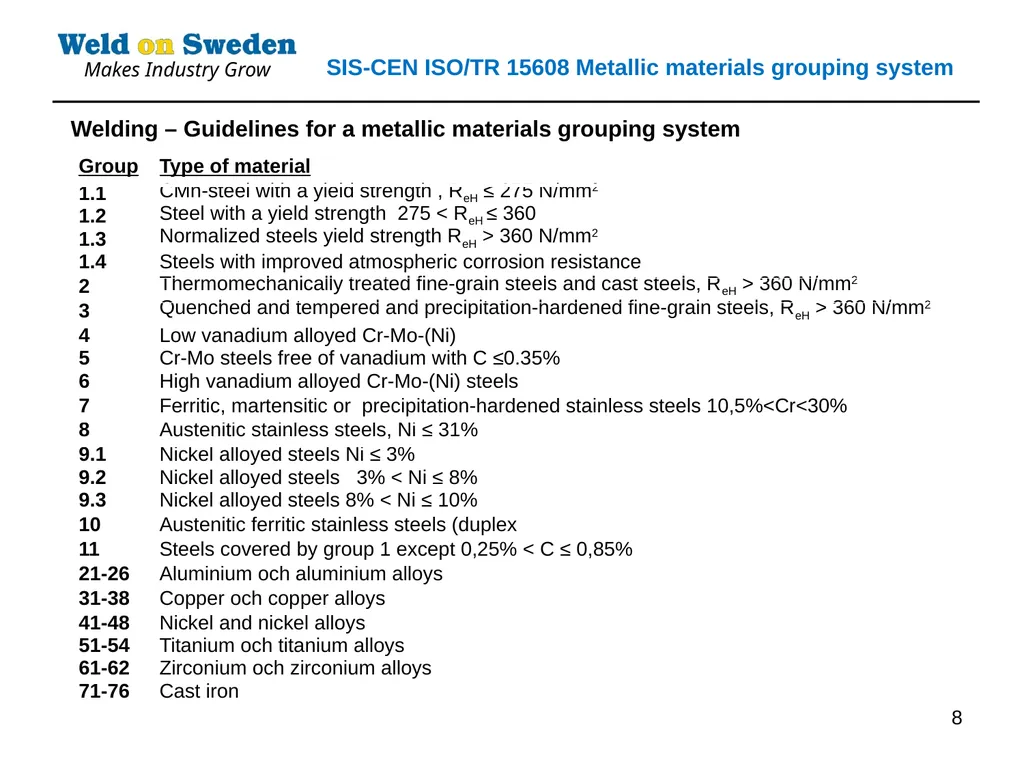
Welding – Guidelines for a metallic materials grouping system SIS-CEN ISO/TR 15608 Metallic materials grouping system 8<br>
09
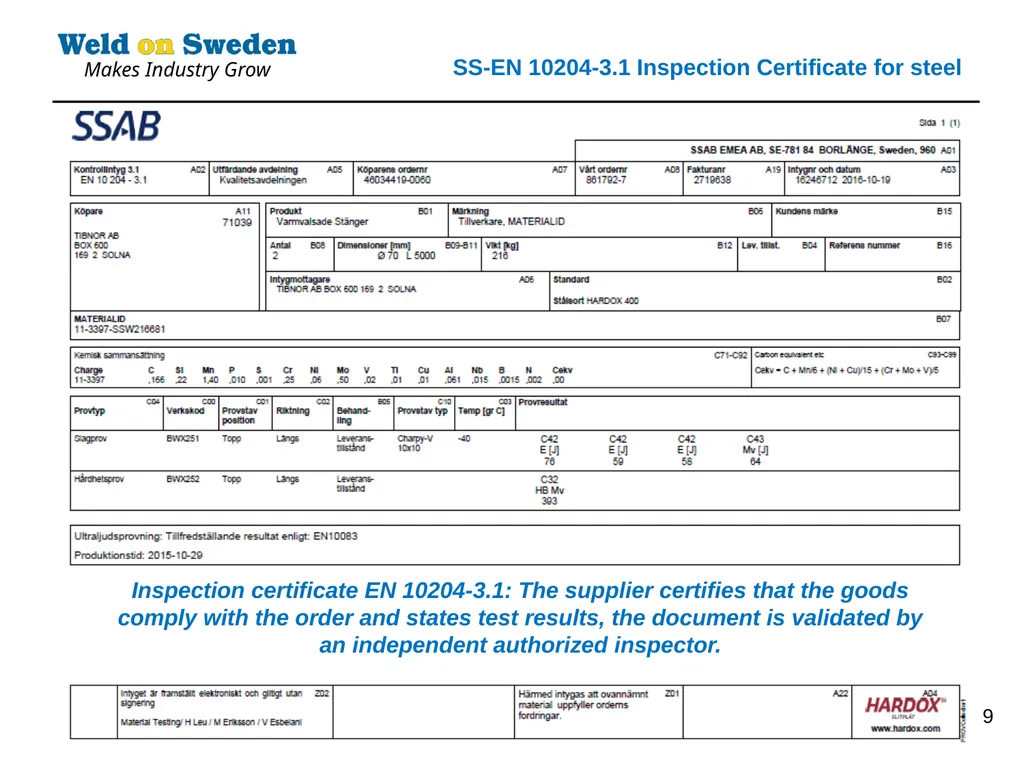
SS-EN 10204-3.1 Inspection Certificate for steel 9 Inspection certificate EN 10204-3.1: The supplier certifies that the goods comply with the order and states test results, the document is validated by an independent authorized inspector.<br>
10
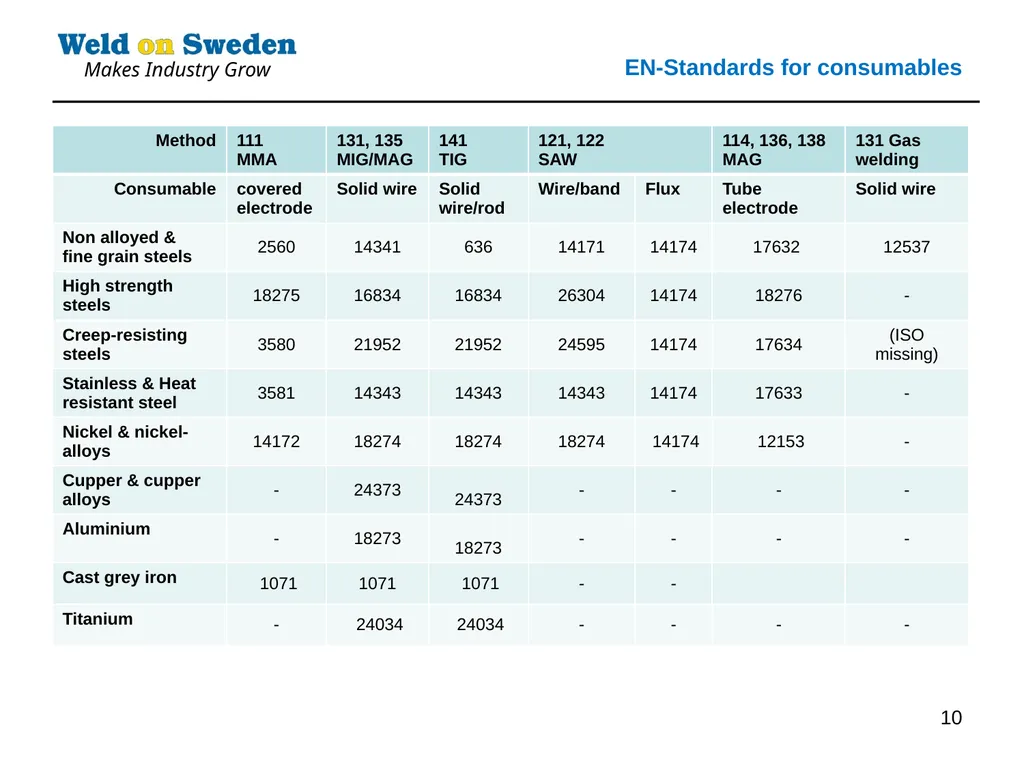
10 EN-Standards for consumables<br>
11
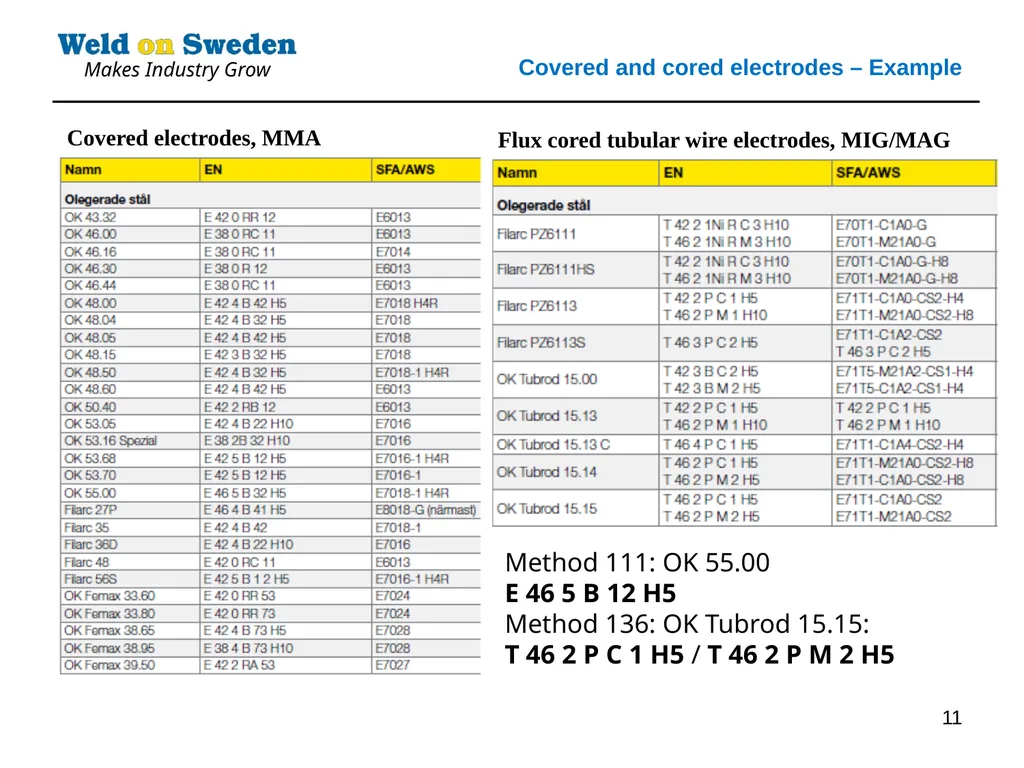
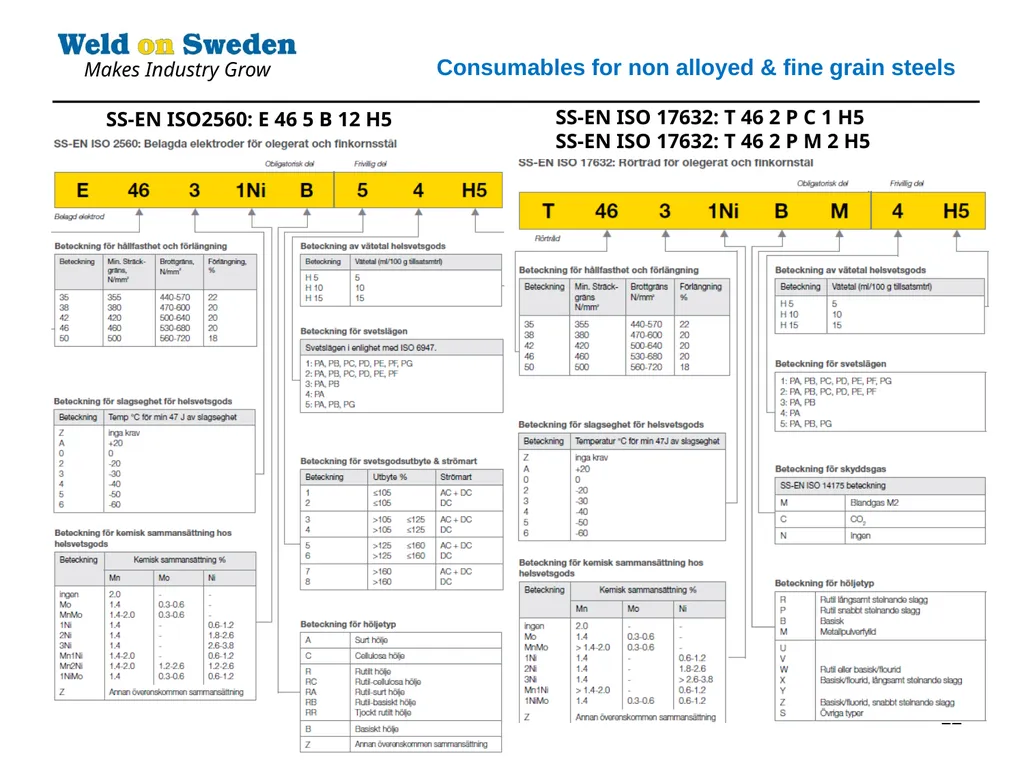
Covered and cored electrodes – Example 11 Method 111: OK 55.00
E 46 5 B 12 H5
Method 136: OK Tubrod 15.15:
T 46 2 P C 1 H5 / T 46 2 P M 2 H5 Covered electrodes, MMA Flux cored tubular wire electrodes, MIG/MAG<br>
12
Consumables for non alloyed & fine grain steels SS-EN ISO 17632: T 46 2 P C 1 H5
SS-EN ISO 17632: T 46 2 P M 2 H5 SS-EN ISO2560: E 46 5 B 12 H5 12<br>