
1 SUBJECT: Environmental protection and management
MJ
Published · 92 slides · 0 views

1 / 1






Description
1 SUBJECT: Environmental protection and management SUBJECT CODE: 18CV753 DEPT. OF CIVIL ENGG. K.S. SCHOOL OF ENGG. MANAGEMENT NAME OF THE FACULTY: Dr Rashmi H R, Asst. Prof. MODULE:2 Environmental quality Module 2 Environmental quality
Related Topics
Share
Embed code
Download this presentation From Below
"1 SUBJECT: Environmental protection and management" is the property of its rightful owner. Permission is granted to download and print the materials on this website for personal, non-commercial use only, and to display it on your personal computer provided you do not modify the materials and that you retain all copyright notices contained in the materials. By downloading content from our website, you accept the terms of this agreement.
Presentation Transcript
01
1 SUBJECT: Environmental protection and management
SUBJECT CODE: 18CV753
DEPT. OF CIVIL ENGG.
K.S. SCHOOL OF ENGG. & MANAGEMENT
NAME OF THE FACULTY: Dr Rashmi H R,
Asst. Prof. MODULE:2 Environmental quality<br>
SUBJECT CODE: 18CV753
DEPT. OF CIVIL ENGG.
K.S. SCHOOL OF ENGG. & MANAGEMENT
NAME OF THE FACULTY: Dr Rashmi H R,
Asst. Prof. MODULE:2 Environmental quality<br>
02
Module 2 Environmental quality objectives – Rationale of Environmental standards: Concentration and Mass standards, Effluent and stream standards, Emission and ambient standards, Minimum national standards, environmental performance evaluation: Indicators, benchmarking. Pollution control Vs Pollution Prevention - Opportunities and Barriers – Cleaner production and Clean technology, closing the loops, zero discharge technologies -8 Hours 2<br>
03
ENVIRONMENTAL MANAGEMENT Environmental management and its strategy -
Characterized by long-term objectives and
Business areas
(Company wants to be active and tries to obtain
the necessary resources in order to succeed in
the competitive environment) 3<br>
Characterized by long-term objectives and
Business areas
(Company wants to be active and tries to obtain
the necessary resources in order to succeed in
the competitive environment) 3<br>
04
Environmental strategy means
Compliance with the obligations set by the applicable legislation and
Voluntary decision of the company to mitigate its impact on the environment. 4<br>
Compliance with the obligations set by the applicable legislation and
Voluntary decision of the company to mitigate its impact on the environment. 4<br>
05
aim of environmental management To minimize the damage caused to the environment
To reduce the amount of waste
An efficient use of natural resources
Protection of biodiversity
Climate and others 5<br>
To reduce the amount of waste
An efficient use of natural resources
Protection of biodiversity
Climate and others 5<br>
06
In the longer run Companies may profit from a range of other benefits
Improvement of the financial results
Enhancing company reputation
Recruiting new and retaining the existing employees
(- To build a strong position of the enterprise on the market
- To acquire new business opportunities
-To reduce costs in the individual areas of its business activities) 6<br>
Improvement of the financial results
Enhancing company reputation
Recruiting new and retaining the existing employees
(- To build a strong position of the enterprise on the market
- To acquire new business opportunities
-To reduce costs in the individual areas of its business activities) 6<br>
07
Environmental Quality Objectives Reduced Climate Impact
Clean Air
Natural Acidification only
A Non-Toxic Environment
A Protective Ozone Layer
A Safe Radiation Environment
Zero Eutrophication
Flourishing Lakes and Streams 7<br>
Clean Air
Natural Acidification only
A Non-Toxic Environment
A Protective Ozone Layer
A Safe Radiation Environment
Zero Eutrophication
Flourishing Lakes and Streams 7<br>
08
Objectives cont…. Good-Quality Groundwater
A Balanced Marine Environment, Flourishing Coastal Areas
Thriving Wetlands
Sustainable Forests
A Varied Agricultural Landscape
A Magnificent Mountain Landscape
A Good Built Environment
A Rich Diversity of Plant and Animal Life 8<br>
A Balanced Marine Environment, Flourishing Coastal Areas
Thriving Wetlands
Sustainable Forests
A Varied Agricultural Landscape
A Magnificent Mountain Landscape
A Good Built Environment
A Rich Diversity of Plant and Animal Life 8<br>
09
1. Reduced Climate Impact The UN Framework Convention on Climate Change - stabilization of concentrations of greenhouse gases in the atmosphere at level - ensure that human activities do not have a harmful impact on the climate system
Goal achieved - biological diversity is preserved, food production is assured and other goals of sustainable development
All countries, must have responsibility for achieving global objective 9<br>
Goal achieved - biological diversity is preserved, food production is assured and other goals of sustainable development
All countries, must have responsibility for achieving global objective 9<br>
10
2. Clean Air The air must be clean enough not to represent a risk to health or to animals, plants or cultural assets 10<br>
11
3. Natural Acidification Only Acidifying effects of deposition and land use must not exceed the limits that can be tolerated by soil and water.
Deposition of acidifying substances must not increase the rate of corrosion of materials or cultural artefacts and buildings 11<br>
Deposition of acidifying substances must not increase the rate of corrosion of materials or cultural artefacts and buildings 11<br>
12
4. A Non-Toxic Environment The environment must be free from man-made or extracted compounds and metals that represent a threat to human health or biological diversity 12<br>
13
5. A Protective Ozone Layer The ozone layer must be replenished so as to provide long-term protection against harmful UV radiation 13<br>
14
6. A Safe Radiation Environment Human health and biological diversity must be protected against the harmful effects of radiation in the external environment 14<br>
15
7. Zero Eutrophication Nutrient levels in soil and water
Adversely affect human health
Biological diversity
Possibility of varied use of land and water use 15<br>
Adversely affect human health
Biological diversity
Possibility of varied use of land and water use 15<br>
16
8. Flourishing Lakes and Streams Lakes and watercourses must be ecologically sustainable and its variety of habitats must be preserved
Natural productive capacity, biological diversity, cultural heritage assets and the ecological and water-conserving function of the landscape must be preserved, at the same time as recreational assets are safeguarded 16<br>
Natural productive capacity, biological diversity, cultural heritage assets and the ecological and water-conserving function of the landscape must be preserved, at the same time as recreational assets are safeguarded 16<br>
17
9. Good-Quality Groundwater Groundwater must provide a safe and sustainable supply of drinking water 17<br>
18
10. A Balanced Marine Environment and
Flourishing Coastal Areas The sustainable productive capacity, and biological diversity must be preserved
Coasts must be characterized by a high degree of biological diversity and a wealth of recreational, natural and cultural assets
Industry, recreation and other utilization of the seas, coasts must be compatible with the promotion of sustainable development
Particularly valuable areas must be protected against encroachment and other disturbance 18<br>
Coasts must be characterized by a high degree of biological diversity and a wealth of recreational, natural and cultural assets
Industry, recreation and other utilization of the seas, coasts must be compatible with the promotion of sustainable development
Particularly valuable areas must be protected against encroachment and other disturbance 18<br>
19
11. Thriving Wetlands The ecological and water-conserving function of wetlands in the landscape must be maintained and valuable wetlands preserved for the future 19<br>
20
12. Sustainable Forests The value of forests and forest land for biological production must be protected, at the same time as biological diversity and cultural heritage and recreational assets are safeguarded 20<br>
21
13. A Varied Agricultural Landscape The value of the farmed landscape and agricultural land for biological production and food production must be protected, at the same time as biological diversity and cultural heritage assets are preserved and strengthened 21<br>
22
14. A Magnificent Mountain Landscape The pristine character of the mountain environment must be largely preserved, in terms of biological diversity, recreational value, and natural and cultural assets
Activities in mountain areas must respect these values and assets, with a view to promoting sustainable development
Particularly valuable areas must be protected from encroachment and other disturbance 22<br>
Activities in mountain areas must respect these values and assets, with a view to promoting sustainable development
Particularly valuable areas must be protected from encroachment and other disturbance 22<br>
23
15. A Good Built Environment Cities, towns and other built-up areas must provide a good, healthy living environment and contribute to a good regional and global environment
Natural and cultural assets must be protected and developed
Buildings and amenities must be located and designed in accordance with sound environmental principles and in such a way as to promote sustainable management of land, water and other resources 23<br>
Natural and cultural assets must be protected and developed
Buildings and amenities must be located and designed in accordance with sound environmental principles and in such a way as to promote sustainable management of land, water and other resources 23<br>
24
16. A Rich Diversity of Plant and Animal Life Biological diversity must be preserved and used sustainably for the benefit of present and future generations
Species habitats and ecosystems and their functions and processes must be safeguarded
Species must be able to survive in long-term viable populations with sufficient genetic variation
People must have access to a good natural and cultural environment rich in biological diversity, as a basis for health, quality of life and wellbeing 24<br>
Species habitats and ecosystems and their functions and processes must be safeguarded
Species must be able to survive in long-term viable populations with sufficient genetic variation
People must have access to a good natural and cultural environment rich in biological diversity, as a basis for health, quality of life and wellbeing 24<br>
25
Rationale of Environmental standards Report issued by an expert group on the subject of environmental health should place great emphasis on criteria and standards.
Public health are dependent upon standardized values, procedures and substances 25<br>
Public health are dependent upon standardized values, procedures and substances 25<br>
26
Examples –
Motor Vehicle emission – authority for other sources of atmospheric pollution
Water supply under interstate carriers but not for water used in schools, offices, hospitals etc.,
Need for functional rather than categorical approach to standards developed
Move on set up of standards initiated by Public Health Service - effect from 1 Jan, 1967 26<br>
Motor Vehicle emission – authority for other sources of atmospheric pollution
Water supply under interstate carriers but not for water used in schools, offices, hospitals etc.,
Need for functional rather than categorical approach to standards developed
Move on set up of standards initiated by Public Health Service - effect from 1 Jan, 1967 26<br>
27
Authorities includes –
Public Health Service
Bureau of Disease Prevention and Environmental Control
Five national centers concerned - air pollution, radiological health, urban and industrial health, communicable disease control, and chronic disease control 27<br>
Public Health Service
Bureau of Disease Prevention and Environmental Control
Five national centers concerned - air pollution, radiological health, urban and industrial health, communicable disease control, and chronic disease control 27<br>
28
Statutory authority for developing criteria and enforcing standards for the following
Control of air pollution
Interstate spread of communicable disease
Ionizing radiations
Solid wastes
Accidental injuries, occupational hazards
Pesticides
Noise
Control of rodents, mosquitoes, and other
vectors of disease 28<br>
Control of air pollution
Interstate spread of communicable disease
Ionizing radiations
Solid wastes
Accidental injuries, occupational hazards
Pesticides
Noise
Control of rodents, mosquitoes, and other
vectors of disease 28<br>
29
Extended study and consultation
both within and outside the Public Health
Service
Determined - any health protection standard promulgated by Bureau should meet the characteristics like- 29<br>
Determined - any health protection standard promulgated by Bureau should meet the characteristics like- 29<br>
30
Characteristics Standard should be truly relevant to the health and well-being of man
Should be addressed to the prevention or control of a health hazard or to other statutory responsibilities of the Public Health Service. 30<br>
Should be addressed to the prevention or control of a health hazard or to other statutory responsibilities of the Public Health Service. 30<br>
31
Standard must be realistic and attainable
Standard should – employ the best available methods of control under conditions which are economically feasible and which do not constitute unacceptable risks to human health
Health protection standards should be attainable within the current state of the art and at a financial cost which is not prohibitive 31<br>
Standard should – employ the best available methods of control under conditions which are economically feasible and which do not constitute unacceptable risks to human health
Health protection standards should be attainable within the current state of the art and at a financial cost which is not prohibitive 31<br>
32
Adherence to the standard should be measurable with reasonable precision and reliability
Responsible for enforcing and also those who are required or expected to comply with the standard must be able to ascertain when a violation· has taken place 32<br>
Responsible for enforcing and also those who are required or expected to comply with the standard must be able to ascertain when a violation· has taken place 32<br>
33
Standard should be aggressive in terms of protecting the public health
Uncertainties as to the degree of control necessary should, be resolved in that direction which will afford the greater protection to the public 33<br>
Uncertainties as to the degree of control necessary should, be resolved in that direction which will afford the greater protection to the public 33<br>
34
Standard should clearly identify the population group it is intended to protect
Example: some standards are designed to protect the general population
- Some to protect a segment of the population
- Some to protect persons living in certain
geographic areas
- Some to protect workers in certain occupation
groups 34<br>
Example: some standards are designed to protect the general population
- Some to protect a segment of the population
- Some to protect persons living in certain
geographic areas
- Some to protect workers in certain occupation
groups 34<br>
35
EFFLUENT AND STREAM STANDARDS STREAM PROTECTION MEASURES
Methods of maintaining a stream
Effluent Standards
Stream Standards
Effluent Standard: The Quality Standards established for the wastewater that has been processed from the units.
Stream Standard: The Standard Quality established in accordance with the designation of water bodies 35<br>
Methods of maintaining a stream
Effluent Standards
Stream Standards
Effluent Standard: The Quality Standards established for the wastewater that has been processed from the units.
Stream Standard: The Standard Quality established in accordance with the designation of water bodies 35<br>
36
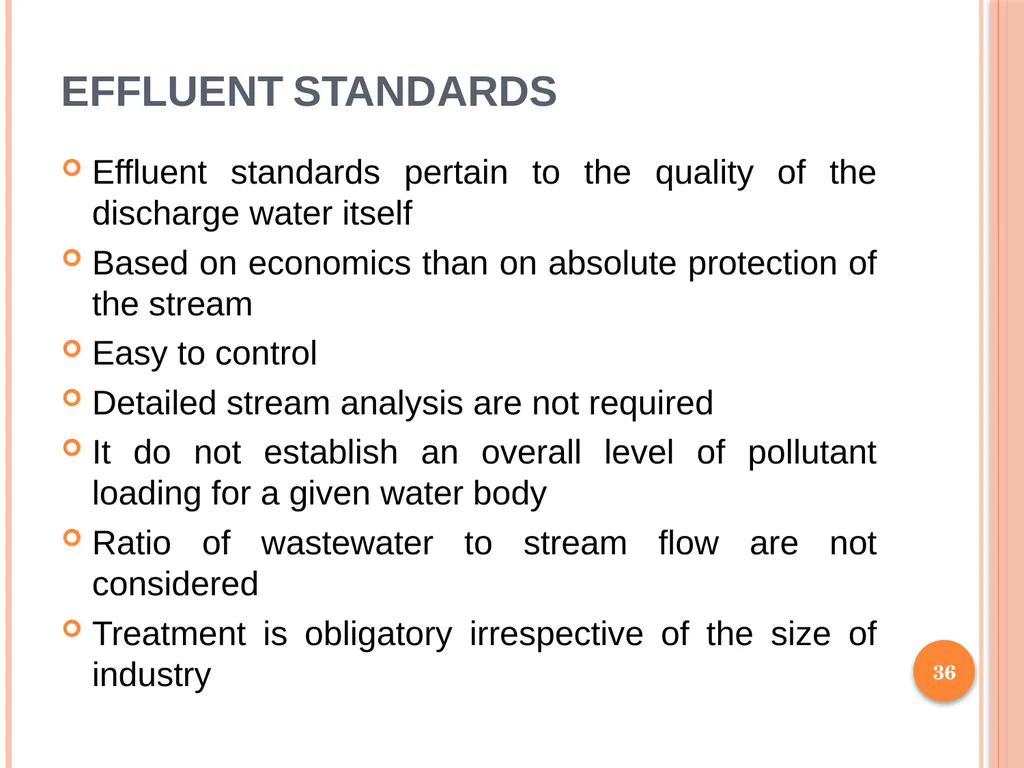
EFFLUENT STANDARDS Effluent standards pertain to the quality of the discharge water itself
Based on economics than on absolute protection of the stream
Easy to control
Detailed stream analysis are not required
It do not establish an overall level of pollutant loading for a given water body
Ratio of wastewater to stream flow are not considered
Treatment is obligatory irrespective of the size of industry 36<br>
Based on economics than on absolute protection of the stream
Easy to control
Detailed stream analysis are not required
It do not establish an overall level of pollutant loading for a given water body
Ratio of wastewater to stream flow are not considered
Treatment is obligatory irrespective of the size of industry 36<br>
37
For effective protection of an overloaded stream, the effluent standards are required to be upgraded
Large industries have an edge over small industry 37<br>
Large industries have an edge over small industry 37<br>
38
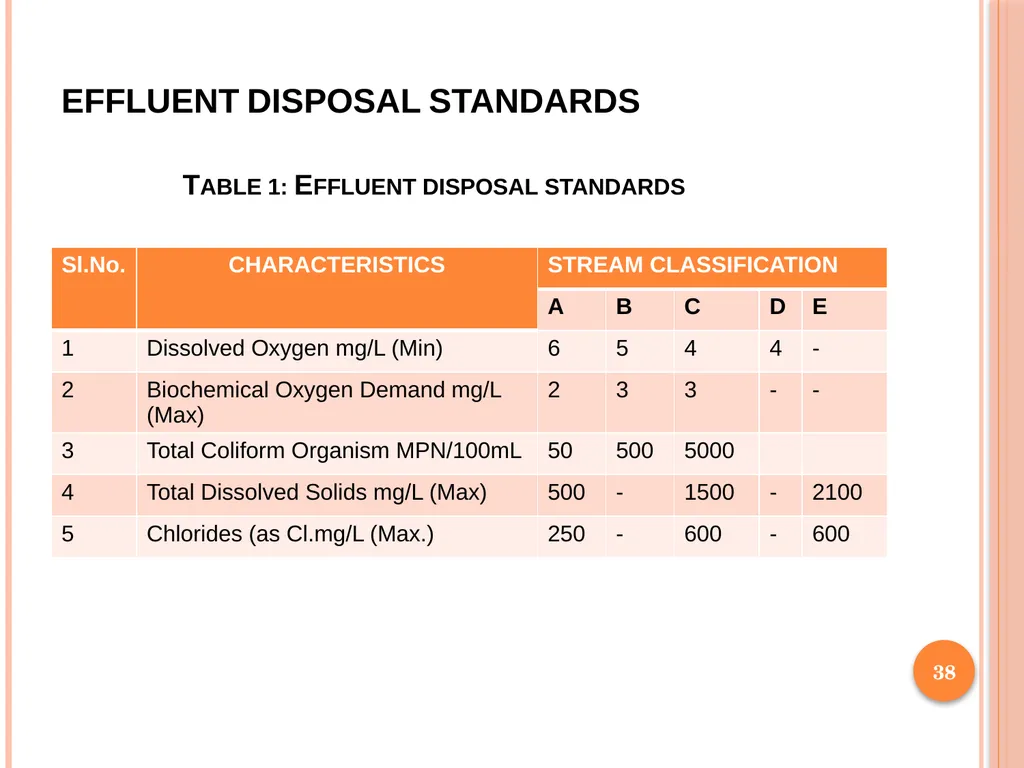
EFFLUENT DISPOSAL STANDARDS
Table 1: Effluent disposal standards 38<br>
39
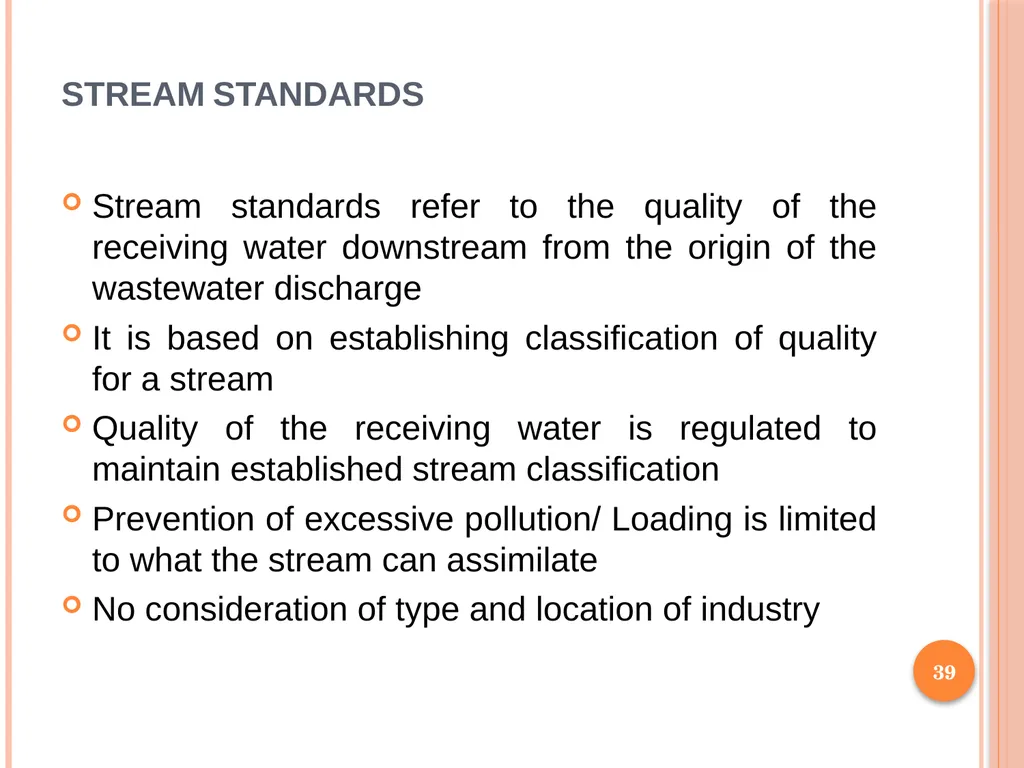
STREAM STANDARDS Stream standards refer to the quality of the receiving water downstream from the origin of the wastewater discharge
It is based on establishing classification of quality for a stream
Quality of the receiving water is regulated to maintain established stream classification
Prevention of excessive pollution/ Loading is limited to what the stream can assimilate
No consideration of type and location of industry 39<br>
It is based on establishing classification of quality for a stream
Quality of the receiving water is regulated to maintain established stream classification
Prevention of excessive pollution/ Loading is limited to what the stream can assimilate
No consideration of type and location of industry 39<br>
40
Allows public to establish goals for present and future water quality
Confusion of zone of different classification
Controversy over proportion of stream to be reserved for future usage (municipal, industrial, agriculture etc.)
Opposition from industry/ public to change the established classification 40<br>
Confusion of zone of different classification
Controversy over proportion of stream to be reserved for future usage (municipal, industrial, agriculture etc.)
Opposition from industry/ public to change the established classification 40<br>
41
A detailed stream analysis is required to determine the level of wastewater treatment required to maintain the health of the ecosystem
Cost of treatment may affect the survival of industry 41<br>
Cost of treatment may affect the survival of industry 41<br>
42
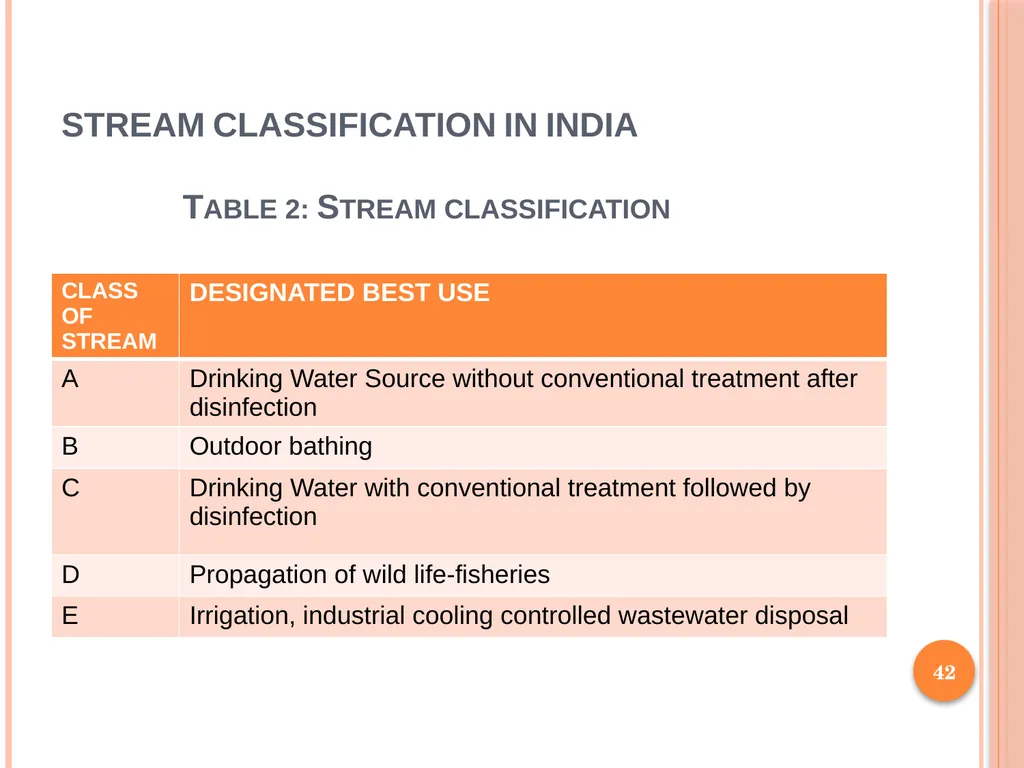
STREAM CLASSIFICATION IN INDIA
Table 2: Stream classification 42<br>
43
Concentration and Mass Concentration
Concentration is the mass of a pollutant in a defined volume of water
Load (Mass)
Load is the amount (mass) of a pollutant that is discharged into a water body during a period of time (i.e. tons of sediment per year)
Both concentration and load provide information of environmental significance, but each has limitations 43<br>
Concentration is the mass of a pollutant in a defined volume of water
Load (Mass)
Load is the amount (mass) of a pollutant that is discharged into a water body during a period of time (i.e. tons of sediment per year)
Both concentration and load provide information of environmental significance, but each has limitations 43<br>
44
Minimum national standards (MINAS) 1976 – CPCB developed concept of evolving industry specific effluent standards
Based on comprehensive study of the problems of the industry
An attempt was made
To identify relevant pollution parameters
Its pollution potential
Best pollution control technologies available in India 44<br>
Based on comprehensive study of the problems of the industry
An attempt was made
To identify relevant pollution parameters
Its pollution potential
Best pollution control technologies available in India 44<br>
45
MINAS MINAS contemplated a minimum level of treatment for specific industrial wastewater – based on
Annual turnover of the industry
Techno-economic feasibility of the control objective
Initially textile and man-made fibers were studied and standards were set
Later included oil refineries, chloro-alkali etc., 45<br>
Annual turnover of the industry
Techno-economic feasibility of the control objective
Initially textile and man-made fibers were studied and standards were set
Later included oil refineries, chloro-alkali etc., 45<br>
46
Disposal specificity was not a part of MINAS
Standards were considered to be minimum standards that a specific industry should achieve irrespective of the mode of disposal
In Environmental Protection Act 1986, some of these standards were incorporated
Since these were minimal standards – SPCB were permitted to make them only stringent and in no case relax them 46<br>
Standards were considered to be minimum standards that a specific industry should achieve irrespective of the mode of disposal
In Environmental Protection Act 1986, some of these standards were incorporated
Since these were minimal standards – SPCB were permitted to make them only stringent and in no case relax them 46<br>
47
Two basic problems Since these standards were not disposal specific , it lead to many anomalous situations
Tended to become rather stringent and in many cases almost the maximum achievable standards
MINAS are indeed not minimal standards but maximum achievable standards 47<br>
Tended to become rather stringent and in many cases almost the maximum achievable standards
MINAS are indeed not minimal standards but maximum achievable standards 47<br>
48
Emission and ambient standards Ambient air quality refers to the condition or quality of air surrounding us in the outdoors
National Ambient Air Quality Standards are the standards for ambient air quality set by the Central Pollution Control Board (CPCB) that is applicable nationwide.
The CPCB has been conferred this power by the Air (Prevention and Control of Pollution) Act, 1981. 48<br>
National Ambient Air Quality Standards are the standards for ambient air quality set by the Central Pollution Control Board (CPCB) that is applicable nationwide.
The CPCB has been conferred this power by the Air (Prevention and Control of Pollution) Act, 1981. 48<br>
49
Ambient Air Quality Standards in India The Air (Prevention and Control of Pollution) Act 1981 was enacted by the Central Government with the objective of arresting the deterioration of air quality
The Air (Prevention and Control of Pollution) Act 1981 describes the main functions of the Central Pollution Control Board (CPCB) as follows 49<br>
The Air (Prevention and Control of Pollution) Act 1981 describes the main functions of the Central Pollution Control Board (CPCB) as follows 49<br>
50
To advise the Central Government on any matter concerning the improvement of the quality the air and the prevention, control and abatement of air pollution.
To plan and to be executed a nation-wide programme for the prevention, control and abatement of air pollution.
To provide technical assistance and guidance to the State Pollution Control Board 50<br>
To plan and to be executed a nation-wide programme for the prevention, control and abatement of air pollution.
To provide technical assistance and guidance to the State Pollution Control Board 50<br>
51
To carry out and sponsor investigations and research related to prevention, control and abatement of air pollution
To collect, compile and publish technical and statistical data related to air pollution and
To lay down annul standards for the quality of air 51<br>
To collect, compile and publish technical and statistical data related to air pollution and
To lay down annul standards for the quality of air 51<br>
52
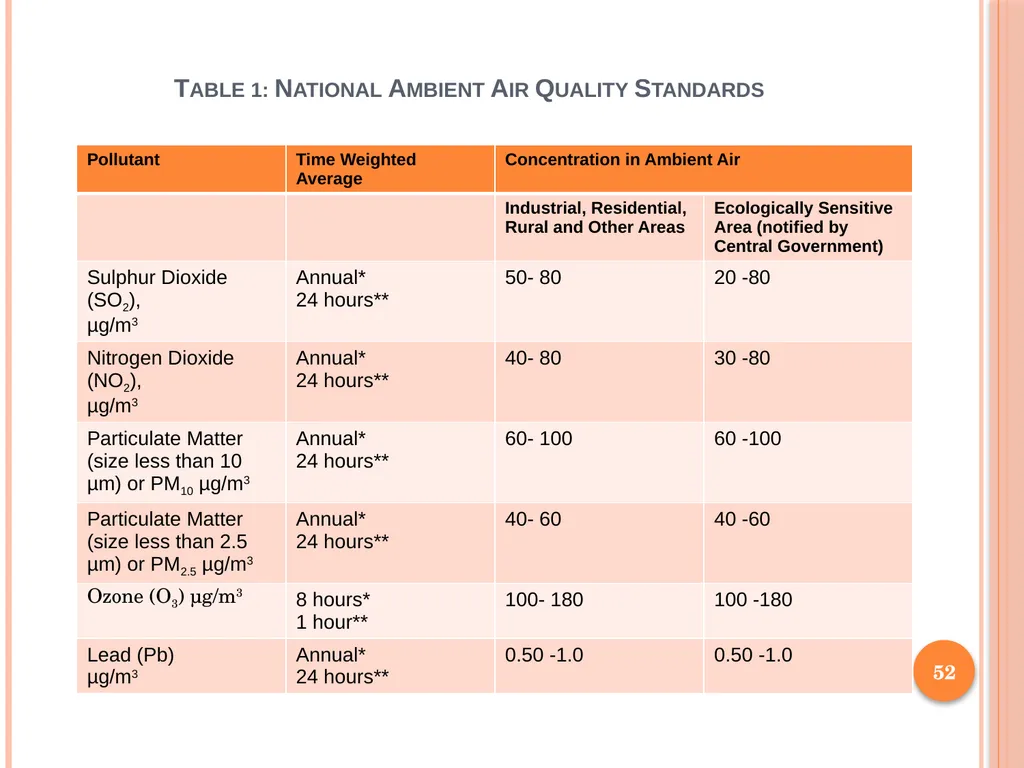
Table 1: National Ambient Air Quality Standards 52<br>
53
Maximum amount of a specific pollutant allowed to be discharged into the atmosphere from a single fixed or mobile source. 53<br>
54
Environmental Performance Evaluation 54<br>
55
Environment Performance Indicators Purpose
1. Environmental performance indicators provide
information that
Helps evaluation and
Decision making within organizations that engage in environmental efforts 55<br>
1. Environmental performance indicators provide
information that
Helps evaluation and
Decision making within organizations that engage in environmental efforts 55<br>
56
2. Environmental performance indicators provide a common foundation of information for
Organizations and external interested parties (such as consumers, business partners, residents in local communities, shareholders, and financial institutions) and
It helps interest parties’ proper understanding of activities of the organizations and their environmental efforts 56<br>
Organizations and external interested parties (such as consumers, business partners, residents in local communities, shareholders, and financial institutions) and
It helps interest parties’ proper understanding of activities of the organizations and their environmental efforts 56<br>
57
3. Environmental performance indicators provide a common foundation of information that helps the integration of environmental policies of the national and local governments, such as basic environment plans, and environmental activities of organizations 57<br>
58
Objective of EPI 1. To measure and evaluate environmental burdens, environmental problems that need to be solved and outcomes of environmental efforts comprehensively in order to promote environmental activities of organizations and to obtain information that helps decision making regarding these activities. 58<br>
59
2. To provide a common foundation of information between an organization and interested parties in order to facilitate that interested parties, such as consumers, business partners, residents in local communities, shareholders, and financial institutions, understand environmental activities of the organization 59<br>
60
3. To provide a common foundation of information for macro-level environmental policies of the national and local governments 60<br>
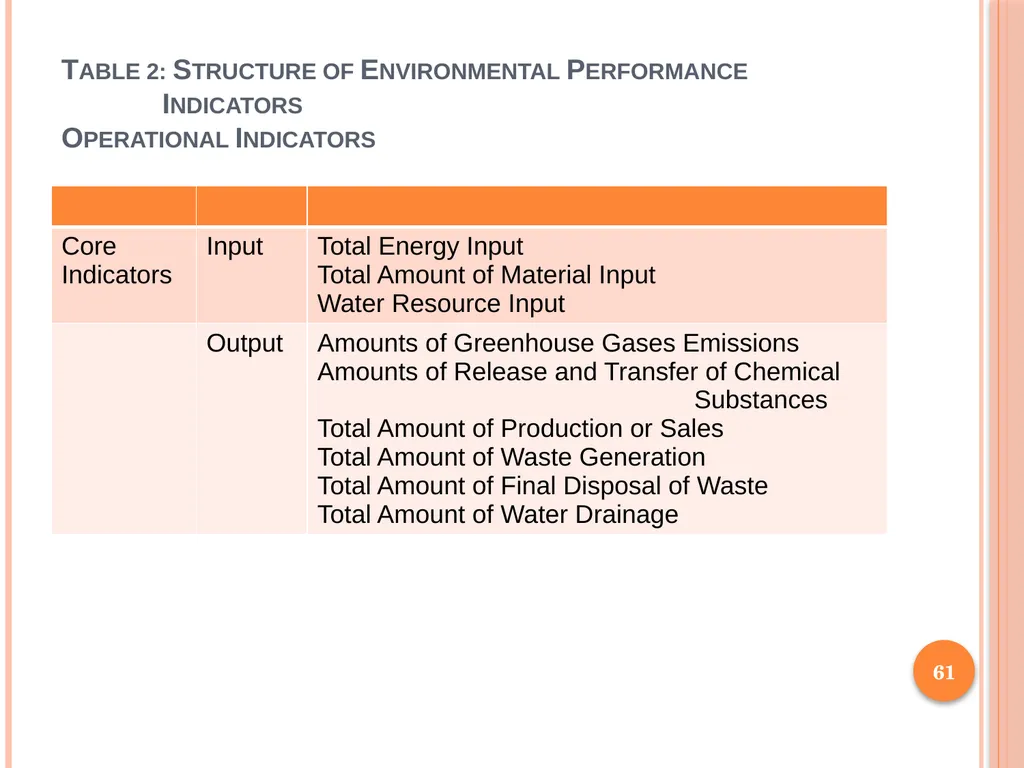
61
Table 2: Structure of Environmental Performance
Indicators
Operational Indicators 61<br>
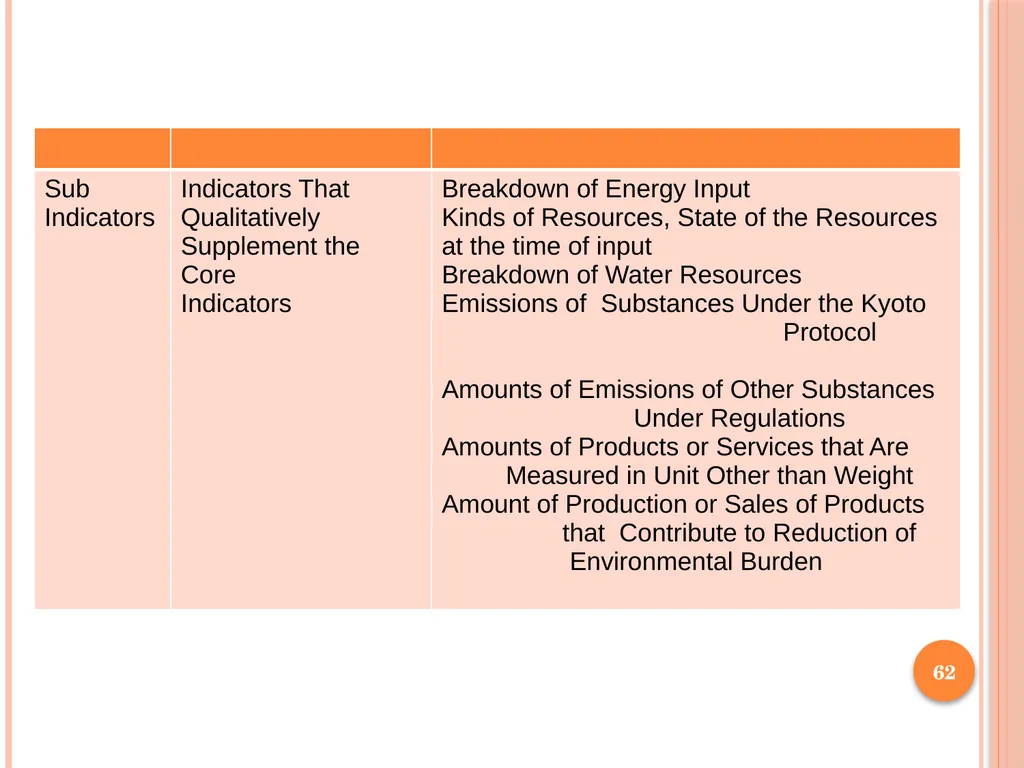
62
62<br>
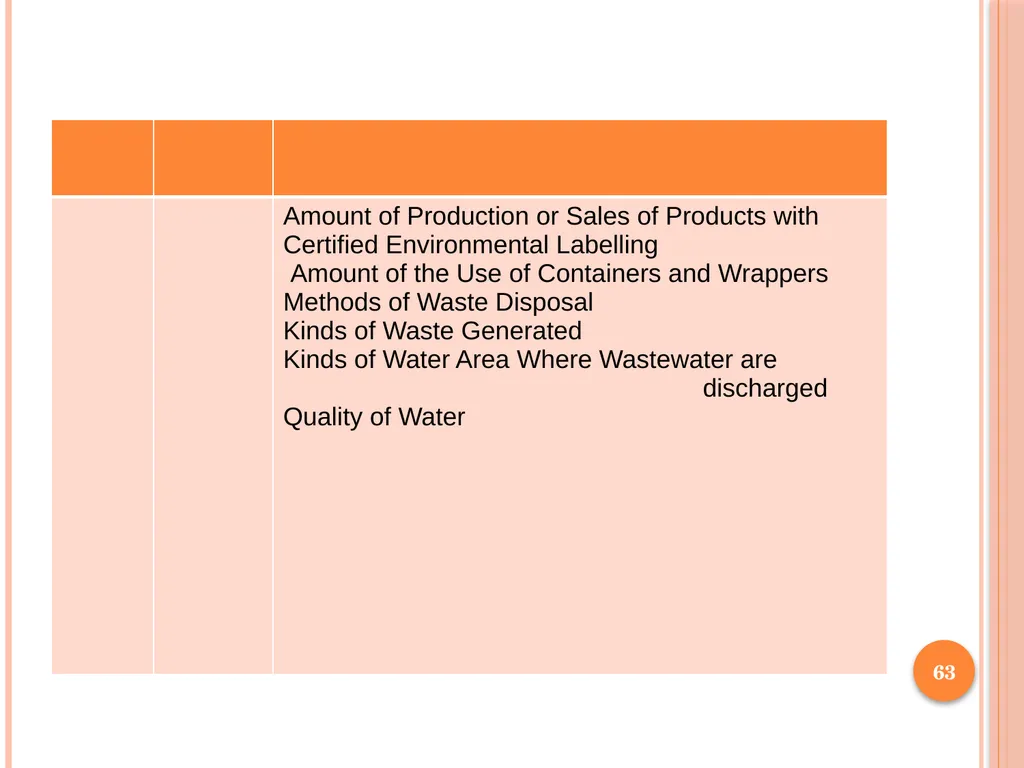
63
63<br>
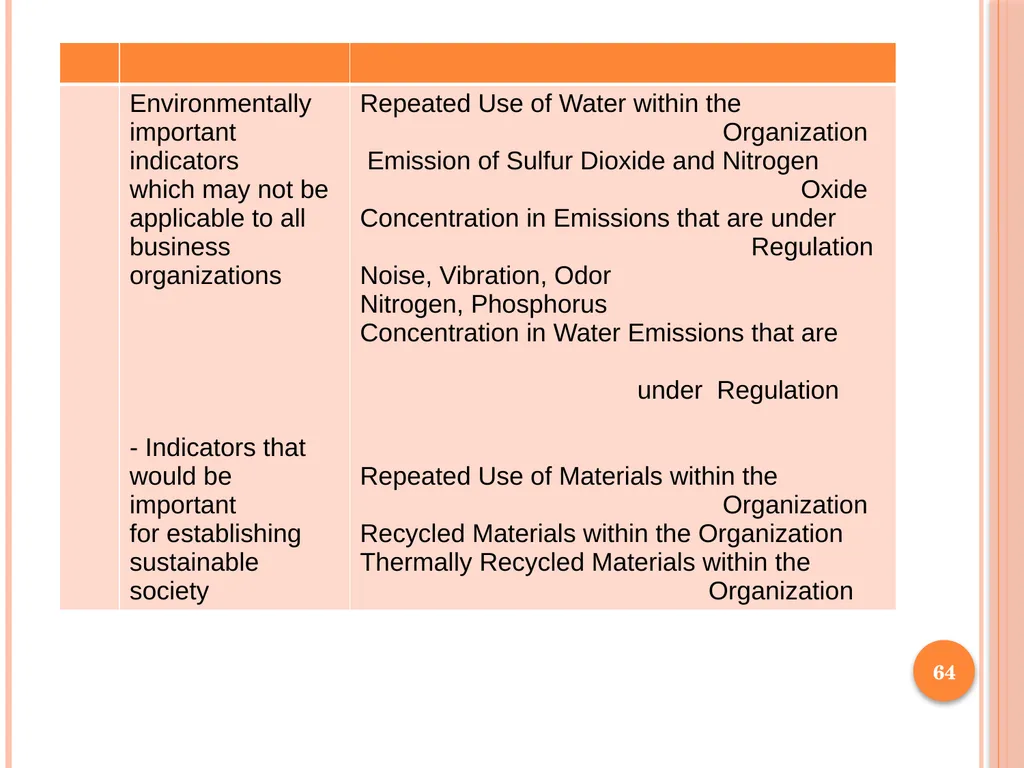
64
64<br>
65
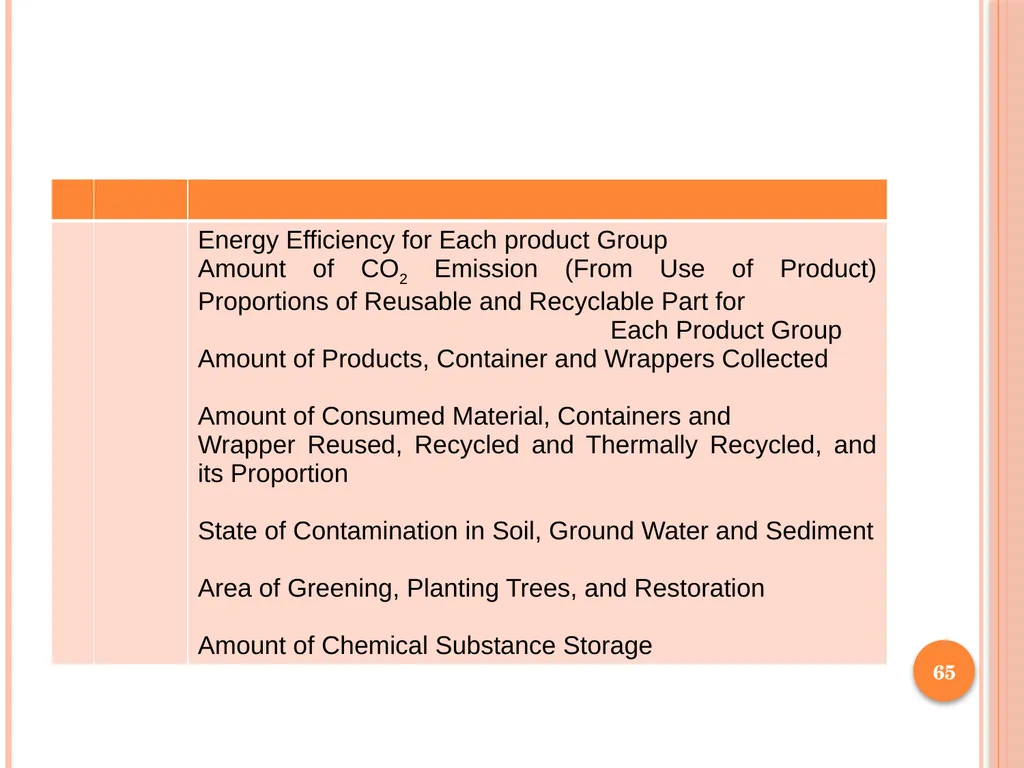
65<br>
66
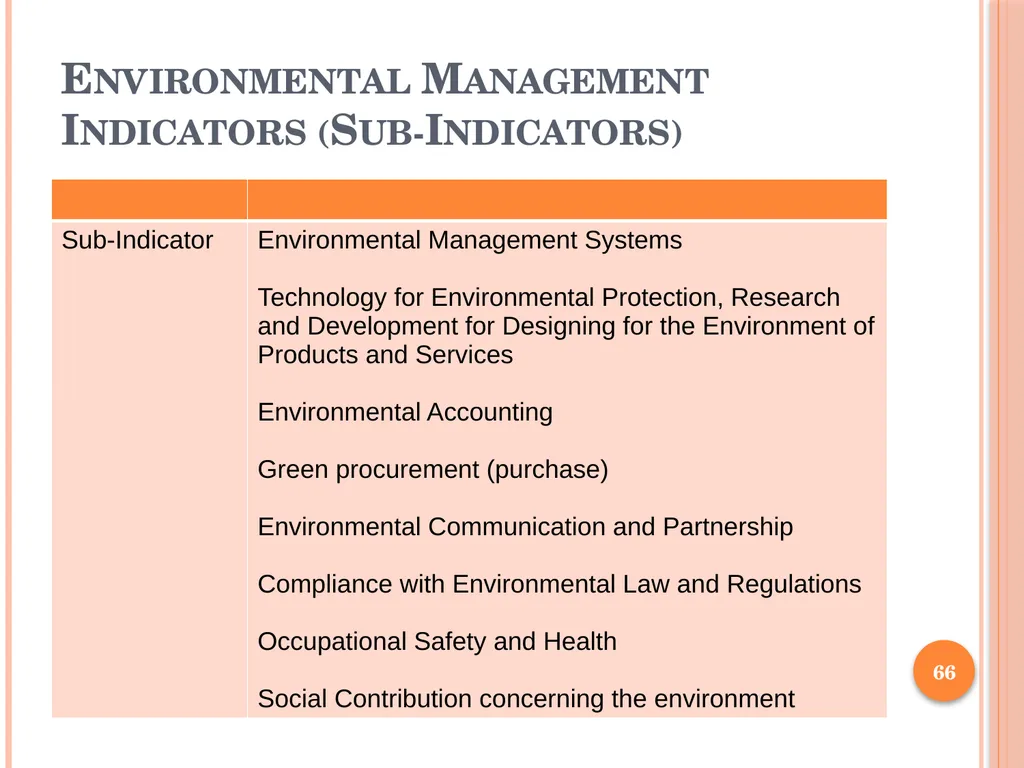
Environmental Management Indicators (Sub-Indicators) 66<br>
67
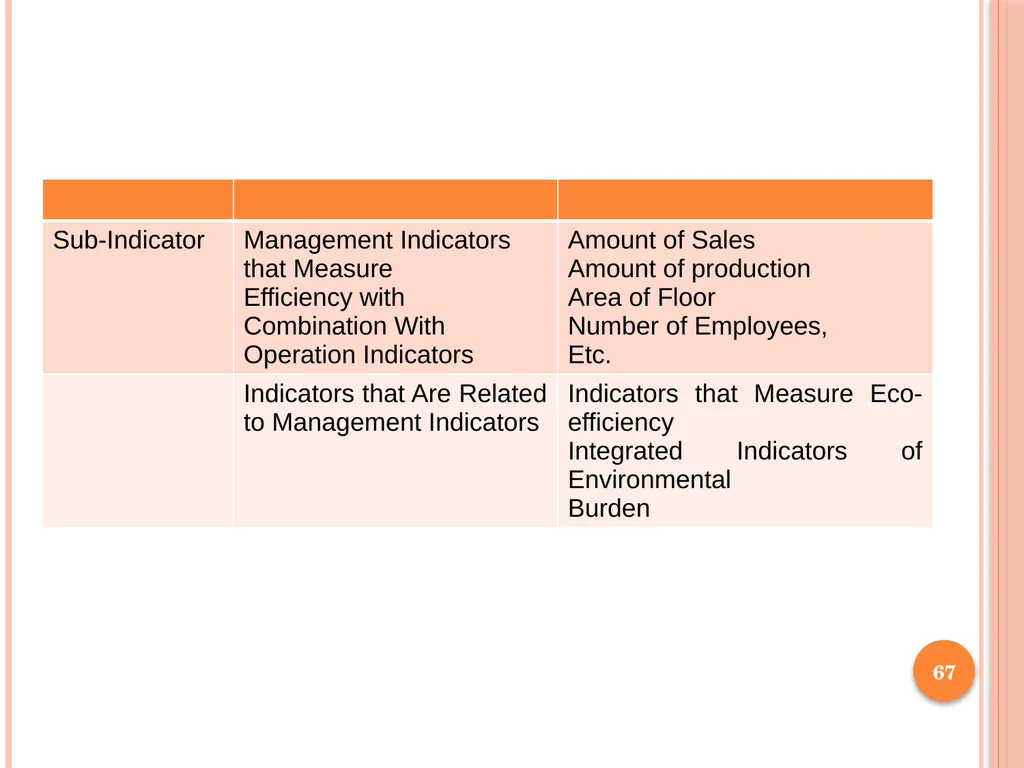
67<br>
68
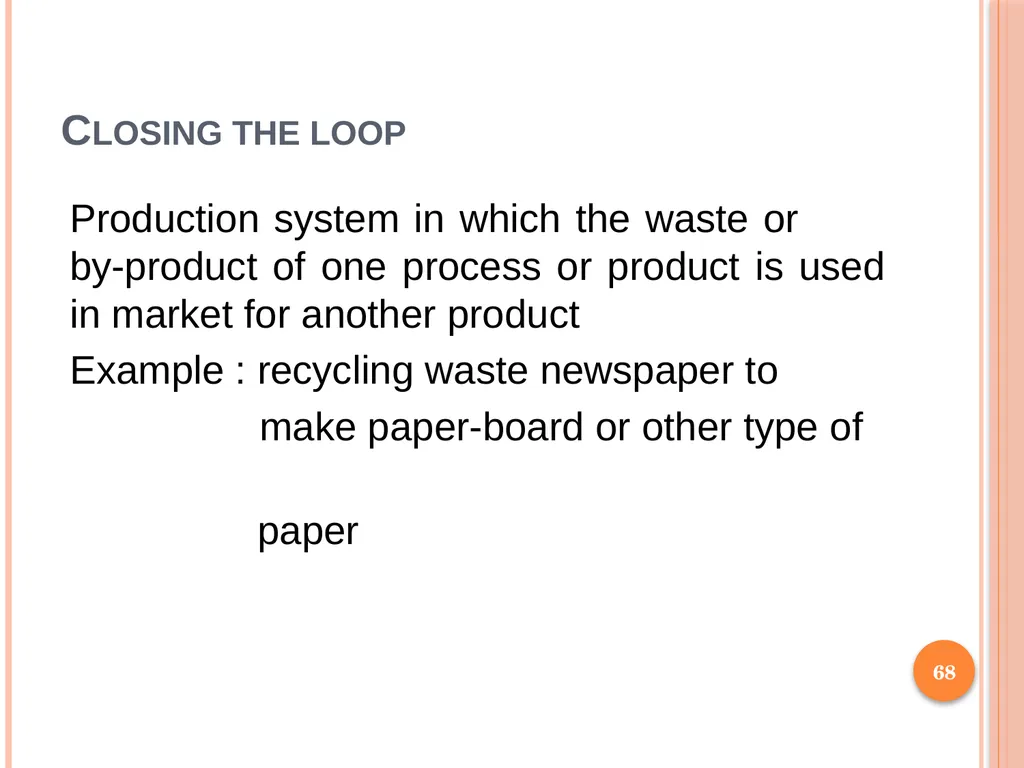
Closing the loop Production system in which the waste or by-product of one process or product is used in market for another product
Example : recycling waste newspaper to
make paper-board or other type of
paper 68<br>
Example : recycling waste newspaper to
make paper-board or other type of
paper 68<br>
69
Buying recycled products is part of Closing the Loop
Step is critical because it maintains the market demand for recyclables
Without a demand for recycled products, there is no economy to support recycling
Creating stable markets for recycling ensures the continuation and expansion of recycling programs everywhere 69<br>
Step is critical because it maintains the market demand for recyclables
Without a demand for recycled products, there is no economy to support recycling
Creating stable markets for recycling ensures the continuation and expansion of recycling programs everywhere 69<br>
70
pollution prevention Pollution prevention is an environmental approach fundamentally different from approaches that focus on managing or controlling pollution after it has been generated
Pollution prevention occurs prior to the creation of a waste or a pollutant and thus occurs prior to the consideration of alternatives such as pollution control, waste management, treatment, recycling or disposal 70<br>
Pollution prevention occurs prior to the creation of a waste or a pollutant and thus occurs prior to the consideration of alternatives such as pollution control, waste management, treatment, recycling or disposal 70<br>
71
Barriers of pollution prevention REGULATORY BARRIERS TO POLLUTION PREVENTION
End-of-Pipe Focus
In most instances, the end-of-pipe focus of existing regulations does not create a direct barrier to pollution prevention.
Potential negative effect of focusing industrial and public resources on controlling pollutants after it has been created rather than on product, process, or raw material changes 71<br>
End-of-Pipe Focus
In most instances, the end-of-pipe focus of existing regulations does not create a direct barrier to pollution prevention.
Potential negative effect of focusing industrial and public resources on controlling pollutants after it has been created rather than on product, process, or raw material changes 71<br>
72
b) Media-Specific Focus
Current regulations address one environmental medium at a time.
The result can be transfer of pollutants from one environmental medium to another and concentration on media-specific solutions rather than multi-media preventive approaches.
Media-specific focus does not always encourage multi-media preventive approaches 72<br>
Current regulations address one environmental medium at a time.
The result can be transfer of pollutants from one environmental medium to another and concentration on media-specific solutions rather than multi-media preventive approaches.
Media-specific focus does not always encourage multi-media preventive approaches 72<br>
73
c) Regulatory Program Evaluation Criteria
Current benchmarks for measuring the success of programs do not include consideration of pollution prevention progress
The focus is on more easily quantified performance measures such as the number of permits issued or the number of inspections performed. 73<br>
Current benchmarks for measuring the success of programs do not include consideration of pollution prevention progress
The focus is on more easily quantified performance measures such as the number of permits issued or the number of inspections performed. 73<br>
74
d) Regulatory Inflexibility
Lack of flexibility can sometimes create a barrier to pollution prevention
Pollution prevention is a customized process, varying facility by facility.
May require flexibility and short-term variances in compliance schedules for emission standards or permits 74<br>
Lack of flexibility can sometimes create a barrier to pollution prevention
Pollution prevention is a customized process, varying facility by facility.
May require flexibility and short-term variances in compliance schedules for emission standards or permits 74<br>
75
e) Regulatory Uncertainty
Industry personnel working to implement pollution prevention strategies may be required to consult with several agencies and with decision-making authority.
Innovative project or a pollution prevention proposal may require multiple approvals for different aspects of that project, which may be difficult to obtain. This can discourage facilities from undertaking pollution prevention practices. 75<br>
Industry personnel working to implement pollution prevention strategies may be required to consult with several agencies and with decision-making authority.
Innovative project or a pollution prevention proposal may require multiple approvals for different aspects of that project, which may be difficult to obtain. This can discourage facilities from undertaking pollution prevention practices. 75<br>
76
f) Pollution Fees
If structured on a multi-media basis with a significant correlation to quantities of pollutants created and set at sufficient levels, fees can provide incentives for pollution prevention
Current fees are for the most part media-specific, set at levels determined by the costs of regulatory services, and in some cases are not closely correlated with quantities of pollutants released.
Although fees set up in this manner do not present direct barriers to pollution prevention, it provide little incentive to go beyond standards and prevent pollution at the source. 76<br>
If structured on a multi-media basis with a significant correlation to quantities of pollutants created and set at sufficient levels, fees can provide incentives for pollution prevention
Current fees are for the most part media-specific, set at levels determined by the costs of regulatory services, and in some cases are not closely correlated with quantities of pollutants released.
Although fees set up in this manner do not present direct barriers to pollution prevention, it provide little incentive to go beyond standards and prevent pollution at the source. 76<br>
77
g) Data Gathering and Management
Data gathering and management systems have generally developed along media-specific lines.
It focus on end-of-pipe emissions and quantities of waste generated as a means of enforcing and ensuring compliance with existing regulatory requirements.
Need for improved data relating to pollution prevention is recognized at both the federal and state levels. 77<br>
Data gathering and management systems have generally developed along media-specific lines.
It focus on end-of-pipe emissions and quantities of waste generated as a means of enforcing and ensuring compliance with existing regulatory requirements.
Need for improved data relating to pollution prevention is recognized at both the federal and state levels. 77<br>
78
2. ECONOMIC BARRIERS TO POLLUTION
PREVENTION
Inaccurate Market Signals
In some instances, the costs of releasing toxic substances may be less than the cost of implementing a pollution prevention project
Because the full environmental cost of the release is not included in the calculation. 78<br>
PREVENTION
Inaccurate Market Signals
In some instances, the costs of releasing toxic substances may be less than the cost of implementing a pollution prevention project
Because the full environmental cost of the release is not included in the calculation. 78<br>
79
b) Incomplete Cost/Benefit Analysis
Indirect benefits (e.g., lower future liabilities, potential for "environmental marketing" and positive investment image) are not commonly considered in an analysis and therefore do not reflect the advantages of implementing preventive projects.
Failure to take into consideration all relevant costs and benefits or failure to properly allocate these costs to appropriate operations and processes may present unnecessary barriers to pollution prevention. 79<br>
Indirect benefits (e.g., lower future liabilities, potential for "environmental marketing" and positive investment image) are not commonly considered in an analysis and therefore do not reflect the advantages of implementing preventive projects.
Failure to take into consideration all relevant costs and benefits or failure to properly allocate these costs to appropriate operations and processes may present unnecessary barriers to pollution prevention. 79<br>
80
c) Inappropriately Short Time Horizons
Companies with very short-term perspectives on criteria for investment (e.g., 1-2 year payback periods) may be less likely to support certain prevention projects despite the fact that they would be economically viable in a moderate payback timeframe. 80<br>
Companies with very short-term perspectives on criteria for investment (e.g., 1-2 year payback periods) may be less likely to support certain prevention projects despite the fact that they would be economically viable in a moderate payback timeframe. 80<br>
81
d) Fear of Market Share Loss/Consumer Pressure
Surveys suggest that the most significant barrier to pollution prevention is reluctance to tamper with proven processes for fear of adverse effects on product quality 81<br>
Surveys suggest that the most significant barrier to pollution prevention is reluctance to tamper with proven processes for fear of adverse effects on product quality 81<br>
82
e) Inappropriate Product/Process Specifications
Very specific cases involving the barrier, "fear of customer loss," result from unnecessarily rigid specifications for products or processes. 82<br>
Very specific cases involving the barrier, "fear of customer loss," result from unnecessarily rigid specifications for products or processes. 82<br>
83
f) Fear of Production Interruption
If prevention options require major operational changes, equipment alterations or process modifications, companies may resist implementation because of concern about not being able to produce the product at all or having higher reject rates through less reliable actions 83<br>
If prevention options require major operational changes, equipment alterations or process modifications, companies may resist implementation because of concern about not being able to produce the product at all or having higher reject rates through less reliable actions 83<br>
84
g) Limited Access to Necessary Resources
Prevention projects can face stiff competition for limited internal capital resources also presents a significant barrier to pollution prevention.
Access to external sources of capital to fund prevention projects may also be limited. The shortage of staff resources 84<br>
Prevention projects can face stiff competition for limited internal capital resources also presents a significant barrier to pollution prevention.
Access to external sources of capital to fund prevention projects may also be limited. The shortage of staff resources 84<br>
85
h) Worker Fear of Job Loss
If employees or labor groups look upon pollution prevention as a threat to their jobs, these concerns may pose a barrier to pollution prevention efforts
Experience shows that companies with pollution prevention programs are often strengthened economically, and produce higher quality products in a more efficient manner. 85<br>
If employees or labor groups look upon pollution prevention as a threat to their jobs, these concerns may pose a barrier to pollution prevention efforts
Experience shows that companies with pollution prevention programs are often strengthened economically, and produce higher quality products in a more efficient manner. 85<br>
86
3) EDUCATIONAL BARRIERS TO POLLUTION
PREVENTION
a) Lack of Top Level Support. It is common for educational leaders to simply exclude pollution prevention and environmental protection from institutional priorities
b) Insufficient Faculty Motivation and Training Barrier is caused, in part, by the difficulty in creating new courses, unavailability of teaching aids (e.g., case studies and research pressures. 86<br>
PREVENTION
a) Lack of Top Level Support. It is common for educational leaders to simply exclude pollution prevention and environmental protection from institutional priorities
b) Insufficient Faculty Motivation and Training Barrier is caused, in part, by the difficulty in creating new courses, unavailability of teaching aids (e.g., case studies and research pressures. 86<br>
87
c) Insufficient Student Interest. Student demand for treatment of environmental issues has been small, possibly because they haven’t yet seen a connection between job success and environmental expertise.
d) Inflexible Curriculum Requirements. At most educational institutions the degree coursework is already crowded with requirements and continually faces new demands to add more credits and topics. In many instances, there is simply little or no room to add pollution prevention into the program. 87<br>
d) Inflexible Curriculum Requirements. At most educational institutions the degree coursework is already crowded with requirements and continually faces new demands to add more credits and topics. In many instances, there is simply little or no room to add pollution prevention into the program. 87<br>
88
e) Lack of Instructional Materials.
Not sufficient existing material (e.g., casebooks, text books or videos) that is easily available to integrate into existing classes. 88<br>
Not sufficient existing material (e.g., casebooks, text books or videos) that is easily available to integrate into existing classes. 88<br>
89
INSTITUTIONAL BARRIERS TO POLLUTION PREVENTION
Three categories of institutional barriers are
a) Organizational: Reflect the ways in which companies manage human and material resources.
b) Technical: Address the development and use of technologies and operational practices.
c) Societal: Describe some ways in which society impacts pollution prevention efforts. 89<br>
Three categories of institutional barriers are
a) Organizational: Reflect the ways in which companies manage human and material resources.
b) Technical: Address the development and use of technologies and operational practices.
c) Societal: Describe some ways in which society impacts pollution prevention efforts. 89<br>
90
Lack of Top Management Support.
Lack of Clear Communication of Priorities or Support.
Organizational Structures may Separate Environmental Decisions from Production Decisions.
Habit and Inertia may Inhibit Change.
Lack of Involvement of affected Workers.
Reward System does not Focus on Pollution Prevention.
Firms may lack the Technical Ability to Apply Preventive Methods and Technologies. 90<br>
Lack of Clear Communication of Priorities or Support.
Organizational Structures may Separate Environmental Decisions from Production Decisions.
Habit and Inertia may Inhibit Change.
Lack of Involvement of affected Workers.
Reward System does not Focus on Pollution Prevention.
Firms may lack the Technical Ability to Apply Preventive Methods and Technologies. 90<br>
91
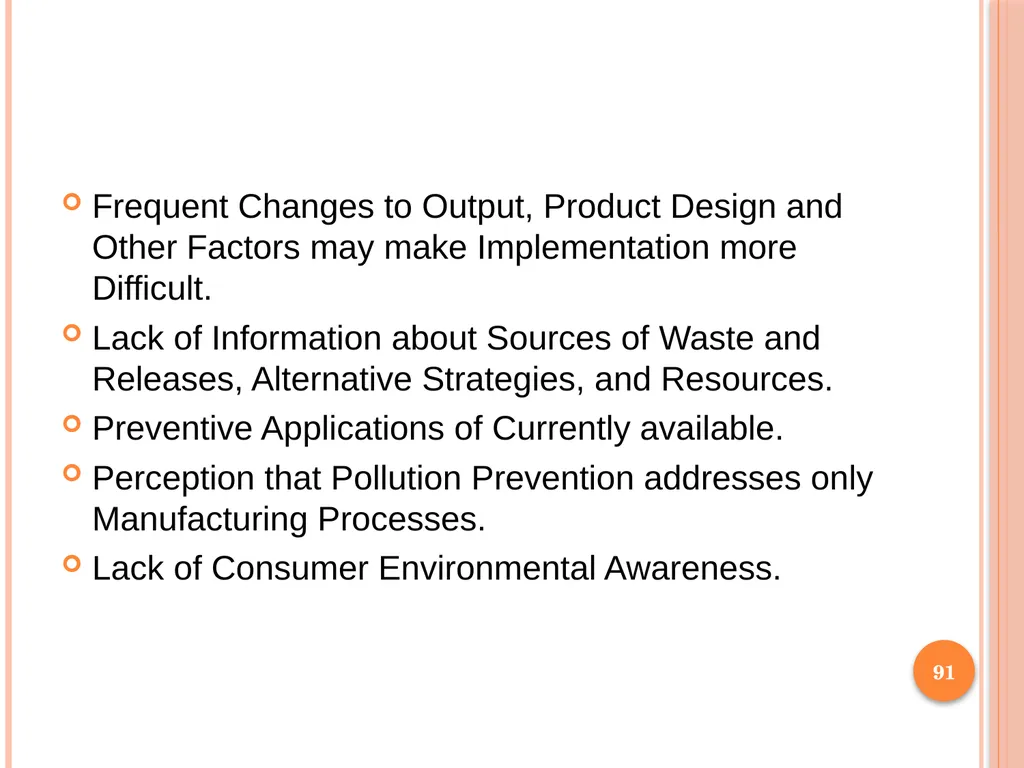
Frequent Changes to Output, Product Design and Other Factors may make Implementation more Difficult.
Lack of Information about Sources of Waste and Releases, Alternative Strategies, and Resources.
Preventive Applications of Currently available.
Perception that Pollution Prevention addresses only Manufacturing Processes.
Lack of Consumer Environmental Awareness. 91<br>
Lack of Information about Sources of Waste and Releases, Alternative Strategies, and Resources.
Preventive Applications of Currently available.
Perception that Pollution Prevention addresses only Manufacturing Processes.
Lack of Consumer Environmental Awareness. 91<br>
92
USEFUL WEBLINKS https://www.youtube.com/watch?v=oHbTgSqGo5c
https://www.youtube.com/watch?v=hLIqZMVygAg
https://www.youtube.com/watch?v=IZ3CIMnj498 92<br>
https://www.youtube.com/watch?v=hLIqZMVygAg
https://www.youtube.com/watch?v=IZ3CIMnj498 92<br>