
1 United Nations Statistics Division Programme in
EM
Published · 24 slides · 0 views
1 / 1
Description
1 United Nations Statistics Division Programme in Support of the 2020 Round of Population and Housing Censuses Session 8 Main Drivers and Decision-Making on the Use of Electronic Data Collection Technologies Srdjan Mrkić United Nations
Related Topics
Share
Embed code
Download this presentation From Below
"1 United Nations Statistics Division Programme in" is the property of its rightful owner. Permission is granted to download and print the materials on this website for personal, non-commercial use only, and to display it on your personal computer provided you do not modify the materials and that you retain all copyright notices contained in the materials. By downloading content from our website, you accept the terms of this agreement.
Presentation Transcript
01
1 United Nations Statistics Division Programme in Support of the 2020 Round of Population and Housing Censuses
Session 8
Main Drivers and Decision-Making on the Use of Electronic Data Collection Technologies
Srdjan Mrkić
United Nations Statistics Division<br>
Session 8
Main Drivers and Decision-Making on the Use of Electronic Data Collection Technologies
Srdjan Mrkić
United Nations Statistics Division<br>
02
Content Key drivers of technological innovation in census data collection
Steps for decision making
Management structure for making a decision<br>
Steps for decision making
Management structure for making a decision<br>
03
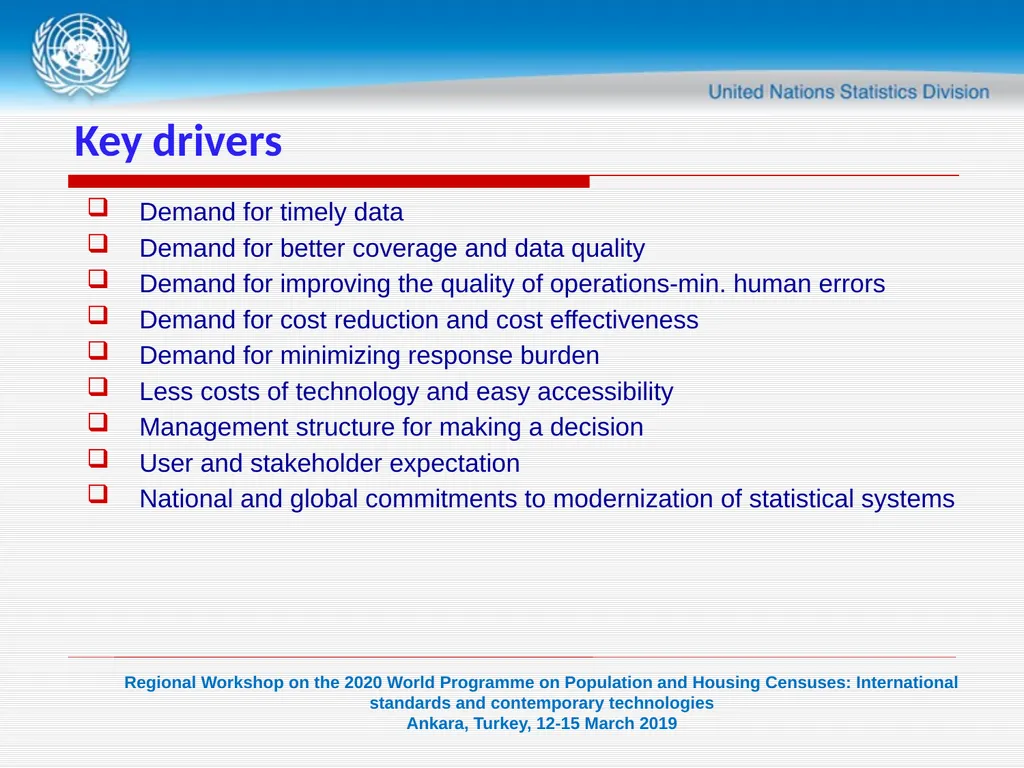
Key drivers Demand for timely data
Demand for better coverage and data quality
Demand for improving the quality of operations-min. human errors
Demand for cost reduction and cost effectiveness
Demand for minimizing response burden
Less costs of technology and easy accessibility
Management structure for making a decision
User and stakeholder expectation
National and global commitments to modernization of statistical systems<br>
Demand for better coverage and data quality
Demand for improving the quality of operations-min. human errors
Demand for cost reduction and cost effectiveness
Demand for minimizing response burden
Less costs of technology and easy accessibility
Management structure for making a decision
User and stakeholder expectation
National and global commitments to modernization of statistical systems<br>
04
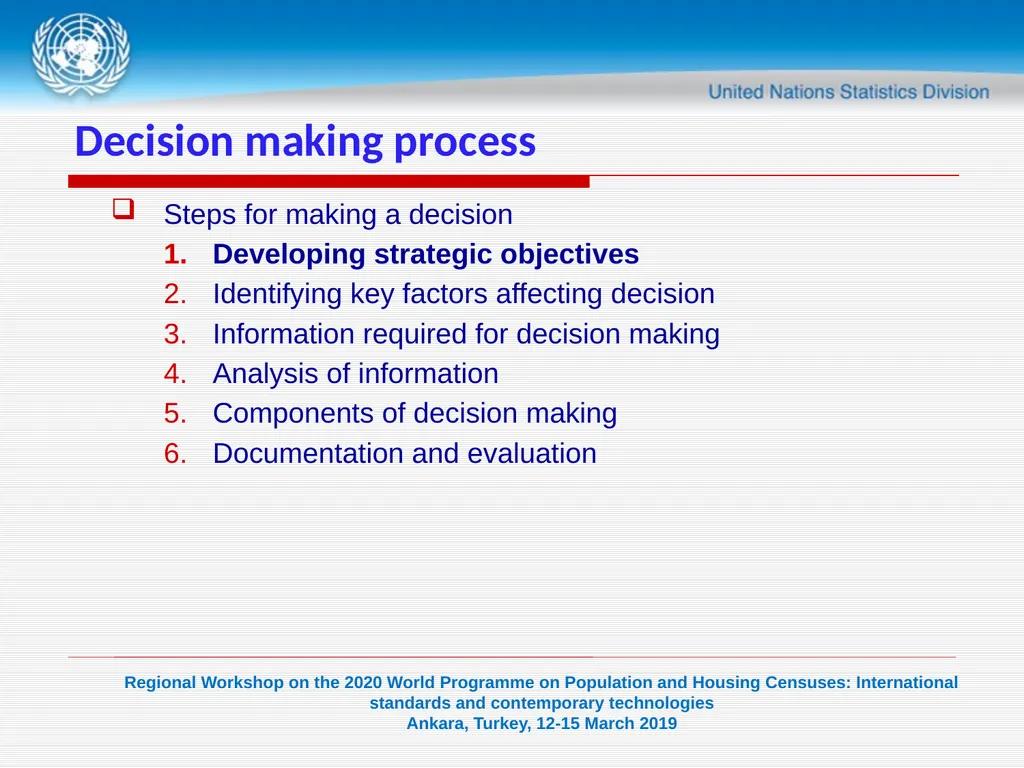
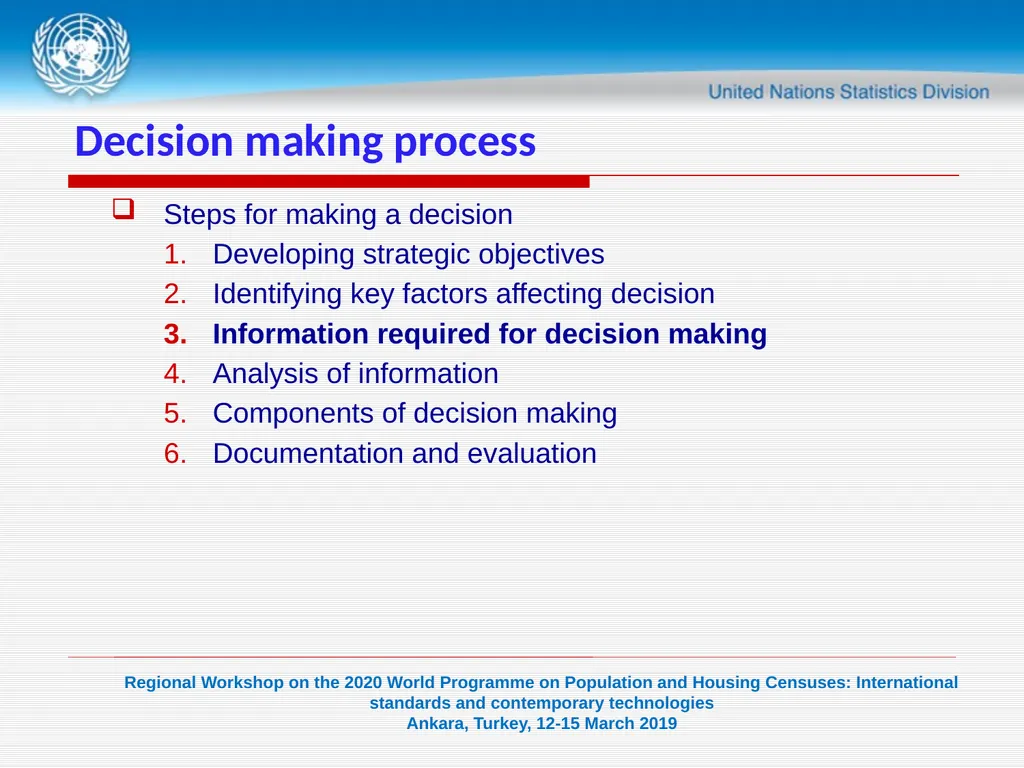
Decision making process Steps for making a decision
Developing strategic objectives
Identifying key factors affecting decision
Information required for decision making
Analysis of information
Components of decision making
Documentation and evaluation<br>
Developing strategic objectives
Identifying key factors affecting decision
Information required for decision making
Analysis of information
Components of decision making
Documentation and evaluation<br>
05
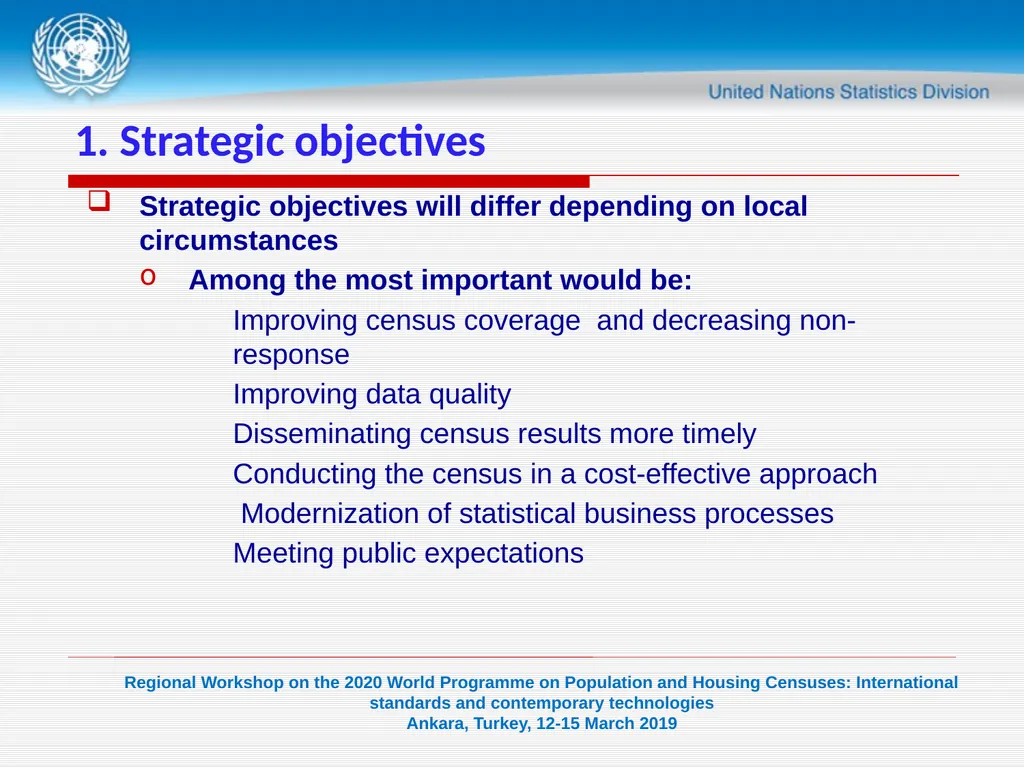
1. Strategic objectives Strategic objectives will differ depending on local circumstances
Among the most important would be:
Improving census coverage and decreasing non-response
Improving data quality
Disseminating census results more timely
Conducting the census in a cost-effective approach
Modernization of statistical business processes
Meeting public expectations<br>
Among the most important would be:
Improving census coverage and decreasing non-response
Improving data quality
Disseminating census results more timely
Conducting the census in a cost-effective approach
Modernization of statistical business processes
Meeting public expectations<br>
06
Decision making process Steps for making a decision
Developing strategic objectives
Identifying key factors affecting decision
Information required for decision making
Analysis of information
Components of decision making
Documentation and evaluation<br>
Developing strategic objectives
Identifying key factors affecting decision
Information required for decision making
Analysis of information
Components of decision making
Documentation and evaluation<br>
07
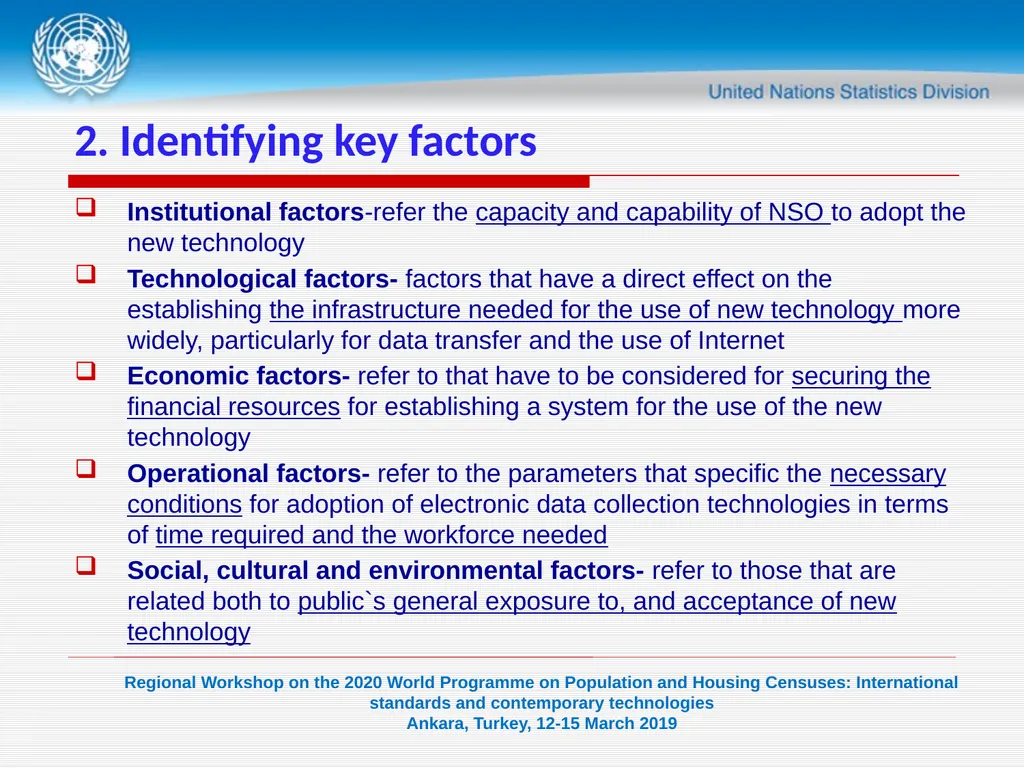
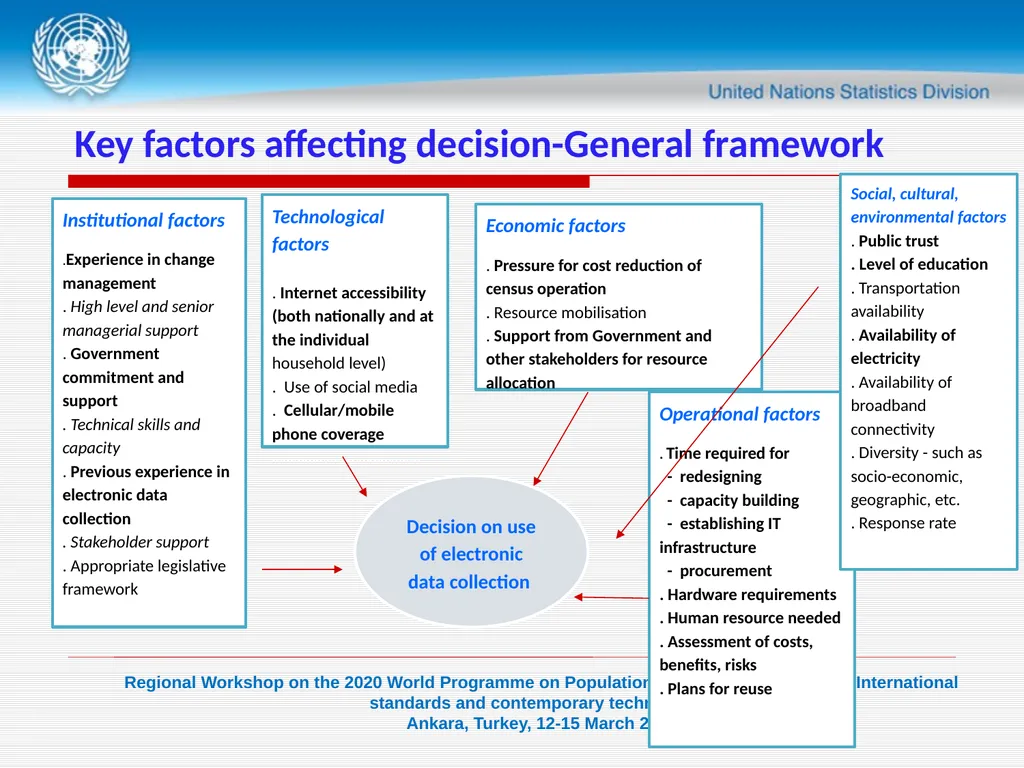
2. Identifying key factors Institutional factors-refer the capacity and capability of NSO to adopt the new technology
Technological factors- factors that have a direct effect on the establishing the infrastructure needed for the use of new technology more widely, particularly for data transfer and the use of Internet
Economic factors- refer to that have to be considered for securing the financial resources for establishing a system for the use of the new technology
Operational factors- refer to the parameters that specific the necessary conditions for adoption of electronic data collection technologies in terms of time required and the workforce needed
Social, cultural and environmental factors- refer to those that are related both to public`s general exposure to, and acceptance of new technology<br>
Technological factors- factors that have a direct effect on the establishing the infrastructure needed for the use of new technology more widely, particularly for data transfer and the use of Internet
Economic factors- refer to that have to be considered for securing the financial resources for establishing a system for the use of the new technology
Operational factors- refer to the parameters that specific the necessary conditions for adoption of electronic data collection technologies in terms of time required and the workforce needed
Social, cultural and environmental factors- refer to those that are related both to public`s general exposure to, and acceptance of new technology<br>
08
Key factors affecting decision-General framework Institutional factors
.Experience in change management
. High level and senior managerial support
. Government commitment and support
. Technical skills and capacity
. Previous experience in electronic data collection
. Stakeholder support
. Appropriate legislative framework Technological factors ICT infrastructure
. Internet accessibility (both nationally and at the individual household level)
. Use of social media
. Cellular/mobile phone coverage
………………………………….. Operational factors
. Time required for
- redesigning
- capacity building
- establishing IT infrastructure
- procurement
. Hardware requirements
. Human resource needed
. Assessment of costs, benefits, risks
. Plans for reuse Economic factors
. Pressure for cost reduction of census operation
. Resource mobilisation
. Support from Government and other stakeholders for resource allocation Decision on use of electronic data collection Social, cultural, environmental factors
. Public trust
. Level of education
. Transportation availability
. Availability of electricity
. Availability of broadband connectivity
. Diversity - such as socio-economic, geographic, etc.
. Response rate<br>
.Experience in change management
. High level and senior managerial support
. Government commitment and support
. Technical skills and capacity
. Previous experience in electronic data collection
. Stakeholder support
. Appropriate legislative framework Technological factors ICT infrastructure
. Internet accessibility (both nationally and at the individual household level)
. Use of social media
. Cellular/mobile phone coverage
………………………………….. Operational factors
. Time required for
- redesigning
- capacity building
- establishing IT infrastructure
- procurement
. Hardware requirements
. Human resource needed
. Assessment of costs, benefits, risks
. Plans for reuse Economic factors
. Pressure for cost reduction of census operation
. Resource mobilisation
. Support from Government and other stakeholders for resource allocation Decision on use of electronic data collection Social, cultural, environmental factors
. Public trust
. Level of education
. Transportation availability
. Availability of electricity
. Availability of broadband connectivity
. Diversity - such as socio-economic, geographic, etc.
. Response rate<br>
09
Decision making process Steps for making a decision
Developing strategic objectives
Identifying key factors affecting decision
Information required for decision making
Analysis of information
Components of decision making
Documentation and evaluation<br>
Developing strategic objectives
Identifying key factors affecting decision
Information required for decision making
Analysis of information
Components of decision making
Documentation and evaluation<br>
10
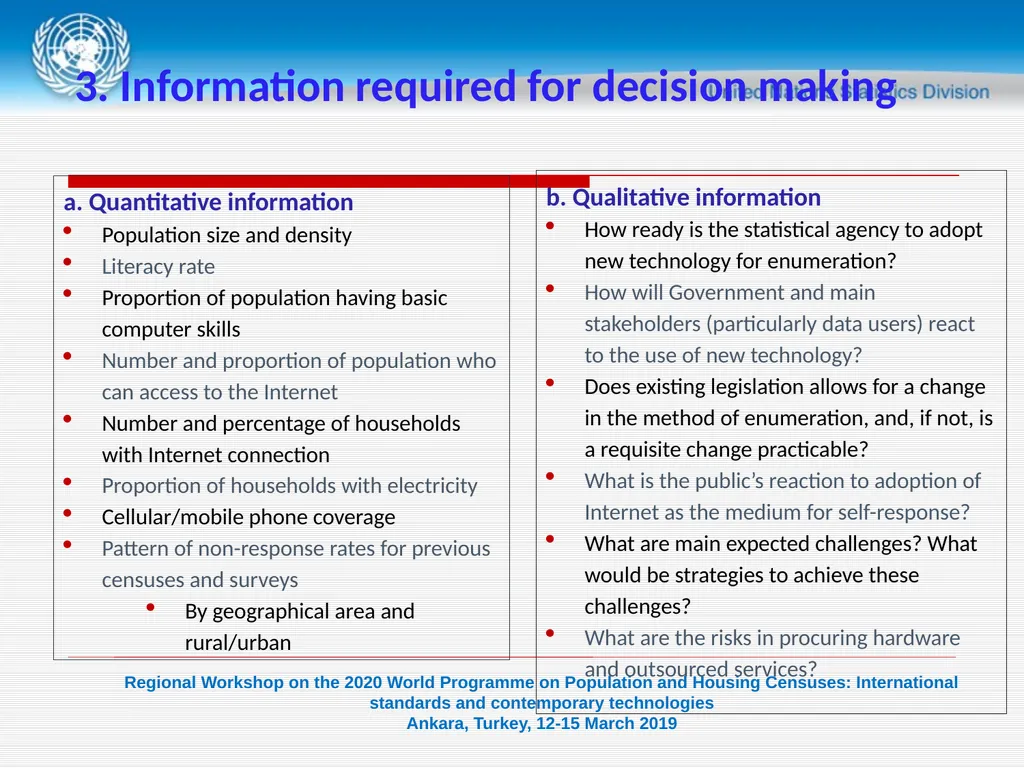
3. Information required for decision making a. Quantitative information
Population size and density
Literacy rate
Proportion of population having basic computer skills
Number and proportion of population who can access to the Internet
Number and percentage of households with Internet connection
Proportion of households with electricity
Cellular/mobile phone coverage
Pattern of non-response rates for previous censuses and surveys
By geographical area and rural/urban b. Qualitative information
How ready is the statistical agency to adopt new technology for enumeration?
How will Government and main stakeholders (particularly data users) react to the use of new technology?
Does existing legislation allows for a change in the method of enumeration, and, if not, is a requisite change practicable?
What is the public’s reaction to adoption of Internet as the medium for self-response?
What are main expected challenges? What would be strategies to achieve these challenges?
What are the risks in procuring hardware and outsourced services?<br>
Population size and density
Literacy rate
Proportion of population having basic computer skills
Number and proportion of population who can access to the Internet
Number and percentage of households with Internet connection
Proportion of households with electricity
Cellular/mobile phone coverage
Pattern of non-response rates for previous censuses and surveys
By geographical area and rural/urban b. Qualitative information
How ready is the statistical agency to adopt new technology for enumeration?
How will Government and main stakeholders (particularly data users) react to the use of new technology?
Does existing legislation allows for a change in the method of enumeration, and, if not, is a requisite change practicable?
What is the public’s reaction to adoption of Internet as the medium for self-response?
What are main expected challenges? What would be strategies to achieve these challenges?
What are the risks in procuring hardware and outsourced services?<br>
11
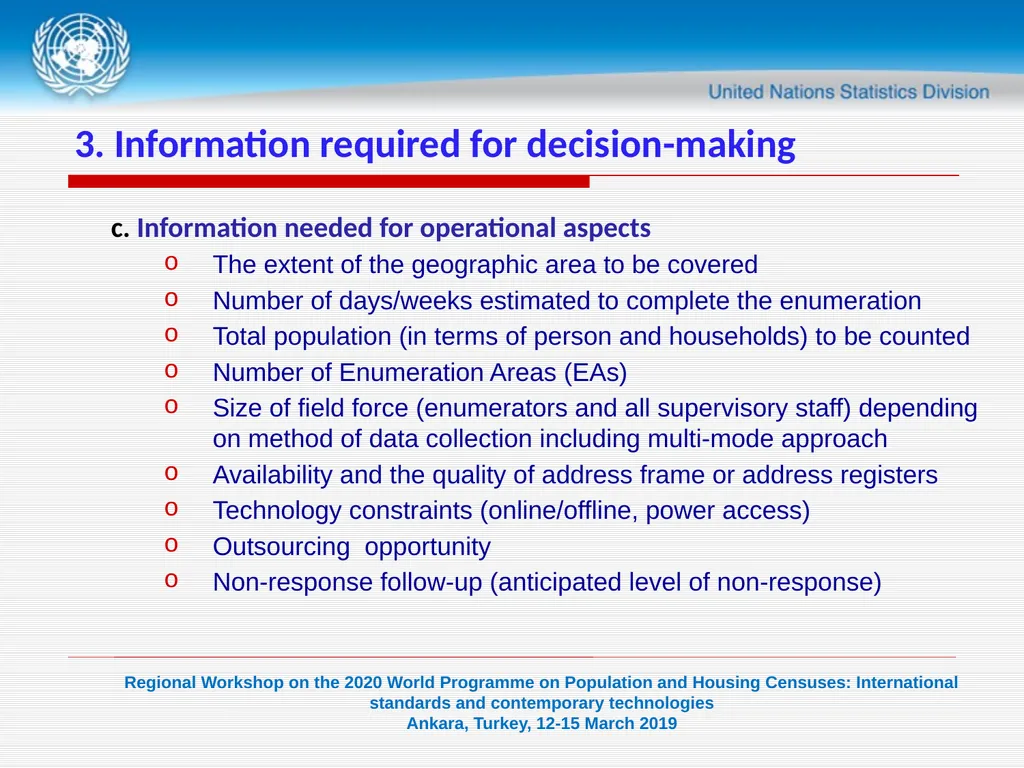
3. Information required for decision-making c. Information needed for operational aspects
The extent of the geographic area to be covered
Number of days/weeks estimated to complete the enumeration
Total population (in terms of person and households) to be counted
Number of Enumeration Areas (EAs)
Size of field force (enumerators and all supervisory staff) depending on method of data collection including multi-mode approach
Availability and the quality of address frame or address registers
Technology constraints (online/offline, power access)
Outsourcing opportunity
Non-response follow-up (anticipated level of non-response)<br>
The extent of the geographic area to be covered
Number of days/weeks estimated to complete the enumeration
Total population (in terms of person and households) to be counted
Number of Enumeration Areas (EAs)
Size of field force (enumerators and all supervisory staff) depending on method of data collection including multi-mode approach
Availability and the quality of address frame or address registers
Technology constraints (online/offline, power access)
Outsourcing opportunity
Non-response follow-up (anticipated level of non-response)<br>
12
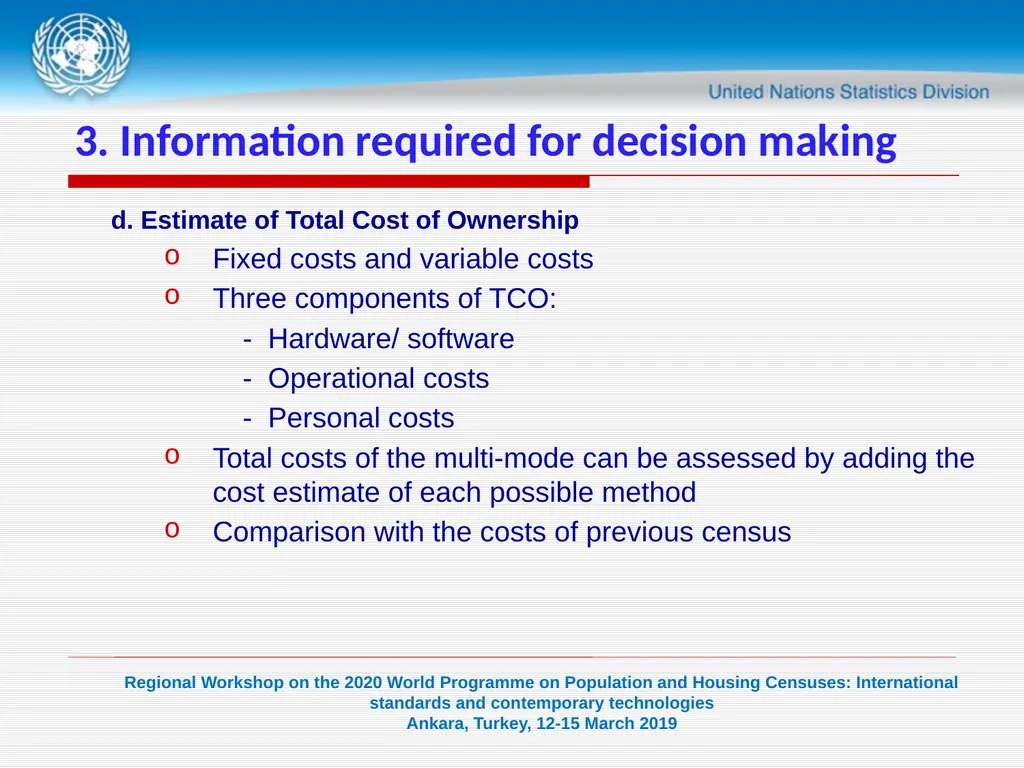
3. Information required for decision making d. Estimate of Total Cost of Ownership
Fixed costs and variable costs
Three components of TCO:
- Hardware/ software
- Operational costs
- Personal costs
Total costs of the multi-mode can be assessed by adding the cost estimate of each possible method
Comparison with the costs of previous census<br>
Fixed costs and variable costs
Three components of TCO:
- Hardware/ software
- Operational costs
- Personal costs
Total costs of the multi-mode can be assessed by adding the cost estimate of each possible method
Comparison with the costs of previous census<br>
13
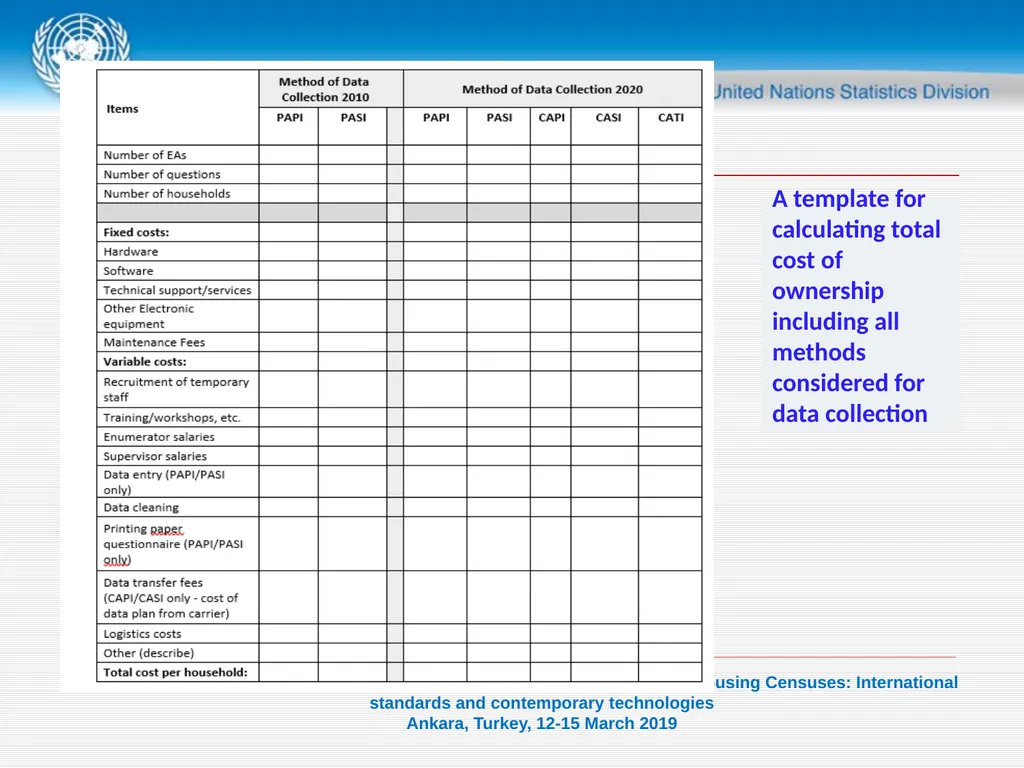
A template for calculating total cost of ownership including all methods considered for data collection<br>
14
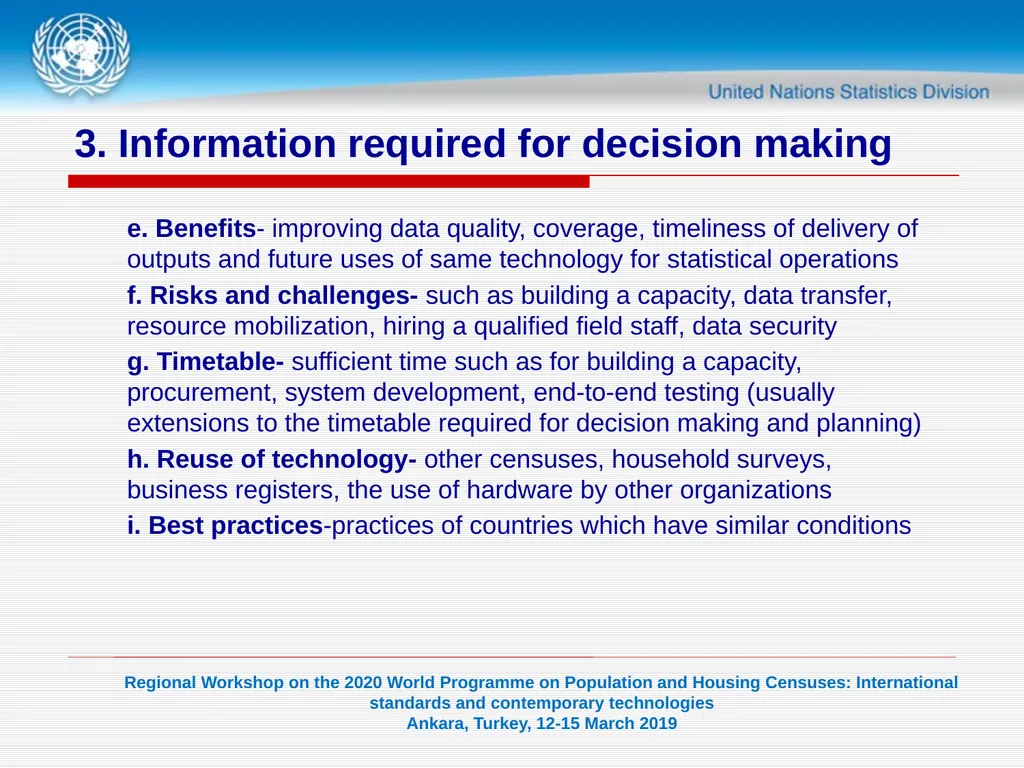
3. Information required for decision making e. Benefits- improving data quality, coverage, timeliness of delivery of outputs and future uses of same technology for statistical operations
f. Risks and challenges- such as building a capacity, data transfer, resource mobilization, hiring a qualified field staff, data security
g. Timetable- sufficient time such as for building a capacity, procurement, system development, end-to-end testing (usually extensions to the timetable required for decision making and planning)
h. Reuse of technology- other censuses, household surveys, business registers, the use of hardware by other organizations
i. Best practices-practices of countries which have similar conditions<br>
f. Risks and challenges- such as building a capacity, data transfer, resource mobilization, hiring a qualified field staff, data security
g. Timetable- sufficient time such as for building a capacity, procurement, system development, end-to-end testing (usually extensions to the timetable required for decision making and planning)
h. Reuse of technology- other censuses, household surveys, business registers, the use of hardware by other organizations
i. Best practices-practices of countries which have similar conditions<br>
15
Decision making process Steps for making a decision
Developing strategic objectives
Identifying key factors affecting decision
Information required for decision making
Analysis of information
Components of decision making
Documentation and evaluation<br>
Developing strategic objectives
Identifying key factors affecting decision
Information required for decision making
Analysis of information
Components of decision making
Documentation and evaluation<br>
16
4. Analysis of Information Analysis of existing census/demographic and contextual data is a critical step in the decision-making process
Several types of approaches should be used for analysis
Information collected should be analyzed with the involvement of relevant stakeholders
Comparative analysis is necessary for selection of appropriate data collection method in a country context<br>
Several types of approaches should be used for analysis
Information collected should be analyzed with the involvement of relevant stakeholders
Comparative analysis is necessary for selection of appropriate data collection method in a country context<br>
17
4. Analysis of Information A. SWOT (Strengths, Weaknesses, Opportunities, Threats) analysis: a better understanding of the balance between the benefits, risks and challenges in the introduction of new technology
Strengths: those characteristics of the new process or methodology that give it an advantage over others
Weaknesses: those characteristics which put the process or methodology at a disadvantage compared to the others
Opportunities: those elements of the process or methodology that can be exploited to its advantages or the advantages of others
Threats: those elements that create risks, or present challenges,
comparative advantages and disadvantages of adoption of new technology<br>
Strengths: those characteristics of the new process or methodology that give it an advantage over others
Weaknesses: those characteristics which put the process or methodology at a disadvantage compared to the others
Opportunities: those elements of the process or methodology that can be exploited to its advantages or the advantages of others
Threats: those elements that create risks, or present challenges,
comparative advantages and disadvantages of adoption of new technology<br>
18
4. Analysis of Information B. Cost-benefit analysis: comparison of total costs with its benefits
a tool for explaining the benefits of adopting an electronic data collection technology by comparing its cost with the costs of current data collection mode
If a multi-mode data collection methodology is an option, the cost estimates, benefits and risks should be determined for each type of data collection method under consideration
Results of analysis should be the basis for making a decision
Results should be used for preparing a justification for transferring to new technology
Especially for convincing the government and stakeholders about the value of the new approach<br>
a tool for explaining the benefits of adopting an electronic data collection technology by comparing its cost with the costs of current data collection mode
If a multi-mode data collection methodology is an option, the cost estimates, benefits and risks should be determined for each type of data collection method under consideration
Results of analysis should be the basis for making a decision
Results should be used for preparing a justification for transferring to new technology
Especially for convincing the government and stakeholders about the value of the new approach<br>
19
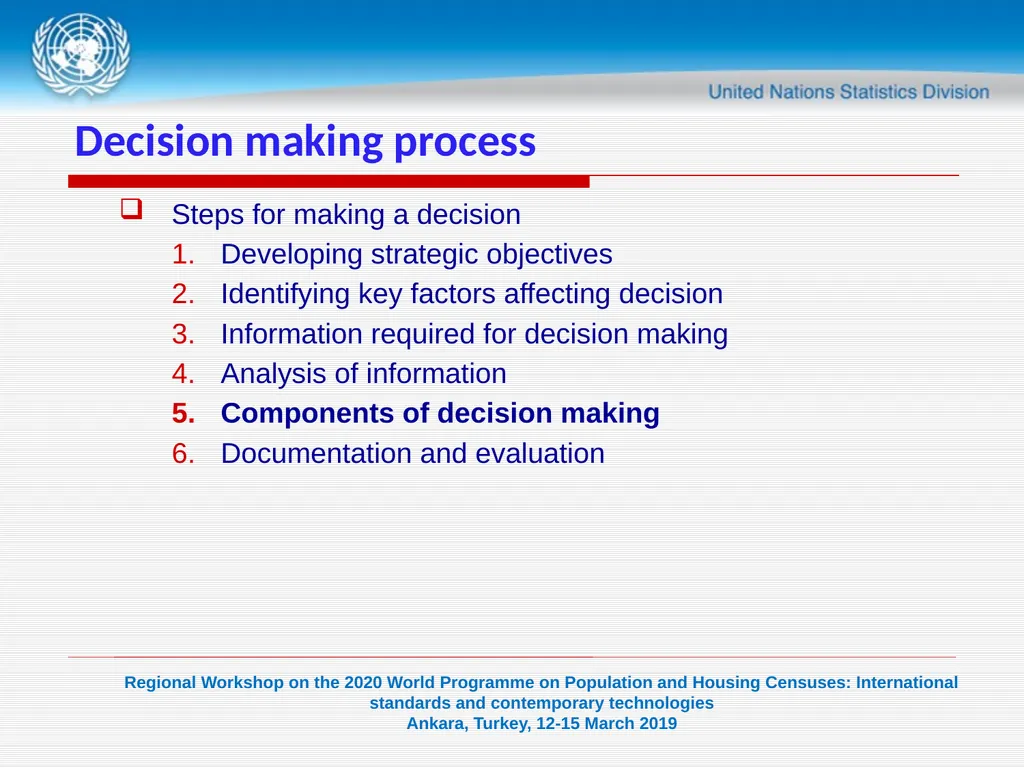
Decision making process Steps for making a decision
Developing strategic objectives
Identifying key factors affecting decision
Information required for decision making
Analysis of information
Components of decision making
Documentation and evaluation<br>
Developing strategic objectives
Identifying key factors affecting decision
Information required for decision making
Analysis of information
Components of decision making
Documentation and evaluation<br>
20
5. Components of decision making Data collection mode(s): Understanding the data collection mode (or modes if a multi-mode approach is decided) is one of the first considerations. PAPI, PASI, CAPI, CASI, CATI or some combination of these be adopted?
Type of hardware : Types of hardware (such as servers, handheld devices, tables or smartphones) needed for census operations should be decided
Software development: Method of developing software and applications should be decided- (commercial, in-house, out-sourced, customized)<br>
Type of hardware : Types of hardware (such as servers, handheld devices, tables or smartphones) needed for census operations should be decided
Software development: Method of developing software and applications should be decided- (commercial, in-house, out-sourced, customized)<br>
21
5. Components of decision making System development: Understanding and balancing an investment in refreshing or updating existing systems
Management structure and capacity: There should be decision on how to manage census project.
Is there a need for restructuring organisation?
What would be management structure of census project?
What new skills are needed?
How can the existing capacity be developed?<br>
Management structure and capacity: There should be decision on how to manage census project.
Is there a need for restructuring organisation?
What would be management structure of census project?
What new skills are needed?
How can the existing capacity be developed?<br>
22
Decision making process Steps for making a decision
Developing strategic objectives
Identifying key factors affecting decision
Information required for decision making
Analysis of information
Components of decision making
Documentation and evaluation<br>
Developing strategic objectives
Identifying key factors affecting decision
Information required for decision making
Analysis of information
Components of decision making
Documentation and evaluation<br>
23
6. Documenting decisions and evaluation Statistical agencies should clearly document the discussions and procedures followed at each stage during the whole of the decision- making process from start to finish. Each stage of this process should be described by linking all decisions with relevant documents
Systematic recording of this process will be very useful document for designing and implementation census operations affected by the decisions, and crucial if there is a need for revising the decisions during later stage of census planning if the conditions/requirements underlying particular decisions change<br>
Systematic recording of this process will be very useful document for designing and implementation census operations affected by the decisions, and crucial if there is a need for revising the decisions during later stage of census planning if the conditions/requirements underlying particular decisions change<br>
24
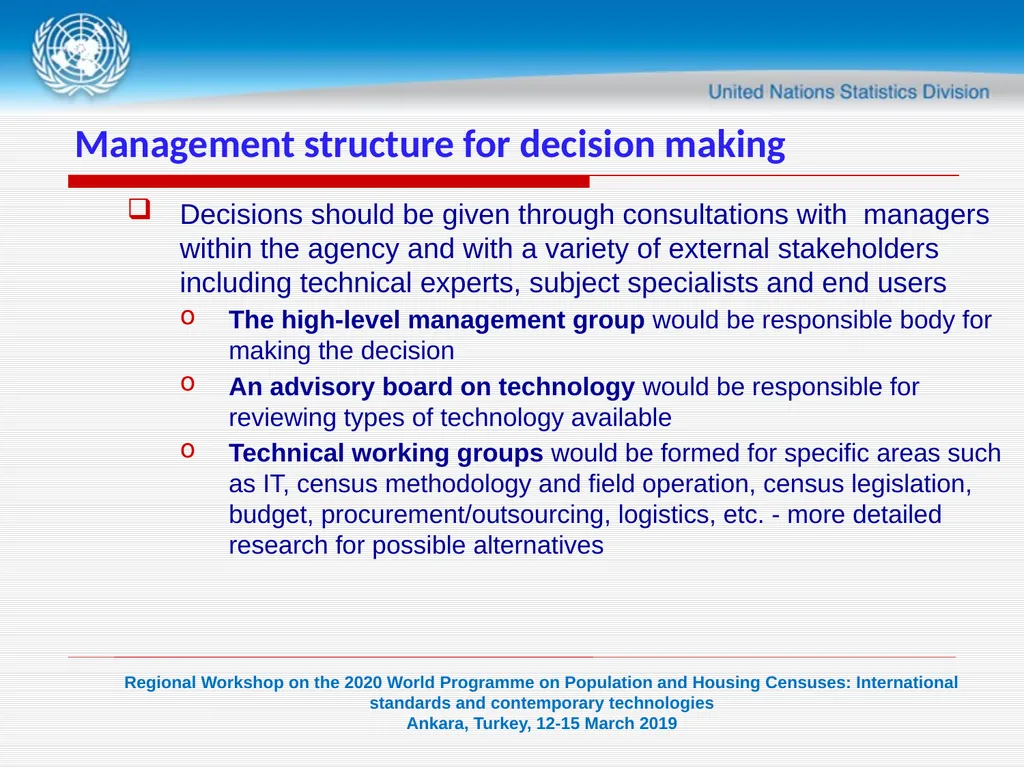
Management structure for decision making Decisions should be given through consultations with managers within the agency and with a variety of external stakeholders including technical experts, subject specialists and end users
The high-level management group would be responsible body for making the decision
An advisory board on technology would be responsible for reviewing types of technology available
Technical working groups would be formed for specific areas such as IT, census methodology and field operation, census legislation, budget, procurement/outsourcing, logistics, etc. - more detailed research for possible alternatives<br>
The high-level management group would be responsible body for making the decision
An advisory board on technology would be responsible for reviewing types of technology available
Technical working groups would be formed for specific areas such as IT, census methodology and field operation, census legislation, budget, procurement/outsourcing, logistics, etc. - more detailed research for possible alternatives<br>