
1 Web Vulnerabilities Module 9 Module 9 Agenda Web
CB
Published · 24 slides · 0 views
1 / 1

Description
1 Web Vulnerabilities Module 9 Module 9 Agenda Web Vulnerabilities OWASP OWASP Top Ten 2 Copyright 2021 Iowa State University Web Vulnerabilities Copyright 2021 Iowa State University 3 Web Vulnerabilities As we know, vulnerabilities are
Related Topics
Share
Embed code
Download this presentation From Below
"1 Web Vulnerabilities Module 9 Module 9 Agenda Web" is the property of its rightful owner. Permission is granted to download and print the materials on this website for personal, non-commercial use only, and to display it on your personal computer provided you do not modify the materials and that you retain all copyright notices contained in the materials. By downloading content from our website, you accept the terms of this agreement.
Presentation Transcript
01
1 Web Vulnerabilities Module 9<br>
02
Module 9 Agenda Web Vulnerabilities
OWASP
OWASP Top Ten 2 Copyright 2021 Iowa State University<br>
OWASP
OWASP Top Ten 2 Copyright 2021 Iowa State University<br>
03
Web Vulnerabilities Copyright 2021 Iowa State University 3<br>
04
Web Vulnerabilities As we know, vulnerabilities are weaknesses within a computer that can compromise its security.
Web Vulnerabilities are weaknesses within a website or web application that can allow hackers access to a wide variety of features. Copyright 2021 Iowa State University 4<br>
Web Vulnerabilities are weaknesses within a website or web application that can allow hackers access to a wide variety of features. Copyright 2021 Iowa State University 4<br>
05
Web Vulnerabilities There is a list on the ten most common web vulnerabilities.
The list is compiled and maintained by an organization named The Open Web Application Security Project (OWASP).
OWASP is a non-profit organization that strives to strengthen security across the web.
*The OWASP Top 10 can be found on OWASP’s website: owasp.org Copyright 2021 Iowa State University 5<br>
The list is compiled and maintained by an organization named The Open Web Application Security Project (OWASP).
OWASP is a non-profit organization that strives to strengthen security across the web.
*The OWASP Top 10 can be found on OWASP’s website: owasp.org Copyright 2021 Iowa State University 5<br>
06
Open Web Application Security Project (OWASP) Copyright 2021 Iowa State University 6<br>
07
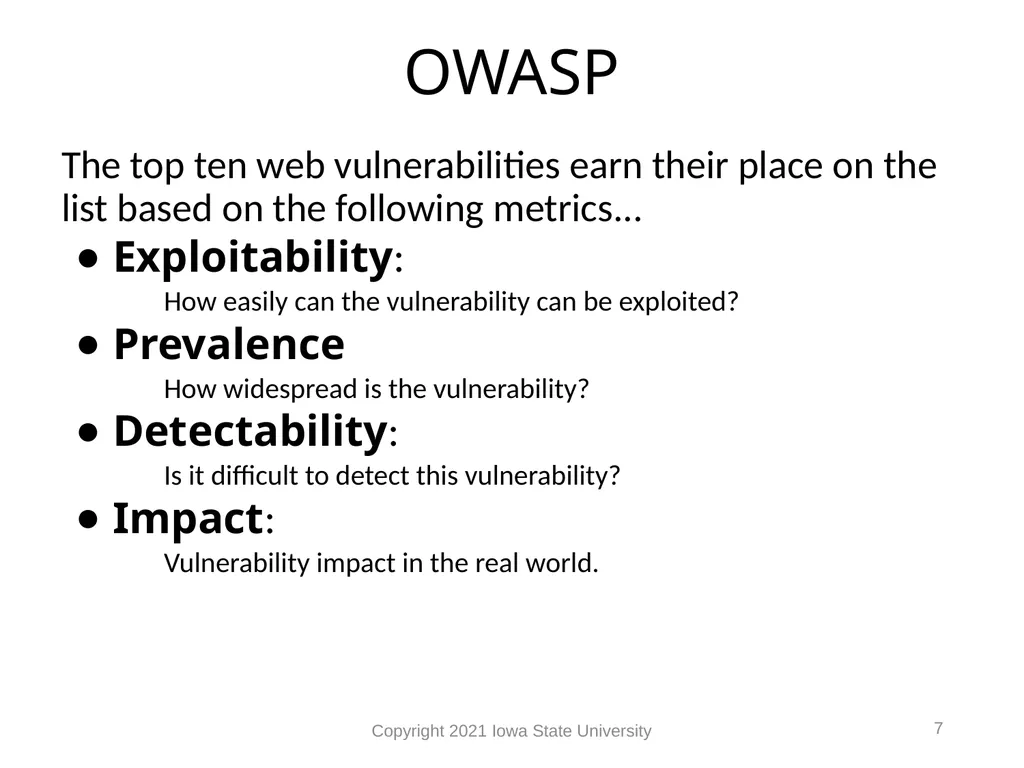
OWASP The top ten web vulnerabilities earn their place on the list based on the following metrics...
Exploitability:
How easily can the vulnerability can be exploited?
Prevalence
How widespread is the vulnerability?
Detectability:
Is it difficult to detect this vulnerability?
Impact:
Vulnerability impact in the real world. Copyright 2021 Iowa State University 7<br>
Exploitability:
How easily can the vulnerability can be exploited?
Prevalence
How widespread is the vulnerability?
Detectability:
Is it difficult to detect this vulnerability?
Impact:
Vulnerability impact in the real world. Copyright 2021 Iowa State University 7<br>
08
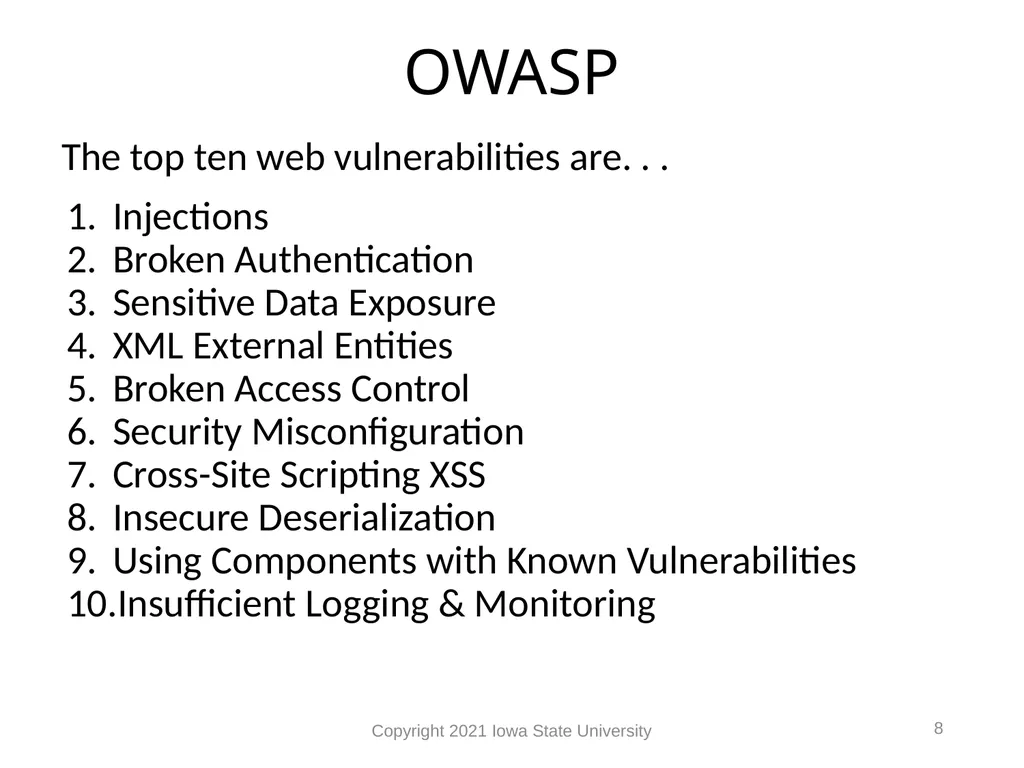
OWASP The top ten web vulnerabilities are. . .
Injections
Broken Authentication
Sensitive Data Exposure
XML External Entities
Broken Access Control
Security Misconfiguration
Cross-Site Scripting XSS
Insecure Deserialization
Using Components with Known Vulnerabilities
Insufficient Logging & Monitoring Copyright 2021 Iowa State University 8<br>
Injections
Broken Authentication
Sensitive Data Exposure
XML External Entities
Broken Access Control
Security Misconfiguration
Cross-Site Scripting XSS
Insecure Deserialization
Using Components with Known Vulnerabilities
Insufficient Logging & Monitoring Copyright 2021 Iowa State University 8<br>
09
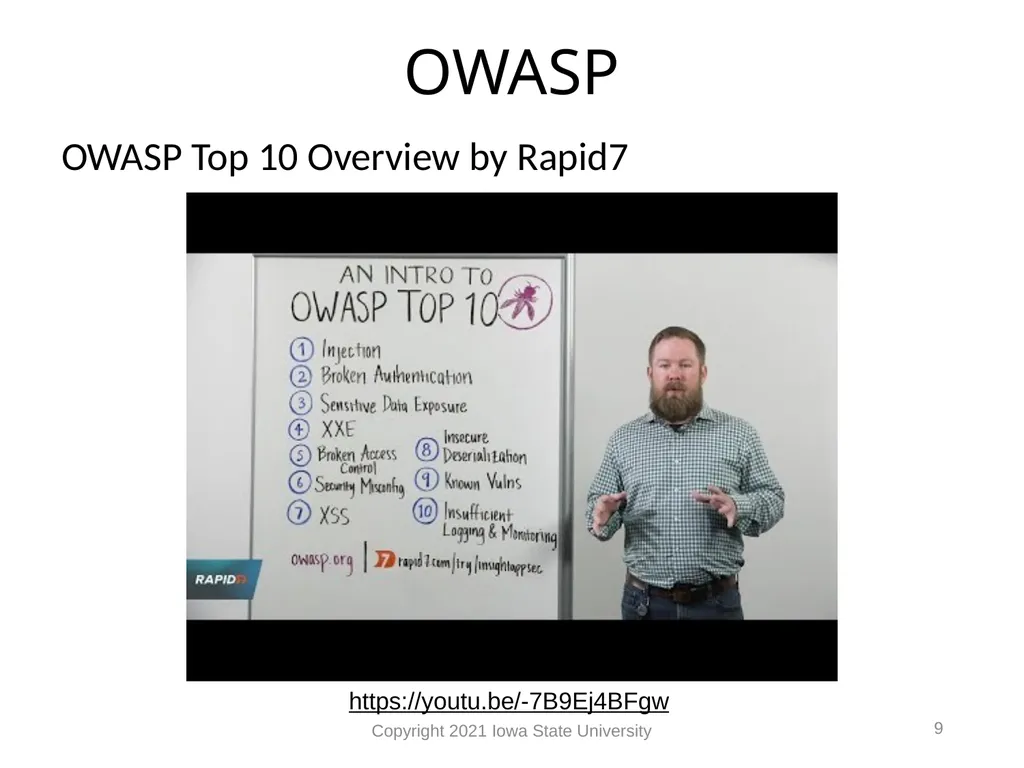
OWASP OWASP Top 10 Overview by Rapid7 Copyright 2021 Iowa State University 9 https://youtu.be/-7B9Ej4BFgw<br>
10
OWASP Top Ten Copyright 2021 Iowa State University 10<br>
11
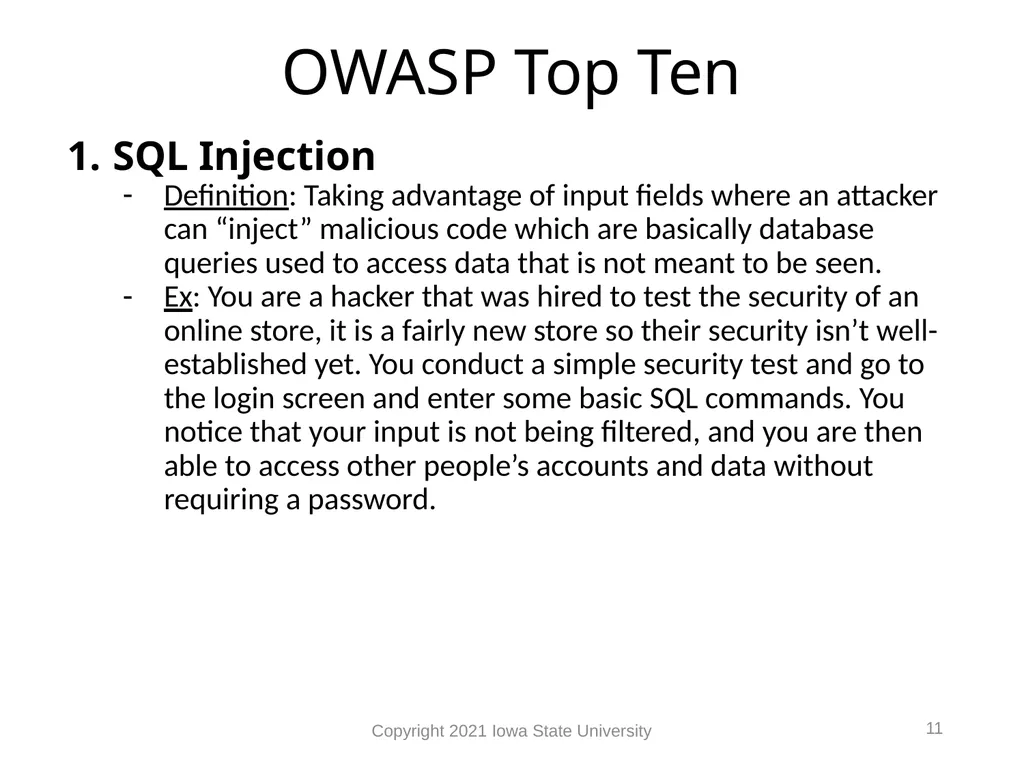
OWASP Top Ten SQL Injection
Definition: Taking advantage of input fields where an attacker can “inject” malicious code which are basically database queries used to access data that is not meant to be seen.
Ex: You are a hacker that was hired to test the security of an online store, it is a fairly new store so their security isn’t well-established yet. You conduct a simple security test and go to the login screen and enter some basic SQL commands. You notice that your input is not being filtered, and you are then able to access other people’s accounts and data without requiring a password. Copyright 2021 Iowa State University 11<br>
Definition: Taking advantage of input fields where an attacker can “inject” malicious code which are basically database queries used to access data that is not meant to be seen.
Ex: You are a hacker that was hired to test the security of an online store, it is a fairly new store so their security isn’t well-established yet. You conduct a simple security test and go to the login screen and enter some basic SQL commands. You notice that your input is not being filtered, and you are then able to access other people’s accounts and data without requiring a password. Copyright 2021 Iowa State University 11<br>
12
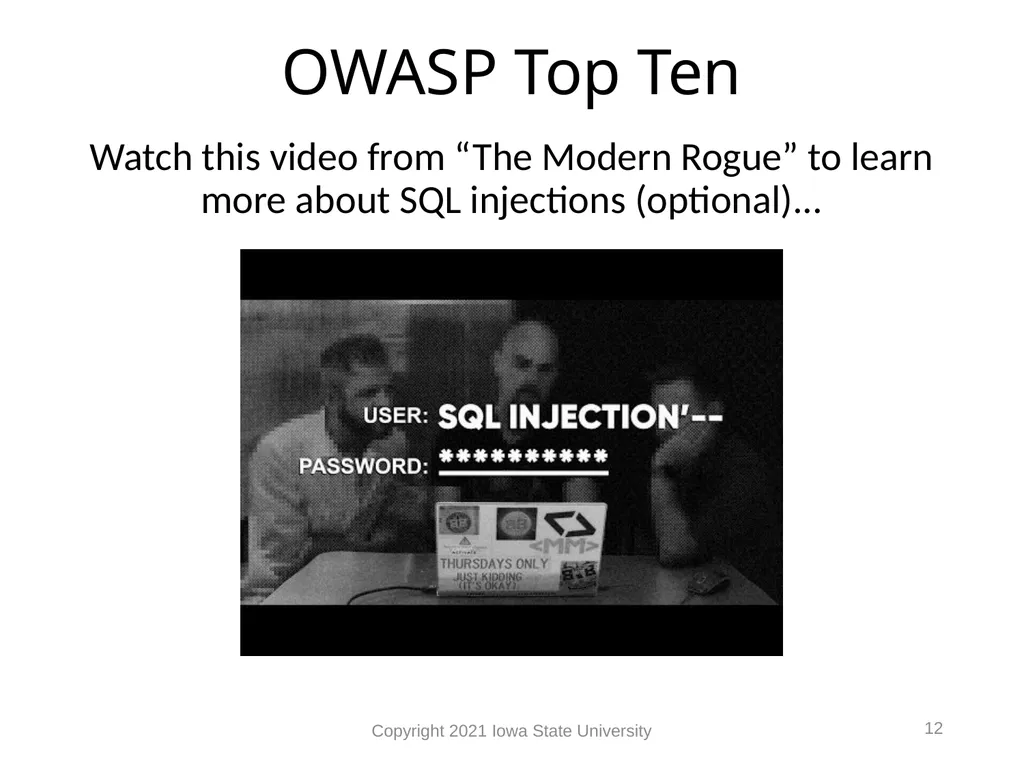
OWASP Top Ten Watch this video from “The Modern Rogue” to learn more about SQL injections (optional)... Copyright 2021 Iowa State University 12<br>
13
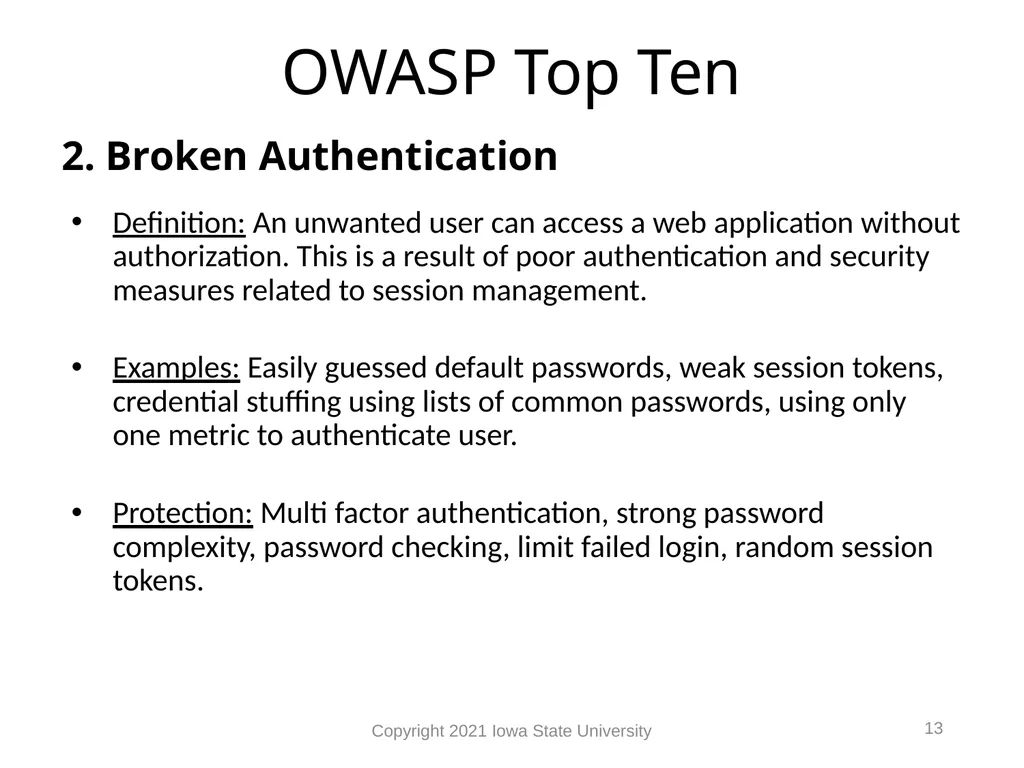
OWASP Top Ten 2. Broken Authentication
Definition: An unwanted user can access a web application without authorization. This is a result of poor authentication and security measures related to session management.
Examples: Easily guessed default passwords, weak session tokens, credential stuffing using lists of common passwords, using only one metric to authenticate user.
Protection: Multi factor authentication, strong password complexity, password checking, limit failed login, random session tokens. Copyright 2021 Iowa State University 13<br>
Definition: An unwanted user can access a web application without authorization. This is a result of poor authentication and security measures related to session management.
Examples: Easily guessed default passwords, weak session tokens, credential stuffing using lists of common passwords, using only one metric to authenticate user.
Protection: Multi factor authentication, strong password complexity, password checking, limit failed login, random session tokens. Copyright 2021 Iowa State University 13<br>
14
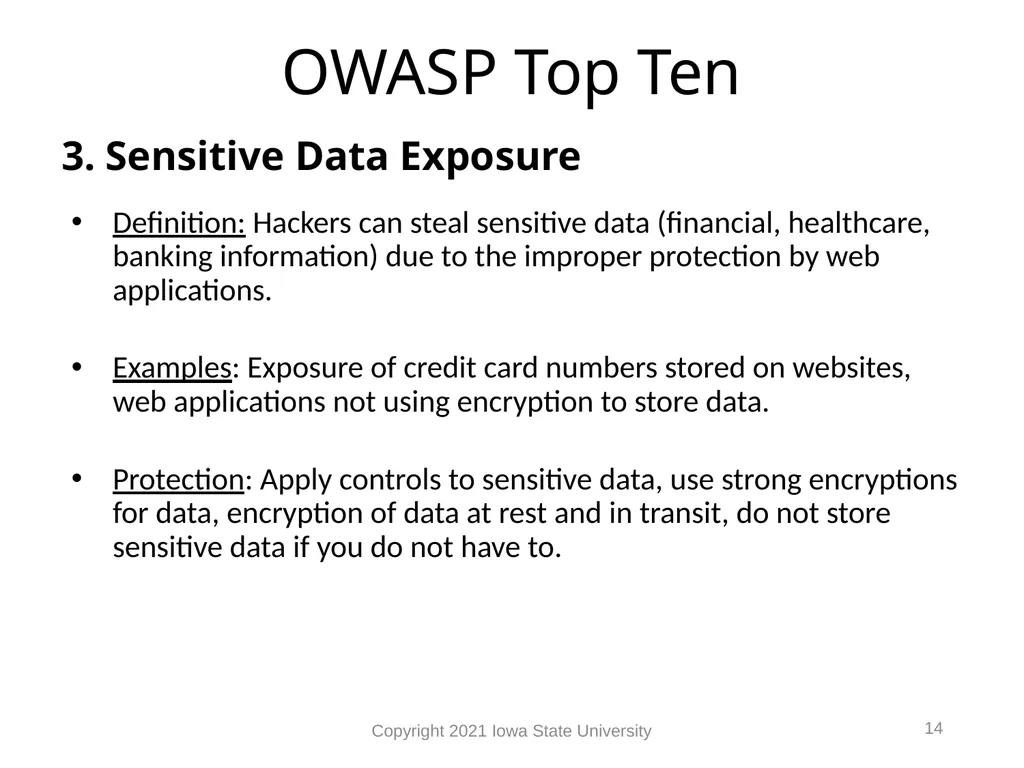
OWASP Top Ten 3. Sensitive Data Exposure
Definition: Hackers can steal sensitive data (financial, healthcare, banking information) due to the improper protection by web applications.
Examples: Exposure of credit card numbers stored on websites, web applications not using encryption to store data.
Protection: Apply controls to sensitive data, use strong encryptions for data, encryption of data at rest and in transit, do not store sensitive data if you do not have to. Copyright 2021 Iowa State University 14<br>
Definition: Hackers can steal sensitive data (financial, healthcare, banking information) due to the improper protection by web applications.
Examples: Exposure of credit card numbers stored on websites, web applications not using encryption to store data.
Protection: Apply controls to sensitive data, use strong encryptions for data, encryption of data at rest and in transit, do not store sensitive data if you do not have to. Copyright 2021 Iowa State University 14<br>
15
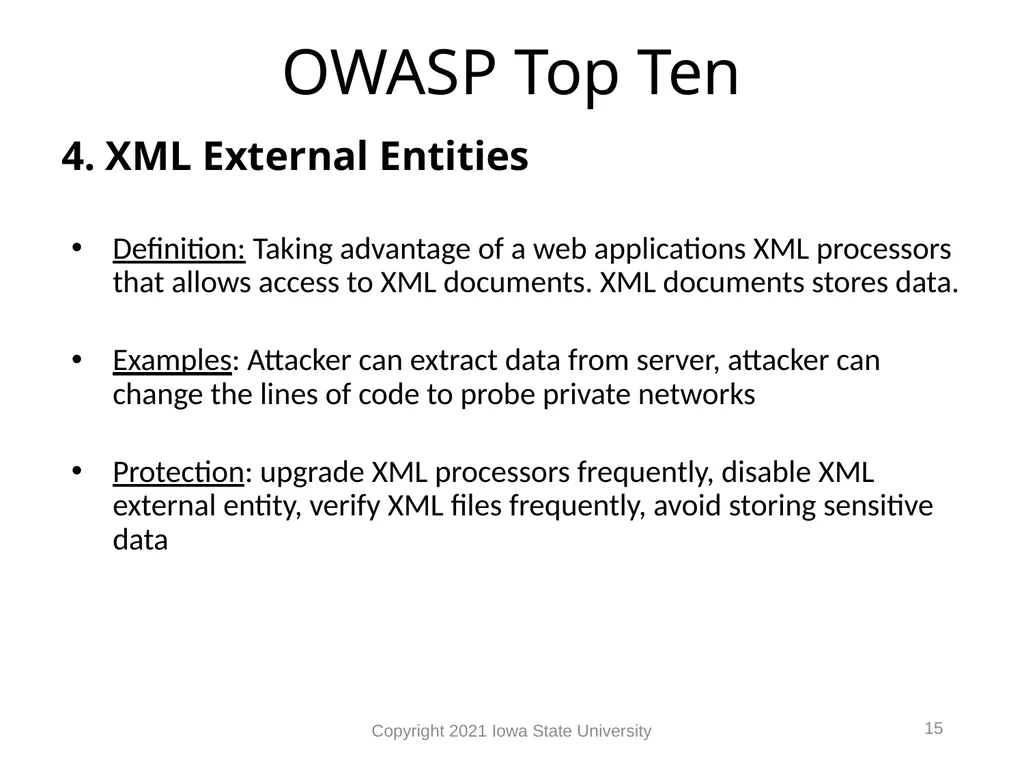
OWASP Top Ten 4. XML External Entities
Definition: Taking advantage of a web applications XML processors that allows access to XML documents. XML documents stores data.
Examples: Attacker can extract data from server, attacker can change the lines of code to probe private networks
Protection: upgrade XML processors frequently, disable XML external entity, verify XML files frequently, avoid storing sensitive data Copyright 2021 Iowa State University 15<br>
Definition: Taking advantage of a web applications XML processors that allows access to XML documents. XML documents stores data.
Examples: Attacker can extract data from server, attacker can change the lines of code to probe private networks
Protection: upgrade XML processors frequently, disable XML external entity, verify XML files frequently, avoid storing sensitive data Copyright 2021 Iowa State University 15<br>
16
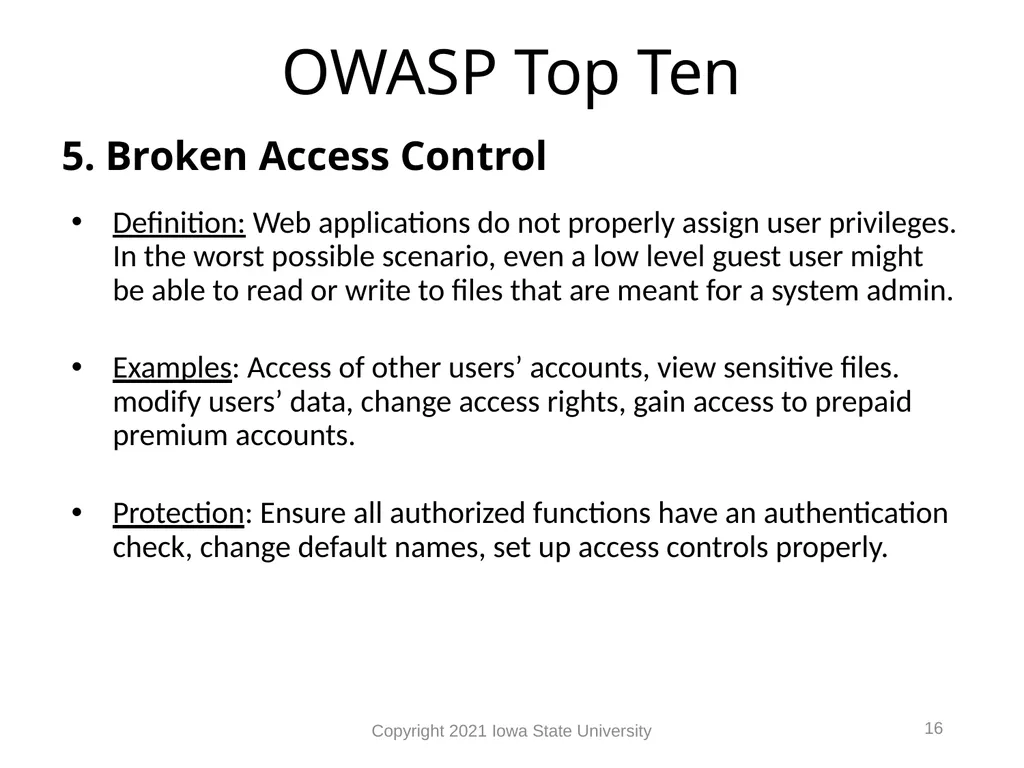
OWASP Top Ten 5. Broken Access Control
Definition: Web applications do not properly assign user privileges. In the worst possible scenario, even a low level guest user might be able to read or write to files that are meant for a system admin.
Examples: Access of other users’ accounts, view sensitive files. modify users’ data, change access rights, gain access to prepaid premium accounts.
Protection: Ensure all authorized functions have an authentication check, change default names, set up access controls properly. Copyright 2021 Iowa State University 16<br>
Definition: Web applications do not properly assign user privileges. In the worst possible scenario, even a low level guest user might be able to read or write to files that are meant for a system admin.
Examples: Access of other users’ accounts, view sensitive files. modify users’ data, change access rights, gain access to prepaid premium accounts.
Protection: Ensure all authorized functions have an authentication check, change default names, set up access controls properly. Copyright 2021 Iowa State University 16<br>
17
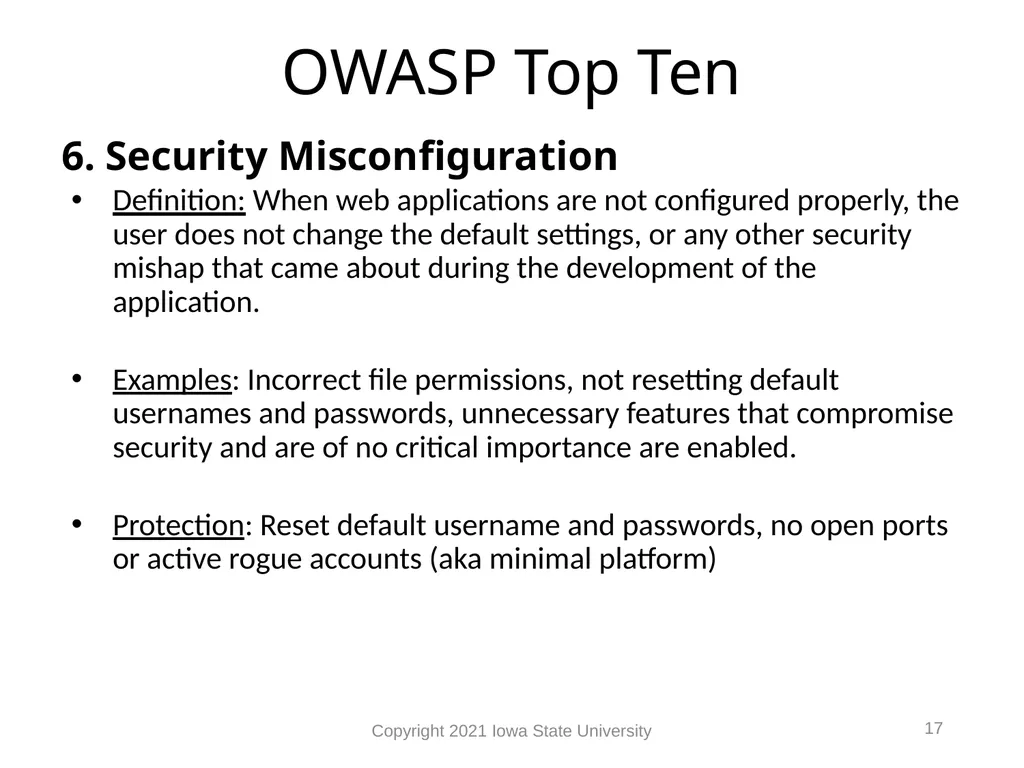
OWASP Top Ten 6. Security Misconfiguration
Definition: When web applications are not configured properly, the user does not change the default settings, or any other security mishap that came about during the development of the application.
Examples: Incorrect file permissions, not resetting default usernames and passwords, unnecessary features that compromise security and are of no critical importance are enabled.
Protection: Reset default username and passwords, no open ports or active rogue accounts (aka minimal platform) Copyright 2021 Iowa State University 17<br>
Definition: When web applications are not configured properly, the user does not change the default settings, or any other security mishap that came about during the development of the application.
Examples: Incorrect file permissions, not resetting default usernames and passwords, unnecessary features that compromise security and are of no critical importance are enabled.
Protection: Reset default username and passwords, no open ports or active rogue accounts (aka minimal platform) Copyright 2021 Iowa State University 17<br>
18
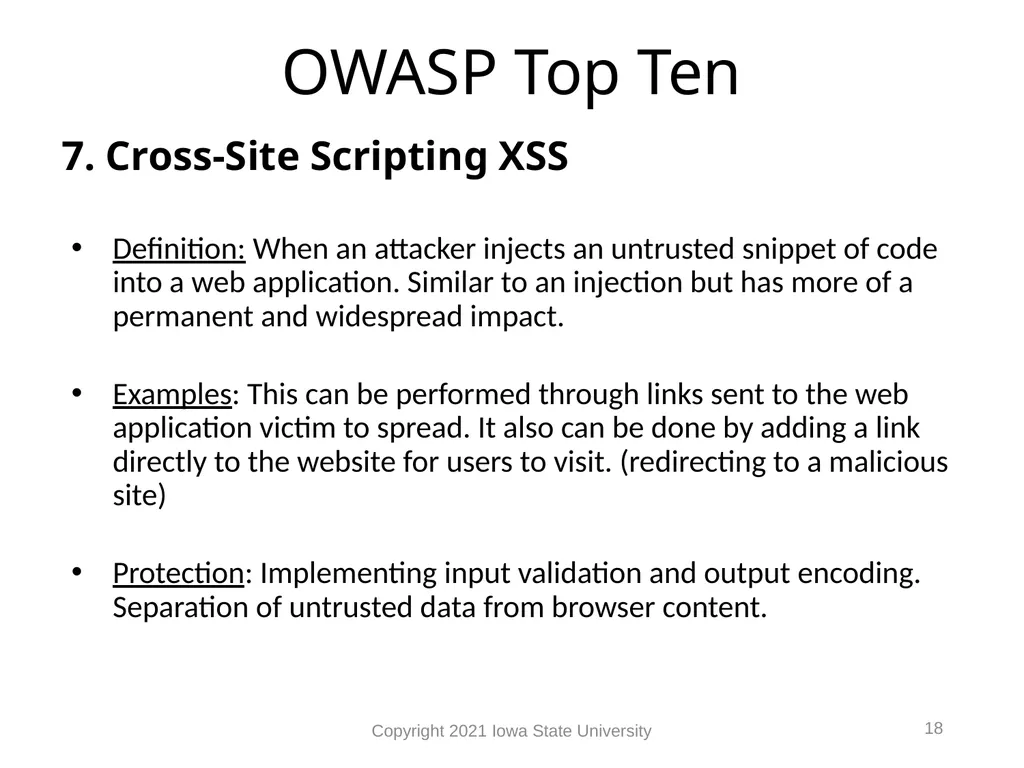
OWASP Top Ten 7. Cross-Site Scripting XSS
Definition: When an attacker injects an untrusted snippet of code into a web application. Similar to an injection but has more of a permanent and widespread impact.
Examples: This can be performed through links sent to the web application victim to spread. It also can be done by adding a link directly to the website for users to visit. (redirecting to a malicious site)
Protection: Implementing input validation and output encoding. Separation of untrusted data from browser content. Copyright 2021 Iowa State University 18<br>
Definition: When an attacker injects an untrusted snippet of code into a web application. Similar to an injection but has more of a permanent and widespread impact.
Examples: This can be performed through links sent to the web application victim to spread. It also can be done by adding a link directly to the website for users to visit. (redirecting to a malicious site)
Protection: Implementing input validation and output encoding. Separation of untrusted data from browser content. Copyright 2021 Iowa State University 18<br>
19
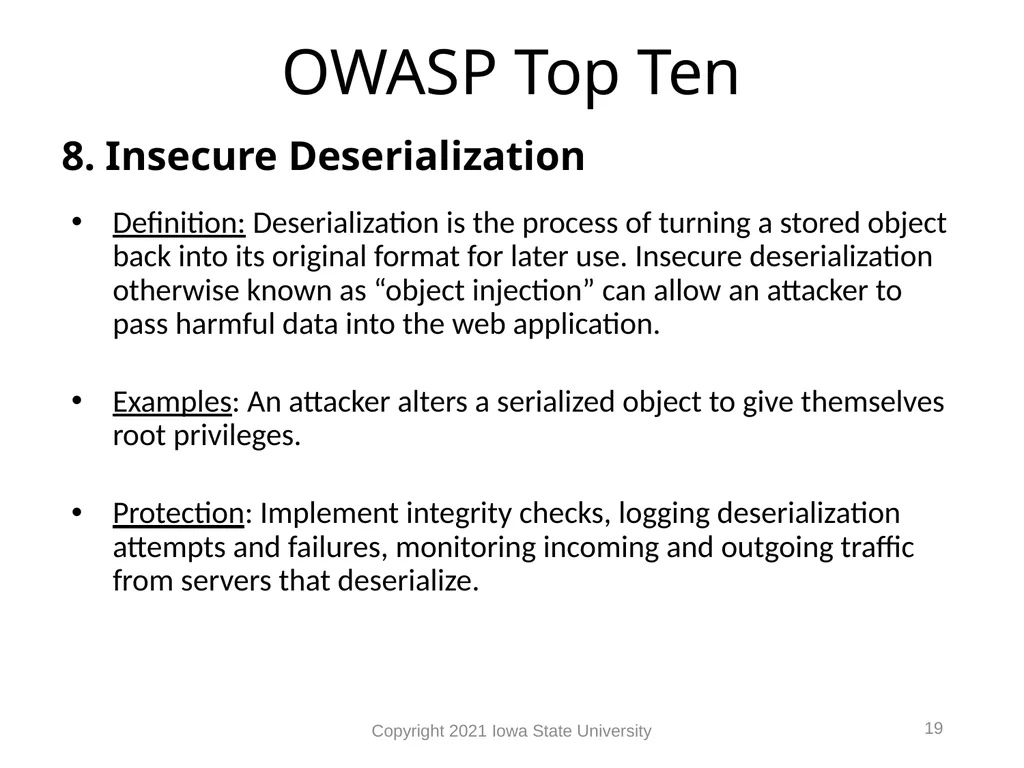
OWASP Top Ten 8. Insecure Deserialization
Definition: Deserialization is the process of turning a stored object back into its original format for later use. Insecure deserialization otherwise known as “object injection” can allow an attacker to pass harmful data into the web application.
Examples: An attacker alters a serialized object to give themselves root privileges.
Protection: Implement integrity checks, logging deserialization attempts and failures, monitoring incoming and outgoing traffic from servers that deserialize. Copyright 2021 Iowa State University 19<br>
Definition: Deserialization is the process of turning a stored object back into its original format for later use. Insecure deserialization otherwise known as “object injection” can allow an attacker to pass harmful data into the web application.
Examples: An attacker alters a serialized object to give themselves root privileges.
Protection: Implement integrity checks, logging deserialization attempts and failures, monitoring incoming and outgoing traffic from servers that deserialize. Copyright 2021 Iowa State University 19<br>
20
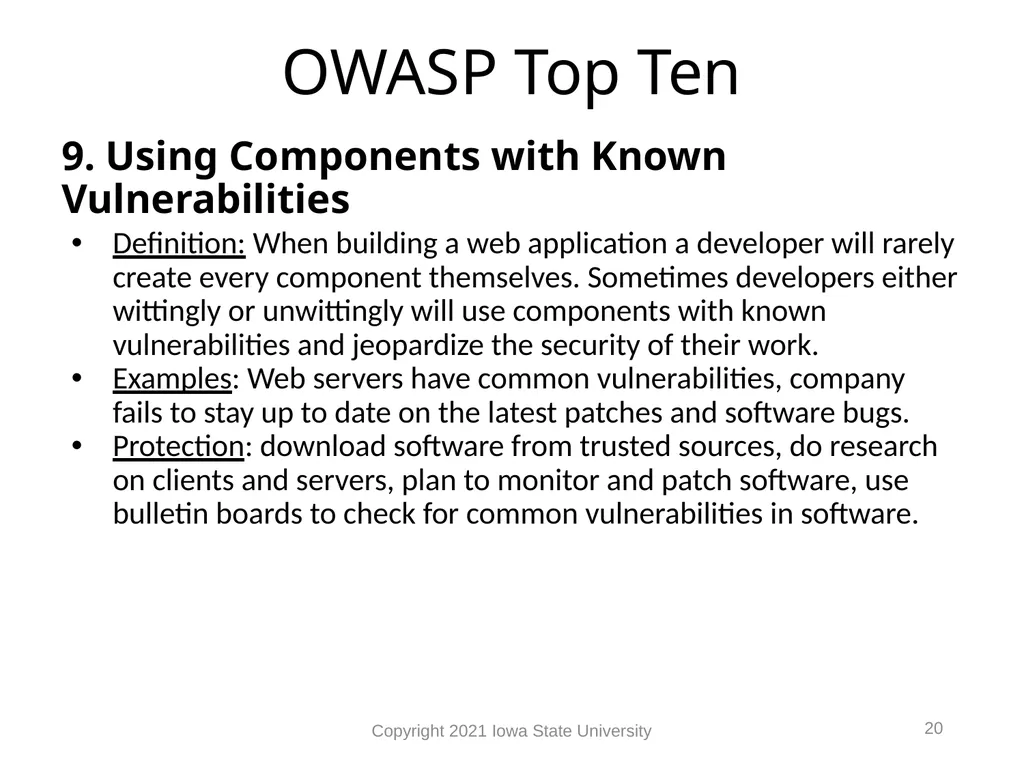
OWASP Top Ten 9. Using Components with Known Vulnerabilities
Definition: When building a web application a developer will rarely create every component themselves. Sometimes developers either wittingly or unwittingly will use components with known vulnerabilities and jeopardize the security of their work.
Examples: Web servers have common vulnerabilities, company fails to stay up to date on the latest patches and software bugs.
Protection: download software from trusted sources, do research on clients and servers, plan to monitor and patch software, use bulletin boards to check for common vulnerabilities in software. Copyright 2021 Iowa State University 20<br>
Definition: When building a web application a developer will rarely create every component themselves. Sometimes developers either wittingly or unwittingly will use components with known vulnerabilities and jeopardize the security of their work.
Examples: Web servers have common vulnerabilities, company fails to stay up to date on the latest patches and software bugs.
Protection: download software from trusted sources, do research on clients and servers, plan to monitor and patch software, use bulletin boards to check for common vulnerabilities in software. Copyright 2021 Iowa State University 20<br>
21
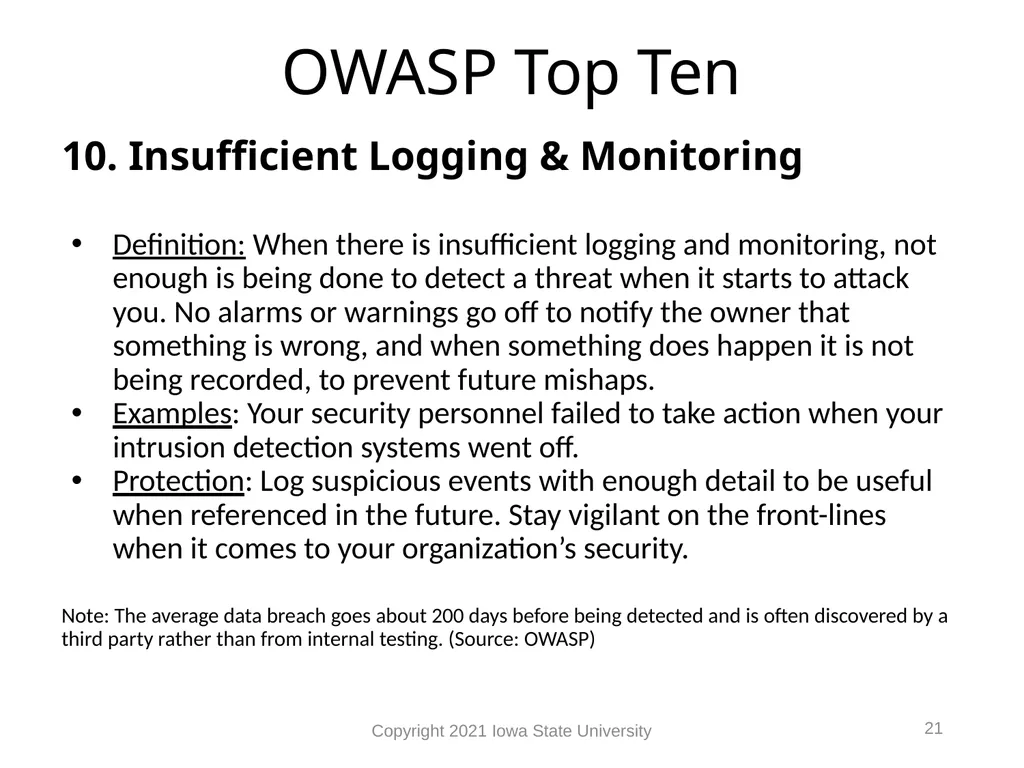
OWASP Top Ten 10. Insufficient Logging & Monitoring
Definition: When there is insufficient logging and monitoring, not enough is being done to detect a threat when it starts to attack you. No alarms or warnings go off to notify the owner that something is wrong, and when something does happen it is not being recorded, to prevent future mishaps.
Examples: Your security personnel failed to take action when your intrusion detection systems went off.
Protection: Log suspicious events with enough detail to be useful when referenced in the future. Stay vigilant on the front-lines when it comes to your organization’s security.
Note: The average data breach goes about 200 days before being detected and is often discovered by a third party rather than from internal testing. (Source: OWASP) Copyright 2021 Iowa State University 21<br>
Definition: When there is insufficient logging and monitoring, not enough is being done to detect a threat when it starts to attack you. No alarms or warnings go off to notify the owner that something is wrong, and when something does happen it is not being recorded, to prevent future mishaps.
Examples: Your security personnel failed to take action when your intrusion detection systems went off.
Protection: Log suspicious events with enough detail to be useful when referenced in the future. Stay vigilant on the front-lines when it comes to your organization’s security.
Note: The average data breach goes about 200 days before being detected and is often discovered by a third party rather than from internal testing. (Source: OWASP) Copyright 2021 Iowa State University 21<br>
22
To Do Complete Module 9 Activity 1
Complete Module 9 Activity 2 22 Copyright 2021 Iowa State University<br>
Complete Module 9 Activity 2 22 Copyright 2021 Iowa State University<br>
23
End of Module 9! What questions do you have?
Next Module Topic:
Network & Vulnerability Scanning! 23 Copyright 2021 Iowa State University<br>
Next Module Topic:
Network & Vulnerability Scanning! 23 Copyright 2021 Iowa State University<br>
24
Questions? Contact IT-Adventures support staff!
email:
innovate_it@iastate.edu
Your school’s IP-Range can be found at:
http://www.it-adventures.org/ip-ranges/ 24<br>
email:
innovate_it@iastate.edu
Your school’s IP-Range can be found at:
http://www.it-adventures.org/ip-ranges/ 24<br>