
10/12/2023 PREPARED BY ASAP II 1 Accelerating
DP
Published · 150 slides · 0 views

1 / 1












Description
10122023 PREPARED BY ASAP II 1 Accelerating Support to Advanced Local Partners II (ASAP II) Subaward Management Training October 2023 SUBAWARD MANAGEMENT TRAINING Welcome Introductions Name Organization Position What you are most
Related Topics
Share
Embed code
Download this presentation From Below
"10/12/2023 PREPARED BY ASAP II 1 Accelerating" is the property of its rightful owner. Permission is granted to download and print the materials on this website for personal, non-commercial use only, and to display it on your personal computer provided you do not modify the materials and that you retain all copyright notices contained in the materials. By downloading content from our website, you accept the terms of this agreement.
Presentation Transcript
01
10/12/2023 PREPARED BY ASAP II 1 Accelerating Support to Advanced Local Partners II (ASAP II) Subaward Management Training October 2023<br>
02
SUBAWARD MANAGEMENT TRAINING Welcome
Introductions
Name
Organization
Position
What you are most interested in learning in this training
Ice Breaker<br>
Introductions
Name
Organization
Position
What you are most interested in learning in this training
Ice Breaker<br>
03
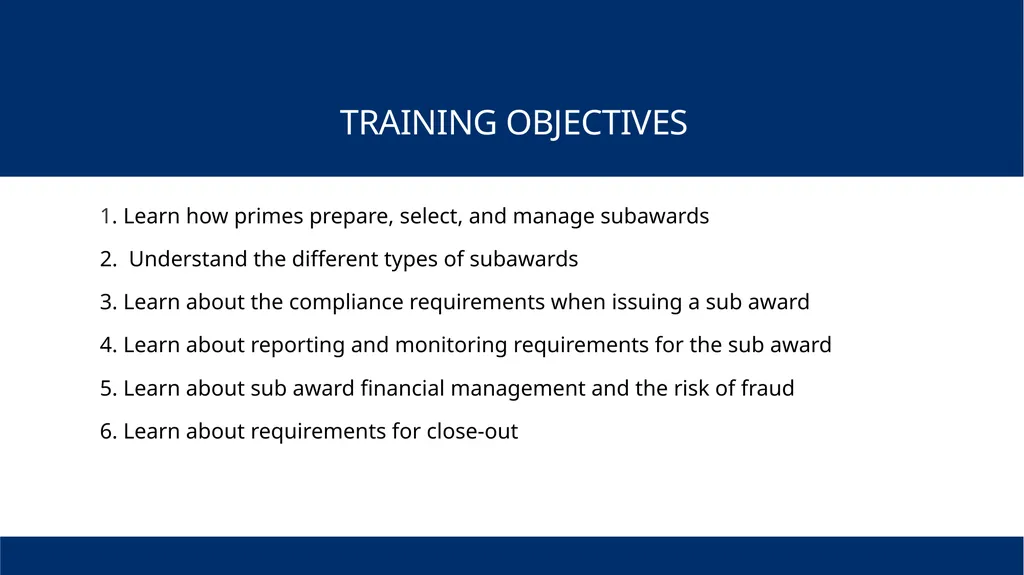
TRAINING OBJECTIVES 1. Learn how primes prepare, select, and manage subawards
2. Understand the different types of subawards
3. Learn about the compliance requirements when issuing a sub award
4. Learn about reporting and monitoring requirements for the sub award
5. Learn about sub award financial management and the risk of fraud
6. Learn about requirements for close-out<br>
2. Understand the different types of subawards
3. Learn about the compliance requirements when issuing a sub award
4. Learn about reporting and monitoring requirements for the sub award
5. Learn about sub award financial management and the risk of fraud
6. Learn about requirements for close-out<br>
04
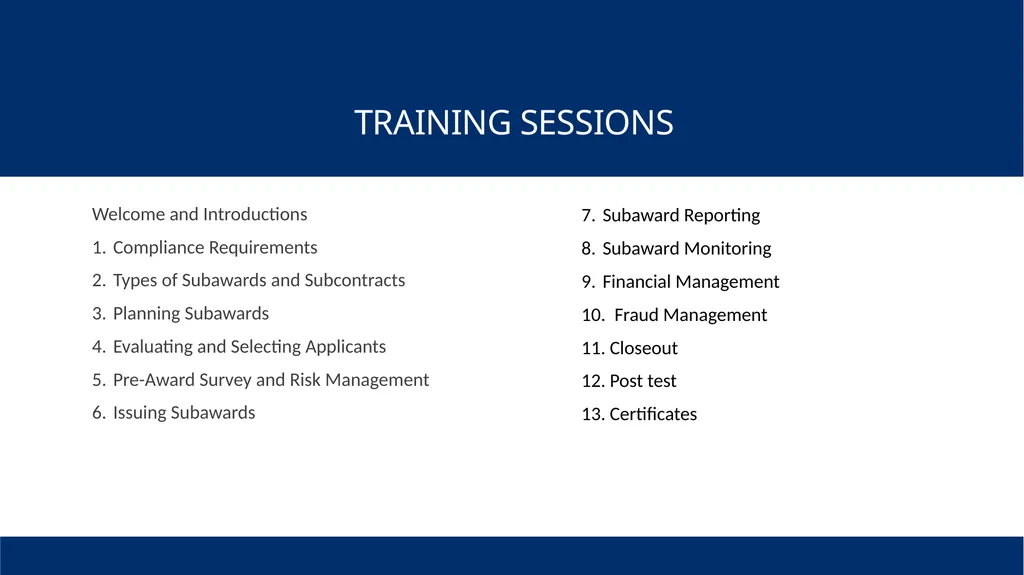
TRAINING SESSIONS Welcome and Introductions
Compliance Requirements
Types of Subawards and Subcontracts
Planning Subawards
Evaluating and Selecting Applicants
Pre-Award Survey and Risk Management
Issuing Subawards Subaward Reporting
Subaward Monitoring
Financial Management
Fraud Management
Closeout
Post test
Certificates<br>
Compliance Requirements
Types of Subawards and Subcontracts
Planning Subawards
Evaluating and Selecting Applicants
Pre-Award Survey and Risk Management
Issuing Subawards Subaward Reporting
Subaward Monitoring
Financial Management
Fraud Management
Closeout
Post test
Certificates<br>
05
Pre-test<br>
06
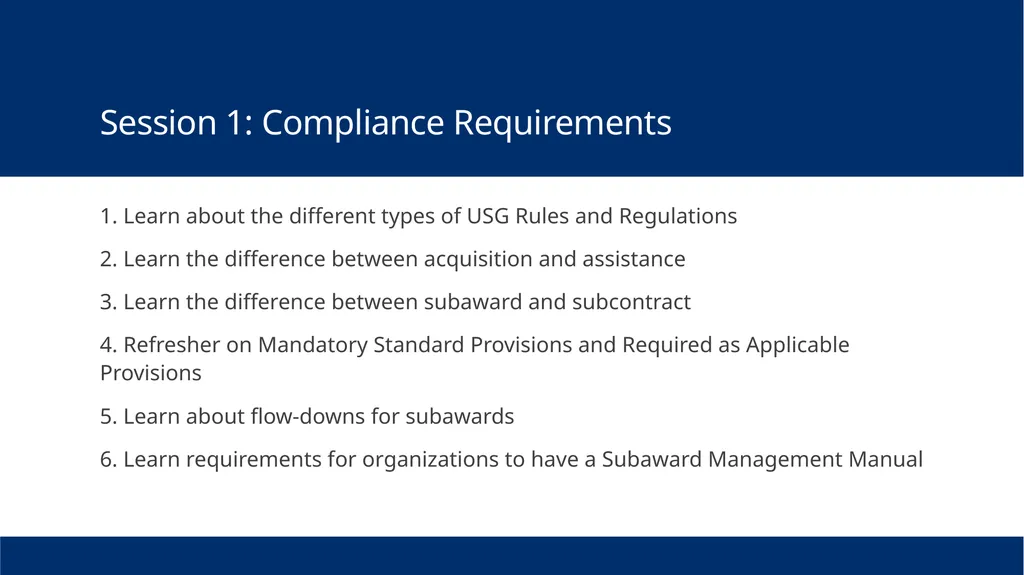
Session 1: Compliance Requirements 1. Learn about the different types of USG Rules and Regulations
2. Learn the difference between acquisition and assistance
3. Learn the difference between subaward and subcontract
4. Refresher on Mandatory Standard Provisions and Required as Applicable Provisions
5. Learn about flow-downs for subawards
6. Learn requirements for organizations to have a Subaward Management Manual<br>
2. Learn the difference between acquisition and assistance
3. Learn the difference between subaward and subcontract
4. Refresher on Mandatory Standard Provisions and Required as Applicable Provisions
5. Learn about flow-downs for subawards
6. Learn requirements for organizations to have a Subaward Management Manual<br>
07
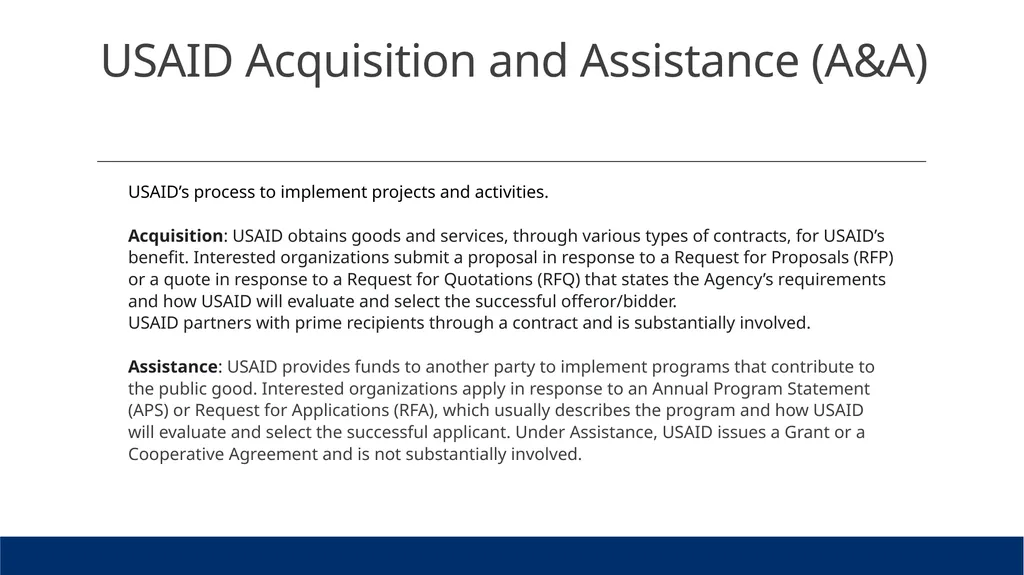
USAID Acquisition and Assistance (A&A) USAID’s process to implement projects and activities.
Acquisition: USAID obtains goods and services, through various types of contracts, for USAID’s benefit. Interested organizations submit a proposal in response to a Request for Proposals (RFP) or a quote in response to a Request for Quotations (RFQ) that states the Agency’s requirements and how USAID will evaluate and select the successful offeror/bidder.
USAID partners with prime recipients through a contract and is substantially involved.
Assistance: USAID provides funds to another party to implement programs that contribute to the public good. Interested organizations apply in response to an Annual Program Statement (APS) or Request for Applications (RFA), which usually describes the program and how USAID will evaluate and select the successful applicant. Under Assistance, USAID issues a Grant or a Cooperative Agreement and is not substantially involved.<br>
Acquisition: USAID obtains goods and services, through various types of contracts, for USAID’s benefit. Interested organizations submit a proposal in response to a Request for Proposals (RFP) or a quote in response to a Request for Quotations (RFQ) that states the Agency’s requirements and how USAID will evaluate and select the successful offeror/bidder.
USAID partners with prime recipients through a contract and is substantially involved.
Assistance: USAID provides funds to another party to implement programs that contribute to the public good. Interested organizations apply in response to an Annual Program Statement (APS) or Request for Applications (RFA), which usually describes the program and how USAID will evaluate and select the successful applicant. Under Assistance, USAID issues a Grant or a Cooperative Agreement and is not substantially involved.<br>
08
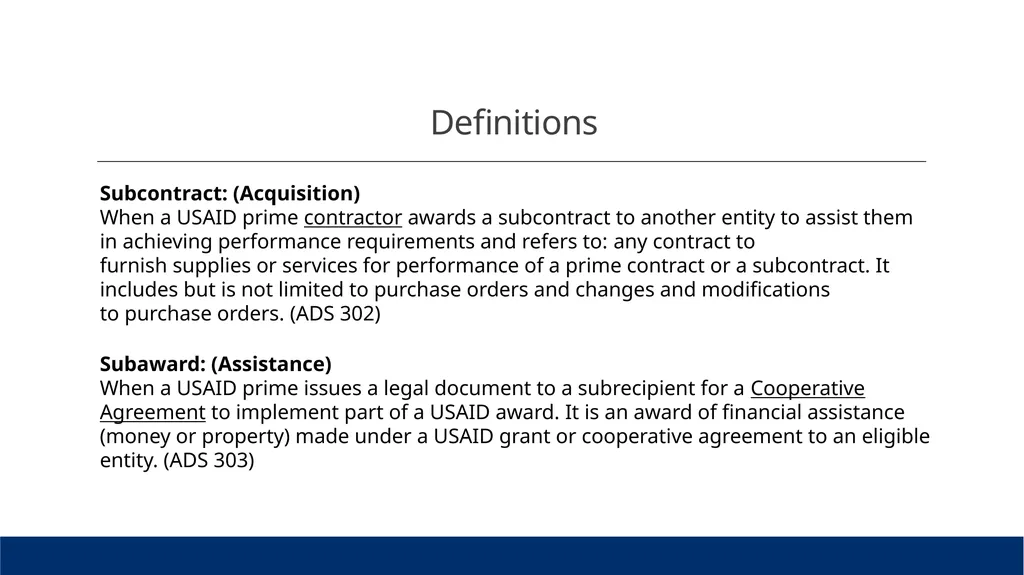
Definitions Subcontract: (Acquisition)
When a USAID prime contractor awards a subcontract to another entity to assist them in achieving performance requirements and refers to: any contract to furnish supplies or services for performance of a prime contract or a subcontract. It includes but is not limited to purchase orders and changes and modifications to purchase orders. (ADS 302)
Subaward: (Assistance)
When a USAID prime issues a legal document to a subrecipient for a Cooperative Agreement to implement part of a USAID award. It is an award of financial assistance (money or property) made under a USAID grant or cooperative agreement to an eligible entity. (ADS 303)<br>
When a USAID prime contractor awards a subcontract to another entity to assist them in achieving performance requirements and refers to: any contract to furnish supplies or services for performance of a prime contract or a subcontract. It includes but is not limited to purchase orders and changes and modifications to purchase orders. (ADS 302)
Subaward: (Assistance)
When a USAID prime issues a legal document to a subrecipient for a Cooperative Agreement to implement part of a USAID award. It is an award of financial assistance (money or property) made under a USAID grant or cooperative agreement to an eligible entity. (ADS 303)<br>
09
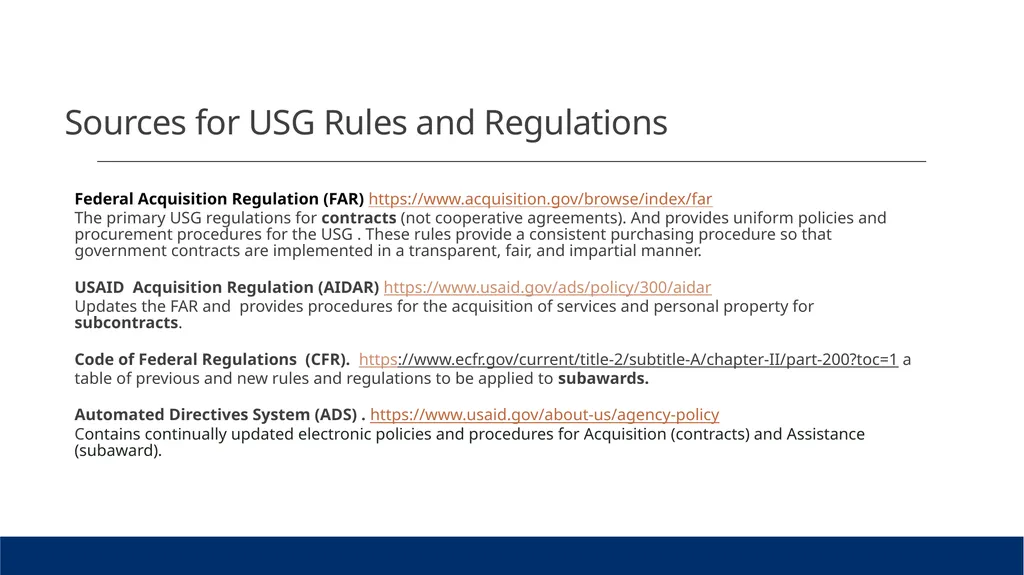
Sources for USG Rules and Regulations Federal Acquisition Regulation (FAR) https://www.acquisition.gov/browse/index/far
The primary USG regulations for contracts (not cooperative agreements). And provides uniform policies and procurement procedures for the USG . These rules provide a consistent purchasing procedure so that government contracts are implemented in a transparent, fair, and impartial manner.
USAID Acquisition Regulation (AIDAR) https://www.usaid.gov/ads/policy/300/aidar
Updates the FAR and provides procedures for the acquisition of services and personal property for subcontracts.
Code of Federal Regulations (CFR). https://www.ecfr.gov/current/title-2/subtitle-A/chapter-II/part-200?toc=1 a table of previous and new rules and regulations to be applied to subawards.
Automated Directives System (ADS) . https://www.usaid.gov/about-us/agency-policy
Contains continually updated electronic policies and procedures for Acquisition (contracts) and Assistance (subaward).<br>
The primary USG regulations for contracts (not cooperative agreements). And provides uniform policies and procurement procedures for the USG . These rules provide a consistent purchasing procedure so that government contracts are implemented in a transparent, fair, and impartial manner.
USAID Acquisition Regulation (AIDAR) https://www.usaid.gov/ads/policy/300/aidar
Updates the FAR and provides procedures for the acquisition of services and personal property for subcontracts.
Code of Federal Regulations (CFR). https://www.ecfr.gov/current/title-2/subtitle-A/chapter-II/part-200?toc=1 a table of previous and new rules and regulations to be applied to subawards.
Automated Directives System (ADS) . https://www.usaid.gov/about-us/agency-policy
Contains continually updated electronic policies and procedures for Acquisition (contracts) and Assistance (subaward).<br>
10
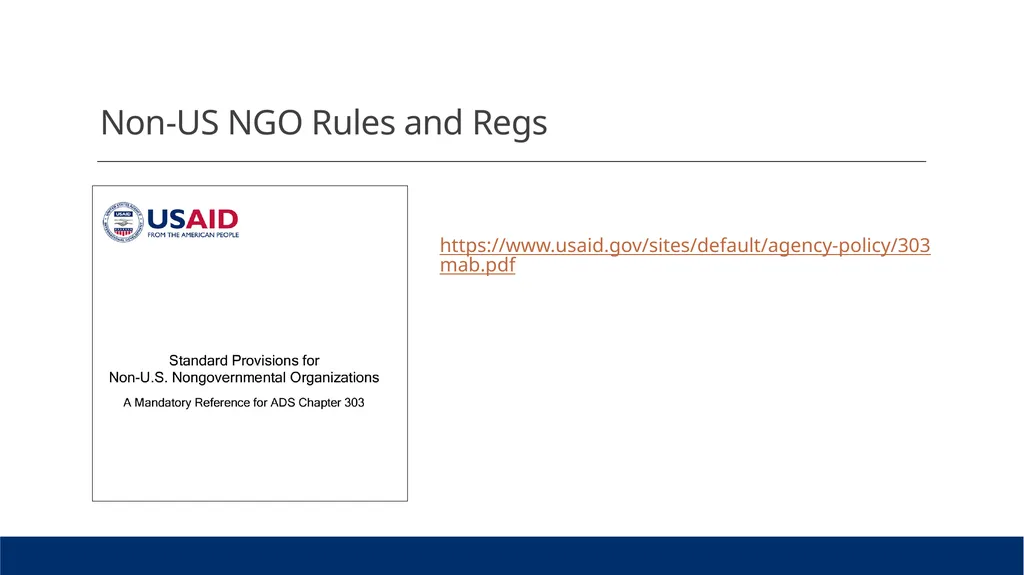
Non-US NGO Rules and Regs https://www.usaid.gov/sites/default/agency-policy/303mab.pdf<br>
11
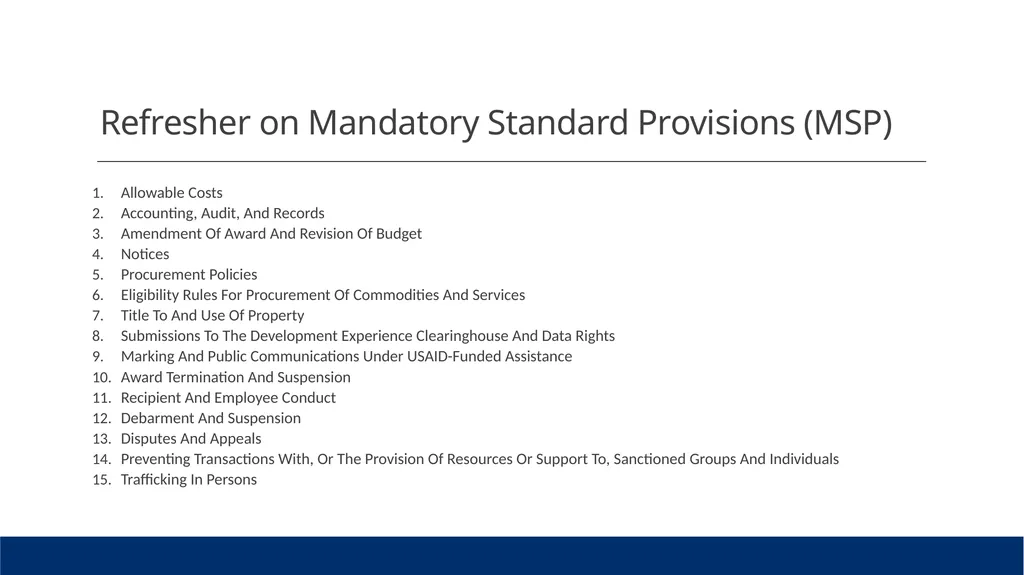
Refresher on Mandatory Standard Provisions (MSP) Allowable Costs
Accounting, Audit, And Records
Amendment Of Award And Revision Of Budget
Notices
Procurement Policies
Eligibility Rules For Procurement Of Commodities And Services
Title To And Use Of Property
Submissions To The Development Experience Clearinghouse And Data Rights
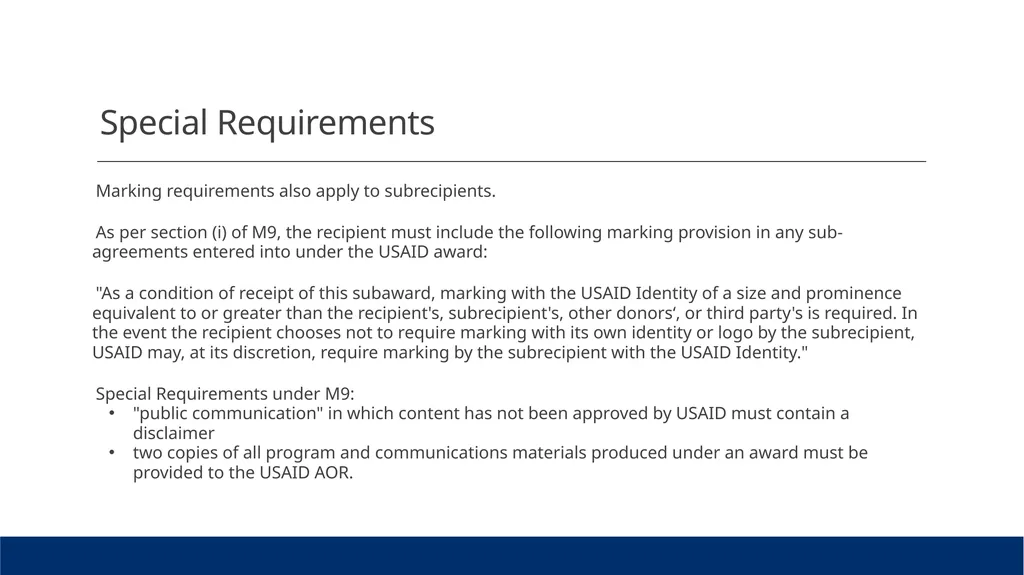
Marking And Public Communications Under USAID-Funded Assistance
Award Termination And Suspension
Recipient And Employee Conduct
Debarment And Suspension
Disputes And Appeals
Preventing Transactions With, Or The Provision Of Resources Or Support To, Sanctioned Groups And Individuals
Trafficking In Persons<br>
Accounting, Audit, And Records
Amendment Of Award And Revision Of Budget
Notices
Procurement Policies
Eligibility Rules For Procurement Of Commodities And Services
Title To And Use Of Property
Submissions To The Development Experience Clearinghouse And Data Rights
Marking And Public Communications Under USAID-Funded Assistance
Award Termination And Suspension
Recipient And Employee Conduct
Debarment And Suspension
Disputes And Appeals
Preventing Transactions With, Or The Provision Of Resources Or Support To, Sanctioned Groups And Individuals
Trafficking In Persons<br>
12
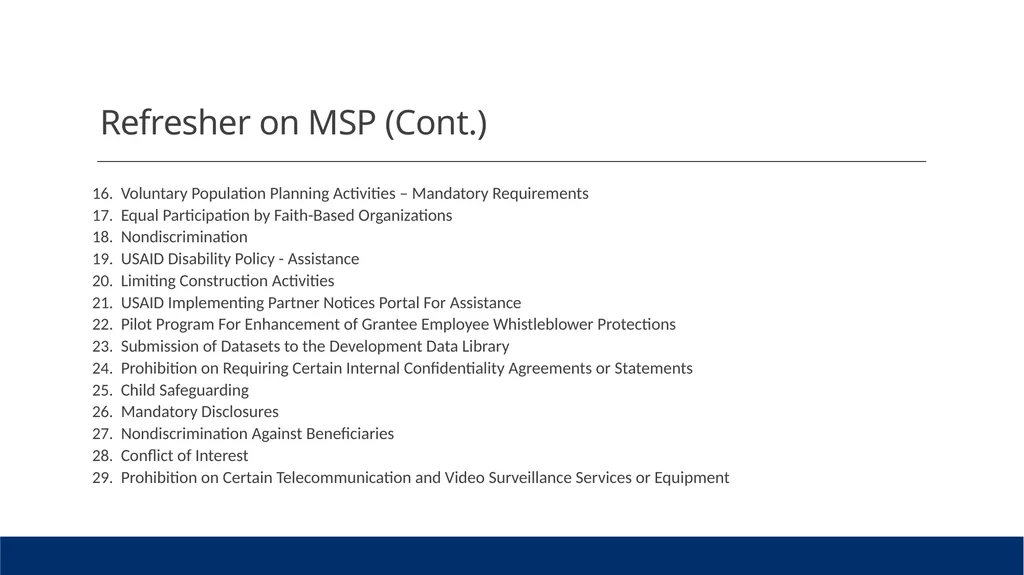
Refresher on MSP (Cont.) Voluntary Population Planning Activities – Mandatory Requirements
Equal Participation by Faith-Based Organizations
Nondiscrimination
USAID Disability Policy - Assistance
Limiting Construction Activities
USAID Implementing Partner Notices Portal For Assistance
Pilot Program For Enhancement of Grantee Employee Whistleblower Protections
Submission of Datasets to the Development Data Library
Prohibition on Requiring Certain Internal Confidentiality Agreements or Statements
Child Safeguarding
Mandatory Disclosures
Nondiscrimination Against Beneficiaries
Conflict of Interest
Prohibition on Certain Telecommunication and Video Surveillance Services or Equipment<br>
Equal Participation by Faith-Based Organizations
Nondiscrimination
USAID Disability Policy - Assistance
Limiting Construction Activities
USAID Implementing Partner Notices Portal For Assistance
Pilot Program For Enhancement of Grantee Employee Whistleblower Protections
Submission of Datasets to the Development Data Library
Prohibition on Requiring Certain Internal Confidentiality Agreements or Statements
Child Safeguarding
Mandatory Disclosures
Nondiscrimination Against Beneficiaries
Conflict of Interest
Prohibition on Certain Telecommunication and Video Surveillance Services or Equipment<br>
13
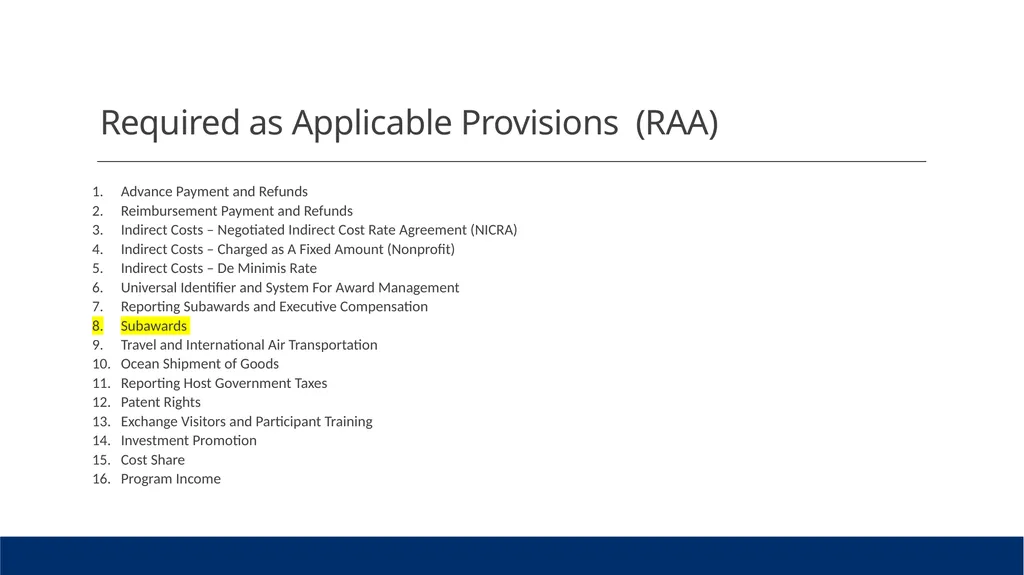
Required as Applicable Provisions (RAA) Advance Payment and Refunds
Reimbursement Payment and Refunds
Indirect Costs – Negotiated Indirect Cost Rate Agreement (NICRA)
Indirect Costs – Charged as A Fixed Amount (Nonprofit)
Indirect Costs – De Minimis Rate
Universal Identifier and System For Award Management
Reporting Subawards and Executive Compensation
Subawards
Travel and International Air Transportation
Ocean Shipment of Goods
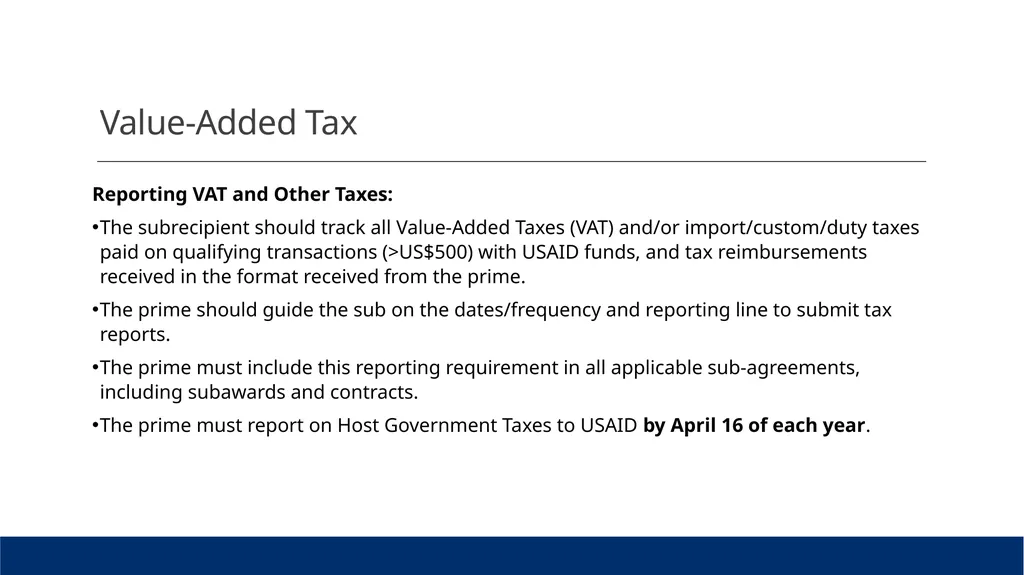
Reporting Host Government Taxes
Patent Rights
Exchange Visitors and Participant Training
Investment Promotion
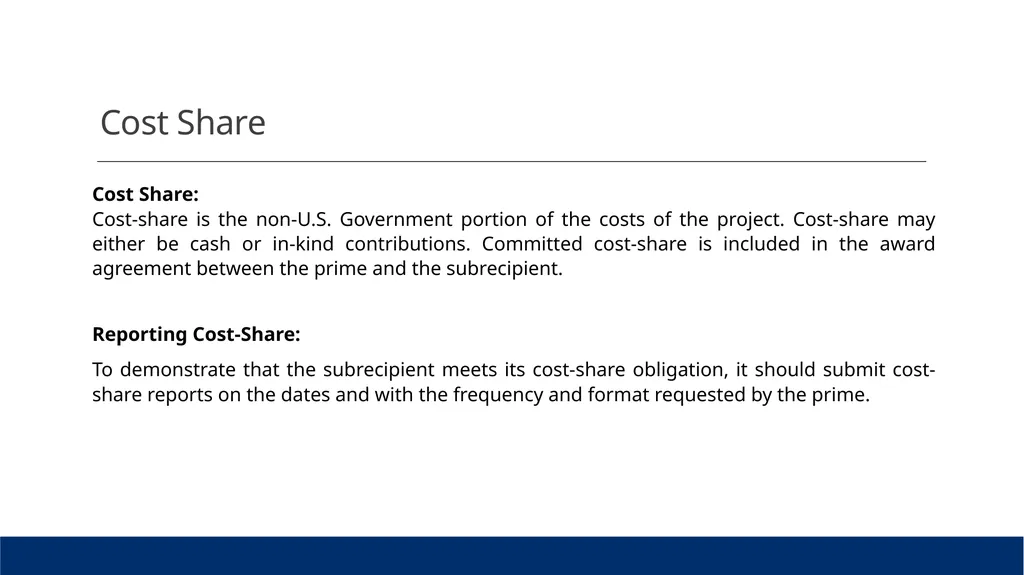
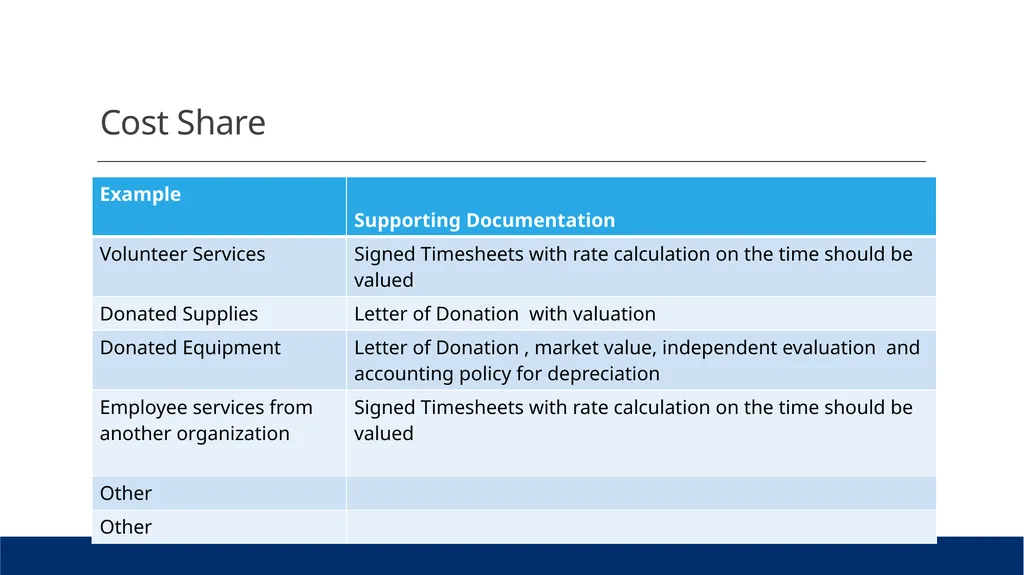
Cost Share
Program Income<br>
Reimbursement Payment and Refunds
Indirect Costs – Negotiated Indirect Cost Rate Agreement (NICRA)
Indirect Costs – Charged as A Fixed Amount (Nonprofit)
Indirect Costs – De Minimis Rate
Universal Identifier and System For Award Management
Reporting Subawards and Executive Compensation
Subawards
Travel and International Air Transportation
Ocean Shipment of Goods
Reporting Host Government Taxes
Patent Rights
Exchange Visitors and Participant Training
Investment Promotion
Cost Share
Program Income<br>
14
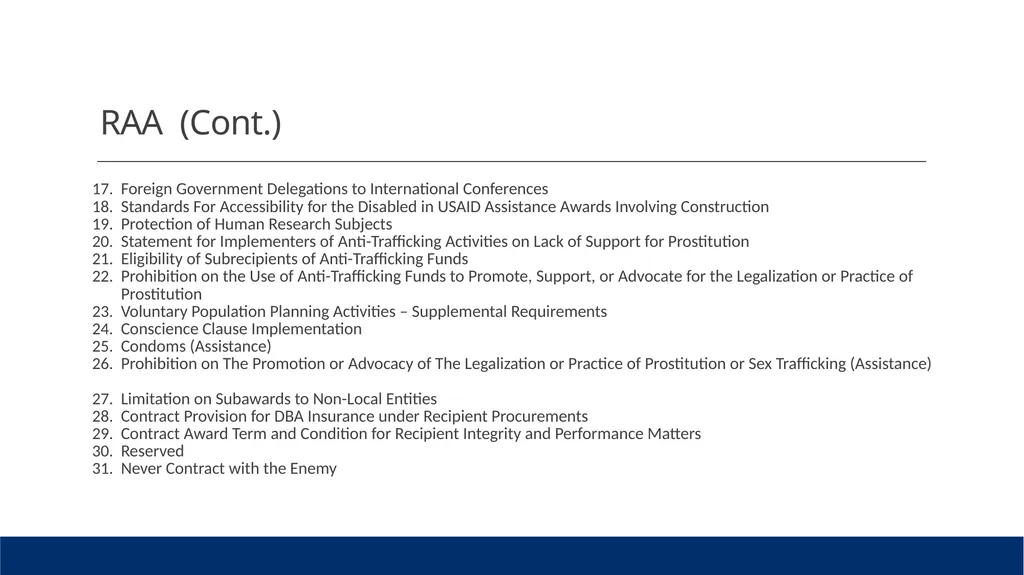
RAA (Cont.) Foreign Government Delegations to International Conferences
Standards For Accessibility for the Disabled in USAID Assistance Awards Involving Construction
Protection of Human Research Subjects
Statement for Implementers of Anti-Trafficking Activities on Lack of Support for Prostitution
Eligibility of Subrecipients of Anti-Trafficking Funds
Prohibition on the Use of Anti-Trafficking Funds to Promote, Support, or Advocate for the Legalization or Practice of Prostitution
Voluntary Population Planning Activities – Supplemental Requirements
Conscience Clause Implementation
Condoms (Assistance)
Prohibition on The Promotion or Advocacy of The Legalization or Practice of Prostitution or Sex Trafficking (Assistance)
Limitation on Subawards to Non-Local Entities
Contract Provision for DBA Insurance under Recipient Procurements
Contract Award Term and Condition for Recipient Integrity and Performance Matters
Reserved
Never Contract with the Enemy<br>
Standards For Accessibility for the Disabled in USAID Assistance Awards Involving Construction
Protection of Human Research Subjects
Statement for Implementers of Anti-Trafficking Activities on Lack of Support for Prostitution
Eligibility of Subrecipients of Anti-Trafficking Funds
Prohibition on the Use of Anti-Trafficking Funds to Promote, Support, or Advocate for the Legalization or Practice of Prostitution
Voluntary Population Planning Activities – Supplemental Requirements
Conscience Clause Implementation
Condoms (Assistance)
Prohibition on The Promotion or Advocacy of The Legalization or Practice of Prostitution or Sex Trafficking (Assistance)
Limitation on Subawards to Non-Local Entities
Contract Provision for DBA Insurance under Recipient Procurements
Contract Award Term and Condition for Recipient Integrity and Performance Matters
Reserved
Never Contract with the Enemy<br>
15
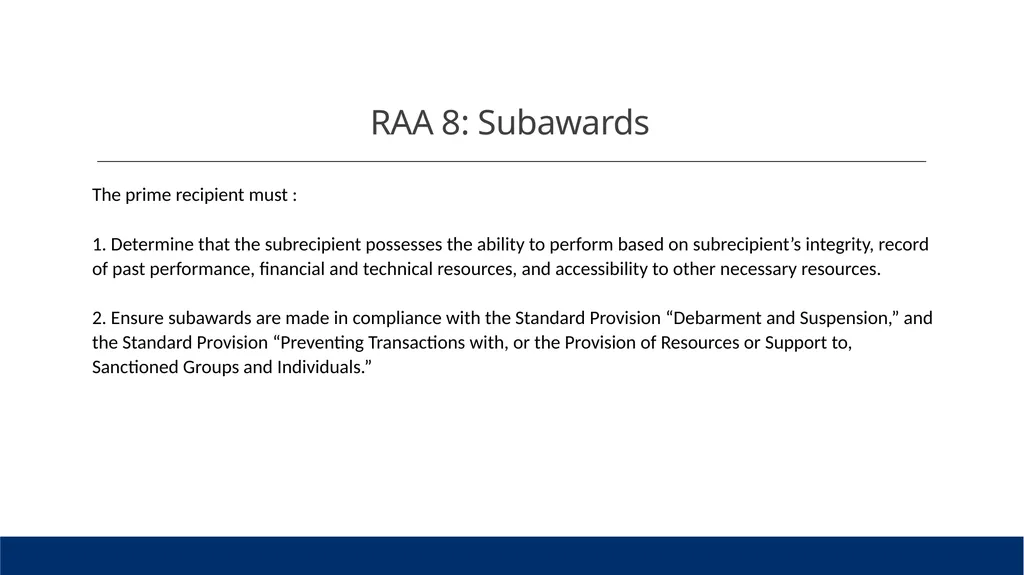
RAA 8: Subawards The prime recipient must :
1. Determine that the subrecipient possesses the ability to perform based on subrecipient’s integrity, record of past performance, financial and technical resources, and accessibility to other necessary resources.
2. Ensure subawards are made in compliance with the Standard Provision “Debarment and Suspension,” and the Standard Provision “Preventing Transactions with, or the Provision of Resources or Support to, Sanctioned Groups and Individuals.”<br>
1. Determine that the subrecipient possesses the ability to perform based on subrecipient’s integrity, record of past performance, financial and technical resources, and accessibility to other necessary resources.
2. Ensure subawards are made in compliance with the Standard Provision “Debarment and Suspension,” and the Standard Provision “Preventing Transactions with, or the Provision of Resources or Support to, Sanctioned Groups and Individuals.”<br>
16
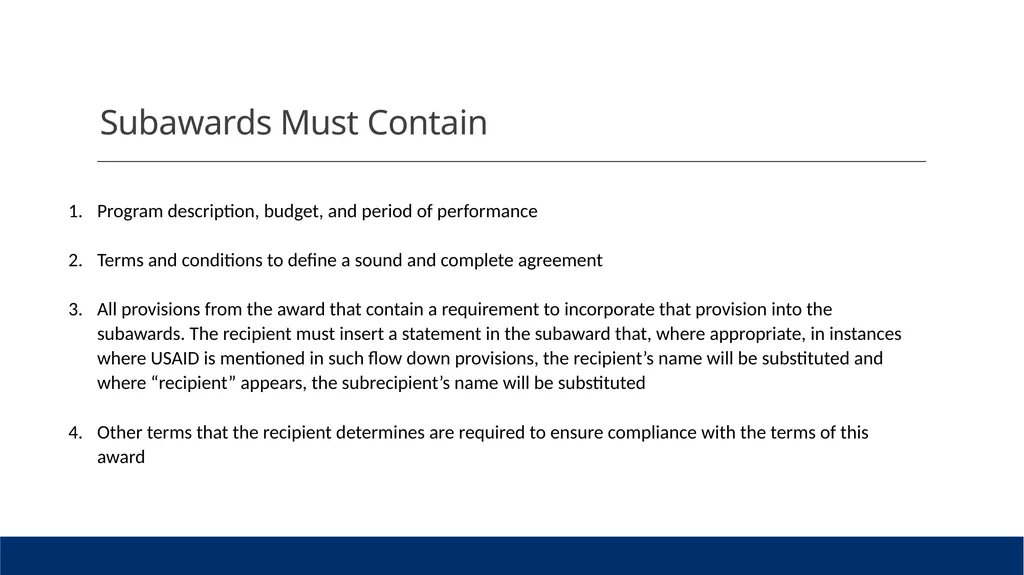
Subawards Must Contain Program description, budget, and period of performance
Terms and conditions to define a sound and complete agreement
All provisions from the award that contain a requirement to incorporate that provision into the subawards. The recipient must insert a statement in the subaward that, where appropriate, in instances where USAID is mentioned in such flow down provisions, the recipient’s name will be substituted and where “recipient” appears, the subrecipient’s name will be substituted
Other terms that the recipient determines are required to ensure compliance with the terms of this award<br>
Terms and conditions to define a sound and complete agreement
All provisions from the award that contain a requirement to incorporate that provision into the subawards. The recipient must insert a statement in the subaward that, where appropriate, in instances where USAID is mentioned in such flow down provisions, the recipient’s name will be substituted and where “recipient” appears, the subrecipient’s name will be substituted
Other terms that the recipient determines are required to ensure compliance with the terms of this award<br>
17
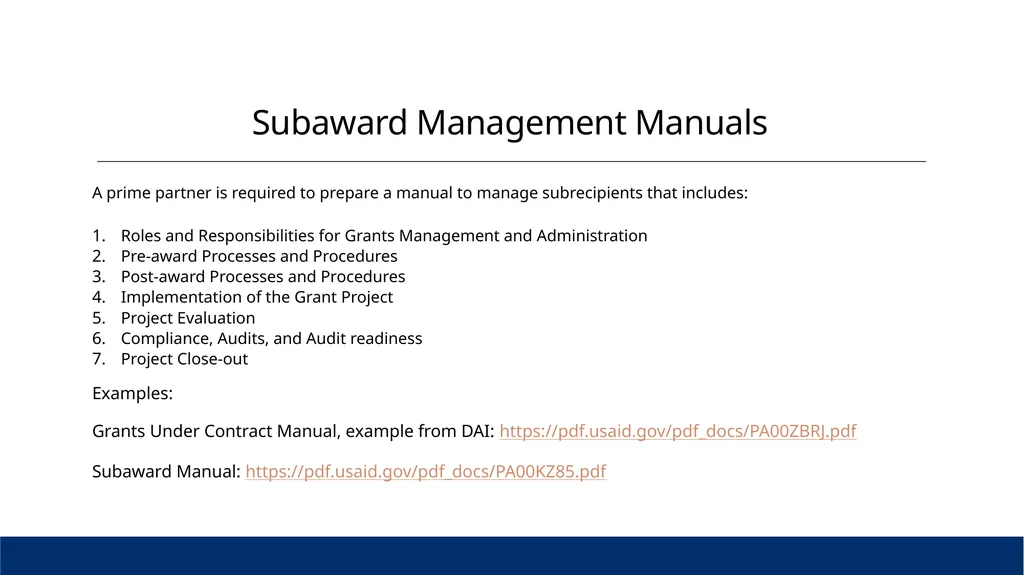
Subaward Management Manuals A prime partner is required to prepare a manual to manage subrecipients that includes:
Roles and Responsibilities for Grants Management and Administration
Pre-award Processes and Procedures
Post-award Processes and Procedures
Implementation of the Grant Project
Project Evaluation
Compliance, Audits, and Audit readiness
Project Close-out
Examples:
Grants Under Contract Manual, example from DAI: https://pdf.usaid.gov/pdf_docs/PA00ZBRJ.pdf
Subaward Manual: https://pdf.usaid.gov/pdf_docs/PA00KZ85.pdf<br>
Roles and Responsibilities for Grants Management and Administration
Pre-award Processes and Procedures
Post-award Processes and Procedures
Implementation of the Grant Project
Project Evaluation
Compliance, Audits, and Audit readiness
Project Close-out
Examples:
Grants Under Contract Manual, example from DAI: https://pdf.usaid.gov/pdf_docs/PA00ZBRJ.pdf
Subaward Manual: https://pdf.usaid.gov/pdf_docs/PA00KZ85.pdf<br>
18
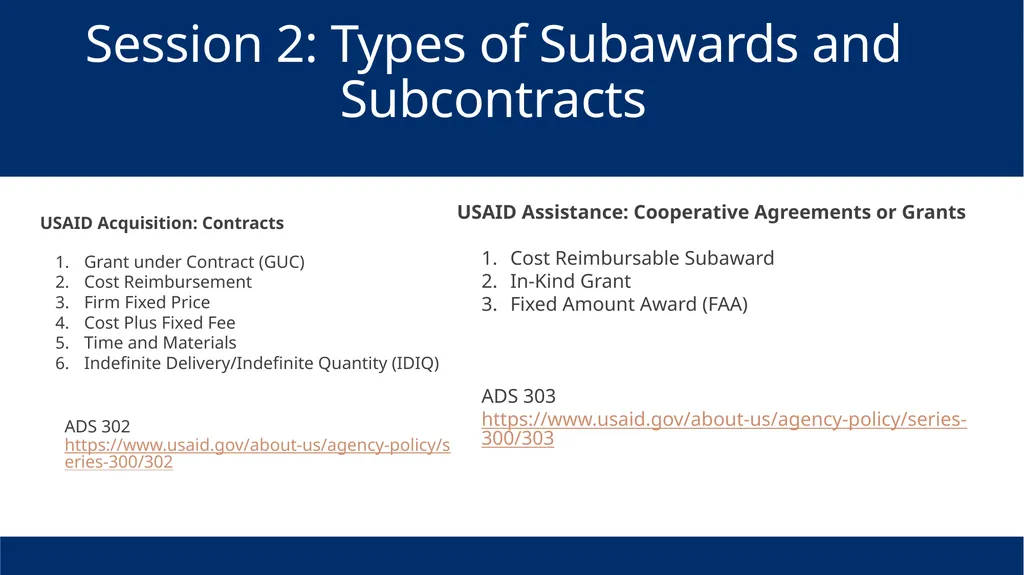
Session 2: Types of Subawards and Subcontracts USAID Assistance: Cooperative Agreements or Grants
Cost Reimbursable Subaward
In-Kind Grant
Fixed Amount Award (FAA)
ADS 303
https://www.usaid.gov/about-us/agency-policy/series-300/303 USAID Acquisition: Contracts
Grant under Contract (GUC)
Cost Reimbursement
Firm Fixed Price
Cost Plus Fixed Fee
Time and Materials
Indefinite Delivery/Indefinite Quantity (IDIQ)
ADS 302
https://www.usaid.gov/about-us/agency-policy/series-300/302<br>
Cost Reimbursable Subaward
In-Kind Grant
Fixed Amount Award (FAA)
ADS 303
https://www.usaid.gov/about-us/agency-policy/series-300/303 USAID Acquisition: Contracts
Grant under Contract (GUC)
Cost Reimbursement
Firm Fixed Price
Cost Plus Fixed Fee
Time and Materials
Indefinite Delivery/Indefinite Quantity (IDIQ)
ADS 302
https://www.usaid.gov/about-us/agency-policy/series-300/302<br>
19
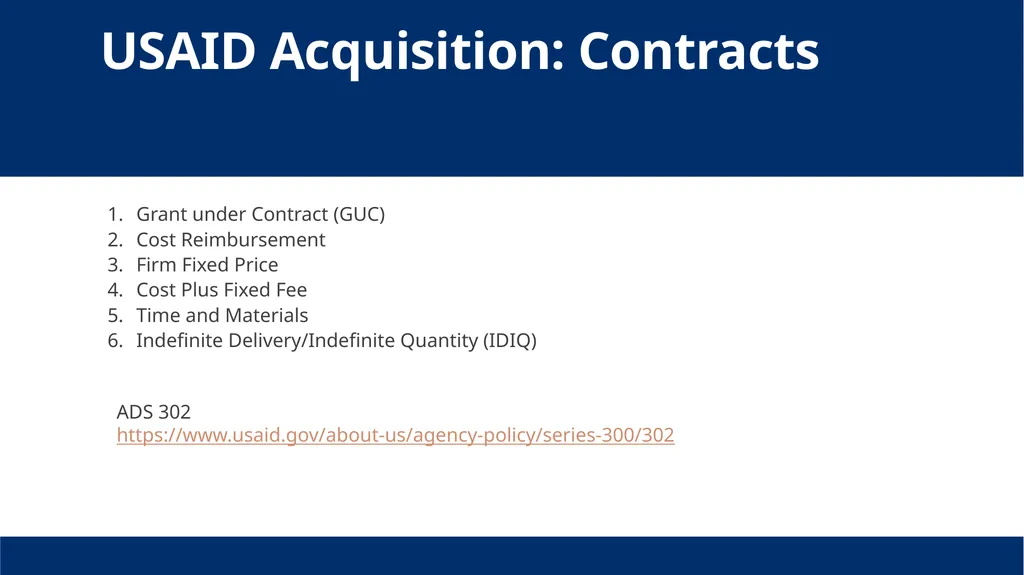
USAID Acquisition: Contracts Grant under Contract (GUC)
Cost Reimbursement
Firm Fixed Price
Cost Plus Fixed Fee
Time and Materials
Indefinite Delivery/Indefinite Quantity (IDIQ)
ADS 302
https://www.usaid.gov/about-us/agency-policy/series-300/302<br>
Cost Reimbursement
Firm Fixed Price
Cost Plus Fixed Fee
Time and Materials
Indefinite Delivery/Indefinite Quantity (IDIQ)
ADS 302
https://www.usaid.gov/about-us/agency-policy/series-300/302<br>
20
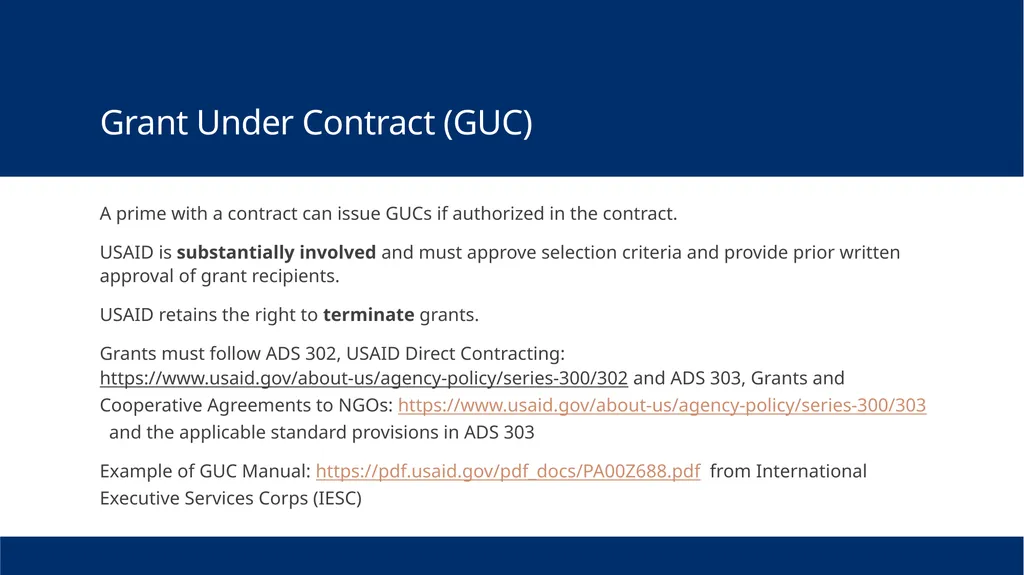
Grant Under Contract (GUC) A prime with a contract can issue GUCs if authorized in the contract.
USAID is substantially involved and must approve selection criteria and provide prior written approval of grant recipients.
USAID retains the right to terminate grants.
Grants must follow ADS 302, USAID Direct Contracting: https://www.usaid.gov/about-us/agency-policy/series-300/302 and ADS 303, Grants and Cooperative Agreements to NGOs: https://www.usaid.gov/about-us/agency-policy/series-300/303 and the applicable standard provisions in ADS 303
Example of GUC Manual: https://pdf.usaid.gov/pdf_docs/PA00Z688.pdf from International Executive Services Corps (IESC)<br>
USAID is substantially involved and must approve selection criteria and provide prior written approval of grant recipients.
USAID retains the right to terminate grants.
Grants must follow ADS 302, USAID Direct Contracting: https://www.usaid.gov/about-us/agency-policy/series-300/302 and ADS 303, Grants and Cooperative Agreements to NGOs: https://www.usaid.gov/about-us/agency-policy/series-300/303 and the applicable standard provisions in ADS 303
Example of GUC Manual: https://pdf.usaid.gov/pdf_docs/PA00Z688.pdf from International Executive Services Corps (IESC)<br>
21
Contracts: Grants Under Contract (GUC) A prime with a contract can issue GUCs if authorized in the contract.
USAID is substantially involved and must approve selection criteria and provide prior written approval of grant recipients.
USAID retains the right to terminate grants.
Grants must follow ADS 302, USAID Direct Contracting: https://www.usaid.gov/about-us/agency-policy/series-300/302 and ADS 303, Grants and Cooperative Agreements to NGOs: https://www.usaid.gov/about-us/agency-policy/series-300/303 and the applicable standard provisions in ADS 303
Example of GUC Manual: https://pdf.usaid.gov/pdf_docs/PA00Z688.pdf from International Executive Services Corps (IESC)<br>
USAID is substantially involved and must approve selection criteria and provide prior written approval of grant recipients.
USAID retains the right to terminate grants.
Grants must follow ADS 302, USAID Direct Contracting: https://www.usaid.gov/about-us/agency-policy/series-300/302 and ADS 303, Grants and Cooperative Agreements to NGOs: https://www.usaid.gov/about-us/agency-policy/series-300/303 and the applicable standard provisions in ADS 303
Example of GUC Manual: https://pdf.usaid.gov/pdf_docs/PA00Z688.pdf from International Executive Services Corps (IESC)<br>
22
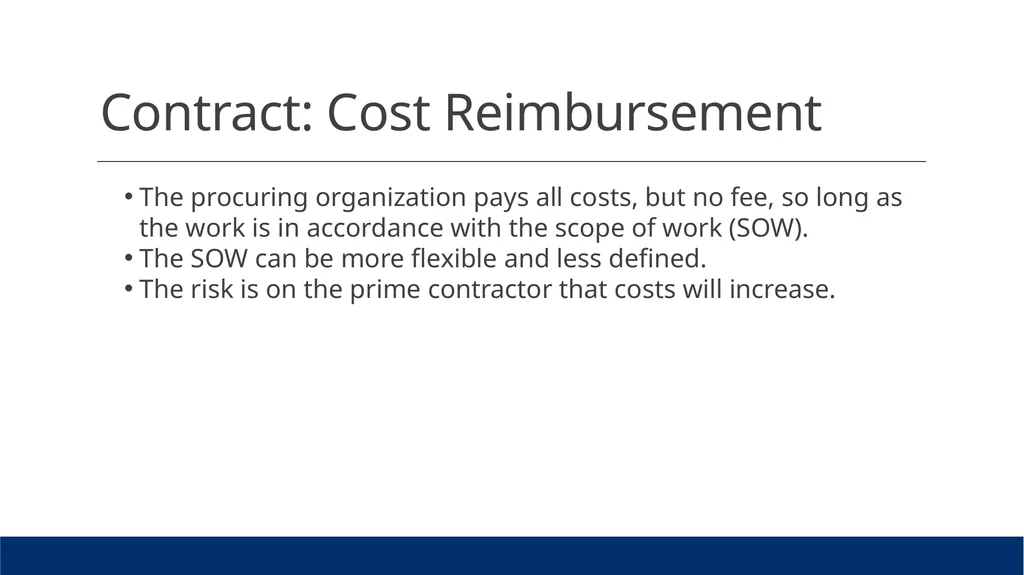
Contract: Cost Reimbursement The procuring organization pays all costs, but no fee, so long as the work is in accordance with the scope of work (SOW).
The SOW can be more flexible and less defined.
The risk is on the prime contractor that costs will increase.<br>
The SOW can be more flexible and less defined.
The risk is on the prime contractor that costs will increase.<br>
23
Contract: Firm Fixed Price Contractor has full responsibility for performance costs and resulting profit (or loss). Most of the risk is on the contractor.
Everybody must agree on fixed price at inception.
Use when deliverables and price can be negotiated with a high degree of certainty.
Deliverables must be completed regardless of cost, even if it is more or less than the contract states.<br>
Everybody must agree on fixed price at inception.
Use when deliverables and price can be negotiated with a high degree of certainty.
Deliverables must be completed regardless of cost, even if it is more or less than the contract states.<br>
24
Example of Firm Fixed Price A vendor has an FFP contract to supply 33 baby scales at $454 a piece totaling $15,000.00
If it costs the vendor $14,000.00 to supply the 33 baby scales, the vendor is still owed the agreed-upon amount of $15,000.00—which means that the vendor will make a profit of $1,000.00.
However, if it costs $20,000.00 to supply 33 baby scales, the vendor will still be paid $15,000.00 because of the FFP that was agreed upon at the inception of the contract.
The risk of an FFP contract is on the vendor.<br>
If it costs the vendor $14,000.00 to supply the 33 baby scales, the vendor is still owed the agreed-upon amount of $15,000.00—which means that the vendor will make a profit of $1,000.00.
However, if it costs $20,000.00 to supply 33 baby scales, the vendor will still be paid $15,000.00 because of the FFP that was agreed upon at the inception of the contract.
The risk of an FFP contract is on the vendor.<br>
25
Contract: Cost Plus Fixed Fee The negotiated fee (profit) is fixed. Negotiate an estimate of the total cost with the vendor.
The risk in using this contract type is on the organization procuring the services because costs may increase.
The contractor will perform against the scope of work (SOW) and will be reimbursed for that work up to a predefined ceiling.<br>
The risk in using this contract type is on the organization procuring the services because costs may increase.
The contractor will perform against the scope of work (SOW) and will be reimbursed for that work up to a predefined ceiling.<br>
26
Contract: Time and Materials Direct labor hours at specified fixed rates (inclusive of indirect expenses and profit); materials or other direct costs at actual cost.
May only be used after a determination that no other contract type is suitable – per 2 CFR 200.318(j)(i).
The contract must include a ceiling price, which the contractor exceeds at their own risk.
Used when there is no requirement for deliverables (best effort to achieve goals on contract).<br>
May only be used after a determination that no other contract type is suitable – per 2 CFR 200.318(j)(i).
The contract must include a ceiling price, which the contractor exceeds at their own risk.
Used when there is no requirement for deliverables (best effort to achieve goals on contract).<br>
27
Contract: IDIQ Indefinite Delivery/Indefinite Quantity (IDIQ)
IDIQs are contracts that do not specify delivery or quantity a the time of award. Work is requested through task orders, which may be issued as fixed price or cost reimbursement type orders.
IDIQs are also sometimes called "Task Orders" or "Delivery Order Contracts." IDIQ contracts are a subtype of the Indefinite Delivery Contract (IDC), which is a "vehicle that has been awarded to one or more vendors to facilitate the delivery of supply and service orders.”
This type of contract provides for an indefinite quantity of supplies or services during a fixed time.
The legal origin of IDIQ contracts is the Federal Acquisition Regulation (FAR) section 16.504(a) (48 CFR 16.504).<br>
IDIQs are contracts that do not specify delivery or quantity a the time of award. Work is requested through task orders, which may be issued as fixed price or cost reimbursement type orders.
IDIQs are also sometimes called "Task Orders" or "Delivery Order Contracts." IDIQ contracts are a subtype of the Indefinite Delivery Contract (IDC), which is a "vehicle that has been awarded to one or more vendors to facilitate the delivery of supply and service orders.”
This type of contract provides for an indefinite quantity of supplies or services during a fixed time.
The legal origin of IDIQ contracts is the Federal Acquisition Regulation (FAR) section 16.504(a) (48 CFR 16.504).<br>
28
USAID Assistance: Cooperative Agreements or Grants Cost Reimbursable Subaward
In-Kind Grant
Fixed Amount Award (FAA)
ADS 303
https://www.usaid.gov/about-us/agency-policy/series-300/303<br>
In-Kind Grant
Fixed Amount Award (FAA)
ADS 303
https://www.usaid.gov/about-us/agency-policy/series-300/303<br>
29
Cooperative Agreement or Grant:
Cost Reimbursable Subaward Cost reimbursable subaward is a standard subaward under which the subrecipient is reimbursed for the amount expended to carry out its scope of work.
The total estimated amount is for the life of a project.
The total obligated amount is the amount of funding available to the subrecipient to spend.
Financial and programmatic reports are required at a frequency determined by the prime.<br>
The total estimated amount is for the life of a project.
The total obligated amount is the amount of funding available to the subrecipient to spend.
Financial and programmatic reports are required at a frequency determined by the prime.<br>
30
Cooperative Agreement or Grant:
In Kind Grant In-Kind Grants are a type of subaward that provide for the transfer of in-kind goods and services from the prime to the subrecipient.
They are non-cash subawards but must be set up and monitored according to the requirements set forth in the procedures.
In-kind good and services must not be transferred until the in-kind grant is fully executed.
Financial reports are not required.<br>
They are non-cash subawards but must be set up and monitored according to the requirements set forth in the procedures.
In-kind good and services must not be transferred until the in-kind grant is fully executed.
Financial reports are not required.<br>
31
Cooperative Agreement or Grant: Fixed Amount Award (FAA) Fixed Amount Awards are used for very specific program elements and do not require the prime to monitor actual costs incurred, as all costs are covered on a benchmarked reimbursement basis. ADS 303.3.25 states that an FAA is appropriate when supporting a specific project and when the prime is confident that a reasonable estimate of the actual cost of the effort can be established, and that clear milestones can be defined.
Must not exceed $250,000 USD.
Payments and milestones can be divided into smaller units.
Payments are made upon completion and documentation of the milestone.<br>
Must not exceed $250,000 USD.
Payments and milestones can be divided into smaller units.
Payments are made upon completion and documentation of the milestone.<br>
32
Sole Source If the project requires performance from a single source because the services or expertise needed are not available from other sources, the prime must justify that sole source by identifying the need for the specific services and why the selected subcontractor is the only source available to fulfill them.
The justification should include:
Specific description of the supplies or services required/needed.
Statement of facts that show unique qualifications of subcontractor to meet those needs.
A description of why the anticipated costs are fair and reasonable.
Any other information supporting the justification of sole source.<br>
The justification should include:
Specific description of the supplies or services required/needed.
Statement of facts that show unique qualifications of subcontractor to meet those needs.
A description of why the anticipated costs are fair and reasonable.
Any other information supporting the justification of sole source.<br>
33
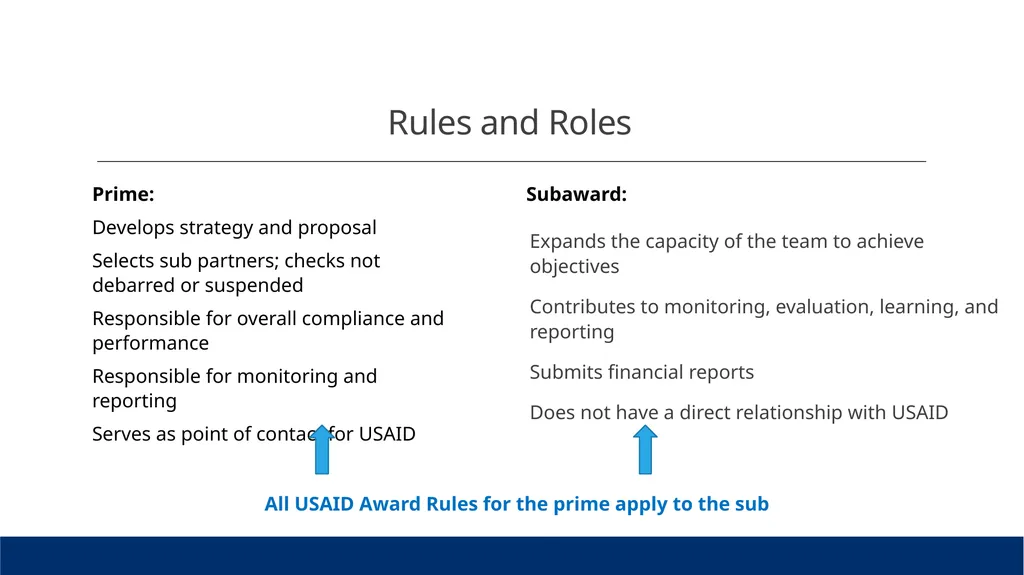
Rules and Roles Prime:
Develops strategy and proposal
Selects sub partners; checks not debarred or suspended
Responsible for overall compliance and performance
Responsible for monitoring and reporting
Serves as point of contact for USAID Subaward:
Expands the capacity of the team to achieve objectives
Contributes to monitoring, evaluation, learning, and reporting
Submits financial reports
Does not have a direct relationship with USAID All USAID Award Rules for the prime apply to the sub<br>
Develops strategy and proposal
Selects sub partners; checks not debarred or suspended
Responsible for overall compliance and performance
Responsible for monitoring and reporting
Serves as point of contact for USAID Subaward:
Expands the capacity of the team to achieve objectives
Contributes to monitoring, evaluation, learning, and reporting
Submits financial reports
Does not have a direct relationship with USAID All USAID Award Rules for the prime apply to the sub<br>
34
Do NOT use a subaward when… 1. The agreement provides for goods or services within normal business operations
2. The organization/business provides similar goods or services to many different purchasers
3. The organization/business operates in a competitive environment to procure the goods or services
4. Providing goods or services are ancillary to the operations of the funding agency, or the organization/business is not subject to the requirements of the funding agency<br>
2. The organization/business provides similar goods or services to many different purchasers
3. The organization/business operates in a competitive environment to procure the goods or services
4. Providing goods or services are ancillary to the operations of the funding agency, or the organization/business is not subject to the requirements of the funding agency<br>
35
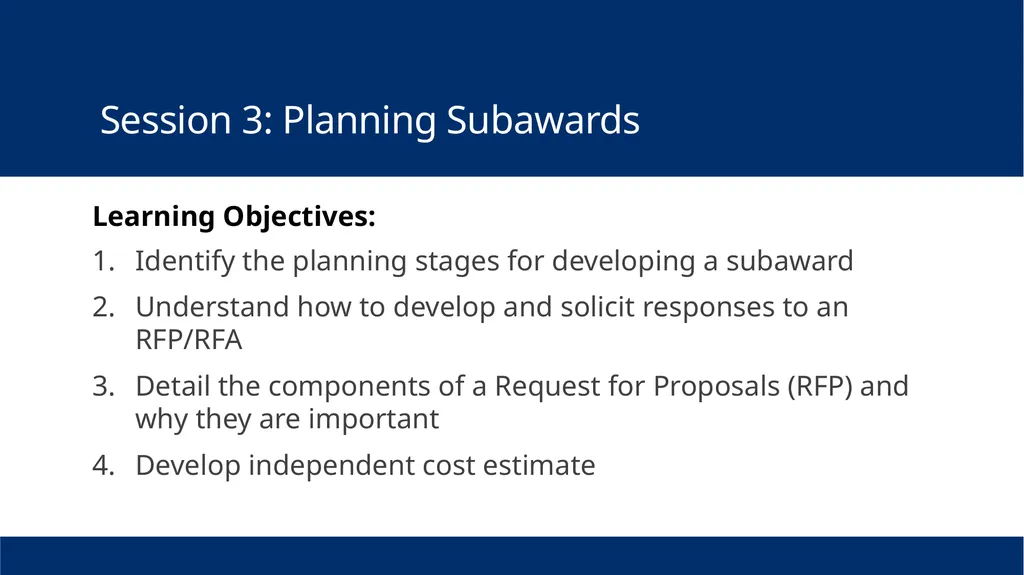
Session 3: Planning Subawards Learning Objectives:
Identify the planning stages for developing a subaward
Understand how to develop and solicit responses to an RFP/RFA
Detail the components of a Request for Proposals (RFP) and why they are important
Develop independent cost estimate<br>
Identify the planning stages for developing a subaward
Understand how to develop and solicit responses to an RFP/RFA
Detail the components of a Request for Proposals (RFP) and why they are important
Develop independent cost estimate<br>
36
Planning
Factors for Consideration
Competitive or Non-Competitive
RFP Planning Stages
RFP Planning Timeline
Steps to Prepare the RFP
Recommended Sections in an RFP
RFP Sections
Budget for RFP Session 3: Topics<br>
Factors for Consideration
Competitive or Non-Competitive
RFP Planning Stages
RFP Planning Timeline
Steps to Prepare the RFP
Recommended Sections in an RFP
RFP Sections
Budget for RFP Session 3: Topics<br>
37
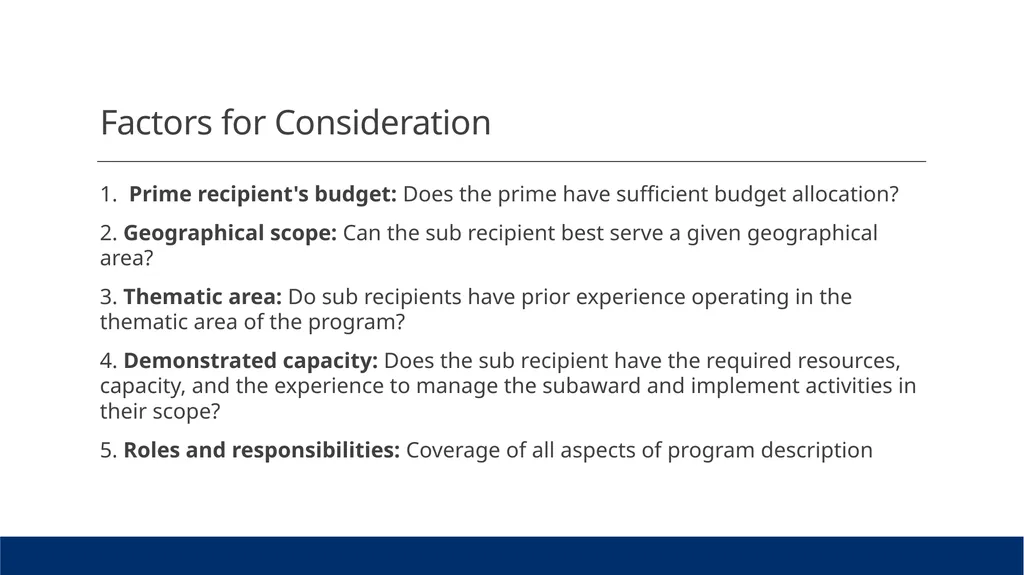
Factors for Consideration 1. Prime recipient's budget: Does the prime have sufficient budget allocation?
2. Geographical scope: Can the sub recipient best serve a given geographical area?
3. Thematic area: Do sub recipients have prior experience operating in the thematic area of the program?
4. Demonstrated capacity: Does the sub recipient have the required resources, capacity, and the experience to manage the subaward and implement activities in their scope?
5. Roles and responsibilities: Coverage of all aspects of program description<br>
2. Geographical scope: Can the sub recipient best serve a given geographical area?
3. Thematic area: Do sub recipients have prior experience operating in the thematic area of the program?
4. Demonstrated capacity: Does the sub recipient have the required resources, capacity, and the experience to manage the subaward and implement activities in their scope?
5. Roles and responsibilities: Coverage of all aspects of program description<br>
38
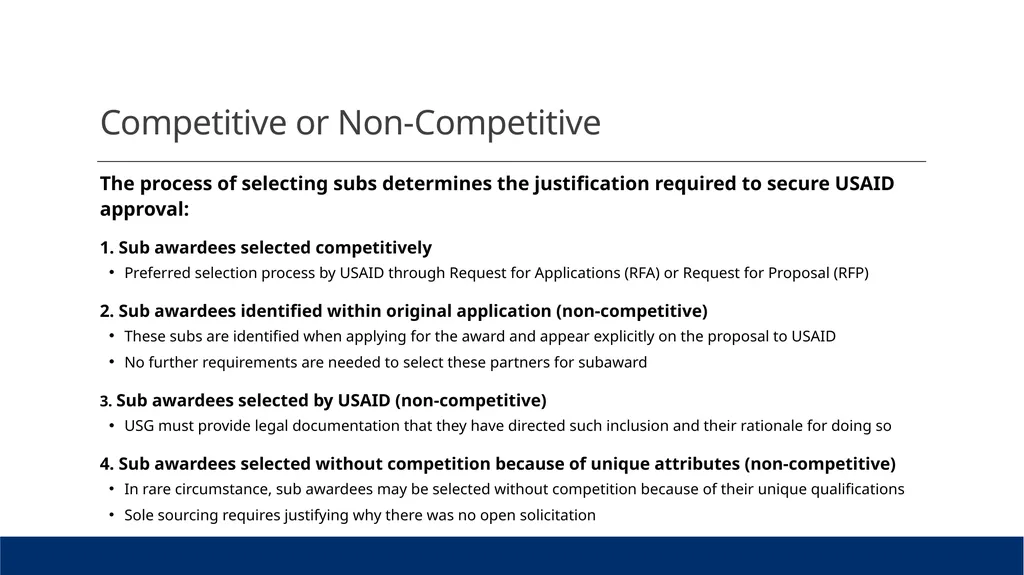
Competitive or Non-Competitive The process of selecting subs determines the justification required to secure USAID approval:
1. Sub awardees selected competitively
Preferred selection process by USAID through Request for Applications (RFA) or Request for Proposal (RFP)
2. Sub awardees identified within original application (non-competitive)
These subs are identified when applying for the award and appear explicitly on the proposal to USAID
No further requirements are needed to select these partners for subaward
3. Sub awardees selected by USAID (non-competitive)
USG must provide legal documentation that they have directed such inclusion and their rationale for doing so
4. Sub awardees selected without competition because of unique attributes (non-competitive)
In rare circumstance, sub awardees may be selected without competition because of their unique qualifications
Sole sourcing requires justifying why there was no open solicitation<br>
1. Sub awardees selected competitively
Preferred selection process by USAID through Request for Applications (RFA) or Request for Proposal (RFP)
2. Sub awardees identified within original application (non-competitive)
These subs are identified when applying for the award and appear explicitly on the proposal to USAID
No further requirements are needed to select these partners for subaward
3. Sub awardees selected by USAID (non-competitive)
USG must provide legal documentation that they have directed such inclusion and their rationale for doing so
4. Sub awardees selected without competition because of unique attributes (non-competitive)
In rare circumstance, sub awardees may be selected without competition because of their unique qualifications
Sole sourcing requires justifying why there was no open solicitation<br>
39
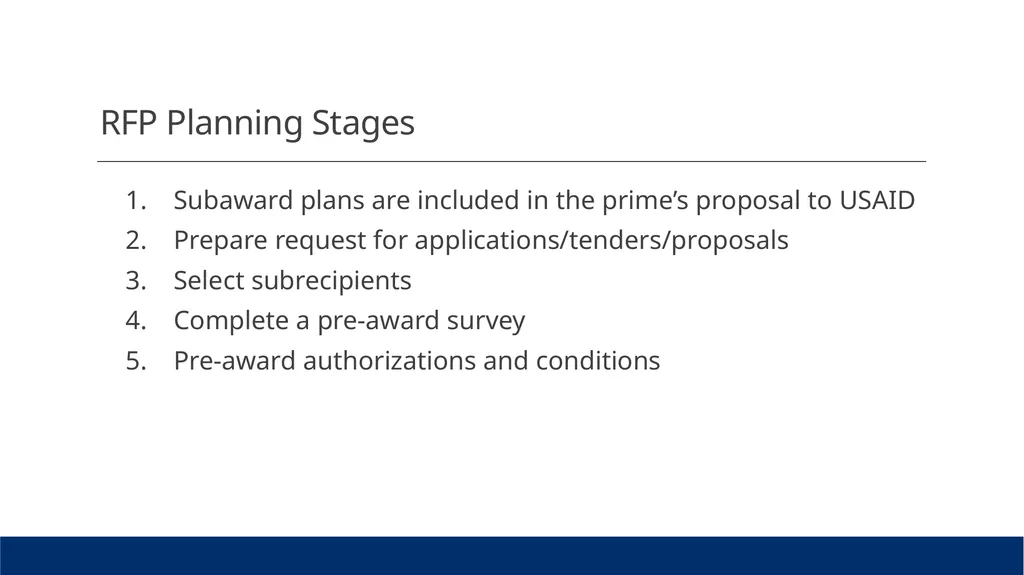
RFP Planning Stages Subaward plans are included in the prime’s proposal to USAID
Prepare request for applications/tenders/proposals
Select subrecipients
Complete a pre-award survey
Pre-award authorizations and conditions<br>
Prepare request for applications/tenders/proposals
Select subrecipients
Complete a pre-award survey
Pre-award authorizations and conditions<br>
40
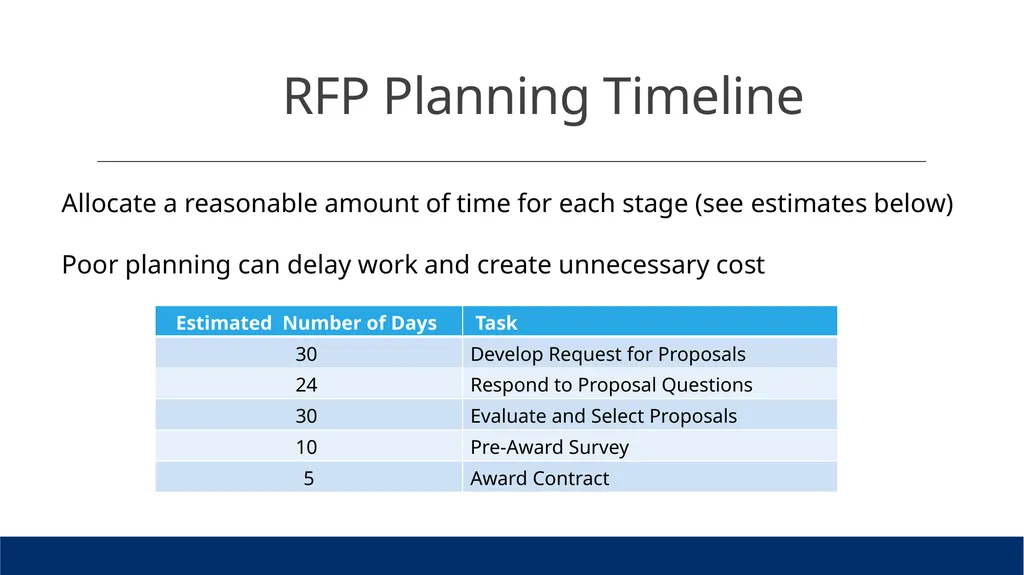
RFP Planning Timeline Allocate a reasonable amount of time for each stage (see estimates below)
Poor planning can delay work and create unnecessary cost<br>
Poor planning can delay work and create unnecessary cost<br>
41
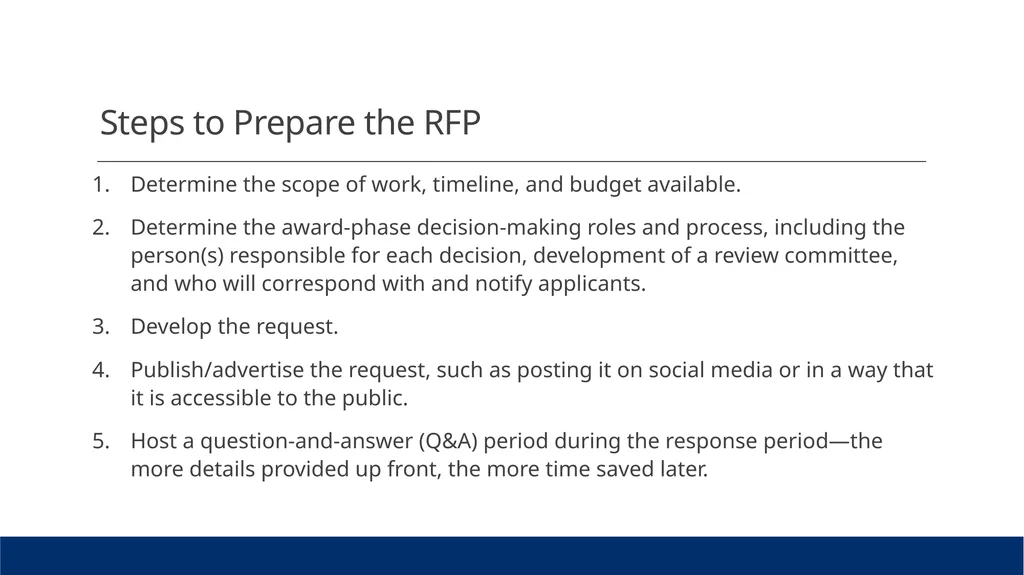
Steps to Prepare the RFP Determine the scope of work, timeline, and budget available.
Determine the award-phase decision-making roles and process, including the person(s) responsible for each decision, development of a review committee, and who will correspond with and notify applicants.
Develop the request.
Publish/advertise the request, such as posting it on social media or in a way that it is accessible to the public.
Host a question-and-answer (Q&A) period during the response period—the more details provided up front, the more time saved later.<br>
Determine the award-phase decision-making roles and process, including the person(s) responsible for each decision, development of a review committee, and who will correspond with and notify applicants.
Develop the request.
Publish/advertise the request, such as posting it on social media or in a way that it is accessible to the public.
Host a question-and-answer (Q&A) period during the response period—the more details provided up front, the more time saved later.<br>
42
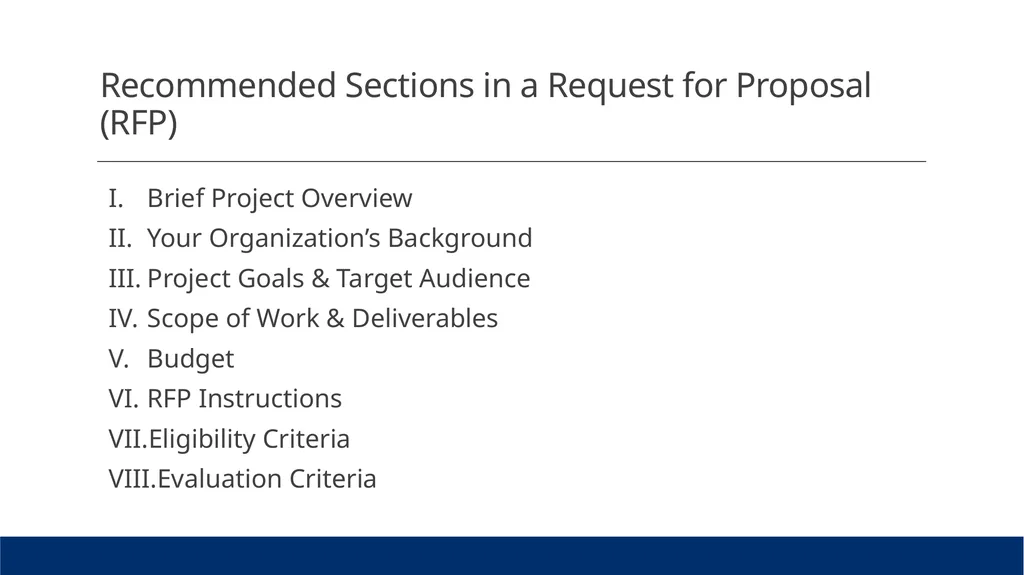
Recommended Sections in a Request for Proposal (RFP) Brief Project Overview
Your Organization’s Background
Project Goals & Target Audience
Scope of Work & Deliverables
Budget
RFP Instructions
Eligibility Criteria
Evaluation Criteria<br>
Your Organization’s Background
Project Goals & Target Audience
Scope of Work & Deliverables
Budget
RFP Instructions
Eligibility Criteria
Evaluation Criteria<br>
43
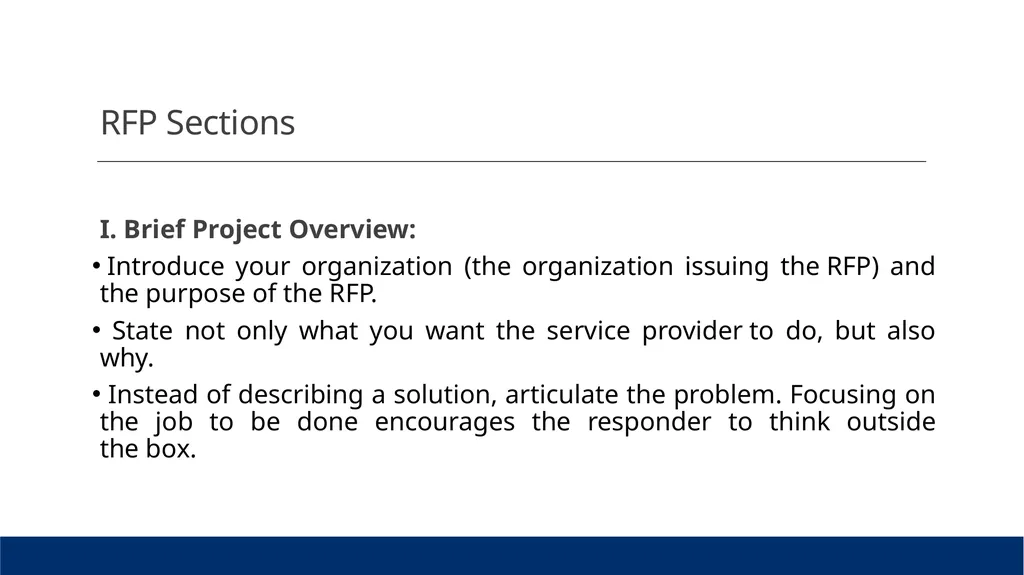
RFP Sections I. Brief Project Overview:
Introduce your organization (the organization issuing the RFP) and the purpose of the RFP.
State not only what you want the service provider to do, but also why.
Instead of describing a solution, articulate the problem. Focusing on the job to be done encourages the responder to think outside the box.<br>
Introduce your organization (the organization issuing the RFP) and the purpose of the RFP.
State not only what you want the service provider to do, but also why.
Instead of describing a solution, articulate the problem. Focusing on the job to be done encourages the responder to think outside the box.<br>
44
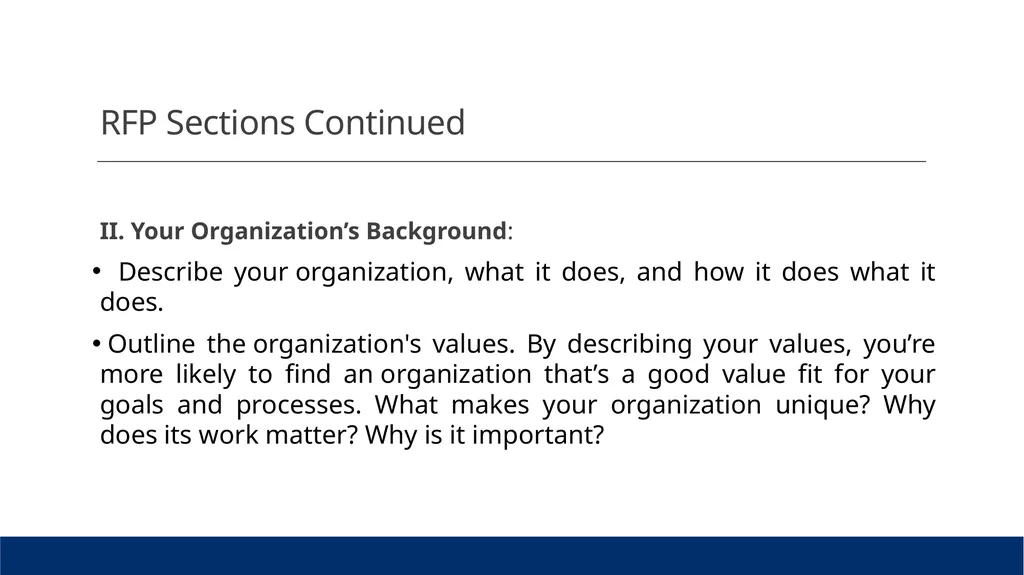
RFP Sections Continued II. Your Organization’s Background:
Describe your organization, what it does, and how it does what it does.
Outline the organization's values. By describing your values, you’re more likely to find an organization that’s a good value fit for your goals and processes. What makes your organization unique? Why does its work matter? Why is it important?<br>
Describe your organization, what it does, and how it does what it does.
Outline the organization's values. By describing your values, you’re more likely to find an organization that’s a good value fit for your goals and processes. What makes your organization unique? Why does its work matter? Why is it important?<br>
45
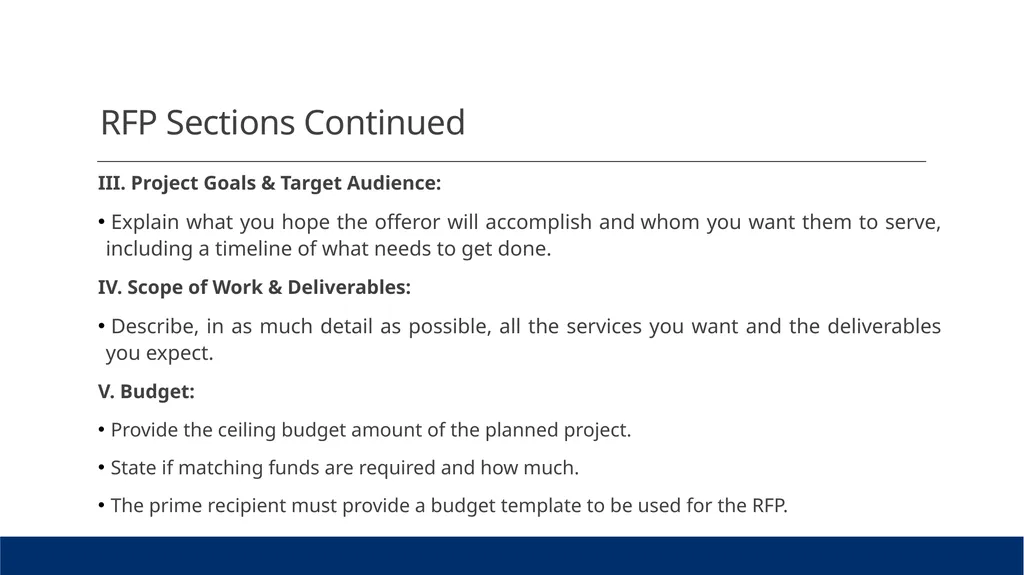
RFP Sections Continued III. Project Goals & Target Audience:
Explain what you hope the offeror will accomplish and whom you want them to serve, including a timeline of what needs to get done.
IV. Scope of Work & Deliverables:
Describe, in as much detail as possible, all the services you want and the deliverables you expect.
V. Budget:
Provide the ceiling budget amount of the planned project.
State if matching funds are required and how much.
The prime recipient must provide a budget template to be used for the RFP.<br>
Explain what you hope the offeror will accomplish and whom you want them to serve, including a timeline of what needs to get done.
IV. Scope of Work & Deliverables:
Describe, in as much detail as possible, all the services you want and the deliverables you expect.
V. Budget:
Provide the ceiling budget amount of the planned project.
State if matching funds are required and how much.
The prime recipient must provide a budget template to be used for the RFP.<br>
46
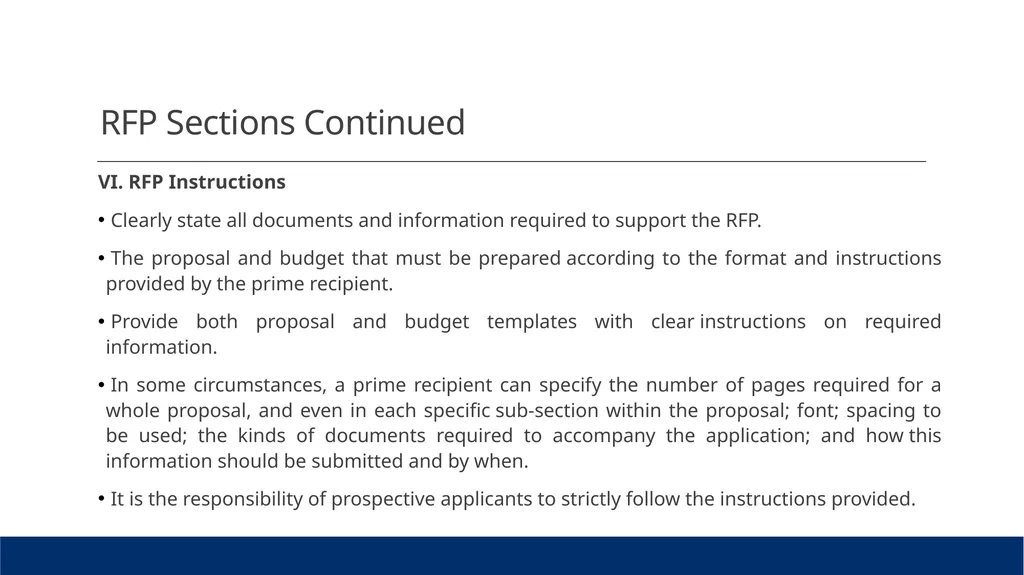
RFP Sections Continued VI. RFP Instructions
Clearly state all documents and information required to support the RFP.
The proposal and budget that must be prepared according to the format and instructions provided by the prime recipient.
Provide both proposal and budget templates with clear instructions on required information.
In some circumstances, a prime recipient can specify the number of pages required for a whole proposal, and even in each specific sub-section within the proposal; font; spacing to be used; the kinds of documents required to accompany the application; and how this information should be submitted and by when.
It is the responsibility of prospective applicants to strictly follow the instructions provided.<br>
Clearly state all documents and information required to support the RFP.
The proposal and budget that must be prepared according to the format and instructions provided by the prime recipient.
Provide both proposal and budget templates with clear instructions on required information.
In some circumstances, a prime recipient can specify the number of pages required for a whole proposal, and even in each specific sub-section within the proposal; font; spacing to be used; the kinds of documents required to accompany the application; and how this information should be submitted and by when.
It is the responsibility of prospective applicants to strictly follow the instructions provided.<br>
47
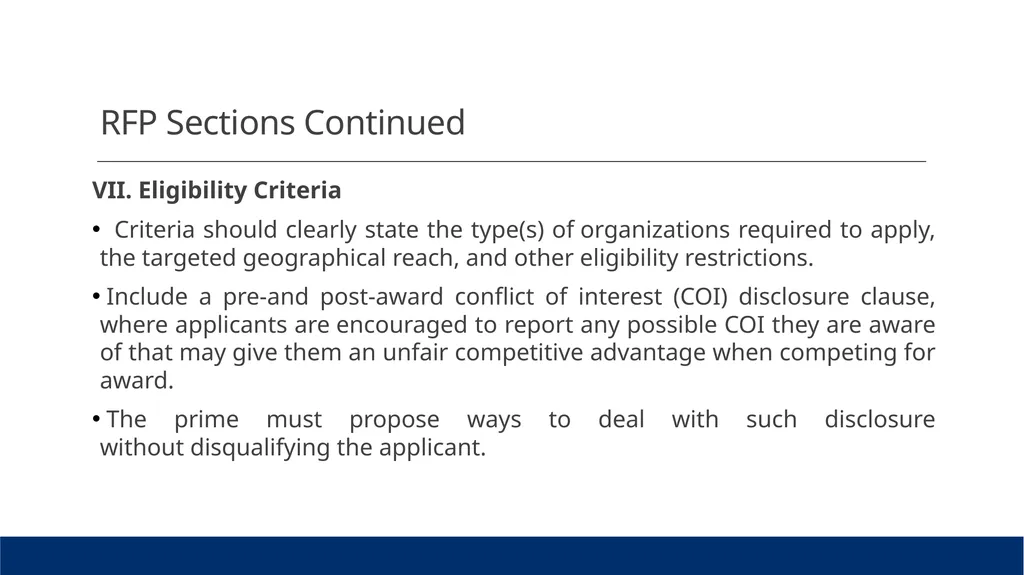
RFP Sections Continued VII. Eligibility Criteria
Criteria should clearly state the type(s) of organizations required to apply, the targeted geographical reach, and other eligibility restrictions.
Include a pre-and post-award conflict of interest (COI) disclosure clause, where applicants are encouraged to report any possible COI they are aware of that may give them an unfair competitive advantage when competing for award.
The prime must propose ways to deal with such disclosure without disqualifying the applicant.<br>
Criteria should clearly state the type(s) of organizations required to apply, the targeted geographical reach, and other eligibility restrictions.
Include a pre-and post-award conflict of interest (COI) disclosure clause, where applicants are encouraged to report any possible COI they are aware of that may give them an unfair competitive advantage when competing for award.
The prime must propose ways to deal with such disclosure without disqualifying the applicant.<br>
48
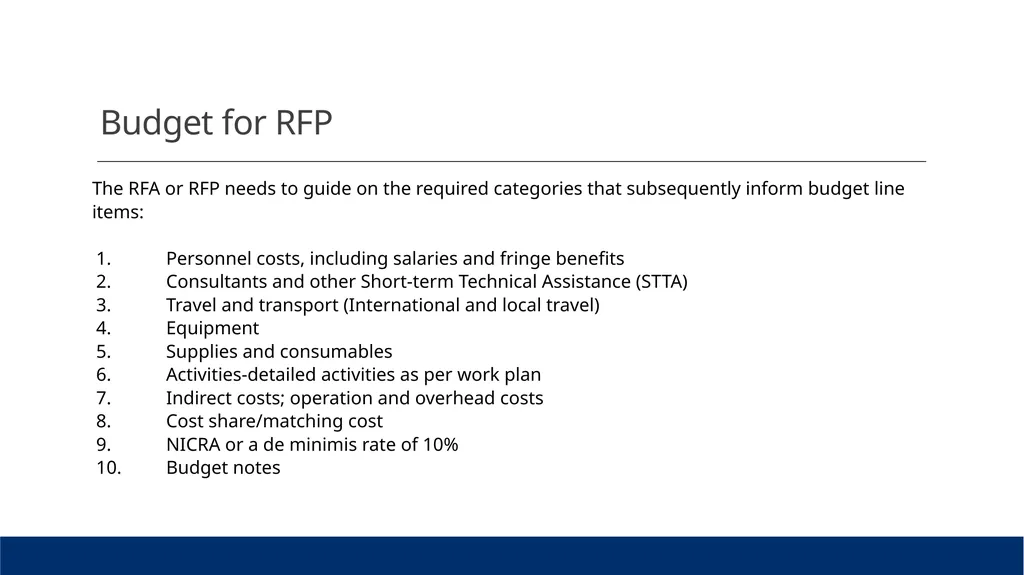
Budget for RFP The RFA or RFP needs to guide on the required categories that subsequently inform budget line items:
1. Personnel costs, including salaries and fringe benefits
2. Consultants and other Short-term Technical Assistance (STTA)
3. Travel and transport (International and local travel)
4. Equipment
5. Supplies and consumables
6. Activities-detailed activities as per work plan
7. Indirect costs; operation and overhead costs
8. Cost share/matching cost
9. NICRA or a de minimis rate of 10%
10. Budget notes<br>
1. Personnel costs, including salaries and fringe benefits
2. Consultants and other Short-term Technical Assistance (STTA)
3. Travel and transport (International and local travel)
4. Equipment
5. Supplies and consumables
6. Activities-detailed activities as per work plan
7. Indirect costs; operation and overhead costs
8. Cost share/matching cost
9. NICRA or a de minimis rate of 10%
10. Budget notes<br>
49
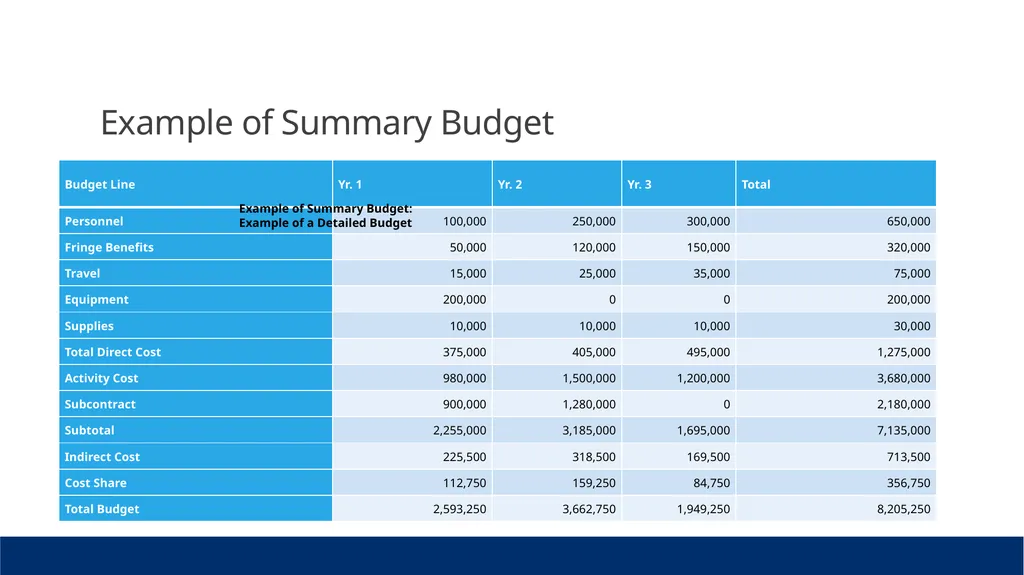
Example of Summary Budget Example of Summary Budget:
Example of a Detailed Budget<br>
Example of a Detailed Budget<br>
50
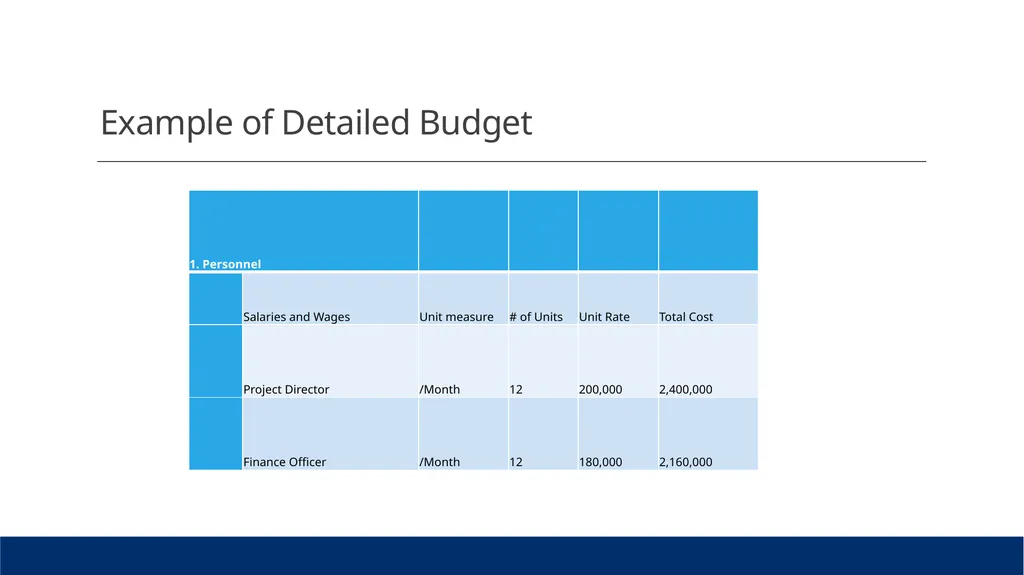
Example of Detailed Budget<br>
51
Budget Notes Example of Budget Notes:
SALARIES AND WAGES
Briefly summarize the role, description, and level of effort for each position proposed on the project, including any that may be based at regional offices.
FRINGE BENEFITS
If a fringe benefit rate has not been so approved, the offeror must propose a rate, and the budget narrative must explain how the rate was determined and provide detailed breakdown comprised of all items of fringe benefits (e.g., unemployment insurance, workers compensation, health and life insurance, retirement, FICA, etc.) and the costs of each, expressed in dollars and as a percentage of salaries.<br>
SALARIES AND WAGES
Briefly summarize the role, description, and level of effort for each position proposed on the project, including any that may be based at regional offices.
FRINGE BENEFITS
If a fringe benefit rate has not been so approved, the offeror must propose a rate, and the budget narrative must explain how the rate was determined and provide detailed breakdown comprised of all items of fringe benefits (e.g., unemployment insurance, workers compensation, health and life insurance, retirement, FICA, etc.) and the costs of each, expressed in dollars and as a percentage of salaries.<br>
52
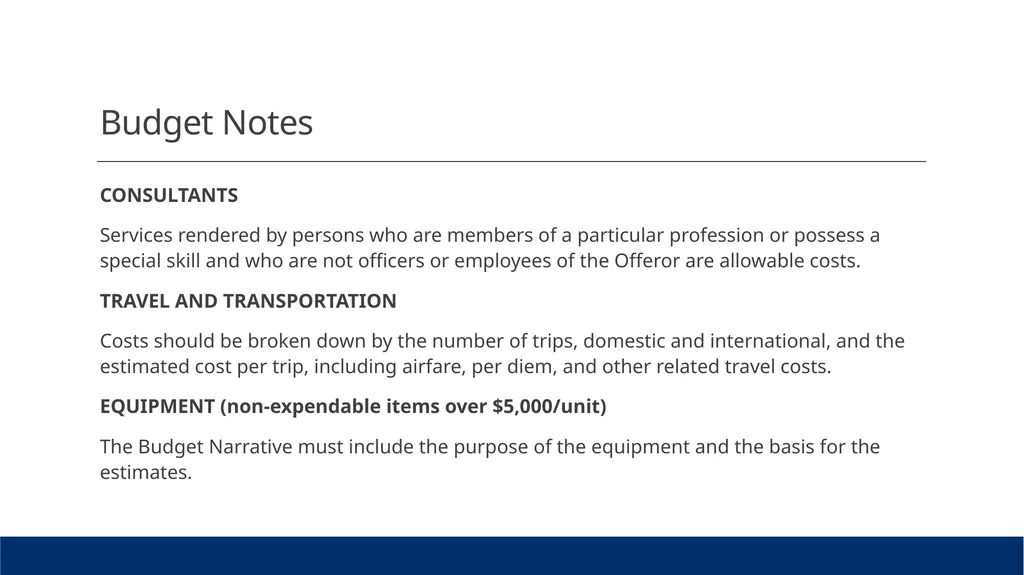
Budget Notes CONSULTANTS
Services rendered by persons who are members of a particular profession or possess a special skill and who are not officers or employees of the Offeror are allowable costs.
TRAVEL AND TRANSPORTATION
Costs should be broken down by the number of trips, domestic and international, and the estimated cost per trip, including airfare, per diem, and other related travel costs.
EQUIPMENT (non-expendable items over $5,000/unit)
The Budget Narrative must include the purpose of the equipment and the basis for the estimates.<br>
Services rendered by persons who are members of a particular profession or possess a special skill and who are not officers or employees of the Offeror are allowable costs.
TRAVEL AND TRANSPORTATION
Costs should be broken down by the number of trips, domestic and international, and the estimated cost per trip, including airfare, per diem, and other related travel costs.
EQUIPMENT (non-expendable items over $5,000/unit)
The Budget Narrative must include the purpose of the equipment and the basis for the estimates.<br>
53
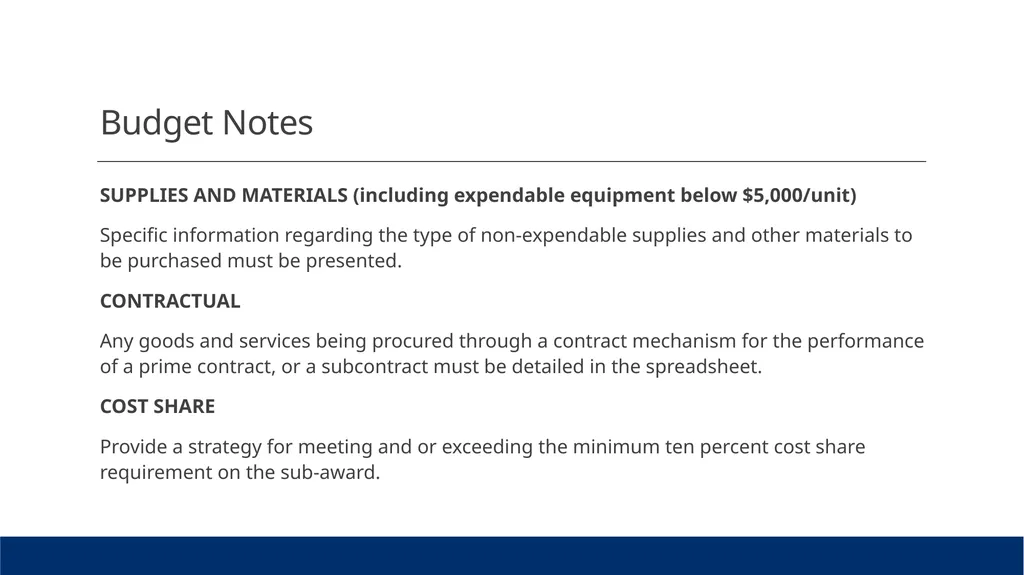
Budget Notes SUPPLIES AND MATERIALS (including expendable equipment below $5,000/unit)
Specific information regarding the type of non-expendable supplies and other materials to be purchased must be presented.
CONTRACTUAL
Any goods and services being procured through a contract mechanism for the performance of a prime contract, or a subcontract must be detailed in the spreadsheet.
COST SHARE
Provide a strategy for meeting and or exceeding the minimum ten percent cost share requirement on the sub-award.<br>
Specific information regarding the type of non-expendable supplies and other materials to be purchased must be presented.
CONTRACTUAL
Any goods and services being procured through a contract mechanism for the performance of a prime contract, or a subcontract must be detailed in the spreadsheet.
COST SHARE
Provide a strategy for meeting and or exceeding the minimum ten percent cost share requirement on the sub-award.<br>
54
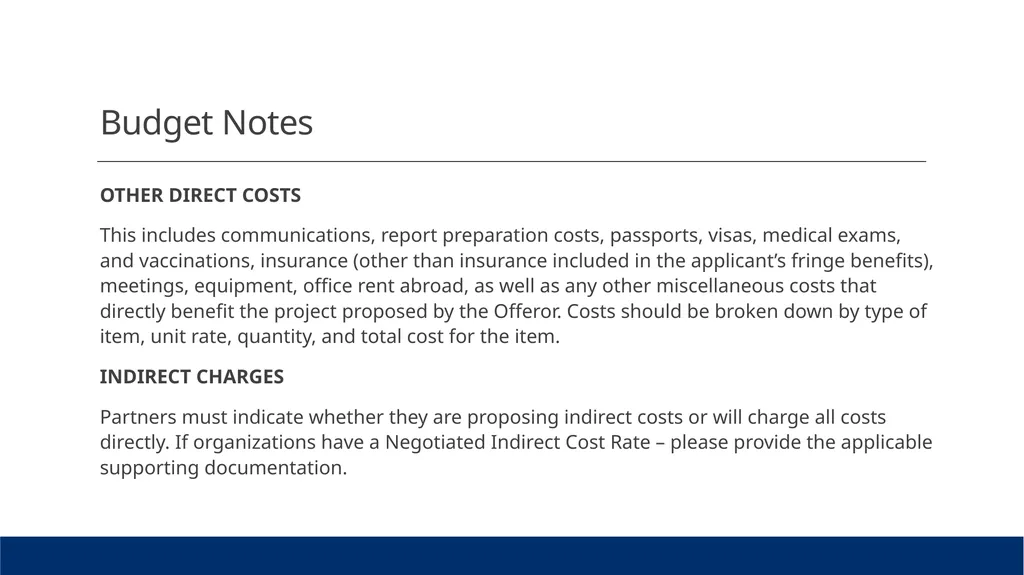
Budget Notes OTHER DIRECT COSTS
This includes communications, report preparation costs, passports, visas, medical exams, and vaccinations, insurance (other than insurance included in the applicant’s fringe benefits), meetings, equipment, office rent abroad, as well as any other miscellaneous costs that directly benefit the project proposed by the Offeror. Costs should be broken down by type of item, unit rate, quantity, and total cost for the item.
INDIRECT CHARGES
Partners must indicate whether they are proposing indirect costs or will charge all costs directly. If organizations have a Negotiated Indirect Cost Rate – please provide the applicable supporting documentation.<br>
This includes communications, report preparation costs, passports, visas, medical exams, and vaccinations, insurance (other than insurance included in the applicant’s fringe benefits), meetings, equipment, office rent abroad, as well as any other miscellaneous costs that directly benefit the project proposed by the Offeror. Costs should be broken down by type of item, unit rate, quantity, and total cost for the item.
INDIRECT CHARGES
Partners must indicate whether they are proposing indirect costs or will charge all costs directly. If organizations have a Negotiated Indirect Cost Rate – please provide the applicable supporting documentation.<br>
55
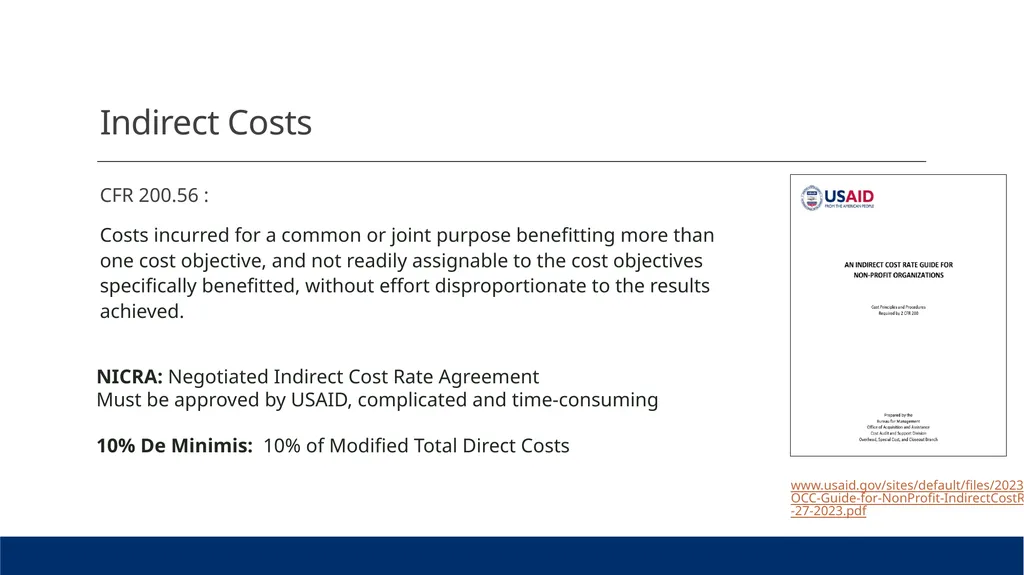
Indirect Costs CFR 200.56 :
Costs incurred for a common or joint purpose benefitting more than one cost objective, and not readily assignable to the cost objectives specifically benefitted, without effort disproportionate to the results achieved.
NICRA: Negotiated Indirect Cost Rate Agreement
Must be approved by USAID, complicated and time-consuming
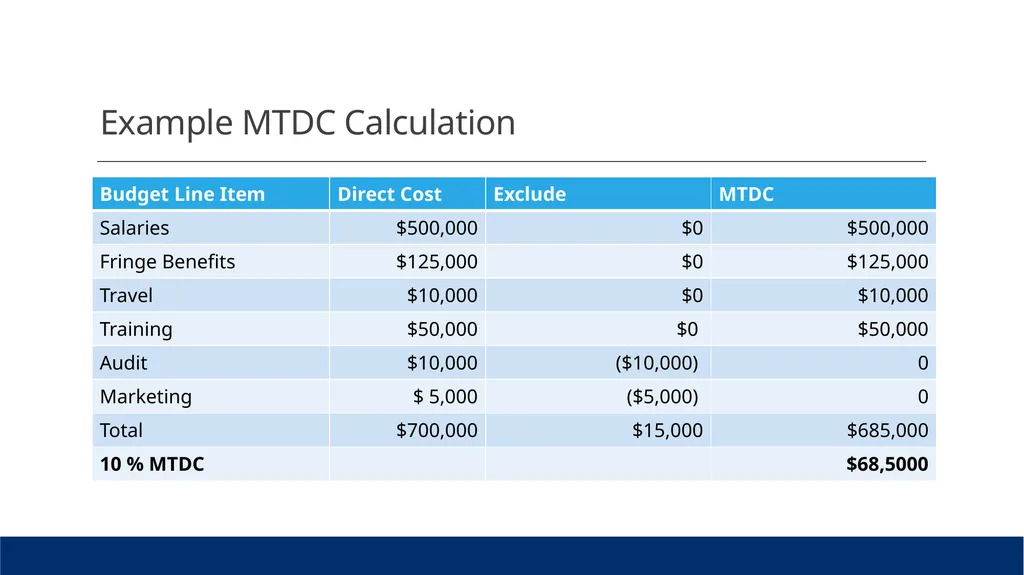
10% De Minimis: 10% of Modified Total Direct Costs www.usaid.gov/sites/default/files/2023-01/OCC-Guide-for-NonProfit-IndirectCostRate1-27-2023.pdf<br>
Costs incurred for a common or joint purpose benefitting more than one cost objective, and not readily assignable to the cost objectives specifically benefitted, without effort disproportionate to the results achieved.
NICRA: Negotiated Indirect Cost Rate Agreement
Must be approved by USAID, complicated and time-consuming
10% De Minimis: 10% of Modified Total Direct Costs www.usaid.gov/sites/default/files/2023-01/OCC-Guide-for-NonProfit-IndirectCostRate1-27-2023.pdf<br>
56
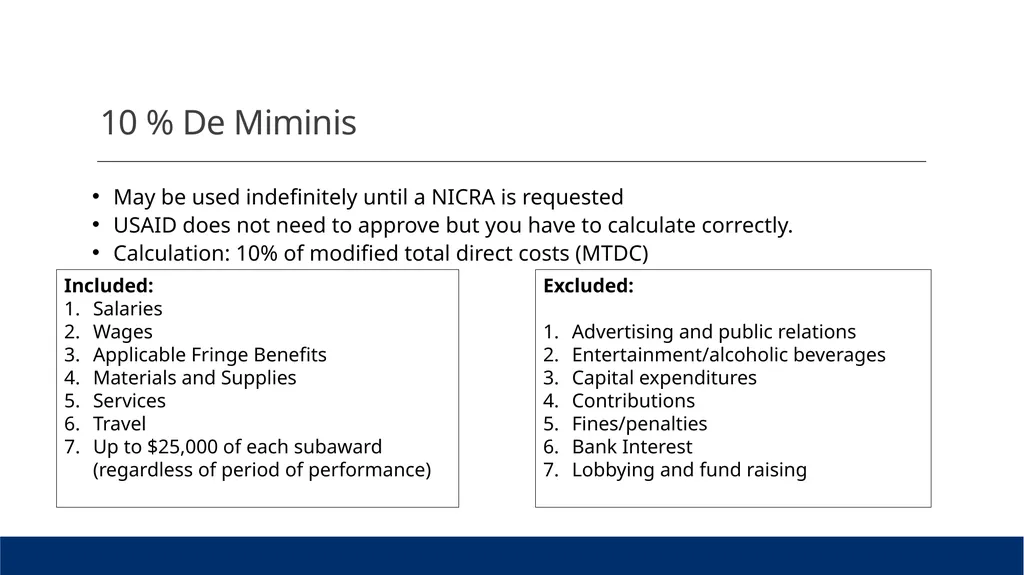
10 % De Miminis May be used indefinitely until a NICRA is requested
USAID does not need to approve but you have to calculate correctly.
Calculation: 10% of modified total direct costs (MTDC) Included:
Salaries
Wages
Applicable Fringe Benefits
Materials and Supplies
Services
Travel
Up to $25,000 of each subaward (regardless of period of performance) Excluded:
Advertising and public relations
Entertainment/alcoholic beverages
Capital expenditures
Contributions
Fines/penalties
Bank Interest
Lobbying and fund raising<br>
USAID does not need to approve but you have to calculate correctly.
Calculation: 10% of modified total direct costs (MTDC) Included:
Salaries
Wages
Applicable Fringe Benefits
Materials and Supplies
Services
Travel
Up to $25,000 of each subaward (regardless of period of performance) Excluded:
Advertising and public relations
Entertainment/alcoholic beverages
Capital expenditures
Contributions
Fines/penalties
Bank Interest
Lobbying and fund raising<br>
57
Example MTDC Calculation<br>
58
Learning Objectives:
Identify the steps for evaluating and selecting a subrecipient.
Understand the required certification.
Understand the subaward requirements to file for the RFP process. Session 4. Evaluating and Selecting Applicants<br>
Identify the steps for evaluating and selecting a subrecipient.
Understand the required certification.
Understand the subaward requirements to file for the RFP process. Session 4. Evaluating and Selecting Applicants<br>
59
Topics for Evaluation Organizing the Evaluation
Required Certifications
3. Subaward File<br>
Required Certifications
3. Subaward File<br>
60
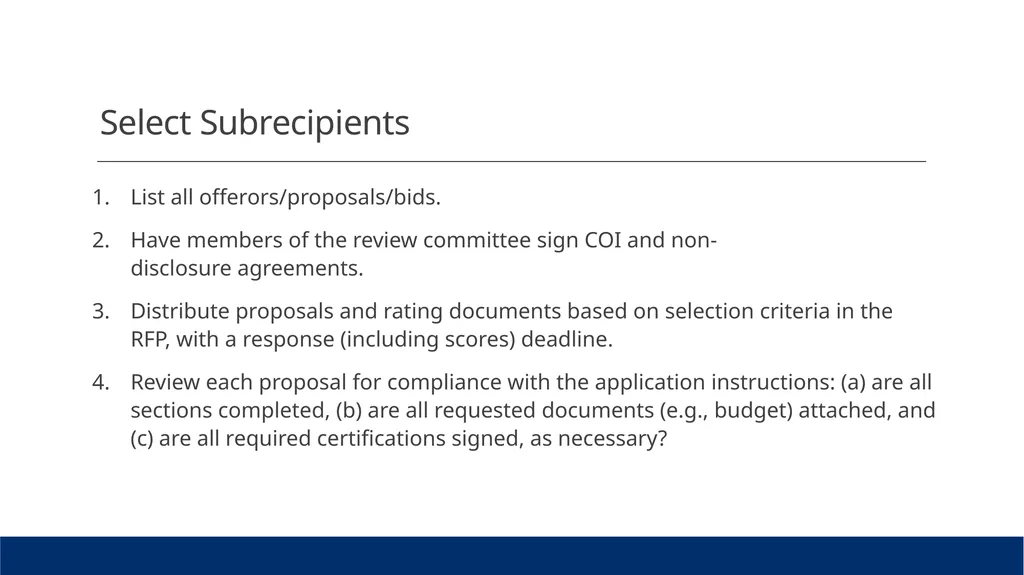
Select Subrecipients List all offerors/proposals/bids.
Have members of the review committee sign COI and non-disclosure agreements.
Distribute proposals and rating documents based on selection criteria in the RFP, with a response (including scores) deadline.
Review each proposal for compliance with the application instructions: (a) are all sections completed, (b) are all requested documents (e.g., budget) attached, and (c) are all required certifications signed, as necessary?<br>
Have members of the review committee sign COI and non-disclosure agreements.
Distribute proposals and rating documents based on selection criteria in the RFP, with a response (including scores) deadline.
Review each proposal for compliance with the application instructions: (a) are all sections completed, (b) are all requested documents (e.g., budget) attached, and (c) are all required certifications signed, as necessary?<br>
61
Select Subrecipients Contd. Convene meetings for all reviewers to discuss each proposal and their scores.
Finalize and aggregate scores to determine the best offerors.
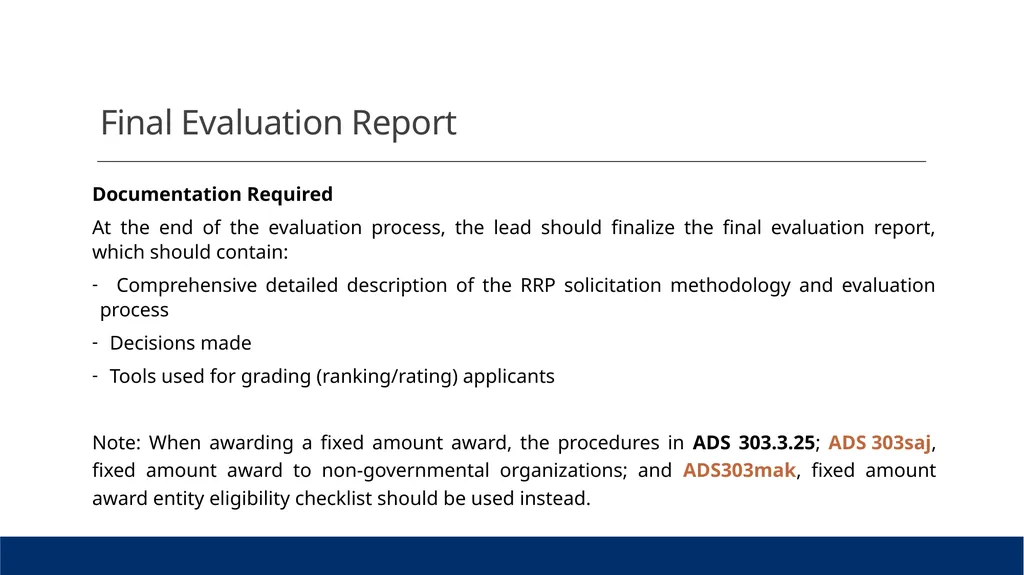
Develop the Final Evaluation Report that summarizes the process, results, and rationale for the decision.
Notify all applicants.<br>
Finalize and aggregate scores to determine the best offerors.
Develop the Final Evaluation Report that summarizes the process, results, and rationale for the decision.
Notify all applicants.<br>
62
Review Committee The review committee will evaluate all competitive applications and proposals based on the criteria included in the solicitation to ensure that the proposed activities support the prime’s objectives.
Conflict of interest and non-disclosure forms should be signed by each person involved with the solicitation.
Review committee members will be chosen based on their technical capacity to evaluate the proposed activity. The review committee will always include senior project management, though committee members may not be the same for each subaward. In addition, the committee will comprise an odd number of voting members.
Evaluation will be conducted and scored against appropriate selection criteria. The evaluation process may entail interviews, site visits, background research, and budget reviews to ensure that proposed activities and costs are reasonable and allowable, and that prospective awardees understand the financial requirements of the activity and possess the ability to participate as proposed.
In some instances, the awardee may be required to modify or clarify the application; in these cases, activity staff will work with the applicant to revise the proposal.<br>
Conflict of interest and non-disclosure forms should be signed by each person involved with the solicitation.
Review committee members will be chosen based on their technical capacity to evaluate the proposed activity. The review committee will always include senior project management, though committee members may not be the same for each subaward. In addition, the committee will comprise an odd number of voting members.
Evaluation will be conducted and scored against appropriate selection criteria. The evaluation process may entail interviews, site visits, background research, and budget reviews to ensure that proposed activities and costs are reasonable and allowable, and that prospective awardees understand the financial requirements of the activity and possess the ability to participate as proposed.
In some instances, the awardee may be required to modify or clarify the application; in these cases, activity staff will work with the applicant to revise the proposal.<br>
63
Cost and Price Analysis The prime is responsible for conducting and properly documenting a cost and price analysis when selecting a subrecipient, both when competitively bidding and when using a sole source. Cost and price analysis must be performed each time a subrecipient is proposed or selected, in accordance with the UG.
When performing a Cost and Price Analysis:
1. Review and compare quotes.
2. Compare cost/price to similar services available in the marketplace/industry.
3. Ensure that the subrecipient has provided a copy of their indirect cost rate agreement or factored in the 10% de minimis.
4. Evaluate costs for reasonableness, allocability, and allowability.
Cost Analysis (the review of separate elements of cost and supporting data; required for cost‐reimbursement subawards). • Review each cost element and supporting information • Determine whether each cost is necessary and reasonable • Evaluate cost trends and reasonableness of estimates • Evaluate the application of audited and negotiated F&A rates, labor rates, etc.
5. Compare proposed subrecipient costs against: • Actual costs previously incurred by subrecipient • Previous cost estimates from the subrecipient or other subrecipients for similar items • Other cost estimates received in response to the solicitation, or • Independent estimates by technical personnel.
Price Analysis (the review of the entire contract price without looking at individual items of cost; appropriate when there is adequate price comparison). Required for fixed‐price subawards. • Used to evaluate the total price under fixed price awards • Review the full price of the subaward without evaluating individual cost elements • Evaluate based on price comparisons, competitive bids, published price lists • Compare with cost estimates, market research, historical data/experience<br>
When performing a Cost and Price Analysis:
1. Review and compare quotes.
2. Compare cost/price to similar services available in the marketplace/industry.
3. Ensure that the subrecipient has provided a copy of their indirect cost rate agreement or factored in the 10% de minimis.
4. Evaluate costs for reasonableness, allocability, and allowability.
Cost Analysis (the review of separate elements of cost and supporting data; required for cost‐reimbursement subawards). • Review each cost element and supporting information • Determine whether each cost is necessary and reasonable • Evaluate cost trends and reasonableness of estimates • Evaluate the application of audited and negotiated F&A rates, labor rates, etc.
5. Compare proposed subrecipient costs against: • Actual costs previously incurred by subrecipient • Previous cost estimates from the subrecipient or other subrecipients for similar items • Other cost estimates received in response to the solicitation, or • Independent estimates by technical personnel.
Price Analysis (the review of the entire contract price without looking at individual items of cost; appropriate when there is adequate price comparison). Required for fixed‐price subawards. • Used to evaluate the total price under fixed price awards • Review the full price of the subaward without evaluating individual cost elements • Evaluate based on price comparisons, competitive bids, published price lists • Compare with cost estimates, market research, historical data/experience<br>
64
Required Certifications The prime is responsible for obtaining certifications for or from the subs:
A Unique Entity ID (generated by SAM.gov)
Restrictions to Lobbying (22 CFR 227)
Prohibitions on Assistance to Drug Traffickers (ADS 206.3.10)
Certification Regarding Terrorist Financing (AAPD 044)
Certification Regarding Trafficking in Persons
Certification of Recipient
A signed copy of Certifications and Assurances, which include Assurance of Compliance with Laws and Regulations Governing Nondiscrimination in Federally Assisted Programs (this assurance applies to Non-U.S. Government Organizations if any part of their program will be undertaken in the U.S.)<br>
A Unique Entity ID (generated by SAM.gov)
Restrictions to Lobbying (22 CFR 227)
Prohibitions on Assistance to Drug Traffickers (ADS 206.3.10)
Certification Regarding Terrorist Financing (AAPD 044)
Certification Regarding Trafficking in Persons
Certification of Recipient
A signed copy of Certifications and Assurances, which include Assurance of Compliance with Laws and Regulations Governing Nondiscrimination in Federally Assisted Programs (this assurance applies to Non-U.S. Government Organizations if any part of their program will be undertaken in the U.S.)<br>
65
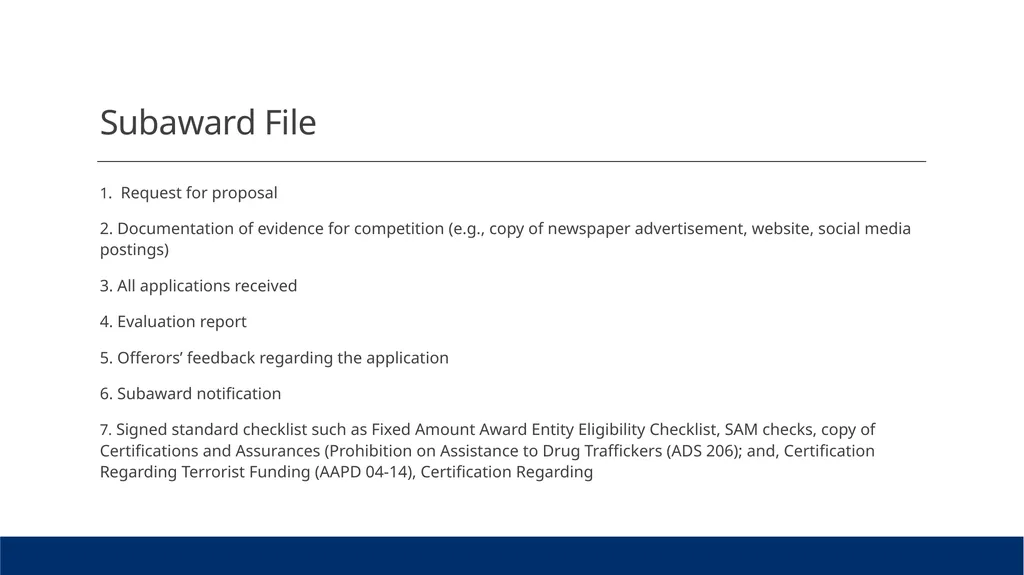
Subaward File 1. Request for proposal
2. Documentation of evidence for competition (e.g., copy of newspaper advertisement, website, social media postings)
3. All applications received
4. Evaluation report
5. Offerors’ feedback regarding the application
6. Subaward notification
7. Signed standard checklist such as Fixed Amount Award Entity Eligibility Checklist, SAM checks, copy of Certifications and Assurances (Prohibition on Assistance to Drug Traffickers (ADS 206); and, Certification Regarding Terrorist Funding (AAPD 04-14), Certification Regarding<br>
2. Documentation of evidence for competition (e.g., copy of newspaper advertisement, website, social media postings)
3. All applications received
4. Evaluation report
5. Offerors’ feedback regarding the application
6. Subaward notification
7. Signed standard checklist such as Fixed Amount Award Entity Eligibility Checklist, SAM checks, copy of Certifications and Assurances (Prohibition on Assistance to Drug Traffickers (ADS 206); and, Certification Regarding Terrorist Funding (AAPD 04-14), Certification Regarding<br>
66
Learning Objectives:
Explain how to perform a pre-award survey
Become aware of NUPAS Plus assessment tool
Understand the pre-award assurances to be considered/obtained by the prime when making an award under USAID-funded projects Session 5: Pre-Award Survey<br>
Explain how to perform a pre-award survey
Become aware of NUPAS Plus assessment tool
Understand the pre-award assurances to be considered/obtained by the prime when making an award under USAID-funded projects Session 5: Pre-Award Survey<br>
67
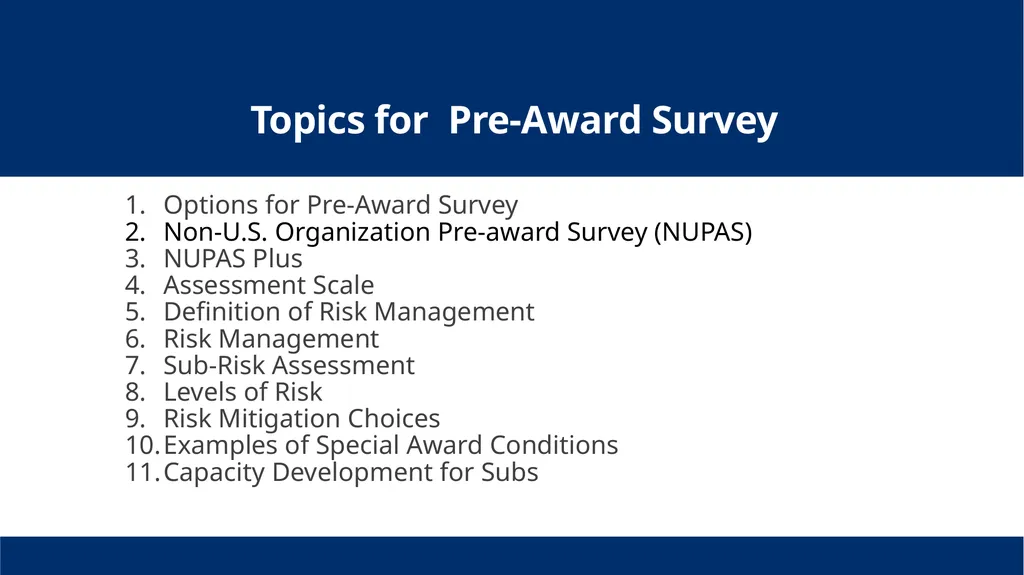
Topics for Pre-Award Survey Options for Pre-Award Survey
Non-U.S. Organization Pre-award Survey (NUPAS)
NUPAS Plus
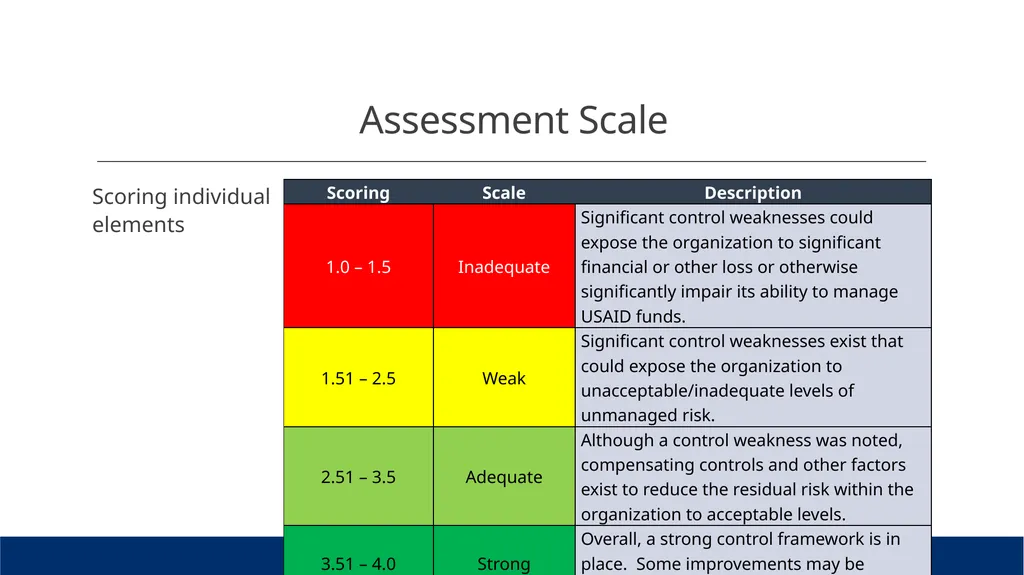
Assessment Scale
Definition of Risk Management
Risk Management
Sub-Risk Assessment
Levels of Risk
Risk Mitigation Choices
Examples of Special Award Conditions
Capacity Development for Subs<br>
Non-U.S. Organization Pre-award Survey (NUPAS)
NUPAS Plus
Assessment Scale
Definition of Risk Management
Risk Management
Sub-Risk Assessment
Levels of Risk
Risk Mitigation Choices
Examples of Special Award Conditions
Capacity Development for Subs<br>
68
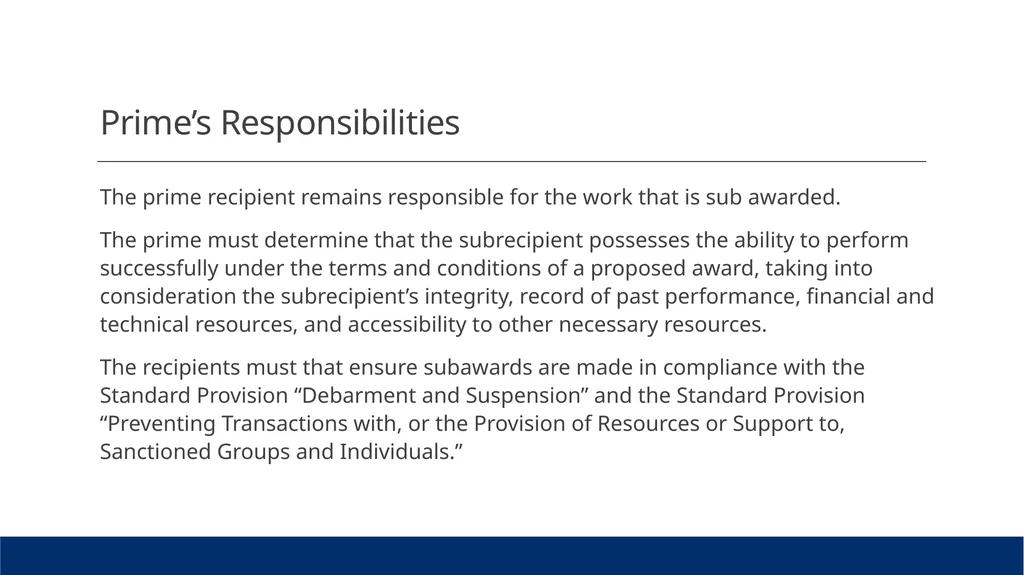
Prime’s Responsibilities The prime recipient remains responsible for the work that is sub awarded.
The prime must determine that the subrecipient possesses the ability to perform successfully under the terms and conditions of a proposed award, taking into consideration the subrecipient’s integrity, record of past performance, financial and technical resources, and accessibility to other necessary resources.
The recipients must that ensure subawards are made in compliance with the Standard Provision “Debarment and Suspension” and the Standard Provision “Preventing Transactions with, or the Provision of Resources or Support to, Sanctioned Groups and Individuals.”<br>
The prime must determine that the subrecipient possesses the ability to perform successfully under the terms and conditions of a proposed award, taking into consideration the subrecipient’s integrity, record of past performance, financial and technical resources, and accessibility to other necessary resources.
The recipients must that ensure subawards are made in compliance with the Standard Provision “Debarment and Suspension” and the Standard Provision “Preventing Transactions with, or the Provision of Resources or Support to, Sanctioned Groups and Individuals.”<br>
69
Options for Pre-Award Survey The Pre-Award Survey should be included in your Procurement Manual and be approved by your Board.
Available Tools:
1. Ask your former prime for the Pre-Award Survey they use
2. Use USAID’s NUPAS
3. Use ASAP’s NUPAS Plus
4. Use ASAP II’s NUPAS Plus 2.0<br>
Available Tools:
1. Ask your former prime for the Pre-Award Survey they use
2. Use USAID’s NUPAS
3. Use ASAP’s NUPAS Plus
4. Use ASAP II’s NUPAS Plus 2.0<br>
70
Non-U.S. Organization Pre-award Survey (NUPAS) USAID uses the Non-U.S. Organization Pre-award Survey (NUPAS)
NUPAS Objectives:
Determine whether the Non-U.S. Organization has sufficient financial and managerial capacity to manage USAID funds following U.S. Government and USAID requirements.
Provide recommendations to USAID on areas of support needed for the local partner to succeed as a prime with increased funding.
International primes have developed their own pre-award survey.<br>
NUPAS Objectives:
Determine whether the Non-U.S. Organization has sufficient financial and managerial capacity to manage USAID funds following U.S. Government and USAID requirements.
Provide recommendations to USAID on areas of support needed for the local partner to succeed as a prime with increased funding.
International primes have developed their own pre-award survey.<br>
71
NUPAS The NUPAS is a pre-award survey to identify and establish the baseline for potential risk areas inherent in making a non-U.S. NGO award. USG regulations require the prime to conduct a pre-award survey, prior to issuing an award, that assesses the following domains among other areas:
Legal
Financial
Procurement
Human Resources
Sustainability
Performance<br>
Legal
Financial
Procurement
Human Resources
Sustainability
Performance<br>
72
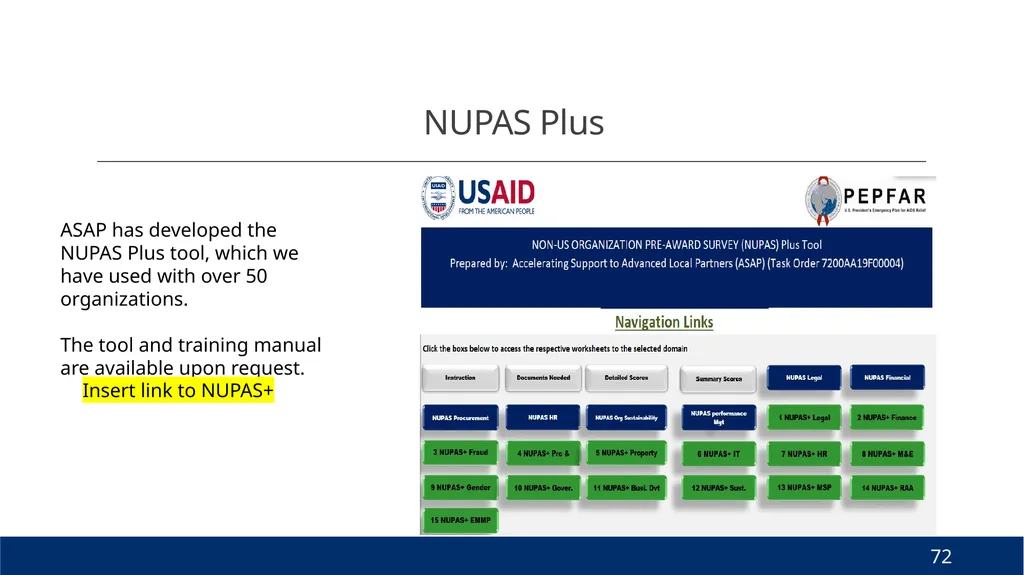
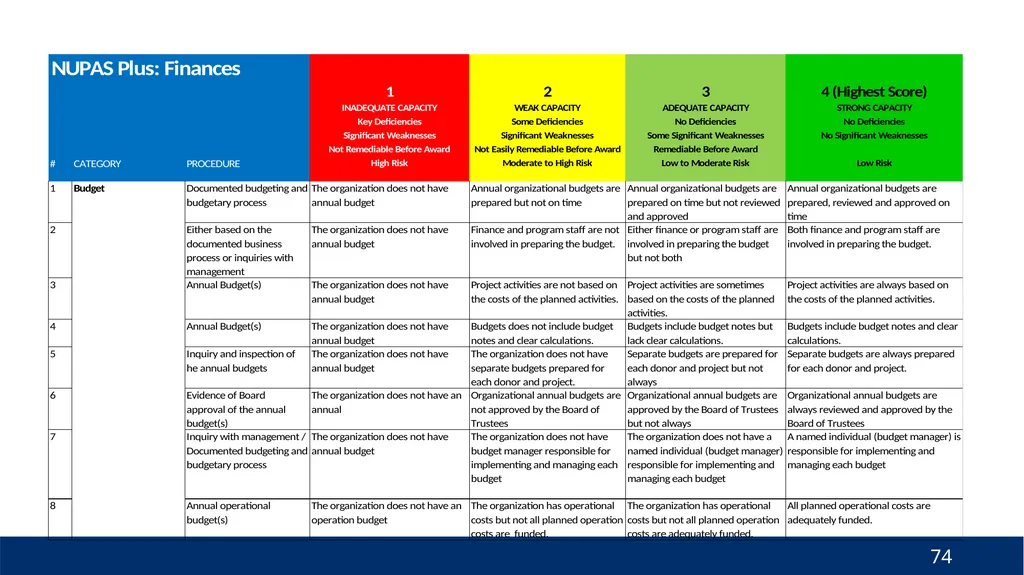
NUPAS Plus 72 ASAP has developed the NUPAS Plus tool, which we have used with over 50 organizations.
The tool and training manual are available upon request. Insert link to NUPAS+<br>
The tool and training manual are available upon request. Insert link to NUPAS+<br>
73
Assessment Scale Scoring individual elements<br>
74
74<br>
75
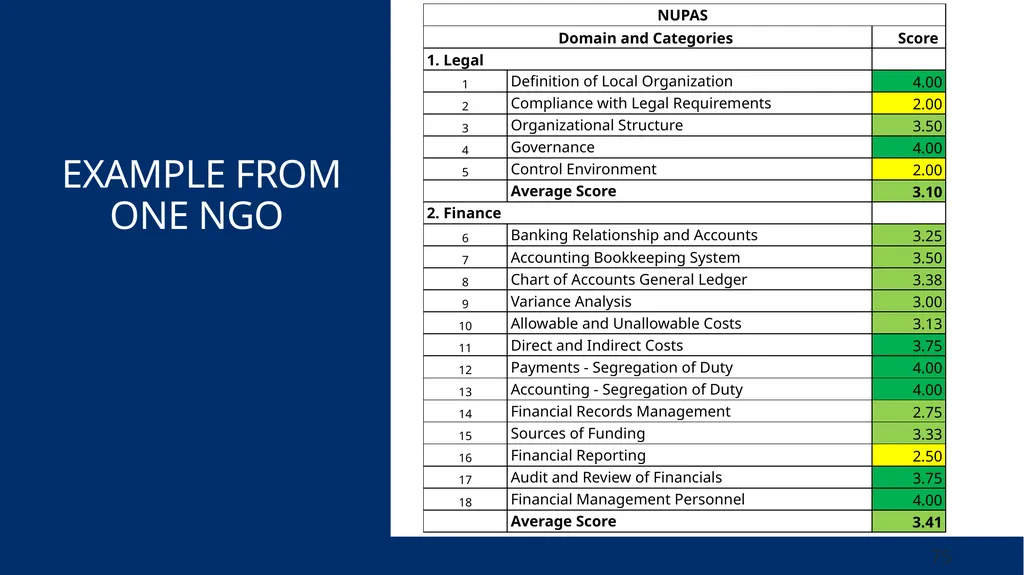
EXAMPLE FROM ONE NGO 75<br>
76
Percentage of Scores by Local Partners 76<br>
77
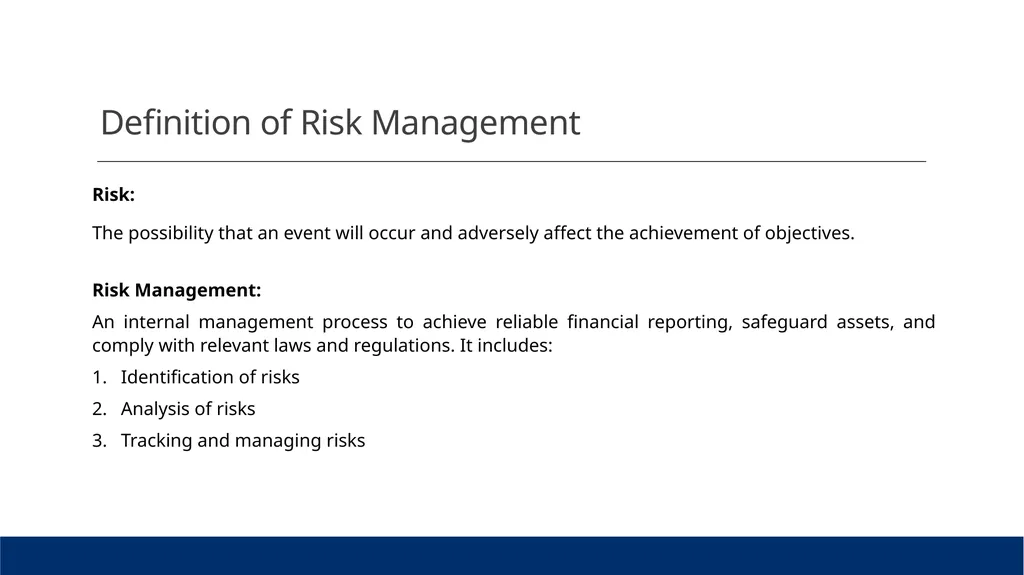
Definition of Risk Management Risk:
The possibility that an event will occur and adversely affect the achievement of objectives.
Risk Management:
An internal management process to achieve reliable financial reporting, safeguard assets, and comply with relevant laws and regulations. It includes:
Identification of risks
Analysis of risks
Tracking and managing risks<br>
The possibility that an event will occur and adversely affect the achievement of objectives.
Risk Management:
An internal management process to achieve reliable financial reporting, safeguard assets, and comply with relevant laws and regulations. It includes:
Identification of risks
Analysis of risks
Tracking and managing risks<br>
78
Risk Management Assemble a comprehensive list of risks, both threats and opportunities.
Examine risks to help prioritize risk response. Consider both the likelihood of the risk and its impact on the mission. A matrix may be used to assess identified risks.
Determine the level of risk your organization is willing to take.
Select a treatment response for risk that includes acceptance, avoidance, reduction, sharing, and transfer.
Continuously monitor how risks are changing and if responses are successful.
Communicate risks with stakeholders, including prime recipients, and report on the status of addressing the risks.<br>
Examine risks to help prioritize risk response. Consider both the likelihood of the risk and its impact on the mission. A matrix may be used to assess identified risks.
Determine the level of risk your organization is willing to take.
Select a treatment response for risk that includes acceptance, avoidance, reduction, sharing, and transfer.
Continuously monitor how risks are changing and if responses are successful.
Communicate risks with stakeholders, including prime recipients, and report on the status of addressing the risks.<br>
79
Sub Risk Assessment Uniform Guidance requires risk assessments for subrecipients.
Factors to review and consider:
Sub's prior experience with similar awards
Previous audits<br>
Factors to review and consider:
Sub's prior experience with similar awards
Previous audits<br>
80
Levels of Risk High Risk Recipients
Organizations that have not met most of the requirements as per the selection and evaluation criteria pose high risk to the organization if selected. However, this does not necessarily imply that these organizations cannot be selected.
Medium Risk Recipients
Organizations that demonstrate some ability to partially comply with the award terms and conditions and meet the requirements. However, the exceptions could materially affect the reliability of reporting or their ability to attain program activities. Medium risk status may still require some level of oversight, monitoring and supervision, and technical support to ensure that observed deficiencies are addressed.
Low Risk Recipients
Organizations that meet most of the requirements, demonstrating the ability to comply with award terms and conditions with few exceptions. Such organizations may still be subjected to special award conditions (SACs) and require frequent monitoring at the discretion of the prime or be given standard reporting requirements with minimal supervision and monitoring by the prime.<br>
Organizations that have not met most of the requirements as per the selection and evaluation criteria pose high risk to the organization if selected. However, this does not necessarily imply that these organizations cannot be selected.
Medium Risk Recipients
Organizations that demonstrate some ability to partially comply with the award terms and conditions and meet the requirements. However, the exceptions could materially affect the reliability of reporting or their ability to attain program activities. Medium risk status may still require some level of oversight, monitoring and supervision, and technical support to ensure that observed deficiencies are addressed.
Low Risk Recipients
Organizations that meet most of the requirements, demonstrating the ability to comply with award terms and conditions with few exceptions. Such organizations may still be subjected to special award conditions (SACs) and require frequent monitoring at the discretion of the prime or be given standard reporting requirements with minimal supervision and monitoring by the prime.<br>
81
Risk Mitigation Choices 1. Not to fund
2. Apply Special Award Conditions
3. Set minimum ceiling for funding
4. Make award but provide technical and operational support
5. Make award, require monthly reports and conduct frequent site visits<br>
2. Apply Special Award Conditions
3. Set minimum ceiling for funding
4. Make award but provide technical and operational support
5. Make award, require monthly reports and conduct frequent site visits<br>
82
Capacity Development of Subs The Pre-Award Survey can inform capacity-building technical assistance (TA) for the subrecipient, based on the identified areas of risk and weaknesses.
Types of TA:
Resource Hubs: Provide subrecipient tools, resources on best practices, and access to experts. Offer subrecipients an easily accessed online portal (on in-person platform) that can serve as a repository of information, a platform for collaboration, a central resource-management tool, and a place to house and disseminate best practices. This may include the prime sharing its policies with the subrecipient.
The subrecipient gathers a selected group of participants at a single event to learn or improve skills and knowledge in a specific discipline. The training should address issues of concern, such as the Pre-Award Survey report. If a prime is to have multiple subrecipients under its award, the prime should consider having a consolidated training event where consistent messaging regarding templates, reporting dates, supporting documentation, etc., can be shared with all subrecipients.
Substantial Involvement: Such involvement in program implementation with the subrecipient may include field supervision of program activities and performance of the subrecipient.<br>
Types of TA:
Resource Hubs: Provide subrecipient tools, resources on best practices, and access to experts. Offer subrecipients an easily accessed online portal (on in-person platform) that can serve as a repository of information, a platform for collaboration, a central resource-management tool, and a place to house and disseminate best practices. This may include the prime sharing its policies with the subrecipient.
The subrecipient gathers a selected group of participants at a single event to learn or improve skills and knowledge in a specific discipline. The training should address issues of concern, such as the Pre-Award Survey report. If a prime is to have multiple subrecipients under its award, the prime should consider having a consolidated training event where consistent messaging regarding templates, reporting dates, supporting documentation, etc., can be shared with all subrecipients.
Substantial Involvement: Such involvement in program implementation with the subrecipient may include field supervision of program activities and performance of the subrecipient.<br>
83
Award Notification Primes must notify all bidders whether they were selected, or not.
Primes hold “kickoff” meeting with successful applicants to review the agreement and all requirements.<br>
Primes hold “kickoff” meeting with successful applicants to review the agreement and all requirements.<br>
84
Learning Objectives
Learn about the components of a subaward
Learn about kick-off meeting Session 6: Issuing Subawards<br>
Learn about the components of a subaward
Learn about kick-off meeting Session 6: Issuing Subawards<br>
85
Special Award Conditions
Donor approval
Documents to share with sub
Award notification
Kickoff meeting
Mandatory flow downs
Annual Workplan
Activity Monitoring Evaluation and Learning Plan (AMELP)
Award amendments and modifications Topics under Issuing the Subawards<br>
Donor approval
Documents to share with sub
Award notification
Kickoff meeting
Mandatory flow downs
Annual Workplan
Activity Monitoring Evaluation and Learning Plan (AMELP)
Award amendments and modifications Topics under Issuing the Subawards<br>
86
Special Award Conditions SACs are identified in the Pre-Award Assessment as risk areas requiring special attention to remedy before or during the award.<br>
87
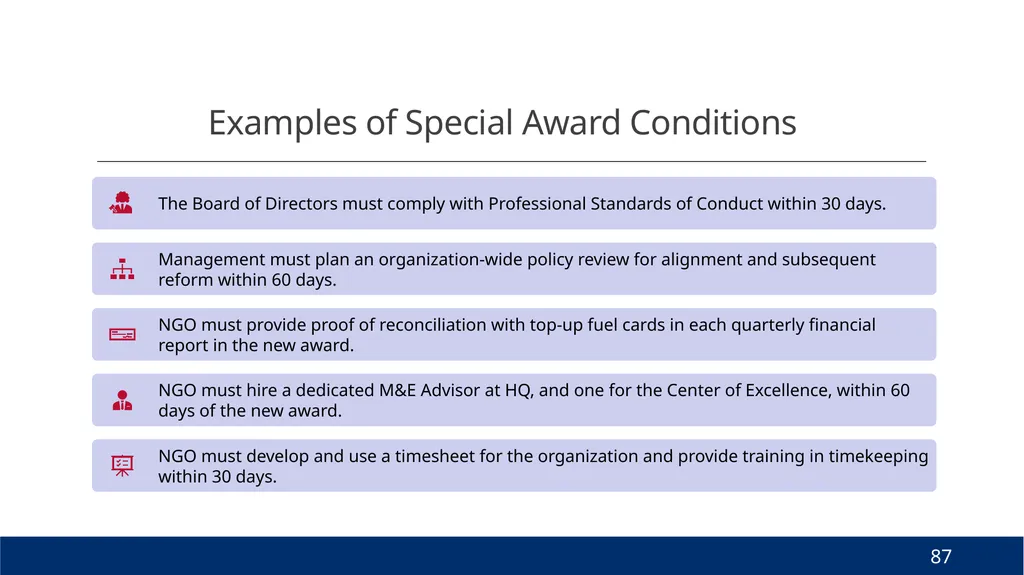
Examples of Special Award Conditions 87<br>
88
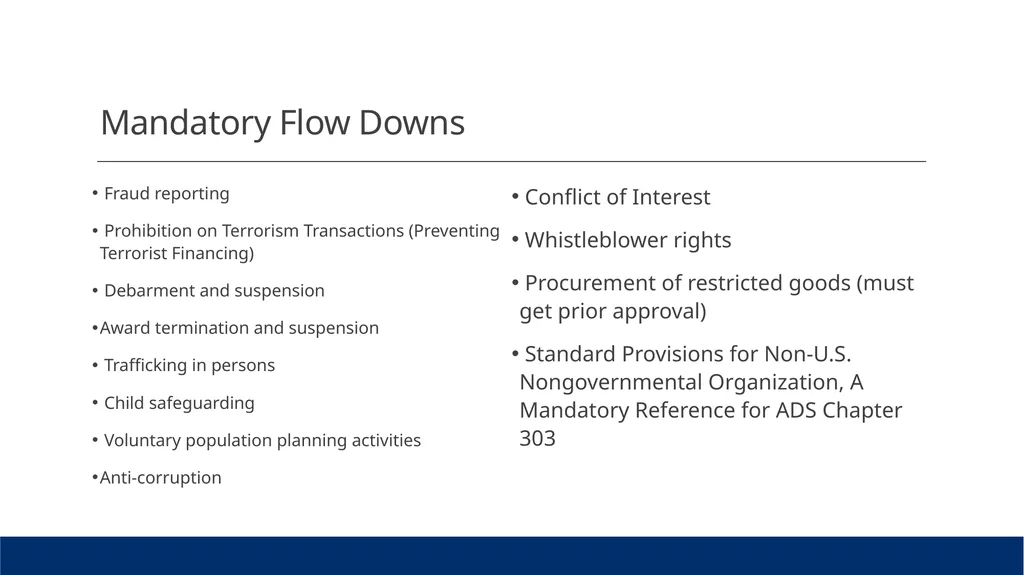
Mandatory Flow Downs Fraud reporting
Prohibition on Terrorism Transactions (Preventing Terrorist Financing)
Debarment and suspension
Award termination and suspension
Trafficking in persons
Child safeguarding
Voluntary population planning activities
Anti-corruption Conflict of Interest
Whistleblower rights
Procurement of restricted goods (must get prior approval)
Standard Provisions for Non-U.S. Nongovernmental Organization, A Mandatory Reference for ADS Chapter 303<br>
Prohibition on Terrorism Transactions (Preventing Terrorist Financing)
Debarment and suspension
Award termination and suspension
Trafficking in persons
Child safeguarding
Voluntary population planning activities
Anti-corruption Conflict of Interest
Whistleblower rights
Procurement of restricted goods (must get prior approval)
Standard Provisions for Non-U.S. Nongovernmental Organization, A Mandatory Reference for ADS Chapter 303<br>
89
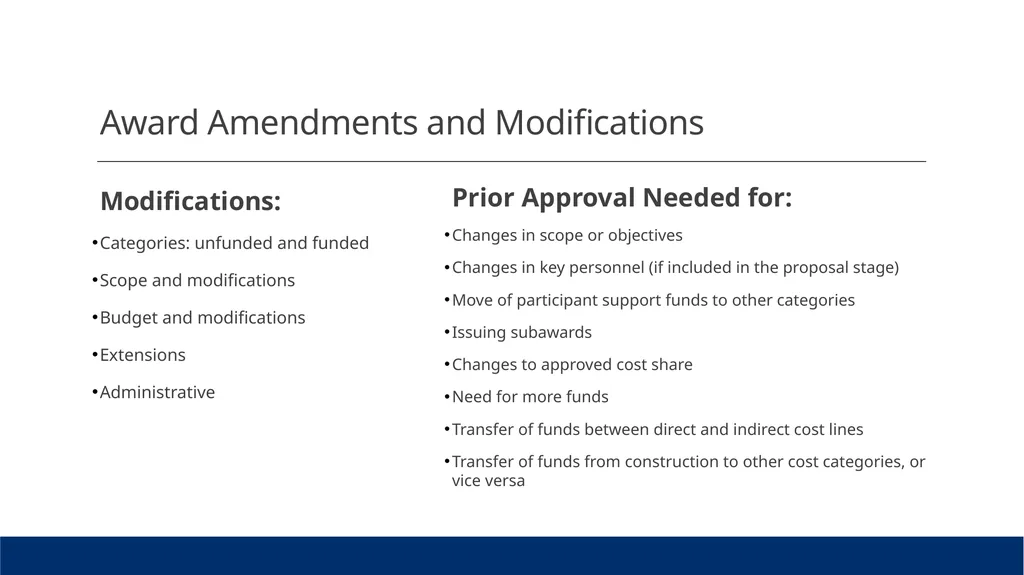
Award Amendments and Modifications Modifications:
Categories: unfunded and funded
Scope and modifications
Budget and modifications
Extensions
Administrative Prior Approval Needed for:
Changes in scope or objectives
Changes in key personnel (if included in the proposal stage)
Move of participant support funds to other categories
Issuing subawards
Changes to approved cost share
Need for more funds
Transfer of funds between direct and indirect cost lines
Transfer of funds from construction to other cost categories, or vice versa<br>
Categories: unfunded and funded
Scope and modifications
Budget and modifications
Extensions
Administrative Prior Approval Needed for:
Changes in scope or objectives
Changes in key personnel (if included in the proposal stage)
Move of participant support funds to other categories
Issuing subawards
Changes to approved cost share
Need for more funds
Transfer of funds between direct and indirect cost lines
Transfer of funds from construction to other cost categories, or vice versa<br>
90
Documents to Share with Sub Prime award notification of approval with clear start date of the project and award amount.
1. Approved agreement with clear terms and conditions of the award, proposal, and project, including reporting requirements, types of reports (financial and programmatic), frequency of reporting requirements, reporting period and due dates, and reporting contents and Special Award Conditions, if applicable.
2. Final technical proposal approved, with project description or scope of work and detailed budget approved.
3. Guiding document on operations from donor, such as relevant applicable ADS, 2CFR200, etc.<br>
1. Approved agreement with clear terms and conditions of the award, proposal, and project, including reporting requirements, types of reports (financial and programmatic), frequency of reporting requirements, reporting period and due dates, and reporting contents and Special Award Conditions, if applicable.
2. Final technical proposal approved, with project description or scope of work and detailed budget approved.
3. Guiding document on operations from donor, such as relevant applicable ADS, 2CFR200, etc.<br>
91
Donor Approval The prime must request and obtain in writing USAID approvals for subawards.
Requirements to obtain approval are outlined in the “substantial involvement” section of the award document.<br>
Requirements to obtain approval are outlined in the “substantial involvement” section of the award document.<br>
92
Annual Workplan Subs must prepare annual work plans for the prime to approve.
The work plan must align with the subaward and the prime's award.<br>
The work plan must align with the subaward and the prime's award.<br>
93
Activity Monitoring Evaluation and Learning Plan (AMELP) This is the document that guides activity monitoring and learning.
The purpose of the AMELP is to lay out a plan for collecting, evaluating, and validating data that will be used to measure overall progress over time.
The AMELP lists the performance indicators with annual targets.
The AMELP should explain how data and information will be collected, analyzed, and used; and the cost effectiveness of such activities.<br>
The purpose of the AMELP is to lay out a plan for collecting, evaluating, and validating data that will be used to measure overall progress over time.
The AMELP lists the performance indicators with annual targets.
The AMELP should explain how data and information will be collected, analyzed, and used; and the cost effectiveness of such activities.<br>
94
Learning Objectives
1. Understand the different types of reports that the prime should receive.
2. Understand the information required for financial reports, reports on performance progress, data submissions, marking and communication, and the program’s environmental impact. Session 7: Subaward Reporting<br>
1. Understand the different types of reports that the prime should receive.
2. Understand the information required for financial reports, reports on performance progress, data submissions, marking and communication, and the program’s environmental impact. Session 7: Subaward Reporting<br>
95
Required Reports
Program Income
Financial Reporting
Cost Share
Value-Added Tax
Progress Reports
Marking and Branding Topics for Subaward Reporting<br>
Program Income
Financial Reporting
Cost Share
Value-Added Tax
Progress Reports
Marking and Branding Topics for Subaward Reporting<br>
96
Subs Required Reports Financial reports
Cost share
Value-Added Tax (VAT) Reports
Program income
Indirect expenses
Negotiated Indirect Rate Cost Agreement (if applicable)
Performance progress reports
Marking and branding
Special requirements Under M9
Environmental reporting<br>
Cost share
Value-Added Tax (VAT) Reports
Program income
Indirect expenses
Negotiated Indirect Rate Cost Agreement (if applicable)
Performance progress reports
Marking and branding
Special requirements Under M9
Environmental reporting<br>
97
Program Income Program income is:
Gross income earned by the recipient that is directly generated by a supported activity or earned as a result of the Federal award during the period of performance. It includes:
Fees for services performed
Rental of real or personal property acquired under awards
Sale of commodities or items fabricated under an award
License fees and royalties on patents and copyrights
Principal and interest on loans made with Federal award funds.
Program income is not:
Interest earned on advances
Rebates, credits, discounts, or interest earned on any of them<br>
Gross income earned by the recipient that is directly generated by a supported activity or earned as a result of the Federal award during the period of performance. It includes:
Fees for services performed
Rental of real or personal property acquired under awards
Sale of commodities or items fabricated under an award
License fees and royalties on patents and copyrights
Principal and interest on loans made with Federal award funds.
Program income is not:
Interest earned on advances
Rebates, credits, discounts, or interest earned on any of them<br>
98
Financial Reporting Direct Project Expenses are:
Costs identified with implementing project activities
Indirect/Shared Costs are:
Costs that cannot be directly identified to a single funded project. The indirect costs are applied equitably across all the organization's business activities, according to the benefits that each gains.
Examples of indirect costs are office space rental, utilities, and clerical and managerial staff salaries. To the extent that indirect costs are reasonable, allowable, allocable, and supported, they are a legitimate cost of doing business payable under a U.S. Government contract or grant (as per ADS 302).
NICRA:
The Negotiated Indirect Rate Cost Agreement is a rate negotiated individually between an organization and the US Government to cover indirect costs.<br>
Costs identified with implementing project activities
Indirect/Shared Costs are:
Costs that cannot be directly identified to a single funded project. The indirect costs are applied equitably across all the organization's business activities, according to the benefits that each gains.
Examples of indirect costs are office space rental, utilities, and clerical and managerial staff salaries. To the extent that indirect costs are reasonable, allowable, allocable, and supported, they are a legitimate cost of doing business payable under a U.S. Government contract or grant (as per ADS 302).
NICRA:
The Negotiated Indirect Rate Cost Agreement is a rate negotiated individually between an organization and the US Government to cover indirect costs.<br>
99
Cost Share Cost Share:
Cost-share is the non-U.S. Government portion of the costs of the project. Cost-share may either be cash or in-kind contributions. Committed cost-share is included in the award agreement between the prime and the subrecipient.
Reporting Cost-Share:
To demonstrate that the subrecipient meets its cost-share obligation, it should submit cost-share reports on the dates and with the frequency and format requested by the prime.<br>
Cost-share is the non-U.S. Government portion of the costs of the project. Cost-share may either be cash or in-kind contributions. Committed cost-share is included in the award agreement between the prime and the subrecipient.
Reporting Cost-Share:
To demonstrate that the subrecipient meets its cost-share obligation, it should submit cost-share reports on the dates and with the frequency and format requested by the prime.<br>
100
Value-Added Tax Reporting VAT and Other Taxes:
The subrecipient should track all Value-Added Taxes (VAT) and/or import/custom/duty taxes paid on qualifying transactions (>US$500) with USAID funds, and tax reimbursements received in the format received from the prime.
The prime should guide the sub on the dates/frequency and reporting line to submit tax reports.
The prime must include this reporting requirement in all applicable sub-agreements, including subawards and contracts.
The prime must report on Host Government Taxes to USAID by April 16 of each year.<br>
The subrecipient should track all Value-Added Taxes (VAT) and/or import/custom/duty taxes paid on qualifying transactions (>US$500) with USAID funds, and tax reimbursements received in the format received from the prime.
The prime should guide the sub on the dates/frequency and reporting line to submit tax reports.
The prime must include this reporting requirement in all applicable sub-agreements, including subawards and contracts.
The prime must report on Host Government Taxes to USAID by April 16 of each year.<br>
101
Performance Progress Reports Subs are required to submit progress reports with data on a quarterly or monthly basis if needed.
Primes should provide a reporting template and guidance on how to collect and report data per the indicators they have been assigned.
Open communication should be maintained with subs to enhance meeting deadlines and obtain any needed clarifications.
Special, unplanned reports occur that require a quick response and input from the subrecipient.
Primes should provide subs with feedback, so they understand how they contribute to the prime’s activities.<br>
Primes should provide a reporting template and guidance on how to collect and report data per the indicators they have been assigned.
Open communication should be maintained with subs to enhance meeting deadlines and obtain any needed clarifications.
Special, unplanned reports occur that require a quick response and input from the subrecipient.
Primes should provide subs with feedback, so they understand how they contribute to the prime’s activities.<br>
102
USAID Marking and Branding Subs must use the USAID Identity, of a size and prominence equivalent to or greater than any other identity or logo displayed, to mark partially or fully funded projects by USAID, including:
Programs, projects, activities, public communications, and commodities partially or fully- funded by USAID.
Program, project, or activity sites funded by USAID, including visible infrastructure projects or other physical sites.
Technical assistance, studies, reports, papers, publications, audiovisual productions, public service announcements, websites/internet activities, promotional, informational, media, or communications products.
Commodities, equipment, supplies, and other materials funded by USAID, including commodities or equipment provided under humanitarian assistance or disaster relief programs.
Training courses, conferences, seminars, exhibitions, fairs, workshops, press conferences, and other public activities. If the USAID Identity cannot be displayed, the recipient is encouraged to otherwise acknowledge USAID and the support of the American people.<br>
Programs, projects, activities, public communications, and commodities partially or fully- funded by USAID.
Program, project, or activity sites funded by USAID, including visible infrastructure projects or other physical sites.
Technical assistance, studies, reports, papers, publications, audiovisual productions, public service announcements, websites/internet activities, promotional, informational, media, or communications products.
Commodities, equipment, supplies, and other materials funded by USAID, including commodities or equipment provided under humanitarian assistance or disaster relief programs.
Training courses, conferences, seminars, exhibitions, fairs, workshops, press conferences, and other public activities. If the USAID Identity cannot be displayed, the recipient is encouraged to otherwise acknowledge USAID and the support of the American people.<br>
103
Special Requirements Marking requirements also apply to subrecipients.
As per section (i) of M9, the recipient must include the following marking provision in any sub-agreements entered into under the USAID award:
"As a condition of receipt of this subaward, marking with the USAID Identity of a size and prominence equivalent to or greater than the recipient's, subrecipient's, other donors‘, or third party's is required. In the event the recipient chooses not to require marking with its own identity or logo by the subrecipient, USAID may, at its discretion, require marking by the subrecipient with the USAID Identity."
Special Requirements under M9:
"public communication" in which content has not been approved by USAID must contain a disclaimer
two copies of all program and communications materials produced under an award must be provided to the USAID AOR.<br>
As per section (i) of M9, the recipient must include the following marking provision in any sub-agreements entered into under the USAID award:
"As a condition of receipt of this subaward, marking with the USAID Identity of a size and prominence equivalent to or greater than the recipient's, subrecipient's, other donors‘, or third party's is required. In the event the recipient chooses not to require marking with its own identity or logo by the subrecipient, USAID may, at its discretion, require marking by the subrecipient with the USAID Identity."
Special Requirements under M9:
"public communication" in which content has not been approved by USAID must contain a disclaimer
two copies of all program and communications materials produced under an award must be provided to the USAID AOR.<br>
104
Environmental Reporting Per EMMP timelines, the recipient (prime/sub) should prepare an Environmental Mitigation and Monitoring Report (EMMR) for submission to the AO/AOR and the USAID Environmental Compliance Database USAID Environmental Compliance Database.
If a subrecipient implements program activities that require developing an EMMP, the prime is responsible for ensuring timely preparation and submission to the AO.<br>
If a subrecipient implements program activities that require developing an EMMP, the prime is responsible for ensuring timely preparation and submission to the AO.<br>
105
Session 8: Subaward Monitoring Learning Objectives
To understand how to conduct:
Program Monitoring
Financial Monitoring
Compliance Monitoring
Data Reviews
Audit Reviews
Corrective Action Plans<br>
To understand how to conduct:
Program Monitoring
Financial Monitoring
Compliance Monitoring
Data Reviews
Audit Reviews
Corrective Action Plans<br>
106
Monitoring vs. Reviews
Types of Subaward Monitoring
Onsite Monitoring
Planning Onsite Visits
Offsite Monitoring Topics for Subaward Monitoring<br>
Types of Subaward Monitoring
Onsite Monitoring
Planning Onsite Visits
Offsite Monitoring Topics for Subaward Monitoring<br>
107
Monitoring versus Reviews What is monitoring?
The collection and analysis of information about a project or program during the performance thereof.
What are reviews?
The periodic, retrospective assessment of an organization, project, or program that might be conducted internally (by the prime) or by an external independent evaluator.<br>
The collection and analysis of information about a project or program during the performance thereof.
What are reviews?
The periodic, retrospective assessment of an organization, project, or program that might be conducted internally (by the prime) or by an external independent evaluator.<br>
108
Types of Subaward Monitoring Program Monitoring
Financial Monitoring
Compliance Monitoring
Data Reviews
Audit Reviews
Corrective Action Plans<br>
Financial Monitoring
Compliance Monitoring
Data Reviews
Audit Reviews
Corrective Action Plans<br>
109
Onsite Monitoring Prime’s responsibilities:
Performance monitoring
Context monitoring
Data verification
Learning to inform design and implementation
Checking compliance against subaward requirements<br>
Performance monitoring
Context monitoring
Data verification
Learning to inform design and implementation
Checking compliance against subaward requirements<br>
110
Planning Onsite Visits Plan for site visits throughout the award
Schedule a visit and avoid schedule conflicts
State the purpose of the visit and ensure that the right staff are available<br>
Schedule a visit and avoid schedule conflicts
State the purpose of the visit and ensure that the right staff are available<br>
111
Offsite Monitoring Virtual monitoring visits increased during COVID
Know the information you need first
Determine connectivity issues
Schedule regular monitoring visits
Consider third-party monitoring if onsite is necessary<br>
Know the information you need first
Determine connectivity issues
Schedule regular monitoring visits
Consider third-party monitoring if onsite is necessary<br>
112
Session 9: Financial Management Learning Objectives
Understand disbursement methods
Understand how disbursement requests are undertaken<br>
Understand disbursement methods
Understand how disbursement requests are undertaken<br>
113
Disbursements and reimbursement requests
Prime recipient responsibilities for disbursements to subs
Other prime recipient financial management responsibilities
Disbursement methods
Payment by cash advance
Payment by cost reimbursement Topics for Financial Management<br>
Prime recipient responsibilities for disbursements to subs
Other prime recipient financial management responsibilities
Disbursement methods
Payment by cash advance
Payment by cost reimbursement Topics for Financial Management<br>
114
Disbursements and Reimbursement Requests The disbursement process and method vary from one agreement to the other.
Sub awardees should refer to the individual Grant Agreement for further guidance on what schedule applies to each subaward, as this may include different conditions based on the pre-award assessment or associated risks.<br>
Sub awardees should refer to the individual Grant Agreement for further guidance on what schedule applies to each subaward, as this may include different conditions based on the pre-award assessment or associated risks.<br>
115
Prime Recipient Responsibilities for Disbursements to Subrecipients Attest to bank account(s) of the subrecipient upon signing the sub agreement.
Confirm that all payment/disbursement requests are supported by the appropriate supporting documents, as agreed in the subaward agreement.
Monitor utilization of funds.<br>
Confirm that all payment/disbursement requests are supported by the appropriate supporting documents, as agreed in the subaward agreement.
Monitor utilization of funds.<br>
116
Other Prime Recipient Financial Management Responsibilities 2 CFR 200.332:
Review subrecipient financial reports.
Verify that every subrecipient that spent $750,000 or more of USAID funding during its financial year is subject to a GAGAS Audit.
Follow up and ensure that the subrecipient takes timely and appropriate action on all deficiencies pertaining to the Federal award.
Issue a management decision for applicable audit findings that only pertain to the Federal award.<br>
Review subrecipient financial reports.
Verify that every subrecipient that spent $750,000 or more of USAID funding during its financial year is subject to a GAGAS Audit.
Follow up and ensure that the subrecipient takes timely and appropriate action on all deficiencies pertaining to the Federal award.
Issue a management decision for applicable audit findings that only pertain to the Federal award.<br>
117
Disbursement Methods Disbursement to the subrecipient can be made through cash advance or reimbursement.
The subaward agreement should outline the payment/disbursement method (Advance/Cost reimbursement).<br>
The subaward agreement should outline the payment/disbursement method (Advance/Cost reimbursement).<br>
118
Payment by Cash Advance Efficient payment terms and conditions are critical to ensuring that funds are available to the subrecipient as needed and that cash advances from the USAID are drawn as close as possible to actual cash outlays by the subrecipient.
Cash advances to a subrecipient shall be limited to immediate cash requirements and the minimum amounts needed by the subrecipient to implement the purpose of the approved program or project.
Procedures for requesting cash advances should be as close as is administratively possible to actual cash outlays. The ideal scenario is monthly cash advance to subrecipients.
At any given point of time, no further cash advance should be made unless a substantial percent of the outstanding cash advance has been liquidated. (Primes liquidate quarterly to USAID; subrecipient financial reports should therefore be more frequent.)
NOTE: Interest-bearing bank account and the treatment earn on the advances<br>
Cash advances to a subrecipient shall be limited to immediate cash requirements and the minimum amounts needed by the subrecipient to implement the purpose of the approved program or project.
Procedures for requesting cash advances should be as close as is administratively possible to actual cash outlays. The ideal scenario is monthly cash advance to subrecipients.
At any given point of time, no further cash advance should be made unless a substantial percent of the outstanding cash advance has been liquidated. (Primes liquidate quarterly to USAID; subrecipient financial reports should therefore be more frequent.)
NOTE: Interest-bearing bank account and the treatment earn on the advances<br>
119
Payment by Cost Reimbursement Apply to selected subrecipients with financial means to implement activities prior to receiving the award transfers.
Requires subrecipients to periodically submit financial reports with other additional supporting documentation to be reimbursed for expenses already incurred.
Payment terms may be used as a tool to effectively control/manage the program.
Determining payment terms and conditions should be influenced by the prime’s risk assessment of the sub. A high-risk sub warrants more rigid payment terms.<br>
Requires subrecipients to periodically submit financial reports with other additional supporting documentation to be reimbursed for expenses already incurred.
Payment terms may be used as a tool to effectively control/manage the program.
Determining payment terms and conditions should be influenced by the prime’s risk assessment of the sub. A high-risk sub warrants more rigid payment terms.<br>
120
Cost Share<br>
121
Subaward Record Retention According to M1 (d) of the Standard Provisions:
Subs must retain documentation to support charges to this award for three years from the date of submission of the final expenditure report.
If country-specific rules are more stringent, then they must be followed.
An up-to-date document retention register should be kept and cross-referenced to the actual location where they are kept.
Access must be granted to the Inspectors General and the USAID Comptroller.<br>
Subs must retain documentation to support charges to this award for three years from the date of submission of the final expenditure report.
If country-specific rules are more stringent, then they must be followed.
An up-to-date document retention register should be kept and cross-referenced to the actual location where they are kept.
Access must be granted to the Inspectors General and the USAID Comptroller.<br>
122
Session 10: Fraud Management Learning Objectives:
To understand the definition, indicators, and examples of fraud.
To learn the requirement for reporting fraud.<br>
To understand the definition, indicators, and examples of fraud.
To learn the requirement for reporting fraud.<br>
123
Definition
USAID’s Anti-Corruption Policy
Examples of Fraud
Fraud Red Flags & Specific Indicators
Reporting Fraud Topics for Fraud Management<br>
USAID’s Anti-Corruption Policy
Examples of Fraud
Fraud Red Flags & Specific Indicators
Reporting Fraud Topics for Fraud Management<br>
124
Definition of Fraud & Corruption Fraud includes false representation of fact, making false statements, or by concealment of information. Waste is defined as the thoughtless or careless expenditure, mismanagement, or abuse of resources to the detriment (or potential detriment) of the U.S. government.
Corruption is the abuse of entrusted power or influence for personal or political gain. Whether corruption is perpetuated by public officials or external actors, its defining characteristic is the exploitation of power and access to subvert the public good in service of narrow personal, economic or political interest.<br>
Corruption is the abuse of entrusted power or influence for personal or political gain. Whether corruption is perpetuated by public officials or external actors, its defining characteristic is the exploitation of power and access to subvert the public good in service of narrow personal, economic or political interest.<br>
125
USAID Anti-Corruption Policy
December 2022 USAID has launched the Anti-Corruption Policy to elevate, integrate, and strengthen anti-corruption across the Agency, and to improve coordination with our partners across the U.S. government and the development community. This includes:
Bolstering anti-corruption efforts: USAID is expanding its anti-corruption programs, including launching signature initiatives at the Summit for Democracy.
Accelerating innovation and adaptation: USAID is increasing its focus on innovative, responsive, and flexible programming, as well as addressing the increasingly transnational nature of corruption.
Embedding anti-corruption across USAID: USAID is institutionalizing anti-corruption throughout our internal operations, and integrating anti-corruption across key sectors, including health, humanitarian assistance, and climate change.
Building partnerships and coalitions: USAID is fostering new partnerships -- including with businesses, technologists, researchers, and other donors -- in our effort to transform the fight against corruption.
Prioritizing localization: USAID is deepening support to frontline actors, whose leadership is essential to anti-corruption progress.
Strengthening safeguards: USAID is enhancing our already-robust anti-corruption safeguards to ensure our assistance is neither diverted nor inadvertently feeds into corruption dynamics.
https://www.usaid.gov/anti-corruption/policy<br>
Bolstering anti-corruption efforts: USAID is expanding its anti-corruption programs, including launching signature initiatives at the Summit for Democracy.
Accelerating innovation and adaptation: USAID is increasing its focus on innovative, responsive, and flexible programming, as well as addressing the increasingly transnational nature of corruption.
Embedding anti-corruption across USAID: USAID is institutionalizing anti-corruption throughout our internal operations, and integrating anti-corruption across key sectors, including health, humanitarian assistance, and climate change.
Building partnerships and coalitions: USAID is fostering new partnerships -- including with businesses, technologists, researchers, and other donors -- in our effort to transform the fight against corruption.
Prioritizing localization: USAID is deepening support to frontline actors, whose leadership is essential to anti-corruption progress.
Strengthening safeguards: USAID is enhancing our already-robust anti-corruption safeguards to ensure our assistance is neither diverted nor inadvertently feeds into corruption dynamics.
https://www.usaid.gov/anti-corruption/policy<br>
126
USAID’s Objectives 1. Constrain opportunities: USAID will support activities that reduce opportunities for corruption and strengthen disclosure requirements.
2. Raise the cost: USAID will support activities to impose consequences.
3. Incentivize integrity: USAID will support innovative activities to curb corruption.<br>
2. Raise the cost: USAID will support activities to impose consequences.
3. Incentivize integrity: USAID will support innovative activities to curb corruption.<br>
127
Types of Fraud Asset misappropriation
Bribery and incentives/corruption
Financial statement fraud<br>
Bribery and incentives/corruption
Financial statement fraud<br>
128
Examples of Fraud Employee submits invoices for payment from a fictitious company.
Employee arranges for overpayment of vendor and pockets overpayment when returned to company.
Winning bid is high compared to cost estimates, published price lists, similar jobs, or industry averages.
Unusual bid pattern that shows bids are consistently too high, too close, or too far apart; or have round numbers; are incomplete; or have other anomalies.
Losing bidders submit identical bids on different jobs.
Losing bidder hired as subcontractor.<br>
Employee arranges for overpayment of vendor and pockets overpayment when returned to company.
Winning bid is high compared to cost estimates, published price lists, similar jobs, or industry averages.
Unusual bid pattern that shows bids are consistently too high, too close, or too far apart; or have round numbers; are incomplete; or have other anomalies.
Losing bidders submit identical bids on different jobs.
Losing bidder hired as subcontractor.<br>
129
Impact of Fraud Loss of assets (equipment, money, or other resources), by way of penalties/fines paid, closure of business (and employees losing their jobs)
Inaccurate or incomplete financial reporting (misrepresentation of financial information to make it look like the financial affairs of a company are in order)
Non-compliance with laws or regulations
Ineffective operations
Poor quality of product or service
Negative work environment for employees and clients
Damage to reputation
Loss of life (e.g., if a health and safety inspector is bribed during a health and safety audit/review, deficiencies in a manufacturing process may not be identified, and lives may be lost)<br>
Inaccurate or incomplete financial reporting (misrepresentation of financial information to make it look like the financial affairs of a company are in order)
Non-compliance with laws or regulations
Ineffective operations
Poor quality of product or service
Negative work environment for employees and clients
Damage to reputation
Loss of life (e.g., if a health and safety inspector is bribed during a health and safety audit/review, deficiencies in a manufacturing process may not be identified, and lives may be lost)<br>
130
Red Flags for Fraud Addiction problems
“Wheeler-dealer” attitude
Complaints about inadequate pay and/or lack of authority
Control issues – is unwilling to share duties and rarely takes vacations or sick days (this may be due to realizing that their illegal acts may be uncovered by someone)
Excessive pressure from within organization (e.g., to reach unrealistic targets, individuals may tend to circumvent internal controls) Irritability, suspiciousness, secretiveness, or defensiveness (as their conscience may start to trouble them)
Lifestyle outside the norm for their means
Past employment-related or legal problems
Too “consistent” in achieving goals/objectives
Financial difficulties
Unusually close association with vendor/customers A person who demonstrates these behaviors is vulnerable to committing fraud:<br>
“Wheeler-dealer” attitude
Complaints about inadequate pay and/or lack of authority
Control issues – is unwilling to share duties and rarely takes vacations or sick days (this may be due to realizing that their illegal acts may be uncovered by someone)
Excessive pressure from within organization (e.g., to reach unrealistic targets, individuals may tend to circumvent internal controls) Irritability, suspiciousness, secretiveness, or defensiveness (as their conscience may start to trouble them)
Lifestyle outside the norm for their means
Past employment-related or legal problems
Too “consistent” in achieving goals/objectives
Financial difficulties
Unusually close association with vendor/customers A person who demonstrates these behaviors is vulnerable to committing fraud:<br>
131
Best Practices for Sub awardees on Fraud Conduct regular fraud awareness training
Develop a Whistleblower policy— a confidential reporting mechanism for employees to make complaints directly (internally/externally)
Require employees to sign a Conflict of Interest (COI) declaration and periodic updates
Conduct reference checks for employees and vendors, including regular OFAC and SAMS checks
Develop clear and open communication lines between all facets of the organization, including a robust escalation policy and an effective feedback loop
Emphasize the protection of the whistleblower<br>
Develop a Whistleblower policy— a confidential reporting mechanism for employees to make complaints directly (internally/externally)
Require employees to sign a Conflict of Interest (COI) declaration and periodic updates
Conduct reference checks for employees and vendors, including regular OFAC and SAMS checks
Develop clear and open communication lines between all facets of the organization, including a robust escalation policy and an effective feedback loop
Emphasize the protection of the whistleblower<br>
132
Reporting Fraud Local partners are required to report fraud when they suspect it
OIG Hotline Portal
As per M26:
Consistent with 2 CFR 200.113, applicants and recipients must disclose, in a timely manner, in writing to the USAID Office of the Inspector General (OIG), with a copy to the cognizant Agreement Officer, all violations of criminal law involving fraud, bribery, or gratuity violations potentially affecting the award.
Subrecipients must disclose, in a timely manner, in writing to the USAID Office of the Inspector General and to the prime recipient (pass through entity) all violations of criminal law involving fraud, bribery, or gratuity violations potentially affecting the award.
Note: In the case of a subrecipient, reporting should go to the prime and OIG.<br>
OIG Hotline Portal
As per M26:
Consistent with 2 CFR 200.113, applicants and recipients must disclose, in a timely manner, in writing to the USAID Office of the Inspector General (OIG), with a copy to the cognizant Agreement Officer, all violations of criminal law involving fraud, bribery, or gratuity violations potentially affecting the award.
Subrecipients must disclose, in a timely manner, in writing to the USAID Office of the Inspector General and to the prime recipient (pass through entity) all violations of criminal law involving fraud, bribery, or gratuity violations potentially affecting the award.
Note: In the case of a subrecipient, reporting should go to the prime and OIG.<br>
133
Session 11: Topics for Closeout Plan Learning Objectives:
To understand closeout procedures
To understand the importance of early planning for closeout.<br>
To understand closeout procedures
To understand the importance of early planning for closeout.<br>
134
End of project
Prime’s role in Closeout
Closeout planning
Closeout requirements for subs
Prime’s record retention
Final outline of closeout plan
Voucher and reporting submission and reconciliation
Equipment disposition
Record retention
Closeout audit
Award Completion Certificate/Closeout letter Topics for Closeout Plan<br>
Prime’s role in Closeout
Closeout planning
Closeout requirements for subs
Prime’s record retention
Final outline of closeout plan
Voucher and reporting submission and reconciliation
Equipment disposition
Record retention
Closeout audit
Award Completion Certificate/Closeout letter Topics for Closeout Plan<br>
135
End of Project The funding period, or the date of completion as specified in the terms and conditions of the award or in agency implementing instructions, has expired
OR
The total award amount has been expended
AND
The recipient has complied with all applicable terms and conditions of the award<br>
OR
The total award amount has been expended
AND
The recipient has complied with all applicable terms and conditions of the award<br>
136
Prime’s Role in Closeout Ensure that closeout procedures are included in the subaward and support the closeout requirements.
Provide orientation and support to subs as they go through closeout.
Ensure the accuracy and completeness of all final closeout documents.
Reconcile financial records and submit final disbursement or collect reimbursement.
Send a Closeout letter.<br>
Provide orientation and support to subs as they go through closeout.
Ensure the accuracy and completeness of all final closeout documents.
Reconcile financial records and submit final disbursement or collect reimbursement.
Send a Closeout letter.<br>
137
Prime‘s Record Retention Conduct an internal audit of the subcontract files to ensure that documentation is complete.
The files must include procurement documents, originals of the signed subcontract, modifications, invoices, and copies of deliverables.
Signed document confirming subcontract closeout.<br>
The files must include procurement documents, originals of the signed subcontract, modifications, invoices, and copies of deliverables.
Signed document confirming subcontract closeout.<br>
138
Closeout Planning Subs close out before the prime (preferably two to three months earlier)
Ensure that subs are aware of the closeout procedures in their agreement. For example:
Submit closeout plan six months before end of award
Disposition plan
Cost share report
Final report<br>
Ensure that subs are aware of the closeout procedures in their agreement. For example:
Submit closeout plan six months before end of award
Disposition plan
Cost share report
Final report<br>
139
Outline of Closeout Plan The content of the sub’s closeout plans should meet the needs of the prime’s closeout plan:
Key closeout dates
Closeout management
Background on project
Financial matters
- Current status
- Timeline for financial report
- Anticipated balances
Inventory disposition
Technical Responsibilities through closeout
Personnel Example: https://pdf.usaid.gov/pdf_docs/PA00TQ14.pdf<br>
Key closeout dates
Closeout management
Background on project
Financial matters
- Current status
- Timeline for financial report
- Anticipated balances
Inventory disposition
Technical Responsibilities through closeout
Personnel Example: https://pdf.usaid.gov/pdf_docs/PA00TQ14.pdf<br>
140
Sub Closeout Requirements Key requirements to coordinate with subs include:
Closeout Plan – Subs should submit a closeout plan before the last quarter of their award.
Final Performance Reports — Subs must contribute to the final report, including data. The final performance report should state whether each subrecipient achieved its goals and targets. Subs need to explain any shortfalls.
Financial Close Out — Subs must conclude their final expenditures and complete their final financial report in time for the prime to meet their financial reporting deadline.
Inventory Report — Subs are required to complete a final inventory report.
Records — Subs are required to maintain the same documentation as primes. Work with the subs to make sure they know what documentation they must maintain, and for how long. Source: /https://www.fhi360.org/sites/default/files/media/documents/EssentialGuide.pdf<br>
Closeout Plan – Subs should submit a closeout plan before the last quarter of their award.
Final Performance Reports — Subs must contribute to the final report, including data. The final performance report should state whether each subrecipient achieved its goals and targets. Subs need to explain any shortfalls.
Financial Close Out — Subs must conclude their final expenditures and complete their final financial report in time for the prime to meet their financial reporting deadline.
Inventory Report — Subs are required to complete a final inventory report.
Records — Subs are required to maintain the same documentation as primes. Work with the subs to make sure they know what documentation they must maintain, and for how long. Source: /https://www.fhi360.org/sites/default/files/media/documents/EssentialGuide.pdf<br>
141
Final Voucher and Reporting Submission and Reconciliation Primes should maintain a cumulative register of advances and liquidations (Record of Advances/Liquidations, as per the below template), from the start till the end of the project/agreement.
Ensure there are no outstanding invoices and reports.
Calculate balance due or owed.
Verify whether cost-share requirement was achieved.<br>
Ensure there are no outstanding invoices and reports.
Calculate balance due or owed.
Verify whether cost-share requirement was achieved.<br>
142
Equipment Disposition As per M7 (e) of the Standard Provisions:
Upon completion of this award, the recipient must submit to the AO a property disposition report of the following types of Property, along with a proposed disposition of such Property.
All equipment that has a current fair market value per unit at the end of this award of $5,000 or more.
New/unused supplies with an aggregate current fair market value at the end of this award of $5,000 or more.
Real or intangible property, of any value.<br>
Upon completion of this award, the recipient must submit to the AO a property disposition report of the following types of Property, along with a proposed disposition of such Property.
All equipment that has a current fair market value per unit at the end of this award of $5,000 or more.
New/unused supplies with an aggregate current fair market value at the end of this award of $5,000 or more.
Real or intangible property, of any value.<br>
143
Subaward Record Retention According to M1 (d) of the Standard Provisions:
Subs must retain documentation to support charges to this award for three years from the date of submission of the final expenditure report.
If country-specific rules are more stringent, then they must be followed.
An up-to-date document retention register should be kept and cross-referenced to the actual location where they are kept.
Access must be granted to the Inspectors General and the USAID Comptroller.<br>
Subs must retain documentation to support charges to this award for three years from the date of submission of the final expenditure report.
If country-specific rules are more stringent, then they must be followed.
An up-to-date document retention register should be kept and cross-referenced to the actual location where they are kept.
Access must be granted to the Inspectors General and the USAID Comptroller.<br>
144
Final Evaluation Report Documentation Required
At the end of the evaluation process, the lead should finalize the final evaluation report, which should contain:
Comprehensive detailed description of the RRP solicitation methodology and evaluation process
Decisions made
Tools used for grading (ranking/rating) applicants
Note: When awarding a fixed amount award, the procedures in ADS 303.3.25; ADS 303saj, fixed amount award to non-governmental organizations; and ADS303mak, fixed amount award entity eligibility checklist should be used instead.<br>
At the end of the evaluation process, the lead should finalize the final evaluation report, which should contain:
Comprehensive detailed description of the RRP solicitation methodology and evaluation process
Decisions made
Tools used for grading (ranking/rating) applicants
Note: When awarding a fixed amount award, the procedures in ADS 303.3.25; ADS 303saj, fixed amount award to non-governmental organizations; and ADS303mak, fixed amount award entity eligibility checklist should be used instead.<br>
145
Closeout Audit Closeout audits are only required if the amount exceeds $750,000.<br>
146
Award Completion Certificate/ Closeout Letter After receiving all final documents, primes send a final closeout letter or certificate of completion to end the contractual relationship with the sub.
Technical Completion: “With reference to the technical proposal, award objectives and verifiable results are complete (with the exception of…)”
Financial Plan:
Signatories: Prime and Sub<br>
Technical Completion: “With reference to the technical proposal, award objectives and verifiable results are complete (with the exception of…)”
Financial Plan:
Signatories: Prime and Sub<br>
147
Post-test<br>
148
Certificate Ceremony Congratulations! You have successfully completed the ASAPII Subaward Management Training Course.<br>
149
QUESTIONS?<br>
150
Code of Conduct Primes and subs must maintain high levels of ethical conduct in selection, award, implementation, and oversight.
Conflict of Interest: Any interest, financial or otherwise, direct or indirect, which is or appears to conflict with project implementation
Bribery and Kickbacks: Acceptance of money, fees, commissions, credit, gifts, or gratuities
Gifts, Meals, and Hospitality: Acceptance of gifts, goods, cash, services, transportation, or other favors from current or future subawards, suppliers, or vendors<br>
Conflict of Interest: Any interest, financial or otherwise, direct or indirect, which is or appears to conflict with project implementation
Bribery and Kickbacks: Acceptance of money, fees, commissions, credit, gifts, or gratuities
Gifts, Meals, and Hospitality: Acceptance of gifts, goods, cash, services, transportation, or other favors from current or future subawards, suppliers, or vendors<br>