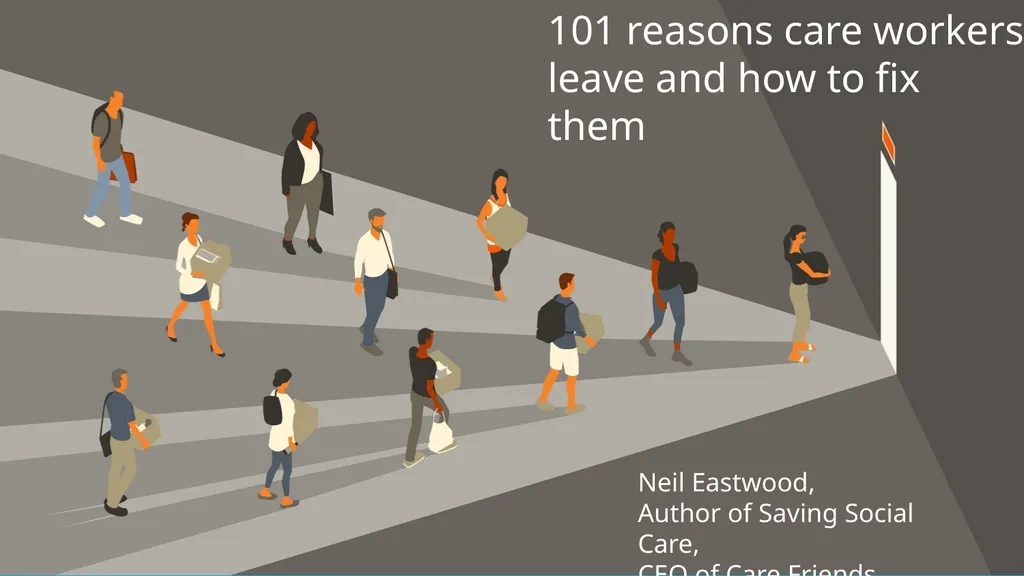
101 reasons care workers leave and how to fix them
Description: 101 reasons care workers leave and how to fix them Neil Eastwood, Author of Saving Social Care, CEO of Care Friends The Goal Todays Agenda 1970s: Vicarage upbringing 2009: How can we fix our 97 homecare annual staff turnover? 2017:
Related Topics
Download Presentation
"101 reasons care workers leave and how to fix them" is the property of its rightful owner. Permission is granted to download and print the materials on this website for personal, non-commercial use only, and to display it on your personal computer provided you do not modify the materials and that you retain all copyright notices contained in the materials. By downloading content from our website, you accept the terms of this agreement.
Presentation Transcript
slide1. 101 reasons care workers leave and how to fix them Neil Eastwood,
Author of Saving Social Care,
CEO of Care Friends<br>
slide2. The Goal<br>
slide3. Today’s Agenda<br>
slide4. 1970’s: Vicarage upbringing
2009: How can we fix our 97% homecare annual staff turnover?
2017: Saving Social Care published
2020: Care Friends launched
2023: 2nd Edition Saving Social Care How did I get here?<br>
slide5. The state of social care in Somerset<br>
slide6. >>Prior or current rural residence
is the strongest predictor of choice of or staying in a rural care role Rural recruitment and retention Most significant impediment to staying, being:
>>a partner who was not committed to rural life<br>
slide7. As base pay rises so the wage premium for experienced and qualified staff gets squeezed 5+ years care experience = 6p/hour<br>
slide8. More financial pressure<br>
slide9. What is causing Somerset care workers to leave? Negative perceptions of both paid care and rural work life Infrastructure gaps – housing, telecoms Small applicant pools - challenges of attracting quality candidates Long-term under-funding, with rising demand for services The rapid decline in sponsored workers Demographic profile – ageing workforce and population<br>
slide10. Figuring out why staff leave is a puzzle. But there is a way.<br>
slide11. There are 101 potential reasons for voluntary turnover Age (e.g. retiring, car insurance costs due to age, age-related factors)
Education - want to study
Race - (e.g. poor treatment due to race from colleagues or clients)
Marital status (spousal or family pressure)
Gender
Personality and personal goals not matching with the role
Poor workplace attitude/behaviour
Lack of motivation for the role
Dissatisfaction with pay and benefits
Previous experience in the sector or role
Low intrinsic satisfaction with the role/boredom
Skills and experience too high or low
Family obligations/childcare challenges
Transport issues - cost/reliability/access
Health, illness or family illness/bereavement
Second job/conflict with another job
Conflict with benefits payments
Career needs
Work/life balance
Employment and life history
Distance from work/travel time/travel cost
Household income - financial vulnerability
Perceptions of their own employability
Lack of pride in the role
Poor interpersonal skills
Beliefs and values not aligning with the work
Confidence they can get another role easily
Mental health challenges
Number of sickness days
Social care qualification - have or not have
International sponsored worker or not
Emotional maturity/lack of Promises not kept (e.g. pay, hours)
Time to hire too long
Relationship with recruiter poor
Interview experience
Hours and contract type not suitable
Unrealistic expectations - information about the nature of the job
Selection effectiveness
Frequency and timeliness of communication poor Training adequacy
Level of personal responsibility
Isolation/loneliness
Quality of orientation and information
Communication - knowing what is going on
No sense of belonging - welcome from colleague
Levels of support from peers, admin staff, management Duration in the job
Task variety
equipment problems
Shift patterns
Poor rostering - scheduling, late or changing roster
Unsafe neighbourhoods or buildings
Appreciation or lack of
Recognition or lack of
job security/zero hour contracts
lack of opportunity for advancement
size of facility and organisation
span of control and responsibility
workload/contracted hours and staffing levels - too few or too many hours
autonomy and flexibility perceived ability to do a good job
pay and benefits
pension enhanced or basic
sick pay enhanced or basic
work injuries
physical setting/environment
availability of technology which impacts the job role
company ownership status - not for profit vs for profit
lack of organisational support (e.g. mental health)
Ongoing availability and quality of training
Perceived workplace risk
physical stress/demands
Emotional stress - Trauma - grief processing
Perceived attractiveness of substitute employment options
Location - accessibility Unsocial hours/nature of the work
Media image and public perception/distastefulness of the role
Local labour market conditions
Economy
Commissioning practices
Immigration policy
societal changes - expectations, employer loyalty problems with client or client's family behaviour
supervisor relationship quality - level of respect and decision participation level
poor culture and leadership
emotional connection with the work/employer
poor or limited communication/feedback
perceived trust and fairness by management
client relationship quality - time for companionship vs tasks
levels of manager stress
manager turnover
socially distressing situations
No group problem solving
Low worker choice in the workplace
visibility and approachability of manage
historical turnover rate supervisor/manager supportiveness/personal relationships/empathy
Client bond broken (e.g. RIP)
strength of relationship/conflict levels with colleagues
lack of support from care worker's family and friends/no support structure<br>
slide12. Recruitment Onboarding Employment Employee conveyor belt:
Generates different reasons to leave at different times Intent to leave can be high even if turnover is low
(as we saw during Covid) 05 01 02 03 04 06 Backstory<br>
slide13. Just six categories cover pretty much all 101 reasons FIRST IMPRESSIONS THE WORK EXPERIENCE To do with relationships, culture and engagement To do with the onboarding process To do with the recruitment process To do with organisational and operational experience and role To do with the individual To do with external factors DEMOGRAPHIC / INDIVIDUAL Age (e.g. retiring, car insurance costs due to age, age-related factors)
Education - want to study
Race - (e.g. poor treatment due to race from colleagues or clients)
Marital status (spousal or family pressure)
Gender
Personality and personal goals not matching with the role
Poor workplace attitude/behaviour
Lack of motivation for the role
Dissatisfaction with pay and benefits
Previous experience in the sector or role
Low intrinsic satisfaction with the role/boredom
Skills and experience too high or low
Family obligations/childcare challenges
Transport issues - cost/reliability/access
Health, illness or family illness/bereavement
Second job/conflict with another job
Conflict with benefits payments
Career needs
Work/life balance
Employment and life history
Distance from work/travel time/travel cost
Household income - financial vulnerability
Perceptions of their own employability
Lack of pride in the role
Poor interpersonal skills
Beliefs and values not aligning with the work
Confidence they can get another role easily
Mental health challenges
Number of sickness days
Social care qualification - have or not have
International sponsored worker or not
Emotional maturity/lack of Promises not kept (e.g. pay, hours)
Time to hire too long
Relationship with recruiter poor
Interview experience
Hours and contract type not suitable
Unrealistic expectations - information about the nature of the job
Selection effectiveness
Frequency and timeliness of communication poor Training adequacy
Level of personal responsibility
Isolation/loneliness
Quality of orientation and information
Communication - knowing what is going on
No sense of belonging - welcome from colleague
Levels of support from peers, admin staff, management Duration in the job
Task variety
equipment problems
Shift patterns
Poor rostering - scheduling, late or changing roster
Unsafe neighbourhoods or buildings
Appreciation or lack of
Recognition or lack of
job security/zero hour contracts
lack of opportunity for advancement
size of facility and organisation
span of control and responsibility
workload/contracted hours and staffing levels - too few or too many hours
autonomy and flexibility perceived ability to do a good job
pay and benefits
pension enhanced or basic
sick pay enhanced or basic
work injuries
physical setting/environment
availability of technology which impacts the job role
company ownership status - not for profit vs for profit
lack of organisational support (e.g. mental health)
Ongoing availability and quality of training
Perceived workplace risk
physical stress/demands
Emotional stress - Trauma - grief processing
Perceived attractiveness of substitute employment options
Location - accessibility Unsocial hours/nature of the work
Media image and public perception/distastefulness of the role
Local labour market conditions
Economy
Commissioning practices
Immigration policy
societal changes - expectations, employer loyalty problems with client or client's family behaviour
supervisor relationship quality - level of respect and decision participation level
poor culture and leadership
emotional connection with the work/employer
poor or limited communication/feedback
perceived trust and fairness by management
client relationship quality - time for companionship vs tasks
levels of manager stress
manager turnover
socially distressing situations
No group problem solving
Low worker choice in the workplace
visibility and approachability of manage
historical turnover rate supervisor/manager supportiveness/personal relationships/empathy
Client bond broken (e.g. RIP)
strength of relationship/conflict levels with colleagues
lack of support from care worker's family and friends/no support structure<br>
slide14. My personal experience:
Branch turnover ranged from 20% - 178%<br>
slide15. Pay Culture/ Leadership style Who you hire Government Policy Shift patterns/
flexibility Alternative employment choices Focus on what you can control Some reasons are more controllable than others Very controllable Out of your control The Economy<br>
slide16. 1. Focus your recruiting efforts on supply lines of mature’ workers with the right values 2. Develop better ways of screening potential employees and improve the candidate experience 3. Improve the welcome and invest in training and develop career tracks 4. Develop opportunities for advancement and an organisational support system 5. Use wage differentials, expanded benefits and visible status symbols 6. Develop a culture of compassionate leadership There are also many proven retention strategies.
Here are seven of my favourites: 7. Regular and timely appreciation 05 01 02 03 04 06 To do with relationships, culture and engagement To do with the onboarding process To do with the recruitment process To do with organisational and operational experience and role To do with the individual To do with external factors N/A<br>
slide17. 1. Focus your recruiting efforts on ‘mature’ workers with the right values 2. Develop better ways of screening potential employees and improve the candidate experience 01 02 To do with the recruitment process To do with the individual 3. Improve the welcome and invest in training and develop career tracks 4. Develop opportunities for advancement and an organisational support system 5. Use wage differentials, expanded benefits and visible status symbols 6. Develop a culture of compassionate leadership 7. Regular and timely appreciation 05 03 04 06 To do with relationships, culture and engagement To do with the onboarding process To do with organisational and operational expereince and role To do with external factors Recommendation: Recruit more carefully N/A<br>
slide18. FIRST IMPRESSIONS To do with the onboarding process To do with the recruitment process To do with the individual DEMOGRAPHIC / INDIVIDUAL THE WORK EXPERIENCE To do with relationships, culture and engagement To do with organisational and operational experience and role To do with external factors Example:
Values-based recruitment reduces the risk of up to 45 reasons Age (e.g. retiring, car insurance costs due to age, age-related factors)
Education - want to study
Race - (e.g. poor treatment due to race from colleagues or clients)
Marital status (spousal or family pressure)
Gender
Personality and personal goals not matching with the role
Poor workplace attitude/behaviour
Lack of motivation for the role
Dissatisfaction with pay and benefits
Previous experience in the sector or role
Low intrinsic satisfaction with the role/boredom
Skills and experience too high or low
Family obligations/childcare challenges
Transport issues - cost/reliability/access
Health, illness or family illness/bereavement
Second job/conflict with another job
Conflict with benefits payments
Career needs
Work/life balance
Employment and life history
Distance from work/travel time/travel cost
Household income - financial vulnerability
Perceptions of their own employability
Lack of pride in the role
Poor interpersonal skills
Beliefs and values not aligning with the work
Confidence they can get another role easily
Mental health challenges
Number of sickness days
Social care qualification - have or not have
International sponsored worker or not
Emotional maturity/lack of Promises not kept (e.g. pay, hours)
Time to hire too long
Relationship with recruiter poor
Interview experience
Hours and contract type not suitable
Unrealistic expectations - information about the nature of the job
Selection effectiveness
Frequency and timeliness of communication poor Training adequacy
Level of personal responsibility
Isolation/loneliness
Quality of orientation and information
Communication - knowing what is going on
Sense of belonging - welcome from colleague
Levels of support from peers, admin staff, management Duration in the job
Task variety
equipment problems
Shift patterns
Poor rostering - scheduling, late or changing roster
Unsafe neighbourhoods or buildings
Appreciation or lack of
Recognition or lack of
job security/zero hour contracts
lack of opportunity for advancement
size of facility and organisation
span of control and responsibility
workload/contracted hours and staffing levels - too few or too many hours
autonomy and flexibility perceived ability to do a good job
pay and benefits
pension enhanced or basic
sick pay enhanced or basic
work injuries
physical setting/environment
availability of technology which impacts the job role
company ownership status - not for profit vs for profit
lack of organisational support (e.g. mental health)
Ongoing availability and quality of training
Perceived workplace risk
physical stress/demands
Emotional stress - Trauma - grief processing
Perceived attractiveness of substitute employment options
Location - accessibility Unsocial hours/nature of the work
Media image and public perception/distastefulness of the role
Local labour market conditions
Economy
Commissioning practices
Immigration policy
societal changes - expectations, employer loyalty problems with client or client's family behaviour
supervisor relationship quality - level of respect and decision participation level
poor culture and leadership
emotional connection with the work/employer
poor or limited communication/feedback
perceived trust and fairness by management
client relationship quality - time for companionship vs tasks
levels of manager stress
manager turnover
socially distressing situations
No group problem solving
Low worker choice in the workplace
visibility and approachability of manager
historical turnover rate supervisor/manager supportiveness/personal relationships/empathy
Client bond broken (e.g. RIP)
strength of relationship/conflict levels with colleagues
lack of support from care worker's family and friends/no support structure<br>
slide19. How well do we sell a paid care role?<br>
slide20. What was your occupation before you became a care worker? Source: DHSC 2018 N=3000 Govt target<br>
slide21. High performers:
What was the trigger for you to become a care worker? Source: Neil Eastwood’s recruitment masterclasses 2015-2019 N=287<br>
slide22. It is not rational to be a care worker considering the alternatives.
So, what keeps them?<br>
slide23. 1 The hidden psychological pull of care work Commitment to, responsibility for the client Surrogate family,
personal connection or bond Emotional satisfaction, pride, self-esteem Religious or spiritual ‘calling’ to care Influenced by: Mittal, Rosen & Leana 2009<br>
slide24. 24 Hyper-local Recruitment<br>
slide25. 25 What is hyper-local recruitment? Recruiting within the local community, (<6 km of where the care is delivered)
Time can matter more than distance
Internet job boards default to 8X this range, so not them!
Targeting passive applicants is key<br>
slide26. Getting hyper-local: Start at your workplace<br>
slide27. 27 Why hyper-local recruitment? Candidates can have shared experiences with those receiving care
Less commuting
Retention likely to be higher
‘Giving back’
Reaches those not actively job seeking
Much much less competition
Vetting is easier<br>
slide28. Your potential candidate pool is much deeper than it appears Active job seekers
(Internet job boards, CV search, recruitment fairs…) The personal connections of your workforce Ex-employees and their networks Unpaid carers Community leaders Outreach – online and offline Life stage changers – newcomers, retirees, children growing up Partner organisations and their supporters Cause-related charities and their supporters<br>
slide29. Diversify your recruitment channels<br>
slide30. 30 Map your recruitment hinterland https://www.google.com.au/maps/about/mymaps/<br>
slide31. Community outreach – lots of help waiting! Unpaid carer groups
Cause-related organisations
Community events
Domestic violence refuges
Universities
Hospices
Military bases<br>
slide32. Local recruitment initiatives<br>
slide33. Photo by Meelan Bawjee on Unsplash Operation Chip Shop<br>
slide34. 34 Look for local changes Photo by Josh Olalde on Unsplash Newcomers who need work?
Businesses closing or relocating?<br>
slide35. 35 85% of employee referrals live locally<br>
slide36. Care Friends
An app enabling and rewarding your workforce to be successful recruiters<br>
slide37. MMM classifications (1 through 7)
MMM 1: metro
MMM 2: regional
MMM 3-5 rural
MMM 6&7 remote The performance of the Care Friends app by location classification<br>
slide38. Recruitment processes are often self-harming Active job seeker focus Prefer automated and process-driven approach
Email comms
CV-centric
Domination of job boards Local Central<br>
slide39. 3. Improve the welcome and invest in training and develop career tracks 03 To do with the onboarding process To do with organisational and operational experience and role Recommendation:
Strong welcome and clear opportunities for advancement 1. Focus your recruiting efforts on ‘mature’ workers with the right values 2. Develop better ways of screening potential employees and improve the candidate experience 4. Develop opportunities for advancement and an organisational support system 5. Use wage differentials, expanded benefits and visible status symbols 6. Develop a culture of compassionate leadership 7. Regular and timely appreciation 05 01 02 04 06 To do with relationships, culture and engagement To do with the recruitment process To do with the individual To do with external factors<br>
slide40. Photo by Aaron Burden on Unsplash Introduce a Welcome Programme use named welcome signage
goody bag – fleece, merch…
personal welcome from the boss
peer mentoring
book in a future training commitment
day 1 wrap-up chat
‘stay’ interviews<br>
slide42. More training opportunities = lower turnover Care worker turnover rate by number of training instances between March 2023 and March 2024 Source: Skills for Care State of the adult social care sector 2024 chart 118<br>
slide43. Dissatisfaction with opportunities for advancement is often second only to dissatisfaction with pay Develop two promotion tracks: Structured opportunities for advancement along two tracks ‘Managerial’ ‘Clinical’<br>
slide44. 3. Improve the welcome and invest in training and develop career tracks 03 To do with the onboarding process To do with organisational and operational expereince and role Recommendation:
work on your culture and become a local employer of choice 1. Focus your recruiting efforts on ‘mature’ workers with the right values 2. Develop better ways of screening potential employees and improve the candidate experience 4. Develop opportunities for advancement and an organisational support system 5. Use wage differentials, expanded benefits and visible status symbols 6. Develop a culture of compassionate leadership 7. Regular and timely appreciation 05 01 02 04 06 To do with relationships, culture and engagement To do with the recruitment process To do with the individual To do with external factors<br>
slide45. Supervisory staff should be mandated to congratulate care workers publicly for good care - and record it – daily.
Don’t stop there. Send a note or letter if a care worker performs in an outstanding way. Embed informal appreciation<br>
slide46. Strengthen the four key relationships<br>
slide47. How many care workers said they left their last employer due to a poor workplace culture? Source: Skills for Care 2023 47% 42% 21% 10% Age<br>
slide48. The impact of leadership styles
From a survey of 2,900 US Nursing Homes Registered Managers who are consensus managers = lowest staff turnover levels Source: The Gerontologist 2009 Donoghue and Castle Photo by Jason Hafso on Unsplash 31%
of all managers<br>
slide49. ‘Shareholder managers’ are associated with the highest turnover levels, avg 168% Source: The Gerontologist 2009 Donoghue and Castle 14%
of all managers<br>
slide50. Shift-swapping and self-rostering
Compressed shifts (9-day fortnights)
Fixed vs rotating shifts Offer more choice & flexibility<br>
slide51. Photo by Tabea Schimpf on Unsplash My Recommendations Sell the role’s intrinsic rewards to those who are most receptive
Diversify your sourcing to include personal networks
Prioritise close connections and unpaid care experience
Focus on retention interventions you can control
Strengthen the worker’s relationships
Be an employer of choice<br>
slide52. neil@carefriends.co.uk
07766 496589 Questions?<br>
Author of Saving Social Care,
CEO of Care Friends<br>
slide2. The Goal<br>
slide3. Today’s Agenda<br>
slide4. 1970’s: Vicarage upbringing
2009: How can we fix our 97% homecare annual staff turnover?
2017: Saving Social Care published
2020: Care Friends launched
2023: 2nd Edition Saving Social Care How did I get here?<br>
slide5. The state of social care in Somerset<br>
slide6. >>Prior or current rural residence
is the strongest predictor of choice of or staying in a rural care role Rural recruitment and retention Most significant impediment to staying, being:
>>a partner who was not committed to rural life<br>
slide7. As base pay rises so the wage premium for experienced and qualified staff gets squeezed 5+ years care experience = 6p/hour<br>
slide8. More financial pressure<br>
slide9. What is causing Somerset care workers to leave? Negative perceptions of both paid care and rural work life Infrastructure gaps – housing, telecoms Small applicant pools - challenges of attracting quality candidates Long-term under-funding, with rising demand for services The rapid decline in sponsored workers Demographic profile – ageing workforce and population<br>
slide10. Figuring out why staff leave is a puzzle. But there is a way.<br>
slide11. There are 101 potential reasons for voluntary turnover Age (e.g. retiring, car insurance costs due to age, age-related factors)
Education - want to study
Race - (e.g. poor treatment due to race from colleagues or clients)
Marital status (spousal or family pressure)
Gender
Personality and personal goals not matching with the role
Poor workplace attitude/behaviour
Lack of motivation for the role
Dissatisfaction with pay and benefits
Previous experience in the sector or role
Low intrinsic satisfaction with the role/boredom
Skills and experience too high or low
Family obligations/childcare challenges
Transport issues - cost/reliability/access
Health, illness or family illness/bereavement
Second job/conflict with another job
Conflict with benefits payments
Career needs
Work/life balance
Employment and life history
Distance from work/travel time/travel cost
Household income - financial vulnerability
Perceptions of their own employability
Lack of pride in the role
Poor interpersonal skills
Beliefs and values not aligning with the work
Confidence they can get another role easily
Mental health challenges
Number of sickness days
Social care qualification - have or not have
International sponsored worker or not
Emotional maturity/lack of Promises not kept (e.g. pay, hours)
Time to hire too long
Relationship with recruiter poor
Interview experience
Hours and contract type not suitable
Unrealistic expectations - information about the nature of the job
Selection effectiveness
Frequency and timeliness of communication poor Training adequacy
Level of personal responsibility
Isolation/loneliness
Quality of orientation and information
Communication - knowing what is going on
No sense of belonging - welcome from colleague
Levels of support from peers, admin staff, management Duration in the job
Task variety
equipment problems
Shift patterns
Poor rostering - scheduling, late or changing roster
Unsafe neighbourhoods or buildings
Appreciation or lack of
Recognition or lack of
job security/zero hour contracts
lack of opportunity for advancement
size of facility and organisation
span of control and responsibility
workload/contracted hours and staffing levels - too few or too many hours
autonomy and flexibility perceived ability to do a good job
pay and benefits
pension enhanced or basic
sick pay enhanced or basic
work injuries
physical setting/environment
availability of technology which impacts the job role
company ownership status - not for profit vs for profit
lack of organisational support (e.g. mental health)
Ongoing availability and quality of training
Perceived workplace risk
physical stress/demands
Emotional stress - Trauma - grief processing
Perceived attractiveness of substitute employment options
Location - accessibility Unsocial hours/nature of the work
Media image and public perception/distastefulness of the role
Local labour market conditions
Economy
Commissioning practices
Immigration policy
societal changes - expectations, employer loyalty problems with client or client's family behaviour
supervisor relationship quality - level of respect and decision participation level
poor culture and leadership
emotional connection with the work/employer
poor or limited communication/feedback
perceived trust and fairness by management
client relationship quality - time for companionship vs tasks
levels of manager stress
manager turnover
socially distressing situations
No group problem solving
Low worker choice in the workplace
visibility and approachability of manage
historical turnover rate supervisor/manager supportiveness/personal relationships/empathy
Client bond broken (e.g. RIP)
strength of relationship/conflict levels with colleagues
lack of support from care worker's family and friends/no support structure<br>
slide12. Recruitment Onboarding Employment Employee conveyor belt:
Generates different reasons to leave at different times Intent to leave can be high even if turnover is low
(as we saw during Covid) 05 01 02 03 04 06 Backstory<br>
slide13. Just six categories cover pretty much all 101 reasons FIRST IMPRESSIONS THE WORK EXPERIENCE To do with relationships, culture and engagement To do with the onboarding process To do with the recruitment process To do with organisational and operational experience and role To do with the individual To do with external factors DEMOGRAPHIC / INDIVIDUAL Age (e.g. retiring, car insurance costs due to age, age-related factors)
Education - want to study
Race - (e.g. poor treatment due to race from colleagues or clients)
Marital status (spousal or family pressure)
Gender
Personality and personal goals not matching with the role
Poor workplace attitude/behaviour
Lack of motivation for the role
Dissatisfaction with pay and benefits
Previous experience in the sector or role
Low intrinsic satisfaction with the role/boredom
Skills and experience too high or low
Family obligations/childcare challenges
Transport issues - cost/reliability/access
Health, illness or family illness/bereavement
Second job/conflict with another job
Conflict with benefits payments
Career needs
Work/life balance
Employment and life history
Distance from work/travel time/travel cost
Household income - financial vulnerability
Perceptions of their own employability
Lack of pride in the role
Poor interpersonal skills
Beliefs and values not aligning with the work
Confidence they can get another role easily
Mental health challenges
Number of sickness days
Social care qualification - have or not have
International sponsored worker or not
Emotional maturity/lack of Promises not kept (e.g. pay, hours)
Time to hire too long
Relationship with recruiter poor
Interview experience
Hours and contract type not suitable
Unrealistic expectations - information about the nature of the job
Selection effectiveness
Frequency and timeliness of communication poor Training adequacy
Level of personal responsibility
Isolation/loneliness
Quality of orientation and information
Communication - knowing what is going on
No sense of belonging - welcome from colleague
Levels of support from peers, admin staff, management Duration in the job
Task variety
equipment problems
Shift patterns
Poor rostering - scheduling, late or changing roster
Unsafe neighbourhoods or buildings
Appreciation or lack of
Recognition or lack of
job security/zero hour contracts
lack of opportunity for advancement
size of facility and organisation
span of control and responsibility
workload/contracted hours and staffing levels - too few or too many hours
autonomy and flexibility perceived ability to do a good job
pay and benefits
pension enhanced or basic
sick pay enhanced or basic
work injuries
physical setting/environment
availability of technology which impacts the job role
company ownership status - not for profit vs for profit
lack of organisational support (e.g. mental health)
Ongoing availability and quality of training
Perceived workplace risk
physical stress/demands
Emotional stress - Trauma - grief processing
Perceived attractiveness of substitute employment options
Location - accessibility Unsocial hours/nature of the work
Media image and public perception/distastefulness of the role
Local labour market conditions
Economy
Commissioning practices
Immigration policy
societal changes - expectations, employer loyalty problems with client or client's family behaviour
supervisor relationship quality - level of respect and decision participation level
poor culture and leadership
emotional connection with the work/employer
poor or limited communication/feedback
perceived trust and fairness by management
client relationship quality - time for companionship vs tasks
levels of manager stress
manager turnover
socially distressing situations
No group problem solving
Low worker choice in the workplace
visibility and approachability of manage
historical turnover rate supervisor/manager supportiveness/personal relationships/empathy
Client bond broken (e.g. RIP)
strength of relationship/conflict levels with colleagues
lack of support from care worker's family and friends/no support structure<br>
slide14. My personal experience:
Branch turnover ranged from 20% - 178%<br>
slide15. Pay Culture/ Leadership style Who you hire Government Policy Shift patterns/
flexibility Alternative employment choices Focus on what you can control Some reasons are more controllable than others Very controllable Out of your control The Economy<br>
slide16. 1. Focus your recruiting efforts on supply lines of mature’ workers with the right values 2. Develop better ways of screening potential employees and improve the candidate experience 3. Improve the welcome and invest in training and develop career tracks 4. Develop opportunities for advancement and an organisational support system 5. Use wage differentials, expanded benefits and visible status symbols 6. Develop a culture of compassionate leadership There are also many proven retention strategies.
Here are seven of my favourites: 7. Regular and timely appreciation 05 01 02 03 04 06 To do with relationships, culture and engagement To do with the onboarding process To do with the recruitment process To do with organisational and operational experience and role To do with the individual To do with external factors N/A<br>
slide17. 1. Focus your recruiting efforts on ‘mature’ workers with the right values 2. Develop better ways of screening potential employees and improve the candidate experience 01 02 To do with the recruitment process To do with the individual 3. Improve the welcome and invest in training and develop career tracks 4. Develop opportunities for advancement and an organisational support system 5. Use wage differentials, expanded benefits and visible status symbols 6. Develop a culture of compassionate leadership 7. Regular and timely appreciation 05 03 04 06 To do with relationships, culture and engagement To do with the onboarding process To do with organisational and operational expereince and role To do with external factors Recommendation: Recruit more carefully N/A<br>
slide18. FIRST IMPRESSIONS To do with the onboarding process To do with the recruitment process To do with the individual DEMOGRAPHIC / INDIVIDUAL THE WORK EXPERIENCE To do with relationships, culture and engagement To do with organisational and operational experience and role To do with external factors Example:
Values-based recruitment reduces the risk of up to 45 reasons Age (e.g. retiring, car insurance costs due to age, age-related factors)
Education - want to study
Race - (e.g. poor treatment due to race from colleagues or clients)
Marital status (spousal or family pressure)
Gender
Personality and personal goals not matching with the role
Poor workplace attitude/behaviour
Lack of motivation for the role
Dissatisfaction with pay and benefits
Previous experience in the sector or role
Low intrinsic satisfaction with the role/boredom
Skills and experience too high or low
Family obligations/childcare challenges
Transport issues - cost/reliability/access
Health, illness or family illness/bereavement
Second job/conflict with another job
Conflict with benefits payments
Career needs
Work/life balance
Employment and life history
Distance from work/travel time/travel cost
Household income - financial vulnerability
Perceptions of their own employability
Lack of pride in the role
Poor interpersonal skills
Beliefs and values not aligning with the work
Confidence they can get another role easily
Mental health challenges
Number of sickness days
Social care qualification - have or not have
International sponsored worker or not
Emotional maturity/lack of Promises not kept (e.g. pay, hours)
Time to hire too long
Relationship with recruiter poor
Interview experience
Hours and contract type not suitable
Unrealistic expectations - information about the nature of the job
Selection effectiveness
Frequency and timeliness of communication poor Training adequacy
Level of personal responsibility
Isolation/loneliness
Quality of orientation and information
Communication - knowing what is going on
Sense of belonging - welcome from colleague
Levels of support from peers, admin staff, management Duration in the job
Task variety
equipment problems
Shift patterns
Poor rostering - scheduling, late or changing roster
Unsafe neighbourhoods or buildings
Appreciation or lack of
Recognition or lack of
job security/zero hour contracts
lack of opportunity for advancement
size of facility and organisation
span of control and responsibility
workload/contracted hours and staffing levels - too few or too many hours
autonomy and flexibility perceived ability to do a good job
pay and benefits
pension enhanced or basic
sick pay enhanced or basic
work injuries
physical setting/environment
availability of technology which impacts the job role
company ownership status - not for profit vs for profit
lack of organisational support (e.g. mental health)
Ongoing availability and quality of training
Perceived workplace risk
physical stress/demands
Emotional stress - Trauma - grief processing
Perceived attractiveness of substitute employment options
Location - accessibility Unsocial hours/nature of the work
Media image and public perception/distastefulness of the role
Local labour market conditions
Economy
Commissioning practices
Immigration policy
societal changes - expectations, employer loyalty problems with client or client's family behaviour
supervisor relationship quality - level of respect and decision participation level
poor culture and leadership
emotional connection with the work/employer
poor or limited communication/feedback
perceived trust and fairness by management
client relationship quality - time for companionship vs tasks
levels of manager stress
manager turnover
socially distressing situations
No group problem solving
Low worker choice in the workplace
visibility and approachability of manager
historical turnover rate supervisor/manager supportiveness/personal relationships/empathy
Client bond broken (e.g. RIP)
strength of relationship/conflict levels with colleagues
lack of support from care worker's family and friends/no support structure<br>
slide19. How well do we sell a paid care role?<br>
slide20. What was your occupation before you became a care worker? Source: DHSC 2018 N=3000 Govt target<br>
slide21. High performers:
What was the trigger for you to become a care worker? Source: Neil Eastwood’s recruitment masterclasses 2015-2019 N=287<br>
slide22. It is not rational to be a care worker considering the alternatives.
So, what keeps them?<br>
slide23. 1 The hidden psychological pull of care work Commitment to, responsibility for the client Surrogate family,
personal connection or bond Emotional satisfaction, pride, self-esteem Religious or spiritual ‘calling’ to care Influenced by: Mittal, Rosen & Leana 2009<br>
slide24. 24 Hyper-local Recruitment<br>
slide25. 25 What is hyper-local recruitment? Recruiting within the local community, (<6 km of where the care is delivered)
Time can matter more than distance
Internet job boards default to 8X this range, so not them!
Targeting passive applicants is key<br>
slide26. Getting hyper-local: Start at your workplace<br>
slide27. 27 Why hyper-local recruitment? Candidates can have shared experiences with those receiving care
Less commuting
Retention likely to be higher
‘Giving back’
Reaches those not actively job seeking
Much much less competition
Vetting is easier<br>
slide28. Your potential candidate pool is much deeper than it appears Active job seekers
(Internet job boards, CV search, recruitment fairs…) The personal connections of your workforce Ex-employees and their networks Unpaid carers Community leaders Outreach – online and offline Life stage changers – newcomers, retirees, children growing up Partner organisations and their supporters Cause-related charities and their supporters<br>
slide29. Diversify your recruitment channels<br>
slide30. 30 Map your recruitment hinterland https://www.google.com.au/maps/about/mymaps/<br>
slide31. Community outreach – lots of help waiting! Unpaid carer groups
Cause-related organisations
Community events
Domestic violence refuges
Universities
Hospices
Military bases<br>
slide32. Local recruitment initiatives<br>
slide33. Photo by Meelan Bawjee on Unsplash Operation Chip Shop<br>
slide34. 34 Look for local changes Photo by Josh Olalde on Unsplash Newcomers who need work?
Businesses closing or relocating?<br>
slide35. 35 85% of employee referrals live locally<br>
slide36. Care Friends
An app enabling and rewarding your workforce to be successful recruiters<br>
slide37. MMM classifications (1 through 7)
MMM 1: metro
MMM 2: regional
MMM 3-5 rural
MMM 6&7 remote The performance of the Care Friends app by location classification<br>
slide38. Recruitment processes are often self-harming Active job seeker focus Prefer automated and process-driven approach
Email comms
CV-centric
Domination of job boards Local Central<br>
slide39. 3. Improve the welcome and invest in training and develop career tracks 03 To do with the onboarding process To do with organisational and operational experience and role Recommendation:
Strong welcome and clear opportunities for advancement 1. Focus your recruiting efforts on ‘mature’ workers with the right values 2. Develop better ways of screening potential employees and improve the candidate experience 4. Develop opportunities for advancement and an organisational support system 5. Use wage differentials, expanded benefits and visible status symbols 6. Develop a culture of compassionate leadership 7. Regular and timely appreciation 05 01 02 04 06 To do with relationships, culture and engagement To do with the recruitment process To do with the individual To do with external factors<br>
slide40. Photo by Aaron Burden on Unsplash Introduce a Welcome Programme use named welcome signage
goody bag – fleece, merch…
personal welcome from the boss
peer mentoring
book in a future training commitment
day 1 wrap-up chat
‘stay’ interviews<br>
slide42. More training opportunities = lower turnover Care worker turnover rate by number of training instances between March 2023 and March 2024 Source: Skills for Care State of the adult social care sector 2024 chart 118<br>
slide43. Dissatisfaction with opportunities for advancement is often second only to dissatisfaction with pay Develop two promotion tracks: Structured opportunities for advancement along two tracks ‘Managerial’ ‘Clinical’<br>
slide44. 3. Improve the welcome and invest in training and develop career tracks 03 To do with the onboarding process To do with organisational and operational expereince and role Recommendation:
work on your culture and become a local employer of choice 1. Focus your recruiting efforts on ‘mature’ workers with the right values 2. Develop better ways of screening potential employees and improve the candidate experience 4. Develop opportunities for advancement and an organisational support system 5. Use wage differentials, expanded benefits and visible status symbols 6. Develop a culture of compassionate leadership 7. Regular and timely appreciation 05 01 02 04 06 To do with relationships, culture and engagement To do with the recruitment process To do with the individual To do with external factors<br>
slide45. Supervisory staff should be mandated to congratulate care workers publicly for good care - and record it – daily.
Don’t stop there. Send a note or letter if a care worker performs in an outstanding way. Embed informal appreciation<br>
slide46. Strengthen the four key relationships<br>
slide47. How many care workers said they left their last employer due to a poor workplace culture? Source: Skills for Care 2023 47% 42% 21% 10% Age<br>
slide48. The impact of leadership styles
From a survey of 2,900 US Nursing Homes Registered Managers who are consensus managers = lowest staff turnover levels Source: The Gerontologist 2009 Donoghue and Castle Photo by Jason Hafso on Unsplash 31%
of all managers<br>
slide49. ‘Shareholder managers’ are associated with the highest turnover levels, avg 168% Source: The Gerontologist 2009 Donoghue and Castle 14%
of all managers<br>
slide50. Shift-swapping and self-rostering
Compressed shifts (9-day fortnights)
Fixed vs rotating shifts Offer more choice & flexibility<br>
slide51. Photo by Tabea Schimpf on Unsplash My Recommendations Sell the role’s intrinsic rewards to those who are most receptive
Diversify your sourcing to include personal networks
Prioritise close connections and unpaid care experience
Focus on retention interventions you can control
Strengthen the worker’s relationships
Be an employer of choice<br>
slide52. neil@carefriends.co.uk
07766 496589 Questions?<br>